66.1 F
Chicago
Saturday, September 26, 2026
Home Blog Page 2480

Sweden Calls On NATO To Focus On China To Placate Trump

Sweden Calls On NATO To Focus On China To Placate Trump

Authored by Kyle Anzalone via The Libertarian Institute,

As members of the North Atlantic Alliance gather in Washington DC to celebrate the pact’s 75th year, Sweden is calling on the alliance to shift some of its attention to China. Stockholm argues this will align the bloc more with former US President Donald Trump’s policies. 

On Tuesday, Swedish Foreign Minister Tobias Billstrom explained that the alliance should reorient some of its military assets towards Asia to confront Beijing. “If you want your partner to think about the things you think are a problem, you have to show commitment to their problems, and the American people are more concerned with the threat that China poses than Russia, for obvious reasons,” he explained.

Swedish Foreign Minister Tobias Billstrom, Anadolu Agency

Billstrom added the bloc will keep fighting Russia in Ukraine but China “should also be recognized as part of NATO’s concerns, [and] headache.“

The shift towards confronting Beijing would put Brussels more in line with the world view of Trump, who many believe will likely win November’s election after President Joe Biden’s recent poor debate performance. 

Some European leaders and NATO officials have feared that if Trump returns to the Oval Office, he will end US support for the proxy war in Ukraine or remove America from the alliance. Billstrom admitted that without Washington’s membership, NATO would be “unthinkable” and lack credibility.

It is unclear how the bloc would find the resources to confront China in the Indo-Pacific. Members of the alliance are struggling to provide Ukrainian soldiers with the arms they need to hold off Russian forces. Additionally, a NATO official recently explained that the bloc is 35-50 brigades short of being able to execute its battle plans should war with Russia break out in Europe. 

The focus on China is the latest effort by the bloc to “Trump-proof” US support for Ukraine should the 45th president win reelection. Past efforts to lock the American taxpayers into a decade-long scheme to fund Kiev with tens of billions of dollars annually failed to materialize. 

The concern over a second Trump presidency may be misguided. During his first term, Trump oversaw the expansion of NATO and began shipping arms to Ukraine. 

American political figures who operate near Trump say his main concern is getting alliance members to spend more on weapons and war. Currently, the US military budget accounts for 68% of the bloc’s defense spending, at least ten times greater than second-highest spender Germany. 

Tyler Durden
Thu, 07/11/2024 – 06:30

House Oversight Subpoenas Top Biden Handlers To Find Out Who’s Running The Country

House Oversight Subpoenas Top Biden Handlers To Find Out Who’s Running The Country

The House Oversight Committee subpoenaed three top White House aides on Wednesday, and has demanded that they sit for depositions concerning President Joe Biden’s health – and who’s actually running the country.

Aide Annie Tomasini, who referred to Hunter Biden as a ‘brother’ in emails, has been subpoenaed.

As Axios reports, Oversight chair James Comer (R-KY) subpoenaed First Lady Jill Biden’s top aide Anthony Bernal, deputy chief of staff Annie Tomasini, and senior adviser Ashley Williams, who the outlet described as “low-profile but very influential” inside the White House.

According to Wednesday letters, Comer cites Bernal and Tomasini’s access to the first family’s residence – which White House residence staff found ‘unusual,’ as ‘political staffers often don’t have such access.’

According to one former Biden aide, these three employees – Annie Tomasini, Anthony Bernal, and Ashley Williams – have created “a protective bubble around” President Biden and he is “staffed so closely that he’s lost all independence.” –House Oversight Committee

Comer also writes that the committee is “concerned” that each official is “one of several White House staffers who have taken it upon themselves to run the country while the President cannot.”

In his letter to Bernal — whose influence extends well beyond the first lady’s office — Comer wrote: The “Committee seeks to understand the extent of Mr. Bernal’s influence over the President and his knowledge of whether the President is personally discharging the duties of his office.” -Axios

Tomasini, a close friend of the Biden family, maintained close relations with Hunter throughout the Obama administration – sometimes referring to him as her “brother,” and often ending emails with “LY” (Love You), according to emails dating from 2010 to 2016.

“The White House has shielded three key aides from testifying about President Biden’s mishandling of classified documents and now we’ve learned through reporting these same aides are also seeking to cover up President Biden’s declining cognitive state inside the White House. President Biden is clearly unfit for office, yet his staff are trying to hide the truth from the American people. Key White House staff must come before our committee so we can provide the transparency and accountability that Americans deserve,” said Comer in a statement.

Tyler Durden
Thu, 07/11/2024 – 06:11

Netanyahu Has Altered Travel Plans Due To ICC Warrant

Netanyahu Has Altered Travel Plans Due To ICC Warrant

The controversial arrest warrant of the International Criminal Court (ICC) has actually altered the travel plans of Israeli leadership, Kan public broadcaster and Times of Israel have reported.

“Prime Minister Benjamin Netanyahu considered, then decided against, visiting the Czech Republic and Hungary on the way to the United States when he travels to address Congress on July 24, the Kan public broadcaster reports, amid fears the International Criminal Court was readying an arrest warrant against him,” writes the Times.

Source: Israel Aerospace Industries

The prime minister’s plane, called the “Wing of Zion”, is required to make a stop en route to North America in cases where it is carrying a full load of passengers. 

However, to make the transatlantic flight in one trip, Netanyahu has reportedly opted to fly with a limited entourage. This will avoid the need to refuel, thus avoiding a potential politically awkward moment for whatever European country hosts the stopover. 

Starting in May, ICC Chief Prosecutor Karim Khan, unveiled arrest warrants for Netanyahu and Defense Minister Yoav Gallant. The ICC charged the two with “causing extermination, causing starvation as a method of war including the denial of humanitarian relief supplies, deliberately targeting civilians in conflict.”

It immediately drew condemnation and outrage from Tel Aviv and Washington. Some reports have said the action divided staff within the Hague-based ICC:

The ICC prosecutor reportedly blindsided his own staff when he announced the pursuit of arrest warrants for Netanyahu and Gallant, in addition to Hamas senior leaders Yahya Sinwar, Mohammed Deif and Ismail Haniyeh.

Khan’s office said the prosecutor proceeded with his request because he had not received evidence from Israel demonstrating “genuine action” to address alleged crimes.

While the court has no enforcement mechanism, it relies on individual country signatories to the Rome statute to implement the ruling.

Other than impacting potential travel of ‘wanted’ officials, the warrant is largely symbolic. But it creates a dilemma politically, and a possible strain on relations for some countries.

For example Russia’s Putin, also subject of a prior ICC arrest warrant, recently canceled an in-person trip to a BRICS summit in South Africa precisely to avoid putting the South African government in a sensitive position.

Tyler Durden
Thu, 07/11/2024 – 05:45

Switzerland Becoming A Hub For The Nuclear Revolution

Switzerland Becoming A Hub For The Nuclear Revolution

Via BFI Capital,

In the beginning of July, the Paul Scherrer Institute (PSI), Switzerland’s largest research institute for natural and engineering sciences, and Copenhagen Atomics, a Danish molten salt reactor developer, announced their large-scale experimental collaboration. The four-year agreement stands to put Europe in the pole position of the advanced nuclear technology field.

The Paul Scherrer Institute (PSI) and Copenhagen Atomics have now publicly announced their collaboration agreement on a thorium molten salt critical experiment.

Aslak Stubsgaard, a co-founder of Copenhagen Atomics, writes in their press release: ‘We’ve spent nearly a decade perfecting our thorium molten salt reactors, and now, we are ready to test them in a real-world setting.’ Beyond the goal of validating the technology, the experiment will provide valuable experience for the design, construction, licensing, operation, and decommissioning of the new technology and help collect data for commercial deployment.

And, with the Paul Scherrer Institute (PSI) as Copenhagen Atomics’ research partner, this milestone experiment will happen right here, in Switzerland! The PSI conducts their research in the fields of energy and climate, future technologies, health innovation, and fundamentals of nature. They operate a hot laboratory which, as equipped for research and work on radioactive materials, provides the

perfect testing venue for the thorium molten salt critical experiment which is scheduled for 2026. Marco Streit, head of PSI Hot Laboratory, states: ‘This experiment is a critical step towards new advancements in nuclear energy.’

Affordable, Clean, Dependable Energy

With the help of this collaboration, the Copenhagen Atomics technology ultimately has the potential of becoming one of the world’s most affordable, dependable, and clean energy solutions; it could truly revolutionize the energy sector and have a huge positive impact in general. After all, as Copenhagen Atomics’ slogan rightfully states: Energy does equal prosperity.

According to Thomas Jam Pedersen, co-founder of the Danish company, they will be able to produce electricity for only 20 dollars per megawatt hour, assuming regulatory burdens are kept within reason. And, the first commercial reactor could be ready as soon as 2028.

Our regular readers will likely remember Mr. Pedersen from our Fireside Conversation in April. At the time he was in Switzerland to present Copenhagen Atomics and their thorium molten salt reactor technology to a group of Swiss entrepreneurs, politicians, and other decision-makers, co-organized by BFI. He also met with the PSI, and now that very collaboration he was working on has come to fruition!

Modern nuclear technologies have nothing to do with Fukushima

Unfortunately, the stigma of past disasters with nuclear reactors has caused many to overlook the fact that nuclear technologies have advanced far, especially when it comes to safety, waste production and efficiency. In his Fireside Conversation with our Frank R. Suess, Thomas Pedersen explains how new technologies, specifically the one from Copenhagen Atomics, no longer resemble the ones we associate with Fukushima.

Collaborations like that between Copenhagen Atomics and PSI will help solidify the importance for the research into nuclear technology and the role it can play for us all in the future. We’ll make sure to keep you posted about these exciting developments happening only one hour from our Zurich offices!

Tyler Durden
Thu, 07/11/2024 – 03:30

Poland Preparing Military For Full-Scale Conflict, Army Chief Says

Poland Preparing Military For Full-Scale Conflict, Army Chief Says

NATO officials have announced several major moves which collectively mark a significant escalation with Russia at the annual NATO summit in Washington DC this week. First, President Biden on Tuesday unveiled that the US is sending dozens of anti-air defense systems to Ukraine forces amid stepped-up Russian aerial assaults.

Next, a joint statement from Washington, the Hague and Copenhagen confirmed that an initial batch of US-made F-16 jet fighters are en route to Ukraine. This alone marks a massive escalation, given Moscow has already vowed it will target the jets.

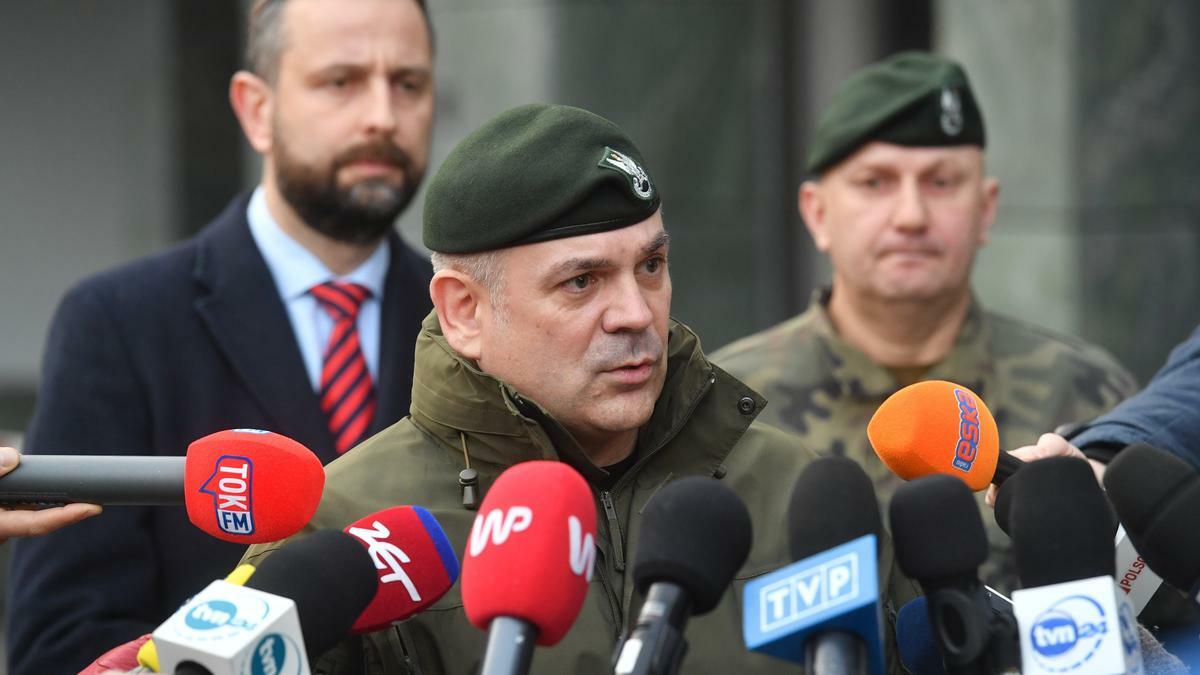
On Wednesday, yet another ultra-provocative announcement was made aimed at ‘deterring’ Moscow. Poland’s army chief of staff General Wieslaw Kukula called for his country to prepare its soldiers for all-out conflict.

“Today, we need to prepare our forces for full-scale conflict, not an asymmetric-type conflict,” General Kukula told a press conference. “This forces us to find a good balance between the border mission and maintaining the intensity of training in the army,” he said.

Chief of General Staff of the Polish Army Gen. Wieslaw Kukula, via EPA/EFE

His ‘border mission’ reference alludes to the ongoing tensions with Belarus, a close Russian ally which forms part of the ‘Union State’. Poland recently implemented its “East Shield” program, a $2.5 billion initiative to beef up defenses along the Poland-Belarus border.

Going back to 2021, Belarus has been accused of intentionally flooding the Polish border with Middle East migrants as a form of hybrid warfare. The European Union has charged President Alexander Lukashenko with orchestrating a border crisis in order to bog down Polish troops and border guards. Another issue is that China’s military has kicked off exercises with Belarusian forces in Brest in recent days, which lies within miles of the Polish border.

According to more of Wednesday’s Polish military announcement from Reuters, “Speaking at the same event, deputy defense minister Pawel Bejda said that as of August, the number of troops guarding Poland’s eastern border would be increased to 8,000 from the current 6,000, with an additional rearguard of 9,000 able to step up within 48 hours notice.”

Warsaw has also been on a major recruitment campaign toward rapidly increasing the size of its armed forces. This comes at a moment the NATO ‘eastern flank’ country is increasingly hitching its wagon to Ukraine’s fate. The current size of the Polish armed forces is commonly estimated at 190,000 personnel, but Warsaw wants to bolster it to 300,000 troops within a few years.

On Monday, President Zelensky met with Polish Prime Minister Donald Tusk in Warsaw where the two signed an unprecedented military agreement. Zelensky subsequently highlighted a provision which allows Poland to intercept Russian missiles over Ukraine territory, if they are deemed a threat to Poland and its population.

Poland has throughout the Ukraine war maintained a muscular, hawkish posture toward Russia and has criticized efforts at peaceful settlement at the negotiating table. 

Just this week Polish President Andrzej Duda reiterated that Ukraine must not cede any territory to Russia in exchange for peace. He said Tuesday, “If there is anyone who wants to give to Russia a piece of Ukrainian land and they are not Ukrainian, then let them give a piece of their land to Russia because it is easy to give away a piece of somebody else’s land.”

“I would like this war to end as soon as possible. However, it cannot end, it must not end in the victory of Russia because if it happened that way, we will have another war soon because Russia will attack again,” Duda added.

President Biden too in his Tuesday address to the NATO summit declared that Ukraine will prevail against Russia, despite the widespread reports that Ukrainian forces have suffered a severe manpower shortage. He said forcefully: “Ukraine can and will stop Putin.” 

However, all of this seems a ‘blind escalation’ without end or without strategy… a recipe for taking NATO directly into WW3 with nuclear-armed Russia. 

* * *

Utter madness…

Tyler Durden
Thu, 07/11/2024 – 02:45

NATO Countries Closest To Russia Up Defense Spending

NATO Countries Closest To Russia Up Defense Spending

Authored by Andrew Thornebrooke via The Epoch Times,

The nations on NATO’s easternmost flank are investing record amounts on defense in order to deter further Russian aggression against the region.

Defense ministers from Estonia, Latvia, and Lithuania gathered on July 9 in Washington to express their dedication to the NATO alliance and encourage other allies to pull their weight when it came to defense contributions.

Anything less, they warned, could encourage more violence in Eastern Europe and, possibly, the end of some nations outright.

Latvia’s Minister of Defense Andris Spruds delivers a doorstep statement during a meeting of NATO Ministers of Defense at the NATO Headquarters in Brussels on June 13, 2024. (Simon Wohlfahrt/AFP via Getty Images)

Latvian Defense Minister Andris Spruds said that Russian President Vladimir Putin’s continued targeting of civilians in Ukraine demonstrated a tolerance for “human loss.” Mr. Putin’s “absolute disregard of human life and human dignity,” he said, had to be taken into account when dealing with Russia.

“We are dealing with an aggressive country,” he said during a fireside chat hosted by Politico on the sidelines of NATO’s 75th annual summit.

“Russia is an existential threat, and we should be ready for this existential threat for years.”

To that end, he added, the international community should prepare to fend off Russian aggression for years to come.

It was vital, he said, that NATO “not engage from positions of weakness and appeasement.”

Estonia, Latvia, and Lithuania were all governed by the Soviet Union until its collapse in 1991.

Now, Mr. Putin has implemented a foreign policy based on uniting the so-called Russian World, including substantial Russian-speaking communities in former Soviet states, which East European leaders fear will lead to conquests beyond Ukraine.

As such, Estonia, Latvia, and Lithuania have all exceeded NATO’s guideline of spending 2 percent of their GDP on defense to ensure collective deterrence against foreign aggression.

Lithuanian National Defense Minister Laurynas Kasciunas said the investments were about “transforming the fear to preparedness.”

Mr. Kasciunas cited the Reagan-era doctrine of “peace through strength” and said that NATO should be “prepared to work with America” to ensure such a policy regardless of the outcome of the U.S. presidential election in November.

“Russians are not attacking when you’re strong. It’s a very simple thing. If you’re weak, they can do this,” he said.

Six NATO nations share a land border with Russian territory, a fact that Estonian Defense Minister Hanno Pevkur said would need to be taken into account when determining NATO’s pathway toward ensuring continued deterrence against Russian aggression.

“When we take the threat of Russia, the first thing we have to understand is that we cannot change the geography,” Mr. Pevkur said.

To that end, he added that NATO must be wholly prepared to engage in a war with Russia should Moscow attack any member state.

“We will start defending our countries from the first inch,” Mr. Pevkur said. “We will not keep away anything, and if that means that we also have to make attacks into Russian territory, then we are ready for that because we cannot fight only on our territory to keep every inch of our integrity.”

Tyler Durden
Thu, 07/11/2024 – 02:00

Modi’s Trip To Moscow Was Much More Important Than Most Observers Realize

Modi’s Trip To Moscow Was Much More Important Than Most Observers Realize

Authored by Andrew Korybko via Substack,

Indian Prime Minister Narendra Modi just completed his first trip to Russia in half a decade and put an end to the several-year-long hiatus in annual meetings between their leaders. The outcome was nine agreements on a wide range of subjects along with a detailed joint statement for guiding their special and privileged strategic partnership to 2030. There were no landmark deals, but nor should any have been expected, since the meeting was only planned recently for the reasons that’ll now be explained.

“Modi’s Trip To Moscow Was Meant To Assess The Reliability Of Russia’s Geopolitical Balancing Act” after his hosts sent eight signals since the start of the year hinting at an impending pro-Chinese pivot, which the reader can learn more about by reviewing the preceding hyperlinked analysis. The indisputable personal rapport between him and Putin during their two days together put an end to concerns about Russia preparing to privilege China over India and thus breathed new life into tri–multipolar processes.

This concept refers to the paradigm of dividing the world into three internally diverse groups: the US-led West’s Golden Billion; the Sino–Russo Entente; and the informally Indian-led Global South. These three groups became more prominent after the global systemic transition was unprecedentedly accelerated by Russia’s special operation, though they predate that development. Prior to then, however, International Relations could best be described as being in a state of Sino-US bi-multipolarity.

What’s meant by this is that everything was trending towards an unofficial division of the world between China and the US where everyone was pressured to some extent to take one or the other’s side. A return to the pure bipolarity that marked most of the Old Cold War till the Sino-US rapprochement was always unlikely because there were already some strategically autonomous emerging players. Likewise, despite the US, China, and India being the informal leaders of their groups, none have full control over them.

Therefore, this present tripolar system can best be described as tri-multipolar, with the key axis being the Russo-Indo Strategic Partnership since it prevents the American and Chinese superpowers from coming together to revive bi-multipolarity in the event of a New Détente between them. Russia’s perceptible shift towards China since the start of the year, which was detailed in an earlier analysis, caused serious concern in India because it suggested that Moscow was abandoning their shared grand strategic goal.

Before those eight signals were sent, India assumed that Russia would continue cooperating with it to accelerate tri-multipolar processes with a view towards midwifing complex multipolarity, which required neither Russia nor India pivoting towards China or the US respectively. What changed over the past year was the emergence of a pro-BRI policymaking faction in Moscow whose members concluded that Sino-US bi-multipolarity is inevitable so it’s best for Russia to turbocharge China’s superpower trajectory.

The ruling establishment’s balancing/pragmatic faction had a tough time fending off their “friendly rivals”, the latter of whom compellingly argued that their envisaged policies would represent the sweetest revenge against the US after all that their adversary did to Russia since 2022. This explains the signals that Russia sent since the start of the year hinting at an impending pro-Chinese pivot, which finally prompted India to dispatch Modi to Russia to investigate what’s really going on and why.

He considered this to be such a priority for his country’s objective national interests that he broke with tradition by traveling to Russia as the first trip of his third term instead of to a nearby country like usual. The timing also coincided with the annual NATO Summit, thus showing that India is strategically autonomous of the West and impervious to its pressure to curtail ties with Russia. The official US criticism that followed only served to reinforce the aforementioned points.  

Russia is always happy to host Modi, even more so than usual due to the timing that was described above as well as the fact that it was his first visit to the country in half a decade, which is why such pomp and circumstance were prepared for him. His three-hour-long informal meeting with Putin at the latter’s dacha was presumably when those two friends candidly discussed the most sensitive aspects of their countries’ strategic partnership and clarified the confusion caused by Russia’s recent pro-Chinese signals.

They clearly worked everything out as proven by their exuberant mood during those informal talks and the official ones the day after. Putin even awarded Modi Russia’s highest civilian honor, the Order of St. Andrew the Apostle, thus showing his country’s pro-BRI faction that he doesn’t approve of their plans to pivot to China. Instead, Russia will continue to pragmatically balance between China and India, thus reaffirming its tri-multipolar grand strategy and putting an end to bi-multipolar speculation.

To be sure, the pro-BRI faction isn’t going away and will continue to make their case that Russia’s best interests are served by acknowledging the supposedly inevitable reversion to Sino-US bi-multipolarity and accordingly turbocharging China’s superpower trajectory, but few in Moscow will listen to them. The most spectacular achievement from Modi’s trip to Russia wasn’t whatever they formally agreed to, but him and Putin informally agreeing to redouble their joint efforts to accelerate tri-multipolarity processes.  

Tyler Durden
Wed, 07/10/2024 – 23:40

Cocoa Grinding Estimates Suggest Demand Destruction Nearing 

Cocoa Grinding Estimates Suggest Demand Destruction Nearing 

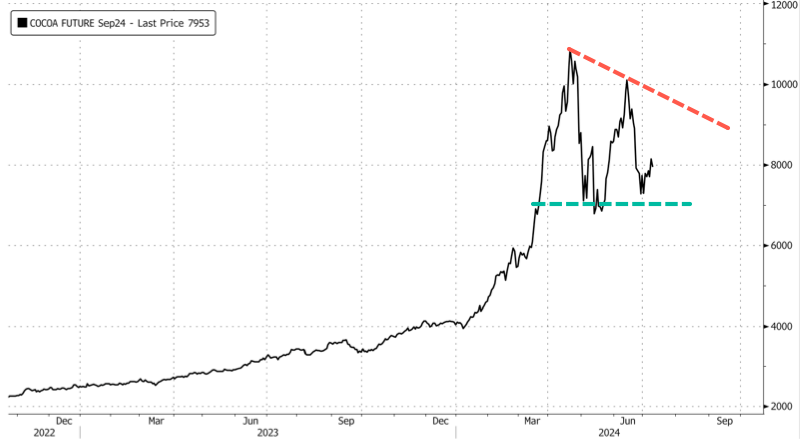
With cocoa prices hovering over $8,000 a ton in New York, the long-anticipated demand destruction for cocoa is finally approaching. New estimates indicate that global bean processing likely declined in the second quarter. 

According to six analysts and traders tracked by Bloomberg, second-quarter global grindings—where cocoa transforms into butter and powder used in food products—likely fell from a year earlier. Estimates from European grindings likely fell 2% in the quarter, hitting lows not seen since early 2020. All of the analysts forecasted much larger declines in the second half of the year. 

“The cheap stuff is beginning to drop off, and the expensive stuff is coming in,” said Jonathan Parkman, head of agricultural sales at broker Marex Group.

Parkman said, “The worst of input inflation will affect the second half of this year.”

The grinding numbers are nowhere near the deterioration to end elevated cocoa prices, but the estimates suggest emerging demand destruction. 

“We are more likely to see a significant change in the grind number in the second half of the year,” said Darren Stetzel, vice president of soft commodities for Asia at broker StoneX.

Stetzel noted that the market has been forced to adapt to the scarcity of beans, which should alleviate some demand pressure. He pointed out that chocolate makers are increasingly using substitutes like palm oil.

Grinding data from Europe is due on Thursday, and Asia and North America will report next week. 

Last month, the KitKat-maker warned ‘cocoaflation‘ will soon send candy bar prices higher. 

Tyler Durden
Wed, 07/10/2024 – 23:20

China: The Helpless Giant

China: The Helpless Giant

Authored by James Rickards via DailyReckoning.com,

Myths die hard. Among these is the great myth that China’s poised to take over the world. Today I’ll debunk that myth.

No one seriously disputes the importance of China to the global economy. It’s the world’s second-largest economy after the U.S. and accounts for 17% of global GDP (or an even larger percentage if one uses an alternative accounting method called purchasing power parity).

It has the world’s second-largest population at 1.41 billion people, just slightly behind India. It has the third-largest landmass in the world behind Russia and Canada. China also has the world’s third-largest nuclear arsenal after Russia and the U.S.

But size can be deceptive. Most observers translate China’s large economy into the status of global superpower soon to surpass the U.S. in economic and military strength.

That extrapolation has been a chimera for some time. In reality, China’s economy is fragile and weakening by the day.

China may soon find itself in economic turmoil including a credit crisis, currency crisis and economic recession all at the same time. Following is a close look at China’s inherent weakness. Unfortunately for U.S. investors, China’s problems threaten to drag the global economy down with it.

The China Myth

China’s economic problems exist at two levels — the long-term macro level and the short-term technical level. Let’s consider these in order: At the long-term level, China is confronting three material obstacles — the middle-income trap, declining demographics and wasted investment.

The middle-income trap afflicts developing economies that have reached the middle-income level of about $10,000 per capita annually. Moving from low-income (about $5,000 per capita annually) is straightforward.

Countries move populations from rural to urban environments, build suitable housing and infrastructure, attract direct foreign investment with cheap labor and low operating costs, engage in assembly-type manufacturing and run significant trade surpluses by exporting the manufactured goods.

The difficulty is in moving from middle-income to high-income ($20,000 per capita annually or higher). For that, low value-added manufacturing isn’t enough. It’s necessary to move to high-tech, high value-added manufacturing, which requires original research and development and access to high-tech tools such as semiconductor manufacturing equipment.

China has acquired some of these tools through theft of intellectual property, but not enough. China also faces fierce competition from those already engaged in high-tech manufacturing including Taiwan, South Korea, Singapore and Japan.

Only a handful of countries have ever made the move from middle-income to high-income, including those just mentioned. Many more including Turkey, Malaysia, Indonesia, India and South Africa are stuck in the same middle-income trap as China.

The prospects of China breaking out of the middle-income bracket are slim, especially now that foreign direct investment is moving toward India and Vietnam and away from China. This conundrum alone is enough to put the brakes on Chinese growth.

China’s Demographic Disaster

China is also confronted with what will become the greatest demographic disaster since the Black Death in the 14th century. This is the bitter fruit of China’s one-child policy from 1980–2015 combined with mass infanticide of girls. The demographic challenge is increased by greater educational and career opportunities for women, which impacts family formation, and an historic shift in the role of the family.

China’s population may decline from 1.41 billion to 750 million over the next 50 years. That’s a loss of over 650 million people.

Considering that one definition of GDP is working-age population x productivity, it follows that China’s GDP will suffer a spectacular decline over the remainder of this century. (Note: The total GDP will decline but per capita GDP may be maintained because the population itself is shrinking.)

Finally, China has wasted much of the wealth it did earn during the past 30 years with bad investments in unneeded infrastructure. A mature economy devotes about 25% of GDP to new investment (plant, equipment, homes, transportation, etc.) and about 65% to consumption. (The remaining 10% is split between trade surpluses or deficits and government spending.)

In China, that split is reversed. About 45% of GDP goes to investment and only about 25% goes to consumption.

That amount of investment can lead to high productivity gains in the future if it is spent intelligently on essential infrastructure, transportation, high-tech plants and equipment as well as research and development.

Instead, China wasted the money on “ghost cities” (ample infrastructure with no residents or business tenants) and extravagant white elephants such as the Nanjing South train station, which has marble walls and 128 escalators but very few train passengers.

Such show projects do produce short-term jobs and demand for copper, glass, steel and aluminum. But when the project is finished, the jobs disappear (unless diverted to another wasteful project) and the infrastructure is nonproductive with high maintenance costs.

If Chinese GDP were adjusted for losses due to wasted investment in accordance with generally accepted accounting principles, the reported growth figures of the past 30 years would have been reduced 20% or more. Those losses are real whether the figures are adjusted or not.

A Dead End for China

Based on these three factors — the middle-income trap, declining demographics and wasted investment — the so-called Chinese miracle has turned into a dead end.

China’s failing growth engine is not due solely to these long-term factors. Among the short-term headwinds to growth are an excessive debt-to-GDP ratio, a drying up of direct foreign investment, a dollar shortage and a rapidly declining currency.

Harvard economists Carmen Reinhart and Ken Rogoff have demonstrated that debt-to-GDP ratios in excess of 90% will reduce the Keynesian multiplier of additional debt-financed government spending below 1.0.

This means that for economies in that condition, if they borrow a dollar and spend a dollar, they receive less than a dollar of added GDP. Of course, this process drives the ratio even higher (since the GDP denominator grows more slowly than the debt numerator), which slows growth even further.

In plain language, you can’t borrow your way out of a debt crisis.

China has one of the highest debt-to-GDP ratios in the world, well over 300%. (Much of this debt is buried at the provincial level or in state-controlled banks rather than sovereign bonds, but the debt/growth dynamic is the same.) This debt overhang will retard Chinese growth independent of the other factors mentioned in this article.

Because of trade wars, tariff wars and deteriorating Chinese-U.S. relations, direct foreign investment is being diverted from China to other high-growth centers, including India. China’s ample (but declining) labor force cannot be productive without foreign direct investment to fund state-of-the-art manufacturing facilities and new technology.

China is doomed to stagnate along the lines of the former Soviet Union without a continual supply of new capital and technology.

China’s dollar-denominated trade surpluses cannot fill the gap because those reserves are needed to service dollar-denominated debt of Chinese state-owned enterprises and to prop up Chinese bank balance sheets.

That’s the real reason why Chinese holdings of U.S. Treasury securities are declining. It’s not because China is “dumping” Treasuries. It’s because China must sell the Treasuries to obtain dollars to prop up its debts and to deal with a global dollar shortage.

Get out of Chinese Stocks

All of these negative trends are expressed in the rapid decline of the USD/CNY exchange rate. After hitting an interim peak of 7.10 to $1.00 on Jan. 31, 2024, the Chinese yuan broke through a central bank target of 7.25 in mid-June and is now trading at 7.27. CNY will continue this decline, perhaps hitting 7.30 to $1.00 in the weeks ahead.

A crashing currency is not as advantageous for exports as many imagine since China’s value added on exports is only about 5%. It has to import most of the inputs it uses to manufacture exports from Japan, South Korea, Germany and Taiwan.

A declining currency increases the cost of those imports and reduces China’s competitiveness. It also makes foreign direct investment less attractive and hurts China’s efforts to move to a consumer economy by causing inflation on imported goods.

It would be a serious matter if China were slowing rapidly and the problems were confined to China. They’re not. Slower growth in China hurts Japanese banks, which are heavily invested there. It hurts South Korean, Taiwanese and Australian exporters that rely on Chinese markets.

It also contributes to a global slowdown that’s already affected Germany, France, Japan and the U.K. And it hurts U.S. investors who are facing a wave of company failures and bond defaults.

The U.S. won’t be insulated from this global slowdown that threatens to become a global recession and financial crisis. U.S. investors should dump Chinese stocks and ETFs and reduce equity holdings generally.

We’re entering another “cash is king” stage with China leading the way.

Tyler Durden
Wed, 07/10/2024 – 23:00

What Taxes Must Be Paid When You Have A Trust?

What Taxes Must Be Paid When You Have A Trust?

Authored by Mike Valles via The Epoch Times (emphasis ours),

When you create your estate plan, consider setting up a trust to pass your assets on to your beneficiaries. The holdings in some trusts do not go through probate, enabling your beneficiaries to receive them faster. They also can help you save a lot of money on taxes.

Types of Trusts

Taxes on a trust and who pays for them depend on the type of trust it is. Trusts generally fall into one of two categories: revocable and irrevocable. There are many varieties of trusts, and you can design them to fit many needs, but they fall into these two categories.

  • The Revocable Trust

A revocable trust, often called a living trust, means that the grantor—the person who created the trust—still has the assets under his control. He can add or remove assets when he wants, and he will pay the taxes on any gains. Gains get taxed at the grantor’s income tax bracket level.

  • The Irrevocable Trust

The assets in an irrevocable trust are under the control of a trustee, and the grantor has little or no control over them. They also are no longer in the grantor’s taxable estate. The trust pays all taxes on any gains except when distributed.

An irrevocable trust enables your assets to escape the hands of creditors, but only after the assets are in it. The more assets you put into the trust, the less taxes your estate must pay. TrustandWill says that the estate tax exemption for 2024 is $13.61 million. This figure will likely revert to $5 million in 2025. You can also reduce your estate by giving individuals up to $18,000 per person each year.

  • The Grantor Retained Annuity Trust 

For those who have more money, you might want to create a grantor retained annuity trust (GRAT), which is a type of irrevocable trust. It can pay you a set amount of money per year (or monthly) for a specific number of years. Taxes are paid on the assets when you put them into the trust. At the end of the set time, any remaining assets pass to the beneficiaries tax-free.

When you create a GRAT, SuperMoney says that the interest market rate (the 7520 rate) is set and sent to the government annually. A successful GRAT will give considerable assets to your beneficiaries, but it requires that the market rate stays above the interest rate.

If you die before the end of the period, all assets in a GRAT will become part of the estate. Some people create a series of GRATs, which can have periods as short as two years. It helps ensure your beneficiaries receive some money—even if you do not outlive all of them.

Trust Beneficiaries Will Pay Some Taxes

A trust distribution may include part of the principal and some interest. Investopedia says that no taxes will be due on the principal, but you must pay taxes on the interest. The principal can be any amount deposited originally or in the year the distribution is made. Any distributions from a trust throughout the year are taxable as interest, SuperMoney says, because principal distributions are only made once a year after depositing all contributions.

If all the interest in the trust gained during the year is not distributed to the beneficiaries, the trust pays the taxes on the remaining amount. Beneficiaries receive a tax report (Form 1041) each year from the trust stating how much money is principal and how much is interest. It also shows them how much they need to pay in taxes.

Taxes From Trusts Are Much Higher Than Regular Taxes

Money received as a distribution from a trust is taxed at a higher rate than ordinary income. People in the first income tax bracket, the Internal Revenue Service says, including those with income ranging from $0 to $11,000, pay 10 percent in taxes. The next higher tax bracket ranges from $11,001 to $44,725, and they pay 12 percent in taxes.

In comparison, the first tax bracket on income from a trust, Forbes says, ranges from $0 to $3,100. They will pay 10 percent in taxes. The second tax bracket is from $3,101 to $11,150, and they must pay $310 plus an additional 24 percent of anything over $3,100. Taxes on regular income reach a maximum of 37 percent, which is the same (maximum) for trust income, but it starts on trust income as low as $15,201.

The Interest Earned Determines the Taxes

When a trust earns interest, there will be taxes, but Fidelity says that part of it may be considered principal. If the assets in the trust do not earn interest, any distributions made are principal.

A trust that distributes $10,000—but only has $5,000 in dividends and another $5,000 in capital gains will have a split between principal and income. Other amounts and situations may also see a split between income and principal, enabling the beneficiary to have lower taxes.

When selling assets out of a trust, Fool says, state laws determine when capital gains are principal or income. A trust can be created so that only income is distributed, but not capital gains. The recipient of the capital gains pays the taxes on it.

A trust can be created to prevent assets in it from going through probate. The laws concerning trusts change frequently and they must be set up correctly—and changed when necessary. When doing your estate planning, it is important to consult a trust lawyer or estate planning attorney to ensure it meets current laws.

The Epoch Times copyright © 2024. The views and opinions expressed are those of the authors. They are meant for general informational purposes only and should not be construed or interpreted as a recommendation or solicitation. The Epoch Times does not provide investment, tax, legal, financial planning, estate planning, or any other personal finance advice. The Epoch Times holds no liability for the accuracy or timeliness of the information provided.

Tyler Durden
Wed, 07/10/2024 – 22:20