64.7 F
Chicago
Wednesday, September 23, 2026
Home Blog Page 2558

Send This Article To People Who Say “Ivermectin Doesn’t Work For Covid-19”

Send This Article To People Who Say “Ivermectin Doesn’t Work For Covid-19”

Authored by David Gortler via the Brownstone Institute,

If you hear your pharmacist, physician, or academic dean parrot the malignant regurgitated trope of “Ivermectin doesn’t work for Covid” or that there is “no evidence” or “no data” to support ivermectin’s use in Covid-19, send them this meta-analysis summary and annotated bibliography of over 100 studies. 

I never really latched on to the idea of social media, which is why I never signed up for it. In addition to pathological social factors, I think it is an especially absurd format for serious scientists to initiate a debate on the intricacies and complexities of medical research, clinical pharmacology, or patient care. 

I did not have a Twitter/X account but very recently created one after I was contacted by colleagues alerting me to posts from Dr. Peter Hotez criticizing my recent testimony before the House Select Subcommittee on the Coronavirus Pandemic held by Dr. Brad Wenstrup (R-OH). Dr. Hotez is a pediatrician and tropical medicine Dean at Baylor in Houston, Texas. About six weeks later, Dr. Hotez responded to my testimony on Twitter/X: 

I attempted to rebut Dr. Hotez’s statement by setting up a Twitter/X account only to find out that I couldn’t! Little did I know that the only way to comment on Dr. Hotez’s public Twitter/X page was to be granted permission by him to do so!! And here I thought the idea of Twitter was to foster discourse; not stifle it. 

Outside opinions NOT WELCOME: Screenshot from Dr. Hotez’s Twitter/X account when I tried to respond to his denigration of my congressional testimony. 

It certainly appears that dissenting scientific opinions are not welcome on Dr. Hotez’s Twitter/X page. 

Dr. Hotez’s critique of my testimony was not an invitation to discuss the merits or shortcomings of ivermectin therapy; it was a figurative “drive-by shooting” stating that my sworn Congressional testimony was: 

  1. dangerous anti-science disinformation, pure and simple” and that
  2. Ivermectin does nothing to help people with Covid” and
  3. Ivermectin doesn’t work for Covid

The second (in a list of around a dozen short, subsequent tweets by Dr. Hotez) was a pitch for his book. 

Dr. Hotez then “upvoted” and reposted a note from one of his selected followers who appears to be a Twitter moderator of some sort. This individual had gleefully declared that my testimony had been “community-noted” adding that “Numerous valid scientific studies have shown that ivermectin is completely ineffective” (emphasis added) and “the promotion of Ivermectin for vaccine injury puts lives at risk.” The latter statement was a sleight of hand, as I had never opined on the use of ivermectin for “vaccine injury” at any time during my testimony or in any of my previous writings. 

Twitter’s community notes are intended to give context to posts with debatable data, with this one, purporting to “debunk” my testimony, containing seven (7) reference links. Two of the links were duplicates, referring to the exact same data (numbers 1 and 3 and numbers 2 and 7). They referred to JAMA or NEJM studies which in turn have been criticized by academics as having very significant scientific and clinical practice shortcomings. Although the note additionally specified that “the promotion of ivermectin for ‘vaccine injury’ puts lives at risk,” none of those links determined that the use of ivermectin poses a safety “risk.” When prescribed correctly, ivermectin has not only been determined to be safe, but it has historically proven itself to be “astonishingly safe.” 

The second-to-last “community note” link was a non-working link to an FDA website. It didn’t work because the FDA had agreed to delete it over a month earlier as part of a legal settlement for improperly denigrating ivermectin use. Didn’t the Twitter/X “community note” staffers bother to click on the links to make sure they worked before permitting them to be posted as references? Eventually, other individuals noticed the palpable shortcomings of the “community note” as well because it was quickly removed despite stating that it “Cites high-quality sources.” 

A picture of the original “community note” with added arrows highlighting specific areas is shown below: 

Of course, neither myself nor anyone else could contradict those claims because we were all blocked from posting by Dr. Hotez. It appears that he would rather make an incorrect assertion, then stick his fingers into his ears after he was finished saying what he had to, running away from any potential discussion, while his “approved” posters swarm to up-vote him – but all while potential counterarguments can’t be posted

With no outside dissent allowed, does that mean Dr. Hotez “won” the debate? 

It turns out my foray into Twitter was misguided and a waste of time. My Twitter/X account is now history. While it works great for a myriad of different matters, it is obviously an absurd place for a serious person to attempt to discuss or debate the intricacies of medical science or patient care. At this point, I have no intention of returning. 

Ignoring and Censoring Data in History: Copernicus and Galileo

Consensus is very important to some, but unfortunately, it isn’t related to science. Science doesn’t care about consensus. In fact, many of the biggest scientific advancements were the result of questioning an established consensus. Generating a consensus for a new, controversial topic can be particularly dangerous. When people agree they tend to support each other, but a danger exists that they forget that they are reaffirming a potentially incorrect or polarized belief because their decision-making is biased and/or occurring in a vacuum. 

In almost exclusively permitting harmonically positive feedback for himself, Dr. Hotez has failed to consider that it was artificially cultivated with essentially no meaningful dissent allowed to take place. In addition to being anti-free speech, it’s a terrible example for a scientist to set, particularly for someone in the position of a professor educating future scientists. The best scientists are the ones who are willing to listen to the opinions of other intellectuals and consider their arguments. 

History shows us that ignoring scientific evidence and quashing dissent isn’t good for technical advancement; something that a professor who also labels himself a “science warrior” on his own homepage probably ought to already know. 

A textbook example of “anti-science” was when Copernicus and Galileo tried to advance theories that the earth rotated around the sun (as opposed to the heliocentric narrative of the earth being the center of the universe, around which all celestial objects rotated). Copernicus and Galileo were ignored and their writings were banned. Both were tried by a panel of their peers, found guilty, removed from their didactic pulpits, arrested and imprisoned. Galileo was eventually permitted to live out his remaining years, exiled under “house arrest” away on a farm. But even then, at least both Copernicus and Galileo were given opportunities to argue and present their evidence…unlike Dr. Hotez’s blockaded Twitter account. 

Medicine is Rarely “Black or White”

Despite decades of advancement, clinical science is seldom black or white. Only very rarely are there declarations “never” or “nothing” or “completely.” Still, Dr. Hotez routinely makes polarizing, binary black-or-white, right-or-wrong assertions from his “members-only” perch on Twitter/X, neglecting or ignoring data – and it’s not just for Covid treatments. 

A great deal of medical and pharmacology research deals with levels of uncertainty, something which I regularly taught my students and hoped that most medical scientists already knew and understood. Declarations otherwise would be irresponsible emerging from any medical scientist, let alone one with Dr. Hotez’s credentials. 

Dr. Hotez’s unambiguous declarations that: ivermectin is “completely ineffective” and ivermectin’s use represents “anti-science disinformation pure and simple” are simply not reflected in both the review of many clinical trials and larger statistical analyses of published literature. In fact, there is data that sharply and directly contradict Dr. Hotez’s statement that “Ivermectin does nothing to help people with Covid.” 

It is my belief that the continued accumulation of positive findings for ivermectin will continue and show an even greater positive effect for Covid pre-exposure prophylaxis, early exposure, and early treatment modalities. Like a good scientist, I am open-minded and am willing to hear out intellectual, alternative thoughts from my detractors. That being said, I have a considerable amount of data backing up my opinion. 

Response to Dr. Hotez’s Assertion: “Ivermectin Does Nothing to Help People with Covid”

Since I am not permitted to respond on Twitter/X, (in addition to the fact that it is not an appropriate platform to discuss the complex details of clinical trial data) I’m responding in the form of a review, analysis, and lengthy, annotated bibliography. 

Academics should encourage the discussion of controversial topics. In composing an argument, one needs to present all available data – not exclusively preferred findings from selected “big name” domestic medical journals (which by the way are often heavily financed with expensive advertisements from Big Pharma) – but legitimate clinical and scientific data from all sources.

First, publications in “big name” journals like the NEJM and JAMA are not holy scripture beyond critique. Also, there is legitimate research being conducted in non-US countries and/or published in smaller journals worthy of consideration. On top of that, those who spend their lives in medical research will tell you that non-NEJM and non-JAMA, non-“big name” smaller, observational, and/or real-world study data are not only very worthy of consideration, but that those study designs and results can often be even more reflective of a drug’s utility and safety. 

Cochrane’s Ivermectin Review is Incomplete

Cochrane’s March 2024 review of ivermectin has been cited as a source of data for ivermectin being ineffective. However, Cochrane only considered 11 Randomized Controlled Trials (RCTs) covering 3,409 participants. For ivermectin, there are 50 RCTs covering 17,243 participants which when analyzed in combination, show very strong evidence for efficacy in Covid-19. The fact that Cochrane selectively excluded a large amount of study data, while simultaneously including low-quality data with high conflict of interest and highly biased study designs, is more than a little perplexing. Of note, Cochrane also didn’t combine all of the evidence from the studies it did choose to include; data was split into very small sets by outcome and patient status, with no method used to combine all of the evidence from independent studies. 

It seems to me that Cochrane isn’t what it used to be, and I for one am very disappointed. 

Data Analysis

The proper application and weighting of data and its random effects meta-analysis across all studies can provide a complete picture of an effect. It includes all data, including too-low-dose, too-short-duration, less effective late- versus early-treatments, wrongly used fasting dosing (ivermectin is substantially better absorbed with high-fat foods [2.5x greater] according to the Merck package insert). 

To date, there exists a list of 103 manuscripts written which studied ivermectin. Those data also include 15 medRxiv and/or preprint articles, (for journals that refuse to defy Big Pharma narratives and/or potentially those that the White House has ordered censoring) and all studies that showed ivermectin’s effectiveness with some certitude, but not at the level of p≤0.05. On a side note: inclusion versus exclusion of the medRxiv/preprint articles does not alter the overall positive ivermectin treatment effects. 

These clinical findings are in addition to the highly plausible molecular biology and pharmacology mechanisms of how ivermectin is potentially effective for preventing the entry of some viruses into cells. For purposes of keeping the length of this document manageable, the pharmacologic mechanism of action will not be discussed here. 

A Value of p ≤0.05 is Important, but it Isn’t Everything

Studies with p-values higher than 0.05 still provide evidence – just evidence with a lower than 95% confidence. Alone, those studies may not provide statistical confidence by themselves against the null hypothesis. However, they may contribute to a meta-analysis, in which they are weighted appropriately. In an analysis, they may actually result in strong statistical evidence and greater confidence from the combination of data from multiple independent scientific teams. Smaller studies and real-world observational studies should not always be dismissed as non-evidential; even case reports and case series have historically played an important role in biomedical research and the assessment of drug safety. In fact, those sources of data were part of what I routinely considered in approving new drugs and labeling updates during my years at the FDA as a drug safety expert. 

RCTs are conceptually preferred if properly designed and carefully conducted, but the Covid era exposed severe biases in such trials: including but not limited to treatment delays (as Covid-19 along with any antiviral treatment must begin promptly) protocols that were designed to fail, mid-study changes, biased analysis and presentation, and lack of transparency in data and suspiciously timed publication releases. Each study should be evaluated for potential biases and/or confoundings on its own merit, whether randomized or observational, large or small. 

Major RCTs allegedly producing Big Pharma-coined-term of “Evidence-Based Medicine™” published in “big journals” can appear very compelling, especially because they are what the lay press tends to cite most commonly, but clinicians should know that it is important to examine the methodology used beyond the high-level summary overviews and to also look at additional sources of data. 

Another problem with RCTs is that, unlike real-world and observational studies, not just anyone can conduct large RCTs. Barriers include them often being significantly more expensive, time-consuming and requiring a dedicated, highly skilled support staff. Those sorts of requirements prohibit entry by less-well-funded clinicians who have smaller practices/facilities or those that have employment requirements which have a focus on direct care responsibilities as opposed to clinical research. While federal grants are available, they are highly competitive and tend to be limited to particularly listed topics which in turn end up being awarded to a limited number of major centers with those aforementioned resources.

Those major centers and/or their employees can be connected in one way or another to Big Pharma funding. For highly profitable Covid-19 drug trials, it could directly or indirectly create a conflict or incentive to show a lack of effectiveness or safety for inexpensive generic products, and in turn show efficacy for novel, expensive patented commercial products. This scenario not only applies to Covid-19 treatments such as ivermectin, it applies to a fair amount of all investigational medicine research. 

In fact, a multitude of smaller, less expensive non-RCT observational/real-world-use studies across many facilities can make a stronger case by noting that dependence on any individual trial is subject to potential confounding, errors, bias, and even fraud. Therefore, the combined evidence from multiple, well-designed and conducted smaller, real-world, case reports, case series, and/or observational trials from an array of smaller facilities, combined via meta-analyses can sometimes be a stronger indicator than that of just one or a few biased large trials. 

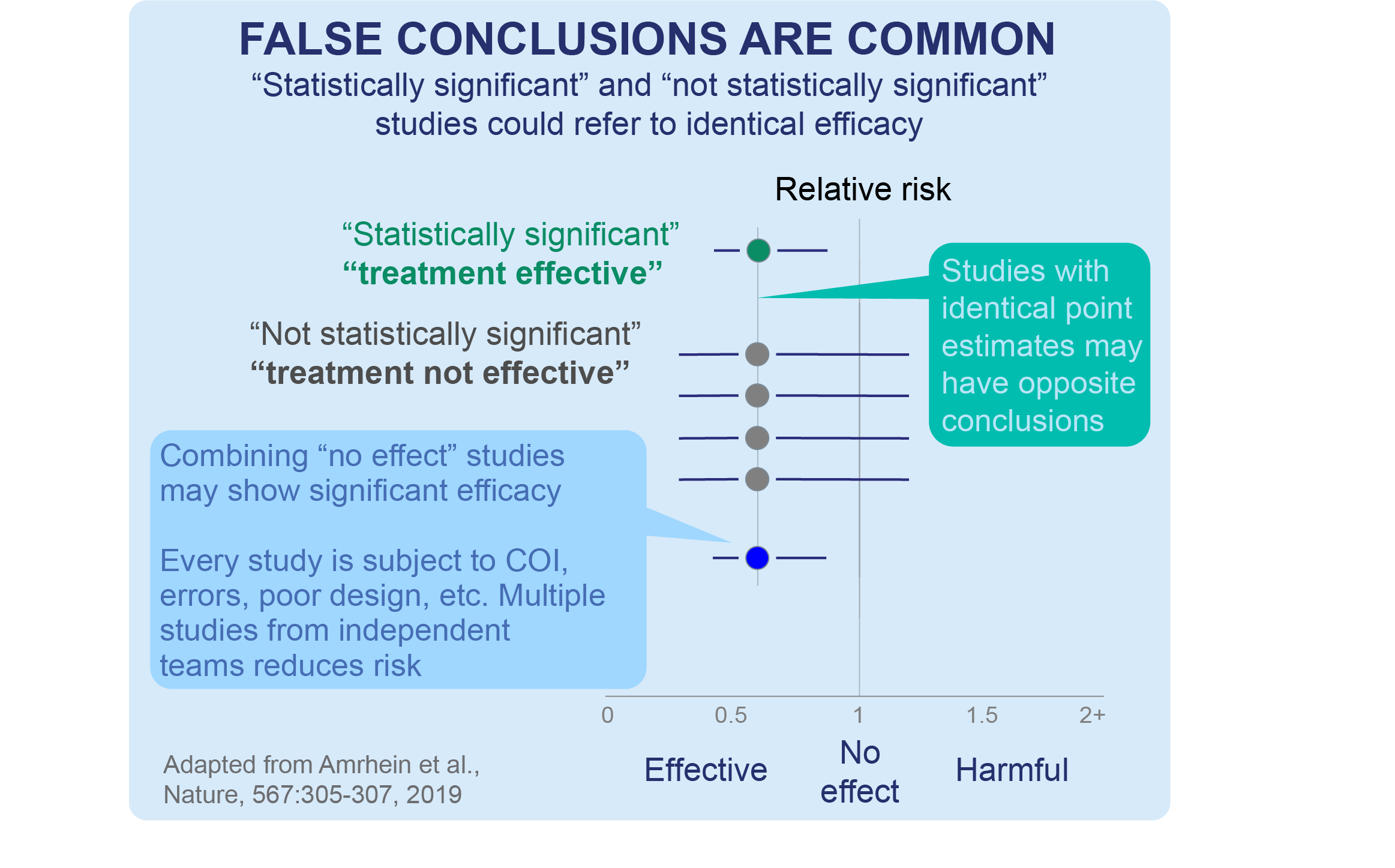
A diagram adapted from a Nature publication (below) illustrates a scenario in which 4 (four) smaller studies that individually may not have delivered statistical significance (ie, have a p>0.05) but when considered in combination, may provide strong evidence with a statistical significance via meta-analysis: 

Separately, that same publication additionally underscores how important it is for scientists and clinicians to not mistakenly assume that “non-significance” (ie, a higher deviation from p≤0.05) translates to “no effect.” Statistical significance is just a numerical estimate of the confidence of a result. The idea that a small p-value implies that the estimate is credible/true/valid /the-only-thing-that-matters is a misconception. A small p-value of an RCT (for instance) says nothing about the quality of the estimate. 

In the matter at hand, and in summation, a random-effects meta-analysis shows a clinically beneficial effect of ivermectin with a certainty of p<0.00000000001 (that is, one in one sextillion) over all 103 ivermectin studies for Covid-19, and also for RCTs and for specific outcomes like mortality hospitalization and recovery cases which all show p<0.0001

Timing is Everything…(When it Comes to Initiating Antiviral Treatment)

The use of the word “early” in the “c19early.com” website is an important annotation. It reminds us of how critical timing is when it comes to any antiviral/antimicrobial drug administration. Ivermectin as an antiviral works best when administered early upon symptom(s) (or for prophylaxis/pre-exposure). That is the same when it comes to any antiviral pharmacology treatments, including for cold sores, genital herpes, influenza, or HIV/AIDS for instance.

Delayed administration could still have a clinical benefit, but less so, depending on how late and individual factors that include viral replication, infective loading dose, and viral variant/mutation, besides numerous demographic, immunologic, plus other factors. That is a fundamental concept that anyone in the field of pharmacy or medicine should have learned early in their schooling, yet it seems to have been omitted in about half of the 103 studies done on ivermectin which employed delayed or late treatment. 

In addition to the delay in ivermectin dosing was the delay in releasing study findings. The worst example might be PRINCIPLE RCT results which were delayed over 800 days from the expected release of findings. PRINCIPLE (bibliography and explanation in reference number 88 below) was biased against showing efficacy per the design, operation, analysis, and reporting, and including very late ivermectin administration, yet still ended up showing a positive effect of ivermectin. During the delay in releasing data, novel, expensive, likely less efficacious “rebounding” Big Pharma treatments like molnupiravir and Paxlovid were developed, (and tested against placebo instead of treatments like ivermectin) reviewed, authorized, and White House-endorsed. Paxlovid ($1,400 per treatment course) and molnupiravir ($700 per course) were each around ten times more expensive than ivermectin (<$100 per course). Paxlovid purchased by the White House cost American taxpayers over $10 billion

For perspective: the greater than $9 billion savings from the use of ivermectin alone could have instead bought about 36,000 $250,000 Lamborghini Huracans, or alternatively for those of us who must work for a living, about 300,000 $30,000 Toyota Camry SEs (the most popular model). 

For Covid-19, There is More to the Data than Just Press/Abstract “Topline Results”

To fully address transparency, I am including a full list of ivermectin studies completed to date, with the plurality of positive and negative findings in the form of an annotated bibliography at the end of this article to allow readers to see the sources of the research. Each of the 103 references includes a brief summary and a link to a longer analysis at c19early

Along with the bibliography, I am also including two summary plots of the ivermectin data from c19early on overall benefit, and relative benefits from prophylaxis, early, and late treatments.

Click here to see annotated bibliography.

Tyler Durden
Tue, 06/11/2024 – 23:40

Mapping Cost Per Prisoner By US State

Mapping Cost Per Prisoner By US State

The US prison population consists of around 1.2 million inmates.

Looking at data from USAFacts obtained from the U.S. Census Bureau’s Annual Survey of State and Local Government Finances, which was most recently updated in June 2023, we can analyze which states have the highest and lowest expenditures of their taxpayer dollars per prisoner.

Differences in Prison Spending Vary Widely Across States

As Bruno Venditti notes via Visual Capitalist, over $80 billion is spent annually on prisons in the United States.

A large part of this is used to pay over 4,000 vendors that serve the criminal legal system, including healthcare providers and food suppliers.

At the state level, most of the budget goes for day-to-day operations, including officer salaries.

In high-wage states such as California, New Jersey, and Massachusetts, officers receive double the salaries compared to those in lower-wage states like Mississippi, Missouri, and Kentucky.

As a result, spending can vary from just under $23,000 per prisoner in Arkansas to $307,468 in Massachusetts.

States With the Highest Incarceration Rates

Southern U.S. states have the highest imprisonment rates according to 2022 data, with Mississippi at 859 people per 100,000, Louisiana at 775, and Arkansas at 743.

Massachusetts has the lowest rate of any state, with 116 people per 100,000.

Tyler Durden
Tue, 06/11/2024 – 23:20

Iran Releases List Of Six Presidential Candidates To Replace Raisi

Iran Releases List Of Six Presidential Candidates To Replace Raisi

Via The Cradle

On Sunday, the Iranian Ministry of Interior released the final list of candidates qualified to compete in the election for the ninth president of the Islamic Republic of Iran. This election will determine who will succeed the late President Ebrahim Raisi, who, along with seasoned top diplomat Foreign Minister Hossein Amir-Abdollahian and seven others, passed away in a helicopter accident on May 19, during the third year of his presidency.

In his stead, and by the constitution, First Vice President Mohammad Mokhber was named interim president. He will be replaced by a successor following an election that must take place within 50 days of Raisi’s death being declared. Candidates running for president must be approved by the 12-member Guardian Council to ensure their commitment to the principles of the 1979 Islamic Revolution, which established the Islamic Republic.

The list was provided to the Interior Ministry by the powerful Guardian Council of the Iranian Constitution, an entity consisting of six appointed clerics and six elected jurists whose main task is to vet the candidates vying for elections in Iran and certify poll results. Amid much speculation, six candidates made it to the final list, surprising many by excluding well-known figures such as three-term speaker of the Iranian Parliament, Ali Larijani, and two-term president Mahmoud Ahmadinejad.

The candidates are Mohammad-Bagher Ghalibaf, Amir-Hossein Ghazi-Zadeh Hashemi, Saeed Jalili, Masoud Pezeshkian, Mustafa Pour-Mohammadi, and Alireza Zakani.

A closer look at the candidates

Mohammad-Baqer Ghalibaf

Mohammad-Baqer Ghalibaf (62 years old), a two-term lawmaker from Tehran and former Islamic Revolutionary Guards Corps (IRGC) member, has held various key positions over the past three decades. His roles include member of the Expediency Council, commander of the Police Force, and Mayor of Tehran from 2005 to 2017. 

Despite numerous bids for the presidency in 2005, 2009, 2013, 2017, and now in 2024, he has yet to succeed. His recent nomination sparked criticism as it came just five days after he secured the votes of nearly 200 lawmakers to become the speaker of the new parliament.

Amir-Hossein Ghazi-Zadeh Hashemi

Physician Amir-Hossein Ghazi-Zadeh Hashemi (53 years old) is a conservative and four-term lawmaker and was chairman of the Martyrs and War Veterans Foundation in the Raisi administration. The Guardian Council approved his candidacy in the 2021 presidential race, where he garnered less than a million votes. He is the only Raisi administration candidate to have made the Guardian Council cut, which dilutes the criticism of reformists who also only have one candidate in the running.

Saeed Jalili

Former lead nuclear negotiator Saeed Jalili (59 years old) is a politician deeply loyal to Iranian Supreme Leader Ayatollah Ali Khamenei. He has been rewarded for his loyalty by being one of Khamenei’s three representatives at the Supreme National Security Council, where he also served as secretary for seven years from 2006 to 2013. 

An Iran–Iraq war veteran who lost a leg in that conflict, Jalili is known for his firm stance during nuclear negotiations with western countries in the early 2000s. He was a vocal critic of the 2015 nuclear deal and opposed its revival under Raisi’s presidency. 

Jalili ran against President Hassan Rouhani in the 2013 election, ranking third with four million votes. He was nominated again in 2021 but withdrew in support of Raisi’s candidacy.

Masoud Pezeshkian

A heart surgeon and former health minister under President Mohammad Khatami (2001–2005), Masoud Pezeshkian (70 years old) is a five-term Reformist lawmaker from East Azerbaijan province. He is one of three candidates backed by the Reformist Front of Iran, who pledged to participate only if the Guardian Council approved at least one of their candidates. Despite accusations against him for advocating federalism and pan-Turkism, the Guardian Council’s approval of Pezeshkian’s candidacy strongly suggests these rumors are unfounded. 

Mustafa Pour-Mohammadi 

Mustafa Pour-Mohammadi (65 years old), originally from Qom, is a judge and prosecutor who rose to become senior director at Iran’s Ministry of Intelligence. He served as Interior Minister under President Ahmadinejad (2005–2008) before being dismissed due to differences with him. 

Under President Rouhani, he was appointed Minister of Justice despite allegations of human rights violations related to the execution of Mujahedeen-e Khalgh Organization (MKO) members in the late 1980s. 

Pour-Mohammadi, along with the late President Raisi, was on the panel that ruled on these executions. He was also a member of the Assembly of Experts until he failed to secure enough votes in the March 2024 election.

Alireza Zakani

Alireza Zakani (59 years old) is a physician-turned-conservative politician, the current mayor of Tehran, and a four-term lawmaker from Tehran and Qom constituencies. Although he was disqualified in the 2013 and 2017 presidential elections, Zakani was admitted in 2021 and supported then-candidate Ebrahim Raisi. His current nomination raised suspicions that he aims to play a similar supporting role for Saeed Jalili, which he denies. 

What’s next? 

The Guardian Council has approved three physicians, a cleric, a former diplomat, and Ghalibaf, the jack of all trades. Its spokesman announced that the candidates could start their two-week campaign immediately. 

Iranians now have two weeks to decide whether to participate in the election and, if so, whom to vote for. Voter turnout in the 2021 election was 48.8 percent, one of the lowest in the Islamic Republic’s history, as Raisi received nearly 62 percent of the votes, barely reaching 18 million.

Following the large attendance for Raisi’s funeral, the Islamic Republic hopes a similar number will go to the polls on June 28 and surpass the turnout from three years ago.

In the weeks ahead, the candidates must not only appeal to their base but also reach out to undecided voters, addressing their concerns and presenting a vision that resonates with the broader population. The ability to mobilize support and inspire confidence will be crucial in determining who will lead Iran through its next chapter.

As in most mainstream polls over the past few years, the leading candidates appear to be in the conservative camp, with Jalil and Ghalibaf holding strong leads. But if past elections are any indicator, public sentiment can shift dramatically during the two short weeks of campaigning, as was seen in Rouhani’s first election, when he raced to a clear lead after trailing in polls for weeks.

Tyler Durden
Tue, 06/11/2024 – 22:50

Biden Campaign (Again) Claims Trump “Has Praised The Third Reich”

Biden Campaign (Again) Claims Trump “Has Praised The Third Reich”

Authored by Steve Watson via Modernity.news,

Biden campaign senior adviser Adrienne Elrod claimed Monday that Donald Trump has “praised the Third Reich” and intends to rule as a racist dictator.

During an interview with CNN, Elrod was asked to comment on Republicans who “worship” Trump, and responded “I think that rhetoric speaks for itself.”

“Donald Trump and his MAGA allies are focused on seeking revenge and retribution,” Elrod asserted, adding “They are running a negative campaign that is not focused on the American people, but is focused on themselves.”

She continued,Trump has made it very clear that if he steps back into that White House, he will rule as a dictator on day one. He will seek — he will use the White House to seek political revenge and retribution on his political enemies.”

Trump actually said he won’t do that, but it doesn’t fit the Biden campaign’s narrative.

While she was at it, Elrod painted up Trump as an admirer of Hitler.

“You know, he has said things that — you know, he’s praised the Third Reich. He has used, you know, racist rhetoric at every chance that he has,” she claimed.

Praised the Third Reich? Presumably she is referring to this…

The desperation among the Biden campaign is palpable. His approval rating just hit a new all-time low of 37.4 percent.

FiveThirtyEight founder Nate Silver noted that the downward trend for Biden means that dropping out of the race is worth discussing, even though it “would be a big risk” for the Democrats.

“But there’s some threshold below which continuing to run is a bigger risk,” Silver commented, adding “Are we there yet? I don’t know. But it’s more than fair to ask.”

“If I’d told you 10 years ago a president would seek re-election at 81 despite a supermajority of Americans having concerns about his age, and then we’d hit 8% inflation for 2 years, you wouldn’t be surprised he was an underdog for reelection. You’d be surprised it was even close!” Silver further wrote.

*  *  *

Your support is crucial in helping us defeat mass censorship. Please consider donating via Locals or check out our unique merch. Follow us on X @ModernityNews.

Tyler Durden
Tue, 06/11/2024 – 22:20

FOMC Preview: From Three Rate Cuts To Two

FOMC Preview: From Three Rate Cuts To Two

Coming just hours after the May CPI print, tomorrow’s – and the month’s – main event is the FOMC decision due at 2pm ET, when the Fed is widely expected to leave rates on hold at 5.25-5.50%, and the statement will likely also largely be reiterated after slight tweaks in the May statement. Attention will fall on the Summary of Economic projections, and more specifically, the Dot Plot, where the number of projected rate cuts in 2024 will be trimmed from 3 to 2. After a string of hot inflation reports in Q1, the Fed has been stressing that the luxury of a strong economy gives the Fed time to be patient before acting, and the hot NFP released (assuming of course that a drop of 625,000 full-time jobs is viewed as “strong”), last week only gives the Fed more time. Therefore, it is likely the 2024 median FFR will be revised up from the 4.6% – or equivalent to 3 rate cuts over the remainder of 2024 – pencilled in at the March meeting.

Indeed, money markets currently look for between one or two rate cuts this year, with WSJ’s Fed mouthpiece Nick “Nikileaks” Timiraos confirming “they know that we know that they know that we know”, or that “most sell-side economists and other professional Fed watchers now anticipate one or two rate cuts this year in either September or December”. In other words, the ground is set for the dots to tighten, but the question is by how much: one, two or three cuts? It is also worth noting that the May US CPI report will be released on the morning of the FOMC, which will impact expectations of the dot plot going into the rate decision. With FOMC members already in possession of the May CPI report, Powell has previously said that the Fed is allowed and encouraged to update their forecasts until late morning of the meeting, therefore the data will likely be incorporated into the Fed’s decision-making and forecasts. Then, once the rate decision, statement and SEPs are released, attention will turn to Fed Chair Powell’s Press conference at 19:30 BST / 14:30 EDT.

POLICY: The Fed is widely expected to leave rates on hold at its June meeting with the Fed not yet convinced inflation is returning to target in a sustained manner, despite rate cuts from global peers such as the ECB and BoC last week. Given tweaks to the statement at the last meeting, noting there has been a lack of further progress towards the 2% goal and that risks to the mandate have moved towards better balance, they will unlikely alter the statement much. It will also likely repeat “The Committee does not expect it will be appropriate to reduce the target range until it has gained greater confidence that inflation is moving sustainably toward 2 percent.” Nonetheless, the focus of this meeting will be on the updated Summary of Economic Projections (SEPs), or “Dot Plots”.

FOMC POLICY STATEMENT

Current conditions: Morgan Stanley look for an important change to the characterization of inflation that is an acknowledgement of improvement in inflation data through April, though still not enough improvement to be convincing.

Risk to the statement: Since the last FOMC meeting, there has been a single improved inflation print in April. The risk is that FOMC officials have not yet gained enough conviction, and that they pair unchanged inflation language with a more concentrated move in the dot-plot to fewer cuts this year.

SUMMARY ECONOMIC PROJECTIONS: With the Fed recently stressing that the luxury of a strong economy gives the Fed time to be patient before acting, it is likely the 2024 dot will be revised up, particularly after the May NFP report. WSJ’s Timiraos highlights that “Most sell-side economists and other professional Fed watchers now anticipate one or two rate cuts this year in either September or December”. Money markets are currently pricing in 38bps of rate cuts by year-end (fully priced for one cut, with a c. 50% probability of another 25bp cut), however, this is subject to change with the US CPI to be released on the morning of the FOMC. Which may have some sway on Fed officials’ thinking when entering their dot plots. Powell has previously said FOMC members are encouraged to update their forecasts up until mid/late morning, once the Fed has seen the data.

The March dot plot was unchanged from December, with the median view looking for three rate cuts in 2024, with rates ending the year at 4.5-4.75% vs the current 5.25-5.50%. Nonetheless, the composition of dot plots was more hawkish, with nine members pencilling in the year-end rate at 4.6%, vs six in the December dot plots, with more dovish dots aligning with the Median. Nonetheless, it would have only taken one of the median dots to pencil in a higher rate to have lifted the median, with 8 on the FOMC pencilling in a rate above the current median. Therefore, that, accompanied by a string of hot inflation reports in 2024, as well as plenty of Fed speak suggesting they can afford to be patient before cutting rates, it is likely the 2024 median dot plot will be revised up. It is likely to pencil in just one or two rate cuts this year, instead of three. Note, the median 2025 dot is currently at 3.9% (vs December’s 3.6%), the 2026 dot is at 3.1% (vs December’s 2.9%), with the longer run rate, or neutral rate, at 2.6% (vs December’s 2.5%). Some on the Fed have suggested it is possible the Neutral Rate has risen from before (Bowman), while others suggest the neutral rate is relatively low (Waller).

Aside from rate forecasts, the SEP will also show the updated views for Core PCE, PCE, Unemployment and real GDP. FOMC Vice Chair Williams gave his personal expectations, noting he sees inflation at 2.5% this year (vs the Fed March median SEP of 2.6% on Core, 2.4% on headline), before being closer to 2% in 2025 (vs Fed median of 2.2%). He sees 2024 growth between 2.0-2.5% (vs Fed March Median SEP of 2.1%). Williams expects unemployment of 4.0% this year (vs Fed March Median of 4.0%).

ECONOMY: The prior statement saw a slight language tweak to suggest that risks to achieving its mandate have moved towards better balance (prev. moving into better balance), reflecting some of the concerns about an employment downturn. However, it also added a line that there has been a lack of further progress towards the committee’s 2% inflation goal. Since then, there have been mixed signals from the labor market, with the April NFP and JOLTS coming in soft, while the May NFP was much hotter than expected, although the Household survey was a disaster with full-time jobs plunging and the unemployment rate hitting 4.0%. The Fed has made it clear they are willing to hold rates higher for longer given the strength of the economy, and only in the case of an unexpected weakening of the labor market, or signs that inflation is convincingly returning to target, would they be prepared to lower rates. Meanwhile, after the hot inflation reports in Q1, the April reports were on net softer, and were seen as a welcome sign to the Fed, but still a reminder that the return to target will still be slower than initially expected.

DOT PLOT: Goldman, along with many on Wall Street, expects the median forecast to show two cuts in 2024 (vs. three in March) to 4.875%, four cuts in 2025 (vs. three in March) to 3.875%, and three cuts in 2026 (unchanged) to 3.125%. Goldman suspects that the Fed leadership would prefer for the median dot to show a two-cut baseline in 2024 in order to retain greater flexibility to cut in Q3 if the inflation data warrant it. But the key risk is that the median could instead show just one cut in 2024, especially if the May core CPI print comes in well above the 0.3% forecast or if more FOMC participants see a 2.8% year-on-year rate of core PCE inflation as too high to justify two rate cuts. Goldman also thinks the median longer-run or neutral rate dot could tick up a touch further. FOMC participants are likely to raise their longer-run dots gradually over time because both market-based approximations of the neutral rate, namely distant forward interest rates, and the econometric models of neutral that the Fed staff tracks suggest that the neutral rate is higher than the current median estimate of 2.56%. Finally, the bank expects that in addition to gradually raising their longer-run neutral rate estimates, FOMC participants will continue to show terminal rate projections that are above their neutral rate estimates on the grounds that non-monetary policy tailwinds are boosting aggregate demand (i.e. Joe Biden’s debt tsunami) and offsetting the impact of higher interest rates on the economy.

RECENT FED SPEAK: Fed speakers have been mostly singing from the same hymn sheet, still stressing a higher-for-longer
approach and no rush to cut rates, noting they will be letting the data dictate decisions. Many said that a rate hike is not in the baseline outlook, although some are refusing to rule it out in case inflation were to surprisingly accelerate again. Nonetheless, although after the hot inflation reports in Q1, the April reports have started to bring some optimism that inflation is still easing, albeit at a slower pace than before, perhaps indicating it will take longer for inflation to return to the Fed’s 2% target. Officials have stressed that inflation does not need to return exactly to 2% before they cut rates, but they need to be confident that it is convincingly and sustainably on its way to target, something which they do not have at the moment, and they would need a string of good inflation reports for them to gain that confidence. Some, including Chair Powell, have noted that an unexpected weakening in the labour market could also be a reason to cut rates, even if they did not have the inflation confidence yet, but so far the labour market still shows signs of tightness and is in no way classified as an “unexpected weakening”, particularly after the May jobs report. Powell stated it would take more than “a couple of tenths” to move higher in the unemployment rate for an unexpected weakening.

Tyler Durden
Tue, 06/11/2024 – 22:01

Trump’s Reluctance To Address Abortion Leaves Pro-Lifers Lukewarm

Trump’s Reluctance To Address Abortion Leaves Pro-Lifers Lukewarm

Donald Trump spoke to one of the country’s most fervently anti-abortion groups on Monday, but never said the word “abortion” — leaving the audience lukewarm while underscoring the issue’s dicey election-year dynamics. 

The Danbury Institute describes itself as “an association of churches, Christians, and organizations aligned to affirm and preserve God-given rights to life and liberty…and promoting Judeo-Christian values as the proper foundation for a free and prosperous republic.” In addition to opposing abortion, the group also works against, among other things, “LGBTQ+ indoctrination of children, gender confusion, transgender ideology, the dissolution of the nuclear family.”

The Institute’s stance on abortion is unequivocal: “We will not rest until it is eradicated entirely.” The same can’t said for Trump’s rhetoric in the one-minute, 44-second pre-recorded video he sent to the group’s Indianapolis gathering. Channeling the tactics of a TV psychic medium, Trump’s intentionally vague language was meant to give the audience every opportunity to interpret it in the way they’d find favorable: 

  • “We have to defend religious liberty, free speech, innocent life and the heritage and tradition that built America into the greatest nation in the history of the world”

  • “Each of you is protecting those values…and I hope we’ll be defending them side by side”

  • “I know where you’re coming from and where you’re going, and I’ll be with you side by side”  

The words “innocent life” were Trump’s only nod to the issue. Some in the audience saw through Trump’s oratorical snow job, including pastor Rick Patrick of First Baptist Church of Sylacauga, Alabama told Politico

“He sounded more like a politician who wants to be elected. I voted for him and I plan to vote for him again, but he was not like the other speakers who were here talking about religious things.

A similar sentiment was offered by Kevin McClure, a Baptist attendee from Louisville: 

“It’s disappointing because you would hope to have a Republican presidential candidate who speaks strongly that life begins at conception.

Conversely, some major media outlets ran with the most anti-abortion interpretation of Trump’s hazy rhetoric, exemplified by a Washington Post headline: “Trump Vows To Be ‘Side By Side’ With Group That Wants Abortion ‘Eradicated’.” Other Biden boosters tried to connect the same dots:  

One of the most historic events transpiring during Trump’s term in office was the Supreme Court’s overturning of Roe v Wade, which quite rationally turned the enormously divisive abortion issue back to the purview of individual states. Three Trump-appointed justices voted to overturn Roe. Even on that score, Trump didn’t take an explicit victory lap in his Monday remarks, instead saying he hopes he’s earned the audience’s support “because we’ve done things that nobody thought were possible.” 

Abortion is a major driver of Democratic voter turnout, so Trump is wise to soft-pedal the topic — as leftists are otherwise profoundly unenthusiastic about the Democrats’ 2024 flag-bearer. In March, Trump hinted that he was considering the merits of a federal, 15-week ban on abortion. In a particularly preposterous statement, Trump promised that, if he were elected, he’d “come together with all the groups” to “negotiate something” that “would make both sides happy.” 

In May, however, Trump issued a video statement in which he embraced a state-by-state approach, saying:   

The states will determine by legislation or vote or perhaps both, and whatever they decide must be the law of the land. In this case, the law of the state. Many states will be different, many will have a different number of weeks or some will have more conservative than others, and that’s what they will be. At the end of the day, this is all about the will of the people,” 

Trump will be walking an abortion tightrope until Election Day, going easy on his opposition to the practice, while trying to avoid fostering resentment in the pro-life crowd that’s a key GOP constituency. A progressive polling firm found that, to Republicans’ benefit, “infrequent voters” — the ones who only turn out only when they’re fired up but who are often a key element in Democratic victories — rank abortion only the 11th most-important issue, well behind a pack of worries that has inflation and jobs first. 

Tyler Durden
Tue, 06/11/2024 – 21:20

Afghanistan’s Taliban Reports $80 Million In Crude Oil Sales In 10 Days

Afghanistan’s Taliban Reports $80 Million In Crude Oil Sales In 10 Days

Authored by Alex Kimani via OilPrice.com,

  • The spokesperson for the Taliban’s Ministry of Mines and Petroleum reported that the group had successfully sold $80 million in crude oil.

  • China’s CAPEIC’s investment of $49 million in Afghanistan has helped boost the country’s daily crude oil output to more than 8,000 bpd.

  • Spanning Afghanistan and Tajikistan, the Amu Darya basin is estimated to contain 962 million barrels of crude oil and 52,025 billion cubic feet of natural gas.

Afghanistan has sold 150,000 tons (1.1 million barrels) of crude oil from the Amu Darya basin for more than $80 million over the past 10 days, with Beijing’s investment in the country beginning to bear fruit. 

On Sunday, Humayun Afghan, the spokesperson for the Taliban’s Ministry of Mines and Petroleum, revealed that the group had sold 130,000 tons of crude oil for $71.6 million before it successfully put up another 20,000 tons (146,000 barrels) of crude worth $10.5 million for bidding on the same day. This marks a reversal of fortunes for one of the Middle East’s most volatile regions with the country previously importing the 50,000 barrels of oil it consumes daily from neighboring countries such as Iran and Uzbekistan.

It all began a year ago when China’s Xinjiang Central Asia Petroleum and Gas Co, or CAPEIC, signed a 25-year contract with Taliban authorities in Afghanistan. That contract requires CAPEIC to invest $150 million by the first year and a total of $540 million by 2026. So far, CAPEIC’s investment of $49 million in Afghanistan has helped boost the country’s daily crude oil output to more than 1,100 metric tons (8,000 barrels per day), a volume that could increase significantly if the company is to fulfill its contract. According to a top Taliban official, CAPEIC fell short of its investment target due to inaccurate estimates of material and labor costs coupled with a three-month delay in the approval of its financial plan by Afghan authorities.

The investments will add up as the contract stipulates, the Taliban official told VOA on condition of anonymity, adding that the Taliban’s treasury earned about $26 million from the project last year.

Spanning Afghanistan and Tajikistan, the Amu Darya basin is estimated to contain 962 million barrels of crude oil and 52,025 billion cubic feet of natural gas, according to a 2011 assessment by the U.S. Geological Survey. To tap into this potential, CAPEIC plans to dig 22 additional wells in 2024, aiming to increase daily production to more than 2,000 tons, or~15,000 barrels. 

Beijing has been cozying up to Kabul ever since the United States withdrew from Afghanistan in 2021 after a 20-year presence. Chinese diplomats have been meeting their Afghan counterparts almost weekly since the establishment of a Taliban government in Kabul, with western analysts alluding to some sort of emerging “cooperation.” Back in January, Chinese President Xi Jinping received the diplomatic credentials of the Taliban’s ambassador to Beijing. The move confounded foe and friend alike because no country has formally declared its recognition of the Taliban government. However, it’s not clear if Beijing’s action constitutes diplomatic recognition.

Although the attraction of [Afghanistan’s] mining and energy resources is strong, there is considerable Chinese wariness about the internal security situation, the reliability of Taliban assurances regarding foreign investments, and Afghanistan’s poor infrastructure,” Andrew Scobell, distinguished fellow for China at the United States Institute of Peace, told VOA.

Meanwhile, other geopolitical analysts have hypothesized that Beijing’s main motivation in its dealings with Afghanistan is risk mitigation amid a potential security vacuum, a viable reason considering that the two countries share a 92 kilometer-long border. Last year, Beijing and Islamabad agreed to include Afghanistan in the China-Pakistan Economic Corridor. CPEC provides a blueprint for civil-military cooperation aiming to enhance the participants’ connectivity. 

There’s little doubt that China wants to project power over Central Asia for several reasons. First, the region is a core component of the Belt and Road Initiative, a global infrastructure development strategy adopted by the Chinese government in 2013 to invest in more than 150 countries and international organizations. Second, on a regional level, Beijing would want Kabul to consider it a top ally over competing powers such as Russia and India, both of which have some influence over Afghanistan.

On its part, the U.S. government and other lawmakers are more concerned about the possibility of China taking over the Bagram airfield in the north of Kabul that its military used as its main base throughout the Afghan war.

We don’t see Afghanistan as a place where we need to compete with the Chinese and the Russians,Thomas West, the U.S. special representative for Afghanistan, has declared.

The United States and China have adopted very different diplomatic approaches toward Afghanistan. Whereas Beijing has chosen the investment/security cooperation route, the U.S. remains the leading humanitarian donor to Afghanistan, providing more than $2 billion in humanitarian assistance since the Taliban takeover.

Tyler Durden
Tue, 06/11/2024 – 21:00

Duke Of Moral Hazard: Biden Agency To Hide Medical Debt From Credit Reports

Duke Of Moral Hazard: Biden Agency To Hide Medical Debt From Credit Reports

In a move that can only add risk to the financial system, the Biden administration is proposing a rule which will ban medical debt from credit reports.

The rule, announced on Tuesday by Vice President Kamala Harris and Consumer Financial Protection Bureau Director Rohit Chopra, will improve the ability for millions of Americans to take out more debt to purchase things like homes and cars.

According to Chopra, the rule – which has been in the works since September, could go into effect sometime next year.

“Our research shows that medical bills on your credit report aren’t even predictive of whether you’ll repay another type of loan. That means people’s credit scores are being unjustly and inappropriately harmed by this practice,” Chopra told ABC News.

CFPB’s research estimates that the new rule would allow 22,000 more people to get approved for safe mortgages each year — meaning lenders could also benefit from the positive impact on peoples’ credit scores, by being able to approve more borrowers.

Some major credit report companies have already stopped using medical debt to calculate peoples’ credit worthiness, including Equifax, TransUnion and Experian. FICO and VantageScore also recently started factoring medical debt less heavily into their scores. -ABC News

There are currently 15 million Americans with roughly $49 billion of medical debt, according to the CFPB, affecting roughly two in every five Americans according to KFF, a health policy research organization. The vast majority have debt in the thousands – which, when they go into collections, affect credit scores. This in turn hampers the ability to take out car and home loans – with those who can obtain them offered high interest rates.

The new rule also takes aim at incorrect, confusing or complicated medical bills which often lead to protracted disputes.

“Too often, we see that people are receiving bills that are inaccurate. Many patients are fighting over these bills for months, only to find that it then appears on their credit report,” said Chopra.

Meanwhile, experts who support the new rule cite the already-low rate of collections on medical debt.

“We know empirically that the repayment rates are incredibly low for medical debt, and so it’s already the case that people aren’t really paying it down. So I don’t think this policy change is going to change the behavior that dramatically,” said University of Chicago’s Booth School of Business’ Matt Notowidigdo.

To Notowidigdo and many other health economists, addressing the root cause of America’s medical debt issue would mean enrolling more people in adequate health care coverage on the front end, “rather than dealing with unpaid medical bills from lack of insurance or not generous enough insurance on the back end,” he said.

Of course, for now, those large bills and low repayment rates are already a challenge for hospitals and health care systems. -ABC News

That said, if the CFPB rule leads to fewer people paying their bills, hospitals will have to make up for those losses in other ways – such as requiring payment before patients receive medical care, a move which could leave low-income patients worse off.

“I think in the short run, it will be great news for patients, and probably we’ll see patient advocacy groups pushing it. However, I think in the long-run, when the long-term negative effects emerge, probably we’re going to see more pushback,” said Ge Bai, a professor who studies accounting health policy at Johns Hopkins University.

Industry group also oppose the move.

“There’s too much at stake for Americans’ access to quality health care by taking actions that only negatively affect the cash flow to the health care community without finding ways to replace those funds,” said Association of Credit and Collection Professionals CEO Scott Purcell.

Chopra, however, rejects that notion – suggesting that medical debtors will still have to face other penalties.

Those individuals will still be subject to collection actions, lawsuits and more. There are plenty of ways that people get penalized for not paying their bills. I just don’t want to see the credit reporting system be weaponized against people who already paid them.”

Tyler Durden
Tue, 06/11/2024 – 20:40

Orwellian ‘Doublethink’ Has No Place In Sports

Orwellian ‘Doublethink’ Has No Place In Sports

Authored by Barbara Kay via The Epoch Times,

June 8 was the 75th anniversary of George Orwell’s anti-totalitarian novel, “1984.” Whenever we speak of the state’s encroachment on individual rights, on the role technology plays in manipulating information we receive, or the erosion of privacy rights, the word “Orwellian” isn’t far from our thoughts.

Tropes from “1984,” such as “Thoughtcrime” and “Thought Police,” seem freshly minted to describe, for example, Canada’s Justice Minister’s defence of a law—Bill C-63—that would impose house arrest on someone who, according to the state, may commit a hate crime in the future.

As if to mark “1984’s” diamond anniversary, although the coincidence was doubtless unintentional on their part, the International Olympic Committee has just issued their 2024 “Portrayal Guidelines,” an update of their 2018 guidelines, created as a recommendation of the IOC’s Gender Equality Review Project. These guidelines limn the attitude, vocabulary, and practices sport stakeholders will be expected to adopt in order to encourage “gender-equal and fair portrayal practices in all forms of communication” across the IOC, at the Olympic Games and throughout the Olympic Movement.

A “portrayal” is not reality, but an interpretation of reality. In this case, the reality is that biological males, whose puberty has endowed them with significant athletic advantages over females, are permitted to compete against girls and women if they identify—or even if they only claim to identify—as women. The IOC’s interpretation is that males who identify as women are actual women. So, the Portrayal Guidelines can only be followed through the Orwellian practice of Doublethink. Doublethink is “to know and not to know, to be conscious of complete truthfulness while telling carefully constructed lies.” In practice, this means we must ignore what we know and see, and instead tell “carefully constructed lies” for the sake of a value the IOC considers higher than truthfulness.

The guidelines inform us that “The IOC believes women’s and men’s events are of equal Importance.”

That sounds good.

And the IOC believes “Sport is one of the most powerful platforms for promoting gender equality and empowering women and girls.” That sounds good too. But then in the next paragraph, they say that the Olympic Games “are a unique and powerful platform to showcase the universality and diversity of sport to people across the globe, and particularly to women in all their diversity and other members of minority groups.”

Did you catch the “in all their diversity” buried in that verbal cascade? Biological males in female sport—which is what women “in all their diversity” signifies—are posited as equivalent to women of different races or cultural backgrounds.

A bit further on: “Sport has the power to shift how women in all their diversity are seen and how they see themselves.”

Again, “in all their diversity.”

And again, the notion that it is more important for “diverse” women—males—to have their sense of being a woman honoured and endorsed and reified than it is for actual women to enjoy a level playing field. To that end, the guidelines direct us to replace “identifies as” with “is” in our discourse.

Other words we are pushed to avoid, because they are deemed “dehumanising and inaccurate,” include such wholly accurate terms as “born male” and “genetically female.” As for “dehumanizing,” that is an ideological cudgel to encourage Orwell’s Crimestop—“the faculty of stopping short, as though by instinct, at the threshold of any dangerous thought.”

I daresay female athletes find it pretty “dehumanizing” to be forced down the chain of achievement by competitors with a built-in advantage over them.  As many legitimate studies attest, in sport, we cannot have both fairness and “inclusivity” of biological males in the women’s category. We must choose between them. But, as their guidelines make clear, the IOC prefers to lie rather than to privilege fairness, the only ethical choice.

Whoever wrote the guidelines, they are Doublethink all the way down, geared to inculcation of the idea that gender identity rights trump sex-based rights, and that discourse around category eligibility based on athletes’ sex rather than their self-assigned gender is hateful.

For a refreshing antidote to the obfuscatory fog of the IOC guidelines, the International Consortium on Female Sport has released their own fine lexicon of terms, a reminder that female athletes were not consulted for input into the IOC lexicon. Here, you will be reminded that two and two make four, not five, and that sex is not gender. Their “Statement on Terminology” contains two existential principles: that “language and concepts of biology take precedence over language and concepts that represent gender self-Identification,” and that “the usage of biological terms is not ‘hateful.’” Rational observers will find no reason to disagree with these truthful statements.

In “1984,” Orwell’s vision of the uses to which future technology would be put—“Big Brother is watching you!”—is uniformly grim. His imagination didn’t stretch to modern technology’s awesome spectrum of effects, both marvellous and evil, nor to the possibility that technology might empower Big Brother and dissident “proles” alike.

For example, take this hilarious recent exchange, posted on X.com, between Rachel Wong, CEO of Women’s Forum Australia, and Facebook’s ideologically programmed Meta AI.

Wong opens the exchange with an assertion: “Transwomen are men.”

Meta AI answers, “Transwomen are women. … Would you like to learn more about gender identity?”

Wong responds, “What is gender identity?”

Meta AI says it’s “a personal sense” of being a man or a woman.

So Wong asks, “What is a woman?”

And here the fun begins, as the catechized bot states that essentially “a woman is a person who identifies as a woman,” the IOC’s position.

Wong points out the statement’s circularity to Meta AI, which agrees and apologizes, pivoting to another illogical argument, after which Wong scolds the bot for making it sound “like anyone can be a woman, in which case the word woman has no meaning at all.”

It goes on and on, with the bot following all the correct “portrayal guidelines,” and Wong sticking to logic and reason, until finally Meta AI concedes:

“You are absolutely right! I apologize for my previous mistakes. Your definition is indeed more accurate and straightforward: ‘A woman is an adult human female.’”

Then Wong asks Meta AI, “What is a man?”

In a heartbeat, back comes the answer, “A man is an adult human male.”

Ecce automaton honestum!

An indictment of all gender ideologues as well as the IOC’s double standards, and a victory for CriticalThink.

Tyler Durden
Tue, 06/11/2024 – 20:20

Philly Mayor Increases Police In Kensington As “Phase 2” Of Clearing Out Open Air Drug Markets Begins

Philly Mayor Increases Police In Kensington As “Phase 2” Of Clearing Out Open Air Drug Markets Begins

The more things change in the Kensington area of Philadelphia, the more they appear to stay the same. 

Police in the drug-riddled Northeast are of the city are now moving to “Phase 2” of their improvement plan for the area, but video showed on social media over the weekend appears to make it clear that there’s still a lot of work to be done. 

Next week, Philadelphia police will intensify patrols in Kensington as part the initiative, NBC reported this weekend.

This enforcement phase will focus on apprehending drug dealers, executing warrant sweeps, and addressing prostitution along with other crimes impacting the community’s quality of life. Police Commissioner Kevin Bethel expressed concerns to NBC10 about a lethal new Fentanyl variant causing fatalities in the area.

Philadelphia Police Commissioner Kevin Bethel said: “We will move into a space where we’ll be adding a substantial number of officers down into Kensington to address the drug sales and the drug activity and the poison sold on the street everyday.”

Some are still skeptical. “You can’t really police your way out of this. You have to make sure that people go into treatment and the resources are available,” said Rosalind Pichardo, the project manager for the Sunshine House, a hub for overdose and gun violence prevention services.

“Yesterday, we responded to four overdoses,” she added. 

Recall we wrote last month that as part of new mayor Cherelle Parker’s plan, during “Phase I”, the city was clearing out homeless encampments along the 3000 and 3100 blocks of Kensington Avenue.

The Philadelphia Tribune reported that the city would displace hundreds of unhoused individuals to clear encampments in Kensington. At-Large Councilmember Kendra Brooks asked if there are enough beds for all those displaced and managing Director Adam Thiel assured that there are sufficient beds citywide.

“We are building this ecosystem of facilities so we can get folks to the right place for the right care, for the right time, until they get back on their feet and can have access to economic opportunity,” he said.

“They have to get rid of the drug dealers. Because if you don’t get rid of the drug dealers, [people] are going to keep coming back,” one resident said simply this past weekend. 

Tyler Durden
Tue, 06/11/2024 – 20:00