64.7 F
Chicago
Wednesday, September 23, 2026
Home Blog Page 2559

WTI Bounces After API Reports Crude, Gasoline Draw

WTI Bounces After API Reports Crude, Gasoline Draw

Oil prices edged higher today as traders anxiously await tomorrow’s CPI and FOMC risk catalysts for any signals on the trajectory of oil demand.

“After recent declines, oil prices have room to recover in the short term,” Morgan Stanley analysts including Martijn Rats and Charlotte Firkins said in a note.

“Nevertheless, inventories are currently higher than we expected some time ago, and on current trends, supply/demand balances will likely weaken after the third quarter.”

Energy stocks ended lower on the day while WTI inched up to $78. All eyes on API for cues on whether this rebound in price can be sustained…

API

  • Crude -2.4mm

  • Cushing -1.94mm

  • Gasoline -2.55mm

  • Distillates +972k

Crude and gasoline stocks saw sizable draws last week as did the inventories at the Cushing Hub…

Source: Bloomberg

WTI was hovering around $77.80 ahead of the API print and bounced back above $78 on the draw…

Along with OPEC+ plans to phase out voluntary output cuts after September, “we think this signals a cautious optimism from the organization when it comes to the trajectory of future supply/demand,” says Rohan Reddy, director of research at Global X in emailed comments.

“The mid-$70s to low-$90s crude pricing we’ve seen in Brent over the past few quarters seems to be a range that OPEC is comfortable with, as the organization maintains its holding pattern,” he adds.

Meanwhile, pump prices have fallen to three month lows as crude and gasoline prices have fallen…

But it’s not helping Biden’s poll numbers…

Tyler Durden
Tue, 06/11/2024 – 19:24

Admission Of Failure? Democratic Cities Stop Reporting Crime Stats To FBI

Admission Of Failure? Democratic Cities Stop Reporting Crime Stats To FBI

The Biden administration’s statisticians at the Bureau of Labor Statistics have painted a rosy economic picture for the job market. Yet, voters know damn well the economy is in a persistent inflation storm sparked by Bidenomics. That’s why President Biden’s reelection odds are sinking by the month. The most recent BLS jobs report shows just how absurd these reports get by the month, and there is no shame by the gov’t statisticians as working poor Americans struggle to pay rent and put food on the table. 

Context about the political BLS is crucial to understanding that data massaging doesn’t stop there. The White House has recently unleashed its propaganda cannons, claiming nationwide crime has plunged to a half-century low. The problem with this narrative is that it’s at odds with imploding progressive cities that do not uphold law and order and fail to arrest and prosecute criminals. Plus, on top of this all, Democrats have flooded the nation with ten million illegal aliens.

Let’s begin with MSNBC’s Kyle Griffin, who posted on X the latest FBI crime stats that show murder, rape, robbery, theft, and property crime has plummeted across the board nationwide. 

The data is at odds with reality. Recently, White House Press Secretary Karine Jean-Pierre touted: “Violent crime is at a near 50-year low…” 

Responding to Griffin’s post on X, Red State’s Bonchie said, “Pretty amazing what happens when left-wing cities just stop reporting crime to the FBI.” 

Bonchie cited a recent NRA-ILA report explaining how the Crime Prevention Research Center found that “one factor contributing to the ostensible dip in violent crime is that almost 40% of local law enforcement agencies are no longer transmitting their information to the national Federal Bureau of Investigation (FBI) database.” 

You heard that correctly. 

Violent crime across America must be so out of control in failed leftist metro areas that radical leftists in local governments just stopped reporting crime data to the FBI. This is an admission the woke utopia of criminal and social justice reforms is an utter disaster.

Here’s more from the NRA-ILA report:

In “2021, 37% of police departments stopped reporting crime data to the FBI (including large departments for Chicago, Los Angeles, and New York),” and for other jurisdictions, like Baltimore and Nashville, crimes are being underreported or undercounted. This leaves a large gap; by 2021, the real crime data collected by the FBI represented only 63% of police departments overseeing just 65% of the population. When compared to pre-2021 data, the result is a questionable “decline” in crime.

One X user provides the three easy steps under progressive control to reduce crime:

  1. Don’t arrest criminals.
  2. Don’t prosecute criminals
  3. Don’t report crime statistics

Massaging economic data, like in the BLS’ case, or, Democratic cities just not reporting data to the FBI achieves the intended result:

Or better, create this narrative:

We all know this is nonsense data. 

A former alleged FBI agent on X explained: 

“The problem is, that all the cities didn’t stop sending arrest data in at the same time.  The problem has been getting worse and worse as mayors got tired of claiming crime was down and then being called liars by people pulling up the FBI reported crime.  Their answer increasingly  became to just stop reporting the crimes (and also there was some reclassifying of violent crimes as well, like calling an armed robbery a larceny).  And, even the murder rates suffered from a data problem that’s really not anyone’s fault.   Trauma care just keeps better and better and a whole lot  of shooting victims who have died just a few years ago, now are saved.  (Baltimore saw this phenomena when they opened their shock trauma center and murders inexplicably went down while attempted murders went up.)” 

The Epoch Times’ Jeffrey Tucker had this to say last fall about falling crime statistics: 

Mass statistical ignorance is extremely costly. It allows a ruling class to toss around numbers all the time to sound vaguely sciency but without having any real substance behind the claims. This is what enabled the Biden administration to say daily that the job market is great, that economic growth is strong, that Americans are growing wealthier, and now, that crime is down. It’s all completely gibberish and contradicted by every bit of reality that we observe with our own eyes.” 

And more recently RealClearInvestigations’ James Varney wrote in a note, “Baltimore department acknowledges its numbers may not be the same as those it submits to the FBI, but states on its website that “any comparisons are strictly prohibited.”

To sum it up, the government is rigging statistics—be it about the economy or crime. You’re living in one giant matrix. This time, the bullshit is clearer than ever.

Tyler Durden
Tue, 06/11/2024 – 19:20

US Wants To Create ‘Hellscape’ Of Drones If China Attacks Taiwan

US Wants To Create ‘Hellscape’ Of Drones If China Attacks Taiwan

Authored by Dave DeCamp via AntiWar.com,

The US military is planning to create a “hellscape” of drones in the Taiwan Strait if China moves to attack Taiwan, the top US military commander in the region has told The Washington Post.

Adm. Samuel Paparo, the head of US Indo-Pacific Command, told Post columnist Josh Rogin that the idea would be to send thousands of drones, unmanned submarines, and drone boats into the Strait to buy time for the US and Taiwan to prepare a defense of the island.

Drone swarm illustrative file image.

“I want to turn the Taiwan Strait into an unmanned hellscape using a number of classified capabilities,” Paparo said. “So that I can make their lives utterly miserable for a month, which buys me the time for the rest of everything.”

The US has taken steps in the direction of developing swarms of drones for a future war with China. Last year, Deputy Secretary of Defense Kathleen Hicks outlined a plan to deploy thousands of drones controlled by Artificial Intelligence, known as the “Replicator Initiative.”

“With Replicator, we’re beginning with all-domain, attritable autonomy, or ADA2, to help us overcome the [People’s Republic of China’s] advantage in mass: more ships, more missiles, more forces,” Hicks said at a conference in September 2023. She added that the US plans to deploy the drones “at a scale of multiple thousands, in multiple domains, within the next 18-to-24 months.”

Paparo framed the plan as necessary to deter China from attacking Taiwan, but the US military buildup in the region and its new support for Taiwan has only raised tensions and is making a conflict more likely.

The admiral also used Cold War-style language when discussing the situation in the Asia Pacific, saying regional countries need to make a choice between the US and China.

“The region has got two choices. The first is that they can submit, and as an end result give up some of their freedomsor they can arm to the teeth,” Paparo said. “Both cases have direct implications to the security, the freedom, and the well-being of the citizens of the United States of America.”

Tyler Durden
Tue, 06/11/2024 – 19:00

Peso Tumbles Further After Leftist President-Elect Sheinbaum Confirms Drastic Reform

Peso Tumbles Further After Leftist President-Elect Sheinbaum Confirms Drastic Reform

The Mexican Peso has continued falling against the dollar on news that the country’s leftist President-elect Claudia Sheinbaum has committed to pushing through deeply controversial reforms of the judiciary widely seen as negative for Mexico’s efforts to create an attractive and prosperous business climate.

In a Monday press conference she previewed plans to put her cabinet in place, after which she confirmed that the “constitutional reform of the judiciary would be among the first reforms to be approved.” A fundamental change is that that federal judges will get elected by popular vote, instead of appointment.

Via Al Jazeera

The reform is not merely a future election plan when judge’s terms are up, but would replace an appointed Supreme Court with popularly elected judges, and would apply to some lower courts.

The reforms require amendments to the constitution, something easily attainable for Sheinbaum’s Morena party given it holds a supermajority in both houses of Mexico’s Congress.

As Sheinbaum spoke Monday, the peso tumbled by nearly 2% to around 18.55 per US dollar in international trading, reaching a 14-month low, extending the ongoing decline since her June 3rd election victory. The peso has depreciated more than 9% since election day.

Sheinbaum also announced that the Biden White House has sent a delegation to welcome her into the country’s top office, and an initial meeting will be held Wednesday.

But current President Andrés Manuel López Obrador doesn’t actually step down until Oct. 1, and with Morena’s supermajority in Congress, López Obrador might fast-track the judicial reform, a further big unknown making investors nervous. 

Bloomberg writes “MXN is down 1% and again among the worst performing major currencies in the word Tuesday, adding to recent losses that made it the second quarter’s biggest decliner.”

AFP observes, “Congress is expected to convene on September 1, potentially giving Lopez Obrador a one-month window to push through reforms before retiring.” Below is more via a Bloomberg note:

  • Sheinbaum’s comments added to concern that Mexico’s government will face weakened checks and balances on its power, opening the way for market unfriendly measures
  • Broad flight-to-quality move is also weighing on the peso Tuesday; most major currencies are depreciating against the dollar while US treasury yields decline 2-3 basis points, a move that is also reflected in TIIE swaps
  • S&P futures are down 0.5%, while most stock indexes in Europe are facing an even bigger decline; declines in oil and copper are also set to contribute to negative sentiment in Latin America
  • The Mexican peso is likely to keep rewarding traders holding short-maturing options, and punishing those eager to fade the move in implied volatility

Sheinbaum on Monday in responding to a reporter’s question said she did not believe her reform program would significantly weaken the peso or impact financial markets.

Tyler Durden
Tue, 06/11/2024 – 18:40

Illnesses Prompt FDA To Probe Microdosing Chocolate Bars Infused With Mushrooms

Illnesses Prompt FDA To Probe Microdosing Chocolate Bars Infused With Mushrooms

Authored by Matt McGregor via The Epoch Times,

The Food and Drug Administration (FDA) said it is investigating a chocolate bar product infused with mushrooms after eight people fell ill and six were hospitalized in Arizona, Indiana, Nevada, and Pennsylvania.

“People who became ill after eating Diamond Shruumz-brand Microdosing Chocolate Bars reported a variety of severe symptoms including seizures, central nervous system depression (loss of consciousness, confusion, sleepiness), agitation, abnormal heart rates, hyper/hypotension, nausea, and vomiting,” the FDA stated.

The FDA said it is “working to determine the cause of these illnesses and is considering the appropriate next steps.”

In microdosing, people ingest small doses of psychedelics like mushrooms in the hopes of gaining insight while maintaining control in daily life. However, the company says its chocolate bars use non-psychedelic mushrooms like Lion’s Mane, Reishi, and Chaga that “have been shown to potentially help with your overall health and cognitive function.”

Microdosing “is designed to elicit subtle effects that enhance your day-to-day activities, meaning you will not face any vivid visions or similar,” the California-based company says on its blog page, adding that “the mushrooms that we use in our products are completely legal and permitted for use, just like the many other natural supplements and plant extracts used elsewhere in the wellness industry.”

The mushroom, herb, and root blends form adaptogens, which the company defines as a naturally occurring compound that helps the body “adapt to stress, be it physical, emotional, or environmental.” Common adaptogens are ashwagandha; ginseng; reishi and chaga mushrooms; and holy basil, the company said.

2018 Farm Bill and Delta-8

“Diamond Shruumz- brand Microdosing Chocolate Bars can be purchased online and in person at a variety of retail locations nationwide including smoke/vape shops, and at retailers that sell hemp-derived products such as cannabidiol (CBD) or delta-8 tetrahydrocannabinol (delta-8 THC),” the FDA said. “The full list of retailers is currently unknown, and FDA recommends that people do not purchase or consume any flavor of Diamond Shruumz-brand Microdosing Chocolate Bars from any retail or online locations at this time.”

The 2018 Farm Bill legalized naturally occurring cannabinoids in hemp, which opened the door for alternative THC derivatives like Delta-8 to be sold.

The FDA defines delta-8 as “a psychoactive substance found in the Cannabis sativa plant, of which marijuana and hemp are two varieties.”

 “Delta-8 THC is one of over 100 cannabinoids produced naturally by the cannabis plant but is not found in significant amounts in the cannabis plant,” the FDA said. “As a result, concentrated amounts of delta-8 THC are typically manufactured from hemp-derived cannabidiol (CBD).”

The Epoch Times reached out to Diamond-Shruumz for comment.

Tyler Durden
Tue, 06/11/2024 – 18:20

Bitcoin Battered, Bonds Bid, Apple Bounces Back Before Big-Risk Day

Bitcoin Battered, Bonds Bid, Apple Bounces Back Before Big-Risk Day

Another quiet macro day, ahead of tomorrow’s extravaganza of event risk with CPI and FOMC (Dots), which the vol market is well aware of…

Source: Bloomberg

Interestingly, rate-cut expectations for 2025 jumped significantly today but the shift in 2024 rate-cuts was relatively benign…

Source: Bloomberg

For context, September is when the market is beginning to price in a rate-cut (56%) with November at 90% odds of a cut by then (note that the FOMC meeting is on 11/7, two days after the election)

Source: Bloomberg

Today’s equity markets followed a very similar path to yesterday’s with weakness overnight into the US equity cash open and then a buying-fest…

Source: Bloomberg

However, today was less of a bounce with Nasdaq outperforming (+0.5%) (thanks to AAPL), S&P managing to cling to unchanged, while The Dow and Small Caps lagged (-0.5%)

Source: Bloomberg


Tech was the only sector to close green today. Financials were the big laggards…

Source: Bloomberg

Mainly… thanks to the ridiculous surge in AAPL which began at the US cash open (buybacks anyone)…

Source: Bloomberg

AAPL overtook NVDA once again as the second largest market cap company…

Source: Bloomberg

One more thing before we move on to non-equity markets, we note that since The Powell Pivot, the Magnificent 7 stocks alone have added over $5 trillion in market cap…

Source: Bloomberg

Treasury yields were all lower today (5-6bps), legging down on a very strong 10Y auction, which pulled them all lower on the week…

Source: Bloomberg

The dollar levitated modestly within yesterday’s range…

Source: Bloomberg

Bitcoin was clubbed like a baby seal (after the first BTC ETF net outflow in 19 days). Having topped $70k yesterday, BTC tumbled to test $66k before bouncing back a little late on…

Source: Bloomberg

Gold limped higher once again, but remains well down from pre-payrolls…

Source: Bloomberg

Oil prices held gains around $78 (WTI)…

Source: Bloomberg

Finally, as we await tomorrow’s fun and games, Bloomberg’s Jeffrey Chaffa notes that the bond market remains more volatile to macro data than equities, but yields are range bound overall.

With rates acting as the shock absorber, the stock market is dominated by the secular theme of AI and high dispersion, contributing to lower index volatility, according to Bloomberg Intelligence chief global derivatives strategist Tanvir Sandhu.

The average move of two-year yields on CPI data-release days is 13.4 bps year-to-date, which is about 3 bps higher versus 2023 and close to the 2022 average. The S&P 500 average realized move is 0.93% year-to-date, much lower than 2022 at 1.93%.

Tyler Durden
Tue, 06/11/2024 – 16:00

Companies Unleash 2nd Biggest Stock Buyback Spree On Record Ahead Of Buyback Blackout This Friday

Companies Unleash 2nd Biggest Stock Buyback Spree On Record Ahead Of Buyback Blackout This Friday

How powerful are stock buybacks? Think of this way: back on April 22, we bottom-ticked the market when we reported that  with the S&P dipping below 5,000, stocks were set to soar as “traders frontrun the end of buyback blackout period.”

The S&P took and and hasn’t looked back since.

And even though both institutional and retail activity in the period since the end of April had been rather muted, there has been one constant, relentless, price-indiscriminate buyer all the way: corporate buybacks. Yes, there is a reason why frontrunning the end of stock buyback period was such a powerful force, because in this market, buybacks have long ago emerged as the primary buying force, amounting to some $5 billion in daily stock purchases, eclipsing all other natural buyers.

Sure enough, as Bank of America writes in its latest Equity Client Flow Trends report (available to pro subs), “client buybacks give an early read on S&P 500 buyback trends and suggest a continued pick-up.” According to the bank, corporate buybacks last week “were the second-largest in our weekly history since ‘10, and have been tracking above typical seasonal levels for 13 weeks.”

In fact, in 2024, corporate client buybacks as a % of S&P500 mkt. cap are 0.44%, and are well above ‘23 YTD highs 0.34% at this time. And, with the tech sector widely outperforming all others in 2024, it will come as no surprise that “70% of announced S&P 500 buybacks YTD have been in Tech/Comm services,” Indeed, one look at Apple’s stock today, which has exploded higher, shows what happens when some of the stock’s massive $110BN recent buyback authorization is put to use.

There is another reason why tech stocks have been surging in recent days on the back of aggressive stock buybacks: the next buyback blackout period is about the begin, and companies either aggressively pursue buybacks now, or are forced to do nothing for the next 4-6 weeks.

As Goldman’s Vani Ranganath writes in her Share Repurchase Weekly Recap note (available to pro subscribers), the bank’s buyback desk was almost as busy as Bank of America and “flows were active again with desk volumes finishing 2.0x vs 2023 YTD ADTV and 1.1x vs 2022 YTD ADTV skewed toward Financials, Consumer Discretionary, and Tech.”

Why? Becuase as Vani explains, “this week is the final week ahead of the estimated blackout period. We estimate the upcoming blackout period will run 6/14 – 7/19.” And while as of Monday, Goldman estimates that around ~20% of stocks are in blackout ~50% are set to be prohibited from repurchasing their shares once the blackout period begins on Friday, June 14.

One final point: on the authorization front, 2024 YTD authorizations stand at $621.4B, up 1.3% vs 2023 YTD authorizations…

… and with executions lagging, it appears that most companies waited until he last possible moment.

In other words, companies – such as Apple – are now rushing to buyback as much stock as they can now ahead of the blackout, and spark as much momentum inertia as they can, before the blackout period begins on Friday.

And yes, to those wondering, while the end of buyback blackout period back in May was an extremely bullish catalyst for markets, so the start of the blackout period this Friday will be a bearish trigger, and don’t be surprised if stocks end up sliding for the next 4 weeks as the biggest buyer of stocks – companies themselves – is now on forced vacation until mid-July.

Tyler Durden
Tue, 06/11/2024 – 15:57

Buy Now, Pay Later Craze Coming To Apple Pay

Buy Now, Pay Later Craze Coming To Apple Pay

Apple’s Worldwide Developers Conference kicked off on Monday and was widely disappointing. What wasn’t disappointing was Elon Musk’s threat to ban Apple devices from his companies following Apple’s announcement of a partnership with ChatGPT-maker OpenAI.

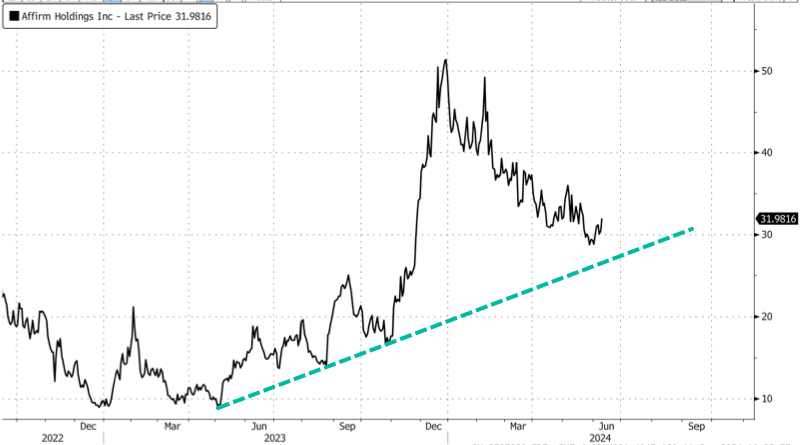
In other Apple news, iPhones and iPads will soon be integrated with Affirm’s buy now, pay later feature. This product will soon be available for Apple Pay users.

First appearing in Affirm’s 8-k filing on Tuesday morning, new “payment products are expected to be available to Apple Pay users in the United States later this year.” 

“This will enable those users checking out online or in-app with Apple Pay on iPhone and iPad to be able to apply to pay over time with Affirm,” the fintech company wrote in the filing. 

It noted, “Affirm does not expect this partnership to have a material impact on revenue or gross merchandise volume in fiscal year 2025.” 

Mizuho Securities analyst Dan Dolev wrote in a note to clients, “The news is a big positive for AFRM, especially since the stock traded down several times in the past when Apple announced its entry into BNPL.” 

Shares of Affirm are up nearly 6% in the first hour of the US cash session.

In recent years, we’ve outlined the explosion in BNPL use among consumers.

Bloomberg data featuring “BNPL” headlines in corporate media has rocketed higher since the onset of Covid, signifying the payment method first became popular in early 2020.

Meanwhile, the Bank for International Settlements has warned that BNPL adoption is high among young adults, particularly those with low education. The report said this is a troubling trend, given that overuse and poor understanding of the service can be disastrous for consumers and lead to overindebtedness. 

Why Apple is only now deciding to embed BNPL into Apple Pay may reflect a recent theme Goldman has pushed out about a struggling consumer.

Tyler Durden
Tue, 06/11/2024 – 15:25

RFK Jr. Inching Closer To Qualifying For CNN’s June 27 Presidential Debate

RFK Jr. Inching Closer To Qualifying For CNN’s June 27 Presidential Debate

Authored by Jeff Louderbeck via The Epoch Times,

Robert F. Kennedy Jr. is simultaneously working to get on the ballot in all 50 states and the District of Columbia, and racing to meet a June 20 deadline to qualify for CNN’s presidential debate.

The independent presidential candidate is getting closer to accomplishing both objectives.

After submitting 3,300 signatures in Minnesota on June 7, Mr. Kennedy noted that he has ballot access in 19 states with 278 Electoral College votes.

CNN is scheduled to host the earliest televised presidential debate in history on June 27.

According to debate qualification rules listed by CNN, a candidate’s name must appear on a sufficient number of state ballots to reach the 270 electoral vote threshold to win the presidency by June 20.

The Kennedy–Shanahan ticket is officially on the ballot in nine states—California, Delaware, Florida, Hawaii, Michigan, Oklahoma, South Carolina, Texas, and Utah.

The campaign said it had collected enough signatures for ballot access in 10 other states—Idaho, Iowa, Minnesota, Nebraska, Nevada, New Hampshire, New Jersey, New York, North Carolina, and Ohio.

Candidates must also get “at least 15 percent in four separate national polls of registered or likely voters that meet CNN’s standards for reporting.”

The window to determine eligibility for the June 27 debate opened on March 13 and will close on June 20, according to CNN.

CNN issued a long list of polls that meet its standards for debate eligibility, including surveys from CNN, ABC News, CBS News, Fox News, Marquette University Law School, Monmouth University, NBC News, The New York Times/Siena College, NPR/PBS News Hour/Marist College, Quinnipiac University, the Wall Street Journal, and The Washington Post.

According to his campaign, Mr. Kennedy has met the requirements for three of those polls. Last week, he gained 17 percent support in a Marquette Law School survey. In April, he gained 16 percent backing in CNN and Quinnipiac polls.

A recent Harvard CAPS-Harris poll showed that 71 percent of voters want to see candidates outside of the two major parties included in this year’s presidential debates.

President Joe Biden and former President Donald Trump, the presumptive Democrat and Republican nominees, agreed to take the stage on June 27 on CNN, the outlet confirmed in a May 15 press release.

The current and former presidents will also meet for a Sept. 10 debate televised by ABC.

(Left) President Donald Trump. (Right) Democrat presidential candidate Joe Biden during the final presidential debate at Belmont University in Nashville, Tenn., on Oct. 22, 2020. (Brendan Smialowski and Jim Watson/AFP via Getty Images)

The non-partisan Commission on Presidential Debates has overseen all presidential forums since 1988.

In a May 15 letter to the Commission on Presidential Debates, President Biden’s campaign said he would not participate in the commission’s planned fall debates, citing the preference for earlier dates.

President Trump’s campaign also sent a letter to the commission last month stating it would like earlier debates as well.

Both campaigns have said that CNN assured them Mr. Kennedy would not take part in the debate, although former President Trump told Scripps News on May 16 that he had “no problem” with Mr. Kennedy participating.

CNN announced its qualification guidelines on May 15; however, President Biden and former President Trump will not appear on enough state ballots to win 270 electoral votes by June 20 because their respective parties do not nominate their candidates until July and August.

Until then, they are presumptive nominees.

States typically certify presidential candidates in August and September.

Until this year, presidential debates have been held in late September and October after candidates have been formally nominated by their parties.

At least 10 states haven’t yet certified Mr. Kennedy’s candidacy, which could impact on his eligibility for the debate.

Independent Cornel West, Green Party nominee Jill Stein, and Libertarian Party nominee Chase Oliver are not remotely near the debate qualification guidelines.

In a post on X on May 15, Mr. Kennedy expressed his dismay at not being included.

“Presidents Trump and Biden are colluding to lock America into a head-to-head match-up that 70 percent say they do not want. They are trying to exclude me from their debate because they are afraid I would win,” Mr. Kennedy wrote.

On May 28, Mr. Kennedy filed a complaint with the Federal Election Commission, claiming that CNN collaborated with the campaigns of President Joe Biden and former President Donald Trump to keep him out of the forum.

Mr. Kennedy has said multiple times that he will satisfy CNN’s requirements, but the FEC complaint alleges that the broadcast outlet is “illegally demanding” that he meet different participation criteria than President Biden and President Trump and that the debate is “a large, prohibited campaign contribution” to the current and former presidents.

According to the complaint, “broadcasters like CNN are not permitted to pre-select the candidates who may participate,” and “debate hosts are also not allowed to use nomination by a particular political party as the sole objective criterion to determine whether to include a candidate in a debate.”

CNN “colluded” with “the Biden committee and the Trump committee” to schedule a debate with criteria “designed to result in the selection of certain pre-chosen candidates, namely Biden and Trump,” the complaint alleges.

That is “a clear breach of federal campaign finance law,” Mr. Kennedy’s complaint states.

It asks that the FEC prevent the June 27 debate from happening “until the parties have come into compliance with the Federal Election Campaign Act.”

Stefanie Spear, Mr. Kennedy’s press secretary, confirmed that the candidate will accept an invitation to participate in the June 27 event if he qualifies.

CNN disagrees with what Mr. Kennedy contends in his legal complaint.

“As the presumptive nominees of their parties both Biden and Trump will satisfy this requirement,” a CNN spokesperson said.

“Per CNN, that presumption isn’t afforded to RFK Jr. The mere application for ballot access does not guarantee that he will appear on the ballot in any state.”


Tyler Durden
Tue, 06/11/2024 – 15:05

JPM Analysts Say Tesla’s Robotaxis Are “Years” Away From Launch 

JPM Analysts Say Tesla’s Robotaxis Are “Years” Away From Launch 

Elon Musk has said that a purpose-built robotaxi will be the centerpiece of his long-term strategy for Tesla.

In about two months, on August 8, Musk is set to unveil the ‘Robotaxi,’ potentially positioning Tesla to compete with some of the largest ride-hailing services. However, before these robotaxis flood city streets and highways, Tesla must first solve full autonomous driving mode.

Tesla has yet to announce a timeline for the Robotaxi or Full Self-Driving (FSD) with no intervention.

Musk recently said that future FSD versions are getting so accurate that “it is starting to get to the point where, once known bugs are fixed, it will take over a year of driving to get even one intervention.” 

Tesla’s latest FSD version (Full Self-Driving v12.4.1) has become more refined ahead of the robotaxi unveiling event. 

At the recent JPMorgan European Automotive Conference in London, analysts from the bank, led by Ryan Brinkman, wrote in a note on Tuesday about a conversation with Tesla’s Director of Investor Relations, Travis Axelrod. 

Brinkman provided clients with a seven-point bullet list highlighting the most critical topics discussed:

  1. The next wave of the company’s growth will be led by the introduction of lower cost models expected in force by 2025 which utilize existing platforms and assembly lines rather than the earlier planned next-generation platform, suggesting the potential for less near-term reduction in COGS but also significant capital savings;

  2. Augmenting the re-acceleration of unit volume growth next year is expected to be continued strong growth in energy storage and services, and autonomy becoming a more meaningful contributor;

  3. Nothing has changed with regards to the company’s ambitious long-term volume targets;

  4. Ratification of CEO Elon Musk’s 2018 compensation plan at a shareholder meeting later this week was said in our meetings to be important in allowing the company to refocus on operational goals by putting the corporate governance issue behind it and because it would allow Mr. Musk to remain comfortable pursuing “real world AI” opportunities within Tesla;

  5. Mr. Musk’s creation of a separate vehicle (xAI) to pursue more generalized or language model artificial intelligence opportunities outside of Tesla was said to not conflict with the automaker’s more robotics focused AI efforts;

  6. Management continues to believe in the superiority of its vision-only based approach to Full Self-Driving, believing it to be by far the lowest cost and most scalable way forward;

  7. Because Tesla expects varying degrees of interest on the part of customers when it comes to placing their private vehicles on a public robo- taxi network, it expects to augment this supply with a dedicated robo-taxi vehicle which will offer cost and utility advantages relative to a traditional consumer vehicle (the expected basing of this dedicated robo-taxi on Tesla’s delayed next- generation platform in our view implies timing could be some years away).

Brinkman provides highlights from the conversation on robotaxi. The biggest takeaway is that the analyst doesn’t believe there will be material revenue generation from these taxis “for years to come.” 

  • Tesla’s Response: Management continues to believe in the superiority of its vision- only based approach to Full Self-Driving, believing it to be by far the lowest cost and most scalable way forward. Because Tesla expects varying degrees of interest on the part of customers when it comes to placing their private vehicles on a public robo- taxi network, it expects to augment this supply with a dedicated robo-taxi vehicle which will offer cost and utility advantages relative to a traditional consumer vehicle. The expected basing of a dedicated robo-taxi on Tesla’s next-generation platform in our view implies timing could be some years away.

  • IR clarified that Tesla’s Full Self Driving (FSD) offering today is an (exceptionally capable) Level 2 system requiring close driver supervision but which it hopes for all vehicles built since 2016 equipped with the requisite hardware to eventually evolve via a software update into a Level 5 (non- geofenced) entirely unsupervised system capable of scaling in virtually any jurisdiction. Management continues to believe that this can be accomplished via vision sensing alone, similar to how human drivers can adequately operate a vehicle with “two cameras attached to the front of their heads” (their eyes) accompanied by a “neural network” (their brain).

  • IR clarified, too, that it has all along intended to pursue a two-pronged approach in which its planned robo-taxi network could be operated with a combination of customer provided vehicles as well as a dedicated robo-taxi. Tesla has long discussed the potential for customers who purchase vehicles equipped with FSD to one day generate a return by offering their vehicles for use on the company’s robo-taxi network when not needed for personal use. With that said, Tesla expects there will be varying degrees of interest on the part of customers when it comes to making their private vehicle available for public use; as such, it plans to augment the supply of customer vehicles on its network with a dedicated robo-taxi. Not discussed in our meeting was who would be the owner of these vehicles — if Tesla would look to sell them to commercial fleet operators or to own and operate the vehicles itself (similar to Cruise). Tesla’s asset-light approach to robo-taxi service operation has in our meetings with investors often been heralded by bullish investors as a superior and more quickly scalable approach to that planned by the likes of Waymo or Cruise which we expect to own the vehicles they plan to operate.

  • Tesla expects that a dedicated robo-taxi would be less expensive for it to manufacture than one of its standard vehicles, in contrast to the robo-taxis of its competitors such as Waymo, Cruise, and others which are reported to be many times more expensive. Tesla expects to reduce the cost of a robo-taxi by utilizing its lower cost next-generation platform, and by removing unnecessary content such as the steering wheel and other driver controls, such as turn signal and wiper indicators and brake and accelerator pedals, etc. A dedicated robo-taxi is also likely to not require the same speed, handling, and performance characteristics as a retail vehicle, given its likely employment in lower speed urban environments, suggesting additional savings when it comes to the battery, powertrain, and other features. All told, Tesla could see costs falling potentially to as low as $20K per vehicle, rivaling the cost even of public transportation and representing a very significant competitive advantage vs. competitor vehicles costing reportedly ~10x as much, given their use of numerous redundant LiDAR, radar, ultrasonic, and other sensor systems.

Here’s the biggest takeaway from the robotaxi conversation

  • Our Take: Competitor systems cost 10x as much as Tesla targets because of the use of redundant sensors competitors believe are critical to ensure safety and achieve regulatory approval. Tesla is pursusing a highly differentiated vision-only or primarily vision approach to autonomous driving that has the potential to be alternatively both a home run or ineffective. We do not know the outcome but fear that consensus expects and valuation demands it will be a home run, leading to Tesla capturing an out-sized share of the robo-taxi market, which is far from certain. We expect also that the timeframe for any company to generate material revenue from robo-taxi operations may be further out than market expectations. Other indications of high investor expectations along this front include TSLA shares reacting sharply positively to the announcement of the robo-taxi day and rising fully +15.3% on April 29 alone (vs. the S&P 500 +0.3%) simply on the news that China would allow some limited testing of FSD (in a way still much more restrictive than in the US). We expect Tesla to show a robo-taxi concept on August 8 and perhaps an accompanying app and to reveal more about its expected business model, but we do not expect material revenue generation likely for years to come. Some hint of this may have been implied in our meeting when it was suggested that the dedicated robo-taxi would be built on the company’s next-generation platform which was elsewhere in our meeting said to not launch until the company is much closer to utilizing its current ~3 mn units of installed capacity (Bloomberg consensus currently forecasts Tesla delivering 3 mn vehicles only by 2027).

Robotaxis have the potential to be a major revenue driver for Tesla. However, as previously noted, fully solving FSD is a prerequisite before these taxis can hit the road.

Tyler Durden
Tue, 06/11/2024 – 14:45