61.4 F
Chicago
Wednesday, September 23, 2026
Home Blog Page 2563

Treasury Yields Jump To One-Week High After Ugly 3Y Auction

Treasury Yields Jump To One-Week High After Ugly 3Y Auction

In a week where all attention will be on the CPI and Fed, clearly how bonds trade will be extremely important, so the reaction to today’s 3Y auction was closely watched. And it was not pretty.

When the Treasury sold $58 billion in 3Y paper for sale, the market reaction was not pretty and for good reason: the demand sucked. Stopping at a high yield of 4.659%, up from 4.659% in May and the highest since November’s 4.701%, the auction tailed the When Issued 4.648% by 1.1bps, the first tail since April.

The bid to cover slumped to 2.433 from 2.632, the lowest since December ’23, and well below the six-auction average of 2.567.

The internals were mediocre at best, with Indirects awarded just 64.1%, the lowest since April but above the six-auction average of 63.2, which was dragged much lower due to the 52.1$ Indirects in the December auction. And with Dealers awarded 20.0%, the most since December, Directs were left holding 15.9%, the lowest since March.

Overall, this was an ugly – if not horrendous – auction, and the market reacted accordingly, sending yields to session highs and the 10Y rising as much as 4.48%.

Tyler Durden
Mon, 06/10/2024 – 13:22

Why Young Voters And Blacks Have Abandoned Biden In Two Pictures

Why Young Voters And Blacks Have Abandoned Biden In Two Pictures

Authored by Mike Shedlock via MishTalk.com,

As Democratic strategist James Carville explained in 1972: “It’s the economy, stupid.”

Data from the BLS, chart by Mish

Two new pictures tell the 2024 story.

Age Group Synopsis

  • Overall: 4.1 up from 3.4

  • 16-19: 12.3 up from 9.3

  • 20-24: 7.9 up from 5.4

  • 25-34: 4.1 up from 3.6

  • 45-54: 2.5 up from 2.1

  • 55+: 2.7 up from 2.3

The overall, 16-19, and 20-24 age group unemployment rates all bottomed in April of 2023.

Since then, the overall unemployment rate increased by 0.6 percentage points, age group 16-19 by 4.0 percentage points, and age group 20-24 by 2.5 percentage points.

Young voters have been hammered on a relative basis.

Unemployment Rate by Race

The unemployment rate of blacks has jumped from 4.8 percent to 6.1 percent while that of whites rose from 3.0 percent to 3.5 percent.

For Hispanics, the unemployment rate jumped from 4.1 percent to 5.0 percent.

I have been talking about the plight of young people and blacks since February. Mainstream media is just now catching on.

Economic Data Paint a Picture of Two Americas

The Wall Street Journal reports Economic Data Paint a Picture of Two Americas

The rich are feeling confident, but lower-income households are growing cautious.

A growing disconnect between the fortunes of upper- and lower-income Americans could account for some of the crossed signals.

In the latest shocker, the Labor Department reported on Friday that the U.S. added 272,000 jobs in May, up from 165,000 in April and much higher than economists’ expectations. The strong reading is especially perplexing because it comes on the heels of a string of weak economic reports in recent weeks, including soft income and spending data for the month of April and a lower-than-expected reading on manufacturing sentiment in May.

Flashback February 2024 MishTalk

Please consider/reconsider my February post: The Fed’s Big Problem, There Are Two Economies But Only One Interest Rate

On average, the economy looks OK. But averages are misleading. Several large groups of people are struggling. They all have one thing in common.

Those looking to buy a home but cannot afford the record high prices, are not faring well in this economy.

Q: Who is Unhappy?
A: Young voters and Blacks.

Flashback April 2024 MishTalk

Please consider/reconsider People Who Rent Will Decide the 2024 Presidential Election

A WSJ Swing State Poll show blacks, especially black males, are abandoning Biden in huge numbers.

In the swing states, 30 percent of black males now support Trump. That’s up from 12 percent in the 2020 election. Trump support from black females is up from 6 percent to 11 percent.

The numbers are not directly comparable because the 2020 numbers are national. However, the numbers flash a huge warning sign.

Q: What is it that young voters [and blacks] really have on their minds?
A: Rent

Flashback May 15, 2024 MishTalk

CPI data from the BLS, chart by Mish

Please consider/reconsider CPI Up 0.3 Percent With Rent Still Rising Steeply

Yet Another Groundhog Day for Rent

Rent of primary residence, the cost that best equates to the rent people pay, jumped another 0.4 percent in April. Rent of primary residence has gone up at least 0.4 percent for 32 consecutive months! 

The “rents are falling” (or soon will) projections have been based on the price of new leases and cherry picked markets. But existing leases, much more important, keep rising.

I now expect (finally!) we will break the string of 32 consecutive months of rent rising 0.4 percent.

I even went out on a limb with my June 5 post I expect a Fed Rate Cut in July Despite Market View of 18.5 Percent Chance

At the risk of looking silly, I think the market is wrong about the odds of a Fed rate cut in July. Let’s discuss why.

My rationale was very weakening economic data coupled with the expectation of a huge slowdown in the the pace of rent inflation. The bizarro jobs report last Friday cut the July rate cut odds to 8.2 percent.

Even if my July rate cut call is correct (and for now I am sticking with that take) rents are not going back where they were four years ago. Meanwhile, home prices are soaring out of sight.

Case-Shiller Home Prices vs Rent

Case-Shiller national and 10-city indexes via St. Louis Fed, OER, CPI, and Rent from the BLS

Flashback May 2, 2024 Mishtalk

Please consider/reconsider Home Prices Hit New Record High, Don’t Worry, It’s Not Inflation

My comment “Don’t worry, it’s not inflation” is sarcasm.

Ironically, it’s also true, at least according to what I suggest is poor economic theory. Economists consider home prices a capital expense not a consumer expense. Thus, home prices are not in any inflation index.

I disagree with definitions of inflation that ignore obvious inflation. And siding with me are young voters, blacks, and anyone looking to buy a home but is priced out of the market while watching rent soar out of sight.

Adding Insult to Injury

On top of it all, unemployment for younger voters and blacks has jumped considerably.

And Biden/Democrats cannot figure out why Trump is still ahead in the polls despite him being convicted of a felony (in a farce of a trial that never should have taken place in the first place).

Another Bizarro Jobs Report – Payrolls Rise 272,000 Employment Drop 408,000

Nonfarm payrolls and employment levels from the BLS, chart by Mish.

For my take on the allegedly hot May jobs report, please see Another Bizarro Jobs Report – Payrolls Rise 272,000 Employment Drop 408,000

Once again, rational people wonder what’s going on with the jobs report. The discrepancy between the trend in jobs and employment surges again.

In the last year, jobs are up 2.8 million while full-time employment is down 1.2 million.

Job numbers based on the entire data (QCEW – Quarterly Census of Employment and Wages) lag by the monthly jobs report by about 5 months but are far more accurate.

Year-Over-Year Change in Nonfarm Payrolls vs QCEW in Thousands

In my follow-up post on the May jobs report, I ask and answer the question How Much Did the BLS Birth-Death Adjustment Pad the May Jobs Report?

The short answer is the BLS overstated 2023 jobs by 735,000 (all in the fourth quarter) and it may or may not have anything to do with BLS birth-death adjustments.

See the above link for details.

Meanwhile, don’t expect any economic improvements for young voters and blacks because improvement is unlikely even if the Fed gets in a token rate cut or two.

Actually, a Fed rate cut would be a sign of a weakening economy. And a weakening economy would help Trump, not Biden.


Tyler Durden
Mon, 06/10/2024 – 13:00

“Went Off Radar”: Military Plane Carrying Malawi’s Vice President Goes Missing

“Went Off Radar”: Military Plane Carrying Malawi’s Vice President Goes Missing

A military plane carrying Malawi’s vice president and nine others has gone missing, sparking a massive search operation.

AP News reports Vice President Saulos Chilima’s plane left the capital, Lilongwe, and failed to land at Mzuzu International Airport – about 230 miles north.

“All efforts by aviation authorities to make contact with the Aircraft since it went off the radar have failed thus far,” the government wrote in a statement.

Here’s the full statement:

X user Malawi Elects wrote, “This Dornier 228 as used by the VP today, was purchased from Germany as a transport plane for the MDF some decades back and was long overdue for retirement. Two years ago, the MDF took delivery of two Xian MA600.” 

In an unrelated incident last month, Iranian President Ebrahim Raisi and the country’s foreign minister died in a helicopter crash

*Developing… 

Tyler Durden
Mon, 06/10/2024 – 12:40

“Time For Some 3D Chess”: Here’s Why A Battered Macron Just Called Snap Elections

“Time For Some 3D Chess”: Here’s Why A Battered Macron Just Called Snap Elections

By Stefan Koopman, Senior macro strategist at Rabobank

The European elections saw the centre hold its ground, albeit narrowly. The European People’s Party is poised to secure 184 seats in the new 720-seat Parliament, with the Socialists and the centrist Renew obtaining 139 and 80 seats respectively. This totals 403 seats for the grand coalition, a decrease from their current 417 seats in the old 705-seat Parliament. The hard-right ECR alliance of Giorga Meloni’s Fratelli d’Italia and the Polish nationalists are projected to rank fourth, with 73 seats, while the far-right Identity & Democracy group is expected to gain 58 seats. The Greens suffered a significant loss, dropping to sixth place with 52 seats, with the Left following at 36 seats, a slight decrease. There are also 45 seats for non-attached members, and 53 newly elected members that are not allied to any of the political groups yet. The overall left-right balance aligns with projections that indicated a lean but not a lurch to the right.

The coming weeks will see national parties formally choosing their European groups and this may alter the seat numbers. The battle for top positions commences at this week’s G7. The most coveted roles are the presidencies of the European Commission, European Council, European Parliament, and the EU Foreign Affairs Chief. The first EU summit of government leaders will be on June 27 and 28, where they will seek to nominate the new president of the European Commission. Nominations for the new European Commissioners will follow after the summer, with all nominees appearing at hearings in the European Parliament in the autumn. The new European Commission then begins on December 1, if everything goes according to plan.

So there’s still a long road ahead, but the implications are clear. Despite the center maintaining the majority, this is the most right-wing European Parliament ever elected. The results signal a European shift towards conservative and radical-right policies and away from progressive and green politics. The center will have to accommodate this shift over the coming years and will sometimes have to lean right to maintain a majority. It means that internal EPP politics will be a major factor in the direction of European policy, being both the median and the largest party in this parliament. We discussed our take on this here.

The Sunday Surprise was in Paris, not Brussels. Following a drubbing in the European election, French President Macron decided it was time to play some 3D Chess and to call a snap parliamentary election for June 30 and July 7, just a fortnight before the start of the Olympics. With this bold move he is putting Le Pen’s Rassemblement National, which dominated yesterday’s election by securing 31.5% of the votes, to the test. The two-round system often presents difficulties for populist parties, making it possible that the far-right may not achieve an outright majority. However, even if they triumph and RN’s Bardella does assume the role of Prime Minister, Macron’s calculation appears to be based on the assumption that if they underperform, they’ll be in a much weaker position for the 2027 presidential election. He also seems intent on compelling the Socialists and the Republicans to join the majority, which would likewise put them at a disadvantage in the 2027 election. This particularly places Melenchon, who aims to consolidate the entire left ahead of that election, in a difficult position. His courage is undeniable, we’d give him that, but it seems like doubling down on a bet after a poor performance.

Investors don’t share Macron’s risk appetite. The euro is the worst performing G10 currency this morning, trading at 1.075 at the time of writing. The CAC 40 is down 1.5%, dragging the Euro Stoxx 50 lower towards a -1.2% loss. Yields on EGBs are rising, with spreads widening, including France’s. The 10-year note now yields 3.17%, up 8 basis points on Friday’s close.

This follows the losses suffered by the EUR on Friday afternoon, after a ‘hot’ NFP report indicated that the US economy added 272,000 jobs in May, surpassing the consensus forecast once again. The unemployment rate slightly increased to 4.0%, and average hourly earnings rose by 0.4% monthly, to an annual rate of 4.1%.

It was one of those reports that serves as a reminder that the Employment Report is based on two separate surveys, with a lot of noise in the establishment survey and even more noise in the household survey. They now present two different perspectives on the labor market: one suggests steady, broad-based, and solid hiring, while the other indicates a sharp slowdown in hiring over the past year, with unemployment and underemployment ticking higher. Throwing last week’s JOLTS report in the mix too, the overall picture is of a solid labor market that is showing signs of loosening, appearing increasingly more ‘pre-pandemic’ than ‘post-pandemic’. It also implies that the US needs a higher rate of job growth to maintain the unemployment rate, possibly due to the surge in immigration. The ‘breakeven pace’ of monthly job growth may be significantly higher than the generally assumed 100-150k. The upshot is that the labor market may not be as hot as the headline NFP’s suggest.

Tyler Durden
Mon, 06/10/2024 – 10:45

Bitcoin ETFs Sucked Up 2 Months Of BTC Mining-Supply In First Week Of June

Bitcoin ETFs Sucked Up 2 Months Of BTC Mining-Supply In First Week Of June

Authored by Jesse Coghlan via CoinTelegraph.com,

Spot Bitcoin exchange-traded funds (ETFs) in the United States acquired the equivalent of around two months’ worth of the cryptocurrency’s mining supply in the first week of June.

With inflows of approximately $1.83 billion, the 11 ETFs bought 25,729 Bitcoin in the trading week between June 3 and 7 – around eight times more than the 3,150 new BTC mined over the same time, according to data from HODL15Capital.

The amount of Bitcoin acquired in the week alone was almost as much as the entire of May, 29,592 BTC, per HODL15Capital’s count, and is the biggest week of buying since mid-March when Bitcoin hit its current all-time high of $73,679.

The weekly BTC buys of U.S. Bitcoin ETFs since their Jan. 11 launch. Source: HODL15Capital

The 11 ETFs have seen $15.69 billion in net inflows since their January launch, including the $17.93 billion in net outflows from Grayscale’s fund, with total assets under management (AUM) of around $61 billion.

Bitcoin proponents have long touted cryptocurrency as “digital gold” due to its built-in scarcity mechanism, which sees only 21 million BTC ever being issued.

ETF Store president Nate Geraci noted in a June 9 X post that Bitcoin ETF AUM is around 60% that of the country’s gold ETFs, despite gold ETFs being around for 20 years and Bitcoin ETFs for only five months.

Bitcoin touched a high of $71,093 on June 5 amid the surge of inflows to the U.S. Bitcoin ETFs, the first time the asset has been above $71,000 since May 21, according to Cointelegraph Markets Pro.

The cryptocurrency has struggled to pass its current high, as its price is “more heavily influenced by macroeconomic factors and geopolitical events,” crypto exchange co-founder “Radar Bear” told Cointelegraph on June 7.

Tyler Durden
Mon, 06/10/2024 – 10:25

New Images Reveal Houthi Missile Damage To Oaktree’s Previously-Owned Bulk Carrier

New Images Reveal Houthi Missile Damage To Oaktree’s Previously-Owned Bulk Carrier

For the first time, shocking new images have surfaced on social media, revealing the extensive damage to the previously owned US bulk carrier “True Confidence.” This vessel was engulfed in flames following a missile attack by Iranian-backed Houthis earlier this year. 

On March 6, Houthis fired an anti-ship ballistic missile that hit the vessel. The US military’s Central Command (Centcom) confirmed the attack, releasing two images of the heavily damaged bulker. 

Source: US Centcom 

Immediately after the attack, the Houthis claimed it targeted the bulk carrier because it was “American” – something the owners denied. 

Perhaps the Houthis weren’t up to date in shipping transactions because, according to the Financial Times, US private equity group Oaktree Capital unloaded the vessel just days before the attack to Liberia-registered True Confidence SA, the owner and managers Third January Maritime of Piraeus, Greece. 

Here are the newest images of True Confidence:

Source: The Sea In Arabic

The latest attack on a cargo ship occurred on Sunday in the Gulf of Aden. Private security firm Ambrey said a missile hit the forward station of the vessel. The British military’s United Kingdom Maritime Trade Operations reported “Damage Control Underway” on the vessel. 

Six months into the Biden administration’s Operation Prosperity Guardian to defend the critical maritime chokepoint Bab al-Mandab Strait has proven disastrous so far. This is a reflection of the administration’s weak foreign policy. 

Tyler Durden
Mon, 06/10/2024 – 10:05

Disinformation Allegations Fly At Harvard’s Disinformation Center

Disinformation Allegations Fly At Harvard’s Disinformation Center

Authored by Jonathan Turley,

For years, free speech advocates (including myself) have criticized the new rationalization for censorship in the cause of combating disinformation, misinformation, and malinformation. As discussed in my new book, The Indispensable Right: Free Speech in an Age of Rage,  there is a burgeoning cottage industry in academia in helping corporations and government agencies to target certain political, social, and scientific viewpoints. One of those centers is located at the Harvard University’s Shorenstein Center on Media, Politics, and Public Policy. Now, however, the faculty are accusing each other of misinformation over the departure of “misinformation and disinformation” expert Joan Donovan.

Joan Donovan

According to an article in The Chronicle of Higher Education, Donovan is in a spat with her former colleagues over the events and accusations leading up to her departure. She has released a 248-page document from December 2022 in which she alleged that Meta (formerly Facebook) was behind a campaign targeting  her and her team, the Technology and Social Change Project. She alleged that her position was eliminated at the behest of  Elliot Schrage, a former Facebook executive and Harvard alumnus, as well as other Meta executives.

Donovan cites a Zoom call in October 2021 in which she alleges that Schrage dominated the discussion and accused her of inaccurately reading documents related to Facebook. However, a recording of the meeting shows that Schrage spoke for only three minutes and that the Facebook files were never discussed.

Facebook was long accused of a massive censorship program but, unlike Twitter, never voluntarily released its files for public scrutiny.

Now various Harvard staff and former staff are accusing Donovan of spreading misinformation or disinformation. They insist that Meta never exerted pressure on the group and accuse Donovan of lying in making such claims as Harvard owning the copyright to her book “Meme Wars.”

They also say that it is untrue that the university stole her plans to publish confidential Facebook documents. Latanya Sweeney, a professor who worked on the project, called Donovan’s version of events “gross mischaracterizations and misstatements.” Sweeny maintains that the vast majority of the work on the project was done by Sweeney and her team.

Fortunately, none of these adversaries will be banned or throttled on social media for alleged disinformation or misinformation. Free speech protects such disagreements and allows the truth to be established by open debate and discourse.

Tyler Durden
Mon, 06/10/2024 – 09:45

Key Events This Week: Fed, CPI and PPI

Key Events This Week: Fed, CPI and PPI

With the (ridiculously manipulated propaganda) jobs report now in the history books, this week the whole financial world will be focused on Wednesday with two big events occurring: the latest FOMC and CPI (with PPI to follow on day later). Below, DB’s Jim Reid previews the first two below but other events this week include NY Fed 1-yr inflation expectations today, UK employment data, US small business optimism and a 10yr UST auction tomorrow, China CPI and Japanese PPI on Wednesday, waking up to a mid-life crisis on Thursday alongside US PPI and a 30yr UST auction, with the BoJ decision and the US UoM consumer sentiment on Friday.

Before we delve deeper, it is fascinating to see the negative reaction of French bond markets this morning after the surprise news last night that Macron has called for snap legislative elections which will take place in two rounds on June 30th and July 7th. This is after his party trailed with 15% in the European Parliamentary (EP) elections with Le Pen’s National Rally (RN) winning 32%. Although this was broadly in line with expectations, Macron is likely hoping to win back some momentum and hope a notable part of the EP results were a protest vote and also encourage other centrist parties to help rally round to limit the charge of Le Pen. His other hope would be that if RN have a bigger part in government, their appeal may diminish before the next Presidential elections in 2027. So a big gamble.

In terms of the wider EP elections the main takeaway is that even with the uncomfortable results in France and Germany, the centrist majority is holding as the far-right didn’t outperform expectations in aggregate. As the results have started to materialise the Euro is -0.44% lower as I type, at 1.0753 against the dollar, its weakest level in nearly a month.

Moving forward, Reid previews the main events of the week in more detail now. According to the DB strategist, it’s not very often you have a US CPI released on the same day as a FOMC meeting and the former will certainly factor into the latest Fed Summary of Economic Projections (SEP). On Friday, a few US houses who were expecting summer Fed cuts pushed back their projections after the strong payroll number and this release will also influence the tone of the meeting. DB economists believe the new SEP forecasts are likely to revise core PCE inflation higher this year (2.8%), and move the median dot from three rate cuts to two with a desire for optionality for September perhaps the only thing preventing this moving nearer to DB’s long standing expectation of a cut only arriving in December. The DB econ team also expects the 2025 median dot to move up by 25bps as well and the long-run dot to 2.75% (with risks it moves even higher).

Powell’s press conference will no doubt offer nuances around any changes and will have the ability to put a dovish or hawkish spin on them. At this stage optionality will likely be preferred with little specific guidance.

May’s CPI release hours earlier will cast a long shadow over the meeting. The DB Econ team expects headline CPI (+0.12% forecast vs. +0.31% previously) to come in softer than core (+0.27% vs. +0.29%), helped by declining gas prices last month. This would reduce the core YoY rate by a tenth to 3.5%, with the headline remaining steady at 3.4% (in-line with consensus). Under these forecasts the three-month annualized core rate would fall three-tenths to 3.8%, while the six-month annualized rate would remain at 4.0%. Obviously as ever rents will get a lot of attention to see if they are falling as the models suggest they should be and then for PPI on Thursday, the components that feed directly into core PCE (namely health care services, domestic airfares, and portfolio management) will be the main thing to watch.

For the Fed to cut rates in September (unlikely in our eyes), or earlier (only in an imminent crisis), inflation must fall sharply, or employment needs to weaken considerably. For the latter, Friday’s payroll suggested that this will be tough to see in the data quickly enough. May’s headline (+272k) and private (+229k) payroll gains were well above the +180k and +165k expected respectively with a 0.4% gain in average hourly earnings a tenth higher than expected. The diffusion index (63.4) was the highest level since January 2023 which shows that job growth has broadened out after narrow gains for a lot of the last year.

The other two big events of the week are the Chinese inflation and the BoJ. For the former, current median estimates on Bloomberg suggest the CPI may improve to +0.4% YoY in May from +0.3% in April, with the PPI also coming in higher relative to the previous reading (-1.5% vs -2.5% in April). For the latter, economists expect the target short-term interest rate to remain unchanged but highlights that the focus will be on guidance for JGB purchases. They also see changes including a reduction of the central bank’s purchases from the current 6tn yen per month to 5tn yen.

Courtesy of DB, here is a day-by-day calendar of events

Monday June 10

  • Data : US May NY Fed 1-yr inflation expectations, Japan May bank lending, Economy Watchers survey, April BoP current account balance, BoP trade balance, Italy April industrial production, Sweden April GDP, Norway and Denmark May CPI
  • Central banks : ECB’s Holzmann speaks
  • Auctions : US 3-yr Notes ($58bn)

Tuesday June 11

  • Data : US May NFIB small business optimism, UK April average weekly earnings, unemployment rate, May jobless claims change, Japan May M2, M3, machine tool orders, Canada April building permits
  • Central banks : ECB’s Villeroy, Rehn, Holzmann and Lane speak
  • Earnings : Oracle, GameStop
  • Auctions : US 10-yr Notes (reopening, $39bn)

Wednesday June 12

  • Data : US May CPI, monthly budget statement, China May CPI, PPI, UK April monthly GDP, Japan May PPI, Germany April current account balance
  • Central banks : Fed’s decision, ECB’s Guindos speaks
  • Earnings : Broadcom

Thursday June 13

  • Data : US May PPI, initial jobless claims, UK May RICS house price balance, Germany May wholesale price index, Italy Q1 unemployment rate, Eurozone April industrial production
  • Central banks : Fed’s Williams interviews US Treasury Secretary Yellen
  • Earnings : Adobe, Wise
  • Auctions : US 30-yr Bond (reopening, $22bn)

Friday June 14

  • Data : US June University of Michigan survey, May import and export price indices, Japan April Tertiary industry index, capacity utilisation, Italy April trade balance, general government debt, Eurozone April trade balance, Canada April manufacturing sales, Sweden May CPI
  • Central banks : BoJ decision, Fed’s Goolsbee speaks, ECB’s Lagarde, Lane and Vasle speak, BoE’s inflation attitudes survey

Finally, focusing on just the US, Goldman notes that the key economic data releases this week are the CPI report on Wednesday and the PPI report on Thursday. The June FOMC meeting is on Wednesday. The post-meeting statement will be released at 2:00 PM ET, followed by Chair Powell’s press conference at 2:30 PM.

 
Monday, June 10

  • 11:00 AM New York Fed 1-year inflation expectations, May (last 3.26%)

Tuesday, June 11

  • 06:00 AM NFIB small business optimism, May (consensus 89.6, last 89.7)

Wednesday, June 12

  • 08:30 AM CPI (mom), May (GS +0.11%, consensus +0.1%, last +0.3%); Core CPI (mom), May (GS +0.25%, consensus +0.3%, last +0.3%); CPI (yoy), May (GS +3.36%, consensus +3.4%, last +3.4%); Core CPI (yoy), May (GS +3.50%, consensus +3.5%, last +3.6%): We estimate a 0.25% increase in May core CPI (mom sa), the softest sequential pace since October. Our forecast reflects a 3% pullback in airfares and price weakness across consumer products, as indicated by Adobe online price data and consistent with Target’s announced price cuts. We also forecast a deceleration in car insurance rates (+1.0% vs. +1.8% in April) based on online price data. We assume another decline in new car prices (-0.3%) but a 1.1% rebound in the used car measure. We estimate stable inflation in the housing measures (primary rent +0.35%; OER +0.42%). We estimate a 0.11% rise in headline CPI, reflecting lower energy (-1.4%) and unchanged food prices. Our forecast composition is consistent with a 19bp increase in core PCE in May (mom sa).
  • 02:00 PM FOMC statement, June 11-12 meeting: As discussed in our FOMC preview, we continue to expect the first rate cut in September, by which point we expect to have seen five straight months of better inflation news. After September, we expect quarterly rate cuts to a terminal rate of 3.25-3.5%. This implies a second cut in December for a total of two cuts in 2024, four more in 2025, and two more in 2026. At the June meeting, we expect the median forecast of 2024 Q4/Q4 core PCE inflation to rise 0.2pp to 2.8%. The GDP growth and unemployment rate projections should be little changed. We do not expect any significant changes to the FOMC statement or Chair Powell’s message. We expect the median forecast in the dot plot to show two cuts in 2024 (vs. three in March) to 4.875%, four cuts in 2025 (vs. three in March) to 3.875%, and three cuts in 2026 (unchanged) to 3.125%.

Thursday, June 13

  • 08:30 AM Initial jobless claims, week ended June 8 (GS 225k, consensus 220k, last 229k): Continuing jobless claims, week ended June 1 (last 1,792k)
  • 08:30 AM PPI final demand, May (GS +0.1%, consensus +0.1%, last +0.5%); PPI ex-food and energy, May (GS +0.3%, consensus +0.3%, last +0.5%); PPI ex-food, energy, and trade, May (GS +0.3%, last +0.4%)
  • 12:00 PM New York Fed President Williams (FOMC voter) speaks: New York Fed President John Williams will moderate a discussion with Treasury Secretary Janet Yellen at an event hosted by the Economic Club of New York. A Q&A is expected. On May 30, Williams said, “I see the current stance of monetary policy as being well positioned to continue the progress we’ve made toward achieving our objectives… Looking at the broader context, the behavior of the economy over the past year provides ample evidence that monetary policy is restrictive in a way that helps us achieve our goals.” He added, “I expect overall PCE inflation to moderate to about 2½ percent this year, before moving closer to 2 percent next year… Overall, I see some of the recent inflation readings as representing mostly a reversal of the unusually low readings of the second half of last year, rather than a break in the overall downward direction of inflation.”

Friday, June 14

  • 08:30 AM Import price index, May (consensus +0.1%, last +0.9%): Export price index, May (consensus +0.1%, last +0.5%)
  • 10:00 AM University of Michigan consumer sentiment, June preliminary (GS 72.7, consensus 73.0, last 69.1): University of Michigan 5-10-year inflation expectations, June preliminary (GS 3.0%, consensus 3.0%, last 3.0%)
  • 02:00 PM Chicago Fed President Goolsbee (FOMC non-voter) speaks: Chicago Fed President Austan Goolsbee will speak in a fireside chat at the Iowa Farm Bureau Economic Summit. A Q&A is expected. On May 10, Goolsbee said, “There isn’t at this time much evidence, in my view, that inflation is stalling out at 3%…we hit this bump [in Q1] and now I think we wait…I still don’t accept that we’re stuck at the last mile and that’s going to be the hardest. That’s one of the things we’re trying to determine – are we hung up at a higher level of inflation, which is what the last two and a half months say, or is that just a bump, which is what the previous seven months say?” He added, “If r-star is increasing, and maybe it is, why [is it increasing]?…My objection with the arguments that maybe r-star is changing is none of those empirical data contributions that would raise r-star have changed in the last six months.”
  • 07:00 PM Fed Governor Cook speaks: Fed Governor Lisa Cook will give remarks on lessons from the American Economic Association Summer Program. Speech text is expected but a Q&A is not.

Source: DB, Goldman, BofA

Tyler Durden
Mon, 06/10/2024 – 09:40

Colorado Weed Industry In Free-Fall As Sales Plunge By $700 Million

Colorado Weed Industry In Free-Fall As Sales Plunge By $700 Million

Colorado’s cannabis market is in free-fall, going from peak revenues of $2.2 billion in 2020, to $1.5 billion just three years later. The drop has had a substantial impact on the state’s economy – with cannabis tax revenues decreasing more than 30% over the past two years to just $282 million last fiscal year, Politico reports.

The causes are manifold, and include an oversaturated local market, regulatory burdens, and increasing competition from nearby states such as New Mexico and Arizona – two out of 24 states where weed is now legal, which may have been attracting consumers that would have previously made a border run to Colorado.

Tourists who once flooded the state for the opportunity to legally experience Rocky Mountain highs have largely disappeared as the novelty has worn off. Even Texans aren’t driving north to buy weed anymore, satisfied with the proliferation of intoxicating hemp products in their own state.

In fact, sales in Colorado’s southern border counties have fallen nearly 50% from their 2021 peak.

What’s more, the price of weed has plummeted thanks to a supply glut, going from nearly $1700 per pound to around $700. Meanwhile, there’s been more than a 16% drop in the number of cannabis licenses issued over the past year, and 16% drop in cannabis-related jobs in the second year of job losses within the industry, suggesting the market is contracting.

A messy assortment of factors has led to the pioneering industry’s struggles. A supply glut caused weed prices to plummet in the wake of the pandemic. The spread of cheap, largely unregulated intoxicating hemp-derived products further heightened competitive pressures. And marijuana remains federally illegal, subjecting operators to sky-high taxes and costly regulations.

One wholesaler, Veritas Fine Cannabis, had 144 employees at their height. They’re now down to just 21.

We all overestimated the market,” said CEO Jon Spadafora. “We all believed a little bit too much of our own PR.”

In short, the rush to expand cannabis production vs. the changing dynamics of the pandemic made for a ‘deadly combination’ of oversupply and price compression – at a time when cultivators had invested in expansion such that all their capacity came online around the same time in 2021, according to Spadafora.

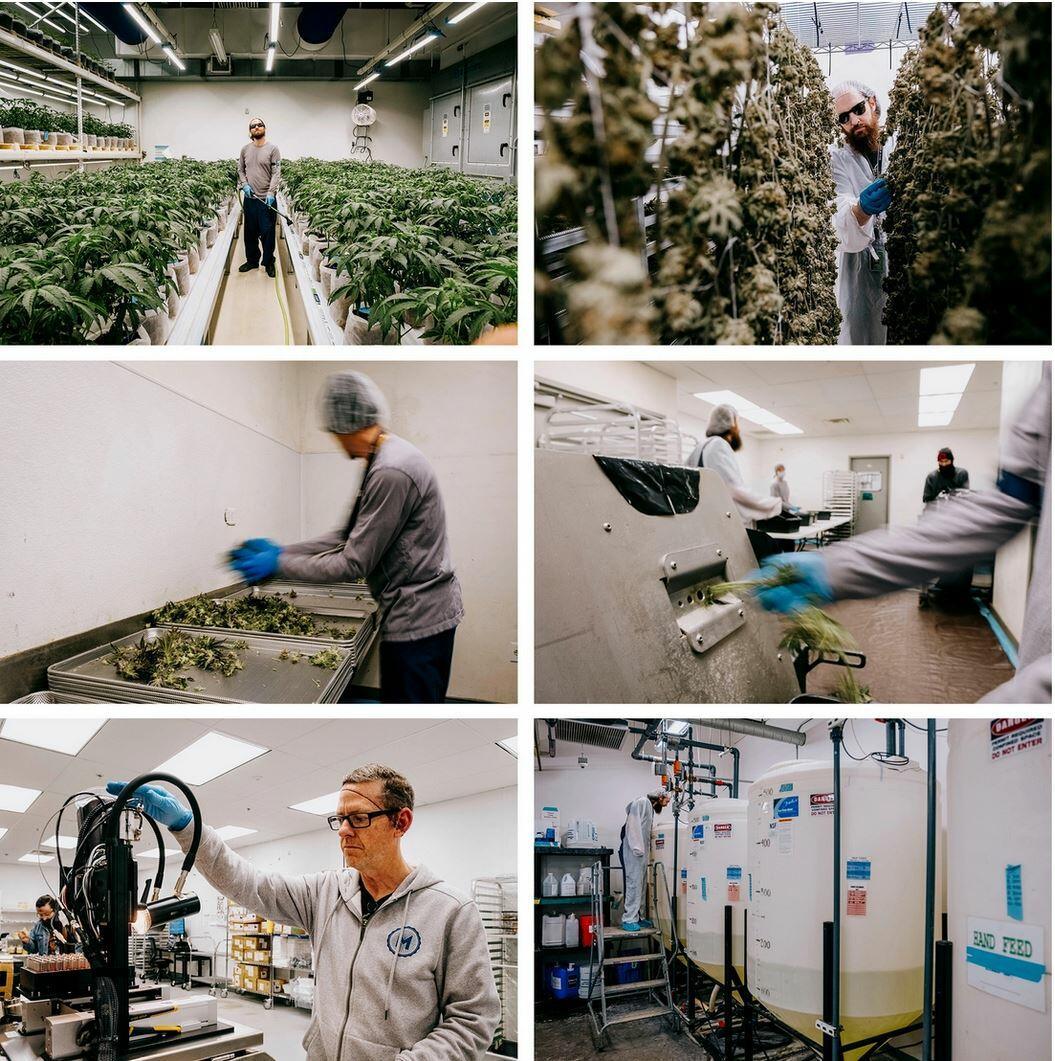
Another wholesaler, Native Roots, used to produce around 32,000 pounds of weed per year at their Denver cultivation facility. By mid the middle of last year, it had cut production in half, according to Jason MacDonald, who is in charge of production.

“We want to be careful to make sure that we don’t oversupply ourselves,” he said.

Various stages of Native Roots Mothership cultivation facility are shown. Part of what helped Native Roots weather the market downturn is that it has 21 of its own dispensaries across the state. (via Politico)

It’s like the wind in our cannabis sails in Colorado has just been sucked all the way out,” Denver dispensary owner, Wanda James of Simply Pure, told the outlet.

Cannabis industry participants in other states are now holding Colorado out as a cautionary tale for other states where weed is legal – with one top New York cannabis official pointing to the dramatic downturn in Colorado as justification for regulators’ hesitance to issue too many licenses at once.

“We’re a victim of our own success,” said Jordan Wellington, a partner at Denver-based cannabis policy and public affairs firm Strategies 64. “New markets drawing investment away, new markets drawing purchasing away — all of these different things combined into the soup of the challenges [facing] Colorado.”

Read the entire report here.

Tyler Durden
Mon, 06/10/2024 – 07:20

The U.S. Economy Is “Finally Cracking”

The U.S. Economy Is “Finally Cracking”

Submitted by QTR’s Fringe Finance 

Friend of Fringe Finance Mark B. Spiegel of Stanphyl Capital released his most recent investor letter on May 31, 2024, with updates on macro and his fund’s positions.

Mark is a recurring guest on my podcast and definitely one of Wall Street’s iconoclasts. I read every letter he publishes and thought it would be a great idea to share them with my readers.

Like many of my friends/guests, he’s the type of voice that gets little coverage in the mainstream media, which, in my opinion, makes him someone worth listening to twice as closely.

Stocks Only

In his most recent letter he offers new takes on his favorite long, his favorite short and his outlook on the market.

Mark on Macro

We remain very net short. This month’s small gain was due to a decline in the price of Tesla (which we’re short) combined with an increase in the price of our long position in Volkswagen (after accounting for it having gone ex-dividend), offset by an increase in the S&P 500 (which we’re short via various ETFs). I discuss VW and Tesla later in this letter, so let’s talk about the S&P, which is very expensive.

The U.S. economy seems to finally be cracking. This month a slew of retailers (off the top of my head: Target, Lowe’s, Macy’s, Kohl’s, Best Buy and Foot Locker) reported negative year-over-year sales comps, and that’s before adjusting for the inflation that makes them 3% to 4% more negative in “real” terms.  Others (Dollar General and Burlington) reported same-store sales comps in the +2% range, but that too was negative when adjusted for inflation, while Walmart and Nordstrom comps managed to roughly keep pace with inflation, but were unable to exceed it. (To its credit, Costco comps did handily beat inflation—I wish I’d bought that damn stock 15 years ago!)

Corroborating the poor retail sales data, final Q1 GDP growth (released May 30th) came in at just 1.3%, primarily because of the weakening consumer, while pending home sales plunged. At some imminent point in time, this stock market will switch from “bad news is good news” to “bad news is bad news” as it suddenly realizes that there’s a HARD economic landing coming and sticky inflation (3.6% core CPI and 2.8% core PCE ) driven by massive federal budget deficits prevents the Fed from cutting enough to compensate for it. That’s what we remain positioned for.

In the far-right column below from Standard & Poor’s are the 12 most recent quarterly operating earnings for the S&P 500 (with Q1 2024 estimated with 88.9%  of companies having reported) and, in the middle column, the price of the S&P 500 as of that date. (The S&P 500 is now at 5277.)

As you can see, nominal earnings have barely grown in the last three years, and although Q1 2024 earnings were up 4.7% year-over-year, that’s only around 1.2% CPI-adjusted. Additionally, those latest earnings are lower “nominally” and much lower “inflation-adjusted” than they were way back in Q4 2021 (when stock prices were much lower). In fact, adjusting for inflation, Q1 2024 earnings came in lower than every quarter of 2021! Annualizing those Q1 2024 earnings to $220.12 ($55.03 x 4) and putting a long-term market average 16x multiple on them would bring the S&P 500 all the way down to just 3522 vs. May’s close of 5277. Even an 18x multiple would bring the S&P down to just 3962 vs. the current 5277. And then what happens to those earnings when we get a recession?

The consensus is now for either “no landing” or a “soft landing,” yet before even the worst recessions the consensus is nearly always for a “soft landing”; for example, here’s just one headline of many from August 2007:

In fact, for reasons I clearly lay out below, I still strongly believe that the U.S. economy is headed for a hard landing. Why do I believe so strongly that we face a “hard landing”? For the same reasons I’ve been stating since the Fed started raising rates in 2022:

There’s no way an “everything bubble” built on over a decade of 0% interest rates and trillions of dollars of worldwide “quantitative easing” can not implode when confronted with 5% U.S. rates and quantitative tightening plus tighter money from the ECB (even with a tiny expected June cut), BOJ and other central banks.

And contrary to the belief of equity bulls with short memories, when an asset bubble unwinds, lower inflation and lower interest rates won’t immediately ride to the rescue. When the 2000 bubble burst and the Nasdaq was down 83% through its 2002 low and the S&P 500 was down 50%, the rates of CPI inflation were 3.4% in 2000, 2.8% in 2001 and 1.6% in 2002, and the Fed was cutting rates almost the entire time.

Yes, a nasty recession was delayed due to a combination of interest rate lag effects, leftover “Covid cash” (which has finally run out), and consumers loading up on credit card debt, but a hard landing will soon arrive as household debt delinquencies are now surging while personal savings have collapsed, and shipping freight data is already recessionary. Yet despite myriad lurking dangers—both economic and geopolitical—the stock market is completely disconnected from a scenario involving any landing. Here are a few exhibits that perfectly capture this decoupling…

A person holding papers and a computer

Description automatically generated

Image

Mark on His Fund’s Positions

For commentary on the positions Mark currently holds in his fund, click here to read the rest of his letter. 

QTR’s Disclaimer: Please read my full legal disclaimer on my About page hereThis post represents my opinions only. In addition, please understand I am an idiot and often get things wrong and lose money. I may own or transact in any names mentioned in this piece at any time without warning. Contributor posts and aggregated posts have been hand selected by me, have not been fact checked and are the opinions of their authors. They are either submitted to QTR by their author, reprinted under a Creative Commons license with my best effort to uphold what the license asks, or with the permission of the author. This is not a recommendation to buy or sell any stocks or securities, just my opinions. I often lose money on positions I trade/invest in. I may add any name mentioned in this article and sell any name mentioned in this piece at any time, without further warning. None of this is a solicitation to buy or sell securities. These positions can change immediately as soon as I publish this, with or without notice. You are on your own. Do not make decisions based on my blog. I exist on the fringe. The publisher does not guarantee the accuracy or completeness of the information provided in this page. These are not the opinions of any of my employers, partners, or associates. I did my best to be honest about my disclosures but can’t guarantee I am right; I write these posts after a couple beers sometimes. I edit after my posts are published because I’m impatient and lazy, so if you see a typo, check back in a half hour. Also, I just straight up get shit wrong a lot. I mention it twice because it’s that important.

Tyler Durden
Mon, 06/10/2024 – 06:55