Bitcoin is considered the world’s most valuable digital currency.
Unlike fiat currencies such as the U.S. dollar, which central banks back, a cryptocurrency like Bitcoin is supported by an underlying blockchain. This blockchain records every Bitcoin transaction in a public, decentralized, and distributed ledger.
Every time bitcoins are spent, a digital transaction record must be validated and added to the blockchain. Miners undertake this task, legitimizing and auditing Bitcoin transactions while earning bitcoins as a reward.
34xp4vRoCGJym3xR7yCVPFHoCNxv4Twseo
According to BitInfoCharts, the world’s top Bitcoin address dates back to October 2018, with a balance of 0.1 BTC (worth $660 at the time).
Since then, it has experienced several massive swings in value, reaching 180,000 BTC ($1.7B) in November 2019 and then falling to 1,370 BTC ($9.4M) in April 2020.
Beginning in late 2020, this address began accumulating bitcoins at a rapid pace, reaching 300,000 BTC ($10.3B) in July 2021.
Since January 2023, its BTC balance has remained constant at around 248,597 BTC.
If you enjoyed this post, check out Ranking the Largest Bitcoin ETFs in the U.S. In this graphic, we rank the top eight Bitcoin ETFs in the U.S. by their total assets under management.
The World’s Great Powers Are Adjusting To The New, Post-2016 Reality
By Eric Peters, CIO of One River Asset Management
The Fates
“What made the war inevitable was the growth of Athenian power and the fear which this caused in Sparta,” wrote Thucydides in the History of the Peloponnesian War. As an Athenian general, he had failed to prevent the Spartan capture of a strategic city, Amphipolis, and was thus exiled for 20 years. This separation allowed Thucydides to collect detailed information on the 27-year war between Athens and Sparta. “I have written my work, not as an essay which is to win the applause of the moment, but as a possession for all time,” he explained.
Graham Allison published his book “Destined for War: Can America and China Escape Thucydides’ Trap?” in 2017. The political gears of global conflict had been grinding since antiquity; they will never cease to turn. The political shocks of 2016, first in the UK and then in the US, alerted politicians in nations across the globe to some strange new subterranean force underway, the gods at play. Ever since the last great war ended in 1945, the global system had been stable, first with a cold war between two Titans, and then with a unipolar world of utter US dominance.
Perhaps it was the US elite’s self-serving support for China’s ascent and their simultaneous neglect for America’s working class that is responsible for the 2016 backlash. No mortal can know such things. But ever since, so much has changed. The world’s great powers are adjusting to this new reality. “If you give way, you will instantly have to meet some greater demand, as having been frightened into obedience in the first instance; while a firm refusal will make them clearly understand that they must treat you more as equals,” wrote Thucydides.
“In general, the men of lower intelligence won out,” wrote Thucydides, his work a gift to those intent on not repeating the great tragedies of ancient history. “Afraid of their own shortcomings and of the intelligence of their opponents, so that they would not lose out in reasoned argument or be taken by surprise by their quick-witted opponents, they boldly moved into action. Their enemies, on the contrary, contemptuous and confident in their ability to anticipate, thought there was no need to take by action what they could win by their brains.”
Much has been written now about the inevitability of conflict with China, the fall of the American empire, the unseating of the dollar as the global reserve currency. But in each case, there is a visible path to success, room for cooperation, a shared prosperity. Only by articulating our fears, have we a chance to avert our fate. And on May 22, the House approved the Financial Innovation and Technology for the 21st Century Act (FIT21), a final version of which may help extend dollar dominance (via US dollar stablecoin), for many decades to come.
“Right, as the world goes, is only in question between equals in power, while the strong do what they can and the weak suffer what they must,” wrote Thucydides for all time. “The bravest are surely those who have the clearest vision of what is before them, glory and danger alike, and yet notwithstanding, go out to meet it.” he wrote. “Those who really deserve praise are the people who, while human enough to enjoy power, nevertheless pay more attention to justice than they are compelled to do by their situation,” wrote the banished general. “And of all manifestations of power, restraint impresses men most.”
Croo Resigns: Left-Wing Belgian Prime Minister Out Amidst Populist Revolt In Europe
Populism is back on the menu in Europe.
After a crushing defeat in France during Sunday’s European elections, causing French President Emmanuel Macron to dissolve the French parliament and announce new elections in June and July, Belgian Prime Minister Alexander De Croo has announced his resignation after a similar wave of populist / nationalist parties swept up votes in the bloc-wide election.
In addition to France and Belgium, Germany and Austria have also see sweeping victories for anti-immigration parties.
De Croo, the leader of the Flemish Liberals and Democrats (Open VLD), says he’ll step down on Monday following the results of the election in which VLD received just 6% of the vote.
BREAKING: Belgium’s globalist Prime Minister Alex De Croo resigns after losing to right-wing parties in EU elections.
Coming in first was the right-wing New Flemish Alliance (N-VA) with an expected 22% of the votes, followed by Vlaams Belang – a similarly anti-immigrant party, with 17.5% of the vote. In third place was the Socialist Voruit party which received roughly 10.5% of the votes.
Back to France – as we reported earlier, Marine le Pen’s National Party wiped the floor with Macron, receiving a projected 31.5% of the vote vs. Macron’s Renaissance party at 15.2% of France’s vote.
Results in France look as bad as had been forecast, per exit polls. Macon’s party barely gets 2nd place – and less than half the 31.5% of the National Rally of Marine Le Pen.
“France needs a clear majority in serenity and harmony. To be French, at heart, it is about choosing to write history, not be driven by it,” Macron said, after his sweeping defeat.
“This is a serious, weighty decision, but above all it’s an act of trust,” Macron said. “Confidence in you, confidence in the ability of the French people to make the right choice for themselves and for future generations.”
Le Pen supporters, such as the woman pictured below, celebrated their win.
And in Germany, Chancellor Olaf Scholz’s Social Democratic Party had its ass handed to it as well – taking just 14% of the votes, a historic low for the party per German broadcasters cited by the Daily Mail.
A conservative alliance of the Christian Democratic Union (CDU) and the Christian Social Union (CSU) took home 29.5% of the vote.
The far-right Alternative for Germany (AfD), took second, with 16.5% of the votes– a massive 5.5% increase compared to the 2019 EU election.
A similar result was seen in Austrian exit polls, with the far-right FPOe party leading the vote count.
If confirmed, it would be the first time the group has topped a nationwide ballot in the Alpine country.
The Freedom Party (FPOe) gained 27 percent of the votes, ahead of the ruling conservative People’s Party (OeVP), according to the polls released by the country’s main media outlets.
To summarize:
France: National Rally wins a historic 31.5% of the EU vote, forcing Macron to dissolve the national parliament.
Germany: AfD surges to become the 2nd largest party, liberal parties tank.
Belgium: Prime Minister resigns after his crushing defeat against the right.
Italy: Meloni’s Brother of Italy wins in a historic landslide
Austria: FPÖ doubles their seats and becomes the largest party in the nation.
When the White House released its second Indo-Pacific strategy in February 2022, senior officials said “no region will be more vital to the United States in the future and that American security and prosperity fundamentally depend on that of the Indo-Pacific.”
Two weeks later, Russia invaded Ukraine. Then, last October, Hamas attacked Israel. In late May, the United States and Germany allowed Ukraine to strike targets on Russian soil using weapons they supply. Anticipating the move from the United States and other NATO countries, Russian President Vladimir Putin warned that a third world war has “crept up unnoticed.”
The United States is simultaneously entangled in escalated conflicts in all three security fronts—Europe, the Middle East, and the Indo-Pacific—and the nexus of foreign adversaries—China, Russia, Iran, and North Korea—is coming together like never before.
Meanwhile, China has kept up its gray zone tactics in the South China Sea, harassing ships from other countries without triggering their defense treaties with America. Various U.S. military leaders, including Adm. John Aquilino, former Indo-Pacific Commander who retired in early May, have warned that China intends to be ready to invade Taiwan by 2027.
Russia and China have significantly increased their military spending to be on a war footing. They announced their “no limits” partnership shortly before Russia’s invasion of Ukraine and reaffirmed it in May.
China and Russia have been strengthening their naval cooperation through joint drills in the Indo-Pacific, and the fourth China-Russia-Iran joint military exercise was conducted in the Arabian Sea two months ago.
Iran has supplied drones to Russia, and North Korea has sent artillery rounds. The United Nations warned in April that Iran was “weeks rather than months” away from having enough highly enriched uranium to make nuclear bombs.
Have the two regional wars and the associated emergencies distracted the United States from its priority in the Indo-Pacific? U.S. government officials say “no.”
“We have not taken our eye off the ball when it comes to our efforts and our focus on the Indo-Pacific and the Asia region broadly,” State Department deputy spokesperson Vedant Patel said in response to an Epoch Times question on May 30. He pointed to the U.S.-Japan-South Korea and U.S.-Japan-Philippines trilateral summits, as well as diplomatic talks with China.
U.S. Secretary of Defense Lloyd Austin called these networks of partnerships a “new convergence” in the Indo-Pacific region. However, he acknowledged simultaneous challenges in other theaters. “Of course, we’re not operating in a vacuum,” he said on May 31 during a global defense forum in Singapore.
“Despite these historic clashes in Europe and the Middle East, the Indo-Pacific has remained our priority theater of operations,” he said.
But security analysts are not so convinced.
Amy Mitchell, a founding partner at geopolitical consultancy Kilo Alpha Strategies, noted the administration’s strategy on all three continents is currently that of containment instead of deterrence, essentially treating each as a separate silo. Ms. Mitchell previously held senior positions at the Defense and State Departments.
The United States, she said, needs to adapt to the changed landscape in which adversaries are aligning across regions, under the premise that any change could spill over and spread at any time.
“An unwillingness to recognize how our adversaries are reorganizing and working together only courts disaster for the U.S.,” she told The Epoch Times.
Meanwhile, the U.S. defense industry is strained from replenishing stockpiles diminished by Ukraine, producing weapons for Ukraine, and catching up with a Taiwan arms sales backlog, according to Eric Gomez, a senior fellow at the Cato Institute, a Washington-based think tank. He estimates the backlog to Taiwan sits at $20 billion, the same as the island’s annual defense budget.
The scale of the aid to Israel after the Oct. 7, 2023, Hamas attack is unclear to the public. The administration has sent more than 100 military aid transfers to Israel. But only two transfers, totaling $250 million, exceeded the threshold requiring a notification to Congress.
In the $95 billion foreign aid package President Joe Biden signed in April, the United States provides for $14 billion of military assistance to Ukraine, $16 billion for Israel, and $2 billion for Taiwan.
Recognizing the challenge of meeting military supply demands, the Defense Department issued its first-ever defense industrial strategy in January. However, many of the weapons Taiwan needs take about three years from contract to delivery.
Ms. Mitchell welcomed the effort in ramping up production but said, “The question will become—is it too little, too late? Is the U.S. defense industry prepared to ramp up as quickly as it did in World War II? And perhaps most importantly, will the timelines match?”
Ensuring that Taiwan has adequate weapons and munition stockpiles is essential for the island’s self defense during the initial moments of a Chinese invasion, before help arrives.
Yet, with urgent demands from Ukraine and Israel, the United States hasn’t been able to address its arms sales backlog to Taiwan based on orders since 2019.
In December 2022, Rep. Don Bacon (R-Neb.), a member of the Armed Services Committee, said the United States was behind in $19 billion worth of defense equipment commitments to Taiwan; the backlog was $14 billion in April 2022, shortly after the Ukraine war began, according to Defense News.
Mr. Gomez said his latest estimate based on open sources is $20 billion. That’s $500 million more than his November estimate because Taiwan has since purchased additional High Mobility Artillery Rocket Systems (HIMARs), a powerful missile launcher.
Ukraine and Taiwan have been largely obtaining weapons and munitions through separate channels, but their weapons and munitions needs overlap greatly. Israel needs weapons, too. But the scale of the Ukraine war makes a much larger impact.
Ukraine has been getting support from the Presidential Drawdown Authority, which takes from U.S. stockpiles and is essentially a donation. On the other hand, Taiwan gets the military supplies it needs from Foreign Military Sales, which goes through a longer and more formal purchase process. The items Taiwan buys don’t come from U.S. stockpiles.
Alex Velez-Green, a senior policy advisor at the Heritage Foundation’s Allison Center for National Security, said the administration’s original strategy was to help Ukraine by using U.S. stockpiles, which would buy time to produce new ones for Taiwan under foreign military sales.
“But the problem is that that only works if you’re able to wrap things up in Ukraine quickly, and you have enough time to produce these new weapons and get them to Taiwan,” he told The Epoch Times.
“Unfortunately, Ukraine has become a protracted war; it is unlikely to end anytime soon. And a Chinese invasion of Taiwan could occur really at any point—we’re in a period of time now where it’s plausible that Beijing might pull the trigger. And it only increases with the months that go by.”
Russia has allocated about a third of its 2024 government spending to defense, showing signs that it’s settling into a long war in Ukraine. Mr. Velez-Green describes the Russia–Ukraine war as “a war of industrial scale” because “Russia has mobilized the economy into a war footing as it ramps up defense production.”
He said the current administration should be prepared to “accept risks in Ukraine” since it has emphasized the Indo-Pacific region as the most critical national security theater.
That doesn’t mean stopping support for Ukraine, he said, but the United States needs to “rely more on our NATO allies in the Ukraine context.”
Since December 2021, the United States has announced about $28 billion of Ukraine aid through presidential drawdown and $19 billion through the Ukraine Security Assistance Initiative. An additional $13.8 billion under the assistance initiative was included in the foreign aid package President Biden signed in April.
The assistance program authorizes funding for newly U.S.-manufactured weapons and those acquired in the global market to be sent to Ukraine. The White House is trying to get Congress’s support to create a similar initiative for Taiwan.
Many of the weapons given to Ukraine are on Taiwan’s arms sales backlog: F-16 fighter jets, Abrams tanks, and Harpoon anti-ship coastal defense systems and missiles. The backlogs are $8 billion, $2 billion, and $2.5 billion, respectively.
France Seeks ‘Direct’ Entry Into Ukraine War: Kremlin
The Kremlin says that NATO member France is fast becoming a ‘direct’ participant in the Ukraine war, which threatens to drastically inflame tensions and escalate the conflict further, possibly beyond Ukraine’s borders.
French President Emmanuel Macron on Friday committed to transferring Mirage fighter jets to Kiev, as well as set up a French training program for Ukrainian pilots. He said this while Zelensky and Biden were in France commemorating and attending D-Day 80th anniversary events. Macron went so far as to repeat his call for Western countries to be willing to send troops directly into Ukraine.
Kremlin spokesman Dmitry Peskov reacted as follows: “Macron demonstrates absolute support for the Kyiv regime and declares readiness for France’s direct participation in the military conflict.”
“We consider these statements to be very, very provocative, inflaming tensions on the continent and not conducive to anything positive,” Peskov said Friday on the sidelines of the Saint Petersburg International Economic Forum.
Macron has pressed ahead undeterred despite repeat Moscow warnings, as The Washington Postobserved:
The comment, made in a news conference with Ukrainian President Volodymyr Zelensky, is the latest sign that France and other allies may now be willing to put NATO country troops on Ukrainian soil — an idea that some allies, including the United States, have long considered potentially escalatory.
Macron on Friday called Ukraine’s request for in-country training “legitimate” and said several partners have “already given their agreement.”
“We are going to use the coming days to finalize a coalition, as broad as possible,” he said.
Some reports have claimed President Biden has talked Macron out of putting Western boots on the ground in Ukraine; however, Biden’s message appears to more simply be that this action can’t be taken without consensus withing NATO.
Indeed such a plan would run the risk of triggering NATO’s Article 5 common defense treaty, and see nuclear-armed confrontation between Russia and the Western alliance.
“Against those who try to redefine borders by force in order to rewrite history, let us be worthy of those who landed here on this beach …”
As Macron salutes the courage of Zelenskyi, the Grande Patrouille de France (🇫🇷 Red Arrows) flies past over Omaha Beach … pic.twitter.com/iR0O20ef2Y
The below recent analysis by Responsible Statecraft shows why Macron’s plan to get allies on board at this sensitive moment politically are likely doomed to failure [emphasis ZH]…
* * *
Macron stated that Russia must not “win” the war; but, like all the other leaders of NATO, he has never defined what he means by this. Perhaps he means fighting Russia to a standstill followed by a compromise peace. In private conversations, however, French officials simply echo the U.S. line that only the Ukrainians can make peace — and the Ukrainian terms for peace require not a stalemate, but the complete military defeat of Russia.
The need for Europe to develop a capacity for self-defense should be obvious. Having nailed themselves to the Biden administration, European governments have very belatedly woken up to the realization that the next president may well be Donald Trump, and that the U.S. commitment to Europe may radically diminish. Indeed, given U.S. problems at home and in the Middle East, plus growing tension with China, this commitment is likely to diminish in future whether or not Trump is elected.
However, Macron’s hope that the supposed threat from Russia will prompt Europe to unite militarily behind French leadership vastly exaggerates both French military power and European willingness to follow France’s lead. After years of budget cuts, the French army is far too weak to intervene in Ukraine without full U.S. support. When in 2011 President Nicolas Sarkozy of France tried to take the lead in the “humanitarian intervention” in Libya, within a very few weeks he was begging an unwilling President Obama to take over the operation on behalf of NATO, for fear of a humiliating Anglo-French failure.
In terms of appealing to other European countries, Macron’s hawkish stance on Ukraine is targeting East European partners. These governments, however, are precisely the countries with the most deeply-rooted determination to oppose European strategic autonomy and maintain until the bitter end the closest possible alliance with the United States.
In Germany, Orwellian conditions prevail in terms of domestic politics and the Germans are being led into the abyss by a bunch of dilettantes in terms of economic policy. When Chancellor Scholz once again publicly criticises a further escalation against Russia and calls for a halt, his words don’t hold water because he regularly gives in to pressure.
Germany has still not realised that the US are not its friends, but are cold-bloodedly driving the proud and great (former) industrial nation to ruin in order to achieve their own goals.
There is a pattern to this. Germany has been controlled from Washington since the end of the Second World War. I am firmly convinced that Germany would be perfectly capable of standing up and putting an end to this madness. The Anglo-Saxon plans would have no chance without Germany’s participation.
Many people who are indoctrinated by the media and politicians do not realise the increasingly tangible risk of a third world war. I refer you to my article “Escalation towards World War 3 – Analysis“. This danger is not new and is constantly growing. Back in February 2023, I pointed out this dangerous trend in “Sleepwalkers at work: World War 3 has probably already begun” and concluded even then that World War 3 had already begun in purely material terms.
In addition, there are no longer any important voices in German politics or the media that could oppose this madness, as they are not even published by the major media or are labelled as Russia-lovers or Nazis.
It would take strength and courage to turn the tide. The last time the Germans were driven into the abyss by psychopaths, they did not find this courage and were completely destroyed. Only then did they spit in their hands and phenomena such as the “Trümmerfrauen” led the country back to prosperity.
Warmongering
As a representative of the warmongers, it should be briefly noted that Marie-Agnes Strack-Zimmermann (FDP) has called for the 900,000 reservists in Germany to be activated. The reason for the “defence politician’s” call is Russia’s possible attack plans against the West. The flaw in this plan: There is not the slightest evidence of any attack plans by Russia. A catastrophe is being conjured up here that is based on invented dangers.
In medicine, we speak of delusions when a doctor hears from his patient that he is afraid of being poisoned by his wife, even though the man in question is not married.
President Putin’s answer to a question from a journalist at his press conference in St. Petersburg shows the usually thoughtful president to be really angry:
Have you completely lost your minds?
Stupid as a table?
They invented that Russia wants to attack NATO.
Have you completely lost your minds?
Dumm wie dieser Tisch?
Who came up with this?
It’s nonsense, utter rubbish.
It would be rubbish, if it wasn’t a plan to just trick their own population by saying, “Help, Russia is going to attack soon, we must arm ourselves urgently, send weapons to Ukraine!”
In reality it is done to preserve their own imperial standing and might, that what it’s done for.
Look at NATO’s potential and Russia’s potential.
Did you decide, we are crazy or something?
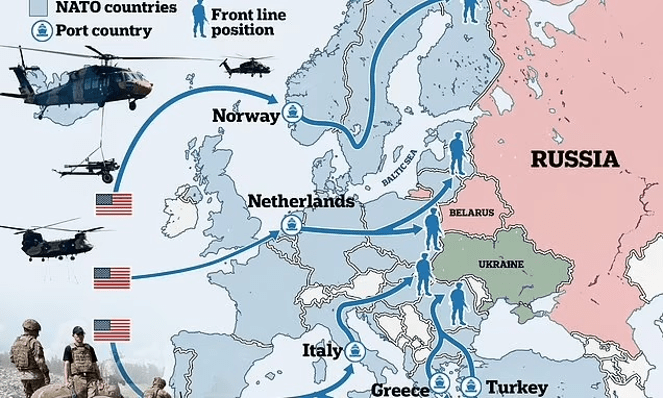
A few days ago, NATO also announced its preparations to deploy 300,000 American troops to the European fronts in the event of a full-blown conflict with Russia. The spiral of madness is accelerating.
By comparing President Putin with Hitler, the Second World War is used to analyse the situation, although the situation of continuous warfare shows striking parallels to the events that took place before the First World War and triggered a war that nobody actually wanted and plunged humanity into an apocalypse.
This war merely paused between 1918 and 1939 and flared up again in Europe 21 years later. There are many signs that the conflicts in Ukraine and the Middle East are the overture to a major catastrophe. Escalation is the motto – everyone in the West agrees on this; the peace conference in Switzerland, without Russia as a warring party and with “peace goals” that are grotesque, merely serves as a fig leaf for the aggressive West to be able to say that everything has been tried when a major conflict breaks out. This conference will fail and is designed to do so. The Swiss Federal Council does not seem to have realised this; the formerly neutral country is acting just as naively as Germany and, with the help of the Swiss media, has quickly become a vile warmonger under the guise of “neutrality”, a term that has degenerated into a meaningless label.
No education and no historical awareness on the part of the government
In addition, the German leadership lacks education. If you don’t understand history and the strategy of the Hegemons, you are in a poor position, because a lack of historical awareness leads to wrong decisions in the present.
The main thrust of the hegemons has not changed in the last 120 years or so. It is somewhat surprising that many people still believe today that Germany was solely responsible for the First World War. Even then, every conceivable effort was made internationally to prevent the Germans from focussing on peace and prosperity in the long term and with all their social power.
Germany was becoming too strong economically for the then hegemon Great Britain. The construction of the Berlin-Baghdad railway, for example, threatened the British Empire not only industrially, but also in terms of trade routes. If you understand Mackinder’s Heartland Theory, which saw the British Empire in danger as early as 1905, and internalise the strategy of Brzesinski and Friedman, the First World War and today’s tensions make much more sense. However, this requires a minimum of knowledge and education, which the German government clearly lacks. On this topic, I refer you to the article by Karl Eckstein “Anglo-Saxon geopolitical strategy – unchanged for 120 years“. We will return to this topic below.
Back to the top with courage, stubbornness and discipline
The economic miracle after the Second World War was an impressive achievement by the Germans after the Second World War. Through hard work and a skilful economic policy, Germany brought itself back to the top of the world. The Marshall Plan launched in 1947 certainly helped, but the Germans achieved their rise primarily through their own efforts. Determined, stubborn and skilful. Ludwig Ehrhard, the first Economics Minister after the war, epitomised the right policy. He had the courage to abolish rationing and price controls as early as 1948; the British, who won the war after all – albeit as the junior partner of the USA – did not abandon the last rationing regulations until 1954. If politics and business make the right decisions, Germany flourishes. Until a few years ago, it was Germany that was the world’s leading exporter.
That’s the positive side of this determined marching and stubbornness, which was necessary to catch up with the top after humanity’s greatest war disaster to date.
Stubbornness and overconfidence lead to hell
However, with the same stubbornness, the Germans also managed to lead their own country – and many others – into the apocalypse and failed to put a stop to it even when any cool-headed observer could see – see, not guess – the catastrophe long before the collapse.
After the great military successes that culminated in the victory over France in 1940, the German army leadership under Adolf Hitler decided to conquer the Soviet Union. Many generals who survived the war and wrote their memoirs afterwards wrote themselves into heroes after the war and claimed that it was Hitler alone who wanted this campaign – they had warned and opposed it.
That is not true. The German army command and the majority of the German people – especially after the French campaign in 1940 – were in such a frenzy of victory that they believed themselves to be invincible and took a bite that they choked on.
The logisticians were the only ones who really warned and rightly argued that the supply of the troops could only cope with such a huge campaign for a few weeks. Almost four million soldiers invaded the Soviet Union, three million Germans and many Romanians, Italians and other allied units. Hitler was convinced that all they had to do was kick down the door and the whole rotten structure would collapse. Disillusionment came very quickly, however.
Biographies of the great German generals are embellished marketing brochures and are in no way suitable for a fact-based analysis. Everything that did not make the gentlemen look good was deliberately omitted. For example, these gentlemen were very well informed about what was happening to Jews and other parts of the civilian population behind the front line, because the genocide required coordination between the ” Einsatztruppen” and the combat troops. The megalomania, in which many generals were in no way second to Adolf Hitler, was also rewritten in the biographies.
However, if you browse through the war diaries of the military leadership, you will find the truth. I read the war diary of the Chief of the Army General Staff, Colonel General Franz Halder. It reveals the truth, written down directly on the day of the events in question. The author did not believe that these records would ever be made public and therefore these records are to be rated significantly higher in terms of honesty than the embellished biographies.
Reading this work, one is surprised that the Chief of the General Staff clearly lacked an accurate overview. He noted down fragments of information, many figures and individual reports. How a war could be waged on the basis of such information is beyond me.
Furthermore, the erratic nature of the overall assessment on the Eastern Front is more than astonishing and confirms the impression of a lack of oversight, which would have been essential for the success of warfare in various theatres.
On 3 July 1941, less than two weeks after the start of “Barbarossa”, the great German offensive against Russia, Halder reported that Russia would probably be finished in a fortnight, only to report just over a month later, on 11 August, that the “colossus” Russia had been underestimated. By the summer of 1941, the dream of a quick victory was already over and the difficulties warned of by the logisticians were already materialising. In October, the Germans were once again confident of victory before the “Typhoon” offensive – the final advance on Moscow – and announced the defeat of the Soviet Union. Things turned out differently. Only a few motorbike patrols made it as far as Khimki, a suburb of Moscow, which today lies on the MKAD ring road, a good 20 kilometres from the Kremlin.
Moscow not only survived, the Russians went on the offensive for the first time. On 8 December 1941, Adolf Hitler issued directive no. 39 and the offensive was halted.
When Wilhelm Keitel, head of the Wehrmacht High Command, was asked by the Soviet prosecutor Major Iona Timofeyevich Nikitchenko at the first Nuremberg war crimes trial when he thought the war against Russia had been lost, Keitel replied with one word: “Moscow”.
Continuing the war even though militarily defeated
Germany’s strategy: fight on until the end
After the defeat before Moscow, the German Wehrmacht was so weakened, even in the opinion of German generals, that a victory against the Soviet Union was no longer conceivable. Nevertheless, the war continued for almost another three and a half years. In the history books, the defeat of the Wehrmacht is linked to later lost battles: Stalingrad (1942), Kursk (1943), Bagration (1944) and even Berlin (1945). Most of the losses were suffered by both sides after 1941, but the fact that the Wehrmacht still managed to continue causing damage for almost three and a half years despite its strategic defeat in front of Moscow should be borne in mind when assessing wars in Korea, Vietnam, Afghanistan, Iraq and ultimately Ukraine and Gaza. These conflicts were and continue to be waged despite the aggressor’s realisation that military victory was and is impossible. Why?
There are probably several reasons why the Germans did not call off the operation in Russia in 1941. Firstly, it was the Nazis’ declared aim to exterminate the Soviets, whom they saw as sub-human. They were quite successful in doing so, as they managed to kill around 15 million civilians. Secondly, an armistice with Stalin would have been difficult, as the military reputation of the Wehrmacht would have suffered, the genocide of the population would have become known worldwide and, after an armistice, a strengthened Russia would have stood on the borders of the German Reich. There were therefore many reasons for the Nazis not to seek peace with Stalin. It is important to note that the Germans did not gain any advantage from this strategy, but rather caused their downfall.
US strategy: lose militarily – win strategically
The Americans also continue to fight lost wars, but achieve strategic goals that benefit their geopolitical strategy.
Since the Second World War, it has been observed that the US has also continued military conflicts for a long time despite regular military defeats. However, they do this by managing to keep their own losses very low, as their weapons systems were vastly superior to their weak opponents until recently, they had air superiority and regularly sent third parties into the fire as proxies.
The reasons for this strategy are multi-layered: firstly, war is a huge business for the USA – or rather for the military-industrial complex. Secondly, the main aim of these wars is to weaken strategic opponents; this can be achieved even if one is ultimately defeated militarily.
As I am now in Iran and studying its history, the Iran-Iraq war is a prime example of this strategy, in which the USA even managed not to be involved militarily; Iraq was used as a proxy. The war lasted eight years. Although the Iranians ultimately prevailed militarily, they were completely bled dry financially, militarily and in terms of population. Many well-educated men died in this conflict, who were then missing for reconstruction. The Americans succeeded in making the rise of an Iran independent of the USA after the Shah impossible in the long term and to this day – goal achieved.
Is the US strategy working in Ukraine?
Fakten
In my opinion, NATO’s military defeat in Ukraine has been a fact since September 2023. We already discussed this last September in “Ukraine is militarily finished“. Since then, the Russian territorial gains have been steadily increasing and for a few weeks now, the Russians have opened a new front from the north against Kharkov, which has led to the front being extended once again, thinning out the Ukrainians’ forces even further. The Russians do not need to launch a major offensive – and have not done so to date – but are instead wearing down the Ukrainian forces on the ever-lengthening front line with small advances. Ukrainian losses per day are steadily increasing and have long since passed the point where these losses were still replaceable. The weapons arriving in Ukraine from the West will not solve the problem – there is not only a lack of soldiers, but above all a lack of will on the part of the Ukrainian population to go to their deaths for the US. Furthermore, President Zelensky has been ruling without a legal basis since May. He has not allowed any elections to take place as he would have been voted out of office. This fact alone makes negotiations with the legalistic Russians impossible.
The facts are on the table; whether you like them or not is irrelevant. Russia will prevail militarily in this conflict. The Russian people are united, the military and civilian infrastructure is functioning, the economy is booming.
This time the USA misses its target – or does it?
The USA has failed against Russia in several ways: firstly, it has missed its military target and this failure is damaging America’s prestige as the greatest military power. Secondly, the sanctions war against Russia was a complete failure. The West was weakened and Russia was strengthened. The IMF figures speak volumes. Germany doesn’t even make the list.
The USA did not succeed in weakening Russia. However, the US strategy is much more cynical. Let’s come back to Mackinder: let’s talk about George Friedman, the current head of American geostrategy, the successor to Mackinder and Brzesinski, so to speak:
“The primary interest of the United States through the last century-that is, the First War, the Second War, and the Cold War-has been the relationship between Germany and Russia, because united, those two would be the only power that could threaten us-and so we have to make sure that doesn’t happen.”
The aim is therefore to prevent Germany from teaming up with Russia. If it is not possible to weaken Russia as a major opponent, there is the option of preventing the alliance by turning Germany and Russia into enemies and/or destroying Germany. Today, Germany is hostile to Russia and massively weakened by this conflict. A military conflict with Russia would probably destroy Germany once again. The USA is therefore on the “right” path – for the third time after 1918 and 1945.
Germany’s turnaround unlikely
The German population has lost its way
Just like 80 years ago, the Germans have lost their way. The soul of the people has been poisoned by the media’s hate propaganda and the population is misinformed about its own economic and military situation – the Second World War sends its regards. Only after the German people have been given a honest talking to would they be able to properly assess the situation and exert pressure on the government, whose members are incompetent but masterfully pursue their personal interests.
Those in power want to maintain their position and their standard of living
There is a complete lack of competence in the government itself. I don’t even need to discuss this at this point, as it is so obvious.
From an American perspective, the government’s line-up is a good choice: Scholz, Habeck, Baerbock and whatever their names are.
Due to their lack of education and character weaknesses, such people would have no chance whatsoever of obtaining a post in the free economy that would allow them so much money, flights in private jets, trips in limousines and overnight stays in the best hostels in the world. I can’t think of any business owner who would hire Mrs Baerbock as an employee in any company for any function.
These politicians know this very well and they do everything they can to continue to lead this life. Instructions from Brussels or Washington are therefore followed in order to guarantee their own job security. They want to be re-elected or receive a new post due to their “loyalty” to Washington, which secures their standard of living. There is currently even speculation that Mrs Baerbock could possibly become Ursula von der Leyen’s successor in Brussels. It can therefore be ruled out that the current government would decide to make a U-turn – their own interests prohibit them from doing so.
New elections will not bring any change
Neither the people nor the current government will therefore want or be able to make a U-turn. Would new elections change the picture?
I am extremely pessimistic about that too. The only political groups that could dare to reassess Russia are the AFD and the Sarah Wagenknecht alliance. The powers that be are aware of this and are using every means at their disposal, with or without a legal basis, to destroy the AFD and ridicule Wagenknecht.
Without having to enter into legal analyses, the accusations against the AFD are already absurd in and of themselves. The AFD is accused of right-wing extremism and its members are labelled Nazis. Even the German Office for the Protection of the Constitution is looking into these issues. The situation is therefore as follows: The warmongers from the CDU/CSU to the Greens, i.e. from left to right, are calling the AFD, which alongside the Sarah Wagenknecht Alliance is the only party in favour of negotiations with Russia and is against the war, Nazis and want to ban it. Terms are being confused and history seems to have been lost.
You can sense that there are people in Germany who oppose the warmongering of the government and the media and are taking to the streets, but even if the AFD were to achieve a brilliant result, this will not bring about a turnaround.
According to the latest figures from the Sunday Bundestag election poll, the AFD would achieve between 14% and 19%, depending on the polling organisation, and the Sarah Wagenknecht alliance between 5% and 8%. Although these are good results compared to the 2021 elections (AFD: 10.3%, Sarah Wagenknecht Alliance was only just formed), they will not be enough to tip the balance of power in the Bundestag towards peace.
Worse still, the CDU/CSU will probably win the elections and Friedrich Merz, whom the USA no longer needs to buy, as this already happened years ago due to his Blackrock mandate, will become the next Federal Chancellor on the basis of today’s figures. More pro-USA and therefore more pro-war is not possible. Depending on the outcome of the elections, there will either be a coalition with the SPD or another three-party coalition with the Greens. A great deal would have to change in order to prevent this outcome.
Cautionary voices are silenced
Internal forces that would bring about a turnaround are therefore lacking in Germany. Voices that oppose this are already being systematically silenced by the system (government and media). The parallels between the actions of those in power today and the 1930s are astounding and worrying. From 1933 onwards, a similar approach was taken, first gently and then increasingly harshly against journalists who asked questions, until the final destination was murder or concentration camp. The fact that Scott Ritter was denied permission to leave his own country a few days ago shows that illegal practices are already a fact of life in the USA and will soon be a reality in Germany too.
Dangerous upcoming wake-up calls
Coming financial collapse as a wake-up call
It is interesting in this context that no one seems to care about the instability in the Western financial markets. The situation is very similar to the domestic and geopolitical situation. People think they have everything under control, although the reality speaks a different language. The entire system could collapse any day and that day will come. Such a collapse could be a wake-up call that forces a reassessment of the overall situation or will lead to a complete escalation.
Russia’s strike against NATO as a wake-up call
The war against Russia has already begun, Russia has not yet reacted kinetically against NATO. Western politicians often bluff and draw red lines in the sand, which are moved once they are crossed. The West does not recognise that the Russians operate differently: they are systematic, clear and do not bluff: they do things differently. The escalation in the use of long-range weapons against targets in Russia is not at all to the liking of the Russians and President Putin has announced consequences. These consequences will come. This could involve a strike against NATO facilities outside Ukraine, including in Germany; see our comments on this in “The consequences of the intercepted German air force conversation mean war“. The chatter about a Russian nuclear attack in the West is a distraction from this conventional danger.
This could also be a wake-up call. The West has obviously not considered that NATO would not have an adequate response to such a strike by Russia. If the Russians come to the conclusion that such a strike will be followed by apathy, it will come and serve as a wake-up call. Nevertheless, it is a dangerous game.
Conclusion
It is obvious that Germany is misjudging the threat situation and its chances and is being completely controlled by the USA. The incompetent and erratic assessment of the situation is nothing new – as a comparison with Franz Halder’s diary shows – and the longer the Bonmôt that history will not repeat itself, the more critically one should assess it. Keitel’s statement confirms that Germany is perfectly capable of walking into disaster with its eyes wide open. In this context, the ability of the Germans to work their way out of even the greatest ruin is little consolation. The chances of Germany achieving a turnaround are minimal.
Mass events such as the Olympics would certainly be valuable catalysts for coming to the conclusion that the whole thing could be reconsidered in the peaceful confrontation of a sporting event with the “enemies”. However, the Olympic Committee is aware of this and is doing everything it can to prevent such an outcome. René Zittlau reported on this in his article “Sport is the continuation of diplomacy by other means“.
To prevent a global war, it would take a wake-up call of the martial kind, such as the collapse of the financial system or a military response from Russia. However, it is impossible to judge whether such events would lead to reflection or escalation.
In my opinion, however, the main responsibility for this situation lies with the leading media in the West. Objective reporting over the last 10 years would have made this development in politics and among the people impossible.
Democrats in Wethersfield, Connecticut refused to fly the ‘thin blue line’ flag in remembrance of a state trooper who was killed while on duty, instead insisting that flying an LGBTQ ‘pride’ flag at half staff was enough of an honor.
Police said Oyola-Sanchez was under the influence of several types of drugs when he drove into Pelletier, his squad car and the vehicle he had pulled over.
The trooper died from fatal injuries at the scene. Oyola-Sanchez Drove off but was later apprehended.
Democrat council members voted down a motion to fly the thin blue line flag in the trooper’s honor.
After the Wethersfield Town Council voted not to fly the “thin blue line” flag this week for the funeral of TFC Aaron Pelletier, the family of late Hartford Police Det. Bobby Garten has created lawn signs that say, ‘We support police officers.’
HEARTBREAKING: Watch fallen state trooper Aaron Pelletier’s wife honor her husband. Aaron leaves behind a loving wife and 2 young children who will now grow up without a father.
Connecticut GOP chairman Ben Proto slammed Democrats for failing to properly honor the fallen trooper.
This epitomises the utter state of towns and cities under Democrat control.
Your support is crucial in helping us defeat mass censorship. Please consider donating via Locals or check out our unique merch. Follow us on X @ModernityNews.
Massie Slams AIPAC, Censorship, Surveillance, Debt Crisis, And Insane Government Regulations: New Tucker
Rep. Thomas Massie (R-KY) sat down with Tucker Carlson for a little over two hours, where the two discussed a variety of topics, including the grip that lobbies such as AIPAC has have over legislative agendas, freedom of speech, government surveillance, and the influence of the media when it comes to the political polarization of American politics.
(If you click into the tweet below you can navigate to various sections)
Rep. Thomas Massie doesn’t care what you think of him, which is pretty great.
(3:19) Where Does US Debt End?
(10:32) Why Massie Voted 15 Times Against Funding Israel
(14:53) AIPAC
(34:04) Mitch McConnell
(42:25) Area 51
(50:32) Massie’s Relationship with Trump
(57:09) Kill… pic.twitter.com/VBOiWjq056
Massie began by opining on the US National Debt, which currently stands at just under $35 trillion.
You know, it’s hard to comprehend 14 digits of debt. But when you see the last five digits are moving so fast, you can’t, you know, perceive them with your eyes, then you kind of understand. Whoa, we are problem here. I mean, it’s a $100,000 a second, roughly. So imagine we had this catapult and we were launching, cyber trucks once a second into the ocean. That’s how much debt we’re taking on, continuously.
He noted a troubling tendency by Congress to treat the debt as a mere abstraction vs. an urgent reality that requires immediate and decisive action, telling Carlson “I am trying to make people feel very uncomfortable” so a to raise awareness.
Lobbyists Rule DC
Massie then went into his views on lobbying and his stance on foreign aid – in particular, his consistent record of voting against funding for Israel. He explained that his opposition to these measures is not rooted in animosity towards Israel but stems from a broader philosophical and fiscal responsibility perspective against excessive foreign aid and involvement in overseas conflicts.
“Look, we haven’t named three post offices like in the last month. We voted like 15 or 16 times on issues related to Israel. And, you know, I’ve been hit because I voted no on all of them.“
His repeated votes against funding Israel reflect his commitment to reducing U.S. expenditures overseas, which he views as contributing to the national debt and entangling the U.S. in foreign issues that do not directly serve American interests. Massie’s larger concern is the implications of US foreign policy decisions and the use of US taxpayer funds to achieve them.
He then delved deep into the workings and influence of the American Israel Public Affairs Committee (AIPAC) on the legislative processes of the United States Congress – and in particular, how the organization shapes the agenda in Washington DC, often overshadowing domestic priorities.
According to Massie, AIPAC effectively places “minders” on GOP members to monitor and influence their actions and voting – saying that each Repuiblican seems to have an “AIPAC person” or babysitter.
“I have Republicans, you come to me on the floor and say, ‘I wish I could vote with you today. Yours is the right vote, but I would just take too much flak back home,” adding “And I have Republicans who come to me and say, ‘That’s wrong, what a PAC is doing to you. Let me talk to my AIPAC person.’ By the way, everybody but me has an AIPAC person.”
MASSIE: It’s like your babysitter. Your AIPAC babysitter who is always talking to you for AIPAC. They’re probably a constituent in your district, but they are, you know, firmly embedded in AIPAC.
CARLSON: And every member has something like this.
MASSIE: Every Re– I don’t know how it works on the Democrats’ side. But that’s how it works on the Republican side. And when they come to D.C., you go have lunch with them. And they’ve got your cell number and you have conversations with them. So I’ve had like–
CARLSON: That’s absolutely crazy.
MASSIE: I’ve had four members of Congress say, “I’ll talk to my AIPAC person.” And like that’s clearly what we call them, my AIPAC guy. I’ll talk to my AIPAC guy and see if I can get them to, you know, dial those ads back.
CARLSON: Why have I never heard this before?
MASSIE: It doesn’t benefit anybody. Why would they want to tell their constituents that they’ve basically got a buddy system with somebody who’s representing a foreign country? It doesn’t benefit the congressman for people to know that. So they’re not going to tell you that.
“They pay for trips for congressmen and their spouses to go to Israel,” Massie continued. “I’m not the only Republican who hasn’t taken the AIPAC trip to Israel, but I’m probably one of a dozen that hasn’t taken that trip and the other ones just haven’t got around to it.”
Censorship and Freedom of Speech
Massie also addressed concerns related to censorship, particularly focusing on legislation that impacts freedom of speech on university campuses. For example, he was critical of a bill that proposed to combat anti-Semitism in educational institutions but, according to him, used an overly broad and externally defined criterion that could potentially limit free speech, pointing out the problematic aspects of using an external definition of anti-Semitism from a website, which he felt could lead to censorship of legitimate academic discussions and expressions. He questioned the rationale behind not including the definition directly in the bill, which could lead to ambiguities and potential misuse:
“They brought a bill to Congress, and this was actually a binding bill, not a non-binding resolution… the problem with this bill is they use some international definition of anti-Semitism on a website somewhere. My first question is, why don’t you just put the definition in the bill?”
He then said that referencing an external source for defining what constitutes hate speech could lead to arbitrary or politically motivated censorship, particularly in educational settings where freedom of speech is crucial.
“For instance, saying that, Jews kill Jesus, which is, you know, in the Bible, he was he was not welcome among his own people. Okay. And so that would be anti-Semitism. And if you engaged in that on campus or just offered that as a thought, let’s say in a classroom, you would be anti-Semitic and you would run afoul of the Department of Education and some federal laws.”
Out-of-control Government
Massie also discussed his concerns over government surveillance, privacy, and overreach, specifically focusing on legislative measures that would allow more intrusive government control. One of the main examples he brought up was related to automotive regulations that would permit remote deactivation of vehicles.
For example, a law that mandates new cars sold by 2026 must have the capability to be remotely turned off by authorities. Massie criticized this capability as a significant overreach, saying, “By 2026, every new automobile sold has to be able to turn itself off if it doesn’t like you’re driving… How do you appeal this conviction at the roadside?” This statement underscores his concerns about the potential for misuse and the erosion of individual freedoms and privacy.
Massie suggests a call to action for policymakers, technologists, and the public to consider the long-term implications of short-term safety measures.
His message is based in libertarian principles, and focuses on the trade-offs between security measures and personal freedoms. With the car example above, Massie slams the lack of recourse or transparency in how these technologies are applied. For him, the principle of autonomy—being able to control one’s movement without unwarranted interference—is paramount.
During a visit to Monroe, N.C., to support conservative congressional candidate Mark Harris on Friday, House Judiciary Chair Jim Jordan, R-Ohio, was surprised by a reporter’s question about fresh allegations from former President Donald Trump’s New York lawfare trial that could potentially result in a mistrial.
Earlier in the day, Judge Juan Merchan wrote a letter to Trump’s attorneys and prosecutors with the Manhattan District Attorney’s Office, notifying them of a Facebook comment that was discovered under a routine court post dated May 29, the day before a jury convicted Trump of 34 felonies.
The commenter, identifying himself as a juror’s cousin by the name of Michael Anderson, appeared to offer some advance inside knowledge about the verdict.
“Well, if that happened, that’s wrong,” Jordan responded when asked about the breaking news. “I have not heard that and I don’t know if it’s true, but you obviously aren’t supposed to be doing that, so we’ll have to see.“
In his letter, Merchan claimed he had just learned of the comment.
“Today, the Court became aware of a comment that was posted on the Unified Court System’s public Facebook page and which I now bring to your attention,” the judge wrote. “The comment, now labeled as one week old, responded to a routine UCS notice, posted on May 29.”
Merchan’s letter did not clarify whether the person who posted the comment was indeed related to a juror.
The judge, a Biden donor, was widely criticized for his biased rulings throughout the trial and was even suspected of receiving bribes through his daughter, whose digital marketing firm drew millions of dollars from Democrat politicians—some of whom became involved directly in the case.
Merchan’s brief letter did not outline any sort of follow up steps, although it stands to reason that the court will investigate the matter and would declare a mistrial if, in fact, juror misconduct were established.
The concern provides yet another avenue for appeal to Trump, whom many legal experts believe will ultimately see the case overturned, although the disruption to his campaign and political fallout from the conviction have yet to be determined.
At the Friday night fundraiser in North Carolina, Jordan offered high praise for Trump, with whom he has formed a close bond, touting his tenacity in particular.
“His attitude in light of everything they’ve done to him is just phenomenal,” Jordan told the audience.
The charter chairman of the House Freedom Caucus recalled an anecdote from the night Trump’s Mar-a-Lago estate was raided by the FBI—an unprecedented abuse of power at the time—which took place shortly before the 2022 midterm election.
“There are certain times where you think, ‘This is not supposed to happen in this country,’” Jordan said of his reaction after seeing the news unfold on television with his wife.
When he called Trump, however, the reaction was far from what one might have expected:
“Jim, this is the best thing that’s ever happened to our party,” Trump reportedly told him. “My numbers are gonna go up.”
During an exclusive interview with Headline USA, Jordan said House Republicans had received a response on Friday after sending a letter last week to Manhattan D.A. Alvin Bragg and his lead prosecutor, requesting that they testify before the House Weaponization Subcommittee.
“They just sent us a letter back today saying they’re willing to talk to us, so we’ll see,” said Jordan. “But we may have to, you know, go with a subpoena to get him [Bragg] to testify as well.”
The House is also investigating Fulton County District Attorney Fani Willis, who has publicly quarreled with Jordan and leveled ad hominem attacks against him for his oversight efforts.
Jordan noted, however, that as of this week, “Willis’s case is falling apart” following an appellate court’s decision to suspend the trial until October while evaluating whether she is ethically fit to continue as prosecutor.
The House is also attempting to impose accountability on special counsel Jack Smith. However, a proposed bill likely faces steep odds of clearing the Democrat-run Senate, even though it ironically vests greater authority in the upper chamber to close a constitutional loophole exploited by Attorney General Merrick Garland.
“We’re trying to get legislation out to say that any special counsel who wasn’t approved by the Senate gets no funds,” Jordan said. “It‘s the way to get at this Jack Smith and the ridiculous things he’s done.”
Florida Judge Aileen Cannon has similarly scheduled a June 21 hearing for Trump and his co-defendants in the Mar-a-Lago case to argue that Smith’s appointment was unlawful since he was never confirmed by the Senate—a legal theory first floated by former Attorney General Ed Meese.
Jordan downplayed calls for the House to rescind two contempt of Congress resolutions passed by Democrats in the previous session, saying the move was unlikely to have any effect on the already prosecuted cases.
Two former Trump advisers—Peter Navarro and Steve Bannon—became the first people prosecuted and convicted under the law in roughly four decades, fueling more outrage and allegations of two-tiered justice. Navarro is currently incarcerated, and Bannon is expected to report to jail by the end of the month.
In the wake of Trump’s felony convictions, House Republicans have faced brutal criticism from some for their inaction, with Jordan, in particular, bearing the brunt of it over his failure to live up to his promise as a GOP attack dog—instead becoming the champion of the “strongly worded letter.”
How long will it take for the majority of Americans to wake up and realize scumbags like Jim “Strongly worded letter” Jordan is a compromised, traitor? Don’t worry if you don’t understand! The #TreasonDocumentary is going to expose it all! pic.twitter.com/KzS8wkqsgR
Undocumented Immigrants Concentrated in Certain States
The unauthorized immigrant population in the United States was estimated at around 10 million in 2021 after peaking at 12.2 million in 2007.
California, Texas, Florida, New York, New Jersey, and Illinois had the largest unauthorized immigrant populations in 2021. These six states were home to 56% of the nation’s unauthorized immigrants in 2021, down from 80% in 1990.
Between 2017 and 2021, the unauthorized immigrant populations in Florida and Washington increased, while those in California and Nevada decreased.
The most common country of birth for people without legal status is Mexico. In recent years, however, there have been increases in immigrants from nearly every other region of the world—Central America, the Caribbean, South America, Asia, Europe, and sub-Saharan Africa.
In addition, around 5% of U.S. workers are unauthorized immigrants.
If you enjoyed this post, be sure to check out Why Do People Immigrate to the U.S.? This visualization shows why immigrants choose to come to America.