61.4 F
Chicago
Wednesday, September 23, 2026
Home Blog Page 2566

10,000 California Fast Food Workers McFired Thanks To $20 Minimum Wage: Report

10,000 California Fast Food Workers McFired Thanks To $20 Minimum Wage: Report

Nearly 10,000 California fast food workers have been fired thanks to the state’s new $20 minimum wage, according to the California Business and Industrial Alliance (CABIA), which slammed Governor Gavin Newsom for the law which went into effect April 1.

2009 Banksy exhibit, Bristol Museum

“California businesses have been under total attack and total assault for years,” said Tom Manzo, CABIA president and founder in a statement to Fox Business, adding “It’s just another law that puts businesses in further jeopardy.”

According to Manzo, nearly 10,000 fast food jobs have been cut across the state since Newsom signed Assembly Bill 1287 into law last year.

“You can only raise prices so much,” he said. “And you’re seeing it. People are not going to pay $20 for a Big Mac. It’s not going to happen.

CAIOBA took out this full page ad in Thursday’s USA Today which includes mock “obituaries” of various fast food chains.

As we noted in April, thanks to the combination of inflation and minimum wage hikes driving up operational costs for businesses across the US, Larger chains raised prices but have also been forced to reduce employees and labor costs through automation, but the layoffs are just getting started. 

“Restaurants are struggling to stay above water, and Democrats just threw them an anvil,” California Assembly Republican leader James Gallagher told FOX Business. “We warned Democrats this new mandate would cost jobs. They ignored us, and here we are with the highest unemployment rate in the country poised to get even worse.”

The “digital options” that many fast food franchises are referring to are automated ordering systems as well as robot workers which are slowly but surely becoming more cost effective than human laborers.  At least one fast food location in California is testing a fully robotic restaurant with no human workers.

On the other side of the window, fast food has gone up an absurd amount. As FinanceBuzz noted recently:

  • From 2014 to 2024, average menu prices have risen between 39% and 100% — all increases that outpace inflation during the given time period (31%).
  • McDonald’s menu prices have doubled (100% increase) since 2014 across popular items — the highest of any chain we analyzed.
  • Popeyes follows McDonald’s with an 86% increase, and Taco Bell is third at +81%.
  • Menu prices at Subway and Starbucks have risen by “just” 39% since 2014 — the lowest among chains we studied. These are also the only restaurants where prices have risen by less than 50%.

McDevastating.

Tyler Durden
Sun, 06/09/2024 – 11:05

Kill Your Good Ideas

Kill Your Good Ideas

Submitted by QTR’s Fringe Finance

As always, I’m stoked to be able to bring you content from one of my favorite investors, Chris DeMuth Jr. Chris took the time to share his up-to-the-minute thoughts on the market for Fringe Finance subscribers this week.

Chris writes the Vale Tudo Substack, which can be found here and the Sifting the World Special Purpose Research Substack, which can be found here.

All information contained herein is opinion only of Chris DeMuth & does not constitute investment recommendations. Nothing is a solicitation to buy or sell securities.

Kill Your Good Ideas

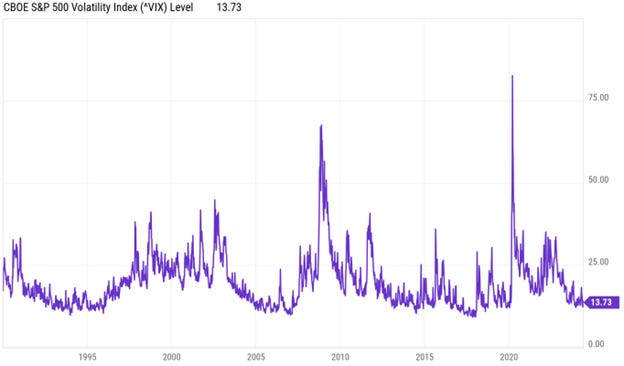
Implied volatility is quite low.

This doesn’t seem to comport with the number of discreet issues that have a material (at least 1%) chance of happening and far greater (at least 5%) chance of spooking the market if concerns grow. 

Internationally, growing Russia coordination with China risks bolder moves from both.  This could cause the Ukraine conflict to spill beyond Ukraine’s borders into the Baltic states or Poland.  It could also increase the tempo and likelihood of a Taiwan invasion.  Domestically, profligate peacetime (relative to a hot world war) spending could lead to a failed government bond auction.  With a bipartisan consensus on unlimited deficit spending, the bond market has become the loyal opposition.  It is complacent so far, but when it turns it can do so abruptly and without warning.  For a pandemic to devastate the economy far beyond what Covid caused, it needs to have both contagion and lethality; Covid was contagious but not particularly lethal.  Covid caused more hysteria than death.  But bird flu has the possibility of being far more lethal and as contagious as the seasonal flu.  Politically, we are in an unstable political year with the most unpopular president in the history of polling getting challenged by the second least popular president in the history of polling.  It is entirely plausible that the presumptive challenger gets convicted with multiple felonies, loses a close election, then has the charges thrown out on appeal.  His followers might not respond with equanimity.

In short, lots could go wrong.  I wouldn’t want to be short volatility here.  What to do?  Instead of buy writing marginal positions, just sell them.  The best hedge is to own positions that don’t need a hedge.  If yours do, consider selling half and hope you’re (and, er um I’m) wrong.  March 2020 was a great time to have poise, capital, liquidity, and simplicity so that you could focus on offense.  Any one of the above potential events could lead to an opportunity at least as pronounced as the Covid lows.  Whatever you do – don’t freak out at the precise moment everyone else does.  Once it is in the press, it is in the price.  So prepare ahead of time so you can be a counterparty for those freaking out.  How much liquidity will it take?  More than your counterparty.  If you get margin calls on the low, then your preparation failed.


🔥 40% OFF FOR LIFE: Using this coupon entitles you to 40% off an annual subscription to Fringe Finance for as long as you wish to remain a subscriber.


In addition to sizing discipline on my best ideas, I’m skipping my marginal ones.  If you load up on your good ideas now, then it will be harder to take big swings at your best ones if volatility spikes.  For one example, Marpai, Inc. (MRAI) is a good long idea at $0.60, crushed by over 30% for Nasdaq delisting with zero impact on its fundamental value.  Bragg (BRAG) is a good long idea; it is a takeout candidate worth a substantial premium to today’s market price to any number of strategic buyers.  But now’s not a great time to start any good long ideas with leverage and certainly not leverage anywhere close to your margin limit. 

Remember – your broker can change margin requirements whenever they want and they will use that right at the worst possible time for you.  Interactive Brokers (IBKR) is perhaps the most ruthless, but Goldman Sach (GS) and others will also force you to sell when you least want to.  The relevant Goldman partners are multimillionaires and IB’s founder is a multibillionaire precisely because they hate risk to themselves and will do absolutely anything whatsoever to avoid it.  As a leveraged client, you are not their partner or friend; you are their counterparty and on the other side of their ruthlessness when it comes to such risks. 

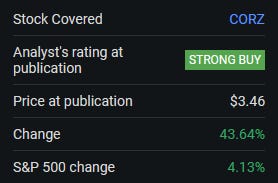
Instead of paying for leverage from your broker at the firm level, use the corporate balance sheets and capital structures to get any desired leverage at the position level.  Brokers are surprisingly dumb about this.  Underleveraged balance sheets (e.g. at recent demutualizations) are given far too little margin and massively leveraged balance sheets (e.g. equities in bankruptcy) are often given the same or more.  Take advantage of this inefficiency.  For example, I like owning bitcoin but love owning the most leveraged miner.  For even greater leverage, they have a warrant (CORZZ) that is leveraged to the company which is in turn leveraged to bitcoin. 

Skip the crisis.  I often think about what I’d do the day after a horrific event.  I would drive safely after a car crash.  I would invest prudently after a market crash.  But I’m perfectly capable of imagining such events, skipping them, and acting on them before they occur.  Do you have any positions with stop losses (pre-planning to sell something lower because it declined)?  Sell them now and skip the loss.  If you prepare, then you need not predict or at least not with any particular precision.  As Cat Stevens sang and as I mentioned here,

Oh baby baby it’s a wild world, it’s hard to get by just upon a smile.  Oh baby baby it’s a wild world.

– Cat Stevens on the log normal nature of capital markets

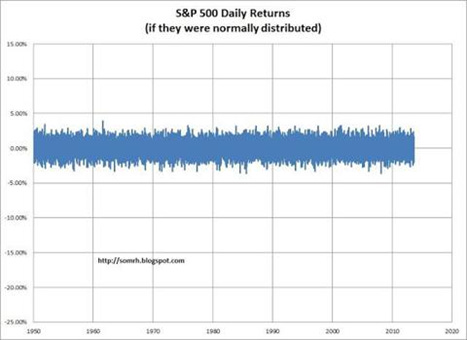
Something isn’t normal in the market today. In fact, it wasn’t normal yesterday. Come to think of it, it never has been. So perhaps, normal is not a particularly useful concept for markets or for nature. It is good for modeling, but reality conforms to normal distribution curves rarely. If it did, here is what the world would look like:

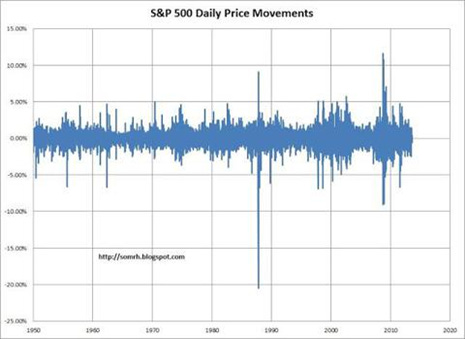
Here is what the world looks like:

We live in a statistically wild world, baby. Like “unseasonably hot” weather in the middle of summer, unexpected things happen all of the time (that is, unexpected if you set your expectations to a normal distribution curve):

If you size risks based on downside, this is all fine. If you size risk based on volatility and the model for volatility is based on an expectation of normalcy, then sooner or later… you’re doomed.

QTR’s Disclaimer: Please read my full legal disclaimer on my About page hereThis post represents my opinions only. In addition, please understand I am an idiot and often get things wrong and lose money. I may own or transact in any names mentioned in this piece at any time without warning. Contributor posts and aggregated posts have been hand selected by me, have not been fact checked and are the opinions of their authors. They are either submitted to QTR by their author, reprinted under a Creative Commons license with my best effort to uphold what the license asks, or with the permission of the author. This is not a recommendation to buy or sell any stocks or securities, just my opinions. I often lose money on positions I trade/invest in. I may add any name mentioned in this article and sell any name mentioned in this piece at any time, without further warning. None of this is a solicitation to buy or sell securities. These positions can change immediately as soon as I publish this, with or without notice. You are on your own. Do not make decisions based on my blog. I exist on the fringe. The publisher does not guarantee the accuracy or completeness of the information provided in this page. These are not the opinions of any of my employers, partners, or associates. I did my best to be honest about my disclosures but can’t guarantee I am right; I write these posts after a couple beers sometimes. Also, I just straight up get shit wrong a lot. I mention it twice because it’s that important.

Tyler Durden
Sun, 06/09/2024 – 10:30

“Damage Control Underway”: Cargo Ship Hit By Missile In Gulf Of Aden In Suspected Attack By Houthi Rebels

“Damage Control Underway”: Cargo Ship Hit By Missile In Gulf Of Aden In Suspected Attack By Houthi Rebels

More than six months since the Biden administration launched Operation Prosperity Guardian to defend the critical maritime chokepoint Bab al-Mandab Strait from Iran-backed Houthis and ensure freedom of navigation in the Red Sea, we’re witnessing yet another alarming development. Late Saturday, rebels targeted a Western-linked cargo ship with missiles. This underscores the ongoing threat to the shipping lane and the utter failure of Biden’s disastrous foreign policies. 

AP News cites a report from private security firm Ambrey, which said the Antigua and Barbuda-flagged cargo ship in the Gulf of Aden was struck by a missile on its forward station, sparking a fire. A second missile missed the vessel, and rebels “on board small boats in the vicinity opened fire on the ship during the incident,” the security firm said, adding no crew on the vessel was hurt in the attack. 

“The Master reports that the vessel was hit by an unknown projectile on the aft section, which resulted in a fire. Damage control is underway, the Master reports no casualties and the vessel is proceeding to its next port of call,” the British military’s United Kingdom Maritime Trade Operations wrote on X

AP notes, “Suspicion for the attack immediately fell on the Houthis. The rebels did not immediately claim the assault, though it can sometimes take hours or even days for them to acknowledge their attacks.” 

In the global economy, the continued Red Sea disruption is generating a supply shock. Containerized shipping costs for several major shipping lanes are exploding. 

Meanwhile, Houthis continue to claim a successful attack on the USS Dwight D. Eisenhower Nimitz-class supercarrier in the Red Sea last week despite US CENTCOM denying any such attack. 

Houthis also mentioned that their attack coverage expanded into the Mediterranean Sea. The terror group claimed a successful attack last month on an Israeli-linked ship in the Mediterranean area. 

And there’s news just days ago from AP that Houthis unveiled a solid-fuel missile that “resembles aspects of one earlier displayed by Iran that Tehran described as flying at hypersonic speeds.” 

With Israel recently mentioning the war against Hamas could last another seven months, there’s reason to believe the Red Sea area will become hotter. What’s also concerning was Biden’s ‘greenlighting’ of Ukraine to attack Russian territory with US-made weapons.

All of this is a sign that the world continues to fracture into a multipolar state, full of conflict and danger. The investment theme in this period is defense

Tyler Durden
Sun, 06/09/2024 – 09:55

Betting Big That Bitcoin Mining Won’t Exist In Five Years…?

Betting Big That Bitcoin Mining Won’t Exist In Five Years…?

Authored by Mark Jeftovic via BombThrower.com,

Long Bitcoin / Short Miners Is The Mid-Curve Trade of the Year

I’ve never understood the hedgies’ penchant for pair trades: long this / short that is supposed to be some kind of big brain move that either outperforms something or hedges out the risk – like I said, I don’t always grok them, maybe because I don’t have an MBA in finance.

To be clear, when I see one I usually do understand the overall thesis – what I don’t understand is the way they seem to put an upside ceiling on returns if you’re right. It probably makes sense to do this when you manage other people’s money.

But a TradFi firm called Kerrisdale Capital has a pair trade on that, may seem counter-intuitive at first glance.

It’s long Bitcoin, and short miners – specifically RIOT Blockchain (Nasdaq: RIOT).

They have a separate trade on that’s short MicroStrategy (Nasdaq: MSTR), also long Bitcoin.

The long Bitcoin half of each trade, according to their pinned tweet, is a hedge. The short side is against MicroStrategy for being an inferior proxy to Bitcoin, especially now that ETFs are here, and in Riot’s case? Well they’ve declared war on Bitcoin mining:

“Our investment thesis is that this sector is not going to be around in five years. Bitcoin mining is one of the stupidest business models we’ve come across in our time short selling over the past 15 years.”
— Kerrisdale Capital CIO Sahm Andrangi

One of the cornerstones of Kerrisdale’s short thesis is that MSTR (and the miners) go up more than Bitcoin when there is no reason for them to. Especially now that the spot ETFs are here, both the miners and MSTR are inferior proxies to Bitcoin.

If they’re right – miners go to zero, so will Bitcoin – I assume they make more money on the RIOT (and MSTR) shorts than they lose on the Bitcoin.

If they’re wrong – and the miners and MSTR continue to outperform Bitcoin, they will get destroyed on their shorts, while the upside from their hedge – Bitcoin,  by their own thesis, is going to lag (this is the part of the pair trade I’m having issues understanding, unless maybe they’re levering up?).

I think what’s confusing me is that the side of their pair trade that means they’re right already has limited upside. Shorts can only go to zero, your upside is capped at 100%, unless you’re using leverage to enhance that – in which case you’re risk is even higher.

What makes more sense to me is that if you’re going to put on a pair trade, you do it with unlimited upside on being right and with the hedge for being wrong on the downside. Kerrisdale seems to have it backwards,  especially because we’re dealing with Bitcoin – the highest performing asset in history.

They’re not wrong.

Even Saifedean Ammous – author of seminal book The Bitcoin Standard has said that Bitcoin mining has got to be one of the worst businesses out there (and points out that the same has always applied to gold miners).

So why would anybody in their right mind hold shares in a Bitcoin miner?

Three Ways Bitcoin Miners Fund Their Operations

There are three ways for mining companies to fund themselves and make a return for shareholder:

#1) Sell the Bitcoin as you mine it.

Especially in a bull cycle when the price is constantly going up – and knowing that the block rewards are going to halve within four years, makes a certain amount of sense.

Core Scientific (Nasdaq:CORZ) is an example of a public miner that does this.

Most miners don’t do that however (unless circumstances force them too), especially among the publicly traded miners – the name of the game is HODL! Stack those sats and pile up as many as possible.

If you’re HODL-ing your BTC and it takes operations like this:

…in order to mine them.

That must mean you are looking further down the road than next quarter (hold that thought).

The other two ways:

Funding method #2) Take on debt

The mining game is a never-ending struggle to grow one’s hashpower at a rate faster than the overall network is growing, and if you thought the price action of Bitcoin was nuts, just try to wrap your head around the hashrate 👇

As I reported previously in The Bitcoin Halving Crash Course, this pencils out to in excess of 600 million trillion computations per second.

That leaves mining outfits competing to acquire: more ASICs (specialty miners that crunch the calculations), power, and datacenters.

And while critics – including Kerrisdale – argue that this is a monumental waste of resources and energy to maintain a decentralized, non-state monetary network…

…it’s actually quite a bit more benevolent, not to mention civilized, compared to the energy and resources it takes to enforce a fiat dollar standard.

Taking on debt works fine in an up cycle, especially when interest rates are squashed through the floor. But when crypto winter hits – look out.

Many of the miners who levered up (BITF, CBIT) had to sell down their HODL in order to survive it – and do so at depressed prices.

Funding method #3: issue shares (dilute, dilute, dilute…)

What may look more appealing than debt, is to issue shares.

You can do that provided Bitcoin is going up faster than your dilution rate.

The miners get an extra boost, because in up cycles, they go up more than Bitcoin.

As does MicroStrategy – and this is one of the main objections Kerrisdale Capital has to all this:

They shouldn’t.

We’ve been hearing a lot of this.

  • Bitcoin shouldn’t be outperforming gold — Peter Schiff
  • MSTR and miners shouldn’t be acting as leveraged proxies for Bitcoin (Kerrisdale)

Bitcoin ETFs should be bad news for MSTR and even worse news for miners.

Canada has had spot Bitcoin ETFs for years and it didn’t stop Bitfarms (BITF.V) from being the number one performing stock on the TSX-V for 2023, it was number three on the Nasdaq (BITF).

Up 618% on the year, it outpaced Bitcoin’s 162% by nearly 4X while the Canadian ETFs pretty much tracked the spot price (mildly lagging, actually).

Why?

When logic says they “shouldn’t” but in reality they do, there has to be a reason.

Make it make sense

My thesis has always been that the Bitcoin phenomenon isn’t “a trade” – it’s not like finding some hot penny stock that’s going to rocket higher for longer – but at some point it has to peak or at least level off.

Bitcoin is a monetary regime change.

If you’re founding, operating, or investing in any of these monster data centers that mine Bitcoin, it isn’t because you think “number go up” as much as you  are anticipating a world of hyper-bitcoinization.

Today we have the money center banks endlessly creating fiat backed by nothing out of thin air. The world looks like this:

In the coming Post Fiat Era, it’ll look more like this:

It sounds crazy now – but so did Bitcoin, back in 2009. Look at the scoreboard.

Our thesis in The Bitcoin Capitalist stock portfolio is that somewhere in there we have an Amazon of crypto, a Berkshire Hathaway of crypto, and a Microsoft of Bitcoin (among others). We don’t second guess why they outperform Bitcoin or ETFs, we just look at where we think they’ll be 10 or 20 years out from a “1000-baggers” framework. Try it out here or sign up for the free list here and get The Crypto Capitalist Manifesto.

Follow me on Twitter, or Nostr (npub: npub1elwpzsul8d9k4tgxqdjuzxp0wa94ysr4zu9xeudrcxe2h3sazqkq5mehan )

Tyler Durden
Sun, 06/09/2024 – 09:20

The Global Gulf In Organ Donation Rates

The Global Gulf In Organ Donation Rates

Data from the European Directorate for the Quality of Medicines and Health Care (EDQM) shows that Spain came out on top for the highest rates of organ donors in 2022, with 47 deceased donors per million population, respectively.

Infographic: The Global Gulf in Organ Donation Rates | Statista

You will find more infographics at Statista

This high rate is often linked to its opt-out system.

Or, in other words, when someone dies, the default will be to donate their organs where possible, unless the person had specifically turned down the option of a transplant.

Relatives can also usually reject the process if they say the deceased person would not have wanted it.

The United States’ organ donation rate is 44.5 deceased donors per million population. This is perhaps more surprising, given that it has an opt-in system.

In its case though, the barrier for registration is relatively low, as in most states, you can register to be a donor when applying for or renewing a driver’s license.

This is a fairly logical, if macabre, step, considering the grim reality that one third of organ donations in the U.S. come from people who have been in fatal vehicle accidents, according to the United Network for Organ Sharing.

Tyler Durden
Sun, 06/09/2024 – 08:45

US Ambassador Slams Hungary For Relying On Russian Energy, But US Remains Huge Buyer Of Russian Uranium

US Ambassador Slams Hungary For Relying On Russian Energy, But US Remains Huge Buyer Of Russian Uranium

Authored by Denes Albert via ReMix News,

Taking his cue from Minister of Foreign Affairs and Trade Péter Szijjártó’s recent visit to the St. Petersburg International Economic Forum, U.S. Ambassador to Hungary David Pressman used the occasion to launch yet another attack on Hungary’s conservative government.

“Hungary’s foreign minister makes his 8th trip to Russia since Putin’s invasion of Ukraine. Hungary’s government says it is the ‘party of peace’ while continuing to stand with Putin’s party of war. Hungary’s addiction to Russian energy is dangerous and unnecessary,” Pressman wrote in a Facebook post on Thursday.

“Minister Szijjártó is right: energy diversification is not a matter of ideology but one of physics. The laws of physics in Hungary are no different than the laws of physics in every single one of Hungary’s EU partners, all of whom have chosen to reduce dependence on Putin,” Pressman concluded his post.

U.S. Ambassador to Budapest David Pressman. (MTI/Szilárd Koszticsák)

Hungarian news and opinion portal Mandiner pointed out the duplicity of Pressman’s position, pointing out that “David Pressman does not seem to be bothered by the fact that America is also funding the Russian war along the same lines, since the uranium business between the U.S. and Russia is still going on behind the scenes.

The U.S. passed a bill just last month banning the purchase of uranium from Russia despite the war running for over two years, and that bill will only gradually phase out these purchases over the course of years, which means the U.S. will be supporting Russia’s war in Ukraine for years to come.

Last year, RIA Novosti, based on data from the U.S. Bureau of Statistics, calculated that in the first half of 2023, the United States bought no less than 416 tons of enriched uranium from Russia during the war, 2.2 times the 188 tons bought in the previous year.

Within Europe, Russian energy continues to flow to several EU countries. LNG exports to the continent ticked back up in 2024, showing an increase of 5 percent year-over-year in Q1. The biggest importers in 2023, according to DW News, were France, Spain and Belgium.

Austria has also been in the spotlight, with OMV Group contracting with Russia’s Gazprom until 2040.

Meanwhile, French President Emmanuel Macron has worked hard to ensure Russian titanium sanctions never come to pass, as such sanctions will harm his own country’s domestic producers, in particular in the aeronautics industry, according to a recent Reuters report.

Notably, Hungary also has plans to phase out its reliance on Russian energy over the coming years and has already reduced its dependence. For instance, Hungary’s solar power industry is growing by leaps and bounds and now produces 18 percent of the country’s energy needs. However, Hungary faces a number of challenges that make it far more difficult than the U.S. to transition away from Russian energy — and not just due to Hungary’s geographic proximity to Russia.

For one, Hungary’s entire infrastructure is geared to process Russian oil, and switching refineries to refine other types of oil takes time and money. Secondly, Hungary lacks other sources of domestic energy that the United States has easy access to, including large deposits of natural gas, coal and oil. Even with the U.S.’s enormous natural resources and technological advantage over countries like Hungary, the U.S. still relies on Russian uranium to an enormous degree, as the U.S. has more nuclear energy plants than any nation in the world.

Finally, Hungary lacks the ports to receive large shipments of liquified natural gas from other countries without incurring large transit fees through other nations.

Read more here…

Tyler Durden
Sun, 06/09/2024 – 08:10

“Zero Tolerance”: Germany To Start Forcibly Deporting Dangerous Migrants After Cop Dies In Stabbing

“Zero Tolerance”: Germany To Start Forcibly Deporting Dangerous Migrants After Cop Dies In Stabbing

In response to last weekend’s terrorist stabbing at a counter-Jihad meeting in Mannheim which left one officer dead – and a second stabbing of an AfD politician in the same city, (and not years of terrorist attacks, having to close public pools and double-digit increases in crime among non-Germans), Chancellor Olaf Scholz – a leftwing social democrat, announced a new ‘zero tolerance’ program which will deport criminal migrants or those “who venerate them.”

“Anyone who threatens our freedom and disturbs our peace should be afraid,” Scholz said in in a Thursday speech at the Bundestag, where he announced that foreigners who commit serious crimes in Germany are no longer welcome – regardless of whether they’re refugees or seeking asylum, The Spectator reports.

The Chancellor announced that the German Ministry of the Interior is drawing up plans to make it easier to deport foreign-born dangerous individuals and serious criminals to their home countries, even if they come from warzones or countries controlled by authoritarian regimes such as Afghanistan and Syria. ‘Such criminals should be deported – even if they come from Syria and Afghanistan,’ Scholz confirmed.

“In such cases, Germany’s security interests outweigh the interest of protecting the perpetrator,” Scholz declared, adding “Anyone who takes advantage of our protection, like the perpetrator in Mannheim, has forfeited our protection. There is zero tolerance for that’. They must ‘feel the full force of the law.”

What’s more, Scholz added that “Anyone who glorifies terrorism is going against all of our values ​​and should be deported.”

Of course, in January Scholz slammed an alleged suggestion by an Austrian politician at an AfD meeting that Germany should deport “unassimilated” migrants (which AfD has made clear is not party policy),” calling it a “diabolical plan,” and saying “The thought of it sends shivers down one’s spine.”

Scholz, Sunak and… Trump?

Germany’s new policy echoes that of British Prime Minister Rishi Sunak’s deportation scheme which will send Rwandan asylum seekers back to their country to have their claims processed. While Sunak’s plan is aimed to broadly deter migrants from Rwanda, Scholz is only focusing on migrants who have, or want to, or support committing crimes.

Meanwhile, after the Biden administration welcomed what’s estimated to be in the tens of millions of illegal migrants into the United States, former President Trump says that if he wins the November election, he’ll begin mass deportations – including those trying to “bring jihadism or anti-Americanism or antisemitism to campuses,”

That said, according to Sen. Lindsey Graham (R-SC), Trump will “deport hundreds of thousands of people” living illegally in the United States.

Back to Germany

According to The Spectator, Scholz’ policy has been in the works since at least early 2023 following a terror incident in Brokstedt, North Germany in which a Palestinian man attacked passengers on a train in Brokstedt, northern Germany, killing two teenagers and injuring several others.

Germany spox Maximilian Kall went further into detail on the new policy, saying that there are currently 480 individuals classified as ‘dangerous’ by the German government who would be eligible for deportation. He did not elaborate on how many criminals will now fall under the new policy at this stage.

Kall clarified that it would not be a case of deciding whether to either deport or imprison criminals of foreign nationality in Germany. These individuals would still be required to serve most of their sentences in Germany first before being deported.

Scholz’s policies will reverse current German law which, in line with the Geneva convention on human rights, prohibits the deportation of individuals to their home countries if they are warzones or if they are at risk of death, torture or inhumane treatment upon their return. Germany ceased deportations to Afghanistan in 2021 following the Taliban’s take-over of the country. -The Spectator

According to the report, Scholz’s new plan will take some time to implement (shocker!), because among other things, it will ‘require the cooperation of foreign governments and regimes such as the Taliban to accept their nationals back.’

What’s more, Scholz did not elaborate on the logistics of his plan when pressed by the Green party.

Tyler Durden
Sun, 06/09/2024 – 07:35

Next Month’s NATO Summit Might See Most Members Joining The “Military Schengen”

Next Month’s NATO Summit Might See Most Members Joining The “Military Schengen”

Authored by Andrew Korybko via Substack,

NATO logistics chief Lt. Gen. Alexander Sollfrank is responsible for last November’s “military Schengen” proposal, which bore fruit in February after Germany, the Netherlands, and Poland – the last of which has comprehensively subordinated itself to Berlin – agreed to optimize their military logistics.

This is intended to streamline the dispatch of emergency American military forces to the Russian border via the Dutch port of Rotterdam and the next two countries’ rail systems in the event of a major crisis.

The Telegraph updated their audience about Sollfrank’s brainchild on Tuesday a little more than a month before the next NATO Summit in DC from 9-11 July in their article detailing how “Nato land corridors could rush US troops to front line in event of European war”.

It included a handy map showing the five corridors that are being relied on to this end, with the most prominent being the abovementioned Dutch-German-Polish one.

In the order that they were enumerated by that outlet, the others include Italy-Slovenia-Croatia-Hungary; Greece-Bulgaria-Romania; Turkiye-Bulgaria-Romania; and Norway-Sweden-Finland. The first is presently unviable given Hungary’s resistance to NATO’s anti-Russian warmongering (unless Orban is neutralized); the next two require expanding Romania’s “Moldova Highway” project to the Aegean Sea; while the last one is dependent on just a few chokepoints. They’re all therefore works in progress.

Therein lies the reason why the upcoming NATO Summit might see most of the bloc agreeing to join the “military Schengen” as its most important outcome in order to increase these corridors’ efficacy. Removing red tape in order to facilitate the free movement of troops and equipment entails sacrificing more of each member’s sovereignty, which Hungary and Slovakia probably won’t agree to, but the rest’s participation would set the basis for the US’ envisaged “Fortress Europe”.

This concept refers to the American-backed but German-driven militarization of the EU, which would see Berlin lead the bloc’s anti-Russian containment on Washington’s behalf after the Ukrainian Conflict inevitably ends in order for the US to “Pivot (back) to Asia” for more muscularly containing China. “Fortress Europe” is therefore a long-term project, not something that’ll be completed anytime soon, especially since NATO also needs to ramp up its military-industrial production to compete with Russia.

Nevertheless, the importance of optimizing military logistics across Europe can’t be overestimated since increasing the efficacy of the five corridors that The Telegraph drew attention to will make it much easier for Germany to manage Russia’s post-conflict containment under the US’ supervision. Getting most members to agree to join the “military Schengen” is also the easiest way for NATO to spin its next summit as success and placate some of Ukraine’s disappointment at once again not being invited to join.

Kiev can be told without any sugarcoating that the steps taken during that event will make it easier for those who’ve extended it “security guarantees” to fulfill their promises to immediately dispatch military aid during a crisis. This could also help reassure those hawkish anti-Russian policymakers who believe that any pragmatic compromise on Ukraine would be to Moscow’s advantage since NATO could pair its forthcoming military-industrial production sites with the “military Schengen” during peacetime.

This can be done during the ongoing NATO-Russian proxy war in Ukraine, but the rate of the latter’s force depletion prevents the bloc from replenishing its own stockpiles since it has to continue supplying Kiev, and that in turn reduces the confidence that EU leaders have in their ability to “deter” Russia. Accordingly, freezing the conflict by year’s end becomes more attractive if they come to see it in this way, which could then enable them to more effectively prioritize these plans over the coming years.

In that event, new military-industrial sites could pop up along these five “military Schengen” corridors as well as supplementary ones like the German-Estonian corridor via Poland for fortifying the new Iron Curtain’s “Baltic Defense Line”, the purpose being to maximally militarize the EU. Conscription might return across the bloc, emergency training could be taught in all schools, and everyone would remain on edge like during the height of the Old Cold War, but this cold peace would still be better than a hot war.

Tyler Durden
Sun, 06/09/2024 – 07:00

The Speech That Military Recruiters Don’t Want You To Hear

The Speech That Military Recruiters Don’t Want You To Hear

Authored by Casey Carlisle via AntiWar.com,

Before we get into this, let’s discuss what most would label “a hypothetical.” Tonight, I’m going to break into your home, point a gun at you, and rob you – all the while claiming that I’m not your enemy. Your enemy, I’ll say, is elsewhere, and I don’t mean across the street but in a different country. What will you do? By a show of hands, will you fight back and protect those in your home by evicting me or even by killing me? By a show of hands, who will thank me and travel to said country in search of the enemy, leaving those in your home vulnerable to me? Anyone? Nobody? It sounds absurd, but for reasons that I’ll soon explain, you’ll understand that it’s more real than hypothetical.

Hello, I’m Casey Carlisle. I’m a West Point graduate, and I spent five years in the Army, including 11 months in Afghanistan. Some of you are thinking about serving your country, and most of you are asking yourselves, “Why am I listening to this guy?” I’m glad that both of these groups are here, and I promise that my remarks will cause both groups to think differently about military service.

I was a high-school senior on September 11th, 2001, sitting in class and stunned after hearing the principal announce that our country had just been attacked. Why would someone want to do this to the greatest country on Earth? I was also livid, and I wanted revenge. I wanted to kill the people responsible for this atrocity, and my dilemma then was between enlisting in the military to exact revenge now or first spending years at a military academy before helping to rid the world of terrorists. I chose the latter, so I didn’t deploy to Afghanistan until 2009. My time there radically changed my views, which was uncomfortable, but, as with failure, discomfort breeds learning.

I learned that not only were we not keeping our fellow Americans safe or protecting their liberty, we were further impoverishing one of the poorest countries in the world. I watched in disgust my alleged allies – the Afghan police – rob their neighbors while on patrol and in broad daylight via traffic stops. Imagine getting pulled over, not for speeding, but because the cop hopes to rob you. My enemy – the Taliban – didn’t do such things, which is why I ended up having more respect for them than for my mission or for those who were allegedly helping us accomplish it. “Oh, but they’re horrible in other ways,” you might argue, and I’d agree; however, it’s much harder to kill an idea than it is to kill a person. Killing someone who holds an idea that you find distasteful only helps that person’s loved ones accept that idea. It turns out that killing someone for their ideas is a great way to spread those ideas.

US Army file image

Instead of dismissing me as an anti-American lunatic, consider the following. In the year 2000, the Taliban controlled most of Afghanistan, and today, they control all of it. This is just one of the reasons why I feel contempt for those who thank me for my alleged service. Our ‘service’ was worse than worthless, and the people thanking me were forced to pay for it. All of those who died there did so for nothing. And the innocent Afghans who were displaced, injured, or killed during our attempt to bring democracy to a country that didn’t want it were far better off in 2000 than they are now.

To be clear, the desire to serve one’s country is noble, but we must first define “country.” Serving one’s country is entirely different from serving one’s government. They are not the same. Serving one’s country is serving one’s family, friends, neighbors, and the land that they’ve made home. Serving one’s country is serving one’s community. Serving one’s government, however, is ultimately what everyone does when they enlist or when they take my path as an officer. Who are these people in government that you’ll end up serving? Are they your family, friends, or neighbors? For the most part, they are not, yet, they are ultimately who will decide your fate while in uniform. Whether they’re politicians or bureaucrats, they decide what serving one’s country entails, and, naturally, they’ll subordinate our country’s prosperity to their job security. If given the opportunity, these people will not hesitate to send you to your death if it means scoring a measly political point against their ideological foes. Serving one’s country in this context – reality – means serving these parasites.

Here’s something else to consider.  When you tell the military recruiter that you want to enlist, what are you implying? You’re telling the recruiter – a government agent – that not only do you want to serve your government but that you’re willing to kill for it. Tell any other recruiter in the real economy of that proclivity, and, at the very least, you won’t be getting that job.  Seems obvious enough, but have you heard of Operation Vigilant Eagle? This operation, headed by the Department of Homeland Security and the FBI, tracks veterans returning from Iraq and Afghanistan and characterizes them as extremists and potential domestic terrorists. Why?  Because these veterans might be disgruntled or suffering from the psychological effects of war. Yes, you heard that correctly.

The government that bribed the graduating senior into joining the military now views that same patriot as its enemy. You might protest, thinking that getting put on a list isn’t all that bad, but I’d argue that lists are never created as an end; they’re always a means, and in this case, too, they’re diabolical. Not only were these veterans put on a list for the ‘crime’ of justifiably feeling disillusioned, when a veteran was explicitly critical of the regime, these veterans were labeled “mentally unfit” and forced into psychiatric facilities where they’d receive treatment for whatever illness the regime deemed appropriate, indefinitely. I don’t know if this program continues today, but if the regime were to tell us, “We’re not doing that anymore,” would you believe it?

I know you weren’t around for 9/11, but I’m sure you recall March of 2020. I bet you were almost as angry then as I was. We all witnessed a very sad truth: the “home of the brave” is devoid of the brave, and the “land of the free” hasn’t been free for quite some time. Most Americans not only take their liberty for granted, they readily reject it. They’re terrified of it, which is why they hate it. What we all witnessed then undermines the tired slogan – the blatant lie – that those who join the military are “fighting for our freedom.” This is no theory; it’s why, to this day, the military is struggling like hell to recruit people like you. They think you’re stupid.

But you might’ve realized that serving one’s country necessarily implies staying in one’s country. You might be thinking that when one joins the military, he swears to defend the Constitution against all enemies – foreign and domestic; however, the regime would like you to combat only the foreign enemies that it tells you to hate. Who kicked you out of school in 2020? Who cancelled your games, meets, matches, and races? Who prevented you from traveling freely?  Who thought it best that you not embrace your loved ones?  Who masked you? Our own government is our greatest threat, and it has proven to be so scared of those it duped into ‘serving’ that it’ll send you to some other country or to a mental hospital in order to protect itself.

I’m not telling you what to do. I’m making sure that you’re fully aware of what you’re getting into if you decide to join the military, as I’m sure the recruiter didn’t tell you about Operation Vigilant Eagle. He probably didn’t tell you that 18 veterans kill themselves every day, and he probably didn’t tell you that the military is the final political option. But does it seem like the regime waits until all else fails before getting involved, or is it easier to count the countries that do not have U.S. military personnel stationed in them? Did the recruiter tell you that those who don’t ‘serve’ pay the salaries of those who do? Seems a bit backward – to be forced to pay those who allegedly serve you.

Most of the millionaires and billionaires in this country got rich by actually serving their fellow man via voluntary exchange, not by living off of their neighbors. I encourage you to consider taking that route – enriching yourself by enriching your community, not by parasitizing it. And no need to fixate on getting rich. If your interactions with your community are voluntary – no matter how lousy the pay – they’re likely honorable, no killing required. In closing, take a deep breath, and look around. Your country is hereWe are your country, and when things get bad, we will need you here, not fighting those in a different country who pose no threat to us while leaving us vulnerable to our greatest threat. Thank you for listening.

Tyler Durden
Sat, 06/08/2024 – 23:20

Where Are America’s Largest Landfills?

Where Are America’s Largest Landfills?

According to the EPA, the U.S. produced 292 million tons of solid waste in 2018. Of that, about 150 million tons headed to the country’s landfills. It would take more than 600 of the largest cargo ships (by dead weight tonnage) to move this much material at once.

Visual Capitalist’s Marcus Lu maps out America’s largest landfills, based on their total capacity (measured in millions of tons) for solid waste.

Data for this graphic is sourced from Statista and is current up to 2023.

Ranked: America’s Largest Landfills

Opened in 1993 and located 25 minutes from Las Vegas, Apex Landfill is believed to be one of the world’s largest landfills by both area and volume.

It spans 1,900 acres, or roughly the size of 1,400 football fields. Given its vast capacity, the landfill is expected to be able to accept waste for over 250 years.

Here are the top 10 largest landfills in the country.

In a 2021 PBS interview, a spokesperson for Apex Landfill reported that the facility captured and treated enough landfill gas to power nearly 11,000 homes in Southern Nevada.

In fact, landfills can create electricity through a process called landfill gas (LFG) recovery. When organic waste decomposes, it produces methane gas which can be captured and purified to create fuel for generators.

As it happens, methane gas from landfills is the third-largest source of human-related carbon emissions, equivalent to 24 million gas passenger vehicles driven for one year. Its capture and treatment is a significant opportunity to combat emissions.

Tyler Durden
Sat, 06/08/2024 – 22:45