61 F
Chicago
Wednesday, September 23, 2026
Home Blog Page 2567

Atlas Shrugs Twice

Atlas Shrugs Twice

Authored by Charles Krblich via The Brownstone Institute,

One fateful day in March 2020, the incompetent men shut down the world with lockdowns. It was the opposite of the premise in Atlas Shrugged.

Who is John Galt?

Who cares?

The incompetent people could stop the motor of the world too.

Atlas shrugs either by disappearing competence or by an overwhelming mass of incompetence too great even for Atlas’s broad, strong shoulders.

Competency crises seem to be brewing left and right and are constantly on public display of late. Consider the self-interested testimony of Fani Willis. Jared Bernstein, the chair of the White House Council of Economic Advisers, caused an interview to go viral by struggling to explain monetary policy. Several previously 100% effective Covid vaccines have been withdrawn from the market (Johnson & JohnsonAstraZeneca). Lastly, consider the inspiring image of our own Secretary of Defense triumphantly marching off his plane in the Philippines wearing his Covid mask and face shield. It is not-so-reminiscent of the image of General MacArthur triumphantly marching onshore at Luzon to liberate the Philippines. It is difficult to observe these things and think, These are competent individuals.

In Ayn Rand’s novelthe competent individuals who build businesses, products, and industries all go on strike and suddenly disappear. The resulting world becomes increasingly bleak. Government takes a larger role. Simple things start to break. Less value is provided and at the same time, everything is more expensive. That sounds much like the world we begin to find ourselves in today.

Rand witnessed all of this herself. She was born in the city of St. Petersburg in pre-revolutionary Russia, the daughter of a pharmacist. After the revolution, her father’s pharmacy was nationalized and they fled to Crimea which was under White Army control during the ensuing Russian Civil War. Afterward, they returned to St. Petersburg and were forced to live under desperate conditions. Nearly starving, she was granted a visa to visit Chicago. She managed to stay in the US and chose to leave her family behind. She watched as incompetent men destroyed her father’s business, needlessly broke up her family, and repeated this disaster society-wide.

Meanwhile, we can read and laugh about recent trends like quiet-quitting, which may be a darkly alternative concept of Galt’s Gulch. Regardless of competency, people can disappear and simply collect a paycheck. Rather than compete, the goal becomes optimizing work-life balance and pursuing passions outside of work. If competent people begin to do only the bare minimum, is it any wonder that customer service or quality control always seems to be on the decline everywhere we look?

The outcome is always the same: incompetence spreads. In many cases, incompetence becomes celebrated. In 2021, Fauci was awarded the Dan David Prize for “speaking truth to power” during the pandemic. Governor Andrew Cuomo of New York was given an international Emmy for his “masterful” pandemic briefings. Today, where do both stand? 

Governor Cuomo’s Emmy was eventually stripped from him after he was forced to resign in response to sexual harassment allegations against him.  Fauci is admitting to the House Select Subcommittee on the Coronavirus Pandemic that much of the rules for social distancing and masking were simply made up. Lying, in spectacular fashion, is “masterful” and “speaking truth to power” only in clown world. In reality, it is neither. 

Maybe, in the upcoming election, we will see Kamala Harris decry the Trump vaccine and claim she never took it. You see, it was the convicted felon Trump’s vaccine and the ineffectiveness and severe side effects were known to all. There will, of course, be video of her being injected, just as there is a video of her at the Vice Presidential debate where she states that she wouldn’t take a vaccine Trump told her to. It is only a coincidence that the Pfizer vaccine was approved in early December, just a little more than a month after the election in November 2020. 

I have long thought that the correct solution to all of this is to not participate, to only focus on what I can immediately control. I imagined that if the Von Trapp family could avoid Nazism and flee across the hills as shown in The Sound of Music, then I would be able to as well. It all seemed so simple. I spent little time contemplating how precarious and close to disaster their situation truly was.

Ayn Rand, on the other hand, fled with her family to Crimea with the White Army. It failed. They were returned to St. Petersburg, Russia. Her parents perished in the city renamed as Leningrad, Russia in 1941 when the Nazis began their Siege of Leningrad.

People pay far too much attention to the charade presented on their television screens. Individuality is lost; energy is squandered. The conflicting messages, hypocrisies, and our own inability to do anything about it affect us in ways that are often not conscious. 

I felt the way he looked. His was one of helplessness, frustration and indignation—but he could do absolutely nothing.

Ayn Rand, speaking about her father in the wake of the 1917 Communist Revolution

How many of us felt this way at the announcement of lockdowns? How many resisted? How many still believe? What does any of it mean? 

Rand’s father, however, did not give in. He refused to work for the Soviet Government, even if it threatened his family’s food security. He helped his daughter escape to America, and he encouraged her to follow her own dreams.

Atlas may shrug, justice may never be served, all of the structures and institutions around us may fall into disrepair or collapse, and the world may be forcefully locked down, but when we give in to apathy and shrug our shoulders in dejected acceptance and passive participation, we also hand over our own individuality, agency, and freedom.

It is then that Atlas shrugs, not once, but twice.

*  *  *

Republished from the author’s Substack

Tyler Durden
Sat, 06/08/2024 – 22:10

Copper Breaks Trend Line As Trafigura Questions Spike, Hedge Funds Bet Big

Copper Breaks Trend Line As Trafigura Questions Spike, Hedge Funds Bet Big

Tight supplies from copper mines and the looming threat of a worsening global deficit rocketed copper prices from February to June, and the AI trade, which drove momentum from speculative traders, pushed prices even higher. But in recent weeks, prices have tumbled, breaking a critical trend line that has been intact for months. Now, prices are teetering on a knife-edge, with trading desks and hedge funds speculating on what comes next. 

Let’s begin with comments from the world’s top copper trader – and as Bloomberg’s Jack Farchy puts it, “usually one of the market’s most bullish voices” – who called the price surge unjustified due to real-world supply. 

“Prices of non-ferrous metals have moved much higher than fundamentals in the physical spot market might indicate or justify, especially for copper,” Trafigura Chief Economist Saad Rahim wrote in a note with first-half results on Thursday. 

Rahim pointed out that copper’s speculative surge in the first half of the year was primarily linked to “investment flows.” However, he does believe the closure of First Quantum Minerals Ltd.’s mine in Panama will eventually tighten global supplies

He wrote that sliding mine supply “has led to a significant concentrates shortage, resulting in smelters having to cut production and pointing to tighter inventories of refined metal even if demand is lackluster.”

Copper prices on the London Metal Exchange on Friday fell to $9,652 a ton, down 11.5% from the all-time high of $11,104 in May. Furthermore, prices have breached a multi-month ascending trend line, which is happening as the top consumer of copper, China, has printed dismal economic data. 

“Specs got in from Feb, fast money chased in March (AI narrative emerged), April we saw consumers really step back (above 9k) and scrap volumes picked up, May was financial FOMO and stop outs and we saw a pickup in producer hedging. Feels to me like the 2023 range steps a good $1500 higher for now, the low of that range will be what we settle next couple of weeks and the higher end will be the stop out top (10k to 11k give or take),” Goldman’s James McGeoch wrote in a note to clients on Friday. 

McGeoch said, “The numbers I hear most is $14-15k. Think this gets the project running, then you drift back to marginal cost.” 

Then there are hedge funds Rokos Capital Management and Andurand Capital Management, which bet that prices could rally significantly from current levels.

Per Bloomberg

Rokos has made a flurry of options purchases in the past several months in a bet that copper could rally to $20,000 or more over the next few years, according to people familiar with the matter. At Andurand, copper was the biggest position by market exposure at the end of April, and the trader has recently predicted that prices could hit $40,000. Those targets are well beyond the forecasts of even the most bullish Wall Street banks.

Last week, Andurand told clients in a letter that its main commodities funds were up between 13% and 30% in April, primarily because of its bullish copper bets. 

“We believe that we are at the beginning of the copper bull-market and that the recent move higher in prices is just the start,” Andurand wrote,adding, “Copper faces a decade-long supply deficit driven by the confluence of increasing demand due to the energy transition and persistent underinvestment in mine expansion.”

In April, David Einhorn’s Greenlight Capital said it had made a “medium-sized macro position to benefit from higher copper prices.” 

“Our thesis now is that copper supply is about to fall short of demand, forcing prices substantially higher,” Greenlight said in a letter to clients, adding, “We think the best way to invest in that thesis is the most direct way — in this case through options on copper futures.”

Goldman’s McGeoch said, “A supply shock doesn’t get the price from $10,500 to $12,000. It’s what takes us from $15k to $20k.” 

Also, Jeff Currie, who led commodities research at Goldman for nearly three decades, recently told Bloomberg’s Odd Lots that copper “is the most compelling trade I have ever seen in my 30 plus years of doing this.”

Despite China’s souring recovery, copper bulls believe the market will tighten as global industrial activity increases, central banks pivot to looser monetary policy, and mining companies struggle to ramp up production. This comes as demand rises due to electric vehicles, renewables, reshoring trends, and AI data centers, as the copper squeeze is likely to reignite again. 

Tyler Durden
Sat, 06/08/2024 – 21:35

FDA Rescinds Ban On Juul E-Cigarettes

FDA Rescinds Ban On Juul E-Cigarettes

Authored by Marina Zhang via The Epoch Times,

The U.S. Food and Drug Administration (FDA) reversed its two-year ban on Juul’s e-cigarettes on Thursday.

The decision was made in response to new case law and the FDA’s review of the information Juul provided, the agency wrote in its public statement.

An FDA spokesperson told The Epoch Times that they could not expand on what case law the FDA is referring to.

The FDA’s initial ban on Juul e-cigarettes started on June 23, 2022, when the agency issued marketing denial orders (MDOs) to Juul Labs, banning all of the e-cigarette company’s products from the U.S. market.

The company immediately filed an appeal that placed a temporary stay on the ban. A week later, the FDA placed an administrative stay on the MDOs “after determining that certain scientific issues warranted additional review,” and Juul’s products remained on the market for two years.

With the new rescission, the FDA said its decision does not mean Juul’s products are now authorized for the U.S. market.

The rescission changes Juul’s application to pending status, and the FDA will conduct a review to authorize or deny Juul’s products.

“All e-cigarette products, including those made by Juul, are required by law to have FDA authorization to be legally marketed. The agency’s continued review does not constitute authorization to market, sell, or ship Juul products,” the FDA spokesperson told The Epoch Times.

The agency stated that its statutes will “significantly limit what the agency can disclose regarding the content of pending applications.”

In a statement published the same day, Juul welcomed the FDA’s decision.

“We appreciate the FDA’s decision and now look forward to re-engaging with the agency on a science- and evidence-based process to pursue a marketing authorization for JUUL products,” said the company.

“We remain confident … and believe that a full review of the science and evidence will demonstrate that our products meet the statutory standard of being appropriate for the protection of public health.”

Juul’s devices and tobacco- and menthol-flavored e-cigarette pods will remain on the market during the review.

Juul’s Past Ban and Controversy

Juul is currently the No. 2 e-cigarette company in the United States.

The company was launched in 2015 and quickly gained popularity among teenagers and young adults. It then caught the attention of lawmakers and regulators due to concerns that Juul intentionally targeted younger people.

Beginning in 2017, the popularity of e-cigarettes in the United States increased by 40 percent, driven primarily by Juul.

At the peak of its popularity in 2019, the company represented the e-cigarette craze, commanding 75 percent of the market share in the United States.

Beginning in 2019, health agencies issued alerts about teenagers ending up in emergency departments due to respiratory injuries from vaping. States and affected families filed personal injury lawsuits against Juul, alleging inappropriate marketing to youths.

In 2020, under a federal court order, the FDA began requiring all e-cigarette and vaping companies to submit applications to continue marketing their products.

In June 2022, the FDA ordered that Juul products be taken off the market due to four unresolved questions in its toxicology data. In its appeal to the FDA, Juul told the agency that these questions could have been clarified through the usual procedures or “a mere phone call.”

Though the ban only lasted a few days, the amassed litigation and FDA action soon sent the company into a financial crisis, with it narrowly avoiding bankruptcy in 2022 and 2024.

Juul has since taken steps to reduce underage usage by not featuring anyone younger than 35 in commercials and requiring age verification for purchase from its website.

Since 2023, Juul’s underage usage has been cut by 95 percent. In December 2023, the company submitted applications to the FDA for next-generation e-cigarette products, but these have not yet been approved.

Tyler Durden
Sat, 06/08/2024 – 21:00

How Homicide Rates Have Changed Since 2012 By US State

How Homicide Rates Have Changed Since 2012 By US State

Are the United States getting more dangerous or more safe? The answer partially depends on your metric of choice.

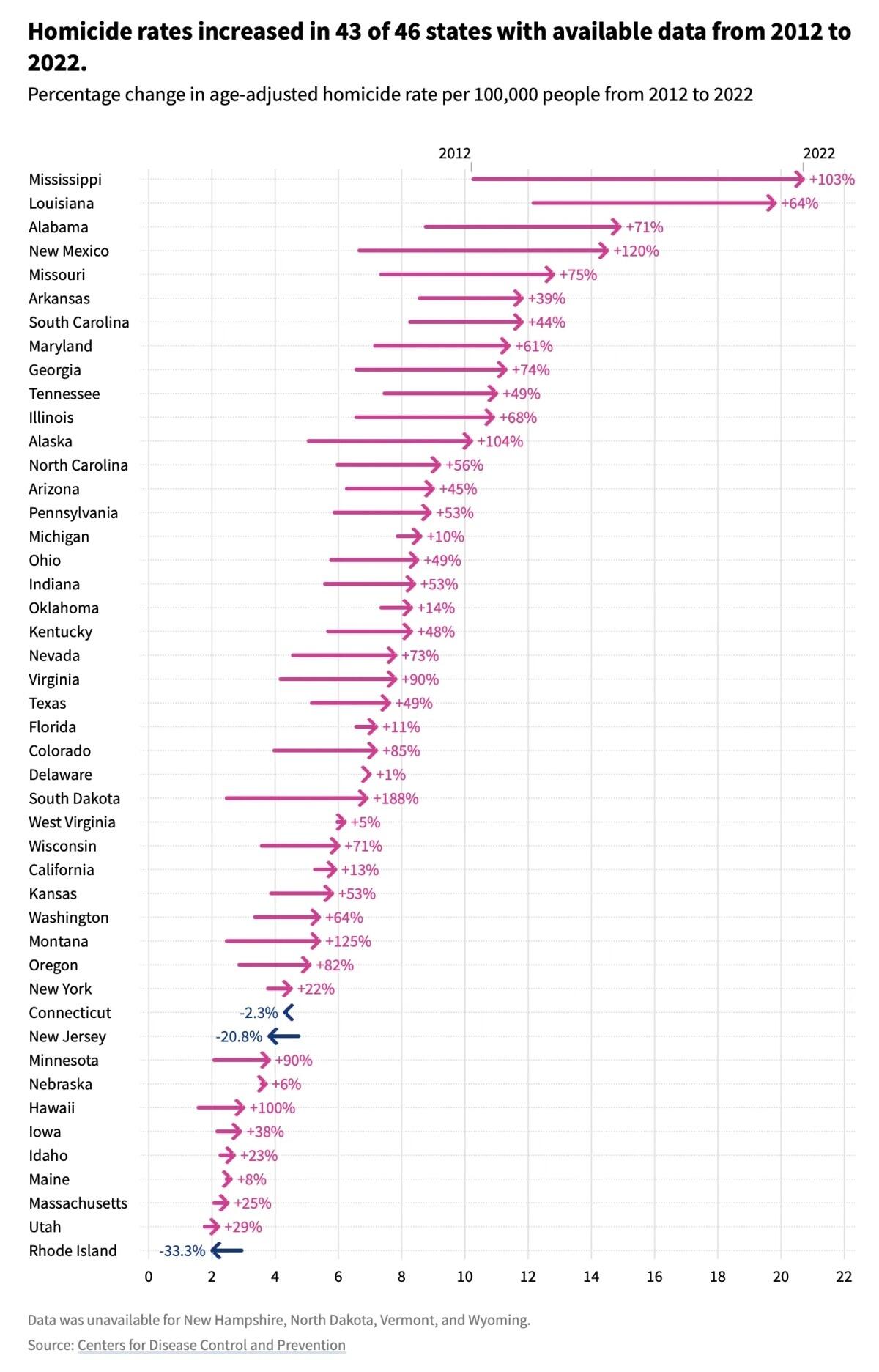
For example, by examining homicide rates by state from 2012 to 2022, it can be seen that rates have increased almost across the board. That said, they are still lower than rates seen in the 1980s and 1990s.

This graphic, via Visual Capitalist, from USAFacts examines the age-adjusted homicide rates by state from 2012 to 2022, and how they’ve changed. It uses CDC data available for 46 states, with no data available for New Hampshire, North Dakota, Vermont, and Wyoming.

Comparing States by Homicide Rates

From 2012 to 2022, homicide rates increased in every state with available data except for ConnecticutNew Jersey, and Rhode Island. Here are the rates for all 46 available states as well as their 10-year change in percentage:

State Homicide rate
(2022, age-adjusted per 100,000)
10-Year Change
(2012–2022)
Mississippi 20.7 +103%
Louisiana 19.8 +64%
Alabama 14.9 +71%
New Mexico 14.5 +120%
Missouri 12.8 +75%
Arkansas 11.8 +39%
South Carolina 11.8 +44%
Maryland 11.4 +61%
Georgia 11.3 +74%
Tennessee 11.0 +49%
Illinois 10.9 +68%
Alaska 10.2 +104%
North Carolina 9.2 +56%
Arizona 9.0 +45%
Pennsylvania 8.9 +53%
Michigan 8.6 +10%
Ohio 8.5 +49%
Indiana 8.4 +53%
Kentucky 8.3 +48%
Oklahoma 8.3 +14%
Nevada 7.8 +73%
Virginia 7.8 +90%
Texas 7.6 +49%
Colorado 7.2 +85%
Florida 7.2 +11%
Delaware 7.0 +1%
South Dakota 6.9 +188%
West Virginia 6.2 +5%
Wisconsin 6.0 +71%
California 5.9 +13%
Kansas 5.8 +53%
Montana 5.4 +125%
Washington 5.4 +64%
Oregon 5.1 +82%
New York 4.5 +22%
Connecticut 4.3 -2.3%
Minnesota 3.8 +90%
New Jersey 3.8 -20.8%
Nebraska 3.7 +6%
Hawaii 3.0 +100%
Iowa 2.9 +38%
Idaho 2.7 +23%
Maine 2.6 +8%
Massachusetts 2.5 +25%
Utah 2.2 +29%
Rhode Island 2.0 -33.3%

Note: Age-adjusted data helps to compare health data over time or between groups more fairly by accounting for the age differences in populations.

Mississippi had the largest increase in homicide rate, more than doubling from 10.2 to 20.7 per 100,000 people. New Mexico (up 7.9 homicides per 100,000 people), Louisiana (up 7.7), Alabama (up 6.2), and Missouri (up 5.5) had the next-biggest increases.

Murder rates doubled in at least six states over the decade: South Dakota (+188%), Montana (+125%), New Mexico (+120%), Alaska (+104%), Mississippi (+103%), and Hawaii (+100%).

Tyler Durden
Sat, 06/08/2024 – 20:25

From Bloody Biden Head To Code Pink ‘War Criminal’ Display, White House Protest Gets Heated

From Bloody Biden Head To Code Pink ‘War Criminal’ Display, White House Protest Gets Heated

Update (2000ET): Thousands of demonstrators surrounded the White House on Saturday to protest President Joe Biden’s response to Israel’s military strikes on Gaza.

Chants of “Free Palestine!”, “Genocide is our red line”, and “Israel bombs, your taxes pay” could be heard from protesters – many of whom were bussed in from over two dozen cities.

Footage posted on X shows protesters getting rowdy as police attempted to make an arrest. As a crowd chants, “Let her go!” officers deployed pepper spray (at 17 seconds).

The woman was not arrested, and the cops were chased away, with one protester saying “get out of here motherfuckers.

The demonstration featured a coalition of groups, including the Council on American Islamic Relations (CAIR) and Code Pink, which featured protesters dressed as Biden, Antony Blinken, Netanyahu, and Israel’s Minister of Defense Yoav Gallant.

It was a diverse crowd to say the least…

One pro-Hamas group even featured a Biden mask covered in blood.

Smoke bombs were lit:

And protesters threw bottles at a police officer, breaking into a chant of “Fascist!”

Oh, and there was a giant pride parade a few streets over.

*   *   *

President Biden loves taxpayer-funded walls, except for former President Trump’s southern border wall. The elderly president has a beautiful taxpayer-funded wall around his beach home in exclusive Rehoboth Beach (a destination for rich liberals), where the poors and illegal aliens are not allowed. On the topic of walls this weekend, another taxpayer-funded wall was quietly erected around the White House in recent days.

Biden’s ‘White House Wall’ was erected on Friday ahead of ANSWER (Act Now to Stop War and End Racism), an anti-war group founded three days after the Sept. 11, 2001 attacks, along with other activist groups, including CODEPINK and the Council on American Islamic Relations, who are all planning to surround the White House for Palestine on Saturday. 

Photo: Craig Birchfield

ANSWER posted on X numerous videos that show busses of pro-Palestinian protesters en route to Washington, DC, Saturday morning. 

“In preparation for the events this weekend in Washington, DC, that have the potential for large crowds to gather, additional public safety measures have been put in place near the White House complex,” a US Secret Service spokesperson told Reuters. 

Tyler Durden
Sat, 06/08/2024 – 20:02

European Elections: Forging Ahead Or A Spanner In The Works

European Elections: Forging Ahead Or A Spanner In The Works

By Elwin de Groot, Stefan Koopman, and Maartje Wijffelaars of Rabobank (pdf link)

Summary

  • The European Parliament elections will serve as a pivotal test of the far right’s influence on the European political landscape.
  • It appears another centrist coalition can be formed, but the far right may still shape the dynamics of parliamentary operations and the allocation of EU top jobs.
  • The European People’s Party will have a key position. This will necessitate trade-offs and, if unattainable, poses the risk of policy stasis on matters where the council is eager to advocate for radical changes.
  • The new parliament will learn there’s a thin line between increasing an economy’s resilience and adopting an unbalanced package of measures.

The European Parliament elections, scheduled for June 6-9, 2024, are expected to carry significant implications for the future of the European Union. This significance primarily arises from the increasing prominence of right-wing parties across Europe, as evidenced by their recent electoral victories and influence in national politics. This election’s outcome does not necessarily preclude the implementation of ambitious plans to overhaul the EU, but it does highlight the risk of either policy stasis or unbalanced decisions.

What’s at stake?

The European Parliament is one of the three key legislative bodies of the European Union (EU), alongside the European Commission and the Council of the European Union.

While the European Commission advocates for the EU’s overall interests and the council represents the governments of member states, the European Parliament upholds the interests of EU citizens. It plays a crucial role in the EU’s legislative and decision-making processes. Despite being perceived as the least influential among the three, it does possess substantial co-legislative authority, including the power to modify and veto legislative proposals in most policy areas. Furthermore, the Lisbon Treaty enhanced its budgetary responsibilities and reinforced its influence over the selection of the European Commission’s president and commissioners. This could prove to be a crucial factor in the months ahead.

Polls indicate the possibility that far-right members of the European Parliament (MEPs) could garner even more support than they won in 2019 (see figure 3). The far right is divided into two groups: the European Conservatives and Reformists (ECR) group and the Identity and Democracy (ID) group. The ECR includes Poland’s Law and Justice party, Italy’s Brothers of Italy, the Sweden Democrats, Spain’s Vox, Belgium’s New Flemish Alliance and France’s Reconquest!. The ID features France’s National Rally, Alternative for Germany, Italy’s League, Belgium’s Flemish Interest, and the Dutch Party for Freedom. There are also parties from the right (e.g., Hungary’s Fidesz) that are not affiliated to any of the European Union’s political groups. These sit, alongside parties from the left and center, in the non-inscrit group. Question marks hang in particular over the affiliation of Fidesz, which has a dire record on the rule of law and calls for Ukraine to negotiate peace with Russia. The party has flirted numerous times with the ECR, but for now sits in the new non-inscrits.

A shift toward the right

At first glance, the ECR and ID parties appear to share common ground, but a closer look reveals deep divisions that prevent a united front. Generally speaking, the ECR wants to curb EU powers without disbanding it altogether, while they also are pro-Ukraine, pro-Atlanticism, and pro-NATO. Its MEPs present themselves as Euroskeptics, but they are also somewhat integrated into the EU’s political and institutional framework. Conversely, the ID exhibits a more ambivalent stance vis-àvis Russia, opposes enlargement, is anti-Atlanticist, and is a pariah within EU policy circles.

Even though the Eurobarometer survey shows citizens are fairly positive about the EU, polling data indicates the ECR and ID could secure a substantial number of seats in the forthcoming elections. The latest poll averages place them at 73 and 83 seats, respectively, so a combined 156 out of 720 seats. This would surpass the center-left Socialists & Democrats (S&D), who are projected to secure 145 seats, and land not too far from the 175 seats forecast for the center-right European People’s Party (EPP). The liberal Renew Europe and the Greens/EFA are losing support. It is worth noting that MEPs do not necessarily remain put after the election; frequent transfers of lawmakers between groups tend to keep the parliament in flux.

The far right has been largely excluded from power across Europe due to tacit agreements among centrist parties, even as its influence does compel the center right to adopt stricter anti-immigration, anti-trade, and anti-environment stances. It appears another centrist coalition between the EPP and the S&D can be formed, contingent on participation of the Liberals and/or the Greens. A right-wing coalition comprising the EPP and the ECR could also be tried, but this would require additional support from other parties. This looks to be very difficult. A right-wing majority composed of the EPP, ECR, and ID looks to be very unlikely, while the Liberals, the Greens, and the Socialists have ruled out working with both far-right parties.

That said, the right wing’s influence is still poised to shape the dynamics of parliamentary operations and the distribution of high-level roles, potentially complicating the confirmation of the European Commission president and commissioners. The  incumbent president, Ursula von der Leyen of the EPP, who seeks a second term, has already engaged with the ECR, further straining her relationship with the S&D. Furthermore, even without a blocking minority or official agreements with other parties, growing support for the far right grants the far right more sway over various policies, including immigration, defense, and environmental issues, by drawing the EPP to the right, away from its alliance with S&D and Renew. Indeed, the European Commission and some mainstream parties in the European Parliament seem to be acknowledging the changing political landscape and are trying to jump on the bandwagon.

A pressing need for change

Apart from the internal landscape, rapidly changing geopolitics is also forcing the EU to change course, or to speed up, in certain areas. As we pondered in one of our strategic think pieces, the changing world order forces the EU to put more emphasis on its quest to become strategically autonomous. To summarize that article, we think that Europe’s quest for strategic autonomy hinges on overcoming three intertwined weaknesses: i) energy/raw materials dependency, ii) industrial decline, and iii) military dependence. Meanwhile, preserving social cohesion is a necessary condition to make things work.

Over the past months, EU institutions, politicians and technocrats have released multiple publications and proposals in line with our thinking.

Trump 2.0 sets things in motion

For example, last month, the commission published a paper discussing the economic impact of defense spending, aiming to spark a debate on the most efficient approach. Additionally, an over 700-page report on “state-induced distortions in China’s economy” was published (and met with immediate criticism from China). This illustrates a broader trend of the EU taking a more assertive stance on global economic matters. This is reflected in, for example, the probes into Chinese electric vehicles and wind turbines, and in investigations in international procurement, for example in medical devices.

On one side, this indicates that the EU might align more closely with the US, potentially adopting a tougher stance on China, especially if pressured by a possible new Trump administration. Conversely, Europe also seeks to establish its own distinct strategy. Given its reliance on China for key exports, as well as the strategic resources necessary for the energy transition, a complete severance of EU-China ties seems unlikely. This is underscored by the Letta report, outlined below, which emphasizes the need to maintain the EU’s foundational principles in the face of escalating geopolitical dynamics.

In the event of a future US administration implementing a universal tariff, Europe’s reaction might involve a blend of measured retaliatory tariffs targeting specific American products, coupled with calibrated actions like non-tariff barriers against China. These measures would aim to preserve the overall EU-US relationship, but until Europe achieves a degree of strategic autonomy, it is forced to play a subordinate role.

Letta and Draghi reports setting the “strategic agenda”?

Europe is also strategically bracing itself for a “Trump 2.0 world.” This is becoming evident in the upcoming strategic agenda shaped by European Council’s president and leaders of the member states. The agenda, set for adoption in June 2024, is intended to give guidance to the newly elected parliament and commission and addresses key issues like security, energy, and EU expansion.

In April, former Italian prime minister Enrico Letta added his input to the discussion, advocating for the introduction of a “fifth freedom” to bolster research, innovation, and education. He also stresses the need to develop a single market that has the ability to finance strategic goals and is able to “play big,” but not by undermining its principles of fair competition, cooperation, and solidarity.

Another significant contribution to the strategic agenda, commissioned by EC President Von der Leyen, comes from former European Central Bank president and former Italian PM Mario Draghi. In a speech, Draghi had already emphasized that the European economy is in for a radical overhaul, which requires self-sufficient energy systems, a unified European defense system, and growth in cutting-edge sectors. Or, in three words: climate, defense, and digitalization.

Draghi proposes to integrate further to leverage Europe’s scale, to focus on joint public-private investments in key areas such as defense, energy, climate, and supercomputers. This also requires a capital market union. And, broadly echoing our own conclusions, he emphasizes securing essential resources in critical input materials as well as a skilled workforce.

This again underscores the inevitability of significant costs and tough choices. At this juncture, the opinion of the European electorate becomes pivotal, as it will influence how political parties will address their needs and sentiments.

Will strategic thinking trump immigration and the cost-of-living concerns?

How this would gel with the new parliament?

Assuming the formation of another centrist coalition in parliament, it is probable that it will still lean toward the right. In table 1 on the next page, we highlight selected excerpts from election manifestos and recent policy papers on the previously mentioned topics from the five parties we believe will have a significant influence on the coalition talks.

The stance of the EPP will be pivotal. They will need to broker compromises between the positions of the S&D (hawkish on climate/environment/social issues, dovish on EU productive capacity) and those of the ECR (dovish on climate/environment/social issues, hawkish on EU productive capacity, immigration, affordability of energy). This necessitates trade-offs. If those are unattainable, there is the risk of policy stasis on matters where the council is eager to advocate for radical changes.

If we were to venture a guess, the compromises might broadly take the following form:

  • Climate: Commitment to the Green Deal remains unwavering; however, the centrality of climate and environmental objectives as an overarching priority for the European Union may diminish.
  • China: The EU maintains an ambivalent stance on China, but will remain keen on addressing dumping and unfair competition, while reducing dependencies in key sectors, framed by concerns over human rights, democracy, and the rule of law.
  • Defense: The EU sees increased (national) defense budgets, perhaps a pro-EU defense fund outside of the current budget, and enhanced collective procurement of European defense equipment and a push for greater integration of armed forces, albeit through bilateral or multilateral arrangements.
  • Trade: The EU will not pursue new trade/investment deals solely to champion free trade; agreements will be considered when they offer tangible benefits to European interests subject to EU standards on human rights and the environment.
  • Industries: The focus on green and key strategic sectors is expected to continue, likely through encouragements and incentives rather than direct, substantial subsidies.
  • Food: European food security and farmer income will be on par with eco-friendlier production, and the focus will shift from setting high (regulatory) standards to enabling farmers to become more sustainable.

What are the implications?

In this last section we briefly discuss the potential impact that the political shifts in Europe may have on three specific areas: namely, F&A, the energy transition, and financial markets.

Food and agriculture: A change of tone, but no sea change

In recent years, in line with the Green Deal, discussions have focused on the need to reduce the environmental and climate impact of farming. But due to geopolitical developments and farmer protests reflecting income and business continuity concerns, the commission has changed its tone. Currently, farmers are portrayed as vital for European food self-sufficiency and the sustainable development of rural areas. Greening agriculture is still on the table, but new legislative proposals are subject to more scrutiny on their feasibility, impact on production, and (socioeconomic) impact on rural areas.

With a more right-conservative parliament, this trend is expected to continue. In this new reality, the new parliament has to deal with several questions. To highlight three:

  • How to continue with legislation on nature/biodiversity and the use of plant protection products? It’s unlikely a new right-conservative parliament will support ambitious (new) proposals on these topics, as the previous proposals have become symbols of (political) polarization.
  • What does the future of the Common Agriculture Policy (CAP) look like? Although the new funding period for CAP won’t start until 2028, preparation starts years in advance. CAP is often criticized for being old-fashioned with too little focus on incentivizing more sustainable agricultural practices. Here too, it seems unlikely that a major reform will take place under a new right-conservative parliament.
  • What is the future of animal welfare legislation? The current commission was supposed to present several revisions on animal welfare legislation, but there is only one on the table regarding animal transport. In particular, the European Citizens’ Initiative to “End the Cage Age” requires attention. This is potentially as divisive as legislation on nature/biodiversity and the use of plant protection products due to its large implications (costs, international competitive position, parallel import measures). It’s unlikely that a new right-conservative parliament will be very ambitious on this subject.

Although a new right-conservative parliament might be less ambitious on reducing the environmental and climate impact of farming, this certainly does not mean European farmers are free from demands. Much of the Green Deal ambitions for agriculture are already laid down in legislation. These include legislation on greenhouse gases, water quality, and biodiversity. Some of this legislation has been in place for decades, but deadlines are nearing and the commission is losing patience with member states not having fulfilled their required efforts and goals.

For instance, the Netherlands, Ireland, and Denmark are phasing out derogations from the Nitrates Directive as water quality hasn’t sufficiently improved. As a consequence, the dairy sectors in these countries are under particular pressure to reduce nutrient losses, which will probably result in a smaller herd size. Moreover, the Water Framework Directive requires water quality to be good in 2027. This increases the need for farmers to reduce nutrient losses and use less plant protection products. Hence, even though new legislation on the latter has been withdrawn, there still is pressure on agriculture to reduce the use of plant protection products.

In short, even with a new right-conservative parliament, farmers still face strict regulations to improve their environmental and climate performance.

Energy transition: Different shades of green

The exiting European Commission already is signaling a different reading of the EU Green Deal. Or at least, it is shifting its accent to parts that were not so high on the agenda back when it was launched, in a 2019, pre-Covid world. The Green Deal Industrial Plan may be hinting at this evolving prioritization, paving the way for stronger state support, more explicitly recognizing the strategic nature of critical raw materials, and initiating the reform of the electricity market design, to ensure the ability to accommodate massive wind and solar generation sources before 2030.

It is clear, and natural, given the geopolitical context, that some points in the original plan may become less prominent. The obvious candidates for diluted efforts, depending on the outcome of the elections, may be the biodiversity policies and those related to the agriculture sector, given their social sensitivity. We also struggle to see a very effective and influential implementation of very socially sensitive regulation, such as the EU ETS II. At least not before “palliative” social measures are put in place both in Brussels and in European capitals.

Meanwhile it is well known that Europe’s greenhouse gas emissions – and the reduction thereof – are becoming less and less definitory in the fate of the global climate, in light of China’s increase and Europe’s decrease. But, it is also crystal clear that the energy transition – or the decarbonization of the energy system – is much more than an environmental effort, as shown by the leading role of China, not known for having a “green agenda” influencing its decision-making. From a more pragmatic and industrial point of view, it has become painfully clear that, if the EU wants to afford some industry and keep or gain some strategic autonomy, it will not be achieved on the shoulders of an energy supply chain relying on European competitors. Not while such providers can afford a much cheaper fossil fuel supply for themselves. An alternative, affordable, and reliable local supply is pivotal for Europe.

Last but not least, there are political factors on the greener side of the balance, such as the strong positioning of Teresa Ribera as officer-to-be of the Green Deal’s next chapter.

With all these elements together, it is not risky to venture that the EU Green Deal may show some brownish areas after the elections, but it may very well grow on steroids in the key areas of renewable and reliable energy supply, simplified strategic permitting, decarbonization of industry, and the deployment of local supply chains.

Financial markets: Europe advances with crises not strategic agendas

When gauging the impact of European elections and subsequent policy shifts on financial markets, recall that the direction of the European project has historically been shaped by crises instead of grand strategies. That has proved all too clear in the euro era, marked by the global financial crisis and sovereign debt crisis from 2008 to 2012, the refugee crisis of 2015-16, the

Covid-19 pandemic in 2020-21, and the subsequent significant energy crisis and war in Ukraine.
The unprecedented issuance of joint European debt, for instance, was a response to external shocks – an unplanned but effective move! While Europe’s strategic vulnerabilities may lead to more of these shocks that help the EU fail forward, they also underscore the possibility that strategic plans are sidelined by emergent issues.

A significant breakdown of the European project seems unlikely. The majority of political parties now acknowledge the project’s irreversibility and the necessity for a unified stance on shared external interests. Real Euroskepticism has largely retreated to the political margins. The existence of the euro itself, even as it trades below its purchasing power parity, is not something financial markets are now worried about.

The European Commission and Council have set ambitious goals. In our view, development of a capital markets union could be positive for financial markets, if it were to help unlock new private funding sources, reduce the cost of capital, and enhance competitiveness. This is also on the wish list of most groups in the parliament. Similarly, initiatives to strengthen defense,  stimulate innovation, support key industries, and secure supply chains and strategic resources should find enough support. If this indeed increases Europe’s resilience, then this transition could be positive for euro assets.

However, when we juxtapose the possible shape of a compromise in the European Parliament with the commission and council’s ambitions, we could envisage two scenarios that may, at some point, adversely impact euro assets:

  • The risk of stasis precipitating the demise of the European project.
  • The risk of the commission or council pushing their agendas and leading to unbalanced results.

Risk of stasis

While the effective response to Covid-19 and the energy crisis highlighted the necessity of EU coordination and joint funding, we could expect some difficult moments on topics such as i) new EU funding sources, ii) the permanence of common funding as a feature of the European toolkit, iii) the need for a permanently larger EU budget, and iv) the need for state aid.

Resistance is likely to come from groups opposed to further integration and the dilution of national competences. Yet even centrist parties like the EPP might object if they perceive this as a threat to prudent budgeting and fiscal sustainability. This could lead to policy stasis and slow down the progress toward Europe’s strategic autonomy. The ambivalent stance on China could also prove a source of stagnation if the EU prioritizes derisking while national governments protect domestic interests. This could obviously weigh on market sentiment at some point.

Risk of unbalanced results

The EU should also avoid unintended demand-supply imbalances. The strategic agenda is costly and adds to demand before it can increase supply. As such, it is potentially inflationary in the transition phase. The impact could be attenuated by prudent budgeting, which requires tough choices, and by the right incentives. A key risk here lies in viewing joint financing, effectively a new layer on top of the existing debt structure, as the “solution” to overcome political hurdles. By this we mean that even when we ignore the condition of fiscal prudence, it is also important that policies steer more actively toward “productive” spending and investment measures rather than just pushing demand or unproductive speculation.

Without such policies, clearly, the other risk is that the same political hurdles force the European Commission and/or Council into compromises that undermine the holistic approach. Sidestepping tough choices or protecting vested interests could lead to an unbalanced package of measures that leads to an unconstrained inflationary impulse. Our analysis suggests the ECB’s role is crucial in a holistic strategy. If there is no consensus, we could end up in a situation where the ECB will simply have to pick up the pieces. This is, obviously, not a market-friendly outcome either.


Tyler Durden
Sat, 06/08/2024 – 19:50

Tokyo Government Dating App Helps Residents Get Laid To Avoid Population Collapse

Tokyo Government Dating App Helps Residents Get Laid To Avoid Population Collapse

Officials in Tokyo, Japan are launching a new dating app to help promote marriage and boost the collapsing national birth rate.

The fee-based app from the Tokyo Metropolitan government will ask people to prove that they are legally single, and sign a letter confirming their willingness to get married. It will also require that people submit a tax certificate slip that proves their annual income, along with roughly 15 other items of personally identifying information – including height, weight, educational background and occupation following a mandatory interview with the app’s operator.

So – Match.com, only you give all of your data to the government instead of a private company.

According to the Independent, Tokyo officials allocated US$1.2 million towards the development of dating apps in 2023, and US$1.9 million for fiscal 2024 for the purpose of promoting marriage through said apps.

“If there are many individuals interested in marriage but unable to find a partner, we want to provide support,” a Tokyo official told The Asahi Shimbun.

“We hope that this app, with its association with the government, will provide a sense of security and encourage those who have been hesitant to use traditional apps to take the first step in their search for a partner.”

According to AFP, the app is intended to give a “gentle push” to the nearly “70 per cent of people who want to get married” but weren’t “actively joining events or apps to look for a partner.”

Falling Birth Rates

In February, we noted that in 2023 Japan’s birth rate fell 5.1% from a year earlier to 758,631, while the number of marriages slid 5.9% to 489,281, the first time in 90 years the number fell below 500,000. The last time the number was this low the US had just dropped the atom bomb over Hiroshima and Nagasaki – signaling even greater declines in the population as out-of-wedlock births are rare in Japan.

The drop comes more than a decade earlier than the government’s National Institute of Population and Social Security Research forecast, which estimated births would decline to below 760,000 in 2035, according to Kyodo news.

Meanwhile, the number of deaths also hit a record – only in the other direction – rising to 1,590,503, while divorces increased to 187,798, up by 4,695.

As a result, Japan’s population, including foreign residents, fell by 831,872, with deaths outnumbering births by a record 831,872, double where it was just five years ago.

The fast pace of decline in the number of newborns has been attributed to late marriages and people staying single. The administration of Prime Minister Fumio Kishida has called the period leading up to 2030 “the last chance” to reverse the trend; all Japan has to do is divert the millions of illegal immigrants entering the US every month through the southern border – with the expectation they will all become diligent Democratic voters – and give them a red carpet welcome.

The declining birthrate is in a critical situation,” Chief Cabinet Secretary Yoshimasa Hayashi told reporters. “The next six years or so until 2030, when the number of young people will rapidly decline, will be the last chance to reverse the trend.”

Also, this is a problem:

And this:

Tyler Durden
Sat, 06/08/2024 – 18:05

American Airlines Threatened With Travel Ban From NAACP After Passengers Removed For Body Odor

American Airlines Threatened With Travel Ban From NAACP After Passengers Removed For Body Odor

Via American Greatness,

American Airlines is under fire from the NAACP after 8 black men were removed from a flight in May following a complaint about body odor.

Last month three of those passengers filed a lawsuit against American Airlines, after alleging that airline personnel removed them and the other black male passenger from a flight from California to New York. A flight attendant had complained about body odor, though none of the passengers removed were accused of being the source of that odor.

A tweet shared by Collin Rugg alleges that the men who filed that discrimination lawsuit don’t even know one another.

After American Airlines offered to book new flights for the men, but when no other flights were available at that late hour, they were all allowed back on the plane.

In 2017, the NAACP issued a travel advisory for the airline after what it described as “disrespectful, discriminatory or unsafe conditions” when booking or boarding with the airline.

American Airlines responded by creating a diversity, equity and inclusion (DEI) panel and the NAACP lifted the ban in 2018.

However, the growing politicization of DEI programs prompted the airline to disband the panel in 2023.

NAACP president and CEO Derrick Johnson released a statement saying, “Without a swift and decisive response, the NAACP will be forced to reinstate an advisory against the airline.”

American Airlines told The Hill that they take “all claims of discrimination very seriously and want our customers to have a positive experience when they choose to fly with us.”

Airlines can justifiably remove passengers who are a source of offensive odors in a highly confined space, but it’s also possible for airline service to stink to high heaven.

Tyler Durden
Sat, 06/08/2024 – 17:30

New Texas GOP Platform Calls For Secession Vote, Resistance To Federal Infringements

New Texas GOP Platform Calls For Secession Vote, Resistance To Federal Infringements

Reflecting plummeting patience with overstepping federal overlords, the Texas Republican Party has adopted two platform planks that call for legislators to assert state sovereignty, and to schedule a secession referendum in the next general election after November’s. 

“This historic vote at the 2024 Republican Party of Texas Convention represents a substantial shift towards enhancing state sovereignty and exploring the potential for Texas to operate as an independent nation,” said the Texas Nationalist Movement (TNM) in a statement. “It reflects the growing sentiment among Texans for greater autonomy and the protection of our rights against federal overreach.” 

Backers of the “TEXIT” movement make their stance known at the Texas Republican Convention in San Antonio (via Texas Nationalist Movement)

Fittingly, that historic vote took place in San Antonio — home of the Alamo, aka “the cradle of Texas liberty.” Though it represented a setback, the 1836 Battle of the Alamo was a key chapter in the fight for independence that culminated in Texas becoming a self-governing republic. 

The first plank asserts that the US government is infringing on powers reserved to Texas and all other states, and calls for unwarranted federal laws to be thwarted by Texas government. It also affirms the right of Texas to secede: 

“Pursuant to Article 1, Section 1, of the Texas Constitution, the federal government has impaired our right of local self-government. Therefore, federally mandated legislation that infringes upon the 10th Amendment rights of Texas shall be ignored, opposed, refused, and nullified.

Texas retains the right to secede from the United States, and the Texas Legislature should be called upon to pass a referendum consistent thereto and pass the Texas Sovereignty Act as filed in the 88th Legislative Regular Session as HB 384.”

The second plank is a pointed directive to put the question of secession to the people of Texas in the next general election: 

“The Texas Legislature should pass a bill in its next session requiring a referendum in the next General Election for the people of Texas to determine whether or not the State of Texas should reassert its status as an independent nation. This referendum should be a legislative priority.”

From the San Antonio convention, here’s a brief but interesting clip of the Texas Nationalist Movement’s Nate Smith speaking in support of the independence-minded platform planks — and ably fielding a question from a delegate who suggests TNM is guilty of treason

We’d have liked to hear Smith answer his critic’s attempted second question — as to whether Smith had recited the Pledge of Allegiance earlier that day as part of convention rituals. It’s likely the questioner would have next pointed to the pledge’s reference to “one nation…indivisible.”

In making a case for why patriots shouldn’t pledge allegiance, Brian McGlinchey has argued that, of several objectionable components of the pledge, “‘indivisible’ should give greatest offense to American patriots. The very existence of the United States — created by secession from the British empire — is a testament to political divisibility as a foundational human right…By reciting the Pledge of Allegiance and proclaiming the United States of America ‘indivisible,’ Americans disclaim their human right of self-determination.”

The Texas Nationalist Movement’s GOP convention success comes on the heels of a state Republican Party controversy over the issue. Despite TNM having amassed more than 139,000 signatures requesting that a secession question be placed on the March 5 primary ballot, the Texas GOP’s leadership refused to include it. TNM appealed to the state supreme court, which refused to hear the controversy.

The party chair who presided over that decision, Matt Rinaldi, is out. Now, party’s top two officials are both signers of the “Texas First Pledge.” In addition to promising to place the interest of Texans “before any other nation, state, political entity, organization, or individual,” signatories commit to bringing about a secession referendum and, if it is approved by a majority of Texans, to work for an expeditious exit from the union.   

After seceding from Mexico, Texas was an independent country from 1836 to 1845 and, economically, is extraordinarily well-suited for independence today. It’s by far the largest oil producer of any US state, accounting for a whopping 42% of American production, with no other state exceeding even 10%. It has deep-water ports, abundant agriculture, and is a major high-tech hub. 

There’s fixin’ to be another feather in Texas’s hat. As we examined earlier this week, the booming Lone Star State economy — and rising aggravation over compliance costs and woke regulations — has spurred BlackRock, Citadel Securities and other investors to back a new challenger to the New York Stock Exchange and Nasdaq: the Texas Stock Exchange.

Tyler Durden
Sat, 06/08/2024 – 16:55

Big Food, Bigger Conspiracy

Big Food, Bigger Conspiracy

Via SchiffGold.com,

Food has gotten big. Literally. A walk through the produce aisle of a 21st-century grocery store would enthrall people of any historical period other than our own. The size of tomatoes and heads of lettuce is unprecedented in the history of humankind. In just a few short generations we have become accustomed to increasingly genetically modified food. This new food is much more tasteless and durable than food of the past. Variations in soil and growing conditions allowed food grown for different reasons to possess unique regional flavors. Food grown near the place it was sold allowed taste to be prized over transportability. While many have described this decrease in food quality as a result of industrialization and the demands of efficiency, it is much more correctly enunciated to be a result of government corruption arising from a socialistic instinct.

Politicians on both sides of the aisle generally support the idea of America as a free market economy, yet they all fall victim to a basic human fallacy: “What you see is all there is.” Their desire to protect the foundation of America’s high quality of life is clouded by the lobbyists and lucrative PACs right in front of them. Timeless principles of wise governance seem unimportant and distant when a Kansan Sorghum Farmer is shedding real tears onto your office carpet. The farmer’s desire to keep things as they are infests the minds of all politicians who happen to interact with him. Small details, like the fact that he is representing a near-risk-proof corporate farm with an army of middle management, become unimportant. Smaller farms that cannot hire lobbyists will inevitably receive the short end of the stick because they have no way to remind the politicians of their existence. Fallible Politicians with a desire to make things right through government intervention rather than honor liberal principles will inevitably favor corporate farmers above both small farmers and the American populace.

Governmental inability to hold back from action has damaged the very concept of local cuisine. Small family farms already had difficulty surviving against larger farms with vast economies of scale, and government support of “American Farmers” (corporations large enough to keep perpetual spokespeople on staff) only makes this struggle more difficult. Even from an interventionist standpoint, it would be better for more unstable businesses to receive more assistance, so the free market would be perceived as better than the current situation where the strongest multi-state farms are subsidized most heavily. Local history and growing conditions converged to create a rich and multifaceted food landscape. Unique types of plants and animals were preserved as they found a valued place in the palates of locals. Slight losses of efficiency were offset by regional cuisines which reveled in distinctiveness. However, some areas of America are more conducive to producing farms large enough to seek government aid. Massive farms in America’s breadbasket sympathy-farmed great depression sentiments until they entered a spiral of lobbying and growth that could not be stopped. Through technological superiority, crop homogeneity, and government cheerleading, they were able to lower prices to the point where local farms could not hope to compete.

The death of local farms would not be nearly so great a problem if the larger farms provided even a semblance of the taste and quality that local farms provided. Food has grown large and tasteless as a direct result of this sympathy-fueled government campaign to protect a certain subgroup of farmers. greater geographic distance from the markets where produce is sold has greatly enhanced the value of firmer variations which can ripen well after being picked. Ripening while still attached to the plant allows more nutrients to enter and increase its flavor profile. Efficiency is also aided by an increase in size because a larger fruit is often easier to pack and has less chance of breaking. While consumers would undoubtedly prefer more flavorful produce, government incentives have exacerbated the prioritization of shelf-life and easy transport. Government-funded GMO research has also accelerated the problem of an abundance of large and tasteless food. The long-term health effects of GMOs are not known, yet because they directly serve the interest of the most well-funded farmers, their use is rarely scrutinized by regulatory agencies.

Americans could once again be culinarily respected by the rest of the world if those in power developed a spine strong enough to stand up to sob story rent-seeking. Quality of life and local farming could gradually increase as the unjust power structures of the agricultural world begin to shift. Healthier and tastier options could become the norm rather than the expensive exception as they stop being crowded out by tasteless produce designed for anything but human consumption.

Tyler Durden
Sat, 06/08/2024 – 16:20