A complex interplay of factors are leading to North America’s long wildfire season: increasing summer temperatures, erratic precipitation patterns, changing land use, and ironically, fire suppression practices.
From glancing at the chart, it’s apparent that U.S. wildfires are burning significantly more acres on average in the 2010s than they did in the 1980s. Interestingly, the World Economic Forum points out that while the number of fires itself has fallen since 2005, the land burned has increased, indicating wildfire intensity has grown.
Year
Million Acres Burned
1983
1.3
1984
1.1
1985
2.9
1986
2.7
1987
2.4
1988
5.0
1989
1.8
1990
4.6
1991
3.0
1992
2.1
1993
1.8
1994
4.1
1995
1.8
1996
6.1
1997
2.9
1998
1.3
1999
5.7
2000
7.4
2001
3.6
2002
7.2
2003
4.0
2004*
8.1
2005
8.7
2006
9.9
2007
9.3
2008
5.3
2009
5.9
2010
3.4
2011
8.7
2012
9.3
2013
4.3
2014
3.6
2015
10.1
2016
5.5
2017
10.0
2018
8.8
2019
4.7
2020
10.1
2021
7.1
2022
7.6
2023
2.7
2024**
1.9
*Doesn’t include North Carolina data. **As of May 27, 2024.
In 2015, wildfires burned more than 10 million acres in the country, a first since these records began. Five years later saw a repeat, thanks to four Californian fires that together burned more than 2.3 million acres in the state.
For comparison, U.S. wildfires burned approximately 2.7 million acres in total in 2023, the lowest amount recorded since 1998. An unusually wet Californian summer helped prevent errant sparks from turning into raging disasters.
Nevertheless, in August, a devastating fire nearly wiped out the historic town of Lahaina, Maui, killing at least 100 people.
Finally, U.S. wildfires have burned 1.9 million acres in 2024 so far, currently below the 10-year annual average of 7.2 million acres. However, experts predict a hotter-than-usual summer and autumn, and fire activity is expected to increase as the summer progresses.
Moving industrialization offshore can look like a good idea at first. But as fossil fuel energy supplies deplete, this strategy works less well. Countries doing the mining and manufacturing may be less interested in trading. Also, the broken supply lines of 2020 and 2021 showed that transferring major industries offshore could lead to empty shelves in stores, plus unhappy customers.
The United States started moving industry offshore in 1974 (Figure 1) in response to spiking oil prices in 1973-1974 (Figure 2).
Industry is based on the use of fossil fuels. Electricity also plays a role, but it is more like the icing on the cake than the basis of industrial production. Industry is polluting in many ways, so it was an “easy sell” to move industry offshore. But now the United States is realizing that it needs to re-industrialize. At the same time, we are being told about the need to transition the entire economy to electricity to prevent climate change.
In this post, I will try to explain the situation–how fossil fuel prices have spiked many times, including 1973-1974 (oil) and more recently (coal in 2022). I will also discuss the key role fossil fuels play. Because of the key role of fossil fuels, a reduction in per-capita fossil fuel consumption likely leads to a transition to fewer goods and services, on average, per person. A transition to all electricity does not seem to be feasible. Instead, we seem to be headed for increased geopolitical conflict and the possibility of a financial crash seems greater.
[1] When fossil fuel supplies become constrained, prices tend to spike to high levels, and then fall back again.
Economists and energy analysts have tended to assume that fossil fuel prices would rise to very high levels, allowing extraction of huge amounts of difficult-to-extract fossil fuels. For example, the International Energy Agency (IEA) in the past has shown forecasts of future oil production assuming that inflation-adjusted oil prices will rise to $300 per barrel.
Instead of rising to a very high level, fossil fuel prices tend to spike because there is a two-way contest between the price the consumers can afford and the price the sellers need to keep reinvesting in new fields to keep fossil fuel supplies increasing. Prices oscillate back and forth, with neither buyers nor sellers finding themselves very happy with the situation. The current price of the benchmark, Brent oil, is $81.
[2] Historical data shows spiking oil and coal prices.
When world oil prices started to spike in the 1973-1974 period, the US started to move its industrial production offshore (Figure 1). The very low inflation-adjusted prices that prevailed up until 1972 no longer held. Manufacturing costs climbed higher. Consumers wanted smaller, more fuel-efficient vehicles, and such cars were already being manufactured both in Europe and in Japan. Importing these cars made sense.
More recently, coal prices have begun to spike. Coal prices vary by location, but the general patterns are similar for the types of coal shown.
Before China joined the World Trade Organization (WTO) in 2001, coal prices tended to be below $50 per ton (figure 3). At that price, coal was a very inexpensive fuel for making steel and concrete, and for many other industrial uses.
After China joined the WTO, China’s coal consumption soared (Figure 4), allowing it to industrialize. Figure 3 shows that the extra demand initially pushed coal prices up a little. By 2022, coal prices had soared. At present, coal prices are part-way back down, perhaps partly because higher interest rates are dampening world demand for coal.
Natural gas prices also soared in 2022, at the same time as coal prices. Both coal and natural gas are fuels that are burned to produce electricity. When the coal supply is constrained, utilities will try to purchase more electricity produced by burning natural gas. However, it is difficult to store much natural gas for future use. Thus, a shortage of internationally traded coal can simultaneously lead to a shortage of internationally traded natural gas.
Having oil, coal, and natural gas prices spiking at the same time leads to inflation and to many unhappy citizens.
[3] The 1997 Kyoto Protocol encouraged the trend toward moving industry to lower-cost countries.
In Figure 1, I show a dotted line at 1997. At that time, an international treaty stating that the participating countries would limit their own CO2 emissions attracted a lot of attention. An easy way to limit CO2 emissions was by moving industry overseas. Even though the US did not sign the treaty until later, the treaty gave the US a reason to move industry overseas. We can see from Figure 1 that US industrialization, as measured by the energy per capita required to industrialize, began to fall even more rapidly after 1997.
[4] There were many reasons besides the Kyoto Protocol why Advanced Economies would want to move industry overseas.
There were many reasons to move industry overseas besides spiking oil prices and concern over CO2 levels. With such a change, customers in the US (and European countries making a similar change) gained access to lower-cost goods and services. With the money the customers could save, they were able to buy more discretionary goods and services, which helped to ramp up local economies.
Also, industry tends to be polluting. Smog tends to be problem if coal is burned, or if diesel with high sulfur content is burned. Mining tends to produce a lot of toxic waste. Moving this pollution offshore to poorer countries would solve the pollution problem without the high cost of attempting to capture this pollution and properly store it.
Furthermore, business-owners in the United States could sense the opportunity to grow to be truly international in size if they moved much of their industry overseas.
[5] All the globalization and moving of industry overseas had a downside: more wage and wealth disparity.
In a matter of a few years, the economy changed to provide fewer high-paying factory jobs in the United States. Increasingly, those without advanced education found it difficult to provide an adequate living for their families. The high incomes were disproportionately going to highly educated workers and the owners of capital goods (Figure 5).
[6] Part of what caused the growing wage and wealth disparities in Figure 5 was the growing industrialization of China (Figure 6).
China, with its growing industrialization, could outcompete whole industries, such as furniture-making and garment-making, leaving US workers to find lower-paid jobs in the service sector. Similar outcomes unfolded in the EU and Japan, as industrialization started moving to different parts of the world.
Anyone who expected that the 1997 Kyoto Protocol would reduce world CO2 emissions would have been disappointed.
[8] The direct use of fossil fuels plays a far more important role in the economy than we have ever been taught.
Thanks to the direct use of fossil fuels, the world can have paved roads, bridges made of steel, and electricity transmission lines. It can have concrete. It can have pharmaceutical products, herbicides, and insecticides. Many of these benefits come from the chemical properties of fossil fuels. Electricity, by itself, could never provide these products since it has been stripped of the chemical benefits of fossil fuels. Electricity is also difficult to store.
With the benefit of fossil fuels, the world can also have high-quality steel, with precisely the composition desired by those making it. With only electricity, it is possible to use electric arc furnaces to recycle used steel, but such steel is limited both in quantity and quality. US production of steel amounts to 5% of world supply (primarily using electric arc furnaces), while China’s production (mostly using coal) amounts to 50% of world supply.
I highly recommend reading the article, Trapped in the Iron Age, by Kris De Decker. He explains that the world uses an enormous amount of steel, but most of it is hidden in places we can’t see. Today, with the US’s limited steel-making capability, the US needs to import most of its steel, including steel pipes from China to drill its oil wells. We cannot see how dependent we have become on other countries for our basic steel needs.
China and India have both based their recent growth primarily on rising coal consumption. This is what has kept world CO2 emissions high. The US is now exporting coal to these countries.
[9] Citizens of Advanced Economies are easily confused about the importance of fossil fuel use because they have never been taught about the subject and because their worldview is distorted by the narrow view they see from within their homes and offices.
Figure 8 shows that the sector with the highest share of electricity use is the commercial sector. This includes uses such as stores, offices, and hospitals. The most visible energy use is lighting and operating computers, which gives the perception that electricity is the greatest energy use. But these businesses also need to be heated, and heat is often produced by burning natural gas directly. Businesses also need back-up for their electrical systems. Such back-up is typically provided by diesel-powered generators.
Residential usage is similar. It is easy to see the use of electricity, but heat is generally needed during winter. This is often provided by natural gas or propane. Natural gas is also often used in hot water heaters, stoves, and clothes dryers. Occasionally, wood is used to heat homes; this would go into the non-electricity portion, as well.
The thing that most people do not realize is that industrial use and transportation use are extremely large sectors of the economy (Figure 9), and these sectors are very low consumers of electricity (Figure 8). Also, if the US and Europe were to re-industrialize to produce more of our manufactured goods, our industrial sectors would need to be much larger than they are today.
In recent years, electrical consumption as a percentage of total energy consumption for the industrial sector has averaged about 13% of the total (Figure 9). Industries typically need high heat levels; such heat can usually be achieved at lowest cost by burning fossil fuels directly. Wikipedia claims, “Electric arc steelmaking is only economical where there is plentiful, reliable electricity, with a well-developed electrical grid.” An electric grid, powered only by intermittent electricity from wind turbines and solar panels, would not qualify.
In Figure 8, electricity consumption as a percentage of total energy consumption for the US transportation sector rounds to 0%, for every year. Even the amount of biomass (ethanol and biodiesel) used by the transportation sector doesn’t have much of an impact, as shown in Figure 10.
A major issue is that transportation is a broad sector, including trucks, trains, planes, and boats, in addition to private passenger autos. Also, I expect that the only electricity that would be considered in the transportation energy calculation would be electricity purchased from an away-from-home charging facility. Electricity used when charging at home would likely be part of residential electricity consumption.
[10] The narrative saying that we can transition to an electricity-only economy, powered by intermittent wind and solar electricity, has major holes in it.
One major issue is that the pricing of wind and solar tends to drive out other electricity providers, particularly nuclear. Intermittent wind and solar are given “priority” when they are available. This leads to very low or negative prices for other electricity providers. Nuclear is particularly affected because it cannot ramp up and down, in response to prices that are far below its cost of production.
Nuclear is a far more stable source of electricity than either wind or solar, and it is also a low-carbon source. As a result, economies end up worse off, in terms of electricity supply per capita, and in stability of available supply, when wind and solar are added.
Another issue is that wind turbines and solar panels are made with fossil fuels and repaired using fossil fuels. Without fossil fuels, we cannot maintain electricity transmission lines and roads. Thus, wind turbines and solar panels are as much a part of the fossil fuel system as hydroelectric electricity and electricity made from coal or natural gas.
Also, as discussed above, only a small share of the economy is today operated using electricity. The IEA says that 20% of 2023 world energy supply comes from electricity. The amounts I calculated as “Overall” in Figure 8 indicate an electricity share of 18%, which is a bit less than the IEA is indicating for the world. Figure 8 shows an early upward trend in this ratio, but no upward trend since 2012. Fossil fuels are being used today because they have chemical characteristics that are needed or because they provide the energy services required in a less expensive manner than electricity.
Even in the early days of the Industrial Revolution, wind and waterpower provided only a small portion of the total energy supply. Coal provided the heat energy that both industry and residences needed, inexpensively. Wind and waterpower were not well adapted to providing heat energy when needed.
If we are short of inexpensive-to-extract fossil fuels, relative to today’s large population, we certainly could use some new inexpensive source of stable electricity supply. But this would not solve all our energy problems–we would still need a substantial amount of fossil fuel supplies to grow our food and keep our roads repaired. But if a new type of electricity production could reduce the demand for fossil fuels, it would make a larger quantity of fossil fuels available for other purposes.
[11] Practically everyone would like a happily-ever-after ending, so it is easy for politicians, educators, and the news media to put together overly optimistic versions of the future.
The narrative that CO2 is the world’s biggest enemy, so we need to move quickly away from fossil fuels, has received a great deal of publicity recently, but it is problematic from two different points of view:
(a) The feasibility of moving away from fossil fuels without killing off a very major portion of the world’s population seems to be virtually zero. The world economy is a dissipative structure in physics terms. It needs energy of the right kinds to “dissipate,” just as humans are dissipative structures and need food to dissipate (digest). Humans cannot live on lettuce alone, or practically any other foodstuff by itself. We need a “portfolio” of foods, adapted to our bodies’ needs. The economy is similar. It cannot operate only on electricity, any more than humans can live only on high-priced icing for cakes.
(b) The narrative about the importance of CO2 emissions with respect to climate change is quite possibly exaggerated. There are many other things that would seem to be at least as likely to cause short-term shifts in temperatures:
Lack of global dimming caused by less coal dust and reduced sulfur compounds in the atmosphere; in other words, reducing smog tends to raise temperatures.
Small changes in the Earth’s orbit
Changes in solar activity
Changes related to volcanic eruptions
Changes related to shifts in the magnetic north and south poles
Politicians, educators, and the news media would all like a narrative that can explain the need for moving away from fossil fuels, rather than admit that “our easy to extract fossil fuel supply is running out.” The climate change narrative has been an easy approach to highlight, since clearly the climate is changing. It also provides the view that somehow we will be able to fix the problem if we take it seriously enough.
[12] Today, we are in a period of conflict among nations, indirectly related to not having access to enough fossil fuels for a world population of 8 billion. There is also a significant chance of financial collapse.
In my opinion, today’s world is a little like the “Roaring 20s” that came shortly before a major stock market crash in 1929 and the Great Depression of the 1930s. After the Great Depression, the world entered World War II. There is huge wage and wealth disparity; energy supplies per capita are stretched.
Today, NATO and Russia are fighting a proxy war in Ukraine. Russia is a major fossil fuel producer; it would like to be paid more for the energy products it sells. Russia could perhaps get better prices by selling oil and other energy products to Asian customers instead of its current customer mix. At the same time, the US claims primary leadership (hegemony) in the world but, in fact, it needs to import many goods from overseas. It even needs supply lines from around the world for weapons being sent to Ukraine. The Ukraine conflict is not going well for the US.
I do not know how this will work out. I am hoping that there will not be a World War III, in the same way that there was a World War II. All countries are terribly dependent on each other, even though there are not enough fossil fuels to go around. Perhaps countries will try to sabotage one another, using modern techniques, such as cyber warfare.
I think that there is a substantial chance of a major financial collapse in the next few years. The level of debt is very high now. A major recession, with lots of collapsing debt, seems to be a strong possibility.
[13] A presentation I recently gave to a group of actuaries that touches on several of these issues, plus others.
South Korea Has Gold Bar Vending Machines…And They’re Selling Out
First, it was Costco selling (and selling out of) gold bars, as we reported last year. Now, you can buy them in vending machines in South Korea.
One way or another, it looks as though the public wants gold.
Bloomberg reported this week that in Seoul’s upscale Gangnam district, a GS Retail Co. convenience store features a vending machine selling gold bars, ranging from less than 1 gram to 37.5 grams, with prices starting at around 88,000 won ($64) and fluctuating daily. Initially launched in 2022, these machines are now in 30 stores nationwide.
South Koreans are joining the global investing trend, with many investing in fractional shares and physical gold, amid widespread interest in various asset types, from meme stocks to cryptocurrencies, the report noted.
The one thing we see in common with the United States? People that want to exit from the fiat system.
A GS spokesperson told Bloomberg: “Currently we are seeing about 30 million won of sales per month. The gold vending machine draws customers’ attention due to increasing demand for safe haven assets and the spreading trend of micro-investing.”
Park Sang-hyun, an economist at HI Investment & Securities in Seoul, added that investors have a “fear of missing out when everything rallies, and that partially contributed to the scene.”
He added: “Feeling uncertainty about the global economy prompts safe haven demand.”
In South Korea, the convenience store CU, a competitor of GS, quickly sold out its ultralight gold cards, with the 1-gram options disappearing in just two days due to high demand from people in their 30s.
As of May 31, CU had sold 95% of its 770 gold items, buoyed by prices falling below market rates, according to a statement from BGF Retail Co. The chain plans to introduce gold bars ranging from 2 to 10 grams, although no specific date has been given.
Additionally, Kbank, an online bank with over 10 million users, began a service on May 9 allowing the purchase of gold bars from 1.875 grams to 37.5 grams with free delivery, as online banks also respond to rising gold demand.
“With the price of gold recently topping $2,400 per ounce, investing in gold has become a popular way,” Kbank said in a statement.
About Costco, late last year, we wrote: “It’s an incredible commentary on the average American citizen. Americans are literally choosing to transact U.S. dollars for gold.”
“Just because it’s happening on a website that says ‘Costco’ and the transaction is being consummated by housewives named Florence doesn’t change the fact that enough people thought converting U.S. dollars into hard assets was a high enough priority that these bars sold out,” we wrote.
“These aren’t shoppers heading over to Kitco — these are people casually picking up some gold when they buy dog food and toilet paper. And if you think that’s crazy now, wait until we hit a period of volatility.”
Whether it’s for speed, convenience, or price, it’s no secret that Americans love fast food. Convenience aside, fast food has also been considered one of the most budget-friendly options to feed your family outside of cooking at home.
However, fast foodies claim menu prices have skyrocketed in recent years, prompting backlash online and on social media.
Have fast food prices really changed so dramatically? And if so, by how much? To find out, our team at FinanceBuzz collected pricing data for a dozen different chain restaurants over the last decade. We then calculated how much prices have risen in that timeframe and compared it to the overall inflation rate in the same period.
Key findings
From 2014 to 2024, average menu prices have risen between 39% and 100% — all increases that outpace inflation during the given time period (31%).
McDonald’s menu prices have doubled (100% increase) since 2014 across popular items — the highest of any chain we analyzed.
Popeyes follows McDonald’s with an 86% increase, and Taco Bell is third at +81%.
Menu prices at Subway and Starbucks have risen by “just” 39% since 2014 — the lowest among chains we studied. These are also the only restaurants where prices have risen by less than 50%.
How does fast food inflation compare to actual inflation?
According to the Bureau of Labor Statistics, the cost of goods has risen 31% since 2014. This means that $100 in 2014 dollars is worth $131 in 2024 dollars. Much of this change has happened in the last 5 years — inflation is up 22% since 2019. So how do the average menu price increases at popular fast food chains compare to those rates?
The restaurants we evaluated raised prices by 60% on average between 2014 and 2024. That means they’ve raised prices at a rate nearly double the national rate of inflation.
Five different restaurants — McDonald’s, Popeyes, Taco Bell, Chipotle, and Jimmy John’s — raised their prices at more than double the actual inflation rate. McDonald’s raised prices so much that their average menu prices increased more than three times the national rate of inflation.
Gold-tier prices at the Golden Arches: McDonald’s prices have risen the most
The worst offender for dramatic price increases is McDonald’s — a chain that recently went viral for all the wrong reasons. An $18 Big Mac® combo garnered so much attention online that the McDonald’s CEO promised affordability on a recent earnings call. According to our data, prices at McDonald’s have doubled since 2014, with an average price increase of 100%.
That rate is more than triple the actual inflation rate at that same time. One menu item that illustrates just how much things have changed is the McChicken® sandwich. This was a staple of the chain’s $1 menu in 2014, but it now costs $3 at some locations. That’s a massive price increase of nearly 200% in a single decade.
Other former value menu items, like the McDouble® and a simple order of medium fries, were among the most egregious price increases across the McD’s menu.
Other notable fast-flation examples
Looking at the full data, we see that Popeyes, Taco Bell, and Chipotle have the second, third, and fourth-largest average price increases. All three have raised prices by at least 75% in the last 10 years. Subway and Starbucks, on the other hand, kept prices the most stable of the bunch.
Though McDonald’s was the biggest inflation offender of the chains we looked at, we found some other interesting inflation trends across fast food menus.
Taco Bell
Similar to McDonald’s, Taco Bell has long had a reputation for being a cheap place to get a quick bite. But also like McDonald’s, that reputation has started to take a hit among fans due to a decade of outsized price increases.
Some of Taco Bell’s most iconic menu items show how much costs have risen. A Doritos® Locos Taco has gone from an average price of $1.39 in 2014 to $2.59 in 2024 (+86%), while a Cheesy Gordita Crunch has doubled in price from $2.49 in 2014 to $4.99 today.
Neither of these price increases is the largest we tracked at Taco Bell. That prize goes to the Beefy 5-Layer Burrito, which went from an average cost of $1.59 in 2014 to a present-day price of $3.69. That’s a 132% increase.
Chipotle
While Chipotle’s prices haven’t increased at quite the same rate as Taco Bell’s or McDonald’s, their costs have still risen by 75% on average in the last decade.
In 2014, hungry customers could get an entree, such as a burrito, bowl, or tacos, for less than $6.75 on average. Those same meals all cost $10.50 or more today. And adding guac costs 64% more now than it did 10 years ago, going from $1.80 to $2.95 on average.
Starbucks
Starbucks is one of the best chains we evaluated in terms of keeping costs down. Menu prices have gone up by 39% on average from 2014 to 2024. That is only slightly higher than the actual inflation rate during that time (31%).
Notably, some beloved Starbucks menu items have kept pace with inflation, such as their Chai Tea Latte (+30%) and their Mocha Frappuccino® (+32%). Even better for Starbucks fans and their wallets, costs for certain items such as a Caffè Latte (+22%) and Caramel Macchiato (+17%) have actually risen slower than inflation, which makes them a better deal now than they were a decade ago.
Burger King
One of McDonald’s’ primary competitors is Burger King, but BK has done a much better job of keeping costs down compared to McDonald’s. While prices at the Golden Arches have doubled on average since 2014, the average cost for Burger King menu items has risen by “just” 55% in that same time.
While our study gave good insight on fast food price inflation, we also had our own questions about what the future holds for affordable meal options. To find out, we asked a panel of experts to weigh in on three questions:
Do you think fast-food menu prices will continue to outpace inflation rates, or is there a potential stopping point?
What are some factors that can contribute to the rising costs of what’s typically considered an affordable food option?
In addition to a considerable increase in menu prices, would you say there’s been a drop-off in fast-food value deals, coupons, and promotions?
Do you think fast-food menu prices will continue to outpace inflation rates, or is there a potential stopping point?
Fast food menu prices are expected to outpace inflation in the near term. However, the rate of increase is expected to slow down going forward. It appears that, if food price inflation and wage inflation continue to decrease, we can expect fast food prices to follow the overall inflation rate by the end of year.
What are some factors that can contribute to the rising costs of what’s typically considered an affordable food option?
A number of factors have contributed to the rising costs of fast food. First, food prices are outpacing inflation. Wage rate is also rising faster than inflation. In other words, the cost of preparing and serving fast food is rising faster than the inflation rate. Second, due to increasing pressure to spend less, some consumers have also downgraded from full-service restaurants to fast food restaurants, thus increasing the overall demand for fast food. Third, because of the increasing need to take multiple jobs and less time to prepare or enjoy food, consumers’ preferences for fast food have become stickier, that is, they are willing to accept higher prices. To make matters worse for fast food restaurants, consumers are tipping less at low- and no-service restaurants. Fast food restaurants are responding by raising prices.
In addition to a considerable increase in menu prices, would you say there’s been a drop-off in fast-food value deals, coupons, and promotions?
Yes, there has been a decrease in the frequency and depth of deals, coupons, and promotions offered by fast food restaurants. My casual observation suggests many fast-food chains such as McDonalds, KFC, and Domino’s Pizza have cut online deals. When deals, coupons, and promotions are offered, they don’t appear to be as attractive as they used to be prior to the pandemic. It appears the low-price items and deals that are currently offered are mostly to mitigate the recent backlash related to skyrocketing fast-food prices and not so much to make fast food more affordable for an average consumer.
Do you think fast-food menu prices will continue to outpace inflation rates, or is there a potential stopping point?
The worst is behind because consumers have reached a tipping point. Fast-food operators have increased prices faster than the overall rate of inflation and that is especially hard on their core consumers. We won’t see prices drop but we can expect a pause.
What are some factors that can contribute to the rising costs of what’s typically considered an affordable food option?
It’s all about labor. Commodity price increases have moderated but labor costs keep climbing. A tight labor market and higher minimum wage laws are a one-two punch for employers.
Do you think fast-food menu prices will continue to outpace inflation rates, or is there a potential stopping point?
In the words of Yogi Berra – ‘It’s tough to make predictions, especially about the future.’ Yogi Berra’s wisdom aside, fast-food prices have been driven up by increasing costs for food, labor, and energy. Additionally, the labor costs for low-wage workers, like those employed in fast food, rose the fastest after the pandemic, outpacing inflation. This last trend is abating, and this will help to push the growth in fast-food prices towards the general rate of inflation. The rise in food prices is also slowing.
What are some factors that can contribute to the rising costs of what’s typically considered an affordable food option?
The fast-food industry is highly competitive, and prices rise as the result of two forces: higher demand or higher costs. In this case, it is due largely to higher costs. The competition for low-wage workers in the aftermath of the pandemic caused their wages to rise the fastest. This directly affects the cost of running a fast-food restaurant. At the same time, the war in Ukraine and other factors contributed to higher food costs. Energy prices, notably for the cost of electricity, rose more than 10% in 2022 and are still increasing at a rate that exceeds the rate of inflation. On top of these cost factors that have added to the challenges of the fast-food industry, the pandemic stimulus funds held by consumers are largely gone, and credit card delinquencies are rising as high interest rates squeeze the poor. Restaurants catering to low-income consumers are adversely being affected by this as well as higher costs.
In addition to a considerable increase in menu prices, would you say there’s been a drop-off in fast-food value deals, coupons, and promotions?
Industry data shows that restaurant deals have been on the rise. Restaurants help their profits by finding ways to appeal to price sensitive consumers without cutting prices for everyone. Coupons and promotions are a way to do this. They sort consumers according to their price sensitivity by providing lower prices only to those consumers who are willing to go to the effort of using a coupon or responding to a promotion. The tougher things get in the industry, the more the industry will fine-tune pricing tactics.
Easy ways to save on your next fast-food order
Maximize your rewards when eating out. Get the best bang for your buck by using a credit card for dining out to help rack up rewards and offset food prices.
Set a budget. Cut back on unnecessary purchases and plan ahead with your fast-food expenses in order to keep more money in your pocket.
Look into a food delivery side hustle. Read up on this ultimate guide to Uber Eats to see how you can create your own hours and earn some extra cash on the side.
Methodology
FinanceBuzz collected prices for 10 menu items from each restaurant. Prices were collected for 2024, 2019, and 2014. Only items that were available to customers in every one of those years were included for each restaurant.
As a final note, McDonald’s franchisees are given a high level of autonomy in setting menu prices for individual locations, which can make it difficult to accurately source historical data to compare to the present. As such, our team collected additional historical data points related to McDonald’s and applied certain adjustments to the final data to create a reasonable representation of national pricing trends over time for the chain.
Update: In light of the popularity of this report, McDonald’s published an open letter regarding the data presented above. In response, FinanceBuzz issued this statement on May 31, 2024.
The idea that the panacea of electric vehicles will end “climate change” may have finally crashed into the wall of reality.
Transportation Secretary Pete Buttigieg was interviewed on May 26 by host Margaret Brennan on “Face the Nation.” The full interview is on YouTube. Ms. Brennan is the most informative and objective of interviewers in the mainstream media.
Although “Mayor Pete,” as he came to be known, was merely the mayor of South Bend, Indiana, population 103,000, in 2020, he won the Iowa caucuses, briefly gaining national attention. He previously worked at McKinsey & Co., which hires really smart people to consult for corporate clients. According to Mr. Buttigieg, his work “consisted of doing mathematical analysis, conducting research, and preparing presentations” on studies for clients. That means he’s one of the smarter people in the Biden administration.
At 9 minutes and 30 seconds, Ms. Brennan said, “Donald Trump repeatedly talks about President Biden’s decision to force the industry toward making 56 percent of car batteries electric by 2032, 13 percent hybrid.” She then played a video of President Trump at a rally in New Jersey.
“We’re spending hundreds of billions of dollars subsidizing a car that nobody wants and nobody’s ever going to buy,” President Trump said.
Then she continued, “He’s not wrong—”
“Oh, he’s wrong,” Mr. Buttigieg interrupted.
Ms. Brennan continued, “—on the purchasing. He’s not. Of the 4 million vehicles purchased, you know, what, 269,000 electric vehicles were sold in the U.S. market.”
And the electric portion is just 6.7 percent of the total. She didn’t mention the time period, but Cox Automotive ran the numbers, and it’s the first quarter of 2024.
Mr. Buttigieg responded: “Every single year, more Americans buy EVs than the year prior. There are two things that I think are needed for that to happen even more quickly. One is the price. Which is why the Inflation Reduction Act acted to cut the price of an electric vehicle. The second is making sure we have the charging network we need across America, even though most EV owners will do most of their charging at home. If you live in an apartment building or you’re driving long distances, you need other options in those chargers. So that’s exactly what we’re working on.”
A Gramscian Childhood
He then mentioned he grew up “in the industrial Midwest, literally in the shadow of broken-down factories from car companies that did not survive.” He didn’t mention his father was not a laid-off auto worker. Instead, young Pete grew up the privileged son of a left-wing, Marxist professor at the University of Notre Dame in South Bend.
The late Joseph Buttigieg is described by Wikipedia as the “translator and editor of the three-volume English edition of Marxist philosopher Antonio Gramsci’s Prison Notebooks, published from 1992 to 2007 with support from the National Endowment for the Humanities.” Your tax dollars at work.
“He was a founding member and president of the International Gramsci Society, founded to facilitate communication between those who study Italian philosopher and politician Antonio Gramsci, one-time leader of the Communist Party of Italy,” the Wikipedia entry reads.
Gramsci is considered the father of what’s now called Cultural Marxism. Seeing economic Marxism wasn’t working in the Soviet Union, and wasn’t attractive to the workers in Western Europe and the United States, he posited Marxism first had to conduct a “long march through the institutions” to prepare the people for full-blown Marxism. That’s the theory that gave us diversity, equity, and inclusion; environmental, social, and corporate governance; corporate social responsibility; “wokeness”; and political correctness in general.
Communist China’s EV Challenge
“The EV revolution will happen with or without us, and we have to make sure that it’s American-led,” Mr. Buttigieg continued. “Under the Trump administration, they allowed China to build an advantage in the EV industry. But, under President Biden’s leadership, we’re making sure that the EV revolution will be a made-in-America EV revolution.”
Mr. Buttigieg criticized President Trump for emphasizing gas-powered cars on the campaign trail. Ms. Brennan pointed out: “It’s resonating for him. Because he wouldn’t bring it up so frequently if there wasn’t some anxiety that he’s tapping into.”
She then switched to a new topic: “The Federal Highway Administration says only seven or eight charging stations have been produced with the $7.5 billion investment that taxpayers made back in 2021. Why isn’t that happening more quickly?”
Mr. Buttigieg replied: “The president’s goal is to have half a million chargers up by the end of this decade. Now, in order to do a charger, it’s more than just plunking a small device into the ground. There’s utility work, and this is also really a new category of federal investment. But we’ve been working with each of the 50 states. Every one of them is getting formula dollars to do this work.”
Ms. Brennan insisted, incredulous, “Seven or eight, though?”
Then—here’s the breaking point for the EV panacea—she started laughing as he repeated: “Again, by 2030, 500,000 chargers. And the very first handful of chargers are now being physically built. That’s the absolute, very, very beginning stages of the construction to come.”
Ms. Brennan then brought up how long-distance travel isn’t possible without a large network of chargers. Mr. Buttigieg said the private sector already has chargers but the federal program is to “fill in some of the gaps.”
Pew Research Study of EV Stations
For perspective, a May 23 Pew Research Center study found: “As of Feb. 27, 2024, there are more than 61,000 publicly accessible electric vehicle charging stations with Level 2 or DC Fast chargers in the U.S. That is a more than twofold increase from roughly 29,000 stations in 2020. For reference, there are an estimated 145,000 gasoline fueling stations in the country.
“EV charging stations can be found in two-thirds of all U.S. counties, which collectively include 95 [percent] of the country’s population. …
“As has been the case in the past, California has the most EV charging infrastructure of any state. … Californians with an EV might also have a harder time than residents of many states when it comes to the actual experience of finding and using a charger. Despite having the most charging stations of any state, California’s 43,780 individual public charging ports must provide service for the more than 1.2 million electric vehicles registered to its residents. That works out to one public port for every 29 EVs, a ratio that ranks California 49th across all 50 states and the District of Columbia.”
So California, the center of EV popularity, isn’t doing well in providing adequate chargers. Here’s Pew’s map of EV charging stations:
Mr. Buttigieg said charging your car is much like charging your phone. However, with my car, unlike an EV, I can fill up a couple of jerry cans with gasoline and throw them in my trunk or truck bed, extending the vehicle’s range by hundreds of miles. It’s not recommended because that can be dangerous. But it can be done.
Mr. Buttigieg then brought up how EV prices are dropping and now are close to those of gas-powered cars. Ms. Brennan, who always comes to her interviews well-briefed, then brought up President Biden’s recent 100 percent tariffs on EVs from communist China.
Mr. Buttigieg responded, “Part of what we see is China pouring huge resources into uncompetitive means, or I should say ‘unfair’ means, of competition; President Biden’s not going to allow that to happen to the American auto industry.”
Mr. Brennan then mentioned how Colorado Gov. Jared Polis called the tariffs “horrible news for American consumers, a major setback for clean energy,” and he said that “this tax increase will hit every family.”
The interview then moved on to drunk driving and traffic safety.
Beginning of the End for 100 Percent EV Mandates
Mr. Buttigieg immediately was lambasted across social media platforms and in news stories:
Newsweek: “Pete Buttigieg Ridiculed for Joe Biden’s $7.5 Billion ‘Massive Failure.’”
Real Clear Politics: “CBS’s Brennan To Buttigieg: How Is It Possible That $7.5 Billion Investment Has Only Produced ‘7 Or 8’ EV Charging Stations So Far?”
Fox News: “CBS anchor tells Buttigieg that Trump is ‘not wrong’ about Biden administration struggling to implement electric vehicle agenda.”
I have a good antenna for political trends. After this interview, with Ms. Brennan’s laugh at Mr. Buttigieg’s numbers repeated many times across the internet, it’s going to be hard for the EV-pushers to get their message across.
Next to crash into the wall of reality: California’s mandate for 100 percent zero-emission vehicle sales by 2035.
Views expressed in this article are opinions of the author and do not necessarily reflect the views of The Epoch Times or ZeroHedge.
Mistrial? Trump ‘Hush Money’ Judge Suggests Juror May Have Had Predetermined Guilty Verdict
The judge in the Trump ‘hush money’ case, Juan Merchan, just issued a very strange note to both parties indicating that a comment made on the court’s Facebook page suggests that one of the jurors may have arrived at a ‘guilty’ verdict before the end of the trial, and told a family member.
“My cousin is a juror and says Trump is getting convicted. Thank you folks for all your hard work!!!” reads the Facebook post highlighted by Merchan.
Why would Judge Merchan want to draw public attention to this?
Either something bigger is being diluted by this story, or perhaps Merchan is using it as a provocation to get Trump to talk about the jury and violate his gag order ahead of sentencing.
Or, perhaps Merchan is looking to create a mistrial to exit the case, or do it over again and extend the gag order. Also, why not include the entire quote from the Facebook Page:
Not sure what’s going on, but something. Something….
.
.
Suspicious Cat remains, well, suspicious.
Needless to say, ‘mistrial‘ is trending on X right now.
New York Supreme Court notified Merchan that the cousin of a juror (Michael Anderson) in Trump’s trial posted the verdict on FB a day BEFORE the verdict was given!!
All jurors need to be brought back and questioned one at a time under oath. If jurors had spoken to family about the case, prior to rendering a verdict, indicating that they had already made up their minds before having heard all the evidence, a mistrial needs to be entered. https://t.co/3ay2CZylCj
Internet addiction (IA) in adolescents can affect neural networks in the brain and lead to behavioural and developmental changes, researchers have found.
A study by University College London (UCL) examined data from 12 studies, conducted in China, Korea, and Indonesia. The papers analysed more than 200 young people, aged 10 to 19, who had been diagnosed with IA.
UCL researchers found that youngsters with IA can present behavioural changes linked to physical coordination, intellectual ability, and mental health.
The study defines IA as an inability to resist the urge to use the internet. It has a negative impact on individual’s psychological well-being, as well as their social, academic, and professional lives.
“In severe circumstances, people may experience severe pain in their bodies or health issues like carpal tunnel syndrome, dry eyes, irregular eating and disrupted sleep,” the study said.
Researchers looked at IA effects on the neural networks in the brains of adolescents. Participants with IA had their functional magnetic resonance imaging (fMRI) taken while resting and completing a task.
When they were involved in active thinking, an overall decrease in the functional connectivity in their brain was recorded. When resting, researchers saw a mixture of increased and decreased activity in parts of the youngsters’ brains.
“Given the influx of technology and media in the lives and education of children and adolescents, an increase in prevalence and focus on internet related behavioural changes is imperative towards future children/adolescent mental health,” the authors of the study wrote in the journal PLOS Mental Health.
Handling Internet Addiction
Researchers said that parents who recognise the early signs and onset of IA can better handle their children’s screen time and impulsivity. This can help minimise the risk factors surrounding the addiction.
“Adolescence is a crucial developmental stage during which people go through significant changes in their biology, cognition and personalities. As a result, the brain is particularly vulnerable to internet addiction-related urges during this time, such as compulsive internet usage, cravings towards usage of the mouse or keyboard and consuming media,” said lead author Max Chang.
Mr. Chang added that as a result, adolescents can suffer from negative behavioural and developmental changes.
“For example, they may struggle to maintain relationships and social activities, lie about online activity and experience irregular eating and disrupted sleep,” he said.
Senior author Irene Lee acknowledged the advantages of the internet, but cautioned about the possible negative effects on people’s day-to-day lives.
“We would advise that young people enforce sensible time limits for their daily internet usage and ensure that they are aware of the psychological and social implications of spending too much time online,” said Ms. Lee.
Widespread Issue
The UK Addiction Treatment Centres (UKAT) found that young people tend to be at a higher risk of falling victim to IA. Among 18–24-year-olds, 78 percent will check their phones whilst dining out, 81 percent will do so at work, and 92 percent will do so while in bed.
“Compulsive internet use changes the way that the brain functions, making the user feel that getting online is far more pleasurable than any other activity. This pleasure of the internet comes as a direct result of the reward,” said UKAT.
Users get a jolt of dopamine every time they receive a message or hear the sound of a new notification. This sends the user’s pleasure centres into overdrive and is “difficult to shake,” UKAT explained.
According to communications regulator Ofcom, 93 percent of people in the UK had home internet access in 2022. The most commonly used sites by teenagers were YouTube (90 percent), Instagram (70 percent), TikTok (66 percent), and Snapchat (58 percent).
Further studies of the effects of IA on functional connectivity changes in adolescents are necessary to better understand the issue, UCL authors said. They called on future studies to test with larger sample sizes and populations outside Far East Asia.
Venture Capitalist David Sacks Goes All In On Trump
A new wave of enthusiasm is emerging for former President Trump among VCs and business leaders across America. While some (or much) of this may be simply reading tea leaves and staying nimble, it’s worth noting that many former Democrat defenders are now on team Trump.
It doesn’t take a crystal ball to see how disastrous economic policies (Bidenomics), failed foreign policies (Ukraine), a chaotic southern border, lawless cities, and the weaponization of the judicial system against political opponents are all contributing to sliding support for the left. And of course, Silicon Valley’s political elites just want stability and prosperity – not this uncertainty and inflation delivered under Biden.
To that end, famed investor David Sacks, who previously gave $33,400 to Hillary Clinton’s 2016 campaign and, more recently, backed Robert F. Kennedy Jr. and Ron DeSantis, joined the growing list of notable money managers who have gone ‘all-in’ by endorsing President Trump.
According to Bloomberg, Sacks will host a $300,000-a-head fundraiser for the former president at his home in San Francisco’s Pacific Heights neighborhood.
“I’ve been very critical of Biden’s performance over the last four years, and I would like for him not to win another term,” Sacks said in an interview, adding, “I’ve been looking at all the alternatives and getting to know the alternatives.”
On Thursday night, Sacks took to X, outlining why he’s supporting Trump in the upcoming presidential elections in November.
“I am giving my endorsement to our 45th President, Donald J. Trump, to be our 47th president. My reasons rest on four main issues that I think are vital to American prosperity, security, and stability – issues where the Biden administration has veered badly off course and where I believe President Trump can lead us back,” Sacks wrote on X.
Here’s the rest of Sacks’ explanation for why he is now backing Trump:
Why I’m Backing President Trump
As many press accounts have reported, I’m hosting a fundraising event for President Donald J. Trump at my home in San Francisco this evening.
Over the last couple of years, I have hosted events for presidential candidates Ron DeSantis, Vivek Ramaswamy, and Robert F. Kennedy Jr., as well as several Congressional figures in both major parties. I give to many, but endorse few.
But today I am giving my endorsement to our 45th President, Donald J. Trump, to be our 47th president. My reasons rest on four main issues that I think are vital to American prosperity, security, and stability – issues where the Biden administration has veered badly off course and where I believe President Trump can lead us back.
1. The Economy
President Biden took over an economy that was already recovering strongly from the Covid-induced shock of Q2 2020. Demand had roared back, and employment had recovered. But he chose to keep priming the pump with unnecessary Covid stimulus – almost $2 trillion of it, passed on a straight party-line vote in March of 2021, with trillions more to follow for “infrastructure,” green energy, and “inflation reduction.”
Biden did this despite early warnings from former Clinton Treasury Secretary Larry Summers that it could lead to inflation. When the inflation came, the Biden administration dismissed it as “transitory.” In fact, inflation still remains persistently high even after the fastest interest-rate tightening cycle in memory.
As a result of Biden’s inflation, average Americans have lost roughly a fifth of their purchasing power over the last few years. Moreover, any American who needs a mortgage, car loan, or credit card debt faces much higher interest costs, which further constrain their purchasing power.
It’s no different for our federal government, which now must devote over a trillion dollars annually to interest on its $34 trillion debt, a massive sum that’s been growing by a trillion dollars every hundred days. This trajectory is unsustainable, yet Biden’s 2025 budget calls for even higher spending.
Growth has already slowed from 3.4 percent in the last quarter of 2023 to an anemic 1.3 percent in the first quarter of this year. We can’t afford another four years of Bidenomics.
2. Foreign Policy / Ukraine War
President Trump left office with ISIS defeated, the Abraham Accords signed, and no new wars raging on the global stage. Three and a half years later, the world is on fire. President Biden has made several strategic choices that have contributed to this situation.
In his first year in office, Biden unnecessarily alienated the Saudis before realizing that they are an indispensable partner in the Middle East. He also presided over a chaotic withdrawal of our troops from Afghanistan (right policy, abysmal execution).
But his biggest blunder by far has been in Ukraine. His administration immediately began pushing for Ukraine’s admission to NATO, despite no unanimity among the existing NATO members that such a move was a good idea. When this predictably antagonized the Russians, the Biden administration doubled down at every turn, insisting that “NATO’s door is open, and will remain open” with respect to Ukraine. Biden himself baited Russia when he said he didn’t “accept anybody’s red lines.”
After the invasion, there was still a chance to stop the war in its early weeks before much loss of life and destruction had occurred. Russian and Ukrainian negotiators had signed a draft agreement in Istanbul that would have seen Russia retreat to its pre-invasion borders in exchange for Ukrainian neutrality. But the Biden administration rejected that deal as well as General Milley’s advice to seek a diplomatic solution in November 2022.
As the war of attrition grinds on, the Ukrainians face ever-mounting casualties and infrastructure damage. Still, President Biden keeps allowing the conflict to escalate and risk World War III. Every escalation that Biden initially resisted – Abrams tanks, F-16’s, ATACMs, allowing Ukraine to hit targets in Russia – he has eventually acquiesced to. There is just one more escalation to go: NATO troops on the ground fighting Russia directly. And our European allies like Emmanuel Macron are already spoiling for exactly this scenario.
With Biden, our choices are limited to fighting the proxy war to the last Ukrainian, or fighting Russia ourselves. President Trump has said he wants the dying in Ukraine to stop, and that he will seek to end the war through a negotiated settlement. Ukraine will no longer be able to get the deal we talked them out of in April 2022, but we can still save Ukraine as an independent nation and avert world war.
3. The Border
As an immigrant to the United States myself, I certainly believe in America’s history of strengthening its ranks by welcoming talented people from other nations seeking freedom and opportunity. But that promise requires an orderly process of legal immigration that emphasizes skills and the principles of American citizenship. This was the preferred policy under President Trump.
What Biden ushered in was a de facto open border policy. On his first day in office, he repealed President Trump’s executive orders restricting illegal immigration and stopped construction of a border wall, selling off parts of it for scrap metal. This quickly resulted in a massive spike in illegal border crossings and a chaotic and dangerous situation on our southern border.
President Biden (along with the hapless Kamala Harris and the malevolent Homeland Security Chief Alejandro Mayorkas) responded to growing concerns by gaslighting the American public, saying there was no problem at the border despite constant videos of masses of people sprinting across it.
When the situation became too dire to ignore or deny, Biden claimed he didn’t have the executive authority to do anything about it and blamed Republicans for not sending him legislation. But this week, facing abysmal polling numbers on this issue, Biden suddenly discovered he has executive authority after all. The order he signed is a tepid, too little-too late effort to slow the tidal wave of illegal immigration in time for the election. But Biden has shown he is not serious on this issue. If he wins a second term, the open border policy will resume, and tens of millions more illegals will stream across the border.
4. Lawfare
A bedrock of the political stability we’ve enjoyed in America over the last 250 years is that we don’t accept attempts to jail political opponents in order to win an election. Yet Biden has pushed for selective and unprecedented prosecutions of his once and future opponent from the moment he assumed office.
Merrick Garland took a long look at the January 6 situation and didn’t see a path to prosecute Trump, even after a one-sided Congressional committee sent a highly-prejudiced referral to his Justice Department. Press stories then appeared describing Biden’s frustration with Garland’s reticence. The result was Jack Smith at the federal level and Alvin Bragg and Fani Willis at the state level. All have pursued cases based on novel legal theories heretofore unseen and designed to get Trump. In the NY case, Bragg resurrected a dead book-keeping misdemeanor into 34 felonies by claiming it was in the service of a second crime that he never defined and that the judge never insisted the jury unanimously agree on.
My immigration to this country as a young boy happened because my parents disagreed with the political system of their home country. That government sought to solve its political disagreements by imprisoning its political enemies. What a sad irony that the lawfare we escaped has now reared its ugly head in America of all places.
President Biden keeps insisting that a return of President Trump to the White House threatens democracy. But his administration is the one that has colluded with tech platforms to censor the Internet, used the intelligence community to cover up his son Hunter’s laptop, and pursued elective prosecutions against his political opponents.
Conclusion: The A/B Test
The voters have experienced four years of President Trump and four years of President Biden. In tech, we call this an A/B test. With respect to economic policy, foreign policy, border policy, and legal fairness, Trump performed better. He is the president who deserves a second term.
Why I’m Backing President Trump
As many press accounts have reported, I’m hosting a fundraising event for President Donald J. Trump at my home in San Francisco this evening.
Over the last couple of years, I have hosted events for presidential candidates Ron DeSantis, Vivek…
The common thread among these investor elites in their support of Trump is a desire for peace and stability to return, as they’re fed up with Biden’s chaos – with Sacks’ support for Trump coming days after Sequoia founder Shaun Maguire wrote on X, “I Just Donated $300k To Trump.”
Meanwhile, hedge fund billionaire Bill Ackman’s support of Trump appears to have strengthened in recent weeks, agreeing with Sacks for what he suggested was an “important read.”
Last month, Blackstone CEO Steve Schwarzman expressed his support Trump:
“I share the concern of most Americans that our economic, immigration and foreign policies are taking the country in the wrong direction. For these reasons, I am planning to vote for change and support Donald Trump for President. In addition, I will be supporting Republican Senate candidates and other Republicans up and down the ticket.”
In short, Silicon Valley investors and Wall Streeters are no longer hiding in their mansions—afraid of commenting on or backing Trump—mainly because the era of canceling is winding down.
We suspect more notable investors will pledge their support for Trump ahead of the elections as the nation peacefully revolts against the current regime in the White House.
Roaring Kitty Ends Bizarre Livestream As GameStop Crashes
Watch Roaring Kitty Live:
* * *
Update (1259ET):
To sum up the bizarre broadcast: Roaring Kitty is betting on GameStop CEO Ryan Cohen’s turnaround with options that expire in two weeks.
… actually agree with Ross Gerber for once.
GameStop now plunging 40% today. At some point people will realize they are getting worked over by GameStop/Ryan Cohen. This pump has allowed $GME to dump 120 mil shares on the public. No question they wouldn’t have been able to do this without the Kitty. 🐈⬛
It’s fine to “bet on management” but why would pay a premium for that? Every investment is a bet on management…
— Martin Shkreli (e/acc) (@MartinShkreli) June 7, 2024
And that is a very good question.
Good question
— Martin Shkreli (e/acc) (@MartinShkreli) June 7, 2024
* * *
Update (1241ET):
Roaring Kitty stated that he is actively managing his accounts and is not working with hedge funds. He clarified that he is not an institutional investor and that all trades are his own.
Dave chimes in…
The Roaring Kitty live stream is kinda disappointing. Not gonna lie.
Roaring Kitty will have some serious explaining regarding his investment thesis in GameStop during the 1200 ET live-streaming event on YouTube.
‘Meme’ stock trader Keith Gill’s (aka Roaring Kitty) latest pump was situated around GME CEO Ryan Cohen announcing another at-market equity offering (impeccable timing) – set to dump tens of millions of shares on Reddit momentum traders. Also, first-quarter earnings were messy, with sharp revenue declines in the first quarter.
Again, what’s the thesis here?
Meanwhile, GME shares have nearly been halved from the premarket highs following GME’s at-market equity offering announcement and dismal earnings report.
Ahead of the live-streaming event, over 200,000 people are tuning in to hear Roaring Kitty speak.
* * *
Redditors and momentum chasers are being led into a burning building by ‘meme’ stock trader Keith Gill’s (aka Roaring Kitty) on the latest pump as GameStop shares erase overnight gains following the announcement of sharp revenue declines in the first quarter and an “at-the-market offering” program to sell more shares.
The grift continues:
*GAMESTOP MAY SELL UP TO 75M SHARES OF CLASS A STOCK
Let’s begin by describing the source of the latest pump. Roaring Kitty’s YouTube live event, slated for 1200ET, was announced on Thursday afternoon, which sent shares doubling from around $26 in cash session to as high as $66 in after-hours trading.
In premarket trading, shares were above the $60 handle, then crashed 40% to around $38 following the news that GME filed an at-the-market offering to sell 75 million shares of the company’s Class A common stock.
Jefferies is the ‘Sales Agent’ on the deal.
Earlier, GME reported first-quarter results showing net sales of 881.80 million, down from $1.237 billion year over year. Net sales missed Wall Street’s consensus estimate of $995.30 million.
GME also reported an EPS loss of 12 cents, missing the average estimate of 9 cents. According to Reuters, this miss highlights customers’ shift to online video games and collectibles, while the retailer continued to rely on its brick-and-mortar stores.
Just weeks ago, during another pump by Gill, GME announced it sold 45 million shares of common stock for about $933.4 million. CEO Ryan Cohen is effectively using Gill’s pumps to dump millions of shares into mom-and-pop retail, chasing momentum.
momentum chasers are literally giving their money to Ryan Cohen
At 1200 ET, Gill will have to re-explain his investment thesis in GME, as first-quarter earnings show a sharp decline, and Cohen is dumping endless shares.
Meanwhile, reports suggest that ETrade might take action against Gill, and at least one securities regulator is currently investigating him for potential stock manipulation.
A week of weaker than expected data was met with a barrel of bullshit from the BLS with payrolls beating but unemployment rising as part time jobs soared )for illegal immigrants) and full time jobs plunged leaving the US Macro Surprise Index back at its lowest since Bidenomics was unleashed (with the unemployment rate at 4% for the first time in 3 years)….
Source: Bloomberg
And that sent rate-cut expectations (hawkishly) lower – after a week of dovish exuberance…
All of which left Small Caps down on the day and the res of the majors unchanged…
Source: Bloomberg
But on the week, Nasdaq outperformed strongly as Small Caps were slammed…
Source: Bloomberg
Nasdaq outperformed the Russell 2000 every day this week for its best relative weekly performance in seven months…
Source: Bloomberg
Most Shorted stocks tumbled today, going red on the week…
Source: Bloomberg
But MAG7 stocks soared for the 6th week in the last 7 (and the best week in the last 7)…
Source: Bloomberg
The gap between Nasdaq and the 10Y yield is becoming silly…
Source: Bloomberg
But there really was no reason for today’s bond market meltdown a (yield melt-up) as the underlying report was ugly as hell. 2Y Yield ended the week higher (after underperforming today +15bps) but the long-end remained down 10bps on the week (even after an 11bps spike today)…
Source: Bloomberg
The dollar spike to one-month highs…
Source: Bloomberg
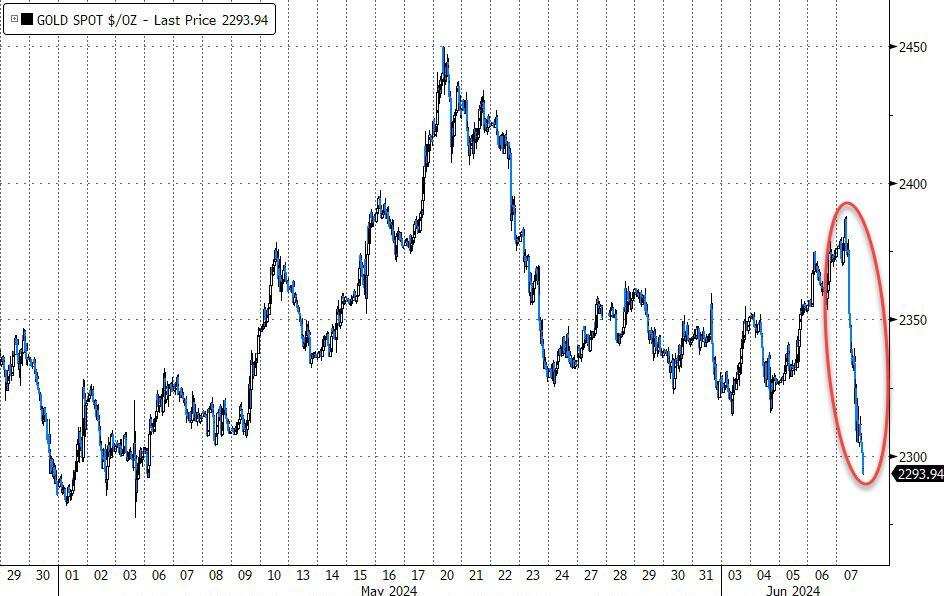
Gold was clubbed like a baby seal as the dollar spiked, trading back at one- monthly lows..
Source: Bloomberg
Crypto was also ugly with Bitcoin testing $72,000 and then puking down to find support at $69,000…
Source: Bloomberg
Even though BTC ETFs have seen 18 straight day s on net inflows…
Source: Bloomberg
Oil prices ended lower o the week but bounced back stromgly in the last three days
Source: Bloomberg
Finally, someone is going to be very wrong here…
Source: Bloomberg
Who is your money on?
Because Central Bank liquidity sure ain’t supporting it anymore…