61 F
Chicago
Wednesday, September 23, 2026
Home Blog Page 2568

Slovakia’s Fico Blames Assassination Attempt On ‘Hateful’ Opposition & Its International Backers

Slovakia’s Fico Blames Assassination Attempt On ‘Hateful’ Opposition & Its International Backers

This week Slovak Prime Minister Robert Fico appeared in a video message while still recovering from the May 15 assassination attempt which saw him shot multiple times at close range in broad daylight. In the video originally published to Facebook, he uttered his first official televised statements since the ordeal which very nearly took his life.

The video was recorded at his home in Bratislava, which suggests he’s nearly made a full recovery and is quickly returning to political life in the country’s top office. He said he has forgiven his attacker, identified officially by authorities as 71-year-old “Juraj C”, who had been tackled to the ground and immediately taken into custody after the shots rang out.

But Fico used the opportunity to put the opposition on notice, saying the shooter was an “activist of the Slovak opposition.” In the searing remarks, Fico called the man a “messenger of the evil and political hatred” who was motivated and whipped up by Slovakia’s “unsuccessful and frustrated” opposition. Amazingly, he at one point in the address – released days ago – made some indirect connections to his firm foreign policy stances and the attempt on his life (policies which have resisted Western hegemony as well as the rush to escalate involvement in Ukraine). Watch the remarkable speech below:

In the video he also addressed the Ukraine situation and his ‘controversial’ stance in opposition to NATO escalation head-on: “The situation in the relations between my political representation and partners in the EU and NATO escalated after the Russian attack on Ukraine, where we refused to provide Ukraine with any military aid from state stocks, except for humanitarian aid, and where we continue to fundamentally prefer peace to war.”

“The reluctance of some large democracies to respect the concept of a sovereign and self-confident Slovak foreign policy became grist to the mill of the Slovak opposition,” he continued. 

The BBC has noted that “Opposition parties – in particular the liberal Progressive Slovakia, which is neck-and-neck with Mr Fico’s left-populist Smer party ahead of the European Parliament elections – have condemned the shooting and have categorically rejected all links with the attacker.”

However, in Fico’s talk he made a direct link, saying further:

The opposition was unable to assess, because no one forced them to do so, where their aggressive and hateful politics had led a section of the society and it was only a matter of time before a tragedy would occur.

“People could see with their own eyes what horror can happen if someone is not able to democratically compete and respect other opinions,” he said.

He has also committed to the following: “As the Prime Minister of Slovakia, I will not drag the country into such military adventures and, within the framework of our small Slovak capabilities, I will do everything to ensure that peace has priority over war.”

“I voted in the hospital because these elections are also important. It is necessary to vote for European deputies who will support peace initiatives, and not the continuation of the war.”

* * *

The below prior report by The GrayZone’s Kit Klarenberg explores the foreign policy context & intrigue surrounding the attempted murder of Robert Fico… 

On May 15, Slovak Prime Minister Robert Fico was almost murdered in broad daylight. While shaking hands with supporters during a public appearance, a gunman shot him twice in the abdomen and once in the shoulder. The attack left him fighting for his life while authorities raced for clues, and many observers at home and abroad puzzled about the would-be assassin’s motives and whether foreign actors were in some way responsible for the attack. And despite the shooter’s instantaneous arrest, those questions still linger weeks later. 

Fico, a veteran Slovak political figure, was re-elected in September 2023 amid a wave of public resentment over the proxy war in Ukraine, pledging to end arms supplies to Kiev and anti-Russian sanctions. On the campaign trail, Western leaders, journalists and pundits aggressively stoked fears of the “pro-Putin,” “populist” candidate returning to office. Ukraine’s Western-backed “Center for Countering Disinformation” publicly accused him of spreading “infoterror” back in April 2022.

But many Slovakians see it differently. They say Fico is merely committed to defending Slovakia’s sovereignty, and governing in his nation’s interests, not those of Brussels, Kiev, London, and Washington. For Western politicians, his victory came at a highly inopportune time, with public and political consensus on the proxy war in Ukraine rapidly fraying across Europe.

Since Fico’s election, media outlets like Germany’s state broadcaster, Deutsche Welle, have branded him a “threat” to the EU and NATO. His declaration that Kiev must cede territory to Russia to end the war was not well-received in Western capitals. In April, the premier seemingly predicted his own shooting, warning that the virulent political climate in Bratislava could result in politicians getting killed.

Domestically, a number of foreign-funded media assets and NGOs have relentlessly targeted Fico for pursuing neutrality in the conflict. But over two years after Russia’s intervention, local polling indicates just 40% of the population blame Moscow for the proxy war, and 50% consider the US to be a threat to national security. Meanwhile, 69% of Slovakians believe by continuing to arm Ukraine, the West is “provoking Russia and bringing itself closer to the war” and 66% agreed that “the US is dragging [their] country into a war with Russia because it is profiting from it.”

When Fico was re-elected in September 2023, this journalist speculated that a color revolution could soon be impending in Slovakia. We are now left to ponder whether the Prime Minister’s attempted assassination was a Western-directed plot to remove his troublesome government from office. Even though he is finally on the road to recovery, the threat of an overseas-orchestrated coup remains. A vast US-sponsored opposition political and media infrastructure is causing havoc in Bratislava, and this could easily escalate further.

Slovakia has since the end of the Cold War stood apart from its neighbors. Folding the country into the EU and NATO and neutralizing its rebellious politics and population has required an enormous investment in time and money by Brussels and Washington, and relentless meddling in the country’s internal affairs by foreign-funded organizations and actors. Fico’s return to power threatened to not only derail that project, but create a regional contagion effect. Disinfecting the country therefore became of the utmost urgency for the West.

Facebook purge suggests shooter was a no ‘lone wolf’

Fico’s shooter, 71-year-old Juraj Cintula, is among the Slovaks who do not support Fico’s positions. A discrepant picture of the man has emerged since his arrest. Some acquaintances describe him as “weird and angry,” and “against everything.” Others report he was meek and mild-mannered, a far from obvious candidate to attempt a high-level political assassination. Cintula, an avowed Kiev ultra, claims he acted alone, his actions motivated by a desire to replace Fico’s government with a pro-Ukrainian administration. Slovakian court documents state that Cintula “wants military aid to be provided to Ukraine and considers the current government to be Judas towards the European Union,” and say this perception is why the would-be assassin “decided to act.”

The mainstream media has made much of Cintula’s background as a dissident poet and writer, in a seeming effort to humanize the would-be killer. By contrast, Aaron Bushnell, who in February self-immolated in protest of Washington’s facilitation of the Gaza genocide, was widely tarred by journalists as a maladjusted, mentally unwell outcast. Unmentioned by any Western outlet is that during the 1980s, Cintula was under surveillance by Czechoslovak security services.

The reason for the Czechs’ interest is unclear, although it may have been due to anti-Communist actions, or foreign contacts. Whether Cintula had seditious confederates within or without Slovakia is a key line of inquiry for police. That all traces of the shooter’s Facebook profile were comprehensively scrubbed from the internet two hours after the shooting, before investigators could access the information, is also source of intense suspicion.

While it is customary for the social network to purge the profiles of “dangerous individuals” – a fate this journalist has suffered for investigative reporting – following such incidents, in Bratislava Facebook relies on cooperating local individuals and organizations to police content. Apparently, Cintula’s profile was wiped before his identity had been reported in local media. Slovak authorities must now rely on the FBI to secure and provide the deleted information. Whether whatever is turned over will be unexpurgated is an open question.

Another disturbing feature of mainstream reporting on the shooting is ubiquitous, persistent reference to Slovakia’s unstable politics. According to this narrative, Fico’s anti-Western policies have fueled the chaotic state of affairs, provoking the assassination attempt and making him ultimately responsible for the attempt on his life. In the days following the shooting, the BBCFinancial TimesNew York Times and Germany’s esteemed Der Spiegel pinned the blame on Slovakia’s alleged “toxic” political culture. The latter revised its wording after significant public backlash. 

One could be forgiven for concluding Western journalists take it as self-evident that defying EU/US will provides legitimate grounds for getting shot. Western politicians clearly do. On May 23rd, Georgian prime minister Irakli Kobakhidze revealed that EU commissioner Oliver Varhelyi warned him he could suffer the same fate as Fico, if his government didn’t drop a highly controversial “foreign influence transparency” law, which would compel local NGOs to disclose their sources of income.

After listing the various ways the EU could retaliate against Georgia in a phone call with Kobakhidze, Varhelyi allegedly stated: “Look what happened to Fico, you should be very careful.”

Varhelyi has since confirmed that he cited Fico’s fate in private conversations with Kobakhidze, but claimed he was merely concerned with “dissuading the Georgian political leadership” from adopting restrictions on foreign-funded NGOs. Varhelyi insisted in a written statement that he simply “felt the need” to caution the Prime Minister “not to enflame [sic] further the already fragile situation,” arguing that he only mentioned “the latest tragic event in Slovakia… as an example and as a reference to where such high levels of polarisation can lead in a society.”

Public records show the US government regime change specialists at the National Endowment for Democracy (NED) have pumped millions into NGOs and media outlets in Slovakia under the aegis of mundane-sounding initiatives such as “strengthening civil society” and “promoting democratic values among youth.” Similar language is used to describe the purpose of Endowment grants in Georgia, financing groups at the forefront of recent violent unrest on the streets of Tbilisi, as The Grayzone has documented. Perhaps unsurprisingly, NED grantees are unanimous in their opposition to Fico. 

Anyone searching for the source of Slovakia’s “toxic” politics need not look further than these US-backed organizations. Washington has stirred this cauldron for almost three decades, and with all sides of the Slovakian political class blaming one another the rising tide of hatred, it is hoping the pot will finally boil over.

Regime change blueprint honed in Slovakia

The NED-organized overthrow of Slobodan Milosevic in Yugoslavia in 2000 established an insurrectionary blueprint which was subsequently exported in the form of color revolutions. But throughout  the 1990s, Slovakian activists honed the tactics which would eventually be deployed by US regime change operatives across the Soviet sphere. 

At the time, Bratislava was one of the only post-Communist countries that neither adopted ruinous neoliberal political and economic reforms, nor pursued EU or NATO membership. Slovakia’s then-Prime Minister Vladimir Meciar paid a harsh price for his independent stance. Relentlessly slandered by US and European leaders as a Russian pawn, he quickly became a target for regime change. 

In 1997, then-Secretary of State Madeleine Albright publicly described Slovakia as “a black hole in the heart of Europe,” formally marking him for removal. So it was that NED funded the creation of Civic Campaign 98 (OK’98), a coalition of 11 anti-government NGOs.

Explicitly modeled on an earlier NED-funded effort in Bulgaria, concerned with “creating chaos” after the Socialist Party won the 1990 election, many of the individuals involved had been part of Cold War-era Czechoslovak anti-Communist dissident groups. OK’98 was publicly framed as a non-partisan get-out-the-vote campaign, but its vast resources were explicitly deployed for anti-government purposes. Its activities included rock concerts, short films, and TV infomercials in which Slovak celebrities urged young people to vote.

Meciar emerged with the most votes in the 1998 election, but the opposition gained enough seats to form a government. The NED assets who powered them to victory went on to give practical training to NED-supported pro-Western agitators like Pora, which ignited Kiev’s 2004 “Orange Revolution.” The insurrectionist youth group successfully overturned the re-election of President Viktor Yanukovych that year, installing the US-backed neoliberal Viktor Yushchenko in his place.

The return of Robert Fico represented a significant broadside against ongoing US “democratization” of the former Soviet sphere. It opened up the prospect of further anti-NATO candidates and governments gaining office elsewhere in Europe, at the most inconvenient juncture imaginable for Brussels and Washington. 

Not coincidentally, it was at this time polling for Germany’s upstart Alternative für Deutschland became turbocharged. The Euroskeptic party’s standing has soared in recent months, eliciting mainstream calls to ban it outright. And in North Macedonia just one week prior to Fico’s shooting, the anti-establishment VMRO-DPMNE party returned to power, overturning a NATO-fuelled color revolution that removed the party from office almost a decade earlier. 

As the anti-Western backlash gained steam, a decision may have been made to draw a bloody red line in Slovakia.

Tyler Durden
Sat, 06/08/2024 – 15:45

Is California Moving Toward Government-Owned Electricity?

Is California Moving Toward Government-Owned Electricity?

Authored by John Seiler via The Epoch Times,

In 1929, almost a century ago, the great economist Ludwig von Mises published “A Critique of Interventionism.”

It’s written in plain language and is free online. He described how government intervention in the free market is not socialism, but eventually “leads to socialism because government intervention is not only superfluous and useless, but also harmful. … It lowers labor productivity and redirects production along lines of political command, rather than consumer satisfaction.”

He died in 1973 at the good old age of 92 and was the teacher of Friedrich von Hayek, who won the Nobel economics prize in 1974.

I bring up Mises because he could have been writing about California’s electricity market, which has been dysfunctional for three decades and well could end up entirely run by the California government.

That’s actually what was called for in a June 2 editorial in the Los Angeles Times titled, “Californians don’t have to accept skyrocketing electric bills. Here’s how to fight back.”

The way to fight back?

“Customers of publicly owned utilities such as the Los Angeles Department of Water and Power pay lower electric rates in large part because a profit margin isn’t part of the equation. Gov. Gavin Newsom threatened to take over the troubled PG&E during its last bankruptcy if it didn’t become a more responsible utility. Ultimately, the governor struck an oversight deal. But a public takeover is still worth exploring to protect Californians from unaffordable rates.”

The internal link for “is still worth exploring” clicks to a 2019 L.A. Times editorial, “We’ve reached a point where public ownership of PG&E shouldn’t just be on the table, it should be actively explored by state and local officials. Newsom has hinted he would open to public takeover of the utility and has raged about its ‘corporate greed,’ but he has also said he wants to see as many bidders for ownership as possible, including from other profit-making entities. Although it’s good for him to consider all approaches and all bidders, public ownership shouldn’t get short shrift in the process.”

The first obvious hurdle to “public ownership”—socialism—is the Fifth Amendment, which concludes, “nor shall private property be taken for public use, without just compensation.”

Here are the valuations of the state’s two largest private utilities:

Where is the state of California supposed to get that kind of money? Float a bond? The state treasurer list California’s current state bond indebtedness at $71.7 billion. And they’ve only started issuing the $6.4 billion in new bonds for Proposition 1, which voters passed last March 5. In sum, a state takeover effectively would nearly triple state bond indebtedness.

California’s Electricity Reform Collapse

Instead of looking to the supposed price gouging by the private utilities, as the L.A. Times demands, it’s worth remembering the state’s own follies the past three decades during which I’ve written against all the anti-market attempts at restructuring. For those who want to read the details, a good history of the early years is, “The History of Electricity Restructuring in California,” from 2002 by Carl Blumstein, L.S. Friedman, and R.J. Green.

The attempt at “deregulation” the authors begin with is Assembly Bill 1890, which Gov. Pete Wilson signed in 1996. It’s worth adding something they left out: 1996 was the only year in the past five decades in which Republicans controlled a house of the Legislature, in that case the Assembly under Speaker Curt Pringle (R-Anaheim), later Anaheim’s mayor. Mr. Wilson also was a Republican. So this was a Republican attempt at “privatization,” with cooperation from Senate Democrats.

AB 1890 set up the California Power Exchange (PX), which “was required to operate an hour-by-hour spot market, in which generators could sell and retailers could buy power. … The new markets began operation for April 1, 1998. This was three months behind the original start date, but it had not proved possible to create the necessary computer systems in time.” It seems every computer system the state sets up has problems. “The PX ran quite smoothly, with low prices.”

Then disaster struck.

“Late in the spring of 2000 the California’s new electricity market began to collapse. In May the average PX price was $50/MWh, higher than any previous month. There were also numerous price spikes. … By the end of January, the collapse was complete. Blackouts occurred on eight days during the winter and spring even though demand was far below the summer peak. The Power Exchange suspended operations, and the CAISO [California Independent System Operator), SCE and PG&E were all insolvent.”

For some reason the study didn’t mention Gov. Gray Davis’s role in this crisis. I remember in October 2000 he actually took a month off to “study” the problem. Then he panicked and signed contracts up to 20 years for natural gas at the height of the market price.

In June 2002, Withold Henisz of the Wharton School at the University of Pennsylvania described the damage: “Wholesale energy prices shot up tenfold and supply shortages forced repeated rolling blackouts. The crisis forced the state’s biggest utility, Pacific Gas and Electric, into bankruptcy and pushed another, Southern California Edison, to the brink. In desperation, California Gov. Gray Davis signed long-term contracts for $48 billion worth of power—prices two to three times today’s [2002] market rate.” But some of the contracts had to be paid for up to 20 years.

Mr. Davis’ mistakes were part of what led to his recall in 2002 and replacement by Gov. Arnold Schwarzenegger.

Arnold Schwarzenegger’s AB 32 Disaster

In his first two years in office, 2003-05, Mr. Schwarzenegger governed reasonably, cutting taxes and restraining spending. Then in November 2005, voters rejected his plank of reform initiatives, such as banning using union dues for political campaign initiatives. He then flipped from conservative to liberal as he headed to his November 2006 reelection, which he won.

His signature legislation was Assembly Bill 32, the Global Warming Solutions Act of 2006, still in effect. Among its mandates:

“It is the intent of the Legislature that the State Air Resources Board consult with the Public Utilities Commission in the development of emissions reduction measures, including limits on emissions of greenhouse gases applied to electricity and natural gas providers regulated by the Public Utilities Commission in order to ensure that electricity and natural gas providers are not required to meet duplicative or inconsistent regulatory requirements.

“It is the intent of the Legislature that the State Air Resources Board design emissions reduction measures to meet the statewide emissions limits for greenhouse gases established pursuant to this division in a manner that minimizes costs and maximizes benefits for California’s economy, improves and modernizes California’s energy infrastructure and maintains electric system reliability, maximizes additional environmental and economic co-benefits for California, and complements the state’s efforts to improve air quality.”

You can see the duality problem there: The state is supposed to both limit “greenhouses gases” for electricity production while maintaining “electric system reliability.” It’s hard enough for private companies, or for that matter socialist government enterprises, to maintain one government dictate. But two dictates make it doubly difficult, even impossible.

Renewable Energy and EV Mandates

Next, throw in renewable mandates, such as this from December 2022: “The California Air Resources Board today approved the final proposed 2022 Scoping Plan, a world-leading roadmap to address climate change that cuts greenhouse gas emissions by 85% and achieves carbon neutrality in 2045. The 2022 Scoping Plan provides a detailed sector-by-sector roadmap to guide the world’s fourth-largest economy away from its current dependance on petroleum and fossil gas to clean and renewable energy resources and zero-emission vehicles.”

Renewable energy, such as wind and solar, requires expensive new power lines on top of the existing power lines. The zero-emission vehicle mandate is for 100 percent new cars to be zero-emission by 2035.

And now AI—Artificial Intelligence—is developing rapidly in Silicon Valley, which leads the world in this area, and requires even more electric juice every year.

Finally, there’s the latest attempt at reforming sky-high electricity rates, which I wrote about last week in, “New California Electricity Scheme Promotes ‘Equity,’ ‘Clean Energy Transition.’” It’s only going to make matters worse.

It’s been three decades of folly and disaster. No wonder for March 2024 the Energy Information Agency pegged California’s average residential rate at 32.47 cents per kilowatt hour (kwh), the second-highest in the nation. North Dakota’s was the lowest, at 10.44 cents.

In a future article, I’ll discuss some free-market remedies to restore to California a sensible electricity market and lower prices for consumers.

Tyler Durden
Sat, 06/08/2024 – 15:10

IDF Frees 4 Hostages In Biggest Gaza Rescue Op Since War Began

IDF Frees 4 Hostages In Biggest Gaza Rescue Op Since War Began

Four hostages have been recovered alive in what’s being widely described as the Israel Defense Forces’ biggest rescue operation in the Gaza Strip since the war began.

All of them had been initially kidnapped by Hamas from the Nova music festival on October 7 and they are: Noa Argamani, 25, Almong Meir Jan, 21, Andrey Kozlov, 27 and Shlomi Ziv, 40. Authorities have confirmed they are in good medical condition and they underwent evaluations at Tel Aviv’s largest hospital.

From left; Shlomi Ziv; Andrey Kozlov and Almog Meir Jan and Noa Argamani.

In total hundreds of soldiers participated in the high-risk operation, but which was spearheaded by the police’s elite Yamam counter-terrorism unit and Shin Bet agents.

These units raided a pair of Hamas buildings in central Gaza’s Nuseirat where the captives were being held, with the operation done “under fire”. One officer of the counter-terror unit, identified as Chief Inspector Arnon Zamora, was critically wounded in the assault and later died at a hospital.

At least 50 Palestinians were killed in the major operation, Israeli media reports, however the military hasn’t specified how many were combatants. Some regional reports say that as many as 200 Palestinians, among them many civilians, were killed in related strikes and operations in central Gaza on Saturday.

IDF spokesman Rear Adm. Daniel Hagari said that “During the operation, we struck… threats to our forces in the area. These threats were struck from the land, air, and sea… for us to extract our forces [and the hostages].” The freed Israelis had been in captivity for eight months.

Tyler Durden
Sat, 06/08/2024 – 13:25

Ethereum ETF Launch Date Depends On Issuers, Not SEC: Gensler

Ethereum ETF Launch Date Depends On Issuers, Not SEC: Gensler

Authored by Felix Ng via CoinTelegraph.com,

The approval of United States spot Ether exchange-traded funds (ETF) will depend on how quickly issuers can respond to comments from the Securities and Exchange Commission, says chairman Gary Gensler. 

Gensler’s comments appear to put the onus for approvals on issuers and indicate the SEC will not drag the process out as some feared.

On May 23, the SEC approved eight 19b-4 filings to list spot Ether ETFs on various U.S. exchanges, though they can’t start trading until they have the required S-1 registration statement approvals.

“These registrants are self-motivated to be responsive to the comments they get, but it’s really up to them how responsive they are,” said Gensler in a June 6 report from Reuters.

The comments shed new light on Gensler’s comments only a day earlier on CNBC — where he said the next steps would “take some time.” Some believed this to mean the commission would take their time signing off on the S-1 Forms.

Bloomberg ETF analyst Eric Balchunas has said previously the process could take weeks or months, though he’s tipped the first week of July as his base case.

Grayscale challenge influenced Ethereum ETF decision

The SEC is yet to explain why it appeared to change its tone on spot Ether ETFs just days before the first decision deadline.

However, Gensler hinted to Reuters that the move was influenced by Grayscale’s Bitcoin ETF legal challenge last year.

Grayscale successfully argued in court that because the SEC had approved Bitcoin futures ETFs, there should be no reason to deny spot Bitcoin ETFs — which became instrumental in their approval.

Speaking to Reuters, Gensler said that Ethereum’s case was similar and that the SEC staff “looked at these [Ether] filings, looked at the various correlations… the correlations are relatively similar to the correlations in the Bitcoin space.”

Alternate theory: Nancy Pelosi-linked SEC Commissioner

Bloomberg ETF analyst James Seyffart — who was caught flat footed by the approval after predicting its low likelihood for months — shared an alternate theory on X. He suggests the reversal on Ether ETFs was influenced by SEC Commissioner Jamie Lizárraga, who has previous ties to an influential member of the Democratic Party, Nancy Pelosi.

Source: James Seyffart

“What I heard from other people was that this could have come from Lizarraga who spent, I don’t even know, a very long time working — he used to be Nancy Pelosi’s right hand man,” said Seyffart in a Bits+Bips podcast with Unchained.

“And a lot of what I was hearing, even leading up to the ETH stuff was that Dems in the Senate and the House really concerned with how the crypto polling was showing up and how many people own it.”

Pelosi was one of many House Democrats who supported the Financial Innovation and Technology for the 21st Century Act (FIT21) crypto bill, which passed a vote in the U.S. House of Representatives on May 22 in a “watershed moment” for crypto.

Tyler Durden
Sat, 06/08/2024 – 12:50

Visualizing The Real GDP Growth Of US Regions In 2023

Visualizing The Real GDP Growth Of US Regions In 2023

Distinct variations in regional economic growth were evident throughout America in 2023, driven by differences in industry composition and population dynamics.

This graphic, via Visual Capitalist’s Dorothy Neufeld, shows real GDP growth across U.S. regions in 2023, based on data from the Bureau of Economic Analysis.

Which Regions Grew the Fastest in 2023?

Below, we show the U.S. regions with the highest real GDP growth last year:

Outpacing all other regions is the Southwest, fueled by rapid population growth and booming oil production across the state of Texas, one of the fastest growing state economies in 2023.

In addition, electric vehicle factories and battery plants are increasingly emerging across the Sun Belt. This includes a 10 million square foot Tesla facility in Texas and a $320 million battery manufacturing plant and assembly facility in Oklahoma. The combination of lower land, labor, and electricity costs are driving corporate investment in the region.

With the second-highest real GDP growth rate, the Southeast also surpasses the national average.

Just as Texas is attracting industrial production across clean energy technologies, Georgia and Tennessee are emerging as automotive hubs. In fact, Georgia leads the country in electric vehicle assembly and battery plant investment, at a staggering $14.5 billion.

By contrast, growth in the Mideast and New England regions fell below the national average, weighed down by states like Massachusetts and New York as construction, manufacturing, and finance and insurance sectors witnessed slower activity.

Lastly, the Great Lakes region, covering Illinois, Ohio, Michigan, Wisconsin, and Indiana, experienced the lowest growth nationally, at just 1.2% in 2023. This sluggish performance was attributed to a shrinking labor force in Illinois and a contracting manufacturing sector in Ohio amid high interest rates. Moreover, three states in the region saw among the weakest real GDP growth in 2023.

Tyler Durden
Sat, 06/08/2024 – 12:15

Commodities And The Boom-Bust Cycle

Commodities And The Boom-Bust Cycle

Authored by Lance Roberts via RealInvestmentAdvice.com,

It is always interesting when commodity prices rise. The market produces various narratives to suggest why prices will keep growing indefinitely. Such applies to all commodities, from oil to orange juice or cocoa beans. For example, Michael Hartnett of BofA recently noted:

The 40-year period from 1980 to 2020 was the era of disinflation: thanks to fiscal discipline, globalization, and peace, markets saw ‘deflation assets’ (government and corporate bonds, S&P, growth stocks) outperform ‘inflation assets’ (cash, commodities, TIPS, EAFE, banks, value). As shown below, ‘deflation’ annualized 10% vs. 8% for ‘inflation’ over the 40-year period.

But the regime change of the past 4 years has roles reversed, and now ‘magnificent’ inflation assets are annualizing 11% returns vs 7% for deflation assets.”

Mind you, this is not the first time that markets have gone “cuckoo for commodities.” The most recent episode in 2007 was “Peak Oil.” However, crucially, this time is never different. As shown below, commodities regularly have surges in performance and are the best-performing asset class in a given year or two. Then, that performance reverses sharply to the worst-performing asset class.

That performance “boom and bust” has remained since the 1970s. The chart below shows the Commodities Index’s performance over the last 50 years. On a buy-and-hold basis, investors received a 40% total return on their investment. This is because, along the way, there were fantastic rallies in commodities followed by huge busts.

Such brings us to the big question? Why do commodities regularly boom and bust?

Why Do Commodities Boom And Bust

The problem with the idea of a structural shift to commodities in the future and why it hasn’t happened in the past is due to the drivers of commodity prices.

Here is a simplistic example.

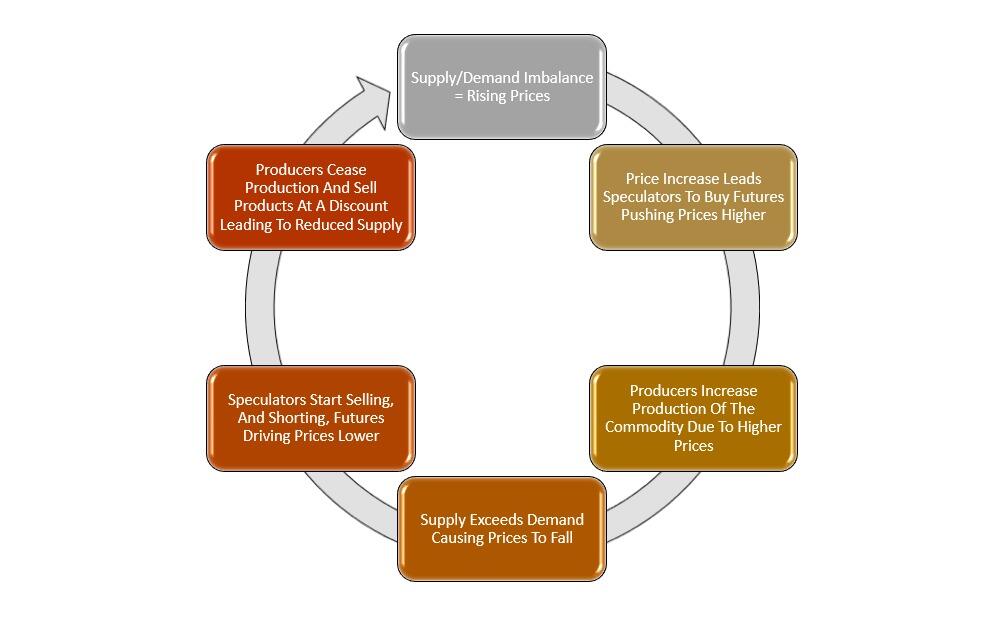
  • During a commodity cycle, the initial phase of a commodity price increase is due to rising demand exceeding existing supply. This is often seen in orange juice, where a drought or infestation wipes out a season’s crops. Suddenly, the existing demand for orange juice massively outweighs the supply of oranges.

  • As orange juice prices rise, Wall Street speculators start bidding up the price of orange juice futures contracts. As orange juice prices increase, more speculators buy futures contracts driving the price of orange juice higher.

  • Farmers scrap plans to produce lemons and increase the orange supply in response to higher orange juice prices. As more oranges are produced, the supply of oranges begins to outstrip the demand for orange juice, leading to an inventory glut of oranges. The excess supply of oranges requires producers to sell them at a cheaper price; otherwise, they will rot in the warehouses.

  • Wall Street speculators begin to sell their futures contracts as prices declinepushing the price lower. As prices fall, more speculators dump their contracts and sell short orange futures contracts, causing prices to fall further.

  • With the price of oranges crashing, farmers stop planting orange trees and start growing lemons again.

  • The cycle then repeats.

Furthermore, high commodity prices threaten themselves. As always, “high prices are a cure for high prices.” If orange juice prices become too expensive, consumers will consume less, leading to declining demand and supply buildup. The following chart of commodities compared to nominal GDP shows the same. Whenever there was a sharp rise in commodity prices, it slowed economic growth rates. Such is unsurprising since consumption drives ~70% of GDP.

There is also a high correlation between commodities and inflation. It should be self-evident that when commodity prices rise, the cost of goods and services also rises due to higher input costs. However, the price increase is constrained as consumers are unable to purchase those goods and services. As noted, the consequence of higher prices is less demand. Less demand leads to lower prices or disinflation.

Such is why hard asset trades repeatedly end badly despite the more ebullient media coverage.

Hard Asset Trades Tend To End Badly

Commodities, and hard assets in general, can be an exhilarating and profitable ride on the way up. However, as shown in the long-term chart above, that trade tends to end badly. Commodities have repeatedly led market downturns and recessions.

Will this time be different? Such is unlikely to be the case for two reasons.

As discussed, high prices (inflation) are the cure for high prices as it reduces demand. As shown above, as the consumer retrenches, demand will fall, leading to lower inflation in the future.

Secondly, as the country moves toward a more socialistic profile, economic growth will remain constrained to 2% or less, with deflation remaining a consistent long-term threat. Dr. Lacy Hunt suggests the same.

Contrary to conventional wisdom, disinflation is more likely than accelerating inflation. Since prices deflated in the second quarter of 2020, the annual inflation rate will move transitorily higher. Once these base effects are exhausted, cyclical, structural, and monetary considerations suggest that the inflation rate will moderate lower by year-end and undershoot the Fed Reserve’s target of 2%. The inflationary psychosis that has gripped the bond market will fade away in the face of such persistent disinflation.

As he concludes:

The two main structural impediments to traditional U.S. and global economic growth are massive debt overhang and deteriorating demographics both having worsened as a consequence of 2020.

The last point is crucial. As liquidity drains from the system, the debt overhang weighs on consumption as incomes are diverted from productive activity to debt service. As such, the demand for commodities will weaken.

While the commodity trade is certainly “in bloom” with the surge in liquidity, be careful of its eventual reversal.

For investors, deflation remains a “trap in the making” for hard assets.

There is nothing wrong with owning commodities; just don’t forget to take profits.

Tyler Durden
Sat, 06/08/2024 – 11:40

Obese Woman Wins ‘Miss Alabama’ And People Have Questions

Obese Woman Wins ‘Miss Alabama’ And People Have Questions

Authored by Paul Joseph Watson via modernity.news,

An obese woman has won Miss Alabama, with the organizers of the contest insisting that the intention of the beauty pageant was to “foster a positive self-image.”

Yes, really.

After Sara Milliken learned that she had won the competition and would go on to represent her state at the national level, she hit back at critics who questioned her weight.

Even something that you type over a screen can have a lasting impression on people,” she told WKRG.

According to a report by the news network, “The purpose of the national American Miss program is to grow confidence and foster a positive self-image.”

This despite the fact that the level of obesity displayed by Milliken is linked with all manner of horrible diseases like diabetes, heart disease, strokes, and certain cancers.

Respondents weren’t very impressed with the result.

Dang I didn’t realize this was a cattle auction,” wrote one.

This 500 pound woman is supposed to be a role model to kids,” added another.

Some expressed gratitude for the fact that at least Milliken is a biological female, unlike the winner of Miss Maryland USA, who is a man.

She practiced 365 days? What? Eating?” remarked another.

As we previously highlighted, the winner of this year’s Miss Germany wasn’t even German.

Any guidelines or rules have been completely obliterated as such contests are completely turned over to woke extremists who use them as a vehicle to amplify the message.

That message is incredibly harmful for young women, especially when you consider the fact that numerous ‘fat pride’ activists have literally died from being overweight in recent years.

Your support is crucial in helping us defeat mass censorship. Please consider donating via Locals or check out our unique merch. Follow us on X @ModernityNews.

Tyler Durden
Sat, 06/08/2024 – 11:15

Soaring Coffee Prices Force Folgers’ Owner To Increase Supermarket Prices

Soaring Coffee Prices Force Folgers’ Owner To Increase Supermarket Prices

Arabica and robusta coffee bean prices have been soaring this year due to supply crunches hitting some of the world’s top bean producers. It was only a matter of time before higher bean prices impacted major US food brands, forcing them to announce imminent price hikes at the supermarket.

Let’s start with our recent coverage of the global coffee market:

In markets, Arabic futures in New York have surged, but the robusta prices on the ICE exchange are skyrocketing the most.

The impact of higher bean prices is now concerning, as it’s finally squeezing major food companies, such as J.M. Smucker Co., whose brands include Folgers, Dunkin’, Café Bustelo, Pilon, and Medaglia d’Oro. 

On Thursday, the company revealed in an earnings report with prepared remarks from management about imminent price hikes across its coffee portfolio.

The coffee category continues to experience commodity volatility and overall meaningful inflation. In response to recent higher green coffee costs that we will begin to incur during the first quarter, we are taking a list price increase across parts of our portfolio in early June. As always, we will continue to manage our coffee business through a strategy that demonstrates a balance between recovering inflationary input costs, while providing consumers with attractive options ranging from value to premium.

Translation: Supermarket prices for coffee, especially J.M. Smucker’s brands, are set to move higher, if not already, thus raising food inflation for consumers.

Meanwhile, Biden’s PR team and Democrats pushed the narrative that inflation is a function of corporate ‘greedflation‘…  

Unless we see a severe recession or depression, food inflation will remain elevated for years. This is the new normal.

Tyler Durden
Sat, 06/08/2024 – 09:55

It’s The Fed That’s A Risk To Financial Stability

It’s The Fed That’s A Risk To Financial Stability

Authored by Alex Pollock via The Mises Institute,

Published in The New York Sun:

Central bankers whistle ‘Dixie’ as mark-to-market losses dramatically shrink the banking system’s economic capital.

Whistling a happy tune, the Federal Reserve vice chairman for supervision, Michael Barr, recently testified to Congress that “overall, the banking system remains sound and resilient.”

A more candid view of the risks would be less sanguine.

Mr. Barr reported that banking “capital ratios increased throughout 2023.” He failed, though, to discuss the mark-to-market losses that have dramatically shrunk the banking system’s economic capital and capital ratios.

A recent study of American banks, including analyses of both their securities and fixed rate loans, estimates that the banking system has at least a $1 trillion mark-to-market loss resulting from the move to normalized interest rates.

Since that loss is equal to half of the banks’ approximately $2 trillion in book value of tangible equity, their aggregate real capital has dropped by about 50 percent. This is just in time for them to be confronted with large potential losses from that classic source of banking busts, commercial real estate, as the prices of many buildings are falling vertiginously.

Given his current position, Mr. Barr could not be expected to mention another particularly large and inescapable threat to financial stability, that from the Federal Reserve itself. As central bank not only to the United States, but to the dollar-using world, the Fed combines great power with an inevitable lack of knowledge, and its actions are a fundamental source of financial instability.

When the Federal Reserve was created, the secretary of the treasury at the time, William Gibbs McAdoo, proclaimed that the Fed would “give such stability to the banking business that extreme fluctuations in interest rates and available credits… will be destroyed permanently.” A remarkably bad prediction.

Instead, throughout the life of the Fed, the financial system has suffered recurring financial crises and Fed mistakes. Mistakes by the Fed are inevitable because the Fed is always faced with an unknowable economic and financial future. This explains its poor record at economic forecasting, including inflation and interest rates.

No matter how intelligent its leaders, how many Ph.D.s it hires, how many computers it buys, how complex it make its models, or how many conferences it holds at posh resorts, the Fed cannot reliably predict the future results of its own actions, let alone the unimaginably complex global interactions that create the economy. 

The Fed held both short-term and long-term interest rates abnormally low for more than a decade. It manipulated long term rates lower by the purchase of $8 trillion of mostly fixed rate Treasury bonds and mortgage securities, mostly funded by floating rate deposits, making its own balance sheet exceptionally risky. It decided to manage the expectations of the market, and frequently assured one and all that interest rates would be “lower for longer” (until, of course, they were higher for longer).

Observe the result: Gigantic interest rate risk built up in the banking system. A notable case was Silicon Valley Bank, which made itself into a 21st century version of a 1980s savings and loan, investing heavily in 30-year fixed rate mortgage-backed securities and funding them with short-short term deposits, while its chief executive served on the Board of the Federal Reserve Bank of San Francisco.

SVB was doing basically the same thing with its balance sheet that the Fed was. In the SVB case, it became the one of the largest bank failures in American history; in the Fed’s case, it has suffered its own mark to market loss of more than $1 trillion, in addition to operating cash losses of $172 billion so far. Adding the mark-to-market losses of the Fed and the banking system together, we have a total loss of $2 trillion. We are talking about real money.

The Fed was the Pied Piper of interest rate risk and consequent losses.

Jim Bunning was the only man ever to be both a Hall of Fame baseball player and a U.S. Senator. He pitched a perfect game in the major leagues, and he delivered a perfect strike in the Senate when Chairman Ben Bernanke was testifying on how the Fed was going to regulate systemic financial risk. In paraphrase, Senator Bunning asked, “How can you regulate systemic risk when you are the systemic risk?” There is no answer to this superb question.

Tyler Durden
Sat, 06/08/2024 – 09:20

“A First Victory Against Big Tech!” – Belgian Lawmaker Awarded €27k From Meta For Unfair Facebook ‘Shadowban’

“A First Victory Against Big Tech!” – Belgian Lawmaker Awarded €27k From Meta For Unfair Facebook ‘Shadowban’

Authored by Thomas Brooke via ReMix News,

Meta, the parent company of Facebook, has been ordered to pay damages in the sum of €27,000 to a Belgian right-wing lawmaker for unfairly limiting his reach on the social media platform, otherwise known as “shadowbanning.”

The Antwerp Court of Appeal ruled on Monday in favor of Tom Vandendriessche, an MEP standing for reelection as the lead candidate for the Flemish separatist party, Vlaams Belang, in Belgium.

The court held that Facebook had unfairly censored Vandendriessche’s account, which currently boasts 234,000 followers, back in February 2021 and had failed to act “in accordance with the principle of good faith” and did not offer “sufficient procedural guarantees” for users who were subjected to such measures. His account was subsequently blocked in May of the same year.

Meta claimed it had acted in accordance with its community guidelines and accused the Belgian lawmaker of posting inappropriate content on the platform, leading to the shadowban. However, Vandendriessche was informed by the social media giant the ban had been lifted at the end of 2021, a claim he contested, as his organic reach remained artificially low.

No ruling was made on this claim, as the court held there was insufficient evidence to prove the account remained subject to adverse measures.

The judgment overruled the court of first instance, which ruled that Belgian courts did not have jurisdiction to decide on the matter, leading to an appeal to the higher court by Vandendriessche.

In a statement following the ruling, the Vlaams Belang politician hailed “a first victory against Big Tech,” insisting that “anonymous technocrats should never dictate what can be said and heard.”

“I hope that this ruling makes it clear to Facebook that they can no longer censor me, and many citizens with me, without consequences,” he added.

Vandendriessche was awarded €27,279 in damages, equal to the amount he had been forced to spend to contest the decision in the courts.

Meta refused to comment on the particulars of the case, but issued a statement reserving its “right to remove violating content and limit the organic reach of certain messages.”

Read more here….

Tyler Durden
Sat, 06/08/2024 – 08:10