62.1 F
Chicago
Tuesday, September 22, 2026
Home Blog Page 2584

Electricity Demand May Cure Debt Concerns

Electricity Demand May Cure Debt Concerns

Authored by Lance Roberts via RealInvestmentAdvice.com,

The future of electricity demand for everything from electric cars to Bitcoin mining to artificial intelligence may also be the cure for our debt concerns.

Before you dismiss that statement, let me explain.

One of the bears’ primary arguments against the financial market and the economy’s health is what is perceived as the surging increase in Government debt. That increase in debt supports their frantic calls for the “end of the dollar,” economic disruption, and essentially the demise of the U.S. as a global power. Looking at the increased Government debt in a vacuum, you can understand the concern.

Of course, the increase in federal debt results from excess government spending, particularly since the pandemic-related shutdown. We see the surge in the federal deficit, the largest since the financial crisis and the most significant deficit outside of a wartime economy.

It is also notable that economic growth has slowed markedly as both debts and deficits have increased. That decrease in economic growth is an essential point of our discussion.

In “40-Years Of Economic Erosion,” we discussed the difference between productive and unproductive debt. To wit:

The problem is that these progressive programs lack an essential component of what is required for ‘deficit’ spending to be beneficial – a ‘return on investment.’ 

Country A spends $4 Trillion with receipts of $3 Trillion. This leaves Country A with a $1 Trillion deficit. In order to make up the difference between the spending and the income, the Treasury must issue $1 Trillion in new debt. That new debt is used to cover the excess expenditures but generates no income leaving a future hole that must be filled.

Country B spends $4 Trillion and receives $3 Trillion income. However, the $1 Trillion of excess, which was financed by debt, was invested into projects, infrastructure, that produced a positive rate of return. There is no deficit as the rate of return on the investment funds the “deficit” over time.

There is no disagreement about the need for government spending. The disagreement is with the abuse and waste of it.

John Maynard Keynes’ was correct in his theory that in order for government ‘deficit’ spending to be effective, the ‘payback’ from investments being made through debt must yield a higher rate of return than the debt used to fund it.

Currently, the U.S. is ‘Country A.”

Read that carefully, as electricity demand may provide that needed change to the debt dynamic.

Electricity Demand To Surge

As noted, the United States power grid has lacked sufficient investment to handle the increasing burdens of electricity demand in previous years. It isn’t just a growing population that needs more housing, mobile phones, laptops, and computers. However, adding electric vehicles, bitcoin mining, and artificial intelligence will overwhelm the current electricity supply in the U.S.

For example, bitcoin mining demands an extreme amount of electricity. As noted by Paul Hoffman in Bitcoin Power Dynamics:

“The daily consumption of 145.6 GWh for Bitcoin mining in the U.S. is about 1.34% of the total daily power consumption in the country. Despite the small percentage this is still an enormous amount of electricity, keeping in mind that the U.S. is a heavily-industrialized country consuming a lot. When we extrapolate this daily consumption to a year, we get 53,144 GWh.”

Bitcoin mining is a relatively small industry with a large footprint on electricity demand. However, “generative artificial intelligence (AI)” is a different beast. According to S&P Global Commodity Insights, the electricity needed for AI remains unclear, but the technology will lead to a significant net increase in US power consumption. Medium recently had some charts detailing that growth.

“AI energy demand is projected to surge from approximately $527.4 million in 2022 to a substantial $4,261.4 million by 2032, with a robust compound annual growth rate (CAGR) of 23.9% from 2023 to 2032.” – Medium.

“Simultaneously, the Utility Market is expected to experience even more significant expansion, increasing from $534 million in 2022 to a substantial $8,676 million by 2032, driven by a remarkable CAGR of 33.1% from 2023 to 2032.”

As S&P points out:

“Power demand from operational and currently planned datacenters in US power markets is expected to total about 30,694 MW once all the planned datacenters are operational, according to analysis of data from 451 Research, which is part of S&P Global Market Intelligence. Investor-owned utilities are set to supply 20,619 MW of that capacity. To put those numbers into perspective, consider that US Lower 48 power demand is forecast to total about 473 GW in 2023, and rise to about 482 GW in 2027.”

So, what does this have to do with the debt?

Growing Our Way Out

We have used deficit spending for decades to fund social welfare programs. Those programs have a long-term negative multiplier on economic growth. However, the future requires building an electricity infrastructure, which is a different dynamic. However, using deficit spending for projects with a “return on investment,” such as power production (geothermal, nuclear, tidal) or broadband, which users pay a fee to consume, is valid. This is because the long-term revenue generated by these projects repays the debt over time. Furthermore, these projects are labor intensive, creating demand for jobs, commodities, and capital expenditures.

Since 1980, capital expenditures (CapEx) have dropped as economic growth slowed. The chart shows the 10-year average annual change in CapEx vs. GDP. If economic growth (primarily consumption) is slowing, then the demand to expend CapEx is also reduced. This is because corporations seek out cheaper alternatives such as offshoring, productivity increases, and wage suppression.

However, building infrastructure is very labor-intensive, and CapEx is labor—and investment-intensive. Those dynamics change the economic growth dynamic.

While corporations increase capital investment to build the power supply, the Government will likely enter the fray with further infrastructure-focused spending bills. This is because AI is a critical component of ensuring the defense and national security of the United States. However, instead of issuing debt to spend on domestic welfare programs, the debt used in infrastructure will create economic growth through labor creation.

The chart below assumes we will continue to issue debt at the average quarterly pace since 2021. However, instead of wasting money, we focus on productive investments while maintaining all current spending programs and obligations. Assuming some conservative growth estimates resulting from the investments, the “debt to GDP” ratio will begin declining in 2026 and revert to more sustainable levels by 2030.

Conclusion

While the bears constantly ring the alarm bell about the current level of debt and deficits, the more dire economic consequences they forecast may fail to come to fruition.

As noted by Goldman Sachs:

“Generative artificial intelligence has the potential to automate many work tasks and eventually boost global economic growth. AI will start having a measurable impact on US GDP in 2027 and begin affecting growth in other economies worldwide in the following years. The foundation of the forecast is the finding that AI could ultimately automate around 25% of labor tasks in advanced economies and 10-20% of work in emerging economies.”

They currently estimate a growth boost to GDP from AI of 0.4 percentage points in the US.

Increases in productivity, productive capital investment, and increased labor demand for the infrastructure buildout (which will also result in higher wages) should provide the economic boost needed.

Will it solve all of the current socio-economic ills facing the U.S.? No. However, it may provide the growth boost necessary to revitalize economic growth and prosperity in the U.S., which we have not seen since the 1970s.

It may also just be enough to keep the demise of the U.S. from occurring any time soon.

Tyler Durden
Sat, 06/01/2024 – 11:40

Louisiana Reaffirms Gold And Silver As Legal Tender

Louisiana Reaffirms Gold And Silver As Legal Tender

Via Money Metals,

Louisiana Gov. Jeff Landry has signed a new law reaffirming gold and silver as legal tender, making a symbolic statement in favor of sound money principles.

Senate Bill 232, sponsored by Sen. Mark Abraham, marks the sixth pro-sound money bill passed by a state this year, underscoring a growing national trend.

Louisiana’s sound money bill simply affirms that “any gold or silver coin, specie, or bullion” issued by the United States government is considered legal tender whenever voluntarily agreed upon by both parties to a contract. The measure enjoyed popular support, receiving only one “no” vote on the floor throughout the Louisiana House and Senate.

This concept is consistent with the U.S. Constitution. In fact, Article 1 Section 10 reads: “No state shall…coin Money; emit Bills of Credit; [or] make any Thing but gold and silver Coin a Tender in Payment of Debts…”

America’s 53-year experiment in a purely fiat currency system has gone poorly. Without backing of gold or silver, the Federal Reserve note “dollar” has continuously declined in purchasing power. The nation has faced a series of Fed-created booms caused by interest rate manipulation, followed by busts and explosive growth in government spending.

When savers, wage earners, and investors seek ways to protect their savings from the ravages of inflation, they often choose precious metals over fiat currency because precious metals have preserved purchasing power over time.

This bill provides symbolic support to Louisiana citizens making this choice, and it is a modest step toward establishing sound money policies in the state.

AlabamaUtahWisconsinNebraska, and Kentucky passed legislation in 2024 ending sales and capital gains taxes on precious metals, declaring that Central Bank Digital Currencies are not valid money in their state, or empowering state treasurers to invest state funds in gold and silver.

Louisiana is the sixth state to enact sound money laws this year, while five other states did so in 2023.

Tyler Durden
Sat, 06/01/2024 – 10:30

Blinken To NATO Leaders: Ukraine Has ‘Strong & Well-Lit Bridge To Membership’

Blinken To NATO Leaders: Ukraine Has ‘Strong & Well-Lit Bridge To Membership’

US Secretary of State Antony Blinken on Friday addressed a meeting of NATO foreign and defense ministers in Prague. The meeting is being held in preparation for a bigger Washington summit set to take place in July. Blinken previewed that the later summit will bring Ukraine closer to NATO.

“At the summit we’ll be taking concrete steps to bring Ukraine closer to NATO, and ensure that there’s a bridge to membership – a bridge that’s strong and well lit,” he said in an address.

Touting that the alliance is “stronger” than ever with the recent addition of two new members (Sweden and Finland), he said that the Western allies are also committed to rebuilding Ukraine after the war.

“NATO will help build Ukraine’s future for us – one that effectively deter aggressive and defend against it as necessary,” Blinken continued.

The US top diplomat said further:

We’ll advance Ukraine’s integration with NATO. 32 countries are also negotiating individual bilateral security agreements with Ukraine.

Thirteen have already been concluded. I expect many more will be concluded by the time of the summit.

“We’ll bring them all together to show how powerful that commitment is,” the continued to preview of the July summit.

From the start of the Feb. 2022 Russian invasion of Ukraine, Russia’s Putin and top Kremlin officials have consistently pointed to NATO expansion to Russia’s borders as a prime cause of the conflict.

And yet, Washington is more intent than ever on seeing Ukraine’s eventual and full integration into the NATO alliance. This is of course a recipe for world war and nuclear-armed confrontation between Moscow and the West. Also, the US on Thursday approved for the first time the ability of Ukraine to hit Russian territory using American-supplied weapons systems.

Blinken’s “well-lit” path of Ukraine to NATO may in the end be “lit” with the blinding flashes of nuclear bombs. 

Tyler Durden
Sat, 06/01/2024 – 09:55

Did FDR Really Confiscate Everybody’s Gold?

Did FDR Really Confiscate Everybody’s Gold?

Authored by Mike Maharrey via Money Metals,

Did the U.S. government really try to confiscate Americans’ gold?

The short answer is… well, there isn’t a short answer. It’s a complicated subject with more nuance than most people give it.

Yes, President Franklin D. Roosevelt did try to take most of the gold out of the public’s hands. But the scheme didn’t go quite as well as many people claim.

Still, some gold dealers use the confiscation story to try to scare you into only buying collectible coins because there was an exception in Roosevelt’s order for “gold coins having a recognized special value to collectors of rare and unusual coins.” They’ll say, “The government could come to take your Gold Eagles as they did in 1933, but not these collectible coins we’re selling.” Of course, these collectible coins come with higher premiums and bigger profits for the dealer. 

You might call it a confiscation con because the reality is there wasn’t “confiscation” in the strict sense of the word.

So what actually happened?

On April 5, 1933, President Franklin D. Roosevelt signed Executive Order 6102. He justified the move based on the Trading with the Enemy Act of 1917, as amended by the Emergency Banking Act in March 1933.

At the time, the United States was in the grip of the Great Depression. A lot of people were redeeming paper dollars for physical gold because they were losing faith in the paper currency.  This caused significant problems for the federal government because the dollar was tethered to gold, and thus, the printing of it was at least somewhat limited. 

During a Fireside Chat a month before issuing the EO, Roosevelt claimed gold “hoarding during the past week has become an exceedingly unfashionable pastime,” and he said that it was undermining the banking system. The use of the word “hoarding” was almost certainly intentional because of its negative connotations. 

This carried forward to EO6102. Stopping hoarding was the public rationale for the order, but it went far beyond merely taking large amounts of gold from “hoarders.” By creating an expansive definition of “hoarding,” the EO was designed to take virtually all gold coins and bars out of private hands and transfer them to the government. 

“The term ‘hoarding’ means the withdrawal and withholding of gold coin, gold bullion, or gold certificates from the recognized and customary channels of trade. The term ‘person’ means any individual, partnership, association or corporation.”

In short, anyone who wanted to hold their gold as a form of savings was considered to be “hoarding.”

Under the order, private citizens, partnerships, associations, and corporations were required to turn in virtually all their gold. 

The order allowed people to keep up to $100 in gold coins, along with gold “as may be required for legitimate and customary use in industry, profession or art within a reasonable time,” and “rare” coins. 

It read, in part: “Deliver on or before May 1, 1933, to a Federal Reserve Bank or a branch or agency thereof or to any member bank of the Federal Reserve System all gold coin, gold bullion, and gold certificates now owned by them or coming into their ownership on or before April 28, 1933.”

In return, the Federal Reserve Bank would give individuals an equivalent amount in “any other form of coin or currency coined or issued under the laws of the United States” at the rate of $20.67 per ounce.

Once the government got the gold at that price, it did what governments do – it changed the price-fixing to its advantage, raising the price to $35 and devaluing the paper money people received in exchange for their gold. 

Violators of the law were subject to up to a $10,000 fine and/or 10 years in prison.

Like so often happens today, Congress passed the Emergency Banking Act before the majority of members had even read the bill. It expanded The Trading With Enemy Act of 1917 (TWEA), a WWI statute still on the books today, prohibiting trade with enemies of the United States. 

One provision in the 1917 law empowered the president to regulate or prohibit “under such rules and regulations as he may prescribe … any transactions in foreign exchange, export or earmarkings of gold or silver coin or bullion or currency … by any person within the United States.” 

On March 6, 1933, President Roosevelt declared a national emergency under § 5(b) of the TWEA, authorizing him to declare a bank holiday to prevent the hoarding of gold. The President invoked this authority even though the section explicitly limited presidential power to wartime. 

Congress then retroactively amended the section to allow the president to take action “during time of war or during any other period of national emergency declared by the president” when it passed the Emergency Banking Act three days later.

Provisions in the Emergency Banking Act gave the secretary of the Treasury the power to require all individuals and corporations to hand over all their gold coin, gold bullion, or gold certificates if in his judgment “such action is necessary to protect the currency system of the United States.” 

This served as the legal justification for EO6102.

What Was the Motive Behind Roosevelt’s Gold Confiscation Scheme?

Despite the window dressing and propaganda, Rosevelt’s order wasn’t a benevolent move to protect America from greedy gold hoarders. In truth, the government needed the gold.

With the dollar tied to gold, the Federal Reserve could not significantly increase the money supply during the Great Depression. It couldn’t simply fire up the printing press as it can today. The Federal Reserve Act required the central bank to hold enough gold to back at least 40 percent of the notes in circulation.

But the central bank was low on gold and up against the limit.

Since monetary stimulus – an increase in the supply of money –  is the Keynesian response to an economic downturn, Roosevelt was between a rock and a hard place. He wanted the Fed to increase the money supply and support government spending but was limited by this partial gold standard.  

By transferring gold from the public to the Federal Reserve, the central bank boosted its reserve holdings, allowing it to print more money than it was previously able to.

Gold confiscation was the second step in Roosevelt’s aggressive plan to weaken the gold standard.

EO6102 followed on the heels of Executive Order 6073, which Roosevelt issued just weeks prior, prohibiting banks from paying out or exporting gold.

A little over a year after the enactment of EO6102, the United States effectively went off the gold standard when Congress passed the Gold Reserve Act of 1934. In effect, this law transformed gold from a currency to a commodity.

One of the most significant provisions in the law erased the right of creditors to demand payment in gold. In practice, this forced debtors to make payments in whatever the government declared was legal tender. Gold couldn’t even be used as the basis for determining how much paper money was owed.

As noted above, when people were ordered to turn in their gold they were given a rate of $20.67 per ounce, but the government wasn’t done.

The war on sound money continued in 1934 when President Roosevelt issued a proclamation raising the fixed price for gold to $35 per ounce. This effectively boosted the value of gold on the Federal Reserve’s balance sheet by 69 percent. 

By increasing its gold stores through the transfer of private gold to the Fed, and declaring a higher exchange rate, the Fed could circulate more paper money. In effect, the hoarding of gold by the government allowed it to inflate the money supply.

Was the Gold Confiscation Order Enforced?

The short answer is “barely.”

EO6102 is often referred to as a gold confiscation order, and in principle, it was. Roosevelt effectively nationalized gold. But the word “confiscation” conjures up images of police breaking down doors to forcibly take people’s gold. 

That’s not what happened.

The Federal Reserve collected plenty of gold, but only because many Americans turned it in voluntarily as an act of obedience. Some likely did so because they trusted the government, others out of a sense of patriotism, and some probably turned their gold in out of fear.

But generally speaking, federal agents did not search for private holdings or seize gold. People took their gold and gold certificates to the bank and received the promised compensation.

As Tom Woods noted in The Great Gold Robbery of 1933, “The paper currency they were receiving in exchange for the gold had always been redeemable in gold in the past, so few saw anything amiss in this coerced transaction, and most trusted the government’s assurances that this was somehow necessary in order to combat the Depression.”

The total amount of gold turned in to the Fed remains unclear because the central bank isn’t required to disclose detailed accounting. However, in their book A Monetary History of the United States, economists Milton Friedman and Anna Jacobson Schwartz estimated the amount was relatively small and that most people simply ignored the order. 

According to their calculations, Americans turned in about 20 to 25 percent of gold held in private hands at the time. In other words, a large percentage of people simply ignored the order.

Friedman and Schwartz came to this conclusion when they found something wonky in the official government data. The amount of gold the government said it held (in dollar terms) before the confiscation order was abnormally low.

“If the estimates of gold lost and gold exported without record are added to the gold coin returned to the Treasury since 1934, we are still far short of accounting for even half of the $287 million. We therefore concluded that in Jan. 1934 the bulk of the $287 million was retained illegally in private hands.”

In effect, the Federal Reserve cooked the books to make it look like more gold was turned in than was. Economist David Henderson explains it this way:

“The government thought that x gold existed in, say, 1930. Then, when people were supposed to turn their gold over by law in 1934, the government calculated that there was only 0.8x. Rather than concluding that people were withholding 0.2x of gold, the government went back and said, ‘Oops, we overestimated the amount of gold in 1930. It must have been falling due to factors y and z.’”

Looking at gold coin mintage versus gold meltdown figures confirms the 20 to 25 percent turn-in rate, along with official gold reserve data.

This goes to show that, like most other federal actions, the gold confiscation actually depended primarily on the voluntary cooperation of the people. 

That’s not to say the government didn’t try to enforce the orders. 

Frederick Barber Campbell was the first person to find himself in federal crosshairs. He had over 5,000 ounces of gold on deposit at Chase National Bank. When the bank refused his request to withdraw the gold after Roosevelt issued EO6102, Campbell sued the bank, bringing himself to the attention of federal prosecutors. 

A judge overturned the prosecution because the president signed EO6102 instead of the Treasury secretary as required under the Banking Act of 1933. But the court upheld the federal government’s authority to confiscate gold and still seized Campbell’s holdings.

Campbell was the only person prosecuted under EO6102

After the judge nullified the federal enforcement authority in EO6102, Roosevelt signed EO6260 to empower the Treasurer to make rules relating to gold confiscation, to allow for licensed individuals to hold gold, and to authorize federal prosecution under the direction of the Treasurer.

“Whoever willfully violates any provision of this Executive Order or of any license, order, rule, or regulation issued or prescribed hereunder, shall, upon conviction, be fined not more than $10,000, or, if a natural person, may be imprisoned for not more than 10 years, or both; and any officer, director, or agent of any corporation who knowingly participates in such violation may be punished by a like fine, imprisonment, or both.”

The Gold Reserve Act of 1934 also included provisions beefing up the power to prosecute individuals illegally holding gold.

“Any gold withheld, acquired, transported, melted or treated, imported, exported, or earmarked or held in custody, in violation of this Act or of any regulations issued hereunder, or licenses issued pursuant thereto, shall be forfeited to the United States, and may be seized and condemned … And in addition, any person failing to comply with the provisions of this Act or of any such regulations or licenses, shall be subject to a penalty equal to twice the value of the gold in respect of which such failure occurred.”

Following the pattern Campbell established, most of the prosecutions happened after people got caught in sting actions trying to illegally sell gold, or otherwise did things that brought attention to their “illegal” gold. 

For instance, the government prosecuted a San Francisco diamond and jewelry merchant after he tried to sell thirteen $20 gold coins without a license. Gus Farber got busted when the buyer tipped off the Secret Service. Faber and his father, along with 12 other people, got caught up in the subsequent sting operation. Federal agents confiscated $24,000 in gold.

Other prosecutions followed a similar pattern. It’s unclear exactly how many people were prosecuted under the various orders and laws, but there weren’t a lot. Most criminal actions involved individuals trying to sell gold. There are no recorded cases of individuals being prosecuted merely because they had gold in their homes.

By and large, Roosevelt’s gold confiscation largely relied on voluntary compliance. The federal government made no effort to hunt down people who quietly ignored the order.

A lack of personnel and resources to enforce federal actions is an ongoing problem for the federal government. As Roger Sherman noted in 1787, “All acts of the Congress not warranted by the constitution would be void. Nor could they be enforced contrary to the sense of a majority of the States.”

The same holds true today. When people and the states refuse to cooperate or submit, the federal government has a hard time doing anything.

This article was adapted from a report published by the Tenth Amendment Center.  

Tyler Durden
Sat, 06/01/2024 – 09:20

“Lower Supply Expectations” Drive EU NatGas To Largest Monthly Gain Since August

“Lower Supply Expectations” Drive EU NatGas To Largest Monthly Gain Since August

Lower supply expectations are driving European natural gas prices to their highest levels since December, with May set to record the largest monthly increase since last August.

Benchmark futures jumped 20% in May, the largest monthly increase since last August.

From a low of 23 EUR/MWh in late February, prices have surged nearly 55% to 35 EUR/MWh. 

“Contracts have gained for three consecutive months as supplies have tightened, just as traders are beefing up stocks ahead of next winter,” Bloomberg said, adding that increased liquefied natural gas demand from India to Argentina means the bloc must fiercely compete in international markets after Russian NatGas flows to the EU have collapsed in recent years. 

Here’s Goldman’s Samantha Dart’s take on supply woes pushing EU NatGas prices higher:

  • Lower supply expectations drive TTF higher… We saw significant volatility in TTF this past week, with prices rallying to over 35 EUR/MWh for the first time since last December, though retreating somewhat on Friday. While we have been highlighting a strong correlation between European gas and carbon emission prices, this time the TTF rally appeared to be in the driving seat, with the TTF discount to hard coal generation economics narrowing in the process (though still largely incentivizing max C2G switching, which requires TTF at a 5 EUR/MWh discount to coal). The main trigger for the move has been European gas supply concerns. Specifically, Austrian oil and gas company OMV has warned gas supply from Russia might be interrupted due to a pending court ruling that could potentially impact payments for the gas. Further, issues at Norway’s Kollsnes gas processing plant have exacerbated the impact of planned maintenance at the facility.

  • …though we believe tightening concerns are overblown. We believe that European balance tightening concerns as a result of these events are overblown. Russian flows to Austria year to date have averaged 11 mcm/d, equivalent to only 2% of our estimated NW Europe gas supply for the remainder of summer. Further, given current record-high gas storage levels in Austria, such a supply curtailment, if materialized, would not have to be fully offset by higher pipeline flows from Germany in order to manage end-summer storage levels in Austria. Gas flows this past week illustrate this point, as a week-on-week decline in Russian net volumes to Austria from 13 mcm/d to 2 mcm/d had no offsetting increase in German flows to Austria, which remained at approximately zero throughout the period.

  • European gas demand remains weak. Regarding the Kollsnes unplanned outage, while the duration of its 9 mcm/d supply impact is uncertain, this is unlikely to offset lower-than-expected gas demand this month. Weakness in both residential and power demand for gas has taken total May demand 27 mcm/d below our previous expectations, a 0.8 Bcm softening impact to storage. On net, we continue to see European storage remaining at comfortable levels, reaching mid-90s% by end-Oct

More from Dart:

Heading into summer, there is some good weather news: Europe is set for a cooler start. But should a heat dome trap the continent in an inferno – this is where prices could start rocketing higher. The EU is now at the mercy of international markets.  

Tyler Durden
Sat, 06/01/2024 – 08:45

Desperate, Lying Biden May Abuse AI To Pull The Ultimate Race Hoax

Desperate, Lying Biden May Abuse AI To Pull The Ultimate Race Hoax

Submitted by Ben Sellers via Headline USA,

Joe Biden / IMAGE: @Suzy_1776 via Twitter

Commentary

Consider, if you will (even those who have been so conditioned by threat of defamation suit never to speak of it), the possibility that the Biden presidency was built upon a major deception: an intentionally stolen election that relied upon illegal ballot-harvesting, manipulation of voting machines and a hodgepodge of factors involving a vast network of intricate moving pieces, each knowing just a small part in the larger script so as to ensure plausible deniability. 

Open your mind, furthermore, to the theoretical premise that Jan. 6 was a false-flag operation intended to derail and deflate the resistance—millions of liberty-loving Americans who witnessed the crime playing out in plain sight while being told their senses were deceiving them and that their own biases and bigotry were the real problem with democracy.

Imagine that the entire lawfare campaign of more than 90 felony charges against former President Donald Trump was little more than a political construct with no legal basis whatsoever, and that those waging this stunning affront on American jurisprudence did so with full awareness of their offense and the implications it may have, but were willing to stake it for their own potential benefit.

And lastly, recognize that everything sandwiched in between these massive conspiracies was a series of smaller lies designed to blunt American voters’ sense of moral outrage and indignation as would China’s notorious “death by a thousand cuts.”

All of the Biden whoppers are delivered by a man whose cognitive faculties may well be in severe decline, but also one who has spent his entire adult life as a sociopathic liar, who takes delight in the mental conquest of lying just as he does the physical conquest of sexual predation.
THE BIGGEST LIE

It is patently clear that 99% of what comes out of Biden’s mouth, and those of his surrogates is an abject, gaslighting falsehood. Many in the voting public have now woken up to this fact, which is why we’ve seen so many red-pilled ex-Biden backers suddenly flipping their support to Trump in protest of all—or even some—of the above.

Taking a page from Adolf Hitler, Democrats already primed people for the so-called Big Lie, deflecting from the fact that they were in the process of committing it by, appropriately enough, projecting it preemptively onto Republicans

Regrettably, we may now be on the cusp of what history will record as the “Biggest Lie,” if and when the truth ever comes to light—something so shamefully bald-faced, so transparently manipulative, that most will think, “They wouldn’t dare lie about that.”

But indeed, Biden has proven nothing if not that he will lie about anything.

We are witnessing the remarkable confluence of several disparate factors that are leading us on the path to the biggest race hoax in recorded history—and yet, it seems obvious, like a black swan event, that something so dastardly would be the inevitable outcome of putting the declining Democrat ethos and the rise in artificial intelligence-generated disinformation together in a tinderbox that includes the bombastic Donald Trump.

ARTIFICIAL ‘N****R’

On Thursday, a former producer from Trump’s ABC television show The Apprentice drudged up a long simmering rumor regarding tapes of Trump having used the n-word to refer to contestant Kwame Jackson.

Trump spokesperson Steven Cheung called it a “a completely fabricated and bullsh*t story,” Politico reported.

Many critics have pointed out that President Joe Biden’s own troubled history when it comes to making controversial remarks about race often undermines his current posturing about being a champion of minority causes.

Nonetheless, Biden’s campaign—after recently botching the rollout on an eight-figure effort to win back black voters—made hay of the Trump smear, releasing an official statement to torque up the race-baiting allegation.

No one is surprised that Donald Trump, who entered public life by falsely accusing [b]lack men of murder and entered political life spreading lies about the first [b]lack president, reportedly used the N-word to casually denigrate a successful [b]lack man,” claimed Jasmine Harris, the Biden campaign’s director of black media.

The campaign also appeared to have been coordinating with Pruitt on the story, which he released in a Slate op-ed, as it had canned footage ready to roll out of former Trump staffer turned critic Omarosa Manigault Newman leveling unsubstantiated ‘racism’ claims against her ex-boss.

The explosive “n-word” allegation is nothing new, however. In fact, comedian Tom Arnold made such claims in 2016 but never furnished the evidence. Arnold even produced a television series, the Hunt for the Trump Tapes, which was widely panned as “unwatchable.”

Pruitt, the current accuser, weighed in obliquely at the height of the Steele dossier frenzy, going so far as to suggest that the mythical Trump “pee tapes,” which proved to be a total fabrication, were not the worst thing out there.

He now claims to be released from a 20-year non-disclosure agreement and ready to reveal everything, but the timing seems to be particularly suspicious.

INVISIBLE TAPES

Pruitt’s revival of the eight-year-old smear attack came as all nearly other nuclear attacks on Trump appeared to be failing, leaving his opponents in a dire position as they dug their hole deeper and deeper with potential consequences. (It remains to be seen how Trump’s conviction on Thursday will impact his overall momentum.)

It also comes at a pivotal moment when Trump seems poised to make a major push for black and Hispanic voters following his high-profile rally in the Bronx.

The shift seems rightfully to be triggering a panic among Democrats, who see their core constituency slipping away. Without minorities, they may still have the material advantages of being the party of the cultural and corporate elite but will lose much of their moral high ground and struggle to be taken seriously by those they are seeking to rule.

Pruitt’s allegation also comes, ironically, amid the outrageous finale of a trial that dealt intricately with the violation of another Trump non-disclosure agreement, for which the violator never faced any adverse legal consequences and was, in many ways, financially rewarded and publicly lionized in the leftist press.

Lost in the Trump Manhattan trial about his alleged falsification of business documents to pay off porn star Stormy Daniels was the fact that the $130,000 paid to Daniels by Michael Cohen did not fulfill its contracted purpose.

Prior to the November 2016 election, the Wall Street Journal published a story that named Daniels and Playboy bunny Karen McDougal, alleging the two had received hush-money payments to keep quiet about their decade-old affairs with Trump. Within two years, some of the key players in the purported scandal were speaking openly about it.

Suffice it to say, if Pruitt had the evidence at the time to support his allegation about Trump using the n-word on The Apprentice, those tapes would have found their way into the hands of interested parties somewhere along the way long before Trump’s third presidential run.

It is reasonable to infer that the absence of the tapes up to this point suggests they don’t exist.

DEEP FAKES MEET THE DEEP STATE

Frighteningly, what does now exist is a rapid surge in artificial intelligence technology that could allow the Biden campaign to produce fake tapes of Trump using the pejorative, sowing just enough suspicion among his nascent black supporters that they would flock back to the fold on the Democrat plantation.

Already, we have seen the technology put to frightening use to imitate Biden’s voice in a fake robocall that went out to New Hampshire voters, telling them to stay home since he wasn’t on the ballot, despite an expensive write-in campaign to deliver him a victory in the Granite State.

The deep-fake was traced back to the owner of a telecom company in Texas, who had previously donated money to Sen. John McCain’s 2008 presidential campaign.

The technology also has been misused to create pornography of high school students and to scam a company out of $25 million with a phony conference call. And oh yea, the CIA has admitted it is taking full advantage of it for undisclosed purposes.

Most perniciously, it has already been used for at least one race hoax. A disgruntled high school athletic director in Baltimore was caught using deep-fake software to mimic the voice of his principal going on a racist and anti-Semitic rant in retaliation for a probe of his misappropriation of school funds.

The rant appeared on Instagram and quickly began to circulate. Although AI was suspected almost immediately, Pikesville High School Eric Eiswert was subjected to negative publicity and an intensive a forensic investigation that drew in the FBI and experts from the University of California, Berkeley, before he was ultimately vindicated.

The potential for AI abuse, paired with the Biden administration’s penchant and proclivity for it, would certainly lead one to wonder, should a tape of Trump using the “n-word” suddenly surface, whether its authenticity could be trusted.

Would Biden, or another bad actor working on his behalf, be willing to stoop so low as to falsely smear someone with an entirely made-up tape in order to deceive and manipulate a particular class of voters into making a misinformed decision?

Sadly, if past is prologue, one need no longer ask questions about the depths to which they will stoop.

Will it work? If so, it would simultaneously be a breakthrough achievement in AI technology—the successful passage, perhaps, of a sort of Turing test on the road to singularity—and a new low-water mark for America, as it faces a bombardment of structure tests from the radical Marxist subversives hoping to topple it for once and for all.

Ben Sellers is the editor of Headline USA. Follow him at twitter.com/realbensellers.

Tyler Durden
Sat, 06/01/2024 – 08:10

Escobar: The West Is Hell-Bent On Provoking Russia Into Hot War

Escobar: The West Is Hell-Bent On Provoking Russia Into Hot War

Authored by Pepe Escobar,

The warning by President Putin could not be starker: “In the event of the use of long-range weapons, the Russian Armed Forces will again have to make decisions about expanding the sanitary zone further (…) Do they want global conflict? It seemed they wanted to negotiate [with us], but we don’t see much desire to do this.”

Kremlin spokesman Dmitry Peskov then came up with the appropriate metaphor to designate NATO’s ramped-up military outbursts: not only NATO is raising the degree of escalation but delving into a warlike “ecstasy”.

It does not get more serious than that. “They”, as Putin alluded to, do seem to want “global conflict”. That’s at the heart of NATO’s new suicidal “ecstasy” strategy.

For all their circumlocutions, NATO Secretary Jens Stoltenberg, French President Emmanuel Macron, and German Chancellor Olaf Scholz have effectively greenlighted Kiev using Western weapons for attacks deep inside the Russian Federation. The alleged debate, still ongoing, is just a “smokescreen” for the real objective: a pretext that could lead to WWIII.

There’s no reason to think Kiev will stick to “limited” strikes against relatively unimportant targets. Instead, it is likely to target critical security infrastructure in hopes of provoking an unrelenting Russian response, which in turn would pave the way for NATO to invoke Article 5 and de facto engage in a Hot War.

Already on the Edge of Doom

The escalation “ecstasy” defined by Peskov went out of control since a – secret – new batch of ATACMS was dispatched to Kiev earlier this year, complemented with longer-range ATACMS. Kiev has been using them for serious hits on Russian air bases and key air defense nodes. These ATACMS fire missiles at Mach 3 speed: a serious challenge even for the best Russian air defense systems.

All that seems to point to a crucial decision enveloped in several layers of fog: as the incoming, cosmic NATO humiliation in the black soil of Novorossiya becomes self-evident day after day, the Western elites who really run the show are betting on provoking a full Hot War against Russia.

Richard H. Black, a former US senator from Virginia, offers a sobering analysis:

“This is a continuation of the pattern in which the NATO forces recognize they are losing the war in Ukraine, with the fragile lines of defense breaking, and the NATO response is to escalate. This is not accidental, but very deliberate. It is not the first attack on the Russian nuclear triad. The ideological folks are seeing their world crumbling, after flying the rainbow flag over conservative countries and [waging] perpetual wars. They are frantic and could escalate to nuclear war to get out of the bind. They are taking a series of baby steps, and respond that ‘they don’t do anything in response,’ and so they keep taking baby steps until one of them lands on a land mine and we are into World War III. (…) Putin is very aware of the disconnect in the West, who keep saying he is just saber rattling, but he is not—he is informing the West of the dangerous reality.”

In Russia, Senator Dmitry Rogozin, a former head of Roscosmos, directly warned Washington: “We are not just on the threshold, but already on the edge, beyond which, if the enemy is not stopped in such actions, an irreversible collapse of the strategic security of the nuclear powers will begin.”

General Evgeny Buzhinky advanced an ominous scenario: “I am sure that if the strikes of Taurus of ATACMS are very harmful for Russia, then I presume we will at least strike the logistical hub in the territory of Poland in Rzeszów” where the missiles are staged for delivery to Ukraine.

The connection in this case would be irreversible: Russia hits Poland; NATO invokes Article 5; WW3.

Be Careful What You Wish For

NATO warlike “ecstasy” is predictably cloaked in cowardice. For all the rhetorical garbage 24/7 about “we don’t want a war with Russia”, the facts point to NATO using Kiev to attack and try to destroy a wide range of Russian military assets. There’s also no denying the US Deep State’s role in enabling Kiev’s terror attacks against Russian civilians in the Donbass, Belgorod, and elsewhere.

Considering the serious debate finally on across several Russian platforms, all of that might constitute a reasonable pretext for a tactical nuclear drop on the – legally illegitimate – Kiev gang. At least that would finish a war that is dragging for too long.

Yet that would be totally out of character when it comes to legalistic Putin – who deals with Armageddon-laden issues with the patience of a Taoist monk. Yet Russia has an entire arsenal of asymmetric tools – both conventional and nuclear — that can deliver a painful blow to NATO in places where the alliance least expects.

We’re not there yet – even as we get ominously closer day after day. Dmitri Medvedev has issued the umpteenth red line: a US strike on Russian targets, or the US letting Kiev hit targets within Russia using American missiles and drones would be the ‘start of World War’.

And Foreign Minister Lavrov, once again displaying his trademark Taoist patience, had to come up with another serious reminder: Russia will regard the deployment of nuclear-capable F-16s in Ukraine – which de facto can only be operated by NATO pilots – as “a deliberate signal from NATO in the nuclear field to Russia”.

And still the gaggle of armchair Dr. Strangeloves – lavishly rewarded by the rarified Atlanticist plutocracy holding real power, funds, influence and mass media control – is not listening.

create a buffer zone because of Ukraine’s continued deadly shelling of Belgorod, he warned.

Tyler Durden
Sat, 06/01/2024 – 07:00

Get Up, Stand Up, Don’t Give Up The Fight: Know Your Rights Or You Will Lose Them

Get Up, Stand Up, Don’t Give Up The Fight: Know Your Rights Or You Will Lose Them

Authored by John & Nisha Whitehead via The Rutherford Institute,

If a nation expects to be ignorant and free in a state of civilization, it expects what never was and never will be.

– Thomas Jefferson

If America’s schools are to impart principles of freedom and democracy to future generations, they must start by respecting the constitutional rights of their students.

Take the case of Lucas Hudson.

With all the negative press being written about today’s young people, it’s refreshing to meet a young person who not only knows his rights but is prepared to stand up for them. 

Lucas is a smart kid, a valedictorian of his graduating class at the Collegiate Academy at Armwood High School in Hillsborough County, Fla.

So, when school officials gave Lucas an ultimatum: either remove most of his speech’s religious references from his graduation speech—in which he thanked the people who helped shape his character, reflected on how quickly time goes by, and urged people to use whatever time they have to love others and serve the God who loves us—or he would not be speaking at all, Lucas refused to forfeit his rights.

That’s when Lucas’s father turned to The Rutherford Institute for help.

In coming to Lucas’ defense, attorneys for The Rutherford Institute warned school officials that their attempts to browbeat Lucas into watering down his graduation speech could expose the school to a First Amendment lawsuit.

Thankfully for Lucas, the school backed down, and he was able to deliver his speech as written.

It doesn’t always work out so well, unfortunately.

Over the course of The Rutherford Institute’s 42-year history, we have defended countless young people who found themselves censored, silenced and denied their basic First Amendment rights, especially when they chose to exercise their rights to free speech and religious freedom.

In case after case, we encounter an appalling level of ignorance on the part of public school officials who mistakenly believe that the law requires anything religious be banned from public schools.

Here’s where government officials get it wrong: while the government may not establish or compel a particular religion, it also may not silence and suppress religious speech merely because others might take offense.

People are free to ignore, disagree with, or counter the religious speech of others, but the government cannot censor private religious speech.

Unfortunately, you can only defend your rights when you know them, and the American people—and those who represent them—are utterly ignorant about their freedoms, history, and how the government is supposed to operate.

As Morris Berman points out in his book Dark Ages America, “70 percent of American adults cannot name their senators or congressmen; more than half don’t know the actual number of senators, and nearly a quarter cannot name a single right guaranteed by the First Amendment. Sixty-three percent cannot name the three branches of government. Other studies reveal that uninformed or undecided voters often vote for the candidate whose name and packaging (e.g., logo) are the most powerful; color is apparently a major factor in their decision.”

More than government corruption and ineptitude, police brutality, terrorism, gun violence, drugs, illegal immigration or any other so-called “danger” that threatens our nation, civic illiteracy may be what finally pushes us over the edge.

As Thomas Jefferson warned, no nation can be both ignorant and free.

Unfortunately, the American people have existed in a technology-laden, entertainment-fueled, perpetual state of cluelessness for so long that civic illiteracy has become the new normal for the citizenry.

In fact, most immigrants who aspire to become citizens know more about national civics than native-born Americans. Surveys indicate that half of native-born Americans couldn’t correctly answer 70% of the civics questions on the U.S. Citizenship test.

Not even the government bureaucrats who are supposed to represent us know much about civics, American history and geography, or the Constitution although they take an oath to uphold, support and defend the Constitution against “enemies foreign and domestic.”

For instance, a couple attempting to get a marriage license was recently forced to prove to a government official that New Mexico is, in fact, one of the 50 states and not a foreign country.

You can’t make this stuff up.

Those who gave us the Constitution and the Bill of Rights believed that the government exists at the behest of its citizens. The government’s purpose is to protect, defend and even enhance our freedoms, not violate them.

It was no idle happenstance that the Constitution opens with these three powerful words: “We the people.”

Those who founded this country knew quite well that every citizen must remain vigilant or freedom would be lost. As Thomas Paine recognized, “It is the responsibility of the patriot to protect his country from its government.”

You have no rights unless you exercise them.

Still, you can’t exercise your rights unless you know what those rights are.

“If Americans do not understand the Constitution and the institutions and processes through which we are governed, we cannot rationally evaluate important legislation and the efforts of our elected officials, nor can we preserve the national unity necessary to meaningfully confront the multiple problems we face today,” warns the Brennan Center in its Civic Literacy Report Card. “Rather, every act of government will be measured only by its individual value or cost, without concern for its larger impact. More and more we will ‘want what we want, and [will be] convinced that the system that is stopping us is wrong, flawed, broken or outmoded.’”

Education precedes action.

As the Brennan Center concludes “America, unlike most of the world’s nations, is not a country defined by blood or belief. America is an idea, or a set of ideas, about freedom and opportunity. It is these ideas that bind us together as Americans and have kept us free, strong, and prosperous. But these ideas do not perpetuate themselves. They must be taught and learned anew with each generation.”

There is a movement underway to require that all public-school students pass the civics portion of the U.S. naturalization test100 basic facts about U.S. history and civics—before receiving their high-school diploma, and that’s a start.

Lucas Hudson would have passed such a test with flying colors.

On graduation day, Lucas stepped up to the podium and delivered his uncensored valedictorian speech as written, without any interference by school censors.

As Lucas’s father relayed to The Rutherford Institute:

“In the end, Lucas got to give his entire speech the way he wanted to give it, and everybody was paying attention.  Nobody got hurt.  Nothing bad happened.  It was just a young man using the First Amendment rights to speak his mind regarding his personal beliefs. [Lucas] never thought a few sentences in a speech would create such a controversy in his world, but this speech turned into a defining moment for him.  He will never be the same after this experience, but this permanent change is a good thing.  When it mattered, Lucas stood up for himself, and when those he stood up against tried to push him down, [The Rutherford Institute] came to his aide and backed him up to make it a fair fight. I am comforted to know you are defending the rights of the people.  These fights matter.  Every time you defend the rights of one person, you defend the rights of every person.  You helped my son fight for his rights against the school, and, in doing so, Hillsborough County Public Schools will think twice before infringing on the rights of future students. Your defense of Lucas became an inspiration for the students in his school and sparked a healthy and meaningful debate among the teachers, students, and parents about the value of the First Amendment and the need for limits on government control over our personal beliefs.  You are fighting for good and doing important work.  Don’t ever stop. Thank you, Rutherford Institute, for being there for my son when he needed you most.”

America needs more freedom fighters like Lucas Hudson and The Rutherford Institute.

It’s up to us.

We have the power to make and break the government.

We the American people—the citizenry—are the arbiters and ultimate guardians of America’s welfare, defense, liberty, laws and prosperity.

We must act—and act responsibly.

A healthy, representative government is hard work. It takes a citizenry that is informed about the issues, educated about how the government operates, and willing to make the sacrifices necessary to stay involved.

As I make clear in my book Battlefield America: The War on the American People and in its fictional counterpart The Erik Blair Diaries, it’s our job to keep freedom alive using every nonviolent means available to us.

As Martin Luther King Jr. recognized in a speech delivered on December 5, 1955, just four days after Rosa Parks was arrested for refusing to relinquish her seat on a Montgomery city bus: “Democracy transformed from thin paper to thick action is the greatest form of government on earth.”

Know your rights. Exercise your rights. Defend your rights. If not, you will lose them.

Tyler Durden
Fri, 05/31/2024 – 23:10

These Are The 10 Most Stolen Vehicles In America

These Are The 10 Most Stolen Vehicles In America

Since the onset of the pandemic, the U.S. has experienced a surge in vehicle theft rates. In 2023, more than one million vehicles were reported stolen.

In this infographic, Visual Capitalist’s Bruno Venditti lists the most stolen vehicles in the U.S. last year, according to the National Insurance Crime Bureau.

Kia and Hyundai Top the List

In 2023, the Hyundai Elantra, Hyundai Sonata, and Kia Optima topped the list of the most stolen cars in the U.S., breaking the years-long trend of full-size pickups topping the list. Security vulnerabilities in Asian models and social media trends highlighting how to steal these vehicles are some factors for the change.

Besides Hyundai and Kia models, the list includes full-size pickups and other mid-size cars, such as the Chevrolet Silverado 1500, Honda Accord, Honda Civic, and Ford F-150.

California accounted for the highest number of vehicle thefts nationwide in 2023, with 208,668 vehicles reported stolen. The District of Columbia had the highest theft rate nationwide, with 1,149.71 thefts per 100,000 people, over three times the national theft rate.

According to the National Insurance Crime Bureau, more than 85% of passenger vehicles reported stolen were subsequently recovered, with 34% recovered within a day.

If you enjoyed this post, check out Mapped: The Most Dangerous Cities in America. This visualization reveals the most dangerous urban areas in the U.S. in terms of how many violent crimes occur for every 1,000 residents.

Tyler Durden
Fri, 05/31/2024 – 22:35

Numbers Behind The Narrative: What Climate Science Actually Says

Numbers Behind The Narrative: What Climate Science Actually Says

Authored by Kevin Stocklin via The Epoch Times,

Most people by now are familiar with the narrative that our planet faces a dire crisis due to rising temperatures.

In January 2023, former Vice President Al Gore provided a graphic depiction during a World Economic Forum summit, informing attendees that greenhouse gas (GHG) emissions are “now trapping as much extra heat as would be released by 600,000 Hiroshima-class atomic bombs exploding every single day on the Earth.

“That’s what’s boiling the oceans, creating these atmospheric rivers, and the rain bombs, and sucking the moisture out of the land, and creating the droughts, and melting the ice, and raising the sea level, and causing these waves of climate refugees,” he stated.

United Nations Secretary-General Antonio Guterres echoed these remarks at the U.N. Environment Assembly in February of this year, warning: “Our planet is on the brink.

“Ecosystems are collapsing,” he stated. “Our climate is imploding, and humanity is to blame.”

Despite ubiquitous reports that there is an overwhelming consensus among scientists in support of this narrative, many scientists, like John Clauser, a 2022 Nobel Prize recipient in physics, see it differently.

Mr. Clauser stated in 2023 that “the popular narrative about climate change reflects a dangerous corruption of science that threatens the world’s economy and the well-being of billions of people.

“Misguided climate science has metastasized into massive shock-journalistic pseudoscience,” Mr. Clauser stated. “In my opinion, there is no real climate crisis.”

How can there be such a vast discrepancy on such an extensively researched topic?

Having studied the production of climate data for decades, physicist Steven Koonin said he has “watched a growing chasm between what the politicians, the media, and the NGOs were saying, and what the science actually said.”

“Nobody has an incentive to portray scientific truth and facts,” he told The Epoch Times.

Mr. Koonin was the undersecretary for science in the U.S. Department of Energy, under President Barack Obama. He is a former physics professor at Caltech and is currently on faculty at New York University.

He also has expertise in the development of analytical models.

In 2021, Mr. Koonin published a best-selling book titled “Unsettled: What Climate Science Tells Us, What it Doesn’t and Why It Matters.” The book analyzes where climate data comes from and how it makes its way from dense, thousand-page scientific reports into headline news for public consumption.

The United Nations’ IPCC

One of the most often cited sources of climate information is the Intergovernmental Panel on Climate Change (IPCC), a collection of scientists and government appointees that, according to its website, is dedicated to “assessing the science on climate change.”

The United Nations and the World Meteorological Organization established the IPCC in 1988.

The IPCC is both a scientific and a political body. It doesn’t conduct its own research but rather assembles teams of hundreds of scientists in working groups that collect reports from scientific journals regarding climate change, its effects, and what should be done about it.

About every seven years, an IPCC Working Group called Working Group I synthesizes the latest reports into Assessment Reports (ARs), often several thousand pages thick, which are then reviewed and edited by government appointees from the 195 member nations.

In 2023, the IPCC released its Sixth Assessment Report (AR6).

The information on which the ARs is based often has a bias from the start, critics say, because research grants typically fund studies that support the prevailing narrative on climate change, and because scientific journals often avoid publishing studies that suggest climate change is not dire.

“Any literature that supports alarmism is promoted and any that does not is rejected,” William Happer, professor emeritus in physics at Princeton University, told The Epoch Times.

According to Mr. Happer, the source of much of today’s climate data comes from “centers whose generous funding would cease if climate hysteria were to abate.”

In addition, according to Richard Lindzen, emeritus professor of meteorology at Massachusetts Institute of Technology, who served as one of the scientists on Working Group I in the past, “the IPCC itself is only studying anthropogenic [man-made] climate change.

“It doesn’t do anything regarding natural climate change,” Mr. Lindzen said, “and that’s a severe technical shortcoming because you can’t do things like attribution unless you know what natural variability is.”

Despite that, “when you read the [Assessment] Reports, focusing mostly on the science, they’re actually pretty good,” Mr. Koonin said.

The data presented in the ARs is a relatively sober analysis. However, it provides little support for the narrative of climate catastrophe—at least as far as what has been observed to date.

Trends in Extreme Weather Events

Chapter 12 of the AR6 details the IPCC’s assessment of the impact of extreme weather events. The tables provided in this chapter show that extreme weather events that have “already emerged” are limited.

The report states a “high confidence” of temperature increases in average air and ocean temperatures and incidences of extreme heat in tropical and mid-latitudes.

It also indicates high confidence in a decrease in arctic sea ice.

However, it states “low confidence” for any increase in floods, rainstorms, landslides, drought, “fire weather,” cyclones, hurricanes, tornadoes, sand and dust storms, hail, sea level rise, coastal flooding, and erosion.

It also indicates low confidence regarding a decrease in snow, glaciers, ice sheets, or lake, river, and sea ice, beyond the Arctic region.

The IPCC’s assessment that such extreme weather events don’t appear to be escalating is supported by the findings of other scientific organizations.

A 30-year analysis of “tornado trends” by the National Oceanic and Atmospheric Administration (NOAA) found that “the number of strong and violent tornadoes hasn’t varied much since 1970.

“While the peak in tornado frequency in the early to middle 1970s included the 1974 Super Outbreak, the year with the most tornadoes during that span was 1973!” the NOAA report states.

It attributed an increase in tornadoes reported in the 1990s to the newly implemented Doppler weather radars, the development of spotter networks, population shifts, the proliferation of cell phone cameras, and “the growing ‘hobby’ of tornado chasing.”

Likewise, a 2022 report in Nature, found a “declining tropical cyclone frequency under global warming.

“On average, the global annual number of TCs [tropical cyclones] has decreased by 13 percent in the 20th century compared with the pre-industrial baseline 1850–1900.” the report stated.

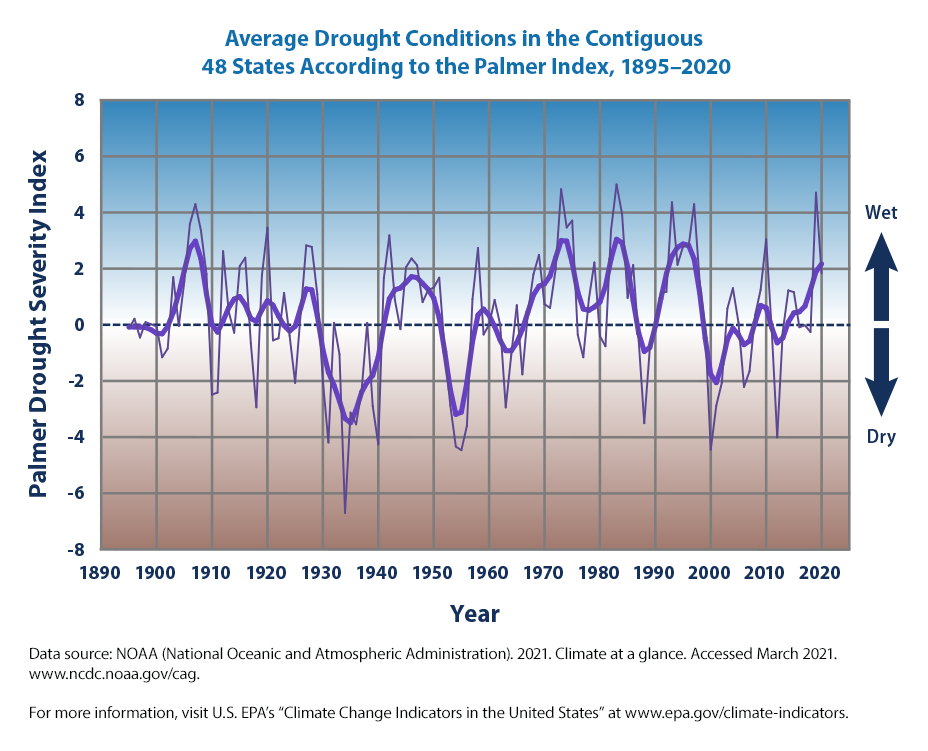
In addition, the Drought Severity Index published by the U.S. Environmental Protection Agency (EPA) showed no material increase in droughts in the United States between 1895 and 2020.

From Data to Narratives

How do such mundane assessments of the impact of climate change evolve into the narrative that “our climate is imploding” and “oceans are boiling”?

In two ways: first, the public statements from the IPCC and the U.N. often diverge from what their own ARs actually say; and second, the predictions of a dire future are based on models rather than observations.

Alongside each new AR, the IPCC also writes condensed Summaries for Policymakers (SPMs) to “inform policymakers what scientists know about climate change.”

The SPMs distill the voluminous ARs down to a short list of bullet points.

In addition, the IPCC produces Headline Statements and Press Releases to “provide a concise narrative” on climate change.

“[The AR] gets boiled down to the Summary for Policymakers, and while it’s drafted by scientists—a small number of them—the governments have to approve the SPM line by line,” Mr Koonin said.

“And so you already have the potential for, let’s say, non-scientific factors entering.”

“The SPM itself is 20–30 pages, and the media have to cover that,” he said. “And they typically will cherry pick the most extreme parts of it, so that’s how we get the distortions, and then that is exacerbated by the politicians, seeing opportunity in distortion, and the NGOs,”

Despite observing no increase in the tornadoes, cyclones, droughts, wildfires, or floods that have been attributed to climate change, the IPCC’s 2023 Headline Statement warns: “There is a rapidly closing window of opportunity to secure a liveable and sustainable future for all [very high confidence].”

“This problem [climate alarmism] is especially severe in the summaries for policymakers, which are mostly written by government bureaucrats,” Mr. Happer said.

“Some of the scientific reviews in the voluminous background material are sound and dispassionate,” he said. “But it is not easy for honest scientists to buck the pressures for alarmism from the political leadership.”

Rise of Computer Models

Much of the basis for climate catastrophism comes not from observation but from computer models.

study of climate models between 1970 and 2020 by the U.S. Department of Agriculture (USDA) found that “observed changes in temperature and precipitation have generally been consistent with the changes projected by earlier models.

“The accurate projections of future climate and hindcasting of past climate makes us confident that models can reliably project changes in the climate,” the USDA report states.

However, taking a closer look at the climate modeling industry raises questions about how reliable those projections are.

The IPCC draws up its predictions based on averaged results from dozens of models, which Mr. Koonin says “disagree wildly with one another.”

In his book, Mr. Koonin notes that the average surface temperatures generated by the models in IPCC reports vary among themselves by around 3 degrees Celsius or three times the amount of warming observed throughout the 20th century.

The ARs “downplay this embarrassment” by focusing not on the actual temperature predictions, where models diverge, but rather on the predicted change in temperatures, where models are more likely to coincide.

And then there is the process of “tuning” the models.

The models typically divide the Earth up into “grid cells,” each a few tens of square miles.

These grid cells are “tuned” in a process of hard-wiring the results from the cells to manually account for more random elements like cloud formations, storms, or humidity, which the models can’t predict but are material to temperature changes.

“There are hundreds of such parameters because the climate system is complicated and has many different dimensions,” Mr. Koonin said.

“And so, as people tune the parameters differently, they get different results.”

Tuning also helps the models show results closer to observed data, but this highlights another shortcoming of the models—while purporting to predict the future, they often fail to reproduce historical temperatures.

They also struggle to separate human influence from natural phenomena, all of which elevates the uncertainty of modeled predictions regarding human behavior.

“If you’re trying—as a politician or NGO or company—to promote a narrative, you don’t want to talk about the uncertainties,” Mr. Koonin said.

“You just want to say it’s going to be five degrees warmer and the world is going to hell.”

Living In Denial

Those who question the narrative of climate catastrophism are often attacked as climate “deniers.”

“Anyone who willfully denies the impact of climate change is condemning the American people to a very dangerous future,” President Joe Biden stated in November 2023.

“The impacts we’re seeing are only going to get worse, more frequent, more ferocious, and more costly.”

Absent the hyperbole, however, what do the numbers indicate about our future?

“Modest warming since the 1900s; 1.3 degrees [Celsius] at the global level,” Mr. Koonin said.

“Despite that, by whatever measure you want to use—lifespan, nutrition, GDP, death rates from extreme events—it’s all going in a positive direction.”

“Sea level rise is continuing at just about a foot a century,” he said. “But the actual and projected economic impacts of warming are in the noise … even the IPCC says it’s small compared to many other things that determine human wellbeing.”

2022 report by the Heritage Foundation, modeling the costs and benefits to the United States of complying with the Paris Agreement and meeting the Biden administration’s goal of reducing GHG emissions to 52 percent below 2005 levels by 2030, predicts these policies would reduce global temperatures by 0.5 degrees at the end of this century.

“Even with theoretical efficiency, we find the costs of the policy to be staggering,” the report states.

“The economy would, in aggregate, lose $7.7 trillion of gross domestic product (GDP) through 2040, which is $87,000 per family of four.”

If the developing world is deprived of the use of fossil fuels, the impact there could be even more severe.

“The billions of people who don’t have energy, who don’t have modern conveniences, they will be condemned to perpetual poverty,” Mr. Lindzen said.

“CO2 has played an important role in increasing agricultural productivity, so we’ll see everyone paying more for food and more people starving.”

“You are already seeing tragic consequences even in the United States, where a whole generation of kids has been told that they have no future,” he said.

“They’re not having children themselves, because what’s the point of having children in a world that’s going to self-destruct?”

The Epoch Times contacted the IPCC for comment but didn’t receive a response.

Tyler Durden
Fri, 05/31/2024 – 22:10