60.9 F
Chicago
Monday, September 21, 2026
Home Blog Page 2627

VDH: The Biden Re-Election Strategy

VDH: The Biden Re-Election Strategy

Authored by Victor Davis Hanson,

President Joe Biden polls at or below 40 percent approval. Historically, such unpopularity has made it almost impossible for a president to be reelected.

Biden is not so much an octogenarian as an unhealthy and prematurely aging 80-year-old. It is America’s irony that he is fit for almost no other job in the country other than the presidency, which apparently allows for a three-day-a-week ceremonial role while others in the shadows run the country.

So how does Biden become renominated and reelected, as polls show he is behind in almost every critical swing state on nearly every issue?

Answer: not by campaigning, not by championing his record, and especially not by doubling down on his neo-socialist and now unpopular agendas.

Instead, his campaign is focused on four other strategies to beat former President Donald Trump.

First, left-wing local, state, and federal prosecutors are tying Trump up in court on crimes that have never been seen before and will never be again after the election. All the cases are politically motivated, with many coordinated with the White House.

Even if Trump is not convicted by blue-state prosecutors, in blue-state courtrooms, in front of blue-state juries, he will lose critical campaigning time.

Trump may end up paying out $1 billion in legal fees and fines. At 76, the monotonous days in court are designed to destroy him financially, physically, and mentally.

Biden and his operatives know that, in the long term, they may have fatally damaged the American legal system with such judicial sabotage. But short-term, they hope to destroy Trump before the ballots are cast.

Second, in his fourth year, Biden is suddenly selling government favors to special-interest voting blocs, or hoping to bring short-term relief to voters at the expense of long-term damage to the nation.

For elite college students and graduates, there are now billions of dollars in student-loan cancellations, despite a Supreme Court ruling declaring such targeted contractual amnesties illegal.

For consumers, before the election, Biden will likely drain the last drops from the critical Strategic Petroleum Reserve to lower gas prices — now sky-high due to his previous disastrous green policies.

If that is not enough, Biden has ordered Ukraine not to hit Russian oil facilities to avoid panic in the global petroleum markets before early and mail-in balloting begin.

Biden will quietly jawbone the Federal Reserve Bank to lower interest rates and reinflate the economy, despite his own creation of hyperinflation that caused interest rates to rise in the first place.

He will pander to Arab-American voters in swing-state Michigan by cutting arms deliveries to Israel, even as it seeks to destroy the killers of Oct. 7.

And if that mollification is not sufficient to win Michigan, he will suddenly slap higher tariffs on imported Chinese electrical vehicles to win back apostate union auto workers.

Three, the left learned after 2016 that the only way to beat Trump is to change the way Americans vote.

So under the cover of the COVID-19 lockdown, the left sued in critical states to reduce Election Day to a mere construct, while 70 percent of voters mailed in their ballots or voted by early, rolling balloting over many weeks.

The key was the inability to fully authenticate votes, given the old practice of showing up on Election Day and presenting an ID was declared “racist.”

Four, Biden, as he did in 2020, will outsource his campaign to the media, 95 percent of which is left-wing. Talking televised heads will claim Biden is “sharp as a knife” while focusing on Trump’s tweets, Stormy Daniels, Michael Cohen, and lurid but irrelevant testimonies that permeate Trump’s court appearances.

Trump will continue to hold weekend-long, massive 100,000-person rallies, even in blue states. Meanwhile, Biden’s fixers in the media, administrative state, and legal community will counter that even with no crowds and no campaigning, Biden can win through 24/7 nonstop “October Surprises” — all summer long.

So expect more false “Russian collusion,” “laptop disinformation,” and “Jan. 6 insurrection” hoaxes and their new replacements designed to smother the airwaves with salacious scandals nonstop.

Biden’s fading tenure is similar to the last sad months of Woodrow Wilson’s second term, when in 1919-20, the country was assured that a bedridden president was somehow hard at work, even as his wife, doctors, and handlers kept everyone else away.

Biden’s keepers do not seem to care about the president’s own failing health or his dismal polls. They discount his rare, anemic, and disastrous public appearances. They laugh off the huge Trump rallies.

And they certainly could care less about the bad optics of pandering to special interests at the expense of the country or the damage done to the American legal and balloting systems.

Instead, Bidenites believe they can reelect an unhealthy, unpopular, and unsuccessful president by any means necessary.

And they may be right.

Tyler Durden
Fri, 05/17/2024 – 12:20

​​​​​​​Desperate Ukraine Launches Massive Kamikaze Drone Attack Against Russian Black Sea Coast, Sparking Fire At Major Refinery

​​​​​​​Desperate Ukraine Launches Massive Kamikaze Drone Attack Against Russian Black Sea Coast, Sparking Fire At Major Refinery

In defiance of repeated warnings from the Biden administration, the Ukrainian military continues ramping up kamikaze drone attacks on the Russian energy complex, a move to crush the nation’s crude oil and crude product export revenues and curtail Moscow’s ability to fund President Putin’s ‘special operation’ in Ukraine. 

A fire broke out overnight at Rosneft PJSC’s large Tuapse refinery on the Black Sea. According to Bloomberg, this wave of overnight drone attacks is one of the largest by Ukraine in the multi-year war.

The Tuapse refinery is the only refinery in Russia located on the Black Sea. It produces naphtha, fuel oil, vacuum gas oil, and high-sulfur diesel, which it exports to Turkey, China, Malaysia, and Singapore. 

The refinery has a capacity of about 240,000 barrels per day and was processing approximately 180,000 barrels per day shortly before the first drone attack in January took the plant offline. 

With Ukraine losing ground with Russia, drone attacks by Kyiv’s military and or special operations personnel, likely with help from US intel operators, are stepping up attacks on Russia’s energy complex. 

Russia said it intercepted 51 drones over Crimea in the attack early Friday. Another four dozen above the southern Krasnodar region, six over the Belgorod region, and one in the Kursk region. The Defense Ministry in Moscow wrote on Telegram that Ukrainian naval drones were also destroyed. 

The regional government in Krasnodar Krai wrote on Telegram that the refinery fire was extinguished three hours after the strike. 

Here’s dramatic footage of the drone attack on the Russian Black Sea coast. 

In mid-April, Reuters estimated that Russia’s refining capacity, which was offline due to drone attacks, was around 660,000 barrels per day, compared to 907,000 bpd offline at the end of March. Russia has stated it can repair damaged refineries over the next few months. 

Last week, Foreign Affairs magazine writer Sam Winter-Levy penned a note titled “Why Ukraine Should Keep Striking Russian Oil Refineries,” explaining that “with less domestic refining capacity, Russia will be forced to export more of its crude oil, not less, pushing global prices down rather than up.” 

In markets, Brent crude prices are marginally higher, above $83 a barrel. The Tuapse refinery attack, plus others in recent months, are reminders of the mounting geopolitical risks that could send oil prices much higher. 

Tyler Durden
Fri, 05/17/2024 – 12:00

With Momentum In Its Favor, Gold Has Potential To Head Higher

With Momentum In Its Favor, Gold Has Potential To Head Higher

Authored by Ven Ram, Bloomberg cross-asset strategist,

Gold looks well poised to build on this year’s gains, with speculative momentum seeming to entice marginal buying and perpetrating a virtuous circle.

Bullion is on track for a fourth successive monthly rally, with its gains so far this year of over 15%.

While those gains appear stunning, in reality, gold adjusted for prices in the economy is far less impressive. At around $2400, it is in line with the 2011/12 highs after adjusting for inflation.

Gold must be viewed for what it actually is: an asset that delivers inflation-adjusted returns in fits and spurts with a highly inconsistent trajectory. Even so, given that we are now in a world where there is little conviction of returning to a 2% inflation regime anytime soon, bullion has room to grind higher.

Over in the US, the markets are again warming up to the idea of interest rate cuts from the Fed after the softer-than-forecast inflation prints for April. Traders now seem to be converging on September for a first reduction and are factoring in nearly two cuts by year-end. Whether or not that positioning proves accurate needs to be seen, but gold traders will be inclined to price those cuts into bullion pricing first and ask questions later.

And with geopolitical tensions staying elevated, gold will find the extra bid going in its favor.

Tyler Durden
Fri, 05/17/2024 – 11:40

Ukraine Formally Asks NATO To Send Troops For 1st Time, Pentagon Mulling

Ukraine Formally Asks NATO To Send Troops For 1st Time, Pentagon Mulling

The continued inevitable and disastrous slide into a WW3 nuclear-armed confrontation between Russian and the West continues as The New York Times reports NATO appears to actually be seriously mulling sending troops to Ukraine to serve in the role as ‘trainers’ at a moment Kiev is desperate to tap and train up new manpower. And this would be closer to front line positions as well.

NATO allies are inching closer to sending troops into Ukraine to train Ukrainian forces, a move that would be another blurring of a previous red line and could draw the United States and Europe more directly into the war,” NY Times wrote Thursday. What has changed? The Zelensky government is now directly requesting it, apparently on a formal level for the first time of the conflict, according to officials.

The Times confirms “Ukrainian officials have asked their American and NATO counterparts to help train 150,000 new recruits closer to the front line for faster deployment.”

Illustrative: US Army image

The report assures that at this moment anyway, the US is still saying ‘no’; however chairman of the Joint Chiefs of Staff Gen. Charles Q. Brown Jr has said an eventual deployment of trainers inside Ukraine looks inevitable. “We’ll get there eventually, over time,” he said.

The Joint Chiefs chairman said this while admitting in the next breath that US and NATO trainers positioned in Ukraine would essentially be sitting ducks under the bombs of superior Russian airpower:

For now, he said, an effort inside Ukraine would put “a bunch of NATO trainers at risk” and would most likely mean deciding whether to use precious air defenses to protect the trainers instead of critical Ukrainian infrastructure near the battlefield. General Brown briefed reporters on his plane en route to a NATO meeting in Brussels.

The report was published the same day that Ukraine’s President Zelensky in his nightly address issued a desperate appeal to Western allies saying that “Russia is trying to expand the war” and that “we must force Russia to a real, just peace by all means.”

Earlier in the week Zelensky abruptly announced that he has canceled all scheduled trips abroad as the crisis in Kharkiv is worsening due to Moscow’s expanded cross-border offensive which seeks to push front lines significantly deeper into Ukrainian territory, where the Kremlin wants to see a buffer zone in order to protect its Belgorod region from shelling.

While there have long been indicators (including a leaked Pentagon file) that up to dozens of special forces troops from various Western countries are likely already on the ground in Ukraine, sending NATO trainers would certainly mark a colossal escalation. Already Russian forces have been actively targeting storehouses with Western weapons, and Putin himself has vowed to make West-supplied tanks and equipment “burn”.

Chairman of the Joint Chiefs of Staff Gen. Charles Q. Brown Jr., AP

NATO is already overseeing a significant Ukrainian troop training program in places like Germany, the UK, Poland, and even in the United States (where pilots are being trained on F-16s in Texas and Phoenix). There had been a training program on Ukrainian soil prior to the Russian invasion of February 2022, however, this was folded up in the days and weeks prior to the war’s start.

The Times quoted Evelyn Farkas, a former top Pentagon official for Ukraine during the Obama administration, to point out: “Remember, when Russia first invaded Crimea in 2014, we sent increased troop numbers into Ukraine to train Ukrainian forces in western Ukraine, and we kept rotating them in all the way to 2022, when we got spooked and withdrew them.”

One location being considered as a ‘safer’ option to establish large troop training operations is the city of Lviv, in Ukraine’s far west near Poland; however, even though it is far from the front lines Russia has still at various time of the war unleashed major ballistic missile strikes on Lviv.

The ball got rolling on this discussion (on a public level at least) with French President Emmanuel Macron raising the idea of Western boots on the ground in Ukraine starting months ago. Since then Lithuania says it stands ready to act and Estonia has just this week also said the small Baltic country is “seriously” considering sending its troops. According to fresh statements:

Estonia has been “seriously” discussing sending troops to Ukraine in roles positioned away from the front lines, per a national security official.

Madis Roll, national security advisor to Estonia’s president, told military news outlet Breaking Defense that his country’s leaders were assessing the viability of sending Estonian soldiers to “rear” roles that wouldn’t see direct combat in Ukraine.

Such a move would help relieve Ukraine’s manpower crunch and allow it to send more soldiers to the front lines.

The Kremlin has repeatedly warned all of this would trigger direct war with NATO if it deploys forces to Ukraine…

Last month, Estonian Defense Minister Hanno Pevkur gave a very revealing interview in European media which raised eyebrows and the alarm in Moscow. The defense chief said in the interview with the Austrian newspaper Die Presse that all NATO countries already have NATO personnel stationed in Ukraine, but that they aren’t directly engaged in hostilities as they are there in advisory roles. He was responding to recent provocative statements by France’s Macron. If so this is probably a small number, and he indicated they tend to be attached to embassies.

The reality is that every NATO member country already has military personnel in Ukraine, such as military attaches or people who travel to Ukraine from time to time,” the Estonian defense chief said. “What [French] President [Emmanuel] Macron said mainly related to personnel training,” he added, according to a translation in Russian media. So clearly, the proverbial camel’s nose is already sneaking in under the tent.

As Russia advances in Kharkiv oblast, Zelensky’s appeals will grow more desperate, and pressure within NATO will grow to ‘respond’:

One source has pointed out how Washington tends to operate and what it all means… In asserting that NATO sending troops is “inevitable,” the Times means the decision has already been made, and all that is being awaited is the determination on how best to announce the escalation to the public.

Tyler Durden
Fri, 05/17/2024 – 10:40

Is Buffett’s Cash Hoard A Market Warning?

Is Buffett’s Cash Hoard A Market Warning?

Authored by Lance Roberts via RealInvestmentAdvice.com,

Every year, investors anxiously await the release of Warren Buffett’s annual letter to see what the “Oracle of Omaha” says about the markets, the economy, and where he is placing his money.

“One of the longest-running traditions in modern finance is that every year, one Saturday morning in late February, the world’s financial class – from professionals to mere amateurs – sit down as they have for the past 65 or so years – for an hour and read the latest Berkshire annual letter written by Warren Buffett. In that letter, the man seen by many as the world’s greatest investor, wrote down his reflections, observations, aphorisms and other thoughts which are closely parsed and analyzed for insight into what he may do next, what he thinks of the current economy and market climate, or simply for insights into how to become a better investor.” – Tyler Durden

This year’s letter was no different, with various tidbits about the current market and investing environment for investors to digest. The one thing that got most of my attention was his comments about the recent surge in cash holdings. Buffett’s cash and short-term investments (read T-bills) exceed $189 billion as of Q1, 2024.

To put that into context, that $189 billion cash pile alone would make Berkshire the 58th-largest economy in the world, only slightly smaller than Hungary.

There are two critical messages regarding Buffett’s cash hoard. The first is that due to the size of Berkshire Hathaway, which is approaching a $1 Trillion market capitalization, acquisitions have to be of substantial size. As Warren previously noted:

“There remain only a handful of companies in this country capable of truly moving the needle at Berkshire, and they have been endlessly picked over by us and by others. Some we can value; some we can’t. And, if we can, they have to be attractively priced.”

Such was an essential statement. One of the most intelligent investors in history suggests that deploying Buffett’s cash hoard in meaningful size is difficult due to an inability to find reasonably priced acquisition targets. With a $189 war chest, there are plenty of companies that Berkshire could either acquire outright, use a stock/cash offering, or acquire a controlling stake in. However, given the rampant increase in stock prices and valuations over the last decade, they are not reasonably priced.

In other words:

“Price is what you pay, value is what you get.” – Warren Buffett

The Valuation Dilemma

The problem with the valuation dilemma is that historically, such has preceded market repricings.

One of Warren Buffett’s favorite valuation measures is the market capitalization to GDP ratio. I have modified it slightly to use inflation-adjusted numbers. This measure is simple: stocks should not trade above the value of the economy. The reason is because economic activity provides revenues and earnings to businesses.

As discussed in “Stock Markets Are Detached From Everything,” the current environment is anything but opportunistic for a value investor like Warren Buffett. To wit:

“While stock prices can deviate from immediate activity, reversions to actual economic growth eventually occur. Such is because corporate earnings are a function of consumptive spending, corporate investments, imports, and exports. The market disconnect from underlying economic activity is due to psychology. Such is particularly the case over the last decade, as successive rounds of monetary interventions led investors to believe ‘this time is different.’”

There is a correlation between economic activity and the rise and fall of equity prices. For example, in 2000 and again in 2008, corporate earnings contracted by 54% and 88%, respectively, as economic growth declined. Such was despite calls for never-ending earnings growth before both previous contractions.

As earnings disappointed, stock prices adjusted by nearly 50% to realign valuations with weaker-than-expected current earnings and slower future earnings growth. So, while stock markets are once again detached from reality, looking at past earnings contractions suggests such deviations are not sustainable.

With the current market capitalization to GDP ratio data outside the historical range as economic growth slows, you can understand Berkshire’s dilemma of deploying cash.

The risk of overpaying for assets comes down to sustaining current profitability.

Berkshire’s issue of finding “reasonably priced” acquisitions is not just one of being overly picky about opportunities. After more than a decade of monetary infusions and zero interest rates, most companies are priced well beyond what economic dynamics can support.

The second message from Buffett’s cash hoard was more of a warning.

Buffett’s Cash Looking For A Crash?

“Occasionally, markets and/or the economy will cause stocks and bonds of some large and fundamentally sound businesses to be strikingly mispriced. Indeed, markets can – and will – unpredictably seize up or vanish as they did for four months in 1914 and a few days in 2001. If you believe American investors are now more stable than in the past, think back to September 2008. Speed of communication and the wonders of technology facilitates instant worldwide paralysis, and we have come a long way since smoke signals. Such instant panics won’t happen often – but they will happen.

Berkshire’s ability to immediately respond to market seizures with both huge sums and certainty of performance may offer us an occasional large-scale opportunity. Though the stock market is massively larger than it was in our early years, today’s active participants are neither more emotionally stable nor better taught than when I was in school. For whatever reasons, markets now exhibit far more casino-like behavior than when I was young. The casino now resides in many homes and daily tempts the occupants.

One investment rule at Berkshire has not and will not change: Never risk permanent loss of capital. Thanks to the American tailwind and the power of compound interest, the arena in which we operate has been – and will be – rewarding if you make a couple of good decisions during a lifetime and avoid serious mistakes.” – Warren Buffett

In other words, he holds such high cash levels to take advantage of market dislocations. Such is what happened in 2008 when the prestigious “white shoe” investment firm of Goldman Sachs came begging with “hat in hand” for a bailout to avoid bankruptcy. Buffett was glad to oblige by providing a massive infusion of capital at lucrative terms. During a crisis, those who “have the gold make the rules.”

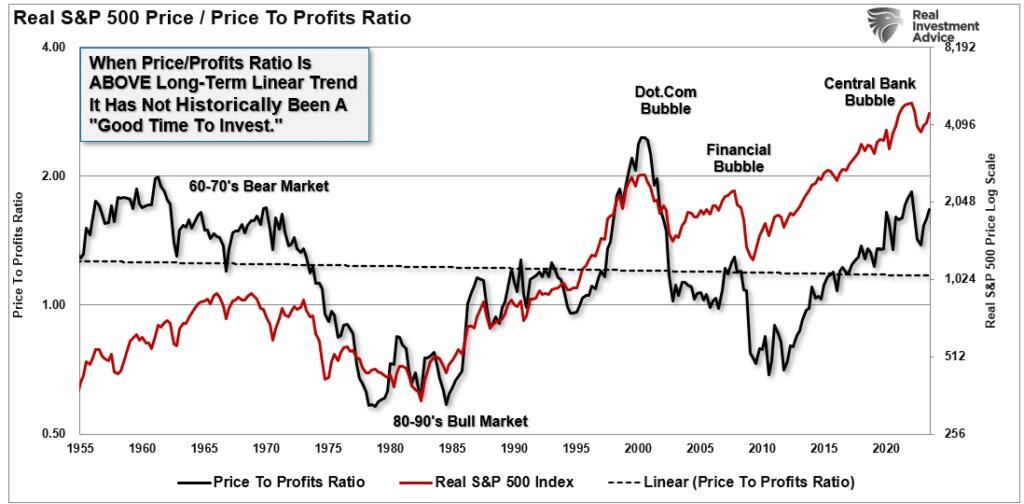
Is there such an opportunity coming in the future? The answer is most likely yes. If we examine corporate profits as they relate to economic growth, we find another measure of excess. The chart below measures the cumulative change in the S&P 500 index compared to corporate profits. Again, when investors pay more than $1 for $1 worth of profits, those excesses are eventually reversed. The current deviation of the market from underlying profitability suggests that eventual reversion will be pretty unkind to investors.

The correlation is more evident in the market versus the price-to-corporate profits ratio. Again, since corporate profits are ultimately a function of economic growth, the correlation is not unexpected. Hence, neither should the impending reversion in both series. Currently, that ratio is approaching levels that preceded more significant market reversions to realign the markets to profitability.

As noted, the high correlation is unsurprising. Investors should expect an eventual reversal with the market on the more extreme end of the valuation spectrum. However, those reversals can take much longer to occur than logic would assume.

Investors believe the deviation between fundamentals and fantasy doesn’t matter as long as the Fed supports asset prices. Such a point remains challenging to argue.

However, as is always the case, the reversion of excesses will occur. Buffett’s cash hoard suggests that he realizes that such a reversion is not unprecedented. More importantly, he wants to capitalize on it when it occurs.

Tyler Durden
Fri, 05/17/2024 – 10:20

GameStop Crashes On Plan To Dump 45 Million Shares On Market

GameStop Crashes On Plan To Dump 45 Million Shares On Market

Sunday:

Roaring Kitty’s post on X unleashed a mega short squeeze in heavily shorted Gamestop and AMC Entertainment Holdings between Monday and Wednesday. 

On the first day of the mania, we pointed out,  “You know Jefferies bankers are burning the phones at GME and AMC pitching ATM equity offerings for after the close.” 

Then Tuesday. 

And Wednesday (read here). 

 Gamestop and AMC’s price action from the start of Wednesday through yesterday’s close has been absolutely awful.

And finally, to end the week, Gamestop entered into an open market sale agreement with Jefferies to sell up to 45 million shares. 

Shares cratered in premarket trading, down 23% to 21.32. 

Here’s the price action recap for both Gamestop and AMC for the week.

Thanks for playing retail. 

Tyler Durden
Fri, 05/17/2024 – 10:00

World’s #1 Golfer Tossed Against Car, Arrested In Kentucky — Calls “Very Chaotic Situation”

World’s #1 Golfer Tossed Against Car, Arrested In Kentucky — Calls “Very Chaotic Situation”

The world’s #1 golfer Scottie Scheffler was arrested and taken to jail on several charges – including a felony charge of assaulting a police officer, after he tried to bypass a massive traffic backup to enter the Valhalla Golf Club in Louisville Kentucky.

Scheffler was set to tee off for his second round of the PGA Championship at 8:48 ET alongside Wyndham Clark and Brian Harman, when he was detained and booked.

In viral footage, Scheffler was seen being led into the police car in handcuffs.

“Can you please help me?” he was heard asking a nearby journalist.

Scheffler reportedly thought he was bypassing security staff, when it was in fact cops who told him to stop due to an earlier traffic accident that he was not involved in. When he didn’t, the officer attached himself to the golfer’s car – which Scheffler drove approximately 30 feet before stopping, ESPN reports.

The officer is then said to have grabbed at Scheffler’s car, attempting to pull him out before Scheffler opened the door – after which he was dragged out of the vehicle, thrown up against it, and placed in handcuffs. 

The 27-year-old golfer was later booked into jail and released by the Louisiana Department of Corrections.

He’s been charged with:

  •     Second-degree assault of a police officer, which is a felony
  •     Third-degree criminal mischief
  •     Reckless driving
  •     Disregarding traffic signals from an officer directing traffic

Following the arrest, ESPN reporter Jeff Darlington said “One police officer came up to me with his pad and said – pen in hand – “Can you tell me the name of the person we’ve just arrested?””

Earlier, when Darlington tried to get the attention of the officers, he was warned “Back up or you’re going to jail also!”

“Right now, he’s going to jail,” another officer said. “He’s going to jail and there’s nothing you can do about it. Period.”

Update: Scheffler, meanwhile, has described the arrest as a “big misunderstanding” following “a very chaotic situation.”

This morning, I was proceeding as directed by police officers.  It was a very chaotic situation, understandably so considering the tragic accident that had occurred earlier, and there was a big misunderstanding of what I thought I was being asked to do.  I never intended to disregard any of the instructions.  I’m hopeful to put this to the side and focus on golf today.

Tyler Durden
Fri, 05/17/2024 – 09:40

Turley: Will The Trump Jury Realize They Are Being Played By The Prosecution

Turley: Will The Trump Jury Realize They Are Being Played By The Prosecution

Authored by Jonathan Turley,

Below is my column in Fox.com on the approaching end of the Trump trial in Manhattan. With the dramatic implosion of Michael Cohen on the stand on Thursday with the exposure of another alleged lie told under oath, even hosts and commentators on CNN are now criticizing the prosecution and doubting the basis for any conviction. CNN anchor Anderson Cooper admitted that he would “absolutely” have doubts after Cohen’s testimony.

CNN’s legal analyst Elie Honig declared “I don’t think I’ve ever seen a star cooperating witness get his knees chopped out quite as clearly and dramatically.”

He previously stated that this case would never have been brought outside of a deep blue, anti-Trump district. Other legal experts, including on CNN and MSNBC, admitted that they did not get the legal theory of the prosecution or understand the still mysterious crime that was being concealed by the alleged book-keeping errors.  The question is whether the jury itself is realizing that they are being played by the prosecution.

Here is the column:

In the movie “Quiz Show,” about the rigging of a 1950s television game show, the character Mark Van Doren warns his corrupted son that “if you look around the table and you can’t tell who the sucker is, it’s you.”

As the trial of former President Donald Trump careens toward its conclusion, one has to wonder if the jurors are wondering the same question.

For any discerning juror, the trial has been conspicuously lacking any clear statement from the prosecutors of what crime Trump was attempting to commit by allegedly mischaracterizing payments as “legal expenses.” Even liberal legal experts have continued to express doubt over what crime is being alleged as the government rests its case.

There is also the failure of the prosecutors to establish that Trump even knew of how payments were denoted or that these denotations were actually fraudulent in denoting payments to a lawyer as legal expenses.

The judge has allowed this dangerously undefined case to proceed without demanding greater clarity from the prosecution.

Jurors may also suspect that there is more to meet the eye about the players themselves. While the jurors are likely unaware of these facts, everyone “around the table” has controversial connections. Indeed, for many, the judge, prosecutors, and witnesses seem as random or coincidental as the cast from “Ocean’s Eleven.” Let’s look at three key things.

1. The Prosecutors

First, there are the prosecutors. Manhattan District Attorney Alvin Bragg originally (as did his predecessor) rejected this ridiculous legal theory and further stated that he could not imagine ever bringing a case where he would call former Trump personal attorney Michael Cohen, let alone make him the entirety of a prosecution.

Bragg’s suspension of the case led prosecutor Mark F. Pomerantz to resign. Pomerantz then wrote a book on the prosecution despite his colleagues objecting that he was undermining their work. Many of us viewed the book as unethical and unprofessional, but it worked. The pressure campaign forced Bragg to green-light the prosecution.

Pomerantz also met with Cohen in pushing the case.

Bragg then selected Matthew Colangelo to lead the case. Colangelo was third in command of the Justice Department and gave up that plum position to lead the case against Trump. Colangelo was also paid by the Democratic National Committee for “political consulting.” So a former high-ranking official in the Biden Justice Department and a past consultant to the DNC is leading the prosecution.

2. The Judge

Judge Juan Merchan has been criticized not only because he is a political donor to President Biden but his daughter is a high-ranking Democratic political operative who has raised millions in campaigns against Trump and the GOP.

Merchan, however, was not randomly selected. He was specifically selected for the case due to his handling of an earlier Trump-related case.

3. The Star Witness

Michael Cohen’s checkered history as a convicted, disbarred serial perjurer is well known. Now, Rep. Dan Goldman, D-N.Y., is under fire after disclosing that “I have met with [Cohen] a number of times to prepare him.”

Goldman in turn paid Merchan’s daughter, Loren Merchan, more than $157,000 dollars for political consulting.

Outside the courtroom, there is little effort to avoid or hide such conflicts. While Democrats would be outraged if the situation were flipped in a prosecution of Biden, the cross-pollination between the DOJ, DNC, and Democratic operatives is dismissed as irrelevant by many in the media.

Moreover, there is little outrage in New York that, in a presidential campaign where the weaponization of the legal system is a major issue, Trump is not allowed to discuss Cohen, Colangelo, or these conflicts. A New York Supreme Court judge is literally controlling what Trump can say in a presidential campaign about the alleged lawfare being waged against him.

The most striking aspect of these controversial associations is how little was done to avoid even the appearance of conflicts of interests. There were many judges available who were not donors or have children with such prominent political interests in the case. Bragg could have selected someone who was not imported by the Biden administration or someone who had not been paid by the DNC.

There was no concern over the obvious appearance of a politically motivated and stacked criminal case. Whether or not these figures are conflicted or compromised, no effort was taken to assure citizens that any such controversies are avoided in the selection of the key players in this case.

What will be interesting is how the jury will react when, after casting its verdict, the members learn of these undisclosed associations. This entire production was constructed for their benefit to get them to convict Trump despite the absence of a clear crime or direct evidence.

They were the marks and, like any good grift, the prosecutors were counting that their desire for a Trump conviction would blind them to the con.

Bragg, Colangelo and others may be wrong. Putting aside the chance that Judge Merchan could summon up the courage to end this case before it goes to the jury, the grift may have been a bit too obvious.

New Yorkers are a curious breed. Yes, they overwhelmingly hate Trump, but they also universally hate being treated like chumps. When they get this case, they just might look around the courtroom and decide that they are the suckers in a crooked game.

Tyler Durden
Fri, 05/17/2024 – 09:25

Out Of Control Inflation: It Now Takes At Least $177,798 For A Family Of 4 To Live Comfortably In The US

Out Of Control Inflation: It Now Takes At Least $177,798 For A Family Of 4 To Live Comfortably In The US

Authored by Michael Snyder via The Economic Collapse blog,

I never imagined that we would ever see a time when it takes $177,798 for a family of four to live comfortably in the United States.  Unfortunately, that day has arrived.  Our leaders have been pursuing highly inflationary policies for many years, and now we have reached a point where inflation is wildly out of control.  In fact, the latest wholesale inflation figure that was released on Tuesday came in much higher than expected.  Sadly, this is just the beginning and we are in far more trouble than most people realize.

According to an incredibly shocking new study, most Americans do not make enough money to “live comfortably” in the highly inflationary environment that we find ourselves in today…

A recent study has revealed the incomes needed for families to live comfortably across the United States – and the stark contrast in the cost of living between states is startling.

The study revealed that in the most expensive states, families need nearly $300,000 to simply live ‘comfortably.’

The least expensive state requires about half that salary – still over $100,000.

Meanwhile, the average annual salary in the US is $59,428, or $28.34 per hour, as of May 2024.

The study determined that Massachusetts is the most expensive state.

It takes a whopping $301,184 a year for a family of four to “live comfortably” there.

The least expensive state is Mississippi.

In the Magnolia State, it only takes $177,798 a year for a family of four “to cover their expenses and maintain a satisfactory quality of life”.

This is our country now.

I feel like I have been banging my head into a wall.  For more than a decade I have warned that this would happen, and now it is here.

And even more inflation is on the way

Americans already contending with persistent and stubbornly high inflation just got more unwelcome news on Tuesday: There are more price hikes likely coming down the pike.

Wholesale inflation picked up in April to its highest rate in a year, according to Bureau of Labor Statistics data released Tuesday.

In April, inflation at the wholesale level jumped 0.5 percent in just one month…

Inflation at the wholesale level rose much more than expected in April, the latest sign that price pressures within the economy remain elevated and difficult to tame.

The Labor Department said Tuesday that its producer price index, which measures inflation at the wholesale level before it reaches consumers, rose 0.5% in April from the previous month.

If you multiply that figure by 12 months, you get 6 percent.

And of course you need to approximately double any number that the Biden administration gives us in order to come up with a figure that is anywhere close to accurate.

By now, just about everyone realizes that the rate of inflation in this country is massively understated.

For example, Joe Biden insists that the rate of inflation has been “low” for quite some time, but home prices have risen by more than 47 percent since the start of this decade…

Home prices have surged 47.1% since the start of 2020, easily outstripping the gains seen in recent decades.

That’s according to a recent analysis by ResiClub of the Case-Shiller National Home Price Index, which showed that house prices in the 1990s and 2010s grew a respective 30.1% and 44.7%.

Let’s all be honest with one another.

The truth is that we are in the midst of a raging cost of living crisis that has no end in sight.

And this should not surprise any of us.  Our politicians continue to borrow and spend trillions upon trillions of dollars, and all of this borrowing and spending is extremely inflationary…

An economic specter haunts America. It’s also one that many American politicians – Republican and Democrat – say a great deal about but are reluctant to address.

The name of that shadow is the United States National Debt: what the US Treasury Department defines as “the amount of money the Federal Government has borrowed to cover the outstanding balance of expenses incurred over time.”

If you go to the Treasury’s website, you can see just how big that debt is. In mid-May, it was 34.5 trillion dollars. The pace of the growth in that debt is equally stunning. Approximately 1 trillion dollars is being added to America’s National Debt every 100 days.

Borrowing and spending another trillion dollars every 100 days is a completely and utterly insane thing to do.

We really are in the endgame.

Earlier this week, Fed Chair Jerome Powell warned that interest rates may have to stay high for an extended period of time in order to fight inflation…

Federal Reserve Chair Jerome Powell said Tuesday that “it may take longer than expected” for high interest rates to lower inflation and gave no hint that a recently slowing labor market could mean earlier rate cuts.

“We’ll need to be patient and let restrictive policy do its work,” Powell said during a session at a Foreign Bankers Association meeting in Amsterdam. “It may be that (high interest rates) take longer than expected to do its work and bring inflation down.”

So far, higher rates have not solved our cost of living crisis, and that is because our politicians continue to spend money like drunken sailors.

But higher rates are crushing the overall economy.

Yesterday, I wrote about the “restaurant apocalypse” that is starting to sweep across America.

This week, it got even worse.

We just learned that at least 99 Red Lobster locations have been shut down and will be auctioned off…

At least 99 locations of Red Lobster are being auctioned off amid questions about the stalwart seafood chain’s long-term future.

In a post Monday on LinkedIn, Neal Sherman, founder and CEO of TAGeX Brands, a liquidation firm, announced he was leading the closure of more than 50 Red Lobster locations, with the restaurants’ equipment to be auctioned off.

A web page dedicated to the liquidations showed closure locations across the U.S. including in Denver; Indianapolis; Rochester, New York; Sacramento, California; San Antonio; and San Diego.

On Tuesday, Restaurant Business Magazine reported 99 locations were closing.

For the Red Lobster workers that just lost their jobs, the end came very suddenly

A third Red Lobster employee took the news in stride, posting: ‘red lobster just laid all of us off without notice and closed for good LMAOO.’

The employee added in replied that Red Lobster didn’t tell managers until 8am yesterday.

Of course it isn’t just restaurant chains that are closing locations.

In fact, even Walmart is closing stores and auctioning off inventory…

After announcing that it would be shutting its doors for good, one Ohio Walmart auctioned off its remaining inventory, including flat-screen televisions, laptops and furniture, for a bargain.

The Walmart at 3579 S. High St. in Columbus opted not to renew its lease in a once-bustling strip plaza. Representatives announced the closure in February, claiming the store had failed to ‘meet financial expectations’.

Last week, the store offloaded its merchandise through a liquidation auction. Bidding closed the morning of May 10, with some items like laptops going for under $20.

If interest rates stay high, we are going to see a lot more of this sort of thing.

But the Federal Reserve is very hesitant to cut rates at this point because of the cost of living crisis.

Officials at the Fed really are caught in a “deer in the headlights” moment right now.

But no matter which way they ultimately choose to go, in the short-term more “stagflation” is ahead.

And in the long-term, the exceedingly foolish policies that our leaders have been pursuing are going to result in a systemic collapse of absolutely epic proportions.

*  *  *

Michael’s new book entitled “Chaos” is available in paperback and for the Kindle on Amazon.com, and you can check out his new Substack newsletter right here.

Tyler Durden
Fri, 05/17/2024 – 07:20

Former Greenlight Employee Offers To Debate David Einhorn Over Merits Of Tesla Short

Former Greenlight Employee Offers To Debate David Einhorn Over Merits Of Tesla Short

A former Greenlight Capital employee, who is embroiled in a lawsuit against his former employer for defamation, claims the firm “fundamentally misunderestimates” Tesla and is seeking to debate Greenlight President David Einhorn on the topic.

On a post on X, the employee, James Fishback, posted what appears to be a copy of an invitation to Mr. Einhorn to debate, among other things, Tesla, passive vs. active investing and the Fed’s path.

He wrote: “I’ve been invited to debate Tesla with David Einhorn (my ex-boss), among other topics. I’ve been critical of Tesla shorts like @davidein because they fundamentally misunderestimate Tesla’s core value driver: autonomy.”

“The path to truth runs through open debate. Let’s do it!” he added.

His former boss, Einhorn, responded on X: “Thank you for the offer. Normally, I am happy to debate and exchange views. However, in order for such a debate to be meaningful, the person on the other side needs to have some knowledge about the subject.”

“In this case, I am not aware that you have ever spent any time analyzing Tesla or its fundamentals – or really any other equity position for that matter,” he continued. “Certainly not during the 2 years while you were a macro research analyst at Greenlight. In any event, even if I were to go against our policy of not publicly discussing shorts or even confirming we are short, such a debate is not possible in the face of the ongoing litigation between us.”

To which Fishback replied: “I get it. You don’t want to debate me and have to defend the fact that you’ve lost your investors a fortune betting against @elonmusk. Also, if I’m not qualified, why on earth did you hire me? Everyone should read my full lawsuit against you.”

This isn’t the first time the Greenlight former has been outspoken about Tesla. He wrote back in April 2024: “Take it from someone who worked at the hedge fund publicly know for *shorting* Tesla. The shorts are wrong.”

“Tesla’s ‘full self driving’ technology will soon prove to be the Fall 2022 ‘ChatGPT’ moment on steroids. Short-sellers focusing a vehicle sales while ignoring what FSD is doing *today* are making a huge mistake. This is game-changing technology. Upside in Tesla is massive,” he added.

Fishback’s defamation lawsuit against Greenlight Capital claims that the firm refused to confirm his title as “Head of Macro” when future business contacts of his reached out to the hedge fund for due diligence purposes. 

Tyler Durden
Fri, 05/17/2024 – 06:55