62.8 F
Chicago
Monday, September 21, 2026
Home Blog Page 2662

Mapping The Number Of AI Startups By Country

Mapping The Number Of AI Startups By Country

Amidst the recent expansion of artificial intelligence (AI), Visual Capitalist’s Marcus Lu visualized data from Quid (accessed via Stanford’s 2024 AI Index Report) to highlight the top 15 countries which have seen the most AI startup activity over the past decade.

The figures in this graphic represent the number of newly funded AI startups within that country, in the time period of 2013 to 2023. Only companies that received over $1.5 million in private investment were considered.

Data and Highlights

The following table lists all of the numbers featured in the above graphic.

From this data, we can see that the U.S., China, and UK have established themselves as major hotbeds for AI innovation.

In terms of funding, the U.S. is massively ahead, with private AI investment totaling $335 billion between 2013 to 2023. AI startups in China raised $104 billion over the same timeframe, while those in the UK raised $22 billion.

Further analysis reveals that the U.S. is widening this gap even more. In 2023, for example, private investment in the U.S. grew by 22% from 2022 levels. Meanwhile, investment fell in China (-44%) and the UK (-14.1%) over the same time span.

Where is All This Money Flowing To?

Quid also breaks down total private AI investment by focus area, providing insight into which sectors are receiving the most funding.

Attracting the most money is AI infrastructure, research, and governance, which refers to startups that are building AI applications (like OpenAI’s ChatGPT).

The second biggest focus area is natural language processing (NLP), which is a type of AI that enables computers to understand and interpret human language. This technology has numerous use cases for businesses, particularly in financial services, where NLP can power customer support chatbots and automated wealth advisors.

With $8 billion invested into NLP-focused startups during 2023, investors appear keenly aware of this technology’s transformative potential.

Tyler Durden
Mon, 05/06/2024 – 20:00

Mass Arrests In NYC As More Than 1,000 Pro-Palestine Protesters March To Met Gala

Mass Arrests In NYC As More Than 1,000 Pro-Palestine Protesters March To Met Gala

The NYPD has begun arresting people after more than 1,000 pro-Palestine demonstrators marched through upper Manhattan towards the Metropolitan Museum of Art, which is hosting the star-studded Met Gala.

As protesters marched down 5th Avenue towards the event, blocking traffic, cops stepped in at the East 79th Street Transverse at Central Park and started the arrests, the NY Post reports.

 “This is an exercise in futility at this point. There’s nowhere for them to go,” one cop attempting to control the crowd was heard telling his partner, according to the report.

The protesters then filed out of the park and were within sight of the Met, but dozens of police formed a blockade — standing two cops deep — preventing them from heading north.

“Is that the Met?” one protester asked a friend. “Oh no, we were so close.”

The group tried to reach the museum again by turning down East 81st Street but was again stopped by more police barricades at the intersection with Madison Avenue. -NY Post

Photo via @essebbi

Disclose, divest, we will not stop, we will not rest,” the group chanted while waving Palestinian flags and wearing keffiyeh face coverings. 

Who do you serve? Who do you protect?” the crowd barked at the cops. 

Things are getting a little chaotic. 

Only days ago, we asked, “Will Campus Chaos Across America’s Woke Universities Spread To The Streets?” 

Tyler Durden
Mon, 05/06/2024 – 19:40

Panama Elects New President Who Vows To Shut Migrant Trail, Restore Economy

Panama Elects New President Who Vows To Shut Migrant Trail, Restore Economy

Voters in the Republic of Panama on Sunday elected a new president who has vowed to sever a key segment of the Latina American migrant trail that leads to the United States while restoring the country’s reputation as an investment destination.   

“We’ll promote a government that’s pro-investment, and pro-private enterprise,” said Mulino in his victory address. (Matias Delacroix/AP)

Former security minister Jose Raul Mulino won via an approximate 34% plurality of the vote. He was a late entrant to the race — subbing in for former President Ricardo Martinelli, who was banned from running after being convicted for money laundering and sentenced to nearly 11 years in prison.

The conviction arose from the use of public money to buy a media firm, which then gave Martinelli a majority ownership position. Martinelli is currently living in the Nicaraguan embassy in Panama City, where he’s been granted asylum. That didn’t stop him from being an active voice in the campaign, urging voters to choose Mulino via messages from his makeshift home in an embassy storeroom. On Sunday, Mulino acknowledged the boost, visiting Martinelli at the Nicaraguan compound after he’d cast his own vote: 

Mulino, whose five-year term will begin on July 1, has vowed to stem the massive flow of illegal migration that transits Panama en route from South America to the United States. In 2023, more than 500,000 migrants traveled through Panama; most of them were Venezuelan, reports Bloomberg

“I will not permit thousands of illegals to pass through our territory like nothing, without control,” said 64-year-old Mulino as he campaigned for office. Making good on that promise will require major attention to Panama’s notorious Darien Gap, a roadless, 60-mile stretch of of swamps, mountains and rain forest that is the only terrestrial connection between South and Central America.

Passage through the gap is filled with perils, not least of which are assault, robbery and rape at the hands of criminal gangs. Aid groups say the criminals in the zone are extraordinarily evil, and are known to steal food — including baby formula — and abandoning beaten, hungry victims in the jungle. 

Mulino has also promised to confront the country’s many economic challenges — which have prompted credit downgrades. Fitch lowered Panamanian debt to junk status in March. For now, S&P and Moody’s score Panamanian bonds one slot above junk.

Lashing out against inflation and government corruption: In 2022, demonstrators imposed roadblocks across the country 

The shuttering of a single enterprise has hit Panama’s economic and fiscal prospects hard. It’s the $10 billion Cobre copper mine run by First Quantum Materials, which accounted for 5% of Panama’s GDP and 1.5% of the global copper supply. In December, the Supreme Court said the company’s contract — which it took over through a hostile takeover — was unconstitutional.

The terms of that contract were perceived by Panamanians as leaving too much on the table, and the mine has been the subject of major protests. Some of the opposition springs from ecological concerns. Mulino’s challenge: Strike a new deal and get the mine working again, bringing money into the economy and taxes into government coffers.

The country has also suffering an economic hit from a drought that has lowered water levels in Gatun Lake. The lake an important component of the Panama Canal route, and the lower water level forced restrictions that slashed canal transits and total tonnage. “The run rate for fiscal year 2024 of vessels through the canal is 9,700, 23% lower than the 2023 fiscal year throughput,” FreightWaves reported in February. 

Nudging the canal back toward normal operations will require identifying a new water source. One proposal calls for the construction of a $900 million water reservoir, something the US Army Corp of Engineers explored in the late 1990s. If it gets the green light, construction is expected to span five years. 

The proposed Rio Indio Reservoir would be situated southwest of Lake Gatun (via Engineering News-Record)

In 2022, the country was rocked the largest civil unrest since the end of dictator Manuel Noriega’s reign in 1989. The action included strikes by teachers and construction workers — and demonstrators using fiery roadblocks — as citizens lashed out against rising prices, as well as government corruption in the form of legislators’ families and cronies being granted bloated contracts and salaries. Members of the ruling Democratic Revolutionary Party threw fuel on the fire when photos captured them drinking $340 bottles of Macallan whisky while celebrating the start of a new legislative session.  

Order was restored after President Cortizo ordered 10% government payroll cuts and imposted price controls. Of course, government market interventions are never a path to lasting prosperity and stability. That’s a fact President-Elect Mulino may not fully grasp: One of his promised economic remedies is a boost in the country’s minimum wage.  

Tyler Durden
Mon, 05/06/2024 – 19:20

Confidence In Biden Economic Stewardship Historically Low

Confidence In Biden Economic Stewardship Historically Low

By Megan Brenan of Gallup

With Americans less optimistic about the state of the U.S. economy than they have been in recent months and concern about inflation persisting, their confidence in President Joe Biden to recommend or do the right thing for the economy is among the lowest Gallup has measured for any president since 2001. But Biden is not alone in facing a skeptical public, as Federal Reserve Chair Jerome Powell, the Republican and Democratic leaders in Congress, and presumptive presidential nominee Republican Donald Trump garner confidence ratings below 50%.

Forty-six percent of U.S. adults say they have “a great deal” or “a fair amount” of confidence in Trump to do or recommend the right thing for the economy, while fewer say the same of Biden (38%), Powell (39%), and Democratic (38%) and Republican (36%) leaders in Congress.

To a large degree, this reflects partisanship; Democrats are confident in Biden, Powell and Democratic congressional leaders, while Republicans are confident in Trump and Republican congressional leaders. Partisans have little to no confidence in the opposing party’s leaders. While political independents are not overly confident in any of the leaders, they have the most confidence in Trump.

These findings are from Gallup’s Economy and Personal Finance poll, conducted April 1-22. During the poll’s field period, the Bureau of Labor Statistics released the latest Consumer Price Index data showing that inflation remains stubbornly elevated, though nowhere near the 40-year highs seen in 2022. After the poll was completed, Powell announced that interest rates would remain steady due to the current inflation rate.

Confidence in Biden’s Management of Economy Low Compared With Predecessors

Gallup has tracked confidence in presidents’ ability to do the right thing for the economy annually since George W. Bush took office in 2001. Bush, Barack Obama and Biden (to a lesser extent) enjoyed majority-level economic confidence ratings at the start of their presidencies, while the public’s confidence in Trump never rose above his initial 48% reading. Trump’s current rating is essentially tied with that of his last year in office.

Obama’s confidence ratings were at least 50% each year except for one (42% in 2014). Biden has fared much worse as confidence in his economic management dropped precipitously in 2022 from 57% to 40% amid sharply higher inflation, and it has been below 40% since then. Only Bush earned lower confidence from Americans than Biden has since last year — by the end of his second term, amid the Great Recession, when just 34% of Americans expressed confidence in his economic abilities.

Confidence in Powell Remains Low Historically

Powell’s latest economic confidence reading of 39% is statistically similar to last year’s 36%. Alan Greenspan, who served five terms in the position, inspired majority-level confidence for each of Gallup’s five readings between 2001 and 2005. In contrast, the two chairs of the Federal Reserve who followed Greenspan — Ben Bernanke and Janet Yellen — failed to register confidence ratings above 50%.

One reason Fed chairs typically engender less confidence than presidents is that the public is not overly familiar with them, and thus more likely to not offer an opinion on their leadership. This year, 16% do not offer an opinion on Powell. Historically, the average percentage not expressing a view on the Fed chair’s leadership has been 17%.

Below-Average Confidence in Democratic, Republican Congressional Leaders

The current economic confidence readings for both parties’ congressional leaders are statistically similar to last year’s readings but well below the historical average for each. Democratic leadership’s latest 38% confidence rating is near the all-time low of 34% recorded in 2023 and below the average of 46% since 2001. Republican leadership’s latest 36% rating is well above the 24% low for that group, in 2014, but significantly below the historical average of 43%.

Confidence ratings were last at the majority level in 2009 for Democratic congressional leaders and in 2003 for Republican congressional leaders.

Confidence in Economic Leaders Driven by Partisanship

Americans’ confidence in these key leaders is driven by partisans’ differing views. Broad majorities of Republicans express confidence in the economic competence of Trump (86%), their party’s presumptive presidential nominee, and 82% of Democrats do the same of Biden.

Democrats are more likely than Republicans to say they are confident in their own party’s congressional leaders (80% vs. 67%, respectively). Democrats (56%) are also more confident than Republicans (30%) in Powell’s handling of the economy. Few in either party are confident in the opposing party’s presidential candidate or congressional leaders.

Roughly one-third of independents say they are confident in Biden, Powell and both parties’ congressional leaders. Trump earns higher confidence from independents (45%).

Bottom Line

Americans’ assessments of the national economy are bleak, and they lack confidence in U.S. leaders’ ability to manage it properly. Democrats trust Biden and Powell on the economy, while Republicans trust Trump — but relatively few independents trust any of the current leaders who have a hand in managing the economy. The net result is that, unlike as recently as 2021, none of the key national figures who can influence the economy earns the trust of a majority of Americans.

Biden’s subpar rating could have significant electoral implications as not only does he have the lowest economic rating of any president seeking reelection since Gallup began tracking this in 2001, but independents trust his opponent more than him.

Tyler Durden
Mon, 05/06/2024 – 19:00

Five Simple Policies To Reset America’s “Rigged” Health System  

Five Simple Policies To Reset America’s “Rigged” Health System  

Calley Means, a one-time consultant for big food and pharmaceutical companies in the Washington, DC, swap and now the founder of TrueMed, a company that enables tax-free spending on food and exercise, has outlined on X five simple policies the federal government can implement to correct the “rigged system” that has contributed to the nation’s obesity crisis. 

Means first compares childhood obesity rates in the US, over 20%, with those in Japan, which are only 4%. He said 50% of US teens are overweight or obese. As we’ve noted before, this is a national security threat, given morbidly obese men aged 18-25 are no good for the modern battlefield if World War III breaks out in Eastern Europe and or the Middle East. 

Even more shocking is that the federal government nor politicians on Capitol Hill offer any simple lifestyle changes that could begin to correct this crisis. Instead, the solution is to bankrupt America’s Medicare program through Big Pharma’s blockbuster weight loss drugs, such as Novo Nordisk’s Ozempic.

Means calls the health system “rigged” and offers five simple policies that are getting attention from America’s billionaires:

1. Ban TV Pharma Ads

  • The US and New Zealand are the only countries in the world that allow pharma ads.

  • Pharma money is 55% of TV news spending. The reason pharma spends is not to influence consumers – it is to influence the news itself.

  • The President can instruct the FDA Office of Prescription Drug Promotion to ban pharma ads tomorrow.

2. No soda on SNAP (food stamps)

  • It is criminal that 10% of all SNAP funding goes to sugary drinks – which are leading to one-third of teens to have pre-diabetes.

  • Using existing drug policy, the President can issue an executive order tomorrow that government money should not subsidize an addictive, toxic substance for kids.

3. Fire the Corrupt USDA Nutrition Panel

  • 95% of the USDA panel that makes nutrition policy is paid for by food companies.

  • This panel recommends 10% of a 2-year-old’s diet can be added sugar.

  • The President can fire this panel tomorrow and insist on unbiased guidelines.

4. No conflicts of interest among NIH researchers

  • This sounds like a no-brainer, but it is a radical suggestion.

  • Currently, there are no conflict-of-interest bans at the NIH and 8,000 researchers have “major” conflicts. 

  • This Is why 40x more money is spent on ways to “manage” cancer than to prevent it — prevention doesn’t make money for pharma.

  • This can be changed tomorrow.

5. Reform Insane Ag Subsidies

  • Today, the federal government subsidizes tobacco more than vegetables.

  • 90% of agriculture subsidies go the components of ultra-processed food (corn, soy, wheat) – distorting incentives for farmers

  • These subsidies are Implemented by the Ag Department.

Bill Ackman and Elon Musk took notice of the proposed policies… 

Means added, “Japan has a 5x lower childhood obesity rate BECAUSE they address the root cause.” 

In a separate post in March, Means wrote, “If our kids are being poisoned by our food, the solution is not to let that happen + inject them w government-funded Ozempic for life.” 

Meanwhile… 

More than ever, Americans must break free of the food-industrial complex and big pharma or risk early death. 

Tyler Durden
Mon, 05/06/2024 – 18:40

‘Squeezey’ Stock Market Extends Gains; Bonds & Bullion Bid

‘Squeezey’ Stock Market Extends Gains; Bonds & Bullion Bid

More of the same today after last week’s tepid payrolls and dovish Powell with gold, stocks, and bonds bid as rate-cut hopes inched higher.

The market is now pricing in two rate-cuts in 2024 and three more cuts in 2025

Source: Bloomberg

For now the market appears to prefer the ‘bad news’ from declining growth expectations to the ‘bad news’ from soaring inflation prints…

Source: Bloomberg

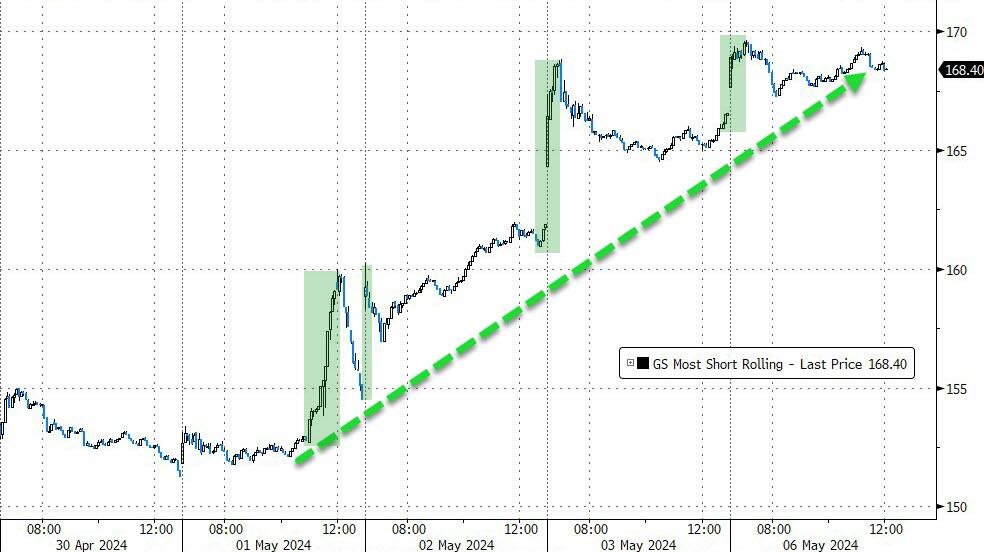
But, hey, for now, as Goldman’s trading desk noted, the market feels “squeezey” and 12% gains for the basket of ‘most shorted’ stocks in the last three days would support that thesis (and overall activity was lower than average)…

Source: Bloomberg

That helps explain why Small Caps (dominated by the heavily shorted names) outperformed but Mag7 stocks also continued higher today with all the majors green on the day (Dow lagged)…

All the majors rallied back above their 50DMAs (but The Dow fell back to test its key technical level)…

A mixed picture in bonds today with the short-end underperforming (2Y +1.5bps, 30Y -2bps), but the whole complex sold off from its US open…

Source: Bloomberg

The dollar ended basically unchanged on the day, recovering small losses from overnight…

Source: Bloomberg

An early surge in bitcoin – up to $65,500 – was quickly sold following headlines that Robinhood had received a Wells Notice…

Source: Bloomberg

As a reminder, we saw huge net inflows into ETFs on Friday, so it will be fascinating to see what happened today…

Source: Bloomberg

Oil prices roller-coastered amid confusing headlines in Israel-Hamas peace deal proposals but ended the day higher with WTI finding support at $78…

Source: Bloomberg

Gold prices completed ‘ye olde ‘W’ formation’ extending gains from Friday’s bounce…

Source: Bloomberg

Finally, Goldman’s Vol Panic Index has tumbled back to ‘normal…

…just as the buyback-blackout window lifts…

…and with CTAs back in ‘buy mode’ and sentiment back off its extremes, short-term tacticals (until a hot CPI print) remain positive.

But bear in mind….

…there’s a reason why Warren Buffett has a record cashpile here.

Tyler Durden
Mon, 05/06/2024 – 16:00

Florida Bans ‘Indoctrination’ In Teacher-Training Programs

Florida Bans ‘Indoctrination’ In Teacher-Training Programs

Authored by Patricia Tolson via The Epoch Times,

Florida Republican Gov. Ron DeSantis has signed a bill into law on May 2 banning “indoctrination” programs for teachers.

The measure, HB 1291, prohibits programs, courses, and curricula in teacher training from “distorting” historical events or promoting political ideologies regarding race, sex, and gender.

Accredited postsecondary institutions can seek Florida Department of Education approval to create institutes to educate teachers on improving classroom instruction and meeting requirements for certification or recertification.

They can also seek approval for instruction on educating existing and potential substitute teachers on how to perform classroom duties and to teach those with baccalaureate degrees how to become certified.

However, teacher preparation, training, and certification programs will not be allowed to teach “identity politics” or to make claims that systemic racism, sexism, oppression, or white privilege are inherent in America’s culture.

In addition, Gov. DeSantis’s office said in a statement that he is working with Attorney General Ashley Moody’s office to safeguard Florida’s workforce from being subjected to ideological discrimination and harassment.

The governor said he does not believe that companies have the right to force their employees to attend training courses designed to convince them that they are “inherently racist or sexist” or to diminish their sense of self-worth because of their religious or social upbringing.

At a press briefing and signing ceremony at the VyStar Tower in Jacksonville, Mr. DeSantis said he did not want teacher-preparation programs “to become captive to someone’s ideological agenda.”

“This bill prohibits the indoctrination in teacher preparation,” he summarized.

“So, there’s not going to be DEI [diversity, equity and inclusion]. There’s not going to be any of the bogus history. It’s just going to be standard, teacher preparation without having an ideological agenda.”

The law becomes effective on July 1.

‘You Have to Be Precise’

In an interview with The Epoch Times, Jonathan Butcher, the Will Skillman Senior Research Fellow in Education Policy at The Heritage Foundation, said there is ambiguity in the legislation that should be addressed.

It isn’t readily clear in the bill’s introduction which kind of teachers are subject to the mandates. He said it isn’t until the list at the bottom of page two of the bill that you learn it applies to substitute teachers, teachers’ assistants, baccalaureate holders who want to become certified teachers, and college graduates who didn’t major in education.

It applies to part-time and full-time, non-degreed teachers for “career programs” associated with higher education programs, such as technical colleges.

Given the context of this bill, he said, it will be important to make sure definitions are clear and that enforcement is kept “within the bounds of appropriate civil rights law.”

“You have to be precise in your language,” he said. “I think the intent of the bill is laudable. Evidence is clear that teacher training programs regularly use materials that is Marxist in nature.”

“When you look at the terms used in these provisions,” he explained, “it will be incumbent on the State Board of Education to say very precisely what they mean by ‘identity politics’ and what they mean by the word ’distort,‘ because the language says they ’may not distort significant historical events.’

“You should define that whole thing. What does ‘distort’ mean? What does ’significant’ mean?”

Other parts of the legislation, he said, are sound, such as the requirement that training courses for teachers cannot  teach students that the United States is built upon racism and is a racist nation.

He noted that Paulo Freire’s “Pedagogy of the Oppressed” has been one of the most assigned books in teacher training programs for 50 years.

“Pablo Freire’s stuff is Marxist. Critical race theory is racially discriminatory,” he said.

Federal grant programs also encouraged teaching critical race theory until public backlash caused them to strip the words from the grant descriptions. But they simply changed the name to social emotional learning.

The U.S. Department of Education announced in 2023 that President Joe Biden’s administration was awarding $14 million in federal grant money to foster more inclusive diversity programs to address racial inequity.

Grants offered by nonprofit organizations like FIRST also push DEI policies in education.

“There is no disputing the idea that teacher training programs use radical ideas that are being passed on to prospective teachers,” Mr. Butcher said.

Mr. Butcher adds that he expects the law to be challenged by leftist groups whose goal, he said, is to establish protected classes, not equality under the law.


Tyler Durden
Mon, 05/06/2024 – 15:45

Where Is “Growth” Coming From? Fed Says Banks Tighten Credit Standards While Loan Demand Drops Further

Where Is “Growth” Coming From? Fed Says Banks Tighten Credit Standards While Loan Demand Drops Further

The first quarter Fed’s Senior Loan Officer Opinion Survey (SLOOS) – the one place where every three months investors go to find information on changes to both loan demand and bank lending tightness – was released and revealed more of the same: despite daily propaganda of economic improvement, the SLOOS found that more US banks reported stricter credit standards in the first quarter, while loan demand declined. As a reminder, without ease credit and without rising loan demand, it is virtually impossible for an economy – especially one that is as financialized as the US – to grow; and yet we are bombarded day after day with lies to the contrary.

Taking a closer look at the SLOOS survey which was conducted between March 25 and April 8, we find that the net share of US banks that tightened standards on the all important C&I (commercial and industrial) loans for mid-sized and large businesses rose to 15.6% in the first three months of the year, from 14.5% in the fourth quarter.

Other types of loans that saw tightening lending standards include New and Used Auto Loans (tighter standards at 9.8% from 6.3%), and small firm credit (19.7% from 18.6%). At the same time credit eased modestly – even if it was still tighter relatively to baseline – for Consumer Credit Card loans, Construction loans, Multifamily residential loans and nonfarm residential loans.

(for those unfamiliar, the figures in the SLOOS report are calculated as net percentages, or the shares of banks reporting tighter conditions or stronger demand minus the proportion of banks reporting easier standards or weaker demand).

On the demand side, the picture was mixed as well: while demand declined across the board relative to baseline, it dipped modestly for C&I loans at 23.0, down from 22.4, with Credit card loan demand, auto loan demand and C&I loan demand all dropping sequentially, while demand for jumbo loans (both qualifying and non-qualifying) seeing a notable jump.

Excerpting from the report we find the following:

  • Survey respondents reported tighter standards regarding loans to businesses, and weaker demand for commercial and industrial (C&I) loans to firms of all sizes. Meanwhile, banks reported tighter standards and weaker demand for all commercial real estate (CRE) loan categories.
  • Banks also responded to a set of special questions about changes in lending policies and demand for CRE loans over the past year. For all CRE loan categories, banks reported having tightened all queried lending policies, including the spread of loan rates over the cost of funds, maximum loan sizes, loan-to-value ratios, debt service coverage ratios, and interest-only payment periods.
  • For loans to households, banks reported that lending standards tightened across some categories of residential real estate (RRE) loans while remaining unchanged for others on balance. Meanwhile, demand weakened for all RRE loan categories. In addition, banks reported tighter standards and weaker demand for home equity lines of credit (HELOCs); finally, standards reportedly tightened and demand weakened for credit card, auto, and other consumer loans.
  • While banks, on balance, reported having tightened lending standards further for most loan categories in the first quarter, lower net shares of banks reported tightening lending standards than in the fourth quarter of last year across most loan categories

Banks have been tightening credit standards since the second quarter of 2022, following a string of high-profile regional bank failures. Meanwhile, the Fed hiked its rate last year to a two-decade high in a bid to curb inflation, and high borrowing costs have weighed on businesses and households.

And here is the bit on the “special question” asked regarding changes in banks’ credit policies on commercial real estate loans over the past year.

A set of special questions asked banks about changes in their credit policies for each major CRE loan category over the past year. These questions have been asked in each April survey for the past eight years.

Banks reported having tightened all the terms surveyed for each CRE loan type. The most widely reported change in terms, cited by major net shares of banks across all CRE loan types, was the widening of interest rate spreads on loans over the cost of funds. Additionally, significant net shares of banks reported tightening maximum loan sizes, lowering loan-to-value ratios, increasing debt service coverage ratios, and shortening interest-only payment periods for all CRE loan types. In addition, significant net shares of banks also reported tightening the maximum loan maturity for nonfarm nonresidential and multifamily loans, and a moderate net share of banks reported doing so for construction and land development loans. Furthermore, significant net shares of banks reported reducing the market areas served for nonfarm nonresidential and construction and land development loans, while a moderate net share of banks reported doing so for multifamily loans. Foreign banks reported tightening across almost all terms for each CRE loan type.9

The most cited reasons for tightening credit policies on CRE loans over the past year, cited by almost all banks, were less favorable or more uncertain outlooks for CRE market rents, vacancy rates, and property prices. Additionally, major net shares of other banks cited a reduced tolerance for risk, increased concerns about the effects of regulatory changes or supervisory actions, and a less favorable or more uncertain outlook for delinquency rates on mortgages backed by CRE properties.

The survey also asked banks about the reasons why they experienced weaker or stronger demand for CRE loans over the past year. More banks responded with reasons for weakened demand than for strengthened demand for CRE loans. The most frequently cited reasons for weaker demand, as reported by major net shares of banks, were an increase in the general level of interest rates, a decrease in customer acquisition or development of properties, and a less favorable or more uncertain customer outlook for rental demand. Of the smaller but sizable share of banks that reported stronger demand, the most frequently cited reasons for stronger demand, as reported by significant net shares of banks, were an increase in customer acquisition or development of properties, a shift in customer borrowing to respondent banks from other banks and non-bank sources, and a decrease in internally generated funds by customers.

Banks also tightened lending standards for consumers: “a significant net share of banks reported increasing minimum credit score requirements for credit card loans, while moderate net shares of banks reported doing so for auto loans and other consumer loans,” the Fed said.

In summary: the US economy remains badly credit-constrained on both the supply (fears of renewed bank shocks) and demand (lack of faith and visibility into the economic future and concerns how the Biden admin will further destroy the economy) side. Which is ironic because if one listens to Biden’s department of propaganda, the US economy has rarely had it this well. It makes one wonder: is it all the latest bubble craze, namely private credit that is funding economic growth, or is there no conundrum at all and all the data is simply manipulated to make it seem that the economy is stronger than it is until the election… and which point we get the long-overdue Wile E. Coyote moment.

Tyler Durden
Mon, 05/06/2024 – 15:25

FAA Opens New Probe Into Boeing Over Potentially Falsified Records, 787 Inspections

FAA Opens New Probe Into Boeing Over Potentially Falsified Records, 787 Inspections

Update (1508ET): Federal air-safety regulators have launched a new probe into Boeing related to the company’s inspections of its 787 Dreamliner – and potentially falsified records.

The FAA says Boeing notified them in April that it may not have completed required inspections related to ‘electrical safeguards of bonding and grounding‘ where the wings and the fuselage meet on certain aircraft, the Wall Street Journal reports.

According to the agency, Boeing will reinspect all 787 airplanes currently in production, and must create a plan to address the in-service fleet.

Needless to say, shares of Boeing have taken a hit on the news.

But hey, at least outgoing CEO Dave Calhoun got a 45% pay hike to $32.8 million in 2023, so not everyone loses.

Developing…

*  *  *

In the span of two months, two Boeing whistleblowers have died under mysterious circumstances.

John Barnett (L), Joshua Dean

The first, 62-year-old John Barnett, died from an apparent self-inflicted gunshot wound on March 9. He was found dead in his Dodge Ram truck holding a silver pistol in his hand in the parking lot of a South Carolina hotel after he failed to show up for the second half of his testimony for a lawsuit against the company. Barnett, who retired in 2017, warned that Boeing had cut corners to speed its 787 Dreamliners into service. He gave numerous interviews in which he described how he lodged internal complaints about serious security flaws. 

The second, 45-year-old Joshua Dean, a former Spirit AeroSystems quality auditor, died last Tuesday from a fast-growing infection. In 2022 he raised the alarm over improperly drilled bulkhead holes for the 737 MAX, and was fired less than a year later.

I think they were sending out a message to anybody else,” Dean told NPR, adding “If you are too loud, we will silence you.

Now, Boeing faces 10 more whistleblowers – and attorneys for the deceased men are hoping that the deaths don’t spook the rest away, the NY Post reports.

Boeing whistleblowers (from left) quality engineer Sam Salehpour; Ed Pierson, executive director of the Foundation for Aviation Safety and a former Boeing engineer; Joe Jacobsen, aerospace engineer and technical adviser to the Foundation for Aviation Safety and a former FAA engineer; and Shawn Pruchnicki, PhD, professional practice assistant professor for integrated systems engineering at the Ohio State University, are sworn in before they testify at a Senate hearing to examine Boeing’s broken safety culture (AP)

“These men were heroes. So are all the whistleblowers. They loved the company and wanted to help the company do better,” attorney Brian Knowles – who represented both Barnett and Dean, told the Post. “They didn’t speak out to be aggravating or for fame. They’re raising concerns because people’s lives are at stake.”

According to Knowles, “I knew John Barnett for seven years and never saw anything that would indicate he would take his own life,” but added “Then again, I’ve never dealt with someone who did (commit suicide). So maybe you don’t see the signs. I don’t know.”

Knowles pointed out that the Charleston, SC, police are still wrapping up their investigation of Barnett’s death — and that it may take some weeks for tests to reveal more about Dean’s passing.

It’s a stunning loss,” Spirit AeroSystems spokesman Joe Buccino said of Dean. (The company is not to be confused with Spirit Airlines.) “Our focus here has been on his loved ones.”

Buccino insisted that Spirit “encourages” employees to come forth with their concerns and that they are then “cloaked under protection.” -NY Post

And while Boeing says they also “encourage” employees to speak up, that’s news to other Boeing whistleblowers who say they’ve either face retaliation or been ignored.

For example, Ed Pierson, 61, a former senior manager at Boeing’s Renton, Washington 737 factory, left Boeing six years ago and created the Foundation for Aviation Safety – after trying in vain to get Boeing execs to shut down production of the plane prior to two 737 MAX crashes in 2018 and 2019 which left 346 people dead.

“It’s an unstable company right now from the top to the bottom,” Pierson told the Post. “Senior corporate leadership is so fixated on not admitting the truth that they can’t admit anything.”

Last month, Pierson told Congress about what he characterized as a “criminal cover-up” by Boeing bosses.

“Boeing is an American icon,” Pierson said. “This company is incredibly important to our country, both economically and in terms of national security with its commercial aviation side and its military defense work. But it doesn’t work when you have the wrong people driving the bus.”

Following Barnett’s death, Boeing employees told The Post that he had made “powerful enemies,” and one said that they were skeptical that it was a suicide.

Tyler Durden
Mon, 05/06/2024 – 15:08

An American Soldier Has Been Detained In Russia

An American Soldier Has Been Detained In Russia

NBC News is reporting that an American soldier has been detained in Russia at a moment of ratcheting nuclear warnings and ongoing heightened tensions with the West.

“A U.S. soldier was detained in Russia over the weekend according to three U.S. officials. He has been stationed in Korea and traveled to Russia on his own,” according to national security correspondent Courtney Kube.

The early reporting further says, “He is accused of stealing but it’s not clear if those charges are legit or not.” According emerging details from NBC:

He had been stationed in Korea and traveled to Russia on his own and not on official business.

The soldier is accused of stealing from a woman. 

“The U.S. Army did not immediately return a request for comment,” the outlet wrote further.

Currently, several Americans remain in Russian detention, with one case in particular having been focus of international media attention: the arrest last year of the Wall Street Journal’s Evan Gershkovich, who has recently seen his pretrial detention extended. 

There has been widespread speculation that Russia is using Gershkovich to do a prisoner swap deal with the West. Additionally ex-Marine Paul Whelan is serving a prison sentence on espionage-related charges, and school teacher Marc Fogel is also in prison for drug charges.

Tyler Durden
Mon, 05/06/2024 – 15:00