

62.3 F
Chicago
Monday, September 21, 2026
Home Blog Page 2693

Retail Sales Data Suggests A Strong Consumer Or Does It

Retail Sales Data Suggests A Strong Consumer Or Does It

Authored by Lance Roberts via RealInvestmentAdvice.com,

The latest retail sales data suggests a robust consumer, leading economists to become even more optimistic about more robust economic growth this year. To wit:

“It has been two years since forecasters felt this good about the economic outlook. In the latest quarterly survey by The Wall Street Journal, business and academic economists lowered the chances of a recession within the next year to 29% from 39% in the January survey. That was the lowest probability since April 2022, when the chances of a recession were set at 28%.

Economists don’t think the economy will get even close to a recession. In January, they, on average, forecast sub-1% growth in each of the first three quarters of this year. Now, they expect growth to bottom out this year at an inflation-adjusted 1.4% in the third quarter.” – WSJ

According to the March retail sales data, consumer spending added “fuel” to economists’ exuberance about this year.

Rising inflation in March didn’t deter consumers, who continued shopping at a more rapid pace than anticipated, the Commerce Department reported Monday. Retail sales increased 0.7% for the month, considerably faster than the Dow Jones consensus forecast for a 0.3% rise though below the upwardly revised 0.9% in February, according to Census Bureau data that is adjusted for seasonality but not for inflation.” – CNBC

The chart below shows the monthly change in the retail sales data over the last two years.

While mainstream economists trumpeted the strength of the consumer, the March retail sales data had some interesting points worth noting.

First, retail sales data was extraordinarily weak from October to January, the traditionally strongest shopping months of the year. That period included Halloween, Thanksgiving, Christmas, and NYear’sr’s. So, to some degree, the strength of spending over the last two months is unsurprising as, eventually, consumers need to buy goods or services previously postponed.

Secondly, while the March retail sales data was strong, it was weaker than February. However, March contained two significant spending periods, Spring Break and Easter, which generally don’t occur. Since Spring Break and Easter are considerable travel and shopping periods, it is unsurprising that the retail sales data increased with oil prices rising. As shown below, there is a very high correlation between nominal retail sales and oil prices.

Paying More For The Same Amount

Economists often overlook another important point about the retail sales data. As noted above, the March retail sales report was NOT adjusted for inflation. Furthermore, the report is in nominal “dollar volume” and not the amount of goods or services sold. Oil and gasoline prices are an excellent example of the issue with the retail sales data.

Let’s assume you own a car with 18-gallon fuel tank. Your daily activities are mostly going to work, going to the grocery store, eating out, having entertainment, etc. As such, you consume one tank of gas each week. Here is the math:

Week 1: 18-gallons of gas @ $3/gallon = $54.

That week, the store adds $54 to the monthly retail sales total for selling 18 gallons of gasoline. However, the price will increase to $4 per gallon next week.

Week 2: 18-gallons of gas @ $4/gallon = $72.

Here is the question.

While the retail sales data increased by $18 in week two, did the consumer purchase more gasoline? In other words, if the economy’s strength is ultimately measured by how much we produce (gross domestic product), then does spending more for the same amount of goods or services equate to a stronger economy?

The picture is quite different if we adjust the nominal retail sales data for inflation. Again, it is unsurprising that even on an inflation-adjusted basis, retail sales rose in February after declining for four months previously. However, with March containing Spring Break and Easter, the data suggests a weaker consumer that headlines tout.

It is worth noting that retail sales data is not very useful in determining whether the economy is nearing a recession. As shown below, an annual growth rate of 2% has been a good marker for economic growth. As such, retail sales should grow at roughly 2% annually as well, given that personal consumption expenditures comprise approximately 70% of the economic equation. However, other than 2007, retail sales did not clarify economic strength.

In other words, spending more for the same amount of goods and services is not a sign of economic strength.

Economic Forecasts Tend To Be Erroneous

Furthermore, while the recent nominal sales data was robust, it is crucial to remember the economic data has a significant lag. Each of the dates below shows the economy’s growth rate immediately before the onset of a recession. You will note in the table that in 7 of the last 10 recessions, real GDP growth was running at 2% or above. In other words, according to the media, there was NO indication of a recession. But the next month, one began.

Crucially, I am not saying a recession is starting next month. However, I suggest that relying heavily on one month’s retail sales data to claim the economy avoided a recession is not likely ideal. Let’s revisit that chart of the WSJ economic forecast. I have added two notations: the start and end of recessions and when the NBER officially dated that period. As shown in both previous recessions, WSJ economists had a very low probability of the economy entering a recession just before it occurred.

The reality is that on an inflation-adjusted basis, the retail sales data suggests the consumer remains weak. While spending more to buy the same amount of goods or services may look good on paper, the average household has less money to spend elsewhere. As shown, the annual rate of change in real retail sales is near some of the lowest levels outside of a recession.

Lastly, consumer credit supporting retail sales will become more problematic with rising interest rates. Higher interest rates tend to reduce the average growth rate of retail sales data.
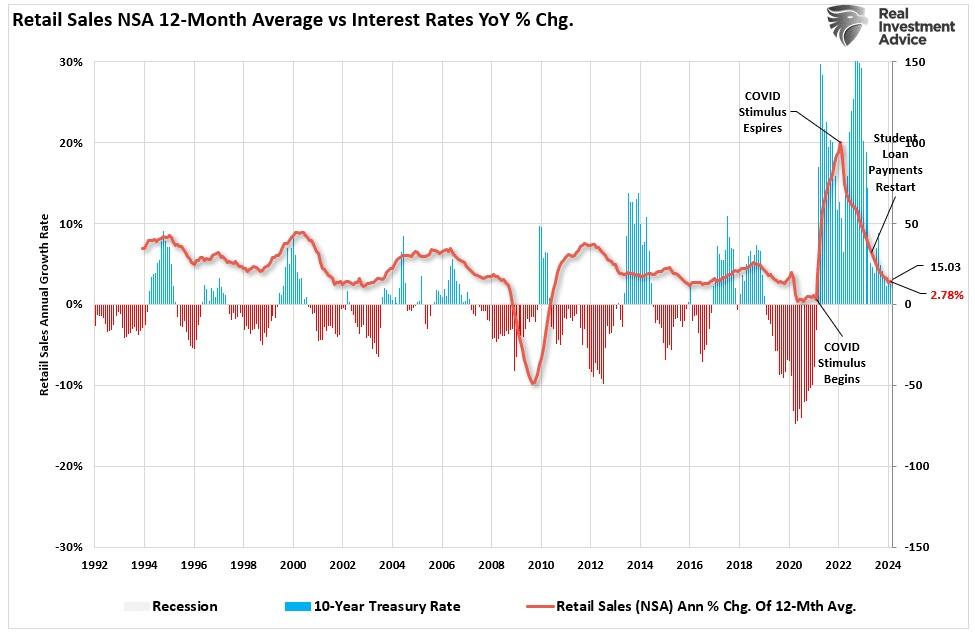
Our advice is to remain cautious about economic exuberance. Those forecasts are often disappointing.

Tyler Durden
Fri, 04/26/2024 – 11:05

UMich Inflation Expectations Accelerated In April To 2024 Highs

UMich Inflation Expectations Accelerated In April To 2024 Highs

Short-term inflation expectations rose… again… according to the latest UMich sentiment survey with 1-year expectations at 3.2% final, up from preliminary 3.1% for April, and 2.9% for March. This is the highest level since Nov 2023…

Source: Bloomberg

The headline sentiment also declined in April from three-year-highs. Consumers’ perceptions of their current financial situation and the economic outlook over the next year both slid to four-month lows. The current conditions gauge dropped to 79 from 82.5. A measure of expectations fell to 76 from 77.4.

Source: Bloomberg

While “consumers’ frustration over high prices in their day-to-day spending decisions grew this month, price concerns for large purchases – durable goods, vehicles, and homes – were all little changed from last month,’’ Joanne Hsu, director of the survey, said in a statement.

About 38% of consumers reported that high prices were weighing down their living standards, up from 33% who said so last month.

Sentiment gauges also provide insight into voters’ feelings about the economy and their finances leading up to the presidential election in November. President Joe Biden’s recent polling bump in key battleground states has mostly evaporated amid economic pessimism, the latest Bloomberg News/Morning Consult poll found.

“Consumers continue to express uncertainty about the future trajectory of the economy pending the outcomes of the upcoming election,” Hsu said.

Partisan differences in views of the economy remain pronounced. While Democrats and Independents saw little change in sentiment this month, sentiment for Republicans fell about 6 index points.

Republicans reported declines for four of the five components of the sentiment index, reflecting their deteriorating views across multiple facets of the economy. Despite these declines, sentiment for Republicans remains well above 2022 and 2023 levels.

In fact, the current reading for Republicans’ Expectations Index is the second highest (after last month) since the end of 2020, as the Trump presidency came to a close.

Tyler Durden
Fri, 04/26/2024 – 10:09

Why Are There So Many Americans That Can’t Find A Job Even Though They Are Desperate To Be Hired?

Why Are There So Many Americans That Can’t Find A Job Even Though They Are Desperate To Be Hired?

Authored by Michael Snyder via The Economic Collapse blog,

According to the absurd numbers that the government feeds us, the unemployment rate is very low and there are lots of jobs available.  But if what they are telling us is true, why are so many Americans not able to find work?  As you will see below, some people haven’t been hired even though they have literally applied for hundreds of jobs. 

There seems to be an enormous disconnect between what is actually happening in the real economy and the economic narrative that they are constantly pushing.  By the time you are done reading this article, I think that you will agree with me.

Earlier this week, I received an email from a reader that has not been able to find work after seven months of searching.

He gave me permission to share part of that email with you, and it is certainly quite heartbreaking…

Hi Michael,

I am a long-time reader of theeconomiccollapseblog.com, and your recent article comparing the economy to the movie “Weekend at Bernie’s” really stood out to me.

I’m really trying to figure out WHY it is so hard to find a job.

I was laid off from my job as a Custodial Foreman in September 2023, and have had ZERO results for my countless hours spent searching for comparable work.

I don’t know if you want to use any of this for an article or not, but if you do, please just keep doing what you normally do: Praising Jesus Christ. Without my faith in him I don’t know what I’d do.

When I wake up, I make coffee and turn on the computer and go through the state’s unemployment job search sites they provided me when I was laid off. I have been looking and also applying for jobs DAILY since September 2023. And these are not “rocket science” positions; I’m simply looking for Maintenance or Custodial or Groundskeeper type jobs. You know, “normal working class” type jobs.

But after ~300 applications (And these are all just to the jobs that I not only have experience for but also would actually want to do), I have had 1 interview. One interview in 7 months of applying and sending tailored cover letters with, daily!

If the economy is doing so “great”, why can’t he find employment?

Some of you may be tempted to think that he is just an isolated case.

Well, here is another example of an experienced worker that has applied for approximately 300 jobs without any success

Royal Siu, who lives in Seattle and is trained as a pharmacist, likes to make his friends guess how many jobs he’s applied to. They’ll often toss out some number around 40, he told BI. He’ll tell them to keep going. Most give up by the time they reach 100. That’s when Siu drops that he’s applied to about 300 jobs. “It’s usually a shock factor to them,” he said.

Siu, who’s trying to use his pharmacy degree to work in other parts of healthcare, is finding it harder to land interviews than in a prior job search. The 28-year-old was getting more phone screenings and first and second interviews in the past. This time, it’s been a couple of months since he had a screening call. So he continues to turn to his network but also doesn’t stop applying.

What in the world is going on here?

I thought that there were “millions” of good jobs just waiting for someone to step into them.

Something definitely does not add up.

Even Americans with advanced degrees from top schools are increasingly finding themselves out of work.

If you doubt this, just check out these numbers

Even at some top business schools, the number of recently minted M.B.A.s without jobs has roughly doubled from a couple of years ago, when U.S. companies were rushing to hire as many workers as they could, according to data from the schools.

At Harvard Business School, 20% of job-seeking 2023 M.B.A. graduates didn’t have one three months after graduation, up from 8% in 2021. At Stanford’s Graduate School of Business, 18% didn’t, compared with 9% in 2021. About 13% of those at the Massachusetts Institute of Technology’s Sloan School of Management didn’t have a job within three months, up from about 5% in 2021.

How are those numbers possible if the unemployment rate is hovering near “historic lows”?

Of course the truth is that we have been sold a lie.

If you do not have a job, you are classified by the U.S. government as either “unemployed” or “not in the labor force”.

In 2008 and 2009, the combined total of those two categories never even reached 90 million.

Today, the combined total of those two categories is over 106 million.

The Biden administration says that only 6,429,000 Americans are officially “unemployed”.

The other 99,989,000 Americans without a job are considered to be “not in the labor force”.

And more will be lumped into those two categories soon, because large employers all over the nation continue to conduct mass layoffs.

For example, thousands of Tesla workers in California and Texas were just notified that they will be losing their jobs

The notifications in California and Texas, where the electric vehicle (EV) maker has large presences, came in the form of WARN notices, according to reports.

In California, the planned Tesla headcount reductions will hit approximately 3,300 workers, The San Francisco Standard reported Tuesday.

They will apparently occur at locations in a total of four different cities in the Golden State.

Meanwhile, Texas will see almost 2,700 employees in Austin lose their jobs, according to the Austin American-Statesman.

Sadly, the pace of layoffs is likely to increase during the months ahead, because business activity in the U.S. is declining

The U.S. economy lost momentum in April, a pair of S&P surveys found, as businesses reported a decline in new orders and reduced employment for the first time since the pandemic.

The flash U.S. manufacturing purchasing managers index slipped to a four-month low of 49.9 in April from 51.9 in March.

The S&P flash U.S. services PMI fell to a five-month low of 50.9 this month from 51.7 in March.

The surveys are the first indicators of each month to give a sense of how the U.S. economy is performing.

Meanwhile, the cost of living crisis just continues to escalate.

Shockingly, at one station in California gasoline now costs $7.29 per gallon

Soaring gas prices have skyrocketed to a whopping $7.29 per gallon in some parts of California – which is above the current the national hourly minimum wage.

While the average price for a gallon of gas varies from state to state – drivers in a certain Silicon Valley town are facing particularly extortionate rates that set them back almost $150 for a full tank.

The Chevron gas station in Menlo Park was exposed on Sunday by a bewildered customer who posted on X that the price per gallon was four cents ‘above the federal hourly minimum wage.’

If you think that this is bad, just wait until the war in the Middle East transforms into the apocalyptic conflict that I believe it will become.

I am entirely convinced that inflation will continue to be a major problem even as economic activity in the U.S. slows down even more.

We are already experiencing “stagflation”.

What is eventually coming will be so much worse than that.

Of course the economic pain that we are going through is just one of the factors that is systematically destroying our nation.

Just about all of our major institutions are crumbling, just about every sector of our society is in the process of melting down, and conditions are rapidly getting worse all around us.

And now we are heading into the most chaotic election season in the entire history of our country.

This is a recipe for disaster, but there is no turning back now.

*  *  *

Michael’s new book entitled “Chaos” is available in paperback and for the Kindle on Amazon.com, and you can check out his new Substack newsletter right here.

Tyler Durden
Fri, 04/26/2024 – 09:50

Anglo American Rejects BHP’s Takeover Deal, Calls It “Highly Unattractive” 

Anglo American Rejects BHP’s Takeover Deal, Calls It “Highly Unattractive” 

The world’s largest global diversified miner, BHP, is being forced to significantly raise its buyout offer of Anglo American or walk away from the proposed all-share deal valued at £31.1 billion ($38.9 billion). 

“The BHP proposal is opportunistic and fails to value Anglo American’s prospects, while significantly diluting the relative value upside participation of Anglo American’s shareholders relative to BHP’s shareholders,” Anglo chairman Stuart Chambers wrote in a statement on Friday. 

Chambers continued, “The proposed structure is also highly unattractive, creating substantial uncertainty and execution risk borne almost entirely by Anglo American, its shareholders and its other stakeholders.”

The first indication that Anglo executives would reject the deal came Thursday afternoon when Reuters reported two sources familiar with talks with top Anglo investors who said the offer was ‘unattractive.’ 

Anglo owns massive copper mines in South America. The miner has become an acquisition target of BHP solely to create the world’s largest copper mining giant, with control of about 10% of the global copper mining supply. Copper mining supplies are dwindling, and demand is expected to soar as power grids worldwide are upgraded to support the green energy transition. 

The Financial Review quoted hedge fund manager Rafi Lamm of Melbourne’s L1 Capital as saying BHP would have to increase its bid for Anglo’s assets, which have been underappreciated by the market and make strategic sense for BHP. 

“We think it’s a sensible move by BHP and we think they can afford to pay the proposed deal pricing and a lot more,” Lamm said. 

James Whiteside, head of mining and metals corporate research at consultancy Wood Mackenzie, said BHP will have to raise its offer to bring its value “closer to the share price in 2023 before operational issues emerged.” 

On Thursday, BHP proposed an all-share deal valued at £31.1 billion ($38.9 billion). The transaction depends on Anglo spinning off its South African iron ore and platinum businesses to its shareholders. The offer is conditional and non-binding at £25.08 a share, or about a 14% premium to Anglo’s closing share price on Wednesday.

BHP investor Equity Trustees Asset Management told the Sydney Morning Herald that BHP’s bid to buy Anglo American made sense strategically, “but much will depend on what BHP will eventually pay.” 

“Having a bit more copper in the portfolio is a positive. If copper can move up from here this will likely offset any errors made in its purchase price of Anglo,” Equity Trustees head of equities Chris Haynes said.

Haynes added, “As we know, large acquisitions like this always have problems and will likely weigh on the BHP stock price in the short term.”

Shares in BHP fell on Friday, ending the Australian session at 4.6% lower.

Meanwhile, copper prices hit $10,000 a ton for the first time in two years, fueled by speculation of dwindling supplies and robust demand from the green energy transition. 

Copper bulls like BlackRock and Trafigura Group have said the base metal must move higher to spur new mine development. 

BofA recently warned, “The copper supply crisis is here.” 

Let’s not forget our note titled “The Next AI Trade,” which explains the investment opportunities in upgrading America’s grid as generative AI data centers increase power demand. 

And Jefferies is on it: “Copper Demand in Data Centers.” 

Recall billionaire mining investor Robert Friedland, who explained last year on Bloomberg TV that “copper prices might explode ten times.” 

Tyler Durden
Fri, 04/26/2024 – 09:35

Watch: Drag Queen Makes Tiny Kids Chant “Free Palestine”

Watch: Drag Queen Makes Tiny Kids Chant “Free Palestine”

Authored by Steve Watson via Modernity.news,

Video has emerged of a drag queen leading children barely older than toddler age in chanting “Free Palestine” during a so called “Queer Storytime for Palestine” event in Massachusetts.

The event, featuring a drag queen going by the name of ‘Lil Miss Hot Mess’, took place earlier this month at the Northampton Center for the Arts.

The event was advertised by the organisers as “dancing, celebrating Palestine culture, learning about queer heroes and doing arts and crafts.”

According to the hosts, Valley Families for Palestine, profits from the event were donated to alQaws, a Palestinian organisation that is “working for queer liberation.”

Video captured at the event shows ‘Hot Mess’ reading her book titled “If You’re a Drag Queen and You Know It,” and ordering the kids “If you’re a drag queen and you know it shout ‘Free Palestine.’”

First off, gay people are at best severely disrespected, and at worst murdered in Gaza and other Palestinian areas. In terms of how gay-friendly it is, The LGBT Equality Index ranks Palestine as 192 out of 197 countries. Syria, Somalia and Yemen are ranked as more open to homosexuality.

It’s safe to say that a drag queen encouraging American kindergarteners to say ‘free Palestine’ is not really going to shift the needle as far as that situation is concerned.

Secondly, these children are clearly being subjected to a double dose of ideological and political indoctrination.

What’s next? Queer Palestine vaccine furry Ukraine drag queen story time?

Who in their right minds are taking their kids to this kind of thing? What do they expect will come of it?

*  *  *

Your support is crucial in helping us defeat mass censorship. Please consider donating via Locals or check out our unique merch. Follow us on X @ModernityNews.

Tyler Durden
Fri, 04/26/2024 – 09:15

Ukrainian Drone Strikes Target Russian Oil Refineries Again Despite White House Pleas

Ukrainian Drone Strikes Target Russian Oil Refineries Again Despite White House Pleas

Just days after the Biden administration signed a new military aid package worth billions of dollars to Ukraine, Kyiv launched a series of suicide drone attacks on Russian oil refineries. Biden’s top officials have pleaded with Kyiv to stop attacks on Russia’s energy infrastructure because of the fears that turmoil in crude markets would send pump prices in the US higher ahead of the presidential elections in November. 

“Our region is again under attack by Ukrainian UAVs,” Smolensk Governor Vasily Anokhin wrote in a post on Telegram on Wednesday. Kamikaze drones damaged oil facilities in western Russia. 

Another drone attack hit the Lipetsk region further south, which is home to steel production plants and pharmaceutical sites, Governor Igor Artamonov said.

“The Kyiv criminal regime tried to hit infrastructure in Lipetsk industrial zone,” Artamonov said. 

The Moscow Times pointed out:

A source in the Ukrainian defense sector confirmed to AFP on Wednesday that drones in the service of the Security Service of Ukraine (SBU) had carried out the attacks.

The source made no mention of the attack on Lipetsk but claimed two oil depots were destroyed in the Smolensk region.

“Rosneft lost two storage and pumping bases for fuels and lubricants in the towns of Yartsevo and Rozdorovo,” the source said, referring to the Russian state-controlled energy giant.

The Financial Times, citing unnamed US officials, recently said long-range drones have hit at least 20 energy facilities deep within Russia so far this year. Kyiv’s drone attacks on Russia’s energy complex have been frightening for the Biden administration, as Brent prices have risen to the $90/bbl level on higher war risk premiums. Higher energy costs feed into inflation as stagflation concerns mount in the US. Also, gasoline pump prices in the US are inching closer to the politically sensitive $4 level. 

According to AAA data, the average cost of gas at the pump across the US was $3.66 as of Thursday, up from $3.10 in mid-January. 

“The recent uptick in US consumer price inflation, driven by services, housing and fuel, is already of concern to the Biden administration, which is hoping to secure a second term in the November election,” Markus Korhonen, senior associate at geopolitical risk consultancy S-RM, told Newsweek.

In recent weeks, Brent prices jumped to the $90bbl to $92bbl range on a higher war risk premium as Israel and Iran volleyed missiles and drones at each other. Prices sank to as low as the $85bbl handle as the market saw the Middle East conflict was just theatrics. However, prices have increased from $85bbl earlier this week, to $89.50 on Friday morning – perhaps on new fears of tighter Russia supplies. 

The latest Bloomberg data shows Russian seaborne crude exports hit a multi-month high in the four weeks to April 21. Refineries in the country have struggled to be repaired from the series of drone attacks as oil processing sinks to lows last seen in May 2023 when floods forced the Orsk refinery offline. 

So far, Ukraine has only attacked oil-processing facilities deep within Russia, avoiding crude and crude product export ports. 

“Should Ukraine begin also targeting crude oil facilities, this could threaten Russia’s overall production and exports and, more meaningfully, global oil prices would tick up, driving up inflation and cost-of-living pressures in the US and elsewhere,” said Korhonen, adding, “It would also raise the prospects of Russia retaliating, for example, targeting energy infrastructure that the West relies on.”

The ultimate goal of Ukraine’s drone attacks is to reduce Moscow’s oil revenues that finance the war. This means that Russia’s crude export ports will be targeted at some point. And we’re 100% sure the Biden administration is terrified about this ahead of the elections. 

If that happens, “it would not only bring up the price of oil, it would put a lot of pressure on inflation because of the impact on prices,” said O’Donnell.

The question becomes when does Kyiv begin hitting Russia’s crude export terminals. 

Tyler Durden
Fri, 04/26/2024 – 08:55

UK Defense Chief Says Ukraine To Increase Long-Range Strikes In Russia

UK Defense Chief Says Ukraine To Increase Long-Range Strikes In Russia

Just as President Biden was signing into effect the newly approved foreign defense package which includes $60 billion for Ukraine, the United Kingdom also rolled out its own massive aid package (though paling in comparison), first unveiled Tuesday.

Britain announced its single largest aid package for Ukraine yet, at the equivalent of $620 million (£500 million). According to UK NATO officials, the arms include Storm Shadow missiles among a total of 1,600 strike and air defense missiles, four million rounds of ammo, 60 boats, and over 400 vehicles.

Even though the White House is busy cautioning that in the coming months Russia is likely to make more gains on the front lines, according to fresh words of Jake Sullivan, British leadership is still talking about “winning”.

Head of the UK military, Admiral Sir Tony Radakin, Via The Telegram

Defense Minister Grant Shapps, for example, had this to say about new aid: “This record package of military aid will give President Zelensky and his brave nation more of the kit they need to kick Putin out and restore peace and stability in Europe.”

“The UK was the first to provide NLAW missiles, the first to give modern tanks, and the first to send long-range missiles,” he added. “Now, we are going even further. We will never let the world forget the existential battle Ukraine is fighting, and with our enduring support, they will win.”

Britain’s military leadership is also echoing this optimism, with UK defense chief, Admiral Sir Tony Radakin, telling Financial Times that the West’s new infusion of military aid will help Ukraine increase its long-range strikes on Russian territory:

Ukraine is set to increase long-range attacks inside Russia as an influx of western military aid aims to help Kyiv shape the war “in much stronger ways”, the head of the UK military has said.

Admiral Sir Tony Radakin acknowledged the downbeat mood surrounding Ukraine’s defence in an interview with the Financial Times, admitting the country was facing a “difficult” fight to repel advancing Russian forces.

But Britain’s chief of defence, a key figure in the west’s military support for Kyiv, stressed that such a gloomy “snapshot” of the war failed to recognise longer trends more in Kyiv’s favour.

Adm. Radakin continued, “As Ukraine gains more capabilities for the long-range fight . . . its ability to continue deep operations will [increasingly] become a feature” of the war. He emphasized of new weapons systems, “they definitely have an effect.”

UK leadership has of late put the country’s defense industry on a “war footing” in preparation to support Kiev for the long haul. More of Radakin’s words point to escalation (and not negotiations) in the following…

“Don’t expect anyone to say publicly ‘this is the plan’ and A, B and C are now going to happen,” he told FT. Some aspect of Ukraine’s strategy and operations “will be hidden . . . some will be dictated by a tactical or operational advantage, and some also depends on more foundational aspects,” he added.

Nowhere in the UK defense chief’s interview was acknowledgement that these policies could lead to runaway escalation, and an eventual direct confrontation between nuclear-armed powers. The Kremlin has in response vowed that it will take more territory in Ukraine in order to counteract the longer range of NATO missiles.

Tyler Durden
Fri, 04/26/2024 – 06:55

Polish President Admits That Major Infrastructure Project Has Dual Military Purposes

Polish President Admits That Major Infrastructure Project Has Dual Military Purposes

Authored by Andrew Korybko via Substack,

Polish President Andrzej Duda revealed in an interview that the Central Communication Port (CPK by its Polish abbreviation) transportation megaproject outside of Warsaw has dual military purposes.

He represents Poland’s prior conservative-nationalist government but remains in office despite the liberal-globalist opposition’s victory at the polls last fall since his term doesn’t expire till next year.

Duda’s latest claim makes Prime Minister Donald Tusk’s decision to pause and audit the CPK even more scandalous.

It was analyzed here at the time that he was economically subordinating Poland to Germany after having already done so on the political and military fronts, which lent credence to conservative-nationalist chieftain Jaroslaw Kaczynski’s warning late last year that Tusk is actually a “German agent”. Tusk then subordinated his country to its neighbor on the educational, judicial, and diplomatic fronts, all of which is being done on the pretext of implementing various “reforms”.

The end result is that Poland now plays an indispensable role in Germany’s “Fortress Europe” that was elaborated upon here, but Duda’s unexpected revelation about the CPK’s dual military purpose might reverse some of the tempo by putting grassroots and external pressure on Tusk to approve the CPK. Most Poles are in favor of this transport megaproject according to the latest polls that Duda’s interlocutor cited, while the US has an interest in using Poland as an anti-Russian military launchpad.

Here’s exactly what Duda said according to Google Translate:

“It is no secret to anyone, and I emphasize this: If a situation of potential danger for Poland were to occur, and the relocation of additional allied forces to Poland would be necessary to defend our territory, we do not currently have an airport that would be able to provide such support for the West to quickly come to Poland.”

This reminder is meant to imply that Tusk is harming NATO’s contingency plans for partisan reasons.

It’s also a dog whistle harkening back to what the former conservative-nationalist government’s Defense Minister claimed about his liberal-globalist predecessors regarding Tusk’s defensive plans during his prior two terms in office. Mariusz Blaszczak alleged that Tusk’s government planned to withdraw west of the Vistula River in the political fantasy that Russia invaded Poland until NATO reinforcements arrived and claimed to have the classified documents to prove it too.

Tusk’s previous time in power was marked by the arguably German-advised Russian-Polish rapprochement that was meant to create a “Europe from Lisbon to Vladivostok” during the halcyon era of Russian-EU relations. Those hopes were obviously dashed as everyone now knows, after which Tusk’s conservative-nationalist successors never wasted an opportunity to speculate that his pragmatic policy at the time was due to secret Russian influence over his government.

Blaszczak’s allegation should be seen in that light just like Duda’s reminder should too. Their conservative-nationalist movement sought to exploit political Russophobia in Polish society ahead of the elections to remain in power, but even though that didn’t work, they haven’t learned their lesson and are now trying to employ it yet again in their attempt to return to power one day. That said, it’s indeed important for Poles to be aware of both facts, after which they can make up their own mind.

Revealing allegedly classified details about outdated Polish national defense policy is one thing, while raising awareness of how possibly canceling the country’s largest megaproject in recent memory could impact national security in theoretical contingencies (not to mention killing lots of jobs) is another.

The first disclosure didn’t succeed in reshaping popular perceptions of the liberal-globalists whereas the second stands a greater chance of success of doing so even though it’s too early to conclude that it will.  

Another point to pay attention to is that this isn’t the first time that Duda dropped a bombshell about a significant issue. Earlier in April, he told Lithuanian media that foreign companies own most of Ukraine’s industrial agriculture, thus confirming what had previously been reported but denied by the West. He therefore has a habit of being very candid about issues that he sincerely believes are of immense importance for Poland’s objective national interests.

Regardless of whatever the reader’s opinion might be about the likelihood of Duda’s scenario unfolding, which concerns Poland relying on the CPK to serve as the port of entry for a large-scale NATO intervention in the event of a Russian invasion, his point about that megaproject is militarily and strategically sound. It’ll be very difficult for Tusk to argue against it after he himself jumped on the Russia-bashing bandwagon since returning to power and continues fearmongering about its intentions.

He even jumped the shark last month by sensationally claiming that “we are in a pre-war era” that he compared to the run-up to World War II, thus suggesting whether sincerely or not that he supposedly believes that it’s possible for Russia to invade Poland in the coming future. If he ultimately decides to cancel the CPK despite Duda reminding him of its dual military purposes, then he’d discredit his previous fearmongering about Russia, which is the pretext for justifying Poland’s subordination to Germany.

Tusk’s hands might be tied, however, since the combination of grassroots and external (US/NATO) pressure might be enough to get him to reconsider weaponizing the CPK as part of his partisan war against his conservative-nationalist opponents under whom this megaproject was initiated. In any case, Duda inadvertently vindicated those Russian observers who long suspected that the CPK had dual military purposes, thus proving that they were right about Poland’s real plans all along.

Tyler Durden
Fri, 04/26/2024 – 06:30

Chipotle Tells Workers To “Preserve” Chicken Supply As Demand Soars

Chipotle Tells Workers To “Preserve” Chicken Supply As Demand Soars

A surge in restaurant traffic boosted Chipotle Mexican Grill’s first-quarter earnings and revenue, topping the average estimate of Wall Street analysts tracked by Bloomberg on Wednesday.

Shares are higher by more than 5% in the cash session on Thursday. However, this note will not expand on earnings. Instead, we will focus on a letter from the company to employees stating: Stop eating chicken during lunch and dinner meals because soaring demand has collided with dwindling poultry supply—and the need to preserve supply urgently. 

Bloomberg obtained the letter Chief Restaurant Officer Scott Boatwright sent employees last week. He told them:

“Due to its sustained strong sales we need your help to keep up with our guests’ demand for this popular protein option.” 

Boatwright told store managers and hot-side and cold-side kitchen employees not to order chicken or chicken al pastor with their free or discounted employee meals. Even white-collar Chipotle workers were told not to order chicken. 

The message read, “Let’s Conserve Our Fan-Favorite Chicken.” Execs did not give a timeline for boosting the chicken supply. The letter aimed to “preserve our supply of Adobo Chicken for our guests.” 

Chief Corporate Affairs and Food Safety Officer Laurie Schalow told Bloomberg in an emailed statement:

“Due to the high demand for chicken in our restaurants and sustained success of our limited-time offer chicken al pastor, we temporarily asked all of our employees at corporate and in-restaurants to select another protein option for their meals to preserve our supply.” 

The Chipotle mobile app shows no disruptions to any protein option on the menu. 

Harper McNamara, an employee in Michigan at the only unionized Chipotle US store, was quoted by Bloomberg as saying the company’s move was a slap in the face to its workforce: “It’s disrespectful, just on a personal level.” 

Tyler Durden
Fri, 04/26/2024 – 05:45

EU Prepares To Tighten Screws On Russian LNG Imports

EU Prepares To Tighten Screws On Russian LNG Imports

By Julianne Geiger of OilPrice.com

In a move that could reshape Europe’s energy landscape, the European Commission is poised to propose new sanctions targeting Russian liquefied natural gas (LNG) imports.

According to Reuters sources close to the matter, the proposed measures will include a ban on shipments within the EU and sanctions on three Russian LNG projects.

The European Commission’s decision comes amid growing concerns over Europe’s reliance on Russian energy, particularly in the wake of the ongoing conflict in Ukraine. While the EU imposed a ban on Russian seaborne oil imports earlier this year, it has thus far refrained from taking similar action against LNG imports. However, with imports of Russian LNG surging since the start of the war, accounting for around 15% of EU gas supply, pressure has been mounting on Brussels to act.

The proposed ban on trans-shipments within the EU is aimed at preventing the diversion of Russian LNG cargoes to other destinations. Currently, Belgium, France, and Spain are the largest importers of Russian LNG, with many of these imports being re-exported to other countries, including China. By imposing restrictions on trans-shipments, the EU hopes to ensure that Russian LNG does not find its way to markets outside of Europe.

In addition to the ban on trans-shipments, the European Commission is also considering sanctions on three Russian LNG projects – Arctic LNG 2, Ust Luga, and Murmansk. While the details of these sanctions are still being discussed, they are expected to target projects that are not yet operational, further complicating Russia’s efforts to expand its LNG exports.

The move by the European Commission reflects growing unease within the EU over its dependence on Russian energy. With tensions between Russia and the West showing no signs of abating, European policymakers are increasingly looking for ways to reduce Europe’s exposure to Russian energy supplies. By targeting Russian LNG imports, the EU hopes to send a clear message to Moscow that its actions in Ukraine will not go unpunished.

However, the proposed sanctions are likely to face resistance from some EU member states, particularly those that are heavily reliant on Russian energy. Nevertheless, with pressure mounting on Brussels to take action, it seems increasingly likely that Europe’s energy landscape could be in for a significant shake-up in the coming months.

Tyler Durden
Fri, 04/26/2024 – 05:00
