The government of US President Joe Biden has decided against imposing sanctions on Israeli army units responsible for human rights violations against Palestinians, despite initial plans to do so.
ABC News reported on Friday that a government assessment determined that three battalions in the Israeli army committed “gross human rights violations” against Palestinians in the occupied West Bank “but will remain eligible for US military aid regardless because of steps Israel says it’s taking to address the problem.”
The assessment, which has not been made public, was outlined in a letter written by US Secretary of State Anthony Blinken to House Speaker Mike Johnson, which the news network obtained.
The rights violations committed by Israeli forces “will not delay the delivery of any US assistance and Israel will be able to receive the full amount appropriated by Congress.” Billions in US aid to Israel was approved by Biden just two days ago after passing in the Senate on Tuesday.
The violations in question were committed prior to October 7 and took place in the occupied West Bank. They include the execution of Palestinians by Israeli border police, as well as torture and rape during interrogation.
None are related to Israel’s ongoing war in Gaza, which has killed tens of thousands of Palestinians, the majority of whom were women and children.
Yet the decision is expected to frustrate many critics of the Biden administration who believe Washington has not done enough to hold Israel accountable for war crimes. Under the US Leahy Law, Washington should withhold military aid to states committing severe human rights abuses. Yet the law allows exceptions if measures are taken to punish those responsible.
An informed source told ABC that Israel and the US have a “special agreement” that Washington must consult with Tel Aviv over any decision relating to foreign assistance. The source added that these consultations are ongoing.
Blinken’s letter states that four of the Israeli army units have undergone “remediation” steps, meaning that those within the units that are responsible for the crimes have been internally held accountable.
Israeli Prime Minister Benjamin Netanyahu said on April 21: “If anyone thinks they can impose sanctions on a unit of the IDF, I will fight it with all my strength.”
According to Hebrew news site Ynet, Israeli pressure on the US helped shape the decision not to impose sanctions on the units. “The reasonable estimate is that we will be able to convince the US not to impose these sanctions,” an Israeli official told the outlet.
In addition to Netanyahu, opposition leaders Benny Gantz and Yair Lapid both called on the US not to proceed with the decision. Israeli Defense Minister Yoav Gallant reportedly promised Blinken that “steps” would be taken.
How we got here: IMPUNITY. U.S. cancels sanctions against IDF units suspected of blatant war crimes. Because Israel pledged to do its own investigation. History show these “investigations” go nowhere except to find excuses; exonerate suspects.https://t.co/HfwJGcOwCj
A special State Department panel proposed months ago to bar certain Israeli police and army units from receiving US funds over human rights abuses. A ProPublica report from last week indicates that Blinken disregarded the panel’s recommendations for action against the units.
The Guardian reported in January, citing interviews and State Department documents, that “special mechanisms have been used over the last few years to shield Israel from US human rights laws.”
Micro Trumps Macro As Stocks Shrug Off Week Of Higher Inflation, Higher Rates, & Lower Growth
It was an ugly macro week…
Source: Bloomberg
…and worse still, ‘growth’ surprises disappointed significantly while ‘inflation’ surprises surprised to the upside significantly…
Source: Bloomberg
Soaring inflation expectations sent rate-cut expectations to new cycle lows…
Source: Bloomberg
…pushing yields higher across the board (led by the long-end)…
Source: Bloomberg
But, stocks didn’t care about any of that because a handful of mega-cap tech stocks’ earnings were awesome (except META) – and that’s what matters (for now)…
Source: Bloomberg
Nasdaq outperformed, up 4% on the week (its best week since the start of Nov 2023). The Dow was the laggard on the week but all the majors had a decent week…
This week saw the biggest short-squeeze since the first week of March…
Source: Bloomberg
And the basket of Magnificent 7 stocks soared over 5% this week, its best week since the first week of November (Fed Pivot) – but it was noisy as TSLA surged, META tumbled, and then GOOGL/MSFT lifted the lid…
Source: Bloomberg
Tech and Discretionary outperformed on the week with Energy and Materials lagging (but all sectors ended the week green)…
Source: Bloomberg
5.00% remains the Maginot Line for the 2Y Yield…
Source: Bloomberg
Interestingly, the dollar ended the week practically unchanged – despite a lot of noise…
Source: Bloomberg
…despite the seventh straight week of declines in the yen vs the dollar as it appears the BoJ and MoF have given up…
Source: Bloomberg
Gold was dumped this week – its worst week since the start of December 2023. Spot prices did find support at $2300 though…
Source: Bloomberg
After two down weeks, oil prices rallied this week, with WTI back above $83…
Source: Bloomberg
Finally, intraday volatility has picked up dramatically in the last couple of weeks…
Former President Donald Trump praised the first witness in his New York City “hush money” trial, former National Enquirer publisher David Pecker, as he is scheduled to deliver more testimony in the case on Friday.
“He’s been very nice. David’s been very nice. He’s a nice guy,” President Trump said on Thursday, responding to a question about Mr. Pecker’s testimony over the past week or so.
During cross-examinations Thursday, Mr. Pecker detailed how he obtained potentially damaging stories about the candidate and paid out tens of thousands of dollars to keep them from the public eye.
But when it came to the seamy claims by adult performer Stormy Daniels, whose real name is Stephanie Clifford, the former National Enquirer publisher said he put his foot down.
“I am not paying for this story,” he told jurors Thursday at President Trump’s trial, recounting his version of a conversation with President Trump’s former lawyer Michael Cohen about attempts to suppress allegations that prosecutors claim amounted to election interference in the 2016 campaign. Mr. Pecker said that he remembers saying he “didn’t want to be involved in this.”
President Trump has maintained he is not guilty of any of the charges, and says the stories that were bought and squelched were false.
“There is no case here. This is just a political witch hunt,” he said before court in brief comments to reporters on Thursday.
Ms. Daniels was eventually paid by Mr. Cohen to not speak about her claim of a 2006 sexual encounter with President Trump. The ex-president denies it happened, while his lawyers have said that she is using the claims to make money and bolster her fame.
Although he did not buy her story, Mr. Pecker told Mr. Cohen that someone should make a move to suppress the claims from going public.
“I said to Michael, ‘My suggestion to you is that you should buy the story, and you should take it off the market because if you don’t and it gets out, I believe the boss will be very angry with you,’” he said.
Later, Trump defense attorney Emil Bove opened his cross-examination by asking Mr. Pecker about his recollection of specific dates and meanings. He appeared to be laying further groundwork for the defense’s argument that any dealings President Trump had with the National Enquirer publisher were intended to protect himself, his reputation, and his family, not his campaign.
At one point on Thursday, Mr. Pecker said that when he spoke to President Trump about the former president reimbursing Mr. Cohen for paying Ms. Clifford, the former president told him that he had no idea what Mr. Pecker was referring to. He specifically testified that the former president “had no idea what [he] was talking about” when he asked about reimbursing Mr. Cohen.
He also said that he purchased the rights to former model Karen McDougal’s story as well but he stipulated that President Trump never told him to purchase that story—only that he and Mr. Cohen were concerned about the McDougal story from emerging.
Former Trump attorney Michael Cohen arrives at the district attorney’s office to complete his testimony before a grand jury in New York City on March 15, 2023. (Yuki Iwamura/AFP via Getty Images)
A conviction by the jury would not preclude President Trump from becoming president again, but because it is a state case, he would not be able to pardon himself if found guilty. The charge is punishable by up to four years in prison, although it’s not clear if the judge would seek to put him behind bars.
For the charges to be a felony, prosecutors have to prove their allegations that President Trump falsified business records in the furtherance of another crime. They have argued that the alleged falsification efforts were tantamount to election interference.
But the former president and his lawyers have said that they were simple legal expenses. They have also cast the credibility of Mr. Cohen into doubt, noting that he spent time in prison on fraud and other charges, and have noted that he has currently made a career out of criticizing President Trump in the media and on social media.
Mr. Cohen on Thursday wrote on X, formerly known as Twitter, that he would stop commenting on the Trump trial.
“Despite not being the gagged defendant … I will cease posting anything about Donald on my X account or on the Mea Culpa Podcast until after my trial testimony. See you all in a month (or more),” he wrote.
On Friday morning, President Trump did not speak to the media before he entered the courtroom. However, he wrote a Truth Social post at around 9:20 a.m. criticizing the level of security at the Manhattan court.
“I’m at the heavily guarded Courthouse. Security is that of Fort Knox, all so that MAGA will not be able to attend this trial, presided over by a highly conflicted pawn of the Democrat Party. It is a sight to behold! Getting ready to do my Courthouse presser. Two minutes!” he wrote.
Earlier this week, he called on his supporters to peacefully protest the trial against him.
Blinken Threatens China Over Russia Ties, Warns Xi Against “Downward Spiral” In Relations With US
On Friday Secretary of State Antony Blinken met with Chinese President Xi Jinping in Beijing, which brought to a close the US top diplomat’s three day visit to China.
Blinken warned the Chinese leader of another potential “downward spiral” in relations and the two sides agreed this should be avoided, however, there were plenty of not so subtle barbs, warnings and threats exchanged.
President Xi in comments underscored that Beijing and Washington “should be partners rather than adversaries” – a familiar theme of top Chinese officials of late. “The world is big enough to accommodate the simultaneous development and prosperity of both China and the United States,” he said according to a Chinese Foreign Ministry readout.
But he added the caveat that US-China relations will only stabilize once the US takes “a positive and constructive view of China’s development.”
“I proposed three major principles: mutual respect, peaceful coexistence, and win-win cooperation. They are not only a summary of past experience, but also a guide to the future,” the Chinese leader was quoted as saying.
Blinken responded in a statement to reporters by emphasizing “We want China’s economy to grow” but it remains that “the way China grows matters.”
“That means fostering a healthy economic relationship where American workers and firms are treated equally and fairly,” he continued, highlighting the Biden admin talking point of China’s unfair trade practices and the potential for certain US sectors being overrun with Chinese products.
During this second trip to China in less than a year by Blinken, the Secretary of State also called out China related to Russia’s war in Ukraine.
“Russia would struggle to sustain its assault on Ukraine without China’s support,” Blinken claimed provocatively, while also asserting China is the “top supplier” of Russia’s defense industrial base – albeit not in terms of lethal aid (but instead “dual use” technologies).
Blinken threatened punitive against on China if it continues to give support to Russia amid the Ukraine onslaught…
🇺🇸 Footage of Blinken threatening action against China if it continues to support Russia. pic.twitter.com/spt9AxMHFb
— S p r i n t e r F a c t o r y (@Sprinterfactory) April 26, 2024
This alleged support to Russia’s defense industry additionally constitutes a “medium to long-term threat that many Europeans feel viscerally that Russia poses to them,” Blinken continued.
He warned that the Biden administration is ready to introduce more sanctions against China if dual-use goods and technologies continue to be sent to Russia, including things previously listed such as: semiconductors, machine tools, chemical precursors, ball bearings, and optical systems.
As expected, China’s foreign ministry hit back at the commentary and accusations, saying Blinken is “unreasonably criticizing the normal trade and economic relations between Russia and China” – at a moment it’s pouring billions into one side of the war: Ukraine… while refusing to press for peace negotiations. “This is a very hypocritical and irresponsible approach,” Chinese Foreign Ministry spokesman Wang Wenbing told reporters later in the day Friday.
Biden Admin Abandons Plan To Ban Menthol Cigarettes To Avoid ‘Angering Black Voters’
The so-called ‘party of science’ has decided to abandon its plan to save millions of lives (of mostly African American youth) by choosing not to ban Menthol cigarettes after all…
In October 2023, the FDA said it was looking to ban menthol cigarettes and flavored cigars due to concerns these tobacco products are harming American youth.
“The U.S. Food and Drug Administration (FDA) is looking to ban menthol cigarettes and flavored cigars due to concerns these tobacco products are harming American youth.
The agency estimated there were 18.5 million menthol cigarette smokers aged 12 and above in the United States in 2018, with “particularly high rates of use by youth, young adults, and African Americans and other racial and ethnic groups.”
Them in December 2023, after what some called a ‘blacklash’, White House officials were reportedly taking more time to review their sweeping ban plan, despite the science’s awful warnings:
“The federal agency estimates a ban on the flavor additive could prevent 300,000 to 650,000 smoking deaths over several decades.
They claim most of the preventable deaths would be among minority groups and Americans of African descent, who disproportionately smoke menthol cigarettes.”
And now, April 2024 (around six months before the election and with Biden’s poll numbers in the proverbial toilet), The Wall Street Journal reports that the Biden administration is reversing course on its plan to ban menthol cigarettes, after the White House weighed the potential public-health benefits of banning minty smokes against the political risk of angering Black voters in an election year.
Some Black community leaders had fought the measure, saying a ban would expand the illicit market for cigarettes and lead police to racially profile Black smokers.
The American Civil Liberties Union and some members of the Congressional Black Caucus expressed similar concerns.
The administration is expected to announce its decision as soon as Friday afternoon, according to people familiar with the matter.
So, to sum up: The White House is willing to ignore the potential (science-driven data) death of 650,000 mostly African American voters to improve its chances in November?
Port Of Baltimore Partially Reopens, Allowing Trapped Cargo Ships To Exit
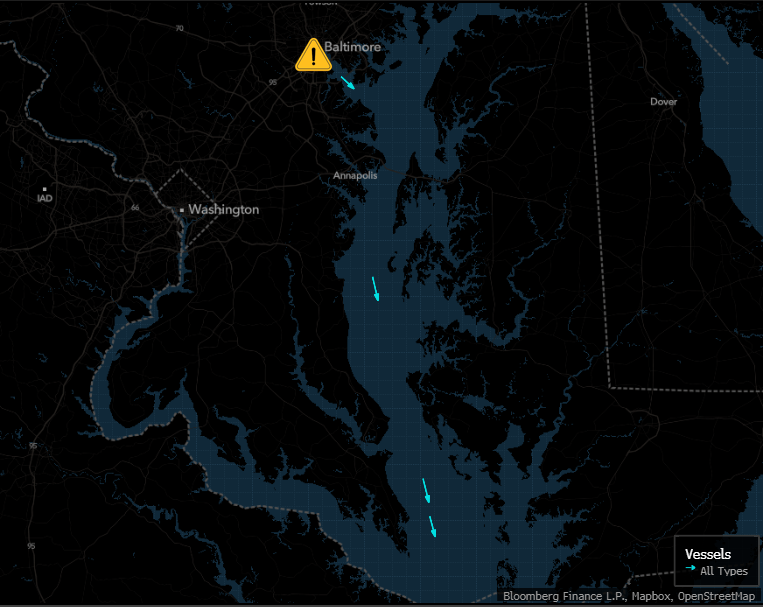
Officials at the Port of Baltimore opened a fourth, 35-foot deep, temporary channel through the collapsed Francis Scott Key Bridge, allowing cargo ships trapped at the port to exit.
According to Bloomberg‘s ship tracking data, four of seven ships trapped at the port navigated the new temporary channel and are sailing down the Chesapeake Bay.
On Thursday, the Balsa 94, a bulk carrier sailing under a Panama flag, transited the temporary channel for Saint John, Canada. Three other ships, including the Saimaagracht cargo vessel, the Carmen vehicle carrier, and the Phatra Naree bulk carrier, were also able to exit.
The general cargo ship Balsa 94 becomes the first ship to use the @portofbalt‘s 35-foot-deep Limited Access Channel promised by the @USACEHQ by the end of April. The ship had been stuck in the harbor since the March 26 collapse of the Key Bridge.
The new 35-foot depth channel is a massive increase compared to smaller channels opened several weeks after the Dali container ship slammed into the bridge one month ago, toppling the bridge and paralyzing the port.
“While this is a significant achievement, we have a long way to go, and Unified Command is committed to fully opening the channel by the end of May,” US Coast Guard Cmdr. Baxter Smoak told reporters.
Next week, salvage crews expect to refloat Dali, which will then be pushed back to port by tugboats for inspection. Once Dali and all debris are removed, the main shipping channel could reopen next month.
However, Ben Schafer, an engineering professor at Johns Hopkins University, told AP News that a new bridge could take five to seven years to be rebuilt.
“The lead time on air conditioning equipment right now for a home renovation is like 16 months, right?” Schafer said.
He continued: “So it’s like you’re telling me they’re going to build a whole bridge in two years? I want it to be true, but I think empirically it doesn’t feel right to me.”
Let’s remember that the bridge was critical for the port and a critical feeder to the Interstate 95 highway network up and down the mid-Atlantic area. Local supply chain snarls will persist for years.
Conservative states across the country—Florida, Iowa, Louisiana, Tennessee, Georgia, and Oklahoma—are taking border security matters into their own hands, proposing or passing legislation targeting illegal immigration.
The Oklahoma legislature just passed a bill designed to prohibit illegal immigrants from entering or living in the state.
HB 4156 states: “A person commits an impermissible occupation if the person is an alien and willfully and without permission enters and remains in the State of Oklahoma without having first obtained legal authorization to enter the United States.”
The bill passed the state House and Senate by wide margins and Gov. Kevin Stitt, a Republican, is expected to sign it into law.
The legislature declared the issue a crisis in the state and stated in the bill: “Throughout the state, law enforcement comes into daily and increasingly frequent contact with foreign nationals who entered the country illegally or who remain here illegally.
“Often, these persons are involved with organized crime such as drug cartels, they have no regard for Oklahoma’s laws or public safety, and they produce or are involved with fentanyl distribution, sex trafficking, and labor trafficking.”
Under the new law, a conviction related to “impermissible occupation” would be considered a misdemeanor, punishable by up to one year in a county jail, a fine of up to $500, or both.
Subsequent offenses are felonies, punishable by up to two years in prison, a fine of up to $1,000, or both.
Illegal immigrants who are barred from the country or have been issued a removal order by an immigration judge, and then enter Oklahoma will face a felony charge carrying a possible sentence of up to two years in prison, a fine of up to $1,000, or both.
In all instances, those found guilty must leave Oklahoma within 72 hours of being convicted or released from custody.
The law requires police to collect fingerprints, photographs, and biometric data, which will be cross-checked with Oklahoma State Bureau of Investigation databases.
“The failure of the federal government to address this issue … has turned every state into a border state,” said bill sponsor state Rep. Charles Mr. McCall said in a statement.
“Those who want to work through the process of coming to our country legally are more than welcome to come to Oklahoma; we would love to have them here. We will not reward [illegal immigration] in Oklahoma, and we will protect our state borders.”
U.S. border authorities have apprehended more than 9 million illegal immigrants nationwide under President Joe Biden, according to Customs and Border Protection (CBP) data.
Under the administration’s catch-and-release policy, many have been released into the United States and have taken up residence all over the country.
Texas’ law, Senate Bill 4, makes it a state crime to enter Texas outside legal ports of entry.
The new law was set to go into effect in March, but has been blocked and is currently tied up in the courts.
New Iowa, Tennessee, and Georgia Laws
Earlier this month, Iowa’s Republican Gov. Kim Reynolds signed Senate File 2340 into law.
The new law, which goes into effect July 1, makes it a misdemeanor to be in the state or attempt to enter the state after being deported, denied admission to the United States, or if an individual has an outstanding deportation order.
Being in the state illegally becomes a felony under certain circumstances such as the accused having two or more misdemeanor convictions involving drugs or crimes against a person.
As with the Texas law, it gives judges the discretion to drop the charges if the illegal immigrant agrees to return to the country from which he or she entered the United States.
“Those who come into our country illegally have broken the law, yet Biden refuses to deport them,” Ms. Reynolds stated in a news release.
“This bill gives Iowa law enforcement the power to do what he is unwilling to do: enforce immigration laws already on the books.”
Tennessee Gov. Bill Lee signed a new law this month that requires law enforcement agencies to communicate with federal immigration authorities if they discover people are in the country illegally, requiring in most cases cooperation in the process of identifying, catching, detaining, and deporting them.
“When there is an interaction with law enforcement, it’s important that the appropriate authorities are notified of the status of that individual,” Mr. Lee, a Republican, told reporters after signing the bill into law. “I think that makes sense. So, I’m in support of that legislation.”
Members of the Tennessee House blamed President Biden’s lack of border enforcement for the necessity of the law.
“President Biden’s administration has delivered this pain to our doorsteps,” Tennessee state Rep. Chris Todd said on the House floor.
In Georgia, lawmakers passed House Bill 1105 that would require jailers to check the immigration status of inmates.
The bill is part of an ongoing political response to the February slaying of nursing student Laken Riley on the University of Georgia campus, allegedly by an illegal immigrant from Venezuela.
The man, Jose Antonio Ibarra, was arrested in February on murder and assault charges in the death of the 22-year-old.
Immigration officials say Mr. Ibarra, 26, crossed into the United States illegally in 2022. The Department of Homeland Security confirmed to Sen. Lindsey Graham(R-S.C.) that Mr. Ibarra was paroled into the country illegally due to “capacity problems” at border detention facilities
The Georgia bill was sent to Republican Gov. Brian Kemp’s desk on April 3 and awaits his signature, at which time most measures would take effect immediately.
Louisiana, Arizona, New Hampshire
Texas’ neighbor, Louisiana, is considering the passage of SB 388, a GOP-led bill that would allow state police to arrest suspected illegal immigrants within the state.
The law passed the chamber on April 8 along party lines and headed to the House, also controlled by Republicans.
“Louisiana is one step closer to securing our border and addressing our illegal immigration crisis,” Republican state Sen. Valarie Hodges, the bill’s sponsor, posted on X.
The battleground state of Arizona passed a law similar to Texas’ HB 4, but its Democratic Gov. Katy Hobbs vetoed it.
That inspired the Legislature to draft a ballot measure to be put to voters in November that would require businesses to use E-verify. E-verify is a voluntary federal online service for employers to check an employee’s eligibility to work in the United States against Department of Homeland Security and Social Security records.
New Hampshire, which is Republican-led, passed SB 504 allowing police to bring criminal trespassing charges against people suspected of illegally entering the United States from Canada. The measure must be approved by the House to advance.
Cities and Counties
Cities and counties in red and blue states are also pushing back in creative ways to stop illegal immigrants from coming into their jurisdictions.
“They’re basically dumped on their doorstep,” said Jessica Vaughan, director of policy studies at the Center for Immigration Studies, a “pro-immigrant, low-immigration” think tank.
In June 2023, New York City under Democratic Mayor Eric Adams sued more than 30 New York local governments alleging they issued unlawful executive orders prohibiting temporary housing for illegal immigrants in their jurisdictions.
Counties such as Orange and Rockland in upstate New York were successful in using local zoning laws to stop the mayor from busing illegal immigrants to live in their hotels.
The state Supreme Court granted Rockland a temporary restraining order against the mayor’s plan after the county argued that local zoning laws bar hotels from operating as shelters.
Orange County was granted a similar ruling.
Likewise, zoning was used by the city of Taunton, Massachusetts, to stop illegal immigrants from living in hotels, Ms. Vaughan said.
In May 2023, the state was paying millions of dollars to house some 120 homeless and migrant families at a local hotel long-term.
Taunton city leaders filed a lawsuit against the hotel, claiming it violated its occupancy limit for nearly four months. The city aims to collect $114,600 in fines.
Residents in these small communities often struggle with housing and obtaining services that illegal immigrants get for free, Ms. Vaughan noted.
“Now paying taxes, essentially, to support these illegal migrants in their town. The schools have to accommodate them. And that’s a huge cost on the local taxpayers,” she said.
In Colorado’s Mesa County, commissioners passed a resolution in February declaring the county a “non-sanctuary county,” and denying shelter and services to illegal aliens sent there by the state or federal government, she said.
Commissioners also passed a resolution to send a letter to Denver Mayor Mike Johnston informing him the county doesn’t plan to help the city deal with its illegal immigrant surge.
Ms. Vaughan said that she believes other states are waiting to see what happens with some of Texas’ laws, such as SB 4, which are aimed at deterring illegal immigration.
“I think the feeling among most state and local officials that I’ve talked to about it is that they are watching and waiting and hoping that the court will draw some boundaries for them on what they can and cannot do,” she said.
Florida’s Laws
When it comes to making life more difficult for illegal immigrants through legislation, Florida has proven as aggressive as Texas.
Besides beefing up law enforcement to help the U.S. Coast Guard spot migrants and sending the Florida National Guard to Texas, Florida Gov. Ron DeSantis has approved laws to deter illegal aliens from staying in the Sunshine State.
The Republican governor signed SB 1718 in 2023, which was criticized by the left as one of the most anti-illegal immigrant pieces of legislation in the country.
One in five samples of milk from grocery store shelves tested positive for the highly pathogenic avian influenza, the U.S. Food and Drug Administration (FDA) announced late April 25.
In a brief 237-word update, the FDA said that initial results from a national commercial milk sampling study “show about 1 in 5 of the retail samples tested are quantitative polymerase chain reaction (qPCR)-positive for HPAI viral fragments, with a greater proportion of positive results coming from milk in areas with infected herds.”
The FDA has refused to disclose how many samples it tested and from which stores the samples came, and a Freedom of Information Act request for the information has not yet yielded results.
Thirty-three cattle herds across eight states—Idaho, Kansas, Michigan, New Mexico, North Carolina, Ohio, South Dakota, and Texas—have tested positive for avian influenza, commonly known as the bird flu, according to the U.S. Department of Agriculture. Poultry in Minnesota and a person in Texas have also become infected with the same genotype of the H5N1 avian influenza strain found in cattle.
Authorities have stressed that positive results from qPCR testing do not mean the pasteurized milk contains intact virus, because the testing can return positive based on fragments of residual virus.
“Additional testing is required to determine whether intact pathogen is still present and if it remains infectious, which would help inform a determination of whether there is any risk of illness associated with consuming the product,” the FDA said.
Testing includes injecting eggs with samples that tested positive and seeing whether any active virus replicates.
In another round of testing, conducted by a team from Ohio State University, 58 of 150 milk samples gathered from grocery stores across six states tested positive for bird flu.
“We’ve screened them for the presence of influenza genetic material, so the viral RNA. Those that have tested positive, we have been forwarded to St. Jude Children’s Research Hospital, where they are conducting studies to see if there’s a viable virus in there. To date, none of them have been viable, but certainly they give the indication that there is viral genetic material in the region,” Dr. Andrew Bowman, an associate professor at Ohio State University, told the Bovine Veterinarian magazine.
“The fact that you can go into a supermarket and 30 percent to 40 percent of those samples test positive, that suggests there’s more of the virus around than is currently being recognized,” Richard Webby, a virologist at St. Jude’s, told STAT News.
The FDA has said it will release more details about the testing in the future. Raw milk from farms with affected cows has also tested positive for bird flu.
Authorities initially said that pasteurized milk was definitely safe but have since acknowledged that they’re not sure whether milk in grocery stores contains live bird flu virus. The FDA announced Tuesday that some samples tested positive for the influenza.
Officials say it’s still safe to drink milk but some outside experts, including former U.S. government official Rick Bright, have said they’re going to hold off until more information is made public about the outbreak.
The U.S. Department of Agriculture only required testing dairy cows showing symptoms of the flu but, starting Monday will require lactating cows to test negative before being moved across state lines.
The flu originated in birds but has since moved to other animals, including cattle and goats.
The person in Texas, and an individual in Colorado who became sick in 2022, are the only humans with confirmed cases of the H5N1 version in the United States.
Monitoring of people who have come into contact with animals has only covered 44 people so far, Sonja Olsen, an epidemiologist with the U.S. Centers for Disease Control and Prevention, told an Association of State and Territorial Health Officials webinar this week. Twenty-three people who showed symptoms were tested. The person in Texas, a farm worker, has been the only person to test positive so far.
Exxon Tumbles On One-Time EPS Charges Despite Surge In Cash Flow, Buyback Boost
With oil prices enjoying a powerful renaissance in recent months amid mounting supply concerns, declining inventory and the growing possibility that China’s economy may finally kickstart, energy giants such as Exxon and Chevron had enjoyed a similar rebound in their stock price, and in fact XOM hit a record high as recently as 2 weeks ago. Which is why many were looking to today’s earnings reports by the largest US energy company to see if the numbers would validate the rebound in sentiment and, of course, price.
So here is what Exxon reported today for the first quarter:
EPS of $2.06, down from 2.83 a year ago, and missing consensus estimates of $2.19, as a result of delayed bump in commodity prices (which however will lift results in Q2) and a spike in non-cash charges
The Net Income number was $8.22 billion, down from $11.618 billion a year ago, with weakness in Upstream and Energy products hitting the bottom line number, coupled with an increases in expenses. The biggest factor behind the drop in earnings was a $2.6 billion hit to price/margin due to lower energy prices in Q1. However, with Brent now well above year ago levels and rising, what XOM lost in Q1 it will more than make up in Q2 absent a collapse in the energy market.
A breakdown by the various operating segments, reveals that price and margin were indeed the biggest culprits for declining earnings.
Taking a closer look at the company’s two main divisions, Upstream and Energy products, the company provided the following detail for the somewhat disappointing earnings here, starting with Upstream:
Lower gas realizations due to high industry inventory
Advantaged assets volume improved due to continued growth in Guyana
>600 Kbd of Guyana quarterly gross production
Payara ramped up to 220 Kbd capacity well ahead of schedule
Base volume lower due to unfavorable sales timing and entitlement impacts
Timing effects had a negative $120 million impact on the quarter compared to a negative $160 million impact last quarter
Energy products, where we saw the bulk of the earnings delta (some $1.7BN in earnings reductions between Q4 and Q1), was more interesting as Exxon attributed the slide to three primary drivers:
Volumes and expenses reflect higher scheduled maintenance activity
Non-cash charges which reflected the absence of favorable year-end inventory impacts, and unfavorable tax adjustments
Finally, timing effects which had a negative $460 million impact on the quarter, consistent with rising price environment compared to a positive $600 million impact last quarter (this is derivative trades which are completely separate from the core business)
“Any given quarter we’ll have a number of non-cash, just a bit more unusual expenses that kind of ebb and flow,” CFO Kathy Mikells told BBG in an interview. “This quarter we had a number of small ones that added up together to be more significant and that’s difficult for analysts to model.”
“We continue to bring projects in more quickly and under budget so we’ve just had great execution in Guyana,” Mikells said, noting that gross daily production is now more than 600,000 barrels, up from 440,000 in the final three months of 2023.
Exxon’s accounting charges were non-cash items associated with tax and inventory balance sheet adjustments, Mikells said. The company also had higher expenses from scheduled maintenance at its facilities.
Some more highlights from the report:
Exxon started output at Payara, its third Guyanese development, ahead of schedule late last year, adding 220,000 barrels of daily supplies that earn profits even if crude plunges to the $35 mark.
Achieved quarterly gross production of more than 600,000 oil-equivalent barrels per day in Guyana and reached a final investment decision on the sixth major development.
Net production was 47,000 oil-equivalent barrels per day lower than the same quarter last year with the growth in advantaged Guyana volumes more than offsetting the earnings impact from lower base volumes due to divestments, government-mandated curtailments and unfavorable entitlement effects.
Excluding the impacts from divestments, entitlements, and government-mandated curtailments, net production grew 77,000 oil-equivalent barrels per day driven by the start-up of the Payara development in Guyana.
What is remarkable is that even though earnings missed mostly on the timing effect of commodity price increases and one-time charges, which has sent the stock tumbling this morning, the company still managed to blow away expectations for cash generation: in Q1, cash from operations jumped to $14.7 billion, $1 billion higher than Q4 2023 and also $1 billion higher than forecasts, boosted by the more than 35% uplift in Guyanese crude production.
This in turn led to a $1.8 billion increase in the company’s cash balance despite $6.8 billion in shareholders distributions including $3.8 billion in dividends.
Exxon’s capital spending was $5.8 billion in the first quarter, a third lower than the previous three month period when the company incurred some added Guyana costs. If that level of spending is repeated for the rest of the year, annual capital expenditure would come in at the low end of the company’s $23 billion to $25 billion guidance, and in a market where capital efficiency is extremely rewarded, it likely means that new all time highs are just weeks if not days away.
More importantly, XOM says that it is on pace to increase buybacks to $20 billion following the close of the Pioneer acquisition, some time in Q2.
Exxon’s stellar performance in Guyana explains why arch-rival Chevron wants to get into the project via a $53 billion takeover of Hess, which has a 30% stake. Exxon claims it has a right-of-first refusal over Hess’s stake while Chevron says that doesn’t apply because its deal is a corporate merger.
Arbitration is still in its “very early days,” Mikells said. Each side has chosen one arbitrator who will sit on a panel of three, she said. Hess this week extended the closing date of its deal with Chevron by six months to October.
Finally looking ahead, the company forecast that it is on track to more than double upstream profits by 2027…
… and with cost-savings expected to save another $5BN in spending by 2027 (a total of $15BN vs 2019), this translates into a stellar 10% CAGR in bottom line earnings, and about $10BN in incremental earnings potential by 2027.
Commenting on the results, Goldman said that relative to its forecasts, US E&P and International R&M drove the miss. Worldwide production came in at 3,784 MBOE/d vs GS at 3,776 MBOE/d and FactSet consensus at 3,808 MBOE/d, with stronger US and International liquids partially offset by weaker US and International gas production.
More importantly, the Goldman analyst writes that, as noted above, timing effects from unsettled derivative mark-to-market impacts and other primarily non-cash impacts from tax and inventory adjustments contributed to the miss vs GS estimates. Additionally, the company reiterated Structural Cost Savings target of $15bn by 2027, with total savings reported at $10.1 bn vs 2019 levels.
So in its infinite wisdom, when faced with a company that is generating more cash than 99% of companies – and is not reliant on hype and chatbots to keep growing but good, old-fashioned energy which may be boring but is what keeps the world turning – this morning the algos decided to dump their Exxon shares sending the stock some 4% lower, and allowing anyone who pays attention to load up on the dip.
The XOM Q1 investor presentation is below (pdf link)
‘For Your Own Safety’: USC Cancels Commencement To Avoid Pro-Palestinian Protesters
Citing safety concerns amid nationwide campus protests against Israel’s conduct of the war in Gaza, the University of Southern California on Thursday announced that its 2024 graduating class will not have the traditional main commencement ceremony that brings all graduates together:
“With the new safety measures in place this year, the time needed to process the large number of guests coming to campus will increase substantially. As a result, we will not be able to host the main stage ceremony that traditionally brings 65,000 students, families, and friends to our campus all at the same time and during a short window from 8:30 a.m. to 10 a.m.”
This news comes on the heels of the university’s controversial declaration that it wouldn’t allow its Muslim valedictorian to deliver a speech to her classmates — a decision that inflamed tensions and prompted an outcry against what was seen by many as an act of censorship and excessive deference to pro-Israel groups.
More immediately, the cancellation also comes on the heels of mass arrests on USC’s campus on Wednesday. More than 90 people were carted off as police cleared protesters from their “occupation” of Alumni Park. As at Columbia University and elsewhere, the protesters are demanding that USC divest from Israel, much as an earlier generation of activists sought similar divestments from apartheid South Africa.
On a statement to the campus on Wednesday, USC Provost Andrew Guzman noted that protesters — many of the whom “do not appear to be affiliated with USC”– failed to comply with direction to remove tents from the property. He also said protesters “actions have escalated to include acts of vandalism, defacing campus buildings and structures, as well as physical confrontation.”
Earlier this month, USC announced that its 2024 valedictorian is Asna Tabassum, a self-described first-generation South Asian-American Muslim who is a biomedical engineering major and resistance-to-genocide minor (details on that discipline here). Her selection sparked an immediate uproar from Zionist groups, including Trojans for Israel, which “advocates for the vitality of the US-Israel relationship,” and We Are Tov, which also promotes support for Israel.
Tabassum’s detractors pointed to her social media history, with Trojans for Israel accusing her of “openlytraffic[king] antisemitic and anti-Zionist rhetoric.”
Her supposedly disqualifying expressions included:
Sharing a link to a slideshow on “what’s happening in Palestine and how to help.” The presentation called for “one Palestinian state” and “the complete abolishment of the state of Israel,” according to the Times of Israel.
Linking to a site that characterizes Zionism as a “racist settler-colonial ideology.”
USC promptly caved to pro-Israel outcry: On April 16, it announced it had canceled Tabassum’s speech because “discussion related to the selection of our valedictorian has taken on an alarming tenor” and that “the intensity of feelings…has grown to include many voices outside of USC and has escalated to the point of creating substantial risks.” At the same time, USC also cancelled appearances by speakers and honorees that included Billie Jean King and “Crazy Rich Asians” director Jon Chu.
After the USC decision, Tabassum issued a statement noting that, via her resistance to genocide minor — which emphasizes the Holocaust — “[I] have learned that ordinary people are capable of unspeakable acts of violence when they are taught hate fueled by fear. And due to widespread fear, I was hoping to use my commencement speech to inspire my classmates with a message of hope. By canceling my speech, USC is only caving to fear and rewarding hatred.”
As for the commencement cancellation, USC’s shut-it-all-down move echoes the excessive caution displayed by the American education system in the face of the COVID-19 pandemic.
Those echoes are all too loud for USC seniors — four years ago, many of them were denied high school graduation ceremonies in the name of “safety.”
Now, their college commencement ceremony has been similarly vaporized, only by a different set of quivering academics.
“It is both enabling and irresponsible. Rather than protect students and their families at this important and well-earned event in their lives, the university is yielding to the mob. It is a feckless and feeble response to what should have been an easy decision for any administrator,” said Jonathan Turley.
After hearing the news, one of those seniors, who goes by @gracieflynn12, took to TikTok to vent:
“The seniors that are graduating college right now are the seniors that graduated in 2020, where we didn’t have a high school graduation. A lot of us had drive-through fake graduations or no graduation at all. And now we are seniors getting ready for our first real graduation and it just got cancelled…
…I just had my last class ever, and just right after, should be celebrating. But we just got the new that we have no graduation, so now all my roommates are depressed, and we were all literally just sitting in the living room in tears.”
Here, a USC senior who was robbed of a high school graduation by the COVID Panic reacts to USC cancelling her college commencement because of an anti-Israel valedictorian and fear of protests…
This is the world that liberals want and are creating for her and her generation.😡🥲 pic.twitter.com/QhbTAfBBcp
Jonathan Turley summed up the situation succinctly: “The problem of violent protests and threats on campus is not solved by removing the potential victims. To yield this ground is to surrender control over not just the campus but the academic operations of the school. Higher education has to aspire to be more than a mere mobocracy where threats not logic prevail. “