Hezbollah Launches Deepest Attack Into Israel Since War’s Start, On Passover
Hezbollah on Tuesday conducted its deepest strikes into Israeli territory since the start of the war, launching drones at Israeli military bases on the outskirts of the Israeli city of Acre.
Israel’s military said none of its facilities were hit, and videos circulating online appear to show Israeli anti-air systems intercepting at least one drone which was flying low over the Mediterranean, just off the coast where Acre is located.
The IDF subsequently confirmed it intercepted two “areal targets” off Israel’s northern coast. Thus far in the conflict, Hezbollah’s daily rocket and drone attacks have tended to stay within within a few kilometers inside Israel.
However, Tuesday’s attack seems to be sending a message that escalation could be imminent:
A security source told Arab News that the attack was “a sensitive targeting.” The area struck is more than 15 km from the border with Lebanon.
“This targeting took place in broad daylight while the Israelis were celebrating the Jewish Passover,” the source said.
Hezbollah said it launched the drones “in response to Israeli aggression against the Lebanese town of Aadloun and the assassination of a (Hezbollah) cadre there.”
While the IDF denied that there were any direct hits on military bases, Lebanese source Al-Mayadeenreported that the headquarters of the army’s Golani Brigade was struck with drones.
The below video shows an IDF intercept of a Hezbollah drone…
— Emanuel (Mannie) Fabian (@manniefabian) April 23, 2024
This was based on a Hezbollah statement claiming that the air attack “targeted the headquarters of the Golani Brigade and the headquarters of Egoz Unit 621 in the Sharaga barracks, north of the occupied city of Akka (Acre), and the drones hit their targets accurately.”
Last week a major war between Iran and Israel was narrowly avoided after each side launched ‘limited’ strikes against the other. But tensions remain high and it could be that Iran’s proxies, such as Hezbollah and Yemen’s Houthis, could be set to escalate, especially as the IDF has Rafah set in its sites.
Interestingly, a fresh report in The New York Times says that Israeli leaders had actually planned a much bigger attack on Iran, but ditched the larger strike option at the last minute due to White House diplomatic intervention:
Israel reportedly abandoned plans for a much more extensive counterstrike on the Islamic Republic after concerted diplomatic pressure from the United States and other foreign allies and because the brunt of an Iranian assault on Israel soil had been thwarted, according to three senior Israeli officials:
Israeli leaders originally discussed bombarding several military targets across Iran last week, including near Tehran, the Iranian capital, in retaliation for the Iranian strike on April 13, said the officials, who spoke on the condition of anonymity to describe the sensitive discussions.
Such a broad and damaging attack would have been far harder for Iran to overlook, increasing the chances of a forceful Iranian counterattack that could have brought the Middle East to the brink of a major regional conflict.
In the end — after President Biden, along with the British and German foreign ministers, urged Prime Minister Benjamin Netanyahu to prevent a wider war — Israel opted for a more limited strike on Friday that avoided significant damage, diminishing the likelihood of an escalation, at least for now.
Another angle showing a drone intercepted near Acre:
Footage purportedly shows two suspected drones being downed by air defenses off the coast of Acre a short while ago. pic.twitter.com/10iIjCn9wZ
— Emanuel (Mannie) Fabian (@manniefabian) April 23, 2024
According to a note via Rabobank, Mohamed El-Erian underlines a markets/NatSec disconnect over Mid-East events. Markets say “de-escalation”, because the oil price has gone down. National security figures worry; and those saying recent attacks were telegraphed might note reports of White House panic when Iran launched missiles, and Israel planning a larger military strike at first. We have calm now, but neither side will pass on the opportunity to weaken the other; the enmity is not over.
The U.S. Centers for Disease Control and Prevention (CDC) hid how a woman who suffered chest pain and other symptoms following COVID-19 vaccination received a shot because of a mandate at work, newly obtained documents show.
The agency also redacted how multiple children were diagnosed with Kawasaki Disease after receiving a COVID-19 vaccine, according to the documents.
The Epoch Times obtained more than 1,400 pages of emails from the CDC concerning its Clinical Immunization Safety Assessment (CISA) project, which analyzes post-vaccination problems reported by health care providers. The tranche included numerous redactions.
While redactions are allowed under the Freedom of Information Act, there were signs that too much information was being hidden.
The Epoch Times appealed some of the redactions.
The CDC agreed to remove some of them, revealing what the agency initially shielded.
In one email, a provider reports a 30-year-old woman who suffered chest pain and leg twitching following COVID-19 vaccination. The original copy of the email stated in part that she “got vaccine due to [redacted].”
In the updated copy, the CDC removed the redaction, showing that the woman received a vaccine because of a mandate at work.
Several other portions of the emails that are now unredacted show the CDC hid how multiple children, including a 2-year-old, were said to have suffered from a serious inflammatory illness called Kawasaki Disease shortly after receiving a shot.
One girl suffered inflammation around the eyes, swollen lips, high fever, and a rash, and “was admitted last week with Kawasaki,” one of the girl’s parents wrote on Dec. 5, 2021, the new documents show. She received a dose of the Pfizer-BioNTech vaccine two weeks prior.
Dr. Matthew Oster is a cardiologist who works for the CDC.
“The biggest question, of course, here, is whether this was truly [redacted] or whether this was [redacted] related to the vaccine,” Dr. Oster wrote after hearing about the case.
The cleaner copy of the email showed that the redactions covered “KD,” or Kawasaki Disease, and “MIS-C,” or multisystem inflammatory syndrome in children.
“We do now have a small number of cases like this one,” Dr. Oster said.
The CDC has portrayed MIS-C as only being caused by COVID-19, but studies have found that there were MIS-C cases before the COVID-19 pandemic and that some people suffered the syndrome after vaccination without evidence of COVID-19. The CDC says on its website that the agency is “investigating reports of multisystem inflammatory syndrome in children (MIS-C) associated with coronavirus disease 2019 (COVID-19), which may present with Kawasaki disease-like features.”
Another email originally hid the age of a male child and what his doctor suspected he suffered after receipt of a second dose of Moderna’s vaccine.
The boy was 2 years old, the newly obtained documents show, when he was admitted with what a pediatric infectious disease doctor suspected was “atypical Kawasaki Disease.” The documents show that the doctor also considered MIS-C as a diagnosis in light of how the boy’s sister tested positive for COVID-19 on the same day the boy started showing symptoms of fever, although multiple COVID-19 tests on the boy returned negative.
The doctor said he had a “low suspicion” for a COVID-19 vaccine reaction but still submitted a report to the Vaccine Adverse Event Reporting System (VAERS), which the CDC helps run.
Kawasaki Disease was detected as a safety signal for the Pfizer and Moderna vaccines among children aged 5 to 11 when the CDC first ran an analysis on VAERS data in 2022, according to files previously obtained by The Epoch Times. The analysis did not include children younger than 5. Kawasaki disease after COVID-19 vaccination has beenreported in the literature, although a study on patients with a history of the disease who contracted COVID-19 or were vaccinated uncovered no signs of problems.
An internal CDC message, now fully unredacted, showed that an official described there being “another CISA ‘inquiry’ about a child with atypical Kawasaki Disease.” Another official said the reports were “very rare” while a third said the normal CDC processes were sufficient to monitor for the disease post-vaccination “unless there’s a specific ask or data need.”
A person reporting symptoms after COVID-19 vaccination was reporting that the symptoms included Coxsackievirus and that he himself was the patient. The provider wrote, “I … don’t know whether to fear another vax more or less than the risk of infection.”
A patient who was reported as suffering heart inflammation after a third Pfizer dose, and came back with the inflammation one year later, was 17 and a male.
The CISA expert who said the woman who suffered chest pain could get additional vaccine doses was Dr. Oster. Previously disclosed emails showed the program repeatedly said people with post-vaccination symptoms should receive more doses.
A patient with “intense malaise” and other symptoms about six months after a Pfizer shot had an elevated heart rate, per a portable electrocardiogram, and sinus tachycardia per a cardiology consultation.
Words and phrases that were redacted originally, but not any longer, include “your daughter”, “hospitalist”, “the parents”, “cardiac workup”, “a physician”, “I believe”, “patient was started on a course of Prednisone”, and “does not drink, smoke, or use any drugs.”
Every single email chain for which redactions were protested was returned with at least some redactions cleared.
The original version claimed that the redactions were appropriate under exceptions outlined in the Freedom of Information Act, including an exception that protects “personnel and medical files and similar files” if their disclosure “would constitute a clearly unwarranted invasion of personal privacy.”
A CDC official told The Epoch Times in an email that the agency, after receiving the appeal, conducted a “careful review” and removed some of the redactions. The official did not explain why the CDC wrongly redacted so much information.
The CDC “has provided modified records for the pages listed in your appeal,” an official with the U.S. Department of Health and Human Services, the CDC’s parent agency, told The Epoch Times in an email. Appeals of CDC Freedom of Information Act requests are lodged with the department.
Fits Pattern
Any person can request information through the Freedom of Infection Act (FOIA), and agencies across the government typically redact portions of responsive documents or withhold them entirely. Agencies “often use FOIA exemptions improperly, withholding records simply because they may reveal problems at the agency or just ‘paint the agency in a bad light,’” Melissa Wasser, a lawyer at the Project On Government Oversight, told senators in 2022. People “consistently receive large swaths of arbitrarily redacted information,” she added.
When presented with signs that information was improperly redacted or withheld, people primarily have two options: lodge an appeal or sue.
Both methods have worked to extract information from the CDC during the pandemic.
An Epoch Times appeal in another case, for example, returned a copy that removed significant redactions that were applied to an internal email describing what Pfizer and Moderna told them about studies that were being done regarding heart inflammation and COVID-19 vaccines.
The unredacted information showed that Moderna had not tested samples from vaccine recipients for subclinical myocarditis because it was waiting for a “specific cardiac biomarker [to] be identified.” An outside study from Switzerland later found signs of subclinical heart inflammation in about one out of 35 people.
The CDC acknowledged that the information had been wrongly redacted. It reasoned that the information “cannot be considered confidential” because it was shared before and “is readily available to the public,” although some of the details had never been made public previously.
Among other lawsuits, meanwhile, one led to the release by the CDC of answers from its V-safe surveillance survey while a second prompted the disclosure of what participants wrote in free-text fields after the CDC left off adverse events of special interest from the survey. Some of the data had never before been described publicly, while other information from the system had only been outlined in CDC-authored studies and presentations.
Backstage, Private Dinner At ZeroHedge Debate With Schiff, Roubini, Scaramucci
On May 3, ZeroHedge is partnering with Crypto Banter to bring together top macroeconomic minds to debate Cryptocurrency: is it the financial engine of the future or a worthless bubble?
In the anti-crypto corner is the man whose name is synonymous with “gold”, infamous crypto bear Peter Schiff. Alongside Schiff will be “Dr. Doom”: renowned economist Nouriel Roubini.
Arguing in favor of crypto will be Anthony Scaramucci — famous wealth manager with over $10 billion in AUM — as well as day-one crypto veteran Erik Voorhees, founder of ShapeShift and torch-bearer for the asset class’ libertarian roots.
ZeroHedge is making an extremely limited number of spaces available for our readers who would like to meet the participants backstage before the debate, and enjoy dinner afterwards with the team and ZeroHedge staff in Palm Beach, Florida.
Only five tickets available at $10,000 each (existing pro subs get a discount – email debates@zerohedge.com to redeem).
Tickets are all-inclusive (business class travel and a luxury hotel stay in Palm Beach are included) and first-come-first-serve, so purchase yours now.
If you cannot attend in person, be sure to catch the debate on ZeroHedge.com on May 3, 7pm ET.
Russia Vows To Ramp Up Attacks On Western Weapons In Ukraine
Russia’s response to the Republican-led House passing Biden’s foreign aid package which includes $61 billion in new military assistance for Ukraine has been to promise stepped-up targeting of the Western weapons store houses.
A new statement by Defense Minister Sergei Shoigu additionally said “The Kiev regime has failed to achieve the goals of its counteroffensive prepared by NATO instructors” and that Russia has “dispelled the myth of the superiority of western weaponry” while its forces have clearly gained and held the initiative along the front lines.
“Our high combat potential allows us to constantly rain fire on the enemy and stop him from holding the line of defense,” he said. This as “Russian defense enterprises have boosted their production capacities several times over.”
“They have considerably increased the combat capabilities of our Armed Forces,” the defense chief said. “This is evidenced by the situation in the special military operation area.” He touted that Russia’s arsenal is currently comprised of over 80% modern weapon systems.
Over the weekend Ukraine’s President Zelensky admitted that his side “did lose the initiative” while awaiting for US military assistance; however, a number of reports and analysts have underscored that there’s a bigger manpower problem, and that an infusion of new Western weapons is unlikely to make much of a difference.
Even Politico, which for two years prior painted a rosy picture of how Ukraine was doing on the battlefield, has in the last days been forced to admit the following:
Morale among troops is grim, ground down by relentless bombardment, a lack of advanced weapons, and losses on the battlefield. In cities hundreds of miles away from the front, the crowds of young men who lined up to join the army in the war’s early months have disappeared. Nowadays, eligible would-be recruits dodge the draft and spend their afternoons in nightclubs instead. Many have left the country altogether.
As I discovered while reporting from Ukraine over the past month, the picture that emerged from dozens of interviews with political leaders, military officers, and ordinary citizens was one of a country slipping towards disaster.
Still, President Biden in hailing the weekend House passage of his massive military aid package (currently it’s expected to sail swiftly through the Senate) has expressed hope it will give the struggling Ukraine army “the chance to stabilize the situation.”
Russian media on an almost weekly basis has featured images of West-supplied weapon systems being destroyed or captured in Ukraine:
🎥 The Russian Defense Ministry has published footage of the transportation of a Leopard tank that was previously captured by Russian forces near Avdeyevka. pic.twitter.com/eDw5z2Hm1c
According to Sputnik, the above shows “footage of the transportation of a Leopard tank that was previously captured by Russian forces near Avdeyevka.” Throughout the war thus far some dozens of Western tanks and armored troop carriers have been destroyed, several clips and battlefield images have confirmed.
Shoigu has further vowed that this current trajectory will continue, and that Russian forces have the clear momentum. Mainstream media reports in the West have of late generally agreed with this assessment.
There Is So Much For The Market To “Pass”/”Over” Right Now
By Michael Every of Rabobank
“Pass”/”Over”
There is so much for markets to try to pass over right over: and they are certainly doing so.
Niall Ferguson warns us again about an escalating global Cold War 2 using Tolkien as an analogy – real Tolkien, not the insult that was The Rings of Power season 1. Markets gave that talk of a bifurcating, antagonistic, inflationary world a pass – like everyone did with The Rings of Power.
The Financial Times admits a new CRINK (China – Russia – Iran – North Korea) “axis”at war with the West and its allies on two fronts already; markets are apparently over that revelation, and its implications, despite continuous ‘surprises’ like the TikTok divestment/ban law now likely to pass in the US appearing one after the other.
SIPRI says defence spending is $2.4 trillion globally, a new nominal high. Yet that buys far less than a few years ago and is set to soar further if we are to get back to the percentage of GDP that defence took up during the Cold War, which many agree we have to: where will those trillions come from? But markets pass over that question, it seems; SIPRI is an acronym too far for those interested in monetary wonkery.
Mohamed El-Erian underlines a markets/NatSec disconnect over Mid-East events. Markets say “de-escalation”, because the oil price has gone down. National security figures worry; and those saying recent attacks were telegraphed might note reports of White House panic when Iran launched missiles, and Israel planning a larger military strike at first. We have calm now, but neither side will pass on the opportunity to weaken the other; the enmity is not over.
Ukraine keeps attacking Russian refineries; and Russia is attacking Ukraine’s grains. As Carlos Mera points out, wheat was just up 4% as the market suddenly noticed the war isn’t over. Indeed, the looming $61bn US military aid package will see fighting escalate.
There are proposals for the EU to finally sanction Russian LNG, which it is still apparently OK to buy vs. piped gas: but let’s see how that moral stance holds up against the need to fight a war as painlessly as possible for the EU economy.
Copper needed for both green *and khaki* transitions is just shy of $10,000 (+14.8% year-to-date); aluminium, also need for both, is +12.8% y-t-d; cocoa, needed to not think about expensive transitions, is around the same price (+183.4% y-t-d); coffee, for those who don’t drink cocoa, is +35.5% y-t-d. And yet markets are focused on the over / under of when we get rate cuts.
Three Germans were just arrested for allegedly working for China (not the last three Chancellors!); markets pass that news off as BAU now.
Yanis Varoufakis (‘A European War Union?’) also screams ‘PASS!’ in arguing “the main difference of opinion between pro-EU political forces concerned whether Europe’s continental consolidation ought to proceed by Hamiltonian means (debt mutualization precipitating the emergence of a proper federation) or in the original intergovernmental way (gradual market integration)” – but now it’s to be “unproductive” war. Yet Hamilton’s economic strategy was to build a US navy, and: “So vital were supplies to national security that Hamilton did not rule out government-owned arms factories. The godfather of American industrial policy realized that market forces, while they could bring many benefits, could not be relied upon for all of the country’s needs. Knowing that international trade was vital to the early republic, Hamilton advocated for a strong navy to protect American shipping when writing: “The want of a Navy to protect our external commerce, as long as it shall Continue, must render it a peculiarly precarious reliance, for the supply of essential articles, and must serve to strengthen prodigiously the arguments in favour of manufactures.””
Relatedly, the shortlist for Trump’s National Security Advisor is down to Grenell and Colby. In either case, that’s ‘Si Vis Pacem, Para Bellum’ on steroids; and an immediate shift in US arms away from Europe towards Asia. That smells like over a trillion in new annual western defence spending could come to pass, even if markets don’t have the nose for it.
Meanwhile, Columbia University sees either 1938 or 1968 style scenes, showing political polarization and volatility are domestic as well as international, and the two are linked.
All of this would have been enough for one Global Daily, but I was inspired by John Authors’ Passover-themed article yesterday to ask just one, not four questions: why is this global market cycle unlike all other global market cycles?
Let’s answer Seder style, to four different children: the wise, the wicked, the simple, and the one who doesn’t know how to ask:
The wise child asks: “What are the testimonies, statues, and laws of global market cycles laid down by history and different disciplinary approaches?” You can talk to them about long-run cycles, peace and war phases, and huge fiscal deficits centrality in all of this.
The wicked child asks: “What does this all mean to you?” Because they are too busy shilling ridiculously large Fed cut forecasts, and/or low bond yields, and/or high equities.
The simple child asks: “What does this mean?” To which a simple summary is: “Free markets brought us out from the bondage of authoritarianism and war; and then led us back there.”
The child who does not know how to ask is to be told adults need to ask difficult questions about this cycle “because of what markets did for us in the West when they were free to be efficient *and* boost Western national security”.
You can opt to let all this pass over you if you want. But don’t be surprised if you then look rather ‘unleavened’ compared to others who are prepared to ask, and honestly answer, difficult questions about our very troubling, far-from-BAU backdrop.
WTI Holds Gains After API Reports Unexpected Crude Inventory Draw
Oil priced ended notably higher today after recovering strongly from overnight weakness (driven by a Bloomberg report that said fresh U.S. sanctions targeting vessels and refineries handling Iranian oil shipments were having a muted impact on crude supply).
If implemented and enforced, the new sanctions could add as much as $8.40 to global prices, according to ClearView Energy Partners, a Washington-based consulting firm.
But…
“Oil traders are nonchalant because they know Biden will certainly sign whatever waivers are necessary to keep Iranian oil flowing into the market just as he is keeping Russian barrels flowing into the market,” said Jim Lucier, managing director at Capital Alpha Partners, a Washington-based research group.
And here’s why!
Source: Bloomberg
The rebound in prices came as WTI tested to a $80 handle, finding support at its 50DMA ($81.25), and after dismal PMI data prompted a ‘bad news is good news’ bid in stocks and bonds as rate-cut hopes were revived (modestly).
Analysts expect a fifth straight week of crude inventory builds and another drawdown in product stocks at tomorrow’s DOE data dump. Tonight’s API preview will confirm or deny hopes…
API
Crude -3.23mm (+500k exp)
Cushing -898k
Gasoline -595k (-1.5mm exp)
Distillates +724k (-1.0mm exp)
Crude stockpiles unexpectedly drew down last week (after four straight weekly builds), but distillates stocks unexpectedly built…
Source: Bloomberg
WTI was trading around $83.30 ahead of the API data (after a roller-coaster day)…
The conflict in the Middle East has “undoubtedly exacerbated tensions in an already volatile region,” Stephen Innes, managing partner at SPI Asset Management, told MarketWatch.
“While the recent attacks have been downplayed, the potential for further escalation cannot be entirely dismissed.”
However, “there’s a lesson to be gleaned from this situation, particularly in how swiftly demand responded to higher oil and gasoline prices, as evidenced by the increase in U.S. oil stockpiles,” he said.
A U.S. congressman is being sued for allegedly defaming a former associate of the Bidens who claims to have personally met with President Joe Biden. The lawsuit was filed on April 22.
Tony Bobulinski is suing Rep. Jamie Raskin (D-Md.) over his claims that Mr. Bobulinski, a military veteran, is a Russian or Chinese spy, after Mr. Raskin ignored demands to retract these claims.
Mr. Bobulinski worked for years with President Biden’s son, Hunter Biden, and the president’s brother, James Biden. He has told the FBI and, more recently, members of Congress that he met with President Biden, that Hunter Biden would seek his father’s approval and advice on business deals, and that messages between himself and others indicate that President Biden, when vice president, was involved in the family’s business dealings.
“Joe Biden was more than a participant in and beneficiary of his family’s business; he was an active, aware enabler who met with business associates such as myself to further the business, despite being buffered by a complex scheme to maintain plausible deniability,” Mr. Bobulinski testified in March.
Mr. Raskin soon after appeared on MSNBC and said that Mr. Bobulinski and other witnesses that have come forward during the U.S. House of Representatives impeachment inquiry against President Biden are either a Chinese spy or Russian spy.
“And none of them has laid a glove on Joe Biden because he hasn’t done anything wrong,” Mr. Raskin said, adding later that “the only crimes we’ve identified are by their own witnesses.”
Mr. Raskin also posted a statement on social media platform X in which he called Mr. Bobulinski a “political pawn” of former President Donald Trump and said Mr. Bobulinski had been “unable to support his claims against President Biden with any evidence.”
Mr. Raskin has also accused Mr. Bobulinski of collaborating with President Trump’s campaign.
“Each of the statements is unequivocally false,” the new suit, filed in Maryland, states.
Mr. Bobulinski has paid for his own legal fees and is not affiliated with President Trump’s campaign, according to the filing. It also says he has never lied about his experience with the Biden family and has provided evidence, including emails and other messages, backing his statements.
Mr. Raskin “deliberately and maliciously made these statements, outside the scope of his employment, in an attempt to discredit Mr. Bobulinski’s testimony and to besmirch Mr. Bobulinski’s character,” the suit states. “It was a mistake for defendant to believe he was cloaked with immunity for his defamatory statements.”
A demand to retract the statements was ignored, according to the filing.
A spokesman for Mr. Raskin, the top Democrat on the House Oversight Committee, did not respond to a request for comment.
The suit seeks $20 million in damages.
Mr. Bobulinski has also recently sued Jessica Tarlov, a Fox News host, and Rep. Daniel Goldman (D-N.Y.) for defamation.
Fox has said that Ms. Tarlov appropriately issued an update in which she said she had no evidence that payments from a super political action committee for President Trump to a law firm representing Mr. Bobulinski were connected with Mr. Bobulinski’s legal fees; however, the lawsuit claims that this update was insufficient.
Ms. Tarlov “failed to retract and apologize,” it states, noting that she described the update as a clarification and not a retraction.
Mr. Goldman, meanwhile, was sued after claiming that Mr. Bobulinski’s testimony was “Russian disinformation” and that Mr. Bobulinski was a “Trump campaign plant.” Mr. Goldman does not appear to have responded to the filing.
An earlier lawsuit says that Cassidy Hutchinson, who worked for White House’s chief of staff, Mark Meadows, during the Trump administration, lied about Mr. Bobulinski in her book when she alleges he wore a ski mask while meeting with Mr. Meadows.
Ms. Hutchinson, according to the court docket, has not yet responded to the suit.
Tesla Soars: Misses Across The Board, But Is “Accelerating” Rollout Of “More Affordable Models”
As previewed earlier, today’s TSLA print is likely to be ugly: the company is the only Mag7 member expected to reported negative earnings growth…
… as a result of anemic Q1 sales, where the (growing) delta between production and deliveries was 46,000+ cars. Since then, CEO Elon Musk has doubled down on his robotaxi vision and vowed to unveil said robotaxi on August 8th. He also laid off more than 10% of the workforce and lost two key executives, while over the weekend, Tesla slashed prices across its lineup yet again and also reduced the cost of Full Self-Driving, or FSD — which despite the name requires attentive drivers to keep their hands on the wheel.
For those who missed it, this is what Wall Street is looking for, starting with the first quarter:
Q1 Revenue estimate $22.3 billion
Q1 Adjusted EPS estimate 52c
Automotive gross margin estimate 17.6%
Free cash flow estimate $651.7 million
Gross margin estimate 16.5%
Capital expenditure estimate $2.4 billion
Cash and cash equivalents estimate $23.24 billion
Turning to the next quarter:
Q2 Automotive gross margin estimate 17.9%
And the full year
Deliveries estimate 1.94 million
Automotive gross margin estimate 17.9%
Capital expenditure estimate $9.91 billion
Goldman cautions that while there is clearly skepticism on both TSLA and the EV market as a whole, with deliveries already announced for 1Q (stock was down 5% on this and another -14% additionally since), much of this has been priced in with short interest is at 3-year highs. Goldman thinks the key focus for investors will be
Can they grow volumes in 2024? Goldman thinks investors were at +10-15% y/y to start the year and are now in the 1-2% range, and
What are gross margins and how low do they need to go? Consensus looks to be 15.8% (ex-credits) and bogey seems to be below 15% for the quarter.
The one thing that everyone — from the Wall Street giant to the retail investor — wants from this earnings print and call, is simple: Clarity. Each group historically assigns different importance to different things and never before has the dichotomy of a robotaxi thesis vs. the pursuit of an affordable EV been so important. So Elon better give the people (investors) what they want, unless he wants to see what is already a record-matching stretch of stock price declines extend further.
Musk has also given us plenty of hints on his focus (spoiler: it’s Robotaxi). And sure enough, the call with Musk will be more important than the print itself. As Bloomberg notes, do we get an expansive, optimistic Musk who sells investors on the robotaxi? Or is he testy and curt with Wall Street analysts?
While Tesla shares closed up 1.8% ahead of the results, snapping a seven day losing streak, and joining the other mega-cap names that also rose, Tesla earnings haven’t been a happy event for investors for a long time now: shares of the company have dropped at least 9% the day after its results in each of the past four quarters. Tuesday’s announcement can also lead to a volatile reaction, with options trading implying that investors are pricing in an 8.3% move in either direction.
Meanwhile, technical strategists, who analyze moves in share prices to predict their future path, are also warning that the stock currently has little support and there’s risk that any disappointment in Tuesday’s report or Musk’s conference call could snowball into a much larger decline.
* * *
With all that in mind, here is what the company reported for the first quarter:
Q1 Revenue $21.3BN, down 9% YoY, and missing estimates of $22.3BN
Q1 Adj EPS 45c, down 47% YoY, and missing estimates of 52x
Q1 Operating income $1.17BN, down 56% YoY and missing estimates of $1.53BN
Q1 Free Cash Flow -$2.53BN, vs +$441MM YoY and missing estimates of +653.6MM
In short: a hot mess as summarized below:
Some more details on the results, starting with revenue which declined 9% YoY in Q1 to $21.3B. YoY. revenue was impacted by the following items:
– reduced vehicle average selling price (ASP) YoY (excl. FX impact), including unfavorable impact of mix
– decline in vehicle deliveries, partially due to the Model 3 update in the Fremont factory and Giga Berlin production disruptions
– negative FX impact of $0.2B1
+ growth in other parts of the business
+ higher FSD revenue recognition YoY due to release of Autopark feature in North America
Turning to operating income, that decreased YoY to $1.2B in Q1, resulting in a 5.5% operating margin. YoY, operating income was primarily impacted by the following items:
– reduced vehicle ASP due to pricing and mix- increase in operating expenses partly driven by AI, cell advancements and other R&D projects
– cost of Cybertruck production ramp
– decline in vehicle deliveries, partially due to the Model 3 update in the Fremont factory and Giga Berlin production disruptions
+ lower cost per vehicle, including lower raw material costs, freight and duties
+ gross profit growth in Energy Generation and Storage including IRA credit benefit
+ higher FSD revenue recognition YoY due to release of Autopark feature in North America
The company’s cash at quarter-end was $26.9B, a sequential decrease of $2.2B which was the result of negative free cash flow of $2.5B, driven by an inventory increase of $2.7B and AI infrastructure capex of $1.0B in Q1.
While we already knew the operating summary, here it is again:
Charted, the results are anything but pretty:
And while the disappointing results would likely have been enough to hammer the stock even more after hours, TSLA is soaring due to these four paragraphs in the company’s “product outlook” section, which promise what everyone has been hoping for: cheaper cars are coming and sooner than expected, meaning Reuters indeed lied (it also mentions the robotaxi whose August 8 unveil Musk hinted at recently):
We have updated our future vehicle line-up to accelerate the launch of new models ahead of our previously communicated start of production in the second half of 2025.
These new vehicles, including more affordable models, will utilize aspects of the next generation platform as well as aspects of our current platforms, and will be able to be produced on the same manufacturing lines as our current vehicle line-up.
This update may result in achieving less cost reduction than previously expected but enables us to prudently grow our vehicle volumes in a more capex efficient manner during uncertain times. This would help us fully utilize our current expected maximum capacity of close to three million vehicles, enabling more than 50% growth over 2023 production before investing in new manufacturing lines.
Our purpose-built robotaxi product will continue to pursue a revolutionary “unboxed” manufacturing strategy.
An earlier launch of cheaper EVs would be a reversal of the Reuters news around a cheaper Tesla model being pushed back, which musk already pushed back on. Arguably Tesla does not need to just release a model to compete with a Toyota Camry to see further growth. BYD, for example, has dozens of models out there for consumers to choose from. Tesla, meanwhile, has opted for less model variety and that has contributed to some of the challenges they’ve faced.
Here are some other highlights from the company’s Outlook section:
Volume: Our company is currently between two major growth waves: the first one began with the global expansion of the Model 3/Y platform and we believe the next one will be initiated by advances in autonomy and introduction of new products, including those built on our next generation vehicle platform. In 2024, our vehicle volume growth rate may be notably lower than the growth rate achieved in 2023, as our teams work on the launch of the next generation vehicle and other products. In 2024, the growth rates of energy storage deployments and revenue in our Energy Generation and Storage business should outpace the Automotive business.
Cash: We have sufficient liquidity to fund our product roadmap, long-term capacity expansion plans and other expenses. Furthermore, we will manage the business such that we maintain a strong balance sheet during this uncertain period.
Profit: While we continue to execute on innovations to reduce the cost of manufacturing and operations, over time, we expect our hardware-related profits to be accompanied by an acceleration of AI, software and fleet-based profits.
Some more details from the presentation:
Tesla notes (on page 7) that it produced 1,000 Cybertrucks in a single week in April. Positive ramping signs, although the Cybertrucks were recently recalled due to issues with its pedal.
Working capital remains a big issue: global vehicle inventory rose to 28 days, a huge jump from the 15 days at the end of the last quarter.
Tesla said that production at Gigafactory Shanghai was down sequentially due to seasonality and planned shutdowns around Chinese New Year in Q1. It also notes that demand typically improves throughout the year, and as it enters new markets, “such as Chile, many of them will be supplied from Gigafactory Shanghai.”
There was the following interesting acknowledgmenet: “Global EV sales continue to be under pressure as many carmakers prioritize hybrids over EVs. While positive for our regulatory credits business, we prefer the industry to continue pushing EV adoption, which is in-line with our mission.”
Turning to the company’s battery division, Tesla deployed a record amount of energy storage for the quarter – 4,053 megawatt-hours – topping its prior record by 2%. Tesla has become a dominant force in the storage business, vying with competitors such as Fluence Energy and Sungrow Power Supply to deploy big batteries that can back up solar plants or prevent blackouts on the electric grid. That market is growing at breakneck speed, with US deployments in the fourth quarter jumping 358% compared to the same period of 2022, according to Wood Mackenzie.
Still, as Bloomberg notes, probably for the first time since it bought SolarCity, Tesla didn’t disclose its quarterly deployments of solar, instead noting the following: “In its Energy Generation and Storage business: “Revenues were up 7% YoY and gross profit was up 140% YoY, driven by increased Megapack deployments, partially offset by a decrease in solar deployments.” In Q4, the company deployed 41 megawatts.
Another notable highlight: the company has previewed what ride-hailing will look like using the TSLA app. Watch out Waymo and Uber, TSLA is coming for you:
And so, with the stock having cratered in the past week, sliding for a record-matching 7 consecutive days, the market is finally happy with what Musk revealed and the stock is sharply higher after hours, surging some 6% and erasing the 4 most recent days of losses…
… although much will depend on Musk’s tone during the earnings call, where TSLA’s overtime fate will be decided.
Bonds & Stocks Bid As ‘Bad News’-Buyers Trump CTA-Sellers
‘Bad news’ was certainly good news today as ‘soft’ survey data showed the US Manufacturing sector dropping back into contraction (<50) and Services sliding too (with pries rising), sending US MAcro Surprise dats slumping..
Source: Bloomberg
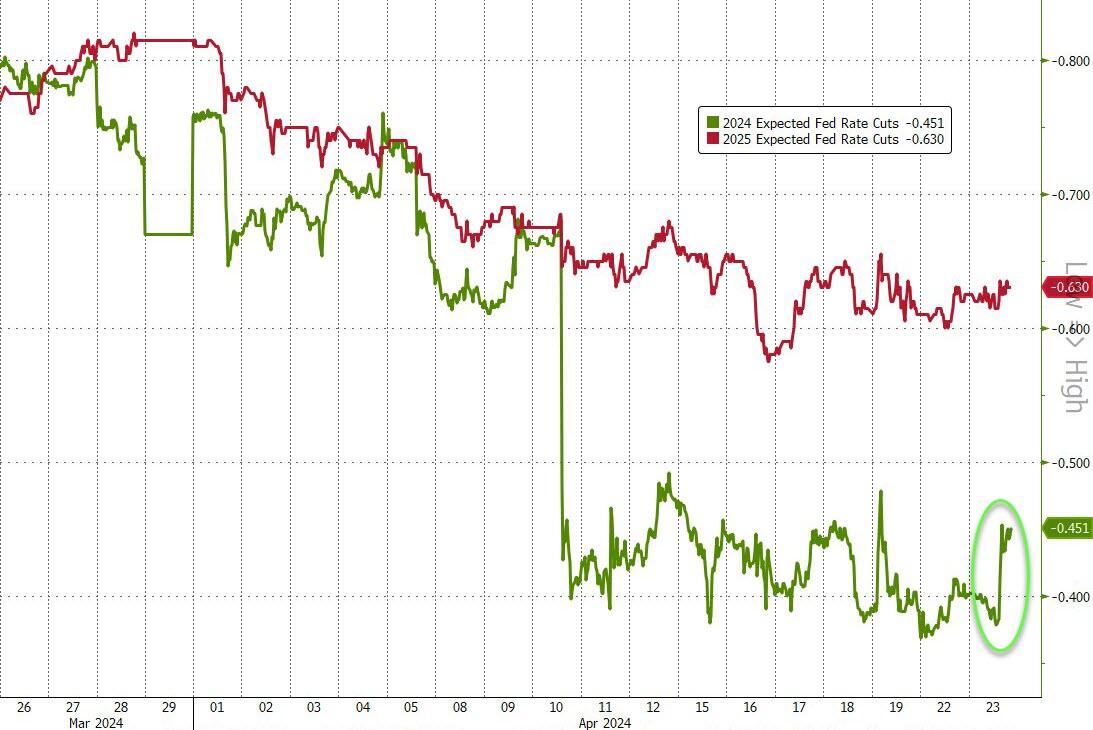
That gave 2024 rate-cut odds a small lift…
Source: Bloomberg
..which seemed all the markets wanted to be able to extend yesterday’s big squeeze as stocks soared from the open… The Dow was the laggard on the day with Small Caps the biggest gainer, but all the majors ended green…
0-DTE traders faded the opening ramp aggressively but were force to cover as the afternoon wore on. Notably the positive delta flow from 0-DTE did nothing to boost stocks suggesting there were ‘fundamental’ sellers offsetting that flow…
Yesterday’s ‘short squeeze’ was dwarfed by today’s extending the gains from yesterday’s lows in the ‘most shorted’ basket to today’s highs to over 6%… – the biggest two-day squeeze since late-Feb. We do note that in context, this is not so impressive, but every trend starts as a reversal…
Source: Bloomberg
MAG7 stocks rallied again, but were unable to get back to even on the week and started to run out of steam into close ahead of TSLA’s earnings…
Source: Bloomberg
Continuing the trend of the last two days, Goldman’s trading desk noted that hedgies were buying and long-only’s were selling:
Our floor is skewed 6% better to buy overall with HFs driving most of our flows. The HF demand is a function of Info Tech Buying (again… mix of LC Tech, semis, select SW), Discretionary demand (mostly e-commerce), Industrials, Comms Svcs, Energy, and Staples… Hcare is the only Sector being sold by HFs. Short Ratios are moderate to low today
LOs are selling Info Tech (pockets of SW), Energy selling, Comm Svcs, Fins.
Additionally, they highlighted the following chart showing the number of Nasdaq components below their 50DMA was at the same levels as the October 2023 swing lows as we rip here…
Source: Bloomberg
Notably, Goldman’s ‘Vol Panic’ Index is off the highs… but not by much (ahead of thee big event risk this week)…
Source: Bloomberg
Treasuries were mixed by the close (with 30Y +1bps, 2Y -5bps), but all well off their overnight (pre-bad-news) high yields of the day…
Source: Bloomberg
Once again, 5.00% was too much for the 2Y yield to handle…
Source: Bloomberg
The yield curve steepened dramatically, off pre-CPI levels from last week…
Source: Bloomberg
The dollar dived on the (dovish) bad news, back to Thursday’s lows…
Source: Bloomberg
USDJPY just couldn’t get it together. Twice they tried to rally the JPY against the USD and twice they failed (just look at last Friday too)… Jawboning is just not doing it guys…
Source: Bloomberg
Gold ended the day basically unchanged having recovered from yesterday evening’s puke…
Source: Bloomberg
Bitcoin also ended the day unchanged, around $67,000…
Source: Bloomberg
Oil prices traded a perfect ‘V’ today, dumping overnight *WTI testing an $80 handle) before finding support and ramping up above $83…
Source: Bloomberg
Finally, tonight brings us TSLA earnings… 0-DTE traders were buying into the close…
Despite being slapped down by the U.S. Court of Appeals for ordering a Jan. 6 probationer’s computer use be monitored for so-called “disinformation,” a senior federal judge in Washington D.C. appears ready to reimpose the restriction on Daniel Goodwyn of Corinth, Texas.
Senior U.S. District Judge Reggie Walton ordered Mr. Goodwyn to “show cause” for why the computer monitoring provision should not be reimposed. Judge Walton set a June 4 hearing date on the issue in Washington.
Defense attorney Carol Stewart said Mr. Goodwyn’s appeal and the Court of Appeals ruling include the statute and relevant case law that explain why computer monitoring in this case is unconstitutional.
“The matter should be closed in my view,” Ms. Stewart told The Epoch Times in a statement. “The First and Fourth Amendments have not been wiped out of the U.S. Constitution yet.”
Computer monitoring could only be relevant if Mr. Goodwyn’s single misdemeanor trespassing crime on Jan. 6 had anything to do with computer use, but since it didn’t, the measure cannot apply to him, she said.
“The application of computer monitoring conditions to conduct invasive searches is covered extensively by case law, where the computer had to be used for the crime,” Ms. Stewart said. “And use could not have just been incidental or casual. The computer had to be integral to the crime.”
There is no speech aspect of 18 U.S. Code 1752(a)(1), the statute that covers the plea deal Mr. Goodwyn agreed to in the case, she said.
‘Minister of Disinformation’
“I am unclear and curious who the judge thinks besides himself will be the Minister of Disinformation for the court if Mr. Goodwyn expresses any views that differ from what the judge believes,” she said. “And how will the judge prevent spying on Mr. Goodwyn’s journalism, support for, and access to, Stophate.com?”
Mr. Goodwyn said he went to Jan. 6 events as a citizen journalist for the website Stophate.com. He pleaded guilty to one count of entering and remaining in a restricted building or grounds on Jan. 6.
He entered the building through the Senate wing door at 3:32 p.m. and spent 36 seconds inside the Capitol, security video shows.
Mr. Goodwyn was arrested on Jan. 29, 2021, in Sherman, Texas. He was charged in a superseding indictment on Nov. 10, 2021, with obstruction of an official proceeding, entering and remaining in a restricted building or grounds, disorderly and disruptive conduct in a restricted building or grounds, disorderly conduct in a Capitol building, and parading, demonstrating, or picketing in a Capitol building.
Mr. Goodwyn’s post-Jan. 6 speech caught the attention of Judge Walton when Mr. Goodwyn appeared on “Tucker Carlson Tonight” on Fox News Channel.
Judge Walton, when imposing a 60-day prison sentence in June 2023, said Mr. Goodwyn spread “disinformation” during Mr. Carlson’s program on March 14, 2023.
Judge Walton ordered that Mr. Goodwyn’s computer be subject to “monitoring and inspection” by a probation agent to check if he spread Jan. 6 disinformation during the term of his supervised release.
The U.S. Court of Appeals for the District of Columbia Circuit issued a per curiam order vacating the monitoring provision.
The appeals judges wrote that Judge Walton “plainly erred in imposing the computer-monitoring condition without considering whether it was ‘reasonably related’ to the relevant sentencing factors and involved ‘no greater deprivation of liberty than is reasonably necessary’ to achieve the purposes behind sentencing.”
A March 26 mandate that sent the issue back to Judge Walton said if he still wanted to impose computer monitoring, he must explain his legal reasoning, develop a record to support the provision, and ensure that what he orders follows federal supervised-release law and accords with constitutional protections.
Ms. Stewart said the logical course of action seemed clear after the Court of Appeals ruling.
“The judge had the option to simply change his sentencing judgement order to remove the computer monitoring special condition,” she said.