62.3 F
Chicago
Monday, September 21, 2026
Home Blog Page 2704

“F**king Clown Show”: Unsealed Court Docs Reveal Biden DOJ Colluded With National Archives To Target Trump, Jack Smith Tried To Conceal

“F**king Clown Show”: Unsealed Court Docs Reveal Biden DOJ Colluded With National Archives To Target Trump, Jack Smith Tried To Conceal

Newly unsealed documents in Donald Trump’s classified documents case reveal that the Biden White House colluded with the National Archives (NARA) and the FBI to concoct a case against the former president.

Journalist Julie Kelly has been all over this:

What’s more, Special Counsel Jack Smith sought to conceal this – telling Judge Eileen Cannon in February that Trump’s counsel isn’t entitled to discovery on documents between the White House and NARA, that the court should toss requests for evidence of the alleged coordination, and that the court should deny Trump’s request for evidence related to secure facilities at his residences. Further, Trump’s request for unredacted discovery of materials should be denied.

As the Epoch Times notes further, the trove of unsealed filings also revealed that the Federal Bureau of Investigation’s (FBI) code name for its investigation into President Trump’s presidential records was “[Redacted] Plasmic Echo.”

A key exhibit included with a motion to compel filed in January was an FBI case file labeled “[Redacted] PLASMIC ECHO; Mishandling of Classified or National Defense Information.”

The defense has argued that the emails unsealed on Monday indicate communication between NARA officials, the Biden administration, and the DOJ regarding President Trump’s records, alleging coordination in targeting the former president since 2021.

One email from NARA’s general counsel to the national archivist discussed drafting a letter to U.S. Attorney General Merrick Garland concerning “missing Trump records.” Subsequent emails revealed coordination between NARA and the Biden White House counsel’s office regarding the handling of these records.

The Sept. 1, 2021, email revealed that NARA’s general counsel, Gary Stern, had been in touch with both the DOJ and the Biden White House “about this issue.” A subsequent email on Sept. 30, 2021, reveals that the White House counsel’s office “is now ready to set up a call to discuss the Trump boxes.”

This email came after Mr. Stern emailed Deputy White House Counsel Jonathan Su two days earlier to “check back in to see when and how you want to proceed re [sic] meeting with [redacted], [redacted], [redacted], and NARA to discuss the Trump boxes?”

Furthermore, the defense highlighted instances where NARA officials didn’t disclose certain actions to Trump representatives, suggesting bias in the investigation process.

The defense alleged that Mr. Su didn’t disclose to a Trump representative that NARA had already drafted a DOJ referral letter when contacting them to discuss access to notes “from the Trump administration relating to records handling.”

*  *  *

More from Epoch: 

The unsealed emails show that NARA took into consideration the Democrat-led January 6 Committee’s investigation when considering the timing of reporting to Congress on their issues of getting access to President Trump’s posts on Twitter (now X).

On Oct. 5, 2023, Mr. Stern wrote in an internal NARA email that the release of a letter to Congress “can be timed with our public release of the Trump social media records … as well as our release to the 1/6 Committee of responsive tweets on the day of January 6.”

Mr. Stern noted that NARA had “issues” getting President Trump’s “social media records” because the Trump White House didn’t “capture them through the use of third-party archiving tools.”

Documents seized during a raid by the FBI of former President Donald Trump’s Mar-a-Lago estate in Palm Beach, Fla., on Aug. 8, 2022. (FBI via The Epoch Times)

“I do not think that these problems are something that the AG/DOJ can deal with, but it could be appropriate to report them to Congress, especially since the January 6 Committee has specifically requested Trump’s Tweets from the day of January 6,” Mr. Stern wrote in the email.

Mr. Stern adds that the Biden White House counsel “is now also aware of this issue, and has asked that I keep them in the loop to the extent that we make any reference to the White House Office of Records Management.”

Another email shows Mr. Ferriero saying that he had run “out of patience” amid back-and-forth communications with Trump representatives regarding “missing boxes” that, according to a draft email to the attorney general, were reported as having been “possibly destroyed.”

‘Matters of Public Record’

The defense, along with a coalition of news media, asked the court to unseal these exhibits, arguing that the court filings are “matters of public record.”

The defense has accused the prosecution of withholding potentially exculpatory evidence and alleged bias in the investigation.

The filings made public on Monday revealed previously sealed information while limiting the redactions to keeping secret the names of government witnesses.

They were included as exhibits in a motion to compel the prosecution to produce discovery material. In the Jan. 16 motion, they argued that the office of Special Counsel Jack Smith has engaged in discovery violations and has disregarded fundamental fairness in its pursuit of prosecuting President Trump.

The disclosures come amid a protracted battle over court documents, with Judge Aileen Cannon having reminded both parties in various court filings of the “strong presumption of public access” in the criminal proceedings, showing a preference for making public as much as possible. In January, she ordered that no unclassified material be sealed unless there were clear risks to personal safety or national security.

Tyler Durden
Tue, 04/23/2024 – 13:25

Just A Correction, Or Is The Bull Market Over?

Just A Correction, Or Is The Bull Market Over?

Authored by Lance Roberts via RealInvestmentAdvice.com,

Is this just a correction after a strong bullish advance from November, or is the bull market ending? If you read some of the headlines, you would suspect the latter. As noted by MarketWatch last week:

“For the first time since early November 2023, less than 30% of S&P 500 stocks are trading above their 50-day moving average — a clear indicator of the current poor market’s breadth. This significant drop from the 85% observed in late March and 92% at the beginning of January highlights a dramatic reversal in market dynamics.

The 50-day moving average is often seen as a barometer for the short-term health of stocks. Falling below this level en masse suggests that a broad swath of the market is facing downward pressure. This shift comes amid escalating geopolitical tensions in the Middle East and renewed concerns over inflation, which have collectively nudged traders towards a more guarded stance in April.”

Of course, there are many “reasons” lately for the drop in stock prices. Geopolitical stress between Israel and Iran and hotter-than-expected inflation data that paused Fed rate cuts brought sellers into the market. However, none of this is shocking, as we previously noted in “Blackout Of Buybacks:”

“Notably, since 2009, and accelerating starting in 2012, the percentage change in buybacks has far outstripped the increase in asset prices. As we will discuss, it is more than just a casual correlation, and the upcoming blackout window may be more critical to the rally than many think.” – March 19, 2024

Furthermore, the “blackout” of corporate buybacks coincided with an aggressively bullish investor sentiment. As we noted in that same article:

“Investor sentiment is once again very bullish. Historically, when retail investor sentiment is exceedingly bullish combined with low volatility, such has generally corresponded to short-term market peaks.”

We will return to this chart momentarily, but given that corporate share buybacks have accounted for roughly 100% of net equity purchases over the last two decades, the blackout period combined with aggressive bullish sentiment was the recipe for a decline in asset prices.

Here is the math of net flows if you don’t believe the chart:

  • Pensions and Mutual Funds = (-$2.7 Trillion)

  • Households and Foreign Investors = +$2.4 Trillion

    • Sub Total = (-$0.3 T)

  • Corporations (Buybacks) = $5.5T

    • Net Total = $5.2 Trillion = Or 100% of all equities purchased

Such is crucial to understand as we head into the rest of the year. It will determine whether this is just a correction within a bullish trend or something more significant.

Buyers Live Lower

In No Cash On The Sidelines,” we discussed the importance of understanding that “market prices” are set by the demand and supply between buyers and sellers. To wit:

“As noted above, the stock market is always a function of buyers and sellers, each negotiating to make a transaction. While there is a buyer for every seller, the question is always at “what price?” 

In the current bull market, few people are willing to sell, so buyers must keep bidding up prices to attract a seller to make a transaction. As long as this remains the case and exuberance exceeds logic, buyers will continue to pay higher prices to get into the positions they want to own.

Such is the very definition of the “greater fool” theory.

However, at some point, for whatever reason, this dynamic will change. Buyers will become more scarce as they refuse to pay a higher price. When sellers realize the change, they will rush to sell to a diminishing pool of buyers. Eventually, sellers will begin to “panic sell” as buyers evaporate and prices plunge.”

In other words, Sellers live higher. Buyers live lower.

We can see where the buyers and sellers “live” in the following chart, which shows where the highest volume occurred.

This current correction is becoming increasingly oversold (bottom panel), which suggests a bounce is likely toward the previous support of the 50-DMA. For comparison, we can look at last year’s market correction. As noted, the bullish rally into July peaked late that month. As the market corrected, it bounced from oversold conditions, allowing investors to reduce risk and hedge portfolios. The markets will likely present investors with that opportunity soon.

Then, like today, many investors began to believe it wasn’t just a correction but something much more. However, the reality was that the “buyers lived lower.” Buyers stepped in as prices approached the October lows, coinciding with the return of corporate share buybacks.

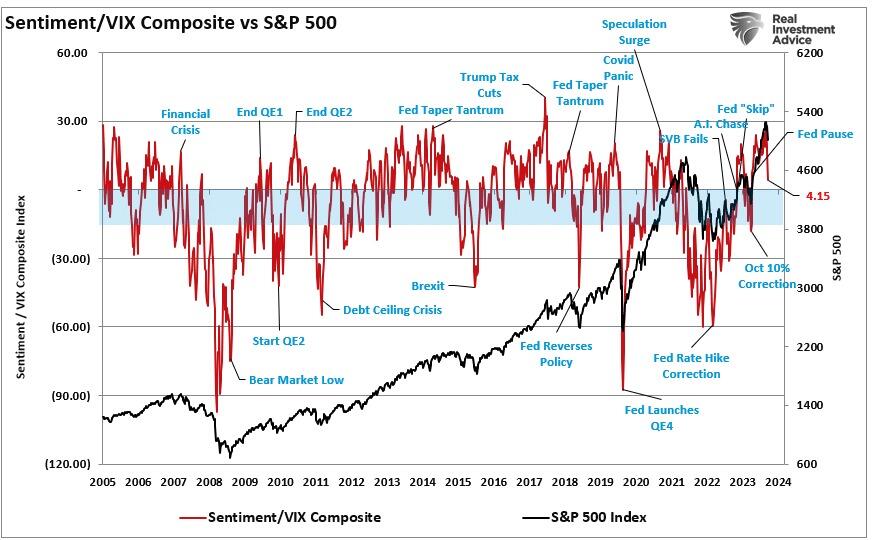
Sentiment Is Reversing Quickly

As I said, we need to revisit the sentiment chart above. Investors’ more frothy, bullish sentiment is reversing quickly on many fronts. The chart below, the same as above, is the composite net bullish sentiment index of retail and professional investors divided by the volatility index (VIX). If this is just a market correction, the index tends to bottom between zero (0) and negative (20). With a current reading of 4.15, down from 25.99 just two weeks ago, bullish sentiment has significantly reversed.

Notably, professional investor allocations to equities recently peaked at 103.88%, which has collapsed in just two weeks to just 62.98% exposure. (Professional investors are notorious for buying market peaks.)

Also, the number of stocks on bullish “buy signals” has dropped from 80.2 to 48.2.

Furthermore, the number of stocks trading above the 50-DMA has fallen from over 80% to 37%, with money flows hitting levels lower than previous market bottom lows. Notably, with just a 5.5% correction from the recent peak (as of last Friday), much of the work of clearing the previous overbought conditions is completed.

Given the significant reversal in sentiment and short-term oversold conditions, we highly suspect the markets will provide a reflexive rally soon. However, with the number of bullish investors who got “trapped” in the selloff, any rallies will likely be met with further selling.

However, despite the current “panic” in the media headlines, this is likely just a correction within an ongoing bullish market. Such is particularly the case given that corporate share buybacks will resume in May, providing critical support for the markets heading into summer.

With that said, this correction, when complete, likely won’t be the last we see this year. Market history suggests we could see another “bumpy ride” heading into what many expect will be a somewhat contentious election.

But that is an article we will write when we get there.

Tyler Durden
Tue, 04/23/2024 – 13:05

GM Shifts Into Higher Gear As It Beats Quarterly Results, Raises 2024 Guidance

GM Shifts Into Higher Gear As It Beats Quarterly Results, Raises 2024 Guidance

General Motors shares are higher in premarket trading after raising its 2024 guidance and beating Wall Street analysts’ top- and bottom-line expectations for the first quarter. The automaker cited stable pricing and increasing demand for its petrol-powered vehicles. 

GM boosted its adjusted pretax profit forecast to $12.5 billion to $14.5 billion, or $9 to $10 a share, up from its previous range of $12 billion to $14 billion, or $8.50 and $9.50 a share, for the year on a more robust car market in North America offsetting losses in other regions.

The automaker increased its 2024 forecast for adjusted automotive free cash flow to $8.5 billion and $10.5 billion, up from the previous estimate of $8 billion to $10 billion. 

“Over the last 24 months, we have been growing at an annualized rate of 15%,” GM Chief Financial Officer Paul Jacobson told investors on an earnings call, noting, “That gave us the confidence to raise full-year guidance.” 

Investors overlooked the company’s waning electric vehicles unit in China primarily because of its strong performance in the US.

“There … is the reality that the pricing is staying stronger for longer than anybody anticipated,” Tim Piechowski, portfolio manager at ACR Alpine Capital Research in St. Louis, which owns GM shares, told Reuters. 

“The engine of the company is truck and SUV at this point,” Piechowski said, adding, “They’re just generating substantial profit and free cash flow that will continue to fund the initiatives in EV. Full steam ahead.”

Here’s a snapshot of the 2024 forecast (courtesy of Bloomberg): 

  • Sees adjusted EPS $9.00 to $10.00, saw $8.50 to $9.50, estimate $9.04 (Bloomberg Consensus)

  • Sees adjusted auto free cash flow $8.5 billion to $10.5 billion, saw $8 billion to $10 billion 

  • Sees adjusted Ebit $12.5 billion to $14.5 billion, saw $12 billion to $14 billion, estimate $12.69 billion

  • Sees net income $10.1 billion to $11.5 billion, saw $9.8 billion to $11.2 billion, estimate $10.22 billion

  • Sees Automotive net cash provided by operating activities $18.3 billion to $21.3 billion

For the first quarter, GM increased revenue to $43 billion, or about 8% year over year, with most of the gain coming from North America. That boosted profits, rising to $2.62 a share, up from $2.21 one year ago, beating the $2.12 average Wall Street analyst estimate tracked by Bloomberg. 

Here’s a snapshot of first-quarter results (courtesy of Bloomberg): 

  • Adjusted EPS $2.62 vs. $2.21 y/y, estimate $2.12

  • Net sales and rev. $43.01 billion, +7.6% y/y, estimate $42.19 billion

  • Cruise net sales and revenue $25 million, estimate $29.3 million

  • Automotive net sales and revenue $39.21 billion, +7% y/y, estimate $37.69 billion

  • GM Financial net sales and revenue $3.81 billion, +14% y/y, estimate $3.6 billion

  • North America adjusted Ebit $3.84 billion, +7.4% y/y, estimate $3.02 billion 

  • International operations adjusted Ebit loss $10 million vs. profit $347 million y/y, estimate profit $223.3 million

  • GM financial adjusted EBT $737 million, -4.4% y/y

  • Adjusted automotive free cash flow $1.09 billion vs. negative $132 million y/y

  • GMNA vehicle sales 792,000 units, +9.5% y/y, estimate 739,557 

  • GMI vehicle sales 104,000 units, -26% y/y, estimate 164,343

  • Adjusted Ebit $3.87 billion, estimate $3.13 billion

Following supply chain snarls during Covid, GM’s vehicle inventories rose to 534,000, well above the 2023 averages. Last quarter’s inventory means the automaker has roughly 63 days of supply, which GM considers ‘healthy.’ 

GM’s strength in the US allowed investors to overlook an operating loss of about $100 million in GM’s China operation. 

“We expect things to normalize a little bit and turn back to profit,” Jacobson told investors on the call while referring to China.

Shares of GM are up 5% in premarket trading. As of Monday’s close, shares entered a technical bull market on the year, rising 20.3%.

In a note to clients, Goldman told them GM is a “Buy rated” company with a 12-month price target of $50 based on 5X applied to our normalized EPS estimate of $10.00.

 They noted several risks to their bull outlook, including the auto cycle, market share, margins, FCF, and GM’s ability to achieve profitably to electric vehicles. 

Tyler Durden
Tue, 04/23/2024 – 12:50

Migrant Child Rapist Won’t Be Deported Because It Would ‘Harm His Mental Health’

Migrant Child Rapist Won’t Be Deported Because It Would ‘Harm His Mental Health’

Authored by Steve Watson via Modernity.news,

A migrant from Eritrea who is a convicted child rapist has won an appeal not to be deported from the UK after arguing that it would harm his mental health.

Yes, really.

The migrant has been in prison for TEN YEARS after attacking a teenage girl in 2014.

GB News reports that an appeal claiming that the migrant wouldn’t be able to access care for PTSD or depression in the East African country has been successful.

The man’s lawyers were able to get a doctor to testify that the migrant would likely kill himself if he was deported.

They also claimed that he would be punished in his home country for evading military service. 

As a result, the migrant will remain in the UK despite a security report concluding that the man poses a significant risk to public safety. 

Conservative MP Nigel Mills commented “This man committed a serious criminal offence and should be nowhere near this country.”

He added, “If he was concerned about losing mental health treatment or being arrested for fleeing the draft, he should have thought about that before he committed the crime.”

“This decision is another sign the tribunal system is deeply out of touch with the rest of Britain,” Mills further urged.

This is far from an isolated case.

Last year, a migrant rapist concluded to be a significant danger to women was allowed to stay in the UK after he argued that the medicines he was receiving to treat his mental health would not be available in Gambia.

As we previously highlighted, an Afghan illegal migrant sex offender was recently granted refugee status in the UK because it was argued that exposing himself in public wouldn’t be tolerated if he was sent back to Afghanistan.

Other hardened criminal migrants have managed to avoid deportation by arguing that it would violate their human rights.

There are also concerns that a government attempt to bring in a new definition of extremism and apply it to criminal illegal immigrants could provide them an excuse to avoid deportation by arguing that it could lead to their ill-treatment if they are returned to their home country.

In addition, a 2022 report found that more than 80 percent of illegal immigrants detained in the UK were simply let go rather than deported.

Those who have been ordered to be deported often purposefully become violent or aggressive, knowing that it will prevent the flight from taking off with them on board.

The government continues to drag its feet on a vow to pass legislation that would see boat migrant asylum seekers arriving in the UK illegally deported to Rwanda for processing.

*  *  *

Your support is crucial in helping us defeat mass censorship. Please consider donating via Locals or check out our unique merch. Follow us on X @ModernityNews.

Tyler Durden
Tue, 04/23/2024 – 12:30

Israel Prepares Rafah Evacuation With Help From US, Egypt – New Tent City Erected

Israel Prepares Rafah Evacuation With Help From US, Egypt – New Tent City Erected

Via The Cradle

The Israeli army is closing in on completing its plans for an assault on the Gaza Strip’s southern city of Rafah, the Wall Street Journal (WSJ) reported on Tuesday. 

WSJ cites Egyptian officials as saying that Israel’s plan to evacuate civilians from the city will take two to three weeks and will be carried out in cooperation with Washington, Cairo, and other Arab states, including the UAE. 

Image: AFP

The officials say Israel is planning on gradual deployments of troops to Rafah. The troops will concentrate on specific areas where Tel Aviv believes Hamas leaders are holed up.

The entire operation – including the evacuations – is expected to take at least six weeks, according to WSJ. The attack on Rafah will have a “very tight operational plan because it’s very complex there,” an Israeli security official told the outlet. “There’s a humanitarian response that’s happening at the same time.”

Israel’s evacuation plan involves moving Rafah’s civilian population upwards towards the southern city of Khan Yunis, as well as other areas of the strip, the report states, adding that shelters with tents, food supplies, and medical facilities will be set up

Egypt has been briefed on the details of the plan. Al-Araby Al-Jadeed reported last week, citing Egyptian sources, that Egyptian forces and agencies are “at full readiness” in northern Sinai and along the Egyptian border with Gaza. The increased readiness came after “contacts from the Israeli side” relating to preparations for the operation in the southern city.

The Al-Araby Al-Jadeed report adds that the Egyptian Red Crescent has been readying camps in Khan Yunis over the past few months in preparation for the displacement of Palestinians from Rafah. Satellite images obtained by AP this week reportedly show a new tent compound near Khan Yunis.

In February, it was reported that Egypt built a security zone in the Sinai near the border with Rafah. Many speculated at the time that the security zone would aid Israeli plans to push Rafah’s population into the Sinai desert. Egypt’s State Information Service said on February 17 that the zone is a logistics hub on the Egyptian side of the Rafah border, which will be used to deliver aid into Gaza.

Israeli army radio reported on Monday that Tel Aviv is now expanding a designated “humanitarian zone” that will “accommodate around one million people.” It said field hospitals have also been set up in the area. Army radio added that the zone will extend from Al-Mawasi on Gaza’s southern coast towards Deir al-Balah in the central Gaza Strip. 

Israel believes Rafah is Hamas’ final stronghold and is dead set on attacking the city. Washington has repeatedly said it would not accept an operation there without a plan to properly and safely evacuate civilians and move them out of harm’s way.  

The UN and several countries have warned that attacking Rafah would have catastrophic consequences and that there is no safe way to evacuate the desperately overcrowded city. 

Tyler Durden
Tue, 04/23/2024 – 11:50

Biden’s America: 40% Of Renters Think They’ll Never Own A Home, Up From 27% Last Year

Biden’s America: 40% Of Renters Think They’ll Never Own A Home, Up From 27% Last Year

Bidenomics 101: the American dream of owning a home has become the American nightmare for almost half the US population.

As housing specialist Redfin reports, rising home prices and mortgage rates “are making it harder to believe in the American dream of homeownership. Lack of affordability is the most commonly cited reason renters don’t believe they’ll ever own a home.

The details are dire: Nearly two in five (38%) U.S. renters don’t believe they’ll ever own a home, up from roughly one-quarter (27%) less than a year ago. 

This is according to a Redfin-commissioned survey of roughly 3,000 U.S. residents conducted by Qualtrics in February 2024. This report focuses on the 1,000 respondents who indicated they are renters. The relevant questions were: “Do you believe that you will ever own your own home in the future?” and “Which of the following are reasons you aren’t likely to purchase a home in the near future?” The 27% comparison is from a Redfin survey conducted in May and June 2023. 

Lack of affordability is the prevailing reason renters believe they’re unlikely to become homeowners. Nearly half (44%) of renters who don’t believe they’ll buy a home in the near future said it’s because available homes are too expensive. The next most common obstacles: Ability to save for a down payment (35%), ability to afford mortgage payments (33%) and high mortgage rates (32%). Roughly one in eight (14%) simply aren’t interested in owning a home. 

Buying a home has become increasingly out of reach for many Americans due to the one-two punch of high home prices and high mortgage rates. First-time homebuyers must earn roughly $76,000 to afford the typical U.S. starter home, up 8% from a year ago and up nearly 100% from before the pandemic, according to a recent Redfin analysis. Home prices have skyrocketed more than 40% since 2019, due to the pandemic homebuying frenzy and a shortage of homes for sale. And the current average 30-year fixed mortgage rate is 6.82%. While that’s below the 23-year-high of nearly 8% hit in October, it’s still more than double the record low rates dropped to in 2020. 

Home prices have risen 7% in the last year alone, and monthly mortgage payments have risen more than 10%, which helps explain why renters today are more likely than they were last year to say they don’t see themselves owning a home anytime soon. 

Many renters can’t fathom homeownership because they’re already struggling to afford their monthly housing costs. Nearly one-quarter (24%) of renters say they regularly struggle to afford their housing payments, and an additional 45% say they sometimes struggle to do so.

Rents have soared over the last few years because so many people moved during the pandemic, upping demand for rentals. The median U.S. asking rent is roughly $2,000, near the record high hit in 2022–but the good news for renters is that prices aren’t growing nearly as fast as they were during the pandemic, partly because an influx of apartment supply is taking some of the heat off prices. 

“Housing costs are high across the board, but renting is a more affordable and realistic option for many Americans right now–especially those who have never owned a home and aren’t able to tap into equity from a previous sale,” said Redfin Chief Economist Daryl Fairweather. “While owning a home is usually a sound longterm investment, the barriers to entry and upfront costs of buying are higher than renting. Buying typically requires a sizable down payment and approval for a mortgage–things that are difficult for many people today, when the typical down payment is near $60,000 and mortgage payments are sky-high. The sheer expense of purchasing a home is causing the American Dream of homeownership to lose some of its shine.” 

Gen Z renters are most likely to believe they’ll own a home

Broken down by generation, Gen Z renters are by far the most likely to believe they will become homeowners (maybe it’s because they are also the dumbest). Just 8% of Gen Z renters believe they’ll never own a home, compared to 22% of millennials, 40% of Gen Xers and 81% of baby boomers.

Tyler Durden
Tue, 04/23/2024 – 09:40

Euro Area PMI Activity Hits 11 Month High On Service Expansion As Manufacturing Recession Gets Worse

Euro Area PMI Activity Hits 11 Month High On Service Expansion As Manufacturing Recession Gets Worse

Europe’s study in paradoxical contrasts continues. On the same day, ECB’s de Guindos said a June rate cut looks like a set deal (unless there are surprises) with the end of inflation fight is in sight, the Euro-area’s private-sector activity advanced to the highest level since May 2023, driven by a buoyant services sector and Germany’s return to growth; UK firms also reported the strongest growth in almost a year

Here are the details: 

France

  • Services Flash PMI (Apr) 50.5 vs. Exp. 49.0 (Prev. 48.3);
  • Manufacturing Flash PMI (Apr) 44.9 vs. Exp. 47.0 (Prev. 46.2);
  • Composite Flash PMI (Apr) 49.9 vs. Exp. 48.8 (Prev. 48.3);
    • “Overall, our HCOB nowcast model for the second quarter points to a recovery of the French economy, driven by the services sector”.

Germany

  • Manufacturing Flash PMI (Apr) 42.2 vs. Exp. 42.9 (Prev. 41.9);
  • Services Flash PMI (Apr) 53.3 vs. Exp. 50.5 (Prev. 50.1);
  • Composite Flash PMI (Apr) 50.5 vs. Exp. 48.6 (Prev. 47.7);
    • “Factoring in the PMI numbers into our GDP Nowcast, we estimate that GDP may expand by 0.2%”.

UK

  • Services PMI (Apr) 54.9 vs. Exp. 53.0 (Prev. 53.1);
  • Manufacturing PMI (Apr) 48.7 vs. Exp. 50.4 (Prev. 50.3);
  • Flash Composite PMI (Apr) 54.0 vs. Exp. 52.7 (Prev. 52.8)

Euro-Area

  • Services Flash PMI (Apr) 52.9 vs. Exp. 51.8 (Prev. 51.5);
  • Manufacturing Flash PMI (Apr) 45.6 vs. Exp. 46.6 (Prev. 46.1);
  • Composite Flash PMI (Apr) 51.4 vs. Exp. 50.8 (Prev. 50.3);
    • “Considering various factors including the HCOB PMIs, our GDP forecast suggests a 0.3% expansion in the second quarter”.

Putting it all together, the Euro area composite flash PMI increased by 1pt to 51.4 in April, above the 50.7 consensus estimate, in expansion (>50) for the second straight month and the highest since May 2023. As shown in the chart below, the improvement in the composite index was skewed heavily towards the services sector, where the index rose (by 1.4pt) to 52.9, while the manufacturing PMI continued to sink.

Across countries, the improvement in the area-wide index was driven by Germany – which was above that key 50 expansion mark for the first time in 10 months driven by services (even as manufacturing continued to shrink, though at a slower pace than the month before) defying analysts who had expected another sub-par reading – and France, partially offset by a slight deceleration in the periphery.

In the UK, the composite flash PMI improved notably to 54.0, above consensus expectations of a decline, on the back of a pick-up in services activity, where the index grew by 1.8pt to 54.9, which was partly offset by a slowdown in manufacturing activity.

Commenting on the results, Goldman saw three main takeaways from today’s data.

  • First, there are continued improvement in the Euro area headline numbers, coupled with continued, but moderating, optimism for the upcoming year.
  • Second, the PMI price components ticked up in April, driven by both sectors, with the risks to cost inflation coming from higher wages and oil prices.
  • Lastly, the UK saw another month of expanding activity, also driven by the services sector, which should support growth momentum going forward.

While output prices ticked up only marginally in both the Euro area and the UK, it is important that firms’ pricing behavior remains supportive for the disinflationary process, Goldman’s economists noted.

The positive figures suggest that the euro area will probably expand by 0.3% in the second quarter, matching the rate of growth in the January-March period, said Cyrus de la Rubia, chief economist at Hamburg Commercial Bank. That’s a more upbeat prediction than the Bloomberg consensus, which sees just 0.1% growth at the start of the year, with data due on April 30.

“It appears that the recession was predominantly concentrated within the manufacturing sector, while the broader economy may have narrowly skirted such a downturn,” de la Rubia said. “The service sector may serve as a catalyst for the overall economy.”

After contracting in the final quarter of last year, Germany was long expected to have had a shallow recession over the winter. But the Bundesbank last week said output may have grown slightly in the first three months of the year because of a pickup in industrial production, exports and construction — meaning the country would avoid such a scenario.

De la Rubia agreed, saying a Nowcast model points to economic expansion of 0.1% in the first quarter followed by 0.2% in the second. German bonds fell across the curve and money markets reduced wagers on the scope for interest-rate cuts after data for the country were published. The two-year maturity, which is sensitive to changes in monetary policy, rose as much as three basis points to 2.99%.

The overall performance was also better in France, where activity remained broadly stable after contracting for 10 months. That development was also driven by services, where rising demand resulted in the first expansion in almost a year. New orders placed with factories fell at the steepest pace since January, increasing the wedge between manufacturers and services firms.

“The French services sector is the workhorse of the economy,” said Norman Liebke, an economist at Hamburg Commercial Bank. “French manufacturing output stays subdued, but we expect it will soon follow the path of the services sector. The manufacturing sector delays the overall economy’s recovery for now, though.”

But the better momentum in both countries was flanked by stronger price pressures, which as Bloomberg notes is a potential source of concern for European Central Bank officials who are gearing up for a first interest-rate cut in June. That development was also centered on the services sector, where rising wages are playing a bigger role.  Diverging fortunes were equally visible in the labor market. While German and French services firms added workers at a quicker pace, factories shed jobs.

Overall though, the currency bloc’s top two economies couldn’t keep pace with the rest of the region, which appears to be recovering after the energy crisis that stifled its post-Covid rebound.

The rise in power costs — triggered by Russia’s war in Ukraine — also fanned inflation, though consumer-price growth has since slowed markedly. The purchasing-manager data showed that price pressures “intensified slightly” this month.

“The PMI figures are poised to test the ECB’s willingness to cut interest rates in June,” de la Rubia said. “Accelerated increases in input costs, likely driven not only by higher oil prices but also, more concerningly, by higher wages, are a cause for scrutiny. Concurrently, service-sector companies have raised their prices at a faster rate than in March, fueling expectations that services inflation will persist.”

Still, he doesn’t expect that to derail a well-telegraphed easing at the ECB’s next monetary-policy meeting. “However, we doubt that the central bank will adopt a ‘pragmatic speed,’ as suggested by Francois Villeroy de Galhau” de la Rubia said. “Instead, we expect a more cautious approach.”

As noted above, comments by ECB Vice President Luis de Guindos earlier on Tuesday reinforce that approach. “The level of uncertainty makes it very difficult to say,” he told Le Monde, according to a transcript on the ECB website. “I already mentioned June. As for what happens afterwards, I’m inclined to be very cautious.”

A separate set of data for the UK showed the economy’s recovery from recession unexpectedly gathered pace at the start of the second quarter as private-sector firms reported the strongest growth in almost a year. PMIs are closely watched by markets as they arrive early in the month and are good at revealing trends and turning points in an economy. A measure of breadth of changes in output rather than depth, business surveys can sometimes be difficult to map directly to quarterly GDP.

US figures later are set to show continued growth. Earlier numbers from Australia, India and Japan pointed to faster expansion.

Tyler Durden
Tue, 04/23/2024 – 09:30

Large Structural Short Will Drive Yen Much Higher

Large Structural Short Will Drive Yen Much Higher

Authored by Simon White, Bloomberg macro strategist,

Focus has been on the growing short position in the yen. But the total size is likely to be small in the scheme of things. The real story is the lack of domestic hedging leading to a large structural short in the yen which will drive the currency much higher when it is covered.

There has been some back and forward internally about the extent of the yen short position. FX positioning is hard to get good visibility on unless you are in the flow. The go-to for most people that aren’t is the CFTC data. This certainly shows that yen short-positioning versus the dollar has risen in recent months.

The chart measures the net short versus open interest. Although the short is high, we can see it has been higher, especially in the late 1990s when USD/JPY rose to ~150.

But COT data is based on flows of FX futures, which are low compared to spot and other flows. The net short for the speculator category – which aims to catch hot flows that are more likely to be price moving on a shorter-term basis, and will mainly be CTA flows – is only about $13.4 billion, not earth shattering.

More important for the longer-term outlook is how the yen’s steadily weakening path is leading to domestic investors to allow their foreign asset positions to become underhedged. As a proxy, we can look at the behavior of life insurers, who are among the largest hedgers of their overseas positions. Their hedging ratios have slipped to under 50%.

Japan is the world’s largest net creditor, with over $3 trillion of assets held abroad. Domestic investors’ flows dominate flows of foreigners buying Japanese assets.

Thus, the large and building structural yen short of Japanese investors will be what ultimately sets the path for the currency.

When the wind changes, the yen is primed to change direction with vigor.

Tyler Durden
Tue, 04/23/2024 – 09:15

Gaza War At 200 Days: IDF Pivots From Iran Threat Back To Hamas Operations

Gaza War At 200 Days: IDF Pivots From Iran Threat Back To Hamas Operations

Monday into Tuesday saw the Israel Defense Forces (IDF) intensify its operations in central and northern Gaza, following a cooling of tensions with Iran after the two almost went to war. Tuesday marks the 200th day of Israel’s war in Gaza, in response to the Oct.7 Hamas terror attacks.

“Israel bombarded northern Gaza overnight in some of the heaviest shelling in weeks, panicking residents and flattening neighborhoods in an area where the Israeli army had previously drawn down its troops, residents said on Tuesday,” Reuters reports.

Image via United Nations

This strongly suggests that even once the IDF has cleared an area, Hamas has the capability of moving back in – also given its capabilities utilizing Gaza’s vast tunnel network.

“Tanks made a new incursion east of Beit Hanoun on the northern edge of the Gaza Strip, though they did not penetrate far into the city, residents and Hamas media said. Gunfire reached some schools where displaced residents were sheltering,” Reuters continues.

Starting Sunday night, the IDF launched a ‘surprise operation’ in the central Gaza corridor, the military confirmed, happening over the Passover holiday

The IDF says the “surprise operation” that began Sunday night is aimed at “deepening the achievements” in the Netzarim corridor.

The corridor, built around a road south of Gaza City, enables the IDF to carry out raids in northern and central Gaza while allowing Israel to control access to the north for Palestinians seeking to return after fleeing south.

“The forces are carrying out targeted raids and are thwarting terror in the area,” the IDF says in a statement.

The IDF confirmed the return of Hamas militants to areas which had previously been clear enough to halt operations. 

“Nahal troops spotted several gunmen amid the raid, and called in airstrikes by fighter jets against them and the buildings they were spotted operating at,” an IDF statement continued.

As for Rafah in the south, so far it seems the IDF’s planned offensive appears to be on pause. An estimated 1.5 million civilians are sheltering in the city, and the White House has urged the Netanyahu government not to attack it. Humanitarian aid groups currently say they don’t know what to expect.

The US has urged that Israel evacuate civilians first, but these plans are anything but clear at this point. “I have no idea what the plan with the procurement of tents by the Israelis is,” the head of the UN humanitarian office in Gaza, Andrea de Domenico, told Al Jazeera. Recent days have seen dozens of casualties due to shelling of some areas, but a full assault is expected to be a humanitarian nightmare for the refugees there.

Tyler Durden
Tue, 04/23/2024 – 08:55

‘Its The Economy, Stupid!’ Black And Hispanic Voters Embrace Trump On Economics And Well-Being

‘Its The Economy, Stupid!’ Black And Hispanic Voters Embrace Trump On Economics And Well-Being

Authored by J.G. Collins via The Epoch Times (emphasis ours),

Epoch Times reporter Tom Ozimek recently wrote in these pages of former President Donald Trump’s encounter with Kayla Montgomery, a young Republican political consultant whose business is to “engage young, black professionals, students, and community members” in the Atlanta area. The ex-president and Ms. Montgomery met at a Chick-fil-A restaurant during an impromptu campaign stop in Atlanta. Ms. Montgomery was effusive in her praise of President Trump, saying, “I don’t care what the media tells you, President Trump—we support you!” A video of Ms. Montgomery and the former president hugging soon went viral, even as the media and Democrats quickly dismissed the interaction as “staged.”

Supporters of former President Donald Trump walk near his residence at Mar-A-Lago in Palm Beach, Fla., on Aug. 9, 2022. (Giorgio Viera/AFP via Getty Images)

Then, last week, President Trump left his trial in Manhattan to visit a bodega in Washington Heights, a mostly black and immigrant community on the Upper West Side of Manhattan and received a hero’s welcome from the working people there.

Whether the Chick-fil-A event was staged or not is open to debate. What is undeniable, though, is that polling shows Donald Trump has upended much of the black and Hispanic voting support Democrats have enjoyed since at least Lyndon Johnson’s “Great Society” and, at least in some instances, back to FDR’s New Deal.

A Wall Street Journal poll showed that President Trump’s support among black men in swing states had moved to 30 percent earlier this month compared to just 11 percent of black men nationally in 2020. Among black women, those same percentages went from 6 percent in 2020 to 11 percent in April.

‘It’s the Economy, Stupid!’

Political pundits and editorial pages all seem flummoxed by President Joe Biden’s erosion of support among the traditional Democrat coalition.

But no one seems more upset by the erosion of black support than Democrat political strategist James Carville, “the Ragin’ Cajun,” who engineered Bill Clinton’s 1988 victory over incumbent George H.W. Bush. That’s ironic, because it was Mr. Carville who added the memorable phrase “It’s the economy, stupid!” to the American political lexicon when he pinpointed President Bush’s greatest vulnerability 36 years ago.

Between January 2021, when President Biden took his oath of office, up to March of this year, average rents have increased by 20 percent. By comparison, residential rents increased just 12 percent during President Trump’s entire term. The increased costs hit blacks and Hispanics disproportionately because of the vast disparity in home ownership, as illustrated below.

Blacks and Hispanic workers also disproportionately occupy positions in production and transportation/material moving jobs at higher rates (17.8 percent and 16.7 percent, respectively) than whites (12.1 percent). But those are the jobs most vulnerable to being taken by the influx of the purported asylum seekers who typically work for less and are less likely to join unions or file complaints with the authorities against their employer. The asylum seekers have exploded since President Biden lifted U.S. border restrictions.

As Well as Crime …

Blacks and Hispanics tend to be disproportionately affected as victims of recidivist criminals let go by criminal justice initiatives championed by leftist Democrat “progressives” in so-called “blue” states. As shown in the chart above, black victims of crime actually decreased during the Trump presidency. (The chart is from a study that has not been updated for later years.)

By the same token, black-owned businesses were among the many businesses looted and destroyed by “progressive” George Floyd rioters in 2020.

… and Education

President Trump made permanent a commitment of $255 million in annual funding for historically black colleges and universities, and he increased funding for the Federal Pell Grant program by signing the FUTURE Act.

Within the states, Republican legislators and governors have championed school choice and a “back-to-basics” approach to K-12 that even Democrats acknowledge. Jorge Elorza, the CEO of Democrats for Education Reform and its affiliate Education Reform Now, a think tank, said: ”We’ve lost our advantage on education because I think that we’ve failed to fully acknowledge that choice resonates deeply with families and with voters.”

Meanwhile, Education Week, the Left-leaning magazine for K-12 teachers, summarized President Biden’s policies as follows:

“[He] passed stricter rules for charter schools seeking federal grant funding; awarded $1 billion to boost school safety and students’ mental health; and proposed an overhaul of Title IX that would give LGBTQ+ students explicit protection under the landmark sex discrimination law and bar outright bans on transgender youth who want to join athletic teams that align with their gender identity.”

Summary

Black and Hispanic voters are moving toward President Trump for a simple reason: their pocketbook and their well-being. The viewpoints of mainstream media pundits—college educated, overwhelmingly white, and mostly liberal—have long maintained a soft bigotry of racial expectations without understanding much of the economy of people who work in blue-, pink-, and green-collar jobs. The pundits don’t understand that blacks and Hispanics, like the rest of the country, have experienced a near 20 percent cumulative erosion in the purchasing power of their dollar and rising crime. They see K-12 education policies that deny school choice and that serve teachers’ unions, special interests, and Democrat party gender identity dogma far more than children and parents.

Black and Hispanic voters have every reason to depart from their traditional voting patterns.

It’s common sense.

Tyler Durden
Tue, 04/23/2024 – 08:35