64.6 F
Chicago
Sunday, September 20, 2026
Home Blog Page 2733

Geopolitical Risk – Hedging The Unhedgeable?

Geopolitical Risk – Hedging The Unhedgeable?

Authored by Peter Tchir via Academy Securities,

This is the first time (in a long time) that I contemplated not doing a weekend T-Report. What’s the point when by the time you read it, everything in the geopolitical realm may have changed? But, with so much going on and so much chatter about geopolitical (and other risks), it still seemed worth it to grind a report out.

Hopefully you saw our recent SITREPs addressing Iran’s launch of drones and missiles against Israel and the seizure of an Israeli-linked container ship near the Strait of Hormuz. We also sent an informal macro view, urging people to hedge ahead of the weekend (primarily direct distribution and via Bloomberg).

Those piggybacked well on our Geopolitical and Macro Webinar from Tuesday. The discussion started in the Middle East, but covered far more than that, directed largely by a high number of audience questions.

We are engaged in more and more intense conversations about how to manage the geopolitical risk. We have been thinking more and more in terms of Tactical vs Strategic.

We will get back to that in just a moment, but it is important and useful to revisit what happened in markets this week, especially relative to our views.

Intense Price Action

Last weekend we produced a chart that looked More Like A Rorschach Test than a Market Chart. It highlighted two points, both very relevant:

  1. There has been almost no consistent pattern between rates and stocks. Who would have thought that the 10-year could go from 4.07% on March 7th, to 4.6% on April 11th and the Nasdaq 100, of all indices, would go from 18,298 to 18,308 over that same period? Certainly not me, as we got the rate call correct, but haven’t seen the drop in stocks that we’ve been looking for (at least not yet). The temptation to end the bearish outlook for stocks on Wednesday night was very high as the Nasdaq rallied strongly from a post-CPI sell-off. I expected it to gather momentum rather than reverse. The only thing staying my hand was the fact that the S&P 500 did not get that same reversal (and some stubbornness). We had hit the high-end of my range on Treasury yields and stocks hadn’t budged. That was (and is) a concern as I’m no longer the bond bear that I was a week or so ago. Thursday brought even more doubt to clinging to the bearish call on equities, as they churned (seemingly unstoppably) higher. Then lo and behold, geopolitical risk raised its ugly head again, which brings us to the next point.

  2. Geopolitical risk is not being priced in and when it hits, it hits hard. The prior week, we had a 3% intraday down move in stocks from high to low as geopolitical risk hit the headlines. While not quite as dramatic, a benign overnight session turned into a 2% pullback from the overnight highs to the lows of the day, as the market was hit with a barrage of geopolitical headlines. AXIOS posted a “scoop” that Iran warned the U.S. to stay out of the fight with Israel. Certainly a step worth taking if you intend to follow up with your threat to retaliate against Israel (please see our SITREP webpage). There was more going on in markets than just that geopolitical move, but it is curious how little seems to be priced in. So little that headlines, not so dissimilar from the prior week, could once again roil markets. The market seems to expect countries to name the place, the date, and the time of strikes, and breathes a sigh of relief when those attacks don’t occur as quickly as expected. I’m not a military expert, but I’d hazard a guess that telling the enemy when and where you are going to strike is hardly ever successful. Better to get them on high alert, wait until they are tired, frazzled, and potentially prone to mistakes, then launch an attack. Which is why the Academy team has not breathed sighs of relief and continues to warn about the risk of escalation and expansion.

Two Noticeable Differences

This Week I managed to save my negative view on equities on Friday (though I’ve received pushback that it wasn’t due to geopolitical risk), and there are two things worth pointing out that confirm my nervousness about the market:

  • VIX closed at its highest level since October of last year (when the stock rally began in earnest) and briefly traded above 19, bringing it close to “peaks” seen in May of last year. Using options to hedge geopolitical risk makes sense, as we will discuss next. In any case, there seems to finally be some real fear.

  • Credit markets gave a hoot. Credit has been one of the most boring markets to cover this year (which is why we haven’t focused on it much – steady as she goes is good for investors, but not particularly interesting for macro strategists). That started to change this week.

    • High yield bonds dropped about 2% this week. While most of the move can be linked to Treasuries, that is a tighter than expected correlation with yields for the high yield market. It trades on price, not spread, and I think spread may be “intellectually” the correct way to think about high yield, but it is not the best metric on a “practical” basis. If anything, I’d tie high yield’s weak performance to the dismal performance of the Russell 2000, which was down 3% on the week.

    • IG credit fared better but showed some signs of pressure on spreads. CDX IG tracked the S&P 500 better than anything (it tends to be correlated to stocks, even more than actual bond spreads, by the nature of who trades it and how), but it widened on Wednesday. Then on Thursday, it barely moved tighter. As stocks were “ripping” higher, CDX barely budged. On Friday it moved higher to almost 55 bps. While still tight, this index seemed to struggle, which is the first time I can say that in months. Having been very bullish on credit, even at the start of the year, when we were looking for it to break out of “ranges” into ever tighter ranges, we turned negative a few weeks ago (mostly in sympathy with equities). This is the first time I’m increasing my bearishness on credit spreads, and not just because I’m bearish risky assets, but because credit now appears to have been caught offsides and has the potential to widen a meaningful amount from here (10 to 15 bps). It will come from hedging. The spread widening did not show up in bond indices, but bond indices are always the last to know what is going on in the bond market . When I look at runs, and the “tone” of the market, I suspect that bonds were marked on Friday at rather optimistic levels and those will be tested by TRACE prints on Monday at the open if the street tries to keep to those levels. This spread widening is happening with higher bond yields, making the move (albeit small so far) extremely important to watch.

With that, I believe that the geopolitical headlines were the catalyst for Friday’s drop, but there is more going on below the surface, none of which is encouraging.

Tactical vs Strategic and What to do About It

Strategic is for longer-term plays. China is not investible as an example. We’ve been largely negative on U.S./China relations for years and on their markets for some time (when the markets chose to get excited about re-opening and we primarily focused on the stress and pressure around National Security). It doesn’t mean that we can’t recommend trading it (I currently like long FXI vs short QQQ for example), but we’ve had a consistent view. That has been helpful to corporations who have been able to adapt their policies ahead of others and were better prepared as they got ahead of what has become a wave of companies looking to expand anywhere but China. For investors, while this call has been good, it wasn’t without bumps, as Chinese stocks had some fierce rallies during this period, and that is the difficulty (we are told) some investors face when trying to incorporate geopolitical risk into their positioning.

On the tactical front, asset managers may be able to take more advantage of geopolitical situations than corporations (though they too can use it for hedging purposes or determining timing of bond issues, etc.).

Even on the tactical front, there are issues around how to implement strategies. In less than 2 weeks, we’ve had 2 drawdowns that can be linked to the geopolitical risk that we have been warning clients about. Having said that, stocks are only down marginally in the past 7 or 8 days and experienced some gut-wrenching rallies if you were caught bearish (as I was). Certainly, this makes options an interesting way to hedge the geopolitical risk, which is likely what we saw on Friday as VIX finally showed signs of life.

A Gameplan for Managing Geopolitical Risk

Now that we’ve set the tone for a market where some cracks have started to appear, let’s go through some ways to take advantage of our views.

First, I am leaning towards the view that escalation and expansion is my base case. That is at the hawkish end of what the GIG said in the most recent SITREPS. The reason, I guess, that I’m at that end of the spectrum is I am not sure that Iran believes all of the rhetoric that has been coming from the U.S. about what we could or would or might do if Iran attacks Israel. Israel was attacked by Hamas and look at the current posture of the U.S. If I was an Iranian leader, I might think I could craft a plan where Iran could attack more directly than it has been (cutting through all the proxy “noise”) and not face severe reprisals from the U.S. Yes, Iran would need to be prepared for a strong response from Israel which is fighting for their existence, but that might be a chance I take, given what has gone on since the October 7th attack on Israel by Hamas.

So, I’m bearish and want to hedge (though I’m bearish for other reasons other than just the geopolitical risk, so that will affect how I think about the market, compared to those who are bullish and are just worried about the off chance of geopolitical risk).

What to hedge depends on your scenario for how any escalation and expansion develops. Here is my quick take:

  • Higher energy prices. Regardless of any potential economic slowdown from escalation and expansion I see energy prices spiking higher. Brent to at least $100 (from there, the Saudis potentially increase their production to generate nice profits and ease the pain for their customers). It should hit energy across the board as not only will Iranian production be cut, but shipments (so far not really affected) also will become affected and if some refining capacity is taken offline or is unable to ship, it would further amplify energy prices.

  • Bad for Western economies, less bad for China. We have already been decoupling. I’m clearly in the camp that we are competing with China rather than dependent on China (The Threat of Made by China 2025).

    • Higher energy prices will hit all economies, but we’ve seen, I believe, since the start of the war in Ukraine, that adversaries who are willing to “bend the rules” have been more successful at quickly adapting to changing geopolitical environments. All evidence points to Russia being back to close to full exports long before Germany gets back to full imports. I see no reason why it won’t be different this time and the West will face more energy inflation than China.

    • Shipping problems will be felt more acutely by the West than other countries. Not only have the Houthis been “selective” in which ships they attack, but China has also invested significant amounts of money into ports across the globe and that money should buy them preferential treatment (very smart moves by China to expand their influence globally, with a real practical potential benefit).

With that outlook on the potential consequences of escalation and expansion, we can examine hedging.

Options are interesting but pose a very different problem than when we use options to hedge against economic data or the Fed or other “known” events. If you worry about jobs being too strong or too hot, you can buy options that expire as close to NFP being released as possible, minimizing the cost. You may also be comfortable waiting to buy those options until we are closer to the time of the event. Why buy options for jobs data, for example, 3 weeks before the data, when you can buy something shortly before ADP comes out? Weekly options or even daily options are legitimate choices when hedging risks related to a specific event. That just isn’t viable with geopolitical risk. Unless the enemy decides to tell us the time and place (which is foolish for them to do), then we need to buy options today. But what maturity do we need? Weekly and daily options are cheaper than longer-dated options, but if you constantly have to roll those option positions, you generally would have been better off buying longer-dated options up front. Is that what happened on Friday? Investors, many of whom were far more worried about missing downside than upside, had been “cute” with their hedging strategies? Trying to “time” geopolitical events? The odds of having had protection in place on the two days you needed it in the past two weeks due to geopolitical headlines were probably not great. Remember, 0DTE and weekly options are too short dated to go into the VIX calculation. I’m going to view Friday as the first day people got serious about their hedging (at this point you might also be hedging the surprise that yields have risen, the Fed is being priced out of the market, and stocks didn’t care much or at all).

Buying VIX calls could be an interesting hedge. Various option selling strategies have become popular. From covered call writing to selling puts “where I’d want to own the stock” have become prevalent. There are ETF flows indicating the popularity of strategies that tend to suppress vol. Daily and weekly options have been favorites for some of these strategies, as over time, even more income is generated by doing it every day, than engaging in longer-dated options. If that vol suppression was to reverse, we could see a sharp spike in VIX. It might already be too late to jump into this market, but it is an interesting way of playing it. As a corollary, options on CDX widening could be interesting as the indices are correlated to stocks and credit spreads usually have a decent degree of correlation to equity vol, so that might be an interesting and potentially cheap way to try to take advantage of a larger move. I do think that the valuation problems are more isolated to equities than credit, but current positioning may be one-sided enough that you get good bang for your buck.

Long energy products and stocks. I wouldn’t bother with options here as I think there are so many reasons to like energy (still largely hated by hedge funds (contrarian), a more robust effort to ensure we have traditional energy as we build out sustainable energy, the rise of India, etc.). The commodities are particularly volatile, so I prefer energy companies, but both work. Given the volatility, you have to be careful on how overweight you are, but that is my favorite hedge.

Rates. This is tricky. First and foremost, we were looking for 10s to get into a 4.4% to 4.6% range, and we hit the top of the range. That alone makes it difficult to be bearish yields here (though suddenly, it seems more bearish views are emerging from the woodwork). We certainly had some “flight to quality” trades on Friday as the 10-year yield fell as low as 4.48% several times during the day. But that rally faded a bit into the close, to finish at 4.52%. I understand the “flight to safety” trade but think it will be short-lived.

  • Higher energy prices will stoke inflation fears.

  • As we’ve been in the process of decoupling, the potential economic slowdown won’t be immediate, making it difficult for yields to go much lower. In fact, there is an argument that it would hasten re-shoring and increase domestic jobs.

  • Military spending. Whatever the economic slowdown is, we should see spending on military increase globally in the event of escalation. It was bad enough seeing Russia invade Ukraine, but yet another larger conflict breaking out will (and should) make countries across the globe rethink current levels of military spending in a world where the military option is no longer off the table.

For those reasons, maybe you can buy some short-term calls on Treasuries, looking for what I think will be at most a “knee jerk” reaction that will fade quickly. Could we break 4.4% to the downside on yields if we get escalation? Sure, and I wouldn’t fight it too hard here at these levels, but I would be looking to fade the rally rather than piling on because “this time is different” and flight to safety doesn’t seem overly compelling to me (given my views above).

Bottom Line

It is difficult to get markets right, even if you knew the economic data ahead of time (who had hot CPI, with much higher bond yields, and the growth stocks outperforming?).

That is even more difficult on the geopolitical front where there is no set timetable, there may or may not be “discrete” events that we can manage risk around, and there are competing factors. On the one side, apparently peace talks continue to “progress” (though I suspect that is for show) and we’ve gone through an entire report without once highlighting that Israel is a nuclear power (should be a deterrent) or that Iran is on its way (which might give Israel the impetus to act, especially if they feel more and more isolated).

A lot going on, and Thursdays’ strength in equities makes me nervous but:

  • Neutral on rates, looking for an opportunity to short again.

  • Bearish on equities (think the VIX and CDX moves help that cause) but still need to respect the upside. I prefer bearish views with some calls rather than the other way around. • Definitely looking for a pullback in credit and suspect that there might be some good relative value ways to use credit markets to hedge out risk that haven’t been as picked over as things like VIX calls.

  • Like energy – though prefer the stocks to the commodities, but like both.

Good luck, hopefully this note is overkill, and we wake up Monday morning to a world that is a better and safer place, but it cannot hurt to be prepared.

Tyler Durden
Sun, 04/14/2024 – 10:30

Iran Threatens America’s Military Bases Across Middle East If US Supports Israeli Counterattack

Iran Threatens America’s Military Bases Across Middle East If US Supports Israeli Counterattack

The Saturday evening fireworks show in the Middle East marked Tehran’s first full-scale military attack on Israel. Although largely unsuccessful, concerns mount that US military bases in the region might be targeted with ballistic missiles and suicide drones if the US supports an Israeli retaliation strike. 

Israel Defense Forces spokesman Daniel Hagari told The Washington Post that Iran launched 300 drones and missiles at Israel, adding that “more than 99 percent” had been intercepted by either Israel or the US. President Biden condemned Tehran’s “brazen attack” on Israel and told Israeli Prime Minister Benjamin Netanyahu about America’s “ironclad commitment” to Israel’s security. However, the US president warned Netanyahu that the US won’t support counterattack strikes against Iran. 

Ahron Bregman, a political scientist and expert in Middle East security issues at King’s College in London, told The New York Times that Iran’s direct attack on Israel last night was the first of its kind from its own territory, calling it a “historic event.” 

Over the years, Tehran has used foreign proxies such as Lebanon’s Hezbollah militia and Yemen’s Houthi rebels to strike Israeli interests. At the moment, the Houthis are targeting US, UK, and Israeli-affiliated commercial vessels in the Southern Red Sea. And early Saturday, Iran seized an Israeli-affiliated container ship near the Strait of Hormuz

Tehran’s attack on Israel is a major escalation. There are mounting concerns that Israel could strike back. If so, Iran warned Washington that US military bases could be in the crosshairs of missiles and suicide drones. 

“Our response will be much larger than tonight’s military action if Israel retaliates against Iran,” Iran’s armed forces chief of staff, Major General Mohammad Bagheri, told state media, as quoted by The Times of Israel. He said that Tehran warned Washington that any backing of an Israeli retaliation strike would result in US bases being targeted. 

“If the Zionist regime (Israel) or its supporters demonstrate reckless behavior, they will receive a decisive and much stronger response,” Iran’s president Ebrahim Raisi said in a statement.

Even before the attack, US bases in Iraq and Syria were peppered with attacks by Iran-backed militias. AP News said these bases were attacked more than 150 times since Oct. 7. 

Meanwhile, Iran’s Fars news agency spoke with a “source” who said Iranian military officials are closely monitoring developments in Jordan, which could be the next area to target. 

Earlier this year, Iran-backed militias attacked a US base in northeast Jordan near the Syrian border with a drone that killed three US troops and injured three dozen. 

Remember the discussion former NATO Supreme Allied Commander Wesley Clark had with CNBC on Friday, where he mentioned that a “direct strike on Israel” by Iran could compel the Israeli Air Force to target “nuclear assets” in the country? 

The Middle East is entering uncharted territory where the next major conflict could be imminent. 

Tyler Durden
Sun, 04/14/2024 – 09:55

US Helps Pro-Ukraine Media Run A Fog Machine Of War: Lee Fang

US Helps Pro-Ukraine Media Run A Fog Machine Of War: Lee Fang

Authored by Lee Fang via RealClear Investigations and LeeFang.com,

Ukraine’s American-backed fight against Russia is being waged not only in the blood-soaked trenches of the Donbas region but also on what military planners call the cognitive battlefield – to win hearts and minds.

A sprawling constellation of media outlets organized with substantial funding and direction from the U.S. government has not just worked to counter Russian propaganda but has supported strong censorship laws and shutdowns of dissident outlets, disseminated disinformation of its own, and sought to silence critics of the war, including many American citizens.

Economist Jeffrey Sachs, commentator Tucker Carlson, journalist Glenn Greenwald, and University of Chicago Professor John Mearsheimer are among the critics on both the left and the right who have been cast as part of a “network of Russian propaganda.”

But the figures targeted by the Ukrainian watchdog groups are hardly Kremlin agents. They simply have forcefully criticized dominant narratives about the war.

Sachs is a highly respected international development expert who has angered Ukrainian officials over his repeated calls for a diplomatic solution to the current military conflict. Last November, he gave a speech at the United Nations calling for a negotiated peace.

Mearsheimer has written extensively on international relations and is a skeptic of NATO expansion. He predicted that Western efforts to militarize Ukraine would lead to a Russian invasion.

Greenwald is a Pulitzer Prize-winning independent journalist who has criticized not just war coverage but media dynamics that suppress voices that run counter to U.S. narratives.

“What they mean when they demand censorship of ‘pro-Russia propaganda’ is anything that questions the US/EU role in the Ukraine war or who dissents from their narratives,” Greenwald has observed.

There’s no evidence of Kremlin influence over their viewpoints, but their comments alone are enough for a network of U.S.-backed Ukrainian media groups to tarnish these experts as Russian propagandists.  

As Congress debates major new funding to support the Ukrainian war effort, U.S. taxpayer dollars are already flowing to outlets such as the New Voice of Ukraine, VoxUkraine, Detector Media, the Institute of Mass Information, the Public Broadcasting Company of Ukraine and many others. Some of this money has come from the $44.1 billion in civilian-needs foreign aid committed to Ukraine. While the funding is officially billed as an ambitious program to develop high-quality independent news programs; counter malign Russian influence; and modernize Ukraine’s archaic media laws, the new sites in many cases have promoted aggressive messages that stray from traditional journalistic practices to promote the Ukrainian government’s official positions and delegitimize its critics.

VoxUkraine has released highly produced videos attacking the credibility of American opposition voices, including Sachs, Mearsheimer, and Greenwald. Detector Media, one of the most influential media watchdog groups, similarly produces a flow of social media and posts branding American critics of the war as part of a Russian disinformation operation. The outlets are also devoted to domestic disputes. Detector Media’s broadcasts have lampooned critics of Ukrainian government moves to shut down opposition media outlets.

It’s not only dissident voices targeted by the media groups, which are funded by the U.S. Agency for International Development (USAID).

Detector Media went after the New York Times in February over a news report about hundreds of Ukrainians in the battle for Avdiivka who were captured or missing. The Ukrainian fact-check site offered little in terms of a rebuttal. Detector Media only cited a spokesperson for the Ukrainian Defense Forces disputing the Times’ story, which it labeled as “disinformation.” The New Voice of Ukraine quoted a Ukrainian official describing the Times story as a “Russian Psyop,” a term for psychological warfare.

Unlike similar media development programs that USAID has led throughout the Middle East, Ukrainian outlets tend to produce a great deal of English content that trickles back into the domestic American audience and explicitly targets American foreign policy discourse.

The New Voice of Ukraine syndicates with Yahoo News. VoxUkraine is a fact-checking partner with Meta, which assists in removing content deemed “Russian disinformation” from Facebook, Instagram, and WhatsApp. Detector Media has similarly led a consortium of nonprofit groups pressuring social media platforms to aggressively remove content critical of Ukraine.

“It makes more sense to have it in English because one of the things that happens is that the narrative that one encounters in the mainstream media in the West is referenced as the official Ukrainian voices,” said Nicolai N. Petro, a professor specializing in Russian and Ukrainian affairs at the University of Rhode Island.

These then become the known Ukrainian voices, although they’re actually only an echo of the voice that we are projecting into Ukraine,” Petro added.

In the new aid earmarked for the war in Ukraine that Congress is now debating, a small portion of the $60 billion emergency spending package is devoted to continued USAID programs in the country. President Volodymyr Zelensky, in an interview this week with Politico and Bild, argued that legislators skeptical of the aid package were under the influence of Russian propaganda.

They have their lobbies everywhere: in the United States, in the EU countries, in Britain, in Latin America, in Africa,” Zelenskyy said of Russian influence, without naming names. The pro-Russian pressure groups, the Ukrainian president added, relied on “certain media groups, citizens of the United States.”

Information control is a central dynamic playing out in the Ukraine-Russia war. U.S. media have provided wide coverage of President Vladimir Putin’s efforts to clamp down on critical news outlets, enacting new criminal penalties for those publishing “false information” about the conflict. Many independent outlets in Russia have been forced to close, including the left-leaning radio station Ekho Moskvy. The Russian government has also blocked Russian-language news sites based in the West and arrested at least 22 journalists, including the Wall Street Journal’s Evan Gershkovich.

But far less attention has been paid to the Ukraine government’s crackdown on independent and opposition media, a push aided by the U.S.-backed network of anti-disinformation groups. Even as Washington’s efforts to censor information at home are drawing greater scrutiny, its support of Ukraine’s efforts reflects the increasingly global reach of the American government’s propaganda arms.

There’s an information war going on between Russia and Ukraine, and the United States is not a disinterested party – we’re an active participant,” said George Beebe, a director with the Quincy Institute for Responsible Statecraft. “The U.S. government has been trying to shape perceptions, and it’s very difficult to separate what’s intended for foreign audiences from what seeps into the Anglosphere media, if you want to call it that, including here in the United States.”

American influence in Ukraine’s media environment stretches back to the end of the Cold War, though it has intensified in recent years. Since the outbreak of the war, USAID support has extended to 175 national Ukrainian media entities.

Over the last decade, efforts to crack down on speech have been increasingly justified as an effort to protect social media from disinformation. The U.S. helped set up new think tanks and media watchdogs and brought over communications specialists to guide Ukraine’s approach. Nina Jankowicz, the polarizing official whom President Biden appointed to lead the Department of Homeland Security’s Disinformation Governance Board to police social media content, previously advised the Ukrainian Foreign Ministry on its anti-disinformation work.

In response to questions about the U.S.-backed anti-disinformation groups in Ukraine targeting Americans, the U.S. State Department provided a statement saying it defines disinformation as “as false or misleading information that is deliberately created or spread with the intent to deceive or mislead.” It added, “We accept there may be other interpretations or definitions and do not censor or coerce independent organizations into adopting our definition.” 

While noting that the U.S. “provides funding to credible independent media organizations to strengthen democracies in the countries we work in around the world,” the statement declared, “We do not control the editorial content of these organizations.”

However, disclosures indicate that the U.S. government and its contractors tasked with reforming Ukraine’s institutions have directly set the agenda for Ukrainian outlets. Immediately after Russia invaded Ukraine two years ago, the USAID dispensed emergency grants to its media partners, partly through the Zinc Network, a contractor based in London that has been accused of setting up covert public relations campaigns on behalf of the British government.

The grant description notes that the money went to the Zinc Network and Detector Media to assist the Ukrainian government with strategic communications and to “undermine Kremlin information operations.” Far from independent reporting, the grant instructions asked the recipients to provide “quick, effective PR and media engagement.” In addition to countering Russian disinformation, the money was intended to “maintain public morale” and “bolster international support for solidarity with Ukraine.”

Last September, journalist Jack Poulson reported on a leaked report from the Zinc Network’s Open Information Partnership, which helps coordinate the activities of several anti-Russian disinformation nonprofits around Europe backed by NATO members, including Detector Media.

The lengthy report defines disinformation as not only false or misleading content but also “verifiable information which is unbalanced or skewed, amplifies, or exaggerates certain elements for effect, or uses emotive or inflammatory language to achieve effects which fit within existing Kremlin narratives, aims, or activities.”

In other words, factual information with emotional language that simply overlaps with anything remotely connected to Russian viewpoints is considered disinformation, according to this U.S.-backed consulting firm helping to guide the efforts of Ukrainian think tanks and media.

Many of the broad narratives the report identified as Russian disinformation follow this vague rubric. These included allegations that NATO is using Ukraine as a pawn in a proxy war against Russia and concerns that Ukrainian politicians are corrupt.

Above, Ukraine war critic John Mearsheimer on “The Grayzone,”
the YouTube program of Aaron MatÄ—, another critic of the war.

The report goes on to blame many British and American experts who “portray the West as being divided, corrupt, or nefarious” as part of the Russian disinformation system. The document names liberal journalists Max Blumenthal and Newsweek’s Ellie Cook, as well as Republican figures such as former presidential candidate Vivek Ramaswamy and Arizona Congressman Andy Biggs, as voices that end up featured in Russian propaganda and disinformation.

The Open Information Partnership report suggests new legislation to counter “malign foreign actors” and for European intelligence agencies to “do more” and provide a “unified approach” against the dangers of disinformation. Zinc Network did not respond to a request for comment.

Ukraine’s government has also worked with U.S. government officials and others to censor its American critics. One prominent example is Aaron Mate—, a RealClearInvestigations contributor who has criticized U.S. policy regarding Ukraine in other outlets. Following the Russian invasion, Twitter, under its old ownership, flagged Mate— to be censored after the Security Service of Ukraine (SBU), the Ukrainian intelligence agency, included him on a list of accounts sent to the FBI that were “suspected by the SBU in spreading fear and disinformation.”

Just months after the social media request, Ross Burley, a former Zinc Network and Open Information Partnership official now with the Centre for Information Resilience, spoke openly about his desire to censor critics of the war, including Mate—. Burley, who “designed, implemented, and led several of the UK Government’s counter disinformation programmes,” according to a now-deleted profile, discussed the rise of independent media critical of the Ukrainian government and Western support for a war that has devastated that country. He discussed the conflict at the Opinion Festival in Tallinn, Estonia, in August 2022.

Burley argued that social media platforms needed more “responsibility” regarding what types of content to allow. “Even I saw Russell Brand, who has a huge following on YouTube, was interviewing a journalist called Aaron Mate— on his channel,” said Burley, who added that it is “incredibly irresponsible for YouTube and other social media companies to continue to host these people.”

Silencing Zelensky’s Enemies Within

The organizations supported by the U.S. government have also sought to silence critics inside Ukraine.  Before the war, in one of President Volodymyr Zelensky’s first controversial acts to stifle political opposition, he moved in February 2021 to close television channels 112, NewsOne, and ZIK – stations owned by Viktor Medvedchuk and his associate Taras Kozak, former lawmakers with the Opposition Party of Life, a bloc opposed to Zelensky – over allegations of Kremlin ties.

“The sanctions against TV channels of Mr. Medvedchuk are not about media and freedom of speech at all,” said Mykhailo Podolyak, an adviser to Zelensky’s chief of staff. “This is only about effective countermeasures against fakes and foreign propaganda.”

Later that year, in December 2021, the United Nations Deputy High Commissioner for Human Rights released a statement that criticized the Ukrainian crackdown on journalists and peaceful expression. The report cited the closure of opposition television channels and other media.

The USAID-funded Ukrainian media network, however, was quick to defend the Zelensky government. The decision to close the outlets, wrote Detector Media, was “not an attack on freedom of speech” because the channels, the group argued, provided “informational support of Russian aggression against Ukraine.”

In May 2022, the Zelensky government widely expanded its efforts to outlaw the political opposition. Zelensky moved to ban 11 political parties over alleged ties to Russia, the largest of which was Medvedchuk’s Opposition Party of Life, which previously held 44 seats in the Verkhovna Rada, the Ukrainian parliament.

Later that summer, other bills to crack down on media rights that had failed to pass in the past over civil liberty concerns were brought back into consideration. Mykyta Poturayev, a Ukrainian legislator and close ally of Zelensky, re-introduced the On Media Law.

The legislation features provisions to penalize hate speech and disinformation, as well as broad powers to limit certain forms of foreign influence. Among its most contentious provisions is the power granting a council controlled by Zelensky and his allies to ban media outlets without a court order. 

Before Zelensky signed the bill in December 2022, many journalists spoke out against the legislation. The European Federation of Journalists and the Committee to Protect Journalists denounced it as an extreme violation of journalistic freedom. Ukraine’s National Union of Journalists described the bill as the “biggest threat to free speech in independent [Ukraine’s] history.”

Again, the USAID-funded media groups provided pivotal support amid a tightening on journalistic freedom. The push to support the bill was largely led by U.S.-government-backed think tanks and media outlets. As the Ukrainian legislature moved forward, Detector Media reported a new statement from select journalists and nonprofits who supported the controversial legislation. The statement argued that the Zelensky-appointed council overseeing media was an “independent regulator” and urged the adoption of the law as a tool to counteract foreign aggression.

The statement was organized by Ukraine’s Center for Democracy and Rule of Law. In 2022, the group received 76.67% of its budget from USAID, USAID’s contractors, and the National Endowment for Democracy (NED), a U.S. government-funded nonprofit that was spun out of the Central Intelligence Agency in the 1980s.

The other signatories of the statement included the Laboratory of Digital Security and Human Rights Platform – both funded by USAID and Internews, a California-based USAID contractor that manages much of the agency’s Ukraine media work. Internews Ukraine, the company’s in-house Ukraine media outlet, also signed the statement supporting the On Media Law.

Internews is a significant pillar of USAID’s $35 million Ukraine media program. Other European governments and private sector donors, led by billionaires Pierre Omidyar via the Omidyar Network and George Soros via the International Renaissance Foundation, have financed the network of media and activists working with the USAID groups.

Disclosures suggest other supplemental funding has been rushed to local Ukrainian media. In 2021, before Russia’s invasion, Detector Media received 35.1% of its nearly $1 million budget from Internews. New data released by the federal government shows that USAID provided a $2.5 million direct grant to Detector Media last year.

In a report titled “Long-Term Investments Pay Dividends in Ukraine,” NED noted that U.S.-backed groups have been pivotal in reshaping the country’s law. It pointed to a coalition of nonprofits led by the Coalition Reanimation Package of Reforms, a USAID-backed group that mobilized civil society to lobby for legal and legislative changes. The group was pivotal in the push for the On Media Law. The group hailed the law’s passage, calling it one of the major achievements of reforms passed during the war.

After the legislation was passed, Detector Media attacked “Pro-Russian Telegram channels” for spreading “fakes and manipulations” about the law. One fact-check published by the group claimed that the law “had to be adopted in the context of Ukraine’s European integration.” The post countered claims that the law introduces authoritarian forms of censorship by pointing to the fact that “media professionals and members of the public were involved in its development.”

NED, the former CIA arm, has publicly touted the effort to pass the On Media Law for its work in reshaping Ukraine’s media landscape. In a report written in collaboration with Detector Media, the group discusses the law with respect to bolstering efforts to “rid the Ukrainian information space of harmful Russian propaganda.” The report noted some journalistic criticism of the proposal, concluded that it was “supported by the majority of media related civil society organizations and international donors for its expansion of democratic accountability in the information space.”

Unmentioned in NED and Detector Media’s claims of widespread media support for the law is its own central role and that of other USAID-backed groups.

New Difficulties Reporting

In the midst of the first months of the Russian invasion, many in Ukraine readily accepted the need for emergency government influence. The Ukrainian government condensed the major television channels into a single “United News” national broadcast that continues today. Many journalists voluntarily paused critical reporting of the Ukrainian government to focus on coverage of the Russian invasion.

Now, over two years into the conflict, reporters are facing new difficulties in reporting on routine issues. Journalists taking a critical look at the government are facing intimidation and threats.

The Columbia Journalism Review has chronicled the precarious situation independent journalists face in today’s Ukraine. In January, a pair of thugs went to the home of Yuriy Nikolov, a prominent investigative journalist who has uncovered scandals involving military catering contracts. The men tried to break down Nikolov’s door, and according to his mother, who was home, called him a “provocateur” and a “traitor.”

That same month, an anonymous video released videos from hidden cameras showing journalists with Bihus.Info – a local media outlet that has extensively reported on Ukrainian government corruption – using illegal drugs in private. Denys Bihus, the head of the site, has reported on Ukraine’s intelligence service’s involvement in the surveillance and intimidation of his media outlet.

Anatoly Shariy, a controversial Ukrainian blogger living in exile over repeated death threats, has clashed repeatedly with USAID’s network of media outlets. Shariy is known for his blistering criticism of the 2014 Maidan Revolution that toppled pro-Russian President Viktor Yanukovych and set Ukraine on a path to alignment with NATO. The SBU, the Ukrainian intelligence agency, has accused him of “high treason” over alleged ethnic slurs targeted towards the people of the western region of Ukraine.

In July 2023, the agency added new charges, claiming Shariy distributed staged videos of Ukrainian prisoners under detention by Russian forces. The SBU has attempted to extradite Shariy, who has moved from the Netherlands to Spain and reportedly to Italy for asylum.

Online reporting in English, though, is dominated by USAID media outlets. A search for Shariy’s name returns half a dozen articles by VoxUkraine, Detector Media, the Institute of Mass Information, and the New Voice of Ukraine. The articles trash Shariy as a pro-Russian propagandist and criminal, guilty of a variety of speech-related crimes.

“In his Telegram posts, Shariy tries to emphasize that Russia is more united and stronger than Ukraine,” Detector Media claimed. “He rejects the severing of any ties between Ukraine and Russia. Even in the face of proven Russian lies and evidence of their crimes, Shariy continues to promote narratives favorable to Russia and disseminate disinformation.”

The Detector Media article provides little substance in terms of any illegal actions beyond Shariy’s viewpoints. But expressing viewpoints that run counter to Ukraine and NATO policies with respect to the war is enough to make an individual an enemy of the state.

Tyler Durden
Sun, 04/14/2024 – 09:20

US, UK Ban Deliveries Of Russian Copper, Nickel And Aluminum To Western Metals Exchanges: Here’s What This Means

US, UK Ban Deliveries Of Russian Copper, Nickel And Aluminum To Western Metals Exchanges: Here’s What This Means

On Friday, the US and UK imposed new restrictions on trading Russian aluminum, copper and nickel in the latest hollow bid to curb President Vladimir Putin’s ability to fund his war machine (as discussed previously, Russian oil is now trading above the western embargo “cap” price virtually everywhere).

According to Bloomberg, the rules prohibit delivery of new supplies from Russia to the London Metal Exchange, where the global benchmark prices are set, as well as to the Chicago Mercantile Exchange. The restrictions apply to copper, nickel and aluminum produced on or after April 13, and the US is also banning Russian imports of all three metals.

Yet like the case of oil sanctions, the decision is purely for popular theater as it will not prevent Russia from being able to sell its metals, since the sanctions do not prevent non-US persons and entities from buying physical Russian copper, nickel or aluminum. While the LME plays a pivotal role in setting global prices, the vast majority of metals are bought and sold between miners, traders and manufacturers without ever seeing the inside of an LME warehouse. Already since 2022, the share of Russian metals sales to China has increased substantially, as some western buyers sought alternative suppliers.

Still, as Bloomberg notes, the new restrictions are likely to affect prices on the LME, which are used as a benchmark in a huge number of contracts around the world. For months, an influx of Russian metal has weighed on LME prices – particularly for aluminum – with non-Russian supplies trading at a premium.

The sanctions will also affect the willingness of traders to handle Russian metal, as many view the ability to deliver on the LME as essential, and some contracts include clauses specifying that they will be void if the metal ceases to be LME-deliverable.

That means the metal – like Russian sourced oil – is likely to trade at a widening discount to other origins, thus reducing the revenue Russia receives, while still continuing to flow into the global market and avoiding the impact of full-scale sanctions on crucial raw materials while making billions more for global commodity merchants like Glencore, Vitol and Trafigura who will be willing – and very well paid – middlemen to assist buyers in evading sanctions. Russian metals exports were worth $25 billion in 2022 and $15 billion in 2023.

“We will reduce Russia’s earnings while protecting our partners and allies from unwanted spillover effects,” US Treasury Secretary Janet Yellen said in a joint statement with her UK counterpart, Jeremy Hunt, who added that the move “will prevent the Kremlin funneling more cash into its war machine.”

No you won’t. All you will achieve is raising the prices of commodities further, but yes, the sanction will raise questions for Glencore which has remained one of the biggest traders of Russian metal thanks to a long-term contract with Rusal.

Russia is a major producer of the three metals, accounting for about 6% of global nickel production, 5% of aluminum and 4% of copper. However, Russian supplies account for a much larger percentage of metal on the LME. At the end of March, Russian metal accounted for 36% of the nickel in LME warehouses, 62% of the copper and 91% of the aluminum.

Comex copper futures rose after the announcement, while shares of US metal producers including Alcoa Corp. gained in post-market trading.

For a more practical perspective of what the sanctions mean, we go to commodity trading powerhouse Goldman Sachs, whose trading desk has published a note discussing the short and long-term impacts of the delivery ban.

Is this a full sanction on Russian metal ? No, OFAC prohibit:

  • a. Russian metal being imported into the US
  • b. OTC derivates settling against Russian metal
  • c. US persons’ from warranting Russian metal produced after 13th April 2024 on either the COMEX or LME.
     
  • There has not been any sanction around the consumption of Russian metal.

How much aluminium, copper and nickel does the US currently import ? Very little, imports for 2021, 2022 and 2023 respectively were

  • Aluminium (HS code 7601): 215k, 190k, 17k MT
  • Copper (HS code 7408 + 7403): 10k, 0k, 0k MT
  • Nickel (HS code 7502): 5k, 10k , 0.6k MT
     
  • Therefore Goldman expects the impact on US physical premiums to be modest because US consumers have already diversified their supply chains away from Russian metal

Are many OTC derivatives settled against Russian metal ? Goldman does not think the Services Determination clause prohibiting settlement of derivatives in Russian metal will impact price because.

  • i) Most OTC derivatives are cash settled; in our experience brand specific physically settled options and swaps are rare
  • ii) Off-take agreements and long-term supply contracts, which probably still do reference Russian metal, are likely not to be classified as a derivative under the Services Determination clause (otherwise end-users would be prevented from consuming Russian metal which would be a de-facto full sanction).

What happens to LME inventory? Unclear until we receive further guidance from the LME, which is scheduled for 11am LDN on Sunday. Currently neither UK nor US persons’ can deliver fresh Russian metal. The question market participants are asking is whether the LME will restrict all future deliveries of Russian metal (not just from UK or US persons).

What % of LME inventory is currently Russian? As of March 28, the LME provided the following breakdown:

  • Aluminium: 312k MT (91%)
  • Copper: 61k MT (62%)
  • Nickel: 25k MT (36%)
     
  • Which is why LME term structure is in such wide contangos (see below point)

What is the impact on LME spreads? Assuming only US and UK persons’ are restricted from delivering fresh Russian production then the c/3M spread (metal for physical delivery at t+2 vs metal for deliver in 3 months’ time) should trade to full finance, because a) the cohort of participants who can take delivery of Russian metal on the LME is reduced, and b) non-US / UK names are incentivised to delivery excess units to achieve a rent deal. Forwards should tighten due to expectation of lower future supply (as Rusal and Norilsk send a higher % of their production to China).

Can China compensate for lower Russian supply? Yes but it takes time. The dynamic in aluminium, where Chinese demand increased by >10%, yet LME struggled to move higher because China were meeting ex-China end-use demand (solar) via primary tolling will, over the medium-term, limit the impact of lower Russian primary supply to ex-China, but it takes time, and won’t impact price today.

What is the is the impact on flat price? Yesterday’s announcement did not reduce the supply of spot metal to the ex-China market; end-users are not restricted from consuming Russian metal, US consumption of Russian metal is already essentially zero, and Rusal (aluminium) and Norilsk (nickel) will not immediately divert supply to China due to arbitrage economics and capacity constraints – Rusal rail aluminium to Northern China and Norilsk struggle to price against SHFE due to persistent negative ARB caused from Indonesia supply growth, which is tolled via China , for example. That being said, history has taught us that the market will price in some “full-sanction” risk premium which when combined with the current macro bid (reflation narrative etc) means we expect a complex wide rally on the Monday’s Shanghai open. At some point the rally (in vol and price) should be faded (especially in nickel), but given where CTA momentum indicators are currently, this is a debate for another day.

Links

Tyler Durden
Sun, 04/14/2024 – 08:45

“China Is About To Start Bidding” – Will Hong Kong Bitcoin ETFs Spark The ‘Halving’ Rally?

“China Is About To Start Bidding” – Will Hong Kong Bitcoin ETFs Spark The ‘Halving’ Rally?

Authored by Zoltan Vardai via CoinTelegraph.com,

The potential approval of the first batch of spot Bitcoin exchange-traded funds (ETFs) in Hong Kong could be a big catalyst for Bitcoin’s halving rally, commentators say.

Hong Kong could approve 4 Bitcoin ETFs before halving

The Securities Regulatory Commission of Hong Kong (SFC) could approve the first batch of spot Bitcoin ETFs by April 15, days before the Bitcoin halving is set to cut the supply issuance rate of BTC.

The Hong Kong regulator has reportedly accelerated the approval process for four spot Bitcoin ETFs, according to local news media reports. The potential approval could attract more buying demand for Bitcoin, by offering BTC exposure to both retail and institutional investors in Hong Kong.

Hong Kong regulators could approve both Bitcoin and Ether ETFs on April 15, according to crypto entrepreneur and investor Lark Davis, who wrote in an April 12 X post:

“Hong Kong likely to approve BOTH Bitcoin and Ethereum spot ETFs as soon as Monday! China is about to start bidding the same week the Bitcoin halving is happening!”

It will take approximately two weeks to finalize ETF listing procedures on the Hong Kong Stock Exchange, after the securities regulator greenlights the initial set of spot Bitcoin ETFs.

Related: How high can Bitcoin go? New BTC price prediction sees cycle top at $180K

Can ETFs spark Bitcoin’s post-halving bull run?

The approval of the first spot Bitcoin ETFs in Hong Kong could catalyze Bitcoin’s post-halving rally, according to Herbert Sim, chief operating officer of crypto exchange Websea, who told Cointelegraph:

“Halving is not the only thing to look out for in the price action. But rather the upcoming Bitcoin ETF approval in Hong Kong, which also happens next week. The big banks of China will all have to start buying Bitcoin themselves too.”

Sim noted that Hong Kong-based ETFs will only add to the institutional demand and inflows created by large U.S. ETF issuers such as BlackRock, which he expects to continue. He added:

“And with this supply cut from the Bitcoin Halving, prices will definitely soar.”

Large investors, or so-called mega whales, that are holding at least 10,000 BTC are accumulating Bitcoin at the current price level, in anticipation of next week’s approval, according to popular crypto commentator Bitcoin Munger’s April 12 X post:

“The only cohort that is net-accumulating Bitcoin is the largest whales (>10k). Just ahead of Hong Kong ETF approvals and the halving. A positive contrarian signal if I had to guess.”

Trend Accumulation Score by Cohort. Source: Bitcoin Munger

ETF inflows have been a significant part of Bitcoin’s price rally. By Feb. 15, Bitcoin ETFs accounted for about 75% of new investment in the world’s largest cryptocurrency as it surpassed the $50,000 mark, according to CryptoQuant research.

Net Bitcoin Flows, Year-To-Date Chart. Source: Thomas Fahrer

Bitcoin’s price action has been closely correlated with the net Bitcoin ETF inflows, according to Thomas Fahrer, the co-founder of Apollo, who wrote in an April 12 X post, referencing the chart above: “I would have thought it was extremely obvious that ETF flows are driving Bitcoin [price]…”

Tyler Durden
Sun, 04/14/2024 – 08:10

Biden Tells Bibi: US Will Not Support A Counterattack Against Iran After Hundreds Of Drones, Missiles Sent

Biden Tells Bibi: US Will Not Support A Counterattack Against Iran After Hundreds Of Drones, Missiles Sent

Update(Midnight ET)It is just after 7am Israel local time and Israel’s military is reporting the Iranian attack has stopped, several hours after Iran said its ‘limited’ operation has “concluded” – which involved an unprecedented hundreds of suicide drones as as well as ballistic missiles sent against Israel in retaliation for the April 1st Israeli attack on Iran’s embassy in Damascus. Below is the top story from English-language Times of Israel

Hebrew media reports claim that not a single drone or cruise missile managed to infiltrate Israeli airspace.

According to the unsourced reports, most ballistic missiles were also knocked down outside of Israeli airspace.

A report in Ynet says some 20 cruise missiles were downed short of Israel’s borders. The US, UK and Jordan helped take down many of the drones.

Israel is reporting very little damage inside the country (though previously admitting “minor damage” against at least one key airbase in the south). 

After the enormous Iranian drone and missile swarm a senior Israeli official has been quoted by Israel’s Channel 12 as saying “Iran’s attack was a strategic failure.” The official added in a threatening manner, “Now they can get ready and not sleep in peace.” Israel’s war cabinet appears to be readying a military response…

Crucially, the Biden White House appears to be strongly signaling to the Netanyahu government that the attack is ‘done’ and that the United States will not back any follow-up counterattack operations against Iran:

US President Joe Biden told Prime Minister Benjamin Netanyahu that the US will not aid any Israeli counterattack on Iran, US media report, citing senior administration officials.

Axios and CNN report that message was passed during a phone call between the pair.

Axios reports that Biden told Netyanyahu the US will oppose any Israeli counterattack.

CNN reports that Biden said the US will not take part in any such counteraction.

    Israel has called on a United Nations Security Council meeting to condemn the Iranian aggression, which is expected to take place late Sunday. The US administration appears to be lobbying for a status quo and for Israel to not mount a strong response. 

    Below is a portion of the Axios report on the Bibi-Biden late night phone call:

    Behind the scenes: Biden told Netanyahu the joint defensive efforts by Israel, the U.S. and other countries in the region led to the failure of the Iranian attack, according to the White House official.

    • “You got a win. Take the win,” Biden told Netanyahu, according to the official.
    • The official said that when Biden told Netanyahu that the U.S. will not participate in any offensive operations against Iran and will not support such operations, Netanyahu said he understood.
    • U.S. Secretary of State Lloyd Austin spoke on Saturday with his Israeli counterpart Yoav Gallant and asked that Israel notify the U.S. ahead of any response against Iran, a senior Israeli official said.

    Meanwhile, Israel’s official channels are filled with ‘fighting words’ like the following:

    * * * 

    Update(20:00ET): CNN is reporting there have been several explosion on the ground across Israel, but there’s yet to be official confirmation of the extent of casualties. Israeli media is reporting the first as follows: “Medics treating first injury from Iran attack – a 10-year-old boy from Bedouin town near Arad in serious condition.” The IDF spokesman is confirming at least one of its military bases has been hit in the south by an Iranian cruise missile, sustaining “minor damage”. This was reportedly at Dimona, where Israel reportedly has undeclared nuclear weapons, making such a strike highly dangerous. Further Iran’s IRNA is reporting:

    Iran successfully struck the Israeli airbase in the Negev Desert with ‘Khaybar’ ballistic missiles.

    Importantly, Times of Israel is reporting that Israel’s military is preparing a response, in what is likely to become a continuing tit-for-tat in the coming days:

    Israel plans a “significant response” to the unprecedented Iranian drone salvo against it, top-rated Channel 12 TV quotes an unnamed senior Israeli official as saying early on Sunday.

    The IDF has called this new attack a “major escalation”. Over “200 different kinds” of projectiles were fired toward Israel, the IDF spokesman said. For more than the past week Israeli leaders have firmly warned that should Iran launch retaliation from within its own soil, the Israeli response against the Islamic Republic will be ‘stronger’ – as Netanyahu previously put it. That’s precisely what has happened and so a major Israeli response is likely.

    Below: stunning footage over the Temple Mount of Jerusalem as Israeli anti-air highly active:

    More over Jerusalem:

    German Foreign Minister Annalena Baerbock has condemned Iran’s attack on Israel, saying it risks plunging the entire region “into chaos.”

    “We condemn the ongoing attack in the strongest possible terms, risking to plunge an entire region into chaos,” Baerbock wrote on X. “Iran and its proxies must stop this immediately. In these hours, we stand firmly by Israel.” However, by and large there was silence from European and NATO leaders when Israel mounted an unprecedented attack on Iran’s embassy in Damascus on April 1st.

    Meanwhile, the US says it is still intercepting inbound drones and missiles. The IDF says it has “numerous” fighter jets in the air right now. Iran has warned Washington not do get involved in the conflict, saying American bases in the region are at risk if it does so.

    An extremely vague Biden statement:

    Al Jazeera LIVE FEED:

    * * *

    Update(1845): Ballistic missiles are still in the air headed for Israel along with more than 100 drones. Live visuals have shown projectiles falling on Israel. Iran is now very publicly saying the matter has “concluded”:

    IRAN’S UN MISSION: “Iran’s military action was in response to the Zionist regime’s aggression against our diplomatic premises in Damascus. The matter can be deemed concluded. However, should the Israeli regime make another mistake, Iran’s response will be considerably more severe. It is a conflict between Iran and the rogue Israeli regime, from which the U.S. MUST STAY AWAY!”

    From Israel’s perspective, Iran has now crossed a red line, and Netanyahu is likely to now see himself as having carte blanche to take out Iran nuclear facilities.

    * * *

    Update(1805): Iranian state media has just reported that the elite IRGC has launched its first wave of ballistic and(or) cruise missiles at Israel. Already an estimated hundreds of drones are headed toward Israel. It appears Iran is seeking to overwhelm Israel’s anti-air defense systems. The United States is expected to help Israel intercept this barrage. There are statements from the Houthis saying they have also launched rockets against Israel, and there are fears Hezbollah is about to unleash a barrage too, with early reports saying dozens of Katyusha rockets have already been sent into northern Israel tonight. Unconfirmed reports have said rockets have been launched from Iranian assets in Syria too.

    Below is the IRGC confirmation via PressTV: “In response to the Zionist regime’s numerous crimes, including the attack on the consular section of Iran’s Embassy in Damascus and the martyrdom of a number of our country’s commanders and military advisors in Syria, the IRGC’s Aerospace Division launched tens of missiles and drones against certain targets inside the occupied territories,” the statement read. At this point the question is which will hit first: the slower-moving drones which were launched well over an hour ago, or the ballistic missiles which are likely to take less than 30 minutes to reach their targets.

    The Iranian attack has an official name, and Tehran is warning that the US and foreign countries must ‘stay away’ from the conflict…

    IRAN’S REVOLUTIONARY GUARDS SAYS OPERATION ‘TRUE PROMISE’ IS PART OF PUNISHMENT FOR ISRAELI CRIMES’ – IRANIAN STATE TV


    Already hawks in the US are urging Biden to intervene heavily on the side of Israel…

    According to an unconfirmed note:

    Al Jazeera citing Channel 12: British fighters participate with American fighters in intercepting Iranian marches in the airspace of Jordan and Syria.

    Geopolitical analyst Max Abrahms writes that “Iran and Israel are now at war. A real, direct war.”

    * * *

    Update(1554ET): Axios correspondent Barak Ravid has cited several US and Israeli officials who say Iran’s attack against Israel has started. It is currently almost 11pm in Israel. It could take hours for the drones to reach Israel, however, the big question remains whether Tehran sends ballistic missiles. Both the IDF and the Biden administration have confirmed that drones are en route to Israeli airspace. Iranian state TV also since confirmed. The White House has said the attack is “likely to unfold over a number of hours.”

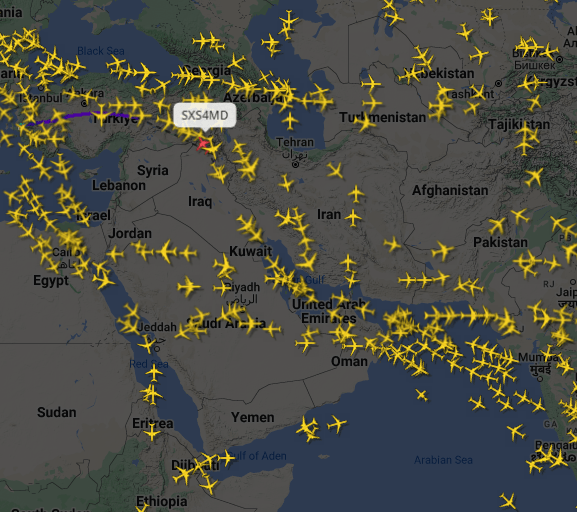
    Iran launches attack against Israel using dozens of drones, four U.S. and Israeli officials told me,” Ravid writes. Airspace across Iran, Iran, Jordan, and Israel has reportedly been shut in the last hours. There are reports citing the Jordanian government saying it stands ready to shoot down any drones that violate its airspace. There are also unconfirmed reports that the Houthis have launched projectiles out of Yemen.

    Airspace shut from Iran to Iraq to Jordan…

    Prime Minister Benjamin Netanyahu issued the following nighttime speech just ahead of the reported attack:

    “Citizens of Israel, in recent years, and even more so in recent weeks, Israel has been preparing for the possibility of a direct attack from Iran,” the premier says in a video statement. “Our defense systems are deployed, and we are prepared for any scenario, both in defense and offense. The State of Israel is strong, the IDF is strong, the public is strong.”

    “We appreciate the US for standing by Israel’s side as well as the support of the UK, France and many other countries.” “I established a clear principle — whoever hurts us, we will hurt them. We will defend ourselves from any threat and we will do so calmly and with determination.”

    “I know that you, the citizens of Israel, are also keeping calm. I urge you to listen to the directives of the Home Front Command.”

    “Together we stand, and with God’s help, together we will overcome all of our enemies,” Netanyahu says.

    Schools in Israel and public gatherings have been closed for the coming days. The IDF is giving the citizenry guidelines about seeking bomb shelters and awaiting instructions.

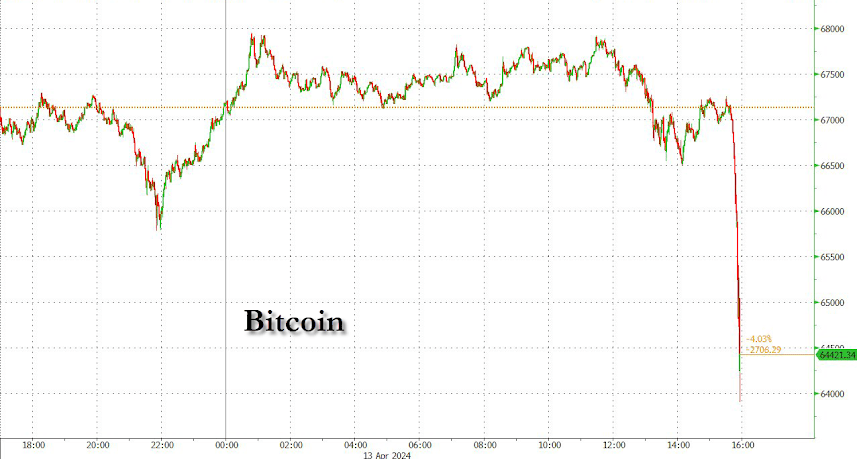
    Crypto is crashing on the news…


    President Joe Biden has reportedly cut short a beach vacation to head back to the White House where he’s meeting with his national security team, monitoring the attacks, as well as Israel’s defense. It’s as yet unclear if Iran has launched ballistic missiles, following the initial drone salvo. Fox News is reporting that the head of US Central Command, Michael Kurilla, has safely departed Israel.

    Israel’s Home Front command has issued the following emergency notification restricting gatherings across the country in anticipation of inbound Iranian projectiles. There are also “work from home” orders being issued, especially for non-essential government personnel.

    Meanwhile just yesterday…

    * * *

    The past days have seen American diplomats in a global push to get countries to hold back Iran from launching a retaliatory attack on Israel for its April 1st embassy attack in Damascus.

    Washington is especially leaning on China, Turkey, and Saudi Arabia in hopes that a united diplomatic front could deescalate the situation, at a moment Israel is bracing for an assault.

    US Secretary of State Anthony Blinken met with several officials over the past week, including Chinese Foreign Minister Wang Yi. “We have also engaged with European allies and partners over the past few days and urged them as well to send a clear message to Iran: that escalation is not in Iran’s interest, it’s not in the region’s interest and it’s not in the world’s interest,” a statement from the State Department indicated.

    Blinken “has been making clear to every country that has any semblance of a relationship with Iran that it is in their interest to use that relationship to send a message to Iran that they should not escalate this conflict. But I will let those countries speak for themselves about what action they may or may not take,” the statement from spokesman Matthew Miller said.

    Miller added that US has also “engaged with European allies and partners over the past few days” to deliver a message urging restraint to Iran. British Foreign Secretary David Cameron and German Foreign Minister Annalena Baerbock have also been engaging the Iranian foreign minister in recent days.

    Blinken’s message to Turkey and Saudi Arabia was that they should “urge Iran not to escalate.” Going into this weekend, it’s being widely reported that a major Iranian attack, possibly including ballistic missiles and drones, remains ‘imminent’. US officials have told media sources that Iran has been observed moving major military assets including missile systems.

    Though Iranian operatives on Saturday morning have seized an Israeli-linked tanker in the Strait of Hormuz, it seems the ‘big attack’ is still on hold for now.

    The Lebanese newspaper Al-Akhbar, suggests there may be a diplomatic way out that avoids full Iranian military retaliation. Iran is “proposing the following: If a ceasefire is reached in Gaza and Israel does not attack the city of Rafah, it is ready, in order to reduce escalation and tension, not to take any action against Israel at the present time,” the newspaper stated.

    But it’s anything but clear that a leader like Prime Minister Benjamin Netanyahu would be willing to alter his plans to eradicate Hamas based on dictates from Tehran. Currently, the atmosphere seems one of the calm before the storm.

    Tyler Durden
    Sat, 04/13/2024 – 23:59

    Illegal Immigration Costs American Households Hundreds Of Billions Annually

    Illegal Immigration Costs American Households Hundreds Of Billions Annually

    Authored by Chadwick Hagan via The Epoch Times,

    Illegal immigration weighs heavily on the wallets of hardworking American taxpayers – to the tune of hundreds of billions of dollars annually.

    Still, the Biden administration turns a blind eye to these fiscal strains, neglecting the toll on our economy, the structural integrity of our nation, and the safety of our citizens.

    Estimates suggest that illegal immigrants cost each household about $1,000, adding up to more than $120 billion a year.

    Sources such as Newsweek hint that the true cost may be even higher, possibly reaching $150 billion annually, an amount shared by both federal and state governments. In all actuality, the financial impact could be much worse.

    The situation continues to deteriorate by the day. Just this past December, Border Patrol recorded 249,785 arrests along the Mexican border, a 31 percent spike from November 2023 and a 13 percent surge from the December 2022 record.

    Since President Joe Biden’s inauguration and the adoption of his open borders approach, more than 7.2 million illegal immigrants have streamed into the United States through the southern border, a number surpassing the population of 36 states.

    Some estimate that number to be nearer to 10 million. The lawlessness makes it impossible to keep an accurate count.

    The repercussions of illegal immigration cast long shadows over various aspects of our society, from heightened crime rates to suppressed wages to the depletion of taxpayer resources. Public services face strain, with illegal immigrants accessing emergency health care, enrolling their children in public schools, and tapping into social welfare programs. Some argue their willingness to accept lower wages drives down earnings, leading to reduced tax revenues and increased reliance on social welfare programs among low-wage workers, citizens, and legal residents alike. Even our property tax is paying for illegal immigrants. This generational problem demands pragmatic consideration and competent leadership.

    To exacerbate matters, if illegal immigrants operate solely within cash transactions, much of their income goes undocumented.

    This is why I advocate for measures such as the Fair Tax Act, which replaces income tax with a consumption tax, ensuring revenue from cash transactions is taxed.

    While proponents argue that illegal immigrants are paying into our tax system, and even our Social Security system, it is hard to tell the difference between fact and fiction.

    According to a 2023 National Bureau of Economic Research paper (Working Paper 31086, “Measuring the Characteristics and Employment Dynamics of U.S. Inventors”), the majority of innovation in America is driven by white and Asian (including Indian) individuals.

    The paper estimates that 96.5 percent of U.S. inventors were white or Asian as of 2016.

    The question remains: Why are we allowing our borders to be overrun by illegal immigrants when we need controlled and tactical immigration to pay into our depleted social systems and kick-start the next wave of innovation?

    Why would the United States prohibit valuable workers from becoming American citizens while on work visas yet entice unskilled and impoverished workers to enter the country and stay illegally?

    These unanswered questions only add fuel to the fires of conspiracy and intrigue.

    Giving priority to visas for highly skilled workers will not only strengthen our domestic initiatives but also stimulate innovation and bolster economic growth. It is beyond puzzling that the United States of America continues to welcome unskilled workers when our nation’s prosperity hinges on innovation and skilled labor. The Democratic Party’s reluctance to use the term “illegal immigrants,” echoed by figures such as Nikki Haley, is equally confusing. As Florida Gov. Ron DeSantis rightly pointed out, coming to this country illegally is illegal.

    We need to fast-track immigrants who are likely to innovate and create wealth instead of prioritizing low-skilled workers.

    It’s time for responsible leadership to step up and implement immigration policies that benefit the United States and the American people.

    Tyler Durden
    Sat, 04/13/2024 – 23:20

    These Are Asia’s Richest Billionaires

    These Are Asia’s Richest Billionaires

    As of the start of April, Mukesh Ambani (66) is the richest man in Asia, with a net worth of $116.1 billion, according to Forbes’ Real-Time Billionaires List,

    Ambani is the chairman of Reliance Industries Limited, a conglomerate that focuses not only on petrochemicals, but also textiles and telecommunications. As Statista’s Anna Fleck reports, Ambani ranks 11th on Forbes’ worldwide list, which is headed by Bernard Arnault & family (LVMH) with $221.8 billion, Jeff Bezos (Amazon) with $197.5 billion and Elon Musk (Tesla, SpaceX, X formerly Twitter) with $189.0 billion.

    Infographic: Asia's Richest Billionaires | Statista

    You will find more infographics at Statista

    In second place – and some 32.8 billion dollars behind – comes 61-year-old Gautam Adani who is the chairperson of the Adani Group, a conglomerate that deals with businesses exporting and importing raw materials and finished goods, including coal trading, mining, oil and gas exploration, as well as ports, energy and agricultural commodities.

    He is succeeded by Zhong Shanshan (69), with a net worth of $64.5 billion. Shanshan is the founder of beverages company Nongfu Spring as well as the founder of Beijing Wantai Biological Pharmacy Enterprise, a private Chinese company and major supplier of Covid-19 testing kits.

    Rounding off the top ten comes Savitri Jindal (74), the widow of Om Prakash Jindal who founded the Jindal Group in India, whose interests lay in steel, power, cement and infrastructure, with an estimated net worth of $34.8 billion, followed by Shiv Nadar (78), founder and chairman of the IT enterprise HCL Technologies, with $34.5 billion.

    The top ten richest people in Asia have a total net worth of $542.1 billion.

    Tyler Durden
    Sat, 04/13/2024 – 22:45

    Snopes Changed Fact-Check After Pressure From Biden Administration: Emails

    Snopes Changed Fact-Check After Pressure From Biden Administration: Emails

    Authored by Zachary Stieber via The Epoch Times,

    The fact-checking website Snopes changed one of its ratings after pressure from President Joe Biden’s administration, newly disclosed emails show.

    Snopes on Jan. 10, 2023, said that there was some truth to a claim that President Biden’s administration was planning to ban gas stoves.

    Under a heading of “what’s true,” Snopes said that “The U.S. Consumer Product Safety Commission (CPSC), a federal agency, is currently considering a ban on gas stoves if they can’t be made safer, due to concerns over harmful indoor pollutants that cause health and respiratory problems.

    Under another heading, it said that the ban has not been put in place.

    The article quoted Richard Trumka Jr., a CPSC commissioner, as saying that “any option is on the table” when dealing with gas stoves. “Products that can’t be made safe can be banned,” Mr. Trumka told Bloomberg a few days prior.

    Pamela Rucker Springs, a spokeswoman for the CPSC, hours after the rating was published contacted Snopes writer Nur Ibrahim, the newly disclosed emails show.

    She said she it was “not accurate to say that CPSC is ‘considering a ban on gas stoves’ and that Mr. Trumka’s views ”do not represent official statements on behalf of the commission.”

    “We would appreciate a correction to this story,” Ms. Springs said.

    Mr. Ibrahim responded the following day saying Snopes would “correct the article.”

    Snopes then changed the fact-check rating from “mixture” to “false.”

    The CPSC “is not currently considering a ban on gas stoves, though a commissioner said ‘anything is on the table’ if they can’t be made safer,” the updated article states.

    Ms. Springs sent a link to the updated page to White House official Michael Kikukawa, the newly disclosed documents show. “Sent over tough letter to this writer yesterday when the initial claim was rated as ’mixed,’” she wrote.

    “Nice!! So helpful going forward,” Mr. Kikukawa responded.

    Mr. Kikuwaka told Ms. Springs in another email that the White House would be circulating a statement “making clear POTUS does not support banning gas stoves” and sharing social media posts from the commission and Mr. Trumka. “Will also be pushing people your way,” he wrote.

    The emails were obtained by the Functional Government Initiative nonprofit through the Freedom of Information Act.

    “A commissioner appointed by President Biden wanted to ban gas stoves, and he got caught, provoking a public outcry. So, the CPSC staff leaned on Snopes, seeking to counter the narrative by splitting hairs about commission processes. And the White House finds this ‘helpful.’ Helpful with what?“ Pete McGinnis, spokesman for the nonprofit, said in a statement.

    ”This goes beyond dysfunction—the government using sympathetic media to censor inconvenient news. The American people deserve both to keep their gas stoves and to know the truth about what regulations government officials are considering.”

    Snopes did not respond to a request for comment.

    Closer to Ban

    The CPSC framed the possibility of banning stoves as solely on Mr. Trumka, issuing a statement from Alexander Hoehn-Saric.

    The chairman of the commission said, “I am not looking to ban gas stoves and the CPSC has no proceeding to do so.”

    At the same time, CPSC officials acknowledged that they were investigating emissions from gas stoves and were “exploring new ways to address any health risks.”

    Mr. Trumka said in an internal memorandum reviewed by The Epoch Times that there was “sufficient information” for the commission to issue a notice of a proposed rule “proposing to ban gas stoves in homes.” He told Peter Feldman, another commissioner, that “emerging evidence” showed that “gas stoves in homes emit toxic gases that cause illnesses and that lower-cost, safer alternatives are available.” The Committee to Unleash Prosperity, which obtained the memo, said that it proved the administration ”intended to ban gas stoves.”

    The CPSC later approved a final notice of rulemaking offered by Mr. Trumka asking for “proposed solutions” to “hazards” from gas stoves.

    That notice has not appeared to have resulted in a new rule as of yet.

    Separately, the U.S. Department of Energy issued a proposed rule that would ban about half of the gas stoves on the market. When the final rule was released in January, though, it had been watered down and only affected about three percent of gas stoves.

    Tyler Durden
    Sat, 04/13/2024 – 22:10

    Investors Bet On Further Rise In US Gasoline Prices

    Investors Bet On Further Rise In US Gasoline Prices

    By John Kemp, senior energy analyst at Reuters

    Portfolio investors have amassed one of the largest bullish positions in U.S. gasoline futures and options since before the coronavirus pandemic, anticipating that prices will continue climbing over the next few months.

    U.S. gasoline has emerged as the most attractive part of the petroleum complex for investors betting prices will rise further this year in the run up to presidential and congressional elections in November.

    Relatively low inventories, employment gains, strong household income growth and the prospect of an active hurricane season are expected to keep gasoline consumption high and inventories under pressure.

    Ukraine’s drone attacks on refineries in Russia threaten to tighten the international supply situation even further and have prompted the Biden administration to warn Ukraine’s government to change its targeting.

    BUOYANT CONSUMPTION

    U.S. gasoline consumption is correlated with employment and household incomes so the current rise in nonfarm jobs and wage rates are likely to underpin strong use in 2024.

    Domestic consumption has been trending structurally lower since 2007 as a result of improvements in fuel economy, ethanol blending and more recently the deployment of electric and hybrid vehicles. But lower domestic use has been more than offset by strong growth in exports, mostly to Mexico and other countries in Latin America, which has kept overall refinery production trending higher.

    Strong domestic consumption during the peak summer driving season is likely to cause inventories to tighten cyclically and exert upward pressure on prices in 2024.

    ACTIVE HURRICANE SEASON

    Nearly half of the total refinery capacity in the U.S. is located along the Gulf of Mexico on the coasts of Texas and Louisiana.

    Every year there is a small but non-zero chance refinery processing will be disrupted by a direct hit from a major hurricane.

    The North Atlantic hurricane season lasts from June through November with activity peaking in August and September (“Tropical cyclone climatology”, U.S. National Oceanic and Atmospheric Administration, 2024).

    The precise number of storms, their intensity and the location of landfalls is highly variable and notoriously difficult to predict months in advance.

    But the expected shift from El Nino to La Nina conditions underway in the central and eastern Pacific is often associated with an increased number and intensity of hurricanes in the Atlantic (“Impacts of El Nino and La Nina on the hurricane season,” NOAA, 2014).

    At the same time, Atlantic storm creation and intensity is strongly correlated with sea surface temperatures in the Caribbean and the tropical North Atlantic.

    Tropical storm formation requires sea surface temperatures of at least 26°C, among a number of other conditions (“Cyclogenesis”, Australian Bureau of Meteorology, 2017).

    Sea surface temperatures in the tropical North Atlantic were at a record seasonal high in March 2024, according to data from the U.S. Climate Prediction Centre.

    Sea surface temperatures surged higher around the world, including a very strong warm El Nino phenomenon in the Pacific, but the exceptional warming was most pronounced in the Atlantic.

    Surface temperatures in the Atlantic from 5° to 20° North and from 30° to 60° West averaged almost 27.1°C in March, which was more than 1.5°C above the long-term seasonal average.

    If the surface warmth persists into the second and third quarters it is likely to result in an above average number of tropical storms and more major hurricanes in 2024 and an elevated threat to the Gulf Coast refineries.

    Colorado State University researchers have predicted an “extremely active” hurricane season in 2024 (“Forecast for 2024 hurricane activity,” CSU, April 4, 2024).

    The number of named tropical storms and hurricanes is expected to be more than 50% higher than the long-term average.

    BULLISH POSITION

    Hedge funds and other money managers owned bullish long positions equivalent to 99 million barrels on April 2, the highest number for more than four years.

    After adjusting for a minority of bearish short positions, the net position was 84 million barrels, which was in the 88th percentile for all weeks since 2013.

    Fund managers were more bullish on gasoline than on crude (56th percentile) or middle distillates such as diesel and gas oil (53rd percentile).

    Bullish long positions in gasoline outnumbered bearish short ones by a ratio of more than 6.4:1 (68th percentile) on April 2.

    The long-short ratio suggests positioning is less stretched than the absolute number of long positions, but there is still downside risk to prices when long positions are unwound.

    LOW INVENTORIES

    On April 5, U.S. gasoline inventories were 5 million barrels (-2% or -0.42 standard deviations) below the prior ten-year seasonal average.

    Stocks had been as much as 7 million barrels (+3% or +0.75 standard deviations) above seasonal average in late January.

    But a site-wide power failure stopped BP’s massive refinery at Whiting, Indiana, lasting for more than a month from the start of February and resulted in a sharp depletion of stocks.

    Since the refinery restarted in March, the deficit has narrowed slightly, but inventories remain below normal for the time of year, putting upward pressure on prices.

    EVEN HIGHER PRICES?

    U.S. retail gasoline prices (including taxes) averaged $3.54 per gallon in March 2024, almost exactly in line with the average since the start of the century once inflation is taken into account.

    Inflation-adjusted prices have risen from a recent low of $3.22 in January 2024 but are still well below the recent high of $5.42 in June 2022 after Russia’s invasion of Ukraine.

    Fund managers are betting heavily that gasoline prices will rise further over the remainder of the year.

    From a purely positioning perspective, the large number of bullish long positions that must eventually be liquidated has itself created downside risk to prices.

    From a fundamental perspective, however, low inventories, strong consumption, threat to Russia’s refineries, and elevated hurricane risk to U.S. refineries are all sources of upside potential.

    Tyler Durden
    Sat, 04/13/2024 – 21:35