64.6 F
Chicago
Sunday, September 20, 2026
Home Blog Page 2734

Trump Suggests Offering Aid To Ukraine In The Form Of A Loan

Trump Suggests Offering Aid To Ukraine In The Form Of A Loan

Authored by Aldgra Fredly via The Epoch Times,

Former President Donald Trump has suggested that he would support Republicans approving Ukraine aid in the form of a loan, but that Europe must “equalize” its efforts to help Ukraine in its war against Russia.

During a press conference at his Mar-a-Lago residence with House Speaker Mike Johnson (R-La.), President Trump said they are “thinking about making it in the form of a loan instead of just a gift.”

“We keep handing out gifts of billions and billions of dollars, and we’ll take a look at it,” the former president said.

“But much more importantly to me is the fact that Europe has to step up, and they have to give money. They have to equalize. If they don’t equalize I’m very upset about it, because they’re affected much more than we are.”

President Trump has been skeptical of Washington’s support for Ukraine in its war against Russia and said that he would bring the fighting to an end within 24 hours if he were to return to the White House.

The former president has previously called on the U.S. government to stop sending money in the form of foreign aid to any country “unless it is done as a loan.”

Mr. Johnson, who was also present during the press conference, has delayed for months a House vote on legislation already passed by the Democratic-led Senate providing $60 billion in aid for Ukraine.

Ukraine’s President Volodymyr Zelenskyy attends a press conference during the “Ukraine Year 2024” forum in Kyiv, Ukraine, on Feb. 25, 2024. (Sergei Supinsky/AFP via Getty Images)

Ukraine Willing to Accept US Aid in Loan

Meanwhile, Ukrainian President Volodymyr Zelenskyy told a local broadcaster last week that his government would be open to accepting U.S. aid in the form of loan if that is the only option left.

“You know, a senator was here recently, and he asked me: would you agree to take the loan money? I said, ‘What are the options?’ He said, ‘Well, if, for example, they tell you that the money is a loan or you won’t get it.’ I said, ‘What’s the point of such an election if there is no choice?’

“Let’s be honest: we will agree to any option. I’ll tell you more: if Ukraine was offered a package on credit today or free of charge in a year, we would say: only today. There is no choice here. Our only choice is to survive and win. We are trying to do this in different ways. This is about the loan. Important: the sooner the better,” he said.

But Mr. Zelenskyy said he remains optimistic in getting “a positive vote” from the U.S. Congress.

“Unfortunately, we are a bit hostage to this situation. Unfortunately, the issue of Ukraine, namely the issue of Russia’s war against Ukraine, has become a domestic political issue in the United States today. Although this is the security of the whole world,” he remarked.

Ukraine Aid Package in Progress

Mr. Johnson told Fox News on March 31 that legislation to provide additional aid for Ukraine is being drafted in the House and will be brought to the floor when members return from their current recess.

“When it comes to the supplemental, we’ve been working to build that consensus. We’ve been talking to all the members, especially now over the district work period. When we return after this work period, we’ll be moving a product, but it’s going to, I think, have some important innovations,” he said.

Mr. Johnson has been supportive of continued aid for Ukraine but has also stressed the importance of securing the United States’s own borders first.

When the Senate passed legislation that included funding for both Ukraine and immigration enforcement, he led the opposition in the House on the grounds that the bill heavily prioritized Ukraine and offered no significant border policy reforms.

As of yet, there has been no agreement reached on the crisis at the U.S.–Mexico border. While President Joe Biden and Democrats say additional funding is needed to stop the historic surge of illegal immigrants into the United States, Republicans hold that the president already possesses the funds and authority to fix the problem.

Tyler Durden
Sat, 04/13/2024 – 21:00

Watch: Non-English Speaking Military-Aged Venezuelan Male Attempts To Rob Bank In Ohio Using Translator App

Watch: Non-English Speaking Military-Aged Venezuelan Male Attempts To Rob Bank In Ohio Using Translator App

President Biden’s disastrous open southern border policies have sparked a migrant crime wave. This comes amid the ten million plus illegal aliens that have invaded the nation through the collapsed southern border, alongside recent calls from radical progressive lawmakers across crime-ridden metro areas to defund the police and limit criminal prosecution. All of this is a perfect storm of crime and chaos heading into the summer months. 

According to Bloomberg data, the story count featuring “migrant crime” has surged from only a handful of headlines to hundreds in the last 3.5 months. 

Some of these headlines include Chilean crime gangs roaming the nation on a burglary spree, targeting wealthy neighborhoods from coast to coast. Some migrants have even taken to social media to inform others about seizing homes from Americans under progressive squatting laws. Others run amuck in progressive metro areas where Soros-backed district attorneys fail to prosecute some criminals. 

The latest instance of the migrant invasion and escalating crime wave was a 20-year-old illegal alien from Venezuela who attempted to rob a bank in Sandusky, Ohio. 

On April 4, Sandusky Police were called to the West Perkins Avenue bank for a ‘suspicious man loitering’, according to local media outlet Sandusky Register

“While en route to the bank, officers received additional information that Yeixon Brito-Gonzalez, who only spoke Spanish, was asking tellers to put money in a white trash bag,” the paper said. 

Video released of the attempted robbery shows the illegal alien using a translator app on a smartphone to instruct the teller to load a trash bag full of cash. 

Here’s more from the Sandusky Register: 

In speaking with bank personnel, officers learned that Brito-Gonzalez had attempted to get behind the bank counter and then sat in a chair.

He purportedly showed a teller his phone several times with messages translated into English from Spanish. The messages directed the teller to get money and place it in a white trash bag Briton-Gonzalez had with him.

Officers later located Brito-Gonzalez in the 1300 block of E. Parish St. They learned he only spoke Spanish so they called in an officer who is fluent in that language, the report states.

It was discovered that he had a white trash bag in his possession. He also voluntarily showed officers his phone, and they found a translation application on it, according to Sandusky police Chief Jared Oliver.

Brito-Gonzalez was arrested based upon statements he made as well as witness statements, however officers were unable to positively identify him at the time due to his not having any identification documents.

He was ordered held at Erie County Jail under a no-bond order. Officers were later able to identify him through the use of an FBI fingerprint database, Oliver said.

As of late Friday, Brito-Gonzalez is still incarcerated in Erie County Jail under a no-bond order. In addition to his charges from the attempted robbery, US Border Patrol is actively involved in this case as well.

This incident serves as a reminder for every law-abiding American that some military-aged migrants who were unvetted and flooded this nation are escalating their rampage across the country.

Let’s not forget.

And Biden’s migrant invasion continues to spiral out of control. 

The migrant crisis the White House helped create is a public safety risk – already killing Americans. Yet, the White House ignores. 

Tyler Durden
Sat, 04/13/2024 – 20:25

IDF Planning “Significant Response” Against Iran As Explosions Ring Out Across Israel

IDF Planning “Significant Response” Against Iran As Explosions Ring Out Across Israel

Update(20:00ET): CNN is reporting there have been several explosion on the ground across Israel, but there’s yet to be official confirmation of the extent of casualties. Israeli media is reporting the first as follows: “Medics treating first injury from Iran attack – a 10-year-old boy from Bedouin town near Arad in serious condition.” The IDF spokesman is confirming at least one of its military bases has been hit in the south by an Iranian cruise missile, sustaining “minor damage”. This was reportedly at Dimona, where Israel reportedly has undeclared nuclear weapons, making such a strike highly dangerous. Further Iran’s IRNA is reporting:

Iran successfully struck the Israeli airbase in the Negev Desert with ‘Khaybar’ ballistic missiles.

Importantly, Times of Israel is reporting that Israel’s military is preparing a response, in what is likely to become a continuing tit-for-tat in the coming days:

Israel plans a “significant response” to the unprecedented Iranian drone salvo against it, top-rated Channel 12 TV quotes an unnamed senior Israeli official as saying early on Sunday.

The IDF has called this new attack a “major escalation”. Over “200 different kinds” of projectiles were fired toward Israel, the IDF spokesman said. For more than the past week Israeli leaders have firmly warned that should Iran launch retaliation from within its own soil, the Israeli response against the Islamic Republic will be ‘stronger’ – as Netanyahu previously put it. That’s precisely what has happened and so a major Israeli response is likely.

Below: stunning footage over the Temple Mount of Jerusalem as Israeli anti-air highly active:

More over Jerusalem:

German Foreign Minister Annalena Baerbock has condemned Iran’s attack on Israel, saying it risks plunging the entire region “into chaos.”

“We condemn the ongoing attack in the strongest possible terms, risking to plunge an entire region into chaos,” Baerbock wrote on X. “Iran and its proxies must stop this immediately. In these hours, we stand firmly by Israel.” However, by and large there was silence from European and NATO leaders when Israel mounted an unprecedented attack on Iran’s embassy in Damascus on April 1st.

Meanwhile, the US says it is still intercepting inbound drones and missiles. The IDF says it has “numerous” fighter jets in the air right now. Iran has warned Washington not do get involved in the conflict, saying American bases in the region are at risk if it does so.

An extremely vague Biden statement:

Al Jazeera LIVE FEED:

* * *

Update(1845): Ballistic missiles are still in the air headed for Israel along with more than 100 drones. Live visuals have shown projectiles falling on Israel. Iran is now very publicly saying the matter has “concluded”:

IRAN’S UN MISSION: “Iran’s military action was in response to the Zionist regime’s aggression against our diplomatic premises in Damascus. The matter can be deemed concluded. However, should the Israeli regime make another mistake, Iran’s response will be considerably more severe. It is a conflict between Iran and the rogue Israeli regime, from which the U.S. MUST STAY AWAY!”

From Israel’s perspective, Iran has now crossed a red line, and Netanyahu is likely to now see himself as having carte blanche to take out Iran nuclear facilities.

* * *

Update(1805): Iranian state media has just reported that the elite IRGC has launched its first wave of ballistic and(or) cruise missiles at Israel. Already an estimated hundreds of drones are headed toward Israel. It appears Iran is seeking to overwhelm Israel’s anti-air defense systems. The United States is expected to help Israel intercept this barrage. There are statements from the Houthis saying they have also launched rockets against Israel, and there are fears Hezbollah is about to unleash a barrage too, with early reports saying dozens of Katyusha rockets have already been sent into northern Israel tonight. Unconfirmed reports have said rockets have been launched from Iranian assets in Syria too.

Below is the IRGC confirmation via PressTV: “In response to the Zionist regime’s numerous crimes, including the attack on the consular section of Iran’s Embassy in Damascus and the martyrdom of a number of our country’s commanders and military advisors in Syria, the IRGC’s Aerospace Division launched tens of missiles and drones against certain targets inside the occupied territories,” the statement read. At this point the question is which will hit first: the slower-moving drones which were launched well over an hour ago, or the ballistic missiles which are likely to take less than 30 minutes to reach their targets.

The Iranian attack has an official name, and Tehran is warning that the US and foreign countries must ‘stay away’ from the conflict…

IRAN’S REVOLUTIONARY GUARDS SAYS OPERATION ‘TRUE PROMISE’ IS PART OF PUNISHMENT FOR ISRAELI CRIMES’ – IRANIAN STATE TV


Already hawks in the US are urging Biden to intervene heavily on the side of Israel…

According to an unconfirmed note:

Al Jazeera citing Channel 12: British fighters participate with American fighters in intercepting Iranian marches in the airspace of Jordan and Syria.

Geopolitical analyst Max Abrahms writes that “Iran and Israel are now at war. A real, direct war.”

* * *

Update(1554ET): Axios correspondent Barak Ravid has cited several US and Israeli officials who say Iran’s attack against Israel has started. It is currently almost 11pm in Israel. It could take hours for the drones to reach Israel, however, the big question remains whether Tehran sends ballistic missiles. Both the IDF and the Biden administration have confirmed that drones are en route to Israeli airspace. Iranian state TV also since confirmed. The White House has said the attack is “likely to unfold over a number of hours.”

Iran launches attack against Israel using dozens of drones, four U.S. and Israeli officials told me,” Ravid writes. Airspace across Iran, Iran, Jordan, and Israel has reportedly been shut in the last hours. There are reports citing the Jordanian government saying it stands ready to shoot down any drones that violate its airspace. There are also unconfirmed reports that the Houthis have launched projectiles out of Yemen.

Airspace shut from Iran to Iraq to Jordan…

Prime Minister Benjamin Netanyahu issued the following nighttime speech just ahead of the reported attack:

“Citizens of Israel, in recent years, and even more so in recent weeks, Israel has been preparing for the possibility of a direct attack from Iran,” the premier says in a video statement. “Our defense systems are deployed, and we are prepared for any scenario, both in defense and offense. The State of Israel is strong, the IDF is strong, the public is strong.”

“We appreciate the US for standing by Israel’s side as well as the support of the UK, France and many other countries.” “I established a clear principle — whoever hurts us, we will hurt them. We will defend ourselves from any threat and we will do so calmly and with determination.”

“I know that you, the citizens of Israel, are also keeping calm. I urge you to listen to the directives of the Home Front Command.”

“Together we stand, and with God’s help, together we will overcome all of our enemies,” Netanyahu says.

Schools in Israel and public gatherings have been closed for the coming days. The IDF is giving the citizenry guidelines about seeking bomb shelters and awaiting instructions.

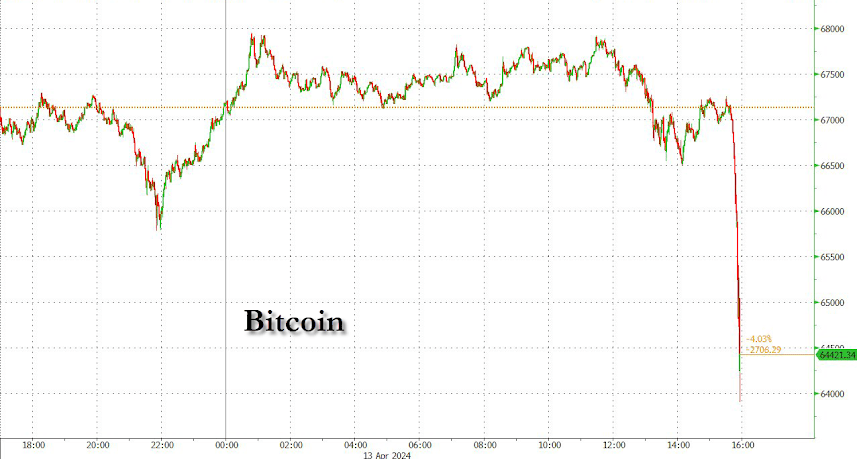
Crypto is crashing on the news…


President Joe Biden has reportedly cut short a beach vacation to head back to the White House where he’s meeting with his national security team, monitoring the attacks, as well as Israel’s defense. It’s as yet unclear if Iran has launched ballistic missiles, following the initial drone salvo. Fox News is reporting that the head of US Central Command, Michael Kurilla, has safely departed Israel.

Israel’s Home Front command has issued the following emergency notification restricting gatherings across the country in anticipation of inbound Iranian projectiles. There are also “work from home” orders being issued, especially for non-essential government personnel.

Meanwhile just yesterday…

* * *

The past days have seen American diplomats in a global push to get countries to hold back Iran from launching a retaliatory attack on Israel for its April 1st embassy attack in Damascus.

Washington is especially leaning on China, Turkey, and Saudi Arabia in hopes that a united diplomatic front could deescalate the situation, at a moment Israel is bracing for an assault.

US Secretary of State Anthony Blinken met with several officials over the past week, including Chinese Foreign Minister Wang Yi. “We have also engaged with European allies and partners over the past few days and urged them as well to send a clear message to Iran: that escalation is not in Iran’s interest, it’s not in the region’s interest and it’s not in the world’s interest,” a statement from the State Department indicated.

Blinken “has been making clear to every country that has any semblance of a relationship with Iran that it is in their interest to use that relationship to send a message to Iran that they should not escalate this conflict. But I will let those countries speak for themselves about what action they may or may not take,” the statement from spokesman Matthew Miller said.

Miller added that US has also “engaged with European allies and partners over the past few days” to deliver a message urging restraint to Iran. British Foreign Secretary David Cameron and German Foreign Minister Annalena Baerbock have also been engaging the Iranian foreign minister in recent days.

Blinken’s message to Turkey and Saudi Arabia was that they should “urge Iran not to escalate.” Going into this weekend, it’s being widely reported that a major Iranian attack, possibly including ballistic missiles and drones, remains ‘imminent’. US officials have told media sources that Iran has been observed moving major military assets including missile systems.

Though Iranian operatives on Saturday morning have seized an Israeli-linked tanker in the Strait of Hormuz, it seems the ‘big attack’ is still on hold for now.

The Lebanese newspaper Al-Akhbar, suggests there may be a diplomatic way out that avoids full Iranian military retaliation. Iran is “proposing the following: If a ceasefire is reached in Gaza and Israel does not attack the city of Rafah, it is ready, in order to reduce escalation and tension, not to take any action against Israel at the present time,” the newspaper stated.

But it’s anything but clear that a leader like Prime Minister Benjamin Netanyahu would be willing to alter his plans to eradicate Hamas based on dictates from Tehran. Currently, the atmosphere seems one of the calm before the storm.

Tyler Durden
Sat, 04/13/2024 – 20:00

The Hidden Cost Of Progressivism, Part I

The Hidden Cost Of Progressivism, Part I

Authored by David Parker via The Epoch Times,

With the U.S. Constitution, the Founding Fathers created a nation of maximum individual freedom, maximum individual responsibility, limited government, and classical liberalism. Having fled anti-democratic European aristocracy, privileged class structure, and limited opportunity, American colonists did not want government in their lives. The Founding Fathers believed that Adam Smith was correct when he said individuals independently pursuing their self-interest to survive naturally organize society. Without government planning, it was the invisible hand of nature.

In 1933, America flipped that vision. To progressives, freedom now meant freedom with government. President Franklin Roosevelt turned government from a neutral third party, whose sole purpose is to protect life, liberty, and property, to government as an active third party, whose sole purpose is to provide life, liberty, and property. This is the nation we have today, where all citizens (to some degree) are dependent on government.

That reversal comes with a cost: the hidden cost of progressivism.

Every individual or family earning $50,000 per year is, today, paying a hidden tax of at least $28,100 per year over and above federal and state income tax.

Examples:

  1. Government has so regulated the market for health care that the market no longer exists. American health insurance today is not insurance; it’s prepaid health care—that’s why it costs two to three times what it should, two to three times what it costs anywhere else in the world. With health insurance in the United States automatically paying for most procedures, citizens no longer bargain over price. To nothing else in life are they so indifferent. Citizens in New Jersey, for instance, are indifferent to the fact that the price of health insurance in Pennsylvania is three times less. In complete violation of interstate commerce, progressive federal law forbids citizens from purchasing health insurance across state lines. Before Medicare, the cost of health insurance was $200 per month (in 2022 dollars), $50 per month for a young person—the price of auto insurance, property insurance on a $1 million home, or life insurance. Today, it’s $600 per month, provided your employer contributes an additional $800 to $1,000. The employer doesn’t care; it’s a tax write-off. Eliminate government from health care, and the price of health insurance will drop by 66 percent. Ask your employer to give you what he’s paying on your behalf. It’s your money. $800 per month times 12 is $9,600 per year. Hidden tax one.

  2. Social Security takes 15 percent of your income. You pay 7.5 percent, and your employer pays 7.5 percent, but it’s money your employer would otherwise have given you. Fifteen percent, however, is more than is necessary. Properly invested, 10 percent is sufficient. That 5 percent differential on $50,000 is $2,500 per year. Hidden tax two. (That 10 percent of $50,000, $5,000, when invested at 5 percent annual interest compounded monthly, in 40 years is worth $658,194. In 50 years, $1,147,283.)

  3. In 1964, President Lyndon Johnson said unequivocally that there would be no increase in taxes for the War on Poverty. A gullible nation now knows that, to date, that “war” has cost $23 trillion; that the poverty rate, 15 percent in 1964, on average, remained 15 percent; and that today, the war is paid for by borrowing. Roughly $900 billion per year (15 percent of the federal budget) divided by 150 million taxpayers is $6,000 per person. Hidden tax three.

  4. Until 1890, schools were private. Parents who couldn’t afford to send their children were provided the means—from property taxes. Thank you, Thomas Jefferson. But then progressives amalgamated them into today’s government-administered unified school districts—except that once a huge enterprise becomes a government project, it’s open to rent-seeking and politicization. This allowed political pressure in the 1970s to force public schools to try to create equal outcomes for all students—which they found was impossible without lowering standards, which is why middle-class parents pulled their children and sent them to private schools at a cost of $20,000 to $40,000 per year per child. If just one child per family attends private school at $20,000 per year ($10,000 per parent), over and above the property taxes the family already pays (even if they are tenants), that’s hidden tax four.

Hidden Taxes Per Year

So if we add up the above hidden taxes, it looks like this: $9,600 plus $2,500 plus $6,000 plus $10,000 equals $28,100.

Actually, there’s much more. Any serious constraint on business causes businesses to raise prices, a hidden tax. Domestic farm subsidies and tariffs on foreign goods raise prices. A hidden tax.

Solution: Reverse all federal legislation since 1933.

Social Security, Medicare, everything—except legislation that reinforces civil rights and national defense. Remove government from the economy, and the federal income tax rate will drop to 15 percent.

Let citizens keep that $28,100 per year! Universal basic income.

In a Jeffersonian democracy, where no citizen is denied the vote, it’s understood that citizens can and do think for themselves.

We’re not living in Plato’s Republic, an island of progressivism, where the nation’s most capable, its aristocracy, are in power. Dictatorship. In Plato’s Republic, the masses didn’t vote.

Arguments for Doing Nothing

The wealthy do not object to high income taxes; they’re not paying! Let the middle class continue to pay!

Large corporations do not object to regulation and monitoring by government. They can afford the millions of dollars in legal fees to comply—Sarbanes-Oxley, Dodd-Frank—then buy up the smaller firms that cannot. Monopoly. Let them continue to do that! The corporations that survive create the efficient corporate state: Bismarck, Mussolini, Hitler, China. National socialism!

For U.S. prosperity, all that’s necessary is that the United States has less regulation than elsewhere in the world. That would give the United States an enormous competitive advantage. Let governments worldwide tax and regulate business, forcing them to increase prices, and prices in the United States will be lower. U.S. manufacturing and exports will rise.

Let the United States offer more social, political, and economic freedom than elsewhere in the world, and it will continue to attract the world’s most independent and entrepreneurial talent – what enabled the United States to go to the moon in 1969 (German scientists), what today keeps the United States at the forefront of high technology, information technology, and quantum computing (71 percent of those in Silicon Valley are foreign-born). With American public schools being the lowest achieving in the industrialized world, with foreign students outscoring American students on the SAT and enrolling in U.S. universities, let smart immigrants continue to arrive.

The U.S. has nothing to worry about…

*  *  *

Views expressed in this article are opinions of the author and do not necessarily reflect the views of The Epoch Times or ZeroHedge.

Tyler Durden
Sat, 04/13/2024 – 19:50

The Exodus Continues: Blue Regions Still Bleeding As Residents Escape Democrat Policies

The Exodus Continues: Blue Regions Still Bleeding As Residents Escape Democrat Policies

Can Democrats take a hint?  The answer is obviously no, but with millions of people flooding out of Democrat controlled places and relocating to more conservative regions one might think they would finally get the message.

Blue cities and states across the US have been experiencing a mass exodus of legal residents since before the pandemic event; many of them business owners taking their money (and job opportunities) with them.  The hardest hit states in the country include New York, Illinois and California, with cities like NYC, LA, Chicago and San Francisco seeing some of the most aggressive population shift.  In states like California the standard operating procedure has been to lie about the situation, using the surge of illegal immigrants to hide population loss in the census.   

There are a multitude of reasons for the great American migration:  The pandemic lockdowns made many people realize Democrats are inclined towards authoritarian policies and they left because they wanted freedom. Sanctuary status is allowing illegals to flood into blue areas, straining welfare programs and inflating housing costs.  The bureaucracy of leftist cities creates a concrete barrier to success for most small to medium business owners, and even larger companies and chains are ready to exit because of high taxes and over-regulation.  Finally, soft prosecution laws in blue states and cities have led to a clear spike in criminal activity which Democrats are also trying to deny.

It’s estimated by Zillow’s chief economist that establishing a residency in California would require around $1 million or more in starting money.  The state has the second highest cost of living in the nation, as well as the worst reported job growth in the nation in 2023.  Property prices are exploding higher, but with fewer and fewer buyers.  This is probably why California has been dead last on the list of most desirable states to move to for the past few years running.   

No one wants to be left holding the bag in a state or city where it’s becoming impossible to leave.  For people with the money, relocation is a no-brainer.  

Another factor which is going mostly ignored by the establishment media is the rising trend of political disassociation.  The left has become so extreme in their views and behavior that the rest of the populace doesn’t want to deal with them anymore.  Conservatives and independents are rushing for the exits to get as far away from these people as possible.

Contrary to popular fears among conservatives, the exodus has not pushed voting numbers towards progressive politicians or policies in the slightest.  In fact, Idaho has reported a considerable influx of conservative voters moving in after escaping blue states.  Similar reports are coming out of Texas and Florida.  There is no blue tide.  There is no California takeover – Red states are only turning more red.

Are progressives moving out of the cities, too?  Yes, to the suburbs and to outlying towns within driving distances of their original homes.  It’s getting to the point where even leftists are admitting their own cities are not livable. The latest U-Haul data helps to explain the developments more clearly.

The exodus is now having visible effects on Democrat havens that can no longer be hidden.  Crime activity is so suffocating that many corporate chains are leaving, only to be threatened by city politicians with legal reprisals if they shut down.  If Democrats can’t trick people into staying, they plan to force people to stay.     

Tyler Durden
Sat, 04/13/2024 – 19:15

As Missiles Fall On Israel, Iran Says Retaliation Is “Concluded” & Warns US To “Stay Away”

As Missiles Fall On Israel, Iran Says Retaliation Is “Concluded” & Warns US To “Stay Away”

Update(1845): Ballistic missiles are still in the air headed for Israel along with more than 100 drones. Live visuals have shown projectiles falling on Israel. Iran is now very publicly saying the matter has “concluded”:

IRAN’S UN MISSION: “Iran’s military action was in response to the Zionist regime’s aggression against our diplomatic premises in Damascus. The matter can be deemed concluded. However, should the Israeli regime make another mistake, Iran’s response will be considerably more severe. It is a conflict between Iran and the rogue Israeli regime, from which the U.S. MUST STAY AWAY!”

Al Jazeera LIVE FEED:

From Israel’s perspective, Iran has now crossed a red line, and Netanyahu is likely to now see himself as having carte blanche to take out Iran nuclear facilities.

* * *

Update(1805): Iranian state media has just reported that the elite IRGC has launched its first wave of ballistic and(or) cruise missiles at Israel. Already an estimated hundreds of drones are headed toward Israel. It appears Iran is seeking to overwhelm Israel’s anti-air defense systems. The United States is expected to help Israel intercept this barrage. There are statements from the Houthis saying they have also launched rockets against Israel, and there are fears Hezbollah is about to unleash a barrage too, with early reports saying dozens of Katyusha rockets have already been sent into northern Israel tonight. Unconfirmed reports have said rockets have been launched from Iranian assets in Syria too.

Below is the IRGC confirmation via PressTV: “In response to the Zionist regime’s numerous crimes, including the attack on the consular section of Iran’s Embassy in Damascus and the martyrdom of a number of our country’s commanders and military advisors in Syria, the IRGC’s Aerospace Division launched tens of missiles and drones against certain targets inside the occupied territories,” the statement read. At this point the question is which will hit first: the slower-moving drones which were launched well over an hour ago, or the ballistic missiles which are likely to take less than 30 minutes to reach their targets.

The Iranian attack has an official name, and Tehran is warning that the US and foreign countries must ‘stay away’ from the conflict…

IRAN’S REVOLUTIONARY GUARDS SAYS OPERATION ‘TRUE PROMISE’ IS PART OF PUNISHMENT FOR ISRAELI CRIMES’ – IRANIAN STATE TV


Already hawks in the US are urging Biden to intervene heavily on the side of Israel…

According to an unconfirmed note:

Al Jazeera citing Channel 12: British fighters participate with American fighters in intercepting Iranian marches in the airspace of Jordan and Syria.

Geopolitical analyst Max Abrahms writes that “Iran and Israel are now at war. A real, direct war.”

* * *

Update(1554ET): Axios correspondent Barak Ravid has cited several US and Israeli officials who say Iran’s attack against Israel has started. It is currently almost 11pm in Israel. It could take hours for the drones to reach Israel, however, the big question remains whether Tehran sends ballistic missiles. Both the IDF and the Biden administration have confirmed that drones are en route to Israeli airspace. Iranian state TV also since confirmed. The White House has said the attack is “likely to unfold over a number of hours.”

Iran launches attack against Israel using dozens of drones, four U.S. and Israeli officials told me,” Ravid writes. Airspace across Iran, Iran, Jordan, and Israel has reportedly been shut in the last hours. There are reports citing the Jordanian government saying it stands ready to shoot down any drones that violate its airspace. There are also unconfirmed reports that the Houthis have launched projectiles out of Yemen.

Airspace shut from Iran to Iraq to Jordan…

Prime Minister Benjamin Netanyahu issued the following nighttime speech just ahead of the reported attack:

“Citizens of Israel, in recent years, and even more so in recent weeks, Israel has been preparing for the possibility of a direct attack from Iran,” the premier says in a video statement. “Our defense systems are deployed, and we are prepared for any scenario, both in defense and offense. The State of Israel is strong, the IDF is strong, the public is strong.”

“We appreciate the US for standing by Israel’s side as well as the support of the UK, France and many other countries.” “I established a clear principle — whoever hurts us, we will hurt them. We will defend ourselves from any threat and we will do so calmly and with determination.”

“I know that you, the citizens of Israel, are also keeping calm. I urge you to listen to the directives of the Home Front Command.”

“Together we stand, and with God’s help, together we will overcome all of our enemies,” Netanyahu says.

Schools in Israel and public gatherings have been closed for the coming days. The IDF is giving the citizenry guidelines about seeking bomb shelters and awaiting instructions.

Crypto is crashing on the news…


President Joe Biden has reportedly cut short a beach vacation to head back to the White House where he’s meeting with his national security team, monitoring the attacks, as well as Israel’s defense. It’s as yet unclear if Iran has launched ballistic missiles, following the initial drone salvo. Fox News is reporting that the head of US Central Command, Michael Kurilla, has safely departed Israel.

Israel’s Home Front command has issued the following emergency notification restricting gatherings across the country in anticipation of inbound Iranian projectiles. There are also “work from home” orders being issued, especially for non-essential government personnel.

Meanwhile just yesterday…

* * *

The past days have seen American diplomats in a global push to get countries to hold back Iran from launching a retaliatory attack on Israel for its April 1st embassy attack in Damascus.

Washington is especially leaning on China, Turkey, and Saudi Arabia in hopes that a united diplomatic front could deescalate the situation, at a moment Israel is bracing for an assault.

US Secretary of State Anthony Blinken met with several officials over the past week, including Chinese Foreign Minister Wang Yi. “We have also engaged with European allies and partners over the past few days and urged them as well to send a clear message to Iran: that escalation is not in Iran’s interest, it’s not in the region’s interest and it’s not in the world’s interest,” a statement from the State Department indicated.

Blinken “has been making clear to every country that has any semblance of a relationship with Iran that it is in their interest to use that relationship to send a message to Iran that they should not escalate this conflict. But I will let those countries speak for themselves about what action they may or may not take,” the statement from spokesman Matthew Miller said.

Miller added that US has also “engaged with European allies and partners over the past few days” to deliver a message urging restraint to Iran. British Foreign Secretary David Cameron and German Foreign Minister Annalena Baerbock have also been engaging the Iranian foreign minister in recent days.

Blinken’s message to Turkey and Saudi Arabia was that they should “urge Iran not to escalate.” Going into this weekend, it’s being widely reported that a major Iranian attack, possibly including ballistic missiles and drones, remains ‘imminent’. US officials have told media sources that Iran has been observed moving major military assets including missile systems.

Though Iranian operatives on Saturday morning have seized an Israeli-linked tanker in the Strait of Hormuz, it seems the ‘big attack’ is still on hold for now.

The Lebanese newspaper Al-Akhbar, suggests there may be a diplomatic way out that avoids full Iranian military retaliation. Iran is “proposing the following: If a ceasefire is reached in Gaza and Israel does not attack the city of Rafah, it is ready, in order to reduce escalation and tension, not to take any action against Israel at the present time,” the newspaper stated.

But it’s anything but clear that a leader like Prime Minister Benjamin Netanyahu would be willing to alter his plans to eradicate Hamas based on dictates from Tehran. Currently, the atmosphere seems one of the calm before the storm.

Tyler Durden
Sat, 04/13/2024 – 18:45

CDC Study Doesn’t ‘Debunk’ Link Between COVID-19 Vaccines & Sudden-Deaths

CDC Study Doesn’t ‘Debunk’ Link Between COVID-19 Vaccines & Sudden-Deaths

Authored by Zachary Stieber via The Epoch Times,

A new U.S. Centers for Disease Control and Prevention (CDC) study does not disprove a link between COVID-19 vaccines and sudden deaths among young people, contrary to claims.


The study, published by the CDC’s quasi-journal on April 11, analyzed death certificates from Oregon for people aged 16 to 30 who died between June 2021 and December 2022.

Among people who died with evidence of vaccination, three died within 100 days of a shot, Drs. Juventila Liko and Paul Cieslak with the Oregon Health Authority found.

None of those three deaths could be attributed to messenger RNA (mRNA) vaccination, or shots from Pfizer-BioNTech and Moderna, according to the doctors. Two of the deaths were attributed to underlying conditions while the cause of death for the third was “undetermined.”

“These data do not support an association between receipt of mRNA COVID-19 vaccine and sudden cardiac death among previously healthy young persons,” the doctors wrote.

The authors failed to note that a much larger, peer-reviewed study from South Korea confirmed vaccine-induced myocarditis caused eight sudden cardiac deaths (SCDs), all among people younger than 45. Myocarditis is a form of heart inflammation.

The new study “is at odds with a higher quality and peer-reviewed journal article published in the European Heart Journal,” Dr. David McCune, who was not involved with either paper, told The Epoch Times via email. “The study, from Korea, found a small but significant group of patients who had SCD and autopsy evidence consistent with vaccine-induced myocarditis.”

Multiple media outlets published stories on the new study, but none mentioned the South Korean article.

The stories also included false or misleading claims.

U.S. News and World Report’s story said that it was an “incorrect idea that COVID-19 vaccines are linked to death in young people.”

NBC’s article said that the study “debunks widespread misinformation that the mRNA shots were connected to sudden cardiac death in young athletes.”

NBC reporter Berkeley Lovelace Jr. also wrote that “there is no evidence that COVID vaccines cause fatal cardiac arrest or other deadly heart problems in teens and young adults, a CDC report finds.”

“I don’t think that is close to an accurate assessment of the CDC paper or the overall level of knowledge we have about vaccine risk,” Dr. McCune said.

The reporters who wrote the articles for U.S. News and World Report, NBC, The Hill, and Medpage Today did not respond to requests for comment.

Other papers that support a link between deaths among young people and COVID-19 vaccination include a study that analyzed post-vaccination deaths in Qatar and determined there was a “high probability” that eight sudden cardiac deaths, including one person aged 11 to 20, were caused by the vaccination. Some death certificates have also described COVID-19 vaccine-induced myocarditis as a cause of death for sudden deaths, including the certificate for an American college student who died suddenly after receiving a Pfizer shot.

Authorities in the United States acknowledge that the COVID-19 vaccines can cause myocarditis but maintain no deaths have been caused by vaccine-induced myocarditis. They have refused to release autopsies conducted on people who died after COVID-19 vaccination. Several long-term studies have identified heart scarring in people who suffered myocarditis after COVID-19 vaccination. Some experts say the scarring may be permanent and could eventually lead to death.

Dr. Ofer Levy, an adviser to the U.S. Food and Drug Administration, told NBC that no vaccine has ever been conclusively linked to sudden cardiac death and that the new study “adds to evidence that people don’t drop dead from getting their mRNA COVID vaccines.” Dr. Levy did not respond when asked whether he was aware of the South Korean paper and other literature.

NBC also quoted Dr. Leslie Cooper in promoting the study while failing to note that Dr. Cooper is a consultant for Moderna.

Authors Respond

Asked why they didn’t mention literature that presents evidence of sudden cardiac death among previously healthy young people after vaccination, the authors told The Epoch Times in an email that they had. The studies they included are an Israeli paper that does not mention sudden death; a letter that noted sudden deaths among athletes, regardless of vaccination status, since the vaccines were rolled out; an analysis of 911 calls from Israel; and a case definition for myocarditis that says it can be a cause of sudden death. None of the papers cite autopsy data or other strong evidence that has emerged.

The authors also linked to a 2021 CDC statement and a 2021 CDC presentation, neither of which mention sudden death.

The authors did not say whether they were unaware of the South Korean study or chose not to include it.

The CDC should “not have published their study without acknowledging the international studies that have identified post-mRNA vax-related cardiac death in young people,” Dr. Tracy Hoeg, who was not involved in the research, wrote on the social media platform X.

In the paper, the authors also cited an earlier CDC study that found people who entered a health system were at higher risk of cardiac complications after COVID-19 infection versus after COVID-19 vaccination. The relevance isn’t clear since the COVID-19 vaccines do not prevent infection, and some other studies have found that the risk of myocarditis is higher after vaccination among young people.

Asked why they didn’t cite any of those other studies, the authors referred back to the papers they did cite and said they “also clearly expressed the limitations in the research.”

Limitations of the paper include the small population size, which would make it “less likely” for Oregon to record “a rare event such as sudden cardiac death among adolescents and young adults,” the authors wrote in the study.

“Nevertheless, it is clear that the risk, if any, of cardiac death linked to COVID-19 vaccination is very low, while the risk of dying from COVID-19 is real,” Dr. Cieslak said in a press release issued by the Oregon Health Authority. “We continue to recommend COVID-19 vaccination for all persons 6 months of age and older to prevent COVID-19 and complications, including death.”

The authority didn’t list any data that show the currently available vaccines prevent COVID-19 complications such as death. U.S. regulators cleared them in 2023 without clinical trial efficacy data. Only animal testing data was available for the Pfizer-BioNTech and Novavax shots. Moderna presented antibody data from 50 humans. Observational studies have since provided mixed effectiveness data against infection and hospitalization.

CDC Journal

The CDC published the study in its journal, Morbidity and Mortality Weekly Report (MMWR), which only publishes papers after officials shape them to align with the agency’s messaging. The CDC has been relentlessly promotive of the COVID-19 vaccines since they were rolled out.

Previous releases of documents under the Freedom of Information Act (FOIA) show that CDC officials engage in multiple rounds of editing of papers published in the journal.

The authors of the new paper acknowledged that the paper was edited prior to publication.

“CDC made no edits that altered the conclusions of the study,” they said.

The CDC journal’s editor-in-chief did not respond to a query.

The Epoch Times has filed FOIA requests to ascertain which edits were made, and by whom.

The authors also defended the choice to submit the paper to MMWR, rather than a traditional journal.

“Many times there is a large amount of observational data that is critical for time-sensitive reporting to inform public health practitioners and clinicians. These sorts of time-sensitive publications that might impact the actions of state and county public health leaders have long been published in the CDC’s MMWR,” they said. “In fact, there are numerous examples of CDC’s MMWR being the first source of information during many important historical events, including the beginning of the AIDS pandemic, the discovery of Legionnaires disease, the initial cases of H1N1 in 2009.”

Tyler Durden
Sat, 04/13/2024 – 18:40

Afghan Migrant On Terror List Released By Immigration Judge, Free To Roam USA

Afghan Migrant On Terror List Released By Immigration Judge, Free To Roam USA

An Afghan man and illegal immigrant who’s on the FBI terror watchlist has been twice apprehended in the United States only to be released by a federal apparatus that continues to make a mockery of the very notion of “border security.”  

Mohammad Kharwin, 48, was first arrested in Southern California in March 2023 after he’d illegally entered the United States from Mexico, according to NBC News, which was first to report the story. Border police suspected Kharwin was on the watchlist, because one unspecified attribute matched his entry on the list.

Masses of migrants camped in San Ysidro, California in 2023. Mohammed Kharwin was initially processed in the same vicinity. (7SanDiego)

However, for lack of additional corroborating data, he was processed and released, just like hordes of other illegal migrants before and since. He was instructed to periodically call an Immigration and Customs Enforcement (ICE) officer, but was free to apply for asylum and permission to work in the United States. He was also free to board domestic flights.  

This February, the FBI alerted ICE that they suspected Kharwin had links to a terrorist group and could pose a danger. That prompted ICE to track him down in San Antonio and arrest him on Feb. 28. 

Buckle in, because the story’s about to get a lot worse. On March 28, Kharwin had an immigration hearing in Pearsall, Texas. The ICE prosecutors told the judge that Kharwin was a flight risk who should be detained without bond. However, they didn’t tell the judge that he posed a potential risk to national security, and declined to show the judge information revealing why the FBI is concerned about him. 

Homeland Security Secretary Alejandro Mayorkas was impeached by the House in February over his border performance (Bill Clark/CQ Roll Call)

Kept in the dark, the unnamed immigration judge ordered that Kharwin be released, but demanded an above-average-for-illegal-immigrants $12,000 bond. Kharwin immediately paid it and off he went, without any court-mandated restrictions on his travel within the country. He is supposed to appear for another hearing next spring. ICE hasn’t appealed the ruling and, in NBC‘s reporting, there’s no indication authorities are seeking him. 

According to the watchlist, the FBI believes Kharwin is a member of an Afghanistan group called Hezb-e-Islami (HIG), which has been designated by the United States as a terror group. 

According to the Office of the Director of National Intelligence, HIG is a “virulently anti-Western insurgent group” that sought to overturn the Western-backed Afghan government before its fall in 2021. 

HIG was responsible for attacks in Afghanistan that killed at least nine American soldiers and civilians between 2013 and 2015. The group is not seen as a top threat in terms of attacks inside the U.S.

Believe it or not, there are some 1.8 million names on the FBI’s terror watchlist, and, as has been observed in the colossal rolling clusterf**k at Guantanamo Bay, the US government sometimes misidentifies people — with positively godawful results. That said, the FBI could well be correct about Kharwin, and the handling of his March immigration hearing is certainly a cause for concern. 

Migrants near Eagle Pass, Texas await processing in December 2023 (John Moore/Getty Images via Fox10)

There have been similar cases where watchlisted men have been processed and released. In February, we detailed the case of a man who allegedly is/was a member of the Somali terror group al-Shabaab. He was also caught in southern California in March 2023 and set free to roam the country.  

In 2023 the Border Patrol caught 172 suspects from the terror watchlist attempting to enter the US illegally. According to former DHS officials, the constant deluge of illegal migrants through the southern border has made it easier for bad actors to enter the country. According to NBC‘s analysis of government data, about 0.02% of encountered illegal immigrants are on the terror watchlist — making them needles in a Biden-enlarged haystack. 

Tyler Durden
Sat, 04/13/2024 – 18:05

How Did Satoshi Think Of Bitcoin?

How Did Satoshi Think Of Bitcoin?

Authored by Unchained CSO Dhruv Bansal via BitcoinMagazine.com,

Bitcoin is often compared to the internet in the 1990s, but I believe the better analogy is to the telegraph in the 1840s.

The telegraph was the first technology to transmit encoded data at near-light speed over long distances. It marked the birth of the telecommunications industry. The internet, though it is bigger in scale, richer in content, and manyto-many instead of one-to-one, is fundamentally still a telecommunications technology.

Both the telegraph and the internet rely upon business models in which companies deploy capital to build a physical network and then charge users to send messages through this network. AT&T’s network has historically transmitted telegrams, telephone calls, TCP/IP packets, text messages, and now TikToks.

The transformation of society through telecom has led to greater freedoms but also greater centralization. The internet has increased the reach of millions of content creators and small businesses, but has also strengthened the grasp of companies, governments and other institutions well-positioned enough to monitor and manipulate online activity.

But bitcoin is not the end of any transformation – it’s the beginning of one. Like telecommunications, bitcoin will change both human society and daily life. Predicting the full scope of this change today is akin to imagining the internet while living in the era of the telegraph.

This series attempts to imagine this future by starting with the past. This initial article traces the history of digital currencies before bitcoin. Only by understanding where prior projects fell short can we perceive what makes bitcoin succeed—and how it suggests a methodology for building the decentralized systems of the future.

OUTLINE

I. Decentralized systems are markets

II. Decentralized markets require decentralized goods

III. How can decentralized systems price computations?

IV. Satoshi’s monetary policy goals led to bitcoin

V. Conclusion

A central claim of this article is that bitcoin can be thought of as an adaptation of Dai’s b-money project that eliminates the freedom to create money. Just weeks after this article was originally published, new emails surfaced in which Satoshi claimed to be unfamiliar with b-money, yet admitted that bitcoin starts “from exactly that point.” In light of this new evidence, we believe this central claim, while not historically accurate, is still a meaningful and helpful way to think about the origin of bitcoin. 

Unchained is the Official Collaborative Custody Partner of Bitcoin Magazine. Click here to learn more about Unchained’s bitcoin financial services and receive exclusive discounts on Unchained vault, Signature and IRA.

HOW DID SATOSHI THINK OF BITCOIN?

Satoshi was brilliant, but bitcoin didn’t come out of nowhere.

Bitcoin iterated on existing work in cryptography, distributed systems, economics, and political philosophy. The concept of proof-of-work existed long before its use in money and prior cypherpunks such as Nick Szabo, Wei Dai, & Hal Finney anticipated and influenced the design of bitcoin with projects such as bit gold, b-money, and RPOW. Consider that, by 2008, when Satoshi wrote the bitcoin white paper,[2] many of the ideas important to bitcoin had already been proposed and/or implemented:

  • Digital currencies should be P2P networks

  • Proof-of-work is the basis of money creation

  • Money is created through an auction

  • Public key cryptography is used to define ownership & transfer of coins

  • Transactions are batched into blocks

  • Blocks are chained together through proof-of-work

  • All blocks are stored by all participants

Bitcoin leverages all these concepts, but Satoshi didn’t originate any of them. To better understand Satoshi’s contribution, we should determine which principles of bitcoin are missing from the list.

Some obvious candidates are the finite supply of bitcoin, Nakamoto consensus, and the difficulty adjustment algorithm. But what led Satoshi to these ideas in the first place?

This article explores the history of digital currencies and makes the case that Satoshi’s focus on sound monetary policy is what led bitcoin to surmount challenges that defeated prior projects such as bit gold and b-money.

I. DECENTRALIZED SYSTEMS ARE MARKETS 

Bitcoin is often described as a decentralized or distributed system. Unfortunately, the words “decentralized” and “distributed” are frequently confused. When applied to digital systems, both terms refer to ways a monolithic application can be decomposed into a network of communicating pieces.

For our purposes, the major difference between decentralized and distributed systems is not the topology of their network diagrams, but the way they enforce rules. We take some time in the following section to compare distributed and decentralized systems and motivate the idea that robust decentralized systems are markets.

DISTRIBUTED SYSTEMS RELY UPON CENTRAL AUTHORITIES

In this work, we take “distributed” to mean any system that has been broken up into many parts (often referred to as “nodes”) which must communicate, typically over a network.

Software engineers have grown adept at building globally distributed systems. The internet is composed of distributed systems collectively containing billions of nodes. We each have a node in our pocket that both participates in and relies upon these systems.

But almost all the distributed systems we use today are governed by some central authority, typically a system administrator, company, or government that is mutually trusted by all nodes in the system.

Central authorities ensure all nodes adhere to the system s rules and remove, repair, or punish nodes that fail to do so. They are trusted to provide coordination, resolve conflicts, and allocate shared resources. Over time, central authorities manage changes to the system, upgrading it or adding features, and ensuring that participating nodes comply with the changes.

The benefits a distributed system gains from relying upon a central authority come with costs. While the system is robust against failures of its nodes, a failure of its central authority may cause it to stop functioning overall. The ability for the central authority to unilaterally make decisions means that subverting or eliminating the central authority is sufficient to control or destroy the entire system.

Despite these trade-offs, if there is a requirement that a single party or coalition must retain central authority, or if the participants within the system are content with relying upon a central authority, then a traditional distributed system is the best solution. No blockchain, token, or similar decentralized dressing is required.

In particular, the case of a VC- or government-backed cryptocurrency, with requirements that a single party can monitor or restrict payments and freeze accounts, is the perfect use case for a traditional distributed system.

DECENTRALIZED SYSTEMS HAVE NO CENTRAL AUTHORITIES 

We take “decentralized” to have a stronger meaning than “distributed”: decentralized systems are a subset of distributed systems that lack any central authority. A close synonym for “decentralized” is “peer-to-peer” (P2P). 

Removing central authority confers several advantages. Decentralized systems:

  • Grow quickly because they lack barriers to entry—anyone can grow the system by simply running a new node, and there is no requirement for registration or approval from the central authority.

  • Are robust because there is no central authority whose failure can compromise the functioning of the system. All nodes are the same, so failures are local and the network routes around damage.

  • Are difficult to capture, regulate, tax, or surveil because they lack centralized points of control for governments to subvert.

These strengths are why Satoshi chose a decentralized, peer-to-peer design for bitcoin:

“Governments are good at cutting off the heads of… centrally controlled networks like Napster, but pure P2P networks like Gnutella and Tor seem to be holding their own.” – Nakamoto, 2008

But these strengths come with corresponding weaknesses. Decentralized systems can be less efficient as each node must additionally bear responsibilities for coordination previously assumed by the central authority.

Decentralized systems are also plagued by scammy, adversarial behavior. Despite Satoshi’s nod to Gnutella, anyone who’s used a P2P file sharing program to download a file that turned out to be something gross or malicious understands the reasons that P2P file sharing never became the mainstream model for data transfer online.

Satoshi didn’t name it explicitly, but email is another decentralized system that has evaded government controls. And email is similarly notorious for spam.

DECENTRALIZED SYSTEMS ARE GOVERNED THROUGH INCENTIVES

The root problem, in all of these cases, is that adversarial behavior (seeding bad files, sending spam emails) is not punished, and cooperative behavior (seeding good files, only sending useful emails) is not rewarded. Decentralized systems that rely upon their participants to be good actors fail to scale because they cannot prevent bad actors from also participating.

Without imposing a central authority, the only way to solve this problem is to use economic incentives. Good actors, by definition, play by the rules because they’re inherently motivated to do so. Bad actors are, by definition, selfish and adversarial, but proper economic incentives can redirect their bad behavior towards the common good. Decentralized systems that scale do so by ensuring that cooperative behavior is profitable and adversarial behavior is costly.

The best way to implement robust decentralized services is to create markets where all actors, both good and bad, are paid to provide that service. The lack of barriers to entry for buyers and sellers in a decentralized market encourages scale and efficiency. If the market’s protocols can protect participants from fraud, theft, and abuse, then bad actors will find it more profitable to either play by the rules or go attack a different system.

II. DECENTRALIZED MARKETS REQUIRE DECENTRALIZED GOODS 

But markets are complex. They must provide buyers and sellers the ability to post bids & asks as well as discover, match and settle orders. They must be fair, provide strong consistency, and maintain availability despite periods of volatility.

Global markets today are extremely capable and sophisticated, but using traditional goods and payment networks to implement incentives in a decentralized market is a nonstarter. Any coupling between a decentralized system and fiat money, traditional assets, or physical commodities would reintroduce dependencies on the central authorities that control payment processors, banks, & exchanges.

Decentralized systems cannot transfer cash, look up the balance of a brokerage account, or determine the ownership of property. Traditional goods are completely illegible from within a decentralized system. The inverse is not true—traditional systems can interact with bitcoin as easily as any other actor (once they decide they want to). The boundary between traditional and decentralized systems is not an impassable wall, but a semi-permeable membrane.

This means that decentralized systems cannot execute payments denominated in any traditional good. They cannot even determine the balances of fiat-dominated accounts or the ownership of real estate or physical goods. The entire traditional economy is completely illegible from within decentralized systems.

Creating decentralized markets requires trading new kinds of decentralized goods which are legible and transferable within decentralized systems.

COMPUTATION IS THE FIRST DECENTRALIZED GOOD

The first example of a “decentralized good” is a special class of computations first proposed in 1993 by Cynthia Dwork and Moni Naor.[3]

Because of deep connections between mathematics, physics, and computer science, these computations cost real-world energy and hardware resources—they cannot be faked. Since real-world resources are scarce, these computations are also scarce.

The input for these computations can be any kind of data. The resulting output is a digital “proof” that the computations were performed on the given input data. Proofs contain a given “difficulty” which is (statistical) evidence of a given amount of computational work. Most importantly, the relationship between the input data, the proof, and the original computational work performed can be independently verified without appeal to any central authority.

The idea of passing around some input data along with a digital proof as evidence of real-world computational work performed on that input is now called “proof-of-work”.[4] Proofs-of-work are, to use Nick Szabo’s phrase, “unforgeable costliness”. Because proofs-of-work are verifiable by anyone, they are economic resources that are legible to all participants in a decentralized system. Proofs-of-work turn computations on data into decentralized goods. Dwork & Naor proposed using computations to limit the abuse of a shared resource by forcing participants to provide proofsof-work with a certain minimum difficulty before they can access the resource:

“In this paper we suggest a computational approach to combatting the proliferation of electronic mail. More generally, we have designed an access control mechanism that can be used whenever it is desirable to restrain, but not prohibit, access to a resource.” – Dwoak & Naor, 1993

In Dwork & Naor’s proposal, an email system administrator would set a minimum proof-of-work difficulty for delivering email. Users wanting to send email would need to perform a corresponding number of computations with that email as the input data. The resulting proof would be submitted to the server alongside any request to deliver the email.

Dwork & Naor referred to the difficulty of a proofof-work as a “pricing function” because, by adjusting the difficulty, a “pricing authority” could ensure that the shared resource remained cheap to use for honest, average users but expensive for users seeking to exploit it. In the email delivery market, server administrators are the pricing authorities; they must choose a “price” for email delivery which is low enough for normal usage but too high for spam.

Though Dwork & Naor framed proofs-of-work as an economic disincentive to combat resource abuse, the nomenclature “pricing function” and “pricing authority” supports a different, marketbased interpretation: users are purchasing access to a resource in exchange for computations at a price set by the resource’s controller.

In this interpretation, an email delivery network is really a decentralized market trading email delivery for computations. The minimum difficulty of a proof-of-work is the asking price for email delivery denominated in the currency of computations.

CURRENCY IS THE SECOND DECENTRALIZED GOOD 

But computations aren’t a good currency.

The proofs used to “trade” computations are only valid for the input used in those computations. This unbreakable lilnk between a specific proof and a specific input means that the proof-of-work for one input can’t be reused for a different input.

Proof-of-work was originally proposed as an access control mechanism for limiting spam emails. Users would be expected to provide proofs-of-work alongside any emails they wanted to send. This mechanism can also be thought of as a market where users are purchasing email deliveries with computations at a price chosen by the email service provider.

This constraint is useful – it can be used to prevent the work done by one buyer in the market from being re-spent by another. For example, HashCash, the first real implementation of the market for email delivery, included metadata such as the current timestamp and the sender’s email address in the input data to its proof-of-work computations. Proofs produced by a given user for a given email can’t be respent for sending a different email.

But this also means that proof-of-work computations are bespoke goods. They aren’t fungible, they can’t be re-spent,[5] and they don’t solve the coincidence-of-wants problem. These missing monetary properties prevent computations from being currency. Despite the name, there is no incentive for an email delivery provider to want to accumulate HashCash, as there would be for actual cash.

Adam Back, inventor of HashCash, understood these problems:

“hashcash is not directly transferable because to make it distributed, each service provider accepts payment only in cash created for them. You could perhaps setup a digicash style mint (with chaumian ecash) and have the bank only mint cash on receipt of hash collisions addressed to it. However this means you’ve got to trust the bank not to mint unlimited amounts of money for it’s own use.” – Adam Back, 1997

We don’t want to exchange bespoke computations for every individual good or service sold in a decentralized economy. We want a general purpose digital currency that can directly be used to coordinate exchanges of value in any market.

Building a functioning digital currency while remaining decentralized is a significant challenge. A currency requires fungible units of equal value that can be transferred among users. This requires issuance models, cryptographic definitions of ownership and transfer, a discovery and settlement process for transactions, and a historical ledger. None of this infrastructure is required when proof-of-work is thought of as a mere “access control mechanism”.

Moreover, decentralized systems are markets, so all these basic functions of a currency must somehow be provided through paying service providers…in the units of the currency that’s being created!

Like compiling the first compiler, a black start of the electrical grid, or the evolution of life itself, the creators of digital currencies were confronted with a bootstrapping problem: how to define the economic incentives that underlie a functioning currency without having a functioning currency in which to denominate or pay those incentives.

Computations and currency are the first and second goods in decentralized markets. Proof-of-work alone allows for the exchange of computations but a functioning currency requires more infrastructure. It took 15 years for the cypherpunk community to develop that infrastructure.

THE FIRST DECENTRALIZED MARKET MUST TRADE COMPUTATIONS FOR CURRENCY

Progress on this bootstrapping problem comes from properly framing its constraints.

Decentralized systems must be markets. Markets consist of buyers and sellers exchanging goods. The decentralized market for a digital currency only has two goods that are legible within it:

  1. Computations through proof-of-work

  2. Units of the currency we’re trying to build

The only market trade possible must therefore be between these two goods. Computations must be sold for units of currency orF equivalentlyF units of currency must be sold for computations. Stating this is easy—the hard part is structuring this market so that simply exchanging currency for computation bootstraps all the capabilities of the currency itself!

The entire history of digital currencies culminating in Satoshi’s 2008 white paperF was a series of increasingly sophisticated attempts at structuring this market. The following section reviews projects such as Nick Szabo’s bit gold and Wei Dai’s b-money. Understanding how these projects structured their marketsF and why they failed will help us frame why Satoshi and bitcoin succeeded.

III. HOW CAN DECENTRALIZED SYSTEMS PRICE COMPUTATIONS?

A major function of markets is price discovery. A market trading computations for currency must therefore discover the price of computation itself, as denominated in units of that currency.

We don’t typically assign monetary value to computations. We typically value the capacity to perform computations because we value the output of computations, not the computations themselves. If the same output can be performed more efficiently, with fewer computations, that is usually called “progress”.

Proofs-of-work represent specific computations whose only output is proof that they were performed. Producing the same proof by performing fewer computations and less work wouldn’t be progress—it would be a bug. The computations associated with proofs-of-work are thus a strange and novel good to attempt to value.

When proofs-of-work are thought of as disincentives against resource abuse, it is not necessary to value them precisely or consistently. All that matters is that the email service provider sets difficulties low enough to be unnoticeable for legitimate users yet high enough to be prohibitive for spammers. There is thus a broad range of acceptable “prices” and each participant acts as their own pricing authority, applying a local pricing function.

But units of a currency are meant to be fungible, each having the same value. Due to changes in technology over time, two units of currency created with the same proof-of-work difficulty— as measured by the number of corresponding computations—may have radically different realworld costs of production, as measured by the time, energy, and/or capital to perform those computations . When computations are sold for currency, and the underlying cost of production is variable, how can the market ensure a consistent price?

Nick Szabo clearly identified this pricing problem when describing bit gold:

“The main problem…is that proof of work schemes depend on computer architecture, not just an abstract mathematics based on an abstract “compute cycle.” …Thus, it might be possible to be a very low cost producer (by several orders of magnitude) and swamp the market with bit gold.” – Szabo, 2005

A decentralized currency created through proof-of-work will experience supply gluts and crashes as the supply of computations changes over time. To accommodate this volatility, the network must learn to dynamically price computations.

Early digital currencies attempted to price computations by attempting to collectively measure the “cost of computing”. Wei Dai, for example, proposes the following hand-wavy solution in b-money:

‘The number of monetary units created is equal to the cost of the computing effort in terms of a standard basket of commodities. For example if a problem takes 100 hours to solve on the computer that solves it most economically, and it takes 3 standard baskets to purchase 100 hours of computing time on that computer on the open market, then upon the broadcast of the solution to that problem everyone credits the broadcaster’s account by 3 units.” – Dai, 1998

Unfortunately, Dai does not explain how users in a supposedly decentralized system are supposed to agree upon the definition of a “standard basket”, which computer solves a given problem “most economically”, or the cost of computation on the “open market”. Achieving consensus among all users about a time-varying shared dataset is the essential problem of decentralized systems!

To be fair to Dai, he realized this:

“One of the more problematic parts in the b-money protocol is money creation. This part of the protocol requires that all [users] decide and agree on the cost of particular computations. Unfortunately because computing technology tends to advance rapidly and not always publicly, this information may be unavailable, inaccurate, or outdated, all of which would cause serious problems for the protocol.” – Dai, 1998

Dai would go on to propose a more sophisticated auction-based pricing mechanism which Satoshi would later say was the starting point for his ideas. We will return to this auction scheme below, but first let’s turn to bit gold, and consider Szabo’s insights into the problem.

USE EXTERNAL MARKETS

Szabo claims that proofs-of-work should be “securely timestamped”:

“The proof of work is securely timestamped. This should work in a distributed fashion, with several different timestamp services so that no particular timestamp service need be substantially relied on.” – Szabo, 2005

Szabo links to a page of resources on secure timestamping protocols but does not describe any specific algorithm for secure timestamping. The phrases “securely” and “distributed fashion” are carrying a lot of weight here, hand-waving through the complexities of relying upon one (or many) “outside the system” services for timestamping.[6]

The time a unit of digital currency was created is important because it links the computations performed to real-world production cost.

Regardless of implementation fuzziness, Szabo was right—the time a proof-of-work was created is an important factor in pricing it because it is related to the cost of computation:

“…However, since bit gold is timestamped, the time created as well as the mathematical difficulty of the work can be automatically proven. From this, it can usually be inferred what the cost of producing during that time period was…” – Szabo, 2005

“Inferring” the cost of production is important because bit gold has no mechanism to limit the creation of money. Anyone can create bit gold by performing the appropriate computations. Without the ability to regulate issuance, bit gold is akin to a collectible:

“…Unlike fungible atoms of gold, but as with collector s items, a large supply during a given time period will drive down the value of those particular items. In this respect bit gold acts more like collector s items than like gold…” – Szabo, 2005

Bit gold requires an additional, external process to create fungible units of currency:

“…[B]it gold will not be fungible based on a simple function of, for example, the length of the string. Instead, to create fungible units dealers will have to combine different-valued pieces of bit gold into larger units of approximately equal value. This is analogous to what many commodity dealers do today to make commodity markets possible. Trust is still distributed because the estimated values of such bundles can be independently verified by many other parties in a largely or entirely automated fashion.” – Szabo, 2005

To paraphrase Szabo, “to assay the value of… bit gold, a dealer checks and verifies the difficulty, the input, and the timestamp”. The dealers defining “larger units of approximately equal value” are providing a similar pricing function as Dai’s “standard basket of commodities”. Fungible units are not created in bit gold when proofs-ofwork are produced, only later when those proofs are combined into larger “units of approximately equal value” by dealers in markets outside the network.

To his credit, Szabo recognizes this flaw:

“…The potential for initially hidden supply gluts due to hidden innovations in machine architecture is a potential flaw in bit gold, or at least an imperfection which the initial auctions and ex post exchanges of bit gold will have to address.” – Szabo, 2005

Again, despite not having arrived at (what we now know as) the solution, Szabo was pointing us at it: because the cost of computation changes over time, the network must respond to changes in the supply of computation by adjusting the price of money.

USE INTERNAL MARKETS

Szabo’s dealers would have been an external market that defined the price of (bundles of) bit gold after its creation. Is it possible to implement this market within the system instead of outside it?

Let’s return to Wei Dai and b-money. As mentioned earlier, Dai proposed an alternative auction-based model for the creation of bmoney. Satoshi’s design for bitcoin improves directly on bmoney’s auction model[7]:

“So I propose an alternative money creation subprotocol, in which [users]… instead decide and agree on the amount of b-money to be created each period, with the cost of creating that money determined by an auction. Each money creation period is divided up into four phases, as follows: 

Planning. The [users] compute and negotiate with each other to determine an optimal increase in the money supply for the next period. Whether or not the [network] can reach a consensus, they each broadcast their money creation quota and any macroeconomic calculations done to support the figures.

Bidding. Anyone who wants to create b-money broadcasts a bid in the form of where x is the amount of b-money he wants to create, and y is an unsolved problem from a predetermined problem class. Each problem in this class should have a nominal cost (in MIPS-years say) which is publicly agreed on.

Computation. After seeing the bids, the ones who placed bids in the bidding phase may now solve the problems in their bids and broadcast the solutions. Money creation.

Money creation. Each [user] accepts the highest bids (among those who actually broadcasted solutions) in terms of nominal cost per unit of bmoney created and credits the bidders accounts accordingly.” Dai, 1998

B-money makes significant strides towards the correct market structure for a digital currency. It attempts to eliminate Szabo’s external dealers and allow users to engage in price discovery by directly bidding against each other.

But implementing Dai’s proposal as written would be challenging:

  • In the “Planning” phase, users bear the burden of negotiating the “optimal increase in the money supply for the next period”. How “optimal” should be defined, how users should negotiate with each other, and how the results of such negotiations are shared is not described.

  • Regardless of what was planned, the “Bidding” phase allows anyone to submit a “bid” to create b-money. The bids include both an amount of b-money to be created as well as a corresponding amount of proofof-work so each bid is a price, the number of computations for which a given bidder is willing to perform in order to buy a given amount of b-money.

  • Once bids are submitted, the “computation” phase consists of bidders performing the proof-of-work they bid and broadcasting solutions. No mechanisms for matching bidders to solutions is provided. More problematically, it’s not clear how users should know that all bids have been submitted – when does the “Bidding” phase end and the “computation” phase begin?

  • These problems recur in the “Money ]reation” phase. Because of the nature of proof-of-work, users can verify the proofs they receive in solutions are real. But how can users collectively agree on the set of “highest bids”? What if different users pick different such sets, either due to preference or network latency?

Decentralized systems struggle to track data and make choices consistently, yet b-money requires tracking bids from many users and making consensus choices among them. This complexity prevented b-money from ever being implemented.

The root of this complexity is Dai’s belief that the “optimal” rate at which b-money is created should fluctuate over time based on the “macroeconomic calculations” of its users. Like bit gold, b-money has no mechanism to limit the creation of money. Anyone can create units of b-money by broadcasting a bid and then doing the corresponding proof-of-work. 

Both Szabo and Dai proposed using a market exchanging digital currency for computations yet neither bit gold nor b-money defined a monetary policy to regulate the supply of currency within this market.

Visit Unchained.BitcoinMagazine.com to access educational content focused on collaborative custody and financial services as well as tools to upgrade your bitcoin security.

IV. SATOSHI’S MONETARY POLICY GOALS LED TO BITCOIN

In contrast, a sound monetary policy was one of Satoshi’s primary goals for the bitcoin project. In the very first mailing list post where bitcoin was announced, Satoshi wrote:

“The root problem with conventional currency is all the trust that’s required to make it work. The central bank must be trusted not to debase the currency, but the history of fiat currencies is full of breaches of that trust.” – Satoshi, 2009

Satoshi would go on to describe other problems with fiat currencies such as risky fractional reserve banking, a lack of privacy, rampant theft & fraud, and the inability to make micropayments. But Satoshi started with the issue of debasement by central banks—with a concern about monetary policy. 

Satoshi wanted bitcoin to ultimately reach a finite circulating supply that cannot be diluted over time. The “optimal” rate of bitcoin creation, for Satoshi, should thus eventually be zero. 

This monetary policy goal, more than any other characteristic they personally (or collectively!) possessed, was the reason Satoshi “discovered” bitcoin, the blockchain, Nakamoto consensus, etc. —and not someone else. It’s the short answer to the question posed in the title of this article: Satoshi thought of bitcoin because they were focused on creating a digital currency with a finite supply.

A finite supply of bitcoin is not only a monetary policy goal or a meme for bitcoiners to rally around. It’s the essential technical simplification that allowed Satoshi to build a functional digital currency while Dai’s b-money remained just a fascinating web post. 

Bitcoin is b-money with an additional requirement of a predetermined monetary policy. Like many technical simplifications, constraining monetary policy enables progress by reducing scope. Let’s see how each of the phases of b-money creation is simplified by imposing this constraint.

ALL 21M BITCOIN ALREADY EXIST

In b-money, each “money creation period” included a “Planning” phase, in which users were expected to share their “macroeconomic calculations” justifying the amount of b-money they wanted to create at that time. Satoshi’s monetary policy goals of a finite supply and zero tail emission were incompatible with the freedom granted by b-money to individual users to create money. The first step on the journey from bmoney to bitcoin was therefore to eliminate this freedom. Individual bitcoin users cannot create bitcoin. Only the bitcoin network can create bitcoin, and it did so exactly once, in 2009 when Satoshi launched the bitcoin project.

Satoshi was able to replace the recurring “Planning” phases of b-money into a single, predetermined schedule on which the 21M bitcoin created in 2009 would be released into circulation. Users voluntarily endorse Satoshi’s monetary policy by downloading and running the Bitcoin Core software in which this monetary policy is hard-coded. 

This changes the semantics of bitcoin’s market for computations. The bitcoin being paid to miners is not newly issued; it’s newly released into circulation from an existing supply. 

This framing is crucially different from the naive claim that “bitcoin miners create bitcoin”. Bitcoin miners are not creating bitcoin, they’re buying it. Bitcoin isn’t valuable because “bitcoin are made from energy”—bitcoin’s value is demonstrated by being sold for energy. 

Let’s repeat it one more time: bitcoin isn’t created through proof-of-work, bitcoin is created through consensus.

Satoshi’s design eliminates the requirement for ongoing “Planning” phases from b-money by doing all the planning up front. This allowed Satoshi to hard-code a sound monetary policy but also simplified the implementation of bitcoin.

BITCOIN IS PRICED THROUGH CONSENSUS

This freedom granted to users to create money results in a corresponding burden for the bmoney network. During the “Bidding” phase the b-money network must collect and share money creation “bids” from many different users. 

Eliminating the freedom to create money relieves the bitcoin network of this burden. Since all 21M bitcoin already exist, the network doesn’t need to collect bids from users to create money, it merely has to sell bitcoin on Satoshi’s predetermined schedule. 

The bitcoin network thus offers a consensus asking price for the bitcoin it is selling in each block. This single price is calculated by each node independently using its copy of the blockchain. If nodes have consensus on the same blockchain (a point we will return to later) they will all offer an identical asking price at each block.[8]

The first half of the consensus price calculation determines how many bitcoin to sell. This is fixed by Satoshi’s predetermined release schedule. All bitcoin nodes in the network calculate the same amount for a given block:

The second half of the consensus asking price is the number of computations the current subsidy is being sold for. Again, all bitcoin nodes in the network calculate the same value (we will revisit this difficulty calculation in the next section):

Together, the network subsidy and difficulty define the current asking of bitcoin as denominated in computations. Because the blockchain is in consensus, this price is a consensus price.

Users in b-money also were presumed to have a consensus “blockchain” containing the history of all transactions. But Dai never thought of the simple solution of a single consensus asking price for the creation of new b-money, determined solely by the data in that blockchain.

Instead, Dai assumed that money creation must go on forever. Individual users would therefore need to be empowered to affect monetary policy – just as in fiat currencies. This perceived requirement led Dai to design a bidding system which prevented b-money from being implemented.

This added complexity was removed by Satoshi’s requirement of a predetermined monetary policy.

TIME CLOSES ALL SPREADS

In the “Computation” phase of b-money, individual users would perform the computations they’d committed to in their prior bids. In bitcoin, the entire network is the seller – but who is the buyer?

In the email delivery market, the buyers were individuals wanting to send emails. The pricing authority, the email service provider, would set a price that was considered cheap for individuals but expensive for spammers. But if the number of legitimate users increased, the price could still remain the same because the computing power of individual users would have remained the same. 

In b-money, each user who contributed a bid for money creation was supposed to subsequently perform the corresponding number of computations themselves. Each user was acting as their own pricing authority based on their knowledge of their own computing capabilities. 

The bitcoin network offers a single asking price in computations for the current bitcoin subsidy. But no individual miner who finds a block has performed this number of computations.[9] The individual miner’s winning block is proof that all miners collectively performed the required number of computations. The buyer of bitcoin is thus the global bitcoin mining industry. 

Having arrived at a consensus asking price, the bitcoin network will not change that price until more blocks are produced. These blocks must contain proofs-of-work at the current asking price. The mining industry therefore has no choice if it wants to “execute a trade” but to pay the current asking price in computations. 

The only variable the mining industry can control is how long it will take to produce the next block. Just as the bitcoin network offers a single asking price, the mining industry thus offers a single bid—the time it takes to produce the next block meeting the network’s current asking price.

To compensate for increasing hardware speed and varying interest in running nodes over time, the proof-of-work difficulty is determined by a moving average targeting an average number of blocks per hour. If they’re generated too fast, the difficulty increases. – Nakamoto, 2008

Satoshi is modestly describing the difficulty adjustment algorithm, often cited as one of the most original ideas in bitcoin’s implementation. This is true, but instead of focusing on the inventiveness of the solution, let’s instead focus on why solving the problem was so important to Satoshi in the first place. 

Projects such as bit gold and b-money didn’t need to constrain the rate in time of money creation because they didn’t have a fixed supply or a predetermined monetary policy. Periods of faster or slower money creation could be compensated for through other means, e.g. external dealers putting bit gold tokens into larger or smaller bundlers or b-money users changing their bids. 

But Satoshi’s monetary policy goals required bitcoin to have a predetermined rate at which bitcoin was to be released for circulation. Constraining the (statistical) rate at which blocks are produced over time is natural in bitcoin because the rate of block production is the rate at which the initial supply of bitcoin is being sold. Selling 21M bitcoin over 140 years is a different proposition than allowing it to be sold in 3 months. 

Moreover, bitcoin can actually implement this constraint because the blockchain is Szabo’s “secure timestamping protocol.” Satoshi describes bitcoin as first and foremost a “distributed timestamp server on a peer-to-peer basis,” and early implementations of the bitcoin source code use the world “timechain” rather than “blockchain” to describe the shared data structure that implements bitcoin’s proof-of-work market.[10]

Unlike bit gold or b-money, tokens in bitcoin do not experience supply gluts. The bitcoin network uses the difficulty adjustment to change the price of money in response to changes in the supply of computations.

Bitcoin’s difficulty readjustment algorithm leverages this capability. The consensus blockchain is used by participants to enumerate the historical bids made by the mining industry and readjust the difficulty in order to move closer to the target block time.

A STANDING ORDER CREATES CONSENSUS 

The chain of simplifications caused by demanding strong monetary policy extends to the “Money creation” phase of b-money. 

User-submitted bids in b-money suffer from “nothing at stake” problem. There is no mechanism to prevent users from submitting bids with a huge amount of b-money for very little work. This requires the network to both track which bids have been completed and only accept the “highest bids…in terms of nominal cost per unit of b-money created” in order to avoid such nuisance bids. Each b-money participant must track an entire order book worth of bids, match bids with their subsequent computations, and only settle such completed orders with the highest prices. 

This problem is an instance of the more general problem of consensus in decentralized systems, also known as the “Byzantine generals” or sometimes the “double-spend” problem in the context of digital currencies. Sharing an identical sequence of data among all participants is challenging inside an adversarial, decentralized network. Existing solutions to this problem – socalled “Byzantine-fault tolerant (BFT) consensus algorithms”—require previous coordination among participants or a supermajority (>67%) of participants to not behave adversarially.

Bitcoin doesn’t have to manage a large order book of bids because the bitcoin network offers a single consensus asking price. This means bitcoin nodes can accept the first (valid) block they see that meets the network’s current asking price— nuisance bids can easily be ignored and are a waste of a miner’s resources. 

Consensus pricing of computations allows the matching of buy/sell orders in bitcoin to be done eagerly, on a first-come, first-served basis. Unlike b-money, this eager order matching means that bitcoin’s market has no phases—it operates continuously, with a new consensus price being calculated after each individual order is matched (block is found). To avoid forks caused by network latency or adversarial behavior, nodes must also follow the heaviest chain rule. This greedy order settling rule ensures that only the highest bids are accepted by the network.

This combination eager-greedy algorithm, where nodes accept the first valid block they see and also follow the heaviest chain, is a novel BFT algorithm which rapidly converges on consensus about the sequence of blocks. Satoshi spends 25% of the bitcoin white paper demonstrating this claim.

We established in previous sections that bitcoin’s consensus asking price itself depends on the blockchain being in consensus. But it turns out that the existence of a single consensus asking price is what allows the market for computations to eagerly match orders, which is what leads to consensus in the first place! 

Moreover, this new “Nakamoto consensus” only requires 50% of participants to not be adversarial, a significant improvement on the prior state of the art. A cypherpunk like Satoshi made this theoretical computer science breakthrough, instead of a traditional academic or industry researcher, because of their narrow focus on implementing sound money, rather than a generic consensus algorithm for distributed computing.

IV. CONCLUSION

B-money was a powerful framework for building a digital currency but one that was incomplete because it lacked a monetary policy. Constraining b-money with a predetermined release schedule for bitcoins reduced scope and simplified implementation by eliminating the requirement to track and choose among user-submitted money creation bids. Preserving the temporal pace of Satoshi’s release schedule led to the difficulty adjustment algorithm and enabled Nakamoto consensus, widely recognized as one of the most innovative aspects of bitcoin’s implementation.

There is a lot more to bitcoin’s design than the aspects discussed so far. We have focused this article on the “primary” market within bitcoin, the market which distributes the initial bitcoin supply into circulation. 

The next article in this series will explore the market for bitcoin transaction settlement and how it relates to the market for distributing the bitcoin supply. This relationship will suggest a methodology for how to build future markets for decentralized services on top of bitcoin.

*  *  *

To continue your Bitcoin education, click here to download the full report: “How to Position for the Bitcoin Boom” by Tuur Demeester, prepared for Unchained

Tyler Durden
Sat, 04/13/2024 – 16:20

US Pressuring China, Turkey, Saudi Arabia To Halt Attack Plans On Israel

US Pressuring China, Turkey, Saudi Arabia To Halt Attack Plans On Israel

The past days have seen American diplomats in a global push to get countries to hold back Iran from launching a retaliatory attack on Israel for its April 1st embassy attack in Damascus.

Washington is especially leaning on China, Turkey, and Saudi Arabia in hopes that a united diplomatic front could deescalate the situation, at a moment Israel is bracing for an assault.

US Secretary of State Anthony Blinken met with several officials over the past week, including Chinese Foreign Minister Wang Yi. “We have also engaged with European allies and partners over the past few days and urged them as well to send a clear message to Iran: that escalation is not in Iran’s interest, it’s not in the region’s interest and it’s not in the world’s interest,” a statement from the State Department indicated.

Blinken “has been making clear to every country that has any semblance of a relationship with Iran that it is in their interest to use that relationship to send a message to Iran that they should not escalate this conflict. But I will let those countries speak for themselves about what action they may or may not take,” the statement from spokesman Matthew Miller said.

Miller added that US has also “engaged with European allies and partners over the past few days” to deliver a message urging restraint to Iran. British Foreign Secretary David Cameron and German Foreign Minister Annalena Baerbock have also been engaging the Iranian foreign minister in recent days.

Blinken’s message to Turkey and Saudi Arabia was that they should “urge Iran not to escalate.” Going into this weekend, it’s being widely reported that a major Iranian attack, possibly including ballistic missiles and drones, remains ‘imminent’. US officials have told media sources that Iran has been observed moving major military assets including missile systems.

Though Iranian operatives on Saturday morning have seized an Israeli-linked tanker in the Strait of Hormuz, it seems the ‘big attack’ is still on hold for now.

The Lebanese newspaper Al-Akhbar, suggests there may be a diplomatic way out that avoids full Iranian military retaliation. Iran is “proposing the following: If a ceasefire is reached in Gaza and Israel does not attack the city of Rafah, it is ready, in order to reduce escalation and tension, not to take any action against Israel at the present time,” the newspaper stated.

But it’s anything but clear that a leader like Prime Minister Benjamin Netanyahu would be willing to alter his plans to eradicate Hamas based on dictates from Tehran. Currently, the atmosphere seems one of the calm before the storm.

Tyler Durden
Sat, 04/13/2024 – 13:25