65.9 F
Chicago
Sunday, September 20, 2026
Home Blog Page 2744

Bridge Collapse: Moody’s Cuts Maryland Transportation Authority’s Debt Outlook To Negative

Bridge Collapse: Moody’s Cuts Maryland Transportation Authority’s Debt Outlook To Negative

The fallout from the Port of Baltimore bridge collapse has sparked supply chain snarls and economic pains in the Maryland area, forcing Moody’s Ratings to downgrade the outlook of the Maryland Transportation Authority’s debt from “stable” to “negative” because of mounting “uncertainties around the Francis Scott Key Bridge’s replacement project’s costs, including their funding and timing.” 

“Any negative impact from the replacement project would be on top of financial metrics that were expected to narrow from capital investments prior to the loss of the bridge,” Cintia Nazima, a Moody’s analyst, noted in a report initially mentioned by Bloomberg.

Moody’s maintained the Aa2 rating for the MTA’s revenue bonds, linked to about $2.2 billion in outstanding debt. Nazima explained that this rating “reflects the essentiality of the authority’s road network, the fundamental strength of the service area, and its history of strong financial and operational management and performance.” 

The analyst said the 1.6-mile (2.6-kilometer) Key Bridge comprised about 7% of MTA’s total revenue in 2023. They expect traffic to be rerouted on adjacent highways and tunnels, adding the MTA will likely recapture most of the lost toll revenue. 

The bridge was the primary land feeder into the Port of Baltimore. It connected the port to the I-95 highway network in the Mid-Alantic.

Source: Bloomberg 

For more than two weeks (since March 26), container ships, vehicle transport ships, bulk carriers, and other large commercial vessels have been diverted to other East Coast ports. Last week, the US Army Corps of Engineers provided a timeline for reopening the port, potentially at the end of May. However, there is no timeline on when the bridge will be rebuilt, with some figures in the 3-5 years range.

In a separate note last week, Moody’s warned the bridge collapse “has the potential to hurt the transportation and warehousing sector” in the Baltimore region. 

How does the MTA recapture the lost toll revenue? Well, higher toll fees, of course. 

Tyler Durden
Wed, 04/10/2024 – 18:40

Biggest Corporate Welfare Scam Of All Time

Biggest Corporate Welfare Scam Of All Time

Authored by Stephen Moore via The Epoch Times,

President Joe Biden keeps lecturing corporate America to “pay your fair share” of taxes.

It turns out he’s right that some companies really are getting away scot-free from paying taxes.

But it isn’t Big Tech companies in Silicon Valley or the Wall Street financial company “fat cats” or big banks or Walmart.

They pay billions in taxes.

The culprits here are the very companies that President Biden is in bed with: green energy firms.

It turns out that despite all the promises over the past decade about how renewable energy is the future of power production in America, by far the biggest tax dodgers in the country are the wind and solar power industries.

Over the past several decades, the green energy lobby—what I call the climate-change-industrial complex—isn’t paying its fair share. That’s because the vast majority of these companies pay nearly ZERO income taxes.

But they wade in rivers of federal direct and indirect subsidies that keep these zombie companies alive. Over the past two decades, the renewable energy lobby has collected more than one-quarter trillion dollars in subsidies—payments that we’ve been assured over and over would be temporary. The argument for these grants, loans, tax abatements and other sweetheart kisses is that these were “infant industries” in need of a Head Start program for CEOs.

Except these companies have never even reached puberty after all these years.

What’s worse is that President Biden keeps spoiling the children with lavish gifts for bad performance.

A new report by tax expert Adam Michel at the Cato Institute finds the green energy subsidies—mostly created by Biden policies like the so-called Inflation Reduction Act—will drain the Treasury of as much as $1.8 trillion over 10 years.

The Cato report finds that since its passage, “the estimated cost of the IRA’s new and expanded energy tax credits increased dramatically.”

These tax shelters are just a form of Aid to Dependent Corporations. They never seem to want to cut the umbilical cord.

What have we gotten for this mountain of taxpayer-funded green energy largesse?

Nothing, really.

Today, we still get 80 percent of our energy in America from fossil fuels and nuclear power. Wind and solar are stuck at less than 10 percent. This is some investment we’re making.

Meanwhile, President Biden keeps railing against companies that pay no income tax. He’s advocated a mandatory 15 percent minimum corporate tax. But guess what industry is explicitly exempt from the minimum? The green energy lobby.

It’s just a reminder that a lot of people are getting really, really rich off climate change hysteria.

The “green” in green energy doesn’t stand for a cleaner environment.

It stands for the color of money. Yours and mine.

Tyler Durden
Wed, 04/10/2024 – 18:20

“Obviously, This Is Very Bad News For Biden”: Wall Street Reacts To Today’s Red Hot Inflation Print

“Obviously, This Is Very Bad News For Biden”: Wall Street Reacts To Today’s Red Hot Inflation Print

Coming into today’s CPI number, which followed three previous red-hot inflation prints, we said that it’s time for a “miss” (the first of 2024) not because the data demands it – on the contrary, prices continue to rise at a frightening pace – but because a dovish CPI print today would be the last opportunity for the Fed to set a timetable for a rate cut calendar ahead of November’s election.

Well, you can wave goodbye to all that, because we just got the 4th consecutive “inflation beat” in a row…

… with supercore inflation coming in blazing hot…

… thanks to a boiling inflation print which saw every single CPI metric coming in hotter than expected – was a shock, not because it reflected reality, but because it effectively sealed Biden’s fate because as Bloomberg’s Chris Antsey writes, “obviously, this is very bad news for Joe Biden… we’re approaching the point where high inflation is bound to still be in voters’ minds when they head to the polls, regardless of how the price figures come in over summer.”

With that in mind, here is a snapshot of kneejerk reactions by various other Wall Street economists and strategists to today’s print courtesy of Bloomberg.

Morgan Stanley economist Ellen Zentner is the first sellside to warn her June rate-cut call is in jeopardy:

“The upside surprise in core CPI is moving the inflation data further away from the convincing evidence the Fed needs to start cutting in June. Dependent on the PPI data tomorrow, this print tilts the Fed toward a later start to the cutting cycle than our current forecast for June.”

Brian Coulton, chief economist at Fitch:

“The so-called ‘Super-core’ CPI  measure – services excluding rents – jumped from 3.9% y/y in February to 4.8% in March. This latter metric is heading the wrong way and quite quickly at that.”

David Kelly, Chief Global Strategist at JPMorgan asset management:

“I wish the Federal Reserve would pay more attention to what they do to financial markets with their manipulation of interest rates and not worry too much about what they are doing to the economy. Last decade, we mispriced housing terribly and now a large chunk of younger Americans can’t buy a house.”

Anna Wong, Bloomberg economist:

“March is a month where the CPI enters a seasonal window that’s favorable for disinflation. The fact that core CPI remained the same in March as February — even if it maps to about 0.3% in core PCE inflation terms – is not a good development. This report, more than February’s, is likely to feed Fed concern that progress on disinflation is stalling — even though the core print for the two months was the same.”

Marvin Loh, State Street economist:

“While the rent component shows a strong disinflationary trend, the more important owner’s occupied component is stubbornly unchanged and well above what is needed to get towards a stable 2% level.”

Ira Jersey, Bloomberg rates strategist:

“The 3-month annualized core CPI climbing to 4.5% is going to keep early Fed-cut calls muted coming up. 50 bps of cuts in 2024 currently being priced may not occur until later in the year. The yield curve flattening isn’t surprising as we continue to price out early and deep cuts.”

* * *
“The timing of 2024 rate-cut expectations are front of mind for market participants, with linear markets pricing just below even odds of a first cut in July. Still, the stickiness of ‘supercore’ inflation, now north of 8% on a 3-month annualized basis, may continue to put upward pressure on expectations of the Fed’s terminal floor.”

* * *

“A retest of 4.51% is nearly assured with the higher-than-expected CPI. If that doesn’t hold, 4.7% is the next stopping spot for the 10-year yield.”

Seema Shah, economist at Principal Asset Management:

“Today’s print sealed the fate for the June FOMC meeting with a hike now very unlikely. In fact, even if inflation were to cool next month to a more comfortable reading, there is likely sufficient caution within the Fed now to mean that a July cut may also be a stretch, by which point the US election will begin to heavily intrude with Fed decision making.”

Priya Misra, JPM rates strategist:

”This was a pivotal report for the market since the last 2 reports were a little high (0.4% mom) and the Fed viewed those readings as a ‘bump in the road’ rather than a change in the trend towards inflation moderation.Rates have risen in the last few weeks as cuts have been priced out but there is more room to go. I also think risk assets will be sensitive to rates if the 10y moves above 4.5%. So far risk assets could ignore the high inflation prints since the Fed was dismissing it. But I think that changes now… Most of the strength in the core explained by firmer motor vehicle insurance costs and medical care — both of these do not feed into the core PCE deflator in the same way. So incoming Fedspeak will be very important”

Lindsay Rosner, head of multi-sector fixed income investing at Goldman Asset Management:

“To be clear, this number did not eclipse the Fed’s confidence; it did, however, cast a shadow on it. When it comes to spread risk, one hotter CPI print does not derail the bigger story which is the economy is strong, defaults remain benign, and the technicals continue to cast sunshine on spreads maintaining this range.”

Erik Norland, chief economist at the CME Group:

“Given the recent trend in fuel prices, there’s a risk that headline inflation readings on a year-on-year basis surpass 4%. The narrative up to now has been danger of sticky 3% but few are talking about a reacceleration to the 4s.

Florian Ielpo at Lombard Odier Asset Management:

“If the Fed remains committed to its ‘one cut in June’ stance, real interest rates could remain stable while inflation compensation may increase. This would be supportive for equities, as real financing conditions would not tighten further, and profit margins could benefit from higher-than-expected inflation.”

Torsten Slok of Apollo Global

“Easy financial conditions continue to provide a significant tailwind to growth and inflation. As a result, the Fed is not done fighting inflation and rates will stay higher for longer.”

It’s about to get even worse: recall today we have a $39 billion 10-year auction which is already being dubbed “sloppy” and a definitive break of 4.5% could easily extend if underwriting dealers are left holding the bag. As it stands, the 10yr has popped above the 4.5% parapet. Ian Lyngen at BMO Capital Markets says:

“We expect the setup to the auction will break 4.50% in 10-year yields with ease.”  

And George Goncalves, head of US macro strategy at MUFG, adds:

“Price action tells you two things – positioning wasn’t as concentrated or in line with the mini rally we had heading into the number over the last 24hrs and at same time very little in auction setup either.. . Bottomline if no dip buyers show up this morning, and we keep drifting, the risk is a 4.5% this afternoon.”

* * *

The bottom line, as Bloomberg’s Sebatian Boyd writes is the following:

“today’s CPI print adds to the evidence that US monetary policy just isn’t as restrictive as the Federal Reserve thinks it is, and that interest rates will therefore need to stay higher for longer. There are lots of reasons that might be: The great resignation during the pandemic may well have heightened productivity in the US economy as people found new jobs where they’re a better fit. Higher government spending would also push up the neutral rate of interest. But every time we get a hot indicator, the case builds that it has happened and that conventional measures of neutral interest rates are too low. If that is the case, the upshot is higher yields and a flatter curve, because not only would the Fed be able to cut by less than expected in the short term, but yields will need to be higher in the long term too.”

Finally, we conclude where we started, and echoing what we said in our CPI preview, namely that the BLS had Biden’s fate in its hands, it appears the bureaucrats just voted for Trump. Here is BBG’s Chris Antsey:

Obviously, this is very bad news for Joe Biden. It’s still only April, and we’ll have another half-a-year’s worth of inflation reports before the election. But we’re approaching the point where high inflation is bound to still be in voters’ minds when they head to the polls, regardless of how the price figures come in over summer.

To underscore how calamitous today’s data is for Biden, here also is BBG’s Enda Curran:

Let’s be clear — today’s data has both economic and political implications. The economics are straight forward: It looks unlikely that the Fed will be cutting rates near term (barring a shock). The political implications are less clear but no less meaningful: Poll after poll has found that voters are grumpy on the economy and news that it could be a while yet before the inflation story is over won’t brighten their mood.

And with Biden’s goose now thoroughly cooked, the next question is how long before somebody raises the possibility of a rate hike.

Tyler Durden
Wed, 04/10/2024 – 18:15

Mercedes Plant In Tuscaloosa Files Formal Request For Unionization Vote To Join UAW

Mercedes Plant In Tuscaloosa Files Formal Request For Unionization Vote To Join UAW

Just when you thought the extortion labor negotiations with automakers, led by UAW President Shawn Fain, were in the rear-view mirror, giving automakers some breathing room on having to figure out labor costs for a couple of years, Tuscaloosa’s Mercedes Benz plant is now looking to join the UAW. 

Tuscaloosa Thread reports that a representative from the United Auto Workers said that the workforce at the Mercedes factory exceeds 5,000 individuals.

Following indications that 70% of this workforce for unionization, a formal request for a unionization vote was submitted to the National Labor Relations Board (NLRB) this past Friday.

This major change follows the union’s big strike at Detroit’s three major automakers last year, which resulted in significant increases in pay and benefits for workers. And the shit is not just happening at MBUSI; workers at a Volkswagen plant in Tennessee also sought to unionize and will vote on it later in April, the report says. 

MBUSI measurement machine operator Jeremy Kimbrell said: “We are standing up for every worker in Alabama. At Mercedes, at Hyundai, and at hundreds of other companies, Alabama workers have made billions of dollars for executives and shareholders, but we haven’t gotten our fair share. We’re going to turn things around with this vote. We’re going to end the Alabama discount.”

Moesha Chandler, an assembly team member at MBUSI, said: “We are voting for safer jobs at Mercedes. I’m still young, but I’m already having serious problems with my shoulders and hands. When you’re still in your twenties and your body is breaking down, that’s not right. By winning our union, we’ll have the power to make the work safer and more sustainable.”

Jacob Ryan, a KVP team member at Mercedes concluded: “We’re going to make Mercedes better with this vote. Right now, the company keeps losing good people because they force them to work Saturdays at the last second, to take shifts that mess with their family lives. And the only choice people have is to take it or quit. With the union, we’ll have a voice for fair schedules that keep workers at Mercedes.”

Alabama Governor Kay Ivey has been against the shift as the state leads the nation in car exports, Tweeting: “It’s no wonder the UAW wants a piece of the pie here in Alabama. And let’s be clear about something: This threat from Detroit has no interest in seeing the people of Alabama succeed, our OEMs succeed, and in turn, the state to succeed like we are now.”

Tyler Durden
Wed, 04/10/2024 – 18:00

‘All Bets Are Off’ – Market-Mayhem After Consumer Prices Crush Dovish-Dreams

‘All Bets Are Off’ – Market-Mayhem After Consumer Prices Crush Dovish-Dreams

Borrowing a phrase from one of our favorite movies “all bets are off” after this morning’s hot-hot-hot CPI print

The fourth hotter-than-expected core inflation report in a row got investors reevaluating expectations around the Fed’s first rate cut

Source: Bloomberg

Goldman’s Diana Asatryan noted that their Research group pushed its first rate cut forecast to July from June, expecting two cuts this year.

The market is now pricing in just 38bps (1.5 rate-cuts) in 2024…

Source: Bloomberg

But do not worry, President Biden promised a rate-cut:

And that all sparked a massive surge in TSY yields with the short-end/belly underperforming (2Y +22bps, 30Y +13bps)

Source: Bloomberg

The 2Y Yield got within a tick of 5.00% today for the first time since mid-Nov…

Source: Bloomberg

The 10Y Yield was double-buggered as a really ugly auction added another leg to the sell-off…

Source: Bloomberg

Today was the biggest yield jump for the 10Y since Sept 2022, 2Y’s biggest absolute jump since March 2023.

Source: Bloomberg

The 5Y TSY Yield broke higher than the 30Y yield today (inverted) for the first time since September…

Source: Bloomberg

Inflation expectations surged to a new cycle high (its highest since June 2022)…

Source: Bloomberg

Small Caps (as you’d expect, most sensitive to rates) were the day’s biggest laggards (-3.25%) with the rest of the majors down together around 1-1.5%…

Real Estate stocks suffered the most today (smashed over 4% lower with homebuilders worst day since Oct) as only Energy stocks managed gains…

Source: Bloomberg

And as also makes sense – ‘most shorted’ stocks (heavily weighted to small caps) – was clubbed like a baby seal

Source: Bloomberg

Small Caps (IWM) closed below their 50DMA for the first time since November…

Source: Bloomberg

Interestingly, the MAG7 basket of stocks was practically unchanged on the day as the early puke was bid back…

Source: Bloomberg

…with NVDA seemingly the new ‘safety’ trade as TSYs were dumped…

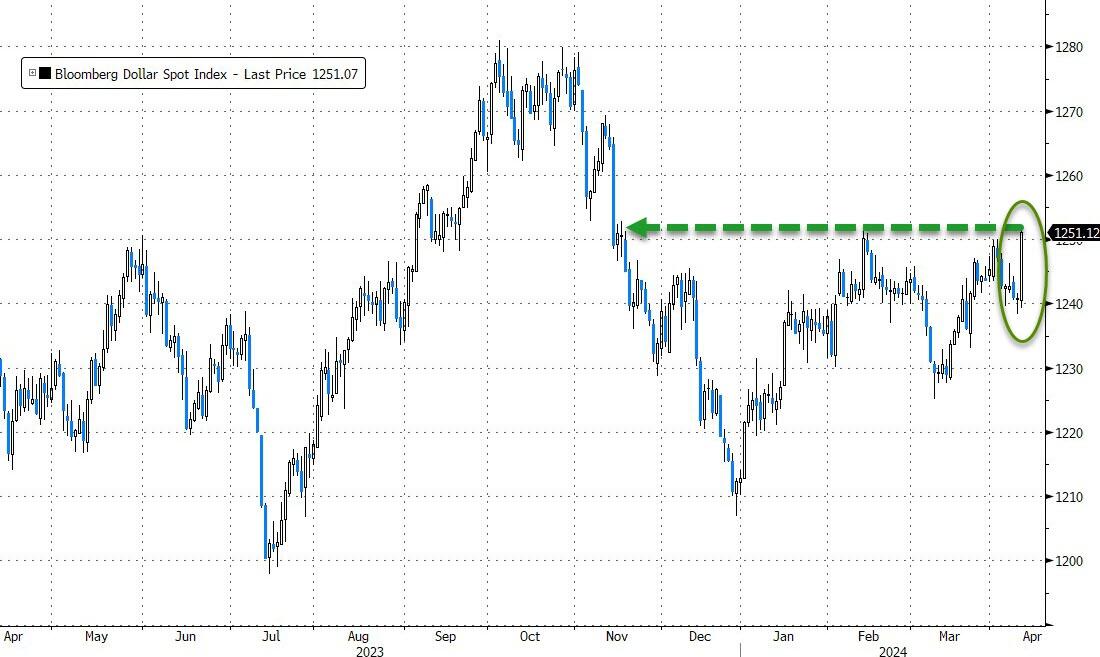
The dollar soared on the (less dovish and maybe hawkish) CPI print to its highest close since Nov 2023…

Source: Bloomberg

The Bank of Japan has a real problem now as USDJPY surged up to 153 – a fresh 34-year-low for the yen against the dollar and below the level at which the BoJ last intervened…

Source: Bloomberg

Gold prices fell on the day – amid dollar gains – but we do note that the initial puke in precious metals was quickly bid back up before fading later…

Source: Bloomberg

Oil prices bucked the trend today thanks to a spike in geopolitical tensions. The initial dump on CPI was worsened by a bigger than expected crude draw but then Iran-Israel missile headlines sent prices soaring back above $86 (WTI)…

Source: Bloomberg

And that won’t help gas prices…

Source: Bloomberg

Finally, this gaping wide crocodile’s mouth is getting ready to snap shut again…

Source: Bloomberg

When will rates matter again?

And don’t forget, its that time of the month/year again…

Will the tax on ‘gains’ from last year spook sellers more this year as rate-cuts are wiped off the table?

Tyler Durden
Wed, 04/10/2024 – 16:00

US Could Launch Joint Retaliatory Strikes With Israel If It Is Attacked By Iran: Official

US Could Launch Joint Retaliatory Strikes With Israel If It Is Attacked By Iran: Official

Update(1550ET): Upping the ante, a US official has told Al Jazeera that the Pentagon could intervene militarily if there is an Iranian attack launched against Israel.

According to a translation from Al Jazeera Arabic, the US source said, “We do not rule out launching joint retaliatory strikes with Israel if it is attacked by Iran or its agents.”

There was no further elaboration, or an indicator whether a US joint response with Israel would include offensive strikes against Iran, or if this would just be defensive, for example – anti air measures.

Yesterday, Israeli officials threatened that Iranian nuclear sites could be targeted, in one of the biggest strike threats to date. The region is on edge awaiting an ‘imminent’ response by Iran following the April 1st deadly attack on Iran’s embassy in Damascus. US intelligence has said it believes a revenge attack from Tehran is coming soon.

* * *

And just like that what was already a terrible day for doves and those hoping disinflation would finally arrive – not to mention Biden and the Fed – got much worse when moments ago oil spiked by over $1 per barrel with WTI jumping above $86 and Brent over $90…

… after a Bloomberg report that the US sees a missile strike on Israel by Iran and proxies as “imminent” to wit:

The US and its allies believe major missile or drone strikes by Iran or its proxies against military and government targets in Israel are imminent, in what would mark a significant widening of the six-month-old conflict, according to people familiar with the intelligence.

The potential assault, possibly using high-precision missiles, may happen in the coming days, the people said, requesting anonymity to discuss confidential matters. It is seen as more a matter of when, not if, one of the people said, based on assessments from US and Israeli intelligence.

Iran has threatened to hit Israel in retaliation for an attack on a diplomatic compound in the Syrian capital of Damascus last week that killed senior Iranian military officials. Israel has not explicitly acknowledged it was behind that attack, though it has traditionally followed a policy of ambiguity on operations in Syria, Lebanon and elsewhere.

* * *

US and Western intelligence indicates an attack from Iran and its proxies may not necessarily come from Israel’s north, where Tehran’s ally Hezbollah in Lebanon is located, the people said.

US and Western intelligence indicates an attack from Iran and its proxies may not necessarily come from Israel’s north, where Tehran’s ally Hezbollah in Lebanon is located, the people said. Israeli officials are in agreement with the allied view. They’ve also publicly threatened Iran that if it hits Israeli soil, Israel will hit Iranian soil.

Earlier on Wednesday Iran’s Supreme Leader Ayatollah Ali Khamenei repeated a vow to retaliate against Israel for the Damascus strike, which he said was tantamount to an attack on Iranian territory.

And while the Bloomberg report said nothing we haven’t already reported, perhaps it was the urgency of the headline or the market’s hypersensitivity to anything that can push inflation even higher, that sparked the powerful reaction. Ironically, the news hit just moments after we correctly predicted that the idiotic Biden puppetmasters are about to push the world into yet another catastrophic war.

The good news: Boeing stock is a buy here.


Tyler Durden
Wed, 04/10/2024 – 15:55

“Hot, Hot, Hot”… And Then There Were None

“Hot, Hot, Hot”… And Then There Were None

By Peter Tchir of Academy Securities

And Then There Were None?

The moment CPI hit the tape, Buster Poindexter’s “Hot, hot, hot” popped into my head (not a song I want on replay, but I’m stuck with it). In any case, the market is repricing the potential number and timing of rate cuts. (using Bloomberg WIRP at approximately noon today)

We are now down to less than 2 cuts being priced into this year.

There is roughly a 50% chance the first cut is July or earlier, which leaves us with a 50% chance in September. I can only imagine the social media hell that would be unleashed by politicians trying to unseat incumbents if the Fed does the first cut in September. Yields dropping, stocks soaring would be great for incumbents. I have to believe, that the Fed, being apolitical, would like to avoid that fury if possible, but the data doesn’t seem to be cooperating.

I Thought it Was Over

We can only imagine the calls Powell is likely receiving today. Incumbents have been hoping to see inflation recede. High inflation has hurt the public opinion of elected officials. They want it manageable coming into the election. I’ve never been sure how the so-called Inflation Reduction Act did anything but increase inflation (spending). The “spend it and they will vote” mentality that seems pervasive in D.C. doesn’t help with inflation.

Geopolitical risk abounds (see yesterday’s Webinar Replay, with Generals (ret.) Marks and Robeson) and with the SPR reserve still near multi-decade lows, there are fewer tools to combat that.

As much as incumbents would like rate cuts (assuming they produce lower yields and higher stocks) they are desperate to avoid a rebound in inflation, and that card, seems to be back on the table (for those who thought it had been taken off the table).

Rethinking (or just thinking) about Recent Fedspeak

Of all the discussions, the one thing, at least on Fed speaker has mentioned directly, is the possibility that the neutral rate is higher than previously thought.

So far, markets have generally accepted that not only are we at peak Fed Funds (probably, but not certain) but that once the cuts start we would head toward a neutral rate reasonably quickly.

What has not been discussed as much, is what if the neutral rate and therefore terminal rate are higher than expected?

Bottom Line

We’ve gone from 6 to 2 cuts. Are we headed to none?

No cuts isn’t my base case, that seems too contrarian, even for a die-hard contrarian, but my gut is telling me it should be.

Inflation isn’t going away.  If this Fed (many of whom were in the “transitory” camp) cuts and sees inflation rise, they will face great scrutiny. As much as we all understand the “long and variable” lag in monetary policy, and the “need” to get ahead of things, many will question what the heck they thought they were getting ahead of, when inflation was already turning higher?

I don’t like yields (though I’m hoping 10’s don’t break 4.6% too quickly, as resetting the range higher is getting increasingly difficult to get on board with).

As this realization sinks in, equities will struggle.

The corollary of “American Exceptionalism” might be “Higher for Much Longer!”

Tyler Durden
Wed, 04/10/2024 – 15:40

Goldman Is “Taking Profits On Tech & Moving To Other Sectors”

Goldman Is “Taking Profits On Tech & Moving To Other Sectors”

‘Sell Mortimer, Sell!’

That is the message (our translation) from Goldman Sachs Asset Management (GSAM), who told Bloomberg today that they are taking profits from high-flying technology shares and putting the money into cheaper companies.

“We like taking profits on technology and moving toward other sectors,”  Alexandra Wilson-Elizondo, co-chief investment officer of multi-asset solutions said in a phone interview.

The firm believes tech shares will come under pressure and prefers areas like energy and Japanese shares.

In the tech industry, “the risk-reward profile is skewed to the downside,” she added.

“While we still believe in being long equities and having them in the portfolio, we think that there are some more attractive opportunities to access.”

We wouldn’t argue with them as valuations on the US Tech sector are ‘high’ to say the least (and seemingly at an historically crucial resistance level)…

Source: Bloomberg

Additionally, the AI-bubble has stalled in the last month…

Source: Bloomberg

…as has the ‘Magnificent 7’ basket of stocks…

Source: Bloomberg

GSAM is holding an overweight position on energy shares as a hedge against inflation and geopolitical risks, said Wilson-Elizondo. That has been a good trade year-to-date…

Source: Bloomberg

She said they’re still cautious on utilities and REITs, as well as small-caps because of their sensitivity to high-interest rates.

And, finally, as we previously noted, this time of the year is a seasonally weak period into Tax Day…

Source: Goldman Sachs

…and, as we also detailed previously, given the massive gains many saw, perhaps the effect will be even larger this year?

Tyler Durden
Wed, 04/10/2024 – 15:20

Could US Treasuries Become The Trade Of The Decade?

Could US Treasuries Become The Trade Of The Decade?

Authored by Charles Hugh Smith via OfTwoMinds blog,

The expediencies and policy extremes have yet to be explored, much less exploited.

Napoleon is reputed to have said, “Do you know what amazes me more than anything else? The impotence of force to organize anything.” This is the lament of someone holding the reins of power: that this earthly power has limits.

Two things amaze me:

1. The public’s complacent confidence in the permanence of the global financial system. Put another way, what amazes me is the scarcity of awareness of the financial system’s fragility and vulnerability to collapse, a fragility that has increased as a result of policy extremes enacted to maintain a facade of security and confidence.

2. A general lack of appreciation for how few steps we’ve taken on the path of extreme central state/bank policies, a path that stretches over the horizon, beyond what we conceive as possible.

This complacency extends to proposed solutions to this systemic fragility. For example, many believe that all we need to do to fix the system is return to sound money such as the gold standard or a bitcoin-based system.

The possibility that there are no solutions doesn’t compute, as it goes against the zeitgeist of optimism: of course there’s a solution, preferably a technological solution that enables a trillion-dollar monopoly or cartel.

The widespread confidence in a predictably secure financial future is equally amazing. Sixty years of stability has generated a recency bias of immense strength: of course we can plan our retirement 20 years hence, for the future will naturally be a seamless extension of the recent past.

The more one knows about the global financial system, the greater one’s appreciation of systemic risk. The more one knows about the normalization of extreme policies enacted to stave off the collapse of the system in 2008-09, the greater one’s appreciation for the vulnerability of a system propped up by expediencies that are now permanent scaffolding for a system that is by design self-liquidating: all the “money”-printing, debt and leverage will dissolve because they will have no other choice but to dissolve.

To Napoleon’s point, there are limits on solving the problems created by “money”-printing, debt and leverage by printing more “money” and expanding debt and leverage.

Which brings us to the question: how will those in power put off the inevitable end-game as long as possible? Per Napoleon, their powers are earthly and limited. But this doesn’t mean they’re already exhausted. If the history of financial crises / depressions is any guide, authorities have barely started exploiting the grab-bag of expedient measures available to them.

Which brings us to US Treasuries. The expedient game plan for the past 15 years was to inflate a global Everything Bubble via expanding “money”-printing, debt and leverage, on the implausible but oh-so appealing theories that 1) borrowing more from future earnings and resources was painless and 2) inflating the wealth of the already-wealthy would generate a pain-free “wealth effect” some of which would trickle down to the working stiffs who don’t own any of the assets being pushed into orbit.

We can summarize this “plan” thusly: save every asset class and every constituency. There was something for everyone in the grab-bag of expedient deficit-funded giveaways and bubble-economics.

Now that the hangover phase of the party looms, those in power won’t be able to save everything and everyone: a bunch of stuff is going to be tossed overboard. This triage–who keeps a seat in the lifeboat and who’s tossed overboard–is tricky. The bottom 60% have already been tossed overboard, and those between the top 10% and bottom 60% have been stripped of their life vests.

In other words, the bottom 90% are already either treading water or on the way to Davy Jones’ Debt-Serf Locker. Inflicting more pain on them raises the risk of social-political revolt, and so those in power will have a lamentably limited set of assets and constituencies to stripmine. Making it even trickier, this set of constituencies holds virtually all the nation’s wealth and political influence.

The first step in crisis is to save what must be saved to keep the ship afloat: the federal government’s ability to borrow more money and float that rising debt by selling Treasury bonds. This isn’t just a necessity for the domestic status quo, it’s also a necessity for the Imperial Project, which must have the capacity to “export” dollars in size globally to preserve the benefits of issuing a reserve currency.

The obvious way to save what must be saved is to reward owners of Treasuries and punish everyone else: make owning Treasuries safer and more lucrative than owning any other asset.

The conventional mind rebels at this: no way would the government punish all other asset classes. Alas, livestock being herded to the next pen might voice the same confidence based on recency bias: so far, we’ve been treated splendidly.

Yes, so far. But when push comes to shove, who’s positioned to overthrow the state and who’s a minion of the state? As various pundits have observed, quantity has its own quality. It’s far less risky to push 1 million wealthy overboard than to push 100 million already disenfranchised overboard.

The possibility of requiring a percentage of 401K and IRA retirement accounts be invested in Treasuries has been floating around for years. This is an excellent policy option, but it leaves the super-wealthy free to hoard non-Treasury assets. That will have to change, as the top 10% own 90% of all financial assets.

The new game will be to push a significant percentage of the $300 trillion in bubble-assets sloshing around the global economy into Treasuries. The grab-bag of policy options is capacious: everything from outright expropriation to wealth taxes to windfall taxes to restrictions on ownership are all available: mix and match, try a few or try them all.

The restlessly disgruntled disenfranchised will support wealth taxes and windfall taxes because they won’t be paying them. They’ll also support active efforts to track down and punish wealthy evaders of these taxes, and the eradication by any means necessary (ahem) of all the tax havens the Empire has left alone in coddling its financial elites.

Wealth taxes and windfall taxes are easy sells: why shouldn’t the wealthy pay more? At the same time, ease the taxes due on income flowing from Treasury bonds, and voila, the calculus of risk and return change: why own an asset that will be taxed at 80% when sold? Why own an asset whose income stream now carries a higher tax rate?

All of these policies rewarding Treasury owners and punishing every other asset class can be sold as serving the public good and protecting us from risk. Every one can start with a single twist of a screw that is then tightened at regular intervals.

Unbeknownst to the financial elite who has benefited so enormously from the past 15 years of bubble-economics, they’re not as indispensable as they believe. They can be tossed overboard and replaced with a new elite who understands the game has changed from inflating Everything Bubbles to funneling capital into Treasuries at scale.

Please understand it’s nothing personal. It’s just business. Those who feel their wealth and power are untouchable will discover the rules will change overnight, and keep changing, and going along to get along might be the best strategy: sell everything and buy Treasuries.

We might even find there’s a new category of dangerous terrorist: the financial terrorists who hoard wealth by evading the policies protecting our security and freedom. Rendition them to the ‘Stans, baby, they have it coming.

All earthly power is limited, but that doesn’t mean it’s as toothless as many presume. The expediencies and policy extremes have yet to be explored, much less exploited.

Save what must be saved to keep the ship afloat. Is there any doubt what qualifies? Tax breaks for the super-wealthy? The Everything Bubble? Um, guess again:

Quantity has its own quality:

*  *  *

Become a $3/month patron of my work via patreon.com.

Subscribe to my Substack for free

Tyler Durden
Wed, 04/10/2024 – 15:00

Plagiarism Scandal Hits The Fed

Plagiarism Scandal Hits The Fed

Another week, another plagiarism scandal in the ivory towers.

This time, journalists Chris Rufo and the Daily Wire‘s Luke Rosiak found that Federal Reserve governor Lisa Cook appears to have plagiarized her academic work in violation of her former university’s policy.

Lisa Cook, governor of the US Federal Reserve. Photographer: Al Drago/Bloomberg

Cook, who taught economics at Harvard and Michigan State before serving on the Obama administration’s Council of Economic Advisers, went on to be appointed to the Federal Reserve Board of Governors in 2022. At the time, her academic record was so thin – and focused on race activism vs. ‘rigorous, quantitative econ,’ that she had trouble getting confirmed by the Senate (her nomination required VP Kamala Harris to cast a tie-breaking vote).

According to Rufo, “in a series of academic papers spanning more than a decade, Cook appears to have copied language from other scholars without proper quotation and duplicated her own work and that of coauthors in multiple academic journals, without proper attribution.” (Click into the below thread on X for more examples).

According to Michigan State’s own policy on plagiarism, Cook is a plagiarist. In the past, administrators have warned students that “plagiarism is considered fraud and has potentially harsh consequences including loss of job, loss of reputation, and the assignation of reduced or failing grade in a course.”

Cook duplicates long passages verbatim without quotation or proper attribution, changing minor words and punctuation.

What’s more, Cook’s rigor has also come under fire and she misrepresented her own credentials. As Rufo and Rosiak write in City Journal and the Daily Wire:

Her most heralded work, 2014’s “Violence and Economic Activity: Evidence from African American Patents, 1870 to 1940,” examined the number of patents by black inventors in the past, concluding that the number plummeted in 1900 because of lynchings and discrimination. Other researchers soon discovered that the reason for the sudden drop in 1900 was that one of the databases Cook relied on stopped collecting data in that year. The true number of black patents, one subsequent study found, might be as much as 70 times greater than Cook’s figure, effectively debunking the study’s premise. 

Cook also seems to have consistently inflated her own credentials. In 2022, investigative journalist Christopher Brunet pointed out that, despite billing herself as a macroeconomist, Cook had never published a peer-reviewed macroeconomics article and had misrepresented her publication history in her CV, claiming that she had published an article in the journal American Economic Review. In truth, the article was published in American Economic Review Papers and Proceedings, a less prestigious, non-peer-reviewed magazine.

When asked for comment, Cook told the journalists: “I certainly am proud of my academic background.”

As Rufo and Rosiak note in closing (emphasis ours):

Cook is no stranger to mobilizing such punishments against others. In 2020, she participated in the attempted defenestration of esteemed University of Chicago economist Harald Uhlig for the crime of publicly opposing the “defund the police” movement. She called for Uhlig’s removal from the classroom, claiming that he had made an insensitive remark about Martin Luther King, Jr. (The university closed its own inquiry after concluding that there was “not a basis” to investigate further.) Uhlig, in a 2022 op-ed for the Wall Street Journal, asked the pertinent question: Under the leadership of an ideologue such as Lisa Cook, would the Fed continue to pursue its mandate, or succumb to left-wing activism?

Time will tell if the gears of justice turn against Lisa Cook, or if repeated academic misconduct, defended by some as mere sloppiness or isolated mistakes, is fast becoming an acceptable part of the academic order—as long as the alleged author of that behavior is favored by the powerful.


Tyler Durden
Wed, 04/10/2024 – 12:45