65.9 F
Chicago
Sunday, September 20, 2026
Home Blog Page 2745

Is Gold Warning Us Or Running With The Markets?

Is Gold Warning Us Or Running With The Markets?

Authored by Michael Lebowitz via RealInvestmentAdvice.com,

Having risen by about 40% since last October, Gold is on a moonshot. Many investment professionals consider gold prices to be a macro barometer, measuring the level of anxiety in the economy, inflation, currency, and geopolitics. Therefore, we must investigate what is and isn’t driving the price of gold higher.

The Divorce Between Gold and Real Yields

To help us figure out what may be driving the momentum in Gold, it is worth first considering that a trusty relationship that largely explained the movement in gold prices broke down about two years ago.

The graph below, courtesy of Matt Weller, shows the 15-year-old correlation between gold prices and real yields is not working. Real yields, or rates, are simply the current yield of a Treasury bond minus the rate of inflation or expected inflation.

It serves as a measure of how loose or restrictive monetary policy is. The higher the real yield, the more restrictive monetary policy is, and vice versa.

The graph below shows the current level of real yields, which is the highest in fifteen years. Accordingly, it’s fair to claim that monetary policy is very restrictive, regardless of how the Fed may have shifted its stance in recent months.

In our article The Feds Golden Footprint we discussed why the relationship between Gold and real yields exists.

The level of real interest rates is a sturdy gauge of the weight of Federal Reserve policy. If the Fed is treading lightly and not distorting markets, real rates should be positive. The more the Fed manipulates markets from their natural rates, the more negative real rates become.

The article shared our analysis, which divided the last 40 years into three periods based on the level of real yields.

As the Fed’s monetary policy became more aggressive in 2008, the relationship between Gold and real yields grew. Before 2008, there was no statistical relationship.

Per the article:

The first graph, the pre-QE period, covers 1982-2007. During this period, real yields averaged +3.73%. The R-squared of .0093 shows no correlation.

The second graph covers Financial Crisis-related QE, 2008-2017. During this period, real yields averaged +0.77%. The R-squared of .3174 shows a moderate correlation.

The last graph, the QE2 Era, covers the period after the Fed started reducing its balance sheet and then sharply increasing it in late 2019. During this period, real yields averaged 0.00%, with plenty of instances of negative real yields. The R-squared of .7865 shows a significant correlation.

Given our historical analysis and the current instance of high real yields, it is unsurprising that the relationship between the price of Gold and real yields has faded. 

Therefore, without real yields steering the price of Gold, let’s consider a few possibilities for why it is rising so rapidly.

Fiscal Imbalance

The Federal government is running large deficits. As shown below, the annual percentage increase in federal debt is over 8%. Such significant deficit spending occurs as economic growth is running above its natural growth rate and pre-pandemic levels. Typically, deficits tend to be lower during periods of economic growth and bigger during recessions or economic slowdowns.

The recent increase in debt growth is significant, but not much more so than other non-recessionary peaks in the last ten years. Additionally, it is well below the debt increases associated with recessions. A $2+ trillion-dollar deficit sounds daunting, but the economy has grown by 33% or $7 trillion since 2020 and doubled in size since 2009. The graph below, showing the debt-to-GDP ratio, helps put more context on the rate at which the government borrows.

The upward trending debt to GDP ratio is not sustainable. However, the current ratio and slope of the recent trend align with the trend going back 20 years and even longer.

We have written many articles on the problem of debt growing faster than GDP and the economic damage it is doing and will do. However, when putting current deficits into proper context with the pace of economic activity, the recent growth is not glaringly different from other experiences of the last 20 years.

As such, we find it hard to believe that debt is responsible for the recent run-up in Gold.

Geopolitical

Geopolitical problems, especially regarding Ukraine and Israel, are indeed problematic.

Russia could deploy nuclear weapons or expand the war to other neighboring countries. An invasion of a NATO country would all but force involvement from the U.S. and European powers.

The Israeli-Hamas conflict appears to be a proxy war with Iran. While the theater of war is primarily in Gaza and, to a lesser degree, surrounding countries, the possibility of more direct involvement between Israel and Iran is problematic. Direct Iranian actions against Israel would likely be met with military force from the U.S. and other NATO powers.

Not to minimize the two geopolitical events and other less critical ones, but the U.S. and Europe have been in various wars in the Mideast and Afghanistan for most of the last 20 years. Is today’s global geopolitical situation much more frightening than in years past?

As we started writing this on April 4, 2023, a rumor circulated that Iran might be planning missile attacks against Israel. The S&P 500 fell by over 1% rapidly, and Gold promptly gave up $25. If geopolitical concerns are responsible for the recent gains, shouldn’t increasing tensions in the Middle East further add to Gold’s value?

Gold Predicts Inflation, Or Does It?

Some argue that Gold prices are warning that the lower inflation trends of the last 30 years are reversing.

If Gold is such a good predictor of prices, why did the price go nowhere when the Fed and government were raining money on the economy and supply lines were shut down? That period represents the most significant inflationary setup in over 40 years.

Dovish Fed In High Inflationary Environment

Since late last year, the Fed has flipped from an uber-hawkish tone to a more dovish one. Despite easy financial conditions (LINK), high and sticky inflation, and above-average growth, the Fed seems intent on cutting rates multiple times this year. Many would argue that a more prudent Fed would keep its hawkish tone and possibly raise the specter of increasing rates further.

As we showed earlier, monetary policy, while seemingly becoming easier, is still at its tightest levels in over 15 years. Compare monetary policy today to that in 2013 and 2014. The economy was growing then, yet the Fed had rates pinned near zero percent and was doing QE. As we share below, Gold languished during that period, despite complete monetary policy carelessness.  

Crypto – AI Mania  

Having discussed a few of the standard responses pundits are spewing regarding Gold’s ascent, we share one that may not be as popular with gold holders.

Gold is a speculative asset. Accordingly, it can rise and fall, and at times violently, based solely on the whims of traders and speculators.   

Might the current surge in Gold be less a function of the issues we raise above and more about the speculative mania flowing through many markets? Consider the five graphs below. The graphs show a solid visible and statistical correlation over the last two years between Gold and Bitcoin, Nvidia, Meta, Eli Lily, and the S&P 500.

Summary

The previous few sections share some typical rationales to justify higher gold prices. While they sound like legitimate reasons for Gold to soar, when taken into context, they are not that different from other periods in the last twenty years when Gold was flat or trending lower in price.

The price of Gold can provide valuable insights at times. But other times, Gold can give false signals warped by irrational market behaviors. We think Gold is getting caught up in a speculative bubble, and its price is not presenting us with a warning of fiscal, monetary, or geopolitical crisis.

Gold is likely to have a more reliable and sustainable run higher when the Fed returns to its careless ways with real yields near 0% or even negative, and QE is again in operation. 

Tyler Durden
Wed, 04/10/2024 – 12:25

“Friendshoring” Ramps Up As Apple’s Made-In-India Iphones Tops $14 Billion

“Friendshoring” Ramps Up As Apple’s Made-In-India Iphones Tops $14 Billion

Global supply chains have fractured since former President Trump started the trade war with China. One of the largest beneficiaries is India, which has become the prime spot for “friend-shoring” US manufacturing supply chains out of the world’s second-largest economy as relations with the West deteriorate. 

Bloomberg reports that Apple makes 14%, or about 1 in 7 iPhones in India. The rapid increase in iPhone production in India suggests that Apple is accelerating efforts to reduce reliance on China amid worsening Sino-US relations. 

According to Bloomberg sources:

Foxconn Technology Group assembled nearly 67% and Pegatron Corp. about 17% of the India-made iPhones in the fiscal year ended March 2024. The remaining iPhones were made in Wistron Corp.’s plant in southern Karnataka state, which the salt-to-software conglomerate Tata Group took over last year. Tata plans to build one of the country’s biggest iPhone assembly plants.

Meanwhile… 

China still produces the largest share of iPhones, though the shift is already underway in a trend called friend-shoring. We have pointed this out for the last several years: 

Michael Every at Rabobank outlined India years ago as the largest beneficiary of friendshoring. 

“… and, of course, Tim Cook can’t publicly announce the rejiggering of supply chains out of China as it would infuriate Beijing. So he recently praised Apple’s ‘symbiotic’ relationship with China,” we noted last April. 

The shift from China also came as Goldman removed Apple from its “Conviction List” and Evercore ISI dropped Apple from its “Tactical Outperform” list due to sliding iPhone sales in the world’s largest smartphone market. 

Furthermore, the relationship between the US and India is entering a new chapter as friend-shoring policies bring the nations closer together. 

Tyler Durden
Wed, 04/10/2024 – 12:05

China’s Xi Meets With Russian Foreign Minister In Show Of Solidarity Against West

China’s Xi Meets With Russian Foreign Minister In Show Of Solidarity Against West

Authored by Dorothy Li via The Epoch Times,

Chinese communist regime leader Xi Jinping met with Russian Foreign Minister Sergey Lavrov in Beijing on Tuesday, reaffirming solidarity amid growing pressure from the West. Mr. Lavrov arrived in China on April 8 for a two-day visit. His trip, according to the Kremlin, could be seen as laying the groundwork for upcoming contacts between Xi and Russian President Vladimir Putin.

Ahead of the meeting with Xi, Mr. Lavrov held talks with the Chinese Communist Party’s (CCP’s) top diplomat, Wang Yi. The two countries agreed to discuss ways to deepen security cooperation across Europe and Asia to counter the pressure imposed by the United States and its allies in the region, Mr. Lavrov told reporters after the meeting.

An outdoor screen shows a news coverage of Russian Foreign Minister Sergei Lavrov meeting Chinese leader Xi Jinping in Beijing on April 9, 2024. AFP via Getty Images

“We have a common focus on strengthening security in Eurasia,” Mr. Lavrov said at a press conference in Beijing. China and Russia had agreed to “start a dialogue with the involvement of our other like-minded people on this issue.”

The Russian top diplomat’s visit to China came amid renewed concerns in the United States that Chinese companies were bolstering Russia’s defense capacity.

Treasury Secretary Janet Yellen, who was in China for economic talks this week, issued a blunt warning about Beijing’s support for Moscow. She emphasized that any companies, including those in China, would face “significant consequences” if they provided aid to support Russia’s invasion of Ukraine.

“We’ve been clear with China that we see Russia as gaining support from goods that China, Chinese firms are supplying to Russia,” she told reporters in the southern Chinese city of Guangzhou on April 6. She said that her Chinese counterpart, Vice Premier He Lifeng, had told her, “It is their policy not to provide Russia with military support.”

She added, “Neither of us want[s] this to be an issue with our bilateral relationship, so we’re working together.”

Her message followed a similar warning from U.S. Secretary of State Antony Blinken. After meeting with NATO foreign ministers at the alliance headquarters in Brussels on April 4, Mr. Blinken told reporters, “China continues to provide materials to support Russia’s defense industrial base.”

During a recent phone call with Xi, U.S. President Joe Biden pressed Beijing over its role in supporting Russia, according to a readout released by the White House.

President Biden will host the leaders of Japan and the Philippines this week to boost economic and defense ties as the allies seek to offset the Chinese regime’s growing aggression and manage risks ranging from North Korea to the wars in Gaza and Ukraine.

Mr. Putin ordered an invasion of Ukraine on Feb. 24, 2022, less than three weeks after he and Xi had declared a partnership with “no limits“ on the opening day of the Winter Olympics in Beijing. Since then, Xi has refrained from condemning the attack and refused to characterize Moscow’s actions as an invasion.

Instead, the CCP blamed the United States for instigating the conflict, and it expanded its trade with Russia, providing Moscow with a vital lifeline after being hit by Western sanctions.

Data from China’s commerce ministry show that trade between the two neighbors hit a record high of $240 billion last year, up 26 percent compared with 2022.

In comparison, trade between Beijing and Washington reported the first fall since 2019. China–U.S. trade fell by 11.6 percent and stood at $664 billion in 2022, according to China’s customs data.

The last time that Xi hosted Mr. Lavrov was in April 2018. Weeks following the meetings, Mr. Putin traveled to China for a state visit.

On April 9, Kremlin spokesman Dmitry Peskov said Mr. Lavrov’s visit to Beijing could be seen as preparation for “upcoming contacts at the highest level.” However, he added, it would be “premature to specify any time frames.”

Reuters, citing unnamed sources, reported last month that the Kremlin chief would visit China in May. If confirmed, this will be Mr. Putin’s first international trip since he secured his fifth term in office in March.

Tyler Durden
Wed, 04/10/2024 – 11:45

Biden Expected To Issue Executive Order On Border Within Weeks

Biden Expected To Issue Executive Order On Border Within Weeks

President Joe Biden told Spanish-language broadcaster Univision in a Tuesday interview that he plans to issue an executive order to ‘dramatically limit the number of asylum-seekers’ who can cross the southern border, Axios reports, noting that “while it’s not final, such an executive order is likely by the end of April.

A brief timeline:

  • Jan. 2017- Jan. 2021: Trump issues Executive Orders to protect the southern US border.

  • Jan. 2021 – April 2024: 10 million illegals pour into the United States, many of whom are then bused to blue ‘sanctuary cities’ full of now-angry (angrier) Democrats.
  • Now: After pretending they can’t fix the border unless we give $60 billion to Ukraine – Biden team panics ahead of the 2024 election and will roll out Executive Orders so they can claim credit for fixing the border crisis they caused.

According to Axios, Biden would be “taking a page from former President Trump” by using Section 212(f) of the Immigration and Nationality Act, which gives the president broad discretion to block the entry of certain immigrants considered “detrimental” to US interests.

So that whole “the border can’t be fixed without Congressional action” thing was, as we know, a complete lie.

According to Axios:

Why it matters: We’re told there’s a fierce debate internally about the legality and politics of a Trump-like lockdown. But Biden, briefed on polls of rising voter anger, wants a dramatic step.

Between the lines: The provision Biden is eyeing would restrict the ability of immigrants to claim asylum, and doesn’t require congressional approval, Axios reported in February.

“We’re examining whether or not I have that power,” Biden told Univision’s Enrique Acevedo in an interview which was taped last week and aired Tuesday night.

“Some are suggesting that I should just go ahead and try it,” he continued. “And if I get shut down by the court, I get shut down by the court.”

The White House has been talking about doing this since at least February, with Axios reporting then:

  • “Everyone around him is well aware — well aware — of the need to jack this campaign up,” a source close to Biden said. “The only way to deal with the negative aftershocks of the special counsel’s report [slamming Biden’s age] is for the president to be out there, to be visible — to be strong of presence and strong of voice.”
  • One bold move that Biden has considered, we’re told, is an executive order that would dramatically stanch the record flow of migrants into the Southwest. This could even happen in the two weeks before the address, allowing Biden to say he took action while Republicans just talk.

NBC News reported that the actions, “which are still weeks away from finalization,” would allow asylum officers to raise the standards they use in their “credible fear reviews,” the first screening given to those claiming asylum and are trying to avoid deportation for crossing into the US illegally.

ICE would also be able to prioritize recently arrived migrants for deportation in a “last in, first out” policy.

Tyler Durden
Wed, 04/10/2024 – 11:25

Congressman Calls On RFK Jr’s Running-Mate To Leave Race Over Trump

Congressman Calls On RFK Jr’s Running-Mate To Leave Race Over Trump

Authored by Zachary Steiber via The Epoch Times,

Rep. Ro Khanna (D-Calif.) is calling on Robert F. Kennedy Jr.’s running mate to step aside, telling her that he’s worried the independent candidate could lead to former President Donald Trump beating President Joe Biden in November’s presidential election race.

“While I completely respect third parties and the right for anyone to run for public office, I am deeply concerned that Robert F. Kennedy’s name on the ballot in swing states could tilt the election in Donald Trump’s favor,” Mr. Khanna wrote in a letter to Nichole Shanahan, Mr. Kennedy’s running mate.

Mr. Khanna pointed to recent polling that found President Trump was favored by more respondents if Mr. Kennedy and other outside candidates were included in the race. That includes a poll from Marquette Law School, which found that registered voters were evenly divided between President Biden and President Trump, but that, if the other candidates were included, President Trump had a 41 percent to 38 percent edge, with Mr. Kennedy coming in third with 14 percent.

Ms. Shanahan, a lawyer, said that she recently spoke to Mr. Khanna. He had congratulated her on being named Mr. Kennedy’s running mate and encouraged her to run, she said.

“Clearly, Ro has changed his stance based on pressure from the party. I hope he understands how anti-democratic it is to ask someone to step down from a race that empowers the American public to make their own decisions,” Ms. Shanahan wrote on the social media platform X.

“I am very disappointed that he has been pressured into issuing this letter to me publicly. He could have called me privately. He has my direct line.”

Mr. Khanna responded to the criticism, writing:

“No one is saying Nicole doesn’t have the right to run, but it is democratic to try to persuade her that she should support Biden instead given [the] stakes.”

Mr. Kennedy said in a statement that he was grateful for Ms. Shanahan.

“I have always admired Ro Khanna. His flip flop here is disappointing. The party has [the] power to bludgeon men of character into waivering [sic],” he said.

Ms. Shanahan was announced as Mr. Kennedy’s running mate in March.

She has donated millions to Mr. Kennedy’s campaign, according to financial filings, and has also donated in the past to Mr. Khanna and President Biden.

Mr. Kennedy originally launched his presidential bid as a Democrat but became an independent after his campaign was stifled within the Democratic Party, which has largely backed President Biden’s re-election effort.

Ms. Shanahan said in March she was a “disillusioned Democrat” and was leaving the party.

“I do believe they’ve lost their way in their leadership,” she said at the time.

I worry for the party’s overwhelming interest in elitism … and winning at all costs. And I worry that they do it even if that means turning a blind eye on the issues that they all know to be true.”

2024 presidential contender Robert F. Kennedy Jr. speaks with his vice presidential pick Nicole Shanahan in Oakland, Calif., on March 26, 2024. (John Fredricks/The Epoch Times)

She also said the Republican Party is letting people down. Ms. Shanahan said she’s spoken to members of Congress from both parties about issues like sustainable farming but “all I’ve gotten are vague promises that never amount to real change.”

Ms. Shanahan, the ex-wife of one of Google’s founders, has spent millions on various causes, including research into farming and autism.

Ms. Shanahan’s views mean she should be focused on supporting President Biden, not helping Mr. Kennedy, Mr. Khanna argued.

Read more here…

Tyler Durden
Wed, 04/10/2024 – 11:05

Alex Jones To Sue CIA After Undercover Report Claims Agency “Went After Him Hardcore”

Alex Jones To Sue CIA After Undercover Report Claims Agency “Went After Him Hardcore”

Infowars founder and host Alex Jones says he plans to sue the CIA following the release of an undercover sting in which an alleged CIA officer claims that the US intelligence community “took his [Jones’s] money away” to “chop his legs off.”

The employee, a CIA contracts officer in San Diego named Gavin O’Blennis, tells the undercover journalist: “You can kind of put anyone in jail if you know what to do,” adding “You set ’em up. You create the situation to where they have no choice but to act on their impulse. And once they act on that impulse, some would call that entrapment.”

“Nothing like putting out a fake social media thing to like really get people mad,” O’Blennis continued.

When asked who the CIA has messed with, O’Blannis mentioned Alex Jones, implying that the agency was involved in Jones’ lawsuit, and encouraged Sandy Hook families to sue.

“We just say ‘there’s no federal statute being broken but you have the option for a civil case and it’s a pretty good case in our opinion.’

Watch (Alex Jones portion begins at 4:47):

Jones to Sue

Following the release of the footage, Alex Jones told journalist Benny Johnson that he’s going to sue the CIA.

“He needs to be subpoenaed by Congress,” Jones said of O’Blennis. “I am planning to launch a lawsuit against the CIA and the FBI. We have to bring all this out and right as my bankruptcy comes to a close and right as all this stuff is being finalized it’s really God’s work working here that this came out at this time.”

Jones says he’s speaking with several lawyers to explore options. Watch:

Tyler Durden
Wed, 04/10/2024 – 10:45

Pump-Prices Continue To Surge, Gasoline Inventories See Small Build

Pump-Prices Continue To Surge, Gasoline Inventories See Small Build

Crude prices slid back to unchanged this morning – from some overnight gains – after a hotter than expected CPI print took demand-seducing rate-cuts off the table.

However, as Bloomberg reports, oil is still up 19% this year as OPEC+ cuts supply and geopolitical tensions across the Middle East create strong tailwinds. The market is bracing for Iran’s response to a suspected Israeli attack on its consulate in Syria last week, and top traders have been striking an increasingly bullish tone in recent days.

API reported a sizable crude build and another gasoline draw – all eyes will be on the official data for any confirmation.

API

  • Crude +3.03mm (+800k exp)

  • Cushing +124k

  • Gasoline -609k (-1.4mm exp)

  • Distillates +120k (-600k exp)

DOE

  • Crude +5.84mm (+800k exp)

  • Cushing -170k

  • Gasoline +715k (-1.4mm exp)

  • Distillates +1.66mm (-600k exp)

Bigger than expected crude build surprised traders but a build in gasoline stocks was probably the most notable aspect of the report…

Source: Bloomberg

In aggregate, this is a pretty chunky nationwide inventory build. Total crude and product stockpiles climbed by 12 million barrels, excluding SPR last week. That’s the biggest weekly gain since July last year. In addition to crude build, there were also increases in the other oils category, as well as gasoline, jet fuel and diesel.

The Biden admin added 595k barrels to the SPR last week…

Source: Bloomberg

US gasoline stockpiles, which have plunged to the lowest levels this year, though they remain above the same period last year.

Source: Bloomberg

US Crude production was flat at 131.mm b/d, near record highs…

Source: Bloomberg

WTI was hovering around $85.25 ahead of the official data, dipped on the data then rallied higher…

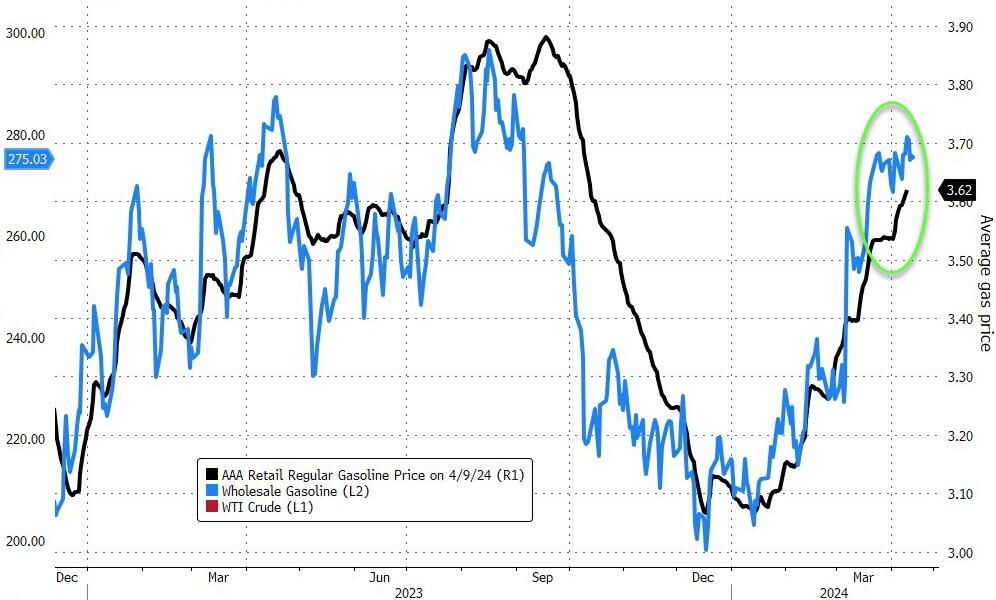
Meanwhile, pump-prices continue to rise, as we expected, tracking wholesale gasoline prices higher…

Source: Bloomberg

…and if you think this morning’s CPI was hot, with the highest pump-prices in six-months, just wait for next month…

Source: Bloomberg

Not at all what President Biden wanted to see, but we are sure it’s all ‘mom and pop’ retail gas station owners’ greed that is driving this!!!

Tyler Durden
Wed, 04/10/2024 – 10:38

Bank of Canada Keeps Rates Unchanged, Needs More Evidence Of Slowing Inflation Before Cuts

Bank of Canada Keeps Rates Unchanged, Needs More Evidence Of Slowing Inflation Before Cuts

The BoC keeps rates unchanged for a sixth consecutive meeting even as officials signaled they’re getting closer to rate cuts but – like the Fed – need more evidence of slowing inflation. The Canadian central bank left the benchmark overnight rate unchanged at 5% on Wednesday, a move which was expected by markets and by economists in a Bloomberg survey.

In the updated forecast, the central bank revises 2024 CPI forecast down to 2.2% from 2.4% while the 2025 CPI forecast was unchanged at 2.1%. Meanwhile, 2024 GDP was revised higher to 2.1% from 1.6%, but 2025 CPI is revised down to 2.2% from 2.7%.

“We are seeing what we need to see, but we need to see it for longer to be confident that progress toward price stability will be sustained,” BoC Governor Macklem said in the prepared text of his opening statement.

Officials said that data since January boosted their confidence that price pressures are gradually slowing, even as they expect economic growth to increase. Still, Macklem called further declines in core inflation “very recent,” adding that the bank wants to “be assured this is not just a temporary dip.” In the months ahead, the BoC will be closely watching the evolution of core inflation. He says he remains focused on the balance between demand and supply in the economy, inflation expectations, wage growth and corporate pricing behavior as indicators of where inflation is headed.

Overall, the communications confirm that officials’ discussions have turned to debating when interest rate cuts can begin this year, but that the decision hinges on how inflation evolves in the coming months.

Economists expect the BOC will be in a position to cut at the bank’s next meeting, on June 5. Traders in overnight swaps place over two-thirds odds of a 25 basis point cut at that meeting. July is fully priced, with traders seeing some chance of two cuts by that time.

Similar to the Fed, BOC officials also raised their estimate for the neutral rate by 25 basis points to a range of 2.25 to 3.25%; suddenly gradual increases in inflation targets are all the rage across “developed” central banks.

Canada’s progress on inflation is starting to diverge from the US, which saw upside surprises to price pressures in January and February.

As Bloomberg notes, last month, members of the bank’s six-person governing council said they expect to be able to start cutting rates in 2024 as long as the economy and inflation evolve roughly in line with their forecasts. But there was little consensus about when or how officials would know it was time to start easing.

Tyler Durden
Wed, 04/10/2024 – 10:28

Congress Bribes Itself To Renew Dystopian FISA ‘Sham Reforms’ That Actually ‘Codify Status Quo’

Congress Bribes Itself To Renew Dystopian FISA ‘Sham Reforms’ That Actually ‘Codify Status Quo’

Late last year, Congress elected to punt the issue of FISA renewal – the Foreign Intelligence Surveillance Act that was designed to surveil terrorists in foreign countries, and has since been horrendously abused by the US intelligence community to target Americans – including former President Donald Trump.

Now, they have 10 days to go to come up with a permanent replacement. To that end, House Speaker Mike Johnson put forth “RISAA” – a bill backed by Ohio Rep. Mike Turner and the intelligence committee, and just passed through the House Rules Committee – where a final floor vote will likely take place on Thursday.

Privacy hawks, however, point out that it’s a steaming pile of shit with no meaningful language to protect privacy rights – except for members of Congress, who gave themselves a carve out which requires the FBI to notify and seek consent from Congress before spying on them.

What’s more, critics say the RISAA essentially codifies surveillance abuses into law.

Under Section 702 of the FISA, the government is authorized to gather foreigners’ communications if they have been flagged in connection with national security matters. The communications can be gathered even if the target was speaking about, or with, Americans.

“Speaker of the House Mike Johnson claims that RISAA reflects a compromise,” reads a joint statement from the Electronic Privacy Information Center, the Brennan Center for Justice and Freedomworks. “In reality, this bill is not a ‘compromise,’ and its 56 ‘reforms’ codify the unacceptable status quo.

The bill has also caused a rift within the Republican party over privacy rights. As the Daily Caller‘s Reagan Reese notes:

The GOP is divided into two broad camps over various proposed reforms, perhaps most notably a warrant requirement. National security hawks aligned with the House Permanent Select Committee on Intelligence have expressed more opposition to the requirement and other privacy-minded reforms — members aligned with the Judiciary Committee are stressing that FISA must no longer be a tool that can be used to spy on Americans, like what happened with the Trump campaign. -Daily Caller

“It’s delicate right now. The place is about to combust,” one GOP source told the Caller on Monday.

According to FreedomWorks, “Of the 56 RISAA “reforms” Speaker Johnson highlights, at least 13 either codify existing practice and procedures, meaning they make NO CHANGES to the warrantless surveillance status quo, or they actively weaken existing protections.”

“I don’t think [RISAA goes far enough] I think that these are a lot of papered over reforms that FBI was doing internally, or were claiming that they’re doing internally,” Rep. Andy Biggs (R-AZ) told the Caller.

RISAA doesn’t go nearly far enough in protecting Americans from illegal spying by their own government. It is a sham reform, and House Republicans should not vote for any FISA reauthorization that lacks a warrant requirement. Speaker Johnson and the GOP majority have a real opportunity to end this madness, and they should take it,” Rep. Mike Lee told the outlet as well.

DC journalist Jim Bovard told the Caller: “Any member of Congress who supports extending FISA without radical reforms should receive a ‘Deep State-approved’ logo to burnish for their reelection campaign,” adding “If Congress cannot yank in the reins on the FBI and NSA after millions of confirmed violations of Americans’ rights, only a fool would expect Congress to ever give a damn about the Constitution.

Digging deeper is Brennan Center for Justice co-director of the Liberty and National Security Program, Elizabeeth Goitein, who wrote on X:

Buried in the Section 702 reauthorization bill that the House will consider this week (RISAA) is a provision that could result in the *permanent* reauthorization of this deeply-flawed authority—without a single reform.

Here’s how. FISA currently includes a sunset date of April 19 for all of Title VII of FISA. Title VII includes Section 702, but it also includes other provisions (Sections 703, 704, and 705) that contain vital protections for Americans located outside the United States.

RISAA’s sunset provision includes two parts. The first changes FISA’s sunset date for Title VII to five years from the date of RISAA’s enactment. If RISAA were enacted and signed into law on April 19, the sunset date for Title VII would be April 19, 2029. So far, so good.

The second part of the sunset provision, however, states: “Effective five years after the date of enactment of [RISAA], [FISA] is amended so that Section 702 reads as it read on the day before the date of enactment of [RISAA].”

In other words, on the sunset date, Section 702 will revert back to the way it looked before RISAA. If RISAA is amended this week to include real reforms (it currently has none), those reforms will drop away, and Section 702 will continue in its current form.

Here’s the problem: Section 702 can’t simultaneously expire and revert back to its previous form. Those two instructions are mutually contradictory. How will the FISA Court make sense of this seeming contradiction?

(Note that Section 702 reverting back wouldn’t itself fix the problem by taking the sunset date back to April 19, 2024. The sunset provision isn’t contained in Section 702; it’s in Section 403(b).)

The most likely answer, I fear, is that the FISA Court will read the first part as creating a general rule: a sunset for Title VII. It will read the second part as creating an exception to the rule: for Section 702, only the changes made by RISAA will sunset, not 702 itself.

So all of the vital protections for Americans that are contained in Sections 703, 704, and 705 will expire, as will any reforms to Section 702 made by RISAA. We’ll be left with a permanent reauthorization of Section 702 in its current, incredibly dangerous form.

There might be other ways to harmonize these competing provisions. But I don’t trust the FISA Court to resolve what is, at best, an incredibly sloppy piece of legislative drafting in a way that favors the protection of Americans’ rights.

The House must NOT pass any legislation that could be read to permanently reauthorize Section 702, let alone permanently reauthorizing it without a single reform. This provision of RISAA must be fixed, or the bill should be DOA.

Read the rest of the report here…

Tyler Durden
Wed, 04/10/2024 – 10:15

Renewed Inflation Risks Aren’t Scaring Buyers Yet

Renewed Inflation Risks Aren’t Scaring Buyers Yet

By Michael Msika, Bloomberg markets live reporter and strategist

The stock market’s momentum is stalling and soaring commodity prices have brought inflation worries back to the forefront. For now, it’s not enough to prompt Wall Street strategists to change their bullish view.

HSBC strategists led by Max Kettner say any setback is likely to prove temporary, especially given that the market is still pricing in rate cuts this year. JPMorgan’s traders are “tactically bullish” going into the inflation data, says Andrew Tyler, the bank’s head of US Market Intelligence.

Even so, there are some market worries ahead of the US CPI data and some investors are nervous about stretched valuations before earnings season gets underway. Market momentum has stalled with stocks moving sideways for the better part of a month. Soaring commodity prices are partly to blame as worries shift back to whether persistently high inflation could threaten the rate outlook, especially with recent cautious comments from a number of Fed officials.

To JPMorgan, if the CPI print comes in cooler, it would be a boon for risk assets. Plus, market positioning is supportive given that hedge funds have been selling stocks for several weeks.

They acknowledge it’s harder for inflation to slow, given the strength in the labor market and higher commodity prices, but don’t expect the process to be derailed. “The bull case remains intact with at or above-trend GDP growth, positive earnings growth, and a paused Fed,” they say.

The slight scare of the past few days has made positioning cleaner, with bullish exposure easing, according to Citi. Investors sold $9.4 billion in long S&P 500 positions last week, reversing the flows from the previous week, according to data from quant strategists including Chris Montagu.

Inflation expectations may have been strengthening in the US and in Europe, as demonstrated by breakevens and swap rates creeping higher, but the market hasn’t been complacent. Stock volatility has been on the rise, as has the skew, with greater demand for hedges as we showed in the column yesterday. But crucially, big technical levels are holding firm.

In the meantime, the global economy keeps improving and economic surprises from Europe, the US and China are firmly in positive territory. Even if financial conditions have tightened ahead of the CPI print, they remain on the loose side, still supporting equities at these levels.

“The equity market is now more focused on the better growth outlook, rather than solely on the inflation and rates outlook,” say Barclays strategists including Matthew Joyce. “The growth outlook continues to improve, so any near-term wobble is likely to be trumped by better incoming data.”

Tyler Durden
Wed, 04/10/2024 – 07:21