WTI Extends Gains After API Reports Inventory Draws Across The Board
US crude futures pierced $85 for the first time since October, the latest milestone in a rally driven by OPEC+ production cuts, strong demand and heightened geopolitical risks.
As Bloomberg reports, oil has jumped this week as tensions rise in the Middle East, with Iran vowing revenge on Israel for an airstrike on its embassy in Syria that killed a top military commander.
After last week’s surprise crude build and big jump in stocks at the Cushing hub, traders were looking for a slowing build…
API
Crude -2.29mm
Cushing -751k
Gasoline -1.46mm
Distillates -2.55mm
Inventory draws across the board with Distillates and crude stocks falling most…
Source: Bloomberg
WTI was just above $85 ahead of the API data and extended gains after…
The market’s strength has also been reflected throughout the oil market curve.
“An escalation in tension in the Middle East has coincided with firmer oil fundamentals,” said Warren Patterson, head of commodities strategy for ING Groep NV.
“The market is tightening thanks to OPEC+ supply cuts, which is evident with the strength we have seen in timespreads.”
The US benchmark’s prompt spread has widened near $1 in backwardation, compared with as low as 54 cents three sessions ago. Meanwhile, the oil options market has flipped to a call skew, underscoring the magnitude of bullish sentiment for crude.
Meanwhile, pump prices remain near six-month highs as wholesale prices put increasing pressure to the upside…
US Fumes Over IDF Strike On Aid Workers, But Still Refuses ‘Conditions’ On Military Transfers
Update(1635ET): In a Tuesday afternoon press briefing, National Security Council Communications Adviser John Kirby expressed that the US is “outraged” by the targeted strike on the World Central Kitchen (WCK) convoy overnight. “We were outraged to learn of an IDF strike that killed a number of civilian humanitarian workers yesterday from the World Central Kitchen, which has been relentlessly working to get food to those who are hungry in Gaza,” he said.
Kirby laid out that the US expects Israel to conduct a broad and legitimate investigation: “We hope that those findings will be made public, and that there is appropriate accountability held,” he told the briefing. Kirby vowed that the US “will continue to press Israel to do more” in protecting aid workers, and noted over 200 local and international aid workers have been killed since the Gaza war started.
The White House also confirmed that President Biden called WCK founder José Andrés and expressed condolences for the seven staff members killed in the strike. The celebrity chef on Tuesday lashed out at Israel for its “indiscriminate killing” of his employees while they were delivering aid.
“The Israeli government needs to stop this indiscriminate killing. It needs to stop restricting humanitarian aid, stop killing civilians and aid workers, and stop using food as a weapon,” Andrés said on X.
The killing of the aid workers, which included three British nationals, an Australian, a Polish national, an American-Canadian dual citizen and a Palestinian, has been featured throughout the day by US news networks. For example for the early half of Tuesday it was the top frontpage story at CNN.com.
But despite the US expressing “outrage” over the attack, when members of the White House press pool got into Q&A with Kirby, he still passionately emphasized that Israel has not violated international humanitarian norms in Gaza. This was pointed out as several clips circulated of the heated exchange online…
Baghdad Bob and Sean Spicer have nothing on John Kirby.
Kirby says that there is no evidence that Israel deliberately struck WCK aid workers in Gaza. He also says that Israel has NOT violated international humanitarian law in Gaza (!!!)#CeasefireNOWpic.twitter.com/mJlt5EonBE
It also became evident in the briefing that the Biden administration still does not intend to attach any conditions to Israel’s use of US-supplied weaponry.
In fact, CNN has just reported, “The Biden administration is close to approving the sale of as many as 50 American-made F-15 fighter jets to Israel, in a deal expected to be worth more than $18 billion, according to three people familiar with the matter.”
But without doubt, this new tragedy in Gaza has significantly ramped up the pressure both on the Netanyahu government and on Washington, with the latter expected by outside countries to impose more punitive measures on Israel, or to at least cut off the flow of weapons and ammo.
My latest exchange with John Kirby — about why the WH won’t put conditions on military aid to Israel, even after yesterday’s killing of seven aid workers in Gaza. pic.twitter.com/Z2552Usfoi
On Monday an Israeli airstrike on the central Gaza town of of Deir al-Balah killed seven international aid workers with World Central Kitchen, resulting in the well-known charity announcing Tuesday that it must suspend operations to deliver food aid to Gaza.
Footage confirming their deaths is driving international outrage and again ramping up the pressure on Israel. The Associated Press writes Tuesday, “Footage showed the bodies, several wearing protective gear with the charity’s logo, at a hospital in the central Gaza town of Deir al-Balah.” The report details, “Those killed include three British nationals, an Australian, a Polish national, an American-Canadian dual citizen and a Palestinian, according to hospital records.”
The well-known charity was founded in 2010 by Spanish American chef and restaurateur José Andrés, and has been among many world charities and NGOs embedded in Gaza amid the ongoing humanitarian catastrophe.
World Central Kitchen CEO Erin Gore has said in a fresh statement: “This is not only an attack against WCK, this is an attack on humanitarian organizations showing up in the most dire of situations where food is being used as a weapon of war.”
“This is unforgivable,” Gore added. The statement underscored that the team “was traveling in a deconflicted zone in two armored cars branded with the WCK logo and a soft skin vehicle.”
What makes this tragedy look even worse for Israel is that it was a targeted drone strike on a convoy operated by the international charity. Israel’s Haaretz reports that the attack was ostensibly targeting a Hamas member who wasn’t there. It was “launched because of suspicion that a terrorist was travelling with the convoy.” What’s more is that the report indicates the convoy was bombed three times.
Israeli Prime Minister Benjamin Netanyahu expressed regret in a Tuesday statement, and amid growing pressure from the press and Western governments, acknowledging his military had conducted the “unintended strike” on “innocent people in the Gaza Strip.”
“Unfortunately, in the past day, there was a tragic incident of an unintentional hit by our forces on innocent people in the Gaza Strip. It happens during war. We are in touch with governments, and we’ll do everything so this doesn’t happen again,” his full statement said, though without mentioning World Central Kitchen by name.
Cyprus has said that as a result of the incident and the charity’s forced shuttering of operations, recently arrived ships have turned back while loaded with some 240 tons of undelivered aid.
Meanwhile, the US State Department has said that famine is likely already present in parts of Gaza. A State Dept. official told Reuters. “While we can say with confidence that famine is a significant risk in the south and center but not present, in the north, it is both a risk and quite possibly is present in at least some areas.”
I find it interesting that Israel can conduct precision HVT strikes on targets in Syria, but in Gaza they will just drop on anything with a pulse with apparently no targeting criteria. https://t.co/i1De3CTANl
The US Army’s project to build a large pier off Gaza’s coast to facilitate maritime aid deliveries is still likely at least two months out as US Navy ships carrying the building equipment and engineering personnel are still traversing the Atlantic while en route to the eastern Mediterranean.
It’s been a little over a week since “Climate: The Movie,” a documentary produced by Thomas Nelson and directed by Martin Durkin, was released on Vimeo, YouTube, Rumble, and other platforms. And already, it’s garnered millions of views and thousands of reviews.
“Watch this documentary to understand the lies, the pseudoscience, but also the self-interest of government-funded parasites pushing climate alarmism,” Maxime Bernier, the founder and leader of the People’s Party of Canada, posted on X, formerly known as Twitter, about the film that details how “an eccentric environmental scare grew into a powerful global industry.”
“The final nail in the coffin for the ‘human-induced climate change’ scam. An absolute MUST-WATCH!” Wide Awake Media posted on X while linking to the movie, which features an elite list of scientists, including Nobel Laureate John Clauser, Richard Lindzen, emeritus professor of meteorology at MIT, and Steven Koonin, a theoretical physicist and professor at NYU’s Tandon School of Engineering.
“I’m a Dutch science journalist, and I watched [Climate: The Movie],” Maarten Keulemans posted on X. “It’s full of crap.”
Some reviewers went so far as to call for censorship.
“I’m thinking we can get 10,000 people to report ‘Climate: The Movie’ on YouTube as having harmful and misleading content,” Eliot Jacobson, a retired mathematics and computer science professor, posted on X on March 23.
Following Mr. Jacobson’s call, Vimeo removed the video from its platform on March 24, citing a “violation of Vimeo’s Terms of Service and/or Guidelines.”
“The [V]imeo link to ‘Climate the Movie’ I shared two days ago has been censored!” Nir Shaviv, a physics professor at the Hebrew University of Jerusalem who appeared in the film, posted on X. “Fully removed beyond the mere shadow blocking [YouTube] has.”
Neither Mr. Durkin nor Mr. Nelson were surprised.
“There’s something bigger going on behind the climate thing, beyond the narrow arguments about whether it’s true that [carbon dioxide] causes all this stuff—which, of course, it doesn’t,” Mr. Durkin told The Epoch Times. “There’s almost a blanket ban on skepticism on mainstream television.
“It’s a kind of Marxism, I suppose. There’s an entire class of people who have an interest in high levels of taxation and high levels of regulation, in what might broadly be termed the ‘publicly funded establishment’ and the ‘education establishment.’”
Mr. Nelson concurred. “There’s a big difference between the climate realists and the other side,” he told The Epoch Times. “[Climate alarmists] are constantly reporting us and tattle-telling on people that don’t agree with them.
“I never see [climate realists] saying, ‘let’s report people from the other side, and let’s take down their videos, let’s censor them.’ All the censorship is coming from one side, and all the free speech and ‘let’s debate’ is coming from our side. We want to talk about it because we’re confident with our evidence.”
Censorship Unchecked
Immediately after Vimeo removed Mr. Durkin’s film, he reached out to the platform, “You know, I’m a reasonably well-known, veteran filmmaker, award-winning,” he said. “And I told them [via an electronic form], ‘Look, all the archive and music is cleared. We see absolutely no reason whatsoever why this was suspended. We’ve got a lot of good scientists in it.”
Mr. Nelson posted to X, “Hey @Vimeo: Specifically what is your justification for censoring ‘Climate: The Movie’?”
“A lot of people said they couldn’t believe it was being censored,” Mr. Nelson said. “But I never got an official response from anybody.”
Mr. Durkin didn’t get a response, either. “About 12 hours after I reached out, it went back up again. But we don’t know why. I presume that some ‘greens’ complained about it and that they automatically took it down. Fair dues to Vimeo that they put it back up, though, that was good.”
Vimeo wasn’t the only platform to take action against “Climate: The Movie.” On March 22, Food Lies, which has 44,000 subscribers, reported that when they first shared the movie on their channel, YouTube “immediately” removed it, and Food Lies had to seek special permission to repost.
When the report was granted, YouTube added the following contextual warming, “Climate change refers to long-term shifts in temperatures and weather patterns. Human activities have been the main driver of climate change, primarily due to the burning of fossil fuels like coal, oil, and gas,” and included a link to the United Nations’ “What is Climate Change?” website.
Further, Mr. Nelson said he believes Google is censoring the movie’s website. “We may have been shadow-banned, but we can’t prove it either way,” he said. “I don’t think Google wants to direct people to our site.”
However, Mr. Nelson and Mr. Durkin agree that the purchase of Twitter by Elon Musk in 2022 changed the social media censorship game.
“I love the fact that X is open right now, and we’re able to talk freely on X,” Mr. Nelson said. “Because just two years ago, if this had come out when we were all suppressed, it would have made a big difference.”
“[Social media] is not so much a problem,” Mr. Durkin said. “Social media is leaky enough now that it gets out there.
“The bigger point is that I pitched this idea to the BBC and Channel Four about a year before I [was on Tom Nelson’s podcast]. Why, I have no idea. I knew they’d say no, but I think I wanted to satisfy myself. And, of course, they did say no.”
Mr. Durkin said that even if a station wanted to air a story expressing skepticism about the “climate crisis,” broadcast regulators in Canada, and the UK can destroy that station.
“In effect, they’re saying, ‘If you put out skeptical views, you’ll be sanctioned.’ And that can go as far as to have your broadcasting license revoked,” Mr. Durkin said. “So, you know, this is full-scale state censorship on mainstream media, and [the general public isn’t] making a fuss. We’re just sort of accepting that this is the case.”
Paying the Social Cost
When asked why “Climate: The Movie” has received such pushback, Mr. Durkin said it boils down to what he terms the “New Class.”
“Many of these characters have built their careers on the climate scam,” he said. “I mean, their reputations, their livelihoods, everything depends on it, and so they feel enormously threatened.
“But beyond that, there’s this kind of political-ideological movement; it’s not just about the weather. And the people who promote it—most of science is publicly funded, and lots of scientists are involved directly with publicly funded institutes—are part of that publicly funded establishment, so they have that worldview.
“You know, if you look at the political analysis of people in universities, they are 99 percent Democrats, or left-wing even.
“And it’s now de rigueur in those circles to hate Trump, to believe that more regulation is a civilized thing, to think that public backing for the arts, is a good thing, and so on and so forth. And when you come out and say that you don’t think the climate thing is true, you’re not just making a narrow point about the medieval warm period, or the geological record, on temperature, you’re saying something much bigger, ideologically.
“You’re saying that maybe Trump’s not so bad. And the Second Amendment is a good idea. And you’re suddenly lumping yourself in with the deplorables and people in pickup trucks. And if you’re in Britain with Brexiteers. You’re putting yourself in a whole other social caste, as it were.”
Mr. Durkin said that before the release of the film “The Great Global Warming Swindle,” in 2007, which the head of science at Channel Four asked him to make, he was considered to be one of the “hottest science documentary producers around,” and was regularly tasked by Channel Four to produce films. But after that film’s release, it took three years before Channel Four asked him back.
He said the regular invites to dinner parties and social gatherings in London“media and academic types” dried up.
“My wife was extremely cross. There was a huge backlash, and she has really bad memories of the immediate aftermath of putting ‘Swindle’ out, and that’s why she was very, very reluctant to have me make another film,” Mr. Durkin said.
“So that part of the film, where we talked about the social cost of coming out against climate in terms of ostracism from a particular social class, the New Class, that was personal.”
The New Class
Mr. Durkin, who is publishing a book that takes a deep dive into the “New Class,” said one of the characteristics of that group is they consider themselves to be part of the intelligentsia. By that, he means those who have a university degree that has “very little application in the real world.”
“They hate capitalism because capitalism hates them, and the market hates them,” he said. “If you do a degree in sociology, what use are you to man or beast? If I’m running a lawnmower company, I do not need anyone with a degree in sociology.
“So, they resent that they’re not well received in the marketplace. And historically, they’ve embraced the state because it provides them with an income and a gratifying grand title if they’re working for some big government agency or forum: for the U.N., or an NGO, or for NOAA, or whatever.”
Mr. Durkin said the class is at odds with the working class and is “enormously powerful” because it’s part of the publicly funded establishment.
“Until we understand that they are a particular group, they have a particular set of interests, and those interests involve taking away our money and taking away our freedom, then we’re in trouble,” he said.
“I keep telling people, incredibly, in the US and the UK, more than twice as many people work in government as work in manufacturing.
“If you told some American in the early part of the 19th century that that could ever happen, they would have thought you were absolutely nuts.”
Gold Hits Another New Record High But Bonds, Stocks, & Bitcoin Battered On ‘Good’ News
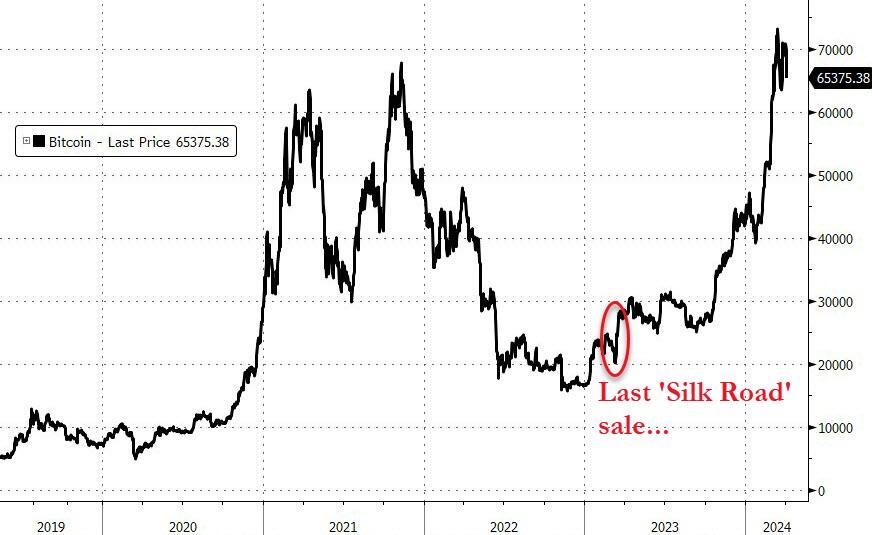
Mixed (well good) data this morning – in-line JOLTS (labor market shows no signs of cracking), stronger than expected Factory orders, but weaker than expected durable goods (final) and shipments data actually shrank in Feb (bad for GDP) – had no major impact on rate-cut expectations (which remain low – 67bps total cuts in 2024, 50% odds of June cut). US macro surprise data is picking up (and overnight saw European PMIs better than expected)…
Source: Bloomberg
But Fed’s Mester sung from the same hymn-sheet as Waller and Bostic, saying that The Fed needs more time to make the ‘cut’ call:
“But I need to see more data to raise my confidence,” Mester said Tuesday in prepared remarks for an event at the Cleveland Fed.
“Some further monthly readings will give us a better sense of whether the disinflation process is stalling out or whether the start-of-the-year readings reflect a temporary detour on the downward path back to price stability.”
And then she explained her view of Fed asymmetry:
“At this point, I think the bigger risk would be to begin reducing the funds rate too early,” Mester said.
“And with labor markets and economic growth both being very solid, we do not need to take that risk.”
And while Mester’s comments did not seem to be an immediate catalyst, yields kept rising overnight (on stronger EU PMIs?), especially at the long-end (2Y unch, 30Y +6bps) extending yesterday’s bloodbathery…
Source: Bloomberg
The 10Y broke above its YTD highs to its highest since Nov 2023 (2nd biggest 2-day jump in yields since October)
Source: Bloomberg
…and steepening the yield curve (2s30s) significantly…
Source: Bloomberg
And stocks appeared to run out of momentum again overnight as yields rose during the European session with Small Caps extending losses in the US session. The last hour saw a mini buying spree which put a little lipstick on the day’s pig. Small Caps were the biggest losers…
‘Most Shorted’ stocks were clubbed like a baby seal for the second day in a row… the biggest 2-day drop in the shortest stocks since November…
Source: Bloomberg
The dollar tumbled, erasing most of yesterday’s gains…
Also of note, the players in the perp futs market have been very active the last couple of days (all but one of the heavy volume surges were sells)…
Ethereum was worse… taking the ETH/BTC ratio down to its lowest since April 2021…
Source: Bloomberg
But while one ‘alternative’ currency is tumbling, another (older one) is rallying to new record highs… Spot Gold hit $2277 intraday – a new record high….
Source: Bloomberg
For a change, Silver outperformed gold today, with spot prices surging up to $26 for the first time since May 2023…
Source: Bloomberg
And Black Gold also surged up above $85 (WTI) – the highest since Oct 2023…
Source: Bloomberg
Finally, as growth expectations have stagnated somewhat over the past year (though the last week has seen some positive surprises), Citi’s inflation-suprise index has resurged back to its highest since Dec 2022…
Source: Bloomberg
…we love the smell of stagflation in the morning… and gold is rising along with Fed policy-error-risk.
Iran’s Khamenei Promises Revenge Against Israel Over Strike On Embassy
For those wondering whether or not the war in Gaza would expand into multiple fronts, it looks like that question has now been answered. And, unless Iran’s “Supreme Leader” Ayatollah Ali Khamenei is engaging in a dramatic bluff, it appears that the nation is about to enter the conflict.
Khamenei declared on Tuesday that “Israel will be punished” for the attack the previous day that killed members of the Revolutionary Guard, including two generals, at the Iranian embassy compound in Damascus.
“The evil Zionist regime will be punished at the hands of our brave men. We will make them regret this crime and the other ones,” Khamenei said in a message published on his official website.
Iranian President Ebrahim Raisi declared that the “cowardly crime will not go unanswered.”
It’s important to note that Israel and Iran have already been engaged in a proxy war, with Iranian supported Hezbollah soldiers exchanging fire with Israeli troops on the border of Lebanon since the beginning of the fighting in Gaza. Theories abound on the purpose of the embassy attack, including the claim that Israel intends to bring the US into the war by triggering open Iranian involvement.
Under the Biden Administration US entry into the conflict is almost assured if a front is opened with Iran. The saber rattling has been mounting since at least January when militants allegedly armed with Iranian weapons attacked an outpost along the Syrian/Jordanian border killing three US soldiers.
The obvious question is why are US troops still in Syria? There are two equally compelling answers – First, they are there to oversee and protect the revamping of Syrian oil fields to secure American energy interests. Second, they are there exactly because both Iran and Russia have operations in the region and the powers-that-be want the option to use those soldiers as fodder to start a wider war.
American oil concerns are generally non-negotiable when it comes to foreign entanglements and any major threat to exports out of the Middle East is going to inspire a US military response (Iran’s first action may be to close the Strait of Hormuz to western oil tankers). Joe Biden has essentially guaranteed this outcome after he drained US strategic oil reserves in a bid to keep inflation down and has consistently interfered with oil resource expansion stateside. One would think if a US president is going to sanction Russia and remove a large portion of the global oil supply from the market that he would try to open the path for more production domestically. But not Biden…he’s worried about “global warming.”
The idea that an all encompassing war in the Middle East is part of the plan is not far fetched. There are interests among the far-left and the Neo-Conservatives that have desired this for decades. If Iran engages with Israel directly, the warhawks are going to get what they want. As far as the western populace is concerned, get ready for higher gas prices this summer (now they can blame war instead of taking responsibility for inflation), an increasing potential for terror attacks along with more marches and riots by leftist activists wanting to attach their bizarre movement to the causes of the Islamic world.
Xiaomi SU7 EV Sells Out Of 2024 Inventory Within 24 Hours Of Launching
The Xiaomi SU7 EV launch was such a resounding success that the vehicle sold out of all of its 2024 inventory within a span of 24 hours, according to InsideEVs.
The automaker is the latest to throw its hat in the fray and make a grab for marketshare in China, alongside of leaders BYD and Tesla.
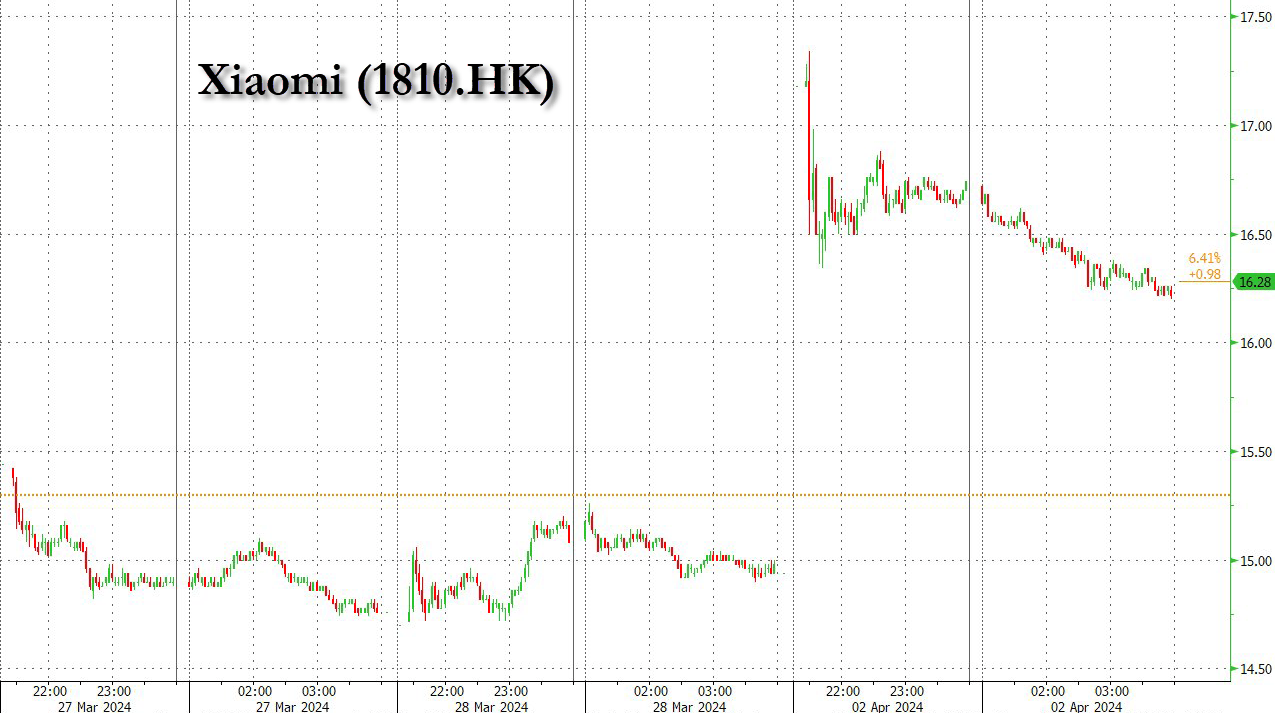
Xiaomi’s stock raged higher in Hong Kong on the news heading into Tuesday’s U.S. market open, which was preceded by Tesla missing its Q1 delivery guidance by a wide margin and posting its first Q1 delivery decline since 2020.
Within the first four minutes of its launch last Thursday, Xiaomi’s debut car, the SU7, saw 10,000 preorders in China, escalating to 50,000 in 27 minutes and nearly reaching 90,000 by day’s end, the Inside EV report says.
The surge in demand for a vehicle by a newcomer to the automotive industry means customers who put down a 5,000-yuan ($850) deposit could face up to a seven-month wait, Reuters reported, citing delivery timelines from Xiaomi’s car app.
Scheduled to start deliveries by month’s end, the top-tier Max model of the SU7, priced at 299,900 yuan ($41,500), has a delivery estimate of 27 to 30 weeks, pushing some deliveries into the next year. The Standard and Pro versions, at 215,900 yuan ($29,900) and 245,000 yuan ($33,990) respectively, are expected to take 18 to 21 weeks for delivery.
The SU7, equipped with in-house developed electric motors and available in rear-wheel or all-wheel drive, features an 800-volt system and batteries from CATL or BYD, offering up to 515 miles (830 kilometers) of range. BAIC is set to manufacture the vehicle in Beijing, with an initial capacity of 150,000 vehicles annually, doubling in the second phase.
Priced around $4,000 less than Tesla’s Model 3 in China, the SU7 boasts a longer range, additional interior screens, a head-up display, and a more upscale interior that integrates with Xiaomi’s consumer electronics. Despite the availability of cheaper alternatives like the Zeekr 007, Xiaomi’s marketing has evidently made a significant impact in the highly competitive EV market.
We noted just yesterday that EV automakers were scrambling to offer incentives to compete not only with Xiaomi’s launch, but leaders Tesla and BYD. On April 1, Shanghai-based Nio unveiled an incentive plan worth up to 1 billion yuan ($186.4 million) to encourage gasoline vehicle owners to switch, offering perks like battery swaps, extra driving function subscriptions, and a Nio smartphone.
At the same time, Xpeng reduced prices on certain vehicles by up to 20,000 yuan, and Chery Automobile introduced free purchase tax on select models and improved trade-in values.
The heavy promotions stand at odds with Tesla’s strategy in China, which saw the automaker increase its Model Y SUV price, a move previously hinted to boost pre-hike demand and sales.
Recall we also wrote just days ago that Nissan is the latest manufacturer to aim to cut EV costs in order to keep up with an increasingly competitive and saturated landscape. The company is now seeking to compete with Chinese rivals by slashing costs by 30%, Financial Times reported last weekend.
Similarly, we have noted that auto companies are slashing investment in EVs, as is the case with American auto manufacturers like Ford and GM. We wrote last month that Joe Biden’s vision for EVs across America is in “full collapse”.
Robinhood, the Menlo Park based company best known for popularizing commission-free trading — and the meme stock frenzy — entered the credit card space with its new Robinhood Gold Card.
The launch of a credit card comes less than a year after Robinhood’s $95MM cash acquisition of credit card company X1. We wrote a detailed piece on this last year; in summary, X1, the self-proclaimed “smartest credit card ever made” was a no-fee, rewards-based credit card offering a modern digital interface, innovative income-based underwriting, and user-friendly features such as easy subscription cancellations and single-use virtual cards. It was more “software app” than “card”.
The specifics of what Robinhood planned to do with the asset, particularly the benefits it would bring to the table, remained unknown. Based on the details that have been released so far, we think the excitement is justified. Some key highlights:
3% cashback on all transactions and 5% back on travel booked through their new travel portal.
While the 5% back on travel is competitive, the unlimited 3% cash back on all purchases sets a new market standard. Although some cards offer higher rewards in specific categories, these benefits are often restricted by category limits and annual caps on earnings.
Users will have the ability to add up to five family members of any age as additional cardholders with each one receiving their own card. The primary account holder can monitor each card’s spending and impose spending limits.
This should be table stakes in today’s market, but adding a cardholder can be shockingly painful. Moreover, many issuers do not provide detailed spending breakdowns by user. This treats a family credit line as a software component, which we like.
Cardholders can create and delete virtual cards for one-time purchases.
Great feature to have and one that is still lacking for many consumer cards, although newer business cards have gotten on board. As we touched on with X1, this allows for subscription cancellations and added security.
As a Visa Signature card, users automatically get trip interruption protection, extended warranty protection, auto rental collision waiver, and more.
Although it falls short of Visa’s top-tier offering, Visa Infinite, it still stands out as a premium option compared to other Visa categories like Visa Classic and Visa Gold.
Now, a few caveats.
Advertising this as a “no fee” card is misleading. To qualify, users subscribe to a Robinhood Gold account, which runs $5 per month or $50 per year.
The fee is minimal for the value you get. You cover your monthly cost so long as you spend $166 per month ($166*3%=$5).
The cash back has limitations as to how it can be redeemed — (1) purchases at select merchants directly through Robinhood’s shopping portal; (2) booking travel through the travel portal; or (3) redeeming as cash to be deposited in the Robinhood brokerage account, which is set up automatically
Users who want to spend their cash back outside of the Robinhood ecosystem will have to figure out how to transfer the cash out of the brokerage account to a checking or savings account. Clearly, the program is set up as a customer acquisition cost for their core brokerage activity, which is where revenue generation is mature. While on the surface this may seem like a money-losing endeavor, it is important to understand the economics behind credit cards. Here are the levers:
Interest Income: Revenue accrued from the interest paid by cardholders on any carried outstanding balances;
Interchange Fees: Often referred to as swipe fees, these are charged to merchants by card networks each time a card is used for a transaction.
Annual Fees: Fees charged to owners of certain premium cards to compensate for the added perks these cards have.
Other Fees: This category encompasses a range of charges, including late payment fees, balance transfer fees, cash advance fees, and others.
In order to be profitable, the revenue from these streams must cover the costs associated with reward programs and unrecoverable debts. When managed properly, credit cards are money-making machines. That said, it’s crucial to recognize that the income generated is distributed among various stakeholders in the ecosystem. The issuer, also known as the issuing bank (e.g., Chase, Citi, Barclays) receives the largest share, generally getting the majority of interchange fees and interest income, as they are the entities extending the credit. The credit networks (e.g., Visa, Mastercard) receive a smaller portion of the interchange fee. However, as networks participate in a significantly higher number of transactions, this really adds up — with merchants paying MasterCard and Visa collectively over $100B in 2023.
For Robinhood, the exact economics from the program are more complicated. Robinhood is not issuing the card directly, instead relying on Coastal Community Bank as the issuer. However, unlike how such models typically work, it appears that Robinhood will still be underwriting the cards and agreeing to cover certain defaults. With that in mind, while the exact revenue share is not disclosed, the nature of the relationship likely means that the interchange fees and interest income will be split, in some manner, between the two entities.
The credit card launch follows Robinhood’s continued push for growth, coming after products like 24-hour trading, IRA accounts, and expansion into the UK Market.
Robinhood is executing a “land and expand” strategy, acquiring customers and then cross-selling them on the Fintech bundle to grow ARPU. This has several benefits:
Increased Customer Value: Allows the company to extract the maximum value from each customer across several offerings
Customer Retention: Customers who have multiple products or services from a company are more integrated into its ecosystem, making them “stickier” and less likely to switch to a competitor.
Lower Acquisition Cost: Acquiring a new customer is expensive, involving marketing, sales efforts, and onboarding processes. In contrast, selling to an existing customer, who is already familiar with and trusts the institution, incurs much lower costs.
Enhanced Customer Insight: Having customers use multiple products allows the company to gather more data on them, and therefore create more effective marketing and risk management
Revenue Diversification: Trading revenues may be cyclical, while credit card revenues are more consistent, and likely more profitable when rates are high.
Robinhood needs to derive maximum value from each customer because their monthly active users (MAUs) have been falling since 2021. The company had over 20 million users in 2021, and shows around 10 million in 2023 — a 50% collapse.
That said, while overall MAUs are declining, Gold Members are increasing, adding 280K during 2023, and an additional 90K in the first 2 months of 2024. Recurring subscription revenue is the antidote to volatility and might be the most critical thing for Robinhood going forward. As discussed by the CFO, Jason Warnick, on the company’s 2023 Q4 earning webcast, aside from generating $85MM in annualized membership fee revenue, Gold Members adopt products at a higher rate and hold approximately 8x the assets, or $40,000, compared to average users.
The introduction of the credit card into this mix is a compelling proposition for subscribers. The link between the Gold Card and a Gold Membership will accelerate membership growth, leading to more revenue from memberships.
However, a critical challenge remains — Robinhood’s ability to effectively cross-sell to these new members within its ecosystem. The allure of the credit card is likely to attract a demographic distinct from the existing Gold Members, which might complicate cross-selling efforts. Will the new credit card users bring $40,000 to the trading platform? Robinhood seems willing to pay 3% cash back for a while to test the hypothesis.
Facebook Shared Private DMs With Netflix ‘For Nearly A Decade’ According To Lawsuit
Facebook parent Meta is alleged to have allowed Netflix to see private user DMs “for nearly a decade” in order to help the streaming giant tailor content to users, according to claims made in an explosive new lawsuit.
According to court documents originally filed last April and finally unsealed on March 23, Netflix and Facebook “enjoyed a special relationship” for “bespoke access” to user data, which Netflix paid over $100 million for.
According to the filing:
By 2013, Netflix had begun entering into a series of “Facebook Extended API” agreements, including a so-called ‘Inbox API’ agreement that allowed Netflix programmatic access to Facebook’s user’s private message inboxes, in exchange for which Netflix would “provide to FB a written report every two weeks that shows daily counts of recommendation sends and recipient clicks by interface, initiation surface, and/or implementation variant (e.g., Facebook vs. non-Facebook recommendation recipients).
…
In August 2013, Facebook provided Netflix with access to its so-called “Titan API,” a private API that allowed a whitelisted partner to access, among other things, Facebook user’s “messaging app and non-app friends.”
The anti-trust class-action lawsuit was filed by two UC citizens, Maximilian Klein and Sarah Grabert, who claim that the two Silicon Valley behemoths agreed to “custom partnerships and integrations that helped supercharge Facebook’s ad targeting and ranking models” from at least 2011 stemming from the personal relationship between Mark Zuckerberg and Netflix co-founder Reed Hastings.
“Within a month” of Hastings joining Facebook’s board, the two companies signed an “Inbox API” (Application Programming Interface) which allowed Netflix “programmatic access to Facebook’s user’s private message inboxes,” the Daily Mail reports.
🚨 NETFLIX AND META SWAPPED YOUR PRIVATE DATA
Facebook gave Netflix all your private messages on Messenger in exchange for all your watch history, while Netflix paid them $100M+ for ads.
In exchange for this data, Netflix would provide Facebook a report every fortnight which showed how users interact with the streaming media platform.
As the Mail notes, Meta and other Silicon Valley companies have been forced to pay millions of dollars in fines for its mishandling of private user information.
In 2022, Ireland fined Meta €265 million ($284 million) after data about more than half a billion users leaked online.
Full names, phone numbers, locations and birthdays of users who used the platform between 2018 and 2019 were leaked online by a ‘bad actor’ who Meta said exploited a security vulnerability.
That same year, Meta agreed to pay $725million to settle a security breach case related to Cambridge Analytica, the British social media engineering company that was brought into the limelight after its role in the Brexit vote and the 2016 presidential election was exposed. -Daily Mail
In 2018, Facebook’s former chief technology officer, Mike Schroepfer, said that as many as 87 million Facebook users had their information improperly shared with Cambridge Analytica. Andrew Bosworth, his successor, said in a leaked email that the Cambridge Analytica scandal was a “non-event,” claiming that the data mining company “were snake oil salespeople. The tools they used didn’t work, and the scale they used them at wasn’t meaningful.”
TradFi Vs DeFi: De-Polarizing The Bitcoin ‘To The Moon’ Or ‘Worthless’ Battle
Authored by Omid Malekan, Co-Authored with Ulrich Bindseil, Director General of the European Central Bank
Cryptocurrencies like Bitcoin have always been polarizing, even within the world of economics and finance. This divisiveness, which often pits the crypto faithful against skeptical experts from traditional finance, is unfortunate. Both sides can learn a great deal from each other.
One of us is a Director General at the European Central Bank with a focus on payment systems and market infrastructure.
This past February Ulrich and a colleague published a viral blog post on the ECB website questioning whether Bitcoin had any fundamental value and listing other reasons to be skeptical of its promise as currency. The blog post was a follow-up to an initial critique on the same blog written by Ulrich and his colleague back in 2022.
The other one of us clearly disagrees.
Omid has been working in the crypto industry for years and teaches it at Columbia Business School. As argued on his own blog and in his books, he believes Bitcoin has unique and appealing properties that will eventually make it a backup reserve currency.
And yet: we consider each other friends, colleagues at a distance, and are conducting research together.
We first connected shortly after Ulrich’s initial blog post. Omid presented a list of rebuttals to Ulrich’s arguments — which to his credit Ulrich wanted to hear. Ulrich asked thoughtful questions and volunteered to read Omid’s book. He then invited Omid to present to his colleagues on digital currencies and cited Omid’s writing in his own research. Along the way we learned that we share a passion for the plumbing of finance and the likelihood of it being revolutionized by modern technology.
Unlike Ulrich, other experts in finance often dismiss all blockchain-based innovation, on account of the speculative nature of crypto assets, not to mention the combative nature of crypto believers.
Unlike Omid, many crypto professionals dismiss the most important lessons from the history of finance, dooming themselves to repeat them.
We’ve learned a lot from each other by putting our differences aside. We’ve even discovered that there’s a lot we agree on when it comes to the power of decentralized settlement networks, smart contracts, and tokenization.
We agree that Bitcoin is a novel invention created by a genius, and that it will lead to lasting innovation.
We also think that decentralization comes with major tradeoffs, one of which is a difficulty to evolve.
The next few halvings are going to test Bitcoin’s economic security.
Bitcoin has an illicit use problem. The illicit use of it needs to be addressed — as it needs to be addressed for every other payment solution. Its unique properties require new tools for combating illicit use, but society has to manage the tradeoffs between catching bad actors and censoring good ones. Where to fall on this spectrum is a political decision.
We agree that the energy impact of Bitcoin is significant and must be acknowledged, even as it trends towards renewables. Whether the environmental impact is worth it will ultimately depend on its utility beyond pure speculation. We both think the appeal of Bitcoin is greater in places with high inflation, political oppression, or a lack of basic financial services.
That said, we both think stablecoins might be even more useful to such people for day-to-day use. They might also be disruptive in developed markets as a more sophisticated and programmable payment instrument, one that can be coupled with other tokenized assets to improve capital markets and invent new instruments. [BU1]
Lastly, we both think the high volatility and lack of generally accepted valuation framework of Bitcoin add to the controversy surrounding it. Omid believes that one of his students (or even Ulrich) might someday make a name for themselves by proposing one. Ulrich believes he already found the answer but will try hard to come with a different solution.
Most of all, we both consider ourselves better off for challenging each other’s views and would encourage others to try the same.
Author’s note: This piece was originally written as a back-and-forth debate about Bitcoin before it morphed into the post above. Below is Omid’s rebuttal to Ulrich’s post on the ECB blog as well as Ulrich’s response to the rebuttal. We share this in the spirit of provoking further debate.
Omid Malekan: (emphasis ours)
Whether Bitcoin or any other asset should have value is for markets to decide. The more interesting question — for any asset — is whether there’s utility, but that lives in the eye of the beholder. I have no interest in collectible tennis shoes, but enough other people do for it to have a multi-billion dollar market [source]. My lack of interest is undecisive.
Bitcoin is an algorithmically minted digital currency with its own censorship-resistant payment system. Anyone can use it and be protected from inflation, repression, & forfeiture. This utility isn’t appreciated in the developed world where currencies are stable, and banking reliable. But countless people all over the world lack these financial amenities. Tellingly, Bitcoin adoption is highest in such countries [source].
In an ideal world, nobody would need Bitcoin. But in this one 25 countries are still experiencing double-digit inflation [source] and several had hyperinflation last year [source]. High inflation is often accompanied by financial repression. Bitcoin served as an effective store of value in these countries, despite its volatility.
A skeptic could argue almost any asset — including dollars, stocks, and real estate — do well when currencies collapse. But these assets are often unavailable to ordinary people, or live on untrustworthy infrastructure. Bitcoin has stronger property rights.
As the original blog post points out, those protections have a cost. Bitcoin is too slow and expensive to be used as a day-to-day currency & is seldom used as originally intended. But many technologies evolve beyond their original intent — the internet was original meant for academia and didn’t allow commercial activity until 1993. Tech evolves to serve users, not the other way around.
Bitcoin’s strong protections require energy. Setting aside the nuances, the environmental impact is significant. But many things use a lot of energy when measured in aggregate — like video games or the US Military. The question is whether the benefits are worth the cost. Bitcoin’s are, at least to women in Afghanistan or expats with family in Venezuela. Corporations and governments might someday find similar utility due to rising geopolitical tensions.
Bitcoin’s censorship-resistance does mean that it can be used for illicit activity. But so can smartphones, the internet, or banking. The existing financial system still accommodates significant illicit activity [source] — despite ever tightening restrictions, the cost of which is borne by everyone, including those who can afford it lease, like the underprivileged in so-called high-risk countries. The total amount of illicit activity in Bitcoin fell last year [source], possibly due to new forensic tools built on the transparency of the blockchain. Banking remains as opaque as ever, and fines for AML-violations jumped 50% in 2022. [source]
What do these benefits have to do with people who invest in Bitcoin ETFs? Very little. But it’s perfectly rational for one group of investors to bet that others will appreciate the utility of an asset. People who invest in Lithium ETFs don’t build batteries, they bet that someone else will.
Ulrich Bindseil: (emphasis ours)
Although it would be nice, I fear that the idea of women in Afghanistan improving their conditions with Bitcoin is largely a romantic wish. And if crypto-assets could support them, wouldn’t a US stablecoin relying on a faster, cheaper, and more efficient blockchain not provide a better store of value or payment mechanism than Bitcoin?
One can easily acknowledge that the technical design of the Bitcoin network appears to be a masterpiece. But that doesn’t mean that it’s not already outdated or on its way to being soon. How can the protocol be changed sufficiently to gain the efficiency it needs to survive in the medium term? Wouldn’t substantial changes betray the narrative of Bitcoin being immutable and having a fixed supply, making it indistinguishable from newer cryptocoins, reminding everyone its design is one of countless possibilities, and therefore not scarce?
We admire the technical designs of the 1944 Colossus computer of Max Newman, but it did not have commercial viability for long. Can we really imagine that Bitcoin will be around in 50 years? Why should it, given the incredible pace of change in computing and crypto technology? And if it’s not around in 50 years, can it have value today without remarkable utility? Proof of work has high energy consumption — proof of stake consumes 99% less energy and centralized ledgers even less. The negative climate effects are experienced by everyone, but perhaps they should be charged to Bitcoin holders, most of whom don’t seem to care so long as prices go up. Ironically, many of them only access Bitcoin through centralized intermediaries, as is the case with the official wallet offered by the government of El Salvador [source]
The “HODL” vision of many Bitcoin owners, predicated on ever-higher prices despite so many question marks and no way to derive a fair value, is a poor basis for a trillion-dollar asset. Unlike the technical resilience of the network, it’s inelegant. It leads to endless promotion by large holders who understate the risks, putting other investors at risk. Having a fundamental value anchor for any asset class isn’t just a side issue, it’s a necessary condition for trust.
The worlds of crypto and finance were always going to merge, so we might as well open our minds and learn from each other.
Group Of Foreign Aid Workers Killed By Israeli Strike On Convoy, Netanyahu Expresses Regret
A Monday an Israeli airstrike on the central Gaza town of of Deir al-Balah killed seven international aid workers with World Central Kitchen, resulting in the well-known charity announcing Tuesday that it must suspend operations to deliver food aid to Gaza.
Footage confirming their deaths is driving international outrage and again ramping up the pressure on Israel. The Associated Press writes Tuesday, “Footage showed the bodies, several wearing protective gear with the charity’s logo, at a hospital in the central Gaza town of Deir al-Balah.” The report details, “Those killed include three British nationals, an Australian, a Polish national, an American-Canadian dual citizen and a Palestinian, according to hospital records.”
The well-known charity was founded founded in 2010 by Spanish American chef and restaurateur José Andrés, and has been among many world charities and NGOs embedded in Gaza amid the ongoing humanitarian catastrophe.
World Central Kitchen CEO Erin Gore has said in a fresh statement: “This is not only an attack against WCK, this is an attack on humanitarian organizations showing up in the most dire of situations where food is being used as a weapon of war.”
“This is unforgivable,” Gore added. The statement underscored that the team “was traveling in a deconflicted zone in two armored cars branded with the WCK logo and a soft skin vehicle.”
What makes this tragedy look even worse for Israel is that it was a targeted drone strike on a convoy operated by the international charity. Israel’s Haaretz reports that the attack was ostensibly targeting a Hamas member who wasn’t there. It was “launched because of suspicion that a terrorist was travelling with the convoy.” What’s more is that the report indicates the convoy was bombed three times.
Israeli Prime Minister Benjamin Netanyahu expressed regret in a Tuesday statement, and amid growing pressure from the press and Western governments, acknowledging his military had conducted the “unintended strike” on “innocent people in the Gaza Strip.”
“Unfortunately, in the past day, there was a tragic incident of an unintentional hit by our forces on innocent people in the Gaza Strip. It happens during war. We are in touch with governments, and we’ll do everything so this doesn’t happen again,” his full statement said, though without mentioning World Central Kitchen by name.
Cyprus has said that as a result of the incident and the charity’s forced shuttering of operations, recently arrived ships have turned back while loaded with some 240 tons of undelivered aid.
Meanwhile, the US State Department has said that famine is likely already present in parts of Gaza. A State Dept. official told Reuters. “While we can say with confidence that famine is a significant risk in the south and center but not present, in the north, it is both a risk and quite possibly is present in at least some areas.”
I find it interesting that Israel can conduct precision HVT strikes on targets in Syria, but in Gaza they will just drop on anything with a pulse with apparently no targeting criteria. https://t.co/i1De3CTANl
The US Army’s project to build a large pier off Gaza’s coast to facilitate maritime aid deliveries is still likely at least two months out as US Navy ships carrying the building equipment and engineering personnel are still traversing the Atlantic while en route to the eastern Mediterranean.