65.8 F
Chicago
Sunday, September 20, 2026
Home Blog Page 2772

FDA’s Anti-Ivermectin “You Are Not A Horse” Post Remains Up As Court Order Deadline Looms

FDA’s Anti-Ivermectin “You Are Not A Horse” Post Remains Up As Court Order Deadline Looms

Authored by Matthew Lysak via The Epoch Times,

Eleven days after a court-ordered settlement required the U.S. Food and Drug Administration (FDA) to remove all social media and directives regarding ivermectin, a webpage and its most infamous post remains online, advising people against the use of the popular drug.

After years of controversy over using ivermectin to fight COVID-19, the FDA agreed to remove its social media posts urging people to stop using the drug, according to a settlement filed with federal court in southern Texas dated March 21.

The agency has already removed a page that said: “Should I take ivermectin to prevent or treat COVID-19? No.”

However, its Aug. 21, 2021, post on X (formerly Twitter)—in which the FDA wrote:

“You are not a horse. You are not a cow. Seriously y’all. Stop it”—continues to remain live on the social media platform.

At the time of publication, the post had been reposted more than 67,000 times.

Further, a page on the agency’s website titled “Why You Should Not Use Ivermectin to Treat or Prevent COVID-19” also remains live, in which the agency states that the “FDA has not authorized or approved ivermectin for use in preventing or treating COVID-19 in humans or animals.” The page also says no data exist showing ivermectin to be effective against COVID-19, despite studies that show the drug to be effective against the disease.

Dr. Mary Talley Bowden, a practitioner in Texas and founder of the Coalition of Health Freedom, told The Epoch Times that she believes the agency is delaying the inevitable to avoid further public ridicule.

“My guess is they’re hoping all the negative publicity over the case will die down, and they can quietly remove them without as many people noticing,” said Dr. Bowden, who was among a group of doctors who initially filed a lawsuit against the FDA.

“We have three years of false propaganda to overcome regarding ivermectin,” she added.

According to the terms outlined in the settlement, the agency has 21 days to “delete and not republish” web pages and several media posts, including an April 26, 2022, social media post that reads: “Hold your horses y’all. Ivermectin may be trending, but it still isn’t authorized or approved to treat COVID-19.”

In exchange for removing the posts and webpages, doctors who sued the agency are dismissing their claims, the filing states.

An FDA spokesperson was not immediately available for comment but had previously told The Epoch Times in an email that the agency “has chosen to resolve this lawsuit rather than continuing to litigate over statements that are between two and nearly four years old.”

Ivermectin has been around for decades but became the center of controversy in 2020 after medical opinion became divided over its effectiveness as a treatment for COVID-19. In the aftermath, many pharmacists refused to fill prescriptions for the medication.

By 2023, the issue had made its way into a courtroom in a case brought by Dr. Bowden and other medical professionals when, on Aug. 8, a lawyer representing the FDA confirmed that doctors were free to prescribe ivermectin to treat COVID-19.

“FDA explicitly recognizes that doctors do have the authority to prescribe ivermectin to treat COVID,” Ashley Cheung Honold, a Department of Justice lawyer representing the FDA, told the U.S. Court of Appeals for the 5th Circuit.

Despite statements from the FDA affirming that right to doctors, many pharmacists nationwide continue to refuse to fill prescriptions for ivermectin issued to patients for the treatment of COVID-19, according to Dr. Bowden.

In most cases, according to Dr. Bowden, individual pharmacists aren’t to blame and often only carry out orders from corporate leadership. However, she claims to have also seen examples where pharmacists prevented her patients from getting their medication because of their own “personal agenda.”

Further, the longer the FDA posts remain up, the more difficult it is for physicians to ensure that patients receive the care needed, according to Dr. Bowden, who added that a pharmacist refused to fill an ivermectin prescription she had written last week.

“I’ve treated over 6,000 COVID patients using a combination of medications, including ivermectin,” said Dr. Bowden. “All of my patients who received early treatment are alive and well.

“The sooner they remove the posts, the better, but we have a lot of work to do to reeducate the public,” she added.

The FDA has until April 11 to delete the remaining posts, according to the settlement.

Tyler Durden
Tue, 04/02/2024 – 10:15

GDP Growth Doubts Rise As Goods Shipments Disappoint In Feb; Orders Revised Lower… Again

GDP Growth Doubts Rise As Goods Shipments Disappoint In Feb; Orders Revised Lower… Again

Having plunged by the most since COVID lockdowns in January, analysts expected a small rebound in February data released this morning. Analysts were right as headline factory orders rose 1.4% MoM (vs +1.0% exp) but this was from a downwardly revised 3.8% MoM loss in January (from -3.6%). That lifted the YoY rise in factory orders to +1.0%…

Source: Bloomberg

On a core (ex-transports) basis, orders also beat expectations, rising 1.1% MoM (vs +0.5% MoM exp) from an upwardly revised 0.6% MoM loss in January. That MoM gain inched the YoY orders back into the green (+0.17%)…

Source: Bloomberg

The Military-Industrial complex struggled in February (poor things) as Defense spending dropped 12.7% MoM (while non-defense rebounded from its biggest MoM drop since COVID lockdowns)…

Source: Bloomberg

Mining and Refining orders rose notably in February while shipbuilding orders tumbled most since June 2023…

Source: Bloomberg

Final factory orders were revised slightly lower over the month with capital goods shipments ex-air –  a key input for the government’s GDP calculation – tumbled 0.6% MoM (the worst since Feb 2021)…

Source: Bloomberg

That’s a troubling signal for future production and and limits the scope for a persistent upswing in capex.

Finally, it’s that same old issue again… downward revisions!! In the last 21 months, US factory orders have been downwardly revised 17 times…

Source: Bloomberg

Bidenomics – make it up as you go along – continues.

Tyler Durden
Tue, 04/02/2024 – 10:11

Baltimore Bridge Collapse: New Underwater 3D Images Show “Sheer Magnitude” Of Salvage Operation Ahead

Baltimore Bridge Collapse: New Underwater 3D Images Show “Sheer Magnitude” Of Salvage Operation Ahead

Update (0945ET):

Local, state, or federal officials have yet to offer a timeline for salvage crews to completely remove the collapsed bridge from the main shipping channel entering the Port of Baltimore. 

On Tuesday morning, the Baltimore District, US Army Corps of Engineers published new 3D images of the wreckage at the bottom of the shipping channel on social media. 

“These 3D images show the sheer magnitude of the very difficult and challenging salvage operation ahead,” the US Army Corps of Engineers said in a Facebook post. 

The post continued, “The underwater sonar imaging tool, known as CODA Octopus, is the primary survey tool used by divers, with visibility clouded to just one to two feet because of the four to five feet of mud and loose bottom of the Patapsco River.” 

“Divers are forced to work in virtual darkness, because when lit, their view is similar to driving through a heavy snowfall at night with high-beam headlights on. So murky is the water, divers must be guided via detailed verbal directions from operators in vessels topside who are viewing real-time CODA imagery,” Army Corps of Engineers pointed out. 

They added that “no usable underwater video exists of the wreckage” because, as one Navy diver put it, “there’s no need to take video of something you can’t even see.”

The complexity of this salvage operation suggests the main shipping channel will be closed for weeks if not months. 

*    *    * 

Salvage crews at the Port of Baltimore have opened up a temporary channel to keep commercial traffic flowing one week after the collapse of the 1.6-mile-long Francis Scott Key Bridge. 

Officials said the narrow channel is 11 feet deep, with a 264-foot horizontal clearance and a 95-foot vertical clearance. Small barges were seen passing through the new channel, as the main shipping channel remained clogged with the mangled steel bridge twisted around the container ship “Dali.”

“This marks an important first step along the road to reopening the port of Baltimore,” US Coast Guard Captain David O’Connell, federal on-scene coordinator, said on Monday. 

O’Connell said, “By opening this alternate route, we will support the flow of marine traffic into Baltimore.”

Secretary of Transportation Pete Buttigieg said Sunday on CBS’s “Face the Nation” that federal officials have no timeline for reopening the main shipping channel or rebuilding the bridge. 

“This is going to be a very complex process,” Buttigieg said, adding, “There are, even now, forces acting on that steel, so it takes a lot to make sure that it can be dismantled safely, to make sure that the vessel stays where it is supposed to be and doesn’t swing out into the channel.”

On Monday, the Department of Defense stated three massive cranes have arrived at the collapsed bridge:

“The Chesapeake, a 1,000-ton lift capacity derrick barge, the Ferrell, a 200-ton lift capacity revolving crane barge, and the Oyster Bay, a 150-ton lift capacity crane barge have arrived in Baltimore Harbor.”

The DoD added:

“An additional 400-ton lift capacity barge is on track to arrive early next week.”

On Monday evening, US Coast Guard Rear Admiral Shannon Gilreath told reporters that salvage operations underneath the water are even more complicated than initially imagined:

“These girders are essentially tangled together, intertwined, making it very difficult to figure out where you need to potentially cut so that we can make that into more manageable sizes to lift them from the water.” 

At the same press conference, Governor Wes Moore said: 

“We’re talking about something that is almost the size of the Statue of Liberty … and the scale of this project, to be clear, is enormous. And even the smallest (tasks) are huge.”

Even with a temporary channel reopened, activity at the Port of Baltimore has crashed and will remain paralyzed until the main shipping channel is reopened. 

CBS News’ Alex Glaze spoke with Scott Cowan, president of the local chapter of the International Longshoremen’s Association, who warned, “If there are no ships, there’s no cargo. If there’s no cargo, there is no work.” 

Cowan said thousands of unionized port workers could lose their jobs. 

ILA leaders have met with state and federal officials about the situation. 

Maryland Senate President Bill Ferguson introduced emergency legislation to the General Assembly to provide stimmy checks for ILA workers. 

“In the coming days, the General Assembly will pass the PORT Act which will support workers not covered by our unemployment insurance system, ensure impacted businesses can retain their workforce and incentivize companies to come back to the Port after it reopens,” Ferguson posted on X on Friday. 

The bridge collapse could have been avoided or at least not a total disaster if Maryland officials had not neglected to spend millions of dollars to install anti-ship strike barriers around critical bridge supports. Also, despite the federal government immediately coming out one week ago and saying the container ship strike was not terror-related, some users on X continue to float the idea this could’ve been “deliberate.” 

Tyler Durden
Tue, 04/02/2024 – 09:45

Ukrainian Drones Hit Russia’s Third-Largest Oil Refinery, Prompting White House Anger

Ukrainian Drones Hit Russia’s Third-Largest Oil Refinery, Prompting White House Anger

As discussed in our morning wrap, US equity futures are dipping lower as bond yields in the US continue to move higher as crude continues to surge and is up another 2% on growing fears of middle-eastern escalation after a senior Iranian commander was killed by an Israeli airstrike in Syria yesterday, with Iran immediately vowing revenge, and as Ukraine once again struck oil infrastructure targets deep inside Russia, overnight hitting Russia’s 3rd largest refinery, ~800 miles from the front lines.

As OilPrice details, Ukrainian drones hit the primary refining unit of Russia’s third-largest refinery southeast of Moscow more than 800 miles from the front line, Reuters reported on Tuesday. Ukraine keeps striking Russian oil assets despite the Biden admin’s unequivocal demands for a hard stop, suggesting that diplomatic fallout is now imminent.

The Taneco refinery of Russian company Tatneft in Tatarstan, an industrialized region southeast of Moscow, was attacked by Ukrainian drones in the latest such attack from Ukraine on Russian refining infrastructure.

The refinery has a capacity to process 340,000 barrels per day (bpd) of crude. Its primary refining unit, with a capacity to process about 155,000 bpd, was hit in Tuesday’s attack, according to pictures seen by Reuters. The unit caught fire, which was swiftly extinguished, Russian media report.

They also quote Ramil Mullin, the mayor of the city of Nizhnekamsk, where the refinery is located, as saying that there have been no injured people in the attack.

“There are no injuries or serious damage,” Mullin wrote on Telegram. “The technological process of the enterprise has not been disrupted,” the mayor added.

A source with the Ukrainian intelligence in Kyiv told Reuters that Ukraine hit a major Russian oil facility in Tatarstan to reduce Russian oil revenues.

Ukraine has stepped up attacks on oil refineries in Russia in recent weeks, which have reduced Russian refining capacity, and which, reportedly, have the White House concerned about rising international prices.

The United States has repeatedly urged Ukraine to halt its drone attacks on Russian oil refineries due to Washington’s assessment that the strikes could lead to Russian retaliation and push up global oil prices, the Financial Times reported last month, citing sources familiar with the exchange.

According to Reuters estimates, the amount of Russian oil refining capacity that has been taken offline due to Ukrainian drone strikes is 14% of Russia’s total refining capacity.

Calculations show that 900,000 bpd of refining capacity have been taken offline by drone strikes, Reuters reported last week.   

Tyler Durden
Tue, 04/02/2024 – 09:40

Tesla Shares Plunge After Suffering First Q1 Delivery Decline Since 2020

Tesla Shares Plunge After Suffering First Q1 Delivery Decline Since 2020

Tesla shares are plunging heading into the cash open after the automaker reported Q1 deliveries and production that fell far below estimates.

For Q1 2024, Tesla produced over 433,000 vehicles and delivered 387,000. It marks the first annual Q1 delivery decline for the automaker since 2020. 

Tesla’s exact delivery number for the quarter was 386,810 vehicles, far below Bloomberg estimates of 449.080.

For the quarter, the company produced 412,376 Model 3/Y vehicles against estimates of 439,194. The company produced 20,995 “other models”. 

Tesla encountered several hurdles in the first quarter, including Houthi militia attacks that disrupted its component supply in the Red Sea, leading to a temporary halt in production at its German factory.

Additionally, environmental activists’ sabotage near the same facility further impeded operations.

As we have been noting on Zero Hedge, in China, intense competition from local EV manufacturers like BYD and Xiaomi led to reduced production at Tesla’s Shanghai plant after disappointing sales in January and February. The U.S. market at the same time gave mixed reviews to Tesla’s new Cybertruck, and discounts and incentives were less successful in boosting sales than previously.

Ahead of the quarter’s end, CEO Elon Musk instructed sales and service staff to demonstrate the latest version of the company’s premium driver assistance system, marketed as Full Self-Driving, which still requires driver supervision. This period saw Tesla’s stock fall 29%, marking its most significant quarterly drop since the end of 2022 and one of its steepest since its 2010 IPO.

Analyst expectations varied, with a FactSet compilation predicting around 457,000 deliveries, and estimates updated in March adjusting this figure to between 414,000 and 469,000. Independent researcher Troy Teslike had anticipated around 409,000 deliveries.

However, a company-compiled consensus shared by Tesla’s head of investor relations Martin Viecha, based on 30 analysts’ estimates, expected an average of 443,027 deliveries for the quarter.

Tyler Durden
Tue, 04/02/2024 – 09:20

The Senate Calls Out-Of-Control Spending A National Security Threat, Keeps Spending Anyway…

The Senate Calls Out-Of-Control Spending A National Security Threat, Keeps Spending Anyway…

Authored by Ron Paul via The Ron Paul Institute,

Last month, the US Senate passed a resolution saying the over 34 trillion dollars (and growing) national debt threatens national security.

A few days later, a bipartisan majority of the Senate voted for a 1.2 trillion dollars spending bill. In addition to the usual increases in war and welfare spending, the bill funds gender transitioning for minors without parental consent and red flag laws, which allow law enforcement to seize an individual’s firearms without due process.

Before passage of the latest spending bill, the Congressional Budget Orifice (CBO) released a report predicting that the national debt would exceed the prior record of 106.4 percent of gross domestic product (GDP) by 2028. Interest payments on the national debt are estimated to reach 870 billion dollars this year, more than the government will spend on the military. The CBO estimates that, unless Congress cuts spending (which is highly unlikely), by 2051 interest on the debt will exceed not just military spending but spending on the two biggest items in the federal budget — Social Security and Medicare.

As Eric Boehm of Reason magazine points out, the CBO report understates how much federal spending will grow in the next several decades since it cannot predict what “crises” future congresses and presidents will exploit to ramp up federal spending.

As Boehm suggests, someone projecting 30 years ago how much government would spend in the future would not have included the increase in spending due to 9/11, the subsequent creation of a homeland security-industrial complex, the “forever” wars in Afghanistan and Iraqi, the housing meltdown, or the covid lockdown.

The hypothetical budget projection would also not have predicted legislation like the Medicare prescription drug benefit or Obamacare.

The large and growing interest on the national debt puts pressure on the Federal Reserve to keep interest rates low. The Federal Reserve’s rate increases, though relatively small, are one reason national debt payments rose by 32 percent since last year. The need for the Federal Reserve to keep interest rates low will further erode the dollar’s purchasing power, subjecting more Americans to the insidious inflation tax. It will eventually cause a loss of the dollar’s world reserve currency status. This will result in a major economic meltdown that will likely lead to widespread civil unrest, the further growth of authoritarian movements on both the left and right, and new restrictions on liberty.

The only way out of this is for Congress to begin winding down the welfare-warfare state.

A good place to start is by cutting spending on militarism and forgoing interventionism. Savings from these cuts could be used to ensure those dependent on entitlement and welfare programs are not harmed as Congress winds down these programs. Responsibility for providing support for the truly needy should be returned to local and religious charitable institutions, while responsibility for education should be returned to local communities and parents. Congress should also pass legislation requiring any new spending to be offset by cuts in other federal spending and forbidding the Federal Reserve from purchasing federal debt instruments.

These steps will be opposed by the special interests that benefit from the current system, but they are the only way to ensure the blessings of liberty and prosperity to our posterity.

Tyler Durden
Tue, 04/02/2024 – 07:20

Temporary Shipping Channel Reopens Near Baltimore Bridge Collapse For Small Vessels 

Temporary Shipping Channel Reopens Near Baltimore Bridge Collapse For Small Vessels 

Salvage crews at the Port of Baltimore have opened up a temporary channel to keep commercial traffic flowing one week after the collapse of the 1.6-mile-long Francis Scott Key Bridge. 

Officials said the narrow channel is 11 feet deep, with a 264-foot horizontal clearance and a 95-foot vertical clearance. Small barges were seen passing through the new channel, as the main shipping channel remained clogged with the mangled steel bridge twisted around the container ship “Dali.”

“This marks an important first step along the road to reopening the port of Baltimore,” US Coast Guard Captain David O’Connell, federal on-scene coordinator, said on Monday. 

O’Connell said, “By opening this alternate route, we will support the flow of marine traffic into Baltimore.”

Secretary of Transportation Pete Buttigieg said Sunday on CBS’s “Face the Nation” that federal officials have no timeline for reopening the main shipping channel or rebuilding the bridge. 

“This is going to be a very complex process,” Buttigieg said, adding, “There are, even now, forces acting on that steel, so it takes a lot to make sure that it can be dismantled safely, to make sure that the vessel stays where it is supposed to be and doesn’t swing out into the channel.”

On Monday, the Department of Defense stated three massive cranes have arrived at the collapsed bridge:

“The Chesapeake, a 1,000-ton lift capacity derrick barge, the Ferrell, a 200-ton lift capacity revolving crane barge, and the Oyster Bay, a 150-ton lift capacity crane barge have arrived in Baltimore Harbor.”

The DoD added:

“An additional 400-ton lift capacity barge is on track to arrive early next week.”

On Monday evening, US Coast Guard Rear Admiral Shannon Gilreath told reporters that salvage operations underneath the water are even more complicated than initially imagined:

“These girders are essentially tangled together, intertwined, making it very difficult to figure out where you need to potentially cut so that we can make that into more manageable sizes to lift them from the water.” 

At the same press conference, Governor Wes Moore said: 

“We’re talking about something that is almost the size of the Statue of Liberty … and the scale of this project, to be clear, is enormous. And even the smallest (tasks) are huge.”

Even with a temporary channel reopened, activity at the Port of Baltimore has crashed and will remain paralyzed until the main shipping channel is reopened. 

CBS News’ Alex Glaze spoke with Scott Cowan, president of the local chapter of the International Longshoremen’s Association, who warned, “If there are no ships, there’s no cargo. If there’s no cargo, there is no work.” 

Cowan said thousands of unionized port workers could lose their jobs. 

ILA leaders have met with state and federal officials about the situation. 

Maryland Senate President Bill Ferguson introduced emergency legislation to the General Assembly to provide stimmy checks for ILA workers. 

“In the coming days, the General Assembly will pass the PORT Act which will support workers not covered by our unemployment insurance system, ensure impacted businesses can retain their workforce and incentivize companies to come back to the Port after it reopens,” Ferguson posted on X on Friday. 

The bridge collapse could have been avoided or at least not a total disaster if Maryland officials had not neglected to spend millions of dollars to install anti-ship strike barriers around critical bridge supports. Also, despite the federal government immediately coming out one week ago and saying the container ship strike was not terror-related, some users on X continue to float the idea this could’ve been “deliberate.” 

Tyler Durden
Tue, 04/02/2024 – 06:55

Blaming Russia For “Havana Syndrome” Pushes The Opposite Narrative Than Intended

Blaming Russia For “Havana Syndrome” Pushes The Opposite Narrative Than Intended

Authored by Andrew Korybko via Substack,

For Russia to have successfully used a mobile directed energy weapon over 1,500 times, including against the US’ “top 5%, 10% performing officers across the Defense Intelligence Agency,” then it must have deeply penetrated the US Government in order to discover those elite targets’ identities and locations.

CBS News, The Insider, and Der Spiegel released the findings of their joint investigation on Sunday blaming Russia for “Havana Syndrome”, which refers to the mysterious ear and head pain that over 1,500 US Government (USG) staffers across the world claim to have experienced since 2016. It appeared timed to coincide with Congress’ plans to vote on Ukraine aid sometime later this month, with the intent obviously being to scare lawmakers into approving more funds for America’s proxy war on Russia.

It might have the opposite effect than intended, however, since those outlets’ dramatic claims paint a picture of deep Russian intelligence penetration of the US’ diplomatic and security services that can’t be remedied by simply sending more money to Ukraine. If what they wrote is true, then Russia has created a mobile directed energy weapon (DEW) that it’s already successfully used over 1,500 times, including against the US’ “top 5%, 10% performing officers across the Defense Intelligence Agency”.

This startling statistic comes from the recently retired Army lieutenant colonel who ran the Pentagon’s investigation into the matter. He claimed that this elite echelon of victims had all “worked against Russia, focused on Russia, and done extremely well” but were then “neutralized” after their injuries. His allegations contradict the Intelligence Community’s (IC) official review from last year that no DEWs nor foreign adversaries were responsible for these “anomalous health incidents”.

Those who take the IC’s official review at face value suspect that the prior hysteria about “Havana syndrome” was just a means of fearmongering about Russia, which they also naturally believe is the motive behind the latest joint investigation’s findings. Meanwhile, those who suspected that the IC’s official review was a cover-up take the latest joint investigation’s findings at face value, which means that they truly believe that Russia has deeply penetrated the US’ diplomatic and security services.

There’s no credible evidence to suggest that this is the case, especially since Russia would have presumably been much better prepared for responding to America’s diplomatic and military provocations throughout the course of their ongoing proxy war if it had moles within both. Nevertheless, the only way that one can believe that it’s systematically targeting members of those institutions who had all worked against it “extremely well” in the past is if it knew who they were and where they lived.

That in turn obliges one to believe that it must have deeply penetrated them in order to obtain this highly classified information, thus meaning that Russian spies are more highly placed than anyone had thought even after the witch hunt that followed the Russiagate hysteria. Once again, there’s no credible evidence that this is the case, and another argument against this theory is that Russia isn’t targeting any similarly prominent Ukrainian diplomats or security officials despite being at “war” with their country.

Reflecting on the abovementioned insight, it’s much more likely that Russia has nothing to do with “Havana syndrome” and that the latest joint investigation’s findings are just a desperate attempt to scare lawmakers into approving more Ukraine aid ahead of their planned vote later this month. Any penetration of the IC at the level that this conspiracy theory implies would have led to the past two years unfolding in a very different way and Russia not being caught off guard by the proxy war that broke out.

Tyler Durden
Mon, 04/01/2024 – 23:40

‘Rich’ Gen Z Women Are By Far The Most Optimistic About ‘Getting Richer’ In 2024

‘Rich’ Gen Z Women Are By Far The Most Optimistic About ‘Getting Richer’ In 2024

The jury is still out on how the global economy is expected to perform in 2024, but as seen during the pandemic, economic turmoil sometimes provides opportunities for the wealthy.

Visual Capitalist’s Marcus Lu visualizes the percentage of high net worth individual (HNWI) respondents who expect their wealth to increase in 2024, categorized by generation and gender, from the Knight Frank Next Gen Survey, accessible in their latest wealth report.

The survey covered 600 global HNWIs, who are individuals with more than $1 million in assets or make more than $200,000 a year, and then categorized their responses by gender and generation.

Affluent Gen Z Women Eye Financial Gains in 2024

At a glance, there’s a very apparent generational difference in the expectations of getting richer in 2024.

About half (52%) of the surveyed Baby Boomers think their assets will grow, compared to Gen X (56%), Millennials, (69%), and Gen Z (75%).

Note: Percentage of respondents who said they expect their wealth will increase in 2024.

There’s also a noticeable gender difference. Men tend to be more optimistic than women, with one glaring exception.

A staggering 81% of the surveyed high net worth Gen Z women expect to make hay this year, making them the most optimistic of all the groups.

This corroborates a trend where Gen Z women were also the most optimistic in retirement planning. As CNBC reports, a combination of newer avenues of financial resources, and an openness towards advice, has given them a more optimistic attitude than their older counterparts.

Meanwhile, American Millennials are expected to become the richest generation ever as a $90 trillion asset transfer between Boomer parents and Millennial children begins to take place over the next two decades.

A huge percentage of that wealth comes in the form of property assets accumulated by generations before them. This especially includes houses, whose prices have skyrocketed over the last two decades.

Tyler Durden
Mon, 04/01/2024 – 23:20

America’s Controversial Stealth Fighter Jet Can Now Carry Nukes

America’s Controversial Stealth Fighter Jet Can Now Carry Nukes

Authored by John Haughey via The Epoch Times (emphasis ours),

It was a routine Pentagon announcement during a regular briefing the Friday before the president typically submits his annual defense budget request to Congress on the second Monday in March.

As of October, a spokesman for the Department of Defense’s (DOD) F-35 Joint Program Office told Pentagon beat writers, that “certain” Air Force F-35As have been operationally certified to carry the B61-12 thermonuclear gravity bomb.

(Illustration by The Epoch Times, Getty Images, Public Domain)

While the revelation hasn’t drawn much interest from general news media in the United States, it has spurred extensive commentary within the defense-tech industry. And it is echoing loudly in Europe, most certainly within the Kremlin where Russian President Vladimir Putin has been openly discussing the use of tactical nuclear weapons.

The F-35A nuclear certification and introduction of the B61-12 bomb are key components in a tactical nuclear weapons upgrade in Europe by the North Atlantic Treaty Organization (NATO) in response to Russian saber-rattling—and advances—in battlefield nuclear weapons.

While NATO’s U.S.-built F-16A/Bs and F-16C/Ds and United Kingdom-built PA-200 Tornadoes are also fighter jets authorized to carry nuclear weapons, the F-35A Lightning II is now the first “fifth-generation” stealth fighter to be “dual-capable” of carrying conventional and nuclear weapons, according to the Pentagon.

The F-35A will soon be among NATO’s primary attack-strike jets. Belgium, Germany, Italy, the Netherlands, and Turkey are all stocking their air forces with F-35s, with Germany explicitly doing so because it would be nuclear-capable.

The March 8 announcement also confirmed the full-scale production of the B61-12 bomb. Their predecessors were housed in Belgium, Germany, Italy, and Turkey. According to some reports, they’ve been replacing them with new bombs since December 2022.

October’s nuclear certification was two months earlier than the January 2024 deadline the Pentagon set. Although only publicly acknowledged by the United States on March 8, Dutch military officials wrote in a November X post that their F-35As had achieved “initial certification” to carry nuclear weapons.

Since Pentagon policy prohibits the release of information about NATO partner military capacities, the announcement only addressed “certain” U.S. Air Force F-35As in Europe, with the U.S. fighter wing at Lakenheath in the United Kingdom likely among those upgrading.

Commander of the Swiss Air Force Major General Peter Merz gestures in front of a screen during a presentation of the a F-35 A Lightning II fighter jet at Emmen Air Base, Switzerland, on March 24, 2022. (Fabrice Coffrini/AFP via Getty Images)

A lot of this is just information warfare, SOP [standard operating procedure] and optics that we got F-35As and allies who have F-35As in Europe,” retired Army Col. John Mills told The Epoch Times.

Mr. Mills, a 33-year Army veteran and former Director for Cybersecurity Policy, Strategy, and International Affairs under the Secretary of Defense, said the F-35A “has always been about Europe.”

“The message is that the F-35s are now there, and they are nuclear certified, and B61-12s are in storage ready to go, ready to be used, if necessary, out of Lakenheath,” he said.

Mr. Mills, who has spoken and written extensively on military matters, including about the F-35A in a column in The Epoch Times, said the announcement was aimed squarely at Mr. Putin.

“Of course,” he said. “He’s the target.”

“If anything, it does create a little bit of angst on the part of the Russians, because that means the [F-35-As] have more potential platforms, more different areas, more places for the Russians to keep track of,” said Mike Fredenburg, founding president of the Adam Smith Institute of San Diego. He writes frequently on defense tech for a wide range of publications, including National Review and The Epoch Times.

“The F-35 has pretty good range for a single-engine fighter. It is stealth, and so you could obviously get closer to Russian air space before being effectively targeted than you could, let’s say, with an F-15,” noting that with 600 to 700 F-35s in U.S. and allied air forces, “we have hundreds of them, and at any given time, some of them are probably capable of flying.”

Mr. Fredenburg admits: “I’m not a huge fan of the F-35.”

So little so that for those who have followed the aircraft’s checkered development for the past 30 years, he had to quantify how truly significant the F-35A certification is. “I don’t want to say it’s insignificant. It does, I think, potentially create some more instability because nobody else has many stealth fighters,” Mr. Fredenburg told The Epoch Times.

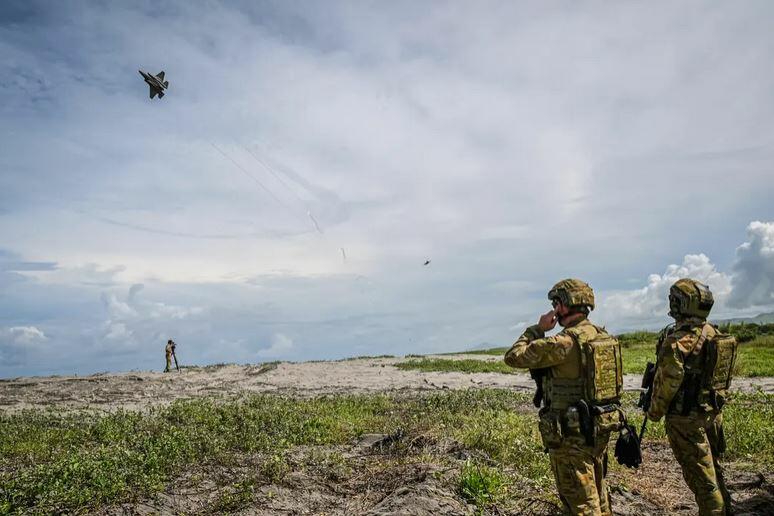
(Top) Australian F-35A lightning fighter jets fly past during a joint exercise at a naval base in the Philippines on August 25, 2023. (Bottom) Denmark’s Minister of Defense Troels Lund Poulsen (R) greets a F-35 pilot at the Skrydstrup base in Denmark, on Sept. 14, 2023. (Ted Aljibe/AFP via Getty Images, Bo Amstrup/Ritzau Scanpix/AFP via Getty Images)

“I’d say it’d be more significant if you were putting [a nuclear weapon] on a platform that was more reliable, that you could count on. I guess I could say that.”

A Long, Haunted History

“First of all,” Mr. Fredenburg said, “you have to look at the history. From the very beginning, it was doomed. It was too heavy. There’s no way you can make an engine powerful enough to fly a plane that big. The plane is the largest single-engine plane in the world.”

When first envisioned in the early 1990s, the F-35 was touted by Lockheed Martin as an all-purpose, next-generation stealth joint-force single-engine fighter that would replace up to 16 different types of warcraft, including the Navy’s F-14, the Air Force’s F-16, and the Marine Corps’ Harrier jump jets.

That was nearly two generations ago.

Design began in 1994. After a series of delays, dozens of F-35-equipped squadrons were supposed to be operational at a cost of $233 billion by 2010.

It didn’t even come close to that,” Mr. Mills said.

By 2016, the project’s cost had doubled. It remains more than a decade behind schedule and billions over budget with mixed results, some say.

“What they did is, you know how you ‘soup up’ your car? Put nitrate in it or something like that? Mr. Fredenburg said. “You might be able to get it around a few times before it blows up, but that’s what they did here.

“They ‘souped up’ the F-22 engine and made it super, super hot to get the horsepower, that thrust, and there’s no way that engine was going to be durable.

“So,” he continued, “it’s got an engine that can’t do the job. It won’t be reliable ever. Ever.”

Read more here…

Tyler Durden
Mon, 04/01/2024 – 23:00