67.2 F
Chicago
Sunday, September 20, 2026
Home Blog Page 2786

Philadelphia Fed Admits US Payrolls Overstated By At Least 800,000

Philadelphia Fed Admits US Payrolls Overstated By At Least 800,000

The first red flags emerged in the summer of 2022: that’s when the Biden Labor Department started well and truly rigging the labor market data.

Regular readers may recall that it was back in July of 2022, when we first warned that something had “snapped” in the labor market: that’s when a striking discrepancy emerged between the number of US Payrolls (as measured by the BLS’ Establishment Survey, a far more crude and imprecise, yet much more market-moving data series), and the number of actual Employed Workers (as measured by the BLS’ far more accurate Household Survey) . As we showed then, after the two series had tracked each other tick for tick for years, a wide gap opened in March 2022 which quickly grew to 1.5 million jobs in just 3 months…

… one which has since exploded to a whopping 5 million “employed workers” that apparently do not exist.

And while some of this discrepancy could be explained with the record surge in multiple jobholders, which increased by 1 million since March 2022 to an all time high of 8.6 million at the end of 2023 (as a reminder, the Establishment Survey counts 1 worker have 2 or 3 (or more) multiple jobs as, well, 2 or 3 (or more) separate jobs, even if it is just one worker trying to make ends meet under the roaring inflation of Bidenomics), most of the gap remained unexplained.

There was more: it was around the summer of 2022 that the Biden labor department – in its zeal to show job growth no matter the cost, or quality of jobs – also started fooling around with the composition of the labor market, with most of the monthly gains going to part-time workers, even as full-time workers stagnated or declined. The culmination, as we reported earlier this month, is that in February 2024, the US had 132.9 million full-time jobs and 27.9 million part-time jobs. Which is great… until you look back one year and find that in February 2023 the US had 133.2 million full-time jobs, or more than it does one year later! And yes, all the job growth since then has been in part-time jobs, which have increased by 921K since February 2023 (from 27.020 million to 27.941 million).

In other words, starting in 2022 and accelerating to present days, less and less full-time jobs were added, until we got to the absurd situation that all the new jobs in the past year have been part-time jobs!

And then there was, of course, the great jobs replacement theory, only as we first showed well over a year ago, it wasn’t a theory but practice, and following countless months in which native-born workers lost their jobs, including a near-record 3-month plunge to start 2024…

… offset by a record 1.2 million foreign-born (read immigrants, both legal and illegal but mostly illegal) workers added in February…

Or, as we first pointed out several months ago, not only has all job creation in the past 6 years – since May 2018 – has been exclusively for foreign-born workers…

… but there has been zero job-creation for native born workers since June 2018!

Ok fine, but all of the above are really just example of the Biden admin Labor Department playing around with statistics and trying (and succeeding) to fool the greatest number of people. There is really nothing about outright data rigging and fabrication… and also while we realize that the Household survey shows a far uglier labor market – one where part-time jobs, illegal immigrants, and multiple jobholders dominate – what about the Establishment survey, which is behind the actual payrolls number, the only number that matters as far as the market is concerned?

All good points, and to address them, we first have to go back to December 2022, when we reported something shocking: as part of its data analysis of the “more comprehensive, accurate job estimates released by the BLS as part of its Quarterly Census of Employment and Wages (QCEW) program“, the Philadelphia Fed found that the BLS had overstated jobs to the tune of 1.1 million! This is what the Philadelphia Fed wrote in its quarterly Early Benchmark Revision of State Payroll Employment report at the time:

Our estimates incorporate more comprehensive, accurate job estimates released by the BLS as part of its Quarterly Census of Employment and Wages (QCEW) program to augment the sample data from the BLS’s CES that are issued monthly on a timely basis. All percentage change calculations are expressed as annualized rates. Read more about our methodology. Learn more about interpreting our early benchmark estimates.

So what did this “more accurate”, “more comprehensive” report find? It found that…

In the aggregate, 10,500 net new jobs were added during the period rather than the 1,121,500 jobs estimated by the sum of the states; the U.S. CES estimated net growth of 1,047,000 jobs for the period.

This is shown graphically in the chart below: specifically, the analysis looks at the quarter in the red box, where the green line, or the more accurate “early benchmark” revision of official data, dipped decidedly below the CES trendline (i.e., the nonfarm payrolls).

Alas, since the far more accurate Quarterly Census of Employment and Wages (QCEW) numbers would not be actually incorporated into BLS benchmarks for well over a year after we wrote our analysis in Dec 2022, neither we nor the market would know just how manipulated the data was until early 2024. Which, of course, is now, and as we already know, the BLS had been consistently downward revising virtually all initial job prints in 2023 (ten of the eleven jobs reports heading into Dec 2023 were revised lower) to make the economy more realistic but only in retrospect…

… however, even though we do know now that the jobs data in 2022 was far weaker than anyone thought at the time, nobody really cares: after all there are part-time jobs and illegal immigrants to plug any and all historical holes, plus we are talking about ancient history.

Plus, we have all those great recent jobs reports to fall back on: the ones that confirm that Bidenomics is doing such a great job.

Only… that’s not true either. Presenting Exhibit A: the latest Philadelphia Fed quarterly report on Early Benchmark Revisions of State Payroll Employment. It shows that once again, the BLS has been fabricating jobs, and not just any jobs but those that make up the all-important (if highly inaccurate) payrolls reported by the Biden Bureau of Goalseeked Statistics.

The primary purpose of this analysis, in the Philly Fed’s own words, is “to produce timely estimates of state payroll jobs that closely predict the annual benchmark revisions released by the BLS each March. To do so, we incorporate more comprehensive job estimates released by the BLS as part of its Quarterly Census of Employment and Wages (QCEW) program.” This is more or less a replica of the analysis which the Philly Fed performed back in December, when it found that 1.1 million jobs were unexpectedly “missing.”

So what happened this time? Well, the analysis, which looked at state-level data, “found that “the employment changes from June through September 2023 were significantly different in 27 states compared with prebenchmark state estimates from the Bureau of Labor Statistics’ (BLS) Current Employment Statistics (CES).” Specifically, “early benchmark (EB) estimates indicated lower changes in 24 states, higher changes in three states, and lesser changes in the remaining 23 states and the District of Columbia.

Some more details from the report:

Over the full year ending with this 2023 Q3 vintage — which includes additional QCEW data changes affecting the prior three quarters — payroll jobs in the 50 states and the District of Columbia grew 1.5 percent.

  • Based on the pre-benchmark CES sum of states and the U.S. CES, payroll jobs grew 1.9 percent and 2.0 percent, respectively.
  • The revised CES sum-of-states growth rate is 1.5 percent.

For 2023 Q3, payroll jobs in the 50 states and the District of Columbia rose 0.5 percent, after adjusting for QCEW data.

  • Based on both the prebenchmark CES sum of states and the U.S. CES, payroll jobs grew 1.7 percent.
  • The revised CES sum-of-states growth rate is 0.5 percent

We’ll go back to the chart above in a second, but first we wanted to show this scatter of state-level employment comparing the St Louis Fed’s more accurate early benchmarking process vs the BLS’ Prebenchmarking CES process: it found that most states’ labor data would be revised lower, in many substantially so.

Ok… but what does all of that mean in English?

Well, to make some more sense of the data, we went through the Early Benchmark state-level data excel spreadsheet provided by the Philly Fed (link), and simply added across the various states to obtain aggregate, country-level data so that we could compare the far more accurate QCEW data with what the BLS had been peddling for the past year.

The result was – again – shocking, and as shown in the chart below, a little over a year after we, or rather the Philly Fed, found that the BLS had overstated payrolls in 2022 by 1.1 million, here we go again, only this time the BLS had overstated payrolls by 800,000 through Dec 2023 (and more if one were to extend the data series into 2024). It’s truly statistically remarkable how every time the data error is in favor of a stronger, if fake, economy.

it also means that far from the stellar 230K average monthly increase in payrolls in 2023, which the White House would spin time and again as direct evidence of the benefits of Bidenomics, the true average monthly payroll increase in 2023 was only 130K! The full monthly change in payrolls as originally reported by the BLS (in green) and the actual monthly number, as per the QCEW (in red) is shown below.

Putting it all together, we now know – as the Philly Fed reported first – that the labor market is far weaker than conventionally believed. In fact, no less than 800,000 payrolls are “missing” when one uses the far more accurate Quarterly Census of Employment and Wages data rather than the BLS’ woefully inaccurate and politically mandated payrolls “data”, and if one looks back the the monthly gains across most of 2023, one gets not 230K jobs added on average every month but rather 130K.

Of course, none of that paints Bidenomics in a flattering picture, because while one can at least pretend that issuing $1 trillion in debt every 100 days to add 3 million jos per year is somewhat acceptable, learning that that ridiculous amount buys 800,000 jobs less is hardly the endorsement that the White House needs.

Which is also why nobody in the mainstream media – which is now nothing more than the PR smokescreen for the Biden puppetmasters, the government and the deep state – will ever mention this report.

As such, we urge all readers to read Philly Fed analysis (link here) and to analyze the excel data (link here) at their own leisure, because in a fascist state, the media no longer works for the people.

Tyler Durden
Thu, 03/28/2024 – 15:45

Disney Faces Accusations Of Misleading Shareholders With Left-Wing Agenda

Disney Faces Accusations Of Misleading Shareholders With Left-Wing Agenda

Authored by Eric Lundrum via American Greatness,

The Walt Disney Company is facing backlash after critics say it has misled its shareholders by prioritizing a “woke political and social agenda” over profits, thus violating its fiduciary duty.

As Fox News reports, a letter was sent to Disney on Wednesday by America First Legal (AFL) accusing the company of unlawful discrimination, as well as forcing political messages that have resulted in “damage to Disney’s brand, properties, and commercial reputation by management’s manufactured misalignment between its woke political and social agenda and the vast majority of the Company’s customers.”

AFL, which is run by Stephen Miller, a former senior adviser to President Donald Trump, further claims that Disney’s upper levels of management “intentionally manufactured misalignment between the Company and its core customers” in recent years, which has led to the company’s market capitalization losing over $100 billion since February of 2021.

“Disney has displayed an inexplicable disregard for its customers and shareholders, forcing radical gender-expansive, anti-White, and anti-police content on families while providing warnings about harmful content on uncontroversial content,” said AFL in a press release, which went on to cite several examples of left-wing rhetoric and messages in Disney’s various entertainment products, from TV shows to movies.

In February, AFL filed a civil rights complaint against Disney with the U.S. Equal Employment Opportunity Commission, claiming that the company implemented a “patently illegal” hiring program that overwhelmingly favored “underrepresented” groups.

“Disney is an iconic American brand–the product of decades of family-focused content infused with American pride that hundreds of millions of Americans have enjoyed for decades,” said AFL Executive Director Gene Hamilton in a statement.

“But today, Disney’s leadership appears to have abandoned its roots–and most notably, its shareholders–in hopes of placating an insatiable activist movement that aims to radically reshape the Disney brand into something that is completely inconsistent with its history.”

“If Disney were a privately held corporation, it could make whatever foolish decisions it desired if those decisions complied with the law. But it’s not,” Hamilton continued.

“Disney’s leadership is gambling with–and losing–shareholder money and appears to be violating federal law in the process.”

Disney is already facing a major lawsuit from actress and former MMA fighter Gina Carano, who was fired from her role on “The Mandalorian,” a TV series in the Star Wars universe, run by Disney’s LucasFilm division.

Carano was fired for a social media post in which she compared the discrimination and dehumanization against American conservatives today to the treatment of Jews in the early days of Nazi Germany. Carano’s lawsuit is supported by X, the platform formerly known as Twitter, and its owner Elon Musk.

Tyler Durden
Thu, 03/28/2024 – 15:25

“I’m Sorry” – FTX Founder Sam Bankman-Fried Sentenced To 25 Years In Prison

“I’m Sorry” – FTX Founder Sam Bankman-Fried Sentenced To 25 Years In Prison

Update (1145ET): And there it is – Bankman-Fried sentenced to 25 years in prison – more than Elizabeth Holmes, less than Bernie Madoff, same as Bernie Ebbers.

Also consider…

SBF will also have to forfeit more than $11 billion.

Judge Kaplan did not hold back during his sentencing:

“When not lying, he was evasive, hair splitting, trying to get the prosecutors to rephrase questions for him. I’ve been doing this job for close for 30 years. I’ve never seen a performance like that.”

Update (1105ET): Just before the federal judge was about to sentence Bankman-Fried in his fraud case, the former FTX founder said that he was “sorry.”

“I know a lot of people feel really let down,” he said at his sentencing hearing Thursday morning in lower Manhattan.

“I’m sorry about that. I’m sorry about what happened at every stage.”

“All of the company followed me across the earth, across continents, burning the midnight oil working until 2 a.m., 4 a.m., dedicated to FTX,” he said in a plea for leniency. “I remember so many of them.”

He said the staff “all built something really beautiful. They threw themselves into it and then I threw that all away. It haunts me every day. I made a series of bad decisions. They weren’t selfish decisions, they were bad decisions.”

Bad decisions indeed Sam.

The long-running legal saga of Sam Bankman-Fried will come to an end on March 28 when Judge Lewis Kaplan announces the sentence of the FTX founder during a 9:30 a.m. hearing at the U.S. Courthouse in Lower Manhattan.

Before we get to the sentencing, @jconorgrogan lays out exactly what SBF did…

1. In January ’22, Sam market sold $75M of stETH, leading to a massive depeg event which set off the Celsius bankrun and the daisy chain of events that included the blow-up of 3AC

2. Using Alameda + FTX customer funds, Sam:
-Bought 10M+ of NFTs
-$18k of Pebble, a fractionalized NFT of a picture of a rock
-$605 of CarolineDAO NFTs a “SimpDAO for Caroline Ellison”
~$20k of “TENDIES”
-Bought $270k of a token called “CUMROCKET”

3. Engaged in 10s of thousands of wash-trading transactions to boost visibility of his holdings

4. Created an NFT (and most likely bought it for 270k using customer funds)

5. Did this dozens of times

6. Sold locked tokens

7. Helped fan the flames for SHIB, built up a giant position, then dumped at the absolute top

8. Manipulated defi governance token distribution forcing an emergency intervention by the protocol

9. Wasn’t that active onchain until the crime started. Here’s a chart of the balance of Alameda Wallets (Jan ’18- June ’20) The blue dot is when Nishad Singh altered the codebase to enable Alameda to withdraw unlimited amounts of crypto from FTX

10. Publicly shilled/pretended to TWAP FTT

Oh btw he later claimed in court that at this time “things were tight” and he had ordered Caroline to put on hedges

11. Filling/shilling

Here SBF is telling a concerned holder that he didn’t short or dump SUSHI. 3 days earlier, an SBF-connected wallet sent 35K SUSHI to the Alameda FTX deposit address. This happened a lot

12. (It was Alameda)

13. Messed up the Sollet bridge enabling him to account for 21k phantom SOL

After all that, in November 2023, as Michael Washburn reports via The Epoch Times, jurors decided to convict Mr. Bankman-Fried on all seven of counts of conspiracy and fraud with which government lawyers charged him.

Mr. Bankman-Fried and his attorneys have repeatedly argued that he didn’t intentionally do anything wrong and that he deserves no more than 6 1/2 years in jail. In his trial testimony in October 2023, Mr. Bankman-Fried insisted he used sophisticated analytics to try to keep track of the state of FTX’s finances and suggested that subordinates acting without his knowledge or imprimatur made costly mistakes.

But prosecutors, citing testimony from Alameda Research head Caroline Ellison, who was at times romantically involved with Mr. Bankman-Fried, vehemently disagreed with the more charitable view and are pressing for a sentence of half a century or longer.

The government’s tough stance has found support from the current CEO of FTX, John Ray III, the former chair of the recovery corporation in another high-profile insolvency: that of Enron, which imploded in December 2001. In a letter to Judge Kaplan, Mr. Ray denounced the “categorically, callously, and demonstrably false” claims that Mr. Bankman-Fried and his lawyers have put forth in the hope of getting a lighter sentence.

Occupying a middle ground between the defense position and the prosecutors, Jeffrey Hooke, a senior lecturer at Johns Hopkins Carey School of Business in Maryland and former investment banker, said that Mr. Bankman-Fried’s transgressions are serious but nowhere near on par with those of convicted fraudster Bernie Madoff, for instance, who received a 150-year sentence for his $65 billion Ponzi scheme and died in prison in 2021.

Mr. Bankman-Fried deserves a lighter sentence than either Mr. Madoff or the senior Enron executives responsible for the calamity of December 2001, Mr. Hooke said.

“Now, stuck with a guilty verdict, an appropriate sentence seems to me to be at least 10 years. The Enron guys essentially got 12 years after appealing longer sentences, and I might argue that they were truly aware of their crimes, whereas Bankman-Fried might have been somewhat less aware or deliberate,” Mr. Hooke told The Epoch Times.

Dominoes Fall

The verdict in November 2023 came exactly one year after a Nov. 2, 2022, report in the cryptocurrency publication Coindesk began to stoke wide concern about the state of FTX’s finances. The report cited a leaked balance sheet of FTX’s hedge fund trading affiliate, Alameda Research.

According to Coindesk’s analysis, a bulk of Alameda’s $14.6 billion of assets was in the form of FTX’s own crypto token, FTT, rather than a fiat currency. This not only suggested that Alameda’s wealth was potentially less fungible than many had assumed but also pointed to extensive commingling of FTX customer deposits with the hedge fund affiliate.

Whether or not Coindesk was correct to impute instability and weakness to FTX on the basis of its position in FTT, the reaction in the market was swift. On Nov. 6, 2022, Changpeng Zhao, then-CEO of Binance, one of the other leading cryptocurrency exchanges, sent out a sharply worded post on Twitter.

Mr. Zhao alluded to the fact that Binance had been distancing itself from FTX over the past year and had received the equivalent of about $2.1 billion in U.S. dollars in the form of both cash and the FTT token.

“Due to recent revelations that have come to light, we have decided to liquidate any remaining FTT on our books. We will try to do so in a way that minimizes market impact,” Mr. Zhao wrote.

Despite that assurance, Binance’s move, and forthright public announcement, immediately helped fuel a run on the bank during which customers pulled $6 billion from FTX in three days.

The exchange would never recover; some $9 billion of customer funds are still lost through the commingling of funds and Bankman-Fried’s lavish spending.

Damian Williams, US attorney for the Southern District of New York, details the indictment of Samuel Bankman-Fried in New York City, on Dec, 13, 2022. (Stephanie Keith/Getty Images)

The Feds Move In

U.S. federal prosecutors were quick to take action. On Dec. 13, 2022, the Department of Justice announced that a federal grand jury had returned an indictment charging Mr. Bankman-Fried with wire fraud, conspiracy to commit wire fraud, securities fraud, money laundering, campaign finance violations, and fraud against the Federal Election Commission.

The last allegation relates to Mr. Bankman-Fried drawing upon customer deposits to make large donations to both Democrats and Republicans with whom he wanted to curry favor.

But it was mainly Democrats who benefited from Mr. Bankman-Fried’s largesse, including a reported $5.2 million donation to then-candidate Joe Biden in 2020. According to The Wall Street Journal, this gift made Mr. Bankman-Fried second only to Michael Bloomberg among top-spending backers of President Biden.

Government lawyers briefly dropped the campaign finance charges on the technical grounds that Bahamas authorities hadn’t included them among their stated grounds for extraditing Mr. Bankman-Fried from the Bahamas to New York to face trial in December 2022. Then, in August 2023, prosecutors did an about-face and announced that Mr. Bankman-Fried was still on the hook for campaign finance violations.

Story continues below advertisement

“The Justice Department has filed charges alleging that Samuel Bankman-Fried perpetrated a range of offenses in a global scheme to deceive and defraud customers and lenders of FTX and Alameda, the defendant’s crypto hedge fund, as well as a conspiracy to defraud the United States government,” Attorney General Merrick Garland said.

Michael J. Driscoll, assistant director of the FBI’s New York office, was blunt about Mr. Bankman-Fried’s misuse of FTX deposits to pay Alameda’s expenses and to make other investments.

“If you deceive and defraud your customers, the FBI will be persistent in our efforts to bring you to justice,” Mr. Driscoll said.

In this courtroom sketch, Sam Bankman-Fried watches as defense lawyer Mark Cohen makes his opening remarks in Mr. Bankman-Fried’s fraud trial over the collapse of FTX, at Federal Court in New York, on Oct. 4, 2023. (Jane Rosenberg/Reuters)

A Fatal Move

Bankman-Fried didn’t gain any sympathy from the media, the public, or prosecutors by situating himself and nine FTX colleagues in an 11,500-square-foot suite in a $35 million Bahamas mansion.

Mr. Hooke suggested that some people still may not fully appreciate the extent of the error that Mr. Bankman-Fried made in agreeing to waive his right to formal extradition hearings and undergo transfer to the United States.

“He should never have left the Bahamas. He could have dragged out the extradition request for years, and by the time he was back in New York, a lot of this controversy would have blown over, and he could cut a decent plea deal,” Mr. Hooke told The Epoch Times.

Once taken into custody in New York, Mr. Bankman-Fried underwent a lengthy ordeal, during which both a federal appeals court and Judge Kaplan repeatedly ruled against granting him pre-trial release.

Judge Kaplan said that, given the seriousness of the charges against him, Mr. Bankman-Fried posed a flight risk, and the judge overruled arguments from the defense team that his dietary needs went unmet in prison and he was unable to confer properly with his lawyers in preparation for trial.

Mr. Bankman-Fried’s personal life also became the subject of extensive media scrutiny in the weeks leading up to the trial’s commencement.

The Epoch Times reached out to Mr. Bankman-Fried’s legal team for comment but received none by press time.

Tyler Durden
Thu, 03/28/2024 – 15:22

“We Don’t Want Your Nice, Cheap Stuff, Thanks”

“We Don’t Want Your Nice, Cheap Stuff, Thanks”

By Michael Every of Rabobank

Thinking you can successfully forecast what markets will do is a fool’s game. However, some recent financial market headlines were easy to forecast years ago. Markets didn’t, and are still failing to join the dots between said headlines and what they imply for asset prices.

No markets-based forecasting skills were needed to predict: Yellen says China’s rapid buildout of its green energy industry ‘distorts global prices’ (Reuters); Yellen to Warn China Against Flood of Cheap Green Energy Exports (New York Times); Janet Yellen says China’s giant EV push ‘distorts global prices’ and hurts workers around the world (Fortune); Janet Yellen warns China against clean energy dumping (Financial Times). Instead, you had to recognize that:

  1. Our global system was imbalanced, seeing subsidized industrial goods supply agglomerate in China, and debt-driven consumer demand in the Anglosphere – and this would end in a huge crisis. Which it did in 2008, catching most in markets by surprise.

  2. Negative rates and QE into bank reserves would not solve the West’s core problemsand public anger would see a populist policy shift. Moreover, the response in China would not be to ‘pivot to consumption’ to rebalance the world economy, but to double down to cement their global position. For those who didn’t read Marx, the clue was on the national flag: the hammer and the sickle aren’t symbols of consumer spending and the “fictitious capital” of asset prices, but of physical production of agri/industrial goods.

  3. History said the West would try reflation and protectionism / industrial policy to match China. In the US, this would have a national security component, as Pentagon began to worry about its purported Chinese rival. All of this would create geopolitical tensions, accelerating the process of reglobalisation away from China, and towards onshoring, near-shoring, and friend-shoring – and physical rearmament. I laid this out as a strategic hypothesis years ago. I didn’t see Covid as an accelerant, but I did warn Russia invading Ukraine would trigger a global meta-crisis based on the above analysis.

So, color me unsurprised the US says it won’t allow China to dump green tech on it. After all, it isn’t an isolated case. We have the clear threat of US (and maybe EU) tariffs on Chinese EVs. We have ever-growing restrictions on the use of US/Western technology in China – indeed, the US just asked its allies not to service chip-making gear in China, to which we see ‘Don’t meddle with our tech access, China’s Xi warns Dutch PM Rutte: as the likely next NATO head, he isn’t likely to bend to that pressure(?) And, less heralded, yesterday also saw Chinese rail company CRRC withdraw from a bid for a Bulgarian public tender amid an EU inquiry designed to stop state subsidies distorting its single market.

In short, forecasts assuming goods deflation is sustained are (geo)politically naïve. Yes, China *wants* to flood the world with even more cheap goods higher up the value chain. Yes, struggling Western consumers might like to buy them. No, Western governments are not going to let them if it means deindustrialisation when the link between industry and national security has been violently rammed home in multiple geographies. Our Aussie/Kiwi analyst Ben Picton notes even so laissez-faire that they are lazy fare Australia just announced it will be trying to produce its own solar panels as part of the government’s new ‘A Future Made in Australia’ plan, suggesting industrial policy and an expansive fiscal budget to come. But where we go from there is far harder to forecast, and even to think about for some.

Will China get dragged into an FX devaluation race to the bottom alongside JPY and KRW, taking other Asian and EM FX down with it? The signals from the PBOC are mixed, but the tail risk should be clear. The logical thing to do would be for China to allow CNY to strengthen, *if* it wanted to pivot to consumption and import more to rebalance the world economy. But it arguably doesn’t want to, so it won’t. In which case, while we are back to the fool’s game of market forecasts, just how foolish some calls might look in hindsight needs to be underlined. Would the West shrug a weaker CNY off, or would tariffs and industrial policy arrive faster?

At which point, the West has opted to reflate, without integrated supply chains and with a tight labor market, which is inflationary; and with huge fiscal deficits and very high debt levels to boot. But what’s the (geo)political alternative? This Daily has regularly floated a hypothetical unorthodox fiscal-monetary-industrial policy hybrid policy for that challenge. (As in another FT headline, ‘Top Fed official says ‘no rush’ on rates after ‘disappointing’ data’: but note Waller is the new, old Powell, who shows what the Fed might look like in just one possible future, and not the one in our present, from the balance of other FOMC comments of late.)

Yet what would China do with its flood of new production if the West won’t buy it? There’s a limit to how much can be channelled into new markets in the Global South; like the West, they don’t make anything much to sell back to it. As such, they can borrow from China for a few years, and then have their own consumer busts and political backlash. All of that would add to the pressures on an already-buckling global system.

Then things would get very hard to forecast, whatever your market or fundamental view: but holding to “We always want nice, cheap stuff” as your lodestone will only make it harder.

Tyler Durden
Thu, 03/28/2024 – 13:30

Russian Warships Enter Red Sea As Rival US-Led Coalition Patrols

Russian Warships Enter Red Sea As Rival US-Led Coalition Patrols

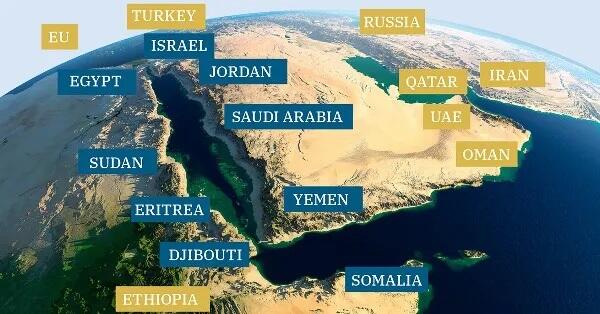
The Russian navy’s Pacific Fleet has confirmed that it sent several of its warships through the Bab al-Mandab Strait and into the Red Sea, at a moment Houthi attacks against international shipping is ongoing, and as the waters are still being patrolled by the US-led military coalition.

Russian defense ministry sources identified that the Russian cruiser Varyag and the frigate Marshal Shaposhnikov are engaged in the patrol mission, but it remains unclear whether additional support vessels are participating as well.

The Varyag missile cruise

State-run TASS describes that the warships are carrying out “assigned tasks within the framework of the long-range sea campaign.” The ultimate destination of the vessels has not been disclosed.

The Varyag and Marshal Shaposhnikov had earlier this month participated in joint naval drills involving Iran, China, and Russia in the Indian Ocean – which Moscow described at the time as practicing “safety in maritime economic activities.”

But a Russian warship presence in the Red Sea certainly makes the waters a bit more ‘crowded’ given that the US and UK are currently leading 22-country naval coalition known as ‘Operation Prosperity Guardian’.  Other countries include Bahrain, Canada, France, Italy, the Netherlands, Norway, and a number of additional nations have reportedly sent ships as anonymous participants. There have been no indicators that Moscow intends to cooperate with its rivals and enemies in the Western naval coalition.

The question remains whether Russia is sending its warships out of concern that they’ll come under Houthi attack. At this point not only dozens of commercial vessels been attacked, but US and UK warships as well, which often must intercept inbound drones. The Yemeni rebel group backed by Iran has long said its goal is to thwart any ships passage which is linked to Israel, the US or UK – and further to prevent commercial vessels’ usage of Israeli ports.

However, the Houthis have simultaneously vowed to provide safe passage for Chinese and Russian vessels. But as international reports have noted, some Russian and Chinese vessels have come under attack in rare instances:

Yet, they appear to have misidentified some vessels. Missiles exploded near a ship hauling Russian oil near Yemen in late January. It happened days after a spokesman for the Houthis told a Russian newspaper that Russian and Chinese merchant ships needn’t fear attacks.

The Houthis also fired a missile at Chinese-owned oil tanker Huang Pu on Saturday, US Central Command said, highlighting continued risks to shipping in the seas off Yemen despite the agreement.

But as recently as a week ago, Chinese and Russian diplomats met in Oman with Mohammad Abdul Salam, the spokesman and chief negotiator for Yemen’s National Salvation Government (NSG), and “reached an understanding” about safe passage through the Red Sea and beyond.

Moscow and Beijing have made their positions clear against the Western coalition’s bombings of Yemen in response to the Houthi attacks. For example, Russia’s deputy UN ambassador Dmitry Polyansky and China’s UN envoy Geng Shuang have previously blasted the US for illegally bombing the Arab world’s poorest nation while failing to pressure Israel into accepting a diplomatic solution. Polyansky said in mid-February, “An immediate cease-fire in Gaza will help stabilize the situation in the Red Sea, and the de-escalation in those waters will, in turn, unblock the efforts of [UN special envoy for Yemen Hans Grundberg].”

“I would like to reiterate that the Security Council has never authorized any country to use force against Yemen. International law and resolutions of the council should not be subjected to misrepresentation and abuse by any country,” Shuang told the UN Security Council earlier this month.

A Houthi spokesman has also set forth that “There is constant cooperation and development of relations between Yemen, Russia, China, and BRICS states, as well as an exchange of knowledge and experience in various areas. This is necessary to drown the US and the West in [the crisis] around the Red Sea, to get bogged down, weaken, and become unable to maintain unipolarity,” he said according to TASS.

Tyler Durden
Thu, 03/28/2024 – 13:10

Dollar Rally Is On Borrowed Time As US Disinflation Lags World

Dollar Rally Is On Borrowed Time As US Disinflation Lags World

Authored by Simon White, Bloomberg macro strategist,

The current rally in the dollar is soon likely to face resistance from rising real-yield differentials with the rest of the world, driven by global inflation that is falling faster than in the US.

The dollar is on a mini spurt higher, with the DXY up almost 2% from its March lows, and up 3.3% year-to-date.

That has been driven mainly by selloffs in developed-market currencies such as the Swiss franc and the yen, with the DXY outperforming the broad trade-weighted dollar (white line in chart below), which includes EM as well as developed-market currencies.

But that is diverging from fundamentals, principally real-yield differentials. We can take the real yields of the currencies in the DXY basket (EUR, JPY, GBP, CAD, SEK and CHF) versus dollar real yields, and sum them using the same weights as in the DXY calculation, to create a DXY Weighted Real Rate. As the chart below shows, the DXY is currently diverging higher from this measure.

The DXY Weighted Real Rate is rising (it is shown reversed in the chart above) as inflation in the rest of the world is falling faster than in the US.

That trend is likely to continue. The US was among the first countries to experience elevated inflation, and one of the first to see fairly steep disinflation. It is now in the vanguard of countries realizing that inflation will not be a here-today-gone-tomorrow problem, and will instead be sticky and prone to re-accelerating.

In other words, US real yields are likely to remain more buoyant than in the rest of the world, even when central banks begin cutting interest rates, as they are all poised to be more cautious than suggested by current pricing.

The options market implies generous odds for a weaker dollar: about a 1-in-8 chance USD/JPY touches 140 by the end of June; the same odds that EUR/USD touches 1.13; and a 1-in-6 chance GBP/USD touches 1.32 (with sterling also likely structurally underpriced, as Brexit has proven surprisingly positive for the UK’s debt and external-account situation).

Tyler Durden
Thu, 03/28/2024 – 12:50

Green Energy Beaten Black And Blue: Video Shows Massive Hail Damage To Texas Solar Farm

Green Energy Beaten Black And Blue: Video Shows Massive Hail Damage To Texas Solar Farm

In the latest of countless cautionary tales about green energy, a large-scale Texas solar farm has been devastated by a hail storm that took much of the facility off-line for an unknown duration. 

The March 15 storm battered thousands of panels with hail described as anywhere between golf ball- and baseball-sized. “They look like somebody took a shotgun and blasted it into the air and let the pellets fall down and shatter holes all in them,” awestruck Fort Bend County resident Nick Kaminski told ABC 13. Actually, the damage looks much more like it was inflicted with direct fire: 

Hail-shattered panels at the solar farm in Fort Bend County, Texas (FOX26 and Houston KRIV via Fox News)

Located about 43 miles southwest of downtown Houston, the Fighting Jays Solar farm is a joint venture of Copenhagen Infrastructure Partners and AP Solar Holdings LLC. Sprawling across 3300 acres, it’s billed as promising 350 MW of capacity. Or, at least, it was before Mother Nature intervened.  

Flyover video showed the sweeping breadth of the destruction:

A spokeswoman for GOP Rep. Troy Nehls, whose district encompasses the solar farm, told Fox News Digital that the incident raises serious questions about where solar farms are built, and undermines green zealots’ belief that fossil fuels can be retired anytime soon: 

“As far as solar farms being damaged where hail and tornadoes are common, those companies knowingly run the risk of building solar panel farms in these areas. Events like this underscore the importance of having an all-of-the-above energy approach to meet our energy needs and showcase how our country cannot solely rely on or fully transition to renewable energy sources like this.

Some residents worried that cadmium telluride, a toxic ingredient of some solar panels, would find its way into the local soil and well water. However, Copenhagen Investment Partners reassured Fox that “the silicon-based panels contain no cadmium telluride and we have identified no risk to the local community or the environment.” 

Nonetheless, the Texas Commission on Environmental Quality has dispatched investigators to make their own assessment of the health implications. 

The sweeping ruin witnessed at the Fighting Jays solar farm is far from unique. A 2019 hail disaster caused roughly $70 to $80 million in damage to the Midway Solar farm in West Texas. Last June, a hailstorm in Nebraska destroyed nearly every last panel at a solar farm north of Scottsbluff: Of 14,000 panels, 13,650 were instantly turned into trash, though a spokesman for the facility unconvincingly assured a reporter that the goal was for the panels to be recycled.  

Different state, similar result: 98% of the panels at this Nebraska solar farm were rendered useless by a June 2023 hailstorm (via Scottsbluff Star-Herald)

These and other episodes underscore a troubling trade-off in solar power: States with abundant sunshine are simultaneously more prone to hailstorms and tornados. 

Of course, solar isn’t the only renewable energy with increasingly evident drawbacks. As the Epoch Times last week reported in a story republished at ZeroHedge, some scientists are sounding alarms about the effects on cell and membrane structures of “infrasound” produced by wind turbine blades. 

However, nothing will derail leftists from mindlessly plowing money into inefficient and problematic “green energy solutions.” 

Tyler Durden
Thu, 03/28/2024 – 12:30

Gold: The Everything Hedge

Gold: The Everything Hedge

Authored by James Rickards via DailyReckoning.com,

Gold is trading at $2,211 per ounce this afternoon. Since its interim low of $1,832 per ounce on Oct. 5, 2023, gold has posted a 21% gain. That’s in less than six months. Almost half of that gain occurred in the one-month period from Feb. 11 to March 11.

That overall gain is especially impressive considering gold had been stuck in a fairly narrow range of $1,650–2,050 for the past two years. That’s a range of about 10% above and below the midpoint of $1,850. Starting from the high end of that range, gold traversed the entire range to the upside and beyond in just one month.

Now, any reference to “gold prices” is an interesting one. If you treat gold as a commodity, then the price per ounce measured in dollars is one way to think about price.

On the other hand, if you think of gold as money (as I do) then the dollar price is not really a price — it’s a cross-rate similar to euro/dollar (about $1.08 today) or dollar/yen (about 152 today). When analysts say the “price” of gold is $2,211 per ounce, I think of that data as showing the gold/dollar cross-rate = $2,211.

That’s useful because there are two sides to a cross-rate. While most analysts say that gold has rallied from $2,000 to $2,211 per ounce, it is just as valid and perhaps more useful to say that the dollar has crashed from 1/2,000 per ounce to 1/2,211 per ounce.

In this analysis, gold is constant (by weight) and the dollar gets stronger or weaker relative to gold. All of the recent market action points to a weaker dollar.

This mode of analysis also solves another market riddle. Given huge U.S. budget deficits, unprecedented levels of U.S. national debt, slow growth, rising unemployment and persistent inflation, how is it possible that the dollar has been so “strong” lately?

The answer is that it’s only been strong relative to the euro, yen, sterling and some other reserve currencies and as measured by certain dollar indexes (DXY, Bloomberg, etc.) composed of baskets of currencies (but not gold).

But that’s often because those other currencies are issued by countries with debt and growth problems even worse than the U.S.’ Those currencies dropping against the dollar have the look and feel of a good old-fashioned currency war.

It’s only when you use gold as your metric that the real weakness in the dollar becomes apparent, as it should. In effect, certain currencies are weakening against each other but all currencies are weakening against gold.

Returning to the “higher gold price” frame, there are a number of reasons for this trend.

The first factor is simple supply and demand. Mining output and recycled gold have been about flat for the past eight years running between 1,100 metric tonnes and 1,250 metric tonnes per year.

At the same time, central bank demand for gold has surged from less than 100 metric tonnes in 2010 to 1,100 metric tonnes in 2022, a 1,000% increase in 12 years. Central bank gold demand remained strong in 2023 with 800 metric tonnes acquired through Sept. 30, 2023. That puts central bank gold demand on track for a new record in 2023. There’s no sign of that demand slowing in 2024.

Constant output with surging demand by central banks does not by itself explain the recent surge in gold prices, but it is a contributor. Importantly, continued strong demand by central banks puts a floor under gold prices. This sets up what we describe as an asymmetric trade where downside is limited but upside is open-ended.

The second factor driving gold prices higher is the need for hedging. This is not the same as inflation hedging. It covers a larger list of risks including geopolitical risk, risks of escalation in the Ukraine and Gaza wars, Houthi efforts to close the Red Sea and Suez Canal, increasing risks of war with China and the intrinsic risk of a senile president of the United States.

As the list of risks grows longer and potentially more dangerous, the need for a hedging asset such as gold that does not rely on any nation-state for its value increases. I call gold the everything hedge.

Finally, gold prices are being driven higher by U.S. threats to steal $300 billion in U.S. Treasury securities from the Russian Federation. Those assets were legally purchased by the Central Bank of Russia as part of their reserve position.

The actual securities are held in custody in digital form at European banks, U.S. banks and the Brussels-based Euroclear clearinghouse. Only about $20 billion of those Treasury securities are held by U.S. banks; the majority are held by Euroclear. Those assets were frozen by the United States at the outbreak of the war in Ukraine.

Freezing assets means the Russians cannot collect interest or sell or transfer the assets or pledge them as collateral. Asset freezes are used frequently by the U.S. including in the cases of Iran, Syria, Cuba, North Korea, Venezuela and other nations. Often the assets are frozen for years but ultimately released to the owner as happened in the case of Iran after 2012.

Now the U.S. wants to go further and actually seize the assets, which may be viewed as outright theft under international law. The U.S. proposes to use the $300 billion to finance the war in Ukraine. European entities have expressed considerable uncertainty about this plan but the U.S. has maintained the pressure and wants to complete the theft before the June and July summits of G7 leaders and NATO members.

If the U.S. steals these assets, Russia will likely confiscate an equivalent amount of industrial and commercial assets located in Russia and owned by German, French, and Italian interests among others.

The bottom line is that if U.S. Treasury securities are not a safe investment, then securities of Germany, Italy, France, the U.K. and Japan are no better. The only reserve asset free of this kind of digital theft is gold. Nations are beginning to diversify into gold in order to insulate themselves from digital confiscation by the collective West.

Finally, there’s an interesting bit of math here, which I’ve explained in the past that shows each $100 per ounce increment in the price of gold is a smaller percentage gain because the denominator is larger.

That makes each $100 milestone ($2,400, $2,500, $2,600) easier to reach than the one before. People don’t really notice this; they just focus on the dollar amount of the gains. But this explains how price rallies gather crazy momentum.

All of these trends — flat output, rising central bank demand, hedging, protection against digital confiscation and simple momentum — will continue. Based on those trends, one would expect the gold price rally to continue as well.

The trend is gold’s friend.

Tyler Durden
Thu, 03/28/2024 – 12:10

FInal Q4 2023 GDP Revision Comes In Red Hot 3.4%, Beating Estimates

FInal Q4 2023 GDP Revision Comes In Red Hot 3.4%, Beating Estimates

It’s ancient history by now, but moments ago the Biden Bureau of Economic Goalseeking Analysis reported that in its third estimate of Q4 GDP, the US was estimated to have grown by 3.4% (3.440% to be precise), above the 3.2% reported last month and above the 3.2% estimate.

The increase in the fourth quarter primarily reflected increases in consumer spending and state and local government spending that were partly offset by a decrease in inventory investment. Imports, which are a subtraction in the calculation of GDP, increased.

The update from the second estimate reflected upward revisions to consumer spending, business investment, and state and local government spending that were partly offset by downward revisions to inventory investment and exports. Imports were revised down. Here is a more detailed analysis:

  • Personal Consumption contributed 2.20% to the bottom line GDP of 3.4%, or two-thirds of the total, up from 2.00% in the previous estimate and up from 1.91% in the first calculation.
  • Fixed Investment added another 0.67% to the bottom line, also a solid improvement to the 0.43% previous estimate
  • The change in private inventories subtracted 0.47% from the bottom line print, a deterioration to the -0.27% first revision and far below the positive +0.07% contribution in the first estimate.
  • Net exports were little changed at +0.25% (consisting of 0.55% exports less 0.3% imports) vs 0.32% in the first revision (0.69% exports less 0.37% imports).
  • Finally, government consumption increased modestly to 0.79% of the bottom line, up from the 0.73% estimated previously.

Here the biggest contribution was personal spending, which increased even more than initially suspected, and reflected increases in both services and goods. Within services, the leading contributors were health care (both outpatient and hospital services), other services (led by professional and other services), as well as food services and accommodations. Within goods, the leading contributors to the increase were other nondurable goods (led by pharmaceutical products) as well as recreational goods and vehicles.

Here is a visual summary:

The BLS also provided a breakdown of GDP by industry, noting that the value added of private goods-producing industries increased 7.0%, private services-producing industries increased 2.6%, and government increased 3.1 percent. Overall, 18 of 22 industry groups contributed to the fourth-quarter increase in real GDP

  • Within private goods-producing industries, the largest contributors to the increase were nondurable goods (led by petroleum and coal products and chemical products), durable goods manufacturing (led by machinery), and construction.
  • Within private services-producing industries, the increase was led by retail trade (led by motor vehicle and parts dealers), health care and social assistance (led by ambulatory health care services), utilities, and professional, scientific, and technical services (led by computer systems design and related services).
  • The increase in government reflected an increase in state and local government as well as federal government

Turning to prices, the Q4 2023 numbers are completely irrelevant especially with the latest Feb monthly PCE data out tomorrow (when markets are closed), but here goes anyway:

  • GDP prices increased 1.9% in the fourth quarter after increasing 2.9% in the third quarter. Excluding food and energy, prices increased 2.1% after increasing 2.5 percent.
  • PCE prices increased 1.8% in the fourth quarter after increasing 2.6% in the third quarter. Excluding food and energy, the all-important – if extremely delayed – PCE “core” price index increased 2.0%, the same increase as in the third quarter. The core PCE came in just below expectations of a 2.1% print.

Finally, looking at corporate profits, these increased 4.1% at a quarterly rate in the fourth quarter after increasing 3.4% in the third quarter. Corporate profits also increased 5.1% in the fourth quarter from one year ago. More details:

  • Profits of domestic financial corporations increased 1.3 percent after increasing 2.0 percent.
  • Profits of domestic nonfinancial corporations increased 5.9 percent after increasing 4.1 percent.
  • Profits from the rest of the world (net) decreased 1.7 percent after increasing 1.7 percent.

Tyler Durden
Thu, 03/28/2024 – 09:05

Facebook Secretly Wiretapped Competitors: Documents

Facebook Secretly Wiretapped Competitors: Documents

Authored by Zachary Stieber via The Epoch Times (emphasis ours),

Facebook secretly obtained proprietary data from competitors, including Snapchat, according to newly unsealed court documents.

At the request of CEO Mark Zuckerberg, Facebook officials developed a program called In-App Action Panel (IAAP) that they deployed in 2016 and which was in use through mid-2019, according to the documents, which include internal emails.

The program utilized cyberattacks to intercept information from Snapchat, YouTube, and Amazon. The program then decrypted the information.

“Facebook’s IAAP Program used nation-state-level hacking technology developed by the company’s Onavo team, in which Facebook paid contractors (including teens) to designate Facebook a trusted ‘root’ certificate authority on their mobile devices, then generated fake digital certificates to redirect secure Snapchat analytics traffic (and later, analytics from YouTube and Amazon) from Snapchat’s servers to Onavo’s; decrypted these analytics and used them for competitive gain, including to inform Facebook’s product strategy; reencrypted them; and sent them up to Snapchat’s servers as though it came straight from Snapchat’s app, with Facebook’s Social Advertising competitor none the wiser,” lawyers said in one of the documents.

The lawyers, representing plaintiffs in a lawsuit that accuses Facebook of anti-competitive behavior, were describing emails they obtained through discovery.

In one email, Mr. Zuckerberg wrote that there was a need to receive information about Snapchat but that their traffic was encrypted. “Given how quickly they’re growing, it seems important to figure out a new way to get reliable analytics about them. Perhaps we need to do panels or write custom software. You should figure out how to do this,” he wrote.

After Facebook employees started working on figuring it out, Facebook Chief Operating Officer Javier Olivan wrote that the program could pay users to “let us install a really heavy piece of software (that could even do man in the middle, etc.).”

Man in the middle refers to a type of cyberattack where attackers secretly intercept information.

“We are going to figure out a plan for a lockdown effort during June to bring a step change to our Snapchat visibility. This is an opportunity for our team to shine,” Guy Rosen, founder of Onavo, later wrote. Onavo was started in Israel and bought by Facebook in 2013.

In a presentation on the program when it was being finalized, it was stated that there would be “’kits” that can be installed on iOS and Android that intercept traffic for specific sub-domains, allowing us to read what would otherwise be encrypted traffic so we can measure in-app usage.”

Documents and testimony obtained in the case showed the program was launched in June 2016 and continued being used through 2019.

The program initially targeted Snapchat but was later expanded to Google’s YouTube and Amazon, according to the documents.

The information gained by the program helped inform Facebook’s product designs, according to Facebook employees. Those products “hamper[ed] Snap’s ability to sell ads,” one Snap executive said in a deposition for the case.

Snap, Google, and Amazon did not return requests for comment.

Mr. Zuckerberg, in another deposition, refused to answer questions about the program. Mr. Zuckeberg indicated he might answer questions if he was given an opportunity to review the documents.

Lawyers for the plaintiffs, who are advertisers, have asked the court handling the case, the U.S. District Court in northern California, to grant them three additional hours with Mr. Zuckerberg so they can ask him more about what happened. They also asked for sanctions against Meta, which owns Facebook, because Meta did not disclose the program when initially asked for all information and data that Facebook derived from Onavo’s work.

Violation of Law?

Facebook’s actions amounted to wiretapping and violated federal law.

The Electronic Communications Privacy Act of 1986, sometimes known as the Wiretap Act, bars people from intercepting any “wire, oral, or electronic communication” and from intentionally disclosing the contents of information that was illegally intercepted.

Facebook’s IAAP program conduct squarely meets the statutory proscriptions … within the meaning of the statute,” lawyers for the plaintiffs told the court.

Facebook’s program does not fall within exceptions outlined in the law, particularly because Snapchat did not approve the interception and decryption of its information, they said. Further, Snap’s contact with users prohibits the behaviors in which Facebook engaged.

Meta did not respond to a request for comment.

Netflix Nexus

Reed Hastings, chairman of Netflix’s board of directors, also served on Facebook’s board for years.

Plaintiffs have attempted to secure documents and a deposition from Mr. Hastings, but he has refused so far, according to other filings. The plaintiffs asked the court to force Mr. Hastings to comply with subpoenas.

The plaintiffs separately said that it asked Netflix for materials but that Netflix had only produced 54 documents, “all of which are collateral (at best) to the issues Advertisers asked for documents on, and none of which fall within the clearly defined categories of documents that Advertisers repeatedly told Netflix were at the core of what was sought for Advertisers’ case.”

Netflix and Facebook have a yearslong relationship that includes Netflix spending tens of millions of dollars on Facebook advertising and Facebook granting Netflix unique access to its data, the filings noted.

The plaintiffs asked the court to compel Netflix to produce relevant documents.

Netflix did not respond to a request for comment.

Tyler Durden
Thu, 03/28/2024 – 08:45