67.2 F
Chicago
Sunday, September 20, 2026
Home Blog Page 2787

Jobless Claims Continue To Hover (Miraculously) Near Record Lows

Jobless Claims Continue To Hover (Miraculously) Near Record Lows

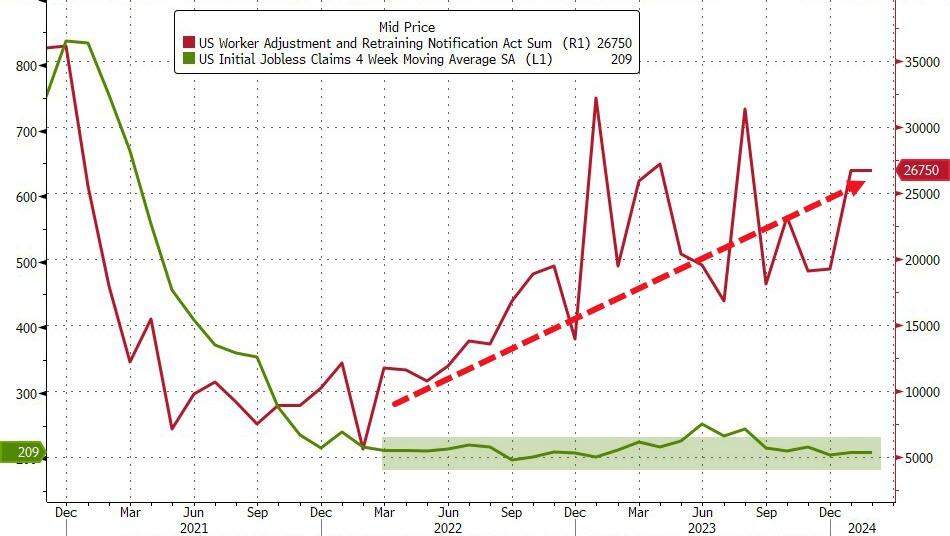
Layoff announcements continue day after day and WARNs are on the rise, but initial jobless claims continues to trend along in very smooth manner (too smooth)…

Source: Bloomberg

NSA initial claims dipped notably last week…

Source: Bloomberg

And continuing claims have been flat around 1.8mm Americans for months…

Source: Bloomberg

This data continues to confound.

Tyler Durden
Thu, 03/28/2024 – 08:40

Stocks Set To Close Blowout Week, Month And Quarter At All-Time High; Gold Soars To Record

Stocks Set To Close Blowout Week, Month And Quarter At All-Time High; Gold Soars To Record

Stock futures are pointing to a flat open on the last trading session of the week, month, and quarter, following a late-session spike that took the S&P 500 to yet another record as the much anticipated quarter-end pension dump (as big as $32BN according to Goldman failed to materialize, but may very well show up today). As of 7:45am ET, both Nasdaq and S&P futures were down 0.1% after Fed Governor Christopher Waller poured cold water on the path to lower interest rates, saying there’s no rush to cut rates given recent “disappointing” inflation figures.

The broadest equity index is set for a gain of 10% for the first three months of the year, with the Nasdaq 100 just short of a 9% rise. Europe’s Stoxx 600 benchmark also notched up another record as Arnaud Cayla, deputy CEO at Cholet Dupont Asset Management, said: “Investors have no reason to sell”, and sure enough, a look at either the weekly S&P candle chart which is up 19 of the past 22 weeks…

… and the monthly, up five straight months.

In premarket trading, RH shares jumed 7.8%, reversing a 10% plunge, after the furniture retailer reported fourth-quarter results. While the company missed on adjusted earnings per share for the period, its guidance update, which showed expectations of accelerating demand throughout fiscal year 2024, led to a positive reaction among analysts. Here are the other notable premarket movers:

  • Akebia Therapeutics shares jump 20% after the biopharmaceutical company said the FDA approved vadadustat, an anemia medicine already available in other countries as Vafseo.
  • Estee Lauder shares gain 2.0% as Bank of America upgrades the personal care products maker to buy from neutral, saying that the company’s earnings have now bottomed.
  • MillerKnoll shares slide 17% after the office furniture maker issued guidance for fourth-quarter adjusted earnings per share that missed estimates. Additionally, the company reported third-quarter sales that did not meet consensus expectations.
  • Snowflake shares are up 3.1% after Chief Executive Officer Sridhar Ramaswamy reported the purchase of about $5 million in shares late Wednesday.
  • Sprinklr shares rise 9.5% after the application software company gave a full-year forecast that is stronger than expected. It also reported fourth-quarter results.

10Y treasury yields rose 4 basis points to 4.22% and the Bloomberg Dollar Spot Index rises 0.2% to its highest since mid-February after the Fed’s hawkish governor Christopher Waller said the Fed still needs to see lower inflation before easing monetary policy in a speech titled, “There’s Still No Rush.” As a result, Brown Brothers strategists Win Thin and Elias Haddad wrote in a note that “market easing expectations for the Fed still need to adjust.” 

Waller pointed to a strong US economy and robust hiring as further reasons the Fed has room to wait to gain confidence that inflation is on a sustained path toward the 2% target. “In my view, it is appropriate to reduce the overall number of rate cuts or push them further into the future in response to the recent data,” he said in prepared remarks Wednesday before the Economic Club of New York.

Stock markets are on cusp of closing out blockbuster gains for the quarter. MSCI’s global equity index has soared 8% in the past three months, supported by rallies in the US, Japan and the frenzy for artificial intelligence. Data on US economic growth and jobless claims are scheduled later today. The Fed’s preferred inflation gauge — the core personal consumption expenditures price index — is due on Friday, when markets will be closed.

European stocks rise to another record high and are on track for the best quarterly performance in a year. The Stoxx 600 climbed 0.3% marking a four-day winning streak, led by gains in travel, consumer product and retail shares. The rally in European stocks has broadened out this month beyond the biggest names on the benchmark such as ASML Holding NV and Novo Nordisk A/S, unlike the US where the gains remain concentrated in big tech stocks.

Earlier in the session, Asia stocks steadied as gains in China countered declines in Japan, with the regional benchmark on course for its biggest first-quarter gain in five years. The MSCI Asia Pacific Index dropped as much as 0.6% before paring most of the loss. TSMC and Toyota were among the biggest drags on the gauge, while Chinese internet stocks including Tencent rose and Taiwan’s Hon Hai Precision climbed to a record on AI expectations. Many markets will be closed for holidays on Friday.

  • Hang Seng and Shanghai Comp. were underpinned by tech strength and after another firm PBoC liquidity operation, while China’s 3rd highest-ranked official Zhao Leji stated at the Boao Forum that China’s economy will provide a strong driving force for a world recovery and that China will reduce the ‘negative list’ for foreign investors.
  • Nikkei 225 was pressured after the JPY bounced back from 33-year lows amid intervention risks.
  • ASX 200 rose to a fresh record high with the broad-based gains in the index led by strength in the mining industry.

In FX, the Bloomberg Dollar Spot Index rises 0.2% to its highest since mid-February after Federal Reserve Governor Christopher Waller said there is no rush to lower interest rates. Meanwhile, the euro fell to a five-week low and traded below $1.08 as the dollar strengthened.

In rates, treasury futures traded off lows into early US session, although cash yields remain cheaper by up to 6bp across front-end of the curve after comments from Fed’s Waller after Wednesday’s close, who said that data warrants fewer cuts or a later start to monetary-policy easing. Treasury yields are cheaper by 6bp to 1bp across the curve in a bear flattening move, with front-end led losses flattening 2s10s, 5s30s spreads by 2.5bp and 3bp on the day; 10-year yields around 4.215%, cheaper by 2.5bp vs. Wednesday close with bunds and gilts marginally outperforming in the sector. Additional hawkish comments seen from BOE’s Haskel in early London session, who said rate cuts are a long way off, according to a Financial Times report. US session focus includes GDP, jobless claims data in a shortened trading day, with SIFMA recommending a 2pm New York cash close.

In commodities, oil prices advance, with WTI rising 0.9% to trade near $82.10. Spot gold rises another 0.7% to trade at a fresh all-time high above $2,200.

Bitcoin reversed Wednesday’s losses driven by another round of futures manipulation, and jumps 2% to around $70,500 after the latest bitcoin ETF data showed continued inflows.

The US economic data slate includes 4Q final GDP, initial jobless claims (8:30am), March MNI Chicago PMI (9:45am), February pending home sales, March University of Michigan sentiment (10am) and Kansas City Fed manufacturing activity (11am). Fed speaker slate empty for the session; Daly (11:15am) and Powell (11:30am) are scheduled to speak Friday

Market Snapshot

  • S&P 500 futures little changed at 5,305.00
  • STOXX Europe 600 up 0.1% to 512.47
  • MXAP down 0.4% to 176.24
  • MXAPJ up 0.3% to 535.76
  • Nikkei down 1.5% to 40,168.07
  • Topix down 1.7% to 2,750.81
  • Hang Seng Index up 0.9% to 16,541.42
  • Shanghai Composite up 0.6% to 3,010.66
  • Sensex up 1.3% to 73,961.36
  • Australia S&P/ASX 200 up 1.0% to 7,896.86
  • Kospi down 0.3% to 2,745.82
  • German 10Y yield little changed at 2.31%
  • Euro down 0.3% to $1.0792
  • Brent Futures up 0.5% to $86.54/bbl
  • Gold spot down 0.0% to $2,194.58
  • US Dollar Index up 0.24% to 104.59

Top Overnight News from Bloomberg

  • Fed’s Waller (voter, hawk) said still no rush to cut rates in the current economy and the Fed may need to maintain the current rate target for longer than expected, while he needs to see more inflation progress before supporting a rate cut and needs at least a couple of months of data to be sure inflation is heading to 2%. Waller said he still expects the Fed to cut rates later this year but added the economy’s strength gives the Fed space to take stock of the data and data suggests fewer rate cuts possible this year.
  • S&P affirmed the US at AA+; Outlook Stable, while it stated the US outlook remains stable indicating its expectation of continued economic resiliency, as well as proactive and effective monetary policy execution. S&P said the stable outlook reflects the US’s institutional checks & balances, and free flow of info contributing to stability and predictability in economic policies but added that ratings are constrained by fiscal weaknesses such as high net general government debt and deficits.
  • Several board members at the BOJ called for a gradual path towards policy normalization when the central bank last week raised interest rates for the first time since 2007. “The bank would need to emphasize its cautious stance in the case of terminating the negative interest rate policy, as Japan’s economy is not in a state where rapid policy interest rate hikes are necessary,” said one board member, according to a summary of opinions at its March meeting released on Thursday. FT
  • The BOE is probing how UK businesses would be hit by the reversal of a long-running private equity boom, officials said, as they escalated warnings about leverage, transparency and valuations. FT
  • German retail sales fell more than expected in February, showing consumers remained cautious and a first-quarter rebound was increasingly unlikely in Europe’s largest economy. Spending on goods by German consumers fell for the fourth consecutive month, dropping 1.9% from the previous month and 2.7% from a year earlier, according to data from the federal statistics agency. Economists polled by Reuters had expected a monthly rebound of 0.3%. FT
  • Christopher Waller said there’s no rush to lower US interest rates, adding that recent eco data warrants delaying or reducing the number of cuts this year. Price trends are “disappointing” and he wants to see “at least a couple months of better inflation data” before easing. BBG
  • Thames Water shareholders refused to provide the first £500 million needed for a turnaround plan to tackle chronic leaks and sewage spills around London. Parent company Kemble said it will be unable to refinance or repay a £190 million loan maturing on April 30 without an extension. BBG
  • Blockbuster deals more than doubled in the first quarter of this year, signaling a nascent recovery in the mergers and acquisitions market following a lengthy drought. The number of takeovers worth at least $10bn jumped in the first three months of 2024 compared with the same period last year, driven by large US deals in the energy, tech and financial sectors, according to data from the London Stock Exchange Group. Eleven such transactions, with a total value of $215bn, were struck during the quarter, up from five takeovers worth a combined $100bn in the first three months of 2023. FT
  • Blackstone’s Steve Schwarzman said the private credit industry will expand further even as critics warn of a bubble. “Our default rate on these types of loans is three-tenths of 1%,” he said. The firm is also planning more retail-investment products in Japan. BBG
  • Insurance payouts for the Baltimore bridge collapse may be among the largest ever in marine insurance, Lloyd’s of London CEO John Neal said. “It’s a multi-billion dollar loss.” BBG
  • Sam Bankman-Fried faces a 40-to-50 year prison term in his fraud case sentencing due today. The FTX co-founder’s lawyers are asking for leniency, arguing that the crypto business was solid and the company expects to repay $8 billion in missing customer funds. BBG
  • Home Depot (HD) has entered into a definitive agreement to acquire SRS Distribution for a total enterprise value (including net debt) of approximately USD 18.25bln

A more detailed look at global markets courtesy of Newsquawk

APAC stocks partially sustained the momentum from the late ramp-up on Wall St heading into quarter-end. ASX 200 rose to a fresh record high with the broad-based gains in the index led by strength in the mining industry. Nikkei 225 was pressured after the JPY bounced back from 33-year lows amid intervention risks. Hang Seng and Shanghai Comp. were underpinned by tech strength and after another firm PBoC liquidity operation, while China’s 3rd highest-ranked official Zhao Leji stated at the Boao Forum that China’s economy will provide a strong driving force for a world recovery and that China will reduce the ‘negative list’ for foreign investors.

Top Asian news

  • China’s top legislator Zhao Leji said at the Boao Forum that Asian countries should inject a strong impetus for world economic growth and that China’s economy will provide a strong driving force for world recovery. Zhao also stated that they oppose trade protection and decoupling, while he added that China is willing to collaborate with other countries on tech innovation and will reduce the ‘negative list’ for foreign investors.
  • China’s Commerce Minister discussed with Dutch counterpart lithography machines and strengthening semiconductor industry cooperation, while the Commerce Minister stated that China hopes the Netherlands will uphold the spirit of the contract, support companies in fulfilling their contractual obligations, and ensure the normal conduct of lithography machine trade.
  • BoJ Summary of Opinions from the March 18th-19th meeting stated that a member said YCC, negative rate and other massive stimulus tools have accomplished their roles and that the BoJ must guide monetary policy using short-term rate as main policy means in accordance with economic, price and financial developments. Furthermore, a member said shifting to ‘normal’ monetary easing is possible without causing short-term shocks and may have a positive impact on the economy in the medium- and long-term perspective, while a member warned that changing policy now could delay achievement of the BoJ’s price target.
  • Citi raises China 2024 GDP growth forecast to 5% (vs 4.6% reported in Jan).
  • China’s Commerce Ministry is lifting anti-dumping and anti-subsidy tariffs on Australian wine as of 29th March

Mixed sentiment across Europe, Stoxx600 (+0.2%), with a modest upward bias following a mostly-firmer APAC handover; the FTSE 100 (+0.5%) benefits from the weaker Pound. European sectors hold a strong positive tilt; Travel & Leisure propped up by Evolution (+1.8%), whilst Construction & Materials is found at the foot of the pile. US Equity Futures (ES -0.1%, NQ -0.2%, RTY -0.2%) are subdued following yesterday’s late rally and ahead of the long weekend. A busy docket ahead will dictate price action today.

Top European news


FX

  • DXY picked up strength in early European trade as participants digested hawkish remarks from the influential Waller at the Fed. DXY now at levels not seen since mid-Feb. Currently eyeing the YTD peak at 104.97. PCE tomorrow looms large.
  • EUR has been dragged lower by USD strength; EUR/USD below the double-bottom at 1.0802 and the 1.08 level with a session trough at 1.0775. Next large is the 20th Feb low at 1.0761.
  • GBP is outmuscled by the dollar with Cable tripping below the 1.26 level in quiet newsflow, where it eventually found support at its 200 DMA at 1.2588; since, it reclaimed 1.26, where it currently resides. Haskel remarks are hawkish but not necessarily a consensus view on the MPC.
  • JPY is one of the better relative performers vs. the USD but ultimately softer. Fresh Yen-specific drivers light ahead of CPI later. Currently contained within yesterday’s 151.02-97 range.
  • Antipodeans lag against the majors as the uptick in the USD saw AUD/USD trip below last week’s low at 0.6503 and the 0.65 mark, with softer Australian Retail Sales also a factor.
  • PBoC set USD/CNY mid-point at 7.0948 vs exp. 7.2259 (prev. 7.0946).

Fixed Income

  • USTs are pressured and dragging fixed benchmarks lower after Fed’s Waller stuck to his hawkish bias and made clear that there is no need to rush towards rate cuts.
  • Bunds ticked higher on the region’s retail numbers, though proved fleeting, with Bunds now probing 133.00 to the downside conforming to the post-Waller pressure seen in Treasuries.
  • Gilt price action is in-fitting with peers; specifics light after an interview from BoE’s Haskel who underscored his hawkish credentials and made clear that while he is no longer voting for further tightening he is in no rush to vote for easing. Gilts currently at 99.57 and will find support at 99.41, 27 & 16 from the last three sessions.

Commodities

  • A positive day thus far for the oil complex despite the strengthening Dollar and quiet newsflow, though has been edging off best levels in recent trade. Brent reside within 86.30-60/bbl parameters.
  • Precious metals vary with spot silver feeling the pressure from the firming Dollar, whilst spot gold is more resilient, potentially supported via geopols/recent BTC strength. XAU briefly printed a fresh weekly high at USD 2,200.75/oz before pulling back under USD 2,200.
  • Mixed trade across base metals with copper futures relatively flat; 3M LME copper trades on either side of the unchanged mark and towards the bottom of a USD 8,830.50-8,930.50/t.
  • Russia’s Kuibyshev mid-sized oil refinery is at a complete halt following a drone attack on March 23, via Reuters citing sources.

Geopolitics

  • US military said it destroyed four long-range drones launched by Iranian-backed Houthis in Yemen, according to Reuters.

US Event Calendar

  • 08:30: March Initial Jobless Claims, est. 212,000, prior 210,000
    • March Continuing Claims, est. 1.82m, prior 1.81m
  • 08:30: 4Q GDP Annualized QoQ, est. 3.2%, prior 3.2%
    • 4Q Personal Consumption, est. 3.0%, prior 3.0%
    • 4Q Core PCE Price Index QoQ, est. 2.1%, prior 2.1%
    • 4Q GDP Price Index, est. 1.6%, prior 1.6%
  • 09:45: March MNI Chicago PMI, est. 46.0, prior 44.0
  • 10:00: Feb. Pending Home Sales YoY, prior -6.8%
  • 10:00: March U. of Mich. Sentiment, est. 76.5, prior 76.5
    • March U. of Mich. Current Conditions, est. 79.6, prior 79.4
    • March U. of Mich. Expectations, est. 74.7, prior 74.6
    • March U. of Mich. 1 Yr Inflation, est. 3.1%, prior 3.0%
    • March U. of Mich. 5-10 Yr Inflation, est. 2.9%, prior 2.9%
  • 10:00: Feb. Pending Home Sales (MoM), est. 1.5%, prior -4.9%
  • 11:00: March Kansas City Fed Manf. Activity, est. -4, prior -4

DB’s Jim Reid concludes the overnight wrap

Welcome to the last business day of Q1 for a sizeable chunk of the global financial market. I’m going on holiday for a couple of weeks tomorrow so see you on the other side. Henry and Peter will be keeping the EMR in safe hands while I’m away. Tonight I’ll be doing the usual negotiating dance with my wife as to what time we start off on our 14-hour drive to the ski slopes tomorrow. I am an early person and worry about falling asleep at the wheel on the last leg of the journey where I always drive, so I’d be quite happy leaving at 5am. My wife is a night person and doesn’t want to get up too early so she’s happier leaving at around 9am. So the bid-offer is always 5-9. Before you trade I should say we have never left before 845am so that tells you all you need to know about my powers of persuasion.

As we approach the end of Q1, it’s fair to say that is has been a very good quarter for risk and less so for government bonds. In equities some highlights include (price only) the Nikkei (+20%), the DAX (+10.3%), the S&P 500 (+10.04%) and the Magnificent-7 (+17.79%) on the upside, but with the Hang Seng (-2.16%) the standout on the downside. Elsewhere 10yr USTs and Bunds are +32bps and +27bps respectively and we’ve moved from pricing in 158bps of Fed cuts by YE to c.75bps. US HY credit is -22bps tighter and WTI oil is +13.54%. All with a few hours of trading left in the quarter.

As trading floors resemble ghost towns tomorrow, we’ll see the US core PCE print. DB expects +0.27% vs. 0.42% last month. In Powell’s press conference, he remarked that the month-over-month print for core PCE could be “well below 30bps” at the end of the month. Taking him at his word does offer downside risk to our economists’ forecast. They believe upward revisions to the January healthcare services prices could square these two numbers. We’ll also see French and Italian inflation tomorrow so a busy day for a holiday!

As we await these events, yesterday was another day where technical factors related to quarter-end appeared to dominate, with a late rally leading to strong close for the S&P 500 (+0.86%) and with it to a fresh all-time high. Treasuries saw a steadier rally, with 10yr yields down -4.2bps across the day. Overnight though we’ve heard notably hawkish comments from Fed Governor Waller. He suggested that “it is appropriate to reduce the overall number of rate cuts or push them further into the future in response to the recent data”, specifically referring to the recent inflation data as “disappointing”. So expressing clearly more concern about the upside in January/February inflation than we heard from Powell last week.

After this markets have dialled back expectations of Fed cuts by -4.6bps to 74.9bps at year end adding to a 1bps decline yesterday. 2yr and 10yr yields are +3.9bp and +1.4bps higher in Asian trading. US futures haven’t responded though and are flat. On a similar note the BoE Haskel has just been quoted in the FT, as we go to print, that “wage growth remains too high” and that interest rates cuts are a “long way off”. He is a known hawk and until last week’s meeting was voting for BoE hikes.

Equity market moves had become very subdued as we moved past last week’s major central bank meetings, but some volatility has returned in the past couple of sessions. In a near mirror image of Tuesday’s close, the S&P 500 rallied more than half a percent within the final hour of trading to narrowly exceed the record level it posted last Thursday and bring the YTD gain to above 10%. The VIX index of implied equity volatility fell to a 2-month low, down -0.46 points to 12.78. Earlier in the day, European equities also saw a positive if less eventful session, with Stoxx 600 (+0.13%), Dax (+0.50%) and CAC (+0.25%) all closing at record highs.

In a sign of potential sector reweighting playing out, rate-sensitive and domestically-oriented stocks led the gains, with utilities (+2.75%) and industrials (+1.60%) outperforming within the S&P 500. This also led the Dow Jones (+1.22%) and Russell 2000 (+2.13%) to outperform, with the latter seeing its strongest day since mid-February. By contrast, tech mega caps lagged behind, with the Magnificent 7 up a marginal +0.03%. Reweighting effects may have even played out within the Magnificent Seven, with Nvidia seeing another major decline (-2.50% after -2.57% on Tuesday), while Apple (+2.12%) and Tesla (+1.22%) outperformed, having lagged YTD.

The Treasury rally yesterday was helped along by a solid 7yr auction, as $43bn of bonds were issued 0.8bps below the pre-sale yield with the indirect bidder share its highest since October. But quarter-end positioning effects may have also contributed to the bond rally – in a note earlier this week, our US rates strategists highlighted how the strong equity rally seen in Q1 pointed to potential significant quarter-end rebalancing into long-dated Treasuries. Consistent with this, long-dated Treasuries outperformed yesterday, with 30yr yields down -4.7bps. It’s a shortened session today in US bonds so expect activity to mostly grind to a halt in the European afternoon.

On the ECB side, yesterday we heard from Cipollone (one of the more dovish voices), who said that “if incoming data confirm the scenario foreseen in the March projections, we should stand ready to swiftly dial back our restrictive monetary policy stance”. The more hawkish Kazaks said he didn’t “have any objection at the moment” to market pricing of a June rate cut, while noting that “we need to be very cautious”. This backdrop saw slight dovish repricing of near-term ECB expectations, with a 25bp June cut fully priced by yesterday’s close (vs. 94% the day before), the first time this has been the case since March 8. Bonds posted a solid rally in Europe, with 10yr bund yields down -5.8bps, while OATs (-4.5bps) and BTPs (-3.7bps) saw slightly smaller moves.

In other central bank news, Sweden’s Riksbank became the latest G10 central bank to signal it’s approaching the start of rate cuts. While keeping rates on hold, it indicated that it saw “a 50% probability of a 25bps cut [at the next meeting] in May”. In large part, this was catching up to market pricing, which further inched up expectations of a May cut from 63% to 67% following the decision.

Elsewhere in Europe, we had the first taste of March inflation data, as Spanish inflation came in a touch below expectations at 3.2% (vs. 3.3% expected) on the EU-harmonized measure. We will get prints for France and Italy tomorrow, followed by Germany and the euro area aggregate next Tuesday. For more, see our European economists’ preview here. The March inflation prints are the most important remaining data points ahead of the next ECB meeting in just two weeks’ time. Similarly to the US, the euro area has seen upside surprises in domestic inflation at the start of the 2024, after a sizeable slowing in the second half of 2023. Whether this upside persists may prove crucial to whether the central banks deliver the starts of their easing cycles that they’ve increasingly signaled for Q2.

In other European data, surveys showed a continued gradual improvement in momentum in March. The European Commission’s economic sentiment picked from 95.4 to 96.3 (va. 96.2 expected), while France’s consumer confidence index rose to 91 (vs. 90 expected), its joint highest since February 2022.

Asian equity markets are seeing divergent trends this morning. The Nikkei (-1.63%) is the biggest underperformer across the region mostly on Japanese stocks going ex-dividend but perhaps a little on rising expectations of possible intervention in the FX market. Elsewhere, the KOSPI (-0.12%) is also lower while the Chinese stocks are outperforming with the Hang Seng (+1.63%), the CSI (+1.12%) and the Shanghai Composite (+1.09%) all comfortably higher. Meanwhile, the S&P/ASX 200 (+0.98%) is extending its gains for a second straight session, hitting an intraday record high of 7,901.20.

To the day ahead now, data releases include jobless claims, final March University of Michigan consumer survey, March MNI Chicago PMI, Kansas City Fed manufacturing activity, and February pending home sales in the US. In Europe we’ll have March unemployment claims and February retail sales for Germany, February money supply for the euro area and Q4 current account balance for the UK. Among central bank speakers, we have ECB’s Villleroy and Panetta.

And while the EMR and most markets are off on their Easter break, Friday will see the important February March PCE inflation print in the US, as well as March flash inflation prints in France and Italy. And we are also due to hear from Fed’s Powell and Daly.

Tyler Durden
Thu, 03/28/2024 – 08:23

FTX Founder Sam Bankman-Fried To Be Sentenced For Fraud Today

FTX Founder Sam Bankman-Fried To Be Sentenced For Fraud Today

Authored by Michael Washburn via The Epoch Times,

The long-running legal saga of Sam Bankman-Fried will come to an end on March 28 when Judge Lewis Kaplan announces the sentence of the FTX founder during a 9:30 a.m. hearing at the U.S. Courthouse in Lower Manhattan.

In November 2023, jurors decided to convict Mr. Bankman-Fried on all seven of counts of conspiracy and fraud with which government lawyers charged him.

Mr. Bankman-Fried and his attorneys have repeatedly argued that he didn’t intentionally do anything wrong and that he deserves no more than 6 1/2 years in jail. In his trial testimony in October 2023, Mr. Bankman-Fried insisted he used sophisticated analytics to try to keep track of the state of FTX’s finances and suggested that subordinates acting without his knowledge or imprimatur made costly mistakes.

But prosecutors, citing testimony from Alameda Research head Caroline Ellison, who was at times romantically involved with Mr. Bankman-Fried, vehemently disagreed with the more charitable view and are pressing for a sentence of half a century or longer.

The government’s tough stance has found support from the current CEO of FTX, John Ray III, the former chair of the recovery corporation in another high-profile insolvency: that of Enron, which imploded in December 2001. In a letter to Judge Kaplan, Mr. Ray denounced the “categorically, callously, and demonstrably false” claims that Mr. Bankman-Fried and his lawyers have put forth in the hope of getting a lighter sentence.

Occupying a middle ground between the defense position and the prosecutors, Jeffrey Hooke, a senior lecturer at Johns Hopkins Carey School of Business in Maryland and former investment banker, said that Mr. Bankman-Fried’s transgressions are serious but nowhere near on par with those of convicted fraudster Bernie Madoff, for instance, who received a 150-year sentence for his $65 billion Ponzi scheme and died in prison in 2021.

Mr. Bankman-Fried deserves a lighter sentence than either Mr. Madoff or the senior Enron executives responsible for the calamity of December 2001, Mr. Hooke said.

“Now, stuck with a guilty verdict, an appropriate sentence seems to me to be at least 10 years. The Enron guys essentially got 12 years after appealing longer sentences, and I might argue that they were truly aware of their crimes, whereas Bankman-Fried might have been somewhat less aware or deliberate,” Mr. Hooke told The Epoch Times.

Dominoes Fall

The verdict in November 2023 came exactly one year after a Nov. 2, 2022, report in the cryptocurrency publication Coindesk began to stoke wide concern about the state of FTX’s finances. The report cited a leaked balance sheet of FTX’s hedge fund trading affiliate, Alameda Research.

According to Coindesk’s analysis, a bulk of Alameda’s $14.6 billion of assets was in the form of FTX’s own crypto token, FTT, rather than a fiat currency. This not only suggested that Alameda’s wealth was potentially less fungible than many had assumed but also pointed to extensive commingling of FTX customer deposits with the hedge fund affiliate.

Whether or not Coindesk was correct to impute instability and weakness to FTX on the basis of its position in FTT, the reaction in the market was swift. On Nov. 6, 2022, Changpeng Zhao, then-CEO of Binance, one of the other leading cryptocurrency exchanges, sent out a sharply worded post on Twitter.

Mr. Zhao alluded to the fact that Binance had been distancing itself from FTX over the past year and had received the equivalent of about $2.1 billion in U.S. dollars in the form of both cash and the FTT token.

“Due to recent revelations that have come to light, we have decided to liquidate any remaining FTT on our books. We will try to do so in a way that minimizes market impact,” Mr. Zhao wrote.

Despite that assurance, Binance’s move, and forthright public announcement, immediately helped fuel a run on the bank during which customers pulled $6 billion from FTX in three days.

The exchange would never recover; some $9 billion of customer funds are still lost through the commingling of funds and Bankman-Fried’s lavish spending.

Damian Williams, US attorney for the Southern District of New York, details the indictment of Samuel Bankman-Fried in New York City, on Dec, 13, 2022. (Stephanie Keith/Getty Images)

The Feds Move In

U.S. federal prosecutors were quick to take action. On Dec. 13, 2022, the Department of Justice announced that a federal grand jury had returned an indictment charging Mr. Bankman-Fried with wire fraud, conspiracy to commit wire fraud, securities fraud, money laundering, campaign finance violations, and fraud against the Federal Election Commission.

The last allegation relates to Mr. Bankman-Fried drawing upon customer deposits to make large donations to both Democrats and Republicans with whom he wanted to curry favor.

But it was mainly Democrats who benefited from Mr. Bankman-Fried’s largesse, including a reported $5.2 million donation to then-candidate Joe Biden in 2020. According to The Wall Street Journal, this gift made Mr. Bankman-Fried second only to Michael Bloomberg among top-spending backers of President Biden.

Government lawyers briefly dropped the campaign finance charges on the technical grounds that Bahamas authorities hadn’t included them among their stated grounds for extraditing Mr. Bankman-Fried from the Bahamas to New York to face trial in December 2022. Then, in August 2023, prosecutors did an about-face and announced that Mr. Bankman-Fried was still on the hook for campaign finance violations.

Story continues below advertisement

“The Justice Department has filed charges alleging that Samuel Bankman-Fried perpetrated a range of offenses in a global scheme to deceive and defraud customers and lenders of FTX and Alameda, the defendant’s crypto hedge fund, as well as a conspiracy to defraud the United States government,” Attorney General Merrick Garland said.

Michael J. Driscoll, assistant director of the FBI’s New York office, was blunt about Mr. Bankman-Fried’s misuse of FTX deposits to pay Alameda’s expenses and to make other investments.

“If you deceive and defraud your customers, the FBI will be persistent in our efforts to bring you to justice,” Mr. Driscoll said.

In this courtroom sketch, Sam Bankman-Fried watches as defense lawyer Mark Cohen makes his opening remarks in Mr. Bankman-Fried’s fraud trial over the collapse of FTX, at Federal Court in New York, on Oct. 4, 2023. (Jane Rosenberg/Reuters)

A Fatal Move

Bankman-Fried didn’t gain any sympathy from the media, the public, or prosecutors by situating himself and nine FTX colleagues in an 11,500-square-foot suite in a $35 million Bahamas mansion.

Mr. Hooke suggested that some people still may not fully appreciate the extent of the error that Mr. Bankman-Fried made in agreeing to waive his right to formal extradition hearings and undergo transfer to the United States.

“He should never have left the Bahamas. He could have dragged out the extradition request for years, and by the time he was back in New York, a lot of this controversy would have blown over, and he could cut a decent plea deal,” Mr. Hooke told The Epoch Times.

Once taken into custody in New York, Mr. Bankman-Fried underwent a lengthy ordeal, during which both a federal appeals court and Judge Kaplan repeatedly ruled against granting him pre-trial release.

Judge Kaplan said that, given the seriousness of the charges against him, Mr. Bankman-Fried posed a flight risk, and the judge overruled arguments from the defense team that his dietary needs went unmet in prison and he was unable to confer properly with his lawyers in preparation for trial.

Mr. Bankman-Fried’s personal life also became the subject of extensive media scrutiny in the weeks leading up to the trial’s commencement.

The Epoch Times reached out to Mr. Bankman-Fried’s legal team for comment but received none by press time.

Tyler Durden
Thu, 03/28/2024 – 08:15

Leaked Document Reveals Amazon To Dump Office Space, In Cost-Cutting Move Amid CRE Tower Crisis

Leaked Document Reveals Amazon To Dump Office Space, In Cost-Cutting Move Amid CRE Tower Crisis

Readers are well aware that the office segment of the commercial real estate sector has been in turmoil for the past year with soaring vacancy rates, a record amount of available sublease space, and rising defaults.

Cost-cutting strategies by major corporations will accelerate the office downturn. This will be in the form of lease expirations and/or the early termination of leases. 

A leaked document by Business Insider reveals that Amazon is trying to save $1.3 billion over the next three to five years. A person familiar with the new strategy said the company plans to “let certain leases naturally expire, stop the use of some office floors, and negotiate early lease terminations for some buildings.” 

The person said Amazon’s current office vacancy rate is 33.8% but expects it to drop to 25% by the end of the year and decrease to 10% over the next three to five years. According to the document, this move to shrink Amazon’s corporate footprint will save the company $1.3 billion in annual operating expense savings. 

On Tuesday, BI reported that Amazon initiated another round of layoffs, this time 160 employees from its advertising unit, extending its 18 months of job cuts. The current high office vacancy rate is a direct result of slower growth and continued layoffs. 

Like Google, Meta, and many other big tech companies, Amazon overhired in the run-up to and during Covid. Now, the hiring cycle is reversing as artificial intelligence threatens white-collar jobs. 

In an email to BI, Brad Glasser, an Amazon spokesperson, said: 

“We’re constantly evaluating our real-estate portfolio based on the dynamic and diverse needs of Amazon’s businesses by looking at trends in how employees are using our offices.

 “In some cases, employees may move buildings to increase collaboration and drive better utilization of our workspaces. In other cases, we may take on additional space where we’re currently limited or make adjustments where we have excess capacity. The changes we’ve already made are improving vacancy rates, and we expect to see further progress as we continue to learn and iterate on our portfolio.”

Amazon is one of many companies that have been shrinking its corporate footprint. Many other big tech firms have been slashing square footage as office space floods the market, pressuring tower values lower and leaving owners with a difficult decision to either refinance (if they can) or default. 

The rating agency Fitch recently warned that the sliding tower value could exceed GFC’s real estate crisis, as the bottom has yet to be found. 

One week ago, Goldman told clients that office commercial mortgage-backed securities were being extended and modified rather than refinanced, which has “helped mitigate a default wave and a sharp pick-up in losses on CRE loan portfolios.” But this only means the can is being kicked down the road until after the presidential elections. 

Tyler Durden
Thu, 03/28/2024 – 07:45

Bad Is Good

Bad Is Good

Via PraCap.com,

Everyone thinks of inflation as being purely a financial phenomenon. However, it is much more than that. It is also a social phenomenon. As the inflation accelerates, an opportunist class rises to the top of society, and the productive class is impoverished. Inflation re-orients all economic activities, encouraging speculation at the expense of work, and forever changing the people who experience it. This societal aspect is rarely discussed.

Fortunately, my buddy, Erik Renander, recently wrote a blog post on the topic. As he did a better job of it than I would ever hope to, with his permission, I’ve re-posted his entry in its entirety.

For disclosure, I’m a paid-up subscriber to YWR. If you enjoyed this blog post, I recommend you also check out his recent podcast with my friends at the Market Huddle.  

The following was originally published on YWR on March 23rd, 2024…

Disclosure: These are personal views only and not investment recommendations. For investment advice seek professional help.

We’ve learned a lot from Project Zimbabwe.

We’ve learned that as inflation takes hold, the prices of everything rise unimaginably. Daily goods, stock prices, real estate, everything.

We reviewed the example of Delta Breweries, a beer company where volumes were unchanged over a 7 year period, and yet the share price rose 1000x.

Source: Project Zimbabwe presentation and company filings.

We learned that in high periods of inflation, inflation becomes the dominant factor. It becomes less about what you own (value vs growth or tech vs banks) and more that you own something.

We learned that in times of high inflation the risk is not so much to the left (20% stock market correction), but to the right.

It’s the risk that prices rise unimaginably and you are left behind.

We learned from from Zimbabwe that paradoxically, Bad is Good when it comes to the stock market.

There can be power outages, crop failures, people walking around with no money and yet the market goes to the moon.

Stocks, property, precious metals; everything goes up as people scramble to escape cash.

But that’s Zimbabwe. It’s Africa.

We study it because it’s a useful exaggeration. It’s a way for us to understand how markets dynamics change as inflation rises.

But that type of a market environment is rare in this day and age. We have to study obscure countries in Africa, or Latin America to understand what happens.

Thankfully, that would never happen here. Right?

We don’t have to worry about high inflation. The Fed has raised rates, inflation is moderating and things are under control.

Still, it might be useful to be able recognize the signs if things were shifting towards a hyper inflationary environment. And what would those signs be?

Of course there would be monthly economic statistics to show us CPI was running structurally higher, but maybe if inflation numbers were bouncing around a lot it might be hard to tell the trend, especially in the beginning.

But maybe there would be other signs along the way, which would warn us inflation was going to get a lot worse. Maybe there would be cultural signs that things were going to spiral out of control.

The best account I’ve come across of the cultural signs leading to inflation is ‘Fiat Money Inflation in France’ by Andrew Dickson White, a history professor and founder of Cornell. It was written back in 1896 as a historical review of the Assignats and France’s slide into inflation in 1789.

As with Zimbabwe, we learn that the worse things seem to get, the more the market rises.

It’s another example of the Bad is Good theme.

So what were some of the signs along the way from France’s slide?

It always starts the same way. Business is slow and the government is looking for a shortcut.

EARLY in the year 1789 the French nation found itself in deep financial embarrassment: there was a heavy debt and a serious deficit.

There was a general want of confidence in business circles; capi- tal had shown its proverbial timidity by retiring out of sight as far as possible; throughout the land was stagnation.

Statesmanlike measures, careful watching and wise management would, doubtless, have ere long led to a return of confidence, a reappearance of money and a resumption of business; but these involved patience and self-denial, and, thus far in human history, these are the rarest products of political wisdom. Few nations have ever been able to exercise these virtues; and France was not then one of these few.

There was a general search for some short road to prosperity: ere long the idea was set afloat that the great want of the country was more of the circulating medium; and this this was speedily followed by calls for an issue of paper money.

In the beginning there is resistance to large issuances of debt. It is seen as being financial imprudent. But, gradually the politicians and the people learn to crave it, and the debt increases exponentially. There is no more resistance.

France was now fully committed to a policy of inflation; and, if there had been any question of this before, all doubts were removed now by various acts very significant as showing the exceeding difficulty of stopping a nation once in the full tide of a depreciating currency.

The first inflation bills were passed with great difficulty, after very sturdy resistance and by a majority of a few score out of nearly a thousand votes; but we observe now that new inflation measures were passed more and more easily and we shall have occasion to see the working of this same law in a more striking degree as this history develops itself.

US Treasury Debt, corporate bonds and bank loans outstanding. Source: FRED

The economy rebounds after every stimulus, but the rebounds get shorter and shorter.

The great majority of Frenchmen now became desperate optimists, declaring that inflation is prosperity. Throughout France there came temporary good feeling. The nation was becoming inebriated with paper money. The good feeling was that of a drunkard just after his draught; and it is to be noted as a simple historical fact, corresponding to a physiological fact, that, as draughts of paper money came faster the successive periods of good feeling grew shorter.

Inflation starts to change the culture. There becomes an obsession with luxury and speculation.

But these evils, though great, were small compared to those far more deep-seated signs of disease which now showed themselves throughout the country. One of these was the obliteration of thrift from the minds of the French people. The French are naturally thrifty; but, with such masses of money and with such uncertainty as to its future value, the ordinary motives for saving and care diminished, and a loose luxury spread throughout the country.

There is an obsession with trading and speculation.

A still worse outgrowth was the increase of speculation and gambling. With the plethora of paper currency in 1791 appeared the first evidences of that cancerous disease which always follows large issues of irredeemable currency,—a disease more permanently injurious to a nation than war, pestilence or famine.

For at the great metropolitan centers grew a luxurious, speculative, stock-gambling body, which, like a malignant tumor, absorbed into itself the strength of the nation and sent out its cancerous fibres to the remotest hamlets. At these city centers abundant wealth seemed to be piled up: in the country at large there grew a dislike of steady labor and a contempt for moderate gains and simple living.

Now began to be seen more plainly some of the many ways in which an inflation policy robs the working class. As these knots of plotting schemers at the city centers were becoming bloated with sudden wealth, the producing classes of the country, though having in their possession more and more currency, grew lean. In the schemes and speculations put forth by stock-jobbers and stimulated by the printing of more currency, multitudes of small fortunes were absorbed and lost while a few swollen fortunes were rapidly aggregated in the larger cities.

Speculation and inflation lead to corruption.

Nor was this reckless and corrupt spirit confined to business men; it began to break out in official circles, and public men who, a few years before, had been thought above all possibility of taint, became luxurious, reckless, cynical and finally corrupt. Mirabeau himself, who, not many months previous, had risked imprisonment and even death to establish constitutional government, was now at this very time—secretly receiving heavy bribes. When, at the downfall of the monarchy a few years later, the famous iron chest of the Tuileries was opened, there were found evidences that, in this carnival of inflation and corruption, he had been a regularly paid servant of the Royal court.

The artful plundering of the people at large was bad enough, but worse still was this growing corruption in official and legislative circles. Out of the speculating and gambling of the inflation period grew luxury, and, out of this, corruption.

Trust in politicians and the media declines.

The artful plundering of the people at large was bad enough, but worse still was this growing corruption in official and legislative circles. Out of the speculating and gambling of the inflation period grew luxury, and, out of this, corruption. It grew as naturally as a fungus on a muck heap. It was first felt in business operations, but soon began to be seen in the legislative body and in journalism.

Like in Zimbabwe the Speculators realize they should borrow to buy assets.

As manufacturers had closed, wages had fallen, until all that kept them up seemed to be the fact that so many laborers were drafted off into the army. From this state of things came grievous wrong and gross fraud. Men who had foreseen these results and had gone into debt were of course jubilant. He who in 1790 had borrowed 10,000 francs could pay his debts in 1796 for about 35 francs.

The rise of the Debtor Class

There appeared, as another outgrowth of this disease, what has always been seen under similar circumstances. It is a result of previous, and a cause of future evils. This outgrowth was a vast debtor class in the nation, directly interested in the depreciation of the currency in which they were to pay their debts. This body of debtors soon saw, of course, that their interest was to depreciate the currency in which their debts were to be paid; and these were speedily joined by a far more influential class; by that class whose speculative tendencies had been stimulated by the abundance of paper money, and who had gone largely into debt, looking for a rise in nominal values.

The Debtor Class become celebrities and mix with the politicians.

Soon demagogues of the viler sort in the political clubs began to pander to it; a little later important persons in this debtor class were to be found intriguing in the Assembly—first in its seats and later in more conspicuous places of public trust.

Before long, the debtor class became a powerful body extending through all ranks of society. From the stock-gambler who sat in the Assembly to the small land speculator in the rural districts; from the sleek inventor of canards on the Paris Exchange to the lying stock-jobber in the market town, all pressed vigorously for new issues of paper; all were apparently able to demonstrate to the people that in new issues of paper lay the only chance for national prosperity.

J0H10R Washington, DC, USA. 12th Apr, 2017. Laurence “Larry” Fink, Chairman and Chief Executive Officer of BlackRock, Inc., speaks during an Economic Club of Washington event in Washington, DC, on April 12, 2017. Credit: Kristoffer Tripplaar/Alamy Live News

This great debtor class, relying on the multitude who could be approached by superficial arguments, soon gained control. Strange as it might seem to those who have not watched the same causes at work at a previous period in France and at various times in other countries, while every issue of paper money really made matters worse, a superstition gained ground among the people at large that, if only enough paper money were issued and were more cunningly handled the poor would be made rich. Henceforth all opposition was futile.

As the wealth disparity increases there are calls to expropriate wealth from the rich.

But now another source of wealth was opened to the nation. There came a confiscation of the large estates of landed proprietors who had fled the country. An estimate in 1793 made the value of these estates three billions of francs.

and on June 22, 1793, the Convention determined that there should be a Forced Loan, secured on the confiscated lands of the emigrants and levied upon all married men with incomes of ten thousand francs, and upon all un- married men with incomes of six thousand francs. It was calculated that these would bring into the treasury a thousand millions of francs.

As daily goods get too expensive, people start to loot the stores.

Marat declared loudly that the people, by hanging shopkeepers and plundering stores, could easily remove the trouble. The result was that on the 28th of February, 1793, at eight o’clock in the evening, a mob of men and women in disguise began plundering the stores and shops of Paris. At first they demanded only bread; soon they insisted on coffee and rice and sugar; at last they seized everything on which they could lay their hands—cloth, clothing, groceries and luxuries of every kind. Two hundred such places were plundered. This was endured for six hours and finally order was restored only by a grant of seven million francs to buy off the mob.

Politicians and financiers start to think they can solve everything by issuing more debt. It’s not necessary to balance budgets or pay for spending through taxes (which would be unpopular).

And now was seen, taking possession of the nation, that idea which developed so easily out of the fiat money system the idea that the ordinary needs of government may be legitimately met wholly by the means of paper currency; that taxes may be dispensed with. As a result, it was found that the assignat printing press was the one resource left to the government, and the increase in the volume of paper money became every day more appalling.

It’s natural to think the financiers in 1789 France must not have known what they were doing or been uneducated, but they were actually some of the brightest in Europe.

All this vast chapter in financial folly is sometimes referred to as if it resulted from the direct action of men utterly unskilled in finance. This is a grave error. That wild schemers and dreamers took a leading part in setting the fiat money system going is true; that speculation and interested financiers made it worse is also true: but the men who had charge of French finance during the Reign of Terror and who made these experiments, which seem to us so monstrous, in order to rescue themselves and their country from the flood which was sweeping everything to financial ruin were universally recognized as among the most skillful and honest financiers in Europe.

Smart speculators buy up the personal property of the working class.

The hopes of many were revived by the fact that in spite of the decline of paper there was an exceedingly brisk trade in all kinds of permanent property. Whatever articles of permanent value certain needy people were willing to sell certain cunning people were willing to buy and to pay good prices for in assignats.

At this, hope revived for a time in certain quarters. But ere long it was discovered that this was one of the most distressing results of a natural law which is sure to come into play under such circumstances. It was simply a feverish activity caused by the intense desire of a large number of the shrewder class to convert their paper money into anything and everything which they could hold and hoard until the collapse which they foresaw should take place. This very activity in business simply indicated the disease. It was simply legal robbery of the more enthusiastic and trusting by the more cold-hearted and keen. It was the “unloading” of the assignats upon the mass of the people.

An enormous wealth disparity develops between those who saw what was happening and levered up to purchase more assets, and those who didn’t.

The question will naturally be asked, On whom did this vast depreciation mainly fall at last? When this currency had sunk to about one three-hundredth part of its nominal value and, after that, to nothing, in whose hands was the bulk of it? The answer is simple.

Financiers and men of large means were shrewd enough to put as much of their property as possible into objects of permanent value. The working classes had no such foresight or skill or means. On them finally came the great crushing weight of the loss. After the first collapse came up the cries of the starving.

Federal Reserve Survey of Consumer Finances 2022.

Those are some of the key warning signs from Fiat Money Inflation in France, and I recommend reading the whole story, but as I said… it’s not something we need to worry about.

Have a good weekend.

Tyler Durden
Thu, 03/28/2024 – 07:20

The Declining Value Of The US Federal Minimum Wage

The Declining Value Of The US Federal Minimum Wage

This graphic illustrates the history of the U.S. federal minimum wage using data compiled by Statista, in both nominal and real (inflation-adjusted) terms. The federal minimum wage was raised to $7.25 per hour in July 2009, where it has remained ever since.

Nominal vs. Real Value

The data Visual Capitalist’s Marcus Lu used to create this graphic can be found in the table below.

What our graphic shows is how inflation has eroded the real value of the U.S. minimum wage over time, despite nominal increases.

For instance, consider the year 1960, when the federal minimum wage was $1 per hour. After accounting for inflation, this would be worth around $10.28 today!

The two lines converge at 2023 because the nominal and real value are identical in present day terms.

Many States Have Their Own Minimum Wage

According to the National Conference of State Legislatures (NCSL), 30 states and Washington, D.C. have implemented a minimum wage that is higher than $7.25.

The following states have adopted the federal minimum: Georgia, Idaho, Indiana, Iowa, Kansas, Kentucky, New Hampshire, North Carolina, North Dakota, Oklahoma, Pennsylvania, Texas, Utah, Wisconsin, and Wyoming.

Meanwhile, the states of Alabama, Louisiana, Mississippi, South Carolina, and Tennessee have no wage minimums, but have to follow the federal minimum.

How Does the U.S. Minimum Wage Rank Globally?

If you found this topic interesting, check out Mapped: Minimum Wage Around the World to see which countries have the highest minimum wage in monthly terms, as of January 2023.

Tyler Durden
Thu, 03/28/2024 – 06:55

Visualizing The Massively Varied Cost Of An EpiPen Across Major Markets

Visualizing The Massively Varied Cost Of An EpiPen Across Major Markets

EpiPens are auto-injectors containing epinephrine, a drug that can treat or reverse severe allergic reactions, potentially preventing death.

The global epinephrine market was valued at $1.75 billion in 2022 and is projected to reach $4.08 billion by 2030. North America represents over 60% of the market.

EpiPens, however, can be prohibitively expensive in some regions.

In this graphic, Visual Capitalist’s Marcus Lu presents estimated EpiPen prices in major global markets, compiled by World Population Review and converted to U.S. dollars as of August 2023.

Why are U.S. Prices so High?

The U.S. stands out as the most expensive market for EpiPens, despite over 1 million Americans having epinephrine prescriptions. After Mylan (now part of Pfizer) acquired the rights to produce EpiPens in the U.S. in 2007, the cost of a two-pack skyrocketed to $600, up from about $60.

*Per unit cost. Commonly sold as a two-pack, meaning total cost is equal to $600

Former Mylan CEO Heather Bresch defended the price hikes to Congress, citing minimal profit margins. Mylan eventually settled with the U.S. government for a nine-figure sum.

Notably, EpiPens are available at a fraction of the cost in other developed countries like Japan, Germany, and Canada.

Making EpiPens More Affordable

Efforts to improve EpiPen affordability are underway in several U.S. states. For instance, the Colorado House approved a $60 price cap on epinephrine, now under review by the state Senate.

Similar measures in Rhode Island, Delaware, Missouri, and Vermont aim to ensure insurance coverage for epinephrine, which is not currently mandatory, although most health plans cover it.

Tyler Durden
Thu, 03/28/2024 – 04:15

Secret Docs Reveal Germany’s Public Health Agency Warned Lockdowns Cause More Harm Than Good

Secret Docs Reveal Germany’s Public Health Agency Warned Lockdowns Cause More Harm Than Good

Authored by John Cody via ReMix News,

Following a long legal battle, Germany’s public health agency, the Robert Koch Institute (RKI), has released the confidential protocols that show the RKI was aware that “lockdowns cause more harm than good” and evidence for “making masks mandatory was lacking.”

The RKI voiced concerns in 2020 that shutting down German society could lead to increased child mortality and other negative outcomes. The RKI experts also disagreed with the implementation of FFP2 face masks, saying there was a lack of data to support such a measure.

“Active communication would make sense in order to make clear why the RKI does not recommend this measure,” notes the minute regarding implementing FFP2 mask regulations. The agency even notes in the minutes that it would tell the public it did not support FFP2 mask regulations, but notably, the agency never did so despite mass protests against mandatory masks and other harsh measures.

The 2,500 pages of documents also contain a passage noting that experts warned that lockdowns could “do more harm than good,” with experts citing lockdowns in Africa and the negative outcomes seen there.

The documents have revealed that German politicians dramatized the situation, contrary to the opinions of experts. This was done presumably in order to implement coercive measures and restrict basic rights. There are now calls to release the rest of the documents, as more than a thousand passages are still redacted, representing a third of the total text dating from meeting notes from the “crisis unit” taken between February 2020 and April 2021.

The release of the documents has sent shockwaves through Germany and led even left-wing parties, such as the Greens, to call for a “comprehensive review” of coronavirus policy. Other parties, like the Alternative for Germany (AfD), are calling for more action, including a commission investigation.

Politicians are urging the RKI to lift the redactions and make all findings available to the public, and further court proceedings are pending. In the meantime, debate continues to rage, with the #RKIFiles tag on X already generating 45,000 posts.

An example of just a couple of posts shows the anger many Germans still feel towards the coronavirus-era policies put in place.

“The Bavarian state government tortured children with masks until spring 2022 — even in physical education classes. Not because there was scientific evidence for it, but because Markus Söder liked the role of coronavirus hardliner. #RKIFiles,” wrote one X user.

Another showed video of police brutalizing protesters demonstrating against Covid-19 measures, writing:

“It’s good that the RKI protocols are included in the broader discussion! But there can be no such thing as cheap forgiveness. With the coronavirus, 2/3 of Germans became massively aggressive against 1/3. The handcuffs must click on the main criminals.”

Virologist reacts to report

Virologist Klaus Stöhr, once the WHO pandemic commissioner, said the revealed protocols once again show that the “risk assessment was not based on data.” According to Stöhr, “his hair stood on end when it came to (Germany’s) pandemic plan.”

Stöhr also commented on the fact that the RKI protocols uncovered that experts were telling the government that there is little data to support widespread mask adoption for the public.

“And the fact that what was known about FFP2 masks was completely ignored is just two small building blocks.” There was “a lot more data available where it was seen that the work was not based on evidence,” he said.

The scientist referred to “curfews, border closures, 2G/3G (areas restricted based on vaccination status), and the side effects of lockdowns” as further examples of this. Stöhr noted that “these are all things that were known – including that the vaccines could not halt the spread of the virus.” He said that the vaccines could not end the pandemic, and it was “clear from the beginning that the vaccine couldn’t do that.”

He is now calling for a commission or review process to avoid the mistakes made by the government during the Covid-19 era in the future.

Virologist Hendrik Streeck, who was appointed to the RKI expert council, also stated: “I’m very surprised that entire pages about vaccinations, for example, were blacked out,” he said to Welt. “And I wonder what it says, why the public shouldn’t see it.”

Lauterbach in panic mode?

Federal Health Minister Karl Lauterbach (SPD) reacted with horror to the findings in the report. As federal health minister during a significant portion of the pandemic, he has often been the top target of criticism from those opposed to Germany’s Covid-19 policies.

“Enlightenment is good, but we must not allow conspiracy theories to arise on social media through the interference of foreign governments,” he wrote on the X platform. Why he referred to “foreign governments” remained unclear, but when cornered, left-wing politicians often resort to claims of “foreign interference” and “Russia.”

Despite calls for a review of policy, Lauterbach is desperate to avoid this outcome and is also openly rejecting a commission, as the AfD and BSW parties are calling for.

Lauterbach claims this would only benefit “a small group of politicians, but also people who perhaps represent radical ideas in other areas.” He claims they would use the findings “to politicize against the state.”

Some from the Greens also resorted to claims of “foreign influence” following the release of the RKI protocols.

Green health politician Janosch Dahmen, one of the most aggressive supporters of extreme Covid-19 policies, said: “It seems to me that the virulent spread of such untruthful rumors is also the result of the influence of foreign intelligence services on our society against the background of Russia’s war against Ukraine, to further divide and render politics incapable of action.”

The AfD, FDP and BSW want an investigation

The AfD, Free Democrats and BSW parties all want a more thorough investigation than a simple “review.”

“The public has a right to know what really happened back then,” said the health policy spokesman for the AfD parliamentary group, Martin Sichert, regarding the redactions still in the report. He appealed to the other parliamentary groups: “Take a look at the protocols of the RKI crisis team and set up a coronavirus investigation committee with us.”

Even the FDP, which is in a governing coalition with the ruling government, is calling for a more thorough investigation. FDP vice-president Wolfgang Kubicki announced that he would “work to ensure that the entire basis for decision-making at this time becomes public.” He also said it is becoming increasingly clear “that the Robert Koch Institute for Health Policy served as a scientific façade for former Minister Jens Spahn and probably also Karl Lauterbach.”

Some Greens are conciliatory

Some left-wing politicians believe some kind of review is necessary to improve “social cohesion.”

“It would be good for social cohesion if there were a review of coronavirus policy with a little distance,” said the Green parliamentary group’s legal policy spokesperson, Helge Limburg, to Welt newspaper. “This could be a commission of inquiry, a commission of experts, or another form of debate that signals to people: We are not simply brushing aside the drastic measures of that time.”

Health and budget politician Paula Piechotta said: “Almost exactly four years after the first pandemic measures were introduced in Germany, it is now overdue to address the mistakes of pandemic policy in a wide range of areas, from health and education to financial policy, in a transparent and timely manner for everyone.”

Her party colleague, Vice Chancellor Robert Habeck, also said a review of the coronavirus era was necessary but was short on specifics.

“We should now initiate a phase in which we reflect on the difficult pandemic period with all its effects,” he told the Bild newspaper. The German government at the time had to make far-reaching decisions quickly in an unprecedented situation during the pandemic.

“Certainly mistakes were made, but it would also have been a mistake not to make a decision,” he continued. “I think we should have the courage to learn the lessons, review processes, and evaluate the impact.”

In retrospect, it is fair to ask “whether the advisory bodies for politicians really covered the diversity of perspectives in science,” said Green MP Dieter Janecek. “For example, some encroachments on fundamental rights were certainly questionable: Unvaccinated people were not allowed into restaurants or swimming pools, even though it was already clear that the vaccine did not prevent transmission. Children and young people were unduly disadvantaged.”

Read more here…

Tyler Durden
Thu, 03/28/2024 – 03:30

Rule By Criminals: When Dissidents Become Enemies Of The State

Rule By Criminals: When Dissidents Become Enemies Of The State

Authored by John & Nisha Whitehead via The Rutherford Institute,

In these days of worldwide confusion, there is a dire need for men and women who will courageously do battle for truth.”

– Martin Luther King Jr.

When exposing a crime is treated as committing a crime, you are being ruled by criminals.

In the current governmental climate, obeying one’s conscience and speaking truth to the power of the police state can easily render you an “enemy of the state.”

The government’s list of so-called “enemies of the state” is growing by the day.

Wikileaks founder Julian Assange is merely one of the most visible victims of the police state’s war on dissidents and whistleblowers.

Five years ago, on April 11, 2019, police arrested Assange for daring to access and disclose military documents that portray the U.S. government and its endless wars abroad as reckless, irresponsible, immoral and responsible for thousands of civilian deaths.

Included among the leaked materials was gunsight video footage from two U.S. AH-64 Apache helicopters engaged in a series of air-to-ground attacks while American air crew laughed at some of the casualties. Among the casualties were two Reuters correspondents who were gunned down after their cameras were mistaken for weapons and a driver who stopped to help one of the journalists. The driver’s two children, who happened to be in the van at the time it was fired upon by U.S. forces, suffered serious injuries.

There is nothing defensible about crimes such as these perpetrated by the government.

When any government becomes almost indistinguishable from the evil it claims to be fighting—whether that evil takes the form of war, terrorism, torture, drug trafficking, sex trafficking, murder, violence, theft, pornography, scientific experimentations or some other diabolical means of inflicting pain, suffering and servitude on humanity—that government has lost its claim to legitimacy.

These are hard words, but hard times require straight-talking.

It is easy to remain silent in the face of evil.

What is harder—what we lack today and so desperately need—are those with moral courage who will risk their freedoms and lives in order to speak out against evil in its many forms.

Throughout history, individuals or groups of individuals have risen up to challenge the injustices of their age. Nazi Germany had its Dietrich Bonhoeffer. The gulags of the Soviet Union were challenged by Aleksandr Solzhenitsyn. America had its color-coded system of racial segregation and warmongering called out for what it was, blatant discrimination and profiteering, by Martin Luther King Jr.

And then there was Jesus Christ, an itinerant preacher and revolutionary activist, who not only died challenging the police state of his day—namely, the Roman Empire—but provided a blueprint for civil disobedience that would be followed by those, religious and otherwise, who came after him.

Indeed, it is fitting that we remember that Jesus Christ—the religious figure worshipped by Christians for his death on the cross and subsequent resurrection—paid the ultimate price for speaking out against the police state of his day.

A radical nonconformist who challenged authority at every turn, Jesus was a far cry from the watered-down, corporatized, simplified, gentrified, sissified vision of a meek creature holding a lamb that most modern churches peddle. In fact, he spent his adult life speaking truth to power, challenging the status quo of his day, and pushing back against the abuses of the Roman Empire.

Much like the American Empire today, the Roman Empire of Jesus’ day had all of the characteristics of a police state: secrecy, surveillance, a widespread police presence, a citizenry treated like suspects with little recourse against the police state, perpetual wars, a military empire, martial law, and political retribution against those who dared to challenge the power of the state.

For all the accolades poured out upon Jesus, little is said about the harsh realities of the police state in which he lived and its similarities to modern-day America, and yet they are striking.

Secrecy, surveillance and rule by the elite. As the chasm between the wealthy and poor grew wider in the Roman Empire, the ruling class and the wealthy class became synonymous, while the lower classes, increasingly deprived of their political freedoms, grew disinterested in the government and easily distracted by “bread and circuses.” Much like America today, with its lack of government transparency, overt domestic surveillance, and rule by the rich, the inner workings of the Roman Empire were shrouded in secrecy, while its leaders were constantly on the watch for any potential threats to its power. The resulting state-wide surveillance was primarily carried out by the military, which acted as investigators, enforcers, torturers, policemen, executioners and jailers. Today that role is fulfilled by the NSA, the FBI, the Department of Homeland Security and the increasingly militarized police forces across the country.

Widespread police presence. The Roman Empire used its military forces to maintain the “peace,” thereby establishing a police state that reached into all aspects of a citizen’s life. In this way, these military officers, used to address a broad range of routine problems and conflicts, enforced the will of the state. Today SWAT teams, comprised of local police and federal agents, are employed to carry out routine search warrants for minor crimes such as marijuana possession and credit card fraud.

Citizenry with little recourse against the police state. As the Roman Empire expanded, personal freedom and independence nearly vanished, as did any real sense of local governance and national consciousness. Similarly, in America today, citizens largely feel powerless, voiceless and unrepresented in the face of a power-hungry federal government. As states and localities are brought under direct control by federal agencies and regulations, a sense of learned helplessness grips the nation.

Perpetual wars and a military empire. Much like America today with its practice of policing the world, war and an over-arching militarist ethos provided the framework for the Roman Empire, which extended from the Italian peninsula to all over Southern, Western, and Eastern Europe, extending into North Africa and Western Asia as well. In addition to significant foreign threats, wars were waged against inchoate, unstructured and socially inferior foes.

Martial law. Eventually, Rome established a permanent military dictatorship that left the citizens at the mercy of an unreachable and oppressive totalitarian regime. In the absence of resources to establish civic police forces, the Romans relied increasingly on the military to intervene in all matters of conflict or upheaval in provinces, from small-scale scuffles to large-scale revolts. Not unlike police forces today, with their martial law training drills on American soil, militarized weapons and “shoot first, ask questions later” mindset, the Roman soldier had “the exercise of lethal force at his fingertips” with the potential of wreaking havoc on normal citizens’ lives.

A nation of suspects. Just as the American Empire looks upon its citizens as suspects to be tracked, surveilled and controlled, the Roman Empire looked upon all potential insubordinates, from the common thief to a full-fledged insurrectionist, as threats to its power. The insurrectionist was seen as directly challenging the Emperor.  A “bandit,” or revolutionist, was seen as capable of overturning the empire, was always considered guilty and deserving of the most savage penalties, including capital punishment. Bandits were usually punished publicly and cruelly as a means of deterring others from challenging the power of the state.  Jesus’ execution was one such public punishment.

Acts of civil disobedience by insurrectionists. Much like the Roman Empire, the American Empire has exhibited zero tolerance for dissidents such as Julian Assange, Edward Snowden and Chelsea Manning who exposed the police state’s seedy underbelly. Jesus was also branded a political revolutionary starting with his attack on the money chargers and traders at the Jewish temple, an act of civil disobedience at the site of the administrative headquarters of the Sanhedrin, the supreme Jewish council.

Military-style arrests in the dead of night. Jesus’ arrest account testifies to the fact that the Romans perceived Him as a revolutionary. Eerily similar to today’s SWAT team raids, Jesus was arrested in the middle of the night, in secret, by a large, heavily armed fleet of soldiers.  Rather than merely asking for Jesus when they came to arrest him, his pursuers collaborated beforehand with Judas. Acting as a government informant, Judas concocted a kiss as a secret identification marker, hinting that a level of deception and trickery must be used to obtain this seemingly “dangerous revolutionist’s” cooperation. 

Torture and capital punishment. In Jesus’ day, religious preachers, self-proclaimed prophets and nonviolent protesters were not summarily arrested and executed. Indeed, the high priests and Roman governors normally allowed a protest, particularly a small-scale one, to run its course. However, government authorities were quick to dispose of leaders and movements that appeared to threaten the Roman Empire. The charges leveled against Jesus—that he was a threat to the stability of the nation, opposed paying Roman taxes and claimed to be the rightful King—were purely political, not religious. To the Romans, any one of these charges was enough to merit death by crucifixion, which was usually reserved for slaves, non-Romans, radicals, revolutionaries and the worst criminals.

Jesus was presented to Pontius Pilate “as a disturber of the political peace,” a leader of a rebellion, a political threat, and most gravely—a claimant to kingship, a “king of the revolutionary type.” After Jesus is formally condemned by Pilate, he is sentenced to death by crucifixion, “the Roman means of executing criminals convicted of high treason.”  The purpose of crucifixion was not so much to kill the criminal, as it was an immensely public statement intended to visually warn all those who would challenge the power of the Roman Empire. Hence, it was reserved solely for the most extreme political crimes: treason, rebellion, sedition, and banditry. After being ruthlessly whipped and mocked, Jesus was nailed to a cross.

Jesus—the revolutionary, the political dissident, and the nonviolent activist—lived and died in a police state. Any reflection on Jesus’ life and death within a police state must take into account several factors: Jesus spoke out strongly against such things as empires, controlling people, state violence and power politics. Jesus challenged the political and religious belief systems of his day. And worldly powers feared Jesus, not because he challenged them for control of thrones or government but because he undercut their claims of supremacy, and he dared to speak truth to power in a time when doing so could—and often did—cost a person his life.

Unfortunately, the radical Jesus, the political dissident who took aim at injustice and oppression, has been largely forgotten today, replaced by a congenial, smiling Jesus trotted out for religious holidays but otherwise rendered mute when it comes to matters of war, power and politics.

Yet for those who truly study the life and teachings of Jesus, the resounding theme is one of outright resistance to war, materialism and empire.

What a marked contrast to the advice being given to Americans by church leaders to “submit to your leaders and those in authority,” which in the American police state translates to complying, conforming, submitting, obeying orders, deferring to authority and generally doing whatever a government official tells you to do.

Telling Americans to blindly obey the government or put their faith in politics and vote for a political savior flies in the face of everything for which Jesus lived and died.

Will we follow the path of least resistance—turning a blind eye to the evils of our age and marching in lockstep with the police state—or will we be transformed nonconformists “dedicated to justice, peace, and brotherhood”?

As Martin Luther King Jr. reminds us in a powerful sermon delivered 70 years ago, “This command not to conform comes … [from] Jesus Christ, the world’s most dedicated nonconformist, whose ethical nonconformity still challenges the conscience of mankind.”

Ultimately, as I make clear in my book Battlefield America: The War on the American People and in its fictional counterpart The Erik Blair Diaries, this is the contradiction that must be resolved if the radical Jesus—the one who stood up to the Roman Empire and was crucified as a warning to others not to challenge the powers-that-be—is to be an example for our modern age.

Tyler Durden
Wed, 03/27/2024 – 23:40

Whiskey Rich: Luxury Liquor Trumps Stocks & Art Over Past Decade

Whiskey Rich: Luxury Liquor Trumps Stocks & Art Over Past Decade

Some of the world’s ultra-wealthy spend their money on luxury goods such as fine wines, expensive watches, or one-of-a-kind art pieces as a passion, but others consider them investments – and their returns do often end up paying off.

Visual Capitalist’s Marcus Lu dives into the 10-year performance of various luxury good classes as of Q4 2023, according to the Knight Frank Luxury Investment Index released as part of the 2024 Wealth Report. The 10-year return of the S&P 500 was included for additional context.

Rare Whisky Bottles Have Outperformed the S&P 500 Since 2013

Knight Frank’s index uses the weighted average of each individual asset, tracking sales of reference brands and pieces for each asset.

Over the past 10 years, rare whisky (or whiskey, depending on where it was made) has been the best performing luxury asset, appreciating by 280% and even besting the S&P 500.

Numerous sale records have been broken at auctions since COVID-19, with collectors sometimes shelling out millions for a single bottle. In November 2023 for example, a bottle of The Macallan Valerio Adami 60 Year Old (of which only 40 bottles were produced) sold for $2.7 million at a Sotheby’s auction. Before bidding commenced, Sotheby’s had given the bottle a high estimate of $1.5M.

Fine wine and luxury watches were the next two best performing luxury goods by 10-year returns, at +146% and +138% respectively.

At the bottom were jewelry (+37%), such as rings and necklaces, and colored diamonds (+8%), including rare pink and blue diamonds.

Tyler Durden
Wed, 03/27/2024 – 23:20