68.3 F
Chicago
Sunday, September 20, 2026
Home Blog Page 2818

Yen’s Whiplash Day Only Begins With A Rate Hike

Yen’s Whiplash Day Only Begins With A Rate Hike

By Mark Cranfield, Bloomberg markets live reporter and strategist

USD/JPY may be priced for the Bank of Japan to exit negative rates – something which thanks to the non-stop media leaks we know for a fact will happen – but a knee-jerk selloff is still likely when the first headline drops as traders react to the news. And that will only be the start of what could be a series of back-and-forth swings for the yen until Governor Ueda ends his press conference a few hours after the BOJ statement lands.

While tightening policy is ostensibly a hawkish move, investors won’t be surprised if there are plenty of dovish caveats within the BOJ statement, with at least five things they will be focusing on for a sense of direction:

  • *BOJ MAINTAINS POLICY RATE AT -0.1%

This is the big one. Will the BOJ finally end negative rates? Although the preamble to next week suggests the decision is too close to call, a move to zero interest rates would still shock the yen into a move higher.

  • *BOJ MAINTAINS 10-YEAR JGB YIELD TARGET AT ABOUT 0%

In many ways this target is redundant as 10-year yields have been above zero for more than three years. That said, the symbolism of dropping the language would be negative for bonds.

  • *BOJ KEEPS UPPER BOUND REFERENCE ON LONG-TERM YIELDS AT 1%

In October the BOJ fumbled the message by introducing flexible yield curve control and JGBs skidded lower. Clear communication on ending YCC will be important to avoid a disorderly reaction in debt markets.

  • *BOJ VOTES 9-0 ON RATE DECISION

Whatever the BOJ decides, investors will want to know how split decision makers remain as a gauge for the pace of interest rate hikes to come.

  • *BOJ WILL ADD TO EASING WITHOUT HESITATION IF NEEDED

Arguably the most symbolic statement of all, dropping it from the text would be a bearish medium-term signal for JGBs.

* * *

And then the fun will really begin when Ueda starts taking questions at the press conference. It’s likely that Ueda will provide dovish forward guidance, but communication in the past hasn’t always run as smoothly as the central bank would like, opening up the risk of more USD/JPY volatility.

It sets up Tuesday for a head-spinning session…  and there is still the Federal Reserve to come!

Tyler Durden
Mon, 03/18/2024 – 22:46

Another Shutdown Averted As Deal Reached

Another Shutdown Averted As Deal Reached

Congress has reached a deal to avert yet another shutdown following an agreement to fund the Department of Homeland Security (DHS) through the remainder of FY 2024, according to Punchbowl News’ Jake Sherman.

The U.S. Capitol building at night in Washington on March 3, 2024. (Madalina Vasiliu/The Epoch Times)

In a race against time, Congress passed a package of six appropriations bills earlier this month, narrowly avoiding a partial shutdown. The deal revealed by Sherman avoids a Friday, March 22 drop-dead date.

The text of a minibus combining those bills was widely expected to be released by Sunday, though no such deal emerged.

As Samantha Flom via The Epoch Times reported earlier, House rules require that members be given at least 72 hours to review legislation before it comes up for a vote. This meant that if a deal was not released on Monday, it could mean another last-minute scramble to get something on President Joe Biden’s desk.

The delay came amid fierce Republican opposition to the president’s handling of the crisis at the southern border, which more than 7 million illegal immigrants have crossed since he took office.

Appropriations for the Department of Homeland Security (DHS) are included among the mix of remaining spending bills. Those negotiations reportedly derailed over the weekend amid talks of a potential year-long continuing resolution.

“Republicans want to underfund DHS, which makes the border less secure and the country less safe,” a White House official told Politico on Sunday, asserting that Republicans were trying to “sow chaos on the border ahead of November.”

But Republicans purportedly pushed back on those claims, holding that the issue was not the amount of funds requested but how they would be used.

Nonetheless, talks were said to be back on track on Monday. Commenting on the negotiations at a press briefing, White House press secretary Karine Jean-Pierre said the administration’s position was that DHS needs more funding to adequately address the border crisis.

The deal is likely to face pushback from the GOP’s right flank, which continues to push for stronger border reforms.

Congress: we are FUNDING a DHS that is MASS RELEASING illegal aliens into our communities, some of whom commit horrific crimes,” wrote Rep. Chip Roy (R-Texas), a member of the staunchly conservative House Freedom Caucus, in an X post.

“Republicans MUST NOT vote to keep funding Mayorkas’ DHS at the same level with zero policy changes next week. We have the power to stop this,” he added.

Thanks to the GOP’s razor-thin majority in the House, Speaker Mike Johnson (R-La.) was forced to ally with Democrats to pass the first appropriations minibus on March 6. A similar partnership may well be in the cards for the second.

Other remaining bills include funding for the departments of Defense, Labor, Health and Human Services, Education, and State, as well as the legislative branch, financial services, and general government.

Tyler Durden
Mon, 03/18/2024 – 22:20

One Bank Sees Bitcoin At $200,000, While Ether Hits $14,000 As It Becomes JPMorgan’s Favorite Crypto

One Bank Sees Bitcoin At $200,000, While Ether Hits $14,000 As It Becomes JPMorgan’s Favorite Crypto

Many crypto skeptics laughed over a month ago when, back on February 5, Standard Chartered analyst Geoff Kendrick predicted that Ether (which was trading in the low $2000s) would hit $4,000 by May, around the time the Ethereum ETF was approved.

They weren’t laughing when we got there just one month later.

They also laughed when back in January, Kendrick laid out his “high” case for bitcoin ETF accumulation – one which would justify a 2024 year-end price of $100,000 – as hitting 400,000 in early April, on their way to 1.32 million “coins” at year-end (or just 437,000 in the low case).

Fast forward to today – it’s not even April yetand already the nine new ETFs have accumulated a whopping 458,000 bitcoin, after net buying virtually every single day since the SEC authorized bitcoin ETFs.

Bottom line: of all sellside analysts, Kendrick has proven time and again to be one of the most accurate, which is why latest research notes – one on bitcoin, and on ether – published earlier today, should be required reading for anyone following the crypto sector.

In his first note, available to pro subs in the usual place, the Standard Chartered analyst writes that his latest forecast is for the price of bitcoin – now beyond the upcoming halving – to end 2024 around USD150k (up from a long held USD100k view). Then, “in 2025 bitcoin will overshoot to a cycle high of $250k before ultimately settling around $200k which will then be the new midpoint of a higher trading range. At that time vol will fall, and so will the rate of ascent of bitcoin.”

How/why will we get there?

Taking a deserved victory lap, Kendrick writes that “ETF inflows have been almost exactly as I had predicted, huge, but much greater than others had expected.” Indeed, the ytd inflows are bang in the middle of his previous high/low forecast range discussed here, and so suggest we end up somewhere around $75BN of inflows. At that point, the gold ETF story suggests we will be around $200k and that we then trade sideways in a higher trading rage (ie. The ETF inflows are a one-off re-rating higher).

Kendrick also notes that “a gold v BTC portfolio optimization suggests we should be around 80%/20% rather than the current 91%/9% spilt. Again that points to the USD200k level as being ‘correct’.”  He explains why below:

The total market cap of all above-ground gold is currently around USD 14.8tn (212,582 tonnes based on World Gold Council data, at the 15 March price of USD 2,160 per ounce). For BTC, the current price gives a market cap of USD 1.4tn – a split of 91% for gold to 9% for BTC. Assuming the gold price stays unchanged, the BTC price would need to increase to USD 190,000 in order for BTC’s share to rise to the 20% indicated by our portfolio optimisation. Again, this is close to our estimated BTC price level of USD 200,000 based on ETF inflows.

The analysis focuses some more on comps to the gold market, before turning to another potential source of bitcoin price upside: FX reserves, i.e., “another large sticky (potential) cash pool, which could follow in the footsteps of new US pension money.” Specifically, Kendrick says that US and EU sanctions on Russia’s reserves “have structurally increased the appeal of non-standard reserve assets for FX reserve managers. The most obvious beneficiaries of this are gold and the CNY, but digital assets could also benefit” (as they already have in El Salvador where Nayib Bukele has previously purchased over 5,600 bitcoin). If they do, expect the largest and most liquid assets – such as Bitcoin – to receive most of the inflows. Which is why, the Standard Chartered analysts sees “a rising likelihood that large reserve managers (Figure 7) may announce BTC buying in 2024.”

That pretty much covers the bullish bitcoin case; now what about Ethereum?

Well, a couple points here. First of all, recall that in recent years, Wall Street has traditionally held ethereum, due to its smart contract nature and flexible architecture in much higher regard than bitcoin. None other than Goldman Sachs said, three years ago when it initiated coverage on the crypto sector, that bitcoin is a good asset, and “ironically” will be used as the “scarce resource” to make PoS systems work “instead of natural resources”, but while bitcoin may end up being a one-trick pony (if quite valuable) it is the new blockchain platforms – like Ethereum – that will serve as the basis for a “large market of trusted information“, as Goldman puts it “like Amazon is for consumer goods today” (Pro subscribers can find the full Goldman report can be found in the usual place).

But it’s not just Goldman: none other than the most important man in the world of finance (sorry Jamie Dimon), the head of Blackrock – which buys and sells ETFs, bonds, and any other asset class at the Fed’s bidding Larry Fink, said he is backing an ether ETF just after the SEC gave approval to Bitcoin. Specifically, the king of Wall Street, said “I see value in having an Ethereum ETF. These are just stepping stones towards tokenization and I really do believe this is where we’re going to be going.”  And whatever Larry sees, and wants, Larry gets.

That said, with just 2 months left until the SEC is expected to greenlight Ethereum ETFs, some are skeptical that the regulator will be as “forthcoming” this time as back in January with bitcoin, most notably Bloomberg’s ETF guru Eric Balchunas who gives just 35% odds of an Ethereum ETF being approved in May, as “we’re 73 days from the final deadline, and there’s been no contact or comments from the SEC to the issuers. That’s not a good sign… The SEC has to give comments and the issuers have to work on correcting them. They may have to refile and they might even want to have a couple of meetings — it’s kind of a long process.”

Needless to say, Standard Chartered’s analyst Geoffrey Kendrick does not agree, and just as he sees much more upside to bitcoin, he sees even more potential gains for ether, which last week quietly and successfully implemented its long-awaited Dencun upgrade, thanks to which ETH is now as competitive as Solana in terms of transaction costs, via layer 2s.

But that is hardly a value proposition (just don’t tell it to all those who are currently blowing Solana NFT memecoin bubbles which will burst spectacularly in a few days, assuming the centralized database that is Solana doesn’t collapse – as it tends to do every other month – first). What is of potential value, is that ether ETF approval is coming one way or another, and according to Kendrick, the SEC will do so on May 23, the final deadline for the first batch under consideration, and consistent with the timeline for the SEC’s January 2024 approval of Bitcoin ETFs: “Albeit I note this is now a non-consensus view. I think the process should be the same as it was for the BTC ETFs and I don’t see why the SEC would not approve” especially since in the UK, the LSE announced on 11 March that it would accept applications for ETH and BTC ETFs, which Kendrick’s think increases the chances of US approval.

What happens then? Well, if the ETH ETFs are approved, Doug estimates $15-45BN – or 2.39-9.15 million ETH – in the first 12 months after approval, using the same logic as he applied to the BTC ETF inflows; importantly, he now sees more price upside than he previously did, and believes that ETH would keep pace with BTC, with the current 5.4% price ratio holding for the rest of 2024: “Given that we now see BTC reaching the USD 150,000 level by end-2024, this would imply a level of USD 8,000 for ETH” or just more than double from here.

But the real value of ETH will shine in 2025 when Kendrick expects the ETH-BTC cross to track higher, back to 7%, as real world use cases on ETH – the same ones laid out by Goldman – start to take shape. This, he believes, “will see ETH to USD14k by year-end 2025.” There could be more gains: the report goes on to note borrow heavily from the Goldman ETH initiation report above, and states that…

“If real-world use cases start to take practical shape before the end of 2025 (we see gaming as the most likely), then we think markets will start to see ETH as the digital assets version of a big tech stock. Indeed, we see several crossovers between tech and ETH, but because tech (most recently via AI) is already visible to end-users, it has taken most of the limelight so far. We expect that to change over time in favour of ETH, which is effectively a behind-the-scenes technology solution. This is because ETH’s smart contract platform enables future applications in much the same that Apple’s iOS system enables the building of apps.

In that scenario, we see the ETH-BTC price ratio rising back to the 7% level that was in place for 18 months from mid-2021 to end-2022. This would present further upside to our estimated USD 14,000 price level by end-2025.”

Impossible, you say, no way ETH rises 4x from its current price of $3,500. Perhaps, but consider the potential rise in use cases in the aftermath of the Dencun upgrade which has sent the cost of layer 2 transactions as cheap as Solanas. As a result, Kendrick believes that ETH’s use cases will “evolve towards gaming and tokenization, adding significant demand via the existing NFT and DeFi channels, respectively. Importantly, this should provide ‘proof of concept’ examples in which real-world industries come on-chain to exploit the benefits of Ethereum over their existing setups. We expect significant developments on these fronts by 2025-26.”

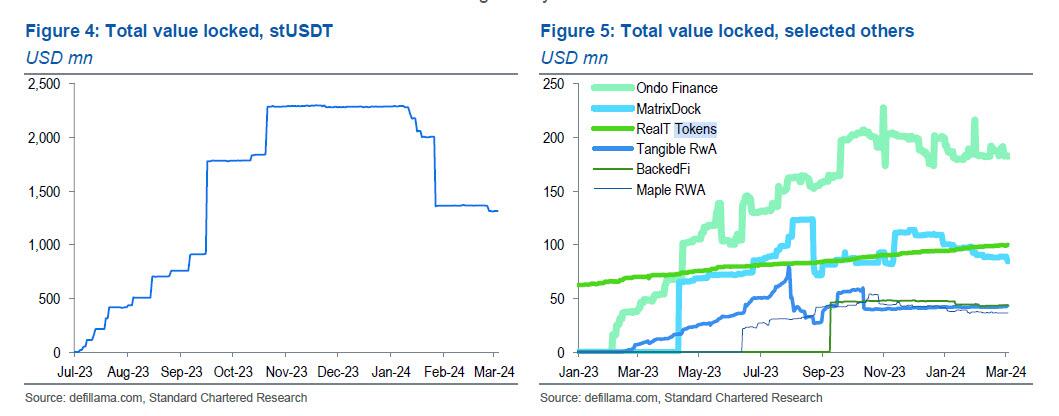
Tokenization of real-world assets has begun, but it is small so far. The largest is stUSDT (staked USDT, Figure 4) on the Tron network. Returns for stUSDT are driven by US Treasury yields. The others, which are primarily built on Ethereum, are shown in Figure 5. These offer investors a mix of exposure ranging from front-end Treasuries (Ondo) to real estate (RealT);

Note, the Standard Chartered analyst is not the first to say the true value of ETH is in tokenization: initially it was Goldman, and most recently it was the king of Wall Street, Blackrock’s Larry Fink, who as we noted above, said “I see value in having an Ethereum ETF. These are just stepping stones towards tokenization and I really do believe this is where we’re going to be going.”

But while Goldman and Blackrock betting on ETH would be effectively a home run, what would guarantee a trifecta would be the last major holdout joining the bandwagon, and that’s precisely what happened last week when the bank – whose boss has been the most vocally skeptical of bitcoin in recent years – put its chips on ETH.

In a March 14 note on Coinbase (which hiked the price target from $95 to $150; full note available to pro subs in the usual place) from JPM’s Ken Worthington, the crypto analyst echoed Goldman, Standard Chartered and Blackrock, and said that while “the focus of the cryptocurrency marketplace has been the net new money going into U.S. spot Bitcoin ETFs and the positive impact on Bitcoin token prices” it is “ethereum and its native token Ether as a substantial contributor to the cryptocurrency ecosystem, and developer of blockchain technology.”

Specifically, JPM writes that “it sees see the progression along the Ethereum roadmap, including the Dancun upgrade, which occurred this week on March 13, as driving crypto development, which is a longer-term positive and discuss this further in this research.”

Compare and contrast that with, well, anything that Jamie Dimon has said about Bitcoin.

There is much more in the full report, including a full fawning section on ETH (that appears to have been taken almost verbatim from the Goldman initiating coverage report)…

… but the bottom line is that while Bitcoin was the pioneer in Wall Street’s institutionalization race, having seen the startling success of bitcoin ETF adoption, the financial titans including Goldman, Blackrock – and now – JPM, have set their sights on what comes next, which is something near and dear to the people who manage trillions: the fastest, cheapest and most effective way to tokenize everything, from information, to data, to money itself. And they have picked the token to do it with.

So keep a close eye on what happens on May 23 when the SEC is reportedly pushing hard against ETF approval for the second biggest digital asset: with all three of the largest US financial institutions pushing hard, any resistance will die a quick and painless death.

More in the full notes from JPM, Std Chartered and Goldman

Tyler Durden
Mon, 03/18/2024 – 22:00

Illegal Immigrant Can Carry Guns: Federal Judge

Illegal Immigrant Can Carry Guns: Federal Judge

Authored by Zachary Stieber via The Epoch Times,

An illegal immigrant was wrongly banned from possessing guns, according to a recent ruling.

A federal law, Section 922 of Title 18 of the U.S. Code, bars illegal immigrants from carrying guns or ammunition. Prosecutors charged Heriberto Carbajal-Flores, the illegal alien, in 2020 after he was found in Chicago carrying a semi-automatic pistol despite “knowing he was an alien illegally and unlawfully in the United States.”

U.S. District Judge Sharon Johnson Coleman rejected two motions to dismiss, but the third motion, based on a 2022 U.S. Supreme Court ruling, triggered the dismissal of the case on March 8.

“The noncitizen possession statute, 18 U.S.C. § 922(g)(5), violates the Second Amendment as applied to Carbajal-Flores,” Judge Coleman, appointed under President Barack Obama, wrote in her 8-page ruling.

“Thus, the court grants Carbajal-Flores’ motion to dismiss.”

Lawyers for Mr. Carbajal-Flores had argued in the most recent motion to dismiss that the government could not show that the law in question was “part of the historical tradition that delimits the outer bounds of the right to keep and bear arms.”

In 2022, the Supreme Court determined that the U.S. Constitution’s Second Amendment “presumptively protects” conduct that is covered by the amendment’s “plain text.”

To justify regulations, governments must show that each regulation “is consistent with this nation’s historical tradition of firearm regulation,” the high court said at the time. “Only if a firearm regulation is consistent with this nation’s historical tradition may a court conclude that the individual’s conduct falls outside the Second Amendment’s ‘unqualified command,’” it said.

“Lifetime disarmament of an individual based on alienage or nationality alone does not have roots in the history and tradition of the United States,” Mr. Carbajal-Flores’s lawyers argued.

They pointed to several rulings interpreting the Supreme Court’s decision, including an appeals court ruling that declared stripping a man convicted of a nonviolent crime of his gun rights was unconstitutional.

The government opposed the motion, noting that neither of the cited decisions applied to illegal immigrants and that the defendant ignored other rulings that did, including a 2023 ruling that found that Second Amendment rights aren’t afforded to illegal immigrants. The government also offered examples of laws that prohibited certain categories of people from carrying guns, including “individuals who threatened the social order through their untrustworthy adherence to the rule of law.”

But Judge Coleman ruled for the defendant, finding that the laws against untrustworthy people contained exceptions for people who signed loyalty oaths and were deemed nonviolent.

“The government argues that Carbajal-Flores is a noncitizen who is unlawfully present in this country. The court notes, however, that Carbajal-Flores has never been convicted of a felony, a violent crime, or a crime involving the use of a weapon. Even in the present case, Carbajal-Flores contends that he received and used the handgun solely for self-protection and protection of property during a time of documented civil unrest in the Spring of 2020,” she wrote.

“Additionally, Pretrial Service has confirmed that Carbajal-Flores has consistently adhered to and fulfilled all the stipulated conditions of his release, is gainfully employed, and has no new arrests or outstanding warrants. The court finds that Carbajal-Flores’ criminal record, containing no improper use of a weapon, as well as the non-violent circumstances of his arrest do not support a finding that he poses a risk to public safety such that he cannot be trusted to use a weapon responsibly and should be deprived of his Second Amendment right to bear arms in self-defense.

An attorney representing Mr. Carbajal-Flores declined to comment. Federal prosecutors didn’t respond to a request for comment.

Reactions

The ruling drew a range of reactions from people in the legal community.

“Supreme Court has said the ‘people’ are members of the political community,” Larry Keane, a lawyer for the National Shooting Sports Foundation, wrote on X.

“Illegal aliens in US are not part of the political community and thus do not have 2A rights.”

Kostas Moros, a lawyer who represents the California Rifle and Pistol Association, said that he also saw the issue that way.

“Bruen asks for a historical tradition of modern regulation that justifies the modern law, and one plainly exists here,” he wrote, noting that groups that have been disarmed in the past, including loyalists, have the common thread of being “outside of the political community.”

Matthew Larosiere, another lawyer, disagreed, writing in an analysis that all immigrants, even ones in the country illegally, are part of “the people” in the Second Amendment. His argument rested in part on the 14th Amendment, which applies to “any person within” the country.

“To find that illegal immigrants are outside of ’the people‘ protected by the Second Amendment, you must believe that the Framers were talking about a different ’people’ in the First, Fourth, Ninth, and Tenth Amendments,” he wrote, adding later that he sided with the court in finding differences between historical laws such as the one that barred loyalists from owning guns and the law that applies to illegal immigrants.

Tyler Durden
Mon, 03/18/2024 – 21:40

Trust In Flying Still High, But Passengers Take More Precautions

Trust In Flying Still High, But Passengers Take More Precautions

The Department of Justice has opened a criminal investigation into the panel blow out of a Boeing 737 MAX operated by Alaska Airlines in January, according to the Wall Street Journal. The incident was the first in a chain of events reported this year, which have led to increased scrutiny of the company and heightened media attention over such incidents.

Despite the string of faults that have been publicized, the chances of being killed on a flight are extremely low.

This knowledge is well ingrained in many, as Statista’s Anna Fleck notes one study, carried out by The Harris Poll on behalf of Fast Company, shows: 69 percent of respondents agreed that flying is safer than other means of long-distance transportation.

At the same time, 86 percent of adults agreed that they would trust flight teams (such as air hostesses and pilots) to keep passengers safe during flights, while 73 percent said that they trust passenger planes are thoroughly inspected before flying.

Yet, it appears that the high-profile safety incidents documented of late are having at least some impact on flyers’ behaviors: 48 percent of respondents said that they would now be more likely to pay attention to safety materials on an upcoming flight, 47 percent said that they would now be more likely to wear a seatbelt when not required and 45 percent said that they would now be more likely pay attention to pre-takeoff activities. At the same time, between 30-40 percent said that they would be more likely to consider the row their seat is located on the plane, the airline they book with and the type of plane they will be flying on.

Infographic: Trust in Flying High But Passengers Take More Precautions | Statista

You will find more infographics at Statista

Against a backdrop of questions over what’s going on with Boeing, Morning Consult carried out a survey on how public trust in the aircraft giant has changed with the new developments.

It found that between Q4 of last year and January 1-February 28 of 2024, net trust had dipped among respondents by 14 percentage points. Net trust is defined as the share of respondents who trust a brand minus the share who distrust a brand.

As the following chart shows, the biggest change was among business travelers, with a 26 percentage point difference between the two survey waves. According to the online polling company, this is partly due to business flyers having historically had more trust in Boeing than other groups, which means there was more room to fall.

Infographic: Trust in Boeing Plummets After Safety Incidents | Statista

You will find more infographics at Statista

Nicki Zink, an analyst at Morning Consult, adds that while Boeing’s reputation has dipped, this has not spread to the wider airline industry and that net trust in airlines has even seen an uptick as the spring break season approaches.

Tyler Durden
Mon, 03/18/2024 – 21:20

Queenpin Of Guatemalan Drug Cartel Sentenced Over International Trafficking Conspiracy

Queenpin Of Guatemalan Drug Cartel Sentenced Over International Trafficking Conspiracy

Authored by Stephen Katte via The Epoch Times (emphasis ours),

A Queenpin of the Lorenzana drug trafficking network has been sentenced to 33 years in prison and forced to forfeit $27 million for charges related to international drug trafficking.

The U.S. Department of Justice building in Washington on June 28, 2023. (Madalina Vasiliu/The Epoch Times)

According to the Department of Justice, Queenpin Marta Julia Lorenzana-Cordon from Zacapa, Guatemala, was a leader in one of the largest and most influential drug cartels in Guatemala. Guatemala is a Central American country south of Mexico, with a population of over 17 million people.

During their reign, the Lorenzana criminal group was described by authorities as one of the most brutal and destructive drug trafficking organizations in the world.

Julia Lorenzana-Cordon was extradited to the United States in December of 2021, after Guatemalan authorities took her into custody at the behest of the U.S. government in May 2021. She subsequently pleaded guilty in May of 2023 to conspiring to distribute five kilograms or more of cocaine, and knowing and intending for the drug to be unlawfully imported to America.

According to the Department of Justice, Julia Lorenzana-Cordon, also known as Yulie, began operating within the criminal enterprise around 2008 and continued until at least 2019. The organization itself began operating in 1996. The patriarchal criminal group comprised primarily of family members and had the goal of distributing multi-ton quantities of cocaine from Colombia to Central America and Mexico for eventual distribution into the United States.

The investigation into Julia Lorenzana-Cordon was part of Operation Slipknot and conducted by the DEA’s Bilateral Investigations Unit, with assistance from the DEA Guatemala City Country Office and the Organized Crime Drug Enforcement Task Forces. Investigators found the Lorenzana drug trafficking organization transported tonnage quantities of cocaine from Colombia into Guatemala, where the cocaine was stored on properties owned by the crime organization.

After the cocaine was processed, the drug was transported by the Sinaloa Cartel, among other organizations, into Mexico, through Central America, and eventually, into the United States.

Along with Julia Lorenzana-Cordon, her siblings, Eliu Elixander Lorenzana-Cordon and Waldemar Lorenzana-Cordon have also been hit with lengthy prison sentences. Both were convicted in 2019 on international narcotics trafficking charges in the District of Columbia and sentenced to life in prison.

At the same time, the father of the siblings, Waldemar Lorenzana-Lima Sr., pleaded guilty in August 2014 to international narcotics trafficking charges in the District of Columbia, receiving 23 years in prison. He has since passed away.

According to authorities, the family was deeply dysfunctional, and Julia Lorenzana-Cordon had separate drug trafficking networks different to those of her brothers and father, which allowed her to continue operating for a few years after the rest of her family was convicted.

Julia Lorenzana-Cordon was also reportedly married to Jairo Estuardo Orellana Morales, a Guatemalan narcotics trafficker and accused murderer who was arrested in May 2014. His status since being detained is unknown.

Drug trafficker Waldemar Lorenzana Lima, related to the Mexican Sinaloa drug cartel, is taken under custody on April 28, 2011, upon his arrival in Guatemala City. He faces an extradition warrant from the United States. (JOHAN ORDONEZ/AFP via Getty Images)

The Department of the Treasury designated the couple as Specially Designated Narcotics Traffickers (SDNT) under the Foreign Narcotics Kingpin Designation Act (Kingpin Act). Under the act, U.S. persons and entities are prohibited from conducting financial or commercial transactions with anyone designated as a SDNT. The act also freezes any assets a SDNT may have under U.S. jurisdiction.

Tyler Durden
Mon, 03/18/2024 – 21:00

High-Schoolers Are Losing Confidence In The Benefits Of A College Degree

High-Schoolers Are Losing Confidence In The Benefits Of A College Degree

Via Campus Reform,

A recently released study that involved focus groups and a national study explores how high school students and non-enrolled adults ages 18-30 view the prospects of a college degree.

New data suggests that prospective college students are finding fewer and fewer reasons to obtain a degree.

Inside Higher Ed recently highlighted a new report by the Gates Foundation-funded HCM Strategists and Edge Research revealing that high school students and young adults have a declining view of the benefits of a college degree.

The study, ”Continuing to Explore the Exodus from Higher Education,”compares the results of focus groups and a national survey conducted in 2023 to findings from a 2022 Gates Foundation report titled, “Where are the students?.”

Researchers found that high schoolers and non-enrolled adults ages 18-30 still associate some benefits with attending college, but those perceived benefits were in decline compared to findings from 2022.

The percentage of non-enrolled adults surveyed who consider reasons to go to college, such as to gain more money or get a better job, as important or very important has also dropped from the year before.

At the same time, however, non-enrolled adults continue to perceive an increasing benefit to other options such as licenses, certificates, and trade schools.

In conclusion, the study’s researchers write that, “Despite our understanding of the value of higher education, perceptions among these high school students and non-enrolled audiences make it clear that institutions need to prove their value to them.”

”In particular, why does the value of a 2-year or 4-year degree outweigh the value of credentials and job training programs?,” the researchers write.

“Both High Schoolers and Non-Enrollees see and select other paths that are shorter, cheaper, and/or more directly linked to specific job opportunities.”

“At the end of the day, higher education has a lot of work to do to convince these audiences of its value,” HCM consultant Terrell Dunn told Inside Higher Ed

Tyler Durden
Mon, 03/18/2024 – 19:40

Google Denies Election Interference After Report Cites Dozens Of Instances Helping Dems, Censoring Republicans

Google Denies Election Interference After Report Cites Dozens Of Instances Helping Dems, Censoring Republicans

Google has denied a new report by the right-leaning Media Research Center (MRC) alleging 41 instances of “election interference” since 2008.

According to the report, Google has “utilized its power to help push to electoral victory the most liberal candidates…while targeting their opponents for censorship.”

MRC also claims that Google “targeted support for Hillary Clinton for censorship” by “suspending the accounts of writers who wrote blogs critical of Obama during his primary race against Clinton.”

In 2008, MRC alleged that Google threw its support behind then-Sen. Barack Obama (D-Ill.) as he faced off against Hillary Clinton for the Democratic nomination. –NY Post

Four years later, Google – which “once again favored Obama over Mitt Romney,” refused to correct a “Google bomb” that smeared GOP primary candidate Rick Santorum, the report reads.

According to Dr. Robert Epstein, who is cited in MRC’s report and has conducted “dozens of controlled experiments” to uncover bias, Google’s search algorithm “shifted at least 2.5 million votes” to Hillary Clinton in the 2016 US election.

In 2018, President Donald Trump accused the search giant of rigging search results to display only left-wing and negative stories about him.

“Google search results for ‘Trump News’ shows only the viewing/reporting of Fake New Media. In other words, they have it RIGGED, for me & others, so that almost all stories & news is BAD, Fake CNN is prominent. Republican/Conservative & Fair Media is shut out. Illegal,” Trump said in a now-deleted post on X.

In response, Google claimed “Search is not used to set a political agenda and we don’t bias our results toward any political ideology.”

Google denies

A company source told the NY Post that Epstein’s claims have been “widely debunked.” In one instance cited by the MRC report, Google is alleged to have “targeted” then-Democratic Congresswoman Tulsi Gabbard (HI), by “disabling Gabbard’s Ads account just as she became the most searched candidate following the first Democratic Party primary debate.”

Google’s source told the Post that the company’s automated systems flagged ‘unusual activity’ due to large spending changes in an effort to prevent fraud – and the issue was resolved within six hours, per the source, who noted that Gabbard’s subsequent lawsuit against the company was dismissed.

The MRC also alleged that Google’s left-leaning bias impacted the 2022 Georgia Senate race between former football great and Republican Herschel Walker and the eventual winner, the Democrat Raphael Warnock.

According to the report, Google’s search results “favored [the] incumbent” Warnock “in the swing precinct where greater proportions of undecided voters likely reside.”

A source close to Google told The Post that third parties who have looked at our results and “found no evidence to support claims of political bias.” -NY Post

There is absolutely nothing new here — just a recycled list of baseless, inaccurate complaints that have been debunked by third parties and many that failed in the courts,” a Google spokesperson told the outlet.

Of course, one can’t help but be skeptical considering that just before the 2016 presidential election, among the many leaks published by Wikileaks as part of its Podesta email leak was Google’s “strategic plan” to help democrats win the election and track voters.

Tyler Durden
Mon, 03/18/2024 – 19:20

Biden Wants To Hike Taxes By $7 Trillion Dollars

Biden Wants To Hike Taxes By $7 Trillion Dollars

Authored by Mike Shedlock via MishTalk.com,

If Democrats win the trifecta with a clean sweep of the Senate, House, and White House in November, taxes would rise by $7 trillion over 10 years.

The House Ways and Means Committee reports The Biden Tax Hike Will Likely Exceed $7 Trillion.

I believe they mean would not will.

Tax Details

  • President Biden Quietly Pledges to Let Trump Tax Cuts Expire

  • Sending Jobs and Companies Overseas with Higher Business Taxes than China

  • Global Tax Surrender Allows Foreign Governments to Take American Tax Dollars

  • President Biden’s proposal to raise the top rate to 39.6 percent goes after small business owners who pay their business taxes via their individual tax return – despite his pledge not to raise taxes on small businesses.

  • A Tax on Wealth You Haven’t Even Earned Yet.

  • Higher Prices for Energy Bills and an Energy Insecure America.

  • An IRS That Would Terrify Godzilla

A friend of mine asked when will the tax hikes cause a recession. I replied never. I suspect my friend was confused over the title that said “will” it should say “would”.

I did not total up all of those details because I don’t believe it’s going to happen. However, It is a warning shot as to what would happen if Democrats did win the trifecta.

Biden’s Populist Budget

The Hill comments Biden’s populist budget marks the overdue end of trickle-down economics

Trickle-down refers to the idea that tax cuts for the wealthiest “trickle down” to the rest of us. It’s long been a popular idea in Washington, but it’s just not true. A few years ago, the London School of Economics studied 50 years of such “trickle-down” policies in 18 industrialized nations, including the U.S., and found that their only result was increasing the wealth of the already wealthy.

So how do we get prosperity for the rest of us? By taxing extreme wealth and investing those revenues in social goods like education, housing, food and health care. President Biden’s recently released federal budget plan follows that blueprint, putting the value of investing in American families and communities ahead of slashing taxes for the rich.

The budget for the fiscal year 2025 would generate about $5.3 trillion in revenues over the next decade. That’s a $388 billion boost compared to last year’s budget — and it all comes from fairer tax policies targeting wealthy individuals and large corporations. Households earning less than $400,000 would see no tax increases, with many seeing reductions.

The proposed budget invests $2.3 trillion towards essential public services for hard-working families while reducing the national debt by almost $3 trillion. That’s a great start toward filling critical investment gaps for families and communities.

Take housing. The National Low Income Housing Coalition reports a shortfall of more than 7 million affordable housing units for poor and low-income Americans. Biden is requesting $33 billion for the Housing Choice Voucher program, which currently helps over 2 million households afford housing and would expand access to homeownership for first-time homebuyers. His request will help to support the existing vouchers and add about 20,000 more.

Though much more is needed, this effort to reduce homelessness by providing access to safe affordable housing in a tight housing market — with high rent prices and often insufficient wages — is a step in the right direction.

Normally writers for The Hill are not nutzoid liberal like the above article.

But it’s not going to happen unless you think Democrats can pull off a trifecta.

Nonetheless, the budget is instructive as are CBO and Fed projections. I will have some comments on those projections Sunday or Monday.

Optimism reins supreme, and it won’t happen.

Tyler Durden
Mon, 03/18/2024 – 19:00

Russia Mulls Security Buffer Zone As Ukraine Drones Shut Down 600,000 Barrels Of Daily Refining

Russia Mulls Security Buffer Zone As Ukraine Drones Shut Down 600,000 Barrels Of Daily Refining

After Russian President Vladimir Putin’s post-election victory speech and Q&A with the press wherein he first unveiled the possibility of creating a buffer zone between Ukrainian land and Russian border regions, the Kremlin has issued more details of the plan being mulled. 

Putin had initially described Sunday, “I do not exclude that, bearing in mind the tragic events taking place today, we will be forced at some point, when we deem it appropriate, to create a certain ‘sanitary zone’ in the territories today under the Kyiv regime.” He referenced the “tragic events” of cross-border attacks in regions bordering Ukraine which have left scores of civilians dead and wounded over the past several months.

Putin described without elaborating further that the security zone “would be quite difficult for the adversary to overcome with its weapons, primarily of foreign origin.”

Refinery ablaze last week in Ryazan, Ryazan Region. via Reuters

On Monday, Kremlin spokesman Dmitry Peskov said that as part of the plan Russia “would take measures to safeguard [its] territories” from Ukrainian drone and artillery attacks on critical infrastructure and civilian areas and residences. These areas can be made safe, he explained in follow-up to Putin’s words, “some kind of corridor, some kind of… buffer zone that [would put] out of reach any means that the enemy might use to launch strikes.”

From Moscow’s perspective, this is laying the foundation and likely even ‘legal framework’ for seizing and solidifying hold over border territories inside Ukraine for the purpose of creating this proposed buffer. In many cases thus far throughout the war, Ukraine forces have been able to send drones hundreds of kilometers inside Russia, reaching even Moscow and St. Petersburg in rare instances.

Oil refineries have been especially targeted, with a dozen or more instances in merely the last few months alone. Crimea too has come under increased drone swarm attack.

The attacks on energy are clearly beginning to have significant impact on a chief source of revenue, part of which no doubt goes to fund the Russian war machine in Ukraine.

“Gunvor Group Ltd. Chief Executive Officer Torbjörn Törnqvist estimates about 600,000 barrels of Russia’s daily oil-refining capacity has been knocked out by Ukrainian drone strikes,” Bloomberg reports based on a Monday report. According to some key quotes:

“It is significant because obviously this is gonna hit the distillate exports straight away,” Törnqvist said during an interview at the CERAWeek by S&P Global conference in Houston on Monday. “So that will probably take down exports by a couple of hundred thousand barrels, so to me it’s a distillate problem.”

…Broadly writ, crude oil markets are mostly in balance and fairly valued, Törnqvist said, adding that US supplies are likely to grow this year by about half the rate of 2023’s 700,000-to-800,000 barrel-a-day pace. Still, non-OPEC supply growth overall is likely to be flat this year, he said. 

The past week has seen consecutive days of drone strikes on oil facilities inside Russia, with a noticeable uptick in attacks confirmed over the weekend, as Russians went to the polls to vote in the presidential election. Just before the three-day election period began, there was an attack on Rosneft’s largest refinery:

Russia’s Ryazan oil refinery, controlled by Rosneft, was set ablaze after a drone attack, a regional governor said on Wednesday.

The plant, with installed capacity of around 350,000 barrels per day, refines about 12.7 million metric tons of Russian crude a year (around 317,000 barrels per day), or 5.8% of total refined crude, according to industry sources.

On Sunday alone, 35 drones were launched on Russia, disrupting electricity in a number of border regions, including resulting at another fire at an oil refinery. One drone made to Moscow, and was shot down as it flew near Domodedovo airport.

Tyler Durden
Mon, 03/18/2024 – 18:40