68.3 F
Chicago
Sunday, September 20, 2026
Home Blog Page 2819

US Announces Plan To Evacuate American Citizens Stranded In Haiti

US Announces Plan To Evacuate American Citizens Stranded In Haiti

Authored by Jack Phillips via The Epoch Times (emphasis ours),

The State Department confirmed that it will try to evacuate Americans who are still stranded in Haiti as the country’s security situation continues to deteriorate.

Police officers patrol a neighborhood amid gang-related violence in downtown Port-au-Prince on April 25, 2023. (Richard Pierrin/AFP via Getty Images)

On March 16, the U.S. Embassy in Haiti stated that it will organize a charter flight for U.S. citizens who still remain in the country, coming months after the embassy issued a warning that Americans should leave.

We are arranging a charter flight for U.S. citizens from Cap-Haitien to the United States, assuming the security situation in Cap-Haitien remains stable,” the embassy said in a security alert issued over the weekend, noting that the airport in the city is “opened periodically for departing flights.”

But, it warned, the “overland trip from Port-au-Prince to Cap Haitien is dangerous,” and the embassy recommended that people head to Cap-Haitien only if they believe they can reach the airport safely.

We cannot provide overland travel from other parts of Haiti to Cap-Haitien,” the statement reads. “We continue to work on options for departures out of Port-au-Prince and will let you know about them as soon as we are able to safely and securely arrange them.”

It also states that U.S. citizens who choose to depart using federal government-backed flights have to sign a statement agreeing to pay the U.S. government back for the flight’s cost.

“The security situation in Haiti is unpredictable and dangerous. Travel within Haiti is conducted at your own risk. The U.S. government cannot guarantee your safety traveling to airports, borders, or during any onward travel,” the embassy warned on March 16. “You should consider your personal security situation before traveling anywhere in Haiti. Only attempt to depart Haiti or travel within Haiti if you believe it is safe for you to do so.”

The statement from the embassy comes about two weeks after U.S. military officials confirmed that it evacuated some embassy personnel in the country. Weeks before that, Haiti declared a state of emergency because of escalating violence from armed gangs while then-Prime Minister Ariel Henry was in Nairobi, Kenya, seeking a deal for a long-delayed U.N.-backed security mission. He resigned last week.

U.S. Secretary of State Antony Blinken said a transition council would be named, after which Mr. Henry would step down.

“This is never going to be smooth and never going to be linear,” Mr. Blinken told reporters during a visit to Austria. “So that’s a work in progress, but we’ve seen that move forward.”

U.S. aid chief Samantha Power announced $25 million in humanitarian assistance for Haiti on March 15 to cover food, essential relief supplies, relocation support, and emergency health care. That was on top of the $33 million announced on March 11.

But some analysts say the transition plan isn’t working.

“It’s starting off very, very badly,” Frederic Boisrond, a sociologist at McGill University, told Radio-Canada, pointing to the dissent within the groups proposed for the transition council by leaders in Jamaica, reported Reuters.

“Elections are very long-term prospect.”

He pointed to the need to, after restoring security, recreate an electoral roll and reappoint mayors, senators, and deputies.

This is a huge machine to reinstall. Haiti is in year zero of democracy,” Mr. Boisrond said.

Gang Leader Issues Warning

Over the weekend, a powerful gang leader in Haiti, Jimmy “Barbecue” Cherizier, issued a threatening message aimed at political leaders who would participate in a planned transition council, as fires broke out amid a fresh surge of violence in the Caribbean nation’s capital.

“Don’t you have any shame?” said Mr. Cherizier, directing his remarks at politicians who he said were looking to join the council. “You have taken the country where it is today. You have no idea what will happen.

Jimmy “Barbecue” Cherizier, leader of the “G9” coalition of gangs in the metropolitan area of Port-au-Prince, Haiti, looks on after speaking to members of the media on Oct. 26, 2021. (Ralph Tedy Erol/Reuters)

“I’ll know if your kids are in Haiti, if your wives are in Haiti … if your husbands are in Haiti. If you’re gonna run the country, all your family ought to be there.”

In his remarks, Mr. Cherizier said the resignation of Mr. Henry was only “a first step in the battle” for the island nation of about 11 million.

Nearby countries have bolstered their border security and withdrawn staff from embassies, while plans to send a long-awaited international security force remain uncertain, Reuters reported.

Reuters contributed to this report.

Tyler Durden
Mon, 03/18/2024 – 18:20

Gen-Z OnlyFans ‘Creator’ Quits As She Dedicates Life To Jesus Christ

Gen-Z OnlyFans ‘Creator’ Quits As She Dedicates Life To Jesus Christ

OnlyFans has become a site for adult entertainers and amateurs to deliver pornographic content straight to their horny fans. Gen-Zers have flocked to the site, many of whom are young women seeking ‘female empowerment.’ 

The platform boasts about young female superstar “models” making six- and seven-figure earnings, aspiring (or corrupting) an entire generation of young people to give up on education and degrade themselves as a sex worker. This trend exploded during Covid as many youngsters have lost all memory of why sex work is shamed in society. 

Taking selfies or videos of feet, asses, boobs, and or pornographic scenes with others isn’t real productive work and is self-destructive behavior (daddy problems much?). Normalizing online prostitution is terrible for civilized societies. Also, sex workers are not respected in society, leaving very limited future opportunities in life after OnlyFans. 

Recent data from OnlyFans shows that about 70% of creators are women, and 30% are men, translating to about 1.4 million American women and 600,000 American men. 

The OnlyFans phenomenon could be a bubble as one top Gen-Zer creator has allegedly given up on her hugely successful account for a life of Christ, or at least she says… 

The Whatever podcast, which has interviewed creator “Nala” before, posted on X Saturday evening, “WE DID IT BOYS!!!” while referring to several videos of the creator finding Jesus and allegedly abandoning her account (however, the account is still online).

“I hope she stays on the narrow road that leads to life. And I also hope it’s genuine. You can have both of these thoughts at once,” one X user said. 

And this. 

However, only some believe in Nala’s awakening and commitment to Jesus….

Rebranding?

Another X user said: “God forgives, but doesn’t forget.” 

Perhaps the OnlyFans creator bubble begins to crack as they must re-enter society and find real jobs. 

Tyler Durden
Mon, 03/18/2024 – 16:40

It’s Not Coercion If We Do It…

It’s Not Coercion If We Do It…

Authored by James Howard Kunstler via Kunstler.com,

Gags and Jibes

“My law firm is currently in court fighting for free and fair elections in 52 cases across 19 states.”

– Marc Elias, DNC Lawfare Ninja, punking voters

Have you noticed how quickly our Ukraine problem went away, vanished, phhhhttttt? At least from the top of US news media websites.

The original idea, as cooked-up by departed State Department strategist Victoria Nuland, was to make Ukraine a problem for Russia, but instead we made it a problem for everybody else, especially ourselves in the USA, since it looked like an attempt to kick-start World War Three.

Now she is gone, but the plans she laid apparently live on.

Our Congress so far has resisted coughing up another $60-billion for the Ukraine project — most of it to be laundered through Raytheon (RTX), General Dynamics, and Lockheed Martin — so instead “Joe Biden” sent Ukraine’s President Zelensky a few reels of Laurel and Hardy movies. The result was last week’s prank: four groups of mixed Ukraine troops and mercenaries drawn from sundry NATO members snuck across the border into Russia’s Belgorod region to capture a nuclear weapon storage facility while Russia held its presidential election.

I suppose it looked good on the war-gaming screen.

Alas, the raid was a fiasco. Russian intel was on it like white-on-rice. The raiders met ferocious resistance and retreated into a Russian mine-field – this was the frontier, you understand, between Kharkov (Ukr) and Belgorod (Rus) – where they were annihilated. The Russian election concluded Sunday without further incident. V.V. Putin, running against three other candidates from fractional parties, won with 87 percent of the vote. He’s apparently quite popular.

“Joe Biden,” not so much here, where he is pretending to run for reelection with a party pretending to go along with the gag. Ukraine is lined up to become Afghanistan Two, another gross embarrassment for the US foreign policy establishment and “JB” personally. So, how long do you think V. Zelensky will be bopping around Kiev like Al Pacino in Scarface?

This time, poor beleaguered Ukraine won’t need America’s help plotting a coup. When that happens, as it must, since Mr. Z has nearly destroyed his country, and money from the USA for government salaries and pensions did not arrive on-time, there will be peace talks between his successors and Mr. Putin’s envoys. The optimum result for all concerned — including NATO, whether the alliance knows it or not — will be a demilitarized Ukraine, allowed to try being a nation again, though in a much-reduced condition than prior to its becoming a US bear-poking stick. It will be on a short leash within Russia’s sphere-of-influence, where it has, in fact, resided for centuries, and life will go on. Thus, has Russia at considerable cost, had to reestablish the status quo.

Meanwhile, Saturday night, “Joe Biden” turned up at the annual Gridiron dinner thrown by the White House [News] Correspondents’ Association, where he told the ballroom of Intel Community quislings:

“You make it possible for ordinary citizens to question authority without fear or intimidation.”

The dinner, you see, is traditionally a venue for jokes and jibes. So, this must have been a gag, right? Try to imagine The New York Times questioning authority. For instance, the authority of the DOJ, the FBI, the DHS, and the DC Federal District court. Instant hilarity, right?

As it happens, though, today, Monday, March 18, 2024, attorneys for the State of Missouri (and other parties) in a lawsuit against “Joe Biden” (and other parties) will argue in the Supreme Court that those government agencies above, plus the US State Department, with assistance from the White House (and most of the White House press corps, too), were busy for years trying to prevent ordinary citizens from questioning authority.

For instance, questioning the DOD’s Covid-19 prank, the CDC’s vaccination op, the DNC’s 2020 election fraud caper, the CIA’s Frankenstein experiments in Ukraine, the J6 “insurrection,” and sundry other trips laid on the ordinary citizens of the USA.

Specifically, Missouri v. Biden is about the government’s efforts to coerce social media into censoring any and all voices that question official dogma.

The case is about birthing the new concept – new to America, anyway – known as “misinformation” – that is, truth about what our government is doing that cannot be allowed to enter the public arena, making it very difficult for ordinary citizens to question authority.

The government will apparently argue that they were not coercing, they were just trying to persuade the social media execs to do this or that.

As The Epoch Times’ Jacob Burg reported, the court appeared wary of arguments by the respondents that the White House is wholesale prevented under the Constitution from recommending to social media companies to remove posts it considered harmful, in cases where the suggestions themselves didn’t cross the line into “coercion.”

Deputy Solicitor General for the U.S. Brian Fletcher argued that the White House’s communications with news media and social media companies regarding the content promoted on their platforms do not rise to the level of governmental “coercion,” which would have been prohibited under the Constitution.

Instead, the government was merely using its “bully pulpit” to “persuade” private parties, in this case social media companies, to do what they are “lawfully allowed to do,” he said.

Louisiana Solicitor General Benjamin Aguiñaga, representing the respondents, argued that the case demonstrates “unrelenting pressure by the government to coerce social media platforms to suppress the speech of millions of Americans.”

Mr. Aguiñaga argued that the government had no right to tell social media companies what content to carry. Its only remedy in the event of genuinely false or misleading content, he said, was to counter it by putting forward “true speech.”

The attorney general took pointed questions from Liberal Justice Ketanji Brown Jackson about the extent to which the government can step in to take down certain potentially harmful content. Justice Jackson raised the hypothetical of a “teen challenge that involves teens jumping out of windows at increasing elevations,” asking if it would be a problem if the government tried to suppress the publication of said challenge on social media. Mr. Aguiñaga replied that those facts were different from the present case.

Justice Ketanji Brown Jackson raised the opinion that some say “the government actually has a duty to take steps to protect the citizens of this country” when it comes to monitoring the speech that is promoted on online platforms.

“So can you help me because I’m really worried about that, because you’ve got the First Amendment operating in an environment of threatening circumstances from the government’s perspective.

“The line is, does the government pursuant to the First Amendment have a compelling interest in doing things that result in restricting speech in this way?”

Attorneys General Liz Merrill of Louisiana and Andrew Bailey of Missouri both told The Epoch Times they felt positive about the case and how the justices reacted.

“I am cautiously optimistic that we will have a majority of the court that lands where I wholeheartedly believe they should land, and that is in favor of protecting speech,” Ms. Merrill said.

Journalist Jim Hoft, a party listed in the case, said, “This has to be where they put a stop to this. The government shouldn’t be doing this, especially when they’re wrong, and pushing their own opinion, silencing dissenting voices. Of course, it’s against the Constitution. It’s a no-brainer.”

In response to a question from Brett Kavanaugh, an associate justice of the Supreme Court, Louisiana Solicitor General Benjamin Aguiñaga said the “government is not helpless” when it comes to countering factually inaccurate speech.

Precedent before the court suggests the government can and should counter false speech with true speech, Mr. Aguiñaga said.

“Censorship has never been the default remedy for perceived First Amendment violation,” Mr. Aguiñaga said.

Maybe one of the justices might ask how it came to be that a Chief Counsel of the FBI, James Baker, after a brief rest-stop at a DC think tank, happened to take the job as Chief Counsel at Twitter in 2020.

That was a mighty strange switcheroo, don’t you think?

And ordinary citizens were not generally informed of it until the fall of 2022, when Elon Musk bought Twitter and delved into its workings.

*  *  *

Support his blog by visiting Jim’s Patreon Page or Substack

Tyler Durden
Mon, 03/18/2024 – 16:20

Big-Tech & Black Gold Surge As Bonds & Bitcoin Purged Ahead Of Fed

Big-Tech & Black Gold Surge As Bonds & Bitcoin Purged Ahead Of Fed

After last week’s data and down-trend, Monday started fresh and shiny for BTFDers ahead of this afternoon’s “most important event in the world” – NVDA CEO Jensen Huang’s Keynote at GTC.

NVDA has not made a new high since March 8th!!!! Shock horror, and sold off intraday today from earlier juicy gains… before after dip-buyers stepped in…

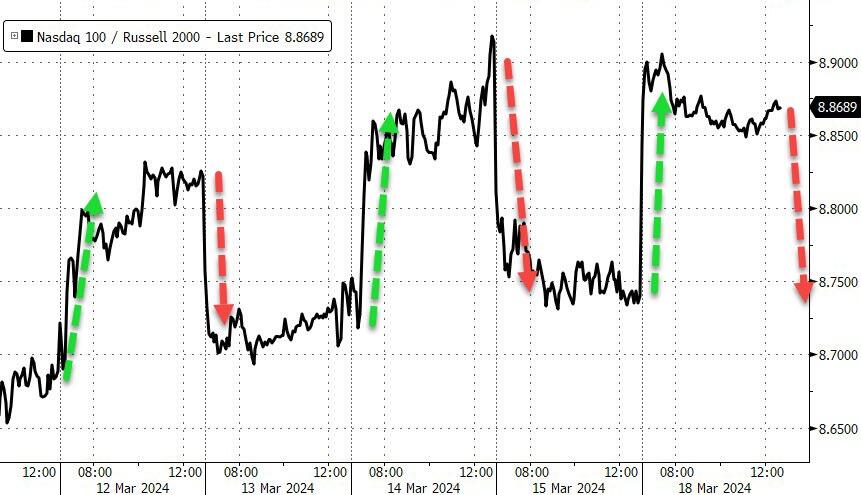
Nasdaq and S&P led the day with The Dow lagging and Small Caps red. The last 10 minutes saw some selling pressure spoil the party as at least some got a little nervous ahead of Jensen…

The flip-flopping of NDX/RTY continues… so tomorrow should be a RTY >> NDX day?

Source: Bloomberg

‘Most Shorted’ stocks opened down but were immediately squeezed – though still closed red…

Source: Bloomberg

Treasury yields were higher across the board again today with the long-end underperforming…

Source: Bloomberg

…but rate-cut expectations continued to tumble (now only 70bps of cuts priced in for 2024)…

Source: Bloomberg

…as Breakevens continue to soar (helped by oil)…

Source: Bloomberg

Bitcoin drifted lower today, back below $68,000…

Source: Bloomberg

…as BTC ETF volumes were very low…

Source: Bloomberg

The dollar extended last week’s gains…

Source: Bloomberg

Despite dollar strength, gold managed gains also, back above $2160 (spot)…

Source: Bloomberg

Oil prices soared on China growth hope (macro data overnight), and Russian refinery supply issues (Ukraine drone attacks), as well as Iraq promising to abide by OPEC+ production cuts. WTI topped $83 for the first time sine the first week of November…

Source: Bloomberg

Finally, there’s no way this happens again, right?

Source: Bloomberg

Over to you, Jensen!!

Tyler Durden
Mon, 03/18/2024 – 16:00

German Lawmaker In Blistering Ukraine Speech To Parliament: “Have You All Lost Your Minds?”

German Lawmaker In Blistering Ukraine Speech To Parliament: “Have You All Lost Your Minds?”

Sahra Wagenknecht was long well-known as one of the leading members of the Left Party (Die Linke), but currently she’s head of the recently formed Sahra Wagenknecht Alliance – Reason and Justice. She recently gave a stirring and rare, courageous speech warning against the German government being on the warpath with Russia, also as a handful of European leaders, with France’s Macron leading the way, even contemplating sending Western troops to Ukraine as a viable ‘option’. 

“Have you all lost your minds?” she questioned members of the Bundestag. She said in the speech: “The Scholz government has already crossed one red line after the other. In the meantime we reached the point where German Air Force officers calmly debate how to destroy Russian targets with German cruise missiles…” She continued, “The scandal is that we have reached a point where it has become normal to have such debates.”

Wagenknecht went on: “Our grandiose military experts from the Greens have been telling us for two years now what ‘game changer’ we have to deliver next so that Ukraine can win this war.” The hawks “dream” about using German missiles to “destroy ministries in Moscow,” she said. “And when the pope speaks out against this madness, saying that Kiev should negotiate rather than drive the country to suicide, he was called a ‘Putin troll’.” She then emphasized, “The whole world outside the German political bubble knows that Ukraine cannot with this war. For a long time there has been no winning in Ukraine. There has only been.. bloody dying day in and day out. And Taurus missiles won’t change any of that.” Watch the German lawmaker’s speech with English captions below:

Tyler Durden
Mon, 03/18/2024 – 15:45

“We’re One Event Away From A 1970s-Style Stagflation Explosion…”

“We’re One Event Away From A 1970s-Style Stagflation Explosion…”

Excerpted from ‘The Turning Point’ report via Larry MacDonald’s TheBearTrapsReport.com,

We hear the comparisons more and more; they are growing louder by the week.

“The years 2023-2024 look a lot like 1973-1974.”

The history books remind us,1973’s oil embargo shook the global energy market. It also reset geopolitics, reordered the global economy, and a multipolar world saw energy weaponized. After kissing 6% in 1970, in Q1 of 1973, inflation as measured by CPI danced just below 4%, much like today, central bankers were doing the Michael Jackson moonwalk in celebratory form. Then, in bloodcurdling fashion in late 1974, CPI breached 12%.

“Don’t be silly, 1973 was a far different set up,” we are told.

When it comes to demand on a global stage, 2024 is 2x 1973.

Above all, the U.S. is the largest producer of oil in 2024, not as was the case in 1973, when she was the world’s largest petroleum importer.

At the time, oil was 50% of world energy consumption vs. 1/3 today.

There is just one overwhelming difference today.

In the last 8 weeks, we have seen drone technology knock out

a) parts of Russia’s second largest airport,

b) at least three of Putin’s prize oil refineries,

and c) countless ships in the Suez Canal.

Weaponizing oil in a multipolar world is exponentially more uncertain with James Cameron calling the shots. In October of 1984, he brought us the “Terminator” and opened the world’s eyes to the future of AI and the weaponization of robots. If Vladimir Putin, on the eve of an election, cannot protect his second-largest airport, how can the Saudi’s protect their own crown jewel. Measuring 280 by 30 km (170 by 19 mi) (some 8,400 square kilometres (3,200 sq mi)), it is by far the largest conventional oil field in the world. That’s a lot of ground to protect. We are one event away from a 1970s-style stagflation explosion.

More often than not, recency bias is an investor’s foe. The 2008 and 2020 recessions were similar in that a shock triggered a colossal bond rally along with plunging PMI, ISM and LEI data. It’s more and more apparent by the minute. What we are experiencing today is much more of a 1970s – 1980s recession vintage. An inflation-driven slowdown hits the bottom 60% first, but this time around after the Fed suppressed rates for so, so, so long, higher net worth consumers feel like they died and went to heaven. Revenge consumption has been the economy’s tailwind from those with $1m ($50k annual income vs. $8k in 2021) to $10m ($500k annual income vs. $80k in 2021) in a money market fund. This, plus trillions of fiscal overdosing coming out of Washington have prevented the recession so far, but they have also made inflation’s second act far more certain in a multipolar world.

In this note we breakdown the increasing stagflationary landscape.

By our count, $500B has moved into Oil & Gas and Metals in recent months. Likewise, oil’s risk to inflation expectations, rates and the — CRE wounded — super regional banks is accelerating.

What does the world look like if the Fed is forced to ease to protect the banks and the bottom 60% of consumers in an election year — while inflation is heading north for the summer?

Sticky Inflation

Both CPI on Tuesday and PPI on Thursday came in hotter than expected.

Core CPI rose 3.8% y/y vs +3.7% expected and PPI rose 2% y/y vs 1.9% expected. At the same time, several data points show a slowing economy as well. Retail sales, which were reported simultaneous with the PPI on Thursday, rose 0.6% m/m, which was less than the 0.8% forecast. The prior month was revised lower as well, from -0.8% to -1.1%.

In ANOTHER stagflationary turn, the Empire State manufacturing survey for March also came in well below expectations at -21 vs -7 expected.

The report noted that “Demand softened as new orders declined significantly, and shipments were lower. Unfilled orders continued to shrink. Labor market indicators weakened, as employment and hours worked both decreased. The pace of input price increases moderated somewhat, while the pace of selling price increases held steady”.

BofA in its monthly consumer spending report on Monday said that” consumer spending momentum appears soft, Credit card and debit card spending rose 0.4% m/m, after a 0.3% drop in January.”

Oil – High Impact Far and Wide

The oil heavy CRB touched its highest level since November Friday. Every day the super-regional banks go without rate cuts, the day of reckoning on market-tomarket losses grows closer to a reality. The Fed opened the door to a softer path, just an inch – that has fueled inflation’s Act II.

This has LARGE implications for the banks.

Since January 2023; Zions ZION, Comerica CMA and Truist TFC are underperforming the S&P 500 by close to 50%.

The NYCB failure has regulators at the OCC and FDIC on the lookout for other Mark-to-Market cheaters.

In recent days, we have multiple Ukraine drone attacks on Russian oil refineries, another over the weekend.

A multipolar world takes some of the steering wheel away from the Fed with large implications for the banks.

Multipolar World – Drone Strikes with High Impact

By some estimates, in 2023 the EU imported 130 million barrels of seaborne refined products – mostly diesel – from refineries processing Russian crude.

These purchases were worth an estimated €1.1 billion. With some Russian refineries down, Europe must draw more supply from the West, WTI is more than +13% off February levels, +20% off the December lows.

The refineries that are processing Russian crude oil and exporting to the EU are largely the same ones sending laundered Russian fuel to the UK and US.

The seven largest refineries collectively processed 390 million barrels of Russian crude oil in 2023, valued at an estimated €23 billion. (Global Witness).

Connecting the Dots

Higher rates + higher inflation expectations are leaving a stain here. Some banks desperately need rate cuts.

Where does that leave us?

The anxious bond market is now pricing in just 60% odds a rate cut in June and 72bp of rate cuts in 2024. In the upcoming FOMC meeting, some economists are now forecasting the DOT plot to move from 3 to 2 cuts this year.

It only takes two Committee members to raise their dot for the median dot to go from 3 cuts to 2 cuts for the year.

Odds of Rate Cut

The higher the white line above the lower the June rate cut probability.

We are back where we were in late February, with June rate hike odds at 60%.

(The market prices these odds as an expected move in the Fed Fund futures. So -15bp is a 15bp/25bp=60% chance of a 25bp drop in Fed Funds.)

“Funny how Nicky-Leaks only mentions the dovish data, failed to mention the Atlanta Fed sticky CPI data out yesterday which showed nice reacceleration” — Dallas PM.

*  *  *

Subscribers can read the full ‘Turning Point’ report from Larry MacDonald’s Bear Traps Report here…

Tyler Durden
Mon, 03/18/2024 – 15:25

Macron’s Long Telegram

Macron’s Long Telegram

By Benjamin Picton, Senior Macro Strategist at Rabobank

The focus of markets last week was, quite rightly, on US inflation figures. US 2-year yields posted gains every day to close the week just over 25bps higher at 4.73%. The move was prodded along by stronger-than-expected US CPI on Tuesday, strong PPI on Thursday, and then rising prices for goods imports on Friday.

So, it was a trio of bad news on the inflation front, with the goods imports inflation providing the cherry on top because disinflation in internationally-traded goods has been doing the heavy lifting for the Fed (and others) up until now. Perhaps unsurprisingly, market pricing on the quantum of cuts expected from the Fed this year fell from 4.2 last Monday to 3.3 as of this morning. The S&P500 picked up on the vibe by closing lower for the second week in a row. That hasn’t happened since October of last year, which happened to be the cyclical low before Jerome Powell’s ‘pivot’ lit the fuse on a whopping Santa rally that has survived well into 2024.

This week will be dominated by central bank actions, even though we fully expect that actual action in the form of shifting policy rates will be pretty thin on the ground. The BOJ will be a major point of interest on Tuesday, with markets now pricing in a 55% probability of an end to the negative interest rates policy (NIRP). A return to ZIRP (zero interest rates policy) is seen as a 70% probability by the April meeting, or 96% by June.

Markets have been gradually bidding up the implied path of the BOJ’s policy rate for weeks as Japanese unions deliver strong wage gains for their members. Rengo, Japan’s largest labour union, last week secured wage increases of ~5.25% for members. That’s the first time in more than 30 years that wage gains have exceeded 5%. BOJ Governor Kazuo Ueda has stressed in the past that he would need to see evidence of persistent wage growth to be convinced that inflation will converge on the 2% target. Given the events of last week, a lift in the policy rate tomorrow is a certainly a possibility but given past dovishness it seems more likely that the BOJ will hold fire until April.

Tomorrow also brings the RBA’s March policy meeting. We expect no change to the policy rate or the bank’s slight hawkish bias, especially since the RBA meeting will predate the February labour market report by two days. We’re forecasting the unemployment rate to dip to 4%, and for the economy to have added 24,500 jobs last month. That will be sufficient to trigger the Sahm Rule, which might explain why Aussie Treasurer Chalmers has recently started the softening-up process for a more growth-oriented budged in May. The RBA’s Financial Stability Review on Friday will also make for interesting reading, especially with regards to Australia’s gravity-defying mortgage market.

Of course, the main event for the week will be the outcome of the March FOMC meeting on Wednesday. Our Senior US Strategist Philip Marey expects no change to the Fed Funds rate this week and maintains our call for the first cut of the cycle to arrive in June. Philip notes that the Fed will give in-depth consideration to the pace of balance sheet runoff at this week’s meeting. Any lowering of $95bn ‘passive QT’ combined monthly cap for Treasuries, MBS and agency debt would be an encouragement for equity managers looking for a fresh round of monetary stim.

The Bank of England also meets this week and will publish their decision on the Bank Rate on Thursday. We’re expecting no changes there either. Stefan Koopman, our Senior Macro Strategist covering the UK thinks that the BOE will trail both the Fed and the ECB in delivering any policy easing, despite signs of softening in labour markets.

If equity markets do take encouragement from central bankers this week, it will be in defiance of a geopolitical environment threatening escalation. Crude oil last Thursday joined other asset classes making year-to-date highs. That coincided with Russian state media reporting claims that the Houthis now have a hypersonic missile, and comments from Houthi Supreme leader Abdul Malik al-Houthi where he said that the group will begin targeting ships heading around the Cape of Good Hope at Africa’s Southern tip.

If the Houthis DO possess a hypersonic missile (a big ‘if’), it could only have come from Russia (by way of Iran) and would pose a worrying risk to US and allied navies operating in the area. The targeting of commercial shipping taking the long route to Europe via the Cape of Good Hope would be a further detriment for insurance costs and would deal a blow to prospects of an ECB rate cut in June.

Last week also saw a stunning interview delivered by French President Emmanuel Macron. We touched on this on Friday, but it bears repeating that Macron is now taking a much firmer line on the War in Ukraine. Macron’s interview follows Vladimir Putin’s well-publicized history lecture of Tucker Carlson, and news that Russia has shifted tactical nuclear weapons westward into Belarus. It also came just before the weekend’s Russian elections, where Putin dubiously secured 88% of the vote. In this context, there are echoes of George Kennan’s ‘Long Telegram’ that established the US policy of Soviet containment in the 1940s.

Macron’s speech reads like a greatest hits of Realpolitik. Europe must do ”whatever it takes”. “If Russia wins this war, Europe’s credibility will be reduced to zero.” “If Ukraine were to fall, our security is threatened. And so, the time has come to resist.” “If the situation were to deteriorate, we have to be ready, and we will be ready. We will be ready to make the decisions to ensure that Russia never wins.”

These comments arrive in the context of Macron’s earlier refusal to rule out committing French troops to fighting in Ukraine. That was met with threats from Putin and denials from European counterparts that “boots on the ground” could ever happen. Seemingly addressing this, Macron said: “Two years ago we said we would never send a tank. We did. Two years ago we said we would never send medium-range missiles. We did. We said we would never send planes. Some are now in the process. We set too many limits.”

Christine Lagarde is famously on the record saying that the ECB’s commitment to the Euro has “no limits”. Macron is making the same commitment on security.

Tyler Durden
Mon, 03/18/2024 – 12:50

“Less Flights And More Full Aircraft”: Airlines Stung By Boeing Delays Ahead Of Busy Summer Travel Season

“Less Flights And More Full Aircraft”: Airlines Stung By Boeing Delays Ahead Of Busy Summer Travel Season

The incessant stream of bad news for Boeing is starting to take its toll on airlines, according to Bloomberg, who noted this weekend that companies like United, Southwest and Ryanair are all stuck dealing with reduced deliveries from Boeing while the planemaker turns its attention to quality control. 

Ahead of the busy summer travel season, airlines are adjusting schedules and seeking alternatives to Boeing 737s due to these delays, while also grappling with the fact that Airbus narrowbody delays. The timeline for Boeing’s aircraft readiness remains uncertain as U.S. inspectors examine its factories, preventing definitive forecasts for a return to normal operations.

Airbus, Boeing’s chief rival, is mostly booked until the decade’s end, Bloomberg writes, leaving limited options for airlines. Both manufacturers face challenges in ramping up production to pre-pandemic levels, with Airbus also dealing with engine-wear problems that have grounded numerous planes, exacerbating the shortage amid soaring airline demand.

In the U.S., domestic flight prices have increased following a drop from post-pandemic peaks. For instance, lack of added capacity on routes such as New York to Los Angeles is expected to push business-class fares up by as much as 8.5% during the summer peak. Similarly, fares between Seattle and San Francisco, as well as Chicago and Las Vegas, could see rises of up to 18% and 9.6%, respectively, the report says. 

While the overall direction of U.S. flight prices had seen a decline after a surge in 2022 and early 2023, the latest government data indicates a 3.6% increase from January to February, marking the most significant monthly rise since May 2022.

Boeing faces an uncertain 2024, with production of the 737 capped at 38 per month by regulators, despite only 42 being delivered in the first two months of the year. Company officials hope to reach this production rate later in the year.

John Plueger, chief executive officer of aircraft leasing company Air Lease Corp. told Bloomberg: “All they’re saying is as you’d expect: ‘We are working as hard as we can. We are sorry for your disruption. We’re doing the best we can. As soon as we have certainty, we will advise you.’ They are saying that.”

Steven Townend, who heads aircraft lessor BOC Aviation Ltd., said on Bloomberg this week: “This is not just a this-year problem. This has been a multiyear issue. It is going to take several years to really catch back up again.”

“You’ll see less flights and more full aircraft” this summer, said Plueger. 

Tyler Durden
Mon, 03/18/2024 – 12:30

Half Of Downtown Pittsburgh Office Space Could Be Empty In 4 Years

Half Of Downtown Pittsburgh Office Space Could Be Empty In 4 Years

Authored by Mike Shedlock via MishTalk.com,

The CRE implosion is picking up steam.

Check out the grim stats on Pittsburgh.

Unions are also a problem in Pittsburgh as they are in Illinois and California.

Downtown Pittsburgh Implosion

The Post Gazette reports nearly half of Downtown Pittsburgh office space could be empty in 4 years.

Confidential real estate information obtained by the Pittsburgh Post-Gazette estimates that 17 buildings are in “significant distress” and another nine are in “pending distress,” meaning they are either approaching foreclosure or at risk of foreclosure. Those properties represent 63% of the Downtown office stock and account for $30.5 million in real estate taxes, according to the data.

It also calculates the current office vacancy rate at 27% when subleases are factored in — one of the highest in the country.

And with an additional three million square feet of unoccupied leased space becoming available over the next five years, the vacancy rate could soar to 46% by 2028, based on the data.

Property assessments on 10 buildings, including U.S. Steel Tower, PPG Place, and the Tower at PNC Plaza, have been slashed by $364.4 million for the 2023 tax year, as high vacancies drive down their income.

Another factor has been the steep drop — to 63.5% from 87.5% — in the common level ratio, the number used to compute taxable value in county assessment appeal hearings.

The assessment cuts have the potential to cost the city, the county, and the Pittsburgh schools nearly $8.4 million in tax refunds for that year alone. Downtown represents nearly 25% of the city’s overall tax base.

In response Pittsburgh City Councilman Bobby Wilson wants to remove a $250,000 limit on the amount of tax relief available to a building owner or developer as long as a project creates at least 50 full-time equivalent jobs.

It’s unclear if the proposal will be enough. Annual interest costs to borrow $1 million have soared from $32,500 at the start of the pandemic in 2020 to $85,000 on March 1. Local construction costs have increased by about 30% since 2019.

But the city is doomed if it does nothing. Aaron Stauber, president of Rugby Realty said it will probably empty out Gulf Tower and mothball it once all existing leases expire.

“It’s cheaper to just shut the lights off,” he said. “At some point, we would move on to greener pastures.”

Where’s There’s Smoke There’s Unions

In addition to the commercial real estate woes, the city is also wrestling with union contracts.

Please consider Sounding the alarm: Pittsburgh Controller’s letter should kick off fiscal soul-searching

It’s only March, and Pittsburgh’s 2024 house-of-cards operating budget is already falling down. That’s the clear implication of a letter sent by new City Controller Rachael Heisler to Mayor Ed Gainey and members of City Council on Wednesday afternoon.

The letter is a rare and welcome expression of urgency in a city government that has fallen in complacency — and is close to falling into fiscal disaster.

The approaching crisis was thrown into sharp relief this week, when City Council approved amendments to the operating budget accounting for a pricey new contract with the firefighters union. The Post-Gazette Editorial Board had predicted that this contract — plus two others yet to be announced and approved — would demonstrate the dishonesty of Mayor Ed Gainey’s budget, and that’s exactly what’s happening: The new contract is adding $11 million to the administration’s artificially low 5-year spending projections, bringing expected 2028 reserves to just barely the legal limit.

But there’s still two big contracts to go, with the EMS union and the Pittsburgh Joint Collective Bargaining Committee, which covers Public Works workers. Worse, there are tens — possibly hundreds — of millions in unrealistic revenues still on the books. On this, Ms. Heisler’s letter only scratched the surface.

Similarly, as we have observed, the budget’s real estate tax revenue projections are radically inconsistent with reality. Due to high vacancies and a sharp reduction in the common level ratio, a significant drop in revenues was predictable — but not reflected in the budget. Ms. Heisler’s estimate of a 20% drop in revenues from Downtown property, or $5.3 million a year, may even be optimistic: Other estimates peg the loss at twice that, or more.

Left unmentioned in the letter are massive property tax refunds the city will owe, as well as fanciful projections of interest income that are inconsistent with the dwindling reserves, and drawing-down of federal COVID relief funds, predicted in the budget itself. That’s another unrealistic $80 million over five years.

Pittsburgh exited Act 47 state oversight after nearly 15 years on Feb. 12, 2018, with a clean bill of fiscal health. 

It has already ruined that bill of health.

Act 47 in Pittsburgh

Flashback February 21, 2018Act 47 in Pittsburgh: What Was Accomplished?

Pittsburgh’s tax structure was a much-complained-about topic leading up to the Act 47 declaration. The year following Pittsburgh’s designation as financially distressed under Act 47 it levied taxes on real estate, real estate transfers, parking, earned income, business gross receipts (business privilege and mercantile), occupational privilege and amusements. The General Assembly enacted tax reforms in 2004 giving the city authority to levy a payroll preparation tax in exchange for the immediate elimination of the mercantile tax and the phase out of the business privilege tax. The tax reforms increased the amount of the occupational privilege tax from $10 to $52 (this is today known as the local services tax and all municipalities outside of Philadelphia levy it and could raise it thanks to the change for Pittsburgh).

The coordinators recommended an increase in the deed transfer tax, which occurred in late 2004 (it was just increased again by City Council) and in the real estate tax, which increased in 2015.

Legacy costs, principally debt and underfunded pensions, were the primary focus of the 2009 amended recovery plan. The city’s pension funded ratio has increased significantly from where it stood a decade ago, rising from the mid-30 percent range to over 60 percent at last measurement.

The obvious question? Will the city stick to the steps taken to improve financially and avoid slipping back into distressed status? If Pittsburgh once stood “on the precipice of full-blown crisis,” as described in the first recovery plan, hopefully it won’t return to that position.

The Obvious Question

I could have answered the 2018 obvious question with the obvious answer. Hell no.

No matter how much you raise taxes, it will never be enough because public unions will suck every penny and want more.

On top of union graft, and insanely woke policies in California, we have an additional huge problem.

Hybrid Work Leaves Offices Empty and Building Owners Reeling

Hybrid work has put office building owners in a bind and could pose a risk to banks. Landlords are now confronting the fact that some of their office buildings have become obsolete, if not worthless.

Meanwhile, in Illinois …

Chicago Teachers’ Union Seeks $50 Billion Despite $700 Million City Deficit

Please note the Chicago Teachers’ Union Seeks $50 Billion Despite $700 Million City Deficit

The CTU wants to raise taxes across the board, especially targeting real estate.

My suggestion, get the hell out…

Tyler Durden
Mon, 03/18/2024 – 12:10

Putin Warns Of ‘Full-Scale WW3’ If West Sends Troops To Ukraine

Putin Warns Of ‘Full-Scale WW3’ If West Sends Troops To Ukraine

Russian President Vladimir Putin’s election victory speech and Q&A with the press was full of familiar themes, but he used the occasion after capturing a record 87% of the vote to warn the US and Europe that a “full-scale World War III” is “possible” should any Western troops enter Ukraine.

The remarks came in response to a journalist’s question on President Macron’s recent statements saying he thinks sending troops to Ukraine should be a realistic possibility. Putin responded on Sunday: “I think anything is possible in today’s world and it’s clear to everyone that this would be one step from a full-scale World War III.”

Putin

But the Russian leader also emphasized that NATO military personnel are already present in Ukraine, with Russian intelligence having observed English and French at times being spoken on the battlefield. “There is nothing good in this, first of all for them, because they are dying there and in large numbers,” he said.

Putin said, “It seems that France could play a role. All is not lost yet.” Over the weekend French President Macron floated the idea of a Ukraine ceasefire during the Paris Olympics, which is set to take place from July 26 to August 11 of this year:

France wants Russia to observe a cease-fire in Ukraine during this summer’s Olympic Games in Paris, French President Emmanuel Macron said in an interview with Ukrainian television on Saturday.

“This is a message of peace,” Macron said, before a voiceover interpreter quoted the French president as saying that France is doing so in line with the spirit of the Olympic movement.

Putin appeared to respond to this overture, saying in his Sunday address: “I’ve been saying it over and over again and I’ll say it again. We are for peace talks, but not just because the enemy is running out of bullets,” Putin stated.
“If they really, seriously, want to build peaceful, good-neighborly relations between the two states in the long term, and not simply take a break for rearmament for 1.5-2 years.”

The Kremlin followed up later with this exchange

Commenting on the French President’s call for a ceasefire, Russian foreign ministry spokeswoman Maria Zakharova urged Macron to stop weapon supplies to Ukraine, the TASS news agency reported.

Zakharova also said Macron should have proposed the same ceasefire to the sides of the conflict in the Middle East.

Putin elsewhere presented his re-election to another six year term as proof that the Russian populace stands behind him in defending Russia in the ‘special military operation’ in Ukraine. “Dear friends, it’s a great pleasure this evening to be with members of my team, with members of my team, people who think alike, who have the same goals. But let’s think about this word, where it came from, comrade in arms, or teammates.” He stressed, “The votes of all citizens of Russia express the united will of the Russian Federation.”

He juxtaposed his ‘mandate’ with the state of affairs in America. “The whole world is laughing at what is happening there,” he said of the United States. “It is just a catastrophe — it is not democracy — what on earth is it?”

Putin was also asked about deceased opposition leader Alexei Navalny, who died Feb.16 in a far northern prison of what was officially listed as ‘natural causes’. Putin confirmed reports that a major prisoner swap with the West was about to happen just before his “sad” death. On this swap which had been in the works just days before Navalny’s unexpected death, Putin explained: “I said: ‘I am agreed’. I had one condition — we exchange him but he never returns.”

Concerning the future of the war in Ukraine at a moment cross-border drone attacks have ramped up on Russian cities and energy infrastructure, Putin spoke of possibly establishing a major buffer zone. “I do not exclude that, bearing in mind the tragic events taking place today, we will be forced at some point, when we deem it appropriate, to create a certain ‘sanitary zone’ in the territories today under the Kyiv regime,” Putin said, but without giving further details.

Tyler Durden
Mon, 03/18/2024 – 11:50