66.8 F
Chicago
Saturday, September 19, 2026
Home Blog Page 2882

Biden Moves To Attach Conditions On Israel Using US Weapons In Gaza 

0
Biden Moves To Attach Conditions On Israel Using US Weapons In Gaza 

The Biden White House has clearly been struggling to both maintain a coherent Gaza policy that will satisfy Democrats – progressives among them – while also holding to the longtime US stance that Israel has a right to defend itself. But the Palestinian death toll is now nearing 30,000 – according to Gaza Health Ministry figures – which is creating immense pressure on Washington, both internationally and at home.

So far throughout the war on Hamas, Biden has refused to attach conditions on the defense aid transferred to Israel. All the while it’s been clear that the bulk of weaponry and bombs which land on civilians are supplied by the US. But the US administration now finally appears ready to give the Netanyahu government an ultimatum (at least “on paper” that is).

Axios reports in an exclusive, “The Biden administration gave Israel until mid-March to sign a letter, provided by the U.S. on Tuesday, that gives assurances it will abide by international law while using U.S. weapons and allow humanitarian aid into Gaza, three U.S. and Israeli officials told Axios.”

Via AP

Israel has 45 days to sign the letter giving these ‘assurances’. Likely, Israel will have no problem doing so based on giving pledges to protect civilian life – but whether it actually does so is of course another question. Israel has long claimed that it doesn’t attack civilians, and says it acts within conventional international rules of warfare. 

But here’s what the letter is really all about:

The Joe Biden administration is requiring all countries that receive US military aid, including Israel, to agree to not commit war crimes using American gear. The White House crafted the pledge to prevent Congress from placing restrictions on a massive military aid package for Israel, Ukraine and Taiwan, as some lawmakers press for greater accountability for US arms transfers. According to rights groups, Israeli forces have used American-made weapons to commit a number of suspected war crimes in Gaza. 

According to the national security memorandum

It also stresses that a country that uses U.S. weapons in conflict areas needs to provide “credible and reliable written assurances” that it will “facilitate and not arbitrarily deny, restrict, or otherwise impede, directly or indirectly, the transport or delivery of United States humanitarian assistance and United States Government-supported international efforts to provide humanitarian assistance.”

Sen. Chris Van Hollen, who has led efforts in the Senate for the US to attach humanitarian conditions to the lethal aid provided to Israel, has said: “We did it to make sure we have an accountability structure and that U.S. security assistance aligns with both our values and our interests.”

There’s long been speculation that if Washington shut off the weapons and munitions pipeline to Tel Aviv, the Israeli Army would quickly run out of munitions and would hardly be able to execute its war against Hamas in retaliation for Oct.7 and to free the hostages. Israel is also on a war footing with Hezbollah in the north, and a full front could open up there at any moment.

Israel is keenly aware of its damaged reputation internationally given the immense civilian death toll, and now the possibility of famine and mass starvation. 

On Wednesday, Israeli military spokesperson Daniel Hagari issued a statement to a world Jewish humanitarian organization which stressed Israel is “fighting against Hamas, not against the people of Gaza.”

“Our aim in this war, our main mission, is to rescue our hostages but also make sure that the citizens of Gaza are free from Hamas,” he continued. “We are dismantling the military framework of Hamas from the north to the south. We already dismantled 18 battalions out of 24 and we are finishing the others, the last four are in Rafah.”

He further pledged that the some 1.4 million civilians in Rafah will be moved to a “safer zone” ahead of the all-out military assault of the southern city, believed to be coming by at least early March.

Tyler Durden
Wed, 02/28/2024 – 09:05

Time To Retire The ‘Magnificent 7’ Moniker

0
Time To Retire The ‘Magnificent 7’ Moniker

Authored by Peter Tchir via Academy Securities,

According to Google, the MAG 7 are MSFT (+8% on the year), GOOG/GOOGL (both -2%), AMZN (+15%), AAPL (-6%), META (+36%), NVDA (+60%) and TSLA (-20%). Looks more like the “Magnificent 7” is more like the “Magnificent 4” with 3 of the alleged members down on the year and underperforming the S&P 500 and Nasdaq 100.

Purists will probably tell me I’ve used the term “moniker” incorrectly. So be it. I think continuing to refer to some mythical group as the  “Magnificent 7” will do your portfolio far more harm than good. It isn’t helpful (any longer) and is likely detrimental as that narrative is hiding other, more important trends. None of that changes whether or not I’ve used moniker correctly, so I’m going to run with it.

In this weekend’s report A Global Game of Chicken we highlighted some of the challenges money managers face when stocks are such a large percentage of benchmark indices. We also highlight that the much maligned (I think we can use that word) Chinese stock market has outperformed the U.S. in February (we focused on FXI vs QQQ).

Far more (and in some ways, as we will demonstrate, far less) is going on in these markets.

I must admit, I did not know much about NVDL or NVDQ until last week. NVDL is a 2x leveraged ETF tracking one stock – NVDA. It looks like it was launched back in December 2022 and has accumulated almost $1 billion in AUM. Shares outstanding have increased significantly, with a big bump in August 2023 and another series of inflows starting at the end of January of this year.  I will give credit for the inverse ETF’s ticker symbol (who doesn’t like to see a Q at the end of a ticker – it is commonly done once a company has gone bankrupt), but it isn’t surprising that ETF has only $12 million.

I bring these two ETFs up, as I’m not really sure why the world needs ETFs tied to a single stock, but also because CHATGPT helped me identify some other interesting symbols.

Remember FNGU? Back when FANG was the “moniker” of choice for a group of stocks allegedly driving everything. That ETF still has a market cap of over $4 billion, but shares outstanding are down around 80% from its peak in late 2022.

CHATGPT also found UWTSL, apparently a 3x leveraged TESLA ETN, but I couldn’t find any evidence of that – not sure whether it exists, did exist, or just sounded cool to CHATGPT (btw, it was the first ticker it presented in response to my single stock etfs and it didn’t come up with either of the NVDA ones). Not bashing AI,, but can’t say I’m horribly impressed versus other searches I might have conducted on my own. In theory that’s a story for another day, but given AI is quite literally the biggest driver in today’s market, maybe it shouldn’t be the story for another day?

When I was interviewing a guest on Bloomberg TV last Friday as guest host, I asked questions about whether the current state of data is good enough for all the current investments around AI. He effectively told me not to worry about it, as there is AI that is creating data. I tried not to visibly cringe.

While on the one hand, it makes a lot of sense for AI to be out their collecting, scrubbing and transforming data into usable forms, I couldn’t help but think of CDO^2 and the Great Financial Crisis.

Of all the issues that wound up hurting markets, the CDO^2 (or CDO squared) product deserves a lot of the blame (the mortgage backed securities at the heart of the crisis and referenced in ABX, of big short fame) were CDO squared. My view, which I think is absolutely correct, is that potentially small mistakes in the original model to create tranches, were amplified to extreme levels, when the model was used to tranche the tranches.

But again, I digress (or maybe, I’m actually not digressing given the importance of AI, its potential, couple with concerns of how ready for “prime time” it is, versus today’s spending).

So, here we are on this seemingly random walk, and we really haven’t reached any conclusions, except that:

  • The Magnificent 7, like FANG is no longer a construction that helps you think about markets.

  • That signs of froth, like the appeal of ETFs that leverage a single stock are garnering flows and volumes, are worth thinking about.

What started today’s piece, which I haven’t gotten to were a series of charts and thoughts I’ve been seeing on media (social and otherwise).

While I cannot today, recreate all these charts, I will copy one from a friend who is extremely good, and try and point you in the right direction on others.

  • Equity put call ratios. I never fully understand this one, but basically when the ratio is low, it means there is a lot more call buying than put buying, which often signals complacency. We saw references to that last week. What I’ve started to see is indications that the ratio is “normalizing” but stocks are not rebounding – which in itself is supposedly a warning sign. As a bear, I will be poking around into this a little bit more.

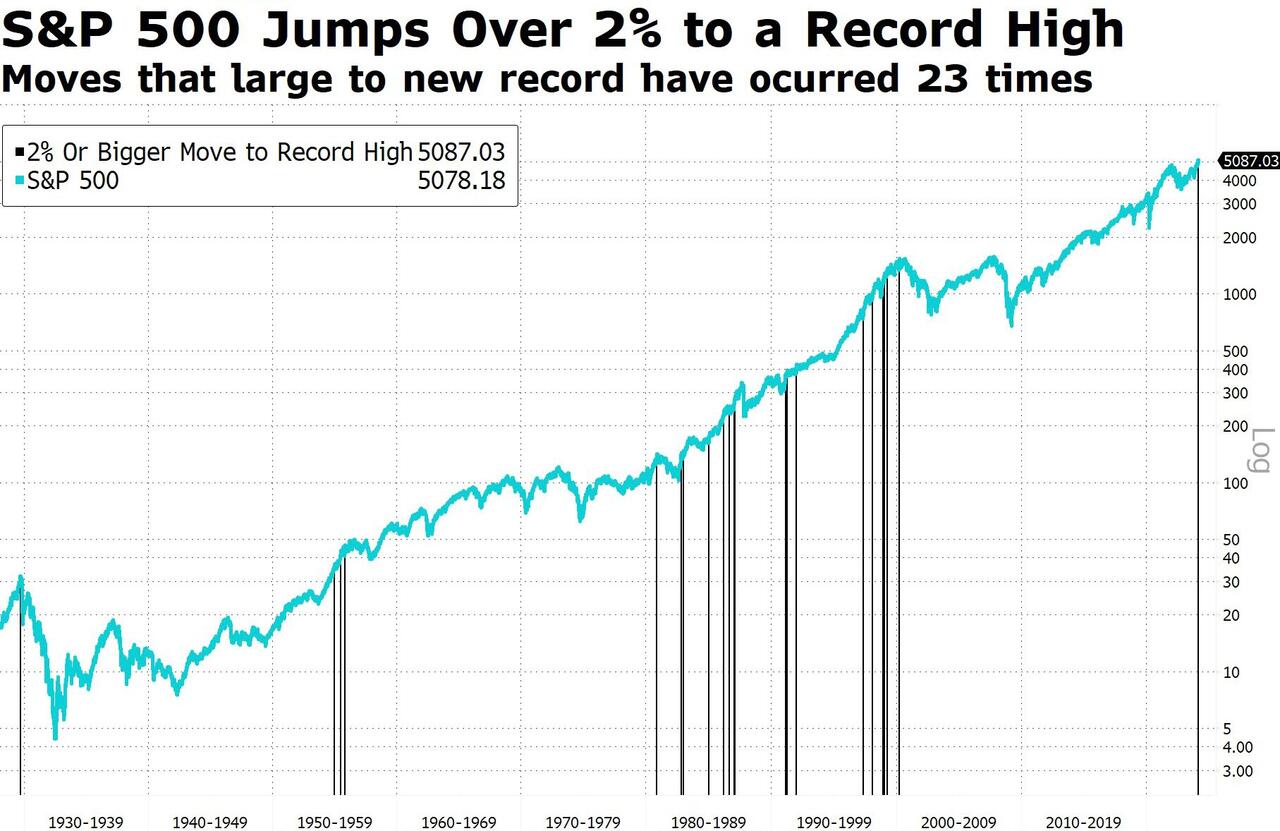
  • Abigail Doolittle on Bloomberg, had a story that “outsized moves into a record” have preceded corrections and tops in the past. The timing certainly varies, but it was an interesting observation and goes back in time. It included periods in 1929, 1980 and 1987, where the timing was reasonably close to large drops. It makes some senses to me, as has the feel of “the last gasp” as bears get pushed in and the last reluctant buyers, decide they cannot wait for a dip. If you have a Bloomberg terminal, you can find the chart with the command G #BTV 6877 . The time horizon on the chart is a bit too big for my tastes, but seems worth at least thinking about.

  • The market performance is very narrow and concentrated. I have used this chart created by a friend, Michael Green of Simplify Asset Management, who is also known as @profplum99 on twitter (or X).  Highly recommended follow.

The argument, with some historical evidence is that as the market returns become more “narrow” – i.e. lower correlations, we are susceptible to pullbacks.

  • Margin debt. Seeing indications that this has accelerated again. In general, it increases over time as the size of the market and the economy and the money investors have grows (all good reasons). It is always unclear if the debt is used to fund short or long positions (typically viewed as being skewed towards leveraged longs). It can grow for extended periods without “triggering” anything. On the other hand, sharp rises in margin borrowing has preceded many severe pullbacks.

  • I do watch TQQQ and SQQQ closely. Triple leveraged ETFs linked to the Nasdaq 100. We have seen big outflows out TQQQ (3x long) since late October. That is “positive” as a contrarian, but the shares outstanding are still higher than prior peaks. The timing of retail, which always seems to surprise professionals, is actually pretty decent. Peak shares outstanding, were at the start of 2023, so these investors caught most of the rally. (If you are keeping score at home, TQQQ is still $21 billion).  SQQQ (3x inverse), had a recent low of shares outstanding back at the end of October. Inflows have picked up again recently (in theory, good for stocks as a contrarian indicator, but the investors in this vehicle have timed things well enough that I’m not sure it is contrarian). SQQQ is only $3 billion. If past trends occur, I think we see ongoing selling of TQQQ to be replaced with purchases of SQQQ. That in itself would create bearish flows, but my real concern is the $60 billion that TQQQ represents (3x leveraged) and the impact that has at the close on positive and negative days, though clearly I’m thinking more about forced selling than I am about the forced buying into the close. Though that certainly helped markets last Thursday.

I would not put on a single trade based on any of these charts or ideas. Collectively, though, they are more interesting. As a bear, they become very interesting.

Bottom Line

I remain bearish on U.S. stocks for many reasons, and nothing I’ve written today, changes that view. For me, it only reinforces that view.

I do like Chinese stocks for a trade, and don’t understand why people want to fight the CCP?

I didn’t even get to mention treasury auctions as a reason to be bearish, but think that too will play a role as we debt and deficit chatter will fill the airways, especially once people get bored of hearing the old (and currently inaccurate) Magnificent 7 narrative.

Tyler Durden
Wed, 02/28/2024 – 08:50

Bitcoin Breaches $60,000; Hits Record High In A Dozen Other Currencies

0
Bitcoin Breaches $60,000; Hits Record High In A Dozen Other Currencies

Bitcoin breached $60,000 for the first time in two years and three months after rising over almost 20% in the last three days…

Source: Bloomberg

The last time Bitcoin traded above $60,000 was on Nov. 12, 2021, when Bitcoin started its reversal, falling over 67% to the macro low of $19,297 at the beginning of April 2022.

Source: Bloomberg

Ethereum has also been on a strong run recently, topping $3300 for the first time since April 2022…

Source: Bloomberg

Additionally, over the past few days, BTC has hit ATH’s price against the Japanese yen, Malaysian ringgit, Indian rupee, Taiwan dollar, South Korean won, Chilean peso, Australian dollar, Chinese yuan, South African rand, Norwegian krone and Turkish lira.

“It’s pretty nuts,” said Ryan Kim, head of derivatives at digital-asset prime brokerage FalconX.

The new BTC ATH against these currencies indicates a declining market value for the fiat currencies.

Crypto shorts are being dragged out with $275 million liquidated in the last three days…

Source: CoinGlass

And crypto funding rates (an indicator of demand for shorting) are going wild…

CoinTelegraph reports that Bitcoin’s price performance can largely be attributed to the market anticipation surrounding the upcoming halving event, which historically leads to increased buying activity, according to Bryan Legend, investor and CEO of Hectic Labs. He told Cointelegraph:

“Investors expect a reduction in supply to drive up prices. This is better known as the ‘Pre-Halving rally’ which contributes to a new bull market with a refreshed bullish sentiment. This is exactly what we are seeing today.”

Yet, according to pseudonymous crypto analyst Rekt Capital, a “pre-halving retracement” could still be on the table. The pseudonymous analyst added that the upcoming Bitcoin halving isn’t priced in by the market, based on historical market data that saw Bitcoin’s major movements occur after previous halvings, not before, Rekt Capital shared in a Feb. 28 X post.

Bitcoin’s bullish momentum comes two days after the spot Bitcoin exchange-traded funds (ETFs) in the United States broke an all-time high of $2.4 billion in daily trading volume on Feb. 26, according to Eric Balchunas, senior ETF analyst at Bloomberg.

Bitcoin ETF Flows. Source: Bloomberg

The nine spot Bitcoin ETFs have recorded combined trading volumes of over $2 billion for the second consecutive day on Feb. 28.

Bitcoin ETF Volumes. Source: Bloomberg

BlackRock’s iShares Bitcoin ETF (IBIT) recorded over 100,000 individual trades on Feb. 27, up from around 30,000 to 60,000 average daily trades, according to an X post by Balchunas.

An estimated 75% of new Bitcoin investments came from the spot Bitcoin ETFs in the United States, according to a Feb. 14 report by on-chain data analytics firm CryptoQuant.

“This reversal is all the more impressive in the light of central banks signaling they intend to keep rates high a while longer, eroding the theory that the next crypto bull would be driven by dropping interest rates,” said Michael Safai, co-founder at quantitative trading firm Dexterity Capital.

As CoinTelegraph reports, Bitcoin’s price rally comes two days after the announcement that Michael Saylor’s MicroStrategy had acquired an additional 3,000 BTC for a total of $155 million at an average price of $51,813 between Feb. 15 and 25. With a total of 193,000 BTC acquired for $6.09 billion at an average price of $31,544, MicroStrategy is the world’s largest Bitcoin holder among publicly traded companies.

According to Mikkel Morch, founder of the digital asset investment fund ARK36, MicroStrategy’s recent purchase is the institutional endorsement mainly fueling this rally. Morch wrote in a research note shared with Cointelegraph:

This rally is not just numbers on a chart; it’s a declaration of the confidence among institutional investors in the transformative potential of cryptocurrencies… Moreover, the green light for Bitcoin-owning ETFs in the United States has injected a fresh wave of optimism, propelling trading volumes and spotlighting crypto-linked firms amidst a broader market fraught with apprehension.”

According to Morch, we could see a new all-time high for both Bitcoin and Ether in the next couple of weeks, driven by the anticipation of the upcoming Bitcoin halving and the potential acceptance of a United States spot Ether ETF.

He wrote:

The anticipation swirling around the approval of spot Ether ETFs further underscores the maturation of the cryptocurrency market. It recognition of Ethereum’s role not just as a digital currency, but as an infrastructure backbone for a future where finance and technology merge more seamlessly.”

Of course, we could always wait for Jim Cramer’s advice as to what will happen next…

The total crypto market capitalization increased by 2.85% in the past 24 hours to $2.19 trillion.

Ethereum is now larger than Exxon Mobil and Bitcoin overtook Meta in market cap.

Tyler Durden
Wed, 02/28/2024 – 08:33

Future Slide As Hawkish Fed Concerns Return

0
Future Slide As Hawkish Fed Concerns Return

US stock futures slumped, pointing to a weak open on Wall Street with both Tech and small-caps underperforming, as traders braced for today’s revised GDP print and tomorrow’s core PCE report which whisper sees coming in hotter than expected and may further push back on expectations for rate cuts.

As of 7:50am, contracts on the Nasdaq 100 drop 0.5%, while S&P 500 futures down 0.4% as European stocks hovered below record high while Asia was dragged lower by Chinawhere regulators are taking steps to shrink the size of a popular quantitative trading strategy “Direct Market Access” that contributed to turmoil in the nation’s stock market this month. Bond yields are lower, and the USD is stronger, while commodities are mixed with base metals higher and energy lower. Bitcoin surged again rising just shy of $60K following record inflows into the Blackrock bitcoin ETF. The macro data focus will be on details surrounding the second estimate of Q4 GDP, as well as the latest inventory data (the more important data kicks off tomorrow with PCE and then Friday’s ISM number). Today’s price action may be more about month-end rebalancing where JPM’s Quant & Derivs Strategy team thinks that we could see stocks lose as much as 1.5% on the rebalance and that rebalancing moves can occur before month-end.

In premarket trading, Nvidia dropped 1.3% in premarket trading, dragging the megacap sector lower. Here are some other notable premarket movers:

  • Ambarella (AMBA) gains 7% after the company projected revenue for the first quarter that topped the average analyst estimate at the midpoint.
  • Array (ARRY) slips 6% following its earnings, which prompted BNP Paribas to downgrade the renewable energy equipment maker and give the stock its only negative analyst rating.
  • Beyond Meat (BYND) soars 61% after it reported fourth-quarter sales that surpassed expectations.
  • Bumble (BMBL) falls 10% after the online dating company issued first-quarter guidance that was weaker than forecast. The company is cutting about one-third of its workforce after a recent executive shakeup.
  • Coupang (CPNG) jumps 8% after South Korea’s largest online retailer reported its fastest revenue growth since 2021.
  • Credo Technology (CRDO) gains 7% after the communications equipment company reported earnings that prompted a price target raise at Cowen, which said the results signal the company is “well past the bottom”

Cryptocurrency-linked stocks gained as Bitcoin advanced for a fifth day, on track for its biggest monthly increased since October 2021. The launch of spot Bitcoin exchange-traded funds in the US in early January has driven a surge in buying, overcoming concerns over slower Fed rate cuts. Bitcoin climbed above $59,000 Wednesday, up almost 40% in the month.

Aside from earnings, attention will be on the latest US GDP print and tomorrow’s inflation numbers and a strong line-up of central bank speakers. Investors are contending with an erosion in expectations for how much the Federal Reserve and European Central Bank will lower rates.

“In December, markets priced sizeable rate cuts in 2024, but what’s happened is we have had slightly problematic inflation prints in most parts of the world,” said Guy Miller, chief market strategist at Zurich Insurance Co. “The US economy has done better than what many people expected, the labor market remains tight and wage gains have been higher than what central bankers are comfortable with.”

Meanwhile, traders have moved to price only 75 basis points of US easing by year-end, in line with what Fed policymakers in December indicated is the likeliest outcome. Treasury yields dipped Wednesday, while a gauge of the dollar strengthened to the highest since Feb. 20.

In Europe, the Stoxx 600 index edged 0.2% lower as investors digested the latest earnings; telecoms and insurance stocks outperforme while personal care stocks are the worst performers, led lower by Reckitt Benckiser, whose sales missed expectations and its shares tumbled 12%, the most since 2008, after the consumer goods company said its sales fell. Tech was also hit after Dutch chip gear firm ASM International slipped as it projected revenue for this quarter that fell far below market expectations.  Here are the biggest movers Wednesday:

  • Glanbia rose as much as 7.2% on the Irish stock exchange, the most in almost a year, after publishing strong full-year results and announcing a share buyback program.
  • Alcon rose as much as 6% after releasing results after the market close on Tuesday that were seen as positive by analysts. Highlights include the Swiss eye-care producer’s above-consensus guidance.
  • UCB shares gained as much as 5.1%, to the highest since May 2022, after the biopharmaceutical company reported earnings for the year that beat analysts’ estimates. Citigroup noted the profit share of its Evenity osteoporosis drug is “under-appreciated.”
  • Reckitt Benckiser shares drop as much as 10%, hitting their lowest level since March 2020, after the household-goods maker reported a surprise fall in like-for-like sales in the final quarter of 2023, missing expectations across the board.
  • St James’s Place plunged as much as 33% after the wealth management firm reported an adjusted pretax loss for the full year, with analysts flagging an ongoing service charge issue and a sharp dividend cut.
  • ASM International declined as much as 6.1% in Amsterdam after the chip equipment maker gave a weaker-than-expected forecast for the current quarter, showcasing the challenge in near-term demand before an expected improvement later this year.
  • Worldline plunged as much as 17% after the French payment processor reported a net loss of €817 million for 2023 due to goodwill impairments. The results and guidance met lowered expectations, yet investors are still cautious.
  • Just Eat Takeaway falls as much as 7.6% in Amsterdam after the food delivery firm issued guidance for 2024 revenue growth which analyst considered cautious.

Earlier in the session, Asian stocks closed lower, dragged by China where the CSI 300 Index dropped as much as 1.3% to touch session low following a report that regulators are taking steps to gradually shrink the size of a popular quantitative trading strategy. Some quantitative funds that manage money for external clients were told to stop accepting new inflows and phase out existing products for “Direct Market Access.” Small-cap indexes fall more: CSI 1000 Index drops as much as 4.5% and CSI 2000 Index -6.8%. Meanwhile,  Hong Kong stocks slumped more than 1% as the city’s budget report failed to impress investors. Chinese stocks fell after a recent rally took gauges to resistance levels, with traders looking to this week’s manufacturing report and a key political meeting in Beijing next week for momentum.  

“This move to deleverage could lead to an extended drop and might be a replay of the slump in January. This is hits across all gauges, as quants usually hold thousands of stocks at once, and the unexpected move leads to a wave of selling,” says Chen Zunde, fund manager ate Guangdong Fund Investment Co.

  • Hang Seng and Shanghai Comp. were pressured amid initial developer-related concerns after a wind-up petition was filed against Country Garden, although the property sector in Hong Kong then recovered after the government announced the cancellation of all demand-side property tightening measures for residential.
  • ASX 200 was indecisive with tech strength offset by weakness in telecoms, consumer stocks and financials, while data showed softer-than-expected monthly CPI in January and a miss on Construction Work Done for Q4.
  • Nikkei 225 lacked conviction but remained above the 39,000 level in the absence of any pertinent catalysts.

In FX, the dollar has benefited from the risk-off mood. The Bloomberg Dollar Spot Index rises 0.2% as the greenback gains versus all its G-10 rivals. The kiwi is the weakest, falling 1.2% versus the dollar after the RBNZ softened its threat of a hike amid signs inflation pressures are waning. Elsewhere, the New Zealand dollar slid more than 1% after the Reserve Bank of New Zealand delivered less hawkish comments on inflation, citing how most measures of price expectations have fallen. Meanwhile, Nigeria’s naira weakened to a fresh low after a much-bigger-than-expected 400 basis point interest rate increase by the central bank on Tuesday failed to support the currency. The naira has been sapped by a local scarcity of dollars and an outstanding backlog of demand for the greenback

In rates, treasury futures hold small gains accumulated during early London session as bunds and gilts advanced, with yields richer by 1bp-2bp across the curve. Weakness in US technology shares pressures S&P 500 futures, further supporting Treasuries. 10-year Treasury yields at 4.29% are ~2bp richer on the day with bunds slightly outperforming and gilts lagging by less than 1bp in the sector; Tuesday’s notable curve-steepening move remains intact with 2s10s and 5s30s trading near top of Tuesday range. IG dollar issuance slate already includes a few names; seven issuers priced $8.5b Tuesday, leaving weekly total already above the $35b expected. Borrowers paid concessions of less than 2bps driven by order books said to be 3.3 times oversubscribed. US session highlights include 4Q GDP revision, and corporate issuance slate is expected to remain busy.

In commodities, oil fell after a two-day gain as signs of higher US inventories vied with expectations that OPEC+ will extend supply cuts. WTI fell 1.1% to trade near $78. Iron ore resumed its slide, as investors remained undecided about the strength of China’s demand for steel ahead of the nation’s usual peak construction season. Spot gold falls 0.2%.

Bitcoin continues to soar and currently holds just shy of the $60k mark less than $10k away from a new all time high, boosted by a record inflow into the IBIT ETF.

Looking at today’s calendar, US economic data includes second estimate of 4Q GDP, January advance goods trade balance and wholesale inventories (8:30am). Fed speakers scheduled include Bostic (12pm), Collins (12:15pm) and Williams (12:45pm).

Market Snapshot

  • S&P 500 futures down 0.4% to 5,071.50
  • STOXX Europe 600 down 0.2% to 495.55
  • MXAP down 0.7% to 172.05
  • MXAPJ down 0.8% to 523.37
  • Nikkei little changed at 39,208.03
  • Topix down 0.1% to 2,674.95
  • Hang Seng Index down 1.5% to 16,536.85
  • Shanghai Composite down 1.9% to 2,957.85
  • Sensex down 0.8% to 72,478.32
  • Australia S&P/ASX 200 little changed at 7,660.42
  • Kospi up 1.0% to 2,652.29
  • German 10Y yield little changed at 2.45%
  • Euro down 0.4% to $1.0803
  • Brent Futures down 0.9% to $82.92/bbl
  • Brent Futures down 0.9% to $82.92/bbl
  • Gold spot down 0.2% to $2,025.50
  • U.S. Dollar Index up 0.35% to 104.20

Top Overnight News

  • European stocks struggled for traction and US futures slipped as traders brace for a slew of economic data in the second half of the week that will help determine the path of monetary policy.
  • Goldman Sachs Group Inc. Chief Executive Officer David Solomon said softer spending by consumers calls into question expectations that the US economy will avoid a recession.
  • US President Joe Biden and Republican frontrunner Donald Trump both cruised to victory in their party’s Michigan primary elections Tuesday, with results for the two candidates indicating discontent among Democrats and Republicans for the likely nominees.
  • Bond traders no longer expect the Federal Reserve to lower interest rates by more than 75 basis points this year, bringing their view in line with what Fed policy makers have indicated is the likeliest outcome.
  • Europe’s biggest asset manager is joining a chorus of investors who are turning bearish on Switzerland’s franc after slowing inflation has eliminated the need for the central bank to prop up the currency.
  • Chinese regulators are taking steps to gradually shrink the size of a popular quantitative trading strategy that contributed to turmoil in the nation’s stock market this month, according to people familiar with the matter.

Earnings

  • Baidu Inc (BIDU) Q4 2023 (USD): EPS 3.08 (exp. 2.48), Revenue 4.92bln (exp. 4.86bln) Shares -1.2% in pre-market trade
  • eBay Inc (EBAY) – Q4 2023 (USD): Adj. EPS 1.07 (exp. 1.03), Revenue 2.56bln (exp. 2.51bln); authorised additional 2bln share repurchase programme and raises quarterly cash dividend 8% to 0.27/shr. Shares +3.2% in pre-market trade
  • Beyond Meat (BYND) Q4 2023 (USD): Revenue 73.7mln (exp. 66.8mln), Adj. EBITDA loss 125mln (exp. loss 47mln); FY revenue view 315-345mln (exp. 344mln) Shares +55% in pre-market trade
  • ASM International (ASM NA) – Q4 (EUR): Normalised Net 100mln (exp. 137mln, prev. 142mln Y/Y), Normalised Op. 141mln (prev. 190mln Y/Y), Revenue 633mln (exp. 647mln, prev. 725mln Y/Y), Launches 150mln share buyback. Raises dividend to 2.75/shr (prev. 2.50/shr). Guides Q1 Revenue 600-640mln. (Newswires) Shares -3.7% in European trade / peer Nvidia (-1.2% pre-market) lags
  • Reckitt (RKT LN) – Q4 (GBP): LFL Sales -1.2% (exp. 1.75%), FY LFL Sales +3.5% (exp. 4.15%), Revenue 3.56bln (exp. 3.6bln). Sees 2024 capital expenditure to be 3-3.5% of Net Revenue. Sees 2024 adj. operating profit to grow ahead of net revenue growth. Shares -10.1% in European trade

A more detailed look at global markets courtesy of Newsquawk

APAC stocks traded cautiously and followed suit to the rangebound performance seen on Wall St where stocks largely ignored weak US data ahead of key events, while the region also digested a couple of data releases and the RBNZ policy announcement. ASX 200 was indecisive with tech strength offset by weakness in telecoms, consumer stocks and financials, while data showed softer-than-expected monthly CPI in January and a miss on Construction Work Done for Q4. Nikkei 225 lacked conviction but remained above the 39,000 level in the absence of any pertinent catalysts. Hang Seng and Shanghai Comp. were pressured amid initial developer-related concerns after a wind-up petition was filed against Country Garden, although the property sector in Hong Kong then recovered after the government announced the cancellation of all demand-side property tightening measures for residential.

Top Asian News

  • Hong Kong Financial Secretary Chan said in the budget address that momentum for economic recovery needs to be improved amid global challenges. Chan announced the government is to cancel all demand-side property tightening measures for residential and noted there is room to further adjust measures for the property market, while it will waive stamp duties payable on transfer of REIT units.
  • HKMA said the maximum loan-to-value ratios will be adjusted to 70% for self-occupation residential properties valued at HKD 30mln or less, while the maximum LTV ratio will be adjusted from 50% to 60% for non-self-use residential properties.
  • RBNZ kept the OCR unchanged at 5.50% as expected, while it slightly lowered its OCR projections and said the OCR needs to remain at a restrictive level for a sustained period. The committee remains confident that the current level of the OCR is restricting demand but also noted that headline inflation remains above the 1%-3% target band, limiting the committee’s ability to tolerate upside inflation surprises. Furthermore, the RBNZ reduced its OCR forecast with the June 2024 view lowered to 5.59% from 5.67% and the March 2025 view lowered to 5.47% from 5.56%.
  • RBNZ Governor Orr said during the press conference Q&A that they did discuss a hike in rates and there was strong consensus that the current level of rates was sufficient, while he added that many variables have given them confidence that policy is working and noted that underlying inflation is still a concern, but headline inflation is easing.
  • China reportedly tells quants to phase out Direct Market Access (DMA) products blamed for turmoil, according to Bloomberg sources; Chinese markets extended losses following this news.
  • PBoC governor and Shanghai party chief held a seminar on Tuesday; PBoC supports Shanghai’s high-level opening up financially

European bourses, (Stoxx600 -0.1%), are mixed, but with clear underperformance in the AEX (-0.7%), after poor results from chip-maker ASM International (-3.8%). European sectors hold a negative tilt; Optimised Personal Care Drug and Grocery is dragged down by Reckitt (-8.9%) post-earnings, whilst Mercedes-Benz (+1.7%) drives Autos higher. US Equity Futures (ES -0.5%, NQ -0.9%, RTY -0.8%) are entirely in the red, paring back most of the gains seen in the prior session, with underperformance in the NQ hampered by Nvidia (-1.9% pre-market).

Top European News

  • ECB’s de Guindos says recent inflation outlook has been very positive and prices will continue to decline; we need to be sure that prices will move towards our 2% target

FX

  • USD is making gains vs. all peers with January PCE data tomorrow expected to come in hot. DXY has reclaimed 104 status and taken out its 100, 10 and 21DMAs as well as a cluster of highs from last week. Current high today at 104.24.
  • EUR is hampered by the broadly firmer USD with EUR/USD oscillating around the 1.08 mark after taking out yesterday’s low of 1.0812.
  • GBP is dragged lower by the USD after yesterday’s failure to test 1.27 to the upside. Session low currently sits at 1.2622 with the 22nd Feb low at 1.2612.
  • USD/JPY remains arguably the most important pair to watch after printing a high of 150.79 with the YTD peak just above at 150.88. The further the pair climbs, the more likely is jawboning from Japanese officials and speculation over intervention.
  • NZD is the standout laggard across the majors as the RBNZ stood pat on rates vs. a 30% chance of a hike accompanied by dovish tweaks to the OCR projections. NZD/USD has erased all of last week’s gains and slipped below the 0.61 mark with the next downside support via its 100DMA at 0.6091. AUD lower in sympathy as well as the region’s soft inflation metrics overnight.
  • PBoC set USD/CNY mid-point at 7.1075 vs exp. 7.2023 (prev. 7.1057).

Fixed Income

  • USTs are marginally firmer with specifics light and perhaps some follow-through from the dovish RBNZ OCR projections in the absence of other drivers. Action which comes after Tuesday’s bear-steepening.
  • Bunds are modestly firmer with specifics light and the focus once again on supply. Bunds are eking out marginal new highs of 132.41 seemingly as US equity futures deteriorate further, but ultimately remains comfortably within yesterday’s 132.02-71 range.
  • Gilt price action is similar to that seen in EGBs with Gilts also able to eke out some very marginal gains but well within Tuesday’s 97.22-98.15 bounds; a UK outing produced a wide 2.2bps tail, resulting in modest pressure in Gilts.
  • UK sells GBP 4.0bln 4.00% 2031 Gilt: b/c 3.0x, average yield 4.085%, tail 2.2bps.
  • Italy sells EUR 8.25bln vs exp. EUR 7.50-8.25bln 3.35% 2029 & 3.85% 2034 BTP and EUR 1.5bln vs exp. EUR 1.00-1.50bln 2031 CCTeu.
  • Orders for Italy’s new 6yr BTP Valore retail bond reaches 12bln since the start of the odder, according to bourse data cited by Reuters

Commodities

  • A downbeat session for the broader crude complex in what is seemingly a function of a firmer Dollar and a subdued risk tone. Brent May futures have slipped below USD 82.00/bbl.
  • The firmer Dollar exerts broader pressure on precious metals, although losses are capped ahead of key US data alongside a number of Fed speakers; XAU approaches USD 2,025/oz to the downside after falling under its 50 DMA at 2,032.15/oz.
  • Base metals are softer across the board amid the aforementioned pressure from the stronger Greenback, whilst Chinese markets overnight continued to tumble despite intervention from regulators.
  • US Private Energy Inventory (bbls): Crude +8.4mln (exp. +2.7mln), Cushing +1.8mln, Gasoline -3.3mln (exp. -1.5mln), Distillate -0.5mln (exp. -2.1mln)
  • Trafigura Chief Economist says oil market talk has shifted to upside risk; oil spreads show a relatively tight market, via Bloomberg TV.
  • Citi upgrades 0-3m Palladium price targe price forecast to USD 1200/oz (prev. 950/oz) on the prospect of imminent supply cuts; bounce would present a tactical opportunity for spec selling and producer hedging; sees structural long-term downtrend.

Geopolitics: Middle East

  • US Central Command said a US aircraft and a coalition warship shot down five Houthi one-way attack unmanned aerial vehicles in the Red Sea on Tuesday, according to Reuters.
  • “Israeli sources: The Israeli delegation returned from Doha after two days of negotiations on the detainee deal without progress”, according to Sky News Arabia

Geopolitics: Other

  • China’s Vice Foreign Minister Sun Weidong conducted consultations in Moscow where he met with his counterpart and the Russian Foreign Minister, while he stated that China supports Russia’s BRICS presidency and stands ready to continuously strengthen strategic coordination between both sides in international multilateral platforms. Furthermore, Sun said both sides should strengthen communication and coordination in Asia-Pacific affairs, as well as jointly safeguard regional security and stability.
  • South Korea and the US are to conduct annual military drills from March 4th-14th.

US Event Calendar

  • 07:00: Feb. MBA Mortgage Applications -5.6, prior -10.6%
  • 08:30: 4Q GDP Annualized QoQ, est. 3.3%, prior 3.3%
    • 4Q Personal Consumption, est. 2.7%, prior 2.8%
    • 4Q GDP Price Index, est. 1.5%, prior 1.5%
    • 4Q Core PCE Price Index QoQ, est. 2.0%, prior 2.0%
  • 08:30: Jan. Retail Inventories MoM, est. 0.4%, prior 0.8%
    • Jan. Wholesale Inventories MoM, est. 0.2%, prior 0.4%
  • 08:30: Jan. Advance Goods Trade Balance, est. -$88.5b, prior -$88.5b, revised -$87.9b

Central Bank Speakers

  • 12:00: Fed’s Bostic Participates in Fireside Chat
  • 12:15: Fed’s Collins Gives Remarks, Fireside Chat
  • 12:45: Fed’s Williams Delivers Keynote Remarks

DB’s Jim Reid concludes the overnight wrap

Henry is on duty tomorrow but given it will be a leap day I wanted to wish all those EMR readers who were born on February 29th a very happy birthday for tomorrow! The last time it fell on a workday was in 2016 so make sure your workmates shower you with 8 years’ worth of gifts.

The week so far has been a bit of a crawl and not the leaps of last week as we await the all important core PCE print tomorrow. Yesterday saw equities post marginal gains (S&P 500 +0.17%), with bond yields edging up across the globe. Despite the subdued tone in markets, there’ve been some important headlines on the political side overnight, as former President Donald Trump seems to be on track to record another primary victory in Michigan. Current estimates are pointing to a big winning margin for Trump (68%) against Nikki Haley (26.8%) with 70% of the vote in, and that comes ahead of Super Tuesday next week, when 15 states will be holding votes on the Republican side. So if Trump is able to keep winning those contests, then he’ll soon have a very substantial delegate lead on the way to the nomination.

Overnight, the Reserve Bank of New Zealand held its official cash rate (OCR) unchanged at 5.5% – a 15-year high but on a day where there was a small chance of a hike delivered a relatively dovish stance. The central bank in its statement highlighted that “core inflation and most measures of inflation expectations have declined and the risks to the inflation outlook have become more balanced”. Following the decision, t he kiwi (-0.94%) is trading at $0.6113, after being one of the best performers in the last month with some hiking probabilities priced in. Bonds rallied with yields on the 10yr government bonds dropping -9.2bps to trade at 4.71% as we go to print.

Asian equity markets are slightly lower as I type with the Nikkei (-0.10%), Hang Seng (-0.27%), CSI (-0.30%) and the Shanghai Composite (-0.67%) declining. Shares of embattled developer Country Garden fell more than -12.0% after it received a liquidation petition in a Hong Kong court over its inability to repay a HK$1.6 billion ($204 million) loan and complicating its debt revamp prospects. On the flip side the HK budget is ongoing and restrictions on the property market have been lifted and boosts to tourism have been announced. Elsewhere, the KOSPI is nearly +1.0% higher this morning after two days of declines. US equity futures are just below flat with yields on 10yr USTs down -0.98bps, standing at 4.29%.

In early morning data, Australia’s CPI unexpectedly remained steady at +3.4% y/y in January (v/s +3.6% expected). YoY Core-CPI was +4.1% in January down from the +4.2% increase seen in December.

When it came to yesterday, the main story was more that there wasn’t much of a story, with little movement across the major asset classes. Among equities, there were some modest movements, with the S&P 500 (+0.17%) closing just below its all-time high, having basically been in a narrow band since the Nvidia results last week. Currently it’s down -0.21% for the week, meaning it still needs to recover a bit in order to achieve a joint record of 16 weekly advances in the last 18 (currently on 15/17 for first time since 1989). Small-cap stocks continued to outperform, with the Russell 2000 up +1.34%, in contrast to the Dow Jones, which was down -0.25%. Tech stocks saw a marginal outperformance, with the NASDAQ up +0.37% and Magnificent 7 up +0.22%. It shows the signs of the times that Apple yesterday announced the closure of its electric car unit which it set up in 2014 that at one point promised autonomous driving within a reasonable timeframe. The fact that they did this partly to divert resources to AI shows how trends can change.

Over in Europe the aggregate equity move was very similar, with the STOXX 600 up +0.18%, whilst the DAX (+0.76%) posted a 5th consecutive gain to reach a fresh all-time high.

On the rates side, Treasuries saw a mild sell off despite a fairly well digested 7yr auction. By the close, the 10yr Treasury yield was up +2.4bps to 4.30%. That said, there were some interesting trends on inflation expectations, which have continued to move higher over recent days. For instance, while the nominal 2yr yield was down -2.6bps, the 2yr breakeven was up a further +3.6bps to 2.75%, which is its highest level since March last year. Bear in mind that the 2yr breakeven began the year at 2.02%, so we’ve seen a pretty substantial move in just two months, which goes some way to explain why investors now don’t expect the rapid rate cuts that were priced at the start of the year. The amount of Fed cuts priced in 2024 inched down to 77bps, so now essentially in line with the 75bps of cuts penciled in by the median FOMC dot back in December. Patience on rates cuts continued to be visible in the latest Fed comments, with Fed Governor Bowman (hawk) noting that the latest inflation data “suggest slower progress in bringing inflation down toward our 2 percent target”.

Over in Europe, gilts saw some of the largest moves, which followed comments from BoE Deputy Governor Ramsden that “key indicators of inflation persistence remain elevated”. So 2 yr gilt yields were up +4.0bps to 4.33%, and 10yr gilt yields ended the session up +3.4bps at 4.19%, which is their highest level since late November. Elsewhere in Europe there was a similar pattern, with yields on 10yr bunds (+2.5bps) also hitting their highest level since November, at 2.46%.

Elsewhere yesterday, there was a mixed tone from the latest US data. On the negative side, the Conference Board’s latest consumer confidence reading for February was down to 106.7 (vs. 115.0 expected), which is the first decline in four months. Moreover, the preliminary durable goods orders for January were down -6.1% (vs. -5.0% expected). Core capital goods orders were in line at +0.1%, but with the previous month revised down by four-tenths. That said, it wasn’t all bad news, with core capital goods shipments up +0.8% (vs. +0.1% exp) in January and the Richmond Fed’s manufacturing index up to -5 in February (vs. -9 expected), ending a run of 4 consecutive monthly declines. The stronger shipments data saw the Atlanta Fed’s GDPNow model marginally upgrade its estimate for Q1 growth to an annualised 3.25%. If realised, that would be a third consecutive quarter with growth above 3%.

To the day ahead now, and data releases include the second estimate of US GDP in Q4, along with the European Commission’s economic sentiment indicator for the Euro Area in February. From central banks, we’ll hear from the Fed’s Bostic, Collins and Williams, the ECB’s Muller and the BoE’s Mann.


Tyler Durden
Wed, 02/28/2024 – 08:16

“All Weapons Safe”: Wildfire Temporarily Suspends Operations At Texas Nuclear Bomb Plant

0
“All Weapons Safe”: Wildfire Temporarily Suspends Operations At Texas Nuclear Bomb Plant

A wildfire in the Texas Panhandle exploded in size on Tuesday, forcing the temporary shutdown of a nuclear weapons plant.

The Smokehouse Creek Fire, burning between Canadian and Stinnett, exploded in size from 40,000 to 200,000 acres in a matter of hours on Tuesday. This prompted Republican Gov. Greg Abbott to issue a disaster declaration for 60 counties.

“Hot and dry conditions caused by high temperatures and windy conditions are expected to continue in the region in the coming days,” Abbott said in a statement. “These conditions could increase the potential for these wildfires to grow larger and more dangerous.”

According to a post on X, Pantex Plant, the nation’s top nuclear weapons assembly and disassembly plant, about 17 miles northeast of Amarillo, canceled plant operations “until further notice” on Tuesday evening, adding, “All weapons and special materials are safe and unaffected.” 

“The fire near Pantex is not contained. Response efforts have shifted to evacuations. There is a small number of non-essential personnel sheltered on-site,” Pantex said late Tuesday night. 

By Wednesday morning, the plant said: “The Pantex Plant is open for normal day shift operations for Wednesday, February 28; all personnel are to report for duty according to their assigned schedule.” 

Pantex has been the US’s main assembly and disassembly site for nukes since the mid-1970s. It assembled the last new bomb in 1991 while dismantling thousands. 

Close call… 

Tyler Durden
Wed, 02/28/2024 – 07:45

Europe’s Record Rally Leaves Behind Riskier Firms

0
Europe’s Record Rally Leaves Behind Riskier Firms

By Michael Msika, Bloomberg Markets Live reporter and strategist

Investors are piling up bets into the largest stocks by market value but also into the ones with the strongest balance sheets, while leaving more risky companies behind.

The broadening of the rally to other parts of the market doesn’t look like it’s coming just yet. Caution is the name of the game when it comes to corporate fundamentals, with the quality factor leading returns on a long-short basis over the past three months, and the trend extending further in February.

Investors have turned increasingly bullish about European stocks, with their optimism driving the European benchmark to a record high last week. Even so, a Goldman Sachs basket of companies with weaker balance sheets has been underperforming peers with stronger ones at a pace not seen since mid-2022 — a period when US rates went from 1% to more than 3% in about three months.

“These baskets are heavily influenced by interest rates given their sensitivity to rising cost of debt,” say Goldman strategists including Guillaume Jaisson, keeping an underweight on these companies. They add that cost of debt isn’t a problem for the overall market given balance sheets are not stretched overall.

Jaisson notes that some constituents of the basket like BAT, Fresenius, GN Store Nord, Siemens Healthineers and Stora Enso committed to reducing debt during the last earnings season, implying less focus on capex or shareholders’ returns. Meanwhile, Bayer even announced it will cut dividends by 95% to focus on its balance sheet, and others such as Atos have been under pressure following refinancing difficulties.

We think these companies will remain constrained now that they need to operate in a higher interest rate environment and especially if we see yields move higher,” they say. The caveat is that a pick-up in activity, combined with rate cuts from the major central banks, could create a rotation out of momentum trades and into cyclical assets such as weak balance sheets and small caps.

In the meantime, investors are being selective, widening the gap between what is seen as the healthier sections of the market. In terms of performance themes, the market is back to the things that worked well for most part of the rally, as mega cap, tech and pricing power stocks are performing well.

Sentiment toward riskier parts of the market, which briefly seemed to play catch up and stoked concern about potential “buy everything exuberance,” is once again sobering up and deflating the notion of too much risk is being deployed.

Yet, while sharing a similar view to Goldman’s Jaisson about the continued outperformance of cash-rich companies versus stocks with high refinancing costs, JPMorgan strategists led by Mislav Matejka are more pessimistic about the overall direction of equities. They see some downside ahead, especially as key drivers of resilient corporate profitability are likely to turn weaker.

“In aggregate, and despite a few notable exceptions, corporate profit margins are elevated in a historical context, and appear to be peaking,” they say. Corporates managed to lock in low financing costs ahead of rate hikes but this will normalize over time, as will productivity gains and the currently strong pricing power.

“The historical pattern where profit margins always start to move lower ahead of the next economic downturn is clear,” they say.

Tyler Durden
Wed, 02/28/2024 – 05:45

NATO’s Debate Over Direct Military Intervention In Ukraine Shows Its Desperation

0
NATO’s Debate Over Direct Military Intervention In Ukraine Shows Its Desperation

Authored by Andrew Korybko’s via Substack, 

French President Macron hosted over 20 fellow European leaders in Paris on Monday to discuss their next moves in Ukraine, including the possibility of a conventional NATO intervention, which he said they hadn’t ruled out for reasons of “strategic ambiguity” despite not reaching a consensus on this. His Polish counterpart Duda also confirmed that this subject was the most heated part of their discussions. The very fact that this scenario is being officially considered shows how desperate NATO has become.

Russia’s victory in Avdeevka, which was the natural result of it winning the “race of logistics”/“war of attrition” with NATO, prompted policymakers to contemplate what they’ll do in the event that it achieves a breakthrough across the Line of Contact (LOC) and starts steamrolling through the rest of Ukraine. They hadn’t previously considered this to be a serious possibility until last summer’s failed counteroffensive exposed the weakness of their military-industrial complex and tactical-strategic planning.

Via Reuters

It’s now a credible scenario that’s reviving speculation about a Polish-led intervention aimed at drawing a red line in the sand for halting any potential Russian breakthrough before it gets too far. This would preserve the G7’s “sphere of (economic) influence” in Ukraine while preventing that former Soviet Republic’s collapse and thus averting another Afghan-like foreign policy disaster for the West. The problem, however, is that Poland also doesn’t want to be put up to this only to be hung out to dry.

Although Poland has comprehensively subordinated itself to Germany after the return of Berlin-backed Prime Minister Tusk to power late last year and envisages carving out its own “sphere of influence” in Western Ukraine, this doesn’t mean that it wants to lead a Western intervention there. The risk of World War III breaking out with Russia by miscalculation is much too high and Poland might fear that NATO won’t activate Article 5 if it clashes with Russia inside Ukraine in order to prevent that from happening.

These concerns could explain why there wasn’t any consensus during Monday’s meeting on this issue since other members wisely won’t want to take the chance of catalyzing an apocalyptic scenario, ergo the reason why the West might be plotting a false flag in Poland to blame on Russia and Belarus. President Lukashenko warned about that in late February, and if it comes to pass, then it could serve as the trigger for pushing Poland into leading a Western intervention in Ukraine without full NATO backing.

Warsaw could be misled to believe without any written guarantees that it has the bloc’s support and Article 5 would be activated if its forces clash with Russia’s there, but only to be hung out to dry if that happens so as to stave off World War III by miscalculation for the greater good. Nevertheless, it would still serve the purpose of drawing a red line in the sand that could halt Russia’s advance since NATO might escalate via brinksmanship afterwards by promising to activate Article 5 if the clashes continue.

Poland would also be left to pick up the tab in that event by having to pay the financial and physical costs of this de facto NATO intervention, thus representing an amoral form of “burden-sharing” that would fall solely on its taxpayers instead of the rest of the bloc’s. The farmers’ protests that are rocking that country right now could lead to a full-blown rebellion if that happens since others could join in, however, which the ruling liberal-globalists would prefer not to unfold since they fear that they’d risk losing power.

That’s why they’re reluctant to lead a Western intervention in Ukraine since there’s a high chance that it’ll backfire on them in particular and Poland’s national interests in general despite being to the benefit of Western hegemony as a whole. Whatever ends up happening, the takeaway from Monday’s meeting in Paris and the details that were revealed about their discussions is that NATO is planning for a possible Russian breakthrough across the LOC later this year but isn’t yet sure how to react if that happens.

Poland could either be pushed to preempt that voluntarily or after being manipulated by the false flag that President Lukashenko warned last week is being plotted, with the second option also potentially being employed right after any breakthrough. If this occurs before NATO’s “Steadfast Defender 2024” drills wrap up in June, then those of the bloc’s forces that are presently training in Poland for its largest continental exercises since the Old Cold War could play a pivotal support role or possibly join in as well.

Should a breakthrough occur after those war games end as part of the Russian offensive that Zelensky claimed is being planned for as early as May, however, then Poland probably couldn’t count on as much NATO support and would likely be pressured to go it alone (at least at first) with only vague promises. Another possibility is that the exercises are extended, whether in whole or in part, including through the semi-permanent stationing of some other NATO forces like Germany’s there until the offensive ends.

That might give Poland enough reassurance to take a leap of faith in plunging head-first into Ukraine with the expectation that the rest of NATO will follow even if they purposely lag behind in order to avoid World War III with Russia by miscalculation as was previously explained. It remains to be seen what’ll happen, but as Macron himself said, “we will do everything needed so Russia cannot win the war” and this therefore means that NATO will certainly intervene to some extent if Russia breaks through the LOC.

The bloc can’t afford another Afghan-like disaster, let alone on European soil in the most geostrategically significant conflict since World War II, which is why it won’t sit idly on the sidelines as Ukraine collapses if there’s a credible chance of that happening and Russia steamrolling through the ruins. The only reason why they’re now planning for this is because Russia’s victory in the “race of logistics”/“war of logistics” makes it conceivable sometime later this year, though it of course can’t be taken for granted either.

Tyler Durden
Wed, 02/28/2024 – 05:00

EU Considers Banning Repairs On ICE Vehicles More Than 15 Years Old

0
EU Considers Banning Repairs On ICE Vehicles More Than 15 Years Old

Just when you thought the EV lunacy had reached so much of a peak that obvious industry backlash was taking place, think again: because the European Commission is here to prove you otherwise.

And how do they plan on doing that? According to Wheels Alive, a UK automobile publication, the EU is considering banning repairs on vehicles that are more than 15 years old. 

The proposed measure, put forward by the European Commission and pending ratification, seeks to gradually eliminate older, high-emission vehicles to promote the adoption of greener alternatives. This pending legislation, which requires the green light from both the European Parliament and the Council, introduces the concept of a ‘residual vehicle’.

Just for perspective, this means vehicles that were manufactured in 2009 or before wouldn’t be considered for major repairs. 

The EU’s ‘Fit for 55’ initiative aims for a 55% cut in transport emissions by 2030 from 1990 levels and zero direct emissions by 2050, including a 2035 ban on new combustion engine vehicles, with exceptions for future synthetic fuels.

This is what a car built 15 years ago looks like.

Despite these goals, the adoption of low or zero-emission vehicles across the EU is uneven, with some countries like Spain seeing average vehicle ages over 14 years, and over 47% of vehicles older than 15 years, reflecting a broader trend across Europe.

The European Commission proposes to tackle this by targeting the longevity of cars, introducing draft regulations to redefine waste management for end-of-life vehicles to encourage recycling and a circular economy.

Despite concerns, the regulation aims to identify vehicles beyond repair due to significant damage or when repair costs exceed market value, without barring necessary repairs or replacements for standard cars.

This has sparked debate regarding its effect on the automotive repair industry and the fate of classic cars, underlining the complexities of balancing environmental goals with economic and cultural considerations.

Hilariously enough, the EU didn’t provide information on where the average person is supposed to get the funds to just ‘throw away’ their old vehicle and start over with a brand new one. And with the non-stop printing of cash worldwide and inflation running rampant, it’s more difficult than ever to do so.

Could this be another step in the ‘you’ll own nothing and like it’ playbook?

Jeez. Just when you thought the globalists couldn’t micromanage a single industry or tell you what you can and can’t own any further…

Tyler Durden
Wed, 02/28/2024 – 04:15

White Supremacy Goes Back To “Early Church”: Oxford Professor

0
White Supremacy Goes Back To “Early Church”: Oxford Professor

By Micaiah Bilger of The College Fix

White supremacy remains so prevalent in Christianity today because it took root in the early church, theologian Anthony Reddie told a Baylor University conference this month.

Reddie, a professor of black theology at Oxford University in England, said in his Feb. 15 speech that white supremacy has “distorted” Christianity since the time of Jesus Christ, according to Baptist News Global.

The conference, hosted by Baylor’s Truett Seminary, focused on racism in the world church.

“The most egregious thing that we have to wrestle with is the normalization of white supremacy,” Reddie said.

Although Christianity “was created as a movement for those who are marginalized and oppressed,” he said white leaders quickly began using the religion as a weapon to seize land and oppress other cultures.

Reddie traced the distortion back to the early Christians who blamed the Jews for killing Jesus, instead of Roman leader Pontius Pilate, according to the report.

“Pilate represents white supremacy, and white supremacy now becomes normalized and effectively becomes the religion of Jesus, the religion of God,” the professor said.

As time went on, more and more people began to believe Jesus was a white European, like them, Reddie said.

Baptist News Global reports:

That’s why few white Christians flinched at the claim that Jesus called European and American Christians to travel the globe to oppress brown- and Black-skinned people, he said, explaining that a Christianity suffused with white supremacy enabled plantation owners in the American South to see no contradiction between their faith and owning other human beings. “They saw people who are other as inferior and that it was OK to kill or enslave them for their own good.”

Those attitudes clearly continue to exist and in the U.S. are evident in the rise of Trumpism, the British scholar said.

Because white supremacy has been connected with Christianity for so long, he said it has “distorted the very fabric of what we call Christianity and the nature of church.”

The Baylor conference is part of a “three-year sequences of programs on confronting racism in the white church and seeking God’s justice,” according to the event website. More than a dozen pastors, theologians, and Christian leaders participated. Baylor is a private, Protestant Christian university in Texas.

Last year, a Catholic university professor also linked white supremacy with the early Christian church in a new book, “Christian Supremacy.” The author, Fordham University Professor Magda Teter, told the Jewish Telegraphic Agency that white supremacists’ ideology “is rooted in Christian ideas of social and religious hierarchy.”

Tyler Durden
Wed, 02/28/2024 – 03:30

Polish Truckers To Rejoin Farmers In Border Crossing Blockades

0
Polish Truckers To Rejoin Farmers In Border Crossing Blockades

By Salon24.PL via Remix News

Polish truckers are to resume their border blockade protest on March 1 after having previously suspended their protest actions at the turn of the year. Truckers are demonstrating once again because they are not satisfied with what has been done to stop Ukrainian trucking companies from creating unfair competition in the Polish transport market. 

The ongoing farmer protests are also about trade relations with Ukraine, with the farmers protesting about the European Commission’s decision to extend the trade agreement with Ukraine, allowing Ukrainian agricultural products to flow into the EU despite these products failing to adhere to EU standards.

Farmers are also up in arms about EU climate policies, which affect energy costs and livestock farming. On Tuesday, Feb. 27, the farmers are to stage a mass protest in Poland’s capital city of Warsaw.  

The truckers action on March 1 will mark the resumption of action which began on Nov. 6. They had been promised government action to tighten controls on Ukrainian haulage firms, but these promises have not been kept. The truckers are demanding the reintroduction of licensing for Ukrainian truckers.

Former Polish Conservative (PiS) Prime Minister Mateusz Morawiecki took to X on Monday to support the protesting farmers. He called on the government to introduce an embargo on Ukrainian agricultural products

For more details please see Remix.news

Tyler Durden
Wed, 02/28/2024 – 02:45