On Thursday, Portland Public Schools (PPS) were sued by an education advocacy group over claims that the school district’s push for diversity in disciplinary actions constitutes a violation of civil rights.
As reported by the Daily Caller, the watchdog group Parents Defending Education (PDE) accuses PPS of violating the Equal Protection Clause of the 14th Amendment, as well as other civil rights law, with its “Student Support and Discipline” policy. The policy forces teachers and staff members to address “disruptive student behavior” by taking into account the offending student’s identity, including race, gender, and sexual preference, before handing out punishment, if any. In addition, the policy orders the district to assign teachers based on race and gender.
The policy clearly states that staff members “must take into consideration the impact of issues related to the student’s trauma, race, gender identity/presentation, sexual orientation, disability, social emotional learning, and restorative justice as appropriate for the student.”
The district is forbidden from transferring a teacher from one school to another if it would ultimately “decrease the building’s percentage of under-represented male or female or transgender/nonbinary/gender non-conforming professional educators to less than thirty percent,” or if it would otherwise “decrease the building’s percentage of minority teachers to less than the student minority percentage in the building or below the percentage of minority professional educators in the District.”
“Portland Public Schools has enacted several concerning policies that treat students and educators differently based on race and gender identity,” PDE states in its lawsuit.
“For instance, Portland Public Schools is disciplining some students and not others, solely based on immutable characteristics.”
In addition to the disciplinary policy, the district also requires all of its schools to hire a “School Climate Team,” which runs “ongoing training in implicit bias, antiracism and culturally responsive practices.”
PDE’s lawsuit comes in an environment where many legal actions are being taken against school districts across the country in the wake of Students for Fair Admissions v. Harvard, a landmark decision by the Supreme Court last year. In the case, along with the concurrent Students for Fair Admissions v. University of North Carolina, the court ruled that the practice of affirmative action – accepting student applications and other hiring decisions based solely on racial identity – was unconstitutional, and ordered it banned at a national level in universities and colleges across the country.
Although the Supreme Court kept its focus to higher education, many lawsuits and other complaints have cited this decision as a basis for similar actions against lower school districts and other entities which similarly discriminate based on race, gender, and other arbitrary identities.
China Suspends Quant Fund For Dumping $350 Million Shares In 1 Minute
To appreciate how “sensitive” Beijing has become to any sharp and/or continued selling of Chinese stocks, now that public sentiment is adversely impacted by China’s relentless rout, look no further than major quant fund Lingjun Investment, which on Tuesday was suspended for three days amid broader regulatory efforts to revive market confidence. The fund’s transgression: it broke rules on orderly trading. Or, stated simply, at a time when it’s no secret that selling of Chinese stocks is frowned upon, Lingjun took it to the next level when the fund dumped a combined 2.57 billion yuan ($357.4 million) in A-shares in a minute between 9:30 a.m. and 9:31 a.m. on Monday, the Shanghai and Shenzhen bourses revealed in identical statements on Tuesday, and said they would strengthen monitoring and analysis of quantitative, especially high-frequency trading. Such trading “has obvious advantages over small investors in terms of technology, information and speed” and could at times contribute to market volatility, the exchanges said.
The orders from Lingjun to dump stocks in early trade on Monday coincided with rapid declines in the benchmark indexes, the Shenzhen and Shanghai stock exchanges said, adding they would restrict the hedge fund’s trading until Feb. 22. The implication was clear: anyone who likewise aggressively sells stocks, is next.
Lingjun is one of China’s biggest quant funds, and according to its website, it manages more than 60 billion yuan (supposedly that include the 2.5 billion the fund just dumped). The fund later apologized for the negative impact in a statement on its website on Wednesday, saying that the firm said it “holds long-term bullish views on Chinese stocks and will stick to long positions,” adding it will review the problems existing in transactions.
And just like that, selling stocks in China – especially in a brisk manner – is de facto banned.
Chinese quant funds, which use derivatives and data-driven computer models, have already suffered from a steep market sell-off this year and government curbs on short-selling. China’s blue-chip index dropped to five-year lows early this month but has since staged a powerful rebound as Beijing has vocally sought to prop up Chinese markets.
“Regulators are sending a clear signal that money should be handed to managers who profit from long-term investment, rather than swift trades,” Yang Tingwu, vice general manager of Tongheng Investment, said. Which means that investors such as RenTec, Citadel and Millennium whose investment horizons are measured in the milliseconds or minutes at best, are no longer welcome to China.
Ironically, Tingwu said the punishment could accelerate redemptions in quant funds as investors would ask: “Who’s next?” The only problem with redemptions is someone has to sell something, which could be a problem in China these days… so expect a whole lot of gating to take place in the next few weeks.
A hedge fund manager who declined to be named told Reuters that a three-day trading halt was not a huge problem for Lingjun, but was a further blow to confidence in quant funds as regulatory scrutiny intensifies.
As regulators seek to revive market confidence, China’s securities watchdog, led by newly installed chairman Wu Qing, held a series of seminars with market participants who proposed tighter scrutiny.
Chinese quant funds already attracted the attention of regulators last year after criticism, including from smaller investors and long-only funds, of a sector able to profit from share price falls and volatility. The industry has also been blamed for its role in causing the boom-and-bust of Chinese small-caps.
China’s quant hedge funds totalled 1.26 trillion yuan at the end of 2021, according to the latest official data. The industry has grown rapidly over the last few years, and has attracted foreign players such as Two Sigma and Winton.
China Markets Eye More Housing Support After LPR Surprise
By George Lei, Bloomberg Markets Live reporter and strategist
China slashed its five-year loan prime rate, a key reference for mortgages, by an unprecedented 25 basis points to a record-low 3.95% on Tuesday. While the move sends a strong signal from Beijing of aid for the property market, analysts caution that further monetary easing isn’t guaranteed and more support measures are needed for a turnaround in the housing sector.
Tuesday’s reduction signals Beijing’s continued preference for targeted easing and its desire to shore up the housing, Oxford Economics said in a research report, noting that one-year LPR, which doesn’t have any mortgage implications, is left on hold. The size of the cut reveals “a genuine concern” among policymakers that the “slow-drip of easing” implemented thus far “has had little impact,” Louise Loo, the firm’s lead economist, wrote.
While none of the 12 analysts polled by Bloomberg foresaw such a big LPR cut, the PBOC won’t necessarily lower other interest-rate benchmarks in a similarly aggressive fashion, according to JPMorgan. Uncertainty around the Fed’s next steps — with some speculation even of a hike — may prompt Beijing to pause further easing until more clarity emerges from Washington, according to Haibin Zhu, JPMorgan’s chief China economist. Any additional easing will also depend on the PBOC’s assessment of the consumer-price outlook, which appears more sanguine than that of markets, the US bank said.
Since early 2022, the PBOC has cut the five-year LPR by 70bps, while average mortgage rates have fallen by 152bp — thanks to bigger reductions early on by local banks. This is almost the same as the total reduction of 153bps in a five-year benchmark rate for all loans in 2008, but the difference is the speed of cuts, according to Pantheon Economics. Back then, mortgage rates dropped over a three-month period from October to December, resulting in a swift boost to market confidence.
With mortgage rates drifting down over two years, a slow, grinding housing recovery remains the most likely scenario, Pantheon concluded. Moreover, the full effect of the LPR reduction could be limited as local lenders —now facing already thin margins — might choose to pass only a fraction of the latest cuts to potential home-buyers, wrote Ting Lu, Nomura’s chief China economist.
Beijing, therefore, will have to “do much more” to salvage housing projects and stabilize the market, the Japanese bank said. Moreover, the vast majority of borrowers will only feel the full impact of lower rates in 10 months time, Nomura noted. There are about 38 trillion yuan ($5.28 trillion) outstanding mortgages that reference the five-year LPR and by contract, rates are not going to reset until Jan. 1, 2025.
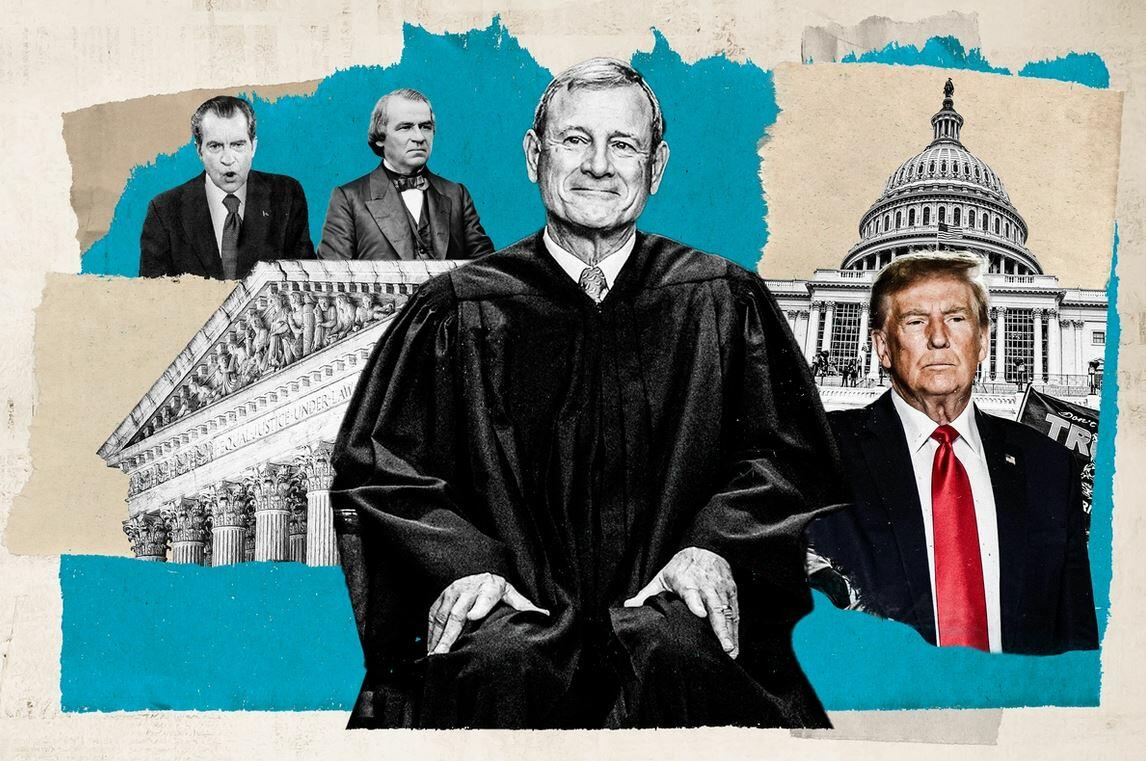
For the second time this year, the Supreme Court could hear oral arguments on a relatively untested area of constitutional law as it relates to former President Donald Trump and set a landmark precedent that could affect the 2024 presidential race.
Chief Justice John Roberts showed interest on Feb. 13 in reviewing former President Donald Trump’s request the prior day to halt a ruling against his presidential immunity claims in the U.S. Court of Appeals for the D.C. Circuit.
Special counsel Jack Smith responded on Feb. 14, telling the court it should deny President Trump’s request.
Earlier this month, three D.C. Circuit judges rejected President Trump’s claim that the doctrine of presidential immunity shielded him from Mr. Smith’s prosecution related to the events of Jan. 6, 2021.
Mr. Smith had asked the Supreme Court to fast-track President Trump’s immunity appeal, but in December 2023, it declined, letting the D.C. Circuit tackle the issue first.
The appeals court set up a tight timeline for President Trump to request the Supreme Court’s review before the district court continued its recently forestalled pre-trial proceedings. Initially scheduled for March 4, that trial is one of many that could interfere with President Trump’s campaign schedule and raise questions about the judiciary’s relationship with American democracy.
The presidential immunity issue also raises questions about how presidents may contest election results, the threats they could face from future administrations, and whether the Constitution’s separation of powers precludes courts from weighing in on certain presidential actions before Congress.
As President Trump noted to the Supreme Court, the case presents a novel question that could have enormous consequences for future executives.
The “claim that presidents have absolute immunity from criminal prosecution for their official acts presents a novel, complex, and momentous question that warrants careful consideration on appeal,” President Trump’s Feb. 12 brief to the Supreme Court said.
The ‘Outer Perimeter’
Presidential immunity from judicial review has been broadly upheld since Marbury v. Madison in 1803. Although the case established judicial review over executive branch decisions, Chief Justice John Marshall’s majority opinion criticized the idea that courts had jurisdiction over a president’s discretion.
“The province of the court is, solely, to decide on the rights of individuals, not to inquire how the executive, or executive officers, perform duties in which they have a discretion,” he wrote.
Presidential immunity’s contours, however, are blurry in part because the Constitution doesn’t explicitly define the doctrine. Instead, a series of court decisions and DOJ opinions have interpreted the Constitution to provide a general outline of how presidents should be shielded from prosecution.
President Trump’s brief cites two Supreme Court decisions—Mississippi v. Johnson and Nixon v. Fitzgerald—in which the judiciary used suits against former Presidents Andrew Johnson and Richard Nixon to define the limitations of judges in reviewing presidential actions.
In Mississippi v. Johnson, the court denied Mississippi’s request to prevent President Johnson from enforcing the Reconstruction Acts because, the court said, it had “no jurisdiction of a bill to enjoin the President in the performance of his official duties.”
The court also distinguished between ministerial duties, or a straightforward adherence to the law, and discretionary duties, which involve the president’s exercising his judgment as to how he should carry out responsibilities assigned by Congress. Chief Justice Salmon P. Chase’s majority opinion quoted Chief Justice Marshall in describing meddling in the executive’s “prerogatives” as “an extravagance, so absurd and excessive.”
Former Justice Lewis Powell went further in Nixon v. Fitzgerald by ruling that President Nixon had “absolute immunity” from civil liability related to “official acts” within the “outer perimeter” of his authority. How far that “outer perimeter” extends is the subject of debate. In this case, the Court ruled that that authority included dismissing a federal employee—A. Ernest Fitzgerald—who alleged unlawful retaliation for testimony he gave to Congress.
That decision left open the question whether a president could face criminal charges, but it distinguished criminal and civil matters.
The court said: “When judicial action is needed to serve broad public interests—as when the Court acts not in derogation of the separation of powers, but to maintain their proper balance … or to vindicate the public interest in an ongoing criminal prosecution … the exercise of jurisdiction has been held warranted.”
Even that distinction, however, is under question with President Trump’s response to the 2020 election. The D.C. Circuit ruled in December 2023 that he wasn’t immune from civil lawsuits related to Jan. 6 because he had acted in his capacity as a presidential candidate, not exercising his official duties as president.
In his criminal case, President Trump maintained that the DOJ was attempting to charge him for actions that fell within his “official” duties and that he therefore should receive immunity. President Trump’s attorney, D. John Sauer, attempted to convince the appellate court in January that the Constitution requires Congress to impeach and try a president for his official acts before he can be charged criminally in a court of law.
Because the Senate already acquitted President Trump, Mr. Sauer argued, prosecuting him would violate the principle of double jeopardy.
The appellate judges rejected those arguments and ruled: “For the purpose of this criminal case, former President Trump has become citizen Trump, with all of the defenses of any other criminal defendant. But any executive immunity that may have protected him while he served as President no longer protects him against this prosecution.”
According to the judges, President Trump had misread Marbury v. Madison and the Constitution’s separation of powers. “Properly understood, the separation of powers doctrine may immunize lawful discretionary acts but does not bar the federal criminal prosecution of a former President for every official act,” the court said.
In legal memos from 1973 and 2000, the Justice Department opposed indicting or criminally prosecuting a sitting president. Former special counsel Robert Mueller, who investigated allegations of Russian collusion by then-candidate Trump’s campaign, cited the 1973 memo as a reason why he couldn’t indict President Trump. Those memos, however, don’t bind the Supreme Court in its determination of whether he can be indicted as a former president.
The Supreme Court generally has an array of options available when it decides cases, making its decision often difficult to predict.
First, the justices will need to decide whether or not to grant President Trump’s requested stay, which could effectively prevent the district court trial from proceeding.
In its Feb. 6 decision, the appellate court said it would withhold its mandate for the district court proceedings to continue if President Trump notified the court by Feb. 12 that he filed an appeal with the Supreme Court, which he did.
Appellants generally can seek en banc review, or a separate hearing with the entire circuit, if they lose their initial appeal. The three appellate judges said President Trump’s request for an en banc hearing wouldn’t delay the district court’s proceedings unless his request was granted by the circuit.
Yemen’s Houthis Now Have Drone Submarines, Likely From Iran
Yemen’s Iran-linked Houthis have already been deploying both aerial and sea drones (or boat/surface drones) against international vessels and warships in the Red Sea, alongside ballistic missiles. The last several days have seen direct hits on commercial tankers, as we’ve detailed.
But there are new reports the Houthis have yet another ‘toy’ in their arsenal, with help from Iran, and it has been used in attacks this past weekend: an unmanned submarine. “The U.S. conducted what it called self-defense strikes on five targets in the Houthi-controlled area of Yemen after the Houthis employed an unmanned submarine for the first time since attacks in the Red Sea and Gulf of Aden began, the Pentagon said,” according to ABC, detailing events which happened Sunday.
So far, the US-led coalition has had to defend primarily against surface boat drones, which are easier to spot, but now the Houthis have something harder to detect in their ongoing war on Red Sea shipping in response to Israel’s war in Gaza.
ABC News national security and defense analyst Mick Mulroy, who formerly worked at the CIA and the Pentagon, has described that the Houthis are escalating their efforts to strike a US warship.
“The Houthis and the IRGC [Islamic Revolutionary Guard Corps] are adjusting their strategy, apparently because they haven’t been successful in striking a U.S. naval vessel,” Mulroy said. “If one or more of these weapons get through and kill U.S. sailors, Iran should expect to be held directly responsible.”
“The Houthis are not likely capable of manufacturing these weapons on their own, so they are probably coming from Iran,” he explained, and went on to describe the Houthi strategy as seeking to “overwhelm the ship’s defenses” in a “swarm attack.”
Thus it appears the Houthis are now capable of mounting more sophisticated, multi-dimensional attacks by air, water’s surface, and from under the water.
It was only in December of last year that Iranian state media unveiled the domestic development of the country’s first underwater drone (UUV):
The homegrown UUV, also known as an underwater drone that can operate without a human occupant, was unveiled in an exhibition of the Iranian Navy’s achievements on Saturday.
The underwater vehicle can discover and terminate various underwater mines by carrying a wide range of equipment. The Iranian UUV can go as deep as 200 meters with an endurance of 24 hours.
Since the Persian Gulf is relatively shallow, it may contain a series of underwater mines laid at depths of 10 to 50 meters, which could cause serious damage to vessels as heavy as 250 tons.
Recent reports from the region say that Iran’s navy has at least one spy ship operating in the Red Sea area. Previously US officials said the spy ship is likely assisting the Houthis with targeting information.
If these fresh reports that Tehran is supplying the Houthis with underwater drones are true, there’s a likelihood that the drones could be assisted from Iranian reconnaissance assets in the region.
Cybertruck Engineer Addresses Legacy Media’s Claims About “Rusting”
Lead Cybertruck engineer Wes Morrill addressed the surge in legacy news articles last week that claimed “Cybertrucks Are Rusting.”
Barron’s: “Tesla Cybertrucks Are Rusting”
Wired: “This Is Why Tesla’s Stainless Steel Cybertrucks May Be Rusting”
CBS News: “Tesla Cybertruck owners complain their new vehicles are rusting”
“A lot of MSM coverage about rust. None show actual photos, usually a good indicator to question the accuracy. Side by side with a painted vehicle, this is surface contamination,” Morrill wrote on social media platform X.
He added: “Tesla SS actually has a PREN value (resistance to pitting corrosion) higher than 316L “marine grade.”
A lot of MSM coverage about rust. None show actual photos, usually a good indicator to question the accuracy. Side by side with a painted vehicle, this is surface contamination.
Tesla SS actually has a PREN value (resistance to pitting corrosion) higher than 316L “marine grade” pic.twitter.com/sxZNl8wfzL
Goldman Sachs, Macquarie, and some hedge funds have boosted physical trading and options trades in uranium amid soaring prices, as many countries look to increase nuclear power generation to meet their climate goals while reducing the need of fossil fuel imports.
Goldman has been increasing trade in physical uranium and has created a derivative of uranium trading by writing options on physical uranium for hedge funds, sources at hedge funds and the trading industry familiar with the deals have told Reuters.
While investment banking giant Goldman Sachs is mostly doing business with hedge funds and other financial clients, Macquarie has been stepping up trading uranium output from miners, a source who has done business with both banks told Reuters.
Uranium is in a bull market as many economies look to use more nuclear power generation in a renaissance for the technology after the energy crisis and the Russian invasion of Ukraine.
At the COP28 climate summit at the end of last year, the United States and 21 other countries pledged to triple nuclear energy capacities by 2050, saying incorporating more nuclear power in their energy mix is critical for achieving their net zero goals in the coming decades.
“The Declaration recognizes the key role of nuclear energy in achieving global net-zero greenhouse gas emissions by 2050 and keeping the 1.5-degree Celsius goal within reach,” the U.S. Department of State said.
As a result of the nuclear energy resurgence, uranium prices spiked early this year to a 16-year high after Kazatomprom—the largest uranium miner in the world—said in January that sulfuric acid shortages and construction delays at newly discovered deposits could lead to the company missing production targets—challenges that could remain into next year.
Uranium prices have doubled over the past year to over $100 per pound amid tighter supply, and Western miners seek to boost output.
US To Hit Moscow With New “Major Sanctions Package” Over Navalny’s Death
Russia has already been subject of the most steadily applied US and EU sanctions regimen on earth over the last two years due to the Ukraine war. But in the wake of Alexei Navaly’s reported death in a far northern Russian prison, which Western officials are blaming “dictator” President Putin for, Washington is about to roll out with… more sanctions — which it should be noted are “major”.
US National Security Council spokesperson John Kirby on Tuesday previewed what he’s calling a “major sanctions package” targeting Moscow in response to Navalny’s death.
The new sanctions, to be formally unveiled Friday, will “hold Russia accountable for what happened to Mr. Navalny, and quite frankly, for all its actions over the course of this vicious and brutal war that has now raged on for two years.”
An course the administration hasn’t missed the opportunity to tell House Republicans they must pass Biden’s massive $60 billion for Ukraine defense aid bill.
“One of the most powerful things that we can do right now to stand up to Vladimir Putin, of course, is to, again, pass the bipartisan national security supplemental bill and support Ukraine as they continue to fight bravely and assess their country,” Kirby continued in his remarks to reporters on a conference call.
The White House is talking about various ‘options’ in terms of consequences for the Russian opposition activist’s death in custody:
In 2021, Biden told reporters that if Navalny died, the consequences for Russia would be “devastating.” Asked directly about that on Friday, the president said his remark was three years ago, and they’ve faced “a hell of a lot of consequences” since then.
Biden directly blamed Russia for Navalny’s death and said: “We’re contemplating what else can be done,” adding, “We’re looking at a whole number of options.”
In Europe, various governments’ embassies have been summoning the resident Russian ambassador to condemn Navalny’s death and gain answers. Poland was the latest to summon the Russian ambassador Tuesday.
Meanwhile, Navalny’s widow, Yulia Navalnaya, has quickly become spokesperson for her husband’s cause, having addressed the Munich Security Council over the weekend. While she’s relatively unknown, over the past days since her husband’s death Western media has been highlighting her words of denunciation aimed at Putin and Moscow. Putin “killed the father of my children,” she’s told press briefings.
Yulia Navalnaya, the widow of Russian opposition leader Alexei Navalny, has asked the European Union to refuse to recognize Russia’s March presidential election, in a step that sharply escalates her campaign against Vladimir Putin https://t.co/do05ocjfvy
On Tuesday there was brief controversy over her X account being briefly suspended:
X, formerly Twitter, said the site’s defense mechanism against manipulation and spam had “mistakenly flagged” Navalnaya’s account as violating its rules.
“We unsuspended the account as soon as we became aware of the error, and will be updating the defense,” X Safety said in a post on Tuesday.
Navalny’s Anti-Corruption Foundation had earlier tagged Elon Musk in a post to ask “exactly which rules were violated” by Navalnaya. Accounts of Navalny’s allies, such as spokesperson Kira Yarmysh, did not appear to have been affected.
Navalny had been serving a 19-year sentence on charges of extremism and corruption. His supporters say these are all trumped-up charges while Russian media has at various times suggested he’s a CIA-supported opposition stooge.
President Biden has said he bravely “stood up” to the “bad things” of the Putin government. Biden described that he had been “poisoned, arrested, sent him to prison, sent him to isolation.. a powerful voice for the truth.”
The FBI has issued a new warning to Americans that they should exercise caution when scanning QR codes with their smartphones because cybercriminals tamper with the codes to steal login and financial information.
A QR code—the square barcode that people can scan with their smartphone cameras—can provide quick and convenient access to a website or to a direct payment to an intended recipient.
Businesses use QR codes to provide contactless access to services, for instance, enabling access to restaurant menu items on a smartphone that can then be conveniently ordered.
However, the FBI stated in an initial alert in late January that it discovered that cybercriminals were tampering with both the physical and digital QR codes to swap them for malicious codes that, when scanned, pose a risk to users.
“Unfortunately, they’re relatively widespread,” Stephanie Walker, assistant section chief of the FBI Cyber Division, told ABC News on Feb. 16, with the agency reiterating its call for people to use caution when scanning QR codes.
Criminals use modified malicious QR codes to direct people to malicious sites to steal their data, break into victims’ devices by embedding malware on them, or redirect payments for immediate financial gain.
“What happens when you scan a QR code that isn’t the one you’re supposed to be scanning is that can give the criminal access to your phone, which then allows them access to any apps that you normally use,” Ms. Walker said.
“It can also drop some sort of computer intrusion type software that can alter your phone and steal credentials.”
The FBI explained in its earlier alert that, after gaining access to a person’s credentials and other financial information, cybercriminals can use it to withdraw funds from victim accounts.
“Law enforcement cannot guarantee the recovery of lost funds after transfer,” the FBI stated.
The FBI’s El Paso division said in September 2023 that the agency began receiving reports in 2022 that people were falling victim to QR code scams, with cryptocurrency fraud being an area of particular concern.
Because crypto transactions are often made through QR codes associated with crypto accounts, that makes such transactions “easy marks,” the FBI said at the time.
Scammers were found to be using malicious QR codes and gift cards as part of a single ploy.
“Scammers may call and say they’re going to send a QR code to your phone so you can receive a free $100 gift card. In reality, the QR code may take you to a malicious website,” the FBI’s El Paso division stated.
“If you make a payment through a bad QR code, it’s difficult, if not impossible, to get those funds back.”
The FBI offered several tips to avoid becoming the victim of a QR code scam.
First of all, the agency says that people should ensure that the website address, or URL, that pops up when a QR is scanned appears legitimate and is the intended site. Malicious domains may mimic the intended URL but have slight alterations such as typos or misplaced letters.
People are also urged to exercise caution when providing sensitive information after scanning a QR code, especially login or financial details.
The FBI says that, when scanning a physical QR code, people should verify that the code hasn’t been tampered with, such as by adding a sticker on top.
Also, the agency cautions against downloading apps directly from QR codes. Instead, the FBI says people should rely on their phone’s app store for safer downloads.
If prompted to complete a payment via QR code in an email claiming a failed transaction, people should contact the company directly to confirm the authenticity of the message, according to the FBI. They should also obtain the company’s contact details from a trusted source, not from the email containing the QR code.
Further, people should avoid downloading QR code scanner apps to minimize the risk of malware. Most smartphones have built-in QR code scanning features in camera apps.
In general, the FBI recommends that people avoid making payments through a site navigated from a QR code. Instead, manually entering a known and trusted URL to complete the payment is a safer option.
Palo Alto Plummets 20%, Wiping Out All 2024 Gains, After Slashing Revenue Guidance Amid “Spending Fatigue”
This was not the release tech bulls wanted ahead of the most anticipated report of earnings season.
Shares of cybersecurity company Palo Alto crashed as much as 20% after it slashed its revenue forecast for the year, sparking concerns that tech euphoria may be misguided and that customers are reining in tech spending.
Here’s what the company just reported for the just concluded fiscal Q2 ended Jan 31:
Sales rose 19% to $1.975 billion beating estimates of $1.97 billion, and in line with the company’s Nov guidance of $1.955BN-$1.985BN.
Product revenue grew more slowly than service and support sales, underscoring an ongoing shift at the company.
Adjusted EPS rose to $1.46 a share, also beating estimates of $1.30, and above the company’s November guidance of $1.29-$1.31
While the historicals were solid, it was the company’s guidance that shocked investors:
PANW reported that sales in 2024 will be $7.95BN-$8BN this fiscal year, a decline from the previous projection of as much as $8.2 billion, and also a big miss to analyst estimates of $8.18 billion.
The top end of Palo Alto Networks’ sales forecast represents an increase of 16%, well below its 25%-plus growth rate of recent years;
according to Bloomberg, the outlook suggests that customers may are dialing back their spending ambitions, even as online attacks proliferate.
Worse, Palo Alto said that its closely watched billings would come in the range of $10.1BN-$10.1BN this year, a huge drop from its previous range went as high as $10.8 billion.
The silver lining: the company did maintain its outlook for earnings and free cash flow for fiscal 2024, which Chief Financial Officer Dipak Golechha said reflected “disciplined execution on profitable growth”, although granted it didn’t do much for the stock after hours.
CEO Nikesh Arora echoed those remarks on a conference call, telling analysts that the company has been successfully executing its profitable growth strategy. But he also said customers were facing “spending fatigue” in cybersecurity.
“This is new,” he said. Customers are finding that adding incremental products “is not necessarily driving a better security outcome for them.” Just wait until customers discover the very same thing about chatbots which aren’t driving a better revenue outcome either.
Palo Alto shares fell as much as 19% in extended trading following the earnings report. Palo Alto Networks, alongside other cybersecurity companies like Crowdstrike Holdings, had outperformed most of its tech peers in 2024. Shares had climbed 24% this year on the hope that cyber investments would continue to surge. Now it’s time to pull the hype punchbowl away with the stock giving away almost all YTD gains in seconds.