64.1 F
Chicago
Saturday, September 19, 2026
Home Blog Page 2896

Biden’s War On Domestic Energy Intensifies

0
Biden’s War On Domestic Energy Intensifies

Authored by Matt Egan and Brent Bennett via RealClear Wire,

On Jan. 26, President Joe Biden took an aggressive step forward in his war on American energy by halting the permitting of new liquified natural gas (LNG) export terminals. This action has massive global implications, as TPPF’s Mark Mills laid out when the decision was publicly announced.

It also has the added benefit for the president of attacking primarily Texas and Louisiana, red states that account for the bulk of U.S. LNG exports. This decision comes on the heels of Texas taking steps to secure its border with Mexico, putting the state directly at odds with the administration—once again.

But the president’s politically motivated actions will reverberate far beyond America’s natural gas producing regions. By locking global supply and demand imbalances in place for longer, this decision will send billions of dollars to foreign producers and raise the cost of energy globally. Any short-term drop in domestic prices will ultimately be negated by reductions in future domestic production.

If this decision doesn’t help Americans and hurts our allies, why do it? Politics, of course, primarily appeasing the radical green cartel that forms a key part of the president’s base, and, perhaps to the surprise of a casual observer, rent-seeking industries looking to hoard short-term supply.

President Biden’s environmental extremism means our allies will become more reliant on our adversaries. For context, 87% of US LNG exports went primarily to U.S. allies in Europe and Asia. The Biden administration blunting America’s ability to participate on the world energy stage creates a vacuum that will undoubtedly be filled by the other major natural gas exporting countries—Russia, Qatar, and Iran—who are certainly not friends of the U.S.

Bear in mind that the Department of Energy (DOE) has never denied an LNG export application, for environmental reasons or otherwise, and rejected a petition to do so just six months ago. President Biden could be pushing for more U.S. LNG exports, because the U.S. produces natural gas more responsibly and with fewer emissions than any LNG exporting country save Australia. However, despite the obvious fact that domestic gas has been a major driver of U.S. GHG emissions reductions and air quality improvements, the green cartels are trying to make the case that LNG exports will not do the same for other countries.

Also, serious questions surround the administration’s legal authority to issue such an all-encompassing, job-killing freeze in energy exports. Congress has not authorized the DOE to take such drastic actions, which would have implications both inside and outside our borders. It is also absurd that the Natural Gas Act, a relic of 1930s-era policymaking, gives the DOE power to deny imports and exports, outside the bounds of trade agreements. States need to take the administration to the courts over this decision, and fortunately, many are already expressing a willingness to do so.

This LNG export ban may be the most strong-armed, authoritative action against American energy producers taken by an administration that has become known for such transgressions. Luckily, Congress is already working to reverse this massive mistake by advancing a bipartisan bill, Unlocking our Domestic LNG Potential Act.

It’s notable when President Biden’s anti-energy policies become so extreme that they elicit condemnations from members of his own party. By rolling back this executive action and ensuring the president cannot have unilateral control over vital energy production and exports, Congress would take a significant step to secure American energy leadership now and for years to come.

Matt Eagan is the Director of Federal Affairs at the Texas Public Policy Foundation.

Brent Bennett, Ph.D., is the policy director for Life:Powered, an initiative of the Texas Public Policy Foundation to raise America’s energy IQ.

Tyler Durden
Tue, 02/20/2024 – 14:40

Houthis Boast Of Fresh Attack On ‘Several’ American Warships

0
Houthis Boast Of Fresh Attack On ‘Several’ American Warships

A military spokesman for Yemen’s Houthis has announced the group carried out fresh attacks Tuesday, as they continue keeping up the pressure on the US-led naval coalition patrolling the Red Sea. 

Significantly, the spokesman announced in the new operation attacks using kamikaze drones “targeting several American warships in the Red Sea and the Arabian Sea.”

Image source: US Navy

The statement further said, according to a translation, “Simultaneously, Yemen targeted sensitive IOF military locations in the Umm al-Rashrash (Eilat) south of occupied Palestine using kamikaze drones.”

“Additionally, the Yemeni naval forces targeted an Israeli ship MSC SILVER in the Gulf of Aden with anti-ship missiles,” the Houthi spokesman’s written statement said.

It’s as yet unclear whether the drones struck their intended targets. The latest Pentagon statement didn’t indicate this was the case. But a statement did confirm an attempt to strike the USS Laboon with an anti-ship cruise missile. On Tuesday US Central Command (CENTCOM) issued a list of at least five significant military actions and events from Monday into early Tuesday.

According to the new statement:

“On Feb 19, between 12:30 and 1:50 p.m., two anti-ship ballistic missiles (ASBM) were launched from Houthi-controlled areas of Yemen toward M/V Sea Champion, a Greek-flagged, U.S.-owned grain carrier in the Gulf of Aden. Minor damage and no injuries were reported. The ship continued toward its scheduled destination to deliver grain to Aden, Yemen. A surface to air missile launcher was located and destroyed by U.S. CENTCOM forces in Houthi-controlled areas of Yemen at approximately 5 p.m.”

And more:

  • One additional anti-ship ballistic missile was launched at 6:40 p.m. but did not impact any commercial or coalition ships. At 7:20 p.m., a one-way attack (OWA) unmanned aerial vehicle (UAV) struck the M/V Navis Fortuna, a Marshall Islands-flagged, U.S.-owned, bulk carrier causing minor damage and no injuries…
  • At 8:15 p.m., U.S. CENTCOM forces destroyed a OWA UAV in Western Yemen prepared to launch at ships in the Red Sea.
  • Between 8 p.m. on Feb. 19 and 12:30 a.m. on Feb. 20, U.S. and coalition aircraft and warships shot down 10 OWA UAVs in the Red Sea and Gulf of Aden.
  • Additionally, at 12:30 a.m., Feb. 20, USS Laboon (DDG 58) identified one anti-ship cruise missile (ASCM) headed in its direction. USS Laboon subsequently shot down the ASCM.

All of this follows US officials admitting that over the weekend that an MQ-9 Reaper drone was downed off Yemen’s coast (at least the second such US drone downing in several months). All of this demonstrates Houthi attacks are coming more frequently, and it is perhaps only a matter of time before a drone slips or missile through the Western naval coalition’s anti-air defense measures.

Meanwhile, Egyptian President Abdel Fattah El-Sisi has issued new figures related to the ongoing economic impact of Red Sea transit being essentially closed to all major Western tanker companies.

He said in a fresh statement that revenues from the Suez Canal have “decreased by 40 to 50 percent” so far this year, according to Agence France Presse (AFP). Egypt is already gripped by a worsening financial crisis, and further the majority conservative Muslim population is increasingly outrage at what’s happening in nearby Gaza, and their own government’s failure to do anything about it.

Tyler Durden
Tue, 02/20/2024 – 14:20

Don’t Fear All-Time Highs, Understand Them

0
Don’t Fear All-Time Highs, Understand Them

Authored by Lance Roberts via RealInvestmentAdvice.com,

Don’t fear all-time highs in the market. Such is a natural response for investors who are concerned about market risk. However, rather than fearing market exuberance, we must understand what drives it.

There is an essential concept investors should understand about markets when they are hitting “new records.”

“Record levels” of anything are “records for a reason.”

It should be remembered that when records are broken, that is the point where previous limits were reached. Just as in horse racing, sprinting, or car races, the difference between an old record and a new one is often measured in fractions of a second. Yes, while the market is currently hitting all-time highs, it is a function that, in this case, took two years to occur.

So, while the media is giddy about markets hitting all-time highs, we must remember that “record levels are NOT THE BEGINNING but rather an indication of a well-underway process. While the media has focused on record-low unemployment, record stock market levels, and surging confidence as signs of an ongoing economic recovery, history suggests caution. For investors, everything is always at its best at the end of a cycle rather than the beginning.

Let’s take a look at a long-term chart of the market. Since 1871, there have been FIVE very distinct bull market cycles. During those roughly 15 to 20-year periods, stock prices rose, hitting new highs. Notably, long periods of flat to declining prices follow bullish periods. In other words, 100% of the total market gains came from five distinct historical periods.

At the end of those five bullish trends, markets were at all-time highs. For those invested at those all-time highs, it took an average of 20 years before they saw all-time highs again. Note the level of valuations when those peak bull market periods occurred.

With valuations currently elevated and prices surging to all-time highs, does this mean we are in for 20 years of no returns?

What Valuations Do And Don’t Tell Us

The mistake investors repeatedly make is dismissing the data in the short term because there is no immediate impact on price returns. Valuations, by their very nature, are HORRIBLE predictors of 12-month returns. As such, investors should avoid any investment strategy with such a focus. However, valuations are strong predictors of expected returns in the longer term.

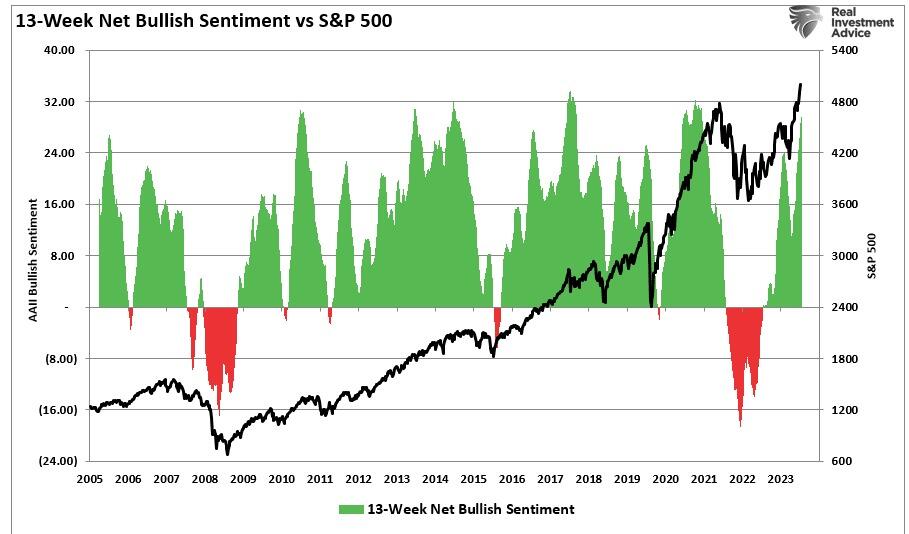
While valuations suggest that returns over the next 10 years will likely be lower than the last decade, psychology drives short-term markets. Unsurprisingly, there is a high correlation between investor sentiment and asset prices. The chart below shows the 13-week moving average of net bullish sentiment (betail and institutional) versus the market. During periods of rising prices, sentiment increases, creating a buying panic for stocks.

Eventually, something changes investors’ sentiment from bullish to bearish, and that creates the eventual reversion in asset prices. So, while valuations are vital in setting expectations for future rates of return, they are of little value in the short term. As such, this is why using some basic technical analysis can help investors navigate short-term market time frames to avoid excessive risk buildup in portfolios. The chart below is a composite of weekly technical indicators (price close as of the end of the week.) In October 2023, with a reading below 20, the deep oversold condition marked the bottom of the market. Such formed our call for a year-end rally. With the current reading above 90, which is exceptionally bullish, risk-taking by investors has swung wildly into bullish territory.

Of course, given the hype of “artificial intelligence” and the ongoing hopes of a reversal in monetary tightening, it is unsurprising that markets have hit all-time highs.

Don’t Fear All-Time Highs, Understand Them

In the short term, investors should not fear all-time highs as a harbinger of impending doom. When driven by momentum and psychology, bull markets can last longer and go farther than logic would predict. But even during these momentum-driven rallies, 5-10% intrayear corrections are the norm.

History is pretty clear that when markets hit all-time highs, more will follow as investors become more “fearful of missing out.” But such exuberance will eventually give way to fundamental realities.

What will cause such a reversal is unknown. However, given the current deviation of the market from its long-term exponential growth trend, it will become more challenging for stocks to continue to grow faster than the economy. Notably, such deviations have historically led to extended periods of very low to zero rates of return.

Of course, that is what current valuations already tell us. While Wall Street analysts are very bullish on the future, some factors must be considered. The economic cycle is tied closely to demographics, debt, and deficit. If you agree with this premise and the data, then the media’s optimistic views are unlikely. 

We believe rationalizing high valuations today will likely lead to disappointing future outcomes. However, bullish sentiment is becoming contagious in the short term, making continued “new all-time highs” more likely.

Don’t fear all-time highs. Just understand they are the byproduct of exuberance.

Tyler Durden
Tue, 02/20/2024 – 14:00

Ford Slashing Prices And Increasing Incentives On Electric Mach-E, F-150 Lightning

0
Ford Slashing Prices And Increasing Incentives On Electric Mach-E, F-150 Lightning

It’s not just Tesla…the increasing saturation of the electric vehicle market continues driving down prices as manufacturers strive to remain competitive.

At the same, manufacturers are starting to realize that hybrids present a more cost-effective option than battery electric vehicles due to lower initial purchase prices and the ability to save on fuel without being wholly dependent on charging infrastructure.

Maybe that’s why, shortly after reducing the prices of its 2023 Mustang Mach-E in Canada, Ford has cut the MSRP across all trims in the U.S. to respond to softer EV demand, offering additional lease discounts and introducing new incentives for the F-150 Lightning, according to Electrek.

The Mustang Mach-E, an all-electric SUV that debuted over four years ago, has become highly popular, ranking as the second-best-selling electric SUV in the U.S. in 2023. Following a pause in orders last year, Ford resumed sales in May with reduced prices, starting at $42,995. This move came right before the company announced a similar price reduction in Canada, marking a continuous effort to make the Mach-E more accessible.

A spokesperson for Ford said:

The Mustang Mach-E is America’s No.2 EV SUV in 2023 and Ford is America’s No.2 EV brand. We are adjusting pricing for MY23 models as we continue to adapt to the market to achieve the optimal mix of sales growth and customer value.

Ford also highlighted that lessees of the 2023 Mustang Mach-E through Ford Credit qualify for a $7,500 cash incentive, which complements the $7,500 federal tax credit for EV leases that Ford extends to its clients. This means that U.S. customers could see discounts up to $15,000 off the MSRP when leasing a Mach-E. Additionally, eligible purchasers have the option of 0% financing for a period of 72 months.

Source: Electrek

The move away from EV investment and price cuts marks a sea change in attitude for EVs. As we noted earlier this month, the latest example of this was General Motors, who posted better than expected earnings earlier this month but also said that it plans on changing its product lineup to include more hybrid vehicles, drifting away from pure electric vehicles. 

CEO Mary Barra said on the earnings call: “Let me be clear, GM remains committed to eliminating tailpipe emissions from our light-duty vehicles by 2035, but, in the interim, deploying plug-in technology in strategic segments will deliver some of the environment or environmental benefits of EVs as the nation continues to build this charging infrastructure.”

Recall, a report from Consumer Reports last year found that electric vehicles have almost 80% more problems and are “generally less reliable” than conventional internal combustion engine cars. 

Tyler Durden
Tue, 02/20/2024 – 13:40

“How Can We Fix NATO Spending If Nobody Understands What Drives Global Economics?”

0
“How Can We Fix NATO Spending If Nobody Understands What Drives Global Economics?”

By Michael Every of Rabobank

1 Corinthians 13:11

“When I was an economist, I spoke as an economist, I understood as an economist, I thought as an economist: but when I became a man, I put away childish things.” – 1 Corinthians 13:11

Yesterday was quiet in markets because of the US Presidents Day holiday. But it wasn’t quiet in the real world, where the Houthis sank a UK-owned bulk carrier, underlining Congressman Gallagher’s complaint that US military sealift (in)capacity is a “screaming national security liability.” Which it is, even if most economists don’t know what sealift is: even so, it’s time for them to start doing wider reading, and thinking, before they too get sunk.

In that line, this time last week I was in Palm Beach for the ZeroHedge debate ‘The Fate of the US Dollar’ asking if the Buck could retain its global reserve currency status by 2030. Notably, the discussion didn’t center just on economics, but on political economy and the military. On one side, @JamesGRickards backed a BRICS+ currency linked to gold: after I retorted that ‘Eastern Powers in Goldmember’ is a parody, the Russian Foreign Minister agreed there will be no such thing. @BobMurphyEcon of the Mises Institute believed US public dissatisfaction with fiscal deficits and inflation could slowly shift holdings away from dollar financial assets. However, with the US top 1% dominating said holdings, it would mean the elite bailing on their own country and power (for where?) which seems a dramatic shift.

Countering, @SantiagoAuFund argued the global Eurodollar network and US military are too big if push comes to shove. I concurred, and added that: (i) if you can’t say what replaces the dollar, logic says it’s unlikely to do so; and, (ii) as long as the Fed keeps policy tight and US policy is more realpolitik than surrealpolitik, then the dollar stays top dog; or, as I also put it, “my dad is bigger than your dad.”

Former Fed voter Dudley is out today saying policy might be too loose, not tight, while Larry Summers is talking about the risks of the next move being a hike. That’s as the Thai PM pressures the Bank of Thailand for an emergency out-of-cycle rate cut, and China just slashed its 5-year LPR rate from 4.20% to 3.95% to little market impact. So, King Dollar still has the crown on its head.

Further underlining political economy matters most now, the European Commission President Von der Leyen just floated using the EU budget to subsidise defense production as well as guaranteeing it will be bought long term. The weekend’s Munich Security Conference was also abuzz with once-and-possibly-future President Trump’s threat to force NATO allies to spend more defence or see the US focus on itself. Presumed incoming NATO leader, former Dutch PM Rutte says Europe should stop moaning and whining and nagging about Trump,” and focus on being able to defend itself – which has a long way to go.

Germany may now increase defence spending to a US-level 3.5% of GDP. Yet that means the EUR100bn special defence fund announced after Russia invaded Ukraine would be swallowed in a single year, and it would need to be repeated every year, plus an increase equal to nominal GDP growth, in order to *stay* at 3.5%.

That’s a *big* shift in fiscal policy that opens constitutional questions. So what kind of pan-European institutional would need to be put in place to achieve it? Relatedly, this morning Bloomberg is also talking about EU automakers also uniting into an “Airbus for cars” to try to resist competition from China. That would shake up the global economy and markets too.    

The need to act urgently is clear. Bloomberg notes today that ‘German Direct Investment in China Rose to Record in 2023’ at $6bn, even as total FDI into China collapsed to $33bn vs. around $350bn in 2021. Yet German FDI into the US soared to almost three times the China level for the first time, sending a message about deindustrialisation, with flows East and West instead.

However, how will defense spending and industrial policy be paid for? With high rates, things get very expensive, very fast. Yet low rates will see no private capital flow to military-industrial sectors, or even adjacent ones, or even domestically. Moreover, early/deep rate cuts may trigger higher inflation. (Look at US payrolls, initial claims, CPI, PPI, the ISM services prices paid, and loose fiscal policy. Even talk of cuts is generating dot-com insanity in some US stocks, and the record net short in speculative positions in grains can easily flip back to longs, pushing up food prices.)

So, cut welfare to pay for military spending? Spending on affordable bombs, not affordable homes, will only pour fuel on the flames of Western populism; the political-economy logic says we may need higher welfare AND military spending to justify the latter. Are we going to tax more to pay for it? Whom? The elite who could undermine US global reserve status, flighty businesses, or ordinary people who need fiscal help? Or are we going to monetize [ZH spoiler: we are]? One sees where the Austrian view of the fallibility of fiat flows from.

Regular readers will know I suspect a shift to higher rates AND ‘acronyms’ to ensure key sectors borrow at low rates to boost the supply and demand side in tandem; and, unspoken, that may require capital controls, hypothecated budgets, and tariffs as part of a national security economy where markets are free to do what the West wants, strategically – as China does.

That is already happening in part: and yesterday the US warned China not to dump its excess output on world markets. China ‘doing a Japan’ always threatened to accelerate the retreat from global free trade into open mercantilism. And here we are, even if many economists think what we are seeing means first order ‘deflation’ rather than second order ‘decoupling’.

But don’t bank on cheap Chinese goods keeping CPI in check; bank on efforts to keep FDI into China in check. The Bloomberg story on German FDI into China also quotes the Rhodium Group saying, “…a gap is emerging between the financial interests of some German corporations, on the one hand, and the interests of their Germany-based staff and the broader German economy, on the other.” A recent Daily referred to an MIT study (‘Wars Without Gun Smoke’) of exactly this historical pattern of behaviour in firms in rising vs. declining powers. Today it’s likely to mean politics injecting itself more into economics: and, coincidentally(?), we again see Germany’s BASF and VW are under pressure to cut their operations in China’s Xinjiang.

Real life is happening outside of economics, which doesn’t see it because of academic specialization, inertia, useful idiocy, and vested interests – but that’s not unique to it.

Indeed, as maritime expert @johnkonrad complains on X:

“Is there a national security finance conference or group I can attend? because miltweet is driving me nuts… Almost every military expert and natsec think tank on this app has mentioned GDP recently but only a few truly understand what GDP is or why it’s used (vs other metrics) for NATO spending. A tiny proportion of those truly understand fiscal and monetary policy. We cannot fix our military problems without understanding the underpinnings of fiscal and monetary policy… is it safe to assume the natsec community is financially illiterate? How can we fix NATO spending if our military think tanks don’t understand the underpinnings of global economics?”


NatSec ignorance of the economy and markets is as deep as economist and market ignorance of NatSec. In NatSec, if you say “GDP”, you’re ‘knowledgeable’; in economics/markets, if you say “geopolitics”, you’re ‘knowledgeable’. But it’s time to put away childish things, learn both, and look to 1 Corinthians 13:12: “For now we see only a reflection as in a mirror; then we shall see face to face. Now I know in part; then I shall know fully, even as I am fully known.”

Tyler Durden
Tue, 02/20/2024 – 13:20

US Is Lone Veto Of UN Resolution Demanding Ceasefire In Gaza 

0
US Is Lone Veto Of UN Resolution Demanding Ceasefire In Gaza 

Another UN Security Council vote on Gaza… another resounding veto by the United States. Tuesday’s vote marks no less than the third US veto of a security council resolution demanding ceasefire in Gaza. 

The US blasted the resolution set before the council as “wishful and irresponsible” and alleged that it puts current sensitive truce negotiations between Israel and Hamas in jeopardy. The UN text called for an “immediate humanitarian ceasefire” and was proposed by Algeria for the 15-member Security Council’s approval. It was seen as having widespread Arab backing.

The US veto (screengrab)

The vote was 13-1 with the UK abstaining and the US being the lone ‘no’ vote, which is a familiar pattern historically on Israel-related issues.

“Colleagues, over the past few weeks, we have made incredibly clear that the resolution before the council would not achieve the goal of a sustainable peace, and may in fact run counter to it,” Biden’s ambassador to the UN Thomas-Greenfield said.

“Proceeding with a vote today was wishful and irresponsible. And so while we cannot support a resolution that would put sensitive negotiations in jeopardy, we look forward to engaging on a text we believe will address so many of the concerns we all share. A text that can, and should, be adopted by the council,” she added.

Had the resolution passed, it would have put immense pressure on the Netanyahu government to at least stop the impending Rafah offensive.

But Thomas-Greenfield’s emphasis was that this would have stymied diplomatic efforts to free the over 100 hostages still being held by Hamas. Israel too has said it sees international demands for ceasefire as essentially a gift to Hamas.

But the reality is that the Qatar-sponsored negotiations appear all but dead at this point. Netanyahu has said Hamas’ conditions are “delusional” – namely the demand to withdraw all Israeli forces from the Gaza Strip first.

Given the death toll in Gaza is nearing 30,000 mostly civilians killed, according to Palestinian ministry figures, the war is becoming increasingly unpopular internationally, and Israel’s actions have been especially condemned by Global South countries.

Tuesday’s vote is sure to create more space between Washington and even some of its allies in Europe. On Monday almost the entire European Union (minus Hungary) signed on to a text demanding immediate humanitarian ceasefire. 

Tyler Durden
Tue, 02/20/2024 – 12:00

NYT Publisher Defends Coverage Of Biden’s Age, Says It’s Made White House “Extremely Upset”

0
NYT Publisher Defends Coverage Of Biden’s Age, Says It’s Made White House “Extremely Upset”

Authored by Bill Pan via The Epoch Times,

The New York Times’ reporting on concerns about President Joe Biden’s age has made the White House very unhappy, according to the publisher of the newspaper.

The revelation came in an interview with Oxford University’s Reuters Institute for the Study of Journalism, during which NY Times publisher Arthur Greg Sulzberger was asked if journalists should take a different approach when covering an “authoritarian candidate.”

Having navigated the newspaper through the turbulent 2020 election cycle, Mr. Sulzberger noted that there is a risk in the media “leaning into becoming the opposition to these candidates and becoming emotionally invested and trying to undermine them,” rather than helping the public better understand who they are and what they can offer.

“For me, the path forward is to fully and fairly convey this and do it unapologetically and with clear language while understanding that doing so may lead some people not to find it too credible,” said Mr. Sulzberger, who succeeded his father, longtime publisher Arthur Ochs Sulzberger, Jr. in the role at the end of 2017.

“We are going to continue to report fully and fairly, not just on Donald Trump but also on President Joe Biden,” he told the Institute.

“He is a historically unpopular incumbent and the oldest man to ever hold this office.”

“We’ve reported on both of those realities extensively, and the White House has been extremely upset about it.”

During the interview, which was published Monday, Mr. Sulzberger also acknowledged that a “disproportionate number” of conservative voters do not trust any news source that recognizes President Biden as the legitimate winner of the 2020 presidential election.

“We can’t try to win those folks over and hedge our language,” he said.

“We are just stating the truth fully and plainly, but we are also doing that in a way that is unemotional.”

The interview comes amid increased concerns about President Biden’s age and mental fitness. In a report on the president’s alleged inappropriate handling of classified documents, special counsel Robert Hur said one of the reasons he decided to not press charges on the 81-year-old president was that a sympathetic jury would probably view him as a “well-meaning, elderly man with a poor memory.”

The report prompted President Biden’s defenders, including Vice President Kamala Harris, to point to Mr. Hur’s history of clerking for two well-known conservative judges, accused him of being “clearly politically motivated.” However, Mr. Hur’s report also included a letter from the White House asking that the comments about the president’s memory be revised “in a manner that is within the bounds of your expertise and remit.”

In the days after the report, the NY Times ran a series of editorials and opinion pieces discussing President Biden’s potential incapacity to hold office due to his age and mental state. At least one of them suggested that he could quit the 2024 race, with columnist Ross Douthat describing the vibe the president gives off in public as “a lightbulb that still burns so long as you keep it on a dimmer.”

In another piece published on Feb. 9, titled “The Challenges of an Aging President,” the NY Times editorial board argued that President Biden, at his age, is taking Americans into “unchartered territories” with his reelection bid.

“Regardless of Mr. Hur’s motivation, the details that he presented spoke to worries voters already had,” the NY Times’ editors wrote.

“The president has to reassure and build confidence with the public by doing things that he has so far been unwilling to do convincingly.”

Those comments have drawn criticism not only from the president’s supporters, but also from members of the press. Margaret Sullivan, a former editor for the NY Times, said the newspaper’s coverage of President Biden’s age has become an “obsession,” suggesting that Mr. Sulzberger tell his editorial team to stop “going overboard with both coverage and commentary” on it and “keep this in better perspective.”

Specifically, Ms. Sullivan argued that the NY Times, as well as other media outlets, should focus on former President Donald Trump’s age—he’s currently 77—his legal problems, and how he is “poised to take down American democracy.”

Mr. Sulzberger didn’t respond to Ms. Sullivan’s criticism, but during the interview with the Institute, he addressed those who point to the civil and criminal charges cases against President Trump.

“We are not saying that this is the same as Trump’s five court cases or that they are even,” Mr. Sulzberger said. “They are different. But they are both true, and the public needs to know both those things.”

“And if you are hyping up one side or downplaying the other, no side has a reason to trust you in the long run.”

Tyler Durden
Tue, 02/20/2024 – 11:40

NTSB Argues Against Having Third Party Examine Evidence From East Palestine Derailment And Chemical Spill

0
NTSB Argues Against Having Third Party Examine Evidence From East Palestine Derailment And Chemical Spill

The NTSB is working to try and prevent a third party from examining evidence in a class action regarding the East Palestine train derailment that wound up spilling noxious chemicals. 

The regulator, supposedly working on the behalf of the American public, using American tax dollars, and overseen by Mayor Pete, has said having a third party examine evidence would “impose an undue burden on the agency’s investigative and financial resources.”

In documents submitted to U.S. Judge Benita Y. Pearson of the Northern District Court of Ohio on Wednesday last week, attorneys representing the NTSB expressed opposition to inspection demands made by OxyVinyls LP, GATX Corp., and General American Marks Co. regarding crash site evidence, WKBN wrote. 

They argued that such inspections would disrupt the active probe into the Norfolk Southern train derailment on February 3, 2023. After a Norfolk Southern train derailment on February 3, 2023 released vinyl chloride, leading to its combustion and a widely broadcasted smoke cloud, evacuations, and numerous lawsuits followed.

Plaintiffs are demanding compensation for economic and emotional distress, with jury selection scheduled for March 31, 2025.

The lawsuits have mostly been consolidated into a class action, with Norfolk Southern suing OxyVinyls LP, GATX Corp., and another company for their roles with the rail cars or chemicals. Norfolk Southern argued these companies should share liability for the damages.

The companies sought to examine the crash evidence on February 7 to prepare their defense. The NTSB has proposed a limited evidence inspection and plans to release all evidence after a June 25 board meeting, concluding the investigation.

Tyler Durden
Tue, 02/20/2024 – 11:20

Watch: Pelosi Goes On Unhinged Rant About Trump Being ‘Blackmailed’ By Putin

0
Watch: Pelosi Goes On Unhinged Rant About Trump Being ‘Blackmailed’ By Putin

Authored by Steve Watson via Modernity.news,

Nancy Pelosi has once again floated the tired conspiracy theory that Donald Trump is controlled by Vladimir Putin, and that the Russian leader is blackmailing Trump with “something financial.”

Appearing on MSNBC with Democrat mouthpiece Jen Psaki, the pair claimed Trump is a “fanboy” of Putin and that he “encourages” Putin to invade NATO countries.

“Putin is among the top three or four evil people in the world,” Pelosi ranted, before stating “What does he have on Donald Trump that he has to be constantly catering to Putin?”

She went on to claim that Trump, whose name she struggled to remember, has “brought disgrace,” to the White House and “didn’t consider it an honour” to serve as President or take seriously the oath to defend the Constitution.

“He is a person without values,” Pelosi further whined, adding “he looks like he’s going to be a person without dollars either,” gloating about the clearly political indictments against Trump.

“I don’t know what [Putin] has on him, but it’s probably financial, or something on the come, something he expects to get,” Pelosi hissed.

She also claimed that Trump is “telling Putin to go into these countries, NATO countries,” without saying what countries she was referring to, adding that “NATO is there to stop Russia, to keep Russia out.”

Ukraine is not a part of NATO.

Watch:

The comments come in the wake of Pelosi’s conspiracy bosom buddy Hillary Clinton claiming that Trump is “enamoured with Putin,” and is going to use the Army to round up Americans if he gets back into office.

The Russiagate nonsense was investigated at a huge cost to the taxpayer and turned up precisely nothing other than the fact that Hillary’s own campaign paid for the fabricated dossier that was held up as ‘evidence’ of Russian interference.

Talk about flogging a dead horse, These two deranged women just cannot stop with this never ending witch hunt:

*  *  *

Your support is crucial in helping us defeat mass censorship. Please consider donating via Locals or check out our unique merch. Follow us on X @ModernityNews.

Tyler Durden
Tue, 02/20/2024 – 11:00

US Leading Indicators Disappoint, Equal Longest Losing Streak Since ‘Lehman’

0
US Leading Indicators Disappoint, Equal Longest Losing Streak Since ‘Lehman’

The Conference Board’s Leading Economic Indicators (LEI) continued its decline in January, dropping 0.4% MoM (notably worse than the -0.1% MoM expectations), and December’s 0.1% declin e was revised down to a 0.2% decline.

  • The biggest positive contributor to the leading index was stock prices (again) at +0.10

  • The biggest negative contributor was average workweek at -0.18

This is the 22nd straight MoM decline in the LEI (and 23rd month of 25) –  equaling the longest streak of declines since ‘Lehman’ (22 straight months of declines from June 2007 to April 2008)

“The U.S. LEI fell further in January, as weekly hours worked in manufacturing continued to decline and the yield spread remained negative,said Justyna Zabinska-La Monica, Senior Manager, Business Cycle Indicators, at The Conference Board.

“While the declining LEI continues to signal headwinds to economic activity, for the first time in the past two years, six out of its ten components were positive contributors over the past six-month period (ending in January 2024).

As a result, the leading index currently does not signal recession ahead.

While no longer forecasting a recession in 2024, we do expect real GDP growth to slow to near zero percent over Q2 and Q3.”

While the Conference Board seems optimistic, we are struggling to see any signs of hope! tumbling back below the peak in March 2006…

And on a year-over-year basis, the LEI is down 7.0% (down YoY for 19 straight months) – still close to its biggest YoY drop since 2008 (Lehman) outside of the COVID lockdown-enforced collapse (but starting to inflect)…

The annual growth rate of the LEI remains deeply negative and decoupled from Real GDP…..

Finally, the massive easing of financial conditions in the last few months suggests a turn in LEI is imminent…

And hence the ‘soft landing’ mission is accomplished… so no need for rate-cuts? (Except for the banking crisis that looms in March).

Tyler Durden
Tue, 02/20/2024 – 10:50