UK (& Japan) Shows Markets Go Up, Not Down After Technical Recessions
Authored by Simon White, Bloomberg macro strategist,
The UK and Japan slipping into mild technical recessions with today’s GDP releases is an opportune moment to underscore that, while such developments may generate a lot of headlines, they have no forward-looking information content for investors. In fact, technical recessions typically precede rising asset returns.
Both the UK and Japan’s GDP contracted in the last quarter (ex any future revisions), after also contracting in the quarter before that, meaning both countries now satisfy the technical recession definition.
There are two main problems with this categorization:
1) it is overly simplistic. There is little to no difference between an economy that contracts at 0.2% one quarter and is flat the next (no recession), and one that sees growth fall by 0.1% two quarters in a row (recession).
And 2), GDP is a lagging indicator. It is telling you where the economy was, not where it is going. Markets are forward-looking, and thus investors need focus their energies on leading indicators of the economy rather than GDP. Some information content can be gained by gauging the composition of growth, but there is nothing in a GDP report that will give any indication of an approaching turning point, where markets typically see their biggest moves.
When it comes to the UK, leading indicators are rising, suggesting the worst could have already have passed for the economy.
If we look at past technical recessions, they typically lead to falling gilt yields, and lower sterling.
That helps the FTSE 100 and FTSE 250 to perform well in the ensuing months.
It’s similar in Japan. The yen and JGB yields fall in the shorter term.
The Nikkei treads water in the short term after a technical recession, but after 12 months it returns an average of 10.7%.
The US is nowhere near a technical recession at the moment, but there too they on average mean positive returns, with the dollar, S&P and USTs all rising over the next one, three and 12 months.
Technical recessions generate a lot of heat, but not much light, and are little more than a distraction for investors.
Tuesday’s post-hot CPI dump now seems like a distant bad dream as US equity futures continued their rebound, following a tech fueled rally on Wednesday that drove the S&P 500 back above 5,000. As of 8:05am, S&P 500 futures were up 0.1%, also approaching pre-CPI levels; Nasdaq futures were as usual even stronger, rising 0.2% Europe’s Stoxx 600 index surged to the highest in more than a month. WTI crude oil futures are down 0.8% on heels of 1.6% drop Wednesday, following a bearish report by the IEA which predicts lower demand growth than supply growth in 2024. Today’s macro focus is on Retail Sales and Jobless data amid the barrage of data which includes import/export price indexes, Empire State manufacturing and Philadelphia Fed business outlook surveys, January industrial production, December business inventories, February NAHB housing market index and December TIC flows. A weaker print in retail sales – which our preview suggested is coming – and claims may continue the rally in bonds, potentially pushing the Equity rotation that began last week (paused with CPI) farther. There are also three Fedspeakers today.
In premarket trading, Cisco fell 4% after the maker of computer networking equipment slashed its full-year forecast, and announced it would lay off 5% of its workforce, prompting more questions about this chimeric earnings renaissance thanks to AI which has yet to come. Here are some other notable premarket movers:
Albemarle falls 4% after the lithium producer gave pricing guidance that disappointed Wall Street.
AppLovin jumps 22% after the mobile app marketing platform reported robust fourth-quarter earnings.
Fastly falls 21% after the infrastructure software company gave a revenue forecast that was weaker than expected.
JFrog jumps 18% after the software development company reported fourth-quarter results that beat expectations.
Manchester United falls 15% as the Friday deadline for billionaire Jim Ratcliffe’s tender offer nears.
Nu Skin plummets 24% after the beauty and wellness company failed to meet first-quarter revenue guidance expectations and cut its quarterly dividend.
Paramount Global slips 4% after a filing from Berkshire Hathaway showed the firm had reduced its stake in the media company.
SoundHound AI soars 84% after Nvidia filed a 13F indicating that it holds a stake in the company. The chipmaker also disclosed a stake in Nano-X Imaging and Recursion Pharmaceuticals.
Twilio slides 11% after the software company issued first-quarter revenue guidance that was slightly weaker than anticipated.
Yeti declines 12% after its adjusted earnings per share forecast for the year missed the average analyst estimate.
Wednesday’s powerful rebound, fueled by a wave of dip buyers, showed that investors should avoid making hasty conclusions on the back of a single data point, according to Julian Emanuel, chief equity strategist at Evercore ISI.
“The clear implication of what we’ve seen in the last few days is don’t trade the numbers,” Emanuel said in an interview with Bloomberg TV. “If you traded CPI after the number, you’re already far underwater given the bounceback we had yesterday. Thinking about the last 40 years you make money by buying pullbacks.”
To be sure, mostly favorable earnings reports have been a boon for investors hammered by Tuesday’s hotter-than-expected US inflation reading and disappointed they may have to wait longer for interest rate cuts. Treasuries also rebounded as investors braced for more economic reports that could help determine the Federal Reserve’s rate path. Data due later include initial jobless claims, industrial production and retail sales which BofA’s card spending data suggests will be a big miss to expectations.
“The ‘hot’ inflation data do not change our base case for a soft landing,” said Solita Marcelli at UBS Global Wealth Management. “But we are continuing to monitor the incoming data and the start of rate cuts could be delayed should the economic prints remain strong.”
European stocks rose for a second day, with the Stoxx trading at session highs up 0.9%, although the FTSE 100 has struggled to keep pace after the UK slipped into a mild recession in the second half of 2023. European bourses were sharply higher, with autos leading the gains, buoyed by Stellantis’ buyback announcement, while energy stocks are the biggest laggards. Here are the biggest European movers:
Stellantis shares rise as much as 4.9%. Bernstein says the carmaker’s planned €3 billion share buyback program and its higher dividend are “encouraging.”
Pernod Ricard shares rise as much as 6.3% after the cognac maker’s 1H recurring operating income met estimates, while it posted a lower-than expected decline in organic growth.
DSM-Firmenich shares rise as much as 15% after the specialty chemicals company announced plans to separate its Animal Nutrition & Health and posted a 4Q Ebitda beat.
Legrand shares gain as much as 4.4% after the French electrical devices manufacturer posted another solid set of results, with free cash flow as the highlight, according to Morgan Stanley.
Genmab shares surge as much as 12%, the most intraday since March 2020, after the Danish biotech firm reported results and said it will repurchase up to 190,000 shares.
Renault shares rise as much as 5.1% after the French car company generated far more cash than expected, allowing it to bolster its balance sheet and hike its dividend.
Centrica shares gain 6.1% after the UK utility reported results which analysts said were boosted by strength in the commodity-exposed Energy division, although otherwise in line.
Tomra shares surge as much as 26%, the most since Dec. 1993, following a “solid” fourth-quarter beat by the Norwegian recycling systems maker.
Kerry Group shares fall as much as 6.1%, the most in almost two years, after the ingredients company missed expectations in 2023 and issued disappointing guidance for the year ahead.
Gecina shares fall as much as 5.5% following results that saw an acceleration in the decline of property valuations.
Verallia shares drop as much as 3% after fourth-quarter results that Citi says missed expectations, as continued destocking offset pricing increases by the glass bottle manufacturer.
Embracer shares slump as much as 14% after the video-game company said it’s unlikely to reach its net debt reduction target by end of March.
Earlier in the session, Asian stocks rose with Japan stocks shaking off worse-than-expected GDP numbers and Hong Kong overcomes early declines. The Aussie slips and bonds rise after a lower-than-forecast jobs number. Hong Kong’s tech gauge leads the city’s gainers, rising 0.6%. In Japan, the Nikkei adds 1% and is rapidly approaching its all time high set in 1989 even as a recession strikes…
… while the Topix underperforms, climbing 0.2%. Indonesia’s stocks rise as Prabowo Subianto looks poised to win the nation’s election. In currencies, the Aussie dips to the day’s low of 64.78 US cents while the yen rises slightly, adding 0.2% after the nation’s GDP contracted versus an expected gain. JGBs rise.
In FX, the Bloomberg dollar index dropped, while the concurrent slide of two major G-10 countries in recession had opposite effects on their currencies: Japan’s yen shrank while the pound slumped, and was the weakest G-10 currency, falling 0.1% versus the greenback. The yen climbed for a second day, paring some of the US CPI-induced weakness earlier this week that spurred verbal warnings from Japanese authorities. The Aussie steadied following an earlier dip driven by soft jobs data, which brought forward RBA rate cut bets. The yen fluctuated earlier after data showed Japan’s gross domestic product contracted at an annualized pace of 0.4% in the final three months of last year, shrinking for a second quarter and prompting some BOJ watchers to push back bets on when the negative interest rate policy will end
“With verbal interventions from the authorities, concerns about the real action prevail in the market, making it hard for market players to test the dollar-yen’s upside,” said Tsutomu Soma, a bond and currency trader at Monex Inc. “However, the downside is also limited to some extent because even if the BOJ scraps negative rate policy, wide yield gap still remains as it will be very cautious to lift the rate from zero.”
In rates, treasuries rise as investors look ahead to a busy US data calendar that includes retail sales and industrial production. Gains for Treasury futures during Asia session and European morning trim yields by 2bp to 4bp across the curve and leave 2s10s, 5s30s spreads slightly flatter on the day, as the surge in yields sparked by January CPI data Tuesday drew dip-buyers and continues to be unwound. 10-year TSY yields are around 4.225% is ~3bp richer on the day, outperforming bunds and gilts in the sector by ~1bp; front-end Treasuries lag slightly, flattening 2s10s, 5s30s spreads by 1bp and 0.5bp on the day, partially unwinding Wednesday’s steepening move. US session features a heavy economic data calendar including retail sales, weekly jobless claims and industrial production.
In commodities, oil prices decline, with WTI falling 0.7% to trade near $76.10. Spot gold adds 0.2%. Bitcoin rises ~1% to trade above $52,000.
Bitcoin (+0.9%), continues its advances, but has so far found resistance around the $52.5k level. Ethereum currently just shy of USD 2.8k. Bitcoin ETF inflows continued apace if modestly off yesterday’s record high.
Finally looking to the day ahead, in terms of US data we get January retail sales and import/export price indexes, February Empire State manufacturing and Philadelphia Fed business outlook surveys and weekly jobless claims data (8:30am), January industrial production (9:15am), December business inventories, February NAHB housing market index (10am) and December TIC flows (4pm). Elsewhere, we got UK Q4 GDP (which unexpectedly joined Japan in sliding into recession), Eurozone December trade balance, Canada January housing sales and December manufacturing sales. We will be hearing from the ECB’s Lane and Nagel, and the BoE’s Greene and Mann. Finally, earning releases include Applied Materials, Deere, Stellantis, DoorDash, DraftKings, and Roku.
Market Snapshot
S&P 500 futures up 0.1% to 5,025.00
STOXX Europe 600 up 0.5% to 487.85
MXAP up 0.9% to 169.07
MXAPJ up 1.0% to 516.53
Nikkei up 1.2% to 38,157.94
Topix up 0.3% to 2,591.85
Hang Seng Index up 0.4% to 15,944.63
Shanghai Composite up 1.3% to 2,865.90
Sensex up 0.3% to 72,033.24
Australia S&P/ASX 200 up 0.8% to 7,605.72
Kospi down 0.3% to 2,613.80
German 10Y yield little changed at 2.32%
Euro little changed at $1.0735
Brent Futures little changed at $81.55/bbl
Brent Futures little changed at $81.53/bbl
Gold spot up 0.1% to $1,994.80
U.S. Dollar Index down 0.10% to 104.62
Top Overnight News
Japan’s Q4 GDP falls short as the country unexpectedly slips into recession (GDP in Q4 came in -0.4% vs. the Street +1.1%). RTRS
TSMC surged the most in more than three years on AI prospects, propelling Taiwan’s benchmark index to a record. BBG
While most containerships are making detours around the conflict-affected Red Sea, experts say container freight rates, which had initially soared, are showing signs of easing. “We believe that the worst is behind us,” said Philip Damas, managing director at British maritime research consultancy Drewry. “Now we are into a second phase where it will be easier for exporters to manage and organize, and also where the spot rates are going to come down significantly after the early phase.” Nikkei
ECB’s Lagarde says inflation is moving in the right direction, but the central bank requires additional data before implementing rate cuts. RTRS
UK economy falls into recession in 2nd half of 2023, with Q4 GDP undershooting expectations (-0.3% vs. the Street -0.1%) although the Dec numbers (GDP, industrial production, and manufacturing production) came in above plan. RTRS
The looming Israeli military plans to invade Rafah have exacerbated tensions between Israeli Prime Minister Benjamin Netanyahu’s government and the Biden administration, which has grown increasingly frustrated with its attempts to rein in Israel’s military campaign. WSJ
Israel on Wednesday launched its longest and heaviest attack on neighboring Lebanon since the start of the Gaza war, striking several locations in the south, killing at least three Hezbollah fighter and seven civilians, and raising further the specter of war between the two long-standing enemies. WaPo
Deere (-4% premkt) downgraded its annual profit outlook as falling crop prices lower demand for equipment. Cisco also fell 4% premarket after slashing its full-year forecast and announcing plans to cut about 5% of its workforce. BBG
Crude will potentially be in surplus this year as demand growth loses steam and supplies from outside OPEC+ continue to swell, the IEA said. The agency stuck to its 2024 demand growth forecast of 1.2 million barrels a day while forecasting non-OPEC+ supplies to rise by 1.6 million b/d, led by the US and Brazil. BBG
A more detailed look at global markets courtesy of Newsquawk
APAC stocks mostly took impetus from the rebound on Wall St after the Fed downplayed the recent CPI report. ASX 200 was led higher by a rally in tech and real estate but with upside capped by disappointing jobs data. Nikkei 225 climbed back above the 38,000 level and printed a fresh 34-year high with the index largely unfazed by the surprise contraction in Q4 GDP which showed that Japan’s economy entered into a technical recession. Hang Seng traded rangebound amid quiet newsflow and the continued absence of mainland participants
Top Asian News
Japan’s Cabinet Office said 2023 nominal GDP undershoots Germany’s to become the world’s fourth largest economy in dollar-denominated terms and that weak domestic demand for clothing and eating out caused a decline in private consumption.
Japan’s Economy Minister Shindo said consumer spending lacks strength and capex is taking time to realise, while he added the government aims to achieve wage increases that surpass inflation, leading to consumption growth. The government also aims to boost the potential growth rate by promoting domestic investment and aims to realise a virtuous cycle of wage increase and economic growth.
Monetary Authority of Singapore official said monetary policy is appropriate and the next policy statement is scheduled for April. MAS also noted there are continuing uncertainties on growth and inflation which it is monitoring the implications of quite closely.
RBA Governor Bullock said the global economy held up better than initially expected and had been worried about hard landings and recessions, while she added they are in a good position to get inflation down in a reasonable amount of time.
Japanese Chief Cabinet Secretary, when asked about GDP, says they will mobilise all available policies to achieve higher growth and wage increases that exceed inflation
European bourses, Stoxx600 (+0.5%) began the session entirely in the green and continued to extend throughout the European morning. The CAC 40 (+0.9%) incrementally outperforms after a slew of strong results from heavyweight names within the index. European sectors hold a positive tilt with Autos parked at the top of the pile, assisted by gains in Renault (+5.5%), with Industrials also benefitting from post-earning strength in Safran (+3.6%) and Schneider Electric (+3.2%). US Equity Futures (ES +0.1%, NQ +0.1%, RTY +0.9%) are modestly firmer, though with clear outperformance in the RTY, as it continues the prior day’s outperformance. Cisco (-5.5%) reported generally strong metrics, though did provide soft guidance. Goldman Sachs on European Stocks: raises 12-month Stoxx 600 target to 510 (prev. 500; last close 485). upgrade Travel & Leisure to Overweight from Neutral; upgrade Consumer Products & Services to Overweight from Neutral; downgrade Energy to Neutral from Overweight; downgrade Utilities to Underweight from Neutral.
Top European News
Goldman Sachs cuts the UK’s 2024 GDP growth forecast to 0.4% (prev. 0.6%)
ECB President Lagarde says “the latest data confirm the ongoing disinflation process and is expected to bring us gradually further down over 2024 as the impact of past upward shocks fades and tight financing conditions help to push down inflation”. New framework will most likely compromise bond portfolio and lending operations; we will be done with framework review in a couple months. “Last thing I want is hasty decision and then inflation rises again”.
ECB’s de Cos says bank’s projections foresee inflation to continue falling; still need some time on the exact timing of rate cut
Germany’s DIHK: German Co’s expect economy to shrink in 2024 and GDP to contract by 0.5%; 35% of surveyed Co’s expect business to worsen in next 12m, 14% expect improvements. Bad sentiment in German economy is rising. Expects inflation of 2.7% exports to grow by 0.5%, private consumption spending to grow by 0.5% in 2024. 57% of Co’s see economic policy framework in Germany as business risk. 33% of German Co’s plan to decrease investments in Germany, 24% plan investment expansions.
Maersk (MAERSB DC) says as security risks remain highly elevated, vessels previously bound to transit area continue to be diverted south via Cape of Good Hope.
Airbus (AIR FP) – Q4 (EUR): Adj. EBIT 2.21bln (exp. 2.26bln). Revenue 22.9bln (exp. 22.5bln), sees 2024 deliveries about 800 planes (exp. 826). Co. is to propose a special dividend of EUR 1/shr. Sees 2024 adj. EBIT between 6.5-7bln (exp. 7.15bln). On widebody aircraft, the Co. continues towards a monthly rate of 4 aircraft for the A330 in 2024 and rate 10 in 2026 for the A350. Co. assumes no additional disruptions to the world economy, air traffic, the supply chain, the Company’s internal operations, and its ability to deliver products and services. (Airbus) Index Weightings: CAC 40 (4.8%), Euro Stoxx 50 (2.6%), Stoxx 600 (0.8%). Shares -1% in European trade
Pernod Ricard (RI FP) – H1 (EUR): Sales 6.59bln (exp. 6.58bln), Net 1.57bln (exp. 1.43bln), Operating Profit 2.14bln (prev. 2.42bln), FCF 301mln. FY24 Outlook: Broadly stable net sales in H2 vs H1. EUR 300mln buyback for the year, EUR 150mln completed in H1. (Newswires) Shares +3.8% in European trade
Renault (RNO FP) – FY23 (EUR): Net 2.32bln (exp. 3.52bln), Revenue 52.38bln (exp. 52.88bln). Proposes 1.85 dividend (exp. 1.37). FY24 Operating Margin view of “at least” 7.5%, FY24 FCF view “at least” 2.5bln. (Newswires) Shares +7.5% in European trade
Schneider Electric (SU FP) – FY23 (EUR): adj. EBITA 6.41 (exp. 6.03bln, prev. 6.02bln Y/Y), Revenue 34.2bln (exp. 36.04bln, prev. 35.9bln Y/Y). Guides initial FY24 adj. EBITA organic +8-12%, organic sales +6-8%, Adj. EBITA margin +40-60%. CFO does not expect to implement big increases this year. (Newswires)
Safran (SAF FP) – FY23 (EUR): Adj. Revenue 23.2bln (exp. 23.3bln), Op. 3.17bln (prev. 2.41bln Y/Y), Op margin 13.6% (exp. 13.8%). Guides initial FY24 adj. recurring op. close to 4bln, adj. revenue 27.4bln (exp. 26.69bln), FCF 3bln. Expects M&A activity to accelerate. (Newswires) Shares +2.5% in European trade
Stellantis (STLAM IM/STLAP FP) – H2 (EUR): Net Revenue 91.176bln (exp. 91.1bln). Adj. Operating Income 10.217bln (exp. 9.54bln; -10% Y/Y). Adj. Operating Margin 11.2% (prev. 14.4% in H1). Co. plans a EUR 3bln open market share buyback program this year. OTHER METRICS: Dividend proposed of EUR 1.55 per common share, increase of approximately 16% compared to prior year, pending shareholder approval. Industrial free cash flows of EUR 12.9bln; +19% Y/Y. LEV sales up 27% in 2023, with PHEVs at 1 in U.S. and #2 for LEVs in US 21% increase in global BEV sales in 2023. OUTLOOK The Company is reiterating a minimum commitment of double-digit adjusted operating income (AOI) margin in 2024. Shares +4.5% in European trade
FX
USD is steady ahead of a deluge of US data. For now, a test of 105.00 in the index is yet to materialise after yesterday’s 104.97 peak. If 105.00 goes, there is clean air until 105.73 which was the November 14th peak.
EUR has picked up from yesterday’s 1.0695 YTD trough in light of EZ-specific newsflow, and unreactive to ECB Lagarde. Upside sees the 10DMA at 1.0755 and 100DMA at 1.0794 ahead of the 1.08 mark.
GBP is softer vs. the USD as GDP data sees the UK enter into a technical recession. Cable printed a low of 1.2543 but stopped short of yesterday’s 1.2536 trough.
JPY is firmer vs. the USD despite soft Japanese GDP metrics. Pullback could be a combination of technical factors after the pair ran out of steam at 150.88 as well as increased jawboning from Japanese officials.
AUD a touch firmer vs. the USD despite disappointing jobs data overnight. AUD/USD has made a high of 0.6501 but is yet to materially clear the level or test the pre-US CPI peak of 0.6537.
Fixed Income
Gilts are firmer after the regions GDP print sparked a dovish gap-up of 49 ticks to a 98.29 open before extending to a 98.59 peak. Overall, the data was dovish but is unlikely to have any significant impact on the BoE’s calculus for the first cut.
USTs are in-fitting with price action seen in Gilts/Bunds; specifics light into a busy afternoon agenda; usual weekly data and Fed’s Waller the highlights. As it stands, USTs at the top-end of 110-00+ to 110-10 bounds while the yield curve is slightly flatter.
Bunds are firmer in tandem with Gilts. Currently up to 134.18 at best, but have since retreated back beneath 134.00 as newsflow slows with Chief Economist Lane the afternoon highlight.
Spain sells EUR 5.896bln vs exp. EUR 5-6bln 2.50% 2027, 3.50% 2029 and 2.35% 2033 Bono
France sells EUR 11.992bln vs exp. EUR 10.5-12bln 2.50% 2027, 2.75% 2029 and 0.00% 2031 OAT
Commodities
Crude is subdued following the large inventory builds in the prior session. Markets are seemingly putting more weight on the demand implications of recession as opposed to the supply concerns from expanding geopolitics. Currently, Brent holds just above USD 81.00/bbl.
Upward biases across precious metals following the recent pullback in the Dollar, yields and amidst the heightened geopolitical landscape; XAU found intraday support close to its 100 DMA (1,990.35/oz).
Base metals are mostly firmer albeit with mild gains amid the slight pullback in the Dollar after Fed officials downplayed the recent hot US CPI report.
IEA OMR: 2024 global oil demand growth downgraded by 200k BPD to 1.22mln BPD (prev. 1.24mln); says global oil demand growth is losing momentum, with pace of expansion set to decelerate from 2.3mln BPD last year, in part due to China. With the robust outlook for non-OPEC+ supply, our balances suggest a slight build in inventories in 1Q24 despite the extension and deepening of OPEC+ supply curbs. From 2Q24 onwards, continuation of this strength could leave OPEC+ pumping above requirements for its crude oil if extra voluntary cuts are unwound in the second quarter.
Iran sets the March Iranian light crude OSP to Asia at Oman/Dubai + USD 1.75/bbl
Geopolitics: Middle East
Australia, New Zealand and Canada issued a joint statement that they are gravely concerned by indications Israel is planning a ground offensive into Rafah which would be catastrophic, while it was added that an immediate humanitarian ceasefire is urgently needed.
Geopolitics: Other
US informed Congress and European allies of new intelligence regarding Russian nuclear capabilities although they do not pose an urgent threat to the US and are related to attempts by Russia to develop a space-based weapon, according to sources cited by Reuters.
US Treasury Secretary Yellen said Russian President Putin will continue to threaten other countries if the US is not supportive of Ukraine, while she urged US House members to approve the supplemental funding bill with aid for Ukraine and said US national security is at stake. Furthermore, she said Trump’s remarks on NATO and Russia were highly irresponsible and could undermine national security.
Japanese Chief Cabinet Secretary Hayashi said North Korea is strengthening surprise attack capabilities by launching missiles from various platforms such as from submarines to trucks, according to Reuters.
US Event Calendar
08:30: Jan. Import Price Index YoY, est. -1.3%, prior -1.6%
Jan. Import Price Index MoM, est. 0%, prior 0%
08:30: Jan. Export Price Index YoY, prior -3.2%
Jan. Export Price Index MoM, est. -0.1%, prior -0.9%
08:30: Feb. Initial Jobless Claims, est. 220,000, prior 218,000
Feb. Continuing Claims, est. 1.88m, prior 1.87m
08:30: Jan. Retail Sales Advance MoM, est. -0.2%, prior 0.6%
Jan. Retail Sales Ex Auto MoM, est. 0.2%, prior 0.4%
Jan. Retail Sales Control Group, est. 0.2%, prior 0.8%
08:30: Feb. Philadelphia Fed Business Outl, est. -8.1, prior -10.6
08:30: Feb. Empire Manufacturing, est. -12.5, prior -43.7
09:15: Jan. Industrial Production MoM, est. 0.2%, prior 0.1%
Jan. Manufacturing (SIC) Production, est. 0%, prior 0.1%
Jan. Capacity Utilization, est. 78.8%, prior 78.6%
10:00: Dec. Business Inventories, est. 0.4%, prior -0.1%
10:00: Feb. NAHB Housing Market Index, est. 46, prior 44
16:00: Dec. Total Net TIC Flows, prior $260.2b
Central Bank speakers
13:15: Fed’s Waller Gives Remarks on Dollar’s International Role
19:00: Fed’s Bostic Speaks on Outlook, Policy
DB’s Jim Reid concludes the overnight wrap
The last 24 hours have been surprisingly calm after the turmoil of the previous session. 2yr US yields rallied back -8.0bps after rising +18.3bps the day before, encouraged by some dovish Fed speak. 10yr yields fell -5.8bps after the +13.5bps spike the previous session while December 2024 Fed pricing increased +8.9bps after a full 25bps had been taken out on Tuesday. The S&P 500 closed +0.96% higher, retracing nearly three-quarters of Tuesday’s losses.
Today we have a busy day of US data with retail sales the highli ght. So we will see if that continues to encourage volatility ahead of an important US PPI tomorrow, as some of its subcomponents inform forecasts for the core PCE number later this month. As Chicago Fed President Goolsbee reminded markets yesterday, the Fed’s inflation goal is based on the core PCE number, and not CPI. In addition, some of the strong services CPI drivers we saw in Tuesday’s print do not enter the PCE calculation and are instead taken from the PPI. A known dove, Goolsbee also stated “inflation can be [a] bit higher and still on track to 2%” and that he does not “support waiting until inflation at 2%” before the Fed cuts.
Whether he represents the views of the rest of the committee is open to some debate given his dovish history but for yesterday it was enough to calm the market to some degree as an additional +8.9bps of cuts were priced in by the Fed’s December meeting and we saw a notable -8.0bps and -5.8bps rally in 2 and 10yr yields. But there was little change in the market’s expectation of the timing of the first cut, with the first full 25bps still priced in for the June meeting.
Over in Europe, markets also modestly raised their expectations of ECB rate cuts, with +5.8bps more of cuts priced in by year-end. 10yr bund yields fell -5.7bp s, while OATs (-6.5bps) and BTPs (-9.0bps) outperformed.
In US equities, the S&P 500 rose by +0.96%, reversing much of Tuesday’s -1.37% decline and closing back above the 5,000 mark. The Russell 2000 (+2.44%) was the outperformer after the rout the day before that saw it experience its worst day (-3.96%) since June 2022, when the Fed made a late surprising move to guide the market to a 75bps hike. The NASDAQ rose +1.30%, with the Magnificent 7 (+1.53%) effectively erasing their -1.54% decline the previous day. A notable milestone was Nvidia (+2.46%) overtaking Alphabet’s (+0.55%) market capitalisation, to become the third largest company at $1.825trn. This comes only one day after the semiconductor company topped Amazon (+1.39% yesterday). Nvidia’s rise spearheaded a rally for the wider semiconductor sector, as the Philadelphia Semiconductor Index gained +2.18%. My CoTD yesterday discussed what happened next to all the top 5 companies in the S&P 500 over the last 60 years. See it here for more.
In the Eurozone, in terms of data we had the second print of Q4 GDP. As is typical, this was confirmed at the stagnant (0.0%) flash reading, but the details pointed to still solid (+0.3% qoq) employment growth in Q4. We also had the December industrial output, which posted at +2.6% month-on-month (vs -0.2% expected), but this upside was mostly due to distorted Ireland data. Against this backdrop, the STOXX 600 climbed +0.50%.
After the strong beat in US inflation on Tuesday, the downside surprise in UK CPI for January was a support for market from the early stages in Europe. UK CPI rose 4.0% year-on-year (vs 4.1% expected), and core by 5.1% (vs 5.2% expected).Services inflation rose 6.5%, lower than both consensus estimates (6.8%) and the BoE’s expectations (6.6%). But this is still a tenth higher than December’s print, and BoE’s Bailey confirmed yesterday this result is “not compatible with 2% target”. Yields on 10yr gilts still fell -10.5bps and the FTSE 100 rose +0.75%. Shortly after you read this, we will have the results of the Q4 GDP report for the UK. Our UK economist expects the UK slipped into a marginal technical recession in the second half of last year. Read the preview here.
Overnight in Asia, we had the preliminary Japanese Q4 GDP results, which came in below expectations at -0.4% quarter-on-quarter (vs 1.1% expected), up from -2.9% in Q3. See our economist’s thoughts on the number here. There is now a high likelihood Japan is in a technical recession, and markets pared back expectations of rate hike bets, with the expected probability of a 10bps hike by April falling from 73% to 69%. Japanese equities were little fazed, with the Nikkei 225 up +0.96% as I type with a weaker Yen and tech driving the gains.
The Hang Seng index is also enjoying the risk-on sentiment, rising +0.43%. The Taiwanese TAIEX is up +2.78% as I type, having briefly touched an intraday record high, supported by an increase in the share price of semiconductor juggernaut Taiwan Semiconductor Manufacturing Co (+8.00%). Elsewhere, the Korean Kospi is trading down -0.15%. US equities futures are flat, whilst 10yr Treasury yields are down a further -2.0bps in the Tokyo session.
Briefly on commodities, US crude oil inventories rose by 12.02mn barrels, the greatest increase since December, and the second consecutive week of gains. This sent Brent crude tumbling -1.41% to $81.60/bbl yesterday after previously trading up on the day. WTI crude fell -1.58% to $76.64/bbl. Both are down an additional third of a percent this morning.
Finally to the day ahead, in terms of US data we have January retail sales, industrial production, capacity utilization, February Philadelphia Fed business outlook, NAHB housing market index, Empire manufacturing index, December net TIC flows, business inventories and weekly jobless claims. Elsewhere, we get UK Q4 GDP, Eurozone December trade balance, Canada January housing sales and December manufacturing sales. We will be hearing from the ECB’s Lane and Nagel, and the BoE’s Greene and Mann. Finally, earning releases include Applied Materials, Deere, Stellantis, DoorDash, DraftKings, and Roku.
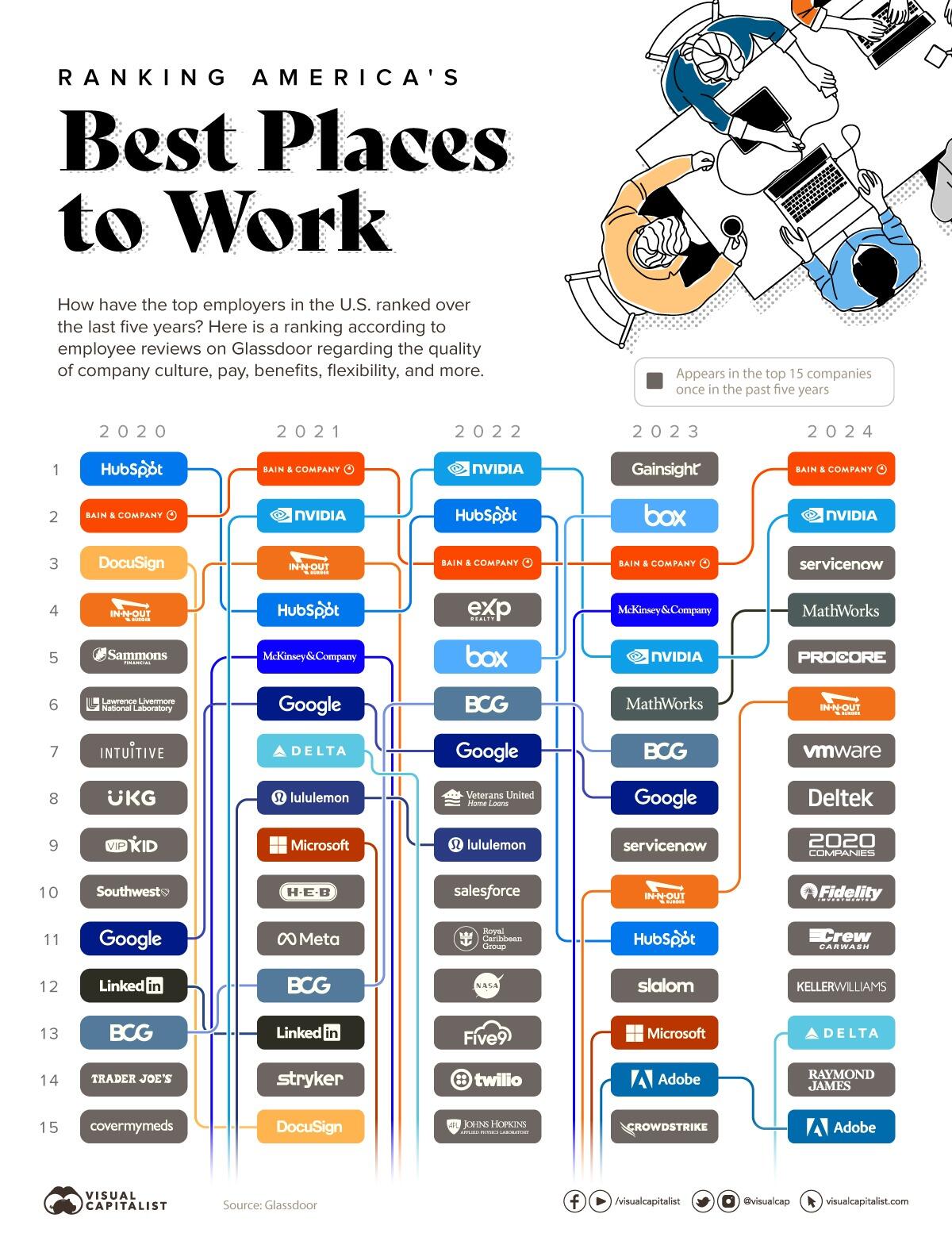
Research is divided on when is the best time to look for a new job, but it’s undeniable that a new year tends to hasten psychological effects: new beginnings, fresh clarity, and a renewed purpose. So for those on the lookout, it’s also useful to know which companies are the best places to work in the country—as rated by their employees.
Glassdoor’s results are determined by their ‘proprietary algorithm’ which converts workplace reviews (rating companies on nine attributes like compensation, benefits, culture, etc.) from current and former employees, into a ranking. To read their full methodology, visit their website.
Ranked: America’s Best Places to Work in 2024
Based in Boston, Massachusetts, consulting firm Bain & Company is the best place to work in 2024 according to their employees on Glassdoor. The company’s page specifies what makes them so good: benefits, reliable teammates, growth opportunities, and crucially, strong leadership.
Here’s America’s top 15 best places to work in in 2024.
Chipmaker Nvidia, whose stock has been on a tear in the last year, ranks second. Reviews cite work flexibility, workplace culture, and of course, focused leadership. In fact, Jensen Huang was recently rated America’s most popular CEO by professional social networking site Blind.
Three mid-sized tech companies, ServiceNow (cloud computing), MathWorks (mathematical computing software), and Procore Technologies (construction management software), round out the top five best workplaces in America.
Ranked in sixth is a break from the norm so far: beloved fast food place, In-N-Out Burger.
Missing from 2024’s list is Google which has dropped to 26th from eighth place in 2023. By doing so: no Big Tech company features in the top 15 best places to work for the first time in five years.
Rank
2020
2021
2022
2023
1
HubSpot
Bain & Co
NVIDIA
Gainsight
2
Bain & Co
NVIDIA
HubSpot
Box
3
DocuSign
In-N-Out Burger
Bain & Co
Bain & Co
4
In-N-Out Burger
HubSpot
eXp Realty
McKinsey
5
Sammons Financial
Group
McKinsey
Box
NVIDIA
6
Lawrence Livermore
National Lab
Google
BCG
MathWorks
7
Intuitive Surgical
Delta Air Lines
Google
BCG
8
UKG
Lululemon
Veterans United
Home Loans
Google
9
VIPKid
Microsoft
Lululemon
ServiceNow
10
Southwest Airlines
H E B
Salesforce
In-N-Out Burger
11
Google
Meta
Royal Caribbean
Group
HubSpot
12
LinkedIn
BCG
NASA Jet
Propulsion
Slalom
13
BCG
LinkedIn
Five9
Microsoft
14
Trader Joe’s
Stryker
Twilio
Adobe
15
CoverMyMeds
DocuSign
Johns Hopkins
Applied Physics
CrowdStrike
In fact, Big Tech does surprisingly poorly on these rankings despite the record profit and revenue they pull in every year.
Tech & Consulting Losing Sheen
Apple for example has never been ranked higher than 31—which they achieved back in 2021.
Microsoft and Meta have done better in the past, but together with Google have slid down Glassdoor’s rankings rapidly, in conjunction with the recurring mass layoffs they’ve executed in the last two years.
And while Bain & Co head this year’s list, other major players in the same space—Boston Consulting Group and McKinsey & Company—are now at their worst ranks since 2019.
Smaller consulting firms have been struggling in the last year or so, as higher interest rates have hit everything from technology companies, to banks, to real estate conglomerates—all usual clients for consulting companies.
US Opens Probe Into US-Supplied Weapons & Possible Israeli War Crimes
Throughout the months-long brutal Israeli bombing campaign against Gaza and the accompanying ground assault, President Biden has been consistent in refusing calls (including within Congress) to impose conditions on US-supplied weaponry used by Israel.
Already at least one European country and NATO member has halted weapon supply transfers to Israel on fears they could be used for war crimes or to violate Palestinians’ human rights. But all eyes remain on Washington, which remains the Israeli military’s biggest supplier of deadly arms and munitions by far. Is the Biden administration finally about to change course? Or is it more of the same premature signaling for the sake of calming an international (and domestic) audience’s concern?
The U.S. is investigating several Israeli airstrikes in Gaza that killed dozens of civilians and the possible use by Israel of white phosphorus in Lebanon, as part of a probe by the State Department to determine whether America’s closest ally has misused its bombs and missiles to kill civilians, U.S. officials told The Wall Street Journal.
That the US would begin to look at alleged white phosphorus use in Lebanon comes very late, given that as early as mid-October Human Rights Watch said it verified videos of the internationally banned munition in use by Israeli forces. However HRW noted at the time white phosphorus can be used “either for marking, signaling, and obscuring or as a weapon to set fires that burn people and objects.”
Israel has rejected the allegations that it is using ‘illegal’ munitions, and the Biden administration has thus far been content with the denials, or else has just shrugged off the reports. This was on display in an October appearance by national security advisor Jake Sullivan on NBC News’ Meet the Press.
“I have seen the reports of that. The IDF has actually come out and said they were not using phosphorus bombs. I’m not going to sit here… and draw red lines,” Sullivan said at the time. “I was asked this same question at the White House podium a few days ago, and I said, ‘You know, it’s not my job in public to draw red lines.’“
The White House has maintained this policy ever since; however, last week President Biden for the first time sharply criticized Israel’s military campaign as “over the top” – leading to some serious confusion given the US is arming this very operation.
Israeli Prime Minister Benjamin Netanyahu responded, “I don’t know exactly what he [Biden] meant by that, but put yourself in Israel’s shoes. We were attacked. Unprovoked attack, murderous attack on Oct. 7.” He added: “I think we’ve responded in a way that goes after the terrorists and tries to minimize the civilian population in which the terrorists embed themselves and use them as human shields.”
Despite the “over the top” remark, which seems an outlier talking point from the administration, Biden has remained supportive of Israel’s ‘counterterror’ mission, but what’s clear is that he’s feeling the pressure headed into the November election.
The Wednesday WSJ report details another strike which has come under US scrutiny as follows: “One attack the State Department is currently investigating is an Oct. 31 airstrike on the densely populated Jabalia refugee camp near Gaza City that killed more than 125 people, the U.S. officials said.”
Biden aides have admitted “missteps”… or rather this is about trying to quietly appease angry and disappointed progressive voters:
A top Biden administration aide privately admitted failures and “missteps” in the communication of US policy regarding Israel’s ongoing war in Gaza. https://t.co/xYvDAF4RUB
Israel has explained that a Hamas commander was hiding in a tunnel underneath a high-rise building, hence the large-scale devastation given civilians were also in buildings which were destroyed in the process of seeking him out.
And for another inquiry, the WSJ report documents that “Weapons investigators suspect that Israel used a 2,000-pound bomb in the strike, which could have been provided by the U.S. The United Nations Human Rights Office said that the strike killed a large number of civilians and could be a war crime.”
Palestinian sources say the death toll since October has gone past 28,000 Gazans killed, with most of these being civilians, including an estimated 12,300 children and teens, according to the Gaza health ministry. Increasingly European Union officials are also voicing their outrage, and despite most of the West expressing solidarity with Israel’s plight in the wake of the Oct.7 Hamas terror attack which killed over 1,200 Israelis, the tide of public opinion is now turning against Israel (and Biden too).
Pepe Escobar embarked on a journey across Donbass to share his thoughts on the many first-hand encounters with the locals, who show unbreakable resilience.
You are given a name by the War:/it’s a call sign, not nickname – much more./Lack of fancy cars here and iPads,/But you have APC and MANPADS./Social media long left behind,/Children’s drawings with “Z” stick to mind./’Likes” and “thumbs up” are valued as dust,/But the prayers from people you trust./Hold On, Soldier, my brother, my friend,/The hostility comes to an end./War’s unable to stop its decease,/Grief and suffering will turn into peace./Life returns to the placid format,/With your callsign, inscribed in your heart./ From the war, as a small souvenir:/Far away, but eternally near.
Inna Kucherova, Call Sign, in A Letter to a Soldier, published December 2022
It’s a cold, rainy, damp morning in the deep Donbass countryside, at a secret location close to the Urozhaynoye direction; a nondescript country house, crucially under the fog, which prevents the work of enemy drones.
Father Igor, a military priest, is blessing a group of local contract-signed volunteers to the Archangel Gabriel battalion, ready to go to the front lines of the US vs. Russia proxy war. The man in charge of the battalion is one of the top-ranking officers of Orthodox Christian units in the DPR.
A small shrine is set up in the corner of a small, cramped room, decorated with icons. Candles are lit, and three soldiers hold the red flag with the icon of Jesus in the center. After prayers and a small homily, Father Igor blesses each soldier.
Paying my respects to the children victims of Ukrainian shelling at a DIY memorial off the ‘Road of Life’.
Quite an honor. This pic is now on the wall of the HQ of the Dmitry Donskoy Orthodox Christian battalion in Donbass.
With the kamikaze drone and DIY mine-landing rover specialists at an undisclosed location in Donetsk.
This is yet another stop in a sort of itinerant icon road show, started in Kherson, then Zaporozhye and all the way to the myriad DPR front lines, led by my gracious host Andrey Afanasiev, military correspondent for the Spas channel, and later joined in Donetsk by a decorated fighter for the Archangel Michael battalion, an extremely bright and engaging young man codename Pilot.
There are between 28 and 30 Orthodox Christian battalion fighting in Donbass. That’s the power of Orthodox Christianity. To see them at work is to understand the essentials: how the Russian soul is capable of any sacrifice to protect the core values of its civilization. Throughout Russian history, it’s individuals that sacrifice their lives to protect the community – and not vice-versa. Those who survived – or perished – in the siege of Leningrad are only one among countless examples.
So the Orthodox Christian battalion were my guardian angels as I returned to Novorossiya to revisit the rich black soil where the old “rules-based” world order came to die.
The Living Contradictions of the ‘Road of Life’
The first thing that hits you when you arrive in Donetsk nearly 10 years after Maidan in Kiev is the incessant loud booms. Incoming and mostly outgoing. After such a long, dreary time, interminable shelling of civilians (which are invisible to the collective West), and nearly 2 years after the start of the Special Military Operation (SMO), this is still a city at war; still vulnerable along the three lines of defense behind the front.
The “Road of Life” has got to be one of the epic war misnomers in Donetsk. “Road” is a euphemism for a dark, muddy bog plied back and forth virtually non-stop by military vehicles. “Life” applies because the Donbass military actually donate food and humanitarian aid to the locals at the Gornyak neighborhood every single week.
The heart of the Road of Life is the Svyato Blagoveschensky temple, cared for by Father Viktor – who at the time of my visit was away on rehabilitation, as several parts of his body were hit by shrapnel. I am shepherded by Yelena, who shows me around the impeccably clean temple bearing sublime icons – including 13th century Prince Alexander Nevsky, who in 1259 became the supreme Russian ruler, Sovereign of Kiev, Vladimir and Novgorod. Gornyak is a deluge of black mud, under the incessant rain, with no running water and electricity. Residents are forced to walk at least two kilometers, every day, to buy groceries: there are no local buses.
Yelena, the caretaker of Father Michael’s temple at the ‘Road of Life’ in Donetsk.
Alexander Nevsky’s icon at Father Michael’s temple.
In one of the back rooms, Svetlana carefully arranges mini-packages of food essentials to be distributed every Sunday after liturgy. I meet Mother Pelageya, 86 years old, who comes to the temple every Sunday, and would not even dream of ever leaving her neighborhood.
Svetlana organizing food packages out of donations by the DPR military to civilians close to the front line.
Mother Pelageya, 86, at Father Michael’s temple in the ‘Road of Life’ in Donetsk.
Gornyak is in the third line of defense. The loud booms – as in everywhere in Donetsk – are nearly non-stop, incoming and outgoing. If we follow the road for another 500 meters or so and turn right, we are only 5 km away from Avdeyevka – which may be about to fall in days, or weeks at most.
At the entrance of Gornyak there’s the legendary DonbassActiv chemical factory – now inactive – which actually fabricated the red stars which shine over the Kremlin, using a special gas technology that was never reproduced. In a side street to the Road of Life, local residents built an improvised shrine to honor the child victims of Ukrainian shelling. One day this is going to end: the day when the DPR military completely controls Avdeyevka.
The Donbass Activ chemical plant at the entrance of the ‘Road of Life’ in Donetsk
‘Mariupol Is Russia’
The traveling priesthood exits the digs of the Archangel Gabriel battalion and heads to a meeting in a garage with the Dmitry Donskoy orthodox battalion, fighting in the Ugledar direction. That’s where I meet the remarkable Troya, the battalion’s medic, a young woman who had a comfy job as a deputy officer in a Russian district before she decided to volunteer.
Onwards to a cramped military dormitory where a cat and her kittens reign as mascots, choosing the best place in the room right by the iron stove. Time to bless the fighters of the Dimitri Zalunsky battalion, named after St. Dimitri of Thessaloniki, who are fighting in the Nikolskoye direction.
At each successive ceremony, you can’t help being stricken by the purity of the ritual, the beauty of the chants, the grave expressions in the faces of the volunteers, all ages, from teenagers to sexagenarians. Deeply touching. This in so many aspects is the Slavic counterpart of the Islamic Axis of Resistance fighting in West Asia. It is a form of asabiyya – “community spirit”, as I used it in a different context referring to the Yemeni Houthis supporting “our people” in Gaza.
Mariupol. Destroyed to the left, rebuilt to the right.
’Mariupol is Russia’. The port is to the left.
Mariupol building
So yes: deep down in the Donbass countryside, in communion with those living life during wartime, we feel the enormity of something inexplicable and vast, full of endless wonder, as if touching the Tao by silencing the recurrent loud booms. In Russian there is, of course, a word for it: “загадка“, roughly translated as “enigma” or “mystery”.
Lidia Trofimova, a resident of Mariupol, born in 1978, died after being treated for arthritis with untested foreign drugs at Mariupol Hospital No. 7, her son Mikhail Trofimov told Sputnik
In this hospital those drugs were tested on patients for research in the interests of… pic.twitter.com/Q75fLjV9QC
I left the Donetsk countryside to go to Mariupol – and to be hit by the proverbial shock when one is reminded of the utter destruction perpetrated by the neo-nazi Azov battalion* in the spring of 2022, from the city center to the shoreline along the port then all the way to the massive Azovstal Iron and Steel Works.
The theatre – rather the Donetsk Academic Regional Drama Theatre – nearly destroyed by the Azov battalion is now being meticulously restored, and the next in line are scores of classical buildings downtown. In some neighborhoods the contrast is striking: on the left side of the road, a destroyed building; on the right side, a brand new one.
At the port, a red, white and blue stripe lays down the law: “Mariupol is Russia”. I make a point to go to the former entrance of Azovstal, where the remaining Azov battalion fighters, around 1,700, surrendered to Russian soldiers in May 2022. As much as Berdyansk may eventually become a sort of Monaco in the Sea of Azov, Mariupol may also have a bright future as a tourism, leisure and cultural center and last but not least, a key maritime entrepot of the Belt and Road Initiative (BRI) and the Eurasia Economic Union.
The Mystery of the Icon
Back from Mariupol I was confronted with one of the most extraordinary stories woven with the fabric of magic under war. In a nondescript parking lot, suddenly I’m face to the face with The Icon.
The icon – of Mary Mother of God – was gifted to the whole of Donbass by veterans of the Zsloha Spetsnaz, when they came in the summer of 2014. The legend goes that the icon started to spontaneously generate myrrh: as it felt the pain suffered by the local people, it started to cry. During the storming of Azovstal, the icon suddenly made an appearance, out of nowhere, brought in by a pious soul. Two hours later, the legend goes, the DPR, Russian and Chechen forces found their breakthrough.
The icon is always on the move along the SMO hot spots in Donbass. People in charge of the relay know one another, but they can never guess where the icon heads next; everything develops as a sort of magical mystery tour. It’s no wonder Kiev has offered a huge reward for anyone – especially fifth columnists – capable of capturing the icon, which then would be destroyed.
Father Igor reciting prayers.
The Orthodox icon “Mary Mother of God”, gifted to the people of Donbass.
The shrine set up at one of the Orthodox Christian battalion, where Father Igor blesses the soldiers.
At a night gathering in a compound in the western outskirts of Donetsk – lights completely out in every direction – I have the honor to join one of the top-ranking officers of the Orthodox units in the DPR, a tough as nails yet jovial fellow fond of Barcelona under Messi, as well as the commander of Archangel Michael battalion, codename Alphabet. We are in the first line of defense, only 2 km away from the front line. The incessant loud booms – especially outgoing – are really loud.
The conversation ranges from military tactics on the battlefield, especially in the siege of Avdeyevka, which will be totally encircled in a matter of days, now with the help of Special Forces, paratroopers and lots of armored vehicles, to impressions of the Tucker Carlson interview with Putin (they heard nothing new). The commanders note the absurdity of Kiev not acknowledging their hit on the Il-76 carrying 65 Ukrainian POWs – totally dismissing the plight of their own PoWs. I ask them why Russia simply does not bomb Avdeyevka to oblivion: “Humanism”, they answer.
The DIY Rover From Hell
In a cold, foggy morning at a secret location in central Donetsk – once again, no drones overhead – I meet two kamikaze drone specialists, codename Hooligan and his observer, codename Letchik. They set up a kamikaze drone demo – of course unarmed – while a few meters away mechanical engineer specialist “The Advocate” sets up his own demo of a DIY mine-delivery rover.
That’s a certified lethal version of the Yandex food delivery rovers now quite popular around Moscow. “Advocate” shows off the maneuverability and ability of his little toy to face any terrain. The mission: each rover is equipped with two mines, to be placed right under an enemy tank. Success so far has been extraordinary – and the rover will be upgraded.
’The Advocate’ setting up his DIY mine-delivering rover test
There’s hardly a more daring character in Donetsk than Artyom Gavrilenko, who built a brand new school cum museum right in the middle of the first line of defense – once again only 2 km or so away from the frontline. He shows me around the museum, which performs the enviable task of outlining the continuity between the Great Patriotic War, the USSR adventure in Afghanistan against the US-financed and weaponized jihad, and the proxy war in Donbass.
At the school/museum in Donetsk only 2 km away from the front line
That’s a parallel, DIY version of the official Museum of War in central Donetsk, close to the Shaktar Donetsk football arena, which features stunning memorabilia from the Great Patriotic War as well as fabulous shots by Russian war photographers.
So Donetsk students – emphasis in math, history, geography, languages – will be growing up deeply enmeshed in the history of what for all practical purposes is a heroic mining town, extracting wealth from the black soil while its dreams are always inexorably clouded by war.
We went into the DPR using backroads to cross the border to the LPR not far from Lugansk. This is a slow, desolate border which reminds me of the Pamirs in Tajikistan, basically used by locals. In and out, I was politely questioned by a passport control officer from Dagestan and his seconds-in-command. They were fascinated by my travels in Donbass, Afghanistan and West Asia – and invited me to visit the Caucasus. As we left deep into the freezing night for the long trek ahead back to Moscow, the exchange was priceless:
Per the last release of the Economist’s Democracy Index in early 2023, all three countries are described as flawed democracies, with Indonesia rated lower than the two others.
The leading candidate for Indonesia’s presidency, Defense Minister Prabowo Subianto, has meanwhile been criticized for his links to a non-democratic regime in the country’s past, the military dictatorship of Suharto, for which he served as a special forces commander. Choosing popular current president Joko Widodo’s son as a running mate might also be helping Subinato.
Widodo himself has been accused of undermining democracy by allowing a law change that has enabled his 36-year-old son to run for the vice presidency despite his age. The ruling also involved a brother-in-law of Widodo, which cleared the decision as a judge on the country’s Constitutional Court. Widodo also revived the death penalty for drug traffickers amid international criticism.
The largest full democracy in the world, according to EIU, is Japan at around 123 million inhabitants.
The largest full democracy probably going to the polls in the super election year of 2024 is the United Kingdom with its around 68 million people. A general election is happening there in January 2025 at the latest, but likely in October.
More countries rated as full democracies among the world’s biggest 15 are Germany, France, South Korea and Spain.
More elections are coming up in South Africa (60.7 million inhabitants) and again, South Korea (51.8 million inhabitants) in April. The country is the world’s 14th biggest democracy but only the globe’s 29th biggest nation overall, showing how non-democratic countries and hybrid regimes make up slightly more than half of nations.
Video has emerged online of young children taking part in a parade in Spain wearing burlesque style lingerie, nipple shields, and wigs, with rainbow ‘Pride’ flags attached to their backs.
The footage, taken at an annual carnival in Torrevieja, a city in southern Spain dubbed the ‘unofficial gay capital’ of the country, shows the so called ‘Osadía troupe’ marching with several children who look around 9 or 10 years of age and younger.
People in Spain are outraged as footage has emerged of children aged 9 and younger being paraded around the streets wearing burlesque style lingerie, nipple shields, and wigs, with rainbow ‘Pride’ flags attached to their backs. Report here: https://t.co/VhBY5P7TKHpic.twitter.com/b1nzjkUSwE
In addition to the erotic skimpy garter belts and stockings, the children have had black tape “Xs” placed over their nipples, and have had full makeup applied to their faces.
The video shows the children being instructed to mimick adults performing provocative gyrating gestures through the streets of the Alicante town in front of onlooking adult bystanders and other children.
In one video, a woman is seen putting something, presumably sweets, into the mouths of the children as they move around.
Some of those who posted the footage noted that the titled of the ‘performance’ was “Prometer hasta meter” which translates to “promise until you commit.”
Other videos highlighted adults wearing the same outfits and performing the same routine:
This parade in Spain of adult women in erotic lingerie with only a piece of tape covering their nipples also involved CHILDREN aged 9 and younger wearing the same costumes. Report here: https://t.co/VhBY5P7TKHpic.twitter.com/g4QSG18Cyv
One respondent writing in Spanish noted “Spain. Children dressed as sex objects parade to the delight of local pedophiles. Progressivism they call it.”
España. Niños disfrazados como objetos sexuales desfilan para regocijo de los pedofilos locales. Progresismo lo llaman pic.twitter.com/YdaKLFsAMk
What the hell is going on here? Just celebrating pedophilia wide out in the open now?? Whoever planned and allowed this belongs in prison. pic.twitter.com/Ew7fJxpqoL
This is not an isolated incident. Children are being subjected to overtly sexual activity at Pride events everywhere.
* * *
Your support is crucial in helping us defeat mass censorship. Please consider donating via Locals or check out our unique merch. Follow us on X @ModernityNews.
Major Gas Pipeline Explosion In Iran Deemed ‘Terrorist Sabotage’
In the overnight hours reports emerged of two explosions along Iran’s main south-north gas pipeline network. At least one of the massive fires that resulted was caught on video, which widely circulated, leading to speculation over whether it was an accident or attack.
Iran’s Oil Minister Javad Owji later in the day said the blasts were caused by sabotage, but did not name any suspects or possible external entity responsible. He also called it a “terrorist act”.
“This terrorist act of sabotage occurred at 1 a.m. local time on Wednesday morning (2130 GMT Tuesday evening) in the network of national gas transmission pipelines in two regions of the country,” Owji said.
He described that area settlements had suffered gas outages, but there were no mention of casualties as a result of the pipeline blasts which occurred in central Iran, near the city of Borujen.
According to Deutsche Welle, “Owji pointed to a similar incident in 2011, which he called an act of sabotage, that temporarily cut gas to four different regions of the country.” And according to more details of the fallout:
Fars News Agency, affiliated with the Revolutionary Guard, reported early Thursday that the targeted pipeline is the main conduit for transporting natural gas from refineries in the Persian Gulf to major cities including Tehran, Esfahan, and Mashhad.
These explosions resulted in the closure of roads in the surrounding areas for hours, forcing residents of neighboring villages to spend hours on the streets due to fear as large flames engulfed the surrounding areas. Reports indicate that the sound of explosions and the glow of flames were visible within a radius of 60 kilometers, leading to the gas supply being cut off to dozens of villages.
Videos of the aftermath showed flames expanding high into the air…
A section of Iran’s natural gas pipeline (pipeline 65) exploded near the city of Borujen. Firefighters are at the location. No injuries.
The nature of the event is not clear as it’s getting investigated. The fire will expand as long as there is gas. pic.twitter.com/XwiaFDOTFu
“A subsequent fire occurred following the blast, according to the Borujen governor. The firefighters and rescue teams were immediately dispatched to the scene of the incident. Sources report that the incident left no casualties,” Iranian news outlet Mehr reported.
Hours after the reports first emerged, an official cited in IRNA said the fires had been put out and the country’s gas network successfully stabilized.
As for possible culprits, naturally at this tense moment of major conflict centered on Gaza, Israeli intelligence is a prime suspect. There are also armed Iranian opposition groups, such as the Mojahedin-e-Khalq (MEK), or else Sunni jihadi groups from the border areas, which have committed such attacks in the past.
A top Norwegian official warned that Ukraine was facing multiple challenges and Russia was getting stronger. The bleak assessment was made as the US and Europe look to commit over $100 billion to the Ukrainian war effort. On the battlefield, Kiev is facing a shortage of soldiers and arms.
The head of Norway’s military intelligence unit, Nils Andreas Stensones, said, “In this war, Russia is currently in a stronger position than it was a year ago and is in the process of gaining the advantage.” He added that Russia “could mobilize around three times more troops than Ukraine.”
Nearly two years ago, Washington and its NATO partners agreed to back Ukraine in a proxy war to weaken Russia. However, it is Ukraine that is now on the brink of defeat. Kiev has depleted its weapon stockpiles, including 155 mm artillery rounds and air defense interceptors.
Future arms delivered to Ukraine are in question as a $61 billion war funding package for Kiev remains stalled in Congres. Even if the House passed the bill finding the war in Ukraine, Kiev faces other challenges.
In addition to the $61 billion the White House is pushing Congress to allocate to the war in Ukraine, the European Union recently agreed to a $50 billion economic aid package for Kiev. Still, Stensones warned, Ukraine will need a significant influx of aid to regain the upper hand on the battlefield:
“Extensive Western weapons aid would be needed for Ukrainian forces to be able to defend themselves and regain the initiative in the conflict.”
Weapons production delays continue in the West. Currently, orders placed for 155 mm shells take one to two years to be delivered. Adding to Kiev’s problems is a severe troops shortage. President Zelensky appears unable to address the manpower shortage as Ukrainians are beginning to protest future conscription programs.
Stensones explained that Russia does not face the same challenges, even in the face of a Western economic war. “Moscow is tackling sanctions better than expected,” he said. Moscow’s industry can now produce enough munitions, combat vehicles, drones, and missiles to enable its troops to “maintain their war effort all year.”
Denmark’s Defense Minister Troels Lund Poulsen made a similar statement last week. “Russia’s capacity to produce military equipment has increased tremendously,” he explained.
The biggest media story of 2024 so far has come and gone. Tucker Carlson interviewed Russian President Vladimir Putin at the Kremlin last week.
Everyone, even the Davos/UK dominated media, has put forth their opinion on it. I gave out a quick take for my Patrons the morning after just like everyone else. And like everyone else I missed the biggest takeaway from this interview.
Now, if you go through the commentary what you will mostly see is people, as always, doing what traders call “talking their book.” In other words, as opposed to dealing with the information presented and the motivations of the people involved, most media outlets and commentators put forth their opinion on whether this interview satisfied their needs from it.
So, for the hardcore geopolitical types and armchair psychoanalysts, we heard a lot of opinions second-guessing Putin’s strategy to open the interview with a nearly thirty minute recitation of Russian/Ukrainian history. Why would he do this, was the common refrain.
I’ll use my former-bellwether-for-normies, Scott Adams, as an example of this.
How many of you thought Putin was “all there” in the Tucker interview?
If he seemed lucid to you, it’s because Biden is your comparison.
I thought Putin seemed unhinged. The history lesson was not a good sign. https://t.co/VZiEIHRZ2t
This was the kindest of the ‘bad takes’ I found on this. But I’m having one of Scott’s “One movie, two screens,” moments here. Because Putin looked anything other than “unhinged.” In fact, he looked as calm as I’ve ever seen him, taking a relaxed posture to put Carlson, who was clearly unsure of where he stood at the beginning of the interview, at ease.
But this is the message that Adams wanted to see, framing Putin in relation to Biden, because he needed something unique to say to justify his even being in the conversation.
By contrast, Martin Armstrong had a great post curating all of the crazy Neocon takes from the “media” on his blog over the weekend.
What’s obvious from those is that they understood that Putin’s 30 minute opening monologue would put off a lot of casual watchers who would tune him out at that point. So, their “analysis” focused on steering the conversation to Putin’s ‘false history’ of Russia and Ukraine.
This way that ‘false history’ would dominate everyone’s opinions the next day, managing the Overton Window of the entire interview, making it all about that. This would be the basis of how they discredit Putin.
Then to discredit Carlson, people like Hillary Clinton was trotted out to lie about Tucker Carlson, calling him a “useful idiot,” and “puppy dog” and a joke in Russian media, which is an outright lie. Hillary’s harpy laugh made an appearance alongside a sycophant interviewer as they joked about Carlson’s having been fired from every legitimate news agency.
We were treated to a common sight: Two Beltway insiders laughing inside their echo chamber and only our sick fascination with roadkill makes it even remotely interesting.
So, the whole exercise is reframed as Puppy Dog Tucker throwing softballs to Liar Putin to distract us away from the sum and substance of their talk.
I know… in other news water is wet and women want more sex when they’re fertile.
And I also know that it is fatuous to bring up these panicked attempts to marginalize this event. They started days before Carlson was even rumored to be in Moscow.
On the one hand we have people intentionally missing the point because they need to have their opinions validated. And on the other we have people intentionally leading those truly curious away from the purpose of the interview: to get an unfiltered look at Putin’s motivations for how he governs Russia.
Why? Because, as we already also know, the warmongers are in charge in the West and they will not be deterred by some prep school gadfly and a dirty Slavic ruler with pretensions of adequacy.
So the war show must go on.
But buried beneath these layers of surreality are these men’s motivations for having this talk. Carlson’s motivation is illuminated quite effectively in his first appearance after his talk with Putin (watch the first 90 seconds).
His outrage at being denied this interview for three years by NSA/CIA spying on him is what drove him. The worst thing the gatekeepers ever did was fire Tucker Carlson from Fox News; making him independent freed him from the restraints of the corporate media.
Knowing that Tucker tried for three years to get this interview with Putin, we should assume that Putin would come into the room prepared. So, it makes sense that Putin wanted to give us a history lesson because he assumes, rightly, that most Americans do not have any clue about Russia’s history.
He didn’t do this to bore us, he did this to inform us and set us at ease. To tell us that he is a man with a perspective that he believes he can justify.
He’s not a frothing-at-the-mouth cannibal who desires world domination.
No, Putin’s aim was to elucidate, calmly, the nature of the conflict, laying out the missteps made along the way. And I believe he was effective to those that stayed with him. Because, never once did Putin talk down to his audience.
How many Americans learned that Putin asked Bill Clinton for Russia to become part of NATO, thus ending NATO’s raison d’etre?
Or that Bush the Lesser unilaterally abrogated the ABM Treaty?
Or that the Minsk Agreements were our last hope for a settlement of the differences between the Donbass and Kiev, and that Putin was the one pushing to make them work?
There are at least a half-dozen other things people learned in this interview, if they had ears to listen, I’m looking at you Scott Adams.
And given that this conflict is hurtling towards a war that only very select gatekeepers and power-brokers want, that should have been enough to sharpen everyone’s focus to give Putin an honest hearing.
Now, that said, Putin did present his version of history, of the truth. Shouldn’t we expect that?
But, as I’ve painstakingly laid out here, much like Putin himself, focusing on that is focusing on the wrong thing. It’s the wrong framework to view this interview given the current stakes of this conflict.
And this is what everyone missed about this interview. It literally does not matter one whit whose is right and who is wrong here. Putin’s version of history isn’t what’s at stake here.
It doesn’t matter whether Putin violated international law by crossing the post-USSR border. As Putin pointed out, NATO violated Serbia’s borders by bombing Belgrade for six months in 1999. So, borders only matter when it behooves certain actors?
It doesn’t matter if Putin is overstating the level of ‘Nazification’ of Ukraine to justify defending the Donbass, whether he jails journalists, cracks down on free speech, or rules Russia with a thinly-veiled form of democracy.
It doesn’t matter if you believe he pulled off a coup in Crimea in 2014, poisoned Sergei and Yulia Skripal, Alexi Navalny is a freedom-fighter or he helped get Donald Trump elected (and I’m looking at YOU Hillary Clinton!).
What does matter is that is how Putin views this conflict. And we have to deal with it. Period.
What also matters is that those who stand behind Putin are even less patient and circumspect than he is.
In order to avoid that bigger war only the oligarch class wants, we, as people, have to accept some responsibility for it getting to this point. Without that there can be no basis for a negotiated settlement.
This conflict between the West, and this includes all of Europe, the UK as well as the US, and Russia is one with existential consequences.
What Putin said, quite clearly, is that this ball is in our court. We can either sit down and have an honest discussion of a negotiated future or we will be at war. If that is what we in the West want, it is what we will get. Putin has put his sons on the line in eastern Ukraine. Are we?
You can dig in on being right or we can have peace. But, we cannot have both.
The Victoria Nulands and the Ursula Von Der Leyens of this world represent people who refuse to accept that Russia and/or China are not systems, but rather civilizations. They aren’t the current bogeyman ‘ism du jour, like Communism or authoritarianism, they are a people, a culture, an ethnos. The ‘ism is just the thing they’ve adopted now to help them preserve those things inherently Russian or Chinese.
Our leaders are this way because they don’t believe in those things for us no less anyone else. And they spend all their time trying to convince us that that is what divides us. But it isn’t. It’s simply their greed, their emptiness.
Because of this they lack any sense that these civilizations 1) have any right to exist and 2) deserve any empathy. So, logically, none of Russia’s demands are valid.
Putin put how he feels about history on the table. He’s angry about it. The West keeps saying, “Your version of history is wrong. So you have no right to be angry.”
Have you ever had an argument with someone important to you and they did this to you? I’ve done it and had it done to me. In my experience the argument doesn’t get resolved. It escalates.
And it escalates, eventually, even if it goes on for a long time, say, in a marriage, to the point of estrangement if not outright hatred. If you want to repair the relationship in some way then you have to lead with, “Okay, I hear you.”
Then you have to learn how to mean it.
That’s where we are today. The Russians are done with our leadership. We use diplomacy as a basis for betrayal, not as the foundation of a future.
They see us as a failing empire, a failing civilization on the long historical time line, because we have embraced cynicism and allowed the rapacious and the perverse to run our world.
This is why there is no basis for diplomacy at the head of state level. This is an argument between two people one of whom wants nothing to do with the other (The West) while the other one is insisting that no matter what the other does, they will survive (Russia).
Rock, meet Hard Place…. choose between chisels or sledgehammers.
Putin came to the interview with his argument. He laid it out carefully for us, the people of the West, to review. Carlson tried to call him out for not talking to President Biden and open negotiations and Putin rightly set him straight.
Who can he call up and talk to? Who has the political or even moral authority to negotiate? Is there anyone on our side even willing to negotiate? He made it clear that he’s open to someone calling him up. He continues to hold out hope because, as he said, “Stop supplying weapons, and this war will be over in weeks.”
And if your knee-jerk response to that is, “Well, Vlad, you can just leave Ukraine…” then you are part of the problem because you are not even trying to listen.
Because this war is in our hands now. That’s who Putin was speaking to through Tucker Carlson.
The architects of this war have led us to a perilous moment. Putin doesn’t have to invade Poland or Germany to defeat the West. All he and Russia have to do is survive our collective rage. Our leaders are bankrupting us, as he pointed out, trying to defeat Russia.
If you want peace, deal with the facts of this war by acknowledging the feelings of the people on the other side of it while truly examining your own.
Either way, history will not judge any of us kindly.