70.5 F
Chicago
Saturday, September 19, 2026
Home Blog Page 2921

Institutions Double Down On AI In trading — JPMorgan Survey

0
Institutions Double Down On AI In trading — JPMorgan Survey

Authored by Helen Partz via Cointelegraph.com,

Institutional investors have been increasingly betting on the role of artificial intelligence (AI) in the future of trading, according to a new survey by the multinational investment bank JPMorgan.

In the most recent edition of JPMorgan’s “e-Trading Edit: Insights from the Inside” survey, 61% of the 4,010 institutional traders surveyed across 65 countries anticipated AI and machine learning (ML) to emerge as the most impactful technologies for trading within the next three years.

According to the survey’s rankings, AI and ML are followed by application programming interface (API) integration, with 13% of respondents choosing it as one of the most important technologies shaping the future of trading.

Blockchain or distributed ledger technology and quantum computing both account for 7% based on the respondent’s preferences. Mobile trading applications and natural language processing secured 6% of respondents.

Technologies shaping the future of trading. Source: JPMorgan

AI and machine learning have been steadily gaining ground in JPMorgan’s reports in recent years, with the tech accounting for just 25% in ranked importance two years ago.

On the other hand, institutions have been growing increasingly skeptical about the role of other technologies in trading, including mobile trading applications and blockchain, according to JPMorgan’s survey. Since 2022, blockchain and mobile trading applications have lost 18% and 23% of investor choices as promising technologies for trading, respectively.

AI has been reshaping the future of finance over the past few years by offering various features, including trade predictions or identifying real-time threats to market sentiment. According to a 2022 report by Nvidia, investors have been integrating AI and ML, with 30% of respondents reportedly managing to reduce their annual revenue by more than 10%.

While doubling down on the AI role in trading, JPMorgan-surveyed institutions have become less willing to get into cryptocurrency trading.

According to the survey results, 78% of institutional traders have no plans to trade cryptocurrencies like Bitcoin

or digital coins within the next five years. The percentage of investors not planning to trade crypto has increased since last year, as 72% of respondents indicated unwillingness to trade such assets in 2023.

Institutional sentiment to cryptocurrency investment. Source: JPMorgan

At the same time, the percentage of respondents that have started trading crypto or trade it already has slightly increased from 8% in 2023 to 9% in 2024.

JPMorgan has been controversial in terms of its approach to crypto over the past few years. CEO Jamie Dimon continued to slam cryptocurrencies like Bitcoin even after the company was named an authorized participant in one of the fastest-growing spot Bitcoin exchange-traded funds by BlackRock.

Tyler Durden
Mon, 02/12/2024 – 17:00

NATO Chief Shocks With Prediction Of ‘Decades-Long Confrontation’ With Russia

0
NATO Chief Shocks With Prediction Of ‘Decades-Long Confrontation’ With Russia

NATO Secretary General Jens Stoltenberg issued some shocking words over the weekend which the Kremlin will likely take as a threat. “NATO is not looking for war with Russia. But we have to prepare ourselves for a confrontation that could last decades,” he told German daily Welt am Sonntag on Saturday. His words also reflect a new emphasis and drive among NATO planners for European countries to urgently invest more heavily in defense and domestic weapons production, as is happening for example in Germany and France. 

So far, defense leaders and officials from NATO countries have tended to speak about a time frame of the conflict lasting “years” – but to hear Stoltenberg tell the West it must brace for a war going on for “decades” is somewhat unprecedented. 

If Putin wins in Ukraine, there is no guarantee that Russian aggression will not spread to other countries,” Stoltenberg continued, echoing an assumption that’s been a persistent talking point out of Zelensky and his Western backers.

EPA via Shutterstock

He urged that to prevent this future scenario, the allies must ramp up support to Ukraine and member states must invest in NATO military infrastructure. “Deterrence only works if it is credible. As long as we invest in our own security and remain united, we will continue to deter any form of aggression,” Stoltenberg said.

Interestingly the words followed on the heels of the Tucker Carlson interview with Vladimir Putin wherein the Russian leader appeared to appeal directly to the US government saying he is ‘ready’ for sincere talks to end the war. “We are willing to negotiate,” Putin had told Carlson and said in reference to the Biden administration: “You should tell the current Ukrainian leadership to stop and come to the negotiating table.”

But Putin also emphasized that the West must understand it is “impossible” to defeat Russia in Ukraine. Putin’s point was that no matter the timeline, and how long the war gets drawn out, it will be the same result of a Russian battlefield victory.

The White House was quick to bat down Putin’s apparent overture as insincere. “Despite Mr. Putin’s words, we have seen no actions to indicate he is interested in ending this war. If he was, he would pull back his forces and stop his ceaseless attacks on Ukraine,” a White House official told The New York Times this weekend.

From the start of the war it has remained a key talking point of Western pundits and leaders to assume Putin is driving an ‘expansionist’ war that threatens the rest of Europe. This has resulted in some leading European allies to drastically increase their defense spending and arms production, as Stoltenberg is still encouraging with his latest comments.

Zelensky too has long said that if the West doesn’t stop Russia in Ukraine, then EU countries are next to be attacked. But Putin in the Carlson interview rejected the idea that he’s leading an expansionist war or based on ‘imperial ambitions’. He said in response to the accusation that it’s “out of the question”

He addressed it specifically in the following: “Only in one case, if Poland attacks Russia. Why? Because we have no interest in Poland, Latvia or anywhere else. Why would we do that? We simply don’t have any interest.” 

Stoltenberg’s latest words on Putin’s motives and intent contradict his own prior assessment. Back in September during a speech at the EU Parliament’s foreign affairs committee, Stoltenberg very explicitly explained that Putin made the decision to invade Ukraine because of fears of NATO expansionism.

His surprisingly frank comments at the time were as follows:

“The background was that President Putin declared in the autumn of 2021, and actually sent a draft treaty that they wanted NATO to sign, to promise no more NATO enlargement. That was what he sent us. And was a pre-condition for not invade Ukraine. Of course we didn’t sign that.

The opposite happened. He wanted us to sign that promise, never to enlarge NATO. He wanted us to remove our military infrastructure in all Allies that have joined NATO since 1997, meaning half of NATO, all the Central and Eastern Europe, we should remove NATO from that part of our Alliance, introducing some kind of B, or second class membership. We rejected that.

So he went to war to prevent NATO, more NATO, close to his borders.”

These prior words implied Russia saw itself as acting defensively in Ukraine. And yet now Stoltenberg claims that Putin fundamentally has an expansionist war in mind that will eventually see more European countries come under direct threat. However, at this point not even tiny Moldova has been invaded by Russia, which many pundits have long predicted. 

Tyler Durden
Mon, 02/12/2024 – 15:20

Meet Dr. Kathleen Hicks – SecDef Austin’s Presumptive Replacement Woke Deep-Stater

0
Meet Dr. Kathleen Hicks – SecDef Austin’s Presumptive Replacement Woke Deep-Stater

Authored by Bob Bishop via Sonar21.com,

Lloyd Austin underwent an invasive surgical procedure called a prostatectomy for his prostate cancer. He was readmitted to the ICU ward of Walter Reed National Military Medical Center seven days later, on January 1st, due to complications caused by a severe infection. It appears he was septic. He concealed his inability to carry out his duties from Biden, Congress, the Pentagon, and his Deputy Secretary, Dr. Kathleen Hicks. On January 4th, finally becoming aware of Austin’s hospitalization, security adviser Jake Sullivan notified Hicks, who was on vacation in Puerto Rico.

Even though Biden continued to back Austin, Austin was already politically skating on cracked thin ice due to the colossal failure of the Afghanistan military withdrawal. Predictably, he will resign. His presumptive replacement is Hicks. Few are aware of Hicks’s woke, deep-state background. Hicks views her Defense Department role as the chief operating officer; in other words, she formulates strategic plans and policy.

Think Tank Cult

Hicks is a policy wonk focusing on climate change, health security, and DEI issues. She holds a Ph.D. in political science from the Massachusetts Institute of Technology. She previously served as senior vice president, Henry A. Kissinger Chair, and director of the International Security Program at the Center for Strategic and International Studies (CSIS). CSIS is a hawkish non-profit think tank providing policy solutions to influence political and bureaucrat decision-makers.    

She also served on the Boards of Council on Foreign Relations and the Truman Center for National Policy. She served on the Center’s board with Vice Chairman Hunter Biden, Kamala Harris, Jake Sullivan, and Pete Buttigieg, ring leaders in the Biden Administration. The Center promotes critical race and gender theology in the State Department and the military and advocates decarbonizing the military. This is a page out of the script of the Idiocracy movie.

Deputy Secretary Hicks’s Woke Policies

Hicks establish the Deputy’s Management Action Group (DMAG) to be the Defense Department’s principal governance body to address topics from diversity to extremism. You would be correct if you consider Hicks’ role similar to the Soviet Union’s political commissar.  

After the January 6th protests, Secretary Austin delegated Hicks to conduct a sixty-day review of white nationalism and racist ideologies in the military (AKA Inquisition). It created the false impression of counter-revolutionary forces embedded in the military. The report was tacitly released last month and provided no evidence supporting Austin’s justification for purging the military of right-wing extremism. Military morale and recruiting have bottomed out at an all-time low. As Gomer Pyle used to say, “Surprise, surprise, surprise!”

Dep. Sec. of Defense focus on diversity & eliminating faux right-wing extremes promotes division

Hicks plans on cutting the military’s carbon footprint by using EVs and hybrid fuels. The military will build charging stations and an electric grid for vehicles that “makes them resilient to manmade or weather-related effects.” She wants to switch from conventional fuels for aircraft and maritime fleet vessels to hybridized fuels or electric approaches, which “has lots of tactical warfighting advantages for us.” “Those are quieter for systems, we can go longer, we can cut fuel lines.” Her junk science green-energy transition is a dangerous delusion and threatens national security.

Dep. Sec. of Defense Hicks plans cutting military’s carbon footprint by using EVs and hybrid fuels

Mandatory DEI Indoctrination

Hicks delivered a DoD Pride Month Event speech promoting diversity and inclusion for the military, public employees, and private contractors. She directs the implementation of racial and gender identity-based pedagogy through “diversity and inclusion requirements and course curriculum, including training to detect and respond to unconscious bias” to advance enterprise-wide DEI.

Idiocracy 2.0

The U.S. military used to represent the best in America. But no more due to society’s youth being too obese, too moronic, and too drugged to fill its ranks. Thus, military recruitment standards are dropping, and led by nomenklatura executive leadership; the military is being hurdled towards an Idiocracy, much like the dark comedy. How paradoxical faux right-wing extremism and climate change are a national threat and not an invasion of millions of military-aged males pouring over an open border.

*  *  *

Bob Bishop is a forensic investigator and retired CPA.

Tyler Durden
Mon, 02/12/2024 – 15:00

Biden Rejects Putin’s Offer For Negotiations On Ukraine Issued In Tucker Carlson Interview

0
Biden Rejects Putin’s Offer For Negotiations On Ukraine Issued In Tucker Carlson Interview

Last week in the wake of the Tucker Carlson interview with Russia’s President Putin, we highlighted that Putin’s offer to the West to negotiate the end of the Ukraine war appeared genuine. “We are willing to negotiate,” Putin told Carlson in the lengthy interview. Importantly he said in reference to the US government: “You should tell the current Ukrainian leadership to stop and come to the negotiating table.”

We further noted that Russian media is touting the widely watched interview as the first time Putin has offered ‘concrete conditions’ which can lead to settlement. “I think the most important message in Putin’s interview is that Russia is ready for for a political or diplomatic solution of the Ukraine conflict,” said Dmitry Suslov, deputy director of the Center for European and International Studies at Russia’s Higher School of Economics, to Russia’s Sputnik. “But it requires a political will from the United States.” he said.

The overture’s significance also lies in the fact that Russia is winning the war, and thus has less reason to enter negotiations at this moment of having the clear upper hand. This fact alone means Putin’s words could represent a significant and authentic invitation to start serious talks.

But perhaps to be expected, the White House doesn’t see it like that, as the US has swiftly rejected Putin’s offer. A spokesperson for the White House’s National Security Council responded to the Putin interview by telling The New York Times there’s nothing to indicate this is a genuine offer out of the Russian leader.

“Both we and President Zelensky have said numerous times that we believe this war will end through negotiations,” the spokesperson said. “Despite Mr. Putin’s words, we have seen no actions to indicate he is interested in ending this war. If he was, he would pull back his forces and stop his ceaseless attacks on Ukraine.”

The NSC spokesperson also repeated a familiar Biden administration talking point, telling the Times further that “Ultimately, it’s up to Ukraine to decide its path on negotiations.”

Yet Ukraine would have to do the one thing Zelensky has vehemently refused to do: territorial concessions as well as forever giving up claims on Crimea. Even if Zelensky refuses, it is likely an inevitability, even if it takes years, Putin and his officials have pointed out.

Russia for now appears content to militarily solidify its firm grip over the four annexed territories of the east, and to continue to drain Ukraine of its manpower and ammo along the largely stalemated front lines. Planning over the future course of the war has already caused division within Kiev’s leadership, resulting in Zelensky embarking on a major military and government “shake-up”. There are also signs that a bigger Ukraine military mobilization is on the horizon, which could trigger division, and protests and unrest on Ukrainian streets.

As for Tucker Carlson’s perspective, he has since voiced as reported in Russian media, “Putin wants to get out of this war. He’s not going to become more open to negotiation the longer this goes on.”

Tyler Durden
Mon, 02/12/2024 – 14:40

Kirby Cornered Over Biden-TikTok Push, While Migrants Continue To Use App For Border Malarkey

0
Kirby Cornered Over Biden-TikTok Push, While Migrants Continue To Use App For Border Malarkey

It hasn’t gone unnoticed that Joe Biden’s Sunday announcement that he’s joined TikTok contradicts the administration’s stance on the app, which remains banned on government devices.

When asked during a Monday presser about the announcement, White House spox John Kirby said that the concerns over the app are more over the “preservation of data and the potential misuse of that data and privacy information by foreign actors.”

Watch:

Meanwhile, TikTok is the app of choice for human trafficking.

According to a segment on “60 Minutes,” migrants have purportedly been using videos on the China-owned social media platform that provide ‘step-by-step instructions’ for how to find gaps in the border wall and hire smugglers. 

A TikTok spokesperson told Fox News Digital, “TikTok strictly prohibits human smuggling which we remove from our platform and report to law enforcement when warranted.” –Fox News

TikTok claims that 93% of human trafficking content on the platform is proactively removed.

*  *  *

Authored by Steve Watson via Modernity.news,

Joe Biden’s campaign announced Sunday that he is now on TikTok, despite the fact that Biden signed a bill banning the platform on all devices assigned to federal employees a year ago.

Biden’s X account reposted a cringe video from his campaign account in which he answers questions about his Super Bowl preferences.

Several respondents pointed out that Biden signed into law a limited TikTok ban in December 2022 as part of the 4,126-page spending bill.

Furthermore, in March last year, Biden threatened to ban TikTok altogether unless the app’s Chinese owners agree to spin off their share of the social media platform.

The ultimatum was made by Biden’s Committee on Foreign Investment in the United States, in response to concerns about the amount of data TikTok trawls, and the platform’s links to the Chinese Communist Party.

In the same month, The U.S. House Foreign Affairs Committee voted to advance a bill, titled Deterring America’s Technological Adversaries, that would clear the way for a full ban on the app.

A similar bipartisan bill, called Restricting the Emergence of Security Threats that Risk Information and Communications Technology (“RESTRICT”) Act, was introduced in the Senate around the same time.

Meanwhile, the president (presumably one of his interns) posted this after the game last night on his personal X account…

*  *  *

Your support is crucial in helping us defeat mass censorship. Please consider donating via Locals or check out our unique merch. Follow us on X @ModernityNews.

Tyler Durden
Mon, 02/12/2024 – 14:34

Stocks Hit All Time High On “New Era In Productivity And Profitability”… Except, We’ve All Seen This Before

0
Stocks Hit All Time High On “New Era In Productivity And Profitability”… Except, We’ve All Seen This Before

By Benjamin Picton of Rabobank

Authentic Foolishness?

Another day, another record for the S&P500. This time the index closed above 5000 for the first time ever and, once again, the gains were mostly driven by the Magnificent Seven tech names. Those seven stocks posted a gain of ~1.7%, while the S&P500 ex Magnificent Seven eked out a more modest 0.25%. The rapid gains since late October last year are very much predicated on the theme of Artificial Intelligence (AI) heralding a new era of productivity and profitability, helped along by lower discount rates as bond yields fell and markets priced in an aggressive easing cycle from major central banks.

Except, we’ve been here before. New Era thinking is certainly not new, and eye-watering valuations on stocks with a compelling narrative behind them is a tale as old as time. There are loads of examples, and many of them are recent enough that we should know better. For most of us, the Dotcom boom happened during our lifetimes. Before that was the Nifty Fifty, and the Roaring Twenties before that, and the Railway Mania, and the South Sea Bubble, and John Law’s Folly, and TulipMania and so on and so forth all the way back to the neolithic. So, is Artificial Intelligence really a game-changer, or is it another case of ‘Authentic Foolishness’?

Whatever the case, the intellectual basis for the rally grows thinner by the day. The Wall Street Journal desperately asks the question ‘Stocks are at Records, But Are They Expensive?’ (spoiler: yes).  We now enter the phase of New Era thinking where P/E ratios, the CAPE ratio or the Buffett Indicator are pushed to the side while alternative valuation metrics (rate of patent filings, R&D spend etc) are proffered to justify soaring valuations. It certainly feels reminiscent of measuring the number of ‘eyeballs’ Pets.com got during the Dotcom years.

So, valuations grow more stretched, expected future returns fall as prices rise, and even the easy-money tailwind from falling bond yields appears to have hit a snag as a sustained break below 4% for the 10-year continues to elude. Indeed, US 10s saw yields pump 15 basis points higher last week as markets reacted to the strong jobs report from the previous Friday, hawkish Fedspeak, firmer jobless claims figures and a revision to the last 5 years’ worth of reported CPI that saw 3 and 6 month annualized inflation creeping higher. In light of the arrayed headwinds, it’s hard not to wonder how much the huge growth in passive indexing is responsible for “feeding the beast”, or is it just a case of markets observing Chuck Prince’s infamous dictum that “as long as the music is playing, you’ve got to get up and dance”?

Given the record close for long duration equities, those upward revisions in CPI don’t seem to have scared the horses too much. The rationale being that the revisions were reasonably small and that the Fed targets PCE, not CPI. Nevertheless, market pricing on the quantum of Fed rate cuts in 2024 has shifted from 7x to just over 4x in a few short weeks, and CPI is a measure of inflation that is preferred in almost every other developed economy, so it’s hardly irrelevant to conversations of policy.  The Wisdom of King Solomon says that “hope deferred makes the heart sick”, but Solomon was a hard money kind of guy, so maybe he didn’t have the effect of later rate cuts on equity valuations top of mind at the time.

Speaking of hope deferred, last week saw an interesting move in the short end of the Aussie and Kiwi rate curves. Antipodean traders wound back bets on monetary easing after New Zealand labor market figures for Q4 showed the unemployment rate rising to just 4% (instead of the expected 4.3%) and one of the local major banks broke ranks to forecast two more rate rises from the RBNZ, with the first to arrive next week. RBNZ Chief Economist Paul Conway sounded hawkish in his speech of the week before, and the new Government in New Zealand has recently trimmed the central bank’s mandate to give it a singular focus on returning inflation to 1-3% (currently 4.7%). Adding to the tone, RBNZ Deputy Governor Hawkesby today told a Parliamentary Committee that the economy “can cope with high interest rates”. Are markets being softened up for another move higher?

The RBA also tilted more hawkish at their policy meeting last week by suggesting that further rate hikes “cannot be ruled out”. Governor Michele Bullock went further in her press conference by telling assembled journalists that she sees the risk of the next move in the policy rate being a hike (as opposed to a cut) as “finely balanced”. We don’t think the RBA is likely to deliver on threats of further tightening, but the balance of risks has certainly shifted. More of our thoughts on that score here.

While antipodean central banks beef up their tightening bias, Brent crude is again trading above $80/bbl as ceasefire talks between Israel and Hamas appear to be going nowhere. Our analysts have a Q1 price target of $80/bbl on Brent, but see potential for a shift higher in H2 as the Fed begins to ease and demand catches up to supply. Of course, there is always the potential for the situation in the Middle East to get worse, and potentially disrupt energy flows through the Hormuz Strait, a scenario that our analysts suggest could see $150/bbl oil if it were to occur.

We’ve not yet mentioned the Super Bowl, or the looming end of the BTFP program and what that might mean for commercial real estate. Our Senior US Strategist Philip Marey has written an excellent note on the latter topic that you can read here. In the meantime, I’ll close by paraphrasing Lord King’s observation that the structure of our financial system encourages radical disequilibria that finds expression in soaring debt levels, soaring asset valuations and downward sloping yield curves.

Riding the asset price wave makes complete sense while the disequilibria holds, but dislocations in global trade, threats of inflation resurgence and popular discontent heighten the risk that this paradigm is not a new long-term steady state. To suggest that this really is a New Era of higher valuations, and that “this time it really is different” might be the height of Authentic Foolishness.

Tyler Durden
Mon, 02/12/2024 – 14:20

Inflation Uncertainty Leaves Global Bonds On Thin Ice

0
Inflation Uncertainty Leaves Global Bonds On Thin Ice

Authored by Simon White, Bloomberg macro strategist,

Inflation may have fallen from its peak around the world, but in the inflationary regime in which we remain, upside surprises are more likely.

That would worsen already weak liquidity in global bonds and heighten the risk of rising yields.

Global bond yields have fallen almost everywhere in recent months, but that shouldn’t distract from the fact that underlying conditions remain combustible, and a seemingly (relatively) benign environment for yields could be abruptly upended.

Bond yields are driven by term premium — in which we can lump all the other risks inherent to owning longer-term bonds such as liquidity and inflation — and by rate expectations.

Liquidity and inflation are related.

The volatility of inflation, which rises when inflation rises, tracks bond liquidity. Higher inflation volatility typically goes with poorer liquidity in bonds.

As we can see from the chart above, developed-market inflation volatility remains elevated, leaving bond liquidity liable to deteriorate.

Bonds have been trading with a negative skew, shown for the TLT (ETF of long-term USTs) below, which means that poor liquidity is more likely to lead to lower prices, higher yields.

This comes at a time when there are compelling signs of a cyclical upswing in global growth.

The combination of supported growth, receding US recession risk, heightened inflation uncertainty, and a deterioration in bond liquidity is a complete recipe for higher bond yields.

The risk is compounded when taking account of the rarefied view that US bond yields – which have a significant influence on DM yields – will move much higher this year, according to bank surveys.

Tyler Durden
Mon, 02/12/2024 – 12:00

3-Year Inflation Expectations Tumble To Lowest On Record, As Earnings Expectations Suddenly Surge

0
3-Year Inflation Expectations Tumble To Lowest On Record, As Earnings Expectations Suddenly Surge

One month after inflation expectations tracked by the NY Fed Consumer Survey extended their recent slide, when in December one-year inflation expectations saw the third consecutive decline in a for a series which traditionally is also a proxy for the price of oil, and which last month dropped to the lowest since Jan 2021, moments ago the NY Fed published results from the January 2024 Survey, which found that while 1- and 5-Year inflation expectations were unchanged on the month, the 3-Year inflation expectation slumped to 2.4%, from 2.6%, the lowest on record

Some more details from the latest survey: Median inflation expectations remained unchanged at the one- and five-year ahead horizons in January, at 3.0% and 2.5%, respectively. Median inflation expectations at the three-year ahead horizon declined to 2.4% from 2.6%. 

Median inflation uncertainty – or the uncertainty expressed regarding future inflation outcomes – increased slightly at all three horizons.

The latest survey comes one day before the release of January CPI report, where economists forecast headline inflation will post a modest decline to 2.9% from 3.4% in December, while core inflation dips to 3.7% from 3.9% YoY.

The pullback in consumers’ near-term inflation views reflected a number of factors, as price changes declined for all goods tracked in the survey, falling by 0.3 percentage point for gas to 4.2%, by 0.1 percentage point for food to 4.9%, by 0.9 percentage point for rent to 6.4%, by 0.5 percentage point for medical care to 8.6%, and by 0.4 percentage point for the cost of a college education to 5.9%. The reading for the expected price change of gas is the lowest since December 2022, while those for food and rent were the lowest since March 2020 and December 2020, respectively.

Median home price growth expectations remained unchanged for the 4th consecutive month at 3.0%, remaining well above the series 12-month trailing average of 2.4%. And with the Fed preparing to cut rates, this is about to explode higher.

While inflation expectations slumped, there was an unexpected reversal households’ expectations for earnings growth: after tumbling to the lowest level since April 2021, the one-year ahead earnings growth suddenly surged by 0.3% – the biggest monthly increase since Sept 2021 – to 2.83%…

… driven by a surge in expectations by respondents above the age of 40, those without a college degree, and those making under $50,000 – good luck to them all – while expectations for people making over $100,000 had their expectations unchanged.

Why employers would be aggressively boosting wages in one year’s time if prices are set to stumble and crush margins isn’t exactly clear to anyone except the NY Fed organizer of the survey who may have slipped a couple of their own preferred “results” here and there.  And tied to that, the “Median expected growth in household income increased by 0.1 percentage point to 3.1% in January, remaining above its pre-pandemic February 2020 level of 2.7%.” Sure, why not.

Elsewhere in the survey, perceptions of credit access also improved notably, with a smaller share of respondents saying it is harder to obtain credit now than it was a year ago and a larger share reporting it is now easier. The share of respondents expecting tighter credit conditions a year from now also declined.

Commenting on the data, Renaissance Macro said what everyone else was thinking, namely that “bth realized and expected inflation data should nudge the Fed to an adjustment in their policy stance.”

Here are some other observations from the latest survey, first focusing on the labor market:

  • Median one-year ahead expected earnings growth increased by 0.3 percentage point to 2.8%, returning to the narrow range of 2.8% to 3.0% seen between September 2021 and October 2023.
  • Mean unemployment expectations—or the mean probability that the U.S. unemployment rate will be higher one year from now—increased marginally to 37.2% from 37.0% in December, remaining below the series 12-month trailing average of 39.2%.
  • The mean perceived probability of losing one’s job in the next 12 months decreased by 1.6 percentage points to 11.8%. The mean probability of leaving one’s job voluntarily in the next 12 months also declined, to 17.7% from 20.4% in December. Both readings are below the series 12-month trailing averages.
  • The mean perceived probability of finding a job if one’s current job was lost decreased by 1.7 percentage points to 54.2%, its lowest reading since June 2021.

… and on consumers’ household finances:

  • Perceptions of credit access compared to a year ago were largely unchanged. Expectations about credit access a year from now instead improved with a larger share of respondents expecting looser credit conditions and a smaller share of respondents expecting tighter credit conditions a year from now.
  • The average perceived probability of missing a minimum debt payment over the next three months increased by 0.6 percentage point to 12.4%, a level above the series 12-month trailing average of 11.5% but comparable to those prevailing just before the pandemic.
  • The median expected year-ahead change in taxes at current income level remained unchanged at 4.1%.
  • Median year-ahead expected growth in government debt decreased to 9.4% from 10% in November.
  • The mean perceived probability that the average interest rate on saving accounts will be higher in 12 months decreased by 3.6 percentage points to 25.9%, its lowest level since November 2021.
  • Perceptions about households’ current financial situations improved with fewer respondents reporting being worse off than a year ago. Year-ahead expectations also improved with a smaller share of respondents expecting to be worse off and a larger share of respondents expecting to be better off a year from now.
  • The mean perceived probability that U.S. stock prices will be higher 12 months from now increased by 0.2 percentage point to 36.7%.

More in the full NY Fed note available here.

Tyler Durden
Mon, 02/12/2024 – 11:45

The Catalyst That Could ‘Standardize’ Bitcoin

0
The Catalyst That Could ‘Standardize’ Bitcoin

Submitted by QTR’s Fringe Finance

Today in my series called “things people following Bitcoin for the last 13 years have already figured out but I’m presenting as a brand new epiphany”, I wanted to write about a revelation about Bitcoin’s adoption, standardization, and normalization I had this past week. While thinking about what it would take for Bitcoin to receive a massive adoption push in the United States, I was able to think of one such scenario that may not be very far off.

And contrary to what you think, it doesn’t have anything to do with regulation, taxation, accounting standards, or any of the things that are mistakenly talked about as the ebb and flow of Bitcoin adoption on a daily basis. As I learned firsthand while finally doing some research on Bitcoin over the last month, none of those things truly matter. The decentralized nature of the network necessitates that it doesn’t need any of those things to flourish. I noted this in my article last week called “Why I Bitcoin.”

But what I also noted in the same article was that Bitcoin will survive if the people want it to survive. For those who understand the network, they understand that ~20,000 global nodes mean that the network is going to stay up regardless of which politician, jurisdiction, or regulatory agency around the world tries to stand in its way. This is part of the elegance of the network.

And still, having realized that, I think to myself, “What is going to accelerate that adoption so much that we move from now—a point of almost no return for Bitcoin—to a significant point of serious escape velocity?” The answer was right underneath my nose.

When I wrote the title to my article last week called “Why I Bitcoin,” it was just one of those titles that came to me instinctively. Sometimes I spend hours trying to figure out which title is going to be the catchiest, and other times, like with this article, I have the title set out beforehand because it is very clear what I want to say.

But I was walking around over the weekend and wondering where I had heard that phrase before.

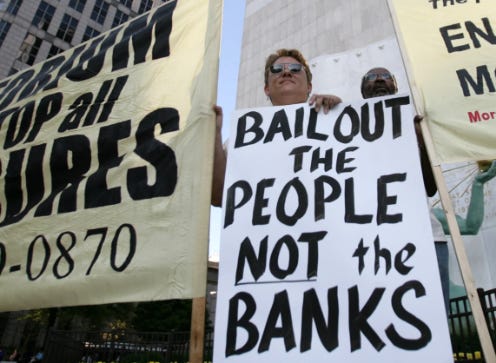
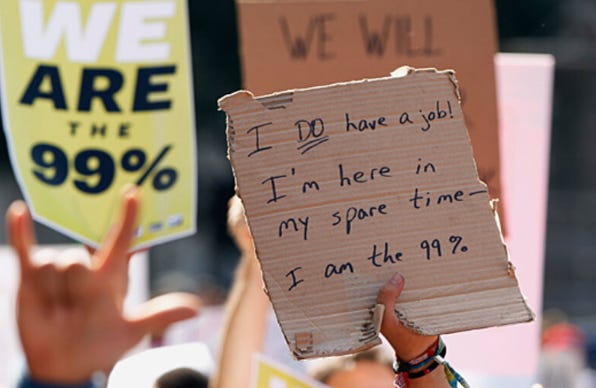
Suddenly, it came to me. In one of my favorite comedy skits, a group of Philadelphia improv comedians went to the Occupy protests that occurred as a result of the 2008 economic crash. In more than one spot, there are signs that say “Why I Occupy.” In fact, this was basically the namesake of part of the Occupy movement. I remember that WhyIOccupy.org was the source for quite a bit of the pissed-off populace at the time; they thought whatever ideology was on that website was their particular brand of solution to the financial crisis.

It was only after remembering that, that I thought in the next major financial crisis, people really are going to have a legitimate exit ramp from the system. Bitcoin is that exit ramp. It’s the thing that people involved in the GameStop frenzy were so desperately looking for, whether they knew it or not, but couldn’t find.

While the GameStop fiasco was taking place, I remember thinking to myself that there were too many people who were pissed off but didn’t have any idea what they were angry about. In chat rooms and on social media, everybody was catching blame but the Federal Reserve. These people were pissed off because they felt like they were getting gypped: they were reacting, whether they knew it or not, to the widening of the inequality gap while they were struggling to make ends meet.

But what they didn’t know was that this wasn’t the fault of Ken Griffin, Citadel, or short sellers; rather, it was the fault of the Federal Reserve.

Nowadays, it’s becoming clearer as the Fed shoehorns that inequality gap even wider. It’s clearer because inflation is a mainstream story and a phenomenon that people can understand. Even if they don’t know why inflation is happening, most people have a semblance of understanding that it has to do with the Fed blowing out the money supply over the last four years and then, to add insult to injury, lying to the public about inflation being transitory.


Support our work by becoming a paying subscriber today & get 50% off FOR LIFE: Get 50% off forever


And those who hoped to repeat GameStop’s success with names like AMC now know that toxic management and a loss-making business can very easily take the air out of any momentum in any type of short, or FOMO, squeeze in any one equity. And they also know that brokerages and regulators can prevent them from transacting in it anytime they damn well please.

During the next major financial crisis, which, in my opinion, isn’t that far away, the same group of pissed-off “have nots” will hopefully direct more of the blame where it belongs: monetary policy. After all, inflation is a brutal tax on the people who can’t afford it and is all but meaningless for the super-rich. And, the super-rich get super richer as a result of quantitative easing and money printing, which directs a disproportionate amount of relief to the stock, bonds and housing market: assets that rich people have that lower-income people do not have.

I would often ask during the Fed money printing over Covid, that if the Fed wanted to print $5 trillion, why wouldn’t they just divide it up evenly amongst all people in the United States and cut us all a check? After all, $5 trillion divided by 300 million people is about $16,500 per person. Putting systemic reasoning aside, this is a fairly simple straightforward question. If you want to stimulate the economy by spraying money all over the place, why not do it equally amongst all of its citizens, instead of playing favorites?

But that isn’t what happened in 2008, and it’s not going to be what happens during the next financial crisis.

What I do think will happen, however, is a new group of “have nots” and economic renegades will be exponentially more informed about how monetary police works, not just as a result of the GameStop fiasco, but also as a new, younger generation has familiarized themselves with the ideological case for Bitcoin. Before I even took to Bitcoin, one of the things I liked about it was the idea that it was forcing a younger generation to understand Austrian economics in a world where we have all but overused and beaten to death our modern monetary theory privileges. Armed with this new knowledge, an entire new generation of pissed-off, regular people will once again bear the cost of socialized losses from nefarious, toxic companies who privatized their profits. And this will be within an inflationary crisis still fresh in their minds. This time there will be no question about who is eroding the purchasing power and the wealth that they have worked for through taxation and inflation.

Which brings me to my point: Bitcoin could very well be the exit ramp that millions of angry people look towards in such a situation.

Unlike with GameStop, Bitcoin actually does have the chance to affect major change because the network’s success is tethered to how large it grows. This means that with every single person who decides to own, or educate themselves about, Bitcoin, they become part of a self-fulfilling prophecy of the network’s success. And, of course, the ideology behind the success of the network is firmly rooted in empowering people just like them: the people who are tired of having what little they earn silently whisked away from them by the dark inflationary financial machinery of the night.

Many people who participated in the GameStop frenzy, including the “apes” over at Reddit’s Wall Street Bets and millions of other retail traders, will be forced to realize that Bitcoin has all of the positives of what they sought to achieve in the past without the negatives. There is no management to mess it up, there is no counterparty to dilute them, there is no one to turn off the buy button and there is essentially no governing or regulatory body to prevent the network from being a success if the people want it to be one. It becomes the digital freedom that all of these people sought out during the last financial crisis but had no effective way to manifest.

2008 was yet another echo of what has become par for the course on Wall Street: every time things get catastrophic, the public bears the cost, gets pissed off and brandishes the torches. But then it eventually blows over and people go about their business.

“I’m starting to feel a little better about this whole thing,” John Tuld says at the end of Margin Call, signifying that the more things change, the more they stay the same.

Bankers and politicians have been relying on this pattern to play out the way it has in the past in order for them to continue to perpetuate the same scheme they’ve been part of for decades. It is, in essence, what enables the miscarriage of justice of everyday Americans bearing the cost of failures of the ultra-rich.

And so, the next time this happens, the investing public could legitimately have a chance to break that cycle for the first time in half a century by adopting Bitcoin. It has a chance to opt them out of the system that they have railed against. Capital flows into Bitcoin and out of traditional financial assets will send a message to major financial institutions who only respond to the opportunity to make fees (see their newfound obsession with Bitcoin now that there’s ETFs for reference). At the same time these flows could add to the self-fulfilling prophecy of the network becoming a success, due to its redundancy essentially serving as the barometer for the health of the network.

It is by no means guaranteed, but if the system ever goes belly up again, and the average person is looking for a true weapon to fight the system – and one that is literally programmed to be the technological braille of the phrases “there’s safety in numbers” and “power to the people,” Bitcoin could shine through and open an epoch for itself that be seen in the future as its adoption Renaissance.


Support our work by becoming a paying subscriber today & get 50% off FOR LIFE: Get 50% off forever

QTR’s Disclaimer: I am an idiot and often get things wrong and lose money. I may own or transact in any names mentioned in this piece at any time without warning. This is not a recommendation to buy or sell any stocks or securities, just my opinions. I often lose money on positions I trade/invest in. I may add any name mentioned in this article and sell any name mentioned in this piece at any time, without further warning. None of this is a solicitation to buy or sell securities. These positions can change immediately as soon as I publish this, with or without notice. You are on your own. Do not make decisions based on my blog. I exist on the fringe. The publisher does not guarantee the accuracy or completeness of the information provided in this page. These are not the opinions of any of my employers, partners, or associates. I did my best to be honest about my disclosures but can’t guarantee I am right; I write these posts after a couple beers sometimes. Also, I just straight up get shit wrong a lot. I mention it twice because it’s that important.


Tyler Durden
Mon, 02/12/2024 – 11:20

Red Sea Ship Resorts To Broadcasting “All Muslim Crew” In Effort To Avoid Houthi Attacks

0
Red Sea Ship Resorts To Broadcasting “All Muslim Crew” In Effort To Avoid Houthi Attacks

Commercial vessels sailing through the Red Sea have been broadcasting that they’re not connected with Israel and or the US, aiming to avoid Iran-backed Houthi attacks. The creativity behind the broadcasts to thwart attacks has been stepped up a notch, according to research firm TankerTracker

On Sunday afternoon, TankerTracker spotted livestock carrier Cattle Force that broadcasted the message: “All Crew Muslims” as it approached the Bab el-Mandeb Strait off Yemen’s coast. 

“This is a first,” TankerTracker wrote on social media platform X. 

In recent weeks, some vessels have broadcasted “No Link To Israel,” “No Relation To Israel,” and “Nothing With Israel” to avoid Houthi attacks. 

According to tracking data analyzed by Bloomberg, Cattle Force successfully sailed through a maritime chokepoint and is in the Red Sea as of Monday. 

“The change was an apparent message to the Houthis, who say they’re targeting ships linked to Israel and its allies to pressure them over the war in Gaza,” Bloomberg United. 

Other vessels may take notice as Japanese shipping giant Mitsui OSK Lines Ltd. warned last week that the Red Sea crisis/disruption could last six months and one year

Tyler Durden
Mon, 02/12/2024 – 11:00