Last April, Germany shut down its last three nuclear power stations, marking the end of the country’s atomic age.
The controversial decision came at a time when Europe and the German public was beginning to warm up to nuclear energy in the wake of the continent’s energy crisis following Russia’s invasion of Ukraine.
“We will need more electric power in the future. That’s a fact. And 6% can be a lot to miss when there is nothing new [to replace it]. We’d be losing 6% when we really will need more,” German Chancellor Olaf Scholz told Deutsche Welle in 2022 shortly after the invasion.
Back then, Germany and scores of European nations were seriously rethinking their nuclear phaseout strategies with over 80% of the German public in favor of extending the lifespan of the country’s existing nuclear reactors. The Washington Post even reported that Germany was repairing coal mines and power plants that were mothballed for more than a decade in what was dubbed a “spring” for Germany’s coal sector. Previously, the country had set a goal to phase out coal-generated electricity by 2038.
But with Germany and Europe having little trouble securing ample new gas supplies, mainly from the United States, the country’s ruling coalition has suddenly changed its tune.
Scholz is now adamant that “nuclear energy is over” and the issue is “a dead horse in Germany” after facing criticism from members of the Free Democrats party who warned that suddenly ditching nuclear energy would only lead to burning more fossil fuels.
“Anyone who wanted to build new nuclear power plants would need 15 years and would have to spend €15-€20 billion each,” Scholz went on.
Two years ago, German politicians vehemently denounced the opposition’s and the EU’s attempt to label nuclear energy as sustainable.
Well, Scholz’s critics were right on the money.
Berlin has unveiled plans to spend €16 billion on 10 gigawatts (GW) of new gas-fired power plants in a major overhaul of the country’s energy grid.
The governing coalition has announced that the new strategy is “in addition to the consistent expansion of renewable energies,” and is key to providing steady power supplies “even in times where there is little sun and wind.”
The government has touted the fossil gas power plants as “modern, highly flexible and climate-friendly” because they will, subsequently, be converted to run on hydrogen in the mid-to-late 2030s.
State-owned, multinational energy company Uniper has lauded the move, saying that “swift action is urgently needed because the approval process and the actual construction of power plants and storage facilities will take several years.“
Germany is now a leading advocate phasing out nuclear energy at an EU level.
As you might expect, environmental groups have come out swinging, with Greenpeace denouncing the strategy as a “perfect example of how the hype around hydrogen is just a smokescreen for more fossil gas.”
On a purely emissions standpoint, nuclear energy is cleaner than natural gas because it produces zero carbon emissions; the lifecycle emissions of nuclear energy are significantly lower than in gas-based generation and it also doesn’t produce other noxious greenhouse gasses.
Unfortunately, several high-profile nuclear accidents including Three Mile Island, Chernobyl and Fukushima will probably remain etched in the public psyche for decades, if not centuries, to come making nuclear power the indelible dark sheep in the global energy mix.
Natural gas is viewed much more favorably.
Back To Renewable Energy
Germany is also abandoning its short-lived love affair with coal. Last year, the country’s giant power firm, LEAG, announced it will convert its lignite-fired thermal power plants into Europe’s largest green energy hub, with a capacity between 7 GW and 14 GW. LEAG has a target to install between 7 GW and 14 GW of wind and solar energy capacity; 3 GWh of storage capacity and 2 GW for green hydrogen production in the Lusatia region in Eastern Germany by 2040.
But Germany is hardly the only European nation that has rekindled its hatred for ‘dirty’ fossil fuels. French energy giant Engie recently announced plans to build a 500 megawatt gas plant near the city of Nijmegen in the Netherlands on the site of a former coal-fired generator. Engie says the facility will be a “hybrid plant” and could be powered by hydrogen in the future.
The United States’ natural gas and LNG bonanza is certainly helping Europe turn its nose up on carbon-heavy fossil fuels: With exports averaging 11.6 billion cubic feet per day (Bcf/d) during the first half of 2023, and ~70% of exports going to Europe and much of the balance to Asia, the U.S. is now the world’s largest LNG exporter.
But Biden just put that at risk with his latest activist-driven executive order.
Independent candidates affiliated with imprisoned Pakistani political leader Imran Khan’s Pakistan Tehreek-e-Insaf (PTI) party have won the most seats in elections for the National Assembly.
Vote counting is ongoing, but the Election Commission of Pakistan announced that independent candidates have won 98 seats so far, with the winners of 22 seats still undetermined. The majority of the independents are affiliated with Khan’s PTI party.
Members of the PTI ran as independents after the party was effectively banned last month. The Pakistani Supreme Court ruled that the party could not use its traditional electoral symbol, a cricket bat. Because many PTI supporters in rural areas are illiterate, the symbol would be the only way to identify the party on the ballot for many.
Khan was slapped with three jail sentences last week and barred from holding any public post for ten years. The former premier has been the target of lawfare since being ousted in a US-backed legislative coup in early 2022.
The PTI has been the target of harassment and even abductions of its candidates by pro-military elements that do not wish to see Khan or his party return to power.
The party has also seen restrictions imposed on rallies and media coverage, as authorities ordered journalists and television stations not to mention Khan’s party as part of their election coverage.
The Pakistan Muslim League Nawaz Party (PMLN) has won 69 seats, while the Pakistan People’s Party (PPP) has the third-most with 51 seats.
None of the country’s three major parties will win the necessary 169 seats to form a government on their own, meaning a coalition must be formed to determine the next prime minister.
Khan used an AI-generated video of himself to claim victory in the election from prison, asking his supporters to “now show the strength of protecting your vote.”
Chairman Imran Khan’s victory speech (AI version) after an unprecedented fightback from the nation that resulted in PTI’s landslide victory in General Elections 2024. pic.twitter.com/Z6GiLwCVCR
“You kept my trust, and your massive turnout has stunned everyone,” the AI voice said in the video.
Khan’s opponent, former Pakistani Prime Minister Nawaz Sharif, was previously deposed in a coup and spent years abroad to avoid prison on corruption charges. However, Sharif is currently viewed as the military establishment’s choice.
However, some PTI candidates who ran as independents could be pressured to align with other parties when forming a coalition.
According to Michael Kugelman, the director of the South Asia Institute at the Wilson Center, “the military will likely pressure them to do so.”
Sharif’s PMLN may also be able to form a coalition with other parties and exclude the PTI from the government, Kugelman added.
The 2024 U.S. presidential election will likely pit former President Donald J. Trump against current President Joseph Biden in an epic rematch of the 2020 election. As most Americans know, in 2020, the Democrats and their allies on the far left reached deep into their bag of dirty tricks to put Biden in the White House. They will undoubtedly pull out all of the stops yet again in 2024. This time, however, far more people are watching and are aware of the grifts being run in our elections by the left.
With so many election integrity groups and concerned citizens watching this time around, what will the Democrats do to tilt the results in their favor?
They have quite a few arrows in their quiver, but virtually every trick relies on one thing: dirty voter rolls.
Voter rolls filled with unqualified voters—for instance, voters without a valid address or with an insufficient or incorrect address—are ready-made for fraud. A mailed ballot may go out to that person, but if the address is wrong or incorrect, the ballot will not reach the voter. These “floating ballots” are often gathered and cast as votes illegitimately. These practices, along with many others, are widely practiced around the country.
Election integrity groups all over America are fighting to clean voter rolls, state-by-state and town-by-town. Progress has been made. For instance, election integrity groups worked hard to clean up Wisconsin’s voter rolls after the 2020 election. Using fractal technology to tie voter rolls to addresses in state property tax databases, phantom voters are being removed from voter rolls throughout the country, making mail in ballot shenanigans more difficult. In Michigan, an election integrity group puts qualified voter file data at your fingertips, allowing ineligible voter registrations to be readily identified. These are just a smattering of the efforts going on across the country to clean up voter rolls, but hopefully the point is made: A lot of people are doing good work to try to clean up the voter rolls all over the country.
What is the problem, then? How will the Democrats and far-left non-governmental organizations (NGOs) tip the scales back in their favor?
Part of the answer is the National Voter Registration Act(NVRA). This Act is commonly known as the Motor Voter Law, because it mandates states to allow people to register to vote when obtaining a driver’s license. While this law actually requires states to remove the names of ineligible voters and to maintain “accurate” lists of registered voters and is used by election integrity groups to challenge inaccurate voter rolls, other provisions are problematic.
This provision creates what is known as the “quiet period” in the 90 days leading up to a federal election and prohibits states from “systematically” removing “names of ineligible voters from the official lists of eligible voters” during that 90-day window. As the court observed in Arcia v. Fla. Sec’y of State, 772 F. 3d 1335 (11th Cir. 2014), the NRVA allows three forms of removals in the 90 days before an election: (1) removals at the request of the registrant; (2) removals for criminal conviction or mental incapacity; and (3) removals upon the death of the registrant. In that case, the court prohibited the Florida secretary of state from systematically removing illegally registered people who were not American citizens in the 90-day “quiet period.”
How will the left seek to take advantage of this 90-day “quiet period” where voters may not be systematically removed from the rolls?
What happened in Muskegon County, Michigan, in 2020 is illustrative. In October 2020, thousands of voter registration applications were filed in Muskegon County, Michigan. The city clerk was immediately suspicious, as many of the applications were in the same handwriting and contained incomplete or invalid addresses. The city clerk reported the matter to local police. An investigation confirmed many of the registrations were fraudulent and that the company gathering and submitting the registrations worked with Democratic political organizations, including working with the Biden campaign in multiple States in 2020.
The police interview with the contractor’s “compliance officer” was obtained by an independent researcher and released in November 2023. In it, the employee outlines the problems with “false registrations” that were happening “everywhere,” not just in Muskegon. Listen to this person’s interview for more on the type of organization this is and how it operates.
Under a provision of the Federal Voting Rights Act, 52 U.S.C. §10307(c), a person who knowingly or willfully gives false information as to his “name, address, or period of residence” to register to vote or “who conspires with another individual” for the purpose of encouraging false registration may be imprisoned for 5 years. Despite this, no one was prosecuted for the thousands of false voter registrations submitted in Muskegon, Michigan. In fact, instead of expanding the investigation to other jurisdictions in Michigan as well as into other states, the investigation was shut down, according to news reports. That does not inspire much confidence in the people in charge of maintaining the integrity of our elections, does it?
In the 90-day “quiet period” established by the NVRA, local election officials are effectively the only screening system in place to block unlawful voter registrations. While challenging an individual registration remains possible in the 90-day “quiet period,” challenging thousands of registrations submitted on a particular day or series of days will undoubtedly be a prohibited “systematic” challenge. Do you think these officials in many of the Democrat bastions in big cities would refuse to accept these bogus registrations? Do you think what happened in Muskegon, Michigan, was an aberration? In jurisdiction after jurisdiction and city after city, piles of fraudulent registration applications will probably be readily accepted. After all, why not?
The bottom line is that the entire Democrat and far-left get-out-the-vote apparatus will be in overdrive in the 90 days before the 2024 presidential election, submitting as many voter registrations as possible (valid or not) in order to harvest as many ballots as conceivably possible.
This will be one of the primary battlegrounds that will determine the outcome of the 2024 election. Is the RNC ready for it?
If “what’s past is prologue,” the answer is probably not. Election integrity groups are doing what they can, but they will need your help.
If Americans hope to maintain legitimate elections, 2024 is the time for “all hands on deck.”
* * *
Daniel R. Street is an attorney with over 25 years of litigation experience. He is the author of the Fake News Exposed about Trump book series. Links to his books, substack, social media and more may be found at his website danielrstreet.com.
Unseasonably warm temperatures in the Northeast are ending to start the week as a snowstorm approaches. We have been following a “pattern change” since mid-last week, warning days ago of the increasing possibility of a snowstorm impacting the Mid-Alantic and Northeast regions.
AccuWeather meteorologists say Ohio Valley, Mid-Atlantic, central Appalachians, and southern New England will see rain or a mixture of rain, wet snow, and sleet to start Monday. By night, portions of the central Appalachians, the upper mid-Atlantic, and New England will transition to all snow, and some areas could receive significant accumulation.
“The way the cold air will invade the storm it appears the best bet for a heavy snowfall will be from northern Pennsylvania to southeastern upstate New York, and southern and central New England, especially from northeastern Pennsylvania on to the east from Monday night to Tuesday evening,” AccuWeather Chief On-Air Meteorologist Bernie Rayno said.
Richmond, Virginia, Washington, DC and Baltimore are forecasted to receive mostly rain. Philadelphia might receive a coating, with higher odds of a few inches in northern and western suburbs. On Monday night, New York City, Manhattan could receive upwards of 2 inches. As for Boston and Hartford, Connecticut, these areas could expect meaningful snowfall.
More from Accuweather on the snow forecast:
The Poconos in northeastern Pennsylvania and the Endless Mountains along Pennsylvania’s northern tier are likely to pick up 6-10 inches of snow, while the lower elevation cities along the Susquehanna River, like Harrisburg and Wilkes-Barre, Pennsylvania, may struggle to pick up 3 inches of slush. Other spots with the best chance for 6-10 inches of snow and locally higher amounts include the Catskills of eastern New York and much of Massachusetts, including the hills west of Boston.
“For much of the central Appalachians to central and southern New England, accumulations will be highly dependent on elevation, where hilly areas and the mountains will pick up much more snow than the valleys or immediate coastal places,” AccuWeather Senior Meteorologist Adam Douty said.
Here’s what other meteorologists on X are saying about the upcoming storm:
The impact map for tomorrow night through Tuesday has been updated! Premium Consulting Members, the impact map in the Premium Dashboard is zoomable down to your street! #nywx#njwx#pawx#ctwxpic.twitter.com/t0IBso6a0k
The ultimate “good for you” is to be dead. At least that is what it would be if some outside authority, or entity, was watching our human behaviour and assessing what looks to be the “best” for us – meaning that if we are dead, nothing bad can happen to us. I would assume that if we fed all of the information a typical human life creates into a supercomputer, and then asked it “What is the best state of being for a human being” it would spit out, “that it never be born, and if alive, it would be safest, (best, good,) for it to be dead.”
The next notch down from this perfection would be to live in a bubble, literally.
Apparently, there are some people who have no immune systems who have to do this (remember the Seinfeld episode, “The Bubble Boy”?)
The next notch down is to be a recluse, to live on some little patch of land, in a little house, and venture out only into your local neighbourhood to buy fish sticks, Twinkies, and RC Cola.
You would never fly in a plane, and never drive as well.
The next notch down is the spot that most people seem to wish they occupied.
This place in the sun is actually sunless. Or at least as sunless as you can make it. Here we find gobs of sunscreen, dark glasses on cloudy days, heavy coats in the fall, and umbrellas in summer. We find ourselves avoiding nearly everything that can be avoided, except the things, of course, that actually do harm us, like McDonalds’ “Big Macs” and a nice can of Diet Coke. Here we avoid travel to dicey countries (which includes nearly all of them), if we travel at all. We avoid being in the same room with someone who is coughing or sneezing or looking the least bit odd, and we essentially avoid taking any risks whatsoever. Nearly everything is dangerous, and it is best to avoid anything unknown, dubious in nature, or not recommended by the guys and gals in white coats with the antique medical device hanging around their neck.
A person at this level of existence is alive but certainly not living.
Why are people into this?
Well, once again, we can thank Mr. Agenda.
Before I was “awakened” I used to muse at this phenomenon and wonder how it could have happened naturally and organically. I thought about all the men clambering on board boats and planes to go to Europe to fight in the trenches in 1917, as well as in 1941. I thought of the scads of pioneers setting out on the perilous journey across the American continent during the decades after the Civil War. I thought of the untold numbers who left the comfort of their homes (which at the time probably wasn’t all that comfortable) to hazard the jungles of Central America to work on the malaria-infested Panama Canal, and the same untold numbers of brave men and women who set out on various journeys in dark and dangerous parts of the world to pursue fame and fortune, or to lend their humanitarian hand in helping others less fortunate.
Where are all of these people today? Sure, there are a few left, but nowhere as many as there used to be. Now most people are terrified to step out of their house, and if they are told by Big Brother to avoid coming close to other humans, or to wear a piece of paper or cloth over their quivering face, they do so frantically and obediently.
Did this decline in chutzpah happen as a natural consequence of social evolution?
No. I don’t think so.
Now I believe it is part of the plan—the agenda.
Ol’ Dr. Paranoia’s mind at work again. Maybe so, but I suspect there are a lot of you out there in the same psych ward as me.
Not only have we been dumbed down, but our natural sense of “joie de vivre” has been all but entirely sucked out of our collective soul. I see this particularly in men, which needless to say have been a major focus of the agenda. But, of course, it is found in all of us, men and women alike.
We have become a nation (or nations) of wimps. When a Covid particle allegedly enters a room, we jump up on the nearest chair and shriek, much like the proverbial fragile women of the Victorian age presumably did when they saw a mouse (if they did this, it was probably all an act to help men feel more manly). Only difference is that you can see a mouse, but you must be told the Covid particle is in the air. And guess who told us? Yep, Mr. Agenda. We are wimps. Enough said. And the agenda wishes us to be wimps because fear is the devil’s greatest and most effective weapon.
Along with fear, there is the carrot—a reward for behaviour, or even an enticement to comply by convincing us whatever we are expected to comply with is good for us. And not only us, but for everyone! So, the vaccine is good for us because it keeps us from getting a deadly disease (or so we are told). Wearing masks is good for us, and keeping a “social distance” is good for us. All these things keep us safe, wearing latex gloves, sloshing poison disinfectant on our hands, and staying at home out of the swarm of Covid nasties flying about on the street. We must do what we can to live safe lives, safe from all the horrible things that nature wants to throw at us. Always remember, the agenda tells us, nature is our enemy.
And this is only part of it. We are now protected from everything because just about everything wants to take a chunk out of us. Not only that, but it isn’t even good for us to own things, because owning things is a pain, and makes our life difficult. It is much easier to just rent stuff. It is also good for us to be lazy and avoid doing anything at all. Why not play virtual games rather than travel, why not have that conference that took us to Las Vegas every year in our bedroom on Zoom? Why not have therapy virtually, or even visit our doctor through the computer or phone?
Why not get a salary paid by the government for doing nothing? How about getting an advanced academic degree without having to go to any classes? What about winning a gold medal in women’s swimming when you are a man and can beat all those little ladies’ times in your sleep? Sure, it is best for us not to drive too much or have to go out of town to meet friends or go to that cool restaurant that’s 20 miles away. It’s safer and better for us to work at home too. In fact, why not just stay at home and do everything there, and have every meal there, even if we want a nice evening without having to stay at home, which used to be a nice visit to a beautiful restaurant, with maybe some nice live music. Nope. Now it’s Uber Eats. That’s good too. It’s all good for us, safe, convenient, takes no effort or skill, and fun. We’re happy, right?
Anyone know where you can buy a nice, cheap, plastic bubble?
I think this made up word in the meme below perfectly captures the tyrannical billionaire psychopaths who seem to have gained control of the world using their billions, while portraying themselves as the saviors of humanity.
Whenever I see the term Foundation related to one of these psychopaths, I know that Foundation is nothing more than a front to achieve their evil agenda.
And if ever their was a poster boy for philanthropaths across the world, it would be Mister depopulation/vaccine pusher/farmer Bill Gates and his Gates Foundation.
Gates, Soros, Bloomberg and the Clintons represent the evil forces in this world, using their wealth, power, and control of the regime media to push their agenda of chaos, death, destruction, and depopulation. They all use their “Charitable” Foundations as a means to their evil ends, while being portrayed by the media they have bought off, as generous philanthropists improving the lives of the poor and downtrodden.
It is all a ruse, easily revealed to anyone willing to dig just below the surface of these Potemkin foundations.
Bill Gates has openly articulated his belief the world needs billions less people.
Everything he does, supports, and funds, actively promotes achieving his psychotic death wish for those he considers useless eaters. Gates funded Event 201 in October 2019, laying out the master plan for the Covid plandemic, while at the same time funding the vaccines for a disease that supposedly didn’t exist yet.
This psychopath was front and center in pushing billions across the globe to be injected with this untested toxic DNA altering concoction.
It is now unequivocally provable these vaccines killed millions immediately, millions more slowly and methodically, and stopped millions more from ever being born by drastically altering the fertility of young people who had ZERO risk from covid, but were forced to be injected by the authorities and their bought off lackeys. This psycho has also funded the introduction of GMO mosquitos into the wild. Suddenly, cases of malaria have risen. This mental defective has funded fake chemically produced meat, while buying up farmland across the country, with no intention of farming. He funds new vaccines, using Africans as his guinea pigs. He funds geo-engineering (aka chemtrails) to block the sun, because his high school degree makes him not only a vaccine expert, but a climate expert too.
Psycho Soros made his billions manipulating financial markets through insider information, so now he fancies himself as puppet master of politicians, the media, and NGOs across the globe. He is single-handedly responsible for the ongoing destruction of America and most of the western world. It has taken billions of dollars to transport the millions of invaders placed at our southern border. Soros is the psychopath funding this invasion under the cover of his foundation and the hundreds of “charitable” organizations he funds to make sure the invaders have the means to successfully enter our country and western Europe.
His sole purpose is to destroy American and western culture, create chaos, maximize societal strife, and destroy every vestige of community, normalcy, and peaceful coexistence. Soros is behind the selection of the DAs in every urban enclave in America, who refuse to enforce the law, encourage crime, and purposefully destroy the cities they were entrusted to protect. Soros wants rampant crime, illegal immigrants overwhelming cities, uncontrolled drug use, mass homelessness, rigged elections through mail-in ballot fraud, and the downfall of America. All done through “legal” means, and cheered on by the regime media he funds.
I could go on with examples about Bloomberg and the Clintons, but it gets repetitive, as these philanthropaths all have the same general purpose. They use their massive wealth, power, and control to gain more wealth, power and control, while inflicting their psychopathic beliefs upon an unsuspecting populace just trying to live their lives.
Most people are not psychopaths. Only this micro-fraction of truly evil people with massive levels of wealth are the true enemy of us all. They are relatively easy to expose.
If the plebs ever gained the courage to stand up to these psychopaths and made examples of a few, the tide might be able to be turned. I’m not optimistic, but it just takes one.
NYC ‘Super Speeders’ Amass Hundreds Of Speeding Tickets
“Super speeders” in New York – or people who have racked up over 100 infractions for going 10 miles per hour or more above the speed limit – are on the rise. In New York City, of all places. Is nothing sacred anymore?
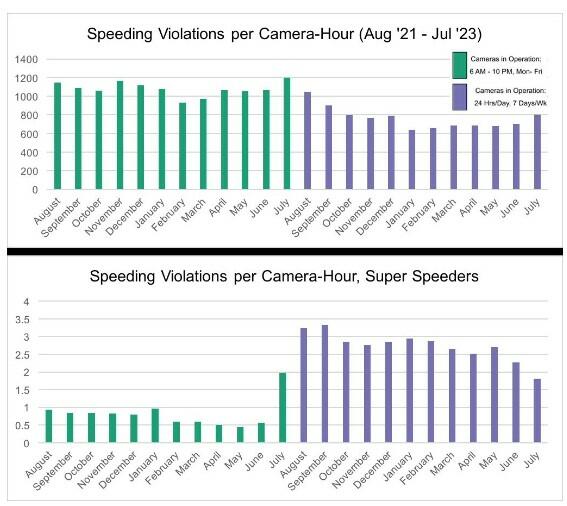
In a report published last week by Bloomberg, it was revealed that these repeat offenders are racking up tickets at a greater share than they ever have. In fact, according to the report, the city was equipped with 1,300 automated traffic enforcement cameras spread throughout its boroughs in 2020. This amounted for just 4 drivers reaching the ‘super speeder’ threshold.
But by 2023, as the number of these cameras nearly doubled, the count of drivers meeting this criterion surged to 186, with one individual alone amassing 373 tickets. In the previous year, the number of speed camera tickets accumulated by fewer than 200 drivers was equivalent to the total received by the lowest-ranked 25,000 drivers.
Amid a national rise in traffic fatalities, which has been exacerbated by the pandemic, speeding remains a key factor in roughly a third of all US roadway deaths. In response, cities are increasingly turning to automated enforcement, like speed cameras, a measure supported by health organizations for its potential to lessen accidents and save lives.
However, the effectiveness of such strategies is not absolute.
New York City’s extensive speed camera program, initiated a decade ago under the Vision Zero initiative by Mayor Bill de Blasio, now includes around 2,500 cameras, operating 24/7 since August 2022, Bloomberg writes.
Since this expansion, there’s been a 33% drop in tickets per hour issued, indicating a general reduction in speeding as most drivers reduce their speed after receiving one or two tickets. Yet, a significant rise in repeat offenses among a small group of persistent violators highlights the complexity of addressing traffic safety solely through enforcement. These “super speeders” now represent a majority of speeding violations, with outstanding fines averaging over $11,000 each.
New York is advancing traffic law enforcement with proposals to hike fines and lower speed limits, though their future is uncertain.
A previous initiative targeting dangerous drivers was discontinued due to its ineffectiveness. An audit also found that illegal or missing license plates led to a $100 million revenue loss from unenforceable camera tickets. Despite challenges, New York’s method of connecting tickets to plates and its extensive camera network could inspire other cities.
Transportation researcher Marcel Moran commented to Bloomberg: “So I think that New York has succeeded in one of its objectives. But the other piece is, ‘What do we do about the extremes?’ That’s when the penalty design really becomes suspect.”
He continued: “There’s no lawbreaking more normalized than speeding. There is a norm in the US of driving 10 miles over the speed limit, which results in the enforcement component: You cannot be written up for speeding unless you’re going over 10. So that enforcement norm becomes a behavioral norm.”
This week, the argument before the Supreme Court in Trump v. Anderson captivated the nation as the justices considered the disqualification of former President Donald Trump from the 2024 presidential ballot. For some of us, the argument brought back vivid memories of covering Bush v. Gore almost 25 years ago. While one justice (Clarence Thomas) remains on the Court, the last major intervention of the Court into a close presidential election is a matter of distant history.
As someone who covered both cases, much is regrettably familiar: the deep division in the country and rage of many advocates. However, unlike in 2000, the Court itself appears virtually unanimous in this case. The biggest difference is not the Court but the coverage.
The Trump case exposed the erosion of legal coverage in the media. For millions of Americans, the cold reception of all of the justices to the novel theory under the 14th Amendment came as a surprise. Networks and newspapers have been featuring experts who assured the public that this theory was well-based and disqualification well-established. The only barrier, they insisted, was the blind partisanship of the six conservative justices on the Court.
Twenty-four years ago, I was covering the Bush v. Gore case for CBS. I had just left NBC as an analyst when the election controversy exploded. While there were the usual partisans and some outlets slanted the merits, the legal analysis was overall balanced and informative.
This is not a case of the Court changing. We have changed as legal analysts.
The Court itself is deeply divided on some issues.
However, the justices gave a fair hearing to both sides. That is not the case with the coverage.
Looking back at the coverage, most legacy media called upon the same legal experts who have previously endorsed virtually every claim made against Trump.
They predictably declared Trump as clearly disqualified despite the fact that this theory has never been embraced by the federal courts.
Others insisted that the argument that the provision might not apply to presidents was “absurd.” That was the argument pushed by Justice Ketanji Onyika Brown Jackson.
Tribe assured the public that the theory was “unassailable” and also insisted that the theory (later voiced by Jackson) is “an absurd interpretation.”
It is important that such views are heard in the coverage.
The problem is that the media has, once again, pushed this novel (and in my view unfounded) theory to the point that many assumed that it was indeed unassailable.
What was most troubling is the repeated attacks on the Court by legal experts who suggested that the only thing keeping Trump on the ballot was the bias of conservative justices. Rep. Jamie Raskin (D. Md.) declared “This is their opportunity to behave like real Supreme Court justices.”
It appears that both Justices Kagan and Jackson did not behave like “real Supreme Court justices” in oral argument by objecting to core aspects of this theory.
We will have to wait for the final opinion but most of us are predicting a reversal of Colorado and the possibility of a unanimous or near unanimous decision.
The question is whether such a result will change how media outlets frame these disputes in the future.
After weeks of portraying the opposition as only resting with the right of the Court, the coverage had a weird disjointed feel as some of the same commentators reported that the justices appeared uniformly unconvinced by this “unassailable” theory.
The Biden administration can’t stop lying to the American public.
On Sunday, Homeland Security Secretary Alejandro Mayorkas had the audacity to claim that the Biden administration doesn’t bear responsibility for the border crisis, despite, among other things:
Terminating the National Emergency at the Southwest border
Revoking a Trump-era Executive Order that was designed to ensure there was meaningful enforcement of U.S. immigration laws.
Issuing an executive order protecting DACA recipients
Unveiling the U.S. Citizenship Act, which would provide amnesty to millions of illegal aliens in the U.S., demonstrating intent to reward illegal border crossers with a path to citizenship.
Announcing a 100-day moratorium on deportations and immigration enforcement, effectively providing amnesty to criminal and other removable aliens
And since Biden was sworn in as president in January 2021, there have been at least 7 million encounters near the southern border, while the government deals with a backlog of more than 3 million asylum cases in US courts.
Appearing on NBC‘s “Meet the Press,” Mayorkas claimed: “It certainly is a crisis. And, well, we don’t bear responsibility for a broken system, and we’re doing a tremendous amount within the system. But fundamentally, Congress is the only one who can fix it.”
And of course, zero pushback from the ‘journalist’ sitting across from him.
“Do you bear responsibility for what is happening at the border?”
So the narrative is: Biden inherited a broken border from Trump.
How much gaslighting can a country take before even Democrats call bullshit?
Mayorkas’ comments come after a failed effort by House Republicans to impeach him – in part because Rep. Al Green (D-TX) was wheeled into Congress from the hospital to vote following abdominal surgery.
“Sometimes when you’re counting votes and people show up when they’re not expected to be in the building, it changes the equation,” said Speaker Mike Johnson (R-LA) afterward, the NY Post reports.
According to Mayorkas, “They’re baseless allegations,” adding “That’s why I really am not distracted by them and focused on the work of the Department of Homeland Security.”
House Republicans have accused Mayorkas of “willful and systemic refusal to comply with the law” while presiding over the border crisis and “breach of public trust” for allegedly lying to Congress by saying the border is “secure” and that DHS has “operational control” of it.
In addition to the impeachment effort against Mayorkas falling by the wayside, a sweeping bipartisan border security reform package in the Senate collapsed last week.
The deal had been negotiated for some four months and was widely seen as a means of unlocking Republican support for a broader supplemental featuring aid to Ukraine, Israel and Indo-Pacific allies. -NY Post
“The system has not been fixed for 30 years. A bipartisan group of senators [has] now presented us with the tools and resources we need … and yet Congress killed it before even reading it,” said Mayorkas, following a failed Senate spending plan which would allocate a scant amount to the border, while providing Ukraine and Israel with roughly $80 billion in aid.
And yet, Biden could simply issue executive orders like Trump in order to close the border.
The story on the emergence of the US dollar hegemony.
* * *
After the collapse of Bretton Woods in 1971 several European central banks tried setting up a new gold pool to stabilize the price and move to a quasi gold standard. The US wanted to phase out gold from the system and enforce a dollar standard on the world.
What frightened the US was that Europe held the most gold and alluded to raising the gold price periodically to create liquidity, giving them the dominant means of creating reserves. Through its military presence in Germany, protecting it from the Soviet Union, the US was able to pressure the Germans not to cooperate with the gold pool. Without Germany the other European countries couldn’t materialize the pool and gold lost its anchor role in the monetary system. In the meantime, the US made a secret deal with Saudi Arabia to recycle oil dollars into US government bonds.
The United States didn’t manage to phase out gold from the system altogether, but it did succeed in establishing a global dollar standard which yielded them unprecedented power.
For the sake of simplicity “Europe” will generally refer to Belgium, France, Germany, Italy, the Netherlands, and Switzerland, most of which also cooperated during the classic gold standard in the 19th century.
The Beginning of the End
At a conference in Bretton Woods, New Hampshire, in July 1944, no less than 730 delegates from 44 nations forged a new international monetary system. With the currency wars of the 1930s in fresh memory an agreement of fixed exchange rates and free trade was reached. Because the United States had the strongest hand at the negotiation table, only the dollar was convertible into gold at $35 per troy ounce, making it “as good as gold” and stimulating its use as a reserve currency. Other currencies were pegged to the dollar (or gold). Gold was thus the ultimate anchor of “Bretton Woods,” granted by the Federal Reserve that was obligated to convert (buy and sell) dollars into bullion for foreign central banks.
While pound sterling was still held by central banks the world over from the previous arrangement, Bretton Woods incentivized central banks to hold dollars and gold as reserves. An advantage of the dollar, relative to gold, was that it accrued interest; a disadvantage was that it could devalue against gold (or be seized). In practice, the system created demand for dollars as a trade, intervention, and reserve currency.
The evolution of the composition of global international reserves (#gold and foreign exchange) since 1950. pic.twitter.com/ZYbHZh6dIi
The “rules of the game” were enshrined in the Articles of Agreement of the newly erected International Monetary Fund (IMF) that was to administer the system and support countries with temporary balance of payments deficits through lending reserves. In consultation with the IMF countries could devalue (revalue) their currency in case of chronic balance of payments deficits (surpluses) to restore equilibrium. The system was stable as long as its members implemented similar domestic monetary policies (countries with relatively loose policies had to devalue), which didn’t happen.
In the late 1950s the United States’ balance of payments deteriorated, resulting in a buildup of dollar balances held abroad, and, as central banks could convert dollars into gold, a decline of the US’s monetary gold stock. At first an increase in the supply of dollars abroad was welcomed because it inflated international liquidity beyond the growth of gold supply. Though, in 1960 the United States’ external dollar liabilities exceeded its monetary gold holdings, which prompted global concern. A run on the dollar could coerce a devaluation or default of the US.
In November 1961, President of the Federal Reserve Bank of New York, Alfred Hayes, presented a plan at the Bank for International Settlements (BIS) in Bazel, Switzerland, to collectively defend the price of gold at $35 dollars an ounce in the free market (Bordo et al 2017). European central banks assented to form a Gold Pool with the US—buying and selling gold in the London Bullion Market to keep the free market price close to the official price—and protect the international monetary system from disintegrating. France accepted to join on the condition the US would restore its balance of payments deficit (Avaro 2022).
Although the new club started as a secretive syndicate, it didn’t take long before the Pool’s operations were leaked to the press to amplify its impact. On March 8, 1962, the Pool was first covered by Le Courrier de Genève (Bordo et al 2017, Naef 2022). Creating public awareness likely worked in its maiden years of existence when the Pool was a net buyer of gold. But as the US started printing more money to finance the war in Vietnam throughout the 1960s, downward pressure on the dollar mounted. The Pool was challenged in its bluff selling gold.
In February 1965, the President of France, Charles de Gaulle, gave a speech in which he conveyed his criticism of Bretton Woods and America’s “exorbitant privilege”: to the extent countries were willing to hold dollars in reserve, the US could print dollars out of thin air to pay for imports and make investments abroad. In reality, Bretton Woods was designed for the world to accumulate dollars. Additionally, the inflationary policies of the US in the late 1960s were exported abroad through its balance of payments deficit and fixed exchange rates, pushing foreign central banks to buy dollars with their printing presses (Dibooglu 1999, Bordo et al 2017).
According to De Gaulle, international settlement should be done in gold and the use of reserve currencies had to be limited. De Gaulle and his economic advisors foresaw a dollar crisis advancing. To protect itself from devaluation France ramped up dollar conversions into gold at the Fed, in part to supply the Pool.
Shortly after, Belgium and France expressed their doubts about the viability of the Pool at BIS meetings (Bordo et al 2017). European central banks didn’t want to defend the dollar-gold peg indefinitely for what was essentially a problem of the United States. France dropped out in June 1967 when the Pool’s resources needed to be increased (Avaro 2020).
In November 1967, Great Britain was forced to devalue pound sterling. If sterling could fail, so could the dollar, the market reckoned. Slowly but surely things started spiraling out of control and the Pool was confronted with significant losses. “The gold markets were faced with numerous bouts of speculative buying in late 1967 and early 1968,” the Federal Reserve Bank of Dallas remarks in its 1968 annual statement. From March 8 through 14, 1968, the Pool sold nearly 1,000 tonnes of gold. “US air force planes rushed more and more Fort Knox gold to London, and so much piled up in the Bank of England’s weighing room that the floor collapsed,” writes Timothy Green in The New World of Gold.
Belgium and Italy also became anxious to opt out as their gold reserves contracted (Green 1973 135). It became senseless to sell gold into a black hole. The next day, on March 15, 1968, the London Bullion Market was closed for two weeks at the behest of the US. Quickly the central bankers of the Pool flew to Washington for a conference.
A prominent person at that time was Jelle Zijlstra, President of the Dutch central bank and Chairman of the BIS from 1967 until 1981. Zijlstra writes the Europeans had a different interpretation than the US from the agreements reached in Washington (Zijlstra 1978 191):
The Washington conference of March 1968, … gave rise to many difficulties afterwards, because almost from the outset the decisions taken there were interpreted in two very different ways. Some countries were of the opinion that the only decision taken in Washington was to abolish the gold pool, to stop gold sales by central banks in the free market in order to keep the free market gold price close to the official price. The Americans took the position that it had also been decided that the central banks would never again buy gold on the free market, or in other words, that a first step had been taken towards the removal of gold from the international monetary system, the so-called demonetization of gold.
Clearly, the communique from the conference doesn’t state that central banks would never again buy gold from the free market. In any case, the Pool was disbanded and the free market price of gold allowed to float.
In favor of the Americans, the IMF’s Articles of Agreement (Article IV Section 2) stipulated that no central bank would buy or sell gold at a price other than the official price. And so, as a consequence from the Pool’s moratorium, a two-tier gold market was born. Private entities could trade gold at the free market price and central banks could transact at the official price.
This setup subsided the role of gold in the international monetary system, as it severed the link between gold production and other sources of gold and monetary reserves. Gold also became increasingly illiquid, because no central bank wanted to sell at $35 an ounce knowing gold was worth much more. Gresham’s Law assured the use of the dollar as intervention and trade currency by its presumed overvaluation with respect to gold (Mundell 1971 13). The world began creeping towards a dollar standard (Bordo 1993 4).
Europe got cornered. By then they held the largest gold reserves, and it would have been a pity, to say the least, to render it useless.
Zijlstra’s solutions to resuscitate Bretton Woods were simple. The official gold prices in all currencies should have been raised to increase global liquidity and make sure the dollar would stay convertible into gold (Zijlstra 1978 190). He adds, “it was curious that in the post-war world, where everything was at least three to four times more expensive than in the 1930s, the gold price had remained unchanged” (Zijlstra 1992 222). In addition to the first measure the official gold price of the dollar should have been raised even more, thus devaluing the dollar against all other currencies to restore the United States its balance of payments. “However, the Americans opposed both solutions tooth and nail. … After all, this would put the dollar in second place to gold, and the Americans’ ideal was and is for the dollar to play a central role on the economic stage” (Zijlstra 1978 191, 1992 222).
The Heat is On
European central banks continued converting dollars at the Federal Reserve, whilst the Americans tried to block such requests.
As shown in chart 6, Germany held less of its total reserves in gold than its European peers. Having American troops on its soil, protecting Germany from the Soviets, came at a cost: not being allowed to convert dollars at the Fed. Germany held large gold reserves, but this was mainly obtained via trading partners in Europe (Bundesbank 2018 99).
Germany’s commitment not to convert dollars was sealed in a letter to the Fed, dated March 30, 1967, by Karl Blessing, President of the German central bank (Bundesbank). Blessing also concurred to invest $500 million dollars in US government bonds, financing both America’s balance of payments and fiscal deficit.
Shortly before Blessing died he gave an interview published in Der Spiegel:
BLESSING: … the threat was always in the background. Former US High Commissioner McCloy once visited the German government and said: “Look, we’ve now had a Senate decision; there is soon a majority that we will withdraw our boys. We have to do something.” So, he called me at home on a Sunday afternoon at half past three and said: “I have to fly back tonight, can’t we see each other?” And I said to him: “My dear McCloy, your situation is clear, this is a balance of payments problem for you, nothing more. You have seen that we are sensible and do not convert our dollars into gold. I am even willing to give you that in writing for a certain time.” Unfortunately, the letter that I wrote back then is still valid today.
I should have been more rigorous with regard to the US. The dollars that we were accumulating should simply have been rigorously converted into gold.
Other European countries were better off. In one of his books Zijlstra describes how he was pressured by the Americans but stood his ground. From Zijlstra (1978 191):
That the mood was becoming more threatening became apparent to me when on July 7, 1971, the US Deputy Secretary of the Treasury, Paul Volcker, and my American colleague, Dewey Daane, came to visit me in Amsterdam [the Netherlands]. They urged me to cancel the exchange of $250 million into gold. We had already exchanged nearly $600 million worth of dollars into gold … since the beginning of 1971. The fact that such a heavy delegation came to Amsterdam to ask me to refrain from conversion was the clearest proof to me that the storm was really about to break. I explained that I could not comply with their request. We held dollars only up to an amount that we considered working stock. Everything above that we wished to exchange for gold …. Volcker then said to me, “You are rocking the boat.” My response was: “if that boat rocks too violently as a result of converting $250 million, that boat has already sunk.”
All along the intent of the Americans was to phase out gold from the international monetary system; for the rest of the world to import their dollars and hold as reserves so the US could live beyond its means and secure the dollar hegemony. Illustrative of this scheme is an action memorandum from Henry Kissinger, the US President’s Assistant for National Security Affairs, to President Richard Nixon dated June 25, 1969. “We can try to finance our deficits,” Kissinger wrote, to “borrow implicitly by inducing other countries to build their dollar holdings. At the extreme, this would mean getting (or forcing) the world to go onto a ‘dollar standard’.” In international economics holding foreign exchange as reserves is a loan to the issuer of that money because technically that issuer still has to settle a trade imbalance with something real.
Primarily “the [dollar-gold] convertibility link,” was blocking the United States’ agenda, as noted by a Volcker Group Paper from 1969. The paper continues:
Perhaps one of the most important long-term problems facing the US is how to move out of this commitment in a graceful manner without causing undue disturbance to the monetary system and with a fair measure of international approbation, at some time in the future. It is not yet clear whether this can be done, and a breaking of the link may have to come in the context of some crisis and a threatened run on the dollar.
A run on the dollar, from the viewpoint of the US, arrived early August 1971 when both the British and French called on the Fed to redeem more dollars (Bordo et al 2017). Finally, on August 15 President Nixon announced to temporarily suspend dollar convertibility, although this has never been reactivated. The “Nixon Shock” de facto terminated Bretton Woods and one can imagine countries holding dollars were not amused. Kindly note, in chart 2, how external dollar liabilities of the US exploded from then on.
At the same time, European countries, trading a great deal with one another, were integrating through the European Economic Community (EEC) and introduced their own framework for managing exchange rates (aimed to progress toward a monetary union) called “the snake.” A unified Europe showed the world its strength and leadership. Kissinger said to Deputy Secretary of the Treasury, William Simon, at one point: “I basically have only one view right now which is to do as much as we can to prevent a united European position without showing our hand. … I don’t think a unified European monetary system is in our interest.”
Because the dollar had become grossly overvalued relative to several other currencies, a group of ten developed countries (G10) met in Washington in December 1971 to negotiate exchange rate realignment. In what became known as the Smithsonian Agreement the dollar was devalued by 10.7% versus a basket of currencies (De Vries 1976 555). The official (“fictional”) gold price was raised to $38 as exchange rates were formally still expressed in parities vis-à-vis the official gold price.
Over a year later pressure on the dollar broke its peg again. In March 1973 the G10 accorded that 6 EEC currencies would jointly float against the dollar, effectively discontinuing what was left over from Bretton Woods. IMF members were free to choose any form of exchange arrangement, “except pegging their currency to gold.”
Among IMF members there was a desire to reform the monetary system, for which a novel reserve asset was developed: the Special Drawing Rights (SDR). In general, both the US and Europe supported the introduction of the SDR in 1969, albeit for different reasons. The Europeans wished the SDR could substitute the dollar (Zijlstra 1992 222), while the US concocted “the nations of the world come to accept Special Drawing Rights in lieu of gold.” All the while Bretton Woods crumbled, the SDR was used as a decoy by the United States.
The US received intelligence that the Europeans were preparing to mobilize their gold by transacting bullion among themselves at the free market price. Then Secretary of the Treasury, George Shultz, wrote to President Nixon:
Some—but not all European officials— … see the proposed move as enhancing the probability that gold will work its way back into the center of the international monetary system and facilitate a French-European vision of a new monetary system.
We should actively support … amending existing agreements so that monetary authorities may sell gold into private markets at the market prices but may not buy gold from any source except at the established official price. It would be hoped that this procedure would permit a gradual phase-out in the official monetary use of gold.
Although the exact date from the above memo isn’t known, it’s likely from October 1973. At BIS headquarters, in November 1973, Zijlstra suggested rescinding the Washington agreement of March 1968. Chairman of the Fed, Arthur Burns, proposed to allow selling (not buying) by central banks in the private market (De Vries 1985 609). Burns’ offer was accepted and from that day central banks could sell gold, just as envisioned by Schultz.
Apparently, it was irrelevant where policy makers met (in Bazel or elsewhere), as long as they had a majority vote in the IMF a decision could be made. Although the US had broken the rules of the Articles of Agreement by ceasing to convert dollars in 1971, the Europeans were cautious to do the same.
Of course, the Europeans wanted more than being able to sell gold. In a Wikileaks cable from 1973 it reads the Minister of Finance of the Netherlands, Willem Duisenberg, told an American ambassador that all currencies should be convertible “or money has no meaning.” In other cables (here and here) from early 1974 it reads that France wanted to regulate (stabilize) the free market price of gold and the EEC oriented to use their gold for international settlement. The former being a prerequisite for the latter (Zijlstra 1981 10). If the EEC joint float would be pegged to gold it would result in “a new gold-based currency bloc.” Within the EEC the Germans weren’t enthusiastic about these ideas, because, as we shall see, they were still being played by the US.
Zijlstra made his views public on March 13, 1974, in a speech in Zurich, Switzerland (Zijlstra 1974):
Central banks holding gold should be free … to … buy and sell gold in the free market – perhaps regulating the price a little through a new-style gold pool – or … use it in settlements between one another. In this latter context one might think in particular of regional groupings like the EEC.
One month after, the Ministers of Finance of the EEC held a conference in Zeist, the Netherlands, that conceptually produced the same as Zijlstra’s views in Zurich (EEC 1975 19).
Monetary authorities should be permitted to buy and to sell gold among themselves at a market related price and to buy and sell on the free market (hold gold in the center of the monetary system).
Monetary authorities periodically fix a minimum and a maximum price beyond which they would not respectively sell or buy on the market (stabilizing the gold price).
Creating a buffer stock to be managed by an agent who would be charged by the monetary authorities to sell or buy on the market such as to ensure orderly conditions on the free market for gold (a new gold pool).
The Americans countered the EEC from the inside. First, on June 3, 1975, Burns wrote to a colleague (Alan Greenspan) that he has “a secret understanding in writing with the Bundesbank—concurred in by [Minister of Finance] Mr. Schmidt—that Germany will not buy gold, either from the market or from another government, at a price above the official price,” which pretty much blocked the Zeist initiative. Without Germany the EEC wasn’t able to form a gold pool, stabilize the price and use gold for international settlement.
Burns’ secretive understanding can be traced to a letter dated November 14, 1973, by then Bundesbank President, Karl Klasen, to the Fed pledging adherence, with Schmidt’s consent, to Article IV Section 2 about not trading gold at a price other than the official par value.
Second, ample leverage equipped the US to go the extra mile. Advisors of US President Ford wrote on June 4, 1975, on the role of gold in the international monetary system: “We must first swing Germany, thus isolating France.” On June 6 President Ford felt comfortable to tell Minister Schmidt:
We … do feel strongly that some safeguards are necessary to ensure that a tendency does not develop to place gold back in the center of the system. We must ensure that there is no opportunity for governments to begin active trading in gold among themselves with the purpose of creating a gold bloc or reinstating reliance on gold as the principal international monetary medium.
Most definitely the Germans obeyed and threw a wrench in the Zeist initiative, as it was strangely never realized.
By not converting dollars into gold when the Fed’s gold window was still open, Germany dug itself into a hole. Next to being dependent on US troops, Germany’s gold to total reserves ratio was so much lower than in surrounding countries that any revaluation of monetary metal relative to dollars would have been sorely embarrassing (chart 6).
Aside from the US the least developed countries (LDCs) of the world also opposed the activation of official gold holdings, for the simple reason they owned fairly little.
The IMF began selling 750 tonnes of gold from its own stock to use for concessional loans to LDCs in 1976 (De Vries 1985 662). At the announcement of the sale the gold price in the free market declined. Ironically, the Swiss central bank (SNB) considered buying some of the gold at auction “to demonstrate its attachment to gold and participate in efforts to stabilize the gold price,” SNB reminisces in its centenary. Four years later in 1979, when the gold price skyrocketed, SNB “considered selling gold on the market, in a coordinated action with other central banks, with the aim of stabilizing the price.”
By 1978 the IMF’s Articles of Agreement had been amended and central banks could buy and sell gold in the private market (De Vries 1985 656). The idea to put monetary gold to use hadn’t died in Europe and so in 1979 the idea to intervene floated again. This time also for gold not to make a mockery out of their fiat currencies and calm monetary unrest.
Before me, attempts of forming a European gold pool in 1979 have been covered by precious metals analyst Ronan Manly (here and here). Manly was able to get his hands on documents from the Bank of England (BOE) in which a new gold pool was discussed. What stands out from Manly’s publications, in relation to our present analysis, is that France didn’t want to participate because Germany resisted and the pool never saw the light of day.
The following quotes are from multiple BOE documents regarding meetings at the BIS in 1979. Paul Jeanty was a dealer in the London Bullion Market, all the others government officials. In brackets it’s clarified who is representing which country:
Paul Jeanty told me [McMahon, UK] that Zijlstra had told him personally a couple of weeks ago that he would now be in favor of a central bank operation to stabilize the price within a moving band. Leutwiler [Switzerland] and Clappier [France] have said this to him in the past and he believes … that de Stryker [Belgium] and Baffi [Italy] would go along with such a plan. All recognize, however, that Emminger [Germany] has no disposition to support.
Fritz [Switzerland] had told Jeanty, what Jeanty already knew, that Zijlstra would be interested; however, apparently Clappier indicated that he was against. This was a reversal of view which Leutwiler attributed to pressure from the Élysée [France] which was itself influenced by the Germans. … Emminger continued to be strongly against.
Leutwiler and Zijlstra then said that although they did not think a very large group was necessary to undertake the operation it probably had to be bigger than two: specifically, they really needed either the French or the Germans.
The core of Europe tried to form a gold pool, but Germany was jamming the project again! Very likely the Germans were still on a leash of the United States.
The US Oil Deal with Saudi Arabia
Suppressing the role of gold was one part in the bigger picture of the US to install the dollar hegemony. In part two “risk free” dollar assets were required to become the prime international reserves.
The oil crisis in the early 1970s was a blessing and a curse for the US. It caused expenses to go up, but a higher price of oil also created more demand for dollars abroad. Now those dollars needed to be invested in US governments bonds (Treasuries).
In July 1974, Secretary of the Treasury, William Simon, visited the Middle-East to dust off a proposal by Saudi Arabian Oil Minister, Yamani, from 1970. Simon’s endeavor was for the Saudis to recycle dollars in bonds.
Eventually the deal encompassed Saudi Arabia to supply oil to the United States and invest the proceeds in Treasury securities. In return, the US would provide military aid and hand the kingdom an “add-on” in the form of a special treatment in Treasury auctions. On request of Saudi King Faisal the deal would remain “strictly secret.”
The add-on allowed the Saudi Arabian Monetary Agency (SAMA) non-competitive bidding outside of the normal auctions held by the New York Fed and avoid disrupting the market caused by large security purchases on their part. “The sine-qua-non for the Saudis in this arrangement is confidential and we have assured them that we will do everything in our power to comply with their desires,” Undersecretary of the Treasury for Monetary Affairs, Jack Benett, writes in a memo to Kissinger in 1975.
For starters $2.5 billion was expected to be invested by SAMA, but shortly after the Treasury inadvertently raised $800 million more than it intended to borrow at auction. Dollars were recycled alright.
It wasn’t all smooth sailing for the dollar in the 1970s, but the US managed to secure its currency as the sun in the international monetary cosmos. In his memoirs, Zijlstra looks back on how it happened (1992 211):
Gold disappeared as the anchor of monetary stability. An attempt to replace it with a newly created substitute (the IMF’s [SDR] …) virtually failed. The fixed parities, apart from our own EEC system, have disappeared. … The road from dollar supremacy, through endless vicissitudes, to a new dollar hegemony was paved with many conferences, with faithful, shrewd, and sometimes misleading stories, with idealistic visions of the future and impressive professorial speeches. (For every notion, no matter how extreme, there is always a professor of economics available.) The political reality was that Americans supported or fought any change, depending on whether they saw the dollar’s position strengthened or threatened.
According to Zijlstra and De Gaulle, final settlement in cross-border trade should be done in gold and the use of reserve currencies restricted (Zijlstra 1972). What frightened the US was that Europe held the most gold and alluded to raising the gold price periodically to create liquidity, giving them “the dominant means of creating reserves.” A few days after the Zeist conference an advisor of Kissinger explained it to him well:
Mr. Enders: It’s against our interest to have gold in the system because for it to remain there it would result in it being evaluated periodically. Although we have still some substantial gold holdings … a larger part of the official gold in the world is concentrated in Western Europe. This gives them the dominant position in world reserves and the dominant means of creating reserves. We’ve been trying to get away from that into a system in which we can control—
Secretary Kissinger: But that’s a balance of payments problem.
Mr. Enders: Yes, but it’s a question of who has the most leverage internationally. If they have the reserve-creating instrument, by having the largest amount of gold and the ability to change its price periodically, they have a position relative to ours of considerable power.
Remarkably, everything that held back the envisioned monetary system of Zijlstra and friends in the 1970s has been resolved. Since Germany repatriated gold from New York several years ago we may assume it has released itself from bondage. Gold is globally more evenly distributed (chart 5), there is a gold leasing market for those that are looking for a yield, and the gold market is liquid. The fact the Dutch central bank recently signaled that it has prepared for a new gold standard makes perfect sense from a historical perspective.
Experience from Bretton Woods and the need to periodically increase the gold price suggests that Europe would target the price in the free market in order to stabilize it. The remaining questions are, (i) what could trigger Europe to stabilize the gold price in the future, and (ii) at what price level?