69.5 F
Chicago
Friday, September 18, 2026
Home Blog Page 2969

Biden’s Real Oil-For-Fake Democracy Plan Ruined After Venezuela Blocks Opposition Leader’s Presidential Run

0
Biden’s Real Oil-For-Fake Democracy Plan Ruined After Venezuela Blocks Opposition Leader’s Presidential Run

And another foreign policy faux pas…

The Biden administration says it is currently reviewing its sanctions policy on Maduro’s Venezuela, after the country’s top court blocked opposition leader María Corina Machado from becoming a presidential candidate. Her formal candidacy was initially banned for backing US sanctions against Caracas and for alleged corruption. 

“The United States is currently reviewing our Venezuela sanctions policy, based on this development and the recent political targeting of democratic opposition candidates and civil society,” State Department spokesman Matthew Miller said in a fresh Saturday statement in response to the development.

It was only in October that the White House initiated most extensive rollback of Trump-era sanctions on Caracas, after a series of visits of high-level US officials to meet with counterparts in Caracas. The engagement came to fruition against the backdrop of the Ukraine war, which sent the US abroad in search of alternative energy resources.

Via AP

Biden’s easing of the sanctions was supposed to be based on President Nicolás Maduro agreeing to significant democratic reform and an even playing field in the 2024 election.

But as the Associated Press reviews, “Machado won a presidential primary held in October by the faction of the opposition backed by the U.S. She secured more than 90% of the vote despite the Venezuelan government announcing a 15-year ban on her running for office just days after she formally entered the race in June.”

Clearly given that Venezuela’s Supreme Tribunal of Justice has just upheld the ban on Friday, the Biden administration request didn’t sink in, and its sanctions-easing gambit appears to have backfired.

Meanwhile, there are signs that Maduro ahead of the presidential election, expected for the latter half of 2024, has launched a new crackdown while accusing alleged conspirators against the government. 

As is typical in Maduro’s socialist Latin American country, the circumstances are highly bizarre

Venezuelan authorities have arrested 32 civilians and soldiers after a months-long investigation into their alleged part in a US-backed “conspiracy” to assassinate President Nicolas Maduro, the prosecutor’s office said Monday.

All suspects have “confessed and revealed information about the plans,” Attorney General Tarek William Saab told reporters in Caracas. He said they had been accused of treason and “convicted” for their crimes.

In addition 11 other arrest warrants were issued, but most of these are reportedly in exile. Interestingly, Caracas authorities say they’ve known about the conspiracy for months, but they didn’t want to derail the high-level talks with the US which appears to be ushering in some kind of slow rapprochement.

Here are the cast of external agencies now being blamed

Padrino told the same press conference that an operation that started last year to uncover details of the alleged conspiracy was kept secret as it coincided with “talks” between Maduro and the United States that resulted in a prisoner swap.

He blamed the plot on the “far right,” as the Maduro government usually refers to the opposition, with “support” of the US Central Intelligence Agency (CIA) and Drug Enforcement Administration (DEA).

And to be expected, opposition candidate Machado is also being accused and has been linked to the conspiracy by police and intelligence. The Maduro government even says it has a video proving it. Machado has dismissed all of this as part of Maduro’s “surreal and delirious plots.” Without doubt the coming weeks and months are going to be interesting, and especially the reaction of the Biden White House – whether it backtracks are pursues further diplomatic “openings” with Maduro.

And now the Biden admin hypocrisy will be exposed for all to see as he is stuck between a rock of supporting an authoritarian dictator hell-bent on destroying democracy and a hard-place of rising oil prices (if sanctions are reinstated 200-300k less barrels of supply) and rising gasoline prices and that’s not an election winner.

Bond investors know that elections always trump ethics and have mostly held onto their bets that the sanctions will remain suspended.

Government notes due in 2027 were quoted late Friday at 21.4 cents, according to indicative pricing compiled by Bloomberg, 2 cents lower than their high earlier this month but still far above the 10-cent range where they traded before the Barbados agreement.

It will be interesting to see how Biden spins the support of democracy-defying dictators overseas (Ukraine first and now Venezuela) while demagoguing the apparent democracy-destroying opposition doimestically.

Tyler Durden
Sat, 01/27/2024 – 15:45

More Senate Republicans Embrace Trump As He Marches Toward GOP Nomination

0
More Senate Republicans Embrace Trump As He Marches Toward GOP Nomination

Authored by Samantha Flom via The Epoch Times (emphasis ours),

Former President Donald Trump continues to pick up endorsements from Capitol Hill as it appears increasingly likely that he will clinch the Republican nomination for president.

Sen. John Kennedy (R-La.) became one of the latest GOP lawmakers to back President Trump on Jan. 24 following his historic victory in New Hampshire.

“Competition makes us all better, so I let the primary play out, but this thing’s over,” Mr. Kennedy wrote in an X post.

“It’s going to be Pres. Trump versus Pres. Biden: A choice between hope and more hurt. It’s not even close. I choose hope. I am endorsing Pres. Trump and look forward to working with him.”

After winning in Iowa by a historic 30-point margin, President Trump went on to set records in New Hampshire as well. Not only did he receive the most votes of any presidential candidate ever in the history of the first-in-the-nation primary, but he is also now the first non-incumbent candidate to win in both Iowa and New Hampshire.

Mr. Kennedy’s endorsement followed those of Sens. John Cornyn (R-Texas) and Deb Fischer (R-Neb.), who backed the 45th president almost immediately after the New Hampshire race was called. The move brings President Trump’s total Senate endorsements up to 30.

It also appears to be part of a more recent trend among Republican senators to coalesce—in some cases reluctantly—behind President Trump and shift the focus to November. But with former South Carolina Gov. Nikki Haley still in the race, that might take longer than they’d like.

Although Ms. Haley will not take part in the GOP’s Nevada caucus on Feb. 8, she has pledged to continue her fight in her home state of South Carolina, where she is targeting a come-from-behind victory.

But even for the former governor, a Palmetto State upset would be no easy feat. There, a 30-point chasm currently separates Ms. Haley from first place, per the RealClearPolitics average of polls. Further, a host of prominent Republican leaders in the state have already backed President Trump.

Yet while the former U.N. ambassador denies that the writing is on the wall for her campaign, in the Senate, Republicans seem more ready to accept what has long appeared inevitable.

He’s going to be the nominee. Voters have made their minds up,” Sen. Josh Hawley (R-Mo.) told NTD News on Jan. 24. “So, I think this is the time to unite—Republicans need to unite. I understand the different candidates who ran have differences, sure. But hey, this is the time to unite and beat Joe Biden.”

‘Time to Unite’

Mr. Hawley, who endorsed President Trump in December, acknowledged that the move to rally around the presumptive nominee has been sluggish in the Senate, particularly among GOP leadership.

It’s no secret that the chamber’s minority leader, Sen. Mitch McConnell (R-Ky.), has a strained relationship with the former president. And those who remain loyal to Mr. McConnell have been among the slowest to get behind President Trump.

Sen. John Thune (R-S.D.), the No. 2 Republican in the Senate, has not endorsed President Trump but has said he would support the party’s eventual nominee.

“Voters are breaking heavily in [Trump’s] favor. He’s in a commanding position, and I’ve said all along I’ll support the nominee,” he told reporters on Jan. 24. “So, if he’s the nominee, I’ll do what I can to help the team win the presidency and the Senate and put an end to the Biden/Schumer agenda.”

Mr. Thune had previously endorsed Sen. Tim Scott (R-S.C.) in his presidential bid. Mr. Scott has since dropped out of the race and joined President Trump on the campaign trail.

Meanwhile, Sen. Thom Tillis (R-N.C.), a leadership counselor to Mr. McConnell, said he won’t endorse during the primary process but will support the Republican nominee.

And Sen. Susan Collins (R-Maine), the top Republican on the Senate Appropriations Committee, has flat-out rejected the idea of endorsing President Trump.

Ms. Collins was one of the seven Republican Senators who voted to convict the 45th president on the impeachment charge of inciting an insurrection just before he left office. When asked if she could see herself supporting President Trump even as the nominee, she replied: “I do not at this point.”

Instead, she said she was glad to see that Ms. Haley was still in the race and hoped that she would prevail in securing the nomination.

But one Senate leader who has embraced President Trump is Sen. John Barrasso (R-Wyo.), the chairman of the Senate GOP conference and the chamber’s third-ranked Republican.

During a Jan. 9 appearance on Fox News’ “Hannity,” Mr. Barrasso endorsed the former president as the candidate who could get the country “back on track.”

“The country was much better off under President Donald Trump. And Joe Biden continues to fail America.”

McConnell Stays Silent

Mr. McConnell himself has remained mum on the primary race. When asked about it on Jan. 23, he told reporters, “I’ve essentially stayed out of it. And when I change my mind about that, I’ll let you know.”

He also dodged a subsequent question on whether he thought he should mend his relationship with President Trump, stating that he had “no news to make” on that, and that he and others would be watching the New Hampshire primary “with great interest.”

But Mr. Hawley said on Jan. 24 that discord between the top Senate Republican and a Republican president—should President Trump be elected—would be bad for the GOP.

You can’t have a Republican leader in the Senate who doesn’t want to work with the president of his own party who’s come into office,” he said.

The senator added that he would not support Mr. McConnell in the party’s next leadership election, regardless of who is elected president.

“I think we need new leadership for a range of reasons. And I think that’s been on full display in recent months,” he said, holding that Mr. McConnell has ignored the will of Republican voters on more than just the presidential primary race.

“In my state, you’ve got people who’ve been exposed to the government’s nuclear radioactive waste for 50 years running,” he said. “The position of the leader of my own party in the Senate is they should get nothing, they deserve to have nothing, but we have unlimited sums of money for Ukraine and other foreign interests in which he is personally interested. I just think that’s an extraordinary position for any member of the Senate to take.”

Jackson Richman contributed to this report.

Tyler Durden
Sat, 01/27/2024 – 15:10

Rand Paul: It’s Time The US Stopped Being “The Sugar Daddy Of The Entire World”

0
Rand Paul: It’s Time The US Stopped Being “The Sugar Daddy Of The Entire World”

Authored by Steve Watson via Modernity.news,

GOP Senator Rand Paul has called for the United States to stop paying for everything on the globe at the expense of its own people, asking “When did we become the sugar daddy of the world?”

Speaking with Fox Business on yet another upcoming funding bill for Ukraine, Paul noted “there’s going to be $11 billion dollars worth of ‘humanitarian assistance,’ some of that goes to Ukraine, but some of it is going to Gaza. It’s not clear exactly how much is going to the Palestinians, but it is sort of bizarre that we fund both sides of every war.”

He continued, “They’re going to expect us to clean up, repair Ukraine when it is done being destroyed. The same with Gaza. Gaza is being destroyed but who is going to pay for it? They expect to us pay for it. I don’t want a penny going to Hamas or any of these people.”

“I have great sympathy for those living in Gaza and the mess they are in, and I wish it would stop. But I don’t think we should always have to pay for everything,” Paul urged.

The Senator added, “It is a history of both parties, really, frankly over decades, funding both sides of every war. Once war is over, we say we will pay to clean it up. No. It is a problem. It is sort of the opposite of the philosophy of some from the liberty wing of the party.”

“We don’t need to have 1,500 troops in Niger, Africa, or troops in Somalia. We frankly don’t need like 800 troops spread out throughout Syria, where they are basically just targets for different terrorists,” Paul continued, noting “These are the discussions we should have, but still the majority of Republicans and Democrats want troops everywhere, our hands in everything.”

We also don’t have money for it anymore because we are running a $1.5 trillion deficit, we borrowed a trillion dollars just in the last three months. It is out of control and some of it has to do with foreign expenditures. We gotta think about what is going on at home,” Paul further warned.

Watch:

Paul’s latest comments come after he told Tucker Carlson “Half of my Republican caucus is, as we speak, ready to sell out, and they’re ready to sell out fake border reform in exchange for what they really want, which is to send more of your tax dollars to Ukraine.”

* * *

Your support is crucial in helping us defeat mass censorship. Please consider donating via Locals or check out our unique merch. Follow us on X @ModernityNews

Tyler Durden
Sat, 01/27/2024 – 14:00

British Oil Tanker On Fire For Several Hours After Houthi Attack, Dramatic Photos Show

0
British Oil Tanker On Fire For Several Hours After Houthi Attack, Dramatic Photos Show

Update(0153ET): The Indian Navy led by the INS Visakhapatnam was among the first rescue team to respond to the stricken Marlin Luanda after it was hit by a missile fired by the Houthis. It was reportedly on fire for a lengthy amount of time, by some accounts over six hours, before the blaze was extinguished by the Indian Navy.

Images published by the Indian Navy (below) show smoke and flame billowing at the height of day. According to more details via BBC:

A tanker with links to the UK was on fire for several hours in the Gulf of Aden after being hit by a missile fired by the Houthis.

The Iran-backed movement, based in Yemen, said it targeted the Marlin Luanda on Friday in response to “American-British aggression”.

The US and UK have launched air strikes on Houthi targets in response to attacks on ships in the Red Sea region French, Indian and US naval ships provided assistance to the vessel.

UK Defence Secretary Grant Shapps has condemned the attack as “intolerable and illegal.”

“It is our duty to protect freedom of navigation in the Red Sea and we remain as committed to that cause as ever,” he said in a statement on X.

Source: Indian Navy

* * *

The British fuel tanker operated on behalf of trading giant Trafigura, was on fire after it was struck by a missile as it transited the Red Sea, in the most significant attack yet by Yemen’s Houthi rebels on an oil-carrying vessel.

Yemen’s Houthis said on Friday their naval forces carried out an operation targeting “the British oil tanker Marlin Luanda” in the Gulf of Aden causing a fire to break out. They used “a number of appropriate naval missiles, the strike was direct,” the Houthi military spokesperson Yahya Sarea said in a statement.

“Firefighting equipment on board is being deployed to suppress and control the fire caused in one cargo tank on the starboard side,” a Trafigura spokesperson said in a statement. “We remain in contact with the vessel and are monitoring the situation carefully. Military ships in the region are underway to provide assistance.”

The area in question and the southern Red Sea have been the center of multiple attacks on ships by Houthi militants in recent weeks. Since mid-November, the Houthis have launched near daily attacks on vessels transiting the waterway, in an act of solidarity with Palestinians amid the war between Israel and the militant group Hamas. The conflict has rerouted trade flows as some shippers avoid the key waterway.

The tanker, headed toward Singapore, was carrying naphtha, which is used to produce gasoline and plastics. Ironically, the naphtha was of Russian origin, Trafigura said.

“The vessel is carrying Russian-origin naphtha purchased below price cap in line with G7 sanctions,” a spokesperson said, however some have voiced questions about how a venerated Swiss merchant procured the Russian commodity.

The attack, the most serious yet since Houthi militants effectively took control of transit in the Red Sea, will raise fresh questions about whether oil tankers will continue to transit the Red Sea. Since joint US and UK airstrikes on the Houthis earlier this month, tanker traffic in the region has declined, but some vessels have continued to pass through, including those hauling oil from Russia and toward China. Other key oil exporters like Saudi Arabia said this week that they were planning to continue using the route.

As Bloomberg correctly, if unironically, points out, the latest attack suggests that the US and its allies haven’t sufficiently degraded the Houthis’ military capabilities two weeks after launching the first of several airstrikes on the group’s missiles, radars and other assets across Yemen. Of course, it also means that the Biden-spearheaded operation “Prosperity Guardian” which was meant to secure passage of ships in the Red Sea is now literally up in flames.

Last weekend, US Deputy National Security Advisor Jon Finer said military actions to deter the Houthis and other groups backed by Iran would take time.

“Deterrence is not a light switch,” Finer told ABC, trying to explain why nobody takes the US seriously any more. “We are taking out these stockpiles so they will not be able to conduct so many attacks over time. That will take time to play out.”

In its update on the incident, the UK Navy advised ships to transit with caution and said authorities are responding.

Earlier Friday, missiles exploded near a Panama-flagged, India-affiliated ship carrying barrels from Russia, according to Ambrey. Although a Houthi spokesman told the Russian newspaper Izvestia last week that Russian and Chinese ships sailing through the Red Sea would be safe, Friday’s attack was the third in the vicinity of a vessel that had previously called on a Russian port.

Tyler Durden
Sat, 01/27/2024 – 13:53

Trump Says Texas Rightly Invoked ‘Invasion’ Clause Over Biden’s Open Border

0
Trump Says Texas Rightly Invoked ‘Invasion’ Clause Over Biden’s Open Border

Former President Trump chimed in on the unfolding border situation in Texas between state officials and the federal Customs and Border Patrol (CBP), saying that President Biden is “unbelievable” for what he’s done.

Texas Gov. Greg Abbott, left, listens as Republican presidential candidate and former President Donald Trump, right, speaks to Texas state troopers and guardsmen during a Thanksgiving meal at the South Texas International Airport, Sunday, Nov. 19, 2023, in Edinburg, Texas. (AP Photo/Eric Gay)

Joe Biden has surrendered our border and is aiding and abetting a massive invasion of millions of illegal migrants into the United States,” Trump said in a Thursday post to Truth Social.

“Instead of fighting to protect our country from this onslaught, Biden is, unbelievably, fighting to tie the hands of Governor [Greg] Abbott and the state of Texas so that the invasion continues unchecked.

“In the face of this national security, public safety, and public health catastrophe, Texas has rightly invoked the invasion clause of the Constitution and must be given full support to repel the invasion,” Trump continued.

The comments come as the Texas Department of Public Safety and the Texas National Guard are engaged in a high-profile conflict with the Biden administration over the use of razor wire along the Rio Grande river separating Texas and Mexico.

Last week, the US Supreme Court allowed the Biden administration to remove the razor wire while a court case plays out – however Texas has remained defiant, and instead deployed more razor wire at the border.

As the Epoch Times notes, some legal experts have pointed out that the Supreme Court decision doesn’t actually prohibit Texas from installing more razor wire – it just allows federal officials to cut it.

Rallying around Abbott

In a Jan. 24 letter, Abbott accused Biden of having “broken the compact between the United States and the states” regarding immigration policy, which has increased demands for the federalization of the National Guard.

Mr. Abbott issued the letter, maintaining his position that illegal immigration is an “invasion” of Texas.

He further stated that he had used “Texas’ constitutional authority to defend and protect itself,” stating that this authority “is the supreme law of the land and supersedes any federal statutes to the contrary.”

The letter asserted that President Biden had “violated his oath” and “instructed his agencies to ignore federal statutes that mandate the detention of illegal immigrants.” It also stated that the impact of federal policy “is to illegally allow their en masse parole into the United States.”

Under President Biden’s lawless border policies, more than 6 million illegal immigrants have crossed our southern border in just three years.

“That is more than the population of 33 different states in this country. This illegal refusal to protect the states has inflicted unprecedented harm on the people all across the United States.” –Epoch Times

What’s more, a coalition of 25 Republican governors have signed a letter in support of the Texas resistance.

Meanwhile, Ten retired FBI officials and experts in counterintelligence sent a letter to Congressional leaders warning that the Biden administration’s policies have facilitated a “soft invasion” of military-age men into the United States from terror-linked areas of the world.


Tyler Durden
Sat, 01/27/2024 – 13:25

Border Patrol Says Agents Will Not Remove Texas Razor Wire Barriers

0
Border Patrol Says Agents Will Not Remove Texas Razor Wire Barriers

Authored by Steve Watson via Modernity.news,

In defiance of the Biden Administration’s wishes, senior figures within Customs and Border Protection have stated that there are no plans to have Border Patrol agents remove razor wire barriers erected along sections of the border by the Texas National Guard.

Fox News reports that a high ranking CBP official told the network that their relationship with the Guard is “strong”.

“While this issue plays out in the courts, the relationship between Border Patrol, Texas DPS [Department of Public Safety], & TMD [Texas Military Dept.] remains strong,” the official said, adding “Our focus is and will always be the mission of protecting this country and its people.”

“On the ground, we continue to work alongside these valuable partners in that endeavor,” the official continued, adding “Bottom line: Border Patrol has no plans to remove infrastructure (c-wire) placed by Texas along the border.”

“Our posture remains the same. If we need to access an area for emergency response, we will do so. When that happens, we will coordinate with Texas DPS & TMD,” the official further declared.

The Border Patrol Union also issued a statement outlining that agents will not interfere with Texas National Guard members carrying out “lawful” operations.

“TX NG and rank-and-file BP agents work together and respect each other’s jobs. Period. If TX NG members have LAWFUL orders, then they have to carry out those orders,” the statement notes.

“Rank-and-file BP agents appreciate and respect what TX has been doing to defend their state in the midst of this catastrophe that the Biden Admin has unleashed on America,” the statement continues, adding “We want to be perfectly clear, there is no fight between rank-and-file BP agents and the TX NG, Gov. Abott, or TX DPS.”

“It may make flashy headlines, but it simply isn’t true,” the statement concluded.

The development comes as Texas Governor Greg Abbott told Tucker Carlson the State is “prepared” for conflict with the federal government.

Twenty five States have expressed support for Texas, with ten of them, according to Abbot, deploying their own National Guard to Texas to help.

One of those States is Oklahoma, with Governor Kevin Stitt saying Friday that “We have the right to defend our country against invasion.”

The White House has refused to rule out Democrat suggestions to federalise the Texas National Guard.

*  *  *

Your support is crucial in helping us defeat mass censorship. Please consider donating via Locals or check out our unique merch. Follow us on X @ModernityNews

Tyler Durden
Sat, 01/27/2024 – 11:40

Defying Inflation, Americans Have Kept Spending Money

0
Defying Inflation, Americans Have Kept Spending Money

U.S. retail sales grew more than expected in December, rounding off a surprisingly strong year in terms of consumer spending, as Americans continued to spend money in defiance of inflation and high interest rates. According to advance estimates from the U.S. Census Bureau, total retail and food services sales – including spending at stores, online and in restaurants – amounted to $709.9 billion in December, up 0.6 percent from the previous month and 6 percent compared to December 2022.

Considering that consumer prices grew by 3.4 percent in December, retail sales outpaced inflation last month, meaning that consumers actually spend more than 12 months earlier, even adjusted for inflation. When measured in constant 1982-1984 dollars, retail sales increased 2.2 percent year-over-year in December, marking the highest increase since February 2022.

As Statista’s Felix Richter shows in the following chart, most of the increase in retail sales over the past two years can be attributed to rising prices, as shoppers have spent more bucks for the same bang.

Infographic: Defying Inflation, Americans Have Kept Spending Money | Statista

You will find more infographics at Statista

Between December 2021 and December 2023, monthly retail and food services sales (adjusted for seasonal variations, holiday and trading day differences) have increased by 12 percent.

Adjusted for CPI inflation, sales have almost flatlined over the past two years, increasing less than 2 percent over the 24-month period.

That in itself is remarkable, however, as it means that consumers have kept their buying behavior roughly the same despite surging prices.

However, in order to maintain that quality of life, Americans have decimated their savings, and taken on more and more debt

In fact the latest data from The Fed shows that consumer borrowing increased much faster than expected during the month of December…

US consumers did not rein in their spending this past holiday season, and now have near-record-breaking debt balances to show for it, according to new Federal Reserve data released Monday.

Consumer borrowing spiked by $23.75 billion in November, more than doubling economists’ expectations for a $9 billion increase and sending outstanding credit balances north of the $5 trillion mark for the first time on record, the Fed’s latest Consumer Credit report showed.

The monthly increase during the critical holiday shopping month was driven by higher rates of revolving credit (which includes mostly credit cards), which soared by nearly $19.5 billion — the third-highest monthly increase on records that go back to 1943.

For quite a while, U.S. consumers were able to handle rapidly rising debt levels, but now it appears that we are reaching a breaking point.

In fact, we are being told that “delinquencies are at their highest level since 2012”

However, the sharp increase in credit balances is starting to be a cause for concern, Ted Rossman, Bankrate senior industry analyst, told CNN via email.

“Credit card usage and Buy Now, Pay Later usage seemingly surged during the holidays, on top of already hefty debt loads,” Rossman said.

Now, delinquencies are at their highest level since 2012.

In 2012, we were just coming out of the Great Recession.

Creditnews has recently reported on a sharp rise in auto delinquencies, especially among subprime borrowers.

In September, the percentage of subprime borrowers who were at least 60 days behind on their car payments increased to 6.11% – the highest since at least 1994.

Those were very painful days… but today we are being told by The White House that Bidenomics is awesome and we should all be more grateful and optimistic than the surveys suggest.

Presumably the ‘truth’ will be exposed in November.

Tyler Durden
Sat, 01/27/2024 – 11:05

“God Help Us In The Next Crisis”

0
“God Help Us In The Next Crisis”

Submitted by QTR’s Fringe Finance

Friend of Fringe Finance Lawrence Lepard released his most recent investor letter this week. He gets little coverage in the mainstream media, which, in my opinion, makes him someone worth listening to twice as closely.

Larry was kind enough to allow me to share his thoughts heading into Q4 2023. The letter has been edited ever-so-slightly for formatting, grammar and visuals.

This is the most recent investor letter from my good friend Lawrence Lepard, which contains a detailed writeup on the following and will be broken up into two parts:

  • 2023 Year in Review 

  • The FED and Treasury Blink in Q4 

  • Inflation 

  • Gold and Bitcoin Got the Memo 

  • US Fiscal Position Not Improving 

  • Catalysts for a Full Fed Pivot 

  • When The Fed Pivots, We Get Paid 

  • Gold’s Outlook Is Improving 

Part 2 of this letter can be found here.


2023 YEAR IN REVIEW 

Here are the major developments of 2023: 

• No Recession – the rapid rate hikes of 2022 (basically from zero to 4.33% at year-end 2022) did  not have the negative impact that we expected on the economy in 2023. “Fiscal Dominance” /  “Bidenomics” (fiscal spending of $6.2 Trillion, not far off the COVID high of $7.2 Trillion) more  than offset the Fed’s hawkishness as GDP growth was solid (+2.8%) and unemployment  remained low (3.7%). There was very little spending restraint this year with continued “can  kicking” on budget decisions ongoing until perhaps after the election. 

• Stock Market Nears Record High – this one really surprised us. Despite the massive increase in interest rates, the S&P 500 rallied +26 % ending just shy of its January 3, 2022 all-time high.  Our view is the US stock market is expensive and at risk of a major decline. Notice in the chart  below the current 19.5x PEx with 10 year UST yields at 3.9%. This compares to the October  2007 (just prior to 2008 crash) 15.1x PEx when treasury yields were at 4.7%. Recall that  following the 2000 bubble and the 2007 peak, the S& P500 declined 49% and 57%, respectively. 

Most of the S&P 500 gains were in the “Magnificent 7” large tech stocks, each of which was up  between 48%-239%! It’s reminiscent of the early 1970s and the concentration of market  capitalization in “The Nifty Fifty” stocks back then. As the chart below shows, the Nifty Fifty did not end well, and we suspect the Mag 7 will have a similar fate.

• Silicon Valley Bank – in March 2023, two of the largest bank failures in US history transpired.  We covered this in our Q1 report. At the time, the US banking system was on the verge of a run  as Treasury Secretary Yellen flip flopped several times on the possibility of guaranteeing the  entire $17.6 Trillion US deposit base. Instead, the government violated the Dodd Frank law and  created a new funding mechanism the BTFPwhich rapidly grew to $80 Billion, and it continues  to grow to this day — increasing significantly in the past several months to $140 Billion. It is set to expire (require repayment) in March of 2024. We will believe it when we see it.  

This credit event was very severe and shows how shaky the system is and how the Fed and  Treasury will always provide a financial liquidity “put” (print money) for financial players and  banks in times of trouble.  

The BTFP was only the small visible part of the bail out. Pam Martens at “Wall Street on Parade” highlighted that the real bail out came via the Federal Home Loan Bank as it provided over $1  Trillion of liquidity to the banking system in March 2023, $100 billion more than provided in the  GFC of 2008. 

• Geopolitics – generally the markets have ignored (perhaps at their own peril) various geopolitical  hot buttons –the ongoing Ukraine war, the growing unification of the BRICs bloc, the Israel Hamas war, or even the Red Sea happenings as the Houthis (likely backed by Iran/Russia)  continue to create havoc in the Freight markets. Some speculate that this is the work of others  trying to draw the US into the war in support of Israel vs. Iran.  

• US Politics – the polarization of politics continued, with more “can-kicking” budget resolutions and the fight over the Speakership/removal of Kevin McCarthy. As far as the upcoming 2024 election, perhaps it’s apathy or just how polarizing politics are, but it seems to us that very few people want to discuss it. The most important political takeaway for us is that while political news will certainly grow this spring and summer, the outcome is unlikely to affect the fiscal spending trajectory, regardless of which party wins. Debt is debt, and math is math.


🔥 50% OFF ALL SUBSCRIPTIONS: Subscribe and get 50% off and no price hikes for as long as you wish to be a subscriber.


THE FED (AND TREASURY) BLINK 

We start the discussion of current events by referring you to our Q3 report. In that report, we presented how the US Government Fiscal doom loop was getting  worse and how mathematically US Federal borrowings were crowding out the debt markets – sending  interest rates higher.

The nearly parabolic growth in US Federal interest costs is making the deficit worse  and without monetary accommodation, we suggested that the debt and equity markets were headed for  real trouble. Lyn Alden’s chart (below) points out that it is only a matter of time before the Fed will be  forced to grow its balance sheet again (print money). In a heavily indebted system, the supply of money  needs to continually grow or the debt becomes unserviceable.

The Fed began to blink in Q4. This is enormously important and supports our thesis that the Fed and  Treasury have no choice but to loosen monetary conditions (further debase the currency) in order to  prevent market dysfunction. Let’s review what happened. 

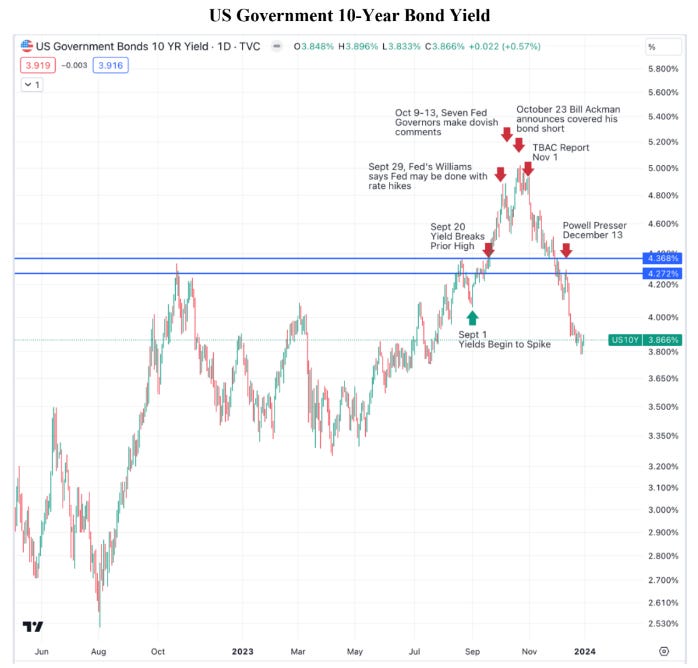
The US 10 Year Treasury Bond yield broke a technically important level (4.368%) on September 20,  2023 and quickly rose to 5.00%. This rate increase drove the S&P 500 down 7% in a matter of weeks, and down 11% from the recent peak. Both events set off alarm bells at the Fed and the Treasury.

The move in the US 10-year yield from September 1 to mid-October was dramatic, a 20% increase in the  yield in roughly 6 weeks. We recall the vibe at this time, and it reminded us of the UK Gilt Crisis in the  Fall of 2022 as UK bond yields began to spike.  

The Fed quickly came with the fire trucks. In rapid succession, we got the following “dovish” comments  out of no less than 8 Federal Reserve Governors: 

Fed’s Williams: central bank may be done with rate rises. 

  • Bloomberg 9/29/2023 

Fed’s Logan: higher yields may mean less need to raise rates. 

  • Bloomberg, 10/9/23 

Fed’s Daly: rise in bond yields may substitute for a rate hike.  

  • Bloomberg, 10/10/23

Federal Reserve Bank of Atlanta President Ralph Bostic reiterated that he doesn’t think policymakers  need to raise interest rates any further and that policy is restrictive enough to bring inflation back to their  2% goal. “I think that our policy rate is at a sufficiently restrictive position to get inflation down to 2%.”  Bostic said Tuesday during a conversation held at the annual convention for the American Bankers  Association. “I actually do not think that we need to increase rates anymore”. 

  • Bloomberg 10/10/23 

“We are in a sensitive period of risk management, where we have to balance the risk of not having  tightened enough, against the risk of policy being too restrictive” Fed Vice Chair Philip Jefferson said,  nodding to the rise in US Treasury yields and the need for the central bank to “proceed carefully” with  any further increases in the benchmark federal funds rate. 

  • Reuters 10/10/23 

Minneapolis Fed President Neel Kashkari noted it is “possible” that further rate hikes may not be required.

  • Reuters 10/11/23 

U.S. Federal Reserve Governor Christopher Waller on Wednesday said higher market interest rates may  help the Fed slow inflation and let the central bank “watch and see” if its own policy rate needs to rise  again or not. Waller, who has been among the most vocal advocates for higher interest rates to fight  inflation, said price data seem to now be moving back towards the Fed’s 2% target, with financial markets  adding further credit tightening on their own. 

  • Reuters 10/11/23 

Fed’s Harker says rate hikes likely over amid ongoing disinflation. 

  • Reuters 10/13/23 

Fed’s Lorie Logan: Pump the brakes on quantitative tightening. 

  • American Banker 1/8/24 

(h/t Luke Gromen, FFTT for summarizing these Fed comments) 

Based upon the number and consistency of these comments, we assume that it was a three-alarm fire that  the Fed had detected in the bond market, as the Bond Volatility Move Index ramped up to levels which  indicate severe stress. Several analysts have pointed out that bonds are now more volatile than gold.  This is not supposed to happen. 

But wait, there is more: The Fed Governors jawboning rates lower on the anticipation of no further rate  increases, and possible rate cuts, was just the first act in a three-act play. 

Act II opened up with US Treasury Secretary Janet Yellen upon the release of the Treasury Borrowing  Advisory Committee (TBAC) report on November 1, 2023. This report comments on the market for US  Treasury securities and estimates the amount and nature of the debt sales that the US Federal Government  will conduct in order to fund its debt and deficits.  

The TBAC report is highly technical with a lot of inside macro baseball. But several things in this most  recent report stood out: 

First, a much larger percentage of the debt is now being bought by US hedge funds and others  who are participating in the “basis trade”.2 

Second, the Treasury indicated that they intend to fund a much larger proportion of the debt via  short term bills and notes as opposed to longer term bonds. This implies: (i) that the Treasury is  having a hard time finding demand for longer term bonds (it is, we will discuss a recent 30-year  auction below); and (ii), the market interprets the tilt toward shorter term notes to be an indication  that the Treasury expects short duration yields to decrease soon. Markets viewed this as a sign  of more monetary accommodation coming soon. 

The Treasury has been worried about some weak government bond auctions in Q4 when the Bid to Cover  was only 2.24x, much lighter demand than usual. Given this anemic demand, primary dealers (i.e., Wall  Street banks) were forced to buy 25% of the bonds auctioned (vs. in normal times perhaps they only have  to buy 10-15%). Many have realized that bonds are not a great investment in an inflationary world, where  the US money supply has grown at 7% per year over the last 50 years, on average. So, we can debate  whether CPI is < 3% or not, but the reality is – debasement is running at 7% on average! Higher interest  rates will be needed to stimulate demand for US Treasuries. Watch for weak bond auctions as a major  risk factor to global markets over the next few years. 

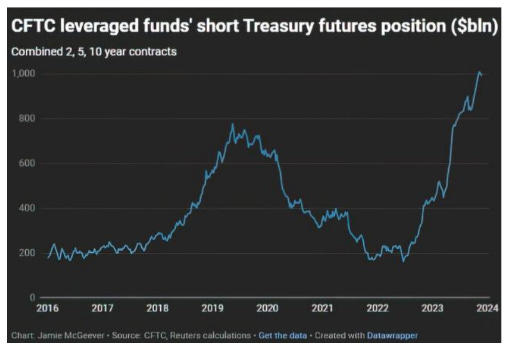
The basis trade mentioned above is also a risk that bears watching given it’s a small cadre of highly  levered hedge funds playing this arbitrage game of shorting US Treasury Futures while buying US  Treasury on-the-run bonds. Given the > 50x leverage employed, there is real risk if this basis trade went  afoul. Recall, Long Term Capital Management was a “can’t miss” back in 1998, until it wasn’t. But, we  are dealing with much larger sums of capital than LTCM’s $1bn of equity levered 100x. As you can see  in the following chart, there appears to be $1 Trillion of Levered Short US Treasury Futures positions.  

Note in the above chart, as rates were rising in 2019/2020, this same levered basis trade was present and  coincided with the September 2019 Repo rate blowout which led to the original Powell pivot.  Furthermore, several hedge funds at that time were rumored to be insolvent and received emergency Fed  swap lines. It would not shock us to see this movie come to a theater near you again soon.  

Act III began with the Federal Reserve meeting on December 13, 2023. As expected, they held the Fed  Funds policy rate constant at 5.25%, but very importantly they adjusted the “dot plot” of expected future  rate levels to reflect that a majority of the Fed Governors now believe the Fed will be cutting rates next  year. Perhaps even more importantly, the following exchange took place in the Q&A session with Fed  Chair Powell: 

Jennifer Schonberger of Yahoo Finance: You said back in July that you needed to start cutting  rates before getting to 2% inflation. As you mentioned PCE inflation is now running at 3.5% on  core. On a six-month annual basis, core PCE is running at 2.5%. Though when you look at  supercore and shelter, they are, of course, stickier. So, when looking in the different components  of the data, how much closer do you have to get to 2% percent before you consider cutting rates? 

Chair Powell: the reason you wouldn’t wait to get to 2% to cut rates is that policy would be too  late… you’d want to be reducing restriction on the economy well before (EMA emphasis added) 2%…..so you don’t overshoot, if we think of restrictive policy as weighing on economic activity.  It takes a while for policy to get into the economy, affect economic activity, and affect inflation. 

That, ladies and gentlemen is the “Powell pivot” (notably the second one, since he also pivoted in 2019).  Chair Powell is looking less like Paul Volcker and more like Arthur Burns.  

The Chair of the Federal Reserve just told us that they will not wait for PCE to hit 2% before beginning  to cut interest rates and loosen monetary policy. As we predicted, the Fed has once again changed the  narrative to suit their purpose. And let’s be clear, their purpose is to keep the bond and stock markets  functioning well. So, we can add “higher for longer” to the prior Fed mis-directions of: 

  • Inflation is too low. 

  • Inflation is transitory. 

  • We are not even thinking about thinking about raising rates. 

  • We will stay higher for longer to make sure inflation is under control. 

As we have said before, they have a tiger by the tail and are swerving between the two extremes of severe  inflation and severe deflation. Given policy lags, they are making a mess of it.  

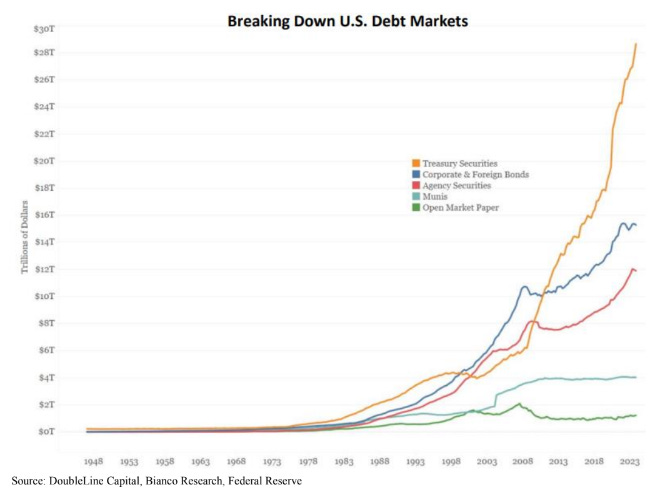
All we can say is good luck, particularly when looking at the next chart below. Notice the parabolic  increase in US Treasury issuance since 2009. In one snapshot here, we can see just how much the  government not only has to finance its own increasing government expenditures, but also the back door  assistance it has increasingly needed to provide over the past 14 years to support this levered system we  have. This is only going to compound even more rapidly, and God help us in the next crisis. Again, debt is debt and math is math. 

INFLATION

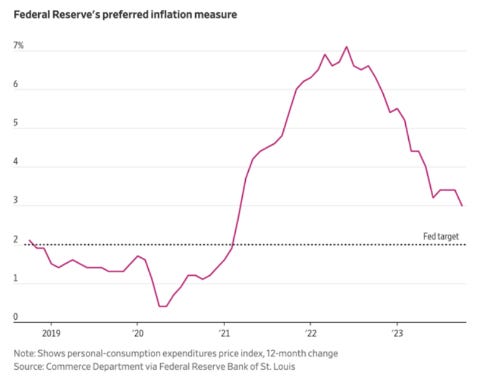
The level of reported PCE inflation has come down substantially (see chart below). Don’t get us started on whether these numbers are accurate or not, just remember that this is the gauge which the Fed uses.

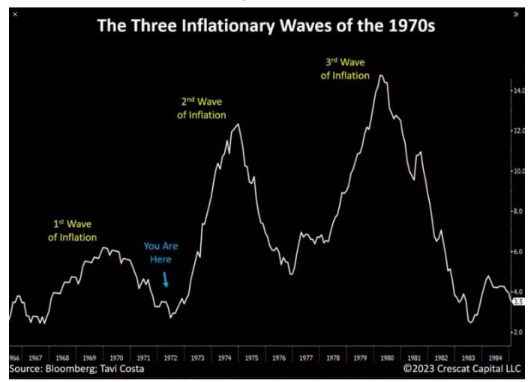
In essence, the Fed Chair is implying that inflation taming has been good enough for Government work.  And perhaps it is. Some think inflation will continue to fall and could perhaps even go negative – particularly as owner’s equivalent rent is ~35% of CPI and its impact is lagged by nearly a year (OER is  down over the past year). Anything is possible in this out-of-control system. However, inflation only  goes negative if we have a system wide deflationary collapse which will surely lead to record monetary  accommodation. The highly irresponsible 2002 “Helicopter Money” speech by Bernanke on preventing  deflation indicated the Fed will never let deflation occur. The system would collapse. We are not sure  of the path of the next Fed printing, or timing, but we can clearly see the issue. The odds are good that  the next wave of accommodation leads to a resurgence of inflation, similar to the 1970’s. 

Our view is that we have left the deflationary years of 1980 to 2020 behind and that in March of 2020  with the US 10-Year bond yielding only 54 basis points, we achieved peak deflation. We now live in an  inflationary world until these debt issues are resolved. Or, said another way the only way we get deflation  is if the Fed and other monetary authorities allow a deflationary collapse. (not impossible, but unlikely).

Part 2 of this letter can be found here.

QTR’s Disclaimer: I am an idiot and often get things wrong and lose money. I may own or transact in any names mentioned in this piece at any time without warning. Contributor posts and aggregated posts have not been fact checked and are the opinions of their authors. They are either submitted to QTR, reprinted under a Creative Commons license or with the permission of the author. This is not a recommendation to buy or sell any stocks or securities, just my opinions. I often lose money on positions I trade/invest in. I may add any name mentioned in this article and sell any name mentioned in this piece at any time, without further warning. None of this is a solicitation to buy or sell securities. These positions can change immediately as soon as I publish this, with or without notice. You are on your own. Do not make decisions based on my blog. I exist on the fringe. The publisher does not guarantee the accuracy or completeness of the information provided in this page. These are not the opinions of any of my employers, partners, or associates. I did my best to be honest about my disclosures but can’t guarantee I am right; I write these posts after a couple beers sometimes. Also, I just straight up get shit wrong a lot. I mention it twice because it’s that important.

Larry’s DisclaimerThese presentation materials shall not be construed as an offer to purchase or sell, or the solicitation of an offer to purchase or sell, any  securities or services. Any such offering may only be made at the time a qualified investor receives from EMA formal materials describing an  offering plus related subscription documentation (“offering materials”). In the case of any inconsistency between the information in this  presentation and any such offering materials, including an offering memorandum, the offering materials shall control. 

Securities shall not be offered or sold in any jurisdiction in which such offer or sale would be unlawful unless the requirements of the applicable  laws of such jurisdiction have been satisfied. Any decision to invest in securities must be based solely upon the information set forth in the  applicable offering materials, which should be read carefully by prospective investors prior to investing. An investment in EMA not suitable or  desirable for all investors; investors may lose all or a portion of the capital invested. Investors may be required to bear the financial risks of an  investment for an indefinite period of time. Investors and prospective investors are urged to consult with their own legal, financial and tax  advisors before making any investment. 

The statements contained in this presentation are made as of the date printed on the cover, and access to this presentation at any given time  shall not give rise to any implication that there has been no change in the facts and circumstances set forth in this presentation since that date.  These presentation materials may contain forward-looking statements within the meaning of US securities laws. The forward-looking  statements are based on EMA’s beliefs, assumptions and expectations of its future performance, taking into account all information currently  available to it, and can change as a result of known (and unknown) risks, uncertainties and other unpredictable factors. No representations or  warranties are made as to the accuracy of such forward-looking statements. EMA does not undertake any obligation to update any forward 

looking statements to reflect circumstances or events that occur after the date on which such statements were made. Historical data and  other information contained herein, including information obtained from third-party sources, are believed to be reliable but no representation  is made to its accuracy, completeness, or suitability for any specific purpose. 

No representation is being made that any investment will or is likely to achieve profits or losses similar to those shown. Past performance is  not indicative of future results. This report is prepared for the exclusive use of EMA investors and other persons that EMA has determined  should receive these presentation materials. This presentation may not be reproduced, distributed or disclosed without the express permission  of EMA.

Tyler Durden
Sat, 01/27/2024 – 10:30

US Median Rents Slide For Eighth Month On Surge In New Apartment Supply 

0
US Median Rents Slide For Eighth Month On Surge In New Apartment Supply 

High-frequency data from Realtor.com shows US median rents slid in December on a year-over-year basis for the eighth consecutive month, down -.4% for 0-2 bedrooms across the 50 top metro areas. The median asking rent was $1,713, down by $4 from last month and $63 (-3.5%) off the July 2022 peak. However, rents are still $309 (22.0%) higher than the same time in 2019. 

“In 2023, the rental market experienced a significant shift in momentum,” Realtor said, explaining that the “influx of record-high new multi-family homes exerted downward price pressure on median asking rents” and added this trend will continue producing “weakness in the rental market for 2024, as the completion of much-needed supply is expected to further impact the dynamics.” 

The report pointed out that metro areas across the West, such as San Francisco and Los Angeles, saw continued declines in rent prices on a year-on-year basis. However, some of the most significant declines were in the southern tier of the US, as multi-family completion rates soared 32% from January to October. 

Specifically, the top 3 metros experiencing the most significant year-over-year rent declines are Orlando, FL (-6.2%), Austin, TX (-5.4%) and Dallas, TX (-4.7%). -Realtor

In a separate report, rental property software provider RealPage said US apartment supply topped a 36-year last year with 440,000 apartment units completed – and that figure could be even higher this year. 

Rent costs are sliding, and since shelter constitutes a third of the Consumer Price Index (CPI) basket, the rising supply of apartments will likely reduce rent costs further – this is good news for the Fed’s war on inflation. 

Tyler Durden
Sat, 01/27/2024 – 09:55

Janet Yellen Bets $2 Trillion That Rates Will Not Be Higher-For-Longer

0
Janet Yellen Bets $2 Trillion That Rates Will Not Be Higher-For-Longer

Submitted by Anthony Trevisan,

A Major Trend Change

In 2023, the Treasury added $2.6T to the national debt. While that number alone should be enough to scare anyone, the details reveal something even more concerning. $2T of it, or 77%, was financed entirely with short-term Treasury Bills maturing in less than a year. The chart below shows the debt issuance trend over the last 20 years. As shown, the Treasury typically relies on medium-term debt (2-10 Year Notes) to fund the budget deficit. 2023 was a massive change in standard procedure as shown by the giant light blue bar on the right of the chart.

Figure: 1 Year Over Year change in Debt

The only other times Bills were used as a primary funding source was in 2008 during the Great Financial Crisis and 2020 during Covid. Neither year came close to 77% of total new debt issuance. These were also emergency times, and specifically in 2021, almost half the short-term debt was retired in favor of Notes and Bonds to undo the 2020 Bill issuance.

The Treasury has spent nearly two decades trying to extend the maturity of the debt. This can be seen in the blue line below that shows the average debt maturity. When the short term debt is issued in such a way, it drives down the average maturity, which causes the Treasury to have to roll-over more debt in shorter time periods. So why has the Treasury all of a sudden gone entirely to short-term debt in non-emergency times? The answer lies in the orange line, so let’s dig in.

Figure: 2 Weighted Averages

First, it is important to understand the interest rates the Treasury is facing. The chart below shows the current yield curve as it stands today and 6 months ago. As you can see, short-term rates are a full 1%-1.5% higher than medium-term. What?!? Didn’t we just see that the Treasury has specifically targeted short-term debt?

Why are they paying more than they have to? Had the Treasury financed the $2T with Notes, they would have saved $30B in interest this year alone!

Figure: 3 Tracking Yield Curve Inversion

So, why have they done this? Well, there are two potential possibilities.

First, they may be nervous about the market’s ability to handle so much medium-term debt. The market typically digests short-term debt very easily, but it can become saturated with medium-term debt. The chart below shows the amount of medium-term debt that rolled over last year. This is not new issuance; this is debt maturing that needs to be rolled over.

As shown, nearly $2T rolled over last year. This means, had the Treasury issued Notes instead of Bills, the Market would have had to absorb a whopping $4T in new medium-term debt like they did in 2020. The difference this year is that back in 2020 the Fed bought nearly all of that debt, putting a floor under the market.

Compounding this problem further is that this year is set to be a record year in terms of debt rollover. Nearly $2.9T in Notes need to be rolled over.

Figure: 4 Treasury Rollover

Still, even with that massive amount of debt issuance, there must be more to the story. Why would Yellen specifically pay $30B more in interest just because she is concerned the about the volume of debt issuance. As Figure 1 above shows, this has never been a concern in the past except in emergency situations. Furthermore, why not issue at least some new debt as medium-term.

This lends to a second, and more probable conclusion. Long-term rates are set to fall in the very near term. The Treasury did not want to lock in for 2-7 years at 4% if it knows rates will fall. It will pay a premium ($30B this year), if it means it can lock in lower rates for longer and save the money on the back end.

So, why are long-term rates, going to fall? Because they have to… the chart below shows the current interest owed on the national debt annualized. It’s not a pretty picture, and you can see how the interest from Bills has absolutely ballooned.

Figure: 5 Net Interest Expense

The Fed has come out with their dot plot that shows a calm glide path down. Well, we can take the debt maturity and push it forward at the projected rate of the Fed. Even given the current proposed 6 rate cuts, and getting back to 3.5% by early 2025, the trajectory for interest expense is not looking good.

Given current projections by the Fed, the Treasury will owe over $900B on interest by 2025. That is a debt death spiral. The Fed had to pivot back in 2018 when interest expense neared $400B. Next year, the cost will be more than double that!

Figure: 6 Projected Net Interest Expense

Wrapping up

There is a potential third option. It’s an election year. Maybe Yellen is doing everything and anything to keep the financial system running smoothly. She has decided that the Treasury market must remain 100% stable and wants to take no chances. Thus, she issues tons of short-term debt, costing the tax payer an extra $30B this year and decides it’s a problem to be fixed at a later date.

While this would be wildly irresponsible and corrupt, the real argument against possibility 3 is the same as possibility 1, the market should be able to ingest at least some medium-term debt. This means the only logical conclusion is that she knows rates are coming down hard and fast. How does she know? Well, she used to be the head of the Fed.

There is no doubt, everyone in Washington can do the simple math above and recognize the Fed cannot take a glide path down. The only option is for rates to come down. Yellen just bet $2T on that outcome.

She’s not gambling though; she is making an informed decision.

Tyler Durden
Sat, 01/27/2024 – 09:20