Obama DOJ Wants To Jail Peter Navarro For 6 Months For Same Thing Eric Holder Got Away With
Former Trump trade adviser Peter Navarro – the only guy who openly stood up to Anthony Fauci’s authoritarian lockdown ‘science’ – is facing six months in jail and a $200,000 fine if the Biden DOJ gets its way, after Navarro defied a subpoena from the House Jan. 6 select committee.
Navarro was arrested at a DC airportin June of 2022 on two misdemeanor contempt of Congress charges for doing exactly what Obama AG Eric Holder did (with zero consequences), and more recently, Hunter Biden – ignore a Congressional subpoena when he told the Jan. 6 committee to pound sand.
“The Defendant chose allegiance to former President Donald Trump over the rule of law,” said Assistant U.S. Attorney Elizabeth Aloi in a 20-page sentencing memo submitted Thursday night, Politico reports.
He will be sentenced by a federal judge next week after being convicted in September of said charges, after Aloi said that he “thumbed his nose at Congressional authority” and would likely do so again if it meant serving the “political interests of his allies and patrons.”
The prosecutor said Navarro summarily refused to aid the Jan. 6 committee’s investigation into the causes of the violent assault at the Capitol — including efforts by Trump to subvert the 2020 election and derail the transfer of power. Navarro worked with allies in Congress on a strategy to help slow Congress’ counting of electoral votes via a strategy that he and fellow Trump ally Steve Bannon dubbed “The Green Bay Sweep.”
The Jan. 6 committee subpoenaed Navarro to discuss those efforts, but he quickly told them that his testimony was barred by executive privilege, and he declined to participate in their probe. -Politico
Navarro was held in contempt in April 2022, after which the DOJ obtained a grand jury indictment for refusing to provide documents and testimony. According to prosecutors, Navarro knew that Trump had never actually asserted executive privilege to bar him from testifying, and that such an assertion would not preclude him from testifying about at least some of the subjects demanded by the committee.
“At no time did the Defendant provide the Committee with any evidence supporting his assertion that the former President had invoked executive privilege over the information the Committee’s subpoena sought from the Defendant, or otherwise challenge the Committee’s authority or composition,” wrote Aloi. “The Court was left with only the Defendant’s fan fiction version of what the Defendant wished or hoped the former President might have wanted but left unsaid.“
Eric Who?
Obama Attorney General Eric Holder famously also defied a congressional subpoena, and was held in contempt for concealing documents related to the “fast & furious” scandal, which was tied to the death of an estimated 150 Mexican civilians – while Navarro is refusing to answer House Democrats’ questions surrounding the 2020 election and the January 6th riot.
As a result of California Governor Gavin Newsom’s executive order, gas-powered vehicles will be banned by 2035. This refers to new vehicles and existing gas-powered cars and trucks that will be allowed on California roads for the moment.
Other states are following California. But with electric vehicles (EVs) comes an investment. What are the economic ramifications of banning gas-powered vehicles? Can California afford it? Can America afford it?
Gov. Newsom’s executive order was announced in 2020 and was followed by the California Air Resources Board’s approval in August 2022. Automakers and car dealers will be restricted to selling only cars, SUVs, and pickup trucks that generate zero tailpipe emissions by 2035.
To prepare for this, California’s Advanced Clean Cars II rule requires 35 percent of new cars and light trucks to have zero emissions by 2026. Sixty-eight percent must reach that goal by 2030.
Power Grids and Demand
There are ramifications to the gas-powered ban. One of these is the need to upgrade the power grid.
In the past, California residents have been plagued with planned rolling blackouts. Some of these were designed to cut the risk of wildfires. In high-risk areas, electric utilities are often preemptively shut off during windstorms, but many blackouts resulted from the strain on the power grid. Residents were asked to conserve energy.
California has experienced more outages in the last five years than any other state except Texas. On average, a California blackout lasted roughly 10 hours, with the longest lasting two and a half days.
Electric vehicles are dependent on the grid. If the power goes out, so does the car.
Cost of Upgrading California Power Grid
Preventative fire measures aside, California’s power grid will need to be upgraded to handle the increase in EV usage.
In 2021, analytics firm Kevala conducted a study for the California Public Advocates Office. Kevala found that without load management of other mitigation measures, system-level peak load would increase as much as 56 percent between 2025 and 2035.
This increase would mainly be due to EVs. Kevala estimated that upgrading the grid would cost $50 billion.
However, the California Public Advocates Office created a different number using a different model. They estimated the usage based on the addresses of all vehicles in California to predict where EV increased usage would likely occur. They then modeled the expected charging load.
The Public Advocates Office estimated the figure was $15–20 billion. But as a caveat, they said, “No single study or pair of studies, particularly this early in the electrification process, can definitively answer such a complex question as what the costs of distribution grid upgrades will be.”
The bottom line is that billions of dollars will need to be invested to upgrade the power grid to handle the additional strain of EVs.
Lack of Charging Stations
In 2022, at 14.3 million, California had more registered automobiles than any state nationwide. The overall number of registered motor vehicles was nearly 31.4 million. California also has the most new car sales. In 2022, new car sales amounted to $1,667,831 worth of vehicles.
With those million-plus potential EV sales, the need for charging stations will soar. Currently, there are approximately 51,000 public charging stations across the nation. As of March 2023, California has the most, with 14,040.
A report by the California Energy Commission shows that California needs 1.2 million electric vehicle chargers by 2030. This doesn’t take into the account the additional 157,000 chargers needed by 2030 for medium, heavy-duty and electric buses.
There are three types of chargers, and their cost ranges from $1,500 to $20,000. But that’s just for the equipment. There’s also the installation cost.
Regardless of which type of equipment is chosen, the installation can cost $100,000 to $200,000. These high-voltage items must have specialized electricians and laborers to install them.
Splitting the difference with $150,000 per charger, it would take roughly $180 billion to build the 1.2 million chargers needed to accommodate the 2035 mandate.
Banning Gas-Powered Vehicles Tax Revenue
With electric vehicles comes a decrease in gas consumption. Fuel taxes are a significant contributor to state transportation funds. It contributes 40 percent of funding. The majority of funding could disappear in the coming decades.
To replace lost revenue, many states have added fees to EV owners. California charges $100 annually for a zero-emissions vehicle. As of January 2021, this fee was indexed to the Consumer Price Index.
Economic Hardship on Middle and Lower Classes
The average EV costs $66,000. The Inflation Reduction Act EV tax credit of $7,500 can be written off when filing income taxes, but the consumer must still make the initial downpayment and finance. This could give them a hefty car payment, which not many may be able to afford.
In California, low-income individuals could be eligible for $9,500 in grants or rebates. If you take both discounts, it comes to a $49,000 vehicle. That’s still a big-ticket item for most middle to low-income Californians.
The high cost is because batteries are more expensive than internal combustion engines—a lithium battery for an EV costs between $5,000 and $20,000. And batteries are easy to damage and difficult to repair.
States Banning Gas Vehicles
But California isn’t the only state with this on its agenda. Nine states have also announced a restriction on new gas-powered vehicle sales. These states are:
Connecticut
Massachusetts
Maryland
New Jersey
New York
Oregon
Rhode Island
Washington
These states eight states are following the Advance Clean Cars II.
In 2022, the ninth state, Vermont, lawmakers required zero-emissions by 2030.
California and EV Economics
California is currently facing a $68 billion dollar deficit. Its debt for 2022 was $145.03 billion. That compares to the 2000 debt of $57.17.
Chris Hoene, head of the California Budget and Policy Center, blamed climate change for the state’s shortfall. This was because the state’s fires interfered with cash.
The goal with California is to reduce emissions to help prevent these climate issues.
However, the cost of converting the most populated state to EVs may not be feasible. Billions of dollars must be invested to upgrade the power grid and build chargers.
Manufacturers will need to drastically reduce prices to make it possible for middle America to afford EVs.
Balancing globalized trade and capital flows with domestic self-reliance and control of credit and capital is a positive development for everyone.
This week’s focus is on self-reliance, a topic of increasing relevance than is more complex that it may seem.
The flip side of the decline of hyper-globalization is the rise of national self-reliance. We can see this dynamic expanding in real time across the globe, particularly in China and the U.S.: though still bound by trillions of dollars / RMB in investment and trade, the two nations are seeking to balance their dependency on the other by increasing their self-reliance with their own resources and technologies.
This reduction of a potent source of instability (dependency) in favor of national self-reliance is a positive development. Just as household self-reliance doesn’t mean self-sufficiency (something I explain in Self-Reliance in the 21st Century), national self-reliance doesn’t mean self-sufficiency: trade and diplomatic ties with other nations are beneficial, but it doesn’t serve anyone’s interests to be so beholden to other nations that blackmail become a temptation.
But withdrawing from the world has risks, too. The ideal is a dynamic balance between national interests and global ties that benefit everyone, that is, ties that nurture cooperation and global stability.
In other words, national self-reliance is not a substitute for global engagement and cooperation, it is a stabilizing force that enables beneficial global ties. Dependencies are sources of instability and risk, as each side is under pressure to preserve whatever is viewed as essential, and this tends to increase the risk of rash decisions and actions.
The ideal global arrangement is a transparent flow of ideas and information that enables every participant to adapt to changing conditions. From this perspective, the risk isn’t that China seeks to become less dependent on Western technology, i.e. becoming more self-reliant; the risk is China blocking the flow of ideas from outside sources with the Great Firewall. (My sources report no U.S. news sites are available in China except a handful of anti-establishment sites.)
In the long sweep of its history, China has opened to the world and prospered, and then closed itself off and stagnated. A century after the glories of Admiral Zheng He’s massive fleet reaching the shores of Africa in the early 1400s, China banned all oceangoing vessels and suppressed maritime trade sought by other nations.
That outside ideas are viewed as potential threats to the domestic status quo is a common feature of history. Many national elites have tried to block ideas and information while seeking to attract technologies and capital, as these benefit not just the domestic economy but the elites’ personal wealth and their power base.
Capital and technology are tricky, however. Capital flowing into a developing nation can be beneficial, but it can also overwhelm and exploit the domestic economy, leading to the neo-colonialization of the nation’s productive assets. Capital flowing out of a nation with excess savings can be a positive source of investment opportunities, but this draining of capital can also hollow out the economy, especially if it is accompanied by a parallel loss of human capital leaving for better opportunities elsewhere.
Cheap credit looks attractive to credit-starved nations, but it comes with a terrible cost as the debt levels quickly rise to unsustainable levels and both borrowers and lenders are forced to absorb losses and retrench. China is receiving a 21st century education in these dynamics via the Belt and Road Initiative, which has been dialed back as loans sour and asset transfers ignite fears of neo-colonialism from the East.
Technology that’s borrowed ends up stagnating unless the entire system that enabled the development of that technology is also imported. The key feature of that technology-engine isn’t money, though that is one ingredient; the most important feature is the free flow of ideas and information, unencumbered by elite / political interference.
Balancing domestic self-reliance and global trade and capital / information flows is not easy. Closing the door to outside ideas, capital and information tends to lead to stagnation, while opening the floodgates with no constraints tends to lead to destabilizing dependencies, credit bubbles, exploitation and neo-colonialism.
National self-reliance has spawned an entire vocabulary. In China, President Xi Jinping has called for a “whole-nation approach” to increase domestic production of technology. In the U.S. the vocabulary includes reshoring, onshoring, friend-shoring and strategic alliances.
Hyper-globalization wreaked havoc on many levels in many places. Balancing globalized trade and capital flows with domestic self-reliance and control of credit and capital is a positive development for everyone. A more balanced global economy offers the potential for continued global cooperation and engagement and domestic development for every nation that pursues the dynamic stability of both self-reliance and global engagement.
Gordon Long and I discuss trade and supply chains in depth in our podcast on Self Reliance (45 min).
* * *
I began my study of China over 50 years ago when I earned a degree in Philosophy at the University of Hawaii at Manoa, where I was a student of two widely admired professors of Chinese philosophy, Chang Chung-yuan and Cheng Chung-Ying. It seems to me that Chinese philosophy–Confucianism, neo-Confucianism, Legalism (Mencius et al), Chan Buddhism, Taoism and in the 20th century, China’s version of Marxism–remain foundations beneath the great flux of China’s often tumultuous history. In this sense, Chinese philosophy is perhaps the ideal path to understanding the history and culture of China.
I haven’t maintained a list of the many books I’ve read on China; I’ve listed a few below that I recall. Please note that I am not an expert or a scholar, I am merely an informed observer.
Majority Of Biden’s $136 Billion Student Loan Forgiveness Scheme Going To “Public Servants”
President Joe Biden is heaping another $5 billion onto a $136 billion pile of taxpayer-funded student loan debt forgiveness, as one of his signature 2024 (vote buying) schemes heading into the 2024 election.
Not only has moral hazard been reduced to an academic concept, shouldn’t taxpayer funds be used to bail out poverty-stricken Americans before people with college degrees who signed their names to a contract for non-dischargeable debt? We digress.
Around 74,000 student loan borrowers will now see debt canceled as a result of administrative changes enacted by the US Department of Education in the latest round of relief – including borrowers enrolled in the government’s income-driven repayment and public service loan forgiveness programs, Bloomberg reports.
Each program requires at least a decade of payment or service to be eligible for relief. Mismanaged federal student-loan plans have left some borrowers without promised relief after making payments for as long as 25 years. -Bloomberg
“My administration is able to deliver relief to these borrowers – and millions more – because of fixes we made to broken student loan programs that were preventing borrowers from getting relief they were entitled to under the law,” Biden said in a Friday statement written by other people.
Of those receiving taxpayer-funded assistance, roughly 60% are taxpayer-funded “public servants” – so the snake continues to eat its tail. So, buying votes with voters’ money.
The article states that 43,900 of those getting debt relief are “public servants.” That means (I presume) government workers. So nearly 60% of the 74,000 people whose loans will now be paid off via deficit financing work for government, not private sector. https://t.co/wuNgAU0lyl
Biden’s bailout comes as civil rights groups, labor unions, and borrowers’ advocates have pressured his administration to expand the scope of his earlier $400 billion initiative that was struck down by the Supreme Court.
The second bite at the apple is much narrower than the original plan which would have forgiven up to $20,000 in student loans for around 40 million Americans.
Nearly 70 groups, including the AFL-CIO and NAACP, asked Education Secretary Miguel Cardona in a letter Thursday to hold another session in the rulemaking process and to include targeted relief for borrowers who have experienced hardship.
The goal is to allow more young people, people of color and low-income borrowers to be eligible for relief. -Bloomberg
According to the report, Biden’s support has weakened among black, hispanic, and young voters – demographics which have been historically critical for Democrats.
The FBI and Cybersecurity and Infrastructure Security Agency (CISA) issued a new memo and report on Wednesday, warning U.S. owners and operators of critical infrastructures not to use Chinese-manufactured unmanned aircraft systems (UAS) due to security risks.
“Our nation’s critical infrastructure sectors, such as energy, chemical and communications, are increasingly relying on UAS for various missions that ultimately reduce operating costs and improve staff safety,” said David Mussington, executive assistant director for CISA’s Infrastructure Security, in a memo that accompanied the report, titled “Cybersecurity Guidance: Chinese-Manufactured UAS.”
“However, the use of Chinese-manufactured UAS risks exposing sensitive information that jeopardizes U.S. national security, economic security, and public health and safety.”
Mr. Mussington added that “urgent attention” must be paid to “China’s aggressive cyber operations to steal intellectual property and sensitive data from organizations.”
Chinese-made drones have long been a concern in the United States, particularly those made by China-based Da Jiang Innovations (DJI), the world’s largest manufacturer of commercial drones. In December 2020, the Commerce Department added DJI to its export control list for being complicit in the Chinese regime’s human rights abuses. Two years later, the Pentagon added DJI to its list of “Chinese military companies.”
The report does not mention DJI or other Chinese UAS manufacturers by name.
Chinese Laws
However, it highlights the risks associated with using Chinese-made drones by pointing to different Chinese laws, including the National Intelligence Law that went into effect in 2017, which compels Chinese companies to hand over data collected within China and elsewhere to Beijing’s intelligence agencies.
“The 2021 Data Security Law expands the PRC’s access to and control of companies and data within China and imposes strict penalties on China-based businesses for non-compliance,” the report says, referring to China’s official name, the People’s Republic of China.
“The 2021 Cyber Vulnerability Reporting Law requires Chinese-based companies to disclose cyber vulnerabilities found in their systems or software to PRC authorities prior to any public disclosure or sharing overseas,” the report adds.
“This may provide PRC authorities the opportunity to exploit system flaws before cyber vulnerabilities are publicly known.”
The report points out three major vulnerabilities that Chinese-made drones can exploit: data transfer and collection, patching and firmware updates, and a broader surface for data collection. Drones controlled by smartphones and other internet-of-things devices could allow foreign intelligence gathering on U.S. critical infrastructure.
Sensitive imagery, surveying data, and facility layouts are some of the vulnerable data that “allow foreign adversaries like the PRC access to previously inaccessible intelligence,” according to the report.
“Without mitigations in place, the widespread deployment of Chinese-manufactured UAS in our nation’s key sectors is a national security concern, and it carries the risk of unauthorized access to systems and data,” said Bryan Vorndran, assistant director of the FBI’s Cyber Division, in a statement.
The memo encourages owners and operators of U.S. critical infrastructures to buy drones that are “secure-by-design,” including those made by U.S. companies. The report provides several cybersecurity recommendations.
Responses
Rep. Elise Stefanik (R-N.Y.), chairwoman of the House Republican Conference, and Rep. Mike Gallagher (R-Wis.), chairman of the House Select Committee on the Chinese Communist Party (CCP), issued a joint statement in response to the report.
“The new Cybersecurity and Infrastructure Security Agency report makes clear that Communist Chinese drones present a legitimate national security risk to our critical infrastructure and must be banned from the U.S.,” the two lawmakers stated.
“The CCP has subsidized drone companies such as DJI and Autel in order to destroy American competition and spy on America’s critical infrastructure sites. We must ban CCP-backed spy drones from America and work to bolster the U.S. drone industry,” they added.
Last November, a bipartisan group of 11 House lawmakers, including Mr. Gallagher and Ms. Stefanik, sent a letter to the Biden administration, calling for an investigation into Chinese drone maker Autel Robotics, citing national security concerns. The group said the firm is openly affiliated with the Chinese military and “poses a direct threat to U.S. national security as local law enforcement and state and local governments are purchasing and operating Autel drones.”
Mr. Gallagher and Ms. Stefanik also introduced the Countering CCP Drones Act (H.R.2864) last April to prevent DJI technologies from operating on U.S. communication infrastructure.
Sen. Mark Warner (D-Va.), chairman of the Senate Intelligence Committee, advised people interested in purchasing Chinese-made drones to read the security report.
“For years, I’ve been concerned about the security risks associated with drones, including those made in the PRC. This memo represents a good first step to studying that, and I hope anyone considering purchasing a Chinese drone reads it carefully,” Mr. Warner wrote in a post on X, formerly Twitter.
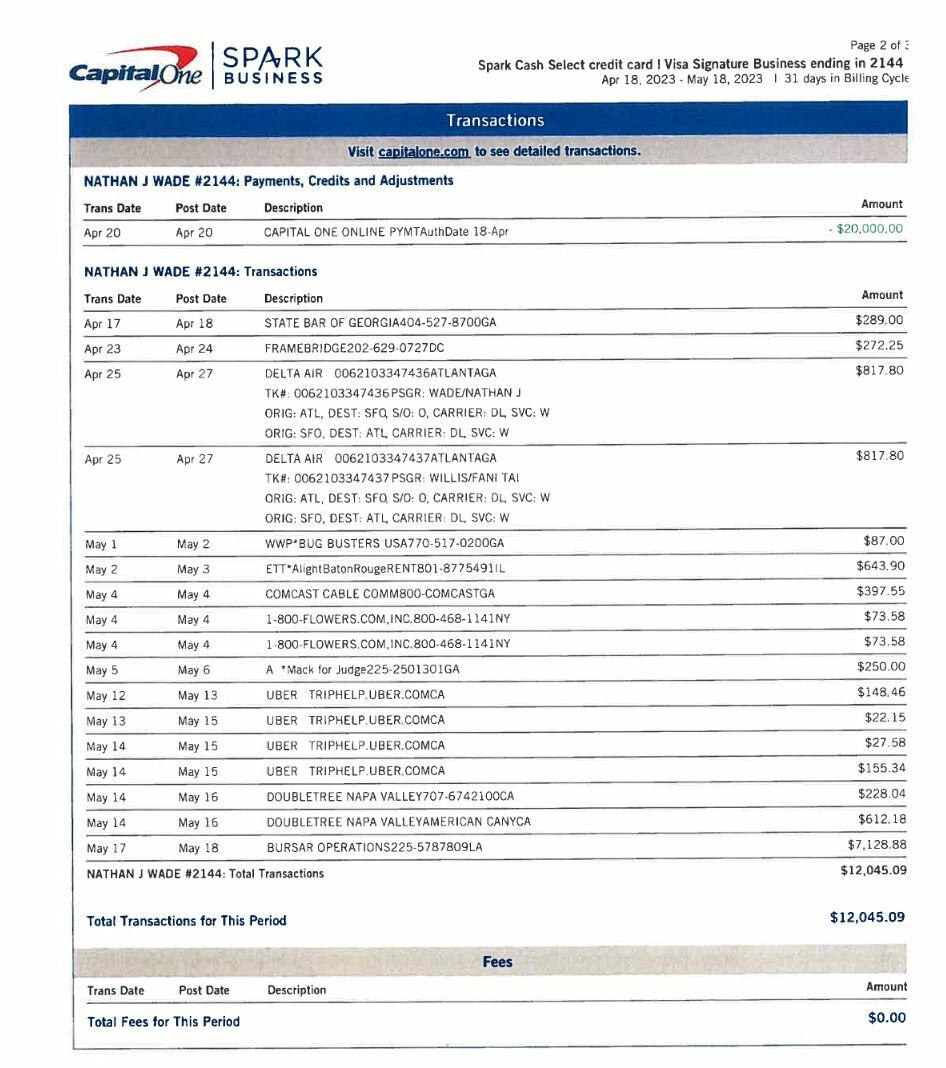
Fani Fingered: Jilted Wife In Trump-Georgia Fiasco Drops Bank Statements Revealing Lavish Vacations
Hell hath no fury like a woman scorned.
The jilted wife of DA Fani Willis’ alleged lover and outside counsel Nathan Wade dropped receipts in a Friday court filing, revealing that Wade purchased plane tickets in Willis’ name, with alleged travel to places such as Napa Valley, California, Florida and the Caribbean, according to the Daily Caller.
According to records filed in the Wade divorce, Wade bought tickets for he and Fani to travel on both Norwegian and Royal Caribbean cruise lines.
According to the report, Wade made two payments to Royal Caribbean cruise lines in the same day in the amount of $1,387 and $1,284, on Oct. 4, 2022.
As the Caller further notes;
Wade filed to divorce his wife on Nov. 2, 2021, the day after his contract with the District Attorney began. His wife alleged in prior filings that he did not disclose his earnings from the county to her but continued to draw from her bank account.
Wade’s firm has been paid nearly $654,000 from the Fulton County District Attorney’s office since 2022, county data shows.
The Friday filing was made in response to Willis’s attempt to quash a subpoena for her to testify in the divorce proceedings – with Willis accusing Joycelyn Wade Thursday of seeking to “harass and embarrass” her to obstruct the Trump case.
Wade’s wife hit back Friday, calling Willis’ arguments “disingenuous,” and said that the evidence is clear “Ms. Willis was an intended travel partner” for several trips.
As recently as May 2023, her office paid the attorney considered Georgia’s top racketeering expert, John Floyd, only $200/hour, while Wade — who reportedly has little to no experience prosecuting RICO cases — was earning $250/hour, per billing statements obtained by the DCNF.
“It is regrettable that Ms. Willis has filed such an inflammatory Motion, which has left Defendant with no other choice than to respond forcefully and with supporting evidence in a case that is very personal in nature,” reads the filing.
Like North Atlantic squalls pounding away at the New England shoreline, judicial deference doctrines have eroded the civil liberties ordinary Americans enjoy. No one can hold back the tide, but the Supreme Court has the opportunity to stop the erosion of civil liberties in a marquee case it will hear this week. My organization, the New Civil Liberties Alliance, is proud to represent the fishermen plaintiffs in this case, Relentless v. Department of Commerce.
Relentless poses a constitutional challenge to Chevron deference. Chevron is a court-made legal doctrine from 1984 requiring judges to defer to an agency’s reasonable interpretation of an ambiguity in a statutory provision it administers. It falsely treats ambiguity – and even statutory silence – as implicit delegations of rulemaking power from Congress to agencies.
At first, Chevron supporters thought that by empowering agencies the doctrine would rein in judicial activism.
In time though, constitutionalists have come to recognize that Chevron enables the administrative state to arrogate power to itself while flouting due process guarantees that protect all Americans.
This case provides one stark example.
For some 30 years federal fisheries agencies have randomly placed observers aboard commercial fishing vessels to log the crew’s activities and ensure compliance with catch quotas.
Placing observers is expensive.
The National Oceanic and Atmospheric Administration concedes that the cost runs at least $700 per day, per observer. That’s multiple thousands of dollars over the course of the typical fishing voyage, in a business where profit margins are tight.
The government bore the cost until 2020 when, concerned that congressional appropriations no longer sufficed to cover the cost of the program, NOAA crafted a new rule that charged the cost to fishermen instead.
NCLA’s clients operate commercial fishing vessels. We challenged the 2020 rule, arguing that federal law does not authorize NOAA to mandate industry-funded observers. The agency countered by citing an allegedly “ambiguous” provision of the 1976 Magnuson-Stevens Act, which it interpreted to allow burden-sharing. The agency demanded Chevron deference to its strained interpretation, and a federal trial court in Rhode Island duly obliged. The U.S. Court of Appeals for the First Circuit affirmed.
These courts did not decide that NOAA’s interpretation of the statute was better than our clients’ interpretation; instead, they merely held that NOAA’s interpretation was “reasonable” – even if our clients’ interpretation was better. Now before the Supreme Court, we argue this judicial deference accorded under Chevron is unconstitutional in at least two respects.
First, deference doctrines allow bureaucrats to hijack the judicial power that Article III of the Constitution properly vests in the federal judiciary.
Construing the law is the essential and exclusive role of the courts. The defining characteristic of this task is independent judgment, and judges are duty-bound to provide litigants their own views on a statute’s meaning, not just to assess the agency’s reasonableness.
For its part, an executive branch agency, like anyone else, cannot be trusted to render judgment in its own case. The agency has a policy agenda and is subject to the president’s political influence. Regulators will invariably interpret (or, as in this case, seek out) “ambiguous” provisions to benefit their power-expanding agendas. That no man can be the judge of his own case is an ancient principle of justice so basic that it should not need restating. But as we have seen, the administrative state imperils first principles.
Here, NOAA has salvaged its preferred regulatory program in the face of lapsing congressional appropriations by discovering latent authority to pass costs on to fishermen in a 40-year-old statute.
The Founding Fathers anticipated this problem. Hamilton explains in Federalist 78 that the separation of powers reflects a division among will, force, and judgment. Without the independent judgment of the judiciary, the people have no defense against the force of the executive, particularly where it has been conjoined with fictitiously delegated legislative will. For this reason, myriad provisions in the Constitution protect judicial independence. Most notably, judges are appointed for life, cannot serve simultaneously in other branches of government, and cannot have their pay cut by Congress. But all those parchment protections are for naught if judges defer to an agency’s legal interpretation instead of providing their own judgment.
The second reason Chevron is unconstitutional is that it violates due process of law principles.
Due process requires that disputes be resolved with neutral rules in a neutral forum by impartial judges. But Chevron makes a mockery of neutrality. It requires a judge to pre-commit to resolve legal ambiguity in favor of one party – and the most powerful party at that – the federal government. Put differently, Chevron systematically injects pro-government bias into legal proceedings; it puts a Leviathan-sized thumb on the scales of justice.
Separation of powers disputes are not esoteric. They pose the question fundamental to any republic – who decides? Nor are these issues arcane for our clients, commercial fishermen who will be forced to pay government agents for performing government functions on their boats, when Congress has never legislated that.
If NOAA can get away with snatching unlawful administrative power to force fishermen to pay for its regulatory regime, then with apologies to Billy Joel there will be no (Rhode) Island left for Rhode Islanders like my clients. The Court must scuttle Chevron and chart a new course, before it wrecks the F/V Relentless and takes the rule of law down with it.
Congressional Tax Deal Will Boost Deficit By $140 Billion: Here’s What’s In It
A bipartisan group of top Republicans and Democrats from the tax-writing committees in Congress reached agreement this week on a $78 billion package that would expand a tax benefit that provides money to parents and restore three popular expired business tax breaks. That combination offers both parties an opportunity to claim wins as voters begin to head to the polls ahead of the election in November.
Specifically, on Tuesday, Senate Finance Committee Chairman Wyden (D-Or.) and House Ways and Means Chairman Smith (R-Mo.) announced an agreement to expand the child tax credit (CTC) and reinstate corporate tax provisions that the 2017 Tax Cuts and Jobs Act (TCJA) made less generous. Limits on further claims of the COVID-related employee retention tax credit (ERTC) would provide savings to reduce the budgetary impact of the changes.
According to an analysis by Goldman, the deal, which expand the child tax credit (CTC) and restore business tax incentives, reduces revenues by $78bn (0.25% of 2024 GDP)over ten years and leads to a bigger increase in the near-term deficit. Limits on the COVID employee retention tax credit (ERTC) would supposedly offset the budgetary impact, but that is certainly not the case, especially not in the near-term.
While the proposal boosts deficit spending by tens of billions, it looks unlikely to materially affect the growth outlook. The child tax credit expansion looks likely to boost 2024 personal income by less than $10bn, with a good chance it has essentially no impact this year if Congress does not enact it in time to affect the upcoming tax filing season (i.e., in the next few weeks). Limitations on ERTC claims would likely reduce tax refunds by a larger amount so, while the effect on low-income households might be positive, the net impact on overall personal income in 2024 would be more likely negative.
By contrast, Goldman calculates that corporate tax changes would result in a larger near-term reduction in cash taxes than the ten-year estimates suggest. The three main changes — a restoration of R&D expensing, 100% bonus depreciation, and more generous interest deductibility — would apply retroactively and could reduce net corporate tax receipts in CY2024 by around $140bn (0.55% of GDP). As these policies shift the timing of tax payments much more than the cumulative amount, the ten-year impact would be substantially less. For the same reason, these policies would likely have a limited positive impact on investment, particularly as many businesses likely expected these retroactive changes to pass at some point.
Here are some more details on what is included in the corporate side of the tax bill:
Full expensing of R&D costs: To raise revenue to offset other business tax cuts, TCJA changed the tax treatment of R&D expenses. Rather than writing off costs in the year businesses incurred them, starting in 2022 the TCJA requires them to be amortized over 5 years. The current proposal would reverse that change, retroactive to 2022. This would reduce net cash taxes in 2024 by around $90bn—tax refunds for 2022 and 2023 and lower estimated taxes for 2024—even though the 10-year impact would be much smaller (companies would pay less tax now and more tax later);
Extension of 100% bonus depreciation: The TCJA allowed businesses to immediately deduct 100% of the cost of capital equipment through 2022, but this phases down to 80% in 2023 and 60% in 2024. The bill would restore the 100% immediate deduction. This would likely reduce net corporate tax receipts by around $40bn in CY2024, but would increase receipts a few years from now, so like the R&D change the longer-term cost would be much smaller than the near-term effect.
More generous interest deductibility: The TCJA limits corporate interest deductibility to 30% of EBIDTA through 2021 but then shifts to 30% of EBIT from 2022. The bill would reinstate the more generous EBITDA-based limitation through 2025. This would reduce net corporate tax receipts in CY2024 by around $10bn.
There is a clear chance that Congress will pass a tax bill similar to this in the near-term, but the odds are against it. There are three arguments in favor of passage.
First, the Republican chairman of the House Ways and Means Committee and the Democratic Chairman of the Senate Finance Committee have both agreed to these changes, and several other members of both parties appear to be in support.
Second, both parties get something out of the deal: most Republicans support the business tax incentives, while nearly all Democrats have sought an expanded child tax credit.
Third, passing the bill now has benefits that won’t be available after this year: if passage is delayed until next year when Congress takes up expiring 2017 tax cuts, the odds of retroactively extending business tax breaks back to 2022 are likely to be lower. Similarly, the means of paying for the current proposal—limiting ERTC claims—will no longer produce any savings next year, as the deadline to claim the credit is June 2025.
The arguments against near-term passage are stronger according to Goldman economist Alec Phillips: while there appears to be plenty of support on both sides of the aisle, there is also plenty of opposition. Most Democrats prefer a greater expansion of the child tax credit—the proposed expansion is worth around 10% of the value of the 2021 policy enacted as part of the American Rescue Plan (ARP)—and object to providing much greater near-term tax relief to businesses than low-income households. On the Republican side, many are likely to object to loosening the relationship between income and eligibility for the child tax credit and are unlikely to be enthusiastic about extra payments to households ahead of the presidential election with a Democratic incumbent in the White House. And while using the ERTC limits to offset and making business tax incentives retroactive becomes harder with a delay, Congress could probably still pass a substantively similar proposal late this year in a lame-duck session of Congress.
The House Ways and Means Committee is scheduled to debate the package Friday, and while an agreement between the chairmen of the two relevant committees raises the odds that a tax bill passes, we are still skeptical the bill will become law quickly as noted above. It looks likely to take several weeks more at a minimum, which would likely be too late to affect the upcoming tax filing season. If such a tax bill does become law this year, it might not happen until after the presidential election in a lame duck session of Congress.
After years of suppressing the story and casting doubts over its authenticity, many in the media in the last year have belatedly and reluctantly acknowledged that the Hunter Biden laptop is real. Some of us reached that conclusion years ago due to the self-authenticating emails confirmed by third parties. However, the denials and doubts have continued, including most recently by Rep. Dan Goldman (D., N.Y.) in hearings.
The Justice Department has now again confirmed the authenticity and added details on why these denials are unsupported.
This week, the Justice Department confirmed that the laptop was authenticated through forensic examination and a search warrant on Hunter’s Apple iCloud. Hunter’s electronic devices were backed up on the Cloud and “the results of the search were largely duplicative of information investigators had already obtained from Apple.”
That is only the latest such confirmation, but some have continued to desperately cast doubts the laptop, which Hunter himself said might be the product of Russian intelligence.
Once again, the last dogs in this fruitless fight are the most partisan among us.
Rep. Goldman, for example, recently lambasted witnesses who referenced the laptop and challenged the credibility of a journalist who cited the laptop.
Goldman attacked Journalist Michael Shellenberger and declared “You have no idea, you know hard drives can be manipulated. Hard drives can be manipulated by Rudy Giuliani or Russia. There is actual evidence of it, but the point is it’s not the same thing.”
Goldman has never revealed the “actual evidence” showing that the laptop is fake or why the Justice Department and FBI are making the same false claim in court if such evidence exists.
The same week that the Biden Administration again confirmed the authenticity of the laptop, one of the loudest laptop deniers wrote a telling column on why the public should avoid researching such questions on their own.
The Washington Post’s Philip Bump has repeatedly pushed false stories from Lafayette Park to Russian collusion to the laptop. Even after many in the media admitted that the laptop was authentic, Bump was still declaring that it was a “conspiracy theory.” Recently, in response to a column on these false claims, the Post remarkably declared that Bump’s original claims on Lafayette Park, the Hunter Biden laptop, and Russian collusion were true and they stand by them.
This week, Bump warned citizens that they needed to continue to get their news from the media and not try to learn the truth on their own. In a column titled “Doing your own research is a good way to end up being wrong,” Bump states without an sense of self-awareness that citizens will often “embrace dubious information supporting their belief than information that corroborates the allegations” — precisely what critics have accused Bump of doing for years on the laptop and other false stories.
Bump’s column is a must read for understanding the sense of entitlement of columnists in today’s age of “advocacy journalism.” It is consistent with what Bump said in an interview last year before he walked out after being confronted about false stories.
In a podcast interview with Noam Dworman, Bump became exasperated and said “I’m gonna lose my mind” when Dworman offered facts contradicting his view. Ironically, when Dworman noted that half of the country does not believe his positions, Bump shot back “I know, because half the country doesn’t actually dig into the issues.”
However, Bump does not believe that they should actually dig into the issues but accept his view.
He chastised Dworman and the public “because you don’t listen to the press. I’m sitting here and I’m telling you, you’re wrong about these things, and you don’t listen … you refuse to listen to what I’m saying to you. You asked me on to present evidence. I keep telling you.”
Indeed, Bump and others kept telling people that the laptop was a “conspiracy theory” and possible Russian disinformation. Now, he is reminding people not to do their own research as the Post expressly declared that the prior false claims in his columns were actually true.
This is why, at the start of our Republic, alternative media sprang up with pamphleteers like Thomas Paine. Citizens rejected the state-supporting media and searched for their own sources. Today citizen journalists can be found on the Internet in blogs and other sites that carry opposing views or accounts.
The media is already moving to be sure that the public is limited in what they are allowed to see or hear. After Donald Trump won the Iowa caucuses, MSNBC host Rachel Maddow explained to viewers that the network had decided that they should not hear Trump’s victory speech because he would only tell them “untrue things.”
As noted by Bump, citizens are much safer to just accept what they are given and avoid the temptation to do their own research. Censorship is now actually proclaimed as a form of virtue signaling, assuring viewers that they will not have to hear certain opposing views or figures.
There is little tolerance for those who insist on seeking out such news. After all, as the Post’s Bump explained, “I’m telling you, you’re wrong about these things, and you don’t listen.”
Texas authorities began arresting illegal immigrants at Shelby Park in Eagle Pass on Wednesday after the state’s attorney general defied a cease-and-desist letter sent by the Biden administration demanding officials stop blocking U.S. Border Patrol agents from the site.
The arrests were announced by Lt. Chris Olivarez at the Texas Department of Public Safety on X, formerly Twitter.
Mr. Olivarez said single adult migrant men and women were taken into state custody and charged with criminal trespassing under Governor Greg Abbott’s new state law, which allows police to arrest and charge people suspected of entering the country illegally.
That measure was passed in December and is set to go into effect in March but is currently subject to a legal challenge by the Justice Department.
“Under the authority of Gov.@GregAbbott_TX’s Border Disaster Declaration, @TxDPS Troopers are arresting illegal immigrants for criminal trespass at #ShelbyPark in Eagle Pass,” he wrote.
“Troopers are enforcing criminal trespass on adult men & women. The State of Texas will maintain a proactive posture in curbing illegal border crossings between the ports of entry,” Mr. Olivarez added.
The Texas official also shared photos and video footage alongside the post, showing officers searching and handcuffing multiple illegal aliens before leading them into police vehicles.
Typically, illegal immigrants who enter the United States may surrender to border patrol agents and seek asylum.
Biden Admin Issues Warning
It is not immediately clear how many arrests were made by Texas officials.
However, the detentions mark the first of their kind since Texas state authorities earlier this month took control of Shelby Park, a roughly 2.5-mile portion of the U.S.-Mexico border that serves as a hotbed for illegal immigration, in an effort to combat unprecedented illegal border crossings.
Wednesday’s arrests are likely to increase ongoing tensions between Texas officials and the Biden administration after the Department of Homeland Security (DHS) demanded state authorities stop “barring” federal Border Patrol agents from accessing the area, which is located next to the Rio Grande.
The federal government claims that Texas has “impeded operations of Border Patrol” along the area in “conflict with the authority and duties of Border Patrol under federal law” and preempted under the Supremacy Clause of the U.S. Constitution.
In a cease-and-desist letter sent to Texas Attorney General Ken Paxton on Jan. 14, DHS general counsel Jonathan Meyer further accused Texas of having failed to allow border agents access to the area “even in instances of imminent danger to life and safety.”
‘Facts and Law Side With Texas’
Mr. Meyer cited an incident on Jan. 12 when a woman and two children drowned in the Rio Grande. DHS has claimed the three died after Border Patrol agents “were physically barred by Texas officials from entering the area,” while the White House has used the incident to further take aim at Mr. Abbott’s policies.
However, the Texas Military Department has provided a different account following a thorough review of the circumstances surrounding the drownings, stating that Border Patrol agents requested access to the area after the drownings occurred while Mexican authorities were already recovering the bodies.
National Guard soldiers stand guard on the banks of the Rio Grande River at Shelby Park in Eagle Pass, Texas, on Jan. 12, 2024. (Brandon Bell/Getty Images)
Despite the differing statement from the Texas Military Department, DHS gave Texas until Wednesday to stop “barring” Border Patrol’s access to the area and threatened to refer the matter to the Department of Justice for “appropriate action” if state officials failed to do so.
Mr. Paxton responded to the DHS cease and desist request on Wednesday by defending the actions of Texas authorities.
“Because the facts and law side with Texas, the State will continue utilizing its constitutional authority to defend her territory, and I will continue defending those lawful efforts in court,” Mr. Paxton wrote.
The Texas Republican also called the White House’s attempts to blame Texas for the death of the three illegal immigrants “vile” and “completely inaccurate.”
“Instead of running to the U.S. Department of Justice in hopes of winning an injunction, you should advise your clients at DHS to do their job and follow the law,” Mr. Paxton wrote.