67.6 F
Chicago
Thursday, September 17, 2026
Home Blog Page 2992

North Korea Tests Exotic Underwater Nuclear Drone, Claims It Can Create “Radioactive Tsunami”

0
North Korea Tests Exotic Underwater Nuclear Drone, Claims It Can Create “Radioactive Tsunami”

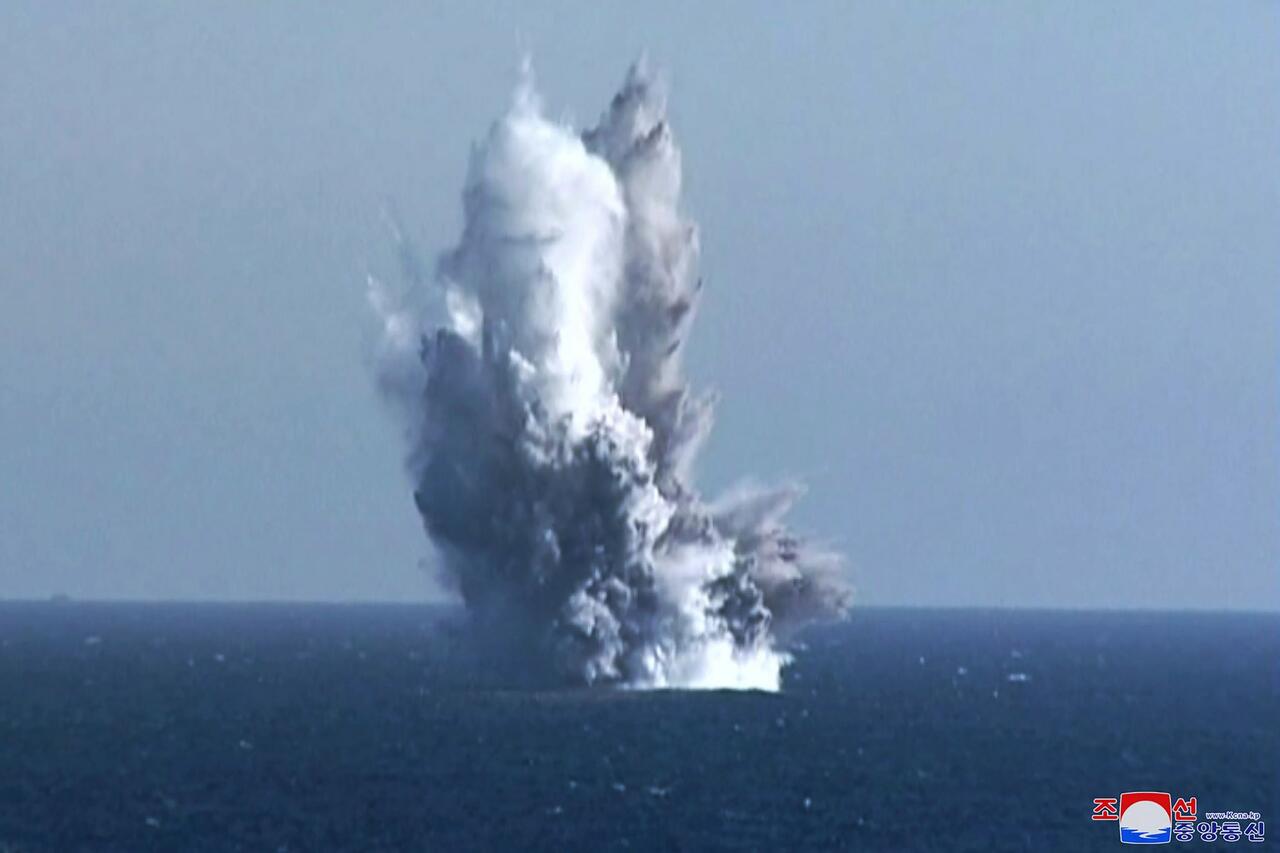
North Korea says it has tested a nuclear-capable underwater attack drone, which some analysts have dubbed an ‘exotic system’ given there’s not much known about it, in response to fresh naval exercises involving the United States off the peninsula. The testing of the “Haeil-5-23” system occurred of the country’s east coast.

Korean Central News Agency (KCNA) on Friday warned of “catastrophic consequences” for the US and its “followers”, also given the joint naval drills with South Korea also had Japan’s participation. 

North Korean state media image

“Our army’s underwater nuke-based countering posture is being further rounded off, and its various maritime and underwater responsive actions will continue to deter the hostile military maneuvers of the navies of the US and its allies,” KCNA described.

While South Korean officials have in the recent past described that the north’s claims concerning the new weapon are exaggerated, it has gained the public’s attention given Pyongyang has touted the weapon’s ability for surprise attacks unleashing mass destruction by generating a “radioactive tsunami” through a large underwater explosion.

Reuters describes, “Dubbed ‘Haeil’, which means tsunami, the new drone system was first reportedly tested in March 2023, and state media said it was intended to make sneak attacks in enemy waters and destroy naval strike groups and major operational ports by creating a large radioactive wave through an underwater explosion.”

Illustrative, imagined result of North Korea’s ‘exotic weapon’

According to commentary on the mysterious weapon system as cited in Al Jazeera:

While there wasn’t much in the public domain about the drone tested, “what we do know about it, if it’s close to what they tested last year, is that this underwater unmanned vehicle is likely quite slow. It’s a very exotic system,” Mason Richey, a professor at the Hankuk University of Foreign Studies in Seoul, told Al Jazeera.

“It probably runs only something around eight knots per hour, which is somewhere around 14 or 15km [8.6-9.3 miles] per hour. It’s probably quite vulnerable to anti-submarine warfare.”

Its value was more likely “political signaling”, rather that its military use, Richey noted in light of the US, South Korean and Japanese drills.

“This does not make North Korea happy, and the political signal from this message here is quite clear – that it’s going to continue to develop its nuclear arsenal in this sort of … spiral situation that we find ourselves in now,” he added.

But as for Friday’s alleged test of the weapon, North Korea did not offer any proof that it actually worked, nor was there any sign of a tsunami in regional waters.

Much of the Kim Jong-Un government statement relayed via KCNA focused on denouncing the US-South Korea-Japan exercises. Pyongyang said it is “an act of seriously threatening the security” of the north, and that “The U.S., Japan and the Republic of Korea are getting frantic in their provocative military exercises.”

BBC: North Korean state media published these images of the “underwater nuclear system” when the drones were revealed last April

The statement added, “The armed forces of (North Korea) will strike horror into their hearts through responsible, prompt and bold exercise of its deterrent.”

The naval exercises in question included the aircraft carrier USS Carl Vinson and several warships, as well as the Japanese helicopter carrier JS Hyūga. Pyongyang is especially angry that the US has docked a nuclear submarine in the south several times since last summer.

Tyler Durden
Fri, 01/19/2024 – 13:45

The Indian Youth Bulge And Demand For Gold

0
The Indian Youth Bulge And Demand For Gold

Via SchiffGold.com,

When a country starts to develop economically, a few things tend to happen:

  • the death rate falls,

  • workers become more productive,

  • consumers consume more,

  • and birth rates normally fall.

During this period, countries experiencing such changes have a relatively small number of retirees and a small share of the population composed of children. 

This means that a large share of the population is economically productive, working either formally or informally.

This phenomenon is known as the demographic dividend. In contrast to the rapidly aging populations of East Asia, North America, Europe, and parts of Latin America, India boasts a large and comparatively young population.

In just over a decade, about a quarter of a billion Indians are expected to reach adulthood and join the workforce, a development economists expect to be beneficial for Indian economic growth.

But this could also be remarkably good news for gold investors.

Why?

India is already the world’s largest democracy and is second only to China in gold consumption, with 849 metric tons against China’s 984 metric tons, respectively.

India is almost certain to surpass China in gold consumption due to its growing population and economic growth.

The United States sits third in total gold consumption at only 193 metric tons per year. What’s interesting is that the US GDP is roughly $25.5 trillion, compared to India’s GDP of $3.4 trillion. Despite having an economy less than one-seventh the size of the US, India consumes over four times as much gold. Per dollar of economic production, Indians choose to consume and invest far more of their wealth in gold than Americans do. Projecting this preference forward, as the Indian economy is poised to surge, suggests that Indian population and economic growth will increasingly determine and support gold prices. While some of the demand for gold will come from Indian consumers and businesses, some may also come from the Reserve Bank of India, which increased its gold reserves towards the end of 2023.

Another reason India’s economic ascent will impact gold is the role that gold plays within Indian culture. CBS News describes how central gold is to Indian celebrations and weddings, noting it as a “symbol of purity that also shows the couple’s wealth and well-being.” Gold is given as a wedding gift, worn by the bride, and, before dowries were banned in India, was often part of a dowry. With hundreds of millions of Indians coming of age in the coming years, a significant number of increasingly affluent Indian couples are set to wed, with gold likely playing a big part in those celebrations.

While India is not yet the largest overall consumer of gold, it has already established itself as the largest consumer of gold for jewelry. Its lead in this area is likely to expand as India becomes increasingly prosperous. However, looking solely at the economic growth of the nation may understate the impending impact of Indian prosperity on gold. Two other factors in which Indian development can drive demand for gold are through the Indian diaspora and Indian cultural influence.

The Indian diaspora, comprising tens of millions of people, can be found around the world. In many countries, including the United States, the Indian diaspora tends to have substantially higher incomes than the average. The cultural traditions and investing preferences of Indians, including those outside of India, drive significant economic activity. As this population grows, its impact in various economic areas, including the price of gold, will only become more significant.

Less directly, but not necessarily less importantly, is the cultural influence of India. While this influence is already evident from Bollywood to the popularity of Indian cuisine and yoga, the growing prominence of India is likely to shape global culture. Just as the United States and the West exported certain wedding traditions like the white veil and dress worldwide, Indian weddings and their embrace of gold may similarly influence other cultures.

Likewise, the prudent choice to invest in gold as a store of value, a practice shared by many around the world including many Indians, may also gain popularity due to Indian cultural influence.

Tyler Durden
Fri, 01/19/2024 – 13:25

Watch: “You Are The Problem” – Conservative Speaker Slams Davos Globalists To Their Faces

0
Watch: “You Are The Problem” – Conservative Speaker Slams Davos Globalists To Their Faces

Authored by Steve Watson via Modernity.news,

Kevin Roberts, President of the conservative think tank The Heritage Foundation, spoke to globalists at the World Economic Forum confab Thursday and told them directly that “You are part of the problem, you are not the solution.”

During a discussion titled “What to Expect from a Possible Republican Administration,” Roberts let rip on the elitists.

“I will be candid,” Roberts began, adding “the agenda that every single person member of the [future Republican] administration needs to have, is to compile a list of everything that’s ever been proposed at the [WEF], and object all of them wholesale.”

He further urged that “anyone not prepared to do that, and take away this power of the unelected bureaucrats and give it back to the American people, is unprepared to be a part of the next conservative administration.”

When the discussion turned to Donald Trump, Roberts told the host of the panel, Sir Robin Niblett, ‘Distinguished Fellow’ of Chatham House, that “It’s laughable that you or anyone would describe Davos as protecting liberal democracy,” adding “It’s equally laughable to use the word ‘dictatorship’ at Davos and aim that at President Trump… I think that’s absurd.”

He continued, “The very reason I’m here at Davos, is to explain to many people in this room and who are watching, with all due respect – nothing personal – that you are part of the problem.”

“Political elites tell the average people… that the reality is ‘x,’ when in fact, reality is ‘y,’” Roberts further declared, going on to give several examples with regards to open borders, immigration, gender issues, and the constant guilt trip elites subject everyday people to over the “existential threat” of climate change, while they hypocritically fly around in private jets.

Watch:

Roberts echoed some of the same sentiments expressed yesterday at the confab by Argentinian president Javier Milei.

It’s surprising to see the likes of Roberts and Milei even invited to speak at the WEF. One can only imagine the globalists there are conducting closer research on their enemies.

In a piece written before the panel discussion, Roberts noted “The infamous hypocritical self-avowed Marxists, private-jet environmentalists, and genocide-adjacent humanitarians want to hear from the Heritage Foundation how they can “rebuild trust” with everyday Americans against whom they have weaponized their institutions.”

Usually it’s just Klaus Schwab fantasising about giving everyone brain implants and doing away with democratic elections.

*  *  *

Your support is crucial in helping us defeat mass censorship. Please consider donating via Locals or check out our unique merch. Follow us on X @ModernityNews

Tyler Durden
Fri, 01/19/2024 – 12:45

China Stocks Hit Rock Bottom: After $6.3 Trillion Market Loss, Brokers Suspend Short-Selling

0
China Stocks Hit Rock Bottom: After $6.3 Trillion Market Loss, Brokers Suspend Short-Selling

Amid ‘snowball derivative liquidations‘, China’s stock market is falling faster than its population.

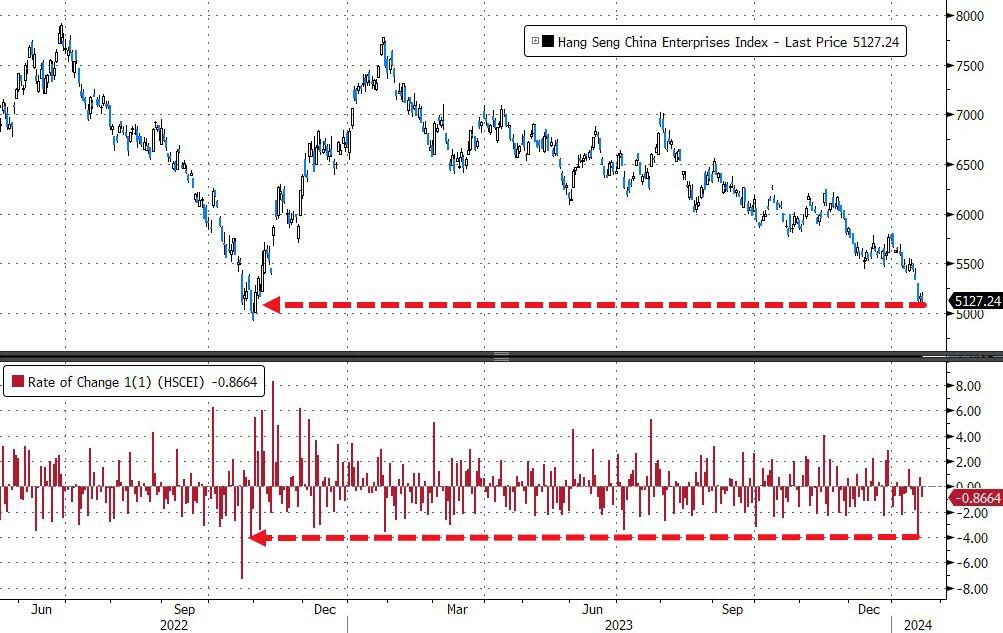
The Hang Seng China Enterprises Index crashed 6.5% this week – its worst weekly loss since March 2023 with Wednesday seeing the biggest daily loss since Oct 2022 as the index plummeted to key support levels around the Oct 2022 lows…

Source: Bloomberg

For context, Chinese and Hong Kong stocks have seen some $6.3 trillion of market value wiped out since a peak reached in 2021…

Source: Bloomberg

But, as we detailed earlier in the week, authorities have ruled out the use of massive stimulus to revive the flagging economy, leaving traders wondering when things will improve.

“What we are seeing this year so far really is a continuation of what we saw last year,” John Lin, AllianceBernstein’s chief investment officer of China equities, said in an Jan. 17 interview on Bloomberg TV.

“These squeezing-the-toothpaste type of stimulus policies so far haven’t been able to turn around the underlying bottom-up fundamentals of areas like the property sector.”

It gets worse as China is setting grimmer and grimmer milestones by the day:

  • Tokyo has overtaken Shanghai as Asia’s biggest equity market…

  • India’s valuation premium over China has hit a record.

  • Locally, a meltdown in Chinese shares is wreaking havoc on the nation’s asset management industry, pushing mutual fund closures to a five-year high.

Most importantly, as we noted previously, the lack of stimulus (amid China’s real estate sector crisis and escalating tensions with Washington on trade) has had a very adverse impact on both economic and market sentiment at a time when China’s middle class is growing increasingly restless and pitchforky, resulting in a surge in labor strikes and (mostly peaceful) protests.

And while a quiet, painless sovereign suicide may be an option for Japan – with its demographic disaster and rapidly aging population where more adult than baby diapers have been sold for years; for China – which still has a young, vibrant and increasingly angry population – this is not an option as the coming tidal wave of unrest could easily result in the one thing the Chinese Communist Party dreads the most, a revolution.

For now, Beijing refuses to unleash a monetary bazooka – amid its longest period of deflation since 1998 – but that doesn’t mean it won’t step in to try and arrest the collapse of the stock market (which along with real estate) is a considerable source of ‘wealth’ for the Chinese.

“The government seems very sanguine about the economy,” said Xin-Yao Ng, an investment director for Asian equities at abrdn.

“The market might not even trust the 5% growth figure, it certainly has a much more negative view on the economy and definitely believes Beijing needs a big fiscal response.”

With that in mind, just a day after unleashing The National Team (China’s Plunge Protection Team), Bloomberg reports that China’s largest brokerage has suspended short selling for some clients in mainland markets, according to people familiar with the matter.

State-owned Citic Securities Co. has stopped lending stocks to individual investors and raised the requirements for institutional clients this week after so-called window guidance from regulators, said the people, asking not be identified discussing a private matter.

Of course, as we have pointed out numerous times (most recently here for example), research has consistently shown that banning short selling during stretches of particularly volatile equity market activity intensifies the volatility.

Such prohibitions impede investors from determining accurate prices of assets and reduce market liquidity.

Moreover, short-selling bans in one market can increase volatility in other markets as some investors try to circumvent the ban.

But since when has historical evidence of the failure of policies ever stopped any politician from ‘doing something’ or blaming someone.

Everything that Chinese authorities have tried has failed to convince money managers that the worst is behind us. As Bloomberg reports, Asian funds have cut their allocation to China by 12 percentage points to a net 20% underweight, the lowest in more than a year, according to the latest Bank of America survey.

Managers of benchmark-tracking funds have sold a net $300 million of shares traded in mainland China and Hong Kong this month, according to a Morgan Stanley analysis.

That’s a reversal from the last half of 2023, when they bought $700 million on a net basis even as stock indexes declined.

“China is a waiting game and we continue to be waiting,” said Mark Matthews, head of Asia research at Bank Julius Baer & Co., which is mostly avoiding Chinese equities.

How much longer can Beijing wait?

Tyler Durden
Fri, 01/19/2024 – 12:25

“I Was Wrong”: Trump Adviser-Turned-Critic Backs Trump Again, Loomer Savages

0
“I Was Wrong”: Trump Adviser-Turned-Critic Backs Trump Again, Loomer Savages

Authored by Catherine Young via The Epoch Times (emphasis ours),

Steve Cortes, a former Trump advisor who campaigned for Florida Gov. Ron DeSantis before stepping down from the Never Back Down super PAC, had a change of heart, penning an op-ed titled “Only Trump Can Save America.”

Donald Trump speaks to supporters in Des Moines, Iowa, on Jan. 15, 2024. (John Fredricks/The Epoch Times)

In the RealClear Politics piece, Mr. Cortes wrote that he had believed Republican voters were ready to move on from former President Donald Trump this election cycle, and “I now believe I was wrong.”

Mr. Cortes was an advisor in President Trump’s 2016 and 2020 campaigns.

In May 2023, he announced his endorsement of Mr. DeSantis in a Newsweek editorial, writing that the “America First movement” was bigger than President Trump.

He made a case for Mr. DeSantis as “the best possible option to win the presidency in 2024” with few references to President Trump, but he later criticized the former president on social media.

As the spokesman of Never Back Down, Mr. Cortes was asked about Mr. DeSantis’s stalling poll numbers contrasting with President Trump’s consistent lead. His comment about the governor being “way behind” in the polls during a Twitter spaces event kicked off a spate of coverage about Mr. DeSantis’s embattled campaign.

In October, Mr. Cortes left his position as a spokesperson for Never Back Down but did not withdraw his support for the governor.

Those of us who backed Ron DeSantis—or the other Republican candidates—should read the room,” he wrote in his new op-ed.

He pointed to President Trump’s victory streak in the polls and most recently in Iowa and said it was time to “coalesce and unite” behind the GOP voters’ favorite.

“We do not have the luxury of further internal strife and instead must gird for an epic battle this autumn against our opponents who are inflicting daily damage upon America,” Mr. Cortes wrote, echoing President Trump’s victory remarks after Iowa, where he called for unity and praised his GOP rivals for a change.

He inferred that voters want Trump because they “admire the resilience of this outsider who is so reviled by the ruling class” and see him as their champion, referencing the spate of legal cases against President Trump as examples of corruption.

Mr. Cortes wrote that time spent attacking President Trump “only dilutes the power of our cause” as the general election draws near.

Mr. Cortes urged unity against a second term for President Joe Biden or Vice President Kamala Harris, pointing to the border crisis and inflation.

“At such a flashpoint in history like this one, political unity among conservatives is an imperative,” he wrote.

“How do we save America? It is time to unify behind former President Trump as he leads the battle against the ruling class and the oligarchs intent on destroying the American way of life.”

Mr. Cortes “pledged” to campaign for President Trump as he “proudly did in 2016 and 2020.”

*  *  *

Trump supporters aren’t so quick to forgive. Laura Loomer, for example, responded to Cortes’ flip-flop with an enthusiastic “FUCK YOU” – writing on X:

My first FUCK YOU of the morning is going out to DeSantis PAC Spokesperson Steve Cortes.@CortesSteve

Steve made money, fame and fortune by going on War Room with Steve Bannon where he pretended to be a Trump supporter.

Then, when things got hard for Trump and he was under attack, Steve Cortes abandoned Trump and became the Spokesperson for @RonDeSantis’s SUPER PAC @NvrBackDown24. He endorsed @RonDeSantis for President on May 9, which was 2 weeks before @RonDeSantis filed to run for President. That is proof that there was illegal coordination between @RonDeSantis’s campaign and the Super Pac, which means Steve Cortes is dirty.

 “Steve made A LOT OF MONEY working with Never Back Down and betraying Trump,” Loomer continued, calling him a “grifter” who she’s been told has been “blowing up the phones of people who work for Trump, begging for another chance and trying to get a job with Trump.”

Click the post below for the entirety of Loomer’s attack:

Now that’s a takedown…

Tyler Durden
Fri, 01/19/2024 – 12:05

Houthis Attack US-Owned Tankers, 3rd Time This Week, As Biden Admits Failure To Stop

0
Houthis Attack US-Owned Tankers, 3rd Time This Week, As Biden Admits Failure To Stop

The Pentagon has revealed than an American-owned commercial vessel has come under attack in the Red Sea. It happened Thursday, the same day that President Biden admitted the US-led Prosperity Guardian has not halted the attacks out of Yemen. “Are they stopping the Houthis? No. Are they going to continue? Yes,” Biden conceded in surprisingly blunt Thursday comments.

The US-owned, Greek-operated Chem Ranger was targeted by a pair of anti-ship ballistic missiles, in what was the third such attack on international shipping in three days. “The crew observed the missiles impact the water near the ship. There were no reported injuries or damage to the ship,” Central Command said. 

This follows closely on the heels of attacks on the US-owned Gibraltar Eagle and the Genco Picardy in the days prior, both which sail under Marshall Islands flags. The Houthis have declared that “we are now in direct confrontation with the US and UK” in the Red Sea, according to the Thursday words of Houthi chief Abdul-Malik al-Houthi.

Not only has the Western coalition patrolling waters off Yemen attacked Houthi positions in four waves of strikes at this point, but the Biden administration put the Houthis back on the global terrorism list. None of this has deterred the Iran-backed rebel group, which has already been battling Saudi and US airpower in the Yemeni civil war that goes back to 2015.

The resultant raised freight costs for the majority of big carriers choosing the more costly journey around Africa has continued the spur in Middle Eastern crude demand. For example, Bloomberg notes “The price of one of the Middle East’s most popular oil grades has jumped in Asia as buyers favor Persian Gulf producers that don’t have to send their crude via the Red Sea or on longer alternative routes”in reference to Murban oil’s premium surging…

The prior economic incentive for Asia to rely on US Gulf Coast imports has effectively closed, given the surging cost of booking supertankers for the long route, making similar Middle Eastern crude oil a more popular choice.

And as for transport of goods, new WSJ analysis observes that European retailers are bearing the brunt of the scramble for alternative routes around the Red Sea:

Those detours are raising freight costs and leading retailers to worry about running out of stock. Some factories have suspended work in the absence of needed parts. Should the threat persist, economists think the decline in inflation Europe enjoyed last year could slow down, pushing back a potential cut in key interest rates. 

“This is clearly one of the major downside risks to growth, and upside risks to inflation,” said Ana Boata, chief economist at insurer Allianz Trade. “We could talk about a recessionary risk.”

Outlook not so good, says Biden…

The report surveys the following companies:

  • IKEA boss Jesper Brodin said the Red Sea conflict has lengthened its shipping routes by about 10 days or longer though its customers aren’t affected. 
  • Discount retailer Pepco said conflict in the Red Sea has had a limited effect on product availability, but could hurt supply in the coming months if it continues. The discount retailer—which houses Poundland in the U.K. and Dealz and Pepco in continental Europe—said Thursday that Houthi attacks on vessels were leading to higher spot freight rates and delays to container lead times.
  • Volvo Cars, the Chinese-Swedish automaker, said gearboxes needed to build conventional combustion vehicles at a plant in Belgium were delayed, forcing the company to halt production for three days
  • Volkswagen, Europe’s largest carmaker by sales, said its plants hadn’t been affected, but that it continued to monitor the situation in close contact with its suppliers. VW said it was rerouting shipments, which was causing some delay.

An estimated 40% of the goods traded between Europe and Asia utilize Red Sea transit; however, the experiences of the Covid-19 pandemic and the fact that transit delays and goods blockages are still nowhere close to being on par with the 2020-2021 situation means companies by and large feel confident.

IKEA CEO Jesper Brodin told an audience at the World Economic Forum in Davos that “The huge difference at the moment is that we have recuperated after the pandemic.” He emphasized: “So that means our stocks in our warehouse are in good shape.” It remains that for most, the real concern is if the Red Sea crisis stretches to six months and beyond.

Tyler Durden
Fri, 01/19/2024 – 11:45

The Intrinsic Value Of Bitcoin And Gold

0
The Intrinsic Value Of Bitcoin And Gold

By Dhaval Joshi of BCA Research

The Intrinsic Value Of Bitcoin And Gold, Finally Explained

The US Securities and Exchange Commission approval last week for bitcoin spot ETFs marked an important milestone for the cryptocurrency asset-class. Albeit, after bitcoin’s spectacular recent rally, the widely-anticipated ‘news’ was the trigger for some healthy profit-taking, which could run further. Even so, bitcoin is up by 160 percent since the start of last year, unwinding most of the losses through 2022, and making cryptocurrencies by far the best performing asset-class of 2023.

Yet for anybody who is considering buying bitcoin or a bitcoin ETF, an over-arching worry lingers. Does bitcoin have intrinsic value? Many senior economists, politicians, and investors have answered with an emphatic ‘no’. Bank of England governor Andrew Bailey has warned:

“If you want to buy bitcoin, fine, but understand it has no intrinsic value. It may have extrinsic value, but there is no intrinsic value.”

Donald Trump has said:

“I am not a fan of bitcoin and other cryptocurrencies, which are not money, and whose value is highly volatile and based on thin air.”

The unlikely paring of Andrew Bailey and Donald Trump are warning that if bitcoin has no intrinsic value, then it is really nothing more than an elaborate Ponzi scheme. Its value relies entirely on finding somebody else to sell to at a higher price. Or, as the late Charlie Munger put it:

“Bitcoin reminds me of Oscar Wilde’s definition of fox hunting: ‘The pursuit of the uneatable by the unspeakable.’”

The Intrinsic Value Of Bitcoin Is That It Cannot Be Confiscated

Andrew Bailey, Donald Trump and Charlie Munger are wrong. Bitcoin does have intrinsic value. The important insight is that something’s intrinsic value comes not only from what you can do with it, but also from what you cannot do with it.

What you cannot do with bitcoin is confiscate it.

This is significant because throughout history, the state and institutions have confiscated our wealth. They have done so in three ways:

  1. Through monetary inflation, which confiscates the real value of our wealth by stealth.
  2. Through the failure of banks and other financial institutions that have custody of our wealth.
  3. Through the outright expropriation of our wealth as, for example, was suffered by European Jews in the 1930s.

Crucially, bitcoin cannot be confiscated in any of these ways.

This is not to say that bitcoin cannot be stolen. If someone forces you, at gunpoint, to give them the keychain to your bitcoin wallet, they can steal your bitcoin. But it would be almost impossible for the state or institutions to confiscate everyone’s bitcoin in this way.

The state could ban bitcoin, but this would not be confiscation. So long as there remained a critical mass of bitcoin users globally, your wealth would remain yours.

And of course, like any asset, bitcoin can be subject to fraud. If you pay someone to buy bitcoin on your behalf and they pocket the cash, then this is just old-fashioned fraud. Which is what the FTX scandal was.

But once you have a bitcoin in your own digital wallet, it is almost impossible for the state to confiscate it either through inflation, or through bank failure, or through outright expropriation. This is what gives bitcoin its intrinsic value: its ‘non-confiscatability’.

Most Of Gold’s Value Also Comes From Its ‘Non-Confiscatability’

Gold is also non-confiscatable in two out of the three ways. Gold cannot be confiscated by inflation, given its controlled supply. And gold cannot be confiscated by bank failure.

This leads to a second insight. All of gold’s value is ‘intrinsic’ with one part coming from its chemical and physical properties – its inertness that makes it suitable for jewellery which stays eternally beautiful, plus its high electrical and thermal conductivity. And the other part coming from its non-confiscatability

To quantify these two parts, note that other precious metals – silver, platinum, and palladium – can substitute for the chemical and physical properties of gold. So, if all of gold’s value came from its chemical and physical properties, then the gold to (say) the silver price ratio would just track the relative scarcity of gold to silver, as captured by the so-called ‘mining ratio’.

Indeed, for centuries, the gold to silver price ratio did just track its mining ratio. But when the world moved to a fiat monetary system – after the collapse of the gold standard in 1931 and then again after the collapse of the Bretton Woods ‘pseudo gold standard’ in 1971 – the gold to silver price ratio surged to well above its mining ratio. This is because in a fiat monetary system, the dominant part of gold’s value became its non-confiscatability through monetary inflation.

Today, gold is eight times as scarce as silver based on its mining ratio, but the gold to silver price ratio stands an order of magnitude higher, at 88 times.

Hence, the gold price of $2050/oz comprises around $190/oz of intrinsic value for its chemical and physical properties (around 10 percent), and around $1860/oz of intrinsic value for its non-confiscatability (around 90 percent).

Given that the above ground value of gold stands at $15 trillion, the 90 percent share that represents its non-confiscatability equals $13.6 trillion. Meanwhile, the market value of cryptocurrencies equals $1.7 trillion. Meaning that the total market value for non-confiscatability is $15.3 trillion, of which gold comprises 89 percent and cryptocurrencies just 11 percent.

Bitcoin Will Displace Gold In The $15 Trillion Non-Confiscatability Market

The structural bull case for bitcoin is simple. First, that the $15.3 trillion market for non-confiscatability will grow in line with the growth in global wealth. And second, that bitcoin will displace gold to take an increasing share of this market.

After all, bitcoin is superior to gold in its non-confiscatability. While neither bitcoin nor gold can be confiscated through inflation or bank failure, gold can be confiscated by outright expropriation as happened to European Jews during the 1930s. Yet it is almost impossible to confiscate bitcoin in this way.

Assuming that in the next few years, the non-confiscatability market grows to around $20 trillion and that cryptocurrencies increase their share of this market to around 20 percent, this would imply that bitcoin’s market value could more than double. As the supply of bitcoins is now reaching its upper limit, it would equate to the bitcoin price rising to well north of $100,000.

Turning to gold, with cryptocurrencies gradually displacing it in the non-confiscatability market, the major source of gold demand is petering out. As such, the real price of gold is likely to stay in the sideways range that it has been in for the past ten years.

Finally, bitcoin and gold are highly susceptible to trending. Such trends, and specifically their vulnerability to reversal, are best analyzed by the breakdown in their complexity. In the case of gold, its recent rally has reached the collapsed 65-day complexity that has reliably marked previous short-term turning points.

As such, a tactical recommendation is to short gold, setting a profit target and symmetrical stop-loss at 5 percent.

This brings us to our third and final insight. All of bitcoin’s major structural uptrends have started when the preceding sell-off’s 260-day complexity collapsed to 1.3. Whereas all of bitcoin’s major structural downtrends – so-called ‘crypto winters’ – have started when the preceding rally’s 260-day complexity collapsed to an even lower level of 1.2.

Despite bitcoin’s strong recent rally, its 260-day complexity is not yet close to the 1.2 level that would signal the start of another crypto winter. Hence, while we should expect a near-term countertrend move, the structural uptrend that started in November 2022 is still intact.


Tyler Durden
Fri, 01/19/2024 – 11:25

Bannon Predicts Trump’s First 100 Days Will Set 50-Year Agenda

0
Bannon Predicts Trump’s First 100 Days Will Set 50-Year Agenda

Authored by Nathan Worcester via The Epoch Times (emphasis ours),

In an exclusive interview with The Epoch Times, Steve Bannon laid out what the beginning of former President Donald Trump’s second term would look like if he is elected later this year.

The first 100 days of President Trump’s second term will be the equivalent of the first 100 days of FDR [Franklin Delano Roosevelt],” said Mr. Bannon, the host of the “War Room” podcast.

“FDR, in his first hundred days, started the foundations of building the administrative state, the deep state. The first 100 days of President Trump, I think you’ll see the beginning of the deconstruction of that and the destruction of the deep state, along with dozens and dozens and dozens of other policy proposals,” he added.

Steve Bannon in Huntington Beach, Calif., on Sept. 18, 2022. (John Fredricks/The Epoch Times)

How 2024 Differs from 2016

Mr. Bannon served on President Trump’s transition team in 2016 and then as the White House’s chief strategist.

He recalled that former New Jersey Gov. Chris Christie had put together the future president’s first transition team.

Mr. Bannon dismissed the resulting work product as “a joke.”

“We reviewed it, but we threw that away,” he said. Mr. Christie was quickly replaced as the lead of the transition effort by the president-elect’s second in command, Mike Pence.

“During the first few days on the job, every hour felt like a race,” Jared Kushner, also a member of the transition team, recalled of the opening hours of President Trump’s time in office in his memoir, “Breaking History.”

Mr. Bannon and Mr. Kushner were among the big names who helped set the White House’s initial agenda. Reporting during the Trump administration often emphasized ways the two men did not always see eye to eye.

“President Trump does like to have the tension of different viewpoints and debating things—and the best idea wins. So that’s not a negative,” Mr. Bannon said, likening the dynamics in Trump’s inner circle of advisers to Abraham Lincoln’s cabinet, which also included many clashing personalities.

He predicted “one difference” that would set that “Team of Rivals” dynamic in the second administration apart from what Americans saw between 2017 and 2021.

“You won’t have people that tend to be more globalist. I think you’ll see populist, nationalist people that are fully on board with the outlines and directionally on board with President Trump’s policies,” Mr. Bannon said.

Trump, he added, is “running an anti-globalist campaign.”

President Trump has said neither Jared Kushner nor his wife and President Trump’s daughter, Ivanka, will be part of a future Trump presidential team.

“It’s too painful for the family,” the former president told Fox News’ Bret Baier in June 2023.

Ivanka Trump and Jared Kushner attend a welcome ceremony at Buckingham Palace in London on June 3, 2019. (Toby Melville/Pool/Reuters)

‘A LinkedIn of MAGA’

Mr. Bannon said the first 100 days of the first Trump term also suffered because “we didn’t have a deep bench of MAGA-type people that had understood policy or had been in the government before.”

Eight years after 2024, Make America Great Again has a real institutional presence in Washington.

“You have groups like Heritage and others that have made a huge effort,” he said, citing Johnny McEntee, a young Trump insider who is now part of the Heritage Foundation’s Project 2025, officially unaffiliated with any candidate, but seen by many as a blueprint for the second Trump White House with a stronger executive and weakened executive branch bureaucracies.

That slow, steady organizational work is yielding “a LinkedIn of MAGA,” according to Mr. Bannon.

The former White House strategist ran through a list of core Trump policies that President Trump has described in his campaign trail speeches: “Tariffs across the board, sealing our border, mass deportations, starting to rethink our geopolitical alliances.”

While he conceded that some of the president’s priorities would likely require cooperation from Congress, he argued that much of the president’s agenda could be enacted through executive order, or even simply a return to enforcement of the law as written.

Executing MAGA policies requires loyal, competent people.

The new MAGA-inflected institutions in Washington are “building up a cadre, a base of like-minded people that can step into the government and media.”

“I think President Trump’s first days will be very dramatic,” Mr. Bannon predicted.

He foresees an equally dramatic immune response from MAGA foes.

“They will come at him from every different angle, just like they do on the lawfare now,” he said.

Former President Donald Trump sits in the courtroom with attorneys Christopher Kise and Alina Habba during his civil fraud trial at New York State Supreme Court in New York City on Nov. 6, 2023. (Brendan McDermid-Pool/Getty Images)

MAGA Equivalent of New Deal Coalition

Mr. Bannon, a naval intelligence veteran who also previously worked in investment banking and Hollywood, returned to the theme of President Trump as an anti-FDR during his conversation with The Epoch Times.

FDR was elected to an unprecedented four terms, serving through the Great Depression and most of World War II. He ultimately died in office.

The New Deal coalition he forged was a political juggernaut for generations, setting a liberal tone to the national government for much of the next half century. The coalition only began to fragment with the election of Ronald Reagan in 1980 and the 1994 “Republican Revolution,” in which Republicans gained control of both houses of Congress for the first time in 42 years.

While a second Trump term could accomplish a lot through executive orders, the reversal of many Trump executive orders at the start of the Biden administration reveals the weakness of governance in that form. To stand a better chance of lasting, MAGA policies emanating from the top would need to be buttressed by MAGA laws promulgated by a friendlier Congress.

Republican skeptics of President Trump are quick to argue that the fruits of his political influence—for example, on the primaries ahead of the underwhelming 2022 midterms—show MAGA isn’t a formula for victory.

But Mr. Bannon envisions a MAGA equivalent of the New Deal coalition capable of implementing an agenda that lasts.

“If we do this right, it’s just the beginning, like FDR’s was, of 50 years of MAGA policies,” he said.

Tyler Durden
Fri, 01/19/2024 – 09:40

New York Stock Exchange Abandons Plan To Control America’s Natural Resources

0
New York Stock Exchange Abandons Plan To Control America’s Natural Resources

Authored by Kevin Stocklin via The Epoch Times,

The New York Stock Exchange (NYSE) on Jan. 17 withdrew its proposal to establish and list Natural Asset Companies (NAC), which would pool investors’ money from around the world to buy controlling rights to public and private land throughout the United States.

The NACs would, according to filing documents, manage the lands solely for the purpose of “sustainability.” Critics of the plan charged that wealthy investors and foreign entities would be able to use these vehicles to make decisions to allow or block the public from accessing the publicly owned land that is designated for uses such as hunting, fishing, drilling, mining, hiking, and logging. 

While some conservation groups and global warming activists had supported the initiative as a way to protect natural resources, many land-rights activists applauded its demise and questioned whether wealthy investors would be better stewards of America’s land. 

“Today’s withdrawal is a major victory for Americans,” Margaret Byfield, executive director of American Stewards of Liberty, a land-rights organization, told The Epoch Times.

“Very few people understand how close we were to losing control of our property and natural resources through this diabolical NAC scam.” 

The creation of NACs was the initiative of an organization called the Intrinsic Exchange Group (IEG), which was created with funding from the Rockefeller Foundation and other unnamed investors. IEG entered into a partnership with the NYSE, where the NYSE bought a stake in IEG.

The two organizations collaborated to set up NACs, which would have been financed and traded on the exchange, while licensing IEG’s proprietary software for valuation and reporting according to guidelines based in the U.N. environmental accounting standards. Because this was a nonstandard type of company, which wouldn’t earn profits for investors in the way that other companies do, nor would it use GAAP accounting to value its assets, the NYSE applied to the Securities and Exchange Commission (SEC) to grant an exception to its existing rules of operation. 

“Ending the overconsumption of and underinvestment in nature requires bringing natural assets into the financial mainstream,” the NYSE stated in its SEC filing.

“The financing gap for biodiversity is estimated between US$598 and US$824 billion per year, and for climate change is estimated at over US$5 trillion per year, and likely an order of magnitude larger for the transition to a more sustainable, resilient, and equitable economy.”

The initial SEC approval process for NACs was relatively short, critics said, allowing for only a 21-day comment period that ran through the Christmas holiday. Amid protests from 25 state attorneys general, 32 members of Congress, and 22 state financial officers, the SEC extended the comment period until Jan. 18.

Creating a Buyer and Seller

The NAC plan coincided with other Biden administration initiatives, including the “30×30 plan,” according to which 30 percent of America’s land and waters would be set aside for preservation by 2030. In addition, the Bureau of Land Management (BLM) has proposed the creation of “conservation leases” on public lands, which would grant third parties the right to control them and preclude further development of those lands.

“Now you have a seller—BLM created that,” Utah Attorney General Sean Reyes told The Epoch Times in a Jan. 9 interview.

“And now [with NACs], you have a buyer, or a vehicle to use private money to buy what the BLM couldn’t do through proper legislation and couldn’t do at the ballot box.”

State AGs challenged the legality of establishing these nonstandard types of companies, as well as the NACs’ ability to acquire rights to public lands and the Biden administration’s authority to sell such rights. 

“The proposed [NAC] rule plainly is intended to serve as the funding mechanism for the Bureau of Land Management’s recent proposed rule, ‘Conservation and Landscape Health,’ which would authorize BLM to grant ‘conservation leases’ for public lands,” the AG’s stated in a letter to the SEC.

“The BLM rule provides that ‘once the BLM has issued a conservation lease, the BLM shall not authorize any other uses of the leased lands that are inconsistent with the authorized conservation use.’”

The AGs applauded the decision to cancel the NAC proposal.

“This is a resounding win for our states and our constituents, as we protect access to multiple legal, productive, and responsible uses of our lands and other natural resources,” Mr. Reyes told The Epoch Times via email.

Kansas Attorney General Kris Kobach, who together with Mr. Reyes co-authored the AGs’ letter, issued a statement that he was “pleased the SEC has withdrawn its proposed rule change. Doing so avoided an unnecessary legal battle.”

Many of the comments posted on the SEC’s website opposed the NYSE’s proposal, with critics arguing that NACs would give private companies control over farmland, grazing areas, national and state parks, and other mineral-rich lands.

“This news illustrates the impact of public engagement on important issues,” Utah State Treasurer Marlo Oaks said in a statement, calling the creation of NACs “one of the greatest threats to rural communities in the history of our nation.”

Rep. Harriet Hageman (R-Wyo.), who had opposed the creation of NACs, called their withdrawal “a clear win for farmers, ranchers, loggers, miners, energy producers, energy users, and all who enjoy the use of public lands.”

“It is also a clear sign that when the insidious policies being considered by this administration are exposed, they can be defeated,” she said in an emailed statement. 

Tyler Durden
Fri, 01/19/2024 – 09:10

Ex-IRS Consultant Took Job With Intention Of Stealing Trump’s Tax Returns: DOJ

0
Ex-IRS Consultant Took Job With Intention Of Stealing Trump’s Tax Returns: DOJ

Authored by Caden Pearson via The Epoch Times (emphasis ours),

The Department of Justice told a sentencing judge on Wednesday that a former Internal Revenue Service (IRS) contractor took the job specifically to steal and leak President Donald Trump’s tax returns.

A sign outside the Internal Revenue Service building is seen in Washington, on May 4, 2021. (Patrick Semansky/AP Photo)

Washington resident Charles Littlejohn pleaded guilty in October last year to one count of unauthorized disclosure of tax returns and return information after he was accused of stealing and leaking data associated with President Trump and other wealthy individuals.

In a 15-page filing, prosecutors pushed for the maximum statutory sentence of five years in prison, arguing that Mr. Littlejohn’s betrayal of the public trust “merits significant punishment.”

Mr. Littlejohn had access to “vast amounts of unmasked taxpayer data” when he worked for Booz Allen, a consulting firm working with public and private clients mostly on IRS contracts, between 2008 and 2013.

After President Trump took office in 2017, Mr. Littlejohn sought to return to work for Booz Allen “with the intention of accessing and disclosing” the tax returns of the president, whom he viewed as “dangerous and a threat to democracy,” according to prosecutors.

Mr. Littlejohn “weaponized his access to unmasked taxpayer data to further his own personal, political agenda, believing that he was above the law,” prosecutors said.

This went on for more than two years, with multiple news organizations receiving unlawfully leaked private tax returns and other private financial information.

Prosecutors did not name the news organizations that received the stolen tax returns in court records, but ProPublica and The New York Times published multiple articles reporting on the leaked documents.

“A free press and public engagement with the media are critical to any healthy democracy, but stealing and leaking private, personal tax information strips individuals of the legal protection of their most sensitive data,” prosecutors said in the filing.

“Everyone is entitled to equal protection under the law,” they continued.

Prosecutors, pushing for the maximum sentence, argued that Mr. Littlejohn leaked the tax returns of over a thousand individuals, resulting in significant harm, including invasion of privacy and psychological distress. They charge that Mr. Littlejohn’s crime “has undermined public faith and confidence in the IRS, an institution that is critical to the effective functioning of our government.”

Sophisticated Scheme

Mr. Littlejohn received access to unmasked taxpayer data in February 2018, and by the end of the year, he had developed “a sophisticated, detailed plan” to secretly download President Trump’s tax returns from a particular internal IRS database without detection, according to the filing.

To avoid triggering scrutiny, Mr. Littlejohn searched for the president’s private data “using more generalized parameters” that would nevertheless collect the tax return and return information.

To extract the data without detection, Mr. Littlejohn exploited a loophole in IRS protocols by uploading the stolen files to a private website he controlled. He then used a personal computer to download the files and made copies, which he stored on an Apple iPod that he had configured as a personal hard drive.

Mr. Littlejohn shopped the tax returns around to a news outlet in May 2019, with one of the publications publishing more than 50 articles using the stolen data.

In September 2020, The New York Times reported that it had obtained the 2016 and 2017 tax records of President Trump, who was in office at the time.

In June 2021, ProPublica published the private tax return information of billionaires such as Elon Musk, Jeff Bezos, Michael Bloomberg, Warren Buffett, Peter Thiel, and others.

Mr. Littlejohn allegedly also obstructed the investigation into his conduct by deleting and destroying evidence of his disclosures.

It is not clear how officials were able to detect Mr. Littlejohn’s behavior.

Booz Allen’s spokesperson told Fox News that the firm fully supports the investigation into Mr. Littlejohn’s actions.

“We condemn in the strongest possible terms the actions of this individual, who was active with the company years ago. We have zero tolerance for violations of the law and operate under the highest ethical and professional guidelines. We fully supported the U.S. government in its investigation into this matter,” the spokesperson said.

Tyler Durden
Fri, 01/19/2024 – 08:30