74.1 F
Chicago
Friday, September 11, 2026
Home Blog Page 3138

NHS Slammed For Recording “Gender Identity” Of Newborn Babies

0
NHS Slammed For Recording “Gender Identity” Of Newborn Babies

Authored by Steve Watson via Summit News,

The National Health Service in the UK has come under increased scrutiny after it rolled out a new £450 million IT system that only allows midwives to register the ‘gender identity’ of newborn babies, rather than their biological sex.

The Daily Mail reports that some midwives went public, complaining that the new EPIC computer system is forcing gender identities on newborns.

“The hospital discharge summary is an important document for the baby to receive the best care from the whole NHS team,” one midwife told the outlet, adding:

“We are talking about newborn and very young babies here. What on earth has gender identity as a concept got to do with them? It’s ludicrous.”

The midwife also claimed that there is now a “climate of fear” within the organisation and that midwives are also being ordered to use terms such as ‘birthing parent’ instead of ‘mother’ and ‘chest-feeding’ rather than ‘breast-feeding’.

Women’s rights campaigners have charged that the move is down to the influence of woke pro-transgender activists within the government run health service, yet NHS bosses have claimed there is a “system error” in the U.S. made technology, and the “unfortunate language” is being corrected.

Maya Forstater, of campaign group Sex Matters, commented “London hospitals registering babies by their gender identity is absurd and chilling, and a clear indicator of the extent to which transactivism has taken over the NHS.”

Jenny Gamble, professor of midwifery at Coventry University, added “Sex is not assigned at birth, that is delusional. A baby cannot have a gender identity, because it’s a baby. Gender identity is important later in life but it never erases the importance of sex.”

As these pictures from earlier this year reveal, the NHS website also includes queries about gender identity of newborns and children when parents register them with GP surgeries:

We have previously reported on similar NHS actions:

NHS Removes References to Women From Advice About Menopause

Just 29 of 142 NHS Hospitals Refer to Pregnancy as Exclusively Biological Female Issue

Report: UK’s NHS Scrubs The Word ‘Women’ From Ovarian Cancer Guidance To Be More “Inclusive”

Your support is crucial in helping us defeat mass censorship. Please consider donating via Locals or check out our great merch.

Tyler Durden
Tue, 11/28/2023 – 05:00

Manpower Now Ukraine’s Biggest Problem As Checkpoints Cast Dragnet For Conscripts

0
Manpower Now Ukraine’s Biggest Problem As Checkpoints Cast Dragnet For Conscripts

Ukraine has remained resistant to the prospect of negotiating a ceasefire with Russia, given it would require territorial concessionsbut its military problems have compounded and become increasingly openly known.

The Financial Times has reported that the Ukrainian military’s manpower shortages are such that the Zelensky government has set up checkpoints to aid in tracking down potential draft evaders.

Image source: NY Times

Older men have increasingly been showing up on the front lines, which has also long been an open secret, but now the military is calling on men who had previously been exempt from service based on medical waivers.

“To help fill the ranks, Ukrainian officials have set up roadside checkpoints to seek men evading the draft.” The FT report continues, “If they are deemed fit, they are whisked off to draft offices. Online videos of recruitment officers picking men off the streets and forcing them into minivans have gone viral.”

Thus it appears a military “medical exam” will be administered in the streets. But tragically, this is yet another grim indicator of the immense casualties Ukraine has suffered after almost two years of war. The report provides an example of how bad things have gotten in the following anecdote

The others had received mobilization notices. Two said medical conditions had previously prevented them from serving: one cited brain damage from a freak accident, the other metal plates in his spine. The fourth — Yevhen, a 42-year-old sales manager with no military experience — said: “I’m not going to hide, but I honestly don’t know what I can contribute.”

The meagre queue was a far cry from the thousands of volunteers who lined up at recruitment centres following Russia’s full-scale invasion of Ukraine in February last year.

Commander of the armed forces, General Valeriy Zaluzhnyi, told FT of ongoing struggles to establish and train a proper reserve force: “However, our capacity to train reserves on our own territory is also limited,” he said. “We cannot easily spare soldiers who are deployed to the front, [and] Russia can strike training centers. And there are gaps in our legislation that allow citizens to evade their responsibilities.”

At a moment the average age of Ukrainian soldiers is 30-40 instead of the usual 18 to mid-20s, the Ukrainian government is offering high pay for anyone still willing to join.

“Soldiers who spend a full month on the front lines are being paid more than $3,000 a month — a high salary in Ukraine, where average pay is less than $500 a month, and much more than the $650 paid for troops in support roles in the rear,” FT notes.

Previously, we detailed how NATO trainers and military advisers working with Ukrainian troops in Europe and the UK are fearful of becoming too close to their trainees given the high death rate for those thrust into the war. Tens of thousands of Ukrainians have been trained under the program.

One French trainer described to the Associated Press, “You have to burn bridges because otherwise you ask yourselves too many questions. When you find out that this or that person is dead, you’re bound to ask yourself what you did wrong: ‘Did we work enough on this or that tactic? Should I have insisted more on this point?'”

Tyler Durden
Tue, 11/28/2023 – 04:15

“We Need To Demolish Mosques In Sweden”, Right-Wing Leader Jimmie Åkesson Tells Party Congress

0
“We Need To Demolish Mosques In Sweden”, Right-Wing Leader Jimmie Åkesson Tells Party Congress

Authored by Thomas Brooke via Remix News,

Swedish authorities must be handed the power to requisition and demolish mosques that are proven to be used to promote messages incompatible with Western values and the country should impose a ban on the construction of new mosques, the leader of the right-wing Sweden Democrats Jimmie Åkesson has claimed.

Speaking at a party event in the southeastern Swedish city of Vasteras on Saturday, Åkesson said that Islamic places of worship in Sweden are a breeding ground for radicalized thought and the anti-West propaganda that is infiltrating the country’s social fabric and sowing discord in Swedish communities.

“It is not a right to come to our country and build monuments to a foreign and imperialist ideology,” Åkesson told his party’s faithful.

“In the long term, we need to start confiscating and demolishing mosque buildings where anti-democratic, anti-Swedish, homophobic, or anti-Semitic propaganda or general misinformation about Swedish society is spread.

“Minarets, domes, crescents, or other attributes that serve as Islamic monuments in the cityscape should be completely removed,” he added.

Speaking to the Aftonbladet newspaper following his speech, Åkesson elaborated on his view, insisting that people should have the right to “have a gathering place if you worship a god or have a religion,” but explained that “the problem is when you force your religion on others” by “building monuments and having prayer calls. We do not think that is reasonable.”

The Sweden Democrats hold considerable influence in the country’s political landscape, propping up the center-right government of Moderate Party leader Ulf Kristersson.

The remarks will be yet another stumbling block for Sweden’s NATO accession with Islamic nations likely to condemn the latest inflammatory remarks.

Stockholm is reliant on Turkey signing off on its accession to the defense alliance, ratification that has been continuously delayed due to Ankara’s dissatisfaction with Sweden over its permittance of Quran-burning protests and its harboring of Kurdish activists Turkey believes are terrorists.

Read more here…

Tyler Durden
Tue, 11/28/2023 – 03:30

China Leads The Growth Of Global Industrial Robots

0
China Leads The Growth Of Global Industrial Robots

While more and more consumers enjoy the convenience of having a robot vacuum their home or take care of the lawn, it is in industrial applications that robotics have made the biggest impact.

State-of-the-art manufacturing processes are unthinkable without industrial robots handling part of the workload, whether it’s handling, welding or assembling, which are the three most common applications of newly installed industrial robots in 2022.

As Statista’s Felix Richter shows in the following chart, based on data from the International Robotics Federation (IFR) shows, the operational stock of industrial robots has tripled over the past decade, with almost four million robots in use across various industries by the end of 2022.

Infographic: Rise of the Robots | Statista

You will find more infographics at Statista

According to the IFR, Asia leads the way in the shift to automated processes, with China in particular installing industrial robots at breakneck speed.

In 2022, the country accounted for more than 50 percent of newly installed industrial robots worldwide, quickly catching up with industry leaders South Korea and Japan, who had the highest density of robots installed per 10,000 workers in the manufacturing industry in 2021.

According to the World Robotics report, a record number of 553,000 industrial robots were newly installed last year, as the global operational stock climbed to 3.9 million by the end of 2022.

As the chart below shows, China alone accounted for more than half of new installations in 2022, making it by far the largest market in the world.

Infographic: China Leads Growth of Global Industrial Robot Stock | Statista

You will find more infographics at Statista

With just over 50,000 new installations, Japan came second last year, followed closely by the United States and South Korea.

Japan is also the largest manufacturer of industrial robots, according to IRF, accounting for 46 percent of global production in 2022.

While China is the largest market in absolute terms and in terms of growth, South Korea and Japan are ahead of the world’s manufacturing superpower in terms of robot density, i.e. installed robots per 10,000 manufacturing workers.

According to the IFR, South Korea had 1,000 installed robots per 10,000 employees in the manufacturing industry, compared to 399 for Japan and 322 for China.

Tyler Durden
Tue, 11/28/2023 – 02:45

The West Is Inching Closer To More Insanity In The Baltic Sea

0
The West Is Inching Closer To More Insanity In The Baltic Sea

Authored by Conor Gallagher via NakedCapitalism.com,

In the Baltic Sea – home of the twisted wreckage of the Nord Stream pipelines – another pipeline was recently damaged along with telecommunications cables.

Western officials are making escalatory statements and are again floating the idea of closing the “NATO lake” to Russian ships, which would likely be viewed by Moscow as an act of war.

Onshore, Finland is rapidly militarizing its border with Russia. And a notable Chinese cargo ship is now at the center of the firestorm.

The Newnew Polar Bear

Over the weekend of October 8th there was an unusual drop in pressure in the Finnish-Estonian Balticconnector gas pipeline. By the morning of October 10th, an investigation had found that the pipeline had ruptured. Telecom cables linking Finland, Estonia and Sweden had also been damaged, as had a Russian telecom cable in the Gulf of Finland.

By October 20th, Finland and Estonia were pointing the finger at the Newnew Polar Bear – a Chinese vessel. The Finnish National Bureau of Investigation produced a large anchor found near the damaged pipeline, which it believes belonged to the 169-meter-long ship and likely broke off as it was dragged across the sea floor. Investigators have not explained a theory for how exactly the anchor damaged telecom cables on opposite sides of the pipeline and broke off at the Balticconector.

I haven’t been able to track down an exact distance between the Balticconnector and the telecom cables, but Finnish telecom operator Elisa told Reuters that the distance between the two was “significant.”

Nonetheless, speculation is that damaging the pipeline and cables would have been hard to do without knowing. According to Insurance Marine News:

It seemed unlikely-to-impossible that the crew could have been unaware of this incident, as the event would have slowed the ship dramatically and involuntarily. If the anchor had fallen accidentally and it had hit the gas line, it could have caused severe damage to the pipe. If the anchor had been stuck to the seabed, it would not have passed unnoticed because the speed would have slowed and the ship would have tilted.

The Finnish daily Helsingin Sanomat wrote on Oct. 23rd that the Newnew Polar Bear stopped in bad weather 1.4 nautical miles from the gas pipeline for about eight minutes before continuing on.

Images of the Newnew missing an anchor were soon circulating:

Newnew Shipping Co. has been silent on the matter. Meanwhile, Finland and Estonia have formally submitted a legal notice to China for cooperation as part of their ongoing investigation. Beijing has promised its full cooperation, although it’s possible China might not be too eager to assist Estonia, which is allowing Taiwan to set up a government office in Tallinn. The Estonian FM recently doubled down on that decision, declaring that the country’s goal is to cooperate “with like-minded partners, mainly our transatlantic allies.”

Accusations have already been flying of a plot by the Russians and Chinese since the Newnew sails under the Hong Kong flag and had a Northern Sea Route sailing permission issued by the General Administration of the Northern Sea Route addressed to Torgmoll, a Russian-registered company with offices in Moscow and Shanghai. While this has been treated by some as some sort of smoking gun, it’s simply because of a joint project of two Chinese companies – the international shipping line Hainan Yangpu Newnew Shipping Co and cargo agent Torgmoll. Russia’s state-owned Rosatom also provides information and navigation support for the newly established container transportation service via the Northern Sea Route between China and Russia.

Sari Arho Havren, an associate fellow at London’s Royal United Services Institute, told RFE/RL the following:

Whether this incident was intentional or not, it’s something that both Russia and China can benefit from. Even if the scale may be small, it once again diverts NATO’s attention and resources away from other global focal points.

Russia has denied any involvement and China’s Foreign Ministry Spokesperson Mao Ning recently said this on the issue:

We hope relevant parties will follow the principles of being objective, fair, just and professional and find out what happened soon. China stands ready to provide necessary assistance in accordance with international law.

Interestingly, there is much more significance to the Newnew Polar Bear than just its alleged involvement in the incident with the pipeline and communication cables. From Maritime Executive:

In another demonstration of the efforts to expand shipping along Russia’s Northern Sea Route, the Chinese-owned containership Newnew Polar Bear (15,950 dwt) became the first to reach the Russian port in Kaliningrad after a six-week passage. The governor of the Kaliningrad region Anton Alikhanov hailed the achievement on his Telegram account.

The vessel was acquired earlier this year by a new Chinese shipping company, Hainan Yangpu Newnew Shipping Co., and ushered in the route sailing from St. Petersburg at the beginning of July. She started the return trip from China in late August, reaching Kaliningrad on Tuesday and spending three days on dock. The ship registered in Hong Kong is 554 feet long with a capacity of 1,600 TEU.

She is part of the effort to expand trade between China and Russia and grow traffic along the Northern Sea Route. President Vladimir Putin has ordered the authorities overseeing the route to boost annual shipments to 80 million metric tons in 2024.

“Transport companies plan to make this logistics product permanent. It turns out cheaper and faster than through the Suez Canal,” writes Alikhanov touting the party line on his Telegram account.

So the Newnew was also a symbolic milestone for the increasing Russia-China trade via the North Sea route – part of the Arctic final frontier of the New Cold War where Russia already has an apparent advantage. Moscow says freight turnover in the Arctic Basin rose 4.4 percent in 2022 to 98.5 mln metric tons. From Reuters: 

Russia is sending more crude oil produced in the Arctic region to China and India, and at steeper discounts, after Europe slammed its doors shut on Russian supplies last month, trade sources and data show.

Over many years Russia has built up its fleet of icebreakers, ships and submarines. Moscow has also developed mining and oil well operations along its 15,000 miles of Arctic coastline. The US is trying to play catch up by pouring money into existing bases in Alaska and Greenland and establishing four US military bases on Norwegian soil. But Russian economic activity in the Arctic is only expected to increase in coming years, and Moscow considers it an “area of existential importance: where it can use all components in the defense of its interests, including force.

Much of the oil and gas from the Russian arctic used to go to Europe. It’s now headed to China and India. India got its first shipment of Arctic liquefied gas last year, and the country’s energy companies are looking at investing in Russian projects there.

As Andrew Korybko points out, Finland’s efforts to manufacture crises at its Russia border could be seen as part of the West’s efforts to militarize the Arctic confrontation:

Granted, the “mutually assured destruction” (MAD) between NATO and Russia places very real limits on how much pressure can be exerted along this newfound front, but still opening it might be deemed by the bloc’s decisionmakers to be better than keeping it closed in that scenario. In other words, “where one door closes, another opens”, or to be more direct, the end of NATO’s proxy war on Russia via Ukraine could lead to the opening of a less high-stakes but still destabilizing front in Finland.

This outcome would also serve the supplementary purpose of being exploited by the Mainstream Media as the “publicly plausible” pretext for accelerating the Arctic’s militarization. This “final frontier” of the New Cold War is poised to soon be a theater of competition between the US-led West’s Golden Billion and the Sino-Russo Entente due to the Northern Sea Route’s growing role in facilitating East-West trade. Considering this, hyping up the Finnish front like NATO is already doing “kills two birds with one stone”.

The immediate fallout from the damage to the Balticconnector is minor. According to Naval News, the Finnish gas grid is still stable thanks to a massive US-owned floating LNG facility that was moored last year to replace Russian gas. The rupture of the Balticconnector does mean that Finland cannot send gas to Estonia until repairs are made, which could take a few months. The telecom cables have already been repaired.

Bigger picture, however, it will serve as a useful tool to further militarize the Baltic and Arctic.

Before the investigation into the damage of the pipeline and communications cables even settled on the Newnew Polar Bear, Baltic officials had itchy trigger fingers pointed at Russia. For example, Latvian President Edgars Rinkēvičs said the Baltic Sea should be closed to Russia if it is found Moscow was involved. The statement was part of the growing chorus to turn the Baltic into a new front against Russia.

A Baltic Blockade?

The tale of the Newnew Polar Bear could provide more fuel for western hardliners who keep pushing the blockade gambit. The Financial Times reported on Nov. 14 that the EU was actually considering stopping Russian oil ships to check their papers as part of a desperate attempt to enforce the ill-conceived oil price caps. Under that failed plan oil not sold under the $60-a-barrel limit cannot be covered by western insurance for its sea voyage.

Well, western officials admit that “almost none” of Russian crude exports were sold below that price point in October, and the ships are simply using non-western insurance.

Now, EU officials are saying with a straight face that the reason they must stop ships carrying Russian crude is that non-western insurance policies may not be effective in the event of an oil spill. Anonymous EU officials told the Financial Times that the task would fall to Denmark in the narrow Danish Straits and checks would be conducted under the UN Convention on the Law of the Sea laws permitting states to to “institute proceedings, including detention of the vessel” given “clear objective evidence” that the vessel poses a threat of environmental damage.

What of the problems with such a plan? The Financial Times notes:

But officials briefed on the proposal say it relies on the capacity of Denmark’s naval authorities to stop and check the tankers, and raises the question of what Copenhagen would do if a ship refused to stop. “Discussions appear to be centred on making life more complicated for Russia and the buyers of its oil,” said Henning Gloystein at Eurasia Group. “If you can make the bureaucracy and risk associated with trading Russian oil a lot more onerous the expectation is buyers will start to demand larger discounts again for their trouble.”

The fact that Russia would almost certainly see such efforts as an act of war goes unmentioned. Roughly 60 percent of Russia’s total seaborne oil exports pass through the Danish straits on its way to international markets, and Moscow’s updated version of the Naval Doctrine of the Russian Federation lists the Baltic Sea and and the Danish Straits as “important areas,” in which the use of force will be available as a last resort after the other options have been exhausted.

After the FT report based on info from unnamed EU officials, Reuters shot it down with other anonymous EU officials saying that there was no such plan in the European Commission’s proposal for tightening the implementation of a price cap on Russia’s crude oil, noting the following:

Three maritime experts said blocking commercial vessels in the Danish straits would be contrary to fundamental rules of the sea, including the U.N. Convention on the Law of the Sea, which governs marine traffic.

Denmark would only have the right to stop a vessel if it posed an obvious threat, they said.

“Denmark has never done anything like that before. Blocking commercial traffic in the Danish straits would come close to a declaration of war,” said Hans Peter Michaelsen, an independent defense analyst.

It’s possible that disagreement over the ship inspection gambit is one of the reasons behind the delay in the European Commission’s delay on its 12th sanctions package. It’s also possible that the FT report was just another in a long line of trial balloons on the possibility of upping the ante in the Baltic.

Estonia, which has a population smaller than Russia’s armed forces, is making noise about causing problems in the Gulf of Finland with Estonian Minister of Defense Hanno Pevkur recently talking about how Helsinki and Tallinn will integrate their coastal missile defense, which he says would allow the countries to close the Gulf of Finland to Russian warships if necessary. Early this year Estonia was also proposing closing the Gulf of Finland to Russia – effectively blockading Saint Petersburg.

The fact that western governments continue to go back to these ideas increases the odds that at some point they’re going to try something along these lines.

They’re already well on their way to implementing The Center for Strategic and International Studies plan for NATO near-term actions in the Baltic:

  • Bring Sweden and Finland into NATO. The ratification of these two nations needs to move forward without delay. Elevating them from strong partners to alliance members changes the calculus of a Baltic conflict significantly. The alliance can immediately leverage these two nations to increase strategic depth.

  • Forward stage capabilities. Mines, anti-submarine capabilities, missile defense, and secure supply and logistics infrastructure should be forward staged across all domains, increasing deterrence.

  • Increase patrol. A whole-of-government approach from each Baltic nation and its allies is needed to ensure that energy, communications, and sea routes remain secure. This includes Baltic Air Policing, readiness to shift the balance of A2/AD, and the monitoring and protection of maritime infrastructure.

  • Strengthen command and control. Existing multi-domain command and control should be tested and ready for use. The need for effective command and control will be swift and will require resilient disaggregated nodes, though an eye should also be kept on future capability.

Taken altogether, it’s clear that despite the waning support for Project Ukraine, there will be no winding down of the confrontation between Europe and Russia, and the Baltic is one potential spot for tensions to rise considerably. The Caucasus and Central Asia are other hot spots, as is the Black Sea where attempts continue to sabotage the TurkStream pipeline that transports gas from Russia to Turkiye and onwards to southeastern Europe.

Upon the announcement that Finland and Sweden would join NATO, former Secretary General of the military bloc Anders Fogh Rasmussen proclaimed it was a strategic victory because “If we wish, we can block all entry and exit to Russia through St. Petersburg”.

The caveat to Rasmussen’s pronouncement is that such an effort could very well lead to open war. Is the West crazy enough to try?

Tyler Durden
Tue, 11/28/2023 – 02:00

The Life And Public Assassination Of President John F. Kennedy By The CIA

0
The Life And Public Assassination Of President John F. Kennedy By The CIA

Authored by Edward Curtin via Off-Guardian.org,

What is the truth, and where did it go?
Ask Oswald and Ruby, they oughta know
“Shut your mouth,” said the wise old owl
Business is business, and it’s a murder most foul

Don’t worry, Mr. President
Help’s on the way
Your brothers are coming, there’ll be hell to pay
Brothers? What brothers? What’s this about hell?
Tell them, “We’re waiting, keep coming”
We’ll get them as well

Bob Dylan, Murder Most Foul

Why President Kennedy was publicly murdered by the CIA sixty years ago has never been more important.  All pseudo-debates to the contrary – including the numerous and growing claims that it was not the U.S. national security state but the Israelis that assassinated the president, which exonerates the CIA – the truth about the assassination has long been evident.  There is nothing to debate unless one is some sort of intelligence operative, has an obsession, or is out to make a name or a buck.  I suggest that all those annual JFK conferences in Dallas should finally end, but my guess is that they will be rolling along for many more decades.  To make an industry out of a tragedy is wrong.  And these conferences are so often devoted to examining and debating minutiae that are a distraction from the essential truth. 

As for the corporate mainstream media, they will never admit the truth but will continue as long as necessary to titillate the public with lies, limited hangouts, and sensational non-sequiturs.  To do otherwise would require admitting that they have long been complicit in falsely reporting the crime and the endless coverup.  That they are arms of the CIA and NSA.

The Cold War, endless other wars, and the nuclear threat John Kennedy worked so hard to end have today been inflamed to a fever pitch by U.S. leaders in thrall to the forces that killed the president. President Joseph Biden, like all the presidents that followed Kennedy, is JFK’s opposite, an unrepentant war-monger, not only in Ukraine with the U.S. war against Russia and the U.S. nuclear first-strike policy, but throughout the world – the Middle-East, Africa, Syria, Iran, and on and on, including the push for war with China. 

Nowhere is this truer than with the U.S. support for the current Israeli genocide of the Palestinians in Gaza, a slaughter also supported by Robert Kennedy, Jr., who, ironically, is campaigning for the presidency on the coattails of JFK and his father Senator Robert F. Kennedy, who would be appalled by his unequivocal support for the Israeli government.  By such support and his silence as the slaughter in Gaza continues, RFK, Jr. is, contrary his other expressed opinions, supporting a wide range of war-related matters that involve the U.S.- Israel alliance, which is central to the military-industrial forces running U.S. foreign policy.  To say this is dispiriting is a great understatement, for RFK, Jr., a very intelligent man, knows that the CIA killed his uncle and father, and he is campaigning as a spiritually awakened man intent on ending the U.S. warfare state, something impossible to accomplish when one gives full-fledged support to Israel.  And I believe he will be elected the next U.S. president.

The Biden administration is doing all in its power to undo the legacy of JFK’s last year in office when on every front he fought for peace, not war.  It is not hard to realize that all presidents since John Kennedy have been fully aware that a bullet to the head in broad daylight could be their fate if they bucked their bosses.  They knew this when they sought the office because they were run by the same bosses before election.  Small-souled men, cowards on the make, willing to sacrifice millions to their ambition.

I believe that the following article – my final one on this matter – which I published two years ago, is worth reading again if you have once done so, and even more important if you have never read it. It is not based on speculation but on well-sourced facts, and it will make clear the importance of President Kennedy and why his assassination lay the foundation for today’s dire events.  In this dark time, when the world is spinning out of control, the story of his great courage in the face of an assassination he expected, can inspire us to oppose the systemic forces of evil that control the United States and are leading the world into the abyss.

Despite a treasure-trove of new research and information having emerged over the last sixty years, there are many people who still think who killed President John Fitzgerald Kennedy and why are unanswerable questions.

They have drunk what Dr. Martin Schotz has called “the waters of uncertainty” that results “in a state of confusion in which anything can be believed but nothing can be known, nothing of significance that is.”

Then there are others who cling to the Lee Harvey Oswald “lone-nut” explanation proffered by the Warren Commission.

Both these groups tend to agree, however, that whatever the truth, unknowable or allegedly known, it has no contemporary relevance but is old-hat, ancient history, stuff for conspiracy-obsessed people with nothing better to do. The general thinking is that the assassination occurred more than a half-century ago, so let’s move on.

Nothing could be further from the truth, for the assassination of JFK is the foundational event of modern American history, the Pandora’s box from which many decades of tragedy have sprung.

PRESSURED TO WAGE WAR

From the day he was sworn in as President on January 20, 1961, John F. Kennedy was relentlessly pressured by the Pentagon, the Central Intelligence Agency, and by many of his own advisers to wage war – clandestine, conventional, and nuclear.

To understand why and by whom he was assassinated on November 22, 1963, one needs to apprehend this pressure and the reasons why President Kennedy consistently resisted it, as well as the consequences of that resistance.

It is a key to understanding the current state of our world today and why the United States has been waging endless foreign wars and creating a national security surveillance state at home since JFK’s death.

A WAR HERO WHO WAS APPALLED BY WAR

It is very important to remember that Lieutenant John Kennedy was a genuine Naval war hero in WW II, having risked his life and been badly injured while saving his men in the treacherous waters of the South Pacific after their PT boat was sunk by a Japanese destroyer. His older brother Joe and his brother-in-law Billy Hartington had died in the war, as had some of his boat’s crew members.

As a result, Kennedy was extremely sensitive to the horrors of war, and, when he first ran for Congress in Massachusetts in 1946, he made it explicitly clear that avoiding another war was his number one priority. This commitment remained with him and was intensely strengthened throughout his brief presidency until the day he died, fighting for peace.

Despite much rhetoric to the contrary, this anti-war stance was unusual for a politician, especially during the 1950s and 1960s. Kennedy was a remarkable man, for even though he assumed the presidency as somewhat of a cold warrior vis-à-vis the Soviet Union in particular, his experiences in office rapidly chastened that stance. He very quickly came to see that there were many people surrounding him who relished the thought of war, even nuclear war, and he came to consider them as very dangerous.

A PRESCIENT PERSPECTIVE

Yet even before he became president, in 1957, then Senator Kennedy gave a speech in the U.S. Senate that sent shock waves throughout Washington, D.C. and around the world.[2] He came out in support of Algerian independence from France and African liberation generally and against colonial imperialism.

As chair of the Senate’s African Subcommittee in 1959, he urged sympathy for African independence movements as part of American foreign policy. He believed that continued support of colonial policies would only end in more bloodshed because the voices of independence would not be denied, nor should they be.

That speech caused an international uproar, and in the U.S.A. Kennedy was harshly criticized by Eisenhower, Nixon, John Foster Dulles, and even members of the Democratic party, such as Adlai Stevenson and Dean Acheson. But it was applauded in Africa and the Third World.

Yet JFK continued throughout his 1960 presidential campaign raising his voice against colonialism throughout the world and for free and independent African nations. Such views were anathema to the foreign policy establishment, including the CIA and the burgeoning military industrial complex that President Eisenhower belatedly warned against in his Farewell Address, delivered nine months after approving the Bay of Pigs invasion of Cuba in March 1960; this juxtaposition revealed the hold the Pentagon and CIA had and has on sitting presidents, as the pressure for war became structurally systemized.

PATRICE LUMUMBA

One of Africa’s anti-colonial and nationalist leaders was the charismatic Congolese Prime Minister Patrice Lumumba. In June, 1960, he had become the first democratically elected leader of the Congo, a country savagely raped and plundered for more than half a century by Belgium’s King Leopold II for himself and multinational mining companies. Kennedy’s support for African independence was well-known and especially feared by the CIA, who, together with Brussels, considered Lumumba, and Kennedy for supporting him, as threats to their interests in the region.

So, three days before JFK’s inauguration, together with the Belgian government, the CIA had Lumumba brutally assassinated after torturing and beating him. According to Robert Johnson, a note taker at a National Security Council meeting in August 1960, Lumumba’s assassination had been approved by President Eisenhower when he gave Allen Dulles, the Director of the CIA, the approval to “eliminate” Lumumba. Johnson disclosed that in a 1975 interview that was discovered in 2000.

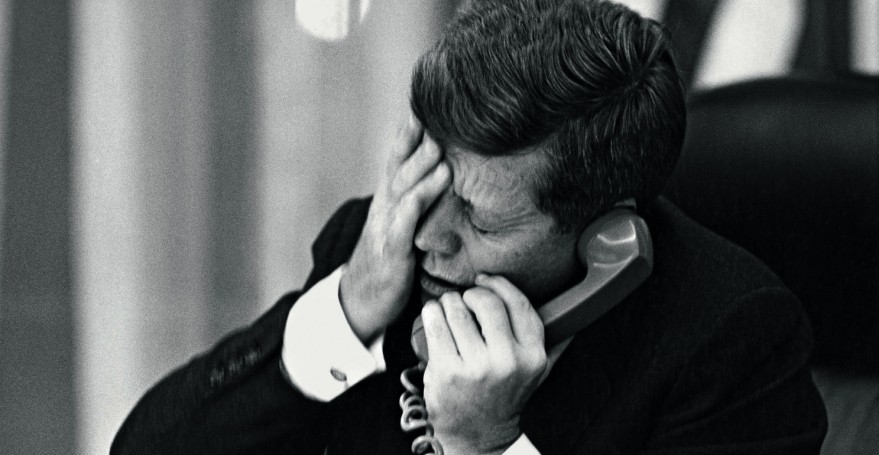
On January 26, 1961, when Dulles briefed the new president on the Congo, he did not tell JFK that they already had Lumumba assassinated nine days before. This was meant to keep Kennedy on tenterhooks to teach him a lesson. On February 13, 1961, Kennedy received a phone call from his UN ambassador Adlai Stevenson informing him of Lumumba’s death. There is a photograph by White House photographer Jacques Lowe of the horror-stricken president sitting in the oval office answering that call that is harrowing to view. It was an unmistakable portent of things to come, a warning for the president.

DAG HAMMARSKJÖLD, INDONESIA, AND SUKARNO

One of Kennedy’s crucial allies in his efforts to support third-world independence was United Nations’ Secretary-General Dag Hammarskjöld. Hammarskjöld had been deeply involved in peacekeeping in the Congo as well as efforts to resolve disputes in Indonesia, both important countries central to JFK’s concerns. Hammarskjöld was killed on September 18, 1961 while on a peacekeeping mission to the Congo. Substantial evidence exists that he was assassinated and that the CIA and Allen Dulles were involved. Kennedy was devastated to lose such an important ally.

Kennedy’s strategy involved befriending Indonesia as a Cold War ally as a crucial aspect of his Southeast Asian policy of dealing with Laos and Vietnam and finding peaceful resolutions to other smoldering Cold War conflicts. Hammarskjöld was also central to these efforts. The CIA, led by Dulles, strongly opposed Kennedy’s strategy in Indonesia. In fact, Dulles and the CIA had been involved in treacherous maneuverings in resource rich Indonesia for decades. President Kennedy supported the Indonesian President Sukarno, while Dulles opposed him since he stood for Indonesian independence.

Just two days before Kennedy was killed on November 22, 1963, he had accepted an invitation from Indonesian President Sukarno to visit that country the following spring. The aim of the visit was to end the conflict (Konfrontasi) between Indonesia and Malaysia and to continue Kennedy’s efforts to support post-colonial Indonesia with non-military economic and development aid. His goal was to end conflict throughout Southeast Asia and assist the growth of democracy in newly liberated post-colonial countries worldwide.

Of course, JFK never made it to Indonesia in 1964, and his peaceful strategy to bring Indonesia to America’s side and to ease tensions in the Cold War was never realized, thanks to Allen Dulles and the CIA.  And, Kennedy’s proposed withdrawal of American military advisers from Vietnam, which, in part, was premised on success in Indonesia, was quickly reversed by Lyndon Johnson after JFK’s murder and within a short time hundreds of thousand American combat troops were sent to Vietnam. In Indonesia, Sukarno would be forced out and replaced by General Suharto, who would rule with an iron fist for the next 30 years. Soon, both countries would experience mass slaughter engineered by Kennedy’s opponents in the CIA and Pentagon.

THE BAY OF PIGS

In mid-April 1961, less than three months into his presidency, a trap was set for President Kennedy by the CIA and its director, Allen Dulles, who knew of Kennedy’s reluctance to invade Cuba. They assumed the new president would be forced by circumstances at the last minute to send in U.S. Navy and Marine forces to back the invasion that they had planned. The CIA and generals wanted to oust Fidel Castro, and in pursuit of that goal, trained a force of Cuban exiles to invade Cuba. This had started under President Eisenhower and Vice President Nixon. Kennedy refused to go along with sending in American troops and the invasion was roundly defeated. The CIA, military, and Cuban exiles bitterly blamed Kennedy.

But it was all a sham. Classified documents uncovered in 2000 revealed that the CIA had discovered that the Soviets had learned the date of the invasion more than a week in advance and had informed Cuban Prime Minister Fidel Castro, but—and here is a startling fact that should make people’s hair stand on end—the CIA never told the President. The CIA knew the invasion was probably doomed before the fact but went ahead with it anyway.

Why? So, they could blame JFK for the failure afterwards.

Kennedy later said to his friends Dave Powell and Ken O’Donnell, “They were sure I’d give in to them and send the go-ahead order to the [Navy’s aircraft carrier] Essex. They couldn’t believe that a new president like me wouldn’t panic and save his own face. Well, they had me figured all wrong.”

This treachery set the stage for events to come. Sensing but not knowing the full extent of the set-up, Kennedy fired CIA Director Allen Dulles (who, as in a bad joke, was later named to the Warren Commission investigating JFK’s assassination) and his assistant, General Charles Cabell (whose brother, Earle Cabell, to make a bad joke absurd, was the mayor of Dallas on the day Kennedy was killed.) It was later discovered that Earle Cabell was a CIA asset.

JFK said he wanted “to splinter the CIA in a thousand pieces and scatter it to the winds.” Not sentiments to endear him to a secretive government within a government whose power was growing exponentially.[8]

KENNEDY RESPONDS AFTER THE BAY OF PIGS TREACHERY

The stage was now set for events to follow as JFK, now even more suspicious of the military-intelligence people around him, and in opposition to nearly all his advisers, consistently opposed the use of force in U.S. foreign policy.

In 1961, despite the Joint Chiefs’ demand to put combat troops into Laos – advising 140,000 by the end of April – Kennedy bluntly insisted otherwise as he ordered Averell Harriman, his representative at the Geneva Conference, “Did you understand? I want a negotiated settlement in Laos. I don’t want to put troops in.” The president knew that Laos and Vietnam were linked issues, and since Laos came first on his agenda, he was determined to push for a neutral Laos.

Also in 1961, he refused to accede to the insistence of his top generals to give them permission to use nuclear weapons in a dispute with the Soviet Union over Berlin and Southeast Asia. Walking out of a meeting with his top military advisors, Kennedy threw his hands in the air and said, “These people are crazy.”

In March 1962, the CIA, in the person of legendary operative, Edward Lansdale, and with the approval of every member of the Joint Chiefs of Staff, presented the president with a pretext for a U.S. invasion of Cuba. Code-named Operation Northwoodsthe false-flag plan called for innocent people to be shot in the U.S., boats carrying Cuban refugees to be sunk and a terrorism campaign to be launched in Miami, Washington D.C., and other places, all to be blamed on the Castro government so that the public would be outraged and call for an invasion of Cuba.

Kennedy was appalled and rejected this pressure to manipulate him into agreeing to terrorist attacks on Americans that could later be used against him. He already knew that his life was in danger and that the CIA and military were tightening a noose around his neck. But he refused to yield.

As early as June 26, 1961, in a White House meeting with Soviet Premier Nikita Khrushchev’s spokesperson, Mikhail Kharlamov, and Khrushchev’s son-in-law, Alexei Adzhubei, when asked by Kharlamov why he wasn’t moving faster to advance relations between the two countries, JFK said “You don’t understand this country. If I move too fast on U.S.-Soviet relations, I’ll either be thrown into an insane asylum, or be killed.”

JFK refused to bomb and invade Cuba as the military wished during the Cuban missile crisis in October 1962. The Soviets had placed offensive nuclear missiles and more than 30,000 support troops in Cuba to prevent another U.S.-led invasion. American aerial photography had detected the missiles. This was understandably unacceptable to the U.S. government. While being urged by the Joint Chiefs and his trusted advisors to order a preemptive nuclear strike on Cuba, JFK knew that a diplomatic solution was the only way out as he wouldn’t accept the death of hundreds of millions of people that would likely follow a series of nuclear exchanges with the Soviet Union. Only his brother, Robert, and Secretary of Defense Robert McNamara stood with him in opposing the use of nuclear weapons. Daniel Ellsberg, a former Pentagon and Rand Corporation analyst, reported a coup atmosphere in the Pentagon as Kennedy chose to settle rather than attack. In the end, after thirteen incredibly tense days of brinksmanship, Kennedy and Soviet Premier Nikita Khrushchev miraculously found a way to resolve the crisis and prevent the use of those weapons.

Afterwards, JFK told his friend John Kenneth Galbraith that “I never had the slightest intention of doing so.”

THE FATEFUL YEAR 1963

In June, 1963, JFK gave an historic speech at American University in which he called for the total abolishment of nuclear weapons, the end of the Cold War and the “Pax Americana enforced on the world by American weapons of war,” and movement toward “general and complete disarmament.”

A few months later he signed a Limited Test Ban Treaty with Nikita Khrushchev.

In October 1963 he signed National Security Action Memorandum 263 calling for the withdrawal of 1,000 U. S. military troops from Vietnam by the end of the year and complete withdrawal by the end of 1965.

All this he did while secretly engaging in negotiations with Soviet Premier Nikita Khrushchev via Saturday Evening Post editor and anti-nuclear weapon advocate, Norman Cousins, Soviet agent Georgi Bolshakov, and Pope John XXIII,as well as  with Cuba’s Prime Minister Fidel Castro through various intermediaries, one of whom was French Journalist Jean Daniel. Of course, secret was not secret when the CIA was involved.

Kennedy, deeply disturbed by the near nuclear catastrophe of the Cuban missile crisis, was determined to open back channel communications to make sure such a near miss never happened again. He knew fault lay on both sides, and that one slipup or miscommunication could initiate a nuclear holocaust.  He was determined, therefore, to try to open lines of communications with his enemies.

Jean Daniel was going to Cuba to interview Fidel Castro, but before he did he interviewed Kennedy on October 24, 1963.  Kennedy, knowing Daniel would tell Castro what he said, asked Daniel if Castro realizes that “through his fault the world was on the verge of nuclear war in October 1962….or even if he cares about it.”  But he also added, to soften the message:

“I approved the proclamation Fidel Castro made in the Sierra Maestra, when he justifiably called for justice and especially yearned to rid Cuba of corruption. I will go even further: to some extent it is as though Batista was the incarnation of a number of sins on the part of the United States. Now we will have to pay for those sins. In the matter of the Batista regime, I am in agreement with the first Cuban revolutionaries. That is perfectly clear.”

Such sentiments were anathema, shall we say treasonous, to the CIA and top Pentagon generals. These clear refusals to go to war with Cuba, to emphasize peace and negotiated solutions to conflicts rather than war, to order the withdrawal of all military personnel from Vietnam, to call for an end to the Cold War, and his willingness to engage in private, back-channel communications with Cold War enemies marked Kennedy as an enemy of the national security state. They were on a collision course.

THE ASSASSINATION ON NOVEMBER 22, 1963

After going through the Bay of Pigs, Cuban Missile Crisis and many other military cliffhangers, Kennedy underwent a deep metanoia, a spiritual transformation, from Cold Warrior to peacemaker. He came to regard the generals who advised him as devaluing human life and hell-bent on launching nuclear wars. And he was well aware that his growing resistance to war had put him on a dangerous collision course with those generals and the CIA. On numerous occasions, he spoke of the possibility of a military coup d’état against him.

The night before his trip to Dallas, he told his wife, “But, Jackie, if somebody wants to shoot me from a window with a rifle, nobody can stop it, so why worry about it.”

And we know that nobody did try to stop it because they had planned his execution from multiple locations to assure its success.

WHO KILLED HIM?

If the only things you read, watched, or listened to since 1963 were the mainstream corporate media (MSM), you would be convinced that the official explanation for JFK’s assassination, the Warren Commission, was correct in essentials. You would be wrong, because those corporate media have for all these years served as mouthpieces for the government, most notably the CIA that infiltrated and controlled them long ago under a secret program called Operation Mockingbird.

In 1977, celebrated Watergate journalist, Carl Bernstein, published a 25,000-word cover story for Rolling Stone, “The CIA and the Media,” in which he published the names of many journalists and media, such as The New York TimesCBS, Time, Newsweek, etc., who worked hand in glove with the CIA for decades. Ironically, or as part of “a limited hangout” (spy talk for admitting some truths while concealing deeper ones), this article can be found at the CIA’s own website.

Total control of information requires media complicity, and with the JFK assassination, and in all matters they consider important, the CIA and the MSM are unified. Such control extends to literature, arts, and popular culture as well as news. Frances Stonor Saunders comprehensively documents this in her 1999 book, The Cultural Cold War: The CIA And The World Of Arts And Letters, and Joel Whitney followed this up in 2016 with Finks: How the CIA Tricked the World’s Best Writerswith particular emphasis on the complicity of the CIA and the famous literary journal The Paris Review.  Such revelations are retrospective, of course, but only the most naïve would conclude such operations are a thing of the past.

The Warren Commission claimed that the president was shot by an ex-Marine named Lee Harvey Oswald, firing three bullets from the 6th floor of the Texas School Book Depository as Kennedy’s car was already two hundred and fifty feet past and driving away from him. But this is patently false for many reasons, including the bizarre claim that one of these bullets, later termed “the magic bullet,” passed through Kennedy’s body and zigzagged up and down, left and right, striking Texas Governor John Connolly who was sitting in the front seat and causing seven wounds in all, only to be found later in pristine condition on a stretcher in Parkland Hospital. And, any lone assassin looking out the 6th floor window would have taken the perfect shot as the limousine approached within forty feet of the TSBD on Houston St.

The absurdity of the government’s claim, a ballistic fairy tale, was the key to its assertion that Oswald killed Kennedy. It was visually shattered and rendered ridiculous by the famous Zapruder film that clearly shows the president being shot from the front right, and, as the right front of his head explodes, he is violently thrown back and to his left as Jacqueline Kennedy climbs on to the car’s trunk to retrieve a piece of her husband’s skull and brain.

This video evidence is clear and simple proof of a conspiracy.

WHO WAS LEE HARVEY OSWALD?

But there is another way to examine it.

If Lee Harvey Oswald, the man The Warren Commission said killed JFK, was connected to the intelligence community, the FBI and the CIA, then we can logically conclude that he was not “a lone-nut” assassin or not an assassin at all. There is a wealth of evidence to show how, from the very start, Oswald was moved around the globe by the CIA like a pawn in a game, and when the game was done, the pawn was eliminated in the Dallas police headquarters by Jack Ruby two days later.

James W. Douglass, in JFK and the Unspeakable: Why He Died and Why It Matters, the most important book on the matter, asks this question:

Why was Lee Harvey Oswald so tolerated and supported by the government he betrayed?

This is a key question.

After serving as a U.S. Marine at the CIA’s U-2 spy plane Atsugi Air Force Base in Japan with a Crypto clearance (higher than top secret, a fact suppressed by the Warren Commission) and being trained in the Russian language, Oswald left the Marines and defected to the Soviet Union. After denouncing the U.S., rejecting his American citizenship, working at a Soviet factory in Minsk, and taking a Russian wife—during which time Gary Powers’ U-2 spy plane was shot down over the Soviet Union—he returned to the U.S. with a loan from the American Embassy in Moscow, only to be met at the dock in Hoboken, New Jersey, by Spas T. Raikin, a prominent anti-Communist with extensive intelligence connections recommended by the State Department.

Oswald passed through immigration with no trouble, was not prosecuted, moved to Fort Worth, Texas where, at the suggestion of the Dallas CIA Domestic Contacts Service chief, he was met and befriended by George de Mohrenschildt, an anti-communist Russian, who was a CIA asset. De Mohrenschildt got him a job four days later at a photography and graphic arts company that worked on top secret maps for the U.S. Army Map Service related to U-2 spy missions over Cuba.

Oswald was then shepherded around the Dallas area by de Mohrenschildt. In 1977, on the day he revealed he had contacted Oswald for the CIA and was to meet with the House Select Committee on Assassinations’ investigator, Gaeton Fonzi, de Mohrenschildt allegedly committed suicide.

Oswald then moved to New Orleans in April, 1963 where he got a job at the Reily Coffee Company owned by CIA-affiliated William Reily. The Reily Coffee Company was located in close vicinity to the FBI, CIA, Secret Service, and Naval Intelligence offices and a stone’s throw from the office of Guy Banister, a former Special Agent in Charge of the FBI’s Chicago Bureau, who worked as a covert action coordinator for the intelligence services, supplying weapons, money, and training to anti-Castro paramilitaries. Oswald then went to work with Banister and the CIA paramilitaries.

From this time up until the assassination, Oswald engaged in all sorts of contradictory activities, one day portraying himself as pro-Castro, the next day as anti-Castro, many of these theatrical performances being directed from Banister’s office. It was as though Oswald, on the orders of his puppet masters, was     enacting multiple and antithetical roles in order to confound anyone intent on deciphering the purposes behind his actions and to set him up as a future “assassin” or “patsy.”

James Douglass persuasively argues that Oswald “seems to have been working with both the CIA and FBI,” as a provocateur for the former and an informant for the latter. Jim and Elsie Wilcott, who worked at the CIA Tokyo Station from 1960-64, in a 1978 interview with the San Francisco Chronicle, said, “It was common knowledge in the Tokyo CIA station that Oswald worked for the agency.”

When Oswald moved to New Orleans in April, 1963, de Mohrenschildt exited the picture, having asked the CIA for and been indirectly given a $285,000 contract to do a geological survey for Haitian dictator “Papa Doc” Duvalier, which he never did, but for which he was paid.

Ruth and Michael Paine then entered the scene on cue. Ruth had been introduced to Oswald by de Mohrenschildt. In September, 1963, Ruth Paine drove from her sister’s house in Virginia to New Orleans to pick up Marina Oswald and bring her to Dallas to live with her, where Lee also stayed on weekends. Back in Dallas, Ruth Paine conveniently arranged a job for Lee Harvey Oswald in the Texas Book Depository, where he began work on October 16, 1963.

Ruth, along with Marina Oswald, was the Warren Commission’s critically important witness against Oswald. Allen Dulles, despite his earlier firing by JFK, got appointed to a key position on the Warren Commission.  He questioned the Paines in front of it, studiously avoiding any revealing questions, especially ones that could disclose his personal connections to the Paines. For Michel Paine’s mother, therefore Ruth’s mother-in-law, Ruth Paine Forbes Young, was a close friend of his old mistress, Mary Bancroft, who worked as a spy with Dulles during WW II. Bancroft and he had been invited guests at Ruth Paine Forbes Young’s private island off Cape Cod.

Ruth and Michael Paine had extensive intelligence connections. Thirty years after the assassination, a document was declassified showing Ruth Paine’s sister Sylvia worked for the CIA. Her father traveled throughout Latin America on an Agency for International Development (notorious for CIA front activities) contract and filed reports that went to the CIA. Her husband Michael’s step-father, Arthur Young, was the inventor of the Bell Helicopter, a major military supplier for the Vietnam War, and Michael’s job there gave him a security clearance.

From late September through November 22nd, various “Oswalds” were later reported to have simultaneously been seen from Mexico City to Dallas. Two Oswalds were arrested in the Texas Theater, the real one taken out the front door and an impostor out the back.

As Douglass says:

There were more Oswalds providing evidence against Lee Harvey Oswald than the Warren Report could use or even explain.

Even J. Edgar Hoover knew that Oswald impostors were used, as he told LBJ concerning Oswald’s alleged visit to the Soviet Embassy in Mexico City. He later called this CIA ploy, “the false story re Oswald’s trip to Mexico…their (CIA’s) double-dealing,” something that he couldn’t forget.

It was apparent to anyone paying close attention that a very intricate and deadly game was being played at high levels in the shadows.

We know Oswald was blamed for the President’s murder. But if one fairly follows the trail of the crime, it becomes blatantly obvious that government forces were at work. Douglass and others have amassed layer upon layer of evidence to show how this had to be so.

WHO HAD THE POWER TO WITHDRAW THE PRESIDENT’S SECURITY?

To answer this essential question is to finger the conspirators and to expose, in Vincent Salandria’s words, “the false mystery concealing state crimes.”

Neither Oswald, the mafia nor anti-Castro Cubans could have withdrawn most of the security that day. Sheriff Bill Decker ordered all his deputies “to take no part whatsoever in the security of that [presidential] motorcade.”

Police Chief Jesse Curry did the same for Dallas police protection for the president in Dealey Plaza. Both “Chief Curry and Sheriff Decker gave their orders withdrawing security from the president in obedience to orders they had themselves received from the Secret Service.” The Secret Service withdrew the police motorcycle escorts from beside the president’s car where they had been on previous presidential motorcades as well as the day before in Houston and removed agents from the back of the car where they were normally stationed to obstruct gunfire.

The Secret Service admitted there were no Secret Service agents on the ground in Dealey Plaza to protect Kennedy. But we know from extensive witness testimony that, during and after the assassination, there were people in Dealey Plaza impersonating Secret Service agents who stopped policeman and the public from moving through the area on the Grassy Knoll where some of the shots appeared to come from. The Secret Service approved the fateful, dogleg turn (on a dry run on November 18) where the car, driven by Secret Service agent William Greer, moved at a snail’s pace and came almost to a halt before the final head shot, clear and blatant security violations.  The House Select Committee on Assassinations concluded this, not some conspiracy theorist.

Who could have squelched the testimony of the many doctors and medical personnel who claimed the president had been shot from the front in his neck and head, testimony contradicting the official story?

Who could have prosecuted and imprisoned Abraham Bolden, the first African-American Secret Service agent personally brought on to the White House detail by JFK, who warned that he feared the president was going to be assassinated? (Douglass interviewed Bolden seven times and his evidence on the aborted plot to kill JFK in Chicago on November 2 is a story little known but extraordinary in its implications.)

The list of all the people who turned up dead, the evidence and events manipulated, the inquiry squelched, distorted, and twisted in an ex post facto cover-up clearly point to forces within the government, not rogue actors without institutional support.

The evidence for a conspiracy organized at the deepest levels of the intelligence apparatus is overwhelming. James Douglass presents it in such depth and so logically that only one hardened to the truth would not be deeply moved and affected by his book, JFK and the Unspeakable.

But there is more from him and other researchers who have cut the Gordian knot of this false mystery with a few brief strokes.

OSWALD, THE PREORDAINED PATSY

Three examples will suffice to show that Lee Harvey Oswald, working as part of a U.S. Intelligence operation, was set up to take the blame for the assassination of President Kennedy, and that when he said in police custody that he was “a patsy,” he was speaking truthfully. These examples make it clear that Oswald was deceived by his intelligence handlers and had been chosen without his knowledge, long before the murder, to take the blame as a lone, crazed killer.

First, Kennedy was shot at 12:30 P.M. CT. According to the Warren Report, at 12:45 P.M. a police report was issued for a suspect that perfectly fit Oswald’s description. This was based on the testimony of Howard Brennan, who said he was standing across from the Book Depository and saw a standing white man, about 5’10” and slender, fire a rifle at the president’s car from the sixth-floor window. This was blatantly false because photographs taken moments after the shooting show the window open only partially at the bottom about fourteen inches, and it would have been impossible for a standing assassin to be seen “resting against the left windowsill,” (the windowsill was a foot from the floor), as Brennan is alleged to have said. He would have therefore had to have been shooting through the glass. The description of the suspect was clearly fabricated in advance to match Oswald’s.

Then between 1:06 and 1:15 P.M. in the quiet residential Oak Cliff neighborhood of Dallas, Police Officer J.D. Tippit was shot and killed. Supposedly based on Brennan’s description broadcast over police radio, Tippit had stopped a man fitting the description and this man pulled a gun and shot the officer. Meanwhile, Oswald had returned to his rooming house where his landlady said he left at 1:03 P.M., went outside, and was standing at a northbound bus stop. The Tippet murder took place nine-tenths of a mile away to the south where a witness, Mrs. Higgins, said she heard a gunshot at 1:06 P.M., ran outside, saw Tippit lying in the street and a man running away with a handgun whom she said was not Oswald.

Oswald is reported to have entered the Texas Theater minutes before the Tippit murder. The concession stand operator, Warren Burroughs has said he sold him popcorn at 1:15 P.M., which is the time the Warren Report claims Tippit was killed. At 1:50 P.M., Lee Harvey Oswald was arrested in the Texas Theater and taken out the front door where a crowd and many police cars awaited him, while a few minutes later a second Oswald is secretly taken out the back door of the movie theater. (To read this story of the second Oswald and his movement by the CIA out of Dallas on a military aircraft on the afternoon of November 22, 1963, documented in great detail by James W. Douglass, is an eye-opener.)

The official narrative of Oswald and the Tippit murder begs credulity, but it serves to “show” that Oswald was a killer.

Despite his denials, Oswald, set up for Kennedy’s murder based on a prepackaged description, is arraigned for Tippit’s murder at 7:10 PM. It was not until the next day that he was charged for Kennedy’s.

THE MESSAGE TO AIR FORCE ONE

Secondly, while Oswald is being questioned about Tippit’s murder in the afternoon hours after his arrest, Air Force One has left Dallas for Washington with the newly sworn-in president Lyndon Johnson and the presidential party. Back in D.C., the White House Situation Room is under the personal and direct control of Kennedy’s National Security Advisor, McGeorge Bundy, a man with close CIA ties who had opposed JFK on many matters, including the Bay of Pigs and Kennedy’s order to withdraw from Vietnam.

As reported by Theodore White, in The Making of the President 1964, Johnson and the others were informed by the Bundy controlled Situation Room that “there was no conspiracy, learned of the identity of Oswald and his arrest …”

Vincent Salandria, one of the earliest and most astute critics of the Warren Commission, put it this way in his book, False Mystery:

This [announcement from the Situation Room to Air Force One in flight back to Washington, D.C] was the very first announcement of Oswald as the lone assassin. In Dallas, Oswald was not even charged with assassinating the President until 1:30 A.M. the next morning. The plane landed at 5:59 P.M. on the 22nd. At that time the District Attorney of Dallas, Henry Wade, was stating that “preliminary reports indicated more than one person was involved in the shooting … the electric chair is too good for the killers.” Can there be any doubt that for any government taken by surprise by the assassination — and legitimately seeking the truth concerning it — less than six hours after the time of the assassination was too soon to know there was no conspiracy? This announcement was the first which designated Oswald as the lone assassin….

I propose the thesis that McGeorge Bundy, when that announcement was issued from his Situation Room, had reason to know that the true meaning of such a message when conveyed to the Presidential party on Air Force One [and to a separate plane with the entire cabinet that had turned around and was headed back over the Pacific Ocean] was not the ostensible message which was being communicated. Rather, I submit that Bundy … was really conveying to the Presidential party the thought that Oswald was being designated the lone assassin before any evidence against him was ascertainable. As a central coordinator of intelligence services, Bundy in transmitting such a message through the Situation Room was really telling the Presidential party that an unholy marriage had taken place between the U.S. Governmental intelligence services and the lone-assassin doctrine. Was he not telling the Presidential party peremptorily, ‘Now, hear this! Oswald is the assassin, the sole assassin. Evidence is not available yet. Evidence will be obtained, or in lieu thereof evidence will be created. This is a crucial matter of state that cannot await evidence. The new rulers have spoken. You, there, Mr. New President, and therefore dispatchable stuff, and you the underlings of a deposed President, heed the message well.’ Was not Bundy’s Situation Room serving an Orwellian double-think function?

OSWALD’S PREPACKAGED LIFE STORY

Finally, Air Force Colonel Fletcher Prouty adds a third example of the CIA conspiracy for those who need more evidence that the government has lied from the start about the assassination.

Prouty was Chief of Special Operations in the Pentagon before and during the Kennedy years. He was the liaison between the Joint Chiefs and the CIA, working closely with Director Allen Dulles and others in supporting the clandestine operations of the CIA under military cover. He had been sent out of the country to the South Pole by the aforementioned CIA operative Edward Lansdale (Operation Northwoods) before the Kennedy assassination and was returning on November 22, 1963.

On a stopover in Christchurch, New Zealand, he heard a radio report that the president had been killed but knew no details. He was having breakfast with a U.S Congressman at 7:30 AM on November 23, New Zealand time. A short time later, at approximately 4:30 PM Dallas time, November 22, he bought the Christchurch Star 23 November 1963 newspaper and read it together with the Congressman.

The newspaper reports from the scene said that Kennedy had been killed by bursts of automatic weapons fire, not a single shot rifle, firing three separate shots in 6.8 seconds, as was later claimed for Oswald. But the thing that really startled him was that at a time when Oswald had just been arrested and had not even been charged for the murder of Officer Tippit, there was elaborate background information on Oswald, his time in Russia, his association with Fair Play for Cuba Committee in New Orleans, etc. “It’s almost like a book written five years later,” said Prouty. “Furthermore, there’s a picture of Oswald, well-dressed in a business suit, whereas, when he was picked up on the streets of Dallas after the President’s death, he had on some t-shirt or something…

Who had written that scenario?  Who wrote that script…So much news was already written ahead of time of the murder to say that Oswald killed the President and that he did it with three shots…Somebody had decided Oswald was going to be the patsy…Where did they get it, before the police had charged him with the crime?  Not so much ‘where,’ as ‘why’ Oswald?

Prouty, an experienced military man working for the CIA in the Pentagon, accused the military-intelligence “High Cabal” of killing President Kennedy in an elaborate and sophisticated plot and blaming it on Oswald, whom they had begun setting up years in advance.

The evidence for a government plot to plan, assassinate, cover-up, and choose a patsy in the murder of President John Kennedy is overwhelming.[42]

Five years after JFK’s assassination, we would learn, to our chagrin and his glory, that the president’s younger brother, Senator Robert F. Kennedy, equally brave and unintimidated, would take a bullet to the back of his head in 1968 as he was on his way to the presidency and the pursuit of his brother’s killers. The same cowards struck again.

Their successors still run the country and must be stopped.

EPILOGUE BY JAMES W. DOUGLASS

John F. Kennedy was raised from the death of wealth, power, and privilege. The son of a millionaire ambassador, he was born, raised, and educated to rule the system. When he was elected President, Kennedy’s heritage of power corresponded to his position as head of the greatest national security state in history. But Kennedy, like Lazarus, was raised from the death of that system. In spite of all odds, he became a peacemaker and, thus, a traitor to the system….

Why? What raised Kennedy from the dead? Why did John Kennedy choose life in the midst of death and by continuing to choose life thus condemn himself to death? I have puzzled over that question while studying the various biographies of Kennedy. May I suggest one source of grace for his resurrection as a peacemaker? In reading his story, one is struck by his devotion to his children. There is no mistaking the depth of love he had for Caroline and John, and the overwhelming pain he and Jacqueline experienced at the death of their son Patrick. Robert Kennedy in his book Thirteen Days has described how his brother saw the Cuban Missile Crisis in terms of the future of his children and all children. I believe John Kennedy was at least partially raised from the dead of the national security state by the life of his children. The heroic peacemaking of his final months, with his acceptance of its likely cost in his own death, was, I suspect, partly a result of the universal life he saw in and through them. I think he believed profoundly the words that he gave in his American University address as his foundation for rejecting the Cold War:

‘Our most basic common link is that we all inhabit this small planet. We all breathe the same air. We all cherish our children’s future. And we are all mortal.’[43]

Tyler Durden
Mon, 11/27/2023 – 23:40

North Korea Moves Heavy Weapons To Border With South, Remilitarizes Outposts Along DMZ

0
North Korea Moves Heavy Weapons To Border With South, Remilitarizes Outposts Along DMZ

Prior years of efforts toward deconfliction based on a series of agreements between North and South Korea have been quickly unraveling, following major joint US-South Korea military drills last summer and the stationing of a US nuclear capable submarine there last July. The nuclear submarine at a South Korean port was a first in four decades.

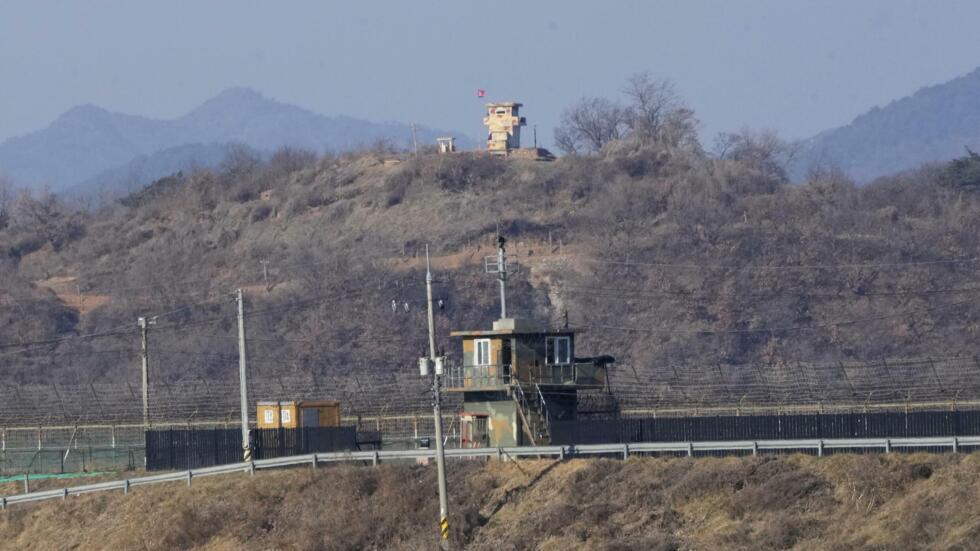
Pyongyang responded predictably by ramping up ballistic missile tests, and most recently launching a spy satellite into orbit for the first time. But South Korea’s Defense Ministry on Monday announced a big major step backward, saying the north has begun building up heavy weapons along its border, while reestablishing guard posts

Border via AP

Reconstructing militarized border positions appears to be the Kim Jong Un government’s response to the south last week suspending participation in a pact meant to avert war.

Seoul said this means it will resume surveillance flights along the border. Pyongyang promptly issued a statement: “From now on, our army will never be bound by the September 19 North-South Military Agreement,” it said last Wednesday. 

And now The Guardian is detailing that “Media reports cited the South Korean military as saying it had detected troops from the North repairing camouflaged guard posts that the regime had destroyed as part of a comprehensive military agreement in 2018 designed to lower the risk of a confrontation along the heavily armed demilitarized zone (DMZ).”

Further, “The South’s military said North Korean soldiers had been observed digging trenches at sites along the border and the regime had sent heavy weapons to the area,” The Guardian continues. “The DMZ has divided the two countries since the end of the 1950-53 Korean war and is seen as a potential flashpoint in any future inter-Korean conflict.”

The South Korean Defense Ministry says it can prove the DPRK is remilitarizing the border, having released a photo set showing new soldiers and arms at freshly constructed outposts along the DMZ.

These same outposts had been destroyed over recent years as relations warmed and tensions eased between the US, South Korea, and North Korea.

South Korean President Yoon Suk Yeol ordered the military to be on a high state of readiness and to monitor troop movements along the border and DMZ. The satellite launch has remained a key issue of contention.

North Korea’s Kim had hailed “new era of a space power” with the Malligyong-1 reportedly in orbit. Pyongyang had claimed that within a mere hours after the launch, Kim was reviewing images of American military bases in Guam.

Tyler Durden
Mon, 11/27/2023 – 23:20

Media Outlet Criticized For Trying To Normalize ‘The Death Of Trump’

0
Media Outlet Criticized For Trying To Normalize ‘The Death Of Trump’

Authored by Jack Phillips via The Epoch Times,

Media outlet Business Insider was criticized over the weekend after publishing an article that offered speculation regarding what would happen “if Donald Trump dies while running in the 2024 election.”

In an article published Saturday, the outlet, also known as Insider, listed several different scenarios that would occur if the former president passed away before the GOP primary, during the primary, or between the primary and the general election. Former President Trump, 77, is by far the leading GOP presidential candidate, besting the No. 2 and No. 3 candidates by more than 45 percentage points, respectively.

“If Trump died during primary season—which ends in mid-June—some states may postpone their scheduled primaries,” the article said, in part.

“If Trump died after the last primary contest but before the Republican National Convention, the other GOP presidential candidates would have to make a case to every state delegation at the convention for why they should be the party’s nominee,” it also said.

Insider also recently ran an article with the title, “What happens if a sitting president dies while running for reelection,” including a photo of President Joe Biden. However, unlike the Trump article, Insider did not specifically make reference to President Biden in the headline. And unlike the Trump article, Insider used President Biden’s last name sparingly throughout the article, although it did mention that President Biden turned 81 several days ago.

“If the president died during primary season—which ends in mid-June—some states may postpone their scheduled primaries,” the article stated.

After Insider published the speculative article regarding President Trump’s death during the primary, some conservative commentators offered criticism. Some also claimed it’s part of an attempt to normalize President Trump’s death, suggesting a nefarious plot could be carried out.

“First, Levi Strauss heir Rep. Dan Goldman says Trump must be ‘eliminated,’ and now Business Insider is openly asking: What would happen if Donald Trump ‘dies while seeking reelection’ in 2024?” wrote commentator Charlie Kirk on X.

“Don’t put anything past these people.”

Human Events editor Jack Posobiec also suggested on X that it was “pointed out the media has begun normalizing the death of Trump again. Now this.” He made reference to his conversation with pollster Richard Baris, who made a comment about such reports.

“I think it’s pretty clear what message they’re sending when they speculate about the death of a candidate they claim is ‘worse than Hitler, Stalin, Mussolini, etc. combined,'” Mr. Baris wrote in an X post in response. 

“The last time they did this, a lefty nutcase decided it was heroic to shoot [Republican Rep. Steve Scalise] and 4 others.”

In 2017, Rep. Scalise (R-La.) was shot during a practice session for the Congressional Baseball Game in Virginia. A 66-year-old self-described Bernie Sanders supporter, James Hodgkinson, was identified as the shooting suspect before he was killed by officers in a shootout.

The Epoch Times has contacted Insider for comment Sunday. The outlet has not publicly responded to the criticism of the Trump article on social media or elsewhere. President Trump also has not made any comments about it.

Based in New York City, Business Insider was purchased in 2015 by German mass media company Axel Springer SE, which purchased popular politics website Politico in 2021. The company also owns European brands Bild, Die Welt, and other media outlets.

What the Polls Show

Several recent polls show that more Americans view President Biden as being too old to serve another term effectively. Fewer Americans believe President Trump is too old to serve.

A Monmouth University poll published last month found 76 percent of voters believe the president is too old, compared to 48 percent who said the same thing about President Trump.

In another poll from The Associated Press-NORC published in August, some 77 percent said President Biden is too old to serve another four years in office. In contrast, around half of American adults said the same about President Trump.

President Biden was asked about his age again over the Thanksgiving holiday weekend.

“Mr. President, are you too old to be running for re-election?” a journalist asked him while he was shopping in Nantucket on Saturday, according to a clip.

“That’s stupid,” President Biden responded with a smile.

As for the GOP primary, an aggregate of recent polls shows that President Trump has 61.6 percent of the vote, Florida Gov. Ron DeSantis is No. 2 with 13.7 percent, former U.N. Ambassador Nikki Haley has 9.8 percent, businessman Vivek Ramaswamy has 4.9 percent, and former New Jersey Gov. Chris Christie is at 2.3 percent

Tyler Durden
Mon, 11/27/2023 – 23:00

Who Are The World’s Biggest Arms Importers (And Exporters)?

0
Who Are The World’s Biggest Arms Importers (And Exporters)?

In 2022, global military budgets hit $2.2 trillion, an eighth consecutive year of increase.

Part of those budgets were used for the procurement of arms, but which countries are major weapons suppliers, and how do they influence the global arms trade?

In the chart below, Visual Capitalist’s Bhabna Banerjee and Marcus Lu highlight the top 10 countries with the biggest share of global arms exports using data from the Stockholm International Peace Research Institute (SIPRI).

Which Country Exports the Most Weapons?

The U.S. is the biggest weapons exporter, accounting for 40% of the total volume of international arms transfers between 2018–2022. Nearly one-fifth of these exports headed to Saudi Arabia, and other significant amounts went to Japan (8.6%) and Australia (8.4%).

Below we rank the biggest weapons exporters by share of total volume traded in 2018–2022, as well as their growth or decline from trends recorded in 2013–2017.

Russia (16%) and France (11%) rank close together, followed by China (5%) and Germany (4%) to round out the top five major arms exporters.

However France’s export volumes grown considerably (+44%) from the previous five-year period, thanks to big sales to India, which included 62 combat aircraft and four submarines, one-third of all French weapons trade. This has resulted in France leapfrogging the U.S. as India’s second-largest weapons supplier after Russia.

On the other hand, Russia’s exports by volume has decreased (-31%) even before sanctions kicked in after the invasion of Ukraine. Its biggest trade partners, India and China, have prioritized developing their own weapons industries.

South Korea’s Surging Weapons Exports

Another country whose arms sales are skyrocketing is South Korea, which ranks 9th in the overall share of global arms exports, but has seen a 74% increase in its export volumes. Key recipients include the Philippines, India, and Thailand.

South Korean president Yoon Suk Yeol has pledged to grow his country into the world’s fourth largest arms exporter by 2027.

Interestingly, South Korea is one of three countries which is both a top-10 arms exporter and importer (along with China and the U.S.) as it has many takers for domestically produced military equipment, while simultaneously being reliant on American-produced long-range missiles and advanced combat aircraft.

*  *  *

But, as Visual Capitalist’s Marcus Lu and Pallavi Rao note, for every weapon being sold, there is a buyer, and countries spend an enormous amount on their militaries, both to secure national interests and maintain their sovereignties.

A huge part of that goes toward acquiring new arms and equipment, often from other nations, as weapons manufacturing becomes extremely sophisticated and specialized.

We highlight the countries with the biggest share of of global arms imports in 2018–2022, using data from the Stockholm International Peace Research Institute (SIPRI).

Which Country Imports the Most Weapons?

India ranks first in having the biggest share of global arms imports at 11% in the time period between 2018–2022. The world’s fifth biggest economy has the fourth-biggest military budget and relies on Russia to supply most of its foreign arms needs, followed by France and the U.S.

From the Middle East, Saudi Arabia (10%) and Qatar (6%) rank as the second and third-largest importers of weapons, both benefiting from the U.S. as their biggest military trade partner.

Australia, China, and Egypt are all at 5%, with the former primarily supplied by the U.S. while the latter two by Russia. In fact, the U.S. and Russia are the primary sources of arms for 13 of the top 16 countries by share of global arms imports.

Naturally, the two countries are the world’s biggest exporters of military equipment, accounting for 56% of arms exports by volume.

How Arms Imports Align with Geopolitical Events and Alliances

The list of biggest arms importers is also a shorthand for geopolitical hotspots and tense border situations in the world. The India-China-Pakistan trifecta has three nuclear-powered nations in close proximity with each other, with border skirmishes between India and its western and eastern neighbour occurring semi-regularly in the last decade.

Four Middle Eastern nations—incidentally all supplied by the U.S.—speak to attempts to counter Iran’s influence in the region. Meanwhile AustraliaJapan and South Korea are bolstering their forces amidst rising tensions with China and North Korea.

With the UK, Ukraine, and Norway rounding out the top 15, the spillover from the Russian invasion—in Ukraine’s case, being the target of the invasion—is also seen clearly.

Tyler Durden
Mon, 11/27/2023 – 22:40

How Sugar Fuels Cancer In The Body

0
How Sugar Fuels Cancer In The Body

Authored by Flora Zhao via The Epoch Times (emphasis ours),

You may have heard that sugar can feed cancer cells. Is that true?

(Illustration by The Epoch Times, Shutterstock)

Sugars ‘Nourish’ Cancer Cells

For cancer patients, “sugar intake can indeed nourish cancer cells,” Mingyang Song, associate professor of clinical epidemiology and nutrition at the Harvard T.H. Chan School of Public Health, told The Epoch Times.

This is supported by strong epidemiological evidence, he said.

A study published in PLoS One involving 1,011 colon cancer patients with a follow-up period of over seven years found that compared to patients consuming less than two servings of sugar-sweetened beverages per month, those who consumed two or more servings per day experienced a 67 percent increased risk of colon cancer recurrence or mortality.

Another Spanish study published in Clinical Nutrition in 2021 involving over 7,000 participants found that for every additional 5 grams of sugar consumed in liquid form per day, cancer incidence increased by 8 percent. People with the highest intake experienced a 46 percent increase.

A can of soda usually contains 30 to 45 grams of sugar.

A shift in a population’s sugar consumption can significantly affect cancer rates. Lewis Cantley, a well-known biologist and professor of cell biology at Harvard Medical School, used Taiwan as an example in an email to The Epoch Times. He wrote that before World War II, Taiwan had relatively low rates of cancers, including colon, endometrial, and breast. That was when sugar-sweetened beverages were scarce. Then, in the 1960s and 1970s, with the introduction of Western diets—particularly sugary drinks—cancer rates there steadily began to rise. They’ve now reached a level comparable to those in the United States.

Soft drinks on shelves in Riga, Latvia. Sugary drinks are prevalent across the world. (Tanya Keisha/Shutterstock)

Cancer cells require a substantial amount of glucose to survive. In the 1930s, Otto Warburg, a German biochemist, discovered that both cancer cells and normal cells require sugar, but their metabolic pathways differ: Normal cells primarily convert glucose into energy through aerobic respiration, while cancer cells obtain energy through glycolysis instead of using oxygen.

Cancer cells produce very little and inefficient energy due to their unique method of metabolizing sugar, which is why they voraciously consume sugar—at a rate 200 times faster than normal cells. That appetite can have wide-ranging effects.

Cancer cells consume sugar at a rate 200 times faster than normal cells. (Illustration by The Epoch Times, Shutterstock)

“Cancer cells, in some sense, hijack metabolic processes in the body,” Lorenzo Cohen, professor and director of the integrative medicine program at MD Anderson Cancer Center and author of “Anticancer Living,” told The Epoch Times.

Sugar–Obesity–Cancer: A Prevailing Theory

“The relationship between sugar and cancer is a complicated one,” said Dr. Jeremy Kortmansky, associate professor of medical oncology at the Yale School of Medicine and clinical director of the Division of Gastrointestinal Medical Oncology at the Yale Cancer Center.

The prevailing theory is that sugar doesn’t directly cause cancer but rather indirectly contributes to it through obesity.

High energy intake, or too many calories, and low energy expenditure are primary risk factors for many types of cancer, Ellen Kampman, a nutritional epidemiologist and chair in nutrition and disease at Wageningen University in the Netherlands, told The Epoch Times. A high sugar intake in the diet increases energy intake.

“Keeping a healthy weight is the most important thing you can do to prevent cancer,” she said.

A prospective study with over 35,000 participants revealed that people who consumed sugar-sweetened soft drinks more than once per day had an 18 percent increased risk of developing obesity-related cancers than those who rarely consumed such drinks.

A comprehensive review published in Cancers in 2023 indicated that about 48 percent of cancer cases are attributed to obesity. Obesity is linked to 13 types of cancer, including breast, colorectal, endometrial, liver, stomach, and thyroid.

A high-sugar diet can lead to the accumulation of body fat, especially visceral fat. Scientists recognize that the role of fat goes beyond energy storage; it acts as a highly active endocrine organ capable of secreting various substances, including hormones. Excessive fat can lead to an imbalance of these substances, contributing to cancer development.

Fat cells in adipose tissue (magnification 250x). (Ed Reschke/Getty Images)

However, there are many other ways that sugar could contribute to cancer, according to experts and various studies.

A Challenging Problem

Proving a direct link between eating sugar and cancer is challenging because of ethical concerns and practical difficulties in conducting such experiments.

“I certainly would not want my children to be in such a trial,” said Mr. Cantley, whose work has significantly impacted cancer cell biology.

Nevertheless, prospective cohort studies—a type of observational study focused on following a particular group of people over a period of time without interfering with their eating habits—can provide valuable insights into the relationship between sugar intake and cancer risk.

One such study, published in The American Journal of Clinical Nutrition in 2020, tracked over 100,000 French adults for several years. Those who consumed the most sugar had a 17 percent increased cancer risk compared to those with the lowest sugar intake. This elevated risk was particularly notable for breast cancer, with a 51 percent increase.

This association remained significant even after adjusting for factors such as weight gain and body mass index. The study suggested that sugar may increase cancer risk through mechanisms other than just weight gain.

The Many Ways Sugar May Lead to Cancer

Processed sugar is a potent energy source. Beyond weight gain, it causes a variety of changes in your body that increase cancer risk.

Alters Metabolism

“Another mechanism through which sugar increases the risk of cancer is its impact on metabolism,” Mr. Song said.

High sugar intake can alter the metabolic profile, triggering inflammation and insulin resistance, both risk factors for tumor development.

This is a major mechanism that causes cancer, independently of obesity, he said. Obese people are more prone to inflammation and insulin resistance, but these can also occur in lean individuals.

Sucrose, fructose, and refined carbohydrates cause a significant spike in blood sugar levels. To maintain sugar balance, the body must increase insulin accordingly, and “excess amounts of increased insulin are inflammatory,” according to Mr. Cohen.

Thomas Seyfried, a professor of biology at Boston College, told The Epoch Times that high blood sugar is linked to systemic inflammation, which can lead to mitochondrial damage and, ultimately, cancer.

Sugar causes a variety of changes in your body that ultimately lead to increased cancer risk. (Illustration by The Epoch Times, Shutterstock)

Triggers DNA Mutation

Inflammation and insulin resistance can also directly promote mutations in cell genes, leading to alteration in cell behavior.

Mr. Song further explained that the normal cell life cycle is disrupted in such cases. Cells don’t undergo normal timely cell death, instead growing and proliferating without limits, fueling tumor development.

Many experiments have confirmed these mechanisms. For example, mutations of genes related to insulin signaling can contribute to tumor development in various tissues, increasing the risk of certain types of cancers, including breast, endometrial, and thyroid.

A study published in Cell Metabolism found that the likelihood of gene mutations leading to pancreatic cancer increases fivefold in a high-glucose environment compared to a normal one.

Affects Gut Microbiota

“Only in recent years have people started to recognize the significance of gut microbiota [in relation to cancer risk],” Mr. Song said.

Sugar can disrupt the structure and function of gut microbiota and replace beneficial bacteria with harmful ones, ultimately resulting in the development of tumors in the intestines and even elsewhere.

Mr. Song explained several mechanisms by which the gut microbiome affects tumor development. These have also been a focus of recent research.

Sugar can increase certain harmful bacteria, which produce carcinogenic proteins on their surfaces, leading to gene mutations and directly promoting tumor development. Some harmful gut bacteria can also affect metabolism, causing uncontrolled cell growth.

Additionally, certain gut bacteria can harm the immune system, compromising its surveillance function. They may also produce specific metabolites that, upon entering the bloodstream from the gut, induce inflammation and immune dysregulation at distant sites, ultimately contributing to the development of tumors in those areas.

Read the rest here…

Tyler Durden
Mon, 11/27/2023 – 22:20