71.7 F
Chicago
Thursday, September 10, 2026
Home Blog Page 3161

Yes, Americans Are Struggling Financially, Just Ask These Folks

0
Yes, Americans Are Struggling Financially, Just Ask These Folks

Authored by Autumn Spredemann via The Epoch Times (emphasis ours),

Oscar Taylor is scrambling to cover household expenses for the first time in his adult life.

It has gotten so dismal that my wife is planning on looking for work after the new year,” said Mr. Taylor, owner of Barrett Rifles in Sioux Falls, South Dakota.

(Illustration by The Epoch Times, Getty Images, Freepik)

He said his wife hasn’t had to work a job since the birth of their first child nearly seven years ago.

Sioux Falls has additional challenges. The city has a population of about 200,000 people, and Mr. Taylor said it’s been hit by a “slew of layoffs.”

This is compounded by the “ever-increasing prices” of grocery staples like eggs, milk, and bread. Mr. Taylor says some everyday items have nearly doubled in price over the past few years, and wages aren’t keeping up.

People shop at a grocery store in New York City on May 31, 2022. (Samira Bouaou/The Epoch Times)

The Taylor family isn’t alone in the struggle.

One survey noted 70 percent of Americans are feeling stressed about their personal finances. And an August analysis revealed that 54 percent of mothers have a hard time finding a job that accommodates the dual task of raising children.

We have had to make the choice. Pay our bills or save money. We’ve obviously chosen to pay our bills, but had to stop contributing to our retirement fund for the time being,” Mr. Taylor told The Epoch Times.

It’s a decision many Americans now face: choosing near-term survival at the cost of their future.

One in every three U.S. workers says they’re “significantly behind” on retirement savings, according to a September Bankrate analysis. Nearly a quarter of Americans couldn’t contribute to their retirement savings at all in 2022 or 2023.

John Lin, owner of JB Motor Works in Philadelphia, said he’s felt the “downward trend” of the U.S. economy on multiple levels.

As a small business owner, saving money has always been a bit of a challenge. But it’s certainly become much harder with the increased cost of utilities, rent, and other general expenses,” Mr. Lin told The Epoch Times.

“The pie has effectively gotten smaller, while slices needed from it have gotten bigger.”

John Lin, owner of JB Motor Works in Philadelphia, said he’s felt the “downward trend” of the U.S. economy on multiple levels. (Courtesy of John Lin)

Mr. Lin said that with the increased cost of car parts for his business over the past year, he’s been forced to increase service prices. But, he also sympathizes with his customers, since he’s in the same boat, paying inflated prices on everything from food to housing and utilities.

“Besides increased service costs, we’ve seen decreased customer visits as people now try to cut back on expenses and are more hesitant to invest in car repairs. As the owner, that directly affects my income stream and overall financial stability,” Mr. Lin said.

Small businesses are considered a barometer for measuring the economic health of a nation. The Biden administration announced more than 10 million applications for new small businesses between 2021 and 2022. Yet, as with most numbers, it doesn’t capture the reality for many business owners.

Last year, high inflation threatened to close 65 percent of American small businesses. Even with lower inflation this year, more than half of U.S. business owners say it remains their number one challenge.

In general, under the Biden administration Americans have higher credit card debt, fewer savings, and a housing crisis that has only worsened since the COVID-19 pandemic.

“To be sure, the high inflation of the past 2-plus years has done lots of economic damage,” Mark Zandi, chief economist at Moody’s Analytics, posted on X, formerly Twitter.

President Joe Biden makes his way to board Air Force One before departing from Andrews Air Force Base in Md., on April 14, 2022. (MANDEL NGAN/AFP via Getty Images)

Mr. Zandi said that in July this year the average American household spent $202 more than in July 2022 and a staggering $709 more than July 2021.

And while the Biden administration uses reduced inflation and the creation of 13 million new jobs as a counterpoint, the message fails to resonate in households that are struggling to make ends meet.

Research shows just 43 percent of U.S. adults have enough in a savings account to cover a $1,000 emergency bill. In August, 61 percent of adults said they’re barely making it between pay periods, according to a CNBC poll of 4,000 people.

Read more here…

Tyler Durden
Mon, 11/20/2023 – 08:55

Futures Flat After OpenAI “Train Wreck” As Markets Brace For Nvidia Earnings

0
Futures Flat After OpenAI “Train Wreck” As Markets Brace For Nvidia Earnings

US stock futures erased earlier losses to trade flat as Microsoft gained 2% in premarket trading, sending it to a new all time high, after it said Sam Altman will lead the software developer’s new in-house artificial intelligence team. The OpenAI co-founder was ousted from his startup last week.

As of 8:30am ET, S&P futures were flat at 4.525, following three weeks of gains that pushed the index nearly 10% higher and propelling it to an 11 week high. Treasuries dropped, pushing US 10-year yields up 3bps to 4.47%. The dollar extended a decline, with a gauge of greenback strength hitting its lowest level since August, amid speculation the Federal Reserve is nearing the end of its rate-hike cycle. Commodities are mixed: oil is higher; base metals are lower. OPEC+ members will meet to set policy on November 26 with RTRS sources reporting that OPEC+ is set to consider whether to make additional oil supply cut. Key catalysts this week include FOMC Minutes (Tue), NVDA’s earnings (Tue), Initial Jobless Claims (Wed), PMIs (Fri) and OPEC Meeting (Sun). We will have a shortened week due to Thanksgiving, and the key event is tomorrow’s NVDA earnings. As DB’s Jim Reid reminds us, “Nvidia’s Q1 earnings in May was probably the event that catapulted AI into the stratosphere in terms of being an important macro topic so the pace of their success will be a key driver in how rapidly AI infiltrates our daily lives.”

In premarket trading, Microsoft climbed as much as 2.7% after hiring OpenAI co-founders Sam Altman and Greg Brockman to lead its in-house artificial intelligence team. Here are some other notable premarket movers:

  • Arm Holdings climbed 0.7% as Wells Fargo initiates coverage of the chip designer with an overweight rating, saying that the company is one of the best-positioned within the S550 billion global semiconductor industry.
  • Boeing gained 1.7% as Deutsche Bank upgrades to buy on “simple” rationale that aircraft deliveries are beginning to accelerate.
  • Chegg shares dropped 3.5% after the edtech company was downgraded to underweight at Morgan Stanley, which sees weaker trends in October and greater competition from generative AI in the longer term.

Traders are currently pricing in about a 30% chance of a first Fed rate cut in March and are awaiting publication Tuesday week of minutes of the last Fed rates meeting for further insight into Powell’s thinking.

“The dovish Fed narrative remains in place,” said Win Thin, global head of currency strategy at Brown Brothers Harriman. “There is likely to be ongoing downward pressure on US yields and the dollar.”

In the biggest political news over the weekend, Argentinian libertarian candidate Javier Milei (defeated Economy Minister Sergio Massa to win Sunday’s presidential runoff. Argentina’s bonds rallied, while a gauge of emerging-market currencies gained along with developing-nation stocks. Elsewhere in emerging markets, Zambia’s eurobonds plunged after the country said it can’t implement a restructuring pact with bondholders as not all creditors supported the agreement. Securities due 2027 fell more than 2 cents in the dollar.

European stocks reversed earlier gains, and traded at session lows, with the Stoxx 600 down 0.2% as a slew of negative corporate news weighed on shares. Bayer AG slumped by the most ever after the German pharmaceutical giant stopped a key drug trial and suffered a defeat in a trial related to its Roundup weed killer. American peer Bristol-Myers Squibb Co. dropped more than 4% in US premarket trading. Ashtead Group Plc plunged after the UK equipment-rental company cut its revenue forecasts. Julius Baer Group Ltd. fell as much as 12% after the Swiss bank warned of a profit decline amid rising bad-loan provisions. Here are the other notable premarket movers:

  • Diploma rises as much as 9.7%, the most since July. The British construction components firm reported “very solid” delivery and a margins beat, according to Morgan Stanley. Analysts see upgrades to consensus
  • Pepco jumps as much as 11% in Warsaw after its majority shareholder Ibex said it wouldn’t sell any stake at current stock price
  • Currys shares gain as much as 5.3%, reaching the highest intraday level since September 4, after RBC Capital Markets upgraded the stock to outperform from sector perform, noting that the sale of the Kotsovolos unit in Greece has made the electronics retailer “more investable”
  • Julius Baer shares fall as much as 12% after the Swiss bank’s 10-month results indicated a 10% downgrade to FY EPS estimates, according to Kepler Cheuvreux
  • Ipsen drops as much as 5.4% after Jefferies downgrades to hold, citing potential pipeline risks for the French drugmaker and a lack of key catalysts.
  • Aurubis falls as much as 3.5%, the biggest drop since Sept. 21, after the copper recycler had its stock downgraded, citing a lack of upside and “disappointing” smelter fees
  • Endesa shares decline as much as 3% in Madrid after the International Court of Arbitration of the International Chamber of Commerce has decided Endesa Generación must pay ~$570 million to liquefied natural gas producer as part of arbitration process
  • AMS-Osram falls as much as 11% after the chipmaker said it will issue ~724 million new bearer shares at CHF1.07 each, a price that Vontobel says is “clearly lower” than expected
  • Sirius Real Estate shares fall as much as 5% as the firm offers shares via Joh Berenberg Gossler & Co. KG, Peel Hunt, Panmure Gordon, PSG Capital

A rise in energy costs may cloud the outlook for inflation and interest rates in Europe. Natural gas prices jumped after a vessel seized in the Red Sea by Iran-backed Houthi rebels renewed concerns that the Israel-Hamas war could affect vital waterways for the fuel. Benchmark European gas futures rose as much as 6.9%. The increase was also driven by colder weather forecasts and higher crude oil prices ahead of an OPEC+ meeting later this week. ECB Governing Council member Pierre Wunsch said on Monday that the Central Bank may have to raise borrowing costs again if investor bets on monetary loosening undermine the institution’s policy stance. He was the first of a number of ECB officials set to speak Monday and later this week.

Earlier in the session, Asian stocks extended last week’s gain, led by a rebound in Hong Kong-listed equities after losses late last week. The MSCI Asia Pacific Index climbed as much as 0.6%, headed for its fifth gain in six sessions. Index heavyweights Tencent and Alibaba bounced back in Hong Kong after sliding in the wake of the latter’s results announcement Friday. More broadly, risk sentiment has improved with traders adding to bets the Federal Reserve is done with rate hikes.

  • Hang Seng and Shanghai Comp outperformed amid resilience in tech and with the property sector underpinned by support pledges, while China’s latest benchmark 1-year and 5-year Loan Prime Rates were unsurprisingly maintained.
  • Australia’s ASX 200 finished marginally higher as strength in energy and financials was partly offset by losses in utilities and miners, while a quiet data calendar further added to the non-committal mood.
  • Japan’s Nikkei 225 swung between gains and losses in which an early rally saw the index climb above 33,850 and print its highest level since 1990, before wiping out all its gains and more. The index has been boosted by recent yen weakness, solid company earnings, and corporate governance reforms.
  • Indian stocks dropped, weighed by India’s largest shadow lender Bajaj Finance, which was pressured by the central bank’s unsecured retail loan crackdown. The S&P BSE Sensex fell 0.2% to 65,655.15 in Mumbai, while the NSE Nifty 50 Index declined by a similar measure. Bajaj Finance Ltd. contributed the most to Sensex’s decline, decreasing 2.1%.

In rates, Treasuries rose, pushing US 10-year yields down 2bps to 4.45%. Italian bonds outperform in Europe after Moody’s revised the outlook on the country to stable from negative. Italian 10-year yields fall 3bps. Treasury auctions resume with $16b 20-year new issue; WI yield at ~4.83% is ~42bp richer than result of October sale. Dollar IG issuance slate empty so far; volume for the week expected to be lighter than the past two weeks with around $10 billion in new bond sales projected.

In FX, the dollar added to its recent decline, with the Bloomberg Dollar Spot Index falling 0.4% to its lowest level since August. The Japanese yen is the best performer among the G-10’s, rising 0.9% versus the greenback. Traders are currently pricing in about a 30% chance of the first Fed rate cut in March after Vice Chair for Supervision Michael Barr said Friday officials are likely at or near the end of their tightening campaign. One-month BBDXY riskies stand around 16 basis points, calls over puts. If July extreme valuations were taken out, bullish sentiment for the greenback hasn’t been this weak in three years. The yen strengthened 0.9% to 148.32 amid speculation that the Bank of Japan will have to tighten policy to fight inflation. The offshore yuan strengthened after the People’s Bank of China boosted its daily reference rate for the currency to the strongest since August. The nation’s commercial lenders on Monday kept their benchmark lending rates unchanged, in line with the central bank’s decision this month to maintain policy rates in favor of other means to support stimulus spending.

Bitcoin is firmer on the session and extending further above the $37k mark, following Milei’s victory in the Argentina presidential elections.

US economic data includes October Leading Index at 10am (est. -0.7%, prior -0.7%); ahead this week are existing home sales, durable goods orders, University of Michigan sentiment and S&P Global PMIs. In the holiday-shortened week, jobless claims has been brought forward to Wednesday due to the holiday, and this week’s data corresponds to the survey week for payrolls so given this and the fact that it has been edging up (albeit slowly) in recent weeks makes it one of the key data points at the moment

Market Snapshot

  • S&P 500 futures little changed at 4,531.00
  • MXAP up 0.7% to 161.94
  • MXAPJ up 0.9% to 505.22
  • Nikkei down 0.6% to 33,388.03
  • Topix down 0.8% to 2,372.60
  • Hang Seng Index up 1.9% to 17,778.07
  • Shanghai Composite up 0.5% to 3,068.32
  • Sensex down 0.2% to 65,651.53
  • Australia S&P/ASX 200 up 0.1% to 7,058.42
  • Kospi up 0.9% to 2,491.20
  • STOXX Europe 600 little changed at 455.76
  • German 10Y yield little changed at 2.59%
  • Euro up 0.2% to $1.0939
  • Brent Futures up 0.8% to $81.24/bbl
  • Gold spot down 0.0% to $1,979.85
  • U.S. Dollar Index down 0.43% to 103.48

Top Overnight News

  1. China’s share of the global economy is shrinking at the fastest pace since the Mao era, reaching a peak of 18.4% in 2021 before sliding to 17% this year. FT
  2. TikTok is facing what it views as perhaps its biggest crisis yet, with the world’s most popular app facing an intense backlash over the perception it favors pro-Palestinian and, at times, antisemitic content. Citing anti-Israel posts that surfaced on TikTok since the Gaza conflict began and a decades-old Osama bin Laden letter that circulated this week, Washington lawmakers have renewed calls to ban the app in the U.S. WSJ
  3. China is creating a list of 50 property developers eligible for a range of financial support as the gov’t continues to take steps to stabilize the industry. BBG
  4. Italy secured a major win after Italy raised its outlook on the country to stable, removing the risk of a downgrade into junk territory. BBG
  5. US, Israel, and Hamas are close to a deal that would see fighting halted for 5 days in exchange for the release of women and children being held hostage. WaPo
  6. OpenAI tapped former Twitch CEO Emmett Shear to replace Sam Altman, defying calls from investors to reinstate him. Altman and OpenAI co-founder Greg Brockman will join Microsoft to lead its new in-house AI team, CEO Satya Nadella said. BBG
  7. Biden’s approval rating sinks to 40%, the lowest level of his presidency, and he’s trailing Trump in a hypothetical general-election matchup. NBC News
  8. Washington is confident Arab states won’t weaponize oil and it notes prices are near the lows despite two major wars taking place (in Ukraine and Gaza). FT
  9. Citigroup plans to announce on Monday the first big round of lay-offs in a sweeping restructuring — the bank’s biggest revamp in nearly two decades — that will eventually result in thousands of positions being eliminated. FT

A More detailed look at global  markets courtesy of Newsquawk

Asia-Pac stocks were mostly positive albeit with gains capped amid the lack of fresh catalysts from over the weekend and as participants await this week’s key events including tomorrow’s FOMC minutes release. ASX 200 finished marginally higher as strength in energy and financials was partly offset by losses in utilities and miners, while a quiet data calendar further added to the non-committal mood. Nikkei 225 swung between gains and losses in which an early rally saw the index climb above 33,850 and print its highest level since 1990, before wiping out all its gains and more. Hang Seng and Shanghai Comp outperformed amid resilience in tech and with the property sector underpinned by support pledges, while China’s latest benchmark 1-year and 5-year Loan Prime Rates were unsurprisingly maintained.

Top Asian News

  • PBoC 1-Year Loan Prime Rate (Nov) 3.45% vs. Exp. 3.45% (Prev. 3.45%); 5-Year Loan Prime Rate 4.20% vs. Exp. 4.20% (Prev. 4.20%)
  • China’s securities regulator will adopt different policies to address the risk of bond defaults by large real estate companies depending on their respective circumstances, according to Chinese financial media outlet Yicai.
  • Taiwan’s APEC envoy Chang said he had informal interactions with US President Biden, Vice President Harris and Secretary of State Blinken but didn’t have any interactions with Chinese President Xi.
  • China is reportedly drafting a “whitelist” of 50 developers for a financing boost, via Bloomberg; designed to guide institutions as they consider support for the industry.

European bourses in the green, Euro Stoxx 50 -0.1%, with action relatively contained overall in light macro newsflow after a slightly downbeat APAC handover. Sectors are mixed with Retail, Telecom & Utilities firmer given Cinco Dias reporting that Cellnex is looking into options for various units while Healthcare, alongside the DAX 40 -0.1%, is hampered by marked pressure in Bayer -20% after several negative updates. Stateside, futures are essentially flat going into a relatively light schedule expect for a 20yr auction before Tuesday’s FOMC minutes and the Thanksgiving closures, ES +0.1%; NQ outperforms slightly as MSFT (+2.0%) extends in the pre-market. Microsoft (MSFT) CEO Nadella says former OpenAI executives Sam Altman and Greg Brockman are to join Microsoft to lead a new advanced AI research team.

Top European News

  • UK Chancellor Hunt said he will not conduct any tax cuts that would make inflation worse and that the only way to reduce personal taxes is to spend public money more efficiently, while he responded that everything is on the table regarding the Autumn Statement when asked about reports of inheritance tax cuts. Hunt also stated that the tax burden is too high which he wants to bring down, according to Reuters. It was separately reported that Hunt is ‘considering’ a cut to income tax and national insurance in the Autumn Statement but may delay a widely anticipated reduction in inheritance tax until the spring budget, according to the Independent.
  • UK PM Sunak says we believe in cutting taxes carefully and sustainably, approach starts with controlling inflation. Tax cuts don’t automatically pay for themselves, Sunak says; can only cut taxes once inflation and debt is under control. To grow the economy, will need to take five long term decisions.
  • ECB’s Wunch says bet on rate cuts risk prompting hike instead; markets are optimistic to rule out further hiking; rates should stay unchanged in December and January.
  • German government spokesperson says court ruling on climate fund means we’re stepping in to new legal territory; all special funds are being reviewed now.
  • Hungarian PM Orban said Hungary needs to change the EU not leave it, while he also stated that they will need to correct the mistaken promise to start talks about Ukraine’s EU membership.
  • Fitch affirmed Spain on Friday at A-; Outlook Stable, while Moody’s raised Portugal’s rating by two notches from Baa2 to A3; Outlook Stable and affirmed Italy at Baa3; Outlook revised to Stable from Negative.
  • Javier Milei won Argentina’s presidential election against Sergio Massa who conceded defeat.

FX

  • Dollar continues to retreat with DXY losing sight of 104.00 before finding some support sub-103.50 within 103.97-46 range.
  • Yen and Yuan among main beneficiaries or architects of Buck depreciation as USD/JPY probes 148.50 from high just shy of 150.00 and USD/CNY, CNH top 7.1650 at best.
  • Kiwi back above 0.6000 vs Greenback ahead of NZ trade data and Aussie over 0.6550 awaiting RBA speeches.
  • Pound briefly back on 1.2500 handle and Euro reclaims 1.0900+ status
  • PBoC set USD/CNY mid-point at 7.1612 vs exp. 7.2320 (prev. 7.1728)

Fixed Income

  • Debt futures regain composure to varying degrees after soaking up more offers.
  • Gilts bounce firmly from 96.87 to 97.28, T-note tags along within a 108-16/25 range ahead of 20 year issuance and Bunds on coattails between 130.70-131.00 bounds.
  • BTPs outperform mostly above 114.00 after Moody’s Italian outlook upgrade to stable from negative

Commodities

  • Crude benchmarks continue the rebound which began on Friday, where the contracts settled higher by circa. USD 3/bbl. Specifics have been light on Monday as participants digest Friday’s/weekend OPEC+ reporting.
  • Currently, WTI trades above USD 77.00/bbl (vs low 75.14/bbl) while Brent is just below USD 82/bbl in a USD 79.58-81.75/bbl intraday range.
  • Energy Intel’s Bakr said she hasn’t heard of any ‘additional’ OPEC+ cuts being discussed at this time. On Friday, it was reported OPEC+ is to consider whether to deepen oil-output cuts at the next meeting on Nov 26th, according to Reuters OPEC+ sources. Additionally, on Friday, reports suggested Saudi Arabia is highly likely to extend its 1mln BPD cut at least until Spring, while an additional OPEC+ cut of up to 1mln BPD could be on the table, according to FT sources.
  • Russia’s Gazprom and Venezuela’s PDVSA are to discuss new gas projects in Venezuela, according to RIA.
  • Spot gold is a touch softer as yields remain higher and the DXY lifts from lows, but overall action is contained. Base metals are mostly firmer in a continuation of APAC action, where Shanghai Copper hit two-month highs. Elsewhere, Dalian iron ore extended amid Australian supply concerns around BHP train drivers taking industrial action.
  • First Quantum, Cobre Panama Operation: Minera Panama has further ramped down operation at Cobre Panama to one remaining ore processing train. Without shipments arriving at Punta Rincon, expects to run out of on-site power plant supplies from Nov. 20th.
  • Click here for more details.

Geopolitics

  • Israel, Hamas and the US are close to an agreement to free dozens of hostages in Gaza in exchange for a five-day pause in fighting and were reported to have reached a tentative deal, according to the Washington Post. However, the White House said there is no deal yet and they continue to work hard to get a deal between Israel and Hamas.
  • Israeli forces advanced in Gaza City as Israeli PM Netanyahu resisted calls for a ceasefire, according to FT. In relevant news, Israel’s ambassador to the US Herzog said Israel is hopeful a significant number of hostages could be freed in the coming days.
  • US President Biden said in an Op-Ed article that a revitalised Palestinian authority should ultimately govern Gaza and the West Bank, while he added that the international community must establish a reconstruction mechanism to sustainably meet Gaza’s long-term needs.
  • UN Secretary-General Guterres said he is deeply shocked that two UNRWA schools were struck in less than 24 hours in Gaza which killed and injured dozens of people. Guterres also said the civilian toll in Gaza is staggering and unacceptable, while he reiterated the call for an immediate humanitarian ceasefire.
  • EU’s foreign policy chief Borrell said at a joint press conference with Qatari PM Al-Thani that the UN Security Council resolution on humanitarian pauses in Gaza must be implemented. It was also reported that Qatar’s PM said challenges to the hostages deal are now very minor and that sticking points in negotiations are practical and logistical, while he is more confident now that a deal can be reached on hostages.
  • Iran’s Foreign Minister said resistance groups are cleverly adjusting pressure on Israel and its supporters and have an ‘unactivated capacity’ for pressure.
  • Iran’s Supreme Leader Khamenei called on Muslim states to at least cut off political ties with Israel for a limited period of time, according to TASNIM.
  • Yemen’s Houthis said they will target all ships owned and operated by Israeli companies or carrying the Israeli flag, while the Houthis later announced that they seized an Israeli ship and took it to a Yemeni port.
  • Chinese Foreign Minister Wang Yi said the international community must act now and take effective measures to end the humanitarian disaster regarding the Gaza situation and that China fully supports the Riyadh summit call for a two-state solution. Saudi’s Foreign Minister also commented that they call for an immediate ceasefire and humanitarian assistance, while he added the international community needs to shoulder the responsibility to stop Israel.
  • Turkish President Erdogan said Turkey will make efforts to rebuild damaged infrastructure, hospitals and schools in Gaza if a ceasefire is achieved, while he added that Turkey is making a call for nuclear weapons inspections in Israel so no doubt is left on the issue, according to Turkish media.
  • Armenia and Azerbaijan agreed on basic principles of a peace treaty, according to TASS citing Armenia’s PM.

US Event Calendar

  • 10:00: Oct. Leading Index, est. -0.7%, prior -0.7%

Central Bank Speakers

  • Fed’s Barkin Speaks on Fox Business

DB’s Jim Reid concludes the overnight wrap

I can’t believe its Thanksgiving week already. Next you’ll be telling me Xmas is just around the corner. The holiday will mean a quiet second half of the week for markets but there is still a reasonable number of planned events throughout the week. Nvidia’s earnings tomorrow will be fascinating, as will the saga at OpenAI where CEO, and Artificial Intelligence pioneer, Sam Altman was ousted on Friday night by the board but with Bloomberg suggesting there has been a subsequent movement from their investors to get him reinstated, including from Microsoft. The board have hired a new CEO overnight though. So a big week for AI. Remember that Nvidia’s Q1 earnings in May was probably the event that catapulted AI into the stratosphere in terms of being an important macro topic so the pace of their success will be a key driver in how rapidly AI infiltrates our daily lives.

In the US this week, jobless claims has been brought forward to Wednesday due to the holiday, and this week’s data corresponds to the survey week for payrolls so given this and the fact that it has been edging up (albeit slowly) in recent weeks makes it one of the key data points at the moment. If our economists’ forecast of +236k is correct, then the 4-week moving average will be just under 10% above where it was for the October survey week. So while predicting payrolls is more difficult than guessing what the weather will be this time next week here in the UK, this will be an input into models.

Elsewhere in the US durable goods are also due on Wednesday with DB expecting core orders to fall slightly in the first month of Q4 after two strong months at the end of Q3. On the same day the final University of Michigan consumer sentiment survey will bring any revisions to what were high inflation expectations in the first read. 5-10yr expectations were at 12-year highs of 3.2%. There’s usually a bit of a bias to downward revisions in the second read but we will see.

Before that, today sees the latest US leading indicator index which has been negative every month since January 2022. Tomorrow sees existing home sales alongside the last FOMC minutes. We will see if it was as dovish as the market interpreted at the time. Powell’s subsequent speech was deemed to be a bit less dovish so maybe he was trying to slightly alter the market’s interpretation of the meeting. With financial conditions being important to the Fed at the moment, and with them swinging about of late, the bias for the committee can change over time so the minutes will already be a bit out of date as financial conditions have loosened notably since partly due to the Fed’s concerns about them. So all a bit circular. Staying on the theme the ECB account of their last meeting will be out on Thursday .

Widening out from the US, the global flash PMIs will be out on Thursday (Europe) and Friday (US and Japan). Germany has its PPI today and a breakdown of Q3 GDP and the latest Ifo survey on Friday. The Dutch have a General Election on Wednesday the same day as the UK autumn statement where there is some talk of a few selected tax cuts around 14 months on from the infamous mega-tax cutting budget of the Liz Truss regime. In Asia Japanese inflation on Thursday will be the key release. See the day-by-day calendar at the end for a full preview of the week.

This morning Asian equity markets have carried on the recent bullish global momentum. Across the region, the Hang Seng (+1.51%) is leading gains with the Shanghai Composite (+0.52%) and the CSI (+0.41%) also edging higher following a rebound in Property stocks after Chinese regulators indicated that they would provide more policy support to the beleaguered real estate sector to help stabilise economic growth. The KOSPI (+1.06%) is also trading in positive territory while the Nikkei (-0.53%) is bucking the trend after briefly touching a 33-year high earlier in the session. S&P 500 (-0.09%) and NASDAQ 100 (-0.26%) futures are lower and 10yr UST yields are around +1.5bps higher.

Coming back to China, the PBOC kept its loan prime rates (LPR) unchanged near record lows as expected. The central bank maintained 1-Yr LPR at 3.45% (the peg for most household and corporate loans) with the 5-Yr benchmark rate intact at 4.2% (the reference rate for most mortgages).

In energy markets, oil has extended its gains in Asia from Friday after a tough couple of weeks (+0.71%) and ahead of an OPEC+ meeting scheduled on November 26 where the oil cartel is set to consider whether to make additional oil supply cuts .

Recapping last week now and markets rallied thanks to a downside surprise in the US CPI release, which led to mounting speculation that the Fed and other central banks would soon be cutting rates. That was cemented by some other weaker data, which led investors to bring forward their expectations of future rate cuts. For instance, last week saw futures raise the chance of a cut by May from 21% to 77%, with a cut now fully priced in by June .

That said, this narrative did lose a bit of steam on Friday thanks to comments from the Fed’s Collins that “I wouldn’t take additional firming off the table”, and that they “need to really stay the course”. Separately, some US data releases were also better than expected, with US housing starts rising to an annualised rate of 1.372m in October (vs. 1.35m expected) .

That backdrop meant that sovereign bond yields rallied significantly over the week, although by Friday there was more of a stabilisation. That included yields on 10yr Treasuries, which ended the week -21.6bps lower (unch. Friday), whilst the 2yr yield saw its biggest weekly decline in two months with a -17.7bps move (+4.8bps Friday). Furthermore, 30yr yields were down for a 4th consecutive week, with a -17.3bps decline (-2.6bps Friday). But the prospect of rate cuts wasn’t so good news for the dollar, and the dollar index weakened -1.84% (-0.41% Friday) .

Over in Europe, markets also bought into dovish narrative, albeit to a lesser extent than in the US. That meant investors were pricing in a 32% chance of an ECB rate cut by March, down from 26% at the start of the week. And on Friday, the ECB’s Villeroy said that the decline in inflation “fully justifies the halting of the sequence of rate hikes”. Given that, we saw yields on 10yr bunds fall -12.9bps last week (-0.2bps Friday), whilst those on 10yr UK gilts were down -23.1bps (-4.6bps Friday) to their lowest level since May. After the US close on Friday, we also heard from Moody’s, who raised their outlook for Italy from “negative” to “stable”.

Equity markets shared in last week’s rally, with the S&P 500 posting a +2.24% advance over the week (+0.13% Friday), and reaching its highest closing level since September 1. That was mirrored by the NASDAQ, which rose +2.37% (+0.08% Friday), and the small-cap Russell 2000 surged by +5.42% (+1.35% Friday). Back in Europe, the STOXX 600 saw a +2.82% gain (+1.01% Friday), and the German DAX saw its strongest weekly performance since January as it rose +4.49% (+0.84% Friday).

Finally in commodities, energy prices fell back last week, with Brent crude posting a 4th consecutive decline. That took it down -1.01% to $80.61/bbl, albeit with some big swings over the week, including a -4.63% slump on Thursday that was followed by a +4.12% recovery on Friday. That also followed a Friday report from the FT that Saudi Arabia was prepared to extend its production cuts in 2024. Elsewhere, copper rallied in line with other risk assets, posting its best week since March thanks to a +4.22% rise (+0.97% Friday).


Tyler Durden
Mon, 11/20/2023 – 08:38

California Democrat Convention Shut Down By Pro-Palestine Protesters

0
California Democrat Convention Shut Down By Pro-Palestine Protesters

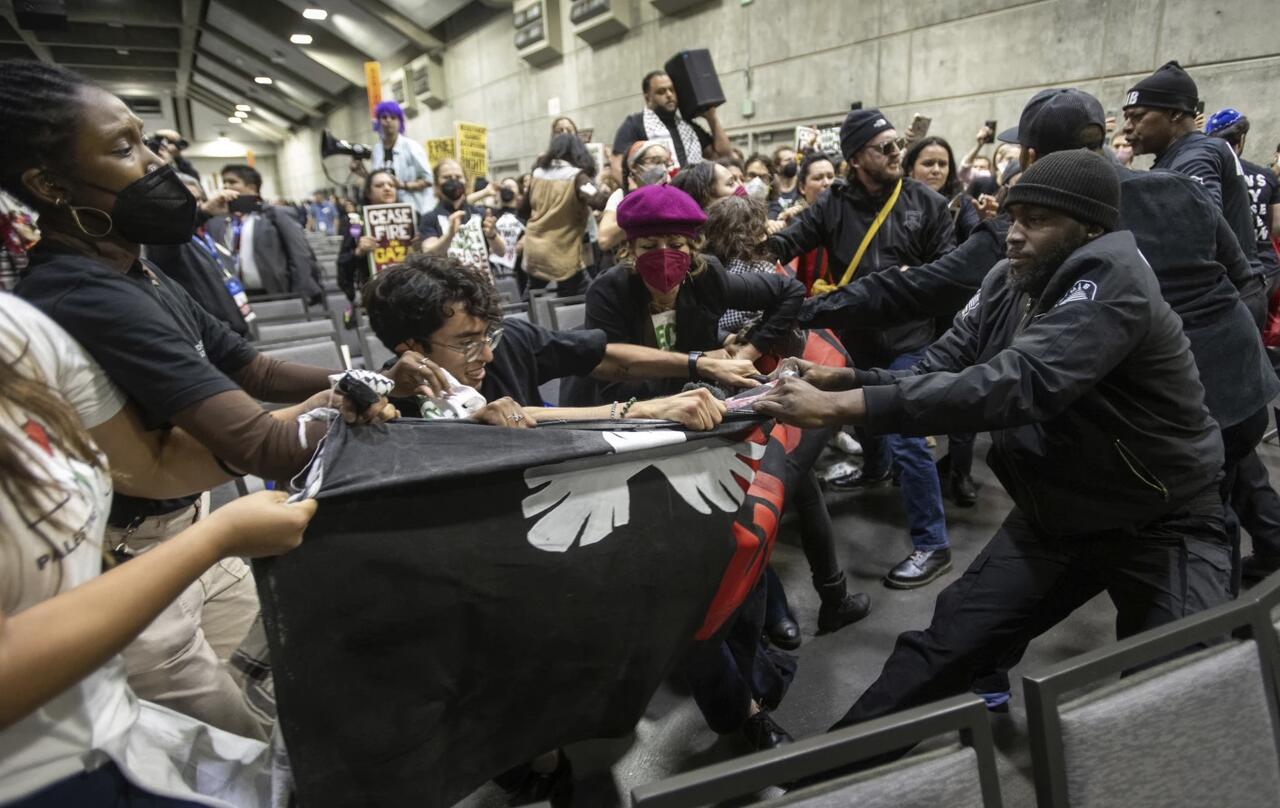
The California Democratic Party shut down its convention on Saturday after thousands of demonstrators mobbed the venue, staging a sit-in in the lobby, heckling speakers, blocking roads and condemning “Genocide Joe” Biden, all in an effort to urge party leaders to support a ceasefire in the Israel-Gaza war.  

The incident is the second prominent display of rage against the Democratic Party in just in the last week by people sympathetic to the Palestinian side. On Wednesday, protesters surrounded Democratic National Committee headquarters while members of Congress were inside for a campaign reception. Legislators were rushed into the basement as police pulled and shoved protesters away from the building. 

Protesters and police fight for control over a banner at the California Democratic convention (Paul Kitagaki Jr/Sacramento Bee via Associated Press)

Saturday’s action in Sacramento kicked off with a sit-in by 200 demonstrators at the Safe Credit Union Convention Center. As word spread and others flocked to the area, the crowd soared to some 2,500 who entered or surrounded the venue, according to CBS 13. When the protesters blocked streets, it caused a massive traffic jam. Sacramento police said there was no acts of vandalism and no arrests were made. 

Among those who were the focus of protesters’ wrath were Katie Porter and Adam Schiff, who are both running for Senate and who have both opposed calls for Israel to pursue a ceasefire.

In addition to the sit-in, videos circulating on social media also showed demonstrators disrupting speeches.

Here, Schiff was the target: 

“Due to circumstances beyond our control, and for the safety and security of our delegates and convention participants, we are canceling tonight’s caucus meetings, hospitality suites, and VoteFest taking place at the convention center,” the California Democrats announced in a statement. 

Some convention delegates were sympathetic to the protest. “A lot of people who are Democrats have lost faith in the party,” Sameena Husman told CBS 13. “We need to stand up and say we’re not going to stand for this, and we have to have a cease-fire.” 

California Democrats chairman Rusty Hicks vowed to hold accountable “any delegates who actively participated in or aided the furtherance of those activities or events in violation of our party’s code of conduct.”  

Meanwhile, the Democratic National Committee must be shuddering at the ongoing trend of young protesters targeting party events. They can only hope that the current Israel-Gaza war subsides before next year’s Democratic national convention in Chicago — the same city in which the party’s 1968 convention was swarmed by tens of thousands of protestors agitating against the Vietnam War.  

Tyler Durden
Mon, 11/20/2023 – 08:20

Zelensky Confirms Artillery Shell Deliveries Decreased Since Outbreak Of Gaza War

0
Zelensky Confirms Artillery Shell Deliveries Decreased Since Outbreak Of Gaza War

Authored by Dave DeCamp via AntiWar.com,

Ukrainian President Volodymyr Zelensky has said that deliveries of artillery shells from the US have “decreased” since Israel unleashed its relentless bombing campaign in Gaza following the October 7 Hamas attack.

The US has provided Ukraine with a huge amount of artillery ammunition since Russia launched its invasion last year, including over 2 million 155mm shells. But supplies are strained as Ukraine is using ammunition at a much faster rate than can be produced by the entire NATO alliance.

Supplies are even more strained now that the US is backing Israel’s onslaught in Gaza. The support includes near-daily weapons shipments. 

Axios recently reported that the US had diverted 155mm shells initially bound for Ukraine to Israel to replenish an ammunition stockpile in the country.

“Our deliveries have decreased,” Zelensky told reporters on November 16, according to AFP. “It’s not like the US said: we don’t give Ukraine any. No! It’s just that everyone is fighting for (stockpiles) themselves… This is life. I’m not saying that this is positive, but this is life, and we have to defend what’s ours.”

Russia has meanwhile kept up the pressure at the contested city of Avdiivka:

Zelensky’s news of a reduction in U.S. deliveries, meanwhile, comes at a particularly challenging moment for Ukraine as Russia steps up its assaults near Avdiivka, a eastern-Ukrainian city where intense fighting resembles that seen in Bakhmut last winter. 

“The situation is quite difficult,” said Ukrainian parliamentarian Yehor Cherniev. “The intensity of heavy shelling from our side is lower and lower because of the lack of ammunition.”

According to Defense One, Ukraine fires about 240,000 155mm artillery shells per month, significantly higher than US monthly production rates. The US has ramped up its monthly production rate to 28,000 shells and is working to reach a goal of 80,000.

Besides the tightening supplies, the Biden administration also has yet to secure new funding for the proxy war in Ukraine. President Biden asked Congress to authorize $61 billion to fund the conflict for another year, but US lawmakers appear more focused on arming and supporting Israel.

Tyler Durden
Mon, 11/20/2023 – 07:45

Climate ‘Enron’ May Be Heading For A Crash

0
Climate ‘Enron’ May Be Heading For A Crash

Authored by Duggan Flanakin via RealClear Wire,

The modern American version of “the environmental emperor has no clothes” until now has been the rise and fall of Enron. As former Ken Lay speechwriter Robert Bradley, Jr., says, “(T)he cause of Enron’s financial bankruptcy were at root philosophical…. Enron’s leaders were certainly engaged in massive philosophical fraud – an attempt to cheat reality itself.

For years, Enron was hailed as one of the most forward-thinking corporations, and Lay, its founder and CEO, was a man in great demand. During his 13-year tenure that ended with a bang in 2021, Lay collected over $220 million in cash and company stock, and just months before “the largest bankruptcy in America” (at that time) Lay gave five presentations at the 2001 World Economic Forum meeting in Davos.

As Bradley, now the CEO of the Institute for Economic Research, recounts, Lay was the salesman promoting a business model developed by Jeffrey Skilling, who Lay had brought on as chief operating officer. In Skilling’s “mark-to-market” accounting, anticipated future profits from any deal were accounted for by estimating their present value rather than historical cost. Thus, argued Skilling, Enron did not really need “assets.”

It just needed connections.

And that was Lay’s special skill. His idea was to embrace a “revolution always” business philosophy, which Bradley called “a perpetual search for the first-mover advantage.” To that end, he became all things to all people, winning favor from Republicans, Democrats, environmentalists, minorities, and business leaders. His “illusion-making” in effect created a smokescreen so strong that nearly everyone was caught by surprise when the bubble burst.

[Editor’s note: As an environmental writer in Louisiana, I wrote in 1999 that the U.S. Senate rejection of the Kyoto Protocol would ensure Enron’s soon demise. I based my view on the fact that the company lacked assets and had built its presumed net worth on Kyoto largesse. As Bradley points out, Enron relied heavily on government favors.]

Today, the collapse of FTX and the recent criminal conviction of founder and CEO Sam Bankman-Fried (who is facing a lifetime behind bars) brings Enron, Skilling, and Lay to mind. But, despite the magnitude of SBF’s fraud, it pales in comparison to the ongoing fraud being perpetrated mostly on America and its Western allies in the name of “climate change.”

A bit like FTX, but unlike Enron, there are plenty of warning signs that the “Green Revolution” is about to come tumbling down and its loudest advocates brought to account. The main thing keeping the mirages afloat today is the massive egos and their investments in folly that may leave them going down with the ship.

While the “Green Revolution” has been under way for decades, it is the Biden Administration that has imposed mandates, attacked popular energy sources and transportation options, and waged war against traditional industrial development. Europeans and states like California had earlier imposed their own mandates with supposedly “hard” deadlines for abolishing the use of oil, natural gas, coal, and every tool or vehicle that uses them.

The green war on fossil fuels, as fleshed out in the “Net Zero” campaign, is perhaps history’s greatest example of philosophical fraud.

“To dream the impossible dream” and turn it into reality would mean sacrificing an estimated 6,000 useful products that rely on byproducts from crude oil refineries – products that range from asphalt for highways to fertilizers, cosmetics, synthetic rubber, medicines and medical devices, cleaning products, plastics, so many more. The 3 billion who live without the benefits fossil fuels have provided are also the poorest, sickest, and most vulnerable humans on the planet.

Cracks are already developing in the “Net Zero” world, what with countries backing away from the mandates they so recently touted while marching around like peacocks in mating season. In March the European Union reached an agreement with Germany to formally back away from its total ban on internal combustion engines in 2035.

Still, 30 countries are signatories to the Glasgow Declaration that would force all vehicles sold by 2040 to have zero carbon dioxide emissions, and 21 others have crafted plans to ban new ICE vehicle sales earlier than 2040. Dozens of major cities and states, most notably California and the California clone states, intend to disallow new ICE vehicles by 2035.

Several problems stand in the way of their utopian dream. Even EV advocates are now admitting the “EV-olution” has to overcome “serious issues” – like the use of child labor in lithium mining, the woefully inadequate EV charging infrastructure, and an unprepared power grid. Yet the biggest obstacle is that a majority of the Earth’s people object to having EVs – or heat pumps, or electric stoves, and so on — shoved down their throats.

EVs may be fine for short-trip urban travel but not for construction equipment, airplanes, or even urban buses, as evidenced by the recent horrific scene in San Francisco when a Google-operated electric bus lost power and slid backwards downhill into nine vehicles. Today’s EVs are wholly impractical for mountain and prairie residents or others making long trips (worse with children).

Like Ken Lay with Enron, the Green revolution has relied heavily on government subsidies and a “revolution always” business philosophy aimed at making pariahs of anyone who dares oppose the grandiose – but fatally flawed – plan.

During the Obama Administration, Solyndra went under despite a $535 million government-guaranteed loan, none of which was paid back. Forbes, citing OpenTheBooks.com, noted that taxpayers were left holding the notes for $400 million given to Abound Solar, $280 million wasted by CaliSolar, $193 million doled out to Fisker Automotive (with another $336 million canceled), and $132 million to A123 Systems (a failed battery maker). 

Undaunted, the Biden Administration’s $2.3 trillion “jobs” package was rife with more subsidies for technologies that by their own admission are unsustainable. Yet despite all the free money, Ford, General Motors, and many other automakers are backing away from multibillion-dollar investments in new EV factories as new EV sales have slowed despite increased rebates.

Ford in March projected a loss of $3 billion on electric vehicles in 2023, offsetting profits of as much as $14 billion from its other divisions. Ford also admitted losses of $900 million in 2021 and $2.1 billion in 2022 in its EV division. Ford and GM believe their EV fortunes will turn around by 2025, but those rosy scenarios seem wholly dependent upon Biden (or an even “greener” Democrat) winning the White House next November.

Even with a Green win in 2024, reality will still bite the EV dream. China has been quietly moving toward total dominance in the global EV marketplace – largely because it controls the lithium battery market. Financial Times wrote in September that China is so far ahead in the EV market that its competitors are trailing in the dust.

Biden’s reliance on huge subsidies to underwrite the “Green Revolution” has brought soaring inflation to the U.S. that is taking away purchasing power faster than it can increase subsidies and Mafia-style “incentives” (you will buy what we want you to buy, or else!).

Lay died of a heart attack shortly after his trial, leaving behind “a legacy of shame” characterized by “mismanagement and dishonesty” that led Politico to rank him as the third-worst American CEO of all time.

America’s doddering President Biden, now facing pre-impeachment hearings for other alleged mistakes, may not live to see his name smeared as Lay’s once was. But does anyone truly believe Biden is calling all the shots here?

Who will, then, get the blame if America’s forced march to EV subservience to Xi’s China brings an end to America’s hegemony on the world stage?

Duggan Flanakin is a senior policy analyst for the Committee for a Constructive Tomorrow and a frequent writer on public policy issues. 

Tyler Durden
Mon, 11/20/2023 – 06:30

All The Metals We Mined In One Visualization

0
All The Metals We Mined In One Visualization

In 2022, 2.8 billion tonnes of metals were mined throughout the world – while major industries that directly consume processed mineral materials contribute 14% of the US economy.

As Visual Capitalist‘s Bruno Venditti details below, here’s each metal’s contribution to the total:

More via Visual Capitalist:

Iron Ore Dominance

Iron ore dominates the metals mining landscape, comprising 93% of the total mined. In 2022, 2.6 billion tonnes of iron ore were mined, containing about 1.6 billion tonnes of iron.

ercentages may not add up to 100 due to rounding.

Iron ores are found in various geologic environments, such as igneous, metamorphic, or sedimentary rocks, and can contain over 70% iron, with many falling in the 50-60% range.

Combined with other materials like coke and limestone, iron ore is primarily used in steel production. Today, almost all (98%) iron ore is dedicated to steelmaking.

The ore is typically mined in about 50 countries, but Australia, Brazil, China, and India are responsible for 75% of the production.

Because of its essential role in infrastructure development, iron ore is one of the most crucial materials underpinning urbanization and economic growth.

Industrial Metals

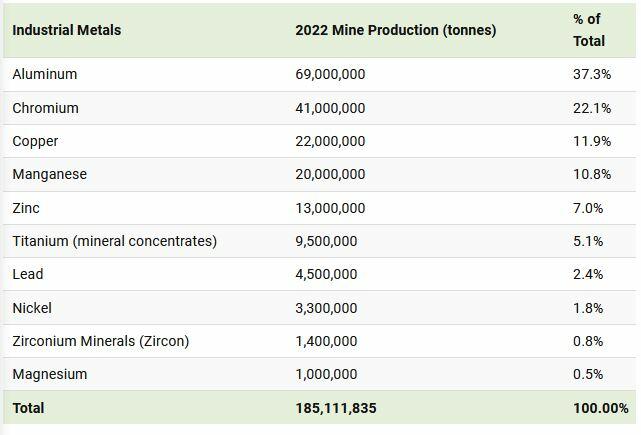
Industrial metals occupy the second position on our list, constituting 6.6% of all metals mined in 2022. These metals, including copper, aluminum, lead, and zinc, are employed in construction and industrial applications.

Aluminum constituted nearly 40% of industrial metal production in 2022. China was responsible for 56% of all aluminum produced.

In the second position is chromium, which plays a primary role in rendering stainless steel corrosion-resistant. South Africa led chromium production, accounting for 44% of the total mined last year.

Technology and Precious Metals

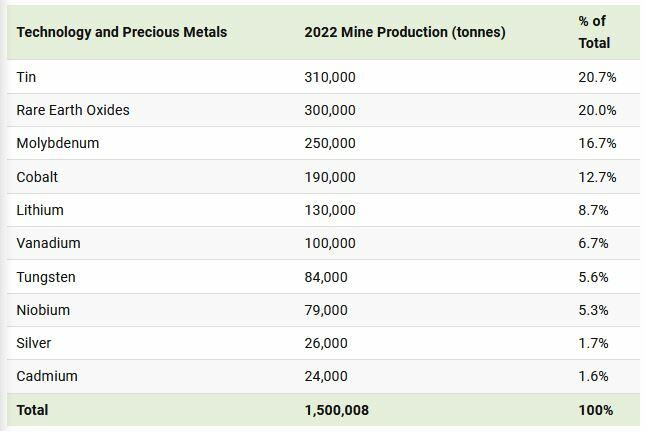
Despite representing less than 1% of all the metals mined, technology metals have been on the news over the last few years as countries and companies seek these materials to reduce carbon emissions and improve productivity.

They include lithium and cobalt, used in electric vehicles and battery storage, and rare earths, used in magnets, metal alloys, and electronics. Many of them are considered critical for countries’ security due to their role in clean energy technologies and dependency on other nations to supply domestic demand.

However, despite increasing interest in these metals, they are still behind precious metals such as gold and silver regarding market size.

The gold market, for example, reached $196 billion in 2022, compared to $10.6 billion of the rare earth market.

Tyler Durden
Mon, 11/20/2023 – 05:45

“Tranhausen By Proxy?” Parents’ Personality Disorders Driving Surge In Trans Kids: Psychiatrists

0
“Tranhausen By Proxy?” Parents’ Personality Disorders Driving Surge In Trans Kids: Psychiatrists

Authored by Darlene McCormick Sanchez via The Epoch Times (emphasis ours),

(Illustration by The Epoch Times, Shutterstock, Freepik)

Playing a role in the sudden rise of transgender children may be “transhausen by proxy,” a term coined for narcissistic parents who push so-called “gender transitioning” on their children, some experts say.

Celebrities are increasingly in the limelight with announcements about their children who come out as transgender or nonbinary. Nonbinary individuals identify as neither male nor female.

“Transhausen by proxy” isn’t an officially recognized psychological condition. It’s a play on an official condition known as Munchausen Syndrome by Proxy (MSBP). MSBP is a mental illness that’s also sometimes called medical child abuse or factitious disorder imposed on others. It’s exhibited mostly by women seeking attention by exaggerating or making up an illness of children or others in their care. 

Transhausen by proxy has very real effects on society, experts told The Epoch Times.

They point to headlines like the one on Pride.com in May, which gushes: “15 Celebs Who Are Out & Proud of Their Trans & Nonbinary Kids.” The article praises stars such as Cher, Sade, Jennifer Lopez, and Charlize Theron for supporting their children who reject their biological sex.

A young girl at the annual New York City Pride March in New York City on June 25, 2023. Some psychiatrists say parents are to blame in some cases of gender dysphoria. (Samira Bouaou/The Epoch Times)

Another article by Pink News details how United Kingdom television stars Carrie and David Grant claim three of their four children are transgender or nonbinary.

Ms. Grant is a singer and voice coach. Her husband was part of the ’80s band Linx and worked with groups such as the Spice Girls. The couple told the publication they had discussed alternate gender identities before their children “came out.”

They’re currently pitching their book, “A Very Modern Family,” on the topic of “understanding queer and neurodivergent children.”

But celebrities aren’t the only ones heralding transgender and nonbinary children.

Parents routinely post on social media cheering their children’s transition or advocating for “transgender rights.” Some parents have been featured in news articles for fleeing red states that block transgender procedures for children and moving to blue states where “gender-affirming care” is allowed.

The increase in cases of gender dysphoria and families with multiple transgender children have led some medical and mental health professionals to suspect psychological illness, such as narcissistic personality disorder, is involved.

A Parent-Fueled Condition?

Dr. Erica Li is a pediatrician in Spokane, Washington, who considers herself an old-school liberal. She’s not necessarily against gender transitioning. Early in her career, she considered becoming a pediatrician specializing in gender dysphoria.

However, she began to question why doctors were advocating for medical procedures to transition children without solid scientific evidence that the procedures came with an overwhelming benefit for their young patients, she told The Epoch Times.

If the cause of gender dysphoria is unknown in a patient and the prognosis of treatment is uncertain, then radical treatment with morbid side effects isn’t justified, she said.

Dr. Li believes contemporary gender medicine is no longer based on reality. Now, she said, it’s more about ideology. And the outcomes and long-term side effects of treating gender dysphoria are “murky.”

Until recently, gender dysphoria was rare and occurred mainly in young males. Left untreated, the condition often resolves naturally after puberty. In some cases, children struggling with gender dysphoria turned out to be gay, according to studies.

But in recent years, many in favor of “gender-affirming care” argue that medical interventions save lives by reducing suicidal tendencies in youth. They assert that it’s a human right for people to be able to identify as the opposite sex and that society must be accepting.

Dr. Li now, in some cases, sees another force at work—parents with personality disorders.

Narcissism, which has similarities to MSBP, may contribute to the proliferation of gender dysphoria claims and shouldn’t be ignored, she said.

Some experts believe narcissist parents are playing a part in the upward trend of gender dysphoria among children. Children attend a New York City Pride March in New York City on June 25, 2023. (Samira Bouaou/The Epoch Times)

The narcissism of some of these mothers has to be exposed,” she said.

Mothers, in particular, may use the attention from having a transgender child to climb the social hierarchy, she said. She’s not the only medical professional to feel this way. MSBP in parents has been described by insiders working in gender clinics in the United States and abroad, Dr. Li said. The condition is associated with what’s known in personality research as the “Dark Triad,” she said.

Those exhibiting the Dark Triad express Machiavellianism, which uses deception to win power. They also express underlying psychopathy, such as amoral behavior. And they express narcissism, which is the need for admiration coupled with an absence of empathy for others.

‘Transhausen by Proxy’

In February, Jamie Reed, a former case manager at the Washington University Transgender Center at St. Louis Children’s Hospital, exposed practices at the clinic and described parents who were adamant about transitioning their children.

Her revelations became the catalyst for Missouri lawmakers to draft a law barring hormone therapy for minors.

In a July article appearing in LGBT Courage Coalition, Ms. Reed wrote about how children at the clinic were the victims of “one parent’s own psychological needs.”

As horrible as this is to say, I did see parents (primarily moms) who showed signs of Munchausen Syndrome by Proxy,” Ms. Reed wrote.

Ms. Reed, a lesbian and mother of five, described how the center tore families apart when both parents didn’t agree to putting their children on hormones.

Fathers often attempted to stop the medical transitioning of their children, she wrote. And staff, she wrote, often referred to those fathers as “idiots” or said they had “patriarchal issues.”

“Often the dads were fighting for the most reasonable things—more time in therapy, therapy with a provider who would actually explore where his child’s desire to escape his or her own body was coming from, time to allow mental health professionals to do proper psychotherapy.”

Ms. Reed wrote that she no longer trusts “affirming” doctors because they are “blinded by ideology.”

Likewise, in the United Kingdom, the Tavistock and Portman gender clinics accepted about 30 children under the age of 5 in the two-year period ending in 2022, according to National Health Service data. About half were younger than 4.

Dr. Az Hakeem, a psychiatrist who worked at the Portman Clinic until 2012, was quoted by The Telegraph and the Daily Mail as saying he was concerned with cases that smacked of “transhausen by proxy.”

Dr. Hakeem told the news outlets he saw a significant number of grieving parents who had lost a child and eventually had another baby. Some parents wanted to transition the later-born child to the sex of the child who died.

Activist Chris Elston, known as Billboard Chris (2nd L), embraces a supporter as he demonstrates against “gender-affirming” treatments and surgeries on minors, outside of Boston Children’s Hospital in Massachusetts on September 18, 2022. (Joseph Prezioso/AFP via Getty Images)

Tyler Durden
Mon, 11/20/2023 – 05:00

Study Reveals Most Common Chronic Symptoms After COVID-19 Vaccination

0
Study Reveals Most Common Chronic Symptoms After COVID-19 Vaccination

Authored by Zachary Stieber via The Epoch Times (emphasis ours),

A new study shows some of the most common chronic symptoms among people who began experiencing the problems after receiving a COVID-19 vaccine.

Syringes with a COVID-19 vaccine in Bidderford, Maine, on April 26, 2021. (Joseph Prezioso/AFP via Getty Images)

The most common symptoms were exercise intolerance, excessive fatigue, numbness, brain fog, and neuropathy, researchers reported in the paper.

Insomnia, palpitations, myalgia, tinnitus, headache, burning sensations, and dizziness were also experienced by at least half of the participants in the study, which was funded in part by the U.S. National Institutes of Health (NIH).

Participants reported a median of 22 symptoms, with a ceiling of 35.

The study focused on people “who report a severe, debilitating chronic condition following COVID-19 vaccination” that “began soon after COVID-19 vaccination and persisted in many people for a year or more,” the researchers said.

The study was led by Dr. Harlan Krumholz of the Department of Internal Medicine at the Yale School of Medicine and Yilun Wu of the Yale School of Public Health’s Department of Biostatistics.

It was published on Nov. 10 as a preprint ahead of peer review.

Methods

The paper comes from Yale’s Listen to Immune, Symptom and Treatment Experiences Now (LISTEN) research, which examines both so-called long COVID and post-vaccine adverse events.

Researchers began recruiting participants in May 2022. Participants filled out a survey, and researchers had access to their health records.

The study featured adults who reported post-vaccination problems from May 2022 through July 2023. The 388 people who also reported so-called long COVID, or lingering symptoms after COVID-19 infection, were excluded. Another 146 people who didn’t completely fill out the survey were also ultimately left out.

The median age of the participants was 46, and 80 percent were female. Approximately 88 percent live in the United States.

The design of the study means no causality could be confirmed, the researchers said. While they acknowledged the chronic symptoms could be caused by the vaccines, they alleged they could also be unrelated and have occurred by change, but also said the clustering of symptoms soon after vaccination “suggests a potential relationship.”

Known side effects of the vaccines include heart inflammation, severe allergic shock, and Guillain-Barré Syndrome.

Other issues have been linked to the vaccines by some but aren’t recognized as widely as confirmed side effects.

The symptoms could be quite painful. Participants reported a median of 80 on a scale of 100 when asked how bad their symptoms were on their worst days.

Lingering Symptoms

In the week before completing the survey, 93 percent of participants said they felt unease at least once.

More than eight out of 10 reported feeling fearful, and 81 percent reported feeling overwhelmed by worries.

Feelings of helplessness, depression, hopelessness, and worthlessness were also commonly reported.

Nearly the entire group said they felt rundown and 91 percent said they suffer from sleep problems.

On the other hand, half of participants reported being in good, very good, or excellent condition. Still, the rest reported fair, poor, or unknown status.

The symptoms started for many people soon after vaccination. The median time of symptom onset was three days. Seventy-seven percent of people experienced the symptoms after their first or second shot.

The study followed an NIH-authored paper that detailed 23 people who experienced persistent symptoms following COVID-19 vaccination.

A number of participants in the new study received new diagnoses after receiving a vaccine, including anxiety, neurological conditions, gastrointestinal issues, and postural orthostatic tachycardia syndrome.

Problems Before the Pandemic

Nearly half the participants had allergies before the pandemic, according to the study.

About three quarters of the participants in total had at least one comorbidity, such as allergies.

Behind allergies, the most common comorbidities were gastrointestinal issues, with acid reflux as an example; anxiety disorders; depressive disorders; and asthma.

Arthritis, an autoimmune disease, high cholesterol, hypertension of high blood pressure, and migraines were also reported each by more than two dozen people.

Treatments Tried

Many participants tried multiple treatments for their symptoms.

Nearly all tried probiotics, which help boost good bacteria in the body.

Vitamins and supplements were also frequently turned to, with vitamins b12, c, and d and ibuprofen being the most popular.

Anti-inflammatory drugs, including ibuprofen, were used by a majority of participants.

Oral steroids such as dexamethasone were used by about half of the group.

Lifestyle changes were also common, with 51 percent limiting exercise or exertion, 44 percent cutting alcohol or caffeine, and 44 percent increasing or decreasing how much salt they consumed. Another approximately four in 10 changed their diet.

Travis
Mon, 11/20/2023 – 04:15

Cheney, Kinzinger, And “Sham” J6 Committee Under Fire After Friday Footage Dump; GOP Senator Calls For Investigation

0
Cheney, Kinzinger, And “Sham” J6 Committee Under Fire After Friday Footage Dump; GOP Senator Calls For Investigation

Ever since Friday’s release of more than 40,000 hours of Jan. 6 Capitol Police security video, dozens of clips debunking the Jan. 6 committee’s ‘violent insurrection’ narrative have been floating around X.

Mike Lee raises questions

In response to the exculpatory footage that the Jan. 6 committee never showed the American public, Senator Mike Lee (R-UT) has raised significant questions about the handling of security footage.

Lee’s statements directly challenge the integrity of the now-disbanded committee, particularly addressing the roles of its former Republican members, Liz Cheney and Adam Kinzinger. He also accuses the committee – particularly those two, of selectively sharing information.

After Cheney attempted to hit back with her ‘best hits’ Jan. 6 footage, Lee replied: “Liz, we’ve seen footage like that a million times. You made sure we saw that—and nothing else.”

Lee also called for an investigation into the committee itself, labeling it a “sham” and questioning the use of taxpayer dollars in its operations. He insinuates that crucial information about the committee’s work could have been “deliberately lost or destroyed,” casting doubts on the committee’s transparency and objectivity.

The argument continued throughout the day, with Lee linking to a NY Post article with the headline “FBI lost count of how many paid informants were at Capitol on Jan. 6, and later performed audit to figure out exact number.”

Kinzinger swings and misses all day

In response to the backlash, Kinzinger made a stupid joke comparing Jan. 6 protesters to US army helicopters providing fire for South Vietnamese ground troops attacking the Vietcong in 1965.

Twice.

He also retweeted about a dozen similarly stupid jokes (check out his timeline).

The House Select Committee on the January 6 Attack was disbanded in January 2023, after releasing its final report in December 2022. The committee, comprising seven Democrats and two Republicans, faced criticism for its composition and the perceived partisanship in its approach.

Kinzinger did not seek reelection, and Cheney lost her primary, marking a significant shift in the Republican landscape. The release of the security tapes by Johnson is seen as a step towards transparency, allowing the public to form their own opinions about the events of January 6, away from the committee’s narrative.

Tyler Durden
Mon, 11/20/2023 – 03:45

France: A Tale Of Two Demos

0
France: A Tale Of Two Demos

Authored by Amir Taheri via The Gatestone Institute,

A week after Paris witnessed a march in support of the “Palestinian cause” it hosted another march, this time against anti-Semitism.

Ostensibly provoked by the ongoing war in Gaza the two marches may persuade the French to take a closer look at the messages they convey and their impact on French politics.

Despite denials by its organizers, the leftist and extreme left parties, the first march, which took part on the right bank of the River Seine, was clearly anti-Israel, at times with anti-Semitic undertones.

The second march, last Sunday, was organized by Senate President Gérard Larcher and National Assembly Speaker Yaël Braun-Pivet, both on the right, who insisted that it was not meant as a show of support for Israel’s war in Gaza but as a defense of the Republic.

Held on the left bank of the Seine, where French café intellectuals have been discussing the fate of mankind for generations, Sunday’s march, which I attended as a reporter, attracted over 100,000 people, five times larger than the pro-Palestine demo.

In his typical neither-nor style of centrism, President Emmanuel Macron decided not to attend either demo, adopting Barack Obama’s style of “leading from behind.”

Sunday’s demo was more inclusive than the one on Saturday.

Several leftist figures attended along with two former presidents of the republic, François Hollande and Nicolas Sarkozy, a dozen Cabinet ministers led by Prime Minister Élisabeth Borne, and most members of the Senate and National Assembly.

There were also many Muslim figures including imams of mosques who ignored the “advice” of the Grand Mosque of Paris not to attend. The Grand Mosque announced it would prefer a march “against all forms of racism including Islamophobia.” Implicitly, it regards Judaism and Islam as racial entities rather than religions.

Representatives of other religions of France, from Buddhism to Judaism and Catholicism, were present.

The hard-left leader Jean-Luc Mélenchon boycotted the demo because it included Marine Le Pen, leader of the far-right National Rally party. Yet the same Mélenchon had welcomed Le Pen’s participation in a demo he attended against the reform of pension laws earlier this year.

In what could be seen as secular fundamentalism, a few left-wing intellectuals also boycotted the march because they saw Gaza as a war between two rival religions.

Sunday’s demo included fewer of what the French call “visible minorities” but more marchers from the provinces. There were also fewer semi-professional marchers but more celebrities of all kinds. Like the Saturday demo, the one on Sunday also included figures on a virtue-signaling exercise.

The marchers I talked to in both demos seemed unable to distinguish between what is a geopolitical issue and what they imagine is a clash of civilizations.

Neither were they prepared to admit that anti-Semitism is an evil whose effects go beyond transient issues such as the Gaza war or the Israel-Palestine conflict.

Paralyzed by group-think, they couldn’t conceive of a situation in which one may have two victims hurting each other. To some of them, as long as one side had a legitimate grievance it mattered little how he tried to redress it.

Anti-Semitism has been and remains a live issue in France.

France was the first country to witness a concrete example of anti-Semitism at the state level with the Dreyfus affair of 1894-1906. The French Vichy state collaborated with Nazi Germany’s occupation, a collaboration that included arresting thousands of Jews for deportation to forced labor and eventually death camps in the Nazi empire.

Since then hardly a year has passed in France without some anti-Semitic action hitting the headlines. Little of that history is related to the Israel-Palestine issue, although in recent years it has been used by neo-Nazi and/or anti-Israel activists as an excuse.

The bulk of the French anti-Semitic constituency, as exemplified by the “Action Française” group, consists of individuals and groups that hate Arabs, Muslims, and Jews, not to mention blacks, single mothers, and LGBTQ+ people.

The Gaza war has provoked a rise in the number of anti-Semitic incidents, at the time of this writing over 1,300 in a month.

Anti-Semitism isn’t a byproduct of the Israel-Palestine conflict; it is an evil in its own right and a threat to what even the politically correct Macron says he upholds as “values of our civilization.”

Some apologists have tried to belittle the threat by presenting anti-Semitism as another form of altrophobia (fear of the other) and, implicitly at least, a reaffirmation of sameness or national unity.

That, however, amounts to gift-wrapping raw hatred into a Hegelian package — intellectual aesthetics trumping ethics.

Paralyzed by petty political postures, the United Nations has not only failed to define anti-Semitism as a threat to “universal values” but has allowed some members to include anti-Semitic tropes in their discourse.

To think that anti-Semitism concerns only Jews is to miss the point.

You don’t have to be pro-Israel to oppose anti-Semitism. There are some Christian fundamentalists who are pro-Israel but anti-Semites; just as there are Jewish sects that are anti-Israel but, obviously, not anti-Semites.

Anti-Semitism challenges the fundamentals of what one may call modern civilization. It denies the existence of human beings as individuals with inalienable rights beyond religious, ethnic, racial and other backgrounds. It dissolves the concept of citizenship as the basis of the relationship between the individual and the state.

Anti-Semitism also violates the principle under which guilt by association and collective punishment could not be accepted. Worse still, it rejects the principle of innocence until proven guilty by a court of one’s peers, thus sapping the roots of civilized legal systems.

Anti-Semitism reaffirms the barbarian notion of imagined inherited sin under which, as T. S. Eliot put it, the blood of children must be spilled to atone for the father’s guilt.

It returns us to the ancient Greek concept of the scapegoat as a symbol of collective sin whose sacrifice purges society and triggers a new beginning. Christianity destroyed that concept through the rival concept of the innocent scapegoat.

Sunday’s demo was one of the largest in France since 1990 and the first to specifically reject anti-Semitism.

National Assembly Speaker Braun-Pivet says the demo was meant to show that a silent majority exists and sees anti-Semitism as a threat to the French Republic. She is right.

Sunday’s demo was a good start in treating it as what it is: an evil that threatens all of us.

Tyler Durden
Mon, 11/20/2023 – 02:00