71.7 F
Chicago
Thursday, September 10, 2026
Home Blog Page 3162

Conservative Think Tank Reveals Best, Worst States For Freedom In Education

0
Conservative Think Tank Reveals Best, Worst States For Freedom In Education

Authored by Jackson Elliott via The Epoch Times (emphasis ours),

Citing the need for equity, lawmakers in several Democrat-controlled states have passed measures recently that make it harder to discipline students who act up in the classroom.

Children in a classroom hold their hands up to be called on during class at Carter Traditional Elementary School in Louisville, Ky., on Jan. 24, 2022. (Jon Cherry/Getty Images)

Schools in California, Illinois, Minnesota, Maryland, and other states have adopted student discipline systems based on “restorative justice” instead of suspending students for bad behavior.

That means, instead of giving students penalties for misbehavior, schools use “empathetic communication” to explain to students why their misbehavior is harmful.

But at least one state has struck out in a different direction in the hopes of improving student success.

In Oklahoma, Ryan Walters, the state superintendent of public instruction, has proposed reforms that will encourage more disciplining of students. He believes that’s the best way to improve learning, he told The Epoch Times.

Decisions like this helped land his state in 10th place on the 2023 Education Freedom Report Card, compiled by The Heritage Foundation, a conservative think tank focused on public policy research.

The Heritage Foundation report ranks school systems in all states and the District of Columbia by their degree of education choice, transparency, teacher freedom, and return on investment in education.

Education choice refers to what degree of choice parents get over where their children attend school.

Teacher freedom means the degree to which teachers control instruction within the classroom.

The transparency rating refers to the degree to which parents know what’s happening in local schools.

Return on investment compares how much each state spends on education in relation to student success on the National Assessment of Education Progress exams.

Florida earned the top spot in the report. Rounding out the top 10, in order of ranking, were Arizona, Utah, Arkansas, Indiana, Mississippi, Tennessee, Texas, Iowa, and Oklahoma.

The bottom 10 on the report were New Jersey, Washington, Delaware, Minnesota, Vermont, Massachusetts, New York, Rhode Island, Connecticut, and, in last place, Oregon. All of these states lean left politically and had a majority of votes in 2020 for President Joe Biden.

And left-leaning policies lead to poor outcomes at schools, Oklahoma superintendent Mr. Walters said.

“As with many subjects, the [political] left is completely dead wrong on this. It’s not that society is causing students to misbehave—it’s that students are not being responsible for their own behavior.”

Oklahoma State Superintendent Ryan Walters reads to children. (Courtesy of Ryan Walters)

But education officials in Minnesota, ranked near the bottom of the Heritage Foundation report, believe “restorative practices” are an example of a winning educational policy.

Restorative practices (RP) are drawn from the traditions of Indigenous people and communities of color around the world,” the Minnesota Department of Education’s website reads. “They are grounded in a belief that people are profoundly relational, interconnected and inherently good.”

“Inherently good” children misbehave because the systems they are in fail them and push them into misbehavior, Minnesota’s guide to implementing restorative justice theorizes.

“It is the system (not the children) that needs to be made whole,” the guide reads.

Conservative policies prevail in nine states in the top 10. Arizona was the only state in the top 10 with a majority of votes for President Biden in the 2020 election that toppled incumbent President Donald Trump.

Conservative Approach

Oklahoma has taken an approach that’s the opposite of the policies in states that seek to make it more difficult to remove unruly youngsters from classrooms.

Mr. Walters has focused on implementing educational policies that hold students accountable for their actions, he said.

These policies, he said, help students succeed by creating environments where students can learn.

And that makes teachers happier, he said.

Veteran teachers have complained that student behavior is worse than ever, he said. They’ve told him: “We’ve got to get discipline back on track,” he said.

So, “they’re very excited that we’re taking this seriously.”

Under his proposed Comprehensive Classroom Discipline Reform for Oklahoma, teachers will have the rights to enforce school district policies, inform law enforcement, refuse to teach violent students, and not be held liable, he said.

He’s especially proud of the state’s fifth-place ranking on education choice because school choice ensures “every parent has access to as many options as possible,” he said. And he’s working on boosting rankings in other areas.

“We are bringing transparency to the state. We are working to ensure that districts are showing their policies, their curriculum, their budgets.”

Red States vs Blue States

State choices on how to fix education make a real difference in children’s lives, Mr. Walters said.

It’s a temptation for state officials to “fix education” by creating policies that change metrics rather than fixing underlying issues, he said.

Schools can help more students succeed, he said. Or they can lower standards until whatever students do counts as success.

Officials in some states, he said, approach the problem by saying, “We want graduation rates to go up. So what do we do? Well, let’s lower the standards by which we’re holding people to graduate.”

You can graduate more people that way,” Mr. Walters said. “But what are you graduating them with?”

He prefers to push schools to improve education so that students graduate by reaching higher standards.

Oklahoma has invested $2.9 million in a “Back to Basics” plan designed to teach children reading and math literacy, Mr. Walters said. The plan pays teachers for tutoring and provides bonuses of up to $4,000 for students’ improved learning.

He takes the same approach to discipline.

If schools set clear expectations, he said, students will learn to meet them.

Thomas Paine Elementary School in Garden Grove, Calif., on Sept. 21, 2023. (John Fredricks/The Epoch Times)

“What you’re trying to instill in young people is self-discipline and work ethic,” Mr. Walters said. “These are the type of things that equate to being successful, not only academically but in life.”

If school systems can create good citizens, life, overall, will get better for students, he said.

And that means happier teachers, too, he said.

We had over 900 teachers apply for our incentive bonus to come teach in the State of Oklahoma.

Republican-controlled Florida ranked top overall on the Education Freedom report card, and earned the rankings of second in educational choice, first in transparency, second in teacher freedom, and fifth in return on investment.

“By providing universal school choice, parental rights in education and curriculum transparency, we have ensured that parents are able to fully direct the upbringing of their children,” Florida Gov. Ron DeSantis said in a news release.

New Standards

Oklahoma’s policies starkly contrast with several educational reforms favored by the political left, emphasizing leniency toward students.

In California, Gov. Gavin Newsom signed the state’s Senate Bill 274 on Oct. 8. This bill ended school suspensions for bad behavior, including talking back to teachers, using phones in class, breaking dress code, being late, and more.

Supporters say measures like these ensure that African American and minority students won’t receive suspension.

“Willful defiance suspensions have disproportionately impacted students of color, LGBTQ students, students who are homeless or in foster care, and those with disabilities,” California state Sen. Nancy Skinner, a Democrat,  announced on her website.

By not suspending students who misbehave in these ways, California will give them more time in school, which will result in education, Ms. Skinner said.

“Suspending youth for low-level behavior issues leads to significant harm, including learning loss and a higher likelihood that affected students will drop out of school completely,” she said.

Currently, California ranks 26th overall on the list by The Heritage Foundation. The state ranked 40th on educational choice, fifth on transparency, 43rd on teacher freedom, and 22nd on return on investment.

Governor of California Gavin Newsom attends a press conference on Oct. 25, 2023. (Wang Zhao/AFP via Getty Images)

In 2021, Oregon lawmakers passed Senate Bill 744, a measure that said students wouldn’t be required to show proficiency in “essential learning skills” to get a diploma during the school years of 2021-2022, 2022-2023, and 2023-2024.

This bill cites “an emergency” as the reason to end standardized tests that show how the state’s students rank compared to youngsters throughout the country.

It’s unclear from the bill’s wording whether the emergency was related to the COVID-19 pandemic or some other academic emergency.

However, the bill doesn’t suspend all educational requirements.

Oregon high-school students still have to earn a minimum number of class credits.

Since the bill’s passage, student graduation rates have remained relatively consistent at nearly 81 percent, state statistics show.

While the state ranks last, overall, it ranks 46th on education choice, 25th on transparency, 51st on teacher freedom, and 29th on return on investment.

Education Battles

Left-wing groups have fought against his policies, Mr. Walters said.

“I will never back down,” he said.

Mr. Walters has referred to teachers’ unions as “terrorist organizations.”

In response, the Oklahoma branch of the National Education Association (NEA) published an official statement on X, formerly Twitter, saying Mr. Walters was “unprofessional.”

Public school educators are not getting rich off of this job,” the statement said. “They keep their hearts and classrooms open to every single child across Oklahoma because they love their students. Comparing them to people who blow up buildings is disgusting, especially when every educator puts their life on the line to protect students as school shootings continue to rise.”

Monica Royer, media relations specialist for the Oklahoma Education Association, said she had no comment about Mr. Walters.

Teachers’ unions often take sides with the political left. The NEA’s LGBT teacher caucus provided badges to teachers with scannable codes that referred students to websites with LGBT sex guides.

Radical activists interested in peddling left-wing ideology like that to children are the biggest danger in education today, Mr. Walters said.

“The left has been trying to force this woke ideology into our schools, and they’ve tried it through many different mechanisms,” he said. “We’re going to continue to push parent rights, parent choice, and also weaken the power of the teachers union every step of the way.”

Tyler Durden
Sun, 11/19/2023 – 20:25

Dictator Xi’s American Cleanup Tour

0
Dictator Xi’s American Cleanup Tour

By Eric Peters, CIO of One River Asset Management

“I know folks say – Oh, they’re just cleaning up this place because all these fancy leaders are coming into town,” said Gavin Newsom, licking the still-damp pressure-washed sidewalks of San Fran’s Tenderloin, the press snapping away. “And that’s true…because it’s true,” continued California’s governor, praying that Xi Jinping’s visit would position him as a serious leader should President Biden stumble a few more times between now and next November.

“But it’s also true for months and months and months prior to APEC we’ve been having different conversations, and we’ve raised the bar of expectation between the city, the county, the state, and our federal partners,” said Gavin, America’s fever perhaps finally breaking, a California politician appearing to condemn, however gently, the senseless forfeit of a great city to tents, rampant crime, drug abuse, squalor.

Portland’s mayor saw Newsom’s press conference and immediately called the Chinese embassy in DC, to beg for a state visit from Xi. He was put on hold. Seattle’s governor was ahead of him in the queue. Naturally Baltimore’s war-torn mayor had been first to call, but Chicago’s mayor had front run the order by piggybacking Citadel’s high-speed connection.

“Could Mr. Jinping please come visit our South Side? Just a quick drive by? High-speed, anything, please?” the mayor pleaded.

Yellen considered asking Xi to swing by Treasury to clean up our chronic deficit but felt it better to leave this historic challenge for her successor. New York City’s Mayor Adams, not one to defund the police unless forced to by budget cuts, was too busy explaining to his constituents that the migrant crisis would cost the city $11bln over the coming two years (next year’s $110bln NYC budget will contain a $7bln deficit).

Governor Abbott was tempted to have Xi come clean up the mess on his border, but communists are obviously not welcome in Texas.

Regardless, on this issue too, America’s fever was breaking. And with New York’s Governor Hochul seeking a more sensible approach to immigration, the creation of a sovereign border of some practical significance was finally on the horizon.

Tyler Durden
Sun, 11/19/2023 – 19:50

The Rise Of Socialists In Latin America Is Giving Terror Groups A Home

0
The Rise Of Socialists In Latin America Is Giving Terror Groups A Home

Authored by Marcos Schotgues via The Epoch Times (emphasis ours),

The new wave of leftist governments in Latin America, along with an increasingly brazen posture from Tehran has given Iran and its proxy terrorist groups a favorable environment to mingle with organized crime, cross borders with impunity, and engage in more direct state-to-state exchanges, analysts say.

(Illustration by The Epoch Times, Shutterstock)

“There’s always been a certain level of, not only networks, but also influence by both Hezbollah and behind Hezbollah, Iran, in the region,” said Evan Ellis, a former State Department official and research professor of Latin American studies at the U.S. Army War College Strategic Studies Institute.

“That increased with respect to the state-to-state Iranian engagement largely through populist actors in the mid-2000s, with a new crop of leftist populist leaders: Hugo Chavez, Evo Morales in Bolivia, and certainly Rafael Correa in Ecuador, among others.”

A map depicts the political leanings of governments in Latin America. (The Epoch Times)

This movement includes the recent reported entry of Iran and Hezbollah agents into the region through Venezuela, as evidenced by a 2022 incident in which a plane was grounded and seized in Argentina upon request of the United States. The state-owned aircraft had five Iranian nationals on board. Paraguay officials and others claimed they were linked to the Quds Force, which is designated a terrorist organization by the United States. Argentina denied reports that crew members were linked to Quds.

The seizure coincided with the return to the region of many of the same populist actors. “Essentially, you’re taking Quds Forces operatives and Hezbollah-affiliated personnel around the region,” Mr. Ellis said.

“In recent months what you’ve seen also is a broadening of that Iranian engagement with a trip to Nicaragua to talk about oil deals. And more recently, a three nation trip by President [Ebrahim] Raisi, accompanied by several ministers, including his defense minister, to Venezuela, as well as to Nicaragua and to Cuba, where several deals were signed in each place.”

The Iranian links in the region have become more apparent amid the Israel–Hamas war. On. Nov. 8, two alleged Hezbollah operatives were arrested in Brazil for planning attacks in the country. And warnings of a terror threat to the United States have increased, particularly in relation to its porous southern border.

Chile and Colombia, both with newly-elected leftist administrations, recalled their ambassadors to Israel on Oct. 31 and criticized the Jewish country’s offensive against Iranian-backed Hamas terrorists.

Bolivia severed diplomatic relations with Tel Aviv on the same day—the country had signed an agreement with Iran in July to strengthen “defense and security cooperation.” At the time, Iran’s Defense Minister said Latin American nations occupied a “special place in Iran’s strategic outlook,” and that the cooperation with Bolivia could be modeled by more countries in the region.

Iranian President Ebrahim Raisi disembarks after landing at Simon Bolivar International Airport in Venezuela, on June 12, 2023. (STR/AFP via Getty Images)

Carlos Berzaín, Bolivia’s former minister of defense and now head of the Interamerican Institute for Democracy, said every Latin American country being ruled under ‘21st century socialism’ is “publicly converted into an enemy of the United States—adopting the rhetoric Cuba has had for almost 65 years—with very grave political and security consequences.”

The term “21st century socialism” is commonly used by Venezuela’s socialist dictatorship and others to characterize their ideology.

Mr. Berzaín said his homeland is an example of one of the countries reclaimed by socialists (in late 2020) after a brief stint with the opposition in power.

Today, Bolivia, as a dictatorship, is dependent upon the leadership of Cuba’s dictatorship, and its foreign policy shows it,” he told the Epoch Times.

“It is at the service of other dictatorial regimes like Iran, Russia, and China with which there is no traditional or legitimate interest in the type of relations they maintain. Those are founded on corruption … on Bolivia’s condition as a narco-state, and on favoring crimes such as terrorism with an ‘anti-imperialist’ rhetoric.”

Leading Iran analyst Emanuele Ottolenghi, a senior fellow at the U.S.-based Foundation for the Defence of Democracy, said terrorist networks have grown.

“In Brazil, the sympathetic government of Luis Ignacio Lula da Silva has allowed Hezbollah and Iranian fronts to quietly expand with little risk of scrutiny from authorities,” Mr. Ottolenghi wrote in an Oct. 28 article.

Supporters of Hezbollah watch a televised speech by its leader Hassan Nasrallah (not pictured) in Beirut, Lebanon, on Nov. 3, 2023. (PAHMAD AL-RUBAYE/AFP via Getty Images)

“In Chile, with a strong and radicalized Palestinian diaspora, Iranian agents and Hezbollah networks have infiltrated government, media, and academia, in addition to running illicit financial networks.”

Iran and its proxies’ long and widespread activity in Latin America further increases concerns about a welcoming political environment.

Terrorist group Hezbollah has played a prominent role in the region. U.S. officials estimate Iran gives the group hundreds of millions of dollars annually, weapons, and more.

For decades, Hezbollah has patiently built a global web of networks, engaged in illicit financial activities, and supported terrorist plots,“ Mr. Ottolenghi wrote.

He said most countries in the region don’t consider Hezbollah a terrorist organization, making it harder to monitor and curb its activities.

“Because of its decades-long involvement with organized crime—a critical component of Hezbollah’s funding strategy—the group has extensive connections with local crime syndicates,” Mr. Ottolenghi said.

“These connections provide access to weapons, explosives, counterfeiting, and most critically, corrupt public officials in key positions at migrations, customs, and ports of entry.”

In recent years, several Hezbollah-connected arrests have been made in Latin America.

“In 2017, U.S. authorities arrested Samer el Debek, another Hezbollah agent, who, court documents reveal, had scouted potential targets that included the Israeli and U.S. embassies in Panama, as well as the Panama Canal,” Mr. Ottolenghi said.

“In 2021, Hezbollah operatives attempted to assassinate U.S. and Israeli nationals in Colombia.”

Despite the handful of arrests, Iran and proxy Hezbollah’s activity is ongoing in the region and remains largely “undisturbed,” Mr. Ottolenghi said.

Complicity and Close Ties

The enabling of illegal activity by Latin American leftist governments and their direct criminal engagement with Iran have been extensively reported.

Key state actors have facilitated transnational terrorist activity by providing criminals, who are wanted by Interpol, transport on state-run airlines as well as real passports with fake names.

“The speed and ease with which Hezbollah operatives are able to secure false documentation in Latin America should not come as a surprise,” stated Matthew Levitt in a 2013 House Homeland Security hearing. At the time, Mr. Levitt was the counterterrorism and intelligence director at The Washington Institute for Near East Policy.

“According to Israeli intelligence, the use of such passports by Hezbollah operatives is widespread, and the documents are used by the organization’s activists in their travels all over the world.”

Read more here…

Tyler Durden
Sun, 11/19/2023 – 19:15

Anti-Woke Central Bank Nemesis Javier Milei Wins Argentina’s Presidential Election

0
Anti-Woke Central Bank Nemesis Javier Milei Wins Argentina’s Presidential Election

Javier Milei, the outsider libertarian candidate with radical solutions to Argentina’s economic crisis, has just won Sunday’s presidential runoff against Economy Minister Sergio Massa.

In a surprise outcome, Massa conceded in a speech to supporters in Buenos Aires on Sunday even before the official results were released, saying he called Milei to congratulate him on his victory.

Javier Milei, a 53-year-old far-right economist and former television pundit with no governing experience, claimed nearly 56 percent of the vote, with more than 80 percent of votes tallied. It was a stunning upset over Sergio Massa, the center-left economy minister who has struggled to resolve the country’s worst economic crisis in two decades.

Voters in this nation of 46 million demanded a drastic change from a government that has sent the peso tumbling, inflation skyrocketing and more than 40 percent of the population into poverty. And with Milei, Argentina takes a leap into the unknown — with a leader promising to shatter the entire system, which the locals now correctly realize, is broken.

Milei, who two months ago was interviewed by Tucker Carlson, has promised to fix Argentina’s perennial economic problems by making drastic budget cuts, replacing the battered peso with the US dollar and shutting down the central bank.  He will take office on Dec. 10.

Massa, from the ruling Peronist coalition, placed first in October’s first round, a remarkable comeback after losing a primary election two months previously. But the dire state of Argentina’s economy, plagued by 143% hyperinflation and a looming recession, posed a challenge too far to his presidential bid.

“Argentines chose another path,” Massa said in a speech to supporters. Polls before the vote showed Milei with a slight edge over his rival.

For those unfamiliar with Milei’s unique style, the following clip should be rather informative:

Commenting on Milei’s victory, Elon Musk predicted that “Prosperity is ahead for Argentina.”

A Milei presidency will have profound implications for not only the third-largest economy in Latin America, but also the region and the world. In a continent dominated by leftist leaders, Milei could create tensions with governments he has attacked, including crucial trading partner and neighbor Brazil. In an era of growing Chinese influence in Latin America, Milei could become the region’s most vocal antagonist to a country he once called “an assassin.”

Milei made a name for himself as a television pundit who insulted other guests, and has shown a tendency to fight with the news media. In presidential debates, he has cast doubt on the widely accepted tally of murders during the country’s Dirty War from 1976 to 1983.

He has branded Pope Francis, an Argentine, an “evil” leftist. Climate change, he says, is a “socialist lie.” He would hold a referendum to undo the three-year-old law that legalized abortion.

Wielding chain saws on the campaign trail, the wild-haired Milei vowed to slash public spending in a country heavily dependent on government subsidies. He pledged to dollarize the economy, shut down the central bank and cut the number of government ministries from 18 to eight. His rallying campaign cry was a takedown of the country’s political “caste” — an Argentine version of Trump’s “drain the swamp.”

Massa was emblematic of that ruling elite — “the king of the caste,” said political analyst Pablo Touzón. The career politician attempted to distance himself from the leftist government of Alberto Fernández and Cristina Fernández de Kirchner, the heirs to the populist dynasty first launched by Juan and Eva “Evita” Peron in the 1940s. Along with a grassroots campaign of activists, Massa sought to stoke fear over a Milei presidency they argued could threaten Argentina’s democracy and way of life.

But ultimately, anger won over fear. For many Argentines, the bigger risk was more of the same.

“We don’t have anything to lose,” Tomás Limodio, a 36-year-old business owner who voted for Milei in Buenos Aires on Sunday. “We’ve had this type of government for so many years, and things are only getting worse.”

* * *

Earlier:

Argentinians return to the polls on Sunday, November 19 to elect the next president in a consequential runoff election. Voters will choose between incumbent Finance Minister Sergio Massa and right-wing libertarian Javier Milei. The election results will shape Argentina’s social and macroeconomic outlook in coming years.

As Goldman writes in its election preview note, polls point to a tightly contested race, with a majority showing Milei having a slight edge in voter preferences. A significant fraction (around one third of polls), however, suggests that Massa is in the lead. In general, polls in Argentina have a poor track record and in this electoral process they have systematically failed to capture shifts in voters’ sentiment. To add to the uncertainty, Massa was seen as outperforming Milei in the final presidential debate last week.

In the August primary elections (PASO), Javier Milei’s La Libertad Avanza party surprised by taking the lead, followed by the center-right coalition Juntos por el Cambio whose presidential ticket would be led by Patricia Bullrich. Massa’s left-leaning Peronist coalition, Unión por la Patria, finished third. In the October first round election, in turn, Massa topped most expectations with an improved performance and finished first. Milei came in second place without a significant change in support, and Bullrich disappointed and finished a distant third.

After the first-round election, part of the Juntos por el Cambio coalition, the faction led by Ms. Bullrich and former President Mauricio Macri, announced their support for Mr. Milei. While the bloc represented by the Radical Party decided not to formally endorse any of the candidates, some members have publicly sided with Mr. Massa.

Following Sunday´s results, investors will turn their attention to economic policy announcements. In the short term, the highly managed exchange rate will be a critical variable to follow. After the August primary elections, the government weakened the exchange rate by about 22% to 350 ARS per Dollar. Subsequently, the exchange rate was kept frozen at this level until this week, when a crawl resumed (1.0% so far this week). Nevertheless, pass-through was high and inflation accelerated considerably after the post-PASO devaluation and as a result, the real exchange rate is now even more overvalued than before the August devaluation.

Parallel exchange rates, for their part, continue to trade at a significant spread over the official rate (162% for the informal market exchange rate and around 145% for the bond (MEP) and equity (CCL) implied rates) and the futures market anticipates a meaningful depreciation in the months ahead. Pressures in both markets, however, eased after the first-round election showed Massa first, having increased significantly following Milei’s outperformance in the August PASO.

Likewise important, in the coming months there are significant payments scheduled to the IMF (around US$0.9bn in December and US$1.9bn in January) and foreign currency bond holders (approximately US$1.5bn due in interest payments in January). In the meantime, the EFF program with the IMF remains off track, and in our view its realignment will take time.

Regardless of the election winner, Goldman writes that a swift change in economic policies is imperative. The accumulated imbalances in the economy have grown too large and must be addressed promptly. The bank expects the economy to contract for the second year in a row in 2024, annual inflation is tracking at close to 150% and is expected to continue to rise in the coming months, the exchange rate is overvalued, international reserves are at critical levels, net reserves are significantly negative (around -US11bn), the fiscal imbalance persists, sovereign bonds trade at distressed levels, and the government lacks access to international financial markets. All in, if policymakers do not steer macro policy in a more orthodox direction, the macro adjustment could impose itself sooner or later, bringing a loss of control of the process and even higher social and economic costs.

Tyler Durden
Sun, 11/19/2023 – 18:30

Family Businesses Can’t Afford To Lose Access To Reliable Electricity

0
Family Businesses Can’t Afford To Lose Access To Reliable Electricity

Authored by Palmer Schoening via RealClear Wire,

Dependable, low-cost electricity is essential to keeping the lights on for millions of American family-owned businesses.

It is the type of essential item that touches nearly every aspect of our lives; the bakery relies on ovens, the repair shop on power tools, and the local grocer on refrigeration, and on and on. A consistent and affordable power source ensures that they can operate without interruption and keep prices competitive for their customers despite low margins and a fragile economy. Unfortunately, misguided federal policies now threaten to further disrupt our electric grid and could cause these business to shutter.

In the last several years, the U.S. has rapidly pivoted from a common sense, ‘all-of-the-above’ energy strategy to one motivated by the singular desire to eliminate fossil fuel-generated electricity. That goal of a energy change could even be somewhat defendable if not for the fact that our economy and power grid are clearly not ready for the rushed and reckless transition that federal regulators are rushing.

Like all other areas of the economy, energy markets adhere to the basic laws of supply and demand. Regulators have distorted the sector to force conventional power plants into early retirement, reducing total power generation and increasing prices. The Biden Administration has backed these actions based on the dubious claim that positive incentives for solar and wind projects will allow new arrays and wind farms to fully replace conventional power plants. 

But reality eventually catches up, and while regulators been successful at pushing the margins to the point where many traditional power plants are struggling to compete financially, they have failed to create the conditions necessary for the rapid deployment of new technologies to replace these important resources. For reasons ranging from permitting to logistics to expense, thousands of renewable energy projects have been delayed for years, in some cases past the planned retirement dates of the existing plants they are meant to replace. All of this comes at a high cost to family businesses like manufactures which rely on affordable energy to keep their doors open and their workers employed. 

Family businesses shouldn’t be made to – and can’t afford – to foot the bill for a haphazard and artificial shift to new and unproven technologies before our grid is ready for it. And while an eventual energy transition is inevitable, recent blackouts in Texas, California, and other parts of the country reveal just how far we are way from that occurring organically. Despite the best efforts of a small group of activist regulators, thermal power generation – coal, natural gas, and nuclear included – remain a critical part of our energy mix.

Small businesses all over the country are hoping that keeping energy prices from further inflation could still be a rare point of bipartisan consensus in Washington. Before the situation worsens, and irreversible harm is done to the backbone of America’s economy, policymakers must realize that abandoning the “all of the above” approach before the country is prepared will result in more business closures and therefore less jobs in our communities. 

Palmer Schoening serves as Chairman of the Family Business Coalition

Tyler Durden
Sun, 11/19/2023 – 18:05

Recycling Eco-Myths Is The Existential Threat

0
Recycling Eco-Myths Is The Existential Threat

Authored by J. Peder Zane via RealClear Wire,

The recycling myth – Save the planet by separating paper and plastic! – is a foundational falsity of the green movement.

By promising a relatively simple solution to an alleged problem, it has enabled the left to control behavior through a made-up morality that stigmatized dissent – Only bad people refuse to recycle.

Like most progressive interventions – from welfare policies that destroyed families while increasing dependency, to drug use reforms that have filled city streets with desperate addicts – recycling plans that sound good on paper (and plastic) have continuously collided with reality so that even liberal outlets such as the New York Times (“Your Recycling Gets Recycled, Right? Maybe, or Maybe Not”), NPR (“Recycling plastic is practically impossible — and the problem is getting worse”) and the Atlantic magazine (“Plastic Recycling Doesn’t Work and Will Never Work”) have finally admitted its failures.

The same dynamic is now at work regrading a far more significant green fantasy: the left’s push to decarbonize the U.S. and other Western industrial economies during the next few decades and attain an eco-purity calculus known as Net Zero. While brandishing the moral cudgel with full force – President Biden describes climate change as “an existential crisis,” i.e., every person and puppy will die if we don’t submit to his agenda – the left also suggests the transition will be easy-peasy: Just build some windmills, install some solar panels, and swap out your car, stove, and lightbulbs for cleaner and cheaper alternatives.

Though much of the cheerleading media downplays this fact, it is already clear that Biden’s enormously expensive, massively disruptive goal is a pipe dream. In a recent series of articles, my colleagues at RealClearInvestigations have reported on several of the seemingly intractable problems that the administration and its eco-allies are trying to wish away.

The dishonesty begins with the engine of the green economy – the vast array of wind and solar farms that must be constructed to replace the coal and gas facilities that power our economy. James Varney reported for RCI that the Department of Energy’s official line is that the installations required to meet Biden’s goal of “100% clean electricity” by 2035 will require “less than one-half of one percent of the contiguous U.S. land area” – or roughly 15,000 of the lower 48’s roughly 3 million square miles. However, Varney noted, “the government report that furnished those estimates also notes that the wind farm footprint alone could require an expanse nine times as large: 134,000 square miles. That is equivalent to the land mass of Ohio, Indiana, and Kentucky combined – plus all of New England.

Echoing the 19th century adage that figures don’t lie, but liars figure, the discrepancy mostly involves estimates of what can be built around the windmills. Each turbine’s footprint is relatively small, but they have to be spaced far apart. The DOE’s smaller number is based on the fanciful assumption that all the surrounding land can be used for agriculture and other purposes, while the larger figure assumes none of it will. The truth probably is somewhere in between. That the government is trumpeting the impossibly small number – while ignoring the additional land needed to build transmission lines which will carry the current to end users – is telling and troubling.

Given Biden’s aggressive timeframes for the build-out – 2035 is a mere dozen years from now – one might expect that the administration has a master plan detailing where and when these green farms will be constructed. It does not. And, as Steve Miller reported for RCI, this challenge already seems insurmountable given the “grassroots resistance … coalescing in varied new state laws and local ordinances that threaten to bog down solar and wind development in a multi-front legal and regulatory war on a scale not seen before.”

In a stinging irony, opponents are routinely invoking arguments regarding endangered species and wetlands that environmentalists have long deployed to kneecap pipelines, gas fields, and other fossil fuel projects.

Another largely ignored problem area is charging stations for electric vehicles. John Murawski reported for RCI that California’s first-in-the-nation move to ban the sale of new gas-powered cars after 2035 is highlighting an array of challenges and dislocations. To keep electric cars rolling, the state “may need to install at least 20 electric chargers for every gas pump now in service to create a reliable, seamless network” – or more than 2 million new stations during the next decade, which is about 10 times as many EV ports as gas station nozzles.

It might be hard to convince private businesses to house the chargers, because, as a 2022 report from the California Energy Commission noted, “Revenue from electricity sales alone is often not enough today for chargers to be profitable, especially for stations with lower utilization.” That’s why California is investing at least $14 billion to subsidize this fantasy.

Even if the EV infrastructure gets built, it will require a massive change in behavior. The days of fill ’er up once or twice a week will likely become a distant memory. Most public stations will only be able to provide between five and 60 miles of range for an hour hook-up. Private citizens will need to pony up for their own charging infrastructure at home, while renters and low-income drivers will have to rely on employer and municipal largesse to supply chargers.

The green dream also involves knotty geo-politico issues. Ben Weingarten reported for RCI that America’s transition to renewables is empowering its most formidable economic adversary. “China currently holds a commanding position in the clean energy industry, controlling the natural resources and manufacturing the components essential to the Biden administration’s desired alternative energy transition,” Weingarten wrote. “Energy experts believe that its dominance will become more entrenched in the years ahead because of domestic environmentalist opposition to perceived ‘dirty’ mining and refining operations, and the Biden administration’s ‘clean energy’ spending blitz – which could provide Chinese companies and subsidiaries billions in subsidies.”

What’s more, if the U.S. slows its production of oil and gas in the coming years, hostile or problematic nations that continue to drill – including Iran, Russia, Saudi Arabia, Qatar, and Venezuela – will reap the benefits should renewables fail to become a reliable source of power.

Finally, the systematic erasure of these and other consequential questions is part of a broad effort to quell dissenting views. While climate action advocates in the government, media, and academia argue that the science is settled, Murawski reported for RCI that a growing number of experts are courageously challenging this orthodoxy. In August, for example, “more than 1,600 scientists, including two Nobel physics laureates, signed a declaration stating that there is no climate emergency, and that climate advocacy has devolved into mass hysteria,” Murawski wrote. “The skeptics say the radical transformation of entire societies is marching forth without a full debate, based on dubious scientific claims amplified by knee-jerk journalism.”

In detailing the central arguments of these skeptics, Murawski reported that few fall into the camp of “climate deniers” – itself a shameful label used to equate climate change with the Holocaust. They acknowledge the Earth is warming. Some, however, question whether human activity is to blame and, if it is, whether the massive human interventions being demanded can make much difference. Others say that the money spent retooling the economy would be better spent spurring economic growth that will allow people to adapt to a changing world.

Murawski reported that many dissenters believe that “[S]logans such as ‘follow the science’ and scientific consensus’ are misleading and disingenuous. There is no consensus on many key questions, such as the urgency to cease and desist burning fossil fuels, or the accuracy of computer modeling predictions of future global temperatures. The apparent consensus of imminent disaster is manufactured through peer pressure, intimidation, and research funding priorities, based on the conviction that ‘noble lies,’ ‘consensus entrepreneurship,’ and ‘stealth advocacy’ are necessary to save humanity from itself.”

A lie is rarely noble. It is almost always evidence of a weak argument and contempt for those it seeks to influence. Those who see climate change as an urgent danger and believe they know how to counter the threat should make their case forthrightly instead of recycling tired myths. Our democracy faces an existential threat when the will of the people gives way to the coercion of the masses.

Tyler Durden
Sun, 11/19/2023 – 14:35

Yet Another Leftist Journalist Arrested On Child Pornography Charges

0
Yet Another Leftist Journalist Arrested On Child Pornography Charges

In the last 12 months alone, two senior producers for ABC and CNN were sentenced to prison for child porn.

We’re starting to sense a trend.

On Monday, Slade Sohmer, 44, the former managing editor of CNN’s now defunct BEME video sharing app and, until a month ago, editor-in-chief of the left-leaning video-driven news site The Recount, was freed on $100,000 bail after he was charged in a Massachusetts court with possessing and disseminating “hundreds of child pornography images and videos.”  He has pled not guilty to two counts of possession of child pornography and two counts of dissemination of child pornography.

Descriptions of the materials in question are indeed horrific, and prosecutors have hinted that Sohmer may have been involved in the production of some videos as well as the abuse of children. Court documents cited by the Berkshire Eagle earlier this week allege that Sohmer’s phone contained disturbing video clips showing boys believed to be as young as 3 years of age being raped and forced to perform sex acts by adults. Assistant District Attorney Marianne Shelvey said this was one of the most “egregious” cases of its kind she has come across.

According to the Berkshire County Law Enforcement Task Force’s Affidavit in Support of Probable Cause, Sohmer allegedly bragged about tricking a 14-year-old boy into sending nude pictures. He also allegedly fantasized about tricking a boy into rape, in which Sohmer and an unnamed accomplice would “Spitroast him for hours.”

Sohmer’s career history is replete with yellow journalism and attacks on conservatives. The Recount’s bread and butter content for at least a couple years included a steady stream of hatchet job videos targeting “conspiracy theorists,” primarily people who stood against covid mandates and forced vaccination.  

The arrest of the former editor comes not long after the arrest of CNN producer John Griffin for child sexual abuse, as well as the arrest of ABC producer James Gordon Meek on child pornography charges. Some critics argue that the growing list of leftist journalists caught in child pornography scandals helps to explain some of the strange behavior of media outlets where child abuse “networking” is concerned.

Their extreme hostility to stories like Pizzagate, their defense of movies like Cuties, as well as their attacks on the film The Sound Of Freedom make more sense if there is a trend of pedophilia hidden within media circles.          

Sohmer, whose X handle is @Slade, was once praised by John Podesta for ‘sleuthing out the origin of the sinkhole,’ replying to a joke from Slade implying that a sinkhole around Mar a Lago was due to Trump’s ‘glowing orb’ meeting.

Sohmer made waves in 2018 when he addressed a class of fourth graders (taught by his mother) where he discussed his homosexuality with the children.  Buzzfeed covered and applauded the story in an article ironically titled “People Are Touched By This Writer’s Conversation With A Bunch of Fourth Graders,” but that piece has now been removed from Buzzfeed’s website. 

Another unfortunate factor playing into the case is Sohmer’s longtime involvement in a non-profit called Camp Power, a summer camp for underprivileged children which Sohmer co-directed.  Funding for Camp Power is mainly provided by an organization called Country Roads Foundation, of which there is almost no online information. 

In a podcast from 2019, Sohmer described his 10 years co-running Camp Power as well as his involvement as a camp councilor through his college years, working with children from grades 5 to 11.  He states that the event was the “best week of his year every year.”

Sohmer also mentions that the organization provided scholarship vacations in which kids from Camp Power could win a place in their college program and visit various schools.  He noted that he “always drives the van” for the kids on such trips.     

Tyler Durden
Sun, 11/19/2023 – 14:00

Is This Why The OpenAI Board Fired CEO/Co-Founder Altman?

0
Is This Why The OpenAI Board Fired CEO/Co-Founder Altman?

Update (1320ET): As (completely unfounded) rumors swirl over the OpenAI board’s sudden shock firing of CEO and co-founder Sam Altman, Bloomberg reports, citing people familiar with the matter, that in recent weeks, Altman was actively working to raise billions from some of the world’s largest investors for a new chip venture to reportedly rival NVDA’s.

The project – code-named Tigris – saw Altman traveling extensively to the Middle East, seeking tens of billions of dollars from Saudi Arabia’s Public Investment Fund, Mubadala Investment Company, SoftBank Group, and others for an AI-focused hardware device that he’s been developing in tandem with former Apple design chief Jony Ive.

Altman’s pitch was for a startup that would aim to build Tensor Processing Units, or TPUs – semiconductors that are designed to handle high volume specialized AI workloads. The goal is to provide lower-cost competition to market incumbent Nvidia and, according to people familiar, aid OpenAI by lowering the ongoing costs of running its own services like ChatGPT and Dall-E.

Custom-designed chips like TPUs are seen as one day having the potential to outperform the AI accelerators made by Nvidia – which are coveted by artificial intelligence companies – but the timeline for development is long and complex.

Bloomberg reports that Altman’s chip venture is not yet formed and the talks with investors are in the early stages, said the people, who asked not to be named as the discussions were private.

So, was Altman raising this money behind the board’s back?

Their carefully-worded statement says Altman was not “consistently candid in his communications with the board.”

Additionally, as we detailed below, in a memo to staff, Brad Lightcap, OpenAI’s chief operating officer, said:

“We can say definitively that the board’s decision was not made in response to malfeasance or anything related to our financial, business, safety, or security/privacy practices.

This was a breakdown in communication between Sam and the board.”

So, did the ‘ethics-police’ on the board dislike the investors (Saudi PIF)?

Did the board get its nose bent out of shape over their lack of input on Altman’s strategy (because who wouldn’t want ot hear what a deep-state censorhsip tsar-ess thought)

Was Microsoft’s Nadella furious at the board’s decision because he (quietly) liked the idea of challenging NVDA’s dominance in the AI chip space, since Bloomberg reports, once again, according to people familiar, Microsoft was also interested in backing Altman’s chips venture.

We are certain of one thing – by the time the ‘truth’ is outed from this temper-tantrum-turd, it will have been well-polished.

*  *  *

Less than a day after JPMorgan came up with this pearl of a headline after the shocking news that OpenAI CEO Sam Altman had unexpectedly been ousted by his own (incompetent) board for being “not consistently candid” (whatever that means, details of what actually happened have yet to be revealed)…

… the drama surrounding Altman’s departure just took a turn for the even more dramatic, because according to reports in the WSJ and Verge, OpenAI’s investors are “pressing the board” to reinstate Sam Altman back as CEO, and none more so than Microsoft CEO Satya Nadella who was “furious” by the ouster, Bloomberg reported, and has been in touch with Altman pledging to support him whatever steps he takes next.

Sam Altman

The WSJ adds that while Altman is considering returning, he has told investors that he wants a new board, which inexplicably includes such woke luminaries as Helen Toner (whose tweets are protected of course), the director of strategy at Georgetown’s Center for Security and Emerging Technology (which means she does nothing at all), and who is perhaps best known for her support of the malignant fraud espoused by SBF that is “effective altruism” better known as virtue signaling covering up flagrant crime and fraud.

Besides Toner, OpenAI’s current board consists of chief scientist Ilya Sutskever (who also co-founded OpenAI and leads its researchers, was instrumental in the ousting of Altman this week, according to sources), Quora CEO Adam D’Angelo, and former GeoSim Systems CEO Tasha McCauley, wife of actor Joseph Godron-Levitt. Unlike traditional companies, the board isn’t tasked with maximizing shareholder value, and none of them hold equity in OpenAI. Instead, their stated mission is to ensure the creation of “broadly beneficial” artificial general intelligence, or AGI.

The now former (and soon-to-be again current) CEO also discussed starting a company that would bring on former OpenAI employees, and is deciding between the two options. Altman is expected to decide between the two options soon, the WSJ said, although the Verge notes that the former CEO is “ambivalent” about coming back and would want significant governance changes.

Altman holding talks with the company just a day after he was ousted indicates that OpenAI is in a state of free-fall without him. Hours after he was axed, Greg Brockman, OpenAI’s president and former board chairman, resigned, and the two have been talking to friends and investors about starting another company. A string of senior researchers also resigned on Friday, and people close to OpenAI say more departures are in the works.

The OpenAI board has been subjected to intense criticism over its decision, made public late Friday afternoon in a blog. post  Several people, including co-founder Greg Brockman and three senior researchers have departed from the company in protest.

Besides Microsoft, which is the leading shareholder in OpenAI, venture capital firm Thrive Capital is also working to orchestrate efforts to reinstate Altman. The motive is clear: Microsoft invested $13 billion into OpenAI and is its primary financial backer. Thrive Capital is the second-largest shareholder in the company. Other investors in the company are supportive of these efforts, the people said.

Then again, Microsoft is probably not all that angry: according to the Sam Bankman-Fried funded Semafor, “only a fraction of Microsoft’s $10 billion investment in OpenAI has been wired to the startup, while a significant portion of the funding, divided into tranches, is in the form of cloud compute purchases instead of cash” which gives the software giant whose stock last week hit an all time high and is about to surpass Apple as the world’s most valuable company, leverage as it sorts through the fallout from the ouster of Altman.

The report goes on to note that “Nadella believes OpenAI’s directors mishandled Altman’s firing and the action has destabilized a key partner for the company.” It is also unclear if OpenAI, which has been racking up expenses as it goes on a hiring spree and pours resources into technological developments, violated its contract with Microsoft by suddenly ousting Altman. At the same time, Microsoft has rights to OpenAI’s intellectual property so if their relationship were to break down, Microsoft would still be able to run OpenAI’s current models on its servers. This is critical because Microsoft has made OpenAI’s products such a key part of its offerings, from Windows to Microsoft Office to GitHub, that anything involving that underlying technology would have an instant and adverse material impact on the $2.75 trillion company’s bottom line.

That’s why since Friday, Silicon Valley has been buzzing about what could happen to this key partnership, including whether Microsoft and other OpenAI investors might attempt to reinstate Altman as CEO (which, as we now learn, is in process).

On Saturday in a note to employees, OpenAI Chief Operating Officer Brad Lightcap said the company’s leaders “still share your concerns about how the process has been handled, and are working to resolve the situation,” according to an internal memo reviewed by Semafor. Lightcap shared new insight into the board’s decision, clarifying that there was no “malfeasance or anything related to our financial, business, safety, or security/privacy practices.”

That struck a different tone than the board’s statement on Friday that said Altman was “not consistently candid” with directors. Instead, Lightcap characterized it as a “breakdown in communication” between Altman and the board and added that the leadership has full faith in interim CEO Mira Murati.

The exact reason for Altman’s firing remains unclear. But for weeks, tensions had boiled around the rapid expansion of OpenAI’s commercial offerings, which some board members felt violated the company’s initial charter to develop safe AI, according to people familiar with the matter.

Tyler Durden
Sun, 11/19/2023 – 13:30

Rally On, Wayne! Rally On, Garth!

0
Rally On, Wayne! Rally On, Garth!

By Peter Tchir of Academy Securities

Betting that the “everything rally” will continue seems about as mature and responsible as two high schoolers hanging out in their parent’s basement and idolizing heavy metal bands, but that’s where I am right now.

Major Headwinds

There are two major headwinds that I see (there are probably many more out there, including a resurgence of inflation, but I either don’t see them as realistic or am dismissing them for now).

Geopolitical Risks

  • Support for supplying weapons to Ukraine is waning. The fighting is clearly at a stalemate. In all likelihood, the next phase of the war will feature a renewed Russian offensive later on this winter once the ground freezes. It will also be interesting to see if North Korean arms play a meaningful role.

  • Israel and Hamas. Israel is making progress towards eliminating Hamas as a military threat, but not without civilian casualties and difficulties maintaining support from its allies (more accurately, the citizens of allied countries). This effort is far more likely to be measured in months (not days), and the difficulties and risks of escalation remain. I continue to hear more concerns about supply chains, both due to the loss of production in Israel and also concerns for the safety of shipping in the region.

  • China and the U.S. The highly anticipated meeting between Xi and Biden (More Than a Photo Op) seemed to go well, although Biden’s use of the word “dictator” dampened the fireworks in the immediate aftermath. Nevertheless, the “easy” next step is to relieve tensions, either by reducing tariffs or by shifting the rules regarding various high-tech sanctions. The easy and short-term “fix” is both easiest for politicians and what I’m betting on (especially given all of the other high-level meetings that occurred between the two countries leading up to the Xi/Biden summit). I expect that we get news that is good for markets from here, and I would own some Chinese stocks here for a trade.

  • My view is that maybe geopolitical headwinds are more than priced in at the moment.

Recession Risks

  • Maybe we are already in a recession?

    • The unemployment rate shot up from 3.4% as recently as April to 3.9% in October. That 0.5% move in a 6-month period seems concerning. While the Sahm Rule is focused on 3-month moving averages, it is worth noticing.

    • I don’t need AI (though it would probably help) to tell me that something weird is going on with consumers and retailers. Even my inbox is flooded with “storewide” discount offers. We saw a similar trend in autos when mailings went from “we want your used car” to “have we got a deal for you with your trade-in” to “winter sales events.” That was a very useful indicator for the Manheim Used Vehicle Index, which continues to decline. Sure, with AI scanning emails, looking at social media advertising, and parsing through earnings calls, we’d probably have “better” information than my subjective view, but I’m running with the view that sales are slowing more abruptly than expected.

    • For the first time in years, I feel that if I wait, I will get a lower price. That’s just me, but I suspect that far more readers will agree with this statement than disagree with it. As unscientific as that is, I’m running with it – schwing!

  • The Economist Who Cried Recession.

  • It is difficult (and dangerous) to be wrong twice. As we wrote in the piece linked above, there is a danger in continually calling for a recession and being wrong! Actually, there are two dangers:

    • Someone (or me the strategist), who calls the recession, loses credibility.

    • People are surprised by the recession when it actually hits.

  • The only “logical” view is that if you called for a recession, you are very careful about making another recession call. “Everyone” got it wrong the first time, so you get a bit of a “free pass” on that mistake. Much like the Fed reporting “transitory” inflation, you don’t want to be wrong again, because getting a second “free pass” is difficult.

    • I suspect that there is a massive amount of good (even great) bearish analysis on the economy that is being held back, restrained, or otherwise not making the circuits because it would be too embarrassing to be wrong again!

    • It was easy to be bearish on Treasuries and point to supply and D.C. because “everyone” was talking about it, the media loved it, and it was working.

    • It’s been difficult to be bearish on the economy, because it hasn’t been working, the media hasn’t had the time for it, and being wrong would waste a good “free” pass.

  • So, I think that the economy is slowing rapidly and we may be in a recession by year-end (while all these various agencies finish their revisions sometime in the 2nd quarter of 2024). That risk is dangerous for risk assets! But the bulls have some time before those stories dominate the headlines for all the reasons above, and markets won’t get fearful until then.

Since I’m bearish on the consumer, jobs, and the economy, you can understand why I don’t feel the need to argue why inflation fears (at least for the next few months) aren’t high on my list of market worries.

The Tailwinds

There are many potential tailwinds:

Seasonality. There is a reason why this report is sponsored by Wayne’s World. It is juvenile, simplistic, and entertaining (if not useful). We’ve made it to Thanksgiving, and sentiment has been and remains too bearish. There are plenty of reasons to talk about M&A (sellers have had enough time to lower their overly lofty expectations, and there is enough stability for buyers to step in, especially as financing costs got much more manageable in a very short time). All the year-end/Santa Claus rally stuff will get a lot of attention (more than usual) as the market’s recent strength will fuel the supply of such analysis. I don’t love seasonality, but who am I to fight it? Especially when it will help my market views

Rates.

The 10-year Treasury yield closed Friday at 4.43% (a level which it has bounced from recently). If yields go lower (I suspect that the data will help with this), then the next stop is around 4.3%. I see no reason for stocks not to respond well to yields as they head towards 4.3%. That is a number still “consistent” with a “reasonable” landing. Yes, we will start getting more and more recession calls in the coming days, but they will remain “background” noise and be easily dismissed. As we go below 4.3% that is when all those bears (who have been circumspect) will come out of the woodwork. So, lower yields (which is my main call) will help stocks until around 4.3% where the narrative will become more difficult (especially when the media and analysts will “unleash the hounds” of bearishness). It will take some negative news to reach 4.3% (given all the other issues). Lower inflation due to a better relationship with China can help initially, but we won’t be at 4.3% without some serious doubts about the state of the economy.

Return chasing. I am not worthy! Okay, I had to work that line into today’s report somehow, and this seemed to be the best place.

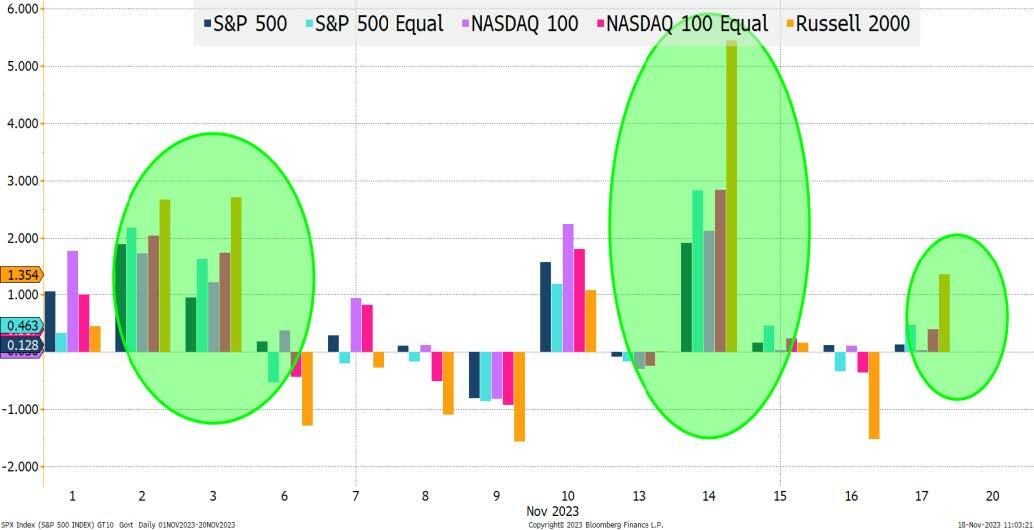
  • We all know how much of this year’s return has been driven by just a handful of stocks. The QQQ (a Nasdaq 100 ETF) is up 46% versus 22% for QQE (an equal weighted version). SPY (S&P 500) is up 19% vs 4% for RSP (an equal weighted version). IWM (Russell 2000) has eked out a 3.4% gain and was negative on the year as recently as last week!

  • Look at what is starting to happen as of late: the laggards have been driving the show, especially to the upside! On Friday, the “major” indices barely moved, but the equal weighted versions did well, with the Russell 2000 increasing more than 1% to gain over 5% on the week!

  • If there is one “pain” trade left for funds, it is being long the “magnificent” stocks versus being short everything else. If I was a massive hedge fund, one area that I’d try to squeeze higher into year-end would be the laggards (like the Russell 2000), partly because people are underweight or short, and partly because the market caps of companies in this index are smaller and they are easier to push around. I’m looking for a massive catch-up into year-end on the equal weights and Russell 2000!

The tailwinds might range from whimsical (seasonality) to technical (the laggards turning the corner) and rely on equities “misinterpreting” or “translating” lower yields “incorrectly” for a period of time.

Bottom Line

It may seem like some of my headwinds are tailwinds, but that is deliberate. Geopolitical risk is being priced in overly negatively at the moment, and I expect that news on the China/U.S. front will help mitigate risk.

It may seem like some of my tailwinds are headwinds, but that is on purpose. The move to lower yields will, at least initially, be more important than the reasons for those moves to lower yields.

I like rates and more inversion in the curves. Still using 4.3% on 10s as a near-term target.

I like credit. While we didn’t discuss credit directly in this report, I remain very bullish. Yes, supply will be higher than normal in December as issuers take advantage of the “unexpected” reprieve in rates, but there should be plenty of money available. That is especially true for BB issuers who can fill the void left in the BB space by Ford’s upgrade (Ford entities were upgraded by S&P to BBB- recently, making their bonds eligible for Investment Grade Index inclusion). I continue to believe that investors will rethink “credit” risk in terms of the U.S. government, and get more overweight credit products (please see last weekend’s Safety Dance where we try to explain this in greater detail).

Equities. I love the laggards and like the rest (for now). Use 4,600 on the S&P 500 as a target to watch (which seems like it could coincide with 4.3% on 10s), but be heavily skewed to the under-owned names, indices, and subindices as I think that the combination of positioning along with everything else will drive extreme outperformance!

Rally on! Schwing!

Just because something is juvenile and immature, doesn’t mean that it’s bad! Kind of like this “everything rally.”

Tyler Durden
Sun, 11/19/2023 – 13:25

France Dispatching Warship With Medical Aid To Gaza

0
France Dispatching Warship With Medical Aid To Gaza

Already the United States has a significant naval build-up in the Mediterranean and Mideast region, but over the weekend France has newly announced it is also sending a warship related to the Israel-Gaza conflict.

“France is preparing to send its Dixmude helicopter carrier to the eastern Mediterranean to offer medical assistance in Gaza,” the office of the French president announced

French Navy/Marine Nationale – Amphibious Assault Ship L 9015 FS Dixmude

The warship is set to deploy “at the start of the week and arrive in Egypt in the coming days,” according to President Emmanuel Macron’s office. The statement underscored a purely humanitarian aid mission.

“France will also contribute to the European effort with medical equipment on board European flights on November 23 and 30,” the statement continued.

It added, “France is mobilizing all its available means to contribute to the evacuation of wounded and sick children requiring emergency care from the Gaza Strip to its hospitals.”

In recent days Macron has been involved in talks with his Qatari and Egyptian counterparts. He spoke about the ongoing hostage crisis in Gaza with the Emir of Qatar, Sheikh Tamim bin Hamad Al-Thani and the Egyptian President, Abdel Fattah al-Sissi. 

The Saturday meetings resulted in the three countries agreeing on “the need to increase the number of trucks entering Gaza and to strengthen coordination for the delivery of humanitarian aid and the treatment of the wounded,” in a statement.

Israel has reportedly already agreed days ago to allow more fuel into the Gaza Strip. This has riled hardliners in Israeli Knesset as they argue that supplying fuel will only benefit Hamas. The Netanyahu government has continued feeling pressure from the international community, and from Washington, given the soaring death toll among Palestinians and the severe humanitarian crisis unfolding.

There have been weekend reports that a major hostage breakthrough deal has been reached, but has yet to materialize on the ground. A Qatar government statement said, “The challenges that remain in the negotiations are very minor… They are more logistical, they are more practical.”

Negotiations have been “up and down over the last few weeks. I think I’m more confident now that we are close enough to reach an agreement that will allow these people (the hostages) to return home safely” a Qatari spokesman said.

Tyler Durden
Sun, 11/19/2023 – 12:50