79.4 F
Chicago
Wednesday, September 9, 2026
Home Blog Page 3170

100 Years Ago This Week, German Hyperinflation Ended

0
100 Years Ago This Week, German Hyperinflation Ended

Authored by Thorsten Polleit via The Mises Institute,

On 15 November 1923 decisive steps were taken to end the nightmare of hyperinflation in the Weimar Republic: The Reichsbank, the German central bank, stopped monetizing government debt, and a new means of exchange, the Rentenmark, was issued next to the Papermark (in German: Papiermark). These measures succeeded in halting hyperinflation, but the purchasing power of the Papermark was completely ruined.

To understand how and why this could happen, one has to take a look at the time shortly before the outbreak of World War I.

Since 1871, the mark had been the official money in the Deutsches Reich. With the outbreak of World War I, the gold redeemability of the Reichsmark was suspended on 4 August 1914. The gold-backed Reichsmark (or “Goldmark,” as it was referred to from 1914) became the unbacked Papermark. Initially, the Reich financed its war outlays in large part through issuing debt. Total public debt rose from 5.2bn Papermark in 1914 to 105.3bn in 1918.1 In 1914, the quantity of Papermark was 5.9 billion, in 1918 it stood at 32.9 billion. From August 1914 to November 1918, wholesale prices in the Reich had risen 115 percent, and the purchasing power of the Papermark had fallen by more than half. In the same period, the exchange rate of the Papermark depreciated 84 percent against the US dollar.

The new Weimar Republic faced tremendous economic and political challenges. In 1920, industrial production was 61 percent of the level seen in 1913, and in 1923 it had fallen further to 54 percent. The land losses following the Versailles Treaty had weakened the Reich’s productive capacity substantially: the Reich lost around 13 percent of its former land mass, and around 10 percent of the German population was now living outside its borders. In addition, Germany had to make reparation payments. Most important, however, the new and fledgling democratic governments wanted to cater as best as possible to the wishes of their voters. As tax revenues were insufficient to finance these outlays, the Reichsbank started running the printing press.

From April 1920 to March 1921, the ratio of tax revenues to spending amounted to just 37 percent. Thereafter, the situation improved somewhat and in June 1922, taxes relative to total spending even reached 75 percent. Then things turned ugly.

Toward the end of 1922, Germany was accused of having failed to deliver its reparation payments on time. To back their claim, French and Belgian troops invaded and occupied the Ruhrgebiet, the Reich’s industrial heartland, at the beginning of January 1923. The German government under chancellor Wilhelm Kuno called upon Ruhrgebiet workers to resist any orders from the invaders, promising the Reich would keep paying their wages. The Reichsbank began printing up new money by monetizing debt to keep the government liquid for making up tax-shortfalls and paying wages, social transfers, and subsidies.

From May 1923 on, the quantity of Papermark started spinning out of control. It rose from 8.610 billion in May to 17.340 billion in April, and further to 669.703 billion in August, reaching 400 quintillion (that is 400 x 1018) in November 1923. Wholesale prices skyrocketed to astronomical levels, rising by 1.813 percent from the end of 1919 to November 1923. At the end of World War I in 1918 you could have bought 500 billion eggs for the same money you would have to spend five years later for just one egg. Through November 1923, the price of the US dollar in terms of Papermark had risen by 8.912 percent. The Papermark had actually sunken to scrap value.

With the collapse of the currency, unemployment was on the rise. Since the end of the war, unemployment had remained fairly low — given that the Weimar governments had kept the economy going by vigorous deficit spending and money printing. At the end of 1919, the unemployment rate stood at 2.9 percent, in 1920 at 4.1 percent, 1921 at 1.6 percent and 1922 at 2.8 percent. With the dying of the Papermark, though, the unemployment rate reached 19.1 percent in October, 23.4 percent in November, and 28.2 percent in December. Hyperinflation had impoverished the great majority of the German population, especially the middle class. People suffered from food shortages and cold. Political extremism was on the rise.

The central problem for sorting out the monetary mess was the Reichsbank itself. The term of its president, Rudolf E. A. Havenstein, was for life, and he was literally unstoppable: under Havenstein, the Reichsbank kept issuing ever greater amounts of Papiermark for keeping the Reich financially afloat. Then, on 15 November 1923, the Reichsbank was made to stop monetizing government debt and issuing new money. At the same time, it was decided to make one trillion Papermark (a number with twelve zeros: 1,000,000,000,000) equal to one Rentenmark. On 20 November 1923, Havenstein died, all of a sudden, through a heart attack. That same day, Hjalmar Schacht, who would become Reichsbank president in December, took action and stabilized the Papermark against the US dollar: the Reichsbank, and through foreign exchange market interventions, made 4.2 trillion Papermark equal to one US Dollar. And as one trillion Papermark was equal to one Rentenmark, the exchange rate was 4.2 Rentenmark for one US dollar. This was exactly the exchange rate that had prevailed between the Reichsmark and the US dollar before World War I. The “miracle of the Rentenmark” marked the end of hyperinflation.

How could such a monetary disaster happen in a civilized and advanced society, leading to the total destruction of the currency? Many explanations have been put forward. It has been argued that, for instance, that reparation payments, chronic balance of payment deficits, and even the depreciation of the Papermark in the foreign exchange markets had actually caused the demise of the German currency. However, these explanations are not convincing, as the German economist Hans F. Sennholz explains: “[E]very mark was printed by Germans and issued by a central bank that was governed by Germans under a government that was purely German. It was German political parties, such as the Socialists, the Catholic Centre Party, and the Democrats, forming various coalition governments that were solely responsible for the policies they conducted. Of course, admission of responsibility for any calamity cannot be expected from any political party.” Indeed, the German hyperinflation was manmade, it was the result of a deliberate political decision to increase the quantity of money de facto without any limit.

What are the lessons to be learned from the German hyperinflation?

The first lesson is that even a politically independent central bank does not provide a reliable protection against the destruction of (paper) money. The Reichsbank had been made politically independent as early as 1922; actually on behalf of the allied forces, as a service rendered in return for a temporary deferment of reparation payments. Still, the Reichsbank council decided for hyperinflating the currency. Seeing that the Reich had to increasingly rely on Reichsbank credit to stay afloat, the council of the Reichsbank decided to provide unlimited amounts of money in such an “existential political crisis.” Of course, the credit appetite of the Weimar politicians turned out to be unlimited.

The second lesson is that fiat paper money won’t work. Hjalmar Schacht, in his 1953 biography, noted: “The introduction of the banknote of state paper money was only possible as the state or the central bank promised to redeem the paper money note at any one time in gold. Ensuring the possibility for redeeming in gold at any one time must be the endeavor of all issuers of paper money.” Schacht’s words harbor a central economic insight: Unbacked paper money is political money and as such it is a disruptive element in a system of free markets. The representatives of the Austrian School of economics pointed this out a long time ago.

Paper money, produced “ex nihilo” and injected into the economy through bank credit, is not only chronically inflationary, it also causes malinvestment, “boom-and-bust” cycles, and brings about a situation of over-indebtedness. Once governments and banks in particular start faltering under their debt load and, as a result, the economy is in danger of contracting, the printing up of additional money appears all too easily to be a policy of choosing the lesser evil to escape the problems that have been caused by credit-produced paper money in the first place. Looking at the world today — in which many economies have been using credit-produced paper monies for decades and where debt loads are overwhelmingly high, the current challenges are in a sense quite similar to those prevailing in the Weimar Republic more than 90 years ago. Now as then, a reform of the monetary order is badly needed; and the sooner the challenge of monetary reform is taken on, the smaller will be the costs of adjustment.

Tyler Durden
Fri, 11/17/2023 – 04:15

The Highest-Valued Startups In The World

0
The Highest-Valued Startups In The World

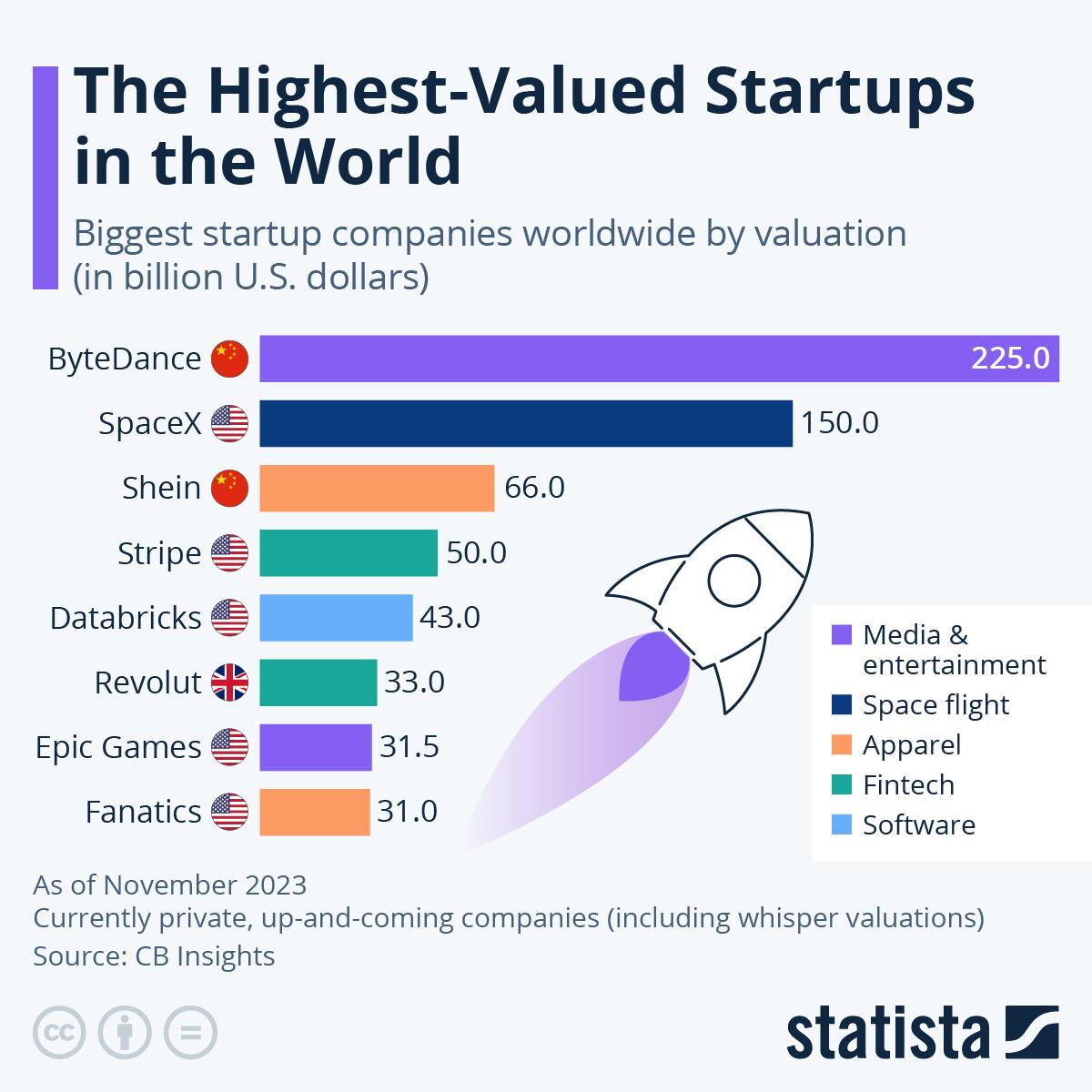
What’s the highest-valued startup in the world? Why, ByteDance – makers of Chinese social media app TikTok, which one might suspect endeavors to drive the collective IQ into double-digits one ADHD-triggering clip at a time, according to the CB Insights unicorn list (the valuation, not the commentary).

In fact, as Katharina Buchholz of Statista further notes, the top 8 highest-valued startups in the world only features one non-U.S. and non-Chinese company, Fintech app and neobank Revolut out of the United Kingdom. As of November 2023, other highly ranked international entries are Australian software company Canva (rank 10) and Indonesian logistics provider J&T Express (rank 13). A quick riser on the list has been Chinese apparel retailer Shein, now valued at $66 billion.

According to CB Insights, there were more than 1,200 unicorn startups (companies valued at $1 billion or more) in the world as of October 2023. Around 40 are decacorns, valued at $10 billion or more, including OpenAI, Discord, Grammarly, JUUL, BYJU’s and Reddit. Bytedance and Space X are the world’s hectocorns, valued at more than $100 billion.

Tyler Durden
Fri, 11/17/2023 – 02:45

Escobar: Why The US Needs This War In Gaza

0
Escobar: Why The US Needs This War In Gaza

Authored by Pepe Escobar via The Cradle,

Washington needs to win its Gazan war against Iran because it failed to win its Ukrainian war against Russia…

The Global South was expecting the Dawn of a New Arabian Reality. 

After all, the Arab street – even while repressed in their home nations – has pulsed with protests expressing ferocious rage against Israel’s wholesale massacre of Palestinians in the Gaza Strip. 

Arab leaders were forced to take some sort of action beyond suspending a few ambassadorships with Israel, and called for a special Organization of Islamic Cooperation (OIC) summit to discuss the ongoing Israeli War Against Palestinian Children. 

Representatives of 57 Muslim states convened in Riyadh on 11 November to deliver a serious, practical blow against genocidal practitioners and enablers. But in the end, nothing was offered, not even solace.  

The OIC’s final statement will always be enshrined in the Gilded Palace of Cowardice. Highlights of the tawdry rhetorical show: we oppose Israel’s “self-defense;” we condemn the attack on Gaza; we ask (who?) not to sell weapons to Israel; we request the kangaroo ICC to “investigate” war crimes; we request a UN resolution condemning Israel.  

For the record, that’s the best 57 Muslim-majority countries could drum up in response to this 21st-century genocide.  

History, even if written by victors, tends to be unforgiving towards cowards.

The Top Four Cowards, in this instance, are Saudi Arabia, the UAE, Bahrain, and Morrocco – the latter three having normalized relations with Israel under a heavy US hand in 2020. These are the ones that consistently blocked serious measures from being adopted at the OIC summit, such as the Algerian draft proposal for an oil ban on Israel, plus banning the use of Arab airspace to deliver weapons to the occupation state.

Egypt and Jordan – longtime Arab vassals – were also non-committal, as well as Sudan, which is in the middle of a civil war. Turkiye, under Sultan Recep Tayyip Erdogan, once again showed it is all talk and no action; a neo-Ottoman parody of the Texan “all hat, no cattle.” 

BRICS or IMEC? 

The Top Four Cowards deserve some scrutiny. Bahrain is a lowly vassal hosting a key branch of the US Empire of Bases. Morocco has close relations with Tel Aviv – it sold out quickly after an Israeli promise to recognize Rabat’s claim on Western Sahara. Moreover, Morocco heavily depends on tourism, mainly from the collective west.  

Then we have the big dogs, Saudi Arabia and the UAE. Both are stacked to the rafters with American weaponry, and, like Bahrain, also host US military bases. Saudi Crown Prince Mohammad bin Salman (MbS) and his old mentor, Emirati ruler Mohammad bin Zayed (MbZ), do factor in the threat of color revolutions tearing through their regal domains if they deviate too much from the accepted imperial script.  

But in a few weeks, starting on 1 January, 2024, under a Russian presidency, both Riyadh and Abu Dhabi will expand their horizons big-time by officially becoming members of the BRICS 11

Saudi Arabia and UAE were only admitted into the expanded BRICS because of careful geopolitical and geoeconomic calculations by the Russia-China strategic partnership.

Along with Iran – which happens to have its own strategic partnership with both Russia and China – Riyadh and Abu Dhabi are supposed to reinforce the energy clout of the BRICS sphere and be key players, further on down the road, in the de-dollarization drive whose ultimate aim is to bypass the petrodollar.  

Yet, at the same time, Riyadh and Abu Dhabi also stand to benefit immensely from the not-so-secret 1963 plan to build the Ben Gurion canal, from the Gulf of Aqaba to the Eastern Mediterranean, arriving – what a coincidence – very close to now devastated northern Gaza. 

The canal would allow Israel to become a key energy transit hub, dislodging Egypt’s Suez Canal, and that happens to dovetail nicely with Israel’s role as the de facto key node in the latest chapter of the War of Economic Corridors: the US-concocted India-MidEast Corridor (IMEC).

IMEC is a quite perverse acronym, as is the whole logic behind this fantastical corridor, which is to position international law-breaking Israel as a critical trade hub and even energy provider between Europe, part of the Arab world, and India.  

That was also the logic behind Israeli Prime Minister Benjamin Netanyahu’s UN charade in September, where he flashed the whole “international community” a map of the “New Middle East” in which Palestine had been totally erased. 

All of the above assumes that IMEC and the Ben Gurion Canal will be built – which is not a given by any realistic standards.  

Back to the vote at the OIC, US minions Egypt and Jordan – two countries on Israel’s western and eastern borders, respectively – were in the toughest position of them all. The occupation state wished to push approximately 4.5 million Palestinians into their borders for good. But Cairo and Amman, also awash in US weapons and financially bankrupt as they come, would never survive US sanctions if they lean too unacceptably towards Palestine.

So, in the end, too many Muslim states choosing humiliation over righteousness were thinking in very narrow, pragmatic, national interest terms. Geopolitics is pitiless. It is all about natural resources and markets. If you don’t have one, you need the other, and if you have none, a Hegemon dictates what you’re allowed to have. 

The Arab and Muslim street – and the Global Majority – may rightfully feel dejected when they see how these “leaders” are not ready to turn the Islamic world into a real power pole within emerging multipolarity. 

It wouldn’t happen any other way. Many key Arab states are not Sovereign entities. They are all boxed in, victims of a vassal mentality. They’re not ready – yet – for their close-up facing History. And sadly, they still remain hostage to their own “century of humiliation.”

The humiliating coup de grace was dispatched by none other than the Tel Aviv genocidal maniac himself: he threatened everyone in the Arab world if they don’t shut up – which they already did.

Of course, there are very important Arab and Muslim brave-hearts in Iran, Syria, Palestine, Iraq, Lebanon, and Yemen. While not a majority by any means, these Resistance actors reflect the sentiment on the Street like no other. And with Israel’s war expanding each day, their regional and global clout is set to increase immeasurably, just as in all of the Hegemon’s other regional wars.

Strangling a new century in the cradle 

The catastrophic debacle of Project Ukraine and the revival of an intractable West Asian war are deeply intertwined. 

Beyond the fog of Washington’s “worry” about Tel Aviv’s genocidal rampage, the crucial fact is that we are right in the thick of a war against BRICS 11.      

The Empire does not do strategy; at best, it does tactical business plans on the fly. There are two immediate tactics in play: a US Armada deployed in the Eastern Mediterranean – in a failed effort to intimidate Resistance Axis behemoths Iran and Hezbollah – and a possible Milei election in Argentina tied to his avowed promise to break Brazil-Argentina relations. 

So this is a simultaneous attack on BRICS 11 on two fronts: West Asia and South America. There will be no American efforts spared to prevent BRICS 11 from getting close to OPEC+. A key aim is to instill fear in Riyadh and Abu Dhabi – as confirmed by Persian Gulf business sources.  

Even vassal leaders at the OIC show would have been aware that we are now deep into The Empire Strikes Back. That also largely explains their cowardice. 

They know that for the Hegemon, multipolarity equals “chaos,” unipolarity equals “order,” and malign actors equal   “autocrats” – such as the new Russian-Chinese-Iranian “Axis of Evil” and anyone, especially vassals, that opposes the “rules-based international order.” 

And that brings us to a tale of two ceasefires. Tens of millions across the Global Majority are asking why the Hegemon is desperate for a ceasefire in Ukraine while flatly refusing a ceasefire in Palestine.

Freezing Project Ukraine preserves the Ghost of Hegemony just a little bit longer. Let’s assume Moscow would take the bait (it won’t). But to freeze Ukraine in Europe, the Hegemon will need an Israeli win in Gaza – perhaps at any and all costs – to maintain even a vestige of its former glory. 

But can Israel achieve victory any more than Ukraine can? Tel Aviv may have already lost the war on 7 October as it can never regain its facade of invincibility. And if this transforms into a regional war that Israel loses, the US will lose its Arab vassals overnight, who today have a Chinese and Russian option waiting in the wings. 

The Roar of the Street is getting louder – demanding that the Biden administration, now seen as complicit with Tel Aviv, halt the Israeli genocide that may lead to a World War. But Washington will not comply. Wars in Europe and West Asia may be its last chance (it will lose) to subvert the emergence of a prosperous, connected, peaceful Eurasia Century.

Tyler Durden
Fri, 11/17/2023 – 02:00

‘We, The Exploited’: The US Government Buys & Sells Its Citizens For Profit And Power

0
‘We, The Exploited’: The US Government Buys & Sells Its Citizens For Profit And Power

Authored by John and Nisha Whitehead via The Rutherford Institute,

Americans have become easy prey for hackers, scammers, snitches, spies, and con artists…

But don’t be fooled into thinking the government is protecting you.

To the contrary, the U.S. government is selling us (or rather, our data) to the highest bidders.

By the way, those highest bidders also include America’s political class and the politicians aspiring to get elected or re-elected. As the Los Angeles Times reports, “If you have been to a political rally, a town hall, or just fit a demographic a campaign is after, chances are good your movements are being tracked with unnerving accuracy by data vendors on the payroll of campaigns.”

Your phones, televisions and digital devices are selling you out to politicians who want your vote.

Welcome to the new frontier of campaign tech — a loosely regulated world in which simply downloading a weather app or game, connecting to Wi-Fi at a coffee shop or powering up a home router can allow a data broker to monitor your movements with ease, then compile the location information and sell it to a political candidate who can use it to surround you with messages,” writes journalist Evan Halper.

In this way, “we the people” have been reduced to economic units to be bought, bartered and sold by all and sundry.

On a daily basis, Americans have been made to relinquish the most intimate details of who we are—our biological makeup, our genetic blueprints, and our biometrics (facial characteristics and structure, fingerprints, iris scans, etc.)—in order to navigate an increasingly technologically-enabled world.

Those intimate details, in turn, have become the building blocks of massive databases accessed by the government and its corporate partners in crime, vulnerable to data breaches by hackers, cyberattacks and espionage.

For years now, and with little real oversight or restrictions, the government has been compiling massive databases comprised of all manner of sensitive information on the citizenry.

Biographical information. Biometric information. Criminal backgrounds. Travel records.

There is not a single person in the U.S. who is not in some government database or another, and these databases are increasingly being shared between agencies, fusion centers, and the police.

The government has also, with little oversight and few guidelines, been adding to its massive trove of data on Americans by buying commercially available information (CAI) from third-party sources. As a report by the Office of the Director of National Intelligence revealed:

“[Commercially purchased data] can reveal sensitive and intimate information about the personal attributes, private behavior, social connections, and speech of U.S. persons and non-U.S. persons. It can be misused to pry into private lives, ruin reputations, and cause emotional distress and threaten the safety of individuals. Even subject to appropriate controls, CAI can increase the power of the government’s ability to peer into private lives to levels that may exceed our constitutional traditions or other social expectations.”

In other words, this is the diabolically sneaky way in which the government is attempting to sidestep the Fourth Amendment, which requires that government agents have probable cause and a warrant before spying on Americans or searching and seizing their private property.

It’s bad enough that the government is building massive databases comprised of our personal information without our knowledge or consent, but then they get hacked and we suffer for it.

Earlier this year, for instance, several federal agencies, state governments and universities were targeted in a global cyberattack that compromised the sensitive data of millions of Americans.

Did that stop the government’s quest to keep building these databases which compromise our privacy and security? Of course not.

In fact, the government has also been selling our private information. According to Vice, Departments of Motor Vehicles in states around the country have been selling drivers’ personal information “to thousands of businesses, including private investigators who spy on people for a profit.”

Where there’s a will, there’s a way, and the government has become a master at finding loopholes that allow it to exploit the citizenry.

Thus, although Congress passed the Driver’s Privacy Protection Act (DPPA) in 1994 to prevent the disclosure of personal information, it hasn’t stopped state DMVs from raking in millions by selling driver data (names, dates of birth, addresses, and the cars they own) to third parties.

This is just a small part of how the government buys and sells its citizens to the highest bidders.

The why is always the same: for profit and power, of course.

Welcome to the age of surveillance capitalism.

Have you shopped at Whole Foods? Tested out target practice at a gun range? Sipped coffee at Starbucks while surfing the web? Visited an abortion clinic? Watched FOX News or MSNBC? Played Candy Crush on your phone? Walked through a mall? Walked past a government building?

That’s all it takes for your data to be hoovered up, sold and used to target you.

Incredibly, once you’ve been identified and tracked, data brokers can travel back in time, digitally speaking, to discover where you’ve been, who you’ve been with, what you’ve been doing, and what you’ve been reading, viewing, buying, etc.

Once you’ve been identified in this way, you can be tracked endlessly.

No one is spared.

In this regard, we are all equals: equally suffering the indignity of having every shred of privacy stripped away and the most intimate details of one’s life turned into fodder for marketers and data profiteers.

This creepy new era of for-profit surveillance capitalism—in which we’re being listened to, watched, tracked, followed, mapped, bought, sold and targeted—is made possible with our cooperation.

All those disclaimers you scroll though without reading them, the ones written in minute font, only to quickly click on the “Agree” button at the end so you can get to the next step—downloading software, opening up a social media account, adding a new app to your phone or computer—those signify your written consent to having your activities monitored, recorded and shared.

Think about it.

Every move you make is being monitored, mined for data, crunched, and tabulated in order to form a picture of who you are, what makes you tick, and how best to influence and/or control you.

With every smartphone we buy, every GPS device we install, every Twitter, Facebook, and Google account we open, every frequent buyer card we use for purchases—whether at the grocer’s, the yogurt shop, the airlines or the department store—and every credit and debit card we use to pay for our transactions, we’re helping Corporate America build a dossier for its government counterparts on who we know, what we think, how we spend our money, and how we spend our time.

The technology has advanced so far that marketers (political campaigns are among the worst offenders) can actually build “digital fences” around your homes, workplaces, friends and family’s homes and other places you visit in order to bombard you with specially crafted messages aimed at achieving a particular outcome.

If anyone else stalked us in this way—tailing us wherever we go, tapping into our calls, reading our correspondence, ferreting out our secrets, profiling and targeting us based on our interests and activities—we’d call the cops.

Unfortunately, the cops (equipped with Stingray devices and other Peeping Tom technologies) are also in on this particular scam.

It’s not just the surveillance and the buying and selling of your data that is worrisome.

The ramifications of a government—any government—having this much unregulated, unaccountable power to target, track, round up and detain its citizens is beyond chilling.

Imagine what a totalitarian regime such as Nazi Germany could have done with this kind of unadulterated power.

Imagine what the next police state to follow in Germany’s footsteps will do with this kind of power. Society is definitely rapidly moving in that direction.

We’ve made it so easy for the government to stalk us.

Government eyes see your every move: what you read, how much you spend, where you go, with whom you interact, when you wake up in the morning, what you’re watching on television and reading on the internet.

Every move you make is being monitored, mined for data, crunched, and tabulated in order to form a picture of who you are, what makes you tick, and how best to control you when and if it becomes necessary to bring you in line.

Chances are, as the Washington Post has reported, you have already been assigned a color-coded threat assessment score—green, yellow or red—so police are forewarned about your potential inclination to be a troublemaker depending on whether you’ve had a career in the military, posted a comment perceived as threatening on Facebook, suffer from a particular medical condition, or know someone who knows someone who might have committed a crime.

In other words, you might already be flagged as potentially anti-government in a government database somewhere—Main Core, for example—that identifies and tracks individuals (so they can be rounded up and detained in times of distress) who aren’t inclined to march in lockstep to the police state’s dictates.

The government has the know-how.

As The Intercept reported, the FBI, CIA, NSA and other government agencies are increasingly investing in and relying on corporate surveillance technologies that can mine constitutionally protected speech on social media platforms such as Facebook, Twitter and Instagram in order to identify potential extremists and predict who might engage in future acts of anti-government behavior.

Surveillance, digital stalking and the data mining of the American people—weapons of compliance and control in the government’s hands, especially when the government can listen in on your phone calls, monitor your driving habits, track your movements, scrutinize your purchases and peer through the walls of your home—add up to a society in which there’s little room for indiscretions, imperfections, or acts of independence.

This is the creepy, calculating yet diabolical genius of the American police state: the very technology we hailed as revolutionary and liberating has become our prison, jailer, probation officer, stalker, Big Brother and Father Knows Best all rolled into one.

It turns out that we are Soylent Green.

The 1973 film of the same name, starring Charlton Heston and Edward G. Robinson, is set in 2022 in an overpopulated, polluted, starving New York City whose inhabitants depend on synthetic foods manufactured by the Soylent Corporation for survival.

Heston plays a policeman investigating a murder, who discovers the grisly truth about the primary ingredient in the wafer, soylent green, which is the principal source of nourishment for a starved population. “It’s people. Soylent Green is made out of people,” declares Heston’s character. “They’re making our food out of people. Next thing they’ll be breeding us like cattle for food.”

Oh, how right he was.

Soylent Green is indeed people or, in our case, Soylent Green is our own personal data, repossessed, repackaged and used by corporations and the government to entrap us.

We, too, are being bred like cattle but not for food.

Rather, as I make clear in my book Battlefield America: The War on the American People and in its fictional counterpart The Erik Blair Diaries, we’re being bred, branded, bought and sold for our data.

As the insidious partnership between the U.S. government and Corporate America grows more invasive and more subtle with every passing day, there’s virtually no way to opt out of these assaults on your digital privacy short of being a modern-day Luddite, completely disconnected from all technology.

What we desperately lack and urgently need is an Electronic Bill of Rights that protects “we the people” from predatory surveillance and data-mining business practices.

Without constitutional protections in place to guard against encroachments on our rights in the electronic realm, it won’t be long before we find ourselves, much like Edward G. Robinson’s character in Soylent Green, looking back on the past with longing, back to an age where we could speak to whom we wanted, buy what we wanted, think what we wanted without those thoughts, words and activities being tracked, processed and stored by corporate giants such as Google, sold to government agencies such as the NSA and CIA, and used against us by militarized police with their army of futuristic technologies.

Tyler Durden
Thu, 11/16/2023 – 23:40

Visualizing Food Unaffordability Across The World

0
Visualizing Food Unaffordability Across The World

Food is the palate’s poetry, the body’s fuel, and a shared language transcending cultures… when people can afford it.

As Visual Capitalist’s Pallavi Rao details below, the World Health Organization found that the COVID-19 pandemic and war in Ukraine pushed 122 million more people into food insecurity between 2019 and 2022. Higher food prices, combined with increasing poverty, have resulted in rising food unaffordability, especially in certain regions of the world.

ℹ️ A person is food insecure when they lack regular access to enough safe and nutritious food for normal growth and development and an active and healthy life.

Our World in Data uses statistics gathered by the World Bank to map the share of the population that cannot afford a healthy diet in every country it has data for.

Ranked: Food Unaffordability as a Share of Population

A healthy diet—in this case, one that meets government dietary guidelines—is considered unaffordable in a country when its cost exceeds 52% of per capita income per day.

Immediate trends in food unaffordability are discoverable from a glance at the map. The wash of red in Africa, South Asia, and Southeast Asia indicates the regions where the majority of the population cannot afford a healthy diet.

Ranking the countries by pure percentages in the table below allows us to get a closer look at country-level issues.

Rank Country Can’t Afford Healthy Diet
1 🇲🇬 Madagascar 97.8%
2 🇧🇮 Burundi 95.9%
3 🇲🇼 Malawi 95.9%
4 🇨🇫 Central African Republic 94.6%
5 🇳🇬 Nigeria 93.5%
6 🇱🇷 Liberia 92.8%
7 🇭🇹 Haiti 92.6%
8 🇲🇿 Mozambique 92.5%
9 🇳🇪 Niger 92.0%
10 🇨🇬 Congo 91.5%
11 🇿🇲 Zambia 90.0%
12 🇬🇳 Guinea 89.1%
13 🇦🇴 Angola 88.0%
14 🇱🇸 Lesotho 87.9%
15 🇨🇩 DRC 85.5%
16 🇸🇩 Sudan 85.4%
17 🇹🇿 Tanzania 85.0%
18 🇬🇼 Guinea-Bissau 84.6%
19 🇪🇹 Ethiopia 83.8%
20 🇸🇱 Sierra Leone 83.5%
21 🇹🇩 Chad 83.1%
22 🇵🇰 Pakistan 82.8%
23 🇧🇯 Benin 82.6%
24 🇷🇼 Rwanda 82.0%
25 🇺🇬 Uganda 81.7%
26 🇸🇹 Sao Tome & Principe 78.2%
27 🇧🇫 Burkina Faso 77.6%
28 🇬🇭 Ghana 77.4%
29 🇳🇵 Nepal 76.4%
30 🇮🇳 India 74.1%
31 🇰🇪 Kenya 74.0%
32 🇱🇦 Laos 74.0%
33 🇵🇭 Philippines 74.0%
34 🇸🇿 Eswatini 73.8%
35 🇲🇲 Myanmar 73.8%
36 🇨🇮 Cote d’Ivoire 72.9%
37 🇬🇲 Gambia 72.2%
38 🇲🇱 Mali 72.0%
39 🇮🇩 Indonesia 70.8%
40 🇿🇦 South Africa 66.7%
41 🇧🇩 Bangladesh 66.1%
42 🇩🇯 Djibouti 65.3%
43 🇲🇳 Mongolia 64.1%
44 🇫🇯 Fiji 63.7%
45 🇯🇲 Jamaica 62.6%
46 🇲🇷 Mauritania 62.4%
47 🇪🇬 Egypt 61.6%
48 🇨🇲 Cameroon 60.5%
49 🇧🇼 Botswana 60.3%
50 🇳🇦 Namibia 59.5%
51 🇸🇷 Suriname 58.6%
52 🇰🇬 Kyrgyzstan 58.2%
53 🇱🇰 Sri Lanka 55.5%
54 🇧🇿 Belize 53.0%
55 🇧🇹 Bhutan 45.2%
56 🇸🇳 Senegal 45.0%
57 🇭🇳 Honduras 44.8%
58 🇹🇯 Tajikistan 44.3%
59 🇦🇲 Armenia 41.4%
60 🇨🇻 Cape Verde 41.2%
61 🇳🇮 Nicaragua 34.2%
62 🇩🇿 Algeria 32.4%
63 🇨🇴 Colombia 31.3%
64 🇮🇷 Iran 30.0%
65 🇬🇦 Gabon 29.9%
66 🇱🇨 Saint Lucia 27.2%
67 🇩🇴 Dominican Republic 25.8%
68 🇵🇪 Peru 25.7%
69 🇧🇷 Brazil 22.4%
70 🇻🇳 Vietnam 21.0%
71 🇵🇾 Paraguay 20.4%
72 🇲🇽 Mexico 20.2%
73 🇪🇨 Ecuador 19.7%
74 🇬🇾 Guyana 18.5%
75 🇮🇶 Iraq 18.4%
76 🇹🇭 Thailand 18.0%
77 🇹🇳 Tunisia 17.1%
78 🇵🇦 Panama 17.0%
79 🇦🇱 Albania 15.9%
80 🇲🇦 Morocco 15.5%
81 🇲🇰 North Macedonia 15.5%
82 🇵🇸 Palestine 15.4%
83 🇧🇴 Bolivia 15.1%
84 🇲🇪 Montenegro 14.9%
85 🇨🇷 Costa Rica 14.2%
86 🇲🇺 Mauritius 14.0%
87 🇨🇳 China 10.9%
88 🇷🇸 Serbia 10.9%
89 🇹🇹 Trinidad & Tobago 9.9%
90 🇸🇨 Seychelles 7.3%
91 🇷🇴 Romania 7.2%
92 🇯🇴 Jordan 7.1%
93 🇹🇷 Turkey 6.0%
94 🇺🇾 Uruguay 5.2%
95 🇧🇬 Bulgaria 4.2%
96 🇲🇩 Moldova 3.8%
97 🇨🇱 Chile 3.5%
98 🇧🇦 Bosnia & Herzegovina 3.0%
99 🇷🇺 Russia 2.6%
100 🇲🇾 Malaysia 2.5%
101 🇰🇿 Kazakhstan 2.3%
102 🇸🇰 Slovakia 2.3%
103 🇬🇷 Greece 2.2%
104 🇯🇵 Japan 2.0%
105 🇭🇷 Croatia 1.8%
106 🇪🇸 Spain 1.8%
107 🇭🇺 Hungary 1.5%
108 🇮🇹 Italy 1.5%
109 🇱🇻 Latvia 1.5%
110 🇰🇷 South Korea 1.5%
111 🇮🇱 Israel 1.2%
112 🇲🇻 Maldives 1.2%
113 🇵🇹 Portugal 1.2%
114 🇺🇸 U.S. 1.2%
115 🇦🇹 Austria 0.9%
116 🇪🇪 Estonia 0.8%
117 🇲🇹 Malta 0.8%
118 🇦🇺 Australia 0.7%
119 🇱🇹 Lithuania 0.7%
120 🇸🇪 Sweden 0.6%
121 🇧🇾 Belarus 0.5%
122 🇵🇱 Poland 0.5%
123 🇨🇦 Canada 0.4%
124 🇬🇧 UK 0.4%
125 🇳🇴 Norway 0.3%
126 🇩🇰 Denmark 0.2%
127 🇫🇷 France 0.2%
128 🇩🇪 Germany 0.2%
129 🇧🇪 Belgium 0.1%
130 🇨🇿 Czechia 0.1%
131 🇮🇸 Iceland 0.1%
132 🇮🇪 Ireland 0.1%
133 🇳🇱 Netherlands 0.1%
134 🇦🇪 UAE 0.1%
135 🇦🇿 Azerbaijan 0.0%
136 🇨🇾 Cyprus 0.0%
137 🇫🇮 Finland 0.0%
138 🇱🇺 Luxembourg 0.0%
139 🇸🇮 Slovenia 0.0%
140 🇨🇭 Switzerland 0.0%

At the top of the list, nearly 98% of Madagascar’s population cannot afford a healthy diet. The country is facing a prolonged drought in the southern region since 2019, affecting agriculture. A series of cyclones in 2021–2022 destroyed rice fields and damaged critical infrastructure, like road networks, putting further pressure on food prices. Finally, the rising price of oil due to the Russian invasion has pushed up transport costs. All these factors have resulted in food prices jumping nearly 20% in three years.

As a result, food insecurity in Madagascar has risen dramatically—by nearly one million people every year since 2019, of which 250,000 are classified under a “famine situation.”

A mix of similar factors affect the next five countries with the highest share of population unable to afford food—Burundi, Malawi, Central African Republic, Nigeria, and Liberia.

In Haiti, ranked 7th, a reliance on food imports makes the country vulnerable to inflation and price volatility, which has been markedly worse in the last two years.

On the other hand, predictably, the top five countries with the least food unaffordability—Cyprus, Finland, Luxembourg, Slovenia, and Switzerland—are all from Europe with 0% of the population unable to afford a healthy diet.

Geographically, eight out of 10 people in sub-Saharan Africa and seven out of 10 people in South Asia cannot afford a healthy diet versus three out of 10 in Europe and one out of 10 in North America.

Healthy Diet vs. Nutrient and Calorie Sufficiency

When reducing the quality of diet, food becomes a little more affordable.

For example, in Indonesia, nearly 71% of the population cannot afford a healthy diet. However this drops to 64% for a nutrient-sufficient diet, and only 3% for a calorie-sufficient diet.

Country Can’t Afford a
Healthy Diet
Can’t Afford a
Nutrient-Sufficient
Diet
Can’t afford a
Calorie-Sufficient Diet
🇦🇱 Albania 15.9% 8.9% 0.0%
🇩🇿 Algeria 32.4% 6.2% 0.1%
🇦🇴 Angola 88.0% 71.1% 36.0%
🇦🇷 Argentina N/A 4.0% 0.2%
🇦🇲 Armenia 41.4% 14.3% 0.5%
🇦🇺 Australia 0.7% 0.5% 0.2%
🇦🇹 Austria 0.9% 0.5% 0.2%
🇦🇿 Azerbaijan 0.0% 0.0% 0.0%
🇧🇩 Bangladesh 66.1% 48.6% 0.6%
🇧🇾 Belarus 0.5% 0.2% 0.0%
🇧🇪 Belgium 0.1% 0.3% 0.1%
🇧🇿 Belize 53.0% 57.0% 19.6%
🇧🇯 Benin 82.6% 81.9% 13.7%
🇧🇹 Bhutan 45.2% 26.2% 0.7%
🇧🇴 Bolivia 15.1% 19.1% 6.8%
🇧🇦 Bosnia & Herzegovina 3.0% 2.4% 0.0%
🇧🇼 Botswana 60.3% 44.3% 1.3%
🇧🇷 Brazil 22.4% 18.1% 3.5%
🇧🇬 Bulgaria 4.2% 6.3% 0.3%
🇧🇫 Burkina Faso 77.6% 76.2% 5.4%
🇧🇮 Burundi 95.9% 84.1% 41.5%
🇨🇲 Cameroon 60.5% 48.6% 15.7%
🇨🇦 Canada 0.4% 0.5% 0.0%
🇨🇻 Cape Verde 41.2% 29.7% 0.3%
🇨🇫 Central African Republic 94.6% 83.3% 67.0%
🇹🇩 Chad 83.1% 60.6% 11.3%
🇨🇱 Chile 3.5% 1.6% 0.2%
🇨🇳 China 10.9% 9.7% 0.2%
🇨🇴 Colombia 31.3% 20.3% 3.5%
🇨🇬 Congo 91.5% 80.8% 39.9%
🇨🇷 Costa Rica 14.2% 7.8% 0.7%
🇨🇮 Cote d’Ivoire 72.9% 39.6% 8.4%
🇭🇷 Croatia 1.8% 3.3% 0.3%
🇨🇾 Cyprus 0.0% 0.1% 0.0%
🇨🇿 Czechia 0.1% 0.1% 0.0%
🇨🇩 DRC 85.5% 86.9% 27.9%
🇩🇰 Denmark 0.2% 0.2% 0.1%
🇩🇯 Djibouti 65.3% 59.0% 5.6%
🇩🇴 Dominican
Republic
25.8% 15.8% 1.3%
🇪🇨 Ecuador 19.7% 14.8% 4.4%
🇪🇬 Egypt 61.6% 33.5% 1.0%
🇪🇪 Estonia 0.8% 0.8% 0.2%
🇸🇿 Eswatini 73.8% 64.4% 26.6%
🇪🇹 Ethiopia 83.8% 62.7% 7.7%
🇫🇯 Fiji 63.7% 21.3% 0.2%
🇫🇮 Finland 0.0% 0.1% 0.1%
🇫🇷 France 0.2% 0.0% 0.0%
🇬🇦 Gabon 29.9% 16.3% 1.3%
🇬🇲 Gambia 72.2% 63.9% 10.6%
🇩🇪 Germany 0.2% 0.7% 0.2%
🇬🇭 Ghana 77.4% 62.9% 14.9%
🇬🇷 Greece 2.2% 2.5% 0.5%
🇬🇳 Guinea 89.1% 61.6% 8.6%
🇬🇼 Guinea-Bissau 84.6% 59.7% 18.3%
🇬🇾 Guyana 18.5% 31.7% 4.4%
🇭🇹 Haiti 92.6% 73.8% 23.5%
🇭🇳 Honduras 44.8% 49.9% 14.3%
🇭🇺 Hungary 1.5% 1.9% 0.3%
🇮🇸 Iceland 0.1% 0.0% 0.0%
🇮🇳 India 74.1% 64.0% 3.2%
🇮🇩 Indonesia 70.8% 7.0% 4.3%
🇮🇷 Iran 30.0% 5.0% 0.2%
🇮🇶 Iraq 18.4% 5.8% 0.1%
🇮🇪 Ireland 0.1% 0.3% 0.2%
🇮🇱 Israel 1.2% 1.2% 0.2%
🇮🇹 Italy 1.5% 2.1% 1.0%
🇯🇲 Jamaica 62.6% 36.6% 0.9%
🇯🇵 Japan 2.0% 1.4% 1.2%
🇯🇴 Jordan 7.1% 0.1% 0.0%
🇰🇿 Kazakhstan 2.3% 0.5% 0.0%
🇰🇪 Kenya 74.0% 57.0% 11.6%
🇰🇬 Kyrgyzstan 58.2% 38.9% 0.7%
🇱🇦 Laos 74.0% 61.1% 0.8%
🇱🇻 Latvia 1.5% 1.7% 0.2%
🇱🇸 Lesotho 87.9% 63.3% 10.7%
🇱🇷 Liberia 92.8% 82.7% 20.2%
🇱🇹 Lithuania 0.7% 1.6% 0.8%
🇱🇺 Luxembourg 0.0% 0.4% 0.1%
🇲🇬 Madagascar 97.8% 96.0% 78.3%
🇲🇼 Malawi 95.9% 83.2% 2.4%
🇲🇾 Malaysia 2.5% 0.9% 0.0%
🇲🇻 Maldives 1.2% 0.6% 0.0%
🇲🇱 Mali 72.0% 57.5% 1.9%
🇲🇹 Malta 0.8% 0.3% 0.1%
🇲🇷 Mauritania 62.4% 48.3% 2.7%
🇲🇺 Mauritius 14.0% 4.4% 0.0%
🇲🇽 Mexico 20.2% 17.2% 0.7%
🇲🇩 Moldova 3.8% 0.3% 0.0%
🇲🇳 Mongolia 64.1% 14.4% 0.1%
🇲🇪 Montenegro 14.9% 9.1% 1.6%
🇲🇦 Morocco 15.5% 6.5% 0.0%
🇲🇿 Mozambique 92.5% 83.3% 13.2%
🇲🇲 Myanmar 73.8% 42.7% 0.7%
🇳🇦 Namibia 59.5% 33.6% 13.9%
🇳🇵 Nepal 76.4% 51.0% 2.6%
🇳🇱 Netherlands 0.1% 0.3% 0.0%
🇳🇮 Nicaragua 34.2% 21.2% 5.7%
🇳🇪 Niger 92.0% 77.1% 13.6%
🇳🇬 Nigeria 93.5% 69.4% 44.4%
🇲🇰 North Macedonia 15.5% 16.8% 2.6%
🇳🇴 Norway 0.3% 0.5% 0.3%
🇵🇰 Pakistan 82.8% 40.9% 0.3%
🇵🇸 Palestine 15.4% 2.4% 0.6%
🇵🇦 Panama 17.0% 12.1% 2.2%
🇵🇾 Paraguay 20.4% 24.4% 0.5%
🇵🇪 Peru 25.7% 16.5% 2.7%
🇵🇭 Philippines 74.0% 53.1% 6.9%
🇵🇱 Poland 0.5% 0.1% 0.0%
🇵🇹 Portugal 1.2% 0.7% 0.1%
🇷🇴 Romania 7.2% 8.0% 0.9%
🇷🇺 Russia 2.6% 0.8% 0.0%
🇷🇼 Rwanda 82.0% 61.3% 28.1%
🇱🇨 Saint Lucia 27.2% 16.7% 4.6%
🇸🇹 Sao Tome & Principe 78.2% 63.4% 8.0%
🇸🇳 Senegal 45.0% 43.2% 3.3%
🇷🇸 Serbia 10.9% 14.3% 3.2%
🇸🇨 Seychelles 7.3% 2.5% 0.1%
🇸🇱 Sierra Leone 83.5% 73.3% 34.9%
🇸🇰 Slovakia 2.3% 1.4% 0.1%
🇸🇮 Slovenia 0.0% 0.0% 0.0%
🇿🇦 South Africa 66.7% 60.3% 24.2%
🇰🇷 South Korea 1.5% 1.5% 0.0%
🇪🇸 Spain 1.8% 1.0% 0.5%
🇱🇰 Sri Lanka 55.5% 22.8% 0.6%
🇸🇩 Sudan 85.4% 58.7% 15.3%
🇸🇷 Suriname 58.6% 34.2% 15.8%
🇸🇪 Sweden 0.6% 0.4% 0.2%
🇨🇭 Switzerland 0.0% 0.0% 0.0%
🇹🇼 Taiwan N/A 0.2% 0.0%
🇹🇯 Tajikistan 44.3% 33.3% 2.3%
🇹🇿 Tanzania 85.0% 75.6% 36.8%
🇹🇭 Thailand 18.0% 7.0% 0.0%
🇹🇹 Trinidad & Tobago 9.9% 3.4% 0.2%
🇹🇳 Tunisia 17.1% 1.9% 0.0%
🇹🇷 Turkey 6.0% 3.1% 0.0%
🇺🇬 Uganda 81.7% 68.9% 13.9%
🇦🇪 UAE 0.1% 0.0% 0.0%
🇬🇧 UK 0.4% 0.5% 0.2%
🇺🇸 U.S. 1.2% 1.5% 1.2%
🇺🇾 Uruguay 5.2% 0.8% 0.0%
🇻🇳 Vietnam 21.0% 11.7% 0.7%
🇿🇲 Zambia 90.0% 82.5% 65.1%
🇿🇼 Zimbabwe N/A 10.6% 0.0%
🌐 World 42.20% 31.90% 4.90%

While the aim is to have every single person able to afford a healthy diet, it is useful to track progress across diets to see which countries are making strides in food affordability, whether it comes from growing incomes or improved supply.

At a regional level, these nuances reveal geographic differences in food unaffordability.

While sub-Saharan Africa and South Asia have comparable shares of population unable to afford healthy and nutrient sufficient diets, the gap widens immensely when looking at just calorie-sufficient diets, nearly 25% versus 2.6%.

For countries in South Asia, this could help target efforts to improve affordability for more than the most basic of diets.

Tyler Durden
Thu, 11/16/2023 – 23:20

Plasmid DNA Contamination In COVID-19 Vaccines Is ‘Clear Breach Of Informed Consent’ By FDA: Dr. Malone

0
Plasmid DNA Contamination In COVID-19 Vaccines Is ‘Clear Breach Of Informed Consent’ By FDA: Dr. Malone

Authored by Naveen Athrappully via The Epoch Times (emphasis ours),

Dr. Robert Malone, the inventor of mRNA and DNA vaccines, slammed health regulatory agencies for not informing people about potential plasmid DNA contamination in mRNA COVID-19 vaccines.

A health care worker prepares a dose of Pfizer BioNTech COVID-19 vaccine in a file image. (Ezra Acayan/Getty Images)

An Oct. 19 preprint study found billions of residual DNA fragments in mRNA COVID-19 vaccine vials. While billions of copies of spike, ori, and SV40 enhancer DNA were discovered in the Pfizer vaccine vials, Moderna vials were found to contain copies of ori and spike DNA. The SV40 virus is a DNA virus known to cause cancer in lab animals.

Talking about the study in a Nov. 11 Substack post, Dr. Malone said that plasmid DNA contamination in the vaccines is a “proven fact” that has been “acknowledged by the US FDA, Health Canada, and the European Medicines Agency.”

“In yet another clear breach of informed consent and labeling requirements, this was not previously disclosed to physicians, public health officials, or patients,” he wrote.

For instance, the FDA’s labeling guidelines require that vaccine labels must contain a description of “serious adverse reactions, potential safety hazards, steps that should be taken in the occurrence of a serious adverse reaction and potential safety hazard, and limitations in use imposed by them.”

Pfizer and Moderna COVID-19 mRNA vaccines “are contaminated with plasmid DNA fragments which have not been removed during the current manufacturing processes,” the doctor wrote. A plasmid is a strand of circular DNA that is common to bacteria and specific parasites.

Dr. Malone said that prior FDA guidance on DNA vaccine technology pointed to the presence of “highly active regulatory sequences as being of particular concern due to potential insertional mutagenesis (integration).”

The FDA’s 2009 “Guidance on Prophylactic DNA Vaccines: Analysis and Recommendations” states that concerns about plasmid DNA potentially integrating into the genome of the vaccine recipient and increasing the likelihood of issues like “malignant transformation, genomic instability, or cell growth dysregulation” were raised when DNA vaccines were initially introduced for clinical use.

It stated that a “tiny fraction” of the plasmids are expected to “integrate into the host genome, regardless of the method of delivery.”

Dr. Malone noted that the FDA has issued a “categorical denial of adulteration and risk” of DNA vaccines.

A spokeswoman from the FDA told The Epoch Times that “no safety concerns related to the sequence of, or amount of, residual DNA have been identified” in the COVID-19 shots.

“With regard to the FDA-approved mRNA vaccines, available scientific evidence supports the conclusion that they are safe and effective.”

This denial is contrary to both federal law on adulterated drugs and devices and FDA guidance on adulteration of drugs, Dr. Malone stated.

The U.S. Code on adulterated drugs and devices makes it clear that a drug shall be deemed to be adulterated if its manufacturing, processing, packing, or holding do not meet the requirements of “quality and purity characteristics.”

Meanwhile, the FDA’s law on adulteration of drugs under the Food, Drug, and Cosmetic Act says that a drug would be deemed to be adulterated “if it fails to conform to compendial standards of quality, strength or purity.”

“Compendial standards” refer to the pharmaceutical standards as outlined in the U.S. Pharmacopeia-National Formulary (USP-NF), which is the official quality standards applicable to all drugs sold in the United States.

Regulators, Moderna Admit Risks

As claimed by Dr. Malone, multiple health agencies have admitted to DNA contamination in the mRNA COVID-19 vaccines.In an email to The Epoch Times last month, Health Canada confirmed the presence of the SV40 DNA sequence in the Pfizer vaccine, which the company failed to disclose previously.

In another email to The Epoch Times, the European Medicines Agency also confirmed that the Pfizer vaccine contains the SV40 sequence, which the company’s partner BioNTech did not highlight in its application.

It isn’t clear whether the presence of the SV40 sequence in the plasmid DNA of mRNA vaccines was identified by Pfizer when the company applied for approval from the FDA.

Dr. Malone pointed out that Moderna “clearly acknowledges” the risks of genotoxicity associated with the DNA delivered via its vaccines.

Dr. Robert Malone, author of “Lies My Gov’t Told Me”, in Washington on Dec. 19, 2022. (Jack Wang/The Epoch Times)

In an Aug. 8, 2019, patent filed by Moderna regarding RNA vaccines, the company states that the direct injection of naked plasmid DNA into a living host comes with “potential problems, including the possibility of insertional mutagenesis, which could lead to the activation of oncogenes or the inhibition of tumor suppressor genes.”

The doctor noted that Moderna considers “even ‘naked’ plasmid DNA” as a potential risk. Naked plasmid DNA does not contain any highly active lipid nanoparticle formulation agents.

Moderna did not disclose in the patent that it has not been able to manufacture such modified mRNA vaccines “without contaminating DNA,” he said.

In conclusion, it is also clear at this point, unless proven otherwise, that none of these regulatory authorities have obtained data from one or more rigorous, well-controlled studies designed to address the genotoxicity and insertional mutagenesis risks” presented by the mRNA COVID-19 vaccines from Pfizer and Moderna.

Until such data is provided, the FDA’s claim that there are “no safety concerns” related to the residual DNA do not “accurately reflect current knowledge,” Dr. Malone said.

“The only objective conclusion to be made concerning such statements is that they functionally represent propaganda rather than proven scientific and regulatory fact.”

FDA’s ‘Willful Blindness’

In his Substack post, Dr. Malone called the FDA’s assertion of “no safety concerns” about the inclusion of residual DNA in mRNA vaccines “willful blindness.” He then highlighted the risks posed by residual DNA in vaccines.

“The most well-documented risks associated with such potential insertional mutagenesis are cancer (in the case of stem and somatic cells, particularly hematopoietic lineage cells) and birth defects,” he wrote.

“As these highly active modified mRNA (plus DNA fragment) lipid nanoparticles are known to cross the placenta and to localize to ovarian tissue, the potential for birth defects would seem to be of particular regulatory interest and concern.”

The U.S. Food and Drug Administration (FDA) in White Oak, Md., on June 5, 2023. (Madalina Vasiliu/The Epoch Times)

Despite reports of “aggressive cancers” in people who were administered the mRNA vaccines, the FDA remains “willfully ignorant and in denial of these risks.” Moreover, the agency does not define the term “safe” even though it insists that the vaccines are “safe and effective,” Dr. Malone wrote.

He pointed out that FDA and CDC assertions of earlier versions of mRNA COVID-19 vaccines reducing risks of severe disease are now “irrelevant” as these products are not available anymore, and the strains have now become extinct.

“Furthermore, many researchers have demonstrated that, even in those historic cases, after some period of time those so dosed with these products become MORE likely to develop severe disease or death relative to unvaccinated patients (most of whom have acquired natural infection with resulting potent and diversified immunity,” Dr. Malone said.

A September 2022 study found that incidences of COVID-19 infection were “significantly higher in vaccine recipients (6.7 percent) than the previously infected (2.9 percent)” individuals six months after the index date.

For the vaccinated, the index date was defined 30 days after their first COVID-19 shot. For the infected, the index date was taken 30 days after the initial infection.

On the positive side, “all-cause mortality in the vaccinated, however, was 37 percent lower than that of the previously infected. The rates of all-cause ED visits and hospitalizations were 24 percent and 37 percent lower in the vaccinated than in the previously infected.”

Presence of SV40 Sequences

Dr. Malone said that “the presence of highly active promoter/enhancer DNA sequences (and fragments) derived from the SV40 virus, present in the Pfizer/BioNTech product, was not disclosed and discussed with either the public or to the regulatory agencies.”

In order to produce mRNA vaccines, the SV40 enhancer gene from the SV40 virus is used. Using bacteria in the production of genes and proteins for the manufacture of pharmaceuticals is a standard practice.

In the case of the mRNA COVID-19 vaccines, the SV40 enhancer gene and other genetic sequences were introduced in the plasmid DNA. Once the mRNA and DNA are harvested from the bacteria, the DNA is supposed to be removed.

Dr. Malone wrote in his Substack post that “such short DNA fragments are associated with a high risk of integration, otherwise known as insertional mutagenesis, which is a well-characterized form of genotoxicity.” The term genotoxicity refers to the ability of harmful substances to damage the genetic information present in cells.

If these mRNA COVID-18 vaccines were reviewed by the FDA as gene therapy products, they would have required “rigorous genotoxicity studies” before allowed for use among human beings, he said. The same would be true in case the mRNA vaccines were reviewed as “DNA vaccines.”

“But apparently there is something magical about inclusion of modified-mRNA together with DNA fragments in these highly active lipid nanoparticle nucleic acid delivery formulations which leads the FDA to conclude that there is no genotoxicity risk.”

Tyler Durden
Thu, 11/16/2023 – 23:00

What’s Behind The Sudden Plunge In Oil Prices? Goldman’s Trading Desk Explains

0
What’s Behind The Sudden Plunge In Oil Prices? Goldman’s Trading Desk Explains

From Goldman floor trader Michael Nocerino

Tons of questions on the weakness in Crude – Thoughts from our trading desk: believe the move is more of a “catch-up” to weaker physical markets as we moved past WTI options expiration yesterday & as Middle East risk premium has now come out of the market in our view.
 
Bigger picture:

  • Margins have remained weak for a while
  • OPEC continues to export
  • Spreads & DFLs have been signaling weaker fundamentals for several days now

Brent breaking through the 200dma…approaching oversold levels (RSI 32.7)…

  • On the vol front, it’s interesting to note that front-end gamma is well bid on this selloff which is a re-engagement of the negative spot/vol correlation we saw from late September until the early October Israeli attacks flipped that abruptly. We’re also seeing put skew rally sharply here with front-end 25d RR’s rapidly approaching the September wides of ~5v for puts.) Options desk think there is some gamma around $75 from sov hedging/other prod strikes and worth noting PMI moved their OSP lower yesterday which brings strikes closer to the money.
  • We haven’t seen too much fresh on the fundamental side. There are some thoughts that an Iraq flows resolution is imminent, but nothing confirmed and that doesn’t warrant a sell off of this magnitude.
  • Our models have CTA selling continuing and timing of the move was around the time that their flow normally ramps up.
  • Fitting that GIR Published their 2024 Outlook today: “We believe that OPEC will ensure Brent in a $80-$100 range by leveraging its pricing power, with a $80 floor from the OPEC put, and a $100 ceiling from spare capacity.” (link)

Tyler Durden
Thu, 11/16/2023 – 22:40

The WEF And The Dangers Of A Circular Economy

0
The WEF And The Dangers Of A Circular Economy

Authored by John Mac Ghlionn via The Epoch Times (emphasis ours),

As the British politician David Cameron famously asserted, “The economy is the start and end of everything.”

To control the economy is, in many ways, to control the world.

Although no one government or organization controls the world’s economy, a few major players help shape it.

A sign of the World Economic Forum in the alpine resort of Davos, Switzerland, on the opening day of the annual meeting on Jan. 16, 2023. (Fabrice Coffrini/AFP via Getty Images)

One of the major players, as many readers know, is the World Economic Forum (WEF). In recent times, the Davos elites have been pushing the idea of a new economy, one that’s circular in nature. Should we be concerned?

Some could say that the circular economy is an “agenda.” According to a recent report published by the WEF and Accenture, it is. The authors of the report said this is an “agenda” and that the directions must “come from the top.” A circular economy is the antithesis of today’s economy—or, as the authors of the report call it, the “linear economy.”

“The transition to circular business models is,” we’re told, “a critical lever for organizations to achieve climate commitments and reach net-zero emissions.”

To reduce greenhouse gas emissions, the WEF and Accenture suggested “changing how goods are produced and consumed.” Circularity, they said, “plays a critical role in this.”

The report goes on to state that the existing “take-make-waste” model, which is “extractive and resource-intensive,” must be replaced. The key to replacing the existing model involves embedding “circularity in decision-making throughout the value chain.” In other words, a top-down approach, overseen, in part, by unelected globalists. If real democracy is predicated on a bottom-up approach, then, one wonders, what are we to make of this recent report?

“This systemic transition,” the authors noted, “requires companies to embed circularity at all levels and functions throughout the organization. Starting from the top, there should be clear governance, leadership and accountability.”

What’s the goal here? The circular economy appears to be associated with the idea that all products become services, with those at the very top of the mountain maintaining ownership of the products that normal, everyday people can only rent. Remember, not that long ago, the WEF stated: “You’ll Own Nothing. And You’ll Be Happy.”

In August, the WEF’s Sean Mowbray discussed how the circular economy could address “rampant overconsumption,” “climate change, biodiversity loss, and the pollution of land, air and oceans.”

This crisis, he suggested, requires “sustainable production cycles” that will “reduce resource use, waste, and ecological harm.”

At its core, according to Mr. Mowbray, the circular economy revolves around the three R’s: reducing, reusing, and recycling materials. The circular economy model, he said, “aims to eliminate waste and pollution, recirculate products and materials, and regenerate nature.”

Although nature should be protected, and the idea of wasting resources isn’t something to be championed, one can’t help but feel a sense of dread when reading Mr. Mowbray’s words. The constant references to “climate change” and “decarbonization” and the calls to drastically alter agricultural practices carry an impersonal, somewhat chiding tone.

Keeping waste to an absolute minimum, we’re informed, is a must. But, one wonders, who dictates how much waste is too much waste? And who gets to decide what constitutes waste and what constitutes harm?

Take meat, for example. For many readers, I’m sure, the consumption of chicken, pork, and beef has an important place in their lives. However, in a circular economy, meat may no longer have any place whatsoever. After all, it’s wasteful and bad for the environment, experts say. Lab-grown meat, which is estimated to have a considerably larger carbon footprint than typically butchered beef, is a viable alternative, they suggest. If the WEF has its way, we’ll all be eating lab-grown grub not long from now.

It has become increasingly common to correctly identify problems but offer wholly unreasonable solutions. Capitalism, in its current form, is destructive. So socialism is the answer. Traditional farming methods are harmful, so lab-grown meat is the solution. The United States was once extremely racist, so financial reparations must be made. And so forth.

Nevertheless, the WEF insists that the circular economy, closely aligned with the nefarious idea of social justice, is a viable alternative to the current model. According to the decision-makers in Davos, Switzerland, the circular economy represents “a seismic shift in the way we conceptualize the entire life cycle of a product, designed to benefit businesses, society and the environment.”

This “seismic shift” could involve closer monitoring of our actions and behaviors, and the introduction of carbon passports, for example. A new report by Intrepid Travel discusses the concept of “personal carbon allowances” being introduced by 2040.

The White House appears to be fully committed to the circular economy transition. Earlier this year, the White House Office of Science and Technology Policy hosted a roundtable designed to discuss the ways in which various circular economy innovations can contribute to, e.g., “decarbonization and net-zero goals.”

Again, although the environment should be protected, and waste should never be encouraged, one wonders how much say normal, everyday people will have in the circular economy. Considering the “agenda” is a top-down one, very little, I imagine.

Views expressed in this article are opinions of the author and do not necessarily reflect the views of The Epoch Times or ZeroHedge.

Tyler Durden
Thu, 11/16/2023 – 22:20

Citadel CEO Ken Griffin Bashes Bidenomics

0
Citadel CEO Ken Griffin Bashes Bidenomics

Citadel founder Ken Griffin sharply criticized the Biden administration’s efforts to persuade Americans of a strong economy through the promotional campaign called ‘Bidenomics.’ The billionaire said the strategists who told the administration to run on Bidenomics before the 2024 presidential election have “no idea how to read an economics textbook.” 

“The American public knows things aren’t working in this economy for them,” Griffin told Bloomberg at the Global Macro Conference in Miami Tuesday. 

He said, “Whoever told him [the president] to run on Bidenomics has no idea how to read an economics textbook.” 

Griffin’s Bidenomics critique comes days after Politico reported members of the Progressive Change Campaign Committee met with the Biden administration in September and October to brief them about the Bidenomics’ branding failure. They presented numerous polling data that showed Americans aren’t convinced about economic policy accomplishments under the president.

“Democrats can’t just hammer people over the head with an insistence that the economy is great,” Adam Green, co-founder of the PCCC, told Politico.

As we noted, the Bidenomics campaign in corporate media started around late June, as shown in the surge in headlines for the term “Bidenomics.” 

Even with the corporate press cheerleading Biden’s alleged economic successes, the president’s approval polling data via Real Clear Politics went down. 

The reason is straightforward why the Bidenomics campaign failed: US real average wages were negative for two years in the worst inflation storm in a generation. Consumers understand shelter, food, and gas prices are still high, forcing many working poor to drain personal savings and rack up insurmountable credit card debt just to survive. No matter how much Biden officials tout Bidenomics, people are angered because of their empty wallets. 

Griffin also said during the conference that Miami will become the new ‘Wall Street,’ displacing New York City: “We’re on Brickell Bay, and maybe in 50 years it will be Brickell Bay North how we refer to New York in finance.”

Tyler Durden
Thu, 11/16/2023 – 20:40

New Report Raises Concerns That CDC Vaccine Adverse Event Reporting System Is Broken

0
New Report Raises Concerns That CDC Vaccine Adverse Event Reporting System Is Broken

Authored by Megan Redshaw via The Epoch Times (emphasis ours),

(II.studio/Shutterstock)

The nation’s primary early warning system used to detect possible safety problems with vaccines is “overwhelmed,” raising concerns the system may be broken and isn’t being adequately managed by the Centers for Disease Control and Prevention (CDC), according to a new investigation.

The report published on Nov. 10 by The BMJ found the Vaccine Adverse Event Reporting System (VAERS) has received an unprecedented number of reports attributed to COVID-19 vaccines, and there aren’t enough staff to meet the requirements for reviewing and following up with serious reports, including deaths. Additionally, the investigation revealed that VAERS is neither transparent, user-friendly, nor responsive, and suggests the government essentially maintains two VAERS systems—only one of which the public can access.

Co-managed by the U.S. Food and Drug Administration (FDA) and CDC, VAERS collects reports of symptoms, diagnoses, hospital admissions, and deaths after vaccination to capture post-marketing safety signals and determine if there are any unusual or unexpected reporting patterns for adverse events.

According to the CDC, healthcare providers are “strongly encouraged” to report any adverse event following vaccination to VAERS, even if they’re unclear whether the vaccine caused the adverse event. In contrast, vaccine manufacturers are required by law to report all adverse events that “come to their attention.”

Although VAERS accepts reports from anyone, knowingly filing a false VAERS report violates federal law and is punishable by fine and imprisonment. This allows VAERS to serve as an “early warning system to detect rare adverse events” and deters false reporting. Even so, VAERS has been shown to reflect only 1 percent of actual vaccine adverse events, according to a Harvard Pilgrim Health Care study.

CDC Isn’t Investigating Serious Adverse Events for COVID-19 Vaccines

According to the CDC,  in 2019—prior to the pandemic—VAERS received more than 48,000 reports of vaccine adverse events, 85 to 90 percent of which were mild. After the COVID-19 vaccine rollout, The BMJ found an “unprecedented” 1.7 million adverse events were reported to VAERS, with 1 million reported in 2021 and an additional 660,000 received thereafter. Nearly 1 in 5 cases met the criteria for a “serious” adverse event, and most reports were attributed to COVID-19 vaccines.

According to the VAERS Standard Operating Procedures for COVID-19, serious adverse events include reports of death, hospitalization, life-threatening illness, permanent disability and/or prolonged hospitalization, and congenital anomalies. Medical records are routinely requested for all serious reports, including deaths, and adverse events of special interest may undergo a more in-depth clinical review by the CDC.

If there is a significant increase in VAERS reports warranting clinical review, the standard operating procedures require additional CDC Immunization Safety Office staff to process cases. For events classified as “serious,” people who report to VAERS are supposed to receive email correspondence prompting them to provide updates, but The BMJ’s investigation shows these standards aren’t being followed.

The BMJ interviewed more than a dozen people, including physicians and a state medical examiner who filed VAERS reports for serious adverse events on behalf of themselves or patients and were either never contacted by the CDC or were contacted months later. Many never received confirmation emails when their reports were filed. Likewise, if a condition was successfully treated or was found to be unrelated to a vaccine, this was not reflected in the database.

Dr. Patrick Whelan, a rheumatologist and researcher at the University of California–Los Angeles, filed a report in 2022 on behalf of his 7-year-old patient after he experienced cardiac arrest and was intubated following COVID-19 vaccination. To Whelan’s knowledge, “nobody called or requested medical records.” The FDA said it followed up “soon after” receiving the report and made several requests for medical records. It also added that staff “might not reach out to medical providers unless they have specific questions about a case or VAERS report.”

Dr. James Gill, chief medical examiner for the state of Connecticut and forensic pathologist, filed a VAERS report after a 15-year-old boy died suddenly in 2021 from stress cardiomyopathy following his second dose of Pfizer’s COVID-19 vaccine. Although he completed a report online and received a temporary e-report number, the CDC never followed up. It wasn’t until Dr. Gill published the boy’s case report in February 2022 in the Archives of Pathology & Laboratory Medicine in February 2022 that the CDC responded—with a letter to the editor challenging Gill’s findings.

React19, a science-based non-profit comprised of 30,000 people injured by COVID-19 vaccines, reviewed 126 VAERS reports and found 22 percent were never given a permanent VAERS ID, and 1 of 3 reports filed disappeared from the system entirely, according to The BMJ.

An intensive care and emergency physician filed several reports on behalf of patients, including six deaths. According to The BMJ, she only received a request for medical records regarding one death and for only two patients admitted to the hospital.

When it comes to reports of death following COVID-19 vaccination, other countries have acknowledged that deaths were “likely” or “probably” related to mRNA vaccination, but the CDC has reviewed more than 20,000 preliminary death reports, which is significantly more than other countries, yet has not attributed a single death to mRNA vaccines, The BMJ stated.

“A BMJ investigation has raised concerns that the VAERS system isn’t operating as intended and that signals are being missed. As someone who has been studying and scrutinizing VAERS data for three years, I can confirm this observation,” researcher Jessica Rose told The Epoch Times in an email. Ms. Rose, a VAERS expert with a doctorate in computational biology, says these stories and experiences reflect the VAERS system’s deficiencies.

There Are 2 VAERS Databases–Only One Is Public

In contrast to how the U.S. government handles adverse reaction reports related to drugs and devices, the author of The BMJ report, Jennifer Block, discovered the FDA and CDC are essentially maintaining two separate VAERS databases—one the public has access to containing initial reports and a private system on the backend with updates, outcomes, and corrections.

Dr. Narayan Nair is the FDA division director who oversees VAERS. According to the BMJ, during a December 2022 meeting, Dr. Nair stated there are two parts to VAERS: “the front-end system and the back end.” In a meeting with advocates, Dr. Nair admitted initial reports are never updated, so the public never sees an updated report on the front end.

Yet the FDA’s Adverse Event Reporting System for drugs does maintain a publicly accessible database that gets updated, as does the Medical Device Reporting System. It’s only the VAERS system that doesn’t publicly display updates. If someone wants a full copy of their record or report, they must submit a formal request under the Freedom of Information Act, an FDA spokesperson told The BMJ.

Although regulatory officials told The BMJ this was to protect patient confidentiality, this means that patients, doctors, and other public users of the database do not have access to updated or complete records.

In an email to The Epoch Times, VAERS expert and data analyst Albert Benavides said he knew there were two VAERS databases, but of even greater concern is that the CDC isn’t publishing all legitimate reports it receives.

“What supersedes even two VAERS databases (internal and external) is the fact that VAERS does not publish all legitimate reports received,” Mr. Benavides said. “The BMJ and the public are just now becoming aware that only initial reports are published, even though VAERS continues to collect follow-up data, hence the two databases. [The fact that] only initial reports are made public begs the question, how many people are now since dead in VAERS?” he added.

Mr. Benevides noted the CDC stopped including follow-up data in 2011 after the Harvard Pilgrim Health Care study was published.

Regulators Are Missing Safety Signals in VAERS

Because clinical trials involve studying products in a small number of selected individuals for a short period, some side effects may only occur when a larger and diverse population has used the products over a longer duration. Pharmacovigilance is the practice of monitoring the effects of medical drugs and vaccines after they have been licensed to identify, prevent, and evaluate previously unreported adverse reactions.

“Good pharmacovigilance requires prompt data collection, review by people with clinical expertise, and adequate follow-up,” Marie Lindquist, former director of the Uppsala Monitoring Centre in Sweden, told The BMJ. “We know that even the best clinical trials won’t detect [rare adverse events].”

For example, the risk of a rare blood clotting disorder associated with the Johnson & Johnson COVID-19 vaccine, manufactured by Janssen, did not manifest until it was authorized. With only six cases reported, regulators in 2021 paused its use to investigate the reports and ultimately linked the rare blood clotting disorder to the shot.

Ralph Edwards, former editor-in-chief of the International Journal of Risk & Safety in Medicine and author or co-author of more than 400 scientific papers, told The BMJ that VAERS is great for detecting adverse events that occur “very soon after vaccination” and those associated with other vaccines. However, it is not good at detecting new or latent effects because regulators may rely too heavily on epidemiological evidence to acknowledge a VAERS signal.

In other words, if an adverse event hasn’t been recognized before, it’s ignored by regulators. If regulators do not acknowledge a signal, it’s not acknowledged by doctors. Doctors also have to be educated to look for a condition so they know how to test for it and treat it. If physicians don’t acknowledge a medical condition could be potentially connected to a vaccine, they won’t report it—so a passive surveillance system like VAERS won’t display the signal.

It is easy to understand why VAERS is underreported and also why it needs to be used as the pharmacovigilance tool that it is,” Ms. Rose told The Epoch Times in an email. “How can doctors file a VAERS report if they do not even know what to look for as per an adverse event occurrence? Furthermore, if a safe and effective doctrine continues to be pushed, the doctors and nurse practitioners will not feel compelled to report suspected adverse events in the first place,” she added.

In Rose’s opinion, VAERS is a functioning pharmacovigilance tool. “The problem is, the owners of the data are not using it as such, and this is why the safety signals are being not so much ‘missed,’ as they are hidden,” she said.

The BMJ’s investigation suggests the VAERS is understaffed, so there aren’t enough people to ensure the CDC’s standards are met. Documents obtained through the Freedom of Information Act and reviewed by the BMJ show that Pfizer had about 1,000 more full-time employees devoted to vaccine surveillance than the CDC. The company brought in an additional 600 people to process adverse event reports attributed to its COVID-19 vaccine with the intent to employ a total of 1,800 people. The CDC only has 70 to 80 full-time equivalent workers, despite the agency’s “responsibility for handling adverse event reports on all products.”

The Epoch Times contacted the CDC for comment but has not received a response.

Tyler Durden
Thu, 11/16/2023 – 20:20