Summary
- Trump: “This war will end immediately after our election.“
- Iran escalates with “20 for 2″ response doctrine: 20 targets for every 2-3 targets struck.
- Iran sets heightened conditions for war’s end: Tehran calls for an end to attacks, Israeli withdrawal from Lebanon, an end to the Yemen blockade, and release of $24B in frozen assets.
- Shipping attacked: A tanker carrying 2M barrels of Iraqi oil was hit by a drone in Iraqi waters.
- Damage assessment in wake of overnight assaults: CENTCOM denies US warships were hit while saying 10 Iranian tankers have been destroyed. Regional reports say Jordan bases hit hard.
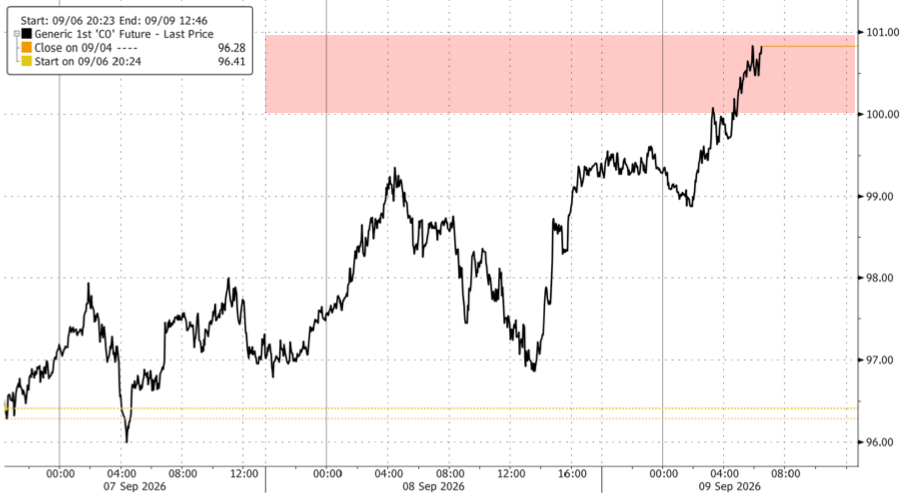
- Oil tops $100: Brent crude surpassed $100/barrel as markets see prolonged Gulf disruptions and little hope for a diplomatic off-ramp.
* * *
Trump on ‘War’ Ending ‘Immediately’
New Trump remarks on Iran… Note that he called it a “war” (no less than twice in the below clip) – contradicting the White House’s own stance (Sept. 4: Trump said don’t call it a war, instead: “I call it a military conflict because it’s small potatoes for us.”:
Q: Do you expect negotiations with Iran to restart at some point?
Trump: Uhhhhhh… we’re not looking for it to be honest with you. This war will end immediately after our election.
And meanwhile, back to the below laughably implausible headlines…
Pakistani Ambassador says they believe that a better understanding will soon be achieved between the US and Iran, reports ISNA
But don’t Republicans actually need the war to end before Congressional elections?
Trump on Iran: I think the war will end immediately after the election. They’re desperate to affect the election. pic.twitter.com/31VEeI0tjO
— Acyn (@Acyn) September 9, 2026
More on high prices at the pump and the question of nuclear weapons… however, the war itself has only made this a greater uncertainty, as Washington has not achieved any prime objectives – and the status of the Iranian nuclear program remains unknown…
Reporter: You said that oil and gas prices were going to come down. Oil is now back above 100 dollars. How do you explain this to Americans?
Trump: It’s very easy to explain to Americans: all you have to do is say, will you let Iran have a nuclear weapon? The answer is no. pic.twitter.com/HFldzUtrbo
— Clash Report (@clashreport) September 9, 2026
IRGC: ’20 for 2′, Vows Disproportionate Responses
Amid the dramatic escalation which kicked off since Tuesday night, Iran is seeking to impose new conditions on the United States. While continuing to vow a ‘disproportionate response’ to any attack moving forward, Tehran is now identifying specifics.
IRGC spokesman Hossein Mohebbi states Wednesday, “The imposed war, which involved the world’s most powerful nations, has ended in certain periods, but the nature of the conflict continues. For the first time, this conflict has directly inflicted strategic damage on the United States, impacting the country’s security and economic equations.”
He issued the following list for the US to reach an end to the conflict. “If the enemy desires an end to this situation, they must”…
- completely cease the war
- refrain from further threats
- withdraw the Israeli army from Lebanon
- end the siege of Yemen
- release the $24 billion of Iranian assets that have been frozen
- cease any interference in the country’s nuclear and missile programs
This definitely marks a raised bar, to be sure, after this summer the MoU complete ceased, and negotiations vanished. There’s no way Washington complies with even half of the conditions, at this rate.
Importantly, Mohebbi also said: “We have reached a point where if the enemy strikes at 2 or 3 of our targets, we will respond forcefully by striking at 20.”
Tanker Attacked in Iraq Territory Waters, After CENTCOM Insists US Warships Not Hit
After a huge Iranian ballistic missile launch on US bases in Jordan overnight, CENTCOM has yet to respond in any major way. The Pentagon has also said all US troops “are accounted for” – but this doesn’t necessarily mean there were no casualties. However, CENTCOM is at the moment denying that the Iranians hit US warships, as the IRGC has been claiming since Tuesday, in an oddly specific statement: The IRGC claims to have targeted and inflicted “significant damage” on a pair of US warships in the Gulf of Oman: DDG-119 USS Delbert D. Black and DDG-53 USS John Paul Jones, both Arleigh Burke-class destroyers.
CENTCOM responded: “No U.S. Navy warship has been struck; all IRGC attempted attacks failed.” It added on X, “Meanwhile, U.S. forces have successfully destroyed 10 Iranian tankers in just the last week. These vessels were part of a multibillion-dollar shadow network that funds the IRGC, and Iran cannot defend them.”
Meanwhile, Iran’s military is continuing to go on the offensive, seeking to maintain its leverage over the contested Strait of Hormuz.
“A Panama-flagged tanker carrying 2 million barrels of Iraqi fuel oil was struck today by a drone in Iraqi territorial waters, two port officials say,” Reuters reports. “Iraqi rescue boats extinguished a fire aboard the tanker, New Andros, and there are no reports of casualties, port officials tell Reuters.”
💢 BREAKING: A Panama-flagged tanker carrying about 2 million barrels of Iraqi fuel oil was struck by a drone in Iraqi territorial waters, according to two Iraqi port officials cited by Reuters journalist Ahmed Rasheed. The vessel and extent of the damage were not immediately… https://t.co/3ciZBBGgg7
— Drop Site (@DropSiteNews) September 9, 2026
Brent Crude Futures Top $100
Brent crude futures topped $100 a barrel for the first time since July as US strikes on Iranian oil tankers and renewed attacks on Saudi energy infrastructure and a US base in Jordan suggested to UBS energy specialist Dominic Ellis that a “US-Iran off-ramp remains elusive.”
Ellis adds more color on the overnight Gulf developments and response in the crude oil market:
Brent topped $100/bbl as the US and Iran continue to trade strikes around the Strait of Hormuz.
The US says it has destroyed multiple Iranian vessels (including 5 on Sept. 8) in response to Iranian attacks, and says it will respond to each subsequent Iranian hit (actual or attempted) by destroying another Iranian tanker.
CENTCOM forces destroyed five Iranian crude oil carriers, Sept. 8, after the Islamic Revolutionary Guard Corps (IRGC) targeted a U.S. Navy warship with ballistic missiles twice over the past two days. The U.S. warship successfully evaded the attempted Iranian attacks and… pic.twitter.com/Gi8a2tloN1
— U.S. Central Command (@CENTCOM) September 8, 2026
Iran hit a US base in Jordan, and has stepped up attacks on the US’ regional allies, with Saudi Arabia’s energy infrastructure under particular pressure.
Some investors have shown signs of wanting to fade the rally in oil and related equities, but the change in tone from all concerned makes it seem less likely (if not impossible) that we will see a return to the de-escalation narrative that has historically triggered a drop in oil and profit-taking in equities.
With the tailwind into Q3 numbers for the integrated energy sector, I think most will be inclined to leave long positions open until there is evidence of real progress back toward a diplomatic off ramp.
Iran has reportedly rejected the latest US offer of talks, and the conflict seems likely to support oil at current levels and potentially push prices higher in the near term.
The global crude benchmark broke above $100 a barrel in European trading but initially failed to hold the level. Just over an hour later, at around 4:36 a.m. ET, Brent reclaimed triple digits and extended gains to $100.83 by around 6:00 a.m. ET.
Price Forecasts
Goldman’s head commodity strategist, Daan Struyven, wrote in a note on Monday that, given the renewed turmoil in the Gulf region, he raised his Brent/WTI price forecasts by $5 to $85/$80 for December 2026 and to $80/$75 for 2027, on the assumption that Mideast shipping disruptions continue into 2027.

Struyven outlined significant net upside price risks with two Gulf output and Brent scenarios:
- Price upside scenario: Brent might exceed $120/bbl if 2027 average Gulf output remains 4mb/d below pre-war levels, versus 0.5mb/d below in the base case. The bank views more intense shipping attacks in Hormuz and the Red Sea as the most likely driver of this lower-output, higher-price scenario.
- Price downside scenario: Brent might decline into the $60s in 2027 if 2027 average Gulf output rises 1mb/d above pre-war levels. Goldman still recommends hedging geopolitical risk through deferred Mar27-Dec27 European diesel timespreads, which would rise over 100% if persistent Russia or Mideast refinery outages keep the nearby 9-month spread near current levels.

Separately, Darrell Fletcher, managing director for commodities at Bannockburn Capital Markets, warned that the “path of least resistance is a strong and steady grind higher as the war enters seven months,” adding, “The fundamental picture for products remains bullish with global inventories and reserves deteriorating. In the typical pattern, the US and Iran continue their counterattacks and warnings.”
Tyler Durden
Wed, 09/09/2026 – 15:20