74.5 F
Chicago
Wednesday, September 9, 2026
Home Blog Page 3182

The Non-Denial Denial: David Weiss And Prosecutorial Nihilism

0
The Non-Denial Denial: David Weiss And Prosecutorial Nihilism

Authored by Jonathan Turley,

Below is my column in The Hill on the long-awaited interview of Special Counsel David Weiss with House investigators.

As expected, Weiss refused to answer most of the questions, but seemed perfectly Nietzschean in explaining obvious conflicts between the accounts of whistleblowers and the Attorney General.

Here is the column:

The philosopher Friedrich Nietzsche once said that all things are matters of mere interpretation and “whichever interpretation prevails at a given time is a function of power and not truth.”

One has to understand Nietzsche and his nihilistic rejection of meaning to fully appreciate this week’s interview with special counsel David Weiss. Indeed, Weiss seemed to be channeling pure Nietzsche in arguing that the denials of his request for authority to charge Hunter Biden were not really denials at all. What about the absence of any but a couple of gun charges after five years? Weiss insisted it is just a matter of interpretation.

Weiss appeared before the House Judiciary Committee, which is looking into the handling of the investigation into Hunter Biden’s alleged criminal conduct. The one thing that both Republican and Democratic members appear to agree upon is that the Weiss investigation was an unmitigated mess — years of delay and internal dissension over the indictment of the president’s son.

Indeed, after years of denial, some Democratic members and the journalists are now admitting that Hunter Biden clearly broke the law. The Weiss investigation, however, languished for years even as some of us were pointing out that the statute of limitations was about to pass on felonies.

At the same time, Attorney General Merrick Garland steadfastly refused to appoint a special counsel into the expanding corruption scandal involving Hunter and other Biden family members selling influence and access.

Congress was scheduled to hear from Weiss when Garland suddenly made him a special counsel, though the attorney general did not expressly extend his mandate to cover the corruption allegations. That allowed Weiss to delay any appearance. He would bring gun charges against Hunter, but he has inexplicably still not brought the tax charges that he did not previously allow to expire or charges under laws like the Foreign Agents Registration Act.

Weiss has shown no signs of movement as evidence has piled up.

Most recently, Hunter’s own tax accountant gave incriminating evidence on his former client from claiming the payment of prostitutes as “a business expense” to allegedly misrepresenting payments as “loans.”

As expected, Weiss continued to refuse to answer questions about his lackadaisical approach

That includes obvious questions like why, when whistleblowers said the defense had agreed to an extension of the statute of limitations, Weiss let felonies expire. Those crimes included some of the most serious allegations of influence peddling and corruption facing the Biden family.

There was one area where the “ongoing investigation” mantra would not work. Garland repeatedly testified that Weiss had total authority to pursue any charges in any district. That was directly contradicted by the whistleblowers, who say that Weiss told them that he lacked such authority to pursue charges — a statement that Gary Shapley included in a memo sent to his superiors without any later contradiction or correction.

The account of the whistleblowers, that Weiss was turned down in efforts to bring charges against Hunter in California and Washington, D.C., were confirmed by those U.S. Attorneys — E. Martin Estrada (California) and Matthew Graves (D.C.).

They also declined to explain why they refused to assist in prosecuting the son of the president.

Weiss has taken years and has brought only a couple of gun charges. Indeed, his billet could be described accurately as a systematic effort to avoid recognizing an array of evidence of other criminal acts.

The Justice Department was faced with a field littered with influence peddling and corrupt practices, including acts that may implicate the president himself. There are actual photos and videotapes of drug use, prostitution and luxury gifts tied to shady foreign sources. And then there are the millions of dollars of transfers from those foreign sources, and emails both promising access to Joe Biden and threatening his wrath if there are failures to pay.

In his House interview, Weiss continued to insist that he did indeed have full authority to bring any prosecution anywhere. When confronted by the fact that Estrada and Graves refused to cooperate, he admitted that he had asked for a special status to allow him to move forward on the cases under what is called “515 Special Attorney authority.”

However, a house investigator stated the obvious: “But [515 authority] wasn’t granted, right?”

“Yes. We have been over this. It wasn’t granted. They said follow the process. I followed the process…I asked for something, and in that conversation, they didn’t give it to me.”

The investigators then pressed again with the obvious: “When you ask for something and they didn’t give it to you, what is that?”

That is when Weiss went full Nietzsche.

Weiss responded”

“I’m not — you want me to say it’s a denial, but it’s not. Not when I know that, weeks later, I was specifically told, ‘You can proceed.’”

Weiss insisted that he was asked to “proceed with this process. We’re asking you to go through this process. From my mind, it’s a sequencing event. It’s not a denial in any way, shape or form.”

That is when he added “That’s the way I interpreted it.”

It is that easy. Even a denial is not really a denial. As Nietzsche said, it is all “a function of power and not truth.” For Garland and Weiss, blind justice itself becomes a matter of interpretation.

Tyler Durden
Mon, 11/13/2023 – 11:20

Cabinet ‘Reset’: Britain’s Home Secretary Fired, David Cameron Returns To Gov’t

0
Cabinet ‘Reset’: Britain’s Home Secretary Fired, David Cameron Returns To Gov’t

British Prime Minister Rishi Sunak sacked Home Secretary Suella Braverman following a turbulent relationship, exacerbated over the weekend with her inflammatory comments about pro-Palestinian demonstrations in central London. Sunak then announced further reshuffling by appointing former minister prime David Cameron as Foreign Secretary after a seven-year leave of absence from politics. 

According to The Telegraph, Braverman was not surprised to receive a call from Sunak on Monday morning, ending her 12-month tenure as Home Secretary. Sources said she had an idea the phone call was coming on Sunday after a “series of controversies over her outspoken criticism of police bias in tackling the pro-Palestinian protests and street vagrancy.” 

In an op-ed in the Times of London newspaper – published ahead of a massive pro-Palestinian demonstration on Saturday, she called protesters “hate marchers” and criticized police for applying “double standards” in the way they manage protests. 

“Right-wing and nationalist protestors who engage in aggression are rightly met with a stern response, yet pro-Palestinian mobs displaying almost identical behavior are largely ignored, even when clearly breaking the law. I have spoken to serving and former police officers who have noted this double standard,” Braverman wrote.

As for Palestinian marches, she added: “We have seen with our own eyes that terrorists have been valorized, Israel has been demonized as Nazis, and Jews have been threatened with further massacres.”

Even though her remarks were applauded by conservatives, liberal corporate media had a meltdown: BBC News spoke with Neil Basu, the former head of counter-terrorism policing in the UK, who said her comments “are potentially divisive is a very dangerous thing to do… no home secretary we’ve served under would have done the same thing.”

Sunak’s sweeping cabinet reshuffle followed Cameron’s appointment as Britain’s foreign secretary. He served as prime minister from 2010-16 and triggered the Brexit referendum 2016, where he voted to stay in the bloc. 

Cameron is also viewed as pro-China, trying to set up a $1 billion investment between the two countries. He’s also seen as a ‘Davos’ man… 

In a statement this morning, he said, “We are facing a daunting set of international challenges, including the war in Ukraine and the crisis in the Middle East. At this time of profound global change, it has rarely been more important for this country to stand by our allies, strengthen our partnerships and make sure our voice is heard.” 

He noted, “Britain is a truly international country. Our people live all over the world and our businesses trade in every corner of the globe. Working to help ensure stability and security on the global stage is both essential and squarely in our national interest. International security is vital for our domestic security.” 

And being a Davos man/pro-China, this might be indicative that Cameron has limited to no intentions to support Israel. 

Meanwhile, The Times of Isreal reported over the weekend that Israel was pushing former British prime minister Tony Blair as humanitarian coordinator for the Gaza Strip. 

“A few weeks ago, Rishi Sunak said David Cameron was part of a failed status quo, now he’s bringing him back as his life raft,” said Pat McFadden, Labour’s campaign chief.

McFadden continued, “This puts to bed the prime minister’s laughable claim to offer change from 13 years of Tory failure.”

Tyler Durden
Mon, 11/13/2023 – 08:50

If The Economy Is So Great, Why Are Tax Revenues So Weak?

0
If The Economy Is So Great, Why Are Tax Revenues So Weak?

Authored by Ryan McMaken via The Mises Institute,

Federal deficits continue to spiral upward, but deficits aren’t just a function of federal spending. Deficits aren’t necessary if tax revenues increase to match spending. But that’s certainly not where we find ourselves in 2023. Rather, federal spending is rising even as federal revenues have fallen, year over year, for ten of the last twelve months. Moreover, on a quarterly basis, federal receipts have been falling—quarter-to-quarter—since the third quarter of 2022.

It’s long been known that there’s a pretty strong correlation between falling tax revenues and worsening economic conditions. Yet, even as tax revenues are falling, we’re being repeatedly told that the American economy is in great shape and there’s no recession in sight

Yet, if we take a historical view, we can see how declining federal revenues have clearly coincided with recessions going back at least 40 years: 

There have been some periods where revenues went slightly negative without an accompanying recession. But not in many decades do we see a situation where year-over-year revenue has fallen to the extent that it has fallen in recent months, without a recession following soon after. (For example, federal revenue dropped 26 percent, year over year, in April of this year, followed by a 21-percent drop in May.)

Most of the corporate media’s declarations of excellent economic conditions look no further than the trailing indicator of employment or consumer spending. Consumer spending, of course, continues to be fueled by rising debt levels while investment falls. 

Tax revenues present a problem for the everything-is-swell narrative, however. This can partly be explained if we consider that federal revenues nowadays are heavily reliant on income taxes and payroll taxes. So, if wages and job growth were truly surging as the Bureau of Labor Statistics insists via its payroll survey, we’d be seeing more growth in taxes on wages and income. The fact federal revenues are falling suggests household incomes aren’t exactly soaring. 

The fact tax revenues are weak and falling should not shock us if we’re actually paying attention, however. Real wages are lower now than they were in January 2020, before the beginning of the covid recession. Looking at CPI-adjusted average hourly wages, wages increased a whopping two cents from September 2022 to September 2023. Wages are down by .06 percent since January 2020 before the lockdowns. In other words, real wages have gone nowhere in years. 

There may be a multitude of other factors as well, of course, but no matter what the specifics are, it’s difficult to deny that falling or weak tax revenues contradict narratives telling us how strong the economy is. Moreover, consumer spending as we now see it is also coinciding with a surge in corporate bankruptcies, a falling saving rate, and mounting consumer debt. The index of leading indicators is in recession territory. The inverted yield curve points to recession, and money-supply growth has crashed to its lowest levels since the Great Depression. Who would be surprised that tax revenues fail to impress? Only mainstream journalists and establishment economists. 

Tyler Durden
Mon, 11/13/2023 – 08:30

US Futures Drop, Europe Gains Ahead Of Key CPI Data

0
US Futures Drop, Europe Gains Ahead Of Key CPI Data

After last week’s torrid rally, and following gains on 9 out of the past 10 days, US stocks are set for a lower open as traders turn cautious ahead of key U.S. CPI data later this week which will give cues on what the Fed could do next, while investors also assessed the risk of a government shutdown on the 17th. As of 7:45am, S&P 500 futures are down 0.2% while Nasdaq 100 contracts lose 0.3% after the underlying indexes closed sharply higher on Friday. European stocks rose on Monday, with the Stoxx 600 index climbing 0.5%, well off the best levels however, with health firms were among the strongest performers as Novo Nordisk jumped almost 4% after a study backed the use of Wegovy to cut heart attacks and deaths in obesity patients. The news also benefited US-listed rival Eli Lilly & Co., which has its own weight-loss medications. Treasury yields slipped, while oil steadied and bitcoin traded around $37K.

In premarket trading, Boeing shares advanced almost 4%, thanks to a $52 billion deal with Emirates, as well as news that China is weighing an end to a freeze on purchases of Boeing aircraft. Plug Power shares fell another 4.2% following Friday’s plunge, after Morgan Stanley cuts its price target on the hydrogen fuel cell maker after the company’s going-concern warning last week. StoneCo shares gain 4.9% after the financial technology provider reported results late Friday that beat expectations thanks to strength in its financial services division.

Market attention is firmly focused on Tuesday’s US CPI data, which are expected to show inflation easing to a year-on-year rate of 3.3% in October, down from 3.7% in the prior month. While several Fed officials have rejected the likelihood of swift rate cuts, money markets and economists are sticking with policy-easing bets. Morgan Stanley forecast deep interest-rate cuts to start from June, while Goldman Sachs predicted the first cut around end-2024.

“If we get inflation in line with consensus, it will be good news but I don’t think the data will alter the tone we are hearing from Fed officials pushing back against markets’ excitement over rate cuts,” said Rabobank strategist Jane Foley. She predicted more “hawkish speak from central banks to control the degree to which markets price cuts.”

At the same time, there are more signs of thawing US-China ties with Joe Biden and Xi Jinping due to meet on Wednesday. The White House has cited a resumption of US-China military communications as a priority. Hong Kong-listed Chinese stocks gained 1.3%.

European stocks rose, with the Stoxx 600 up 0.6%. Health care stocks are among the best performers, with Novo Nordisk up as much as 4.3%, the most in a month, after the Danish pharmaceutical giant this weekend presented full data from a trial backed the use of Wegovy to cut heart attacks and deaths in people with obesity and a history of cardiac disease. Here are some other notable European movers:

  • Evolution gains as much as 6.7%, the most since February, after the Swedish online gambling firm’s CEO bought almost 100,000 shares in the company for a total value of SEK100 million ($9.2 million)
  • Banca Monte dei Paschi di Siena rises as much as 6.5% leading gains on the FTSE MIB index after Deutsche Bank upgraded the bank to buy from hold. Other lenders such as Banco BPM and BPER Banca also advance
  • British Land rises as much as 6.5% to a three-month high after underlying earnings per share top estimates in first half of fiscal year. Morgan Stanley says rental growth was “impressive”
  • Eramet rose as much as 4.2% after the French group announced new production and financial targets at its investor day
  • Thyssenkrupp Nucera gains as much as 2.5% as Goldman sach initiates at neutral, saying it sees growth potential for the German green hydrogen electrolysis technology company; sets PT at €16
  • Tullow Oil rises as much as 5.5%, the most since Oct. 9, after the exploration and production company entered into a $400 million five-year notes facility agreement with Glencore Energy UK, according to a statement
  • Technip Energies drops as much as 3.8% after Barclays double-downgrades to underweight from overweight, saying its peers trade at significant discounts and offer better value
  • Aperam falls as much as 4% after AlphaValue/Baader cut the recommendation on the specialty steelmaker to add, from buy. The broker says 3Q was the “worst quarter ever” for the group and demand remains weak
  • Dr. Martens shares fall as much as 5.2%, after the bootmaker is downgraded to equal-weight from overweight at Barclays, which expressed concern on the company’s focus on direct-to-consumer growth
  • Asos falls as much  -2.4% after Morgan Stanley said the growth outlook for online apparel retailers still looks challenging despite the progress made on margins in 2023
  • FDM Group shares plummet as much as 18%, the steepest drop since March 2020, after the professional services provider signaled its 2024 performance would be hit by a decline in its workforce

Earlier in the session, Asian equities erased opening gains as US index futures drift lower. The Nikkei was little changed; Korea’s Kospi surrendered an early 1.1% jump to trade near flat; the ASX 200 is modestly softer. Greater China indexes are mixed; Hang Seng Tech index is 0.6% higher after increase in Singles’ Day sales. Shanghai Composite edges 0.2% weaker. Taiex outperforms regional peers on TSMC rally. Some more details:

  • Hang Seng and Shanghai Comp traded cautiously as optimism from Alibaba and JD.com’s higher Singles Day sales was offset by cautiousness ahead of the approaching Chinese data and Biden-Xi summit.
  • Japan’s Nikkei 225 initially gained after softer-than-expected PPI data which printed its slowest pace of annual growth since February 2021 although the index eventually reversed its gains amid rising yields and a slew of earnings.
  • Australia’s ASX 200 was lacklustre amid weakness in the top-weighted financial sector after ANZ Bank earnings which posted a record FY cash profit but missed analysts’ forecasts and noted the external environment is likely to remain challenging.
  • Indian stocks declined, underperforming most Asian peers, as investors dump technology and financial services shares. The S&P BSE Sensex Index fell 0.5% to 64,933.87 in Mumbai, while the NSE Nifty 50 Index declined 0.4%. Out of 30 shares in the Sensex index, seven rose and 20 fell, while three were unchanged. Of the 19 sectoral indexes tracked by BSE Ltd., 13 declined. An index tracking technology stocks was the biggest sectoral laggard.

In FX, the Bloomberg Dollar Spot Index steadied after Moody’s downgraded the US credit rating outlook, while Treasury yields fell 1-2bp across the curve; market focus rests on US CPI data out Tuesday and the outlook for Federal Reserve policy

  • USD/JPY rose as much as 0.22% to 151.86 as Japan’s widening yield gap with Treasuries saw the yen slump to a fresh one-year low against the dollar
  • GBP/USD climbed as much as 0.21% to 1.2253, the highest level since Thursday, as data indicated UK house prices fell the most in five years in November
  • EUR/USD crept up as much as 0.14% to 1.0701 as the ECB’s de Guindos warned inflation may pick up again

Treasuries rise, with US 10-year yields falling 2bps to 4.63% as treasuries were slightly richer across the curve, recouping some of the late-Friday losses spurred by Moody’s shift to negative outlook on US credit rating. European bonds outperform slightly, with Italy debt leading gains after Fitch Ratings left the nation’s rating unchanged after Friday’s close. US session is light on economic data and Fed speakers, and coupon auction slate is blank until Nov. 20. US yields richer by 1bp-2bp with 10-year around 4.64%, underperforming comparable gilts and bunds by ~~1bp; 5s30s spread slightly steeper on the day at ~8bp after dropping below 6bp Friday. Dollar IG issuance slate empty so far, though Monday is expected to account for the bulk of the $30b in new bond sales anticipated this week.

In commodities, oil prices are little changed with WTI trading near $77.33. Spot gold falls 0.1%.

Bitcoin is under modest pressure and has lost the $37k handle, but action overall is limited in nature with overall newsflow fairly limited thus far in European hours and as such BTC remains well within familiar ranges.

US economic data scheduled for the session includes October NY Fed inflation expectations (11am) and monthly budget statement (2pm). Scheduled Fed speakers include Cook at 8:50am; Williams, Jefferson, Barkin, Barr, Goolsbee, Mester and Waller also due this week

Market Snapshot

  • S&P 500 futures down 0.2% to 4,420.50
  • STOXX Europe 600 up 0.8% to 446.65
  • MXAP up 0.3% to 156.38
  • MXAPJ up 0.6% to 489.47
  • Nikkei little changed at 32,585.11
  • Topix little changed at 2,336.62
  • Hang Seng Index up 1.3% to 17,426.21
  • Shanghai Composite up 0.2% to 3,046.53
  • Sensex down 0.5% to 64,942.58
  • Australia S&P/ASX 200 down 0.4% to 6,948.84
  • Kospi down 0.2% to 2,403.76
  • German 10Y yield little changed at 2.72%
  • Euro up 0.1% to $1.0700
  • Brent Futures down 0.2% to $81.27/bbl
  • Gold spot down 0.0% to $1,939.32
  • U.S. Dollar Index down 0.16% to 105.69

Top Overnight News

  • Italy credit decision from Moody’s is being watched closely – Italy is rated Baa3 (the lowest rung of investment grade) w/a negative outlook and markets are on edge over whether the country will be moved into junk territory. BBG
  • ECB Vice President Luis de Guindos warned that consumer-price growth may pick up again temporarily, though its prevailing direction is downwards. “We expect a temporary rebound in inflation in the coming months as the base effects from the sharp increase in energy and food prices in autumn 2022 drop out,” Guindos said. “But we see the general disinflationary process continuing over the medium term.” BBG
  • Germany is set to double aid for Ukraine next year to EU8B and boost its total defense spending beyond the 2% of GDP threshold pledged by all NATO members. BBG
  • Netanyahu said Israel would retain “overall security control” over Gaza and expressed opposition to a Palestinian Authority-led gov’t assuming control of the territory. The Hill
  • US credit outlook downgraded from stable to negative by Moody’s after the Friday close (the AAA rating was affirmed), with the agency citing “downside risks to the country’s fiscal strength” as the primary reason for the change (along with continued political polarization). Moody’s
  • Speaker Johnson unveiled a funding bill on Saturday that would extend spending authorization until 1/19 for some parts of the government and until 2/2 for others, but passage is far from guaranteed. BBG
  •  US launches a new round of airstrikes against Iranian-backed proxy facilities in Syria in retaliation for recent attacks in what is being called a “significant escalation” by the White House. WaPo
  • FT-Michigan Ross poll underlines president’s struggle to overcome impact of inflation on voters’ economic outlook. Only 14% of Americans say they are better off financially since Biden took office while 70% feel the president’s economic policies either hurt the US economy or had no impact. FT
  • A Boeing breakthrough in China may be unveiled when Joe Biden and Xi Jinping meet this week, people familiar said. Beijing may signal a commitment for 737 Max jetliners during the APEC summit, ending a long freeze on purchases as the leaders attempt to put a floor under their fraught relationship. BBG

A more detailed look at global markets courtesy of Newsquawk

European bourses are in the green, Euro Stoxx 50 +0.7%, despite a relatively tepid APAC handover with performance more in-fitting with that seen on Friday on Wall Street. Sectors are firmer across the board featuring outperformance in Travel & Leisure as Evolution’s CEO purchases shares, Health Care supported by Novo Nordisk obesity data while Banking names derive support from the likes of SocGen and BMPS. Stateside, futures trade on the back foot, ES -0.2%, despite firmer European trade with updates since Friday’s close unfavourable and include Moody’s altering its US rating and time running out for a resolution before a US shutdown; though, reporting on the shutdown has been mixed on Johnson’s bill. Emirates Airlines announced orders for 90 777-X Boeing (BA) jets worth USD 52bln; ordering General Electric (GE) 9X Engines and updating Dreamliner order for 35 units in total.

Top Asian News

  • Chinese NDRC officials said the state planning agency will set up six platforms to facilitate private business, as well as monitor and solve problems, while the NDRC head said China’s private economy is expected to receive more favourable policies in the future, according to Global Times.
  • Chinese officials met with US Treasury Secretary Yellen in the past week and raised concerns about investment restrictions, while China and the US agreed to avoid escalation of frictions.
  • China is considering ending the freeze on Boeing (BA) with a 737 Max deal in the US, according to Bloomberg.
  • US and Indonesia are to discuss the potential for a deal on electric vehicle minerals with Indonesia President Widodo to meet US President Biden at the White House on Monday, according to Reuters sources cited.
  • RBA’s acting Assistant Governor Kohler said the decline in inflation is to be more gradual than previously thought and bringing inflation back to the target is likely to be more drawn out. Kohler also stated that domestically sourced inflation has been widespread and slow to decline, while she noted the key risk is that high inflation today feeds into inflation expectations.
  • Japanese Finance Minister Suzuki says sudden FX moves are undesirable; does not comment on FX levels; will monitor markets and respond with a sense of urgency. Currency rates should be set by markets reflecting fundamentals.
  • PBoC will step up monitoring and analysis of systemic risks, shadow banks and financial technological innovation, via Reuters citing sources. Will handle risks of small and medium-sized financial institutions in a timely manner.

APAC stocks were mostly subdued and failed to sustain the early momentum from last Friday’s rally on Wall St with the region cautious ahead of this week’s key risk events including US CPI and Chinese activity data, the Biden-Xi meeting on the sidelines of the APEC summit and the US government shutdown deadline. ASX 200 was lacklustre amid weakness in the top-weighted financial sector after ANZ Bank earnings which posted a record FY cash profit but missed analysts’ forecasts and noted the external environment is likely to remain challenging. Nikkei 225 initially gained after softer-than-expected PPI data which printed its slowest pace of annual growth since February 2021 although the index eventually reversed its gains amid rising yields and a slew of earnings. Hang Seng and Shanghai Comp traded cautiously as optimism from Alibaba and JD.com’s higher Singles Day sales was offset by cautiousness ahead of the approaching Chinese data and Biden-Xi summit.

Top European News

  • ECB’s Centeno is facing an ethics review by an independent watchdog following a failed proposal by Portugal’s outgoing PM Costa for Centeno to replace him instead of holding new elections, according to FT.
  • ECB’s de Guindos says he expects a temporary rebound in inflation in the coming months as the base effects from the sharp increase in energy and food prices in autumn 2022 drop out of the year-on-year calculation. At the December meeting, will be in a better position to reassess the inflation outlook and required policy action. Also seeing increasing signs of the impact of our policy decisions on the real economy
  • German Ifo Survey (Oct): 18.2% of firms reported problems (prev. 24.0% M/M); material shortages in the manufacturing sector have eased significantly, supply situation near pre-COVID levels. Ifo says “firms should plan now for future shortages, diversify their supply chains, and increase inventory levels”. The auto sector remained the most affected by supply bottlenecks.
  • Fitch affirmed Italy at BBB; Outlook Stable and affirmed Poland at A-; Outlook Stable on Friday.
  • UK Home Secretary Braverman sacked, replaced by Cleverley. Former PM David Cameron appointed as UK Foreign Minister.

FX

  • Dollar drifts ahead of NY Fed SCE and US CPI data on Tuesday, DXY slips into a slightly softer 105.85-68 range.
  • Aussie outperforms as acting RBA Deputy Governor warns that battle to get inflation back to target will be drawn out, AUD/USD and AUD/NZD cross elevated between 0.6385-51 and 1.0835-1.0775 respective bands.
  • Yen lags on yield dynamics and as Japanese corporate goods prices come in softer than expected, USD/JPY nudges closer to 152.00 from 151.40 where 1.3bln option expiries reside.
  • Pound and Euro perky vs Buck as the former consolidates on 1.2200 handle and latter probes 1.0700.
  • PBoC set USD/CNY mid-point at 7.1769 vs exp. 7.2889 (prev. 7.1771)

Fixed Income

  • Some respite for debt ahead of key risk events including top-tier data.
  • Bunds probe Fib resistance on the way up to 129.89 from 129.48.
  • Gilts back on the 95.00 handle within 95.22-94.64 bounds and T-note nearer top of 107-15/07+ range.
  • BTPs outpace peers after Fitch affirmed Italian BTP rating and speculation mounts about buyback or exchange auction.

Commodities

  • Crude benchmarks rebounded from session lows and are just about in the green; though, initial price action was somewhat choppy and the move thus far keeps benchmarks well within recent ranges.
  • WTI Dec’23 and Brent Jan’24 around USD 77.35/bbl and USD 81.60/bbl respectively; again, headlines have been numerous over the weekend and primarily on geopols (see the section below) while for crude specifically the OPEC MOMR is due at 12:00GMT/07:00EST.
  • Spot gold is little changed as the USD eases from best with XAU in a relatively narrow USD 10/bbl intraday range. However, spot silver has come under further pressure after losing the USD 22/oz mark in APAC trade.
  • Base metals bolstered with marked gains in the likes of LME Copper and Dalian Iron Ore, attributed to property sector optimism within China by some and comes after a bout of upside in the regions equity bourses just prior to the European cash open.
  • Iraq’s Oil Minister Abdel-Ghani said on Sunday that he expects to reach an agreement with the Kurdistan Regional Government and foreign oil companies to resume oil production from the Kurdish region’s oilfields within three days.
  • Iraq and ExxonMobil (XOM) signed a settlement agreement allowing PetroChina (857 HK) to become a lead contractor at the West Qurna 1 oil field.
  • Kuwait Integrated Petroleum Industries Company said there was a sudden interruption of fuel supplies at Kuwait’s Al Zour Refinery due to a defect in one of the main valves which almost halted production, according to state media.

Geopolitics: Middle East

  • Staff at the Al-Shifa Hospital which is the largest in Gaza said patients and refugees were trapped in horrific conditions amid heavy fighting in nearby streets and it was also reported that the hospital had run out of water, food and electricity. Furthermore, WHO’s Tedros said they managed to get in contact with staff at the hospital and that it is no longer functioning as a hospital, according to BBC and Reuters.
  • Israel PM Netanyahu said they offered Gaza’s Al-Shifa Hospital fuel but Hamas refused to receive it, according to an interview with NBC. It was also reported that Hamas suspended hostage negotiations over Israeli forces’ handling of Al-Shifa Hospital and denied refusing any amount of fuel from Israel, while it added that Israel’s offer to provide 300 litres belittles the sick and wounded and is enough to last for 30 minutes.
  • Israel’s military said Hamas lost control of northern Gaza and residents have evacuated to the south despite Hamas instructions. Furthermore, the Israeli military said that civilians were wounded by an anti-tank missile near the Lebanon border and it retaliated with artillery fire, while Israel warned it was poised to impose quiet on the Lebanese front after hostilities increased on Sunday, according to Reuters.
  • Palestinian President Abbas said that their people are facing a genocidal war and that they call on the US to stop the Israeli aggression against Gaza, while he added that they want international protection.
  • US President Biden and Qatar’s Emir Al-Thani engaged in discussions to boost aid to Gaza. It was also reported that US Secretary of State Blinken and Qatar’s PM discussed efforts to evacuate the critically wounded and urgently increase the flow of humanitarian aid into Gaza, as well as discussed efforts to ensure the safe passage of foreign nationals out of Gaza and immediate return of hostages during a phone call on Saturday, according to Reuters citing a State Department spokesperson.
  • White House National Security Adviser Sullivan said the US does not want to see firefights in hospitals and that the US is involved in negotiations between Israel and Qatar over hostages. Sullivan also stated that President Biden is determined to see a re-establishment of military-to-military ties with China and the question of Iran’s nuclear program and the threat it poses will be on the agenda meeting with Chinese President Xi.
  • EU’s top diplomat Borrell called for immediate humanitarian pauses in Gaza and the establishment of humanitarian corridors. Borrell also stated that they call on Hamas to immediately and unconditionally release all hostages, while they condemn the use of hospitals and civilians as human shields by Hamas.
  • Egyptian President Sisi called for an immediate sustainable ceasefire in Gaza without restrictions or conditions. It was separately reported that Egyptian security sources said the first group of Gaza evacuees crossed the Rafah border following the reopening of Sunday.
  • Iranian President Raisi said the Gaza siege should end immediately and called on Islamic countries to impose oil and goods sanctions on Israel, while he added that there is no other way but to resist Israel and that they kiss the hands of Hamas for its resistance against Israel.
  • Syrian President Assad urged a halt to any political process with Israel.
  • US Air Force conducted two airstrikes against Iranian proxy targets in eastern Syria, according to Fox News.
  • Iraq’s Harir Airbase hosting US and international forces was targeted by an armed drone which caused damage to infrastructure.
  • “IRGC Air Force Commander: Israel’s war on Gaza has expanded and Lebanese Hezbollah is involved in it”, according to Al Jazeera.. “There is a possibility of Israel’s war on Gaza expanding and we are ready for all eventualities”

Geopolitics – Other

  • German Chancellor Scholz’s government agreed to double military assistance to Ukraine for next year to EUR 8bln.
  • Russian Foreign Minister Lavrov said the EU isn’t hiding its intentions to push Russia out of Central Asia and that these attempts are futile, while he added that Russia has been historically present there and is not going to disappear from there, according to AFP.
  • US, Japan and South Korean defence officials assessed growing nuclear and missile threats from North Korea at a meeting on Sunday, while the US and South Korea revised their tailored deterrence strategy in the face of North Korean nuclear advancements, according to Yonhap. It was separately reported that North Korea criticised the UN Command meeting scheduled in South Korea as confrontational for the region and it called for the UN Command to be dissolved which it said was an illegal war organisation, according to KCNA.
  • Russia’s Kremlin says Polish plans to deploy tanks closer to the Belarus border would escalate tensions.

US Event Calendar

  • 11:00: Oct. NY Fed 1-Yr Inflation Expectat, prior 3.67%
  • 14:00: Oct. Monthly Budget Statement, est. -$65b, prior -$171b

Central Bank Speakers

  • 08:50: Fed’s Cook Gives Introductory Remarks

DB’s Jim Reid concludes the overnight wrap

This week will be the opposite of last week with not so much Fed speak but lots of important data and events. It’s hard to look much beyond Tuesday’s US CPI as the key highlight of the week butUS retail sales (Wednesday) will a big driver of GDP forecasts. PPI (Wednesday) and a raft of US housing data (NAHB – Thursday, starts/permits – Friday), will be other notable US releases alongside the NY Fed 1-yr inflation expectations today. Something that will sneak up on markets will be the potential US government shutdown on Friday.

We also have an APEC economic leaders’ summit week running in San Francisco until Friday having started on Saturday. A bilateral Xi and Biden meeting on Wednesday will be very important so watch out for headlines. Already Bloomberg are reporting overnight that China may end a 5-yr quasi-freeze in buying Boeing products by restarting 737 jetliner purchases. So the mood music is picking up ahead of the meeting.

Staying with China, it has its monthly big data dump also on Wednesday. In Europe we have the second print of the EA Q3 GDP (flash -0.1%), the ZEW survey and UK employment (tomorrow) and UK inflation (DB preview here) and EA IP (Wednesday). Note that on Friday Moody’s will conclude its review of Italy’s rating. It’s on negative outlook and one notch from high yield territory but all three other main rating agencies have affirmed their rating in recent weeks (Fitch the latest after hours on Friday) and rate it higher than Moody’s so they would really be going out on a limb if they downgraded whatever the fundamental rationale. As a curveball look out for the state of emergency issued in Iceland after a series of powerful earthquakes have put them on high alert of a major volcanic eruption. The risk of an impact on airline travel seems to have been reduced by favourable wind patterns. This is good news as long-time readers will remember that during the last major Icelandic eruption in 2010 I got stuck in Boston for 8 days, and I’m travelling this week.

Going through the main highlights in more detail now, let’s start with US CPI tomorrow. Our economists and consensus expect headline to come in at only +0.1% mom due to softer energy prices.DB think core edges up to +0.4% from +0.3% last month (consensus unchanged). If DB is correct the YoY rate will be 3.3% and 4.2%, respectively, with the consensus 0.1pp lower on core. On DB’s estimates, the 3m and 6m annualised core reading would be 4.1% (up 1pp) and 3.6% (unch), respectively. So that will still be a headache for the Fed if realised.

DB expect PPI on Wednesday to see headline at +0.2% (from +0.5%), due to softer energy prices, and core steady at +0.3% with all the attention on the components that directly feed into the Fed’s preferred core PCE, such as health care services and airfares.

On the same day US retail sales will be important to GDP forecasts. DB expect weak unit motor vehicle sales to encourage a -0.4% print on the headline (from +0.7%), with the same forecast for sales ex-auto (from +0.6%) due to lower gasoline prices. DB expect retail control, which goes into GDP, to be only +0.1% (from +0.6%). As our economists point out this grew at an annualised +6.8% in Q3. So potentially a big step down.

See the rest of the week ahead in the day-by-day calendar of events at the end as usual. Note that 90% of the S&P 500 have reported now but with Nvidia next week breathing some life into the very late stages of the season.

Overnight in Asia, Japanese October producer prices came in below expectations, rising +0.8% month-on-month (vs +0.9% expected). In terms of markets the Nikkei is fairly flat as I type. Elsewhere, the Hong Kong Hang Seng is +0.10%, the Shanghai Comp +0.11%, the Kospi -0.10%, whilst the Chinese CSI 300 is underperforming, down -0.27%. S&P 500 (-0.46%) and NASDAQ (-0.51%) futures are notably lower for this time of day after the US outlook change late on Friday (see below). 10yr yields are currently up +0.4bps with 30yrs +1.7bps higher.

Now turning back to last week, on Friday we had the preliminary results for November’s University of Michigan consumer sentiment survey, which posted below expectations at 60.4 (vs 63.7 expected). Aside from the headline result, inflation expectations for both 1yr ahead and 5 to 10yrs came in above forecasts at 4.4% (vs 4.0% expected) and 3.2% (vs 3.0% expected). Breaking down the details, much of the raised expectations for inflation derived from concerns about higher oil prices in the context of the conflict in Israel. The first print is often revised down and energy prices have fallen back again of late so while these are not good prints, they may not stick. Indeed, markets didn’t react much, especially with US retail gasoline prices falling for a seventh consecutive week (-2.22%).

Late in Friday’s US session (after the equity bell) Moody’s shifted its Aaa credit rating of the US from stable to negative outlook, citing increased downside fiscal risks. S&P and Fitch ratings are already a notch lower at AA+, so the Moody’s move may be seen as a step towards catching up to the other rating agencies but if it did lose its last AAA rating that would be highly symbolic. It did weigh modestly on Treasuries. 10yr yields were virtually flat on the day prior to the news, but then moved higher in the final half an hour to close up +2.7bp. In week-on-week terms, they were up +8.0bps. The 30yr yield (-0.3bps) stabilised after Thursday’s losses and was flat on the week (-0.4bps) after a volatile few days that included the disappointing 30yr auction. The short-end sold off on Friday, as 2yr yields rose +4.2bps, and gained +22.2bps week-on-week, the largest weekly rise since May and back to pre-“dovish”-FOMC level. So also a big flattening last week .

The 10yr German bund yield continued to rise on Friday (+7.1bps), in part catching up to US sell-off on Thursday. In weekly terms, yields were up +7.3bps.

After stumbling on Thursday following the poor 30yr Treasury auction, US equities recovered strongly on Friday. The S&P 500 gained +1.56%, finishing the week up +1.31%, to its highest level in nearly two months. Much of Friday’s momentum was driven by the tech giants, with the NASDAQ up +2.05%, and the FANG+ index gaining +2.71% to its highest level since late July. In weekly terms, the indices were up +2.37% and +4.63% respectively. By contrast, the Russell 2000 small cap index fell -3.15% last week (despite a +1.07% rise Friday) .

Over in Europe, risk-off tones dominated on Friday, with all major European equity indices in the red (albeit before at least half of the US rally on Friday). The STOXX 600 fell -1.00% on Friday, after poor earnings outlooks from beverage firm Diageo (-12.17% on Friday) and luxury firm Richemont (-5.20%). Overall, STOXX 600 was near flat on the week (-0.21%). Elsewhere in Europe, the FTSE 100 fell -0.77% week-on-week (and -1.28% on Friday), the French CAC traded flat (-0.03%, and -0.96% on Friday), whereas the German DAX rose +0.30% (but fell -0.77% on Friday).

Lastly, turning to commodities, oil fell for the third consecutive week amid rising demand fears and easing concerns over supply risks from the Middle East, as well as news crude production reached a record high of 13.2 million barrels per day. Brent Crude fell -4.08% to $81.43/bbl, and WTI crude by -4.15% to $77.17/bbl. Oil did pare back losses on Friday, as Brent gained +1.77% and WTI by +1.89%. With perceptions of geopolitical tensions on the decline, gold dropped -2.63% week-on-week (and -1.11% on Friday) to $1,940/ounce, its largest weekly decline since the end of September.


Tyler Durden
Mon, 11/13/2023 – 08:14

China Considers Lifting Freeze On Boeing 737 Max Purchases

0
China Considers Lifting Freeze On Boeing 737 Max Purchases

Ahead of the highly anticipated talks between President Biden and China’s Xi Jinping scheduled for Wednesday on the sidelines of the Asia-Pacific Economic Cooperation summit in San Francisco, Bloomberg News, citing people familiar with the matter, reported that Boeing Co. might secure a deal with China for its 737 Max aircraft following a prolonged commercial freeze. 

The Chinese government could announce a commitment to buy 737 Max jets at the APEC summit. As indicated by people familiar with the situation, this move could be a sign of easing tensions between the world’s top superpowers – locked in a trade and tech war and an arms race. However, they also warned that the terms of the deal are still being negotiated and may be altered or entirely dissolved before the meeting on Wednesday. 

Boeing has been shut out of new orders from Chinese carriers since the trade war erupted in 2017. It lost market share in China due to arch-rival Airbus SE. Then, the crash of two Max jets, one in 2019 and the other in 2020, forced Chinese airlines to ground the Max jets. About 90% of the jets have resumed commercial operations as of June. 

Source: Boeing

In September, Boeing slightly increased its two-decade forecast for new plane deliveries to China, citing growing demand for domestic travel and economic growth. 

On Monday, Stan Deal, head of Boeing’s commercial aircraft unit, said in an interview at the Dubai Airshow, “I’m optimistic about the discussions that are going to occur in San Francisco.” 

Deal said it’s still too early to predict whether a deal will be reached between Beijing and Washington, adding, “Our job is going to be, deliver airplanes one at a time and express to the Chinese the need to replace their fleets and provide growth for the future.”

Bloomberg noted, “Boeing is also preparing to deliver the first 737 Max to China since March 2019, when the nation’s regulators were the first globally to ground the aircraft. The planemaker has taken about a dozen of the planes earmarked for China out of storage, but work appeared to slow in recent weeks, Jefferies analysts said in a Nov. 6 report.” 

Boeing shares have been trading laterally between $250 and $100 since early 2020 and have been halved since peaking in early 2019.

There’s always a possibility that a diplomatic issue could emerge between Beijing and Washington before the meeting, potentially jeopardizing the deal that would be a breakthrough for Boeing. 


Tyler Durden
Mon, 11/13/2023 – 08:10

Popping The AI Bubble: Companies That Drone On About AI In Earnings Calls See Their Shares Underperform

0
Popping The AI Bubble: Companies That Drone On About AI In Earnings Calls See Their Shares Underperform

For much of the past year we have said (half jokingly, but not really) that countless companies would try to deflect attention from their sagging earnings by bloviating about “AI”, “chatGPT”, and how other topical buzzwords du jour, for the simple reason that merely mentioning said trigger phrases would spark rallies under their stock, something which clearly wasn’t lost on CEOs and CFOs (and especially Sundar Pichai). However, it now appears that the AI euphoria has finally peaked, and according to an analysis by Deutsche Bank (available to pro subs in the usual place), companies that “discuss” artificial intelligence the most in their corporate earnings calls this year have tended to underperform the wider market.

Source: BBG

Starting at the top, it’s hardly a secret that many investors assume the buzz around generative AI since the launch of ChatGPT a year ago has driven the 2023 tech rally. After all, Nvidia has surged 141 per cent since ChatGPT was released, helping the Nasdaq 100 to a 20 per cent gain.

And yet, as DB’s Like Templeman has found, several factors suggest that AI optimism has not been the key driver of tech markets across asset classes. In fact, DB’s analysis shows that the companies that have discussed AI the most in their corporate transcripts this year have tended to underperform the wider market. Furthermore, when we look at abnormal returns for semiconductor stocks (initially deemed the big winners from AI), DB found that after an initial surge, the difference between their returns and those of software stocks, another directly impacted industry, has fallen to be relatively non-meaningful.

While there is a lot in the must-read DB report which looks at how AI has affected equity, credit, private and M&A markets, and analyzes corporate transcripts to see which companies have talked about AI the most and what that means for their market returns, in an “attempt to disentangle the signals from the noise to see where and how investors have priced in (or not) AI optimism”, for the purpose of this post we will focus on some of the highlights, starting the frequency of AI mentions in corporate transcripts.

According to DB, and as shown in the chart above, the mentions of AI-related keywords in corporate transcripts have sharply accelerated this year as companies tried to pitch revenue and/or cost benefits from the technology to their investors. Indeed, The chart below shows that companies that began talking about AI when ChatGPT was released have continued to do so this year.

Yet while management teams may believe that merely throwing around buzzwords is enough to propel their stock to record highs (and for a while, it certainly seemed that way), we can now conclude that stock returns have been negatively correlated with the intensity of AI talk.

For a sample of 77 Russell 3000 stocks, the correlation between total returns since Q1 and the intensity of AI-talk in Q4’22-Q1’23 transcripts was -29%. In part, this is because AI was more in focus for smaller and less profitable firms. In other words, corporate AI enthusiasm is sticky, unlike investor attitudes which seem to be more discerning.

The flipside is that contrary to conventional wisdom,  AI has not been the key driver of tech markets across different asset classes this year. While it is certainly true that tech has decoupled from the broader market this year, it is less clear that AI had a major role in this. The chart below shows a measure of abnormal returns for the tech sector compared with the rest of the market:

While there was a visible outperformance wave in the first months of the year when tech benefited from a risk-on mood as well as in the aftermath of large drawdowns in 2022, later on, big tech rallied on the back of perceived haven status amid the SVB selloff, followed by another advance around an upbeat forecast from Nvidia in late May.

Non-AI factors have since driven the performance of tech stocks. In particular, rising real yields has been the narrative since the summer. Moves across tech stocks became more synchronized as well. While, early on, ChatGPT propelled semiconductor stocks and left the software industry firms behind, now, various industries across the TMT sector seem to be converging. That points to a waning effect on markets of generative AI and indicates investors are refocusing on non-AI factors in their stock decisions.

Another way to see AI’s waning influence on the market is to split out semiconductor stocks from ‘software & services’ firms. The next chart shows an initial surge in semi stocks after ChatGPT was rolled out in November 2022, mainly driven by Nvidia as the first-order beneficiary of the uptick in generative AI. This was followed by a number of smaller market waves tied to earnings of semiconductor firms (and the selloff in software stocks that were deemed to be negatively affected by ChatGPT).

Nevertheless, the wedge between the two industry groups has stabilized over the last few months, showing few new AI-driven shocks. Moreover, semiconductor stocks came under pressure as investors tempered expectations.

Templeman concludes that with the impact of AI now fading on public capital markets, the big gains in AI (in the near term) are likely to remain in private markets. Indeed, “beyond a handful of stocks, there have been few clear winners or losers from the buzz around generative AI.” At present, some of the major non-semiconductor players are still figuring out the product and there are several risks that cannot be ignored. For other technologies including machine learning that are frequently touted for their applications in areas such as medicine and cybersecurity, the reality is that few of those emerged overnight and they have been evolving for years.

Regardless, until AI benefits become widespread enough to significantly move economic data, company-level effects may remain highly skewed and concentrated, with a limited sustained pass-through to broader indices, and mostly benefiting the largest and most diverse companies as we observed on Friday.

Finally, while there is no doubt that some venture capital funds may hit the jackpot when they find the next FAANG of AI, DB does not expect those winners to hit the IPO markets in the next couple of quarters.

For much more, including the changing impact of AI on credit markets, venture capital, IPOs, M&A, see the full note available to pro subs.

Tyler Durden
Mon, 11/13/2023 – 07:45

A Nuclear Renaissance Is The Best Path Forward

0
A Nuclear Renaissance Is The Best Path Forward

Authored by  RJ Roux & Yaël Ossowski via RealClear Wire,

For decades, the fruits of the fracking revolution, plus our newly minted status as the world’s top net exporter of natural gas, demonstrated that American consumers were swimming in bountiful energy.

But as the pandemic effects of supply chain shortages, the war in Ukraine, and higher government spending gave way to inflation hikes, suddenly all eyes were on utility bills. In 2021, Americans spent as much as 25% more on energy than in the previous year.

Compounding that problem for energy consumers are political pledges aimed at the “electrification of everything,” including massive subsidies for electric vehicles, home heat pumps, and solar panels in pursuit of a carbon neutral future.

Now state policies are accelerating that, as at least 22 states — plus Puerto Rico and Washington, D.C. — have committed to either 100% carbon-free electricity generation or “net zero” carbon emissions by 2050.

But rather than subsidize our way toward political climate goals with foreign-made solar panels, batteries, and wind turbines, what if we looked to the new generation of a safe technology that is already the densest and carbon-free source of electricity in the world? What if it’s time to once again champion nuclear energy?

Energy investors, customers, and even green politicians should have every reason to love the atom. Nuclear energy is safe, clean, and reliable for decades. It produces no emissions and produces tens of thousands of good jobs for generations. There’s a reason nuclear plants have larger parking lots than wind turbines or solar farms.

At least three states — Illinois, New Hampshire, and South Carolina — currently generate over 50% of their electricity needs from nuclear power, making them effectively carbon neutral and an ideal hub for energy-intensive industry. 

Even green warrior California Gov. Gavin Newson was forced to rethink the closing of Diablo Canyon in the face of aggressive climate goals, giving the state’s only nuclear plant a lifeline. Other states are reconsidering nuclear energy as their licenses head toward their expiration date.

That said, traditional nuclear energy faces several obstacles. Environmental and radiation concerns are invoked, though new innovations like accident-tolerant fuels have lessened the risk. Regulatory restrictions and permitting can delay approvals and renewals for up to a decade. Most importantly, nuclear projects are significantly labor and capital intensive, testing the financial limits of private investors and utilities who dip into subsidies to stay afloat.

But the age of the brutalist concrete cooling towers and highly centralized state control as the only features of nuclear power may already be over.

Next-generation nuclear energy technology — such as small modular reactors — may share the splitting of the atom with its predecessor, but its modern form is anything but.

SMRs can be as small as an SUV but still produce plenty of megawatts of energy. They can more quickly and reliably deliver power to the electric grid or industry, and in some cases, the spent fuel can be reused. SMRs could become the main carbon-free power source for a large manufacturing facility that would employ thousands of people and keep the load off residential grids. 

For example, SMR developer X-energy is collaborating with chemical giant Dow to install  an advanced SMR nuclear plant at Dow’s manufacturing site in Seadrift, Texas. The Dow project is focused on providing its Seadrift site with safe, reliable, zero carbon emissions power and industrial steam as existing energy and steam assets near their end-of-life.

The project is contingent upon delivering on various reviews and approvals, as companies like Dow must follow strict timeframes to ensure continued operation of its site. X-energy first initiated NRC pre-application activities for their Xe-100 reactor in 2018.

Only one small modular reactor design, made by Oregon-based NuScale, has been certified by the National Regulatory Commission, which released its final rulemaking after a decade-long application process.

If we want to deliver energy at scale and at a low cost for millions of energy consumers, that pace will have to move to a warp speed timeline.

There are simple solutions that could save us time. Every state with an expiring nuclear license should consider supporting plant life extensions. States with anti-nuclear statutes should rethink their implications. Where possible, states should include nuclear and fusion technology within “clean energy” definitions, as North Carolina seems poised to do. The NRC should continue its steadfast efforts in reducing regulatory burdens to fast-track reviews and permits for new nuclear while still keeping a laser focus on safety.

Rather than closing coal plants without alternatives, states should quickly allow experienced project proponents to convert those facilities into nuclear stations. The US Department of Energy estimates that over 80% of the country’s existing coal plants could be cheaply converted into SMRs or advanced nuclear reactors, saving up to 35% in infrastructure costs while reducing emissions for decades. Roadmaps already exist to convert coal plant jobs to next-generation nuclear jobs.

This would represent billions in savings to energy customers, hundreds of thousands more good-paying jobs, and unlimited opportunities for innovators to unleash the next generation of nuclear power technology both domestically and as a global export.

Politicians and regulators have created the paradigm of a net zero world. Nuclear energy will enable that and provide prosperity, resilience, and sustainability that will keep us energy independent. 

It’s time we recognize nuclear energy’s vital role and champion it as a force for good in our world.

RJ Roux is a nuclear industry strategist and president of Lions Global, a clean energy consulting firm, and Yaël Ossowski is deputy director at the Consumer Choice Center, a global consumer advocacy group.

Tyler Durden
Mon, 11/13/2023 – 05:00

Industrial Robot Kills Man In South Korean Distribution Center

0
Industrial Robot Kills Man In South Korean Distribution Center

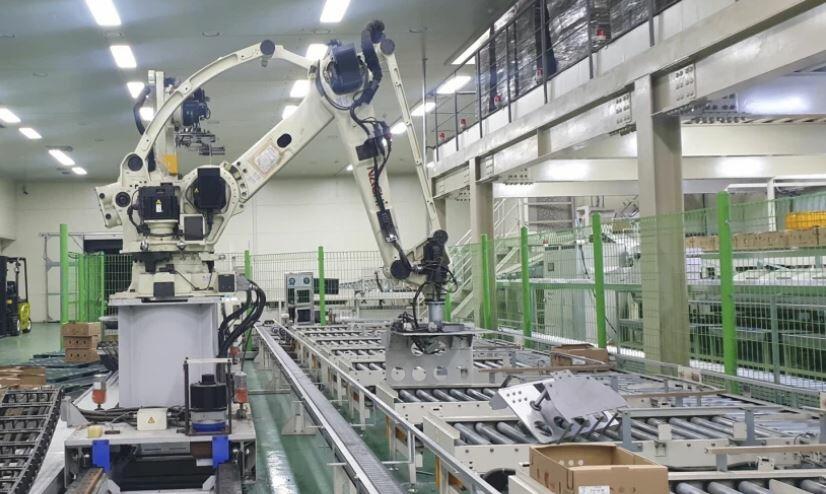
A man in South Korea was crushed to death by a machine which apparently failed to differentiate him from the boxes of produce it was handling, according to Yonhap news.

This photo provided by the South Korea Gyeongsangnam-do Fire Department shows the interior of a vegetable packaging plant after a robot’s deadly crush with a worker was reported in Goseong, South Korea, in November 2023. South Korea Gyeongsangnam-do Fire Department via AP

The man, a robotics company worker in his 40s, was in the process of inspecting the robot’s sensor operations at a distribution center for agricultural produce in the Gyeongsang province.

The robot – having been tasked with lifting boxes full of bell peppers onto a pallet, appears to have identified the man as a box, according to local police.

The robotic arm pushed the man’s upper body down against the conveyor belt, crushing his face and chest, according to Yonhap.

He was transferred to the hospital but died later, the report said. -The Guardian

Donggoseong Export Agricultural Complex, the company that owns the vegetable plant, has called for safer, improved systems surrounding the testing and implementation of robotics.

According to Globalnews.ca, “The pick-and-place robot involved in the incident is one of two machines used in the pepper factory. These machines are common in South Korea’s agricultural communities, which are struggling with a declining and aging workforce.”

“It wasn’t an advanced, artificial intelligence-powered robot, but a machine that simply picks up boxes and puts them on pallets,” according to Kang Jin-gi, who heads the investigations department at Gosong Police Station.

The incident follows one in March, after a South Korean man was trapped by a robot in an automobile parts manufacturing plant, per BBC News.

According the NY Daily News, South Korea has the third-worst industrial safety record of countries in the Organization for Economic Co-operation and Development, according to the Korea Economic Institute of America.

Tyler Durden
Mon, 11/13/2023 – 04:15

Europe Taps Record-High Natural Gas Storage As Temperatures Drop

0
Europe Taps Record-High Natural Gas Storage As Temperatures Drop

Authored by Tsvetana Paraskova via OilPrice.com,

Traders have begun withdrawing natural gas from Europe’s record-high inventories this week as the weather turned colder and heating demand rose.

The gas storage sites in the EU were 99.57% full as of November 8, according to data from Gas Infrastructure Europe. In the past few days, most EU countries have made consecutive small net withdrawals of gas from their storage, the data showed.

These were the first consecutive net withdrawals from Europe’s gas storage since April—the end of the previous winter heating season.  

Withdrawals may accelerate this weekend as some parts of Europe could see lower-than-normal temperatures, but next week many countries are expected to return to typical or above-normal temperatures.

LSEG analysts expect temperatures in France and Germany could be 2-5 degrees Celsius higher than normal at the beginning of next week, Reuters reported on Friday.

Continued weak demand and forecasts for higher temperatures next week sent the front-month Dutch TTF Natural Gas Futures, the benchmark for Europe’s gas trading, plunging by 3.8% as of 11:25 a.m. GMT on Friday.

Despite the nearly full inventories, Europe is not out of the woods yet as a cold winter and potential supply disruptions could tip the balance into deficit and send prices soaring.

Volatility is expected to continue, also because of the threat to supply from the Eastern Mediterranean in case of a flare-up in the Hamas-Israel war.

“The (Dutch) TTF near curve will still likely carry a substantial amount of risk premium related to the typical weather risks and concerns over tension escalation in the Middle East,” Energy Aspects analysts said, as quoted by Reuters.

For now, Europe’s natural gas demand continues to be weak after last year’s energy crisis and most of the demand destruction will likely be permanent, according to France’s utility giant Engie.

But analysts and industry professionals told Bloomberg earlier this month that Europe’s gas demand could begin to rise this winter with higher electricity consumption in major markets and easing industrial demand destruction in the Eurozone.

Tyler Durden
Mon, 11/13/2023 – 03:30

The Cities That Graze The Skies

0
The Cities That Graze The Skies

The metropolis of Hong Kong is the city with the most skyscrapers measuring over 150 meters tall in the world, according to data from the Council on Tall Buildings and Urban Habitat.

As Statista’s Anna Fleck points out, the city’s first two serious high-rises (Hopewell Centre and Sun Hung Kai Centre) – each at over 200 meters tall – were built in the early 1980s, followed by a sea of 550 more skyscrapers, each above the 150 meter mark, in the years since.

Infographic: The Cities That Graze the Skies | Statista

You will find more infographics at Statista

In second and third place, with 390 and 316 buildings, respectively, over 150 meters high, are the Chinese metropolis of Shenzhen and the economic capital of the United States, New York.

Dubai comes fourth in this ranking, with a total of 258 buildings of this scale. The city is home to the tallest skyscraper in the world, the Burj Khalifa, which measures some 828 meters.

Are we entering a new chapter of the Skyscraper Curse?

Tyler Durden
Mon, 11/13/2023 – 02:45