113 Million People Will Join The Global Middle-Class In 2024
Every year, over 100 million people enter the global middle class.
Defined by the World Data Lab as someone who spends at least $12 per day (measured in 2017 purchasing power parity), these individuals are typically rising up in developing regions like Asia and Africa.
World Data Lab expects 113 million people to join the global middle class in 2024, with the vast majority coming from Asia.
The following table includes the data we used to create this graphic, at a regional level (figures rounded).
Based on these figures, we can conclude that Asia will contribute 81% of new consumers in 2024.
Highlights from Asia
The following table breaks down Asia’s 91 million new consumers for 2024, by country. Note that only countries which contribute at least 1 million consumers were broken out, with the rest grouped into “Other”.
As expected, China and India are projected to be the two biggest sources of additions to the global middle class in 2024. Both countries have massive populations, rising income levels, and high rates of urbanization.
Further down the list we can see Indonesia and Bangladesh adding 5 million consumers each. Both of these countries have an expansive population pyramid, meaning they have a relatively young average age and growing labor forces.
It’s interesting to note that many of the countries listed above, including Vietnam, Philippines, and Thailand, also happen to be some of the fastest growing e-commerce markets in the world.
Highlights from Africa
Egypt and Nigeria are the only countries from the Africa region that will contribute more than 1 million consumers in 2024. Once again, both countries are characterized by their high growth potential and above-average birth rates.
In fact, by 2075, Goldman Sachs believes that Egypt and Nigeria could become the fifth and seventh largest economies in the world, surpassing traditional economic leaders like Japan, Germany, and the UK.
Ireland is reaching its capacity of the number of refugees it can accommodate, Prime Minister Leo Varadkar has admitted…
Speaking in the Dáil, the lower house of the Irish parliament, on Wednesday, Varadkar revealed that his administration would struggle to handle another influx of migration next year if the number of new arrivals remained as high as it is currently.
It’s important to note that the Irish government has the ability and is primarily responsible for setting the number of refugees arriving in the country.
Local governments would not be in a position to provide accommodation to another 50,000 people “if that number arrived over the course of the next year,” Varadkar said, warning that such a figure was realistic based on current trends.
“Based on current numbers, it wouldn’t be far off that, and we just don’t know if we’re able to provide that level of accommodation,” he added.
The Irish prime minister told lawmakers that there is a “limit” to the number of refugees a country can provide for, and claimed that Ireland is “very much” at that limit currently.
The liberal leader’s realization of the pressures facing Ireland’s communities as a result of his administration’s asylum and immigration policy has been gradual.
Michael Leahy, the chairman of the Irish Freedom Party, told this site earlier this week that “Ireland has received a higher proportion of Ukrainian refugees per capita than any other EU country with the exception of Poland, despite being the country farthest from the war zone.”
At the beginning of the Russian invasion of Ukraine in February last year, Varadkar issued a staunch commitment to mass migration and accepting as many refugees as possible.
By November last year, despite beginning to express some concerns about the number of new arrivals amid murmurs of discontent among local communities, the Irish leader said, “We’ll do everything we can to provide them with shelter, and that will range from accommodation in people’s homes to retrofitting old warehouses, office blocks, using hotels, using modular housing and rapid build.”
However, by May 2023, Varadkar began to accept the realities of the pressures on public services as a result of his government’s asylum policy.
New data suggest scientists have discovered a medication first designed to treat COVID-19 may also lessen the time it takes for two common symptoms of the disease: loss of taste and smell—to disappear.
The oral antiviral drug ensitrelvir (brand name Xocova) was granted a Fast Track designation by the U.S. Food and Drug Administration (FDA) to be investigated as a potential treatment for COVID-19 in April. Soon after, results from randomized clinical trials published in Clinical Infectious Diseases showed ensitrelvir was safe, effective, and successful in suppressing viral replication in patients with mild to moderate COVID-19.
Ensitrelvir is now gaining traction as a potential solution to address COVID-19’s symptoms of loss of taste and smell—two sensory problems that can linger for up to years after the acute infection has subsided. The drug’s multipurpose use is based on the results of a study by researchers from the drug’s co-developer, pharmaceutical giant Shionogi Inc., a United States subsidiary of Shionogi & Co. Ltd. based in Osaka, Japan.
Ensitrelvir Improves Taste and Smell Symptoms
In a poster presentation, Shionogi presented data demonstrating that patients given ensitrelvir within three days of the onset of symptoms may have benefited from the medication by preventing or reducing the loss of taste and smell. Researchers also presented their analysis of the phase 2/3 clinical study results, showing a “significantly smaller proportion of patients had taste disorder or smell disorder on Day 7 when treated with 125 [milligrams] of ensitrelvir versus a placebo,” according to a news release.
“As an investigator who has evaluated both clinical data and real-world experience with ensitrelvir, I am optimistic about its potential to become an important tool in managing the unpredictability of COVID-19,” said Dr. Yohei Doi, a professor of medicine at Fujita Health University in Japan, said in the news release. “The new data … offer another reason to have confidence in this investigational agent and its potential to be a meaningful treatment option for patients.”
The findings were presented in Boston at the October 2023 IDWeek meeting, an annual conference that brings together infectious disease specialists and epidemiologists from around the globe.
Ensitrelvir remains an investigational drug, having received emergency approval in Japan in November 2022 to treat COVID-19. It has not been approved for use outside of Japan. However, Takeki Uehara, senior vice president of drug development and regulatory science at Shionogi, hopes this will change.
“The data we are seeing in Japan are promising as we work to meet unmet medical needs of COVID-19 and make ensitrelvir available worldwide, pending regulatory approvals,” he said in the same news release.
Loss of Taste and Smell in US Adults
A 2023 paper published in Laryngoscope showed 35.8 million U.S. adults—or 14 percent of the population—were diagnosed with COVID-19 in 2021. Among those, an estimated 60.5 percent reported losing their sense of smell, while 58.2 percent reported loss of taste.
Most patients (over 72 percent) completely recovered their sense of smell post-infection. However, about 1 in 4 people affected recovered only partially. Approximately 4 percent said their sense of smell had not yet returned.
Taste function recovery was similar, with most (about 77 percent) regaining their sense of taste, while 1 in 5 reported partial recovery. Under 3 percent reported no recovery.
“The majority of adults infected with COVID-19 in 2021 experienced olfactory or gustatory dysfunction with a non-negligible population reporting incomplete or no near-term sensory recovery,” the authors wrote in the 2023 paper. “Our results are useful for providers counseling patients and suggest that interventions lessening overall COVID-19 symptom burden may prevent prolonged sensory dysfunction.”
Other Treatments
COVID-related loss of smell can negatively affect people in several ways, including significantly altering a person’s overall quality of life and leading to poor nutrition. Mental health issues like depression, anxiety, and low self-esteem have also been linked to loss of taste and smell.
Fortunately, smell recovery is possible through smell retraining therapy (SRT). The treatment involves repeated exposure to smells to elicit memories of familiar scents like flowers, fruits, spices, and essential oils.
Ear, Nose, and Throat (ENT) Health, an organization powered by the American Academy of Otolaryngology–Head and Neck Surgery, recommends patients sniff individual scents for at least 10 to 20 seconds once or twice a day. The four best scents are rose, lemon, cloves, and eucalyptus. Being entirely focused on the task is critical to stimulating memories of each smell. This should be followed by a few deep breaths before moving on to the next scent. Perform this exercise for at least three months.
Regaining taste is also possible. Experts at the University of Texas MD Anderson Center recommend the following:
Introduce lemon into your diet because the tart flavor stimulates saliva and taste buds.
Integrate sweet, salty, spicy, and sour foods like pickles, olives, hot sauces, and a variety of salad dressings.
Play around with foods that provide texture, like apples, celery, or sticky peanut butter.
In the days before Covid, doomsday preppers were ridiculed and shunned as part of the fringe minority. Now, they’re being celebrated with their own spread in the The Wall Street Journal entitled: “Who Counts as a Disaster Prepper These Days? Lots of Us”.
In the article, the Journal points out that there is a “renewed interest in self-reliance” in stocking for emergencies. The article asks whether it has to do with supply chain shortages and empty grocery shelves.
We can’t help but ask if it could be people want to front load items before additional 10% annual price hikes? Or if it could possibly have anything to do with the fact that we appear to be on the brink of World War 3? They don’t mention in so many words and we…well, we digress.
What the article does note is that increasing sales of ready-made emergency kits and recent surveys suggest that Americans are now more inclined to maintain emergency provisions than they were in the past.
The Journal writes that approximately 33% of the 2,179 U.S. adults polled by financial-services firm Finder in April reported spending an average of $149 over the last year on essentials like non-perishable food, medical supplies, and bottled water. This marks an increase from the roughly 20% who indicated doing so in 2020.
One 39 year man told the Journal: “I’m a PlayStation 5, love-my-comfort guy” and swore he wasn’t a prepper. Yet he has 4 bags packed with “snacks, flashlights, water and coloring books for his two young sons” in case of emergency now hanging in his closet.
“It’s taking rational steps to ensure we have the ability to act quickly in those moments,” he added. He cited natural disasters mostly, but also the war in Ukraine as reasons for his prepping: “It’s less that we’re trying to survive the end of the world, and more that we have no idea when an earthquake or tornado is going to happen.”
“People are becoming more and more aware of the problems in the world and how fallible things are,” added John Ramey, founder of self-reliance training site The Prepared. “It’s a totally new market,” added Marlon Smith, who runs a $300 Urban and Outdoor Survival class.
In New York City, Alexjandria Edwards, said she keeps a tent, sleeping bag and water-filtration system in her apartment. She admits it “feels silly” sometimes but wound up purchasing disaster packs off Amazon for about $100 each.
“It’s actually for a family of four, but I was like, ‘You know what? Better to be safe,’” she concluded. She has also been watching videos online about “homeopathic healing and learning to grow her own windowsill vegetable garden” because she worries about food availability.
Good luck with that. You can read the Journal’s full report here.
Last week, in the trial of former crypto billionaire Sam Bankman-Fried, details emerged about how the now–disgraced entrepreneur attempted to co-opt U.S. senators from both the Republican and Democratic parties.
With $50 million in donations to secretive dark money vehicles linked to both party’s respective Senate leaders, Chuck Schumer and Mitch McConnell, Bankman-Fried presumably sought to influence future crypto regulations.
Had the 31-year-old former “crypto king” not run afoul of the law, we might never have learned of the donations. The only reason the American people are aware of this influence-buying is because Bankman-Fried allegedly made the donations with stolen investor money.Had Bankman-Fried not been the head of a company engaging in criminal acts, the dark-money contributions to Schumer, McConnell, and other members of Congress would presumably have been legal and likely never come to light.
While the crypto market is still just a fraction of the size of the global stock market, it has grown exponentially over the past decade. At current market prices, there’s roughly $2 trillion of crypto assets in circulation. That’s about the size of France’s annual GDP.
The $50 million that Bankman-Fried spent to secretly buy influence was small in comparison to the size of the industry, but it likely would have given him outsized control over the writing of crypto regulations. Senators from both sides of the aisle would have been encouraged to take his calls and meet with his lobbyists. The Senate majority leader and ranking Republican might have made calls to various regulatory bodies to check up on proposed regulations or provide “feedback” to rules being considered.
Drafts of potential legislation would have been shared with Bankman-Fried and his team before they were shared with the full Senate. Objectionable provisions would have been crossed out and replaced with more favorable terms. Rules that benefited Bankman-Fried’s company, FTX, at the expense of competitors, would have mysteriously made their way into the legislation.
Journalists, unaware of Bankman-Fried’s philanthropy to Club McConnell and Club Schumer, would be producing feel-good stories about the way Congress came together to enact bipartisan legislation to protect the public from unscrupulous operators.
Fortunately, none of that came to pass. But what does it say about our system that it could have happened and would have been considered perfectly legal? Without full disclosure of all campaign spending, reporters and, more importantly, the American people, would have no way of knowing the motivations of their elected leaders. And no politician could be held accountable for conflicts of interest.
With all the talk over the past several months of the ethically challenged behavior of various Trump and Biden family members, the American people are clamoring for Congress to pass rules to fix our broken and corrupt political system.
This isn’t a new issue. In a polling project first commissioned by Jimmy Carter’s pollster, the late Patrick Caddell, the problem of government ethics and corruption has been one of the top two voter concerns for more than a decade. The behavior of the first families of the Democratic and Republican parties has brought the issue into focus for even more Americans to see.
In the polling done by Caddell, over 80% of Americans agreed with the statement, “Washington, DC is a rigged game that only benefits those people who can buy access to power.”
Sam Bankman-Fried’s behavior only reinforces that belief. While the Supreme Court’s ruling in Citizens United v. Federal Election Commission confers the right of billionaires to spend millions buying influence through election spending, it doesn’t guarantee them the right to anonymity.
Bankman-Fried’s trial is expected to last into the middle of next month. No doubt, more details of his political spending will emerge. Congress should use this backdrop to enact legislation requiring full disclosure of all political spending and end the era of special interest and mega–donor dark money influence in America.
Greg Orman is a Kansas entrepreneur, author of “A Declaration of Independents,” and a former independent candidate for governor and senator of his state. His website is www.greg-orman.com.
Rep. Matt Gaetz (R-Fla.) on Wednesday declared the election of Rep. Mike Johnson (R-La.) as House speaker a sign of the strength of the “MAGA movement” in the GOP and the waning power of the “swamp.”
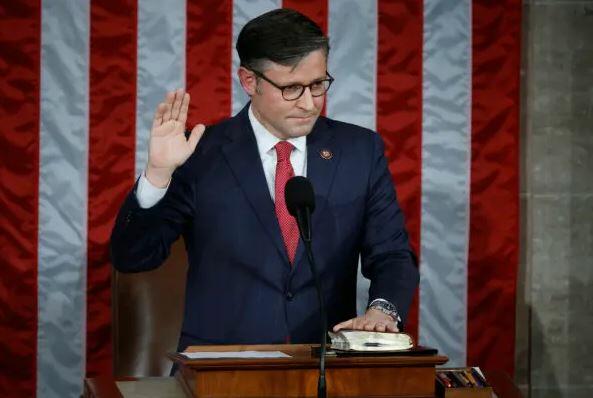
After a three-week leadership void in the House, the GOP conference chose Mr. Johnson as their speaker nominee; he went on to win 220 votes in the first floor ballot on Wednesday.
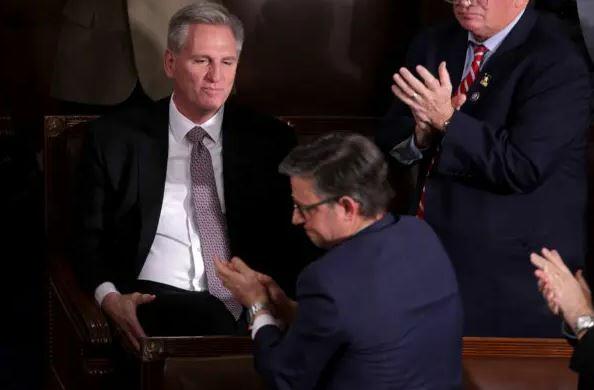
Mr. Gaetz, who led the motion to oust Rep. Kevin McCarthy (R-Calif.), the former speaker, touted Mr. Johnson’s victory as exemplary of the growing power of the “MAGA movement” on Capitol Hill.
“The swamp is on the run. MAGA is ascendant. If you don’t think that moving from Kevin McCarthy to MAGA Mike Johnson shows the ascendance of this movement and where the power in the Republican Party truly lies, then you’re not paying attention,” Mr. Gaetz declared during an interview on Steve Bannon’s “War Room” podcast on Wednesday.
The Floridian congressman shed light on the internal party deliberations that led to Mr. Johnon’s election following the short-lived race of Rep. Tom Emmer (R-Minn.), who withdrew his name hours after receiving the GOP nomination on Tuesday.
Mr. Johnson was runner-up to Mr. Emmer, who was the third speaker nominee after Reps. Steve Scalise (R-La.) and Jim Jordan (R-Ohio) failed to garner the needed support.
Mr. Gaetz said that following Mr. Emmer’s withdrawal, Mr. McCarthy was the sole GOP member to object to a request by Rep. Marcus Molinaro (R-N.Y.), a freshman congressman, for unanimous consent to waive the rules and take a non-binding poll on whether Mr. Johnson “could be our speaker nominee.”
Mr. McCarthy’s objection, in Mr. Gaetz’s view, was evidence that the former speaker “was worried that there was going to be this great, unifying moment” of rallying behind Mr. Johnson that would hurt Mr. McCarthy’s chances of being reelected, so “he scuttled the unifying moment.”
Mr. McCarthy had not put his name in the ring to run again for the speakership.
The Epoch Times contacted Mr. McCarthy’s office for comment.
Gaetz Says He ‘Wasn’t the Force for Chaos’
Mr. Gaetz said that Mr. McCarthy sought write-in votes, nominating himself. However, he received only 33, according to Mr. Gaetz.
“So, they flame out terribly,” Mr. Gaetz said. “Mike Johnson’s gaining momentum. Ultimately, McCarthy gets 43 to vote for him on a secret ballot. But Mike Johnson gets a majority.“
Mr. Johnson then requested a roll-call vote, said Mr. Gaetz. “So that those 43 would have to announce themselves as being for a candidate who wasn’t even running, instead of a unifying force like Mike Johnson,” he added.
“And when we called for the roll call, do you know how many people voted for Kevin McCarthy? Zero,” said Mr. Gaetz.
Mr. Gaetz accused the former Californian speaker of attempting to sabotage the chances of the last four speaker nominees, including Mr. Scalise, Mr. Jordan, Mr. Emmer, and Mr. Johnson, while maneuvering in the shadows to be reelected himself.
“Everyone in the room knew at that moment that I wasn’t the force for chaos; I wasn’t causing disunity; that for the last three weeks, the reason the House of Representatives has been paralyzed is because, for his own selfish gain, Kevin McCarthy was sabotaging the candidacy of anyone else because he was plotting a return,” Mr. Gaetz charged.
Mr. Johnson received a prolonged standing ovation from fellow Republicans upon his nomination by Conference Chair Elise Stefanik (R-N.Y.).
Mr. Gaetz hailed Mr. Johnson’s election to the speakership as a victory over “the swamp,” the term made popular by former President Donald Trump, the creator of the MAGA movement, which stands for Make American Great Again, his 2016 campaign slogan.
“They are crying, they are hand-wringing, they are bed-wetting over on K Street because we have an honorable, righteous man who is about to take this position. He’s going to do great things for the country,” Mr. Gaetz said, referring to “the swamp.”
Mr. Gaetz, who has been “seat mates” with Mr. Johnson on the House Judiciary Committee for seven years, praised the newly-minted speaker.
“He is sharp. He will be as respected in the homes of our most meaningful, righteous, and patriotic donors as he will [be] at the rallies with our most enthusiastic and meaningful activists,” Mr. Gaetz said.
Mr. Johnson’s election was praised by the former speaker nominees, Mr. Emmer and Mr. Scalise.
“I know Mike will keep our majority united as we continue to deliver on the commitments we’ve made to our constituents,” Mr. Emmer said.
Mr. Scalise praised Mr. Johnson’s commitment “to things bigger than himself.”
Mr. Johnson, 51, is an attorney and former radio host. He carried a Bible when he accepted the gavel on Wednesday.
In his first speech as speaker, he said the House is “ready to get to work again” to solve the problems at home and abroad affecting Americans.
“Our mission here is to serve you well, to restore the people’s faith in this House, in this great and essential institution,” he said.
US Warplanes Conduct Major Strikes On ‘Iranian Proxies’ In Syria
Update(22:25ET): In the overnight and early morning hours in Syria (local time), US forces carried out airstrikes on what it said are Iran-linked militants and installations in eastern Syria. Multiple targets have been hit.
According to a statement by Secretary of Defense Lloyd Austin, “Today, at President Biden’s direction, U.S. military forces conducted self-defense strikes on two facilities in eastern Syria used by Iran’s Islamic Revolutionary Guard Corps (IRGC) and affiliated groups.” The attacks were reportedly done by US warplanes, likely operating out of either the Gulf or Mediterranean areas where new US naval assets have recently been positioned, keeping a watch on fast moving events in Gaza. Fox issued the following breaking detail:
F-16s and F-15s were used to strike targets in Syria earlier tonight in retaliation for the attacks on US troops in the region.
Earlier in the day there were reports, though with few details, that US forces in the same northeast region of Syria came under attack, as has been happening in the last several days. The Pentagon had also earlier announced that over a dozen US troops in Iraq and Syria have suffered Traumatic Brain Injury (TBI) in the aftermath of drone and rocket attacks on US bases in the region.
JUST IN — U.S. warplanes have conducted air strikes against Iranian proxies in multiple locations in Syria. pic.twitter.com/agKA4sc0Kx
Below is the full Pentagon statement, which seeks to emphasize that this new, high-risk military aggression is supposedly “separate” from the Israel-Gaza conflict…
BREAKING: Secretary of Defense Lloyd Austin released a statement regarding the US Airstrikes on sites used by Iran’s Revolutionary Guard Corps and other Iranian-proxies in Northeastern Syria pic.twitter.com/MdCvMPRNMz
The United States is also seeking to reassure a region which is clearly at heightened risk for breaking out into major war that it “does not seek conflict”. But the long-running military occupation of Syria’s oil and gas region suggests otherwise.
* * *
Update(1520ET): In the Pentagon’s latest move to bolster US defenses in the Middle East against the ‘Iran threat’ – given the increased instances of Tehran proxies attacking US troop installations in Iraq and Syria over the last week – some 900 more Americans soldiers will be dispatched to the region.
A CBS correspondent has cited Pentagon Press Secretary, Gen. Patrick Ryder, who says 900 US troops have deployed or in process of deploying to bolster missile defense in CENTCOM’s mideast region of operations. They are expected to man Patriot, THAAD and Avenger missile systems. Earlier this week US defense officials said these extra missile batteries are being deployed to the theatre ahead of an expected Israeli ground offensive in Gaza.
The CBS reporter noted “This comes as Iranian-backed groups continue to attack US miliary in Iraq and Syria.” Fears are growing that a major IDF push into the Gaza Strip would unleash broader retaliation strikes on US bases in the region. This could include Hezbollah, which operates both in Lebanon and Syria.
Israel’s “preparation” strikes for the “next stage of war” – according to its officials – have continued to grow in intensity…
🇮🇱🇵🇸 The power of those missiles, and the speed in which a building can be taken down, is hard to imagine.
Iran has become more vocal in its threats against Israel, in response to the soaring death toll in Gaza, which has surpassed 7,000 Gazans killed. Prime Minister Netanyahu has at the same time announced “thousands” of terrorists have been eliminated by the Israel Defense Forces (IDF). Israel has further said it took out three top Hamas commanders in the last several hours.
On Thursday, Hossein Salami, the commander-in-chief of Iran’s elite Islamic Revolutionary Guard Corps (IRGC) warned that if Israel sends ground forces into the Strip, the IDF will be “buried”. He stated: “If the Zionists launch a ground attack in Gaza, they will be buried. If the enemies think that the Muslims will watch these crimes from the sidelines, they are gravely mistaken,” according to a translation in regional media. He also aimed the comments at Washington, saying “the US will be buried by the fire they lit.”
“If the evil people of the world want to carry out a foolish act such as invading the Palestinian territories, they will face a miserable failure and receive a decisive response from the resistance front,” the IRGC statement added.
The US has already parked one carrier strike group in waters off Israel, with another en route, and has been repeatedly warning Tehran not to get involved. National security spokesman John Kirby this week said the US administration stands ready to mount a “decisive response” if Iran or its proxies attack US bases.
However, this appears to already be happening. There has been well over a dozen drone and missile attacks on bases in Iraq and Syria over the past week, with the latest happening Thursday.
There are fresh reports that Iraqi Shia militia groups have launched cross-border attacks on a US installation in northeast Syria. These sporadic attacks now threaten to become a daily event. And now this from Politico on Thursday…
Nineteen American service members stationed in Iraq and Syria have been diagnosed with traumatic brain injury after rocket and drone attacks from Iran-backed militants last week. https://t.co/dRkEbclN1U
Adding further to tensions between Washington and Tehran, fresh Wall Street Journal reporting this week has found that Hamas operatives behind the Oct.7 terrorist attack were given specialized training in Iran. According to the report, this involved up to 500 militants:
In the weeks leading up to Hamas’s Oct. 7 attacks on Israel, hundreds of the Palestinian Islamist militant group’s fighters received specialized combat training in Iran, according to people familiar with intelligence related to the assault.
Roughly 500 militants from Hamas and an allied group, Palestinian Islamic Jihad, participated in the exercises in September, which were led by officers of the Quds Force, the foreign-operations arm of Iran’s Islamic Revolutionary Guard Corps, the people said.
Senior Palestinian officials and Iranian Brig. Gen. Esmail Qaani, the head of Quds Force, also attended, they said.
But then strangely, the same report quotes US officials as saying they can’t verify whether the training on Iranian soil was directly in preparation for the Oct.7 attacks (or else possibly “routine”), which took the lives of at least 1,400 Israelis and foreigners.
“U.S. officials said Iran has regularly trained militants in Iran and elsewhere, but they have no indications of a mass training right before the attack,” WSJ writes. “U.S. officials and the people familiar with the intelligence said they had no information to suggest Iran conducted training specifically to prepare for the events of Oct. 7.”
🚨BREAKING – IRANIAN ARMY:
‘The start of large-scale maneuvers for all ground forces formations starting tomorrow’
These exercises are typically conducted to enhance readiness, test strategies, and improve the overall operational capabilities of the military, but could also be… pic.twitter.com/bA4PhZ3ww3
Given the fact that the terror assault involved paragliders, militants on motorcycles, coordinated assault teams with explosives, and other capabilities not used this effectively in the past – many analysts believe the planning for the attack had to have taken many months or even years.
Show Me The Money: Comer Demands White House Prove $200K Biden-Brother Loan
House Oversight Committee Chairman James Comer on Thursday says his panel doesn’t have a money trail showing that President Biden ever loaned his brother James $200,000, after a suspicious payment took place the same day James received $600,000 in loans from rural hospital operator, Americore.
The $200,000 check, written in 2018, was explained by the White House as the repayment of a loan – however Comer has his doubts, according to Just the News.
“The White House has claimed Joe Biden loaned James Biden $200,000, and this check was repayment,” Comer wrote to White House counsel Edward Siskel. “Records obtained by the Committee do show numerous large incoming transactions into the personal account of James and Sara Biden from various entities. Some of these transaction records may have obscured the identity of the true payer, but no records in the Committee’s possession state that Joe Biden made a large loan payment to his brother.”
“If Joe Biden did personally loan James Biden an amount that was later repaid by the $200,000 check, please provide the loan documents, including the loan payment, loan agreement, and any other supporting loan documentation,” Comer continued.
James Biden allegedly received $600,000 in loans from Americore after convincing the firm he could use the family name to “open doors” and secure a large investment from the Middle East, the Kentucky Republican claimed last week. Comer has since suggested that, even if the president did give his brother the money in the form of a loan, the transaction was nonetheless evidence of personal benefit from his family’s business activities. -Just the News
“Whether it was a loan or not, James Biden’s March 1, 2018, check to Joe Biden aptly demonstrates one way he personally benefited from his family’s shady influence peddling of his name and their access to him,” Comer wrote to Siskel. “Even if the transaction in question was part of a loan agreement, we are troubled that Joe Biden’s ability to recoup funds depended on his brother’s cashing-in on the Biden brand.”
An intruder was arrested on the morning of Oct. 25 at Independent presidential candidate Robert F. Kennedy Jr.’s Los Angeles property, after being detained by Mr. Kennedy’s security detail, according to police.
A spokesperson for the Los Angeles Police Department (LAPD) told The Epoch Times officers responded to a burglary call around 9:30 a.m. Wednesday, and when they arrived, a blonde, white male wearing a green t-shirt was detained by security at Mr. Kennedy’s home in the Brentwood neighborhood.
Authorities said the man, Jonathan Macht, 28, was taken into custody at a nearby police station where he was cited for trespassing and then released.
Police said he then returned to the Kennedy’s home and was arrested a second time at 5:45 p.m. for violating a protective order.
He is currently being held on $30,000 bail.
According to a Thursday press release by Mr. Kennedy’s campaign, the presidential candidate was at home at the time of both arrests.
“After being released from police custody, the man immediately returned to Kennedy’s residence,” states the release.
According to the press release, the intruder entered the property by climbing a fence and is known to the U.S. Secret Service and Mr. Kennedy’s security Gavin de Becker and Associates (GDBA).
“GDBA had notified the Secret Service about this specific obsessed individual several times in recent months, and shared alarming communications he has sent to the candidate,” states the release.
In September, an armed man accused of posing as a federal marshal at an event attended by Mr. Kennedy was arrested and charged with misdemeanors, according to the Los Angeles City Attorney’s office.
At the time of the arrest, Mr. Kennedy was scheduled to speak at the Wilshire Ebell Theatre, at 4401 W. 8th St. in Los Angeles, to celebrate National Hispanic Heritage Month. The event ran from 4 to 8 p.m on Sept. 15.
According to the LAPD, a call was received reporting a male in front of the event venue with “a badge on [his] lapel, a gun, and a shoulder holster,” who “claimed to be a U.S. Marshal,” a spokesperson told The Epoch Times. The suspect, Adrian Paul Aispuro, 44, was initially booked on a felony gun charge, before later being charged with carrying a loaded firearm, carrying a concealed firearm, and impersonating an officer, all misdemeanors.
Police said the suspect claimed to be employed for the event but wasn’t recognized by Mr. Kennedy’s security team.
Requests for Protection
According to Mr. Kennedy’s campaign, two requests for Secret Service protection as a presidential candidate have been denied by the Department of Homeland Security (DHS) in recent months.
“Every presidential administration for 55 years has afforded early protection to candidates who requested it. The Biden administration is the sole outlier,” the campaign stated.
This is the Kennedy campaign’s third formal request, according to the release.
“Since the assassination of my father in 1968, candidates for president are provided Secret Service protection,” Mr. Kennedy wrote on X. “But not me.”
According to U.S. law under “18 USC 3056A,” the U.S. Secret Service is tasked to provide protection to “major presidential and vice presidential candidates and, within 120 days of the general Presidential election, the spouses of such candidates.”
The secretary of the DHS, currently Alejandro Mayorkas, is tasked with identifying “major” candidates in a presidential race in consultation with the speaker of the House, the House minority leader, the majority and minority leaders of the Senate, and one additional member selected by the other members of the committee, which as a whole isn’t answerable to the incumbent president.
DHS has yet to comment on its decision.
Mr. Kennedy called for the Biden administration to provide protection in early August, after one of Ecuador’s presidential candidates, Fernando Villavicencio—who vowed to fight corruption in the country—was assassinated.
After Mr. Kennedy’s father was assassinated, the U.S. Secret Service expanded its protection coverage to presidential and vice presidential candidates, according to its website.
Following the Sept. 15 incident, Mr. Kennedy wrote on X, “I’m still entertaining a hope that President Biden will allow me Secret Service protection.”
“These Kids Have Sh*t For Brains”: Billionaire Leon Cooperman Slams Columbia Protesters, Halts Donations
Hedge fund Billionaire and Columbia alum Leon Cooperman says he’s pulling donations from his alma matter over its support of pro-Palestinian activists.
In an interview with Fox Business, host Liz Claman said to Copperman:
“You are a proud graduate of Columbia Business School, class of 67, son of Polish Jewish immigrants, first in your family to graduate from college,” asking “what do you make of what’s happening at Columbia and Harvard, Stanford, NYU as well?
There was a student walkout at Columbia just a couple hours ago, driven by Columbia professor Joseph Massad, who called the Hamas attack ‘awesome.’ Where are we in the world when 1,300 Israeli civilians…”
Cooperman interrupted her, exclaiming:
“I think these kids at the colleges have shit for brains.“
“We have one reliable ally in the Middle East,” Cooperman continued. “That’s Israel.”
“We only have one democracy in the Middle East. That’s Israel, ok?”
“And we have one economy tolerant of different people – gays, lesbians, etc. And that’s Israel. So, I have no idea what these young kids are doing.”
Cooperman then said he’d pull donations.
“Now, the real shame is I’ve given to Columbia, probably about $50 million over many years,” he continued.
“And I’m going to suspend my giving. I’ll give my giving to other organizations.“