UK Scraps Cap On Banker Bonuses In Post-Brexit Bid To Make London More Competitive
With the global economy teetering on the brink of an interest rate induced downward spiral, it might not be the best time in history to deregulate banker bonuses – but hey, a win is a win, right?
In a bid to try and boost the city of London in its post-Brexit world, the United Kingdom is doing away with a cap on banker bonuses that had been put in place by the European Union.
The rule had previously limited bonuses to double the employee’s base pay for employees of banks, Financial Times reported on Tuesday. Financial regulators in the UK had argued against the ban and current government argues it will make the city of London more competitive.
Bosses at banks didn’t like the rule to begin with, not only for obvious reasons, but also because it forced them to hike base pay to try and retain banking talent, instead of relying on incentives.
The Prudential Regulation Authority was one party, along with the Financial Conduct Authority, that helped review the rule. The PRA concluded: “Over recent years, the regulators consider that growing evidence has emerged of undesired consequences of the rules on firms’ safety and soundness and UK competitiveness.”
The PRA also argued that the cap “reduced companies’ flexibility to cut costs during a downturn,” FT wrote.
Originally instituted by the European Union, the bonus cap aimed to put an end to boundless bonuses that seemingly incentivized financial professionals to gamble with high-risk ventures, a practice criticized for contributing to the instability of the 2008-2009 global financial crisis not just in the UK, but also in the US.
In an effort to modulate these risks, the United Kingdom implemented additional regulations concerning salary and bonuses. Such regulations mandate that a fraction of bonuses be deferred over a span of years, with the provision for recouping these bonuses under certain circumstances, such as misconduct or underperformance.
In the wake of deliberations over lifting the bonus cap, UK regulators have emphasized the need for companies to strike a balance between fixed salaries and variable bonuses. The aim is to ensure that no employee becomes overly reliant on fluctuating remuneration in a way that could incite them to exceed the firm’s predefined risk tolerance.
A new Federal Reserve survey revealed that poverty climbed in 2022, and minorities struggled to obtain a portion of the national net worth increase during the pandemic.
The central bank’s triennial Survey of Consumer Finances (SCF) found that the real (inflation-adjusted) net worth of the typical U.S. household surged by 37 percent from 2019 to 2022, driven by higher home prices, stock appreciation, and government stimulus.
But not everyone has enjoyed the same level of gains in the last few years.
Fed data showed that the typical white family’s income jumped by 1.3 percent. But black and Hispanic families recorded income declines of 1.6 percent and 1.1 percent, respectively. Moreover, wages for all Americans failed to keep up with inflation.
Despite much of the net worth gains emanating from housing, an illiquid asset, real average liquid wealth did not grow for minorities, the Fed found.
“Overall, families were wealthier in 2022 than in 2019 and appear to have had sufficient income to cover their recurring expenses, but some of their ability to cover their expenses with income may have been due to transitory factors that temporarily buoyed incomes in 2021,” the report stated.
“While families can also cover expenses using wealth, particularly for Black and Hispanic families the gains in wealth were concentrated in housing, which is somewhat illiquid and may not be as useful as liquid wealth for covering recurring expenses. Real average liquid wealth, which includes assets such as cash, checking, and savings accounts, did not grow much for Hispanic families and fell for Black families.”
The report noted that minority households benefited more from crisis-era stimulus and relief efforts, like stimulus checks, sweetened unemployment benefits, enhanced food stamps, and childcare tax credits. However, now that most of these programs have expired, families nationwide are contending with above-trend inflation that is eroding every households’ purchasing power to differing degrees.
Since the beginning of the pandemic, consumers’ purchasing power has decreased by 16 percent.
Additionally, the portion of families reporting they were uncertain about next year’s income has risen yearly since 2019 for all ethnicities and races. But this uncertainty is more concentrated among black and Hispanic families, climbing 14.2 percentage points and 10.9 percentage points respectively.
“Once again, the cross-race patterns appear consistent with transitory income sources propping up families’ income that they did not expect to continue in the future, especially for non-White families,” the SCF said.
Economic pessimism was also widespread but it “was especially strong for non-white families.” The study’s respondents were more cynical about the U.S. economy’s future in 2022 than in 2019.
“The percent of families saying the future economy will be worse skyrocketed in 2022 across all races and ethnicities,” the report said. “In fact, the share of families expecting a worse economy is at or near record highs for all races and ethnicities.”
In the end, according to data from the Census Bureau, even with the pandemic-era wealth gains, the poverty rate swelled to 12.4 percent last year.
Bidenomics
President Joe Biden touted the U.S. economy at the Eisenhower Executive Office Building on Oct. 23, championing the successes that Bidenomics has enjoyed this year. President Biden spoke about the tech hubs and clean-energy jobs being planted across the country, whether in red states or in blue states.
“All this is part of my strategy to invest in America and invest in Americans,” President Biden said.
“It’s working. We’re creating good jobs in communities all across the country, including places where, for decades, factories have been shut down, hollowed out when jobs moved overseas to find cheaper employment.”
White House officials have been defending President Biden’s economic vision but their remarks have yet to persuade voters, particularly those residing in swing states, including Michigan, North Carolina, and Pennsylvania.
According to a Morning Consult report, about 3 in 4 swing-state voters argued that the U.S. economy is headed in the wrong direction. They reported that their financial situation was better under former President Donald Trump than President Biden.
About half (49 percent) of swing-state voters say Bidenomics is bad for the economy, and the same percentage picked former President Trump as someone they would trust more to handle the economy.
“It reveals that the president’s ‘Bidenomics’ pitch is not breaking through, as these voters are significantly more likely to trust his predecessor to handle their top voting issue,” the polling firm noted.
James Galbraith, a left-leaning economist and author, asserts that it will be tough to convince struggling Americans that the economy is doing well under the current administration.
“Whatever stories Americans are told about the strength of the economy under President Joe Biden, they are not going to be persuaded to look past the issue of their own living standards,” Mr. Galbraith wrote.
The first estimate of the third-quarter GDP growth rate will be released on Oct. 26, and estimates suggest an expansion between 4 and 5 percent. The U.S. economy added 336,000 new jobs in September, while the unemployment rate remained below 4 percent. However, real wages are down 3 percent since 2021, credit card debt is above $1 trillion, and pandemic-era savings are on the cusp of being eradicated.
Some economists purport that while the headline numbers are strong, issues underneath are starting to fester.
Israel Economy Hammered By War With Hamas – Central Bank Holds Rate At 4.75%
The Oct. 7 attack by Gaza-based Palestinian militant group Hamas has not only exacted a bloody toll on Israel, but now a mounting economic one as well. That reality was underscored by Tuesday statements issued by the country’s central bank, which simultaneously warned about the economic road ahead while assuring markets that the bank would take efforts to dampen the war’s impact.
The Bank of Israel said it has revised its macroeconomic forecast in light of the war, but noted the projection “is accompanied by particularly high uncertainty.” Much of that uncertainty pivots on the future scope of warfare, which has the potential to explode into a regional conflagration involving Lebanon-based Hezbollah, Iranian-backed Shiite militias, Iran and other states forces.
The size of the conflict will be driven in part by Israel’s actions. The Israel Defense Forces (IDF) is reportedly eager to plunge into a full-on ground invasion of densely-populated Gaza, while civilian leaders have yet to give the go-ahead. For its projection, the bank used a relatively optimistic scenario: “Under the assumption that the war will be concentrated on the southern front during the fourth quarter of the year, GDP is expected to grow by 2.3% in 2023 and by 2.8% in 2024.” The bank had previously projected 3.0% for both years.
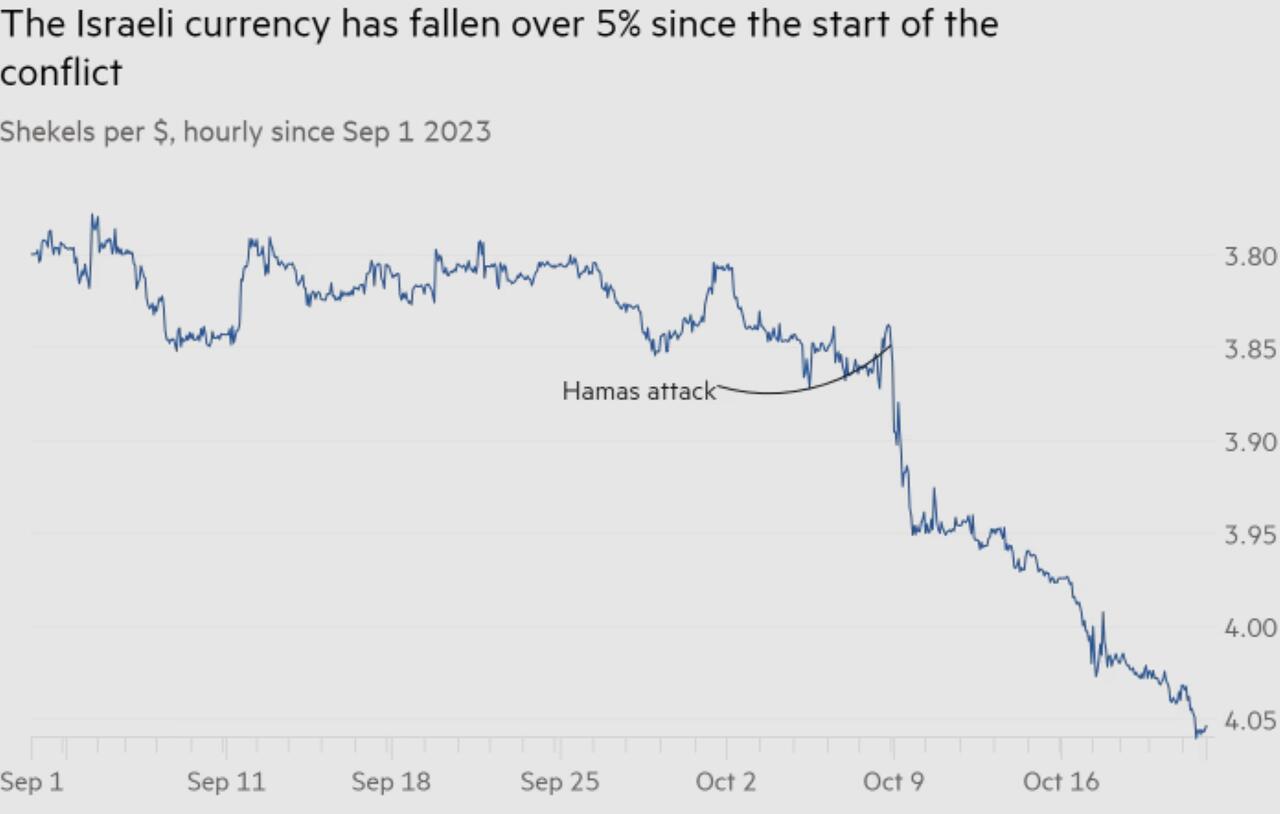
Since the Hamas attack that killed some 1,400 people in Israel, the TA-35 Index comprising 35 large, Israel-listed companies has shed 9%, while the shekel has fallen more than 5% against the US dollar — an 8 1/2-year low. Ratings agencies like Fitch and Moody’s have signaled Israel’s credit rating could be downgraded.
The top-down indicators are underscored by plenty of anecdotal reporting from Israel. The Financial Times points to a brewery where production has plunged from 50,000 litres of beer a month to zero since the attacks. Only 2 of the brewery’s chain of 14 restaurants are still open, and traffic is sparse. The lunch crowd at one plunged from a typical 50 to 100 people to just five last Thursday.
Many businesses that are trying to persevere find themselves short-staffed thanks to the call-up of some 360,000 military reservists. Aside from US politicians eager to turn the grim situation into a photo opportunity, tourism has been slammed, with major airlines cancelling flights after Palestinian rockets targeted Ben Gurion Airport.
Just landed to Israel’s Iron Dome intercepting rockets from Gaza. Passengers huddled in hard cover on the tarmac Ben Gurion Airport. With CNN’s Nic Robertson and producer, Muhammed Darwish. pic.twitter.com/orJ3CvJhrt
The situation creates a pick-your-poison situation for the Bank of Israel as it contemplates interest-rate policy: Cutting rates might help ease economic pain, but at the cost of further setbacks for the shekel. This week, it chose to keep Israel’s benchmark short-term borrowing rate at 4.75%, saying its goal was “stabilizing the markets and reducing uncertainty.”
The target has held at 4.75% for two consecutive meetings. This new plateau comes after 10 rate hikes that have lifted the rate from close to zero. The bank signaled the rate will drop to the 4% to 4.25% range over the next year.
“The situation remains fluid and uncertain, which means that the Bank of Israel could bring rate cuts forward should the projected negative impact on growth become more prevalent or longer-lasting than immediate FX depreciation risks,” wrote a team of Morgan Stanley analysts.
Meanwhile, Gaza’s economy, which was about 95% smaller than Israel’s before the Hamas attack, is suffering far worse consequences from the war…
Drone footage shows the scale of destruction in the al-Zahra neighbourhood in Gaza following Israeli airstrikes.
More than a million Palestinians have been left homeless after Israeli airstrikes on Gaza left entire neighbourhoods in the crowded territory completely flattened pic.twitter.com/oMSr6l9MIe
Instead of looking for ways to foster peace, the European Union’s current and planned actions only serve to extend the war, Hungarian Minister of Foreign Affairs and Trade Péter Szijjártó said after a meeting of the EU’s Foreign Affairs Council.
“It is all about war, there is no peace. Brussels is still pro-war, as shown by the fact that they would give €5 billion a year for arms over the next four years, which also shows that they expect the war to continue,” Szijjártó said.
“No one in Western Europe is talking about peace, Europe is suffering from a war psychosis.”
He added that it is clear there will be no solution to the war on the battlefield. Europeans expect nothing but destruction and death, and the conditions for peace are getting worse.
“Taking arms production and training to Ukraine would drag the EU into an immediate war. We find this totally unacceptable. Nor should arms transfers be just about supplying the Ukrainians with as many weapons as possible, because the EU is not a security organization, and justifying a country’s future accession on security grounds is completely unacceptable,” Szijjártó added.
Energy sanctions are hurting Hungary, Szijjártó claimed
Speaking of the EU’s bans on Russian fossil fuels, Szijjártó said that Hungarians do not want to give up energy security in the name of some ill-defined ideals.
“On energy supplies: We didn’t talk nonsense by saying that it’s not a political issue, it’s a physical issue. We are not willing to risk the security of Hungary’s energy supply or the results of cuts in tariffs. Hungarians are not responsible for the war, we are not willing to make them pay for it,” he said.
The Hungarian foreign minister accused other member states of being covert about its dealings with Russia…
Bloomberg Pushes Climate Doom As Reason Why You Must Eat Bugs
The US is one of the world’s largest exporters of agricultural products. Still, the corporate press continues to promote ‘climate change’ disinformation (read: here) to accelerate the normalization of insects and lab-grown meat into the food supply.
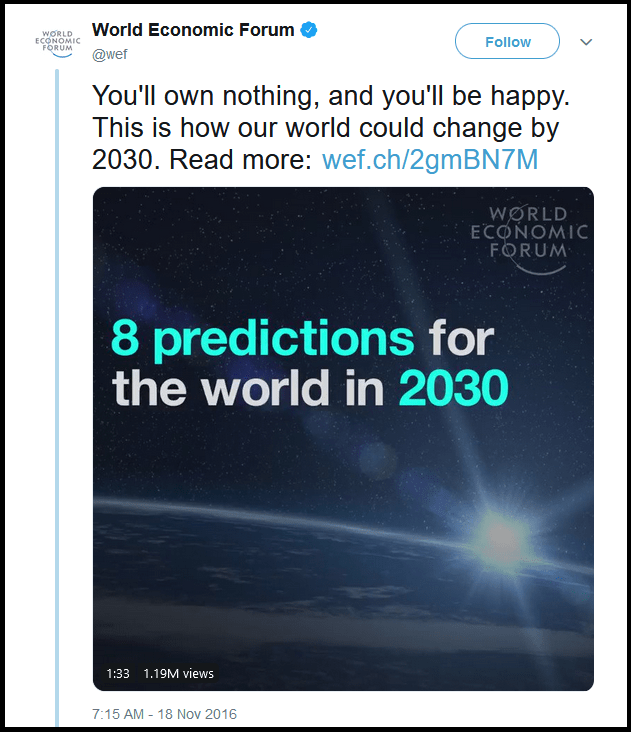
Bloomberg is the latest corporate media to use fear to sell what might be a World Economic Forum agenda of introducing bugs and lab-grown meat into the food supply:
“You may see lab-grown meat and insects on the menu in future decades, as the world grapples with challenges to food security posed by climate change and conflict.”
Bloomberg’s Keira Wright was covering Sydney’s South by South West festival earlier this month, when she said panelists were talking about lab-grown meat, edible insects, and vertical farming.
Wright continued with more climate doom in the article:
“Climate change has made weather more volatile and hotter in many parts of the world, damaging corn crops in the US, slashing wheat crop forecasts in Australia and even accelerating the spread of deadly pests in China.”
However, did anyone tell Wright, the editors, or maybe even billionaire Mike Bloomberg about the inconvenient truth of 1,600 international scientists who said in August, “There is no climate emergency.”
To counter the rogue billionaires who want to reset the food supply, move out of cities, purchase land, start a farm, or, easier, move to suburbia and buy local.
The arrogance of Ukrainian President Volodymyr Zelensky is causing problems with Kyiv’s allies and he believes that, as his country is at war, he can do anything, his former adviser has claimed.
In a bombshell interview with Polish news outlet dorzeczy.pl, Oleksyi Arestovych slammed his former boss for his increasingly overbearing behavior and believes he has fallen victim to delusions of grandeur and a belief that he is all-powerful.
Arestovych cited Zelensky’s response to the ongoing diplomatic conflict over the dumping of Ukrainian grain as an example, accusing the president’s office of “behaving as if it has a decisive voice in the European Union rather than being a country aspiring to join the bloc.”
The former adviser, who himself is a possible candidate in any future Ukrainian presidential election, expressed his fear that Zelensky “has become deluded into thinking he now rules the globe.”
His diplomacy concentrates on making demands and using moral blackmail to claim Ukraine is fighting for the West, said Arestovych, who claimed this tactic may have been successful at the beginning of the conflict but is no longer effective.
“The West is increasingly irritated by Ukraine’s arrogance,” he added.
Arestovych claimed that Zelensky’s behavior had led to tension among Kyiv’s closest allies including Poland and Romania, while its relations with the U.S. and the U.K. have also cooled.
The West will continue to support Ukraine because it is in the West’s own interests to do so, but it may well stop supporting the current Ukrainian government and back an alternative, he warned.
However, Arestovych was dismissive of the argument that Ukraine was colluding with Germany against Poland, claiming that this is only purely due to the fact that Ukraine has no clear foreign policy under Zelensky.
Ukraine wants Germany to be a counter-balance to Russia and that is why Ukraine backs its ambitions of securing a permanent seat in the UN Security Council, the former advisor told the Polish news outlet.
Arestovych admitted that Poland could have gotten more out of Ukraine on issues related to the Volhynia massacre by pursuing a more transactional policy towards the country, but that would not have been beneficial to it in the longer term. “Even if Zelensky is ungrateful for all the help selflessly offered by Poland, Ukrainian people are grateful and that will be more important in the longer term,” he assured.
Friend of Fringe Finance Lawrence Lepard released his most recent investor letter this week.
I believe Larry to truly be one of the muted voices that the investing community would be better off considering. He gets little coverage in the mainstream media, which, in my opinion, makes him someone worth listening to twice as closely.
Larry was kind enough to allow me to share his thoughts heading into Q4 2023. The letter has been edited ever-so-slightly for formatting, grammar and visuals.
OVERVIEW
It was an interesting quarter. There was a whiff of deflation as the Dow Jones, S&P 500 and NASDAQ all declined in value. But this was not matched by the prices of crude oil and commodities, both of which were strong, and the bond market had a bad quarter as rates continued to rise across the curve. A slowing economy, falling stocks and bonds, and rising commodity inflation spell one thing very clearly to us: STAGFLATION.
In the third quarter of 2023, the Fund increased in value slightly by 0.5% and picked up considerable ground (over 10% outperformance) on our benchmark index the Gold Stock Juniors ETF (GDXJ). A big piece of this outperformance occurred due to our large position in Lavras Gold which we profile on page 21. As we have said before, we manage the Fund aggressively, and in bear markets for gold stocks, we expect that we will do worse than GDXJ. However, we also want to point out that the converse is true in bull markets; in 2019 EMA was up 98% vs. the GDXJ which was up 40%, and in 2020 EMA was up 122% vs. the GDXJ which was up 33%. We believe that when this market turns, the results will be similar.
US FISCAL DOOM LOOP GETS WORSE
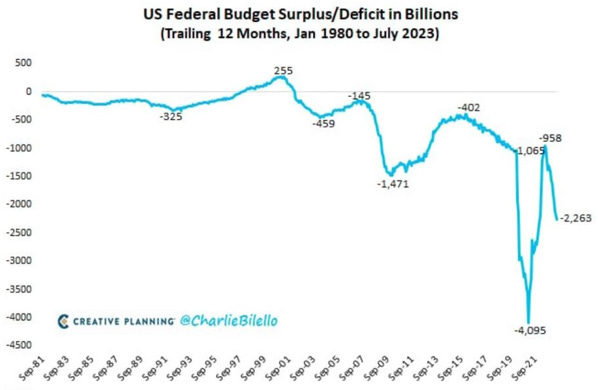
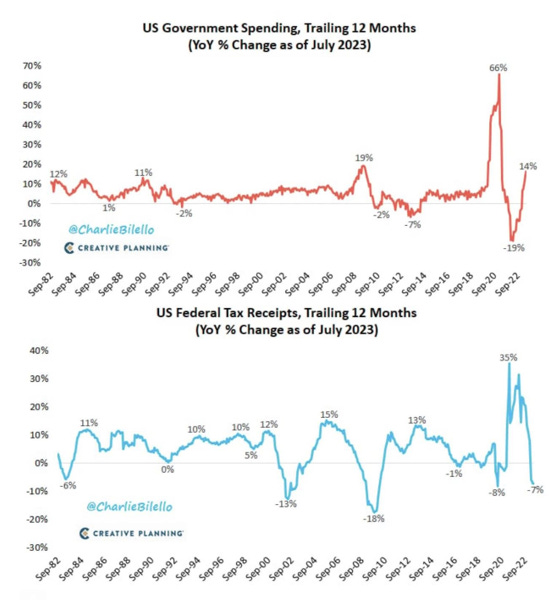
In our view, the biggest elephant in the room is the US Fiscal Doom Loop. To refresh: US Government spending is out of control, and there appears to be very little political will to stop it. As the chart below shows, Government spending is up 14% yoy and tax receipts are down 7% yoy. Fiscal year ended September 2023 is projected to have a deficit of over $2 Billion (or roughly 8% of GDP). In the past, deficits of this magnitude only materialized during significant downturns like the bursting of the Dotcom Bubble, the 2008 GFC and the COVID crisis. It is unprecedented to have deficits of this magnitude with the economy and employment being relatively strong.
One can only imagine where the deficit goes when the FED’s monetary jihad of rapid rate increases tips the economy over. Past economic downturns typically have increased the deficit/GDP ratio by 8-14%.
So as the economy moves into recession in 2024 (as we believe), the US could be looking at deficits as high as 20% of GDP ($5 Trillion) if the economy slows dramatically.
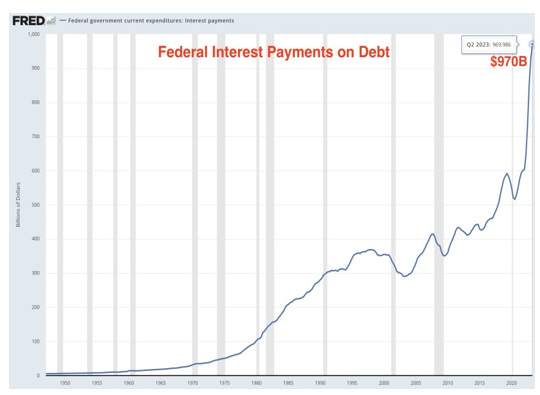
The reason we see it as a “doom loop” is that the current $33.5 Trillion of Federal Debt is continually costing more to service.1The Fed’s rapid increase of interest rates, and elimination of Quantitative Easing (e.g., Fed buying Treasury bonds) has impacted US Treasury interest costs. Note below how interest payments have soared over the past two years.
Interest expense on the Federal Debt now exceeds our substantial annual national defense spending of $816B as well as every other category except Social Security and Medicare.
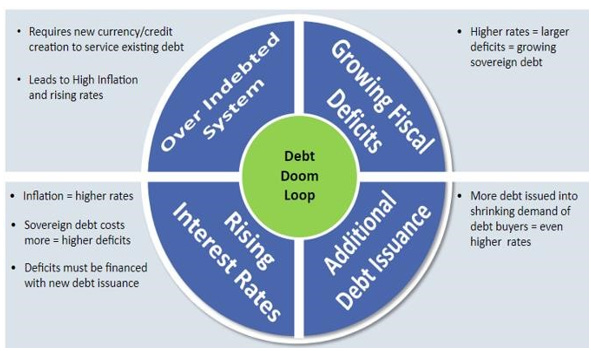
The Doom Loop occurs as higher interest costs drive higher deficits, forcing the Government to sell more bonds to finance the same. Ceteris paribus, more bond sales lead to higher interest rates which then increase the deficit further. Repeat until there is no market for the bonds. Of course, at that point the Fed is forced to step in and become the buyer of last resort for the bonds to keep the bond market functioning.
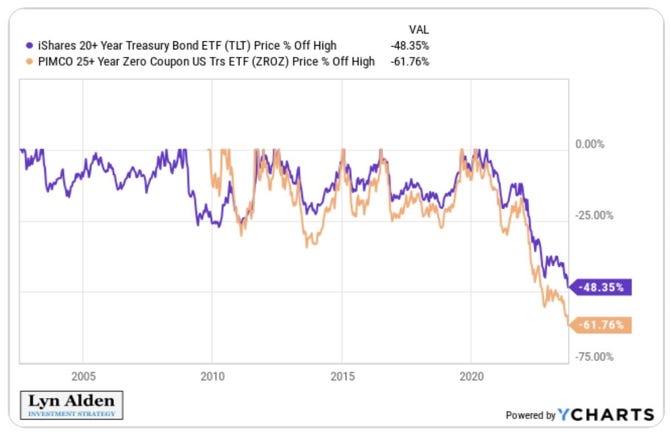
As the chart below shows, it has been a rough couple of years for the bond market.
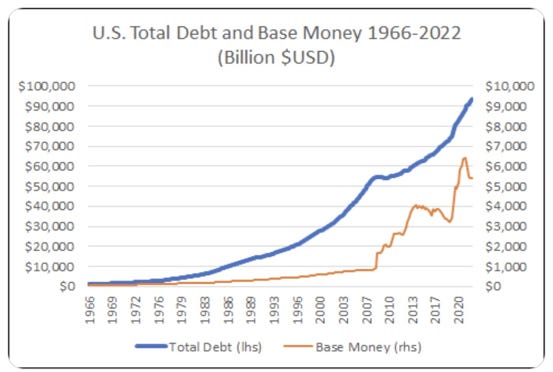
The fundamental issue is that without growing the money supply, there is not enough capital to support the inflated bubble valuations. When the Fed chose violence and went on a campaign of rapid rate increases (taking the Fed funds rate from 0.25% in 2021 to 5.25% today), coupled with the sale of some of its bond portfolio (Quantitative Tightening), it increased the cost and reduced the supply of capital necessary to support all financial markets. Government bond sales (which drive rates higher) are crowding out the debt markets. This is going to have to change or the financial markets as we know them are going to collapse. The only issue is the time scale. The subject is addressed nicely in the chart below by Lyn Alden:
As you can see, when any person, company or government takes on massive leverage, the proceeds better generate productive economic outcomes to support the debt. (e.g., levering to invest in education or nuclear plants has a payback, but if the money is used to finance War, virtually nothing is gained/produced). Thus, to support an over-levered entity, more financing or money supply growth is required. When markets enter chaotic times, like in 2008-2013 and 2018-2021, the Fed is forced to be very aggressive in growing the monetary base via expansion of their balance sheet (money printing). This is what has taken the Fed Balance Sheet Assets from $800B to roughly $8T in the past 15 years. With debt continuing to grow rapidly we see no reason why this will not occur again, perhaps in short order.
The Fed’s recent retrenchment in the Base Money Supply (orange line in the chart above) began in February of 2022. There is a lag effect in terms of its impact on the economy. We believe the lag is now starting to bite hard and that is showing up in the numbers as we will detail below.
EVIDENCE OF ECONOMIC SLOWDOWN
Despite recent Wall Street and CNBC cheerleading, we believe the economy is beginning to roll over.
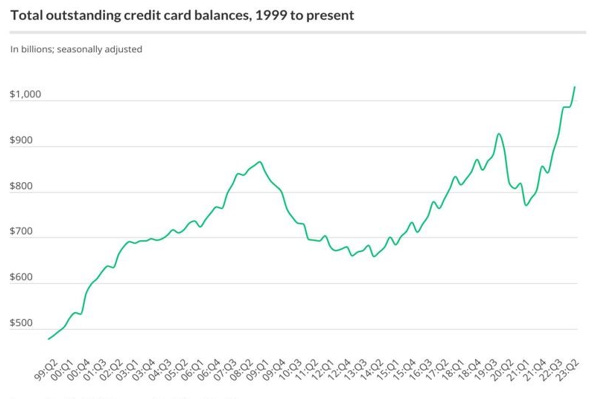
Post COVID, consumers regained confidence and went on a spending spree to maintain their lifestyles despite inflation and rising living costs. They did this by significantly increasing their borrowing on credit cards as seen in the chart below:
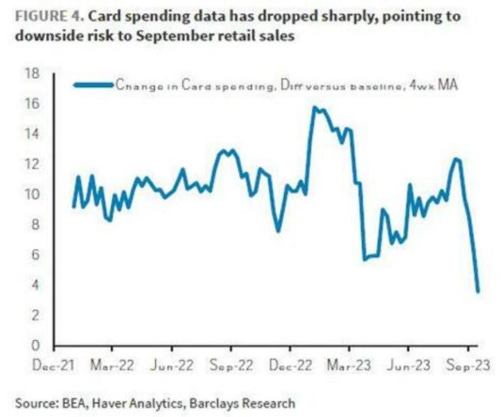
What is not shown on this chart is the average interest rate on these credit cards. Five years ago, the average interest rate on these cards was 13%. Today that rate is 22% – a significant burden for consumers carrying credit card balances. These higher costs have had an impact on consumer behavior and as the next chart shows credit card spending dropped sharply in September.
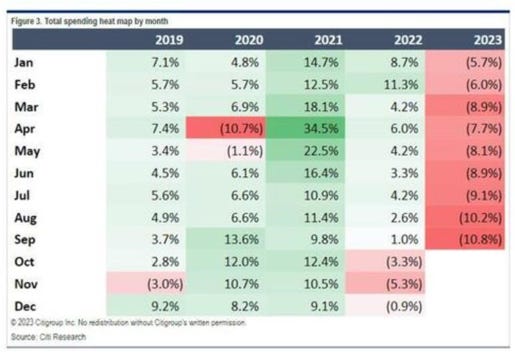
And as the following chart shows, total consumer spending has been dropping significantly year over year in 2023, and the trend is getting worse.
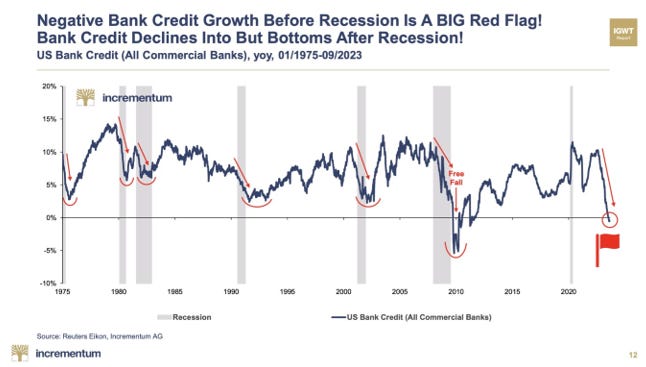
Further, signs of an imminent recession include the level of bank credit growth. The last time it was this negative was in the 2008 GFC. Negative bank credit growth is a very reliable recession indicator.
We believe the economy is very sick. The doctored employment figures are not telling the true story.
THE EVERYTHING BUBBLE IS BURSTING
High inflation, higher interest rates, bonds falling, slowing economic indicators and the stock market starting to look wobbly all lead us to conclude that the “Everything Bubble” that was driven by free money (ZIRP) is in the process of bursting. We believe that this will lead to a US sovereign debt crisis as the US Federal Government’s fiscal position is not sustainable.
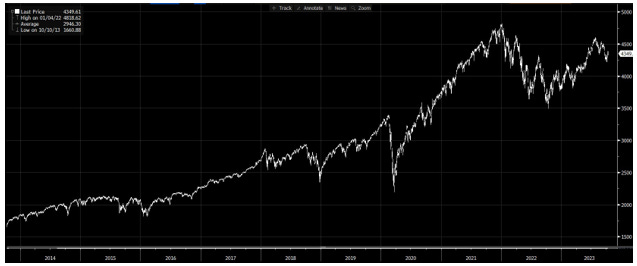
Let’s examine the stock market. As you can see in the chart below, the S&P 500 put in a high in December of 2021, fell hard in 2022 and has now rebounded to retrace a large portion of that loss. We believe the December 2021 high will prove to have been the “top” for this monetary expansion cycle. Absent extremely aggressive money creation by the Fed, the stock market is headed much much lower.
The reasons for that belief are many. First, the economy is rolling over as detailed above. Secondly, using the “Buffet Indicator” of Market Cap to GDP, the stock market is still almost as expensive as it was at the 2000 peak. Another good measure is to look at the Earnings Yield which is the inverse of the PE ratio. (e.g., a PE multiple of 20x has an earnings yield of 5%.) As the chart below shows, the S&P 500 currently has an earnings yield of 4.1%. (PE is 24.5x). Still very much on the expensive side of the scale.
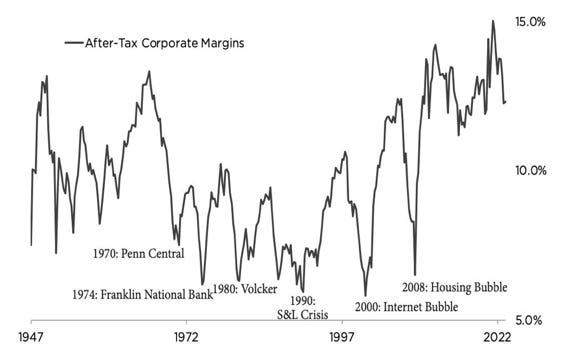
Furthermore, companies are currently operating at peak profit margins. With inflationary pressures driving costs higher (particularly labor), these margins are sure to get squeezed as soft demand does not allow many companies to pass along price increases.
So, we see nothing but downside in the US stock market. Which feeds consumer confidence and spending via its wealth effect. We believe that when the stock market rolls over again, the current Fed obsession with fighting inflation will turn into employment and recession concerns. Once again, the Fed will realize that they have gone too far. Based upon their past performance, we can reliably predict that they will pivot to monetary accommodation. In fact, the Fed is already displaying signs of this with the following recent headlines:
“If the bond market keeps this up, the Federal Reserve will have less of a reason to hike rates again.” Nick Timiaros, Wall Street Journal (Nick is often a Fed mouthpiece)
Wall Street Journal Headlines: Rising Interest Rates Mean Deficits Finally Matter. Bond Sell Off Might Force Fed to Rethink Shedding Assets.
FED’s Mary Daly: With The Rise in Bond Yields the Need To Do Additional Tightening By The Fed is Not There
FED Governor Laurie Logan: Higher Yields May Mean Less Need to Raise Rates.
With the US stock market threatening to break below its technically important 200 day moving average, these dovish comments by the Fed and its mouthpieces at the Wall Street Journal do not surprise us.
These and other recent statements by several economists that the inflation target should be adjusted upward demonstrate that we are probably very close to the end of this FED tightening cycle. This is reflected in the CME Fed futures which currently predict only a 4% probability of the Fed tightening at their November meeting.
Looking ahead to 2024, despite likely persistent inflation, market dislocations will force the FED to loosen monetary conditions. This will be extremely bullish for sound money assets. It is simply a matter of “when, not if” they will ease and return to lower rates and QE. We believe both lower rates and QE are inevitable because of the mathematics outlined on Lyn’s chart on Page 7. Without growth in the monetary base the system will ultimately implode.
Recall, in March of this year, things did break in the form of Silicon Valley Bank’s bankruptcy, but they were able to patch that up with a new liquidity program that they claim is not QE (in reality it is QE). So, the next question becomes, when do things break? We have always referred to this as rivets popping.
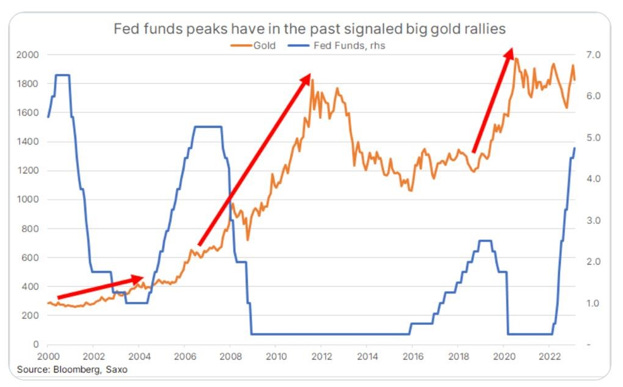
Also, if this Fed tightening cycle is complete, and after a pause period, their next move will be to drop the Fed Funds rate to respond to a weaker economy, the implications for gold are extremely bullish. This next chart clearly demonstrates gold’s price response when Fed tightening cycles have ended.
As you can see in the chart above, when the blue line (Fed Funds Rate) peaks as it did in 2000, 2008 and 2018, gold prices soar and a gold miner bull market ensues. Gold has been bumping up against its alltime high of roughly $2,050. When gold convincingly pushes through $2,100, we expect it to quickly attain $2,500 and then $3,000. The impact on the gold miners will be explosive.
Part 2 of this letter can be read in full here and includes thoughts on the future of gold, Central Banking and 7 signs of further fissures in the economy that will ultimately force the Fed’s hand to re-stimulate.
What Can You Do If A Mob Of Far-Left Antifa-Style Rioters Surround Your Car?
Law-abiding citizens are wondering what to do when a mob of far-left Antifa-style rioters surround their vehicle, sort of like the incident on Sunday where pro-Palestinian protesters illegally blocked a city street in downtown Minneapolis and attacked an apparently confused elderly man in his car.
Washington Gun Law President William Kirk addressed the viral video showing an elderly man surrounded by a mob of angry pro-Palestinian protestors who began damaging his vehicle. This incident raises a frequent question Kirk has received in the last few days: How should one respond when an aggressive crowd besieges their vehicle?
Here’s the video:
MN City Council candidate Zach Metzger blocked off a highway and terrorized an old white man driving past a pro-Palestine riot
He posted the video today and instructed his followers to find the old man. He has since deleted the post. We saved it.
Kirk provides a legal framework around self-defense laws and when a driver can and cannot use lethal force when surrounded by far-left Antifa-style rioters:
Legal Standpoint:
Understanding of self-defense laws is crucial.
Key principles of self-defense:
Force can be used in self-defense if it is necessary, reasonable, and proportional.
Lethal force can only be used under specific conditions (imminent threat of death, serious injury, etc.).
Driving into or over individuals can be considered deadly force.
Defending property:
Cannot use lethal force solely to defend property.
Physical threats to individuals inside the car can justify the use of force.
Scenarios:
If only the car is being damaged, lethal force is not justified.
If windows are being smashed, the potential threat of serious bodily injury arises.
If attackers are trying to pull people out of the car, it indicates an imminent threat, potentially justifying lethal force.
The driver in the video showed restraint and did not use lethal force despite being surrounded twice.
Conclusion:
Importance of understanding local laws and ensuring responses are in line with legal requirements.
Washington Gun Law resources are linked for those interested.
Final message about the importance of being a lawful and responsible gun owner and understanding applicable laws.
Watch Here:
If progressive city leadership in Minneapolis had prioritized law and order, the incident would never have occurred on Sunday. We encourage readers to familiarize themselves with their state’s self-defense laws during uncertain times. To minimize potential confrontations, it might be wise to consider moving away from imploding Democrat-controlled urban centers for rural areas as disastrous ‘defund the police’ policies unleash a crime crisis like this country has never seen before.
During a Twitter/X Spaces discussion Monday, owner Elon Musk warned that he believes the West is “sleepwalking our way into world war three,” and “putting civilization itself at stake.”
Musk noted that America is lagging behind both China and Russia in terms of industrial output, and that Western leaders are pushing those two nations closer together “in an axis of immense power against the west, and laying the groundwork for World War Three.”
Musk explained “Russia has the raw materials, and China has the industrial capacity,” adding “It’s frankly, a perfect match from a war standpoint. So I think we need to stop doing that. It’s unwise, and I think will lead to an immense risk to civilisation.”
He continued, “I want to emphasise like that, there’s civilisational risk – there are tragedies on an individual level, tragedies on a community level, and then there’s civilisational risk. We just need to make sure that we’re not putting civilization itself at stake, which is World War Three.”
.@elonmusk: “Unfortunately our policy has been driving—forcing, really—Russia and Iran to ally with China … and Russia has the raw materials, and China has the industrial capacity. It’s frankly a perfect match from a war standpoint.” pic.twitter.com/jzMkTjRldx
“I think we are sleepwalking our way into World War Three,” Musk further noted, adding “Really, people should be deeply self reflective. If they make their predictions have not come true. They should consider whether perhaps there are other predictions might not come true either.”
“What is the track record here?” Musk continued, noting that there is no longer anyone alive who remembers how horrific world wars are and that everyone today is “coddled.”
ALERT! In the age of mass Silicon Valley censorship It is crucial that we stay in touch. We need you to sign up for our free newsletter here. Support my sponsor – Summit Vitamins – super charge your health and well being.
Also, we urgently need your financial support here.
Seattle Kicks Off Anti-Drug Push With Dozens Of Arrests As Portland Business Owners Beg For Help
Elected officials in Portland and Seattle are beginning to regret turning their cities into crime-ridden hellholes, after their response to Trumpism and the BLM riots in the wake of George Floyd’s death was to defund or otherwise hinder police, elect DAs who refuse to prosecute a variety of crime, and promote rampant drug use.
Now, they’re dealing with the predictable hangover.
In Portland, 25 businesses have banded together for a strongly worded letter to elected officials, who they’ve demanded address their concerns over the city’s crime wave that has decimated foot traffic to businesses such as Ace Hotel, Central Office, Crafty Wonderland, Courier Coffee, Mimi’s Fresh Tees and Multnomah Whiskey Library, according toKGW8.
The situation in Portland is so bad that residents have been told not to call the police unless their lives are at risk thanks to the city’s overwhelmed 911 system. In May, Portland officials figured out that defunding the police was pure idiocy, and attempted to reverse course after cutting the PD budget by $15 million, like idiots.
Portland has also experienced a spate of major stores leaving the region, including REI, Walmart and Cracker Barrel.
“Revitalizing downtown businesses necessitates a multifaceted approach that addresses various aspects of their operations and environment,” reads the letter from the 25 businesses, which includes ideas for garnering more financial support from government in general amid a shrinking customer base that’s killing foot traffic.
Seattle, meanwhile, is making progress towards reducing crimeand drug use.
Hours after the city’s new law against public drug use and possession took effect Friday, cops made around two dozen arrests, according to the Seattle Times.
Police handed out flyers Friday morning in an effort to educate people about the controversial new law, then returned Friday afternoon to enforce the gross misdemeanor offenses, Diaz said in a news conference at the Seattle Police Department headquarters.
The operations targeted the vicinity of 12th Avenue South and South Jackson Street in the Chinatown International District’s Little Saigon neighborhood and Third Avenue and Pine Street in downtown. Both areas have seen prominent public drug use for years.
“We are going to be compassionate in our approach to getting people connected with services while still making sure our city streets are safe,” said police Chief Adrian Diaz.
The enforcement action stems from Seattle’s adoption last month of a law which allows the City Attorney’s Office to prosecute individuals who knowingly possess illicit drugs such as fentanyl, and for using them in public.
Seattle Mayor Bruce Harrell championed the new law, which passed by a narrow 6-3 vote. Supporters say it will improve public safety and help addicts find treatment, while opponents say the law will punish people for said addictions – calling it a new version of the failed war on drugs.
Leftist Seattle councilmember Teresa Mosqueda said the Friday arrests underscore her concerns.
“Data shows the minute you’re arrested, there are cascading consequences for your stability. People are more likely to die while in jail due to withdrawal or die upon release due to overdoses,” she said. “We don’t want public consumption throughout the streets, but we do not have the treatment resources necessary to implement this policy.”
* * *
Read the Portland letter below:
Dear Esteemed Elected Officials,
We trust this message finds you in good health and high spirits. We, the downtown business owners of Portland, are reaching out as concerned stakeholders to bring attention to the pressing issues currently affecting our city center. The adverse conditions in our downtown area have a profound impact on local businesses. While we recognize the complexity of these challenges, we urge our city and state officials to collaborate in addressing these issues and reinvigorating downtown Portland without delay.
Downtown Portland has long served as the vibrant heart of our community, offering a diverse mix of retail establishments, dining options, cultural attractions, and small enterprises. Unfortunately, recent years have witnessed a noticeable decline in the cleanliness, safety, and overall allure of this area. This deterioration has given rise to several significant concerns:
1. Public Safety: The increased incidents of public disturbances, criminal activities, violence, and vandalism have left residents and visitors feeling unsafe in downtown Portland. This perceived lack of security significantly hampers our local businesses, discouraging potential customers and leading to reduced in-person sales.
2. Homelessness and Unsheltered Individuals: The homeless population in downtown Portland has grown considerably, necessitating more comprehensive support and housing solutions. The presence of unsheltered individuals, drug use, and vandalism negatively impacts downtown life and disrupts business operations.
3. Cleanliness and Maintenance: The cleanliness of our city center and parking garages have suffered due to litter, bodily waste, graffiti, and neglected public spaces. A clean and well-maintained environment is vital for attracting residents and tourists to downtown businesses.
4. Economic Impact on Local Businesses: The deteriorating conditions in downtown Portland are directly and detrimentally affecting local businesses. Decreased foot traffic, negative perceptions, and increased security costs are imposing financial strain on entrepreneurs and jeopardizing their business viability.
Revitalizing downtown businesses necessitates a multifaceted approach that addresses various aspects of their operations and environment. Here are several solutions that can aid in the repair and revitalization of downtown businesses:
1. Direct Financial Support for Existing Businesses: Offer grants, low-interest loans, or tax incentives to downtown businesses to help them recover from economic downturns. Directing resources towards small businesses is essential for preserving the unique shopping experience of downtown.
provide startups and small businesses with affordable office space, shared resources, and mentoring support.
3. Marketing and Promotion: Increase marketing and promotional campaigns to draw customers back to downtown areas. Organize events, festivals, and local markets to boost foot traffic and sales. Create a map of small businesses to aid visitors. Provide resources directly to businesses for store marketing.
4. Facade Improvement Programs: Implement programs that offer grants or low-interest loans to business owners for enhancing the appearance of their storefronts, thereby improving the overall aesthetic of downtown.
5. Support Local Entrepreneurs: Provide training and resources to aspiring entrepreneurs, particularly those from underserved communities, to establish and sustain businesses in downtown areas.
6. Digital Presence: Assist businesses in establishing and enhancing their online presence. Offer workshops on e-commerce, social media marketing, and website development to reach a broader customer base.
7. Public Parking Incentive: Encourage more customers to park downtown by offering free parking during specific hours and ensuring parking safety through well-maintained garages, helping to generate revenue for businesses and the city.
8. Arts and Culture: Foster local artists and cultural organizations by hosting art exhibitions, performances, and cultural events in downtown spaces.
9. Business Networking: Facilitate networking events and organizations that allow business owners to connect, share ideas, and collaborate on projects that benefit the downtown community.
10. Tourism Promotion: Promote downtown as a tourist destination, highlighting its unique shops, restaurants, and cultural attractions. Consider establishing a neighborhood association for businesses and residents.
By implementing a combination of these solutions, local governments, business associations, and community members can collaborate to repair and revitalize downtown businesses, creating vibrant and economically thriving urban centers.