Electricity grid capacity available in the world isn’t keeping pace with the rapid growth of “clean energy” technologies, possibly putting governments’ climate goals at risk, according to a recent report by the International Energy Agency (IEA).
In order to achieve climate goals set by global governments, more than 80 million kilometers (49.7 million miles) of electric grids have to be added or refurbished by 2040, which is the “equivalent of the entire existing global grid,” according to the Oct. 17 IEA report. Even though “electrification and renewables deployment are both picking up pace,” there is a risk of the clean energy transition stalling due to a lack of “adequate grids to connect the new electricity supply with the demand.”
“At least 3,000 gigawatts (GW) of renewable power projects, of which 1,500 GW are in advanced stages, are waiting in grid connection queues—equivalent to five times the amount of solar PV and wind capacity added in 2022,” the report noted.
“This shows grids are becoming a bottleneck for transitions to net zero emissions.”
While investments in renewable energy such as solar and wind power, electric vehicles (EV), and heat pumps have been “increasing rapidly”—almost doubling since 2010—the investment in power grids has remained “static” at around $300 billion annually, it said.
The 2015 Paris Climate Accords agreed to hold the global increase in average temperature to 1.5 degrees Celsius above pre-industrial levels. Delays in establishing the necessary power grid could put this target “out of reach,” the report stated.
IEA presented a “Grid Delay Case” scenario in which the modernization of existing power grids and the setting up of new grids don’t happen in a timely manner. In such a situation, there would be 58 gigatonnes of additional CO2 emissions from the power sector, as compared to a situation in which the national climate targets are achieved.
“This is equivalent to the total global power sector CO2 emissions from the past four years. It would also mean that the global long-term temperature rise would go well above 1.5 degrees Celsius, with a 40 percent chance of it exceeding 2 degrees Celsius,” it said.
While the IEA report proposes boosting the power grid infrastructure to accomplish the transition to green energy, such transitioning attempts could endanger the reliability of the grid.
In the United States, many electricity operators have taken a stance against stringent greenhouse gas emission rules being imposed on the power generation sector by the Biden administration in its attempt to push renewable energy.
In an Aug. 8 statement, a group of Independent Systems Operators and Regional Transmission Organizations warned the U.S. Environmental Protection Agency (EPA) that the agency’s proposed emission regulations on the power sector “have the potential to materially and adversely impact electric reliability.”
A host of CO2 emissions rules and decades of efforts to limit fossil fuels have resulted in the retirement of coal and gas power plants at a pace faster than the installation of solar and wind facilities, it said.
Since wind and solar are weather-dependent, there’s a lack of reliable backup sources, raising concerns about potential power shortages, the group stated.
US Power Grid Problem
In an interview with EpochTV earlier this month, energy-related public policy analyst David Blackmon called the power grid issue in the United States a “huge problem.”
“And it’s much bigger than people know because right now, we have a crisis in [the] supply of electric transformers for our power grid,” he said. “Transformers are an integral part of every electricity project in America—around the world, really—and they’re in very short supply. It’s taking up to four years to source new supplies of these transformers. Inventories are very low.
“And, you know, you can’t expand the grid if you don’t have the equipment to do it with. The federal government is not doing anything to solve this problem.”
In March, IEEE Spectrum, a publication of the Institute of Electrical and Electronics Engineers, published a report on EV transition that highlighted several of the cost challenges in preparing the grid for an electric economy.
Costs of transformers have jumped to as much as $20,000 each, from $3,000 to $4,000, the report said. As larger transformers may be required to support EVs, many of the 180 million power poles in America would also have to be replaced, pushing up the cost further.
Improvements and replacements to the grid’s 8,000 power-generation units and 600,000 circuit miles of AC transmission lines, as well as 70,000 substations to support increased renewable energy and battery storage, are estimated to cost more than $2.5 trillion by 2035, according to the report.
In the IEA report, the agency notes that upgrading the grid infrastructure is a time-consuming process. New grid infrastructure often takes five to 15 years to plan, permit, and complete.
In contrast, renewable energy projects can be completed in just one to five years. It also pointed out that grid investments would need to double by 2030 from current levels to more than $600 billion per year.
Moreover, while the IEA report presents renewable energy as a pro-climate action, such energy projects can pose serious pollution risks.
For instance, while there are currently more than 500 million solar panels in the United States, tens of millions of solar panels are expected to be added in the coming years. Meanwhile, nothing has been done to make the industry fully recyclable, creating a question about the safe disposal of the panels.
Toxic chemicals in solar panels include cadmium telluride, lead, hexafluoroethane, and more. In addition, silicon tetrachloride, a chemical created as a byproduct of solar panel manufacturing, can cause severe irritation and burns to the skin and eyes.
Tossing solar panel waste in landfills presents a long-term risk to the environment as the toxic minerals and metals can end up seeping into the ground.
Telecom Giant Nokia Plans 14,000 Job Cuts As Profits Plunge, 5G Market Struggles
Telecom giant Nokia announced as many as 14,000, or roughly 16% of its workforce, will be laid off, warning the “timing of the market recovery is uncertain” after weaker demand for 5G equipment.
Bloomberg data shows Nokia employs 86,000 people. The telecom said a “reset” is needed “to reduce its cost base and increase operational efficiency while protecting its R&D capacity and commitment to technology leadership.” It plans to lower its costs by between 800 million euros and 1.2 billion euros by the end of 2026, adding, “This represents a 10–15% reduction in personnel expenses.”
The massive headcount reduction comes after Nokia reported third-quarter net sales plunged 20% year-on-year to 4.98 billion euros. Profits crashed by as much as 69% year-on-year to 133 million euros from July through September, compared with last year.
“In the face of a challenging market environment, we will reduce our cost base to protect our profitability,” Nokia’s chief executive, Pekka Lundmark, said in a video statement.
Lundmark said it’s “impossible to say” how long the downturn in network markets will last, adding on a long-term basis, investments in 5G will be “necessary” to handle surging data traffic due to artificial intelligence and cloud computing.
He did not rule out the possibility of “structural moves” beyond cost-cutting measures. He emphasized that even when considering substantial headcount reductions, Nokia’s primary goal remains safeguarding its ability to maintain strong R&D output.
The CEO acknowledged that the macroeconomic environment will play a significant role in 2024. However, he stated it was too early to provide specific guidance and cautioned against assuming the company would receive support from the market.
Regarding regional insights, the CEO observed a notable slowdown in India in the second half, suggesting a normalization trend compared to the year’s first half.
After earnings, Lundmark told Bloomberg, “Operators have found it challenging to monetize their 5G investments.”
Growth in the India market “is no anymore able to compensate fully for what we are losing in North America,” Lundmark said. “But what comes down, will go back up again and we do not know what the timing is. That’s why we are taking action.”
Shares of Nokia in Europe fell 3.5%, nearing lows not seen since the early days of Covid.
Nokia isn’t the only Western telecom reducing its workforce: Sweden’s Ericsson announced plans to reduce its headcount by 8,500 earlier this year. The slowing global economy and elevated inflation have pressured telecoms.
On Wednesday, Ericsson CEO Borje Ekholm warned: “Underlying uncertainty impacting” its mobile networks will last into 2024, causing doubts over recovery for telecommunications equipment makers.
European thermal coal imports are expected to dip this month by 60% compared to October 2022, due to low demand and ample stocks, according to preliminary data from Kpler cited by Montel on Thursday.
Total imports by the Netherlands, the UK, Germany, Italy, Spain, Belgium, and France are estimated to be around 2 million tons in October, down by 2.8 million tons compared to the same month of 2022, per the preliminary data from Kpler.
Ample thermal coal inventories and weak demand ahead of the peak winter heating season have depressed prices in recent months and purchases and imports into Europe have been in small quantities.
Even with low coal prices and rising natural gas prices in Europe, the fuel-switching to coal has not happened yet, a trader with a German company told Montel.
The share of coal in Europe’s power generation has been declining in recent years, with many countries pledging to phase out unabated coal use.
But last year’s energy and gas crisis has been keeping utilities and governments on edge and ready to have mothballed coal-fired power plants on stand-by in the coldest winter days to ensure the security of electricity supply.
Earlier this month, Germany’s government said it was bringing back online several coal-fired units for this winter in an attempt to save natural gas and avoid power supply shortfalls.
Several coal-fired blocks operated by RWE and LEAG at their Niederaußem, Neurath, and Jaenschwalde power plants will be temporarily reactivated until March 2024 as a precautionary measure to safeguard electricity supply in the coming winter, the Economy and Climate Action Ministry said, referring to a government decision to bring the coal-fired units online again.
Those coal units were already operational during the 2022/2023 winter when Germany was shocked into a severely reduced gas supply with the end of Russian pipeline deliveries. The backup coal capacity was put on stand-by this summer until the government now decided to reactivate them for the coming winter.
International Man: Thanks to rampant currency debasement, the price of everything has gone up recently.
As the pain from inflation becomes a normal part of life in places like the US and Canada, there are growing calls for politicians to “do something.”
Recently, Canadian Prime Minister Justin Trudeau threatened to tax grocery stores if they don’t lower their prices, accusing them of causing inflation and profiting from higher prices.
What’s your take on this?
Doug Casey: Trudeau epitomizes, in many ways, all that’s wrong with the kind of people who go into politics. Things are as expensive as they are partly because taxes take 20% or 30% of everybody’s income when they earn it. Then, when they spend it, they pay another 10%, 20%, or even 30% in sales taxes and VATs. Add on the burden of regulations, which add to costs while decreasing the amount of production.
Taxes and regulations are disastrous. But the big thing is currency debasement. Governments are printing up money by the bushel because they believe in Modern Monetary Theory—paying for what they want by simply printing money.
People like Trudeau are the reason why food prices, and all kinds of prices, are as high as they are.
Having caused a problem, they present themselves as a solution to the problem. Their solutions are typically counterproductive—stupid, actually. Taxing grocery stores adds to their costs. If they’re to stay in business, those taxes must be passed on to the consumer.
Trudeau is a criminal personality who should be punished for the evil he’s doing. On the other hand, he was popularly elected, largely because he has name recognition from his nominal father and good looks from Fidel Castro, who’s probably his actual sire. In any event, he’s apparently what the majority of Canadians must prefer…
International Man: Many Third World countries have scapegoated business owners for rising prices.
The next step is for them to pass laws regulating how businesses can price their products and services.
Where does this all lead?
Doug Casey: As we’ve just discussed regarding Trudeau, government sticks its nose absolutely everywhere. That’s because the type of people who go into government love power, as well as making themselves famous and wealthy.
Almost all economic problems originate with government intervention. The solution isn’t more laws regulating how businesses can act and price their products but less laws. And by less, I mean none at all.
Government might subsidize milk, perhaps so it’s an “affordable” dollar a gallon. That’s a great idea. You can have all you want for a dollar—but there won’t be any. It’s an insoluble problem until people realize that the cause of the problem is the State itself—fat chance. I’m not optimistic.
International Man: We’ve recently seen prominent politicians and the media in the US blame rising prices on businesses.
They also blame supply chain problems, Vladimir Putin, and so-called climate change… anything but the Federal Reserve and its currency debasement as the source of inflation.
Why do the media and government mislead and gaslight people about inflation?
Doug Casey: You and I realize that the only reason that we’re not all naked, grubbing for roots and berries, is because business creates wealth. Businessmen are directly responsible for our high standard of living. Business is humanity’s friend, not the enemy that government makes it out to be.
But then again, business is now so hooked up and intertwined with government that you can no longer tell the two of them apart. This is the problem with Ayn Rand’s writings. She saw businessmen as heroes for creating wealth. But in the real world, businessmen don’t know anything about either economics or philosophy. Sad to say, they’re not heroes. Few care about anything but becoming personally wealthy.
It’s easier for them to become wealthy by getting in bed with the State and having it pass laws to make their lives easier at the expense of the public. Unlike Rand’s ideal heroes, business never defends itself on a moral basis. In sordid reality, they’re archetypal whipped dogs who comply with everything the government dictates as long as they’re tossed fat bones.
The government is able to mislead and gaslight the public because people naturally believe authority, whether it’s their parents, their teachers, their preachers, or whoever. And the government, through the media, is the ultimate authority. When the government alleges things, people who don’t think or who aren’t independent thinkers believe them. When the bad guys have authority, they naturally make themselves out as being good guys.
International Man: In a separate but related development, US cities are descending into crime-ridden hellholes. Businesses, including grocery stores, are fleeing in droves.
In Chicago, the mayor has said the city will experiment with creating centrally-controlled, state-run grocery stores to service areas where private grocers have left.
The mayor has said:
“All Chicagoans deserve to live near convenient, affordable, healthy grocery options. We know access to grocery stores is already a challenge for many residents, especially on the South and West sides.”
His team calls it “re-imagining the role government can play in our lives by exploring a public option for grocery stores.”
What do you make of this?
Doug Casey: It’s possible, although it’s a highly competitive space, that the mayor of Chicago is the worst mayor in the country. Even worse than his predecessor, the degraded Laurie Lightfoot. Incidentally, Chicagoans don’t preternaturally deserve those things he mentions. The fact the idiots elected this fool, this criminal, means they’re just getting what they deserve.
The government of Chicago has provided nothing but new highs in murders, robberies, taxation, and regulation. They’ve put hundreds of thousands of citizens in vertical ghettos that they’ll almost certainly never be able to get out of.
If they take it to the next level, by having government grocery stores, they’ll have to be renamed “food dispensaries,” where the food will either be stolen, or it’ll be locked up behind plexiglass with armed guards.
The way central cities are devolving, there will be no business anywhere. With government employees dispensing food, going shopping will be like visiting a DMV.
International Man: Where do you think this is all headed if current trends continue? What advice do you have for people on preparing for what is coming?
Doug Casey: Trends in motion tend to stay in motion until they reach a crisis. At which point, things either get much worse or turn around and get better, simply because they’re unsustainable. The country is now like a poker player “on tilt”—nothing changes until he goes bust. And that’s always ugly.
There’s not much any of us can do to change the trend in motion, which has been heading down for many years and is now accelerating downward.
All you can do—and what you should do—is take care of yourself, your family, and your friends. As far as the food situation is concerned, you should take a note from the Mormons, which is to say, set aside six months’ worth of food.
If you live where it’s possible, learn to grow a garden or perhaps raise a few chickens. Be as self-sufficient as possible so that you don’t have to rely on your local government food dispensary when things get really bad.
* * *
Editor’s Note: It’s clear the Fed’s money printing is about to go into overdrive. The next round of money printing is likely to bring the situation to a breaking point.
That means we’re on the cusp of a global economic crisis that could eclipse anything we’ve seen before. Most people won’t be prepared for what’s coming…
That’s precisely why bestselling author and legendary speculator Doug Casey and his team just released this urgent PDF report on how to survive and thrive in this chaotic environment. Click here to download it now.
Albert Edwards Explains Why China’s “Strong” GDP Data Was A Bald-Faced Lie
Two days ago, markets exhaled a collective breath of relief when China published its monthly data dump which disclosed that in addition to beating (almost) across the board for retail sales, industrial output, and fixed investment, the country’s GDP came well above expectations of 4.50%, printing at a 4.90% increase YoY.
This was good news for a world starved for any positive developments out of China, and Chinese assets promptly bounced (if only to sink shortly after as attention return to China’s rapidly disintegrating property sector). There is just one problem: as with every economic data coming out of China (and lately the US, as well), this was a lie.
While it is true that reported real GDP was 4.9%, what SocGen’s Albert Edwards points out in his latest Global Strategy Weekly note is that this was only possible because the Chinese economy remained in deflation in Q3, hardly an indication of economic prosperity.
As Edwards explains, the 4.9% upside surprise on real GDP was “only achieved because of the surprisingly sharp 1.4% fall in the GDP deflator – that was then added to weak 3.5% nominal GDP growth.”
This is a problem because as the SocGen strategist observes next, “nominal GDP growth in China at 3.5% (red line in chart below) is far lower than the pre-Covid run rate compared to real GDP.” And since “it is the nominal pulse that is accurately measured” what matters is the nominal print. Then after statisticians make some informed guesses as to what prices are doing, ‘real’ constant price GDP pops up in the spreadsheet.
Hence for China to meet its 5% ‘real’ GDP target, Edwards sarcastically explains, “merely requires the statisticians to ‘assume’ prices are falling sharply. Hey, maybe there isn’t a Chinese deflation problem after all? But if so, that means real GDP growth is much weaker than is being officially reported.“
Edwards skepticism is corroborated by the far more accurate, PMI data, which signals “worryingly low employment in the non-manufacturing sector with no lockdowns to blame.”
No wonder then that China 10y bond yields remain near an all time low level of 2.7%, in stark contrast to the US’s 4.99%.
But if the Chniese data is again much weaker than indicated, what does that mean about Beijing’s attempts to kickstart the economy and stimulate it out of its Japanification phase? Well, as Edwards explains, “the Chinese authorities have been in easing mode recently, but the degree of easing can be described as support for the economy rather than stimulus” which is what one would expect from a country that has a record 300%+ debt/GDP: this is where the tire meets the road for all those idiot MMT fans whose entire monetary religion goes up in a small puff of smoke once debt becomes the gating factor as it has in China.
That is why, according to Albert, you see industrial metals limping along (more zombie analogies?) rather than sprinting ahead.
Looking ahead, fake data aside, SocGen’s China economists expect one more cut in rates this year, but another problem emerges: China’s recent rate cuts – in stark contrast to the US – are putting the renminbi under heavy downward pressure (left chart below). Nevertheless, the renminbi basket has been rebounding recently and stands close to a Rmb6.4/$ equivalent (see right hand chart).
Which brings us to Edwards’ conclusion which touches on a topic we recently mentioned on twitter, namely that the most important currency pair does not even have the dollar in it, but rather is the interplay between two export powerhouses: China and Japan…
… or as Edwards puts it, “the gap between China’s exchange rate and the yen has become a chasm in recent years, despite Japan also pursuing easy money. China’s tight exchange rate policy is relatively deflationary. Maybe the falling deflator is right after all?”
The SocGen bear’s parting words are spot on: this is a “situation that needs very close watching.”
Everyone has their take as regards the problems besetting us. Few seem to grasp there is fundamentally just one problem. It is the problem that animates the others, giving them the power to be problems.
What is this one problem that leads to all the others?
It is force – especially when its use (and threatened use, which has the same effect) is legalized.
If force institutionalized were taken away, there would of course still be disagreements – as well as annoyances. But that is all there would be. Or at least, mostly. Violence – its use and its threatened use – will of course always be with us as there will always be people willing to resort to the use of force to get what they want. But they would be outliers – and occasional rather than ubiquitous threats.
How often have you been mugged?
Have you been able to go even one day without being forced to pay what are styled “taxes” – i.e., legalized mugging? You are forced to pay the “mugger” every single time you pay for anything. And when you get paid for the work you do, too.
Because such mugging it is legal – and so ubiquitous. The mugger in the alley is a kind of freelancer; he enjoys no such advantage and suffers the disadvantage of it being legal to attempt to avoid his depredations and to defend oneself against them.
If you don’t like someone, but he is legally powerless to force you to interact with him, then you are free to avoid him. And because you are able to avoid him, conflict is avoided.
How do you feel about people you’re forced to deal with – because they have the power to force you to deal with them? For example, the proliferation of government employees whose employment centers on your having to not only deal with them politely but also pay for the privilege?
Think of the government employee who comes onto your property uninvited to assess the value of your home – so that the government can force you to hand over money to pay for government “services” you don’t want or use, such as government schools. How do you feel about him? How about the government worker who puts his hands on your wife, your child – or your elderly parent – at the airport?
The cop who simply takes – legally! – the envelope full of cash you were going to use to pay for the used car you were on your way to buy when you got “pulled over” for not wearing a seatbelt. He says it’s “suspicious” – and it’s up to you to prove (at your expense) that the money is “legitimate.”
The mask-faced bureaucrat who forced you to close the doors to your business that no one was forced to walk through – leading to the bankrupting of your business?
Do you not feel hatred for them?
And how do these people feel about you? How does a person who has power over someone else, who can be made to obey, feel about having such power? What sort of person is attracted to that kind of power? How does a schoolyard bully feel about being able to make a smaller kid hand over his lunch money?
Force empowers the sadist – who becomes an official when force is legalized.
Take legalized force out of the equation and the sadist has no official power to torment anyone. He may succeed in finding some victims. But everyone is not his victim. And those who fall victim to him have the consolation of knowing they might be able to loosen their bonds when the sadist isn’t paying attention and lay hands on the bastard – which is considered a “crime” when done to an official sadist, such as the government worker with a uniform, a badge and a gun who orders you to get on the ground now! because you defied his order to “buckle up.”
Most people are not violent and seek therefore to avoid violence. Down that road lies peaceful resolution and co-existence. Your neighbor does not like the color you decided to paint your house. He can ask you to paint it a different color. He can plant tree along his property line, so that he no longer sees what displeases him. And he is free to move. You may not like this neighbor but you are not likely to hate him because all he can do is ask you to paint your house another color, plant some trees along his side of the property line – or move. And because he has no power to force you to do anything, you are probably more likely to give some weight to his preferences and maybe come to an agreeable compromise.
The absence of force encourages this just as charity is encouraged when people are not forced to “help.” They feel compassion for the truly needy. They do not resent them, at any rate – because why would they? They are objects of pity – as opposed to loci of legalized predation.
Libertarians and anarchists are regularly derided for advocating that institutionalized force – which is a tautology for government – be removed from human interaction. The accusations leveled include that the result would be mayhem. It is a hyperbolic and absurd accusation and easily demonstrated by noting the fact that friends and families base their interactions on libertarian-anarchic concepts; no one is forced to be friends with anyone and our families are bound by affection (with the occasional sad exception) and in any case no one is forced to remain part of any family.
Mayhem?
How about the institutionalized mayhem of legalized violence as the basis for human interaction? Which engenders the greater fear in most people – the burglar who might break into their house one night? Or the IRS agent who might seize their house in broad daylight?
Would you rather live with certain risks – as that you might one day fall victim to someone who acts to harm you? Or the certainty that you will be harmed, not just once but over and over again – and every day of your life, to very end of your life? And be legally powerless to raise a hand in you own defense?
“No Material Impact”: Musk Slams Man’s Prison Sentence Over 2016 Meme Vs. Hunter Laptop Propagandists
On Wednesday, an Obama-appointed federal judge sentenced a man named Douglass Mackey to seven months in jail for posting a meme in 2016 that directed people to vote for then-candidate Hillary Clinton via text message.
In March, a Brooklyn jury found Mackey guilty on charges alleging that he conspired to deprive individuals of their right to vote when he posted this meme under the alias “@TheRickyVaughn,” which had more than 58,000 followers at the time.
Mackey will miss the birth of his first child for the same exact thing this woman did…
Mackey’s legal defense pleaded for the judge in the case not to send him to jail, claiming in a sentencing memorandum that he’s a new man, and that his days as an internet troll are over.
“Three years before the government arrested Douglass Mackey for the charge in this case, he moved to Florida to check himself into an intensive inpatient course of psychotherapy followed by outpatient psychotherapy,” Mackey said last month, according to Headline USA. “The Douglass Mackey who stands before the Court for sentencing is not Ricky Vaughn of seven years ago, but a role model to friends he met in therapy, a brother in faith in his Church, and a devoted husband to his wife, who is expected to give birth to the couple’s first child in November.“
While Mackey has appealed his conviction, his lawyer, Andrew Frisch, says that the case “presents an unusual array of compelling appellate issues. I am optimistic that the conviction will be vacated.”
Reactions on the right to Mackey’s conviction were mostly outrage over Biden’s ‘weaponized’ DOJ going after another conservative. “X” owner Elon Musk said that what he did “had no material impact on the election,” in comparison to those behind the suppression of Hunter Biden’s laptop, which “*did* have a material impact on the election.”
That had no material impact on the election.
What prison sentences were given out to those who suppressed the Hunter Biden laptop information? That *did* have a material impact on the election.
Russiagate had a material impact on the election with a large number of people still believing in collusion. But we are learning now that the Clinton-connected Alfa Bank researchers also had a significant role in attribution for the DNC hack…
Sometimes it feels as if we’re living in a dizzying house of narrative mirrors and anyone sincerely interested in walking the true path through the world risks being unable to see the true path as they get trapped in our horrific hall of insincere reflections.
The truth of any given matter, the objective facts and consilient theories, seems to matter less than the ability of an idea or narrative to reflect back to people what they wish to see. Our marketplace of ideas incentivizes manufacturing narrative mirrors that provide epistemological narcissists an opportunity to view themselves in a favorable light and secure a foothold in media outlets that have devolved from curators of our frontal lobe to antagonists of our amygdala.
Speaking of epistemological narcissists and narrative mirrors, let’s talk about Peter Hotez and his narrative of a growing “Anti-Science” movement.
Peter Hotez self-identifies as a scientist and appears to spend most of his time running around predominately liberal media outlets, using his stature as “The Scientist” to misrepresent, demean, and cry “disinformation” on information, worldviews, and even scientific theories that differ from his own. Any scientist who disagrees with Dr. Hotez and his outrageous, inhuman, insensitive, and irrational proclamations is blocked and ridiculed. While truth may bounce off Hotez like bullets off of Thanos, it appears our disagreements have successfully penetrated the armor of Dr. Hotez’s ego and a new ego-defense is materializing.
Now, Dr. Hotez claims that there is “an Anti-Science movement,” a cultural and political boogeyman that is out to undermine science and target scientists. I have little doubt he would love to snap his fingers and make what he views as “Anti-Science” people, beliefs, and institutions disappear in an act of anti-heroic benevolence for the world.
The whole notion of “Anti-Science,” however, is a narrative. It is not a physical object like “anti-matter” or “antigen” nor is it a process like “antibody maturation” nor an objective and diagnosable clinical condition like “antisocial personality disorder.” “Anti-Science” is nothing but an attempt to name a thing that Hotez sees, but he views our political world from a far-off silo and lives in a hall of mirrors of his own design. As a consequence of Hotez’ distance from the people and patterns he’s labeling “Anti-Science,” the thing he sees is not a thing that exists in our shared, objective universe.
To understand what Hotez sees, why he sees it, and why it’s not a thing in our universe, we have to provide, to the best of our ability, a minimal and objective set of historical facts that can reproduce what he sees. I hypothesize one can synthesize Hotez’ toxic worldview by following the 7-step recipe below:
History of Scientists-Being-Right: Have serious scientific issues over which there is a legitimate consensus, like climate change or evolution, become politically divisive flashpoints.
Socially and Politically Siloed Scientists: Slowly, imperceptibly, increase the political biases of the composition of scientists while having scientists spend more and more time in their social circle.
A Scientific Emergency: Introduce an emergency that requires scientific interpretations to decide effective public policy (COVID-19 pandemic), resulting in an unprecedented surge in the political power and influence of scientists.
Scientists with State Power: Have some scientists in unelected positions of power (e.g. Fauci and Collins) use the power of the State to silence critics and preferentially amplify the theories, papers, and implied policies they prefer.
Uncritical Media: Have media with a long mutualistic history of using scientists to certify narratives and manufacture consent in exchange for providing scientists expanded narrative reach, and, through a mix of market forces and established social norms, have these media “trust the experts” and give them relatively uncritical coverage.
History of Disinformation: Record a true history of disinformation, especially concerning scientific issues like oil and gas companies sowing doubt about climate change (while privately acknowledging it’s true).
Diversity of Belief and Freedom of Speech: Have all of the above occur in a society that safeguards civil liberties, allowing people to speak up, criticize those in power, and advocate for their own position in public fora.
If these seven criteria are met, I believe someone like Peter Hotez will be a nearly inevitable social consequence. The simple explanation is that the criteria above polarized scientists (1) without them knowing they are polarized (2), gave them an opportunity (3) to exercise somewhat unchecked State power (4), and gave them media power (5) to suppress dissent by calling it “disinformation” (6).
The first six steps of this recipe create an authoritarian ethos in scientists – Trust the Science, Follow the Science – and compel them to act on these politically ethnocentric and authoritarian impulses with few checks and balances except for popular discontent. Inevitably, the siloed and politically biased composition of scientists will result in policies that sow massive discontent (lockdowns, mask mandates, vaccine mandates). When we add the 7th ingredient of the recipe, people exposed to an authoritarian bunch of scientists brushing aside their humanity, their political rights, and their distinct value systems will express their discontent. The people expressing discontent will correctly identify the scientists as the people and groups of scientists as the syndicate that corrupted the public policy process through unfair, undemocratic, and intolerant tactics, and the people will speak their minds at these scientists – like Hotez – in public fora.
The Hotez’s will need to be fermented in this social and media concoction of authoritarianism within grasp hindered by legitimate public criticism for some time. Eventually, they will need a narrative to brush away that public resistance so they will create an ego-defensive narrative that positions them as heroes, Scientists as Saviors (scientific saviorism). Hotez and others have somewhat of a manic pixie dream scientist view of themselves – the scientists who are apolitical heroes of infinite cultural latitude exist only in their imaginations to serve their fantasies of grandiosity and benevolence. They sincerely believe that if science says X is effective at reducing one disease then all of society ought to Follow the Science to adopt X, mandate X, do whatever it takes to make X ubiquitous and thank scientists for X. Of course, the tricky thing about society is that it is comprised of humans, a vast anthropological mosaic of beliefs and value systems, and there are other beliefs and value systems that believe we ought to do Y.
Science has become a central pillar of the Saviors’ self-identity and so they don’t distinguish between science (the objective and often messy process of fairly evaluating many competing ideas) and the authoritarian actions of scientists. As the Toxic Hotez nears completion from cooking in a vat of legitimate public criticism for their scientific ethnocentrism, they will conceive a global conspiracy targeting science and scientists, a monstrous “Anti-Science” that demands even more power and legal protection of scientists, even stronger measures to police disinformation. As they look at the restored image of Scientists as Saviors in this narrative mirror, they will descend even further into madness.
Indeed, it is madness because what Hotez views as “Anti-Science” does not exist, it is not a good reflection of reality but rather a story told from pride and ego-defense. Hotez, a set of scientists closely connected with the heads of the NIH, NIAID, and other global health science funders (none of them democratically elected), and even the funders themselves ate the forbidden fruit of authoritarianism. Many before Hotez have tasted authoritarianism, and the results are predictable. The Scientists who grabbed the reigns of society during the pandemic and steered it with insensitive ambition are experiencing not a novel monstrosity but an age-old and dignified human response called “Anti-Authoritarianism.”
Some – not all – scientists acted like authoritarians during the COVID-19 pandemic.
Some – not all – scientists rallied around models from the most powerful and well-funded scientific groups at the start of the pandemic, even if their models were clearly wrong. When some scientists like John Ioannidis spoke up about the shortcomings of models that were guiding policy, the politically siloed scientists reacted with vitriol and social power that could crush careers in scientific institutions. The informal social control of scientists suppressed diverse views and resulted in science not shared.
So some – not all – scientists became very vocal in advocating for lockdowns despite the policy being inhumane and a clear violation of civil liberties, such as when fellow scientists Jay Bhattacharya, Martin Kulldorff, and Sunetra Gupta wrote the Great Barrington Declaration (GBD) arguing that lockdowns were likely to cause harm and that all-cause mortality and morbidity could be reduced by focusing our protection and helping those with high risk of severe outcomes receive the best preventative support and treatment we could muster. The GBD was an alternative policy proposal that was also grounded in science and it differed in its moral calculus and focus on all-cause mortality. The GBD was assisted by a group whose beliefs aligned with the policies and ideas therein – the American Institute for Economic Research. That group was said to be a libertarian think tank.
There was just two problems with the Great Barrington Declaration: it was supposedly aligned with a group whose political preferences are anathema to many liberal scientists and it conflicted with the policies preferred by major science funders. A difference of political opinion also grounded in science and reason shouldn’t be that big of a deal, but for some reason it was. Major science funders, most of all the head of NIAID Dr. Anthony Fauci and the head of NIH Francis Collins, strongly believed that a better policy was to contain the virus – not mitigate its impacts – and hold off infections until vaccines arrived. The cost-benefit analysis of Fauci et al. differed from the GBD in that it prioritized only COVID mortality; costs were ignored and benefits assumed. Science, however, can’t decide which policy is better. The choice of what we ought to do is a problem as old as humanity, it is ethics and politics, religion, and morality. Thankfully, that’s why our system of government has a constitution and system of laws that provide us procedures for choosing policies even when equally good people disagree.
Constitutions and procedures be damned.
Drs. Fauci and Collins, both unelected and consequently not able to be unseated in an election, demanded a “devastating take-down” of the Great Barrington Declaration. They used their positions of immense scientific power to prod and poke and goad scientists who depend on Fauci and Collins for funding into action, generating a flurry of articles and media appearances calling the Great Barrington Declaration “fringe” and thereby imposing even stronger informal social control on scientists than that displayed during Ioannidis’ chapter of this saga. If you agreed with the GBD, you too were considered “fringe,” you were considered a “far-right Trump-supporting Libertarian.” That shouldn’t be a dis-qualifier in a sane scientific society, but such an accusation carries significant career costs in our politically siloed body of scientists.
After lockdowns, there were mask mandates and vaccine mandates. If you spoke up against vaccine mandates, whether your reasoning was scientific, religious, or political-philosophical, many scientists believed your speech should be labelled “disinformation.” Scientists, with the immense narrative power granted to them during this emergency, succeeded in labelling a great deal of information as “disinformation,” including scientific information such as early findings that immunity to COVID – including vaccine-induced immunity – may wane.
So some – not all – scientists did indeed fight too hard in our democratic society and their insensitive need to have everything their way risked tearing the delicate fabric of our society. They tried to force policies on people that conflicted with people’s beliefs, values, or even constitutional rights. Many people are predictably not happy about that. People spoke up and advocated for their beliefs as they are free to do in our society.
Some scientists tried to push back harder by saying that masks, lockdowns, vaccine mandates, and school closures were what The Science demanded. People, including many scientists like myself, then focused their criticism at this small band of authoritarians calling themselves The Science and interfering with our country’s representative and more inclusive policy process.
As people revolted to these Scientists’ undemocratic policies, our elected officials took note. Our democratic republic of states was a checkerboard of policies where not everyone Followed the Science, exactly as our laboratory of democracy was intended to be, but many scientists share the political belief that states’ departures from One Policy was immoral and unscientific (one and the same, in the ethical doctrine of The Science) and that the federal government should decide most things. Incidentally, the federal government is also a hub of scientific power with science-led agencies like the CDC, NIH/NIAID, and so concentrating power in the federal government would benefit scientists whereas letting states chose policies would put the decisions about public health closer to the people and their local elected representatives..
There was tension between the people, our local representatives, our federal representatives, and the Scientists. There was litigation challenging scientists’ suppression of speech, including Missouri v. Biden where plaintiffs include GBD authors were claiming Drs. Fauci and Collins infringed upon their freedom of speech by censoring these scientists and their sincerely held scientific and science-policy beliefs. There were court cases about masks on a plane that challenged the federal government’s deference of public health policy authority to unelected scientists. There were arguments aplenty, and scientists like Drs. Fauci or Hotez who felt they were lionized during the pandemic, who underwent an apotheosis to scientific authoritarianism in their pursuit of scientific saviorism, are now being bombarded by criticism from people, counties, states, elected representatives, and even scientists.
To make matters worse, one of the most consequential conflicts of interest in human history lurked beneath the surface. The virus that triggered the emergency was most likely a laboratory accident from a laboratory that received funding from these same heads of health science funding, Drs. Fauci and Collins. In fact, Peter Hotez himself subcontracted work to the Wuhan Institute of Virology. It’s within the realm of possibility the NIAID money Hotez sent to Wuhan could’ve bought the exact pipette or restriction enzymes that caused the pandemic. That’s a conflict of interest when it comes to deciding policies to mitigate the harms of this likely research-related accident.
Even without knowing the virus emerged from a lab, the mere fear they could be responsible for a global pandemic causing millions of deaths could reasonably be sufficient to cause scientists like Fauci and Hotez to exert undue influence on science and public health policy. Fears of a lab origin could explain why lab origin theories were branded as “conspiracy theories” with support from Drs. Hotez, Fauci and other health-science funders and the scientists close to them (Andersen, Holmes, Garry, etc).
Fears of a lab origin could explain why this syndicate of scientists prioritized reducing COVID mortality through extreme measures like lockdowns instead of drawing on decades of public health science by acknowledging competing risks, encouraging participation from anthropologically diverse people whose policies are being decided, and managing the more conventional all-cause mortality and morbidity instead of implementing a myopic focus on COVID.
The latter policy, incidentally, was that proposed by the GBD, none of whose authors were engaged in risky virological work in Wuhan and all of which had clear heads and sound arguments. Fears of a lab origin could plausibly lead scientists, concerned of their moral failings in possibly causing a pandemic, to desperately need a scientific saviorism success story like vaccines to balance the scales saving as many millions of lives as the millions of deaths they may have caused, leading them to label scientists’ divergent views on costs and benefits of vaccines as “disinformation.” The Wuhan COI could easily affect the observed irrational need to censor opposing views.
When we look at the pandemic history and our post-pandemic society from a more objective, less conflicted lens closer to the bodies of us innocent and diverse people Hotez labels “Anti-Science” from his siloed distance, we don’t see anything like “Anti-Science.” Instead, we see scientific authoritarianism and a predictable bipartisan anti-authoritarian response that even many scientists (including liberals like myself) support. Drs. Hotez and Fauci were authoritarians and now they are being challenged by the indomitable public that is reminding everyone who is in charge. As these authoritarians amongst us are being unseated from power, they create all manners of conspiracy theories and alternative narratives in a desperate effort to find purchase. If they can’t secure their newfound power, at least they may protect their reputations by casting their opponents as evil.
“Anti-Science” is thus not a real thing, nor is it sufficiently widely observed to warrant the dignity of being called a social construct. Anti-Science is an ego-defensive figment of Dr. Hotez’s authoritarian imagination, it is an effort to recenter The Science – the syndicate of scientists who attempted to center their own scientific paradigms and their own policy perspectives as if they were universally true and not merely political beliefs or value statements, possibly heavily conflicted ones – as deserving of power, sympathy, defense, and trust. Dr. Hotez is staring at the narrative mirrors the public uses to show him the monster he’s become, he is seeing a horrific – and true – reflection of scientists like him during the pandemic, and he is desperately trying to restore the image of himself from the current fallen general of an epistemological banana republic, back to the lionized Science and the Scientific Saviors we Followed. Hotez uses Anti-Science as an armor and an excuse to bypass a critical self-examination of the possible insensitivity and undemocratic behavior of he and his scientific savior colleagues during the pandemic.
The best way to assess whether a thing is objective or subjective is to ask different people if they see the same thing. That’s science. Of course, for things that hurt people like micro aggressions and the likes, it may help to ask the victims if it exists as they should experience the concentrated effects of the thing. I am a scientist, I was involved in both science and public policy during COVID, and yet I don’t see any horror of “Anti-Science” along my path in this narrative house of horrors.
Sure, I’ve seen disagreements in the public melee. I remember the history of disinformation on climate science, tobacco, and even Russian disinformation on all things, but that is not the thing Hotez describes and there isn’t generality other than institutions protecting their self-interests not because they are “Anti” anything but because they are “Pro” self and sometimes science reveals information that hurts a business’s bottom line. I’ve also seen companies act the same way when competitors enter the market, so past conflicts have nothing to do with science specifically. I’ve even been attacked, and even attacked for my science, but mostly I’ve been attacked by other scientists (including Hotez) who disliked the political implications of my findings. The Scientists who attacked me all form a relatively small, insular network of people closely connected with NIAID, NIH, or EcoHealth Alliance. While I was a researcher in the same wildlife virology community as EcoHealth Alliance, I didn’t conduct gain-of-function research, I didn’t subcontract work to the Wuhan Institute of Virology, and I have maintained objectivity by critically evaluating the facts of the matter even where they inconveniently point to scientists’ mismanagement of risks. I’ve found flaws in Science papers and used my expertise to uncover evidence consistent with SARS-CoV-2 being a research product of EcoHealth Alliance’s pre-COVID research proposals.
I critically examined early case data, found evidence of large pools of unascertained cases consistent with a lower-severity pandemic and was told that my science risked “upsetting public health policy.” I argued otherwise, helped in part by my brilliant wife who has a PhD in public health policy. I argued that the only way sincere science and rigorous analyses could “upset public health policy” would be if public health policy were unscientific, if scientists were usurping the public’s seats in the policy process, centering Scientists, their belief systems, their value systems, and their institutions at the expense of decentering a larger, more diverse public. I found evidence that corroborated the Great Barrington Declaration’s cost-benefit analysis, and I shared that evidence privately with policymakers without grabbing the reigns and forcing them to choose any one policy.
As a scientist who maintained independence, who presented evidence without invading the deliberative jury or the policy process, I see scientists who became intolerant, petulant authoritarians; I don’t see “Anti-Science” as anything other than a reflection of Hotez grappling with the legitimate criticisms of his and his colleagues’ improper authoritarian scientific conduct before, during, and after the pandemic.
Far from being “anti-scientific,” the anti-authoritarianism unseating Hotez as one of the hallmarks of a true scientist and it is a hallmark of the people our republic. You don’t have to be an expert historian or anthropologist to recall that Americans went to war with the British because my ancestors despised authoritarians ruling without representation.
Throughout the pandemic, many members of the public have been better scientists than many prominent scientists. Members of the public and independent scientists have resisted convenient explanations when the data did not support them, such as the claim that lockdowns are indisputably wise policies when the public knew that lockdowns carried costs that were not being considered by scientists like Hotez on MSNBC.
Members of the public and independent scientists have rightfully questioned the efficacy of masks, and only years later are their hunches about the low efficacy or possible inefficacy of masks as a public health policy becoming known by scientists.
Members of the public and independent scientists questioned the safety and efficacy of vaccines, especially at reducing the risk of infection in the long term, and slowly, only after being labelled as “disinformation,” we are obtaining evidence of myocarditis, vaccine evasion in Provincetown, and more. Our citizenry has proven brilliant and remarkably agile, and predictably anti-authoritarian.
Hotez calls anyone – even scientists – assessing possible costs and estimating the true benefits of vaccines as “anti-vax.” It’s not “anti-vaccine” to err on the side of caution, to help doctors maintain their Hippocratic oath by ensuring benefits of a treatment or vaccine exceed the risks on a case-by-case basis (in science, we call this “individualized medicine”).
On the contrary, supporting systems that shake down and test hypotheses of vaccine safety and efficacy is one of the most pro-vaccine things we can do as it will inspire trust in vaccines that survive the gauntlet of scientific cross-examination. It is both pro-vax and pro-science to question the safety and efficacy of treatments, even those that have passed clinical trials, because that process of shaking down the answers gives us more confidence in the treatments we use and the science we’ve settled on. How many treatments have passed clinical trials only to be later discovered to have intolerable side effects? Would Hotez prefer “science” not uncover such later-discoverable complications?
Similarly, it is not “Anti-Science” to question the policies recommended by scientists or to investigate the possibility that scientists caused a pandemic. What Hotez calls “Anti-Science” is the core of science itself: an independence of mind, a diversity of perspectives, and an anti-authoritarian proclivity that conflicts with the interests of authoritarians masquerading as scientists. It is this independence and anti-authoritarianism that inspires confidence in science as well as democratic society, not the toxic ramblings of a scientific authoritarian as he’s unseated from power.
Alex Washburne is a mathematical biologist and the founder and chief scientist at Selva Analytics. He studies competition in ecological, epidemiological, and economic systems research, with research on covid epidemiology, the economic impacts of pandemic policy, and stock market response to epidemiological news.
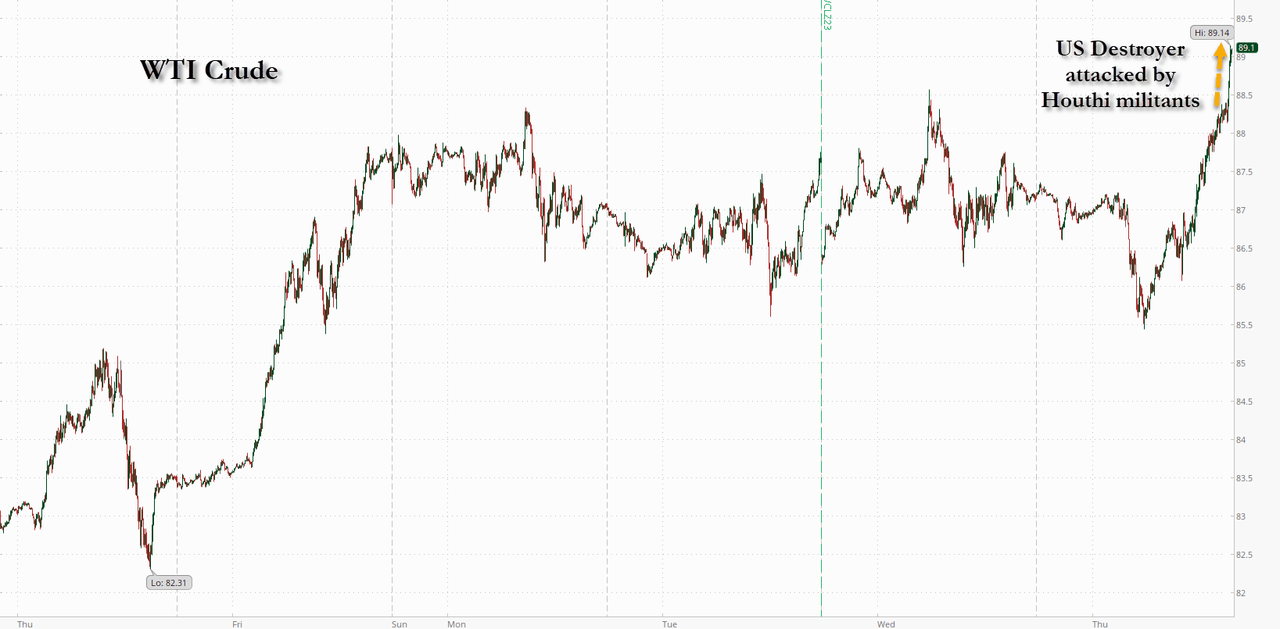
Oil Surges After Report US Destroyer Shoots Down Multiple Houthi Missiles
Update(1458ET): A huge escalation from Iran-linked militants, just after international headlines reported Israel’s military has been given the “green light” to enter Gaza:
According to CNN, a U.S. Navy vessel operating in the Middle East region intercepted multiple missiles launched from Yemen. A U.S. official says the missiles were launched from the Iran-backed Houthi militant group.
According to more from ABC’s senior Pentagon correspondent, US officials confirm to ABC “the destroyer USS Carney shot down multiple Houthi missiles last night. They were NOT aimed at the ship, but headed in a northerly direction.” There’s speculation that they may have been fired toward Israel in solidarity with Gaza. Israel media is reporting:
Israel believes that the missiles launched from Yemen and intercepted by a US warship today were aimed at Israel – Channel 13
The USS Carney (DDG-64) a Arleigh Burke-Class Destroyer with the U.S. Navy had 3 Missiles launched at it earlier today while in the Red Sea off the Coast of Yemen with all Missiles being Intercepted; the Missiles are believed to have been launched by the “Houthi” Terrorist Group… pic.twitter.com/5pJ5KPXTrF
According to geopolitical analyst Jason Brodsky, this means Iranian-backed ‘resistance’ movements are achieving “unification of the fronts: first Gaza, then skirmishes from Hezbollah, Iraq, Syria, now Yemen.”
* * *
With the whole region still on edge due to fast moving events in Gaza and on the Lebanese border, US troops in Syria have again come under attack, this time by drones which may have caused injuries.
Drones were sent, allegedly by “Iran-linked” paramilitary groups, against an oil facility in eastern Syria housing American troops, as well as against a US military outpost in the southern desert near Iraq.
Al-Tanf base, which is the Pentagon’s lone outpost in the south along the Iraq border, was the separate base that came under attack, per a Beirut-based news source:
According to informed sources who spoke with Al-Mayadeen, three drones were able to fly above the Al-Tanf base at the Syrian-Iraqi-Jordanian border and launch several successful airstrikes.
“The attack led to a major alert within [Al-Tanf], with continuous flights of military aircraft and helicopters in the area,” Al-Mayadeen reported.
Sources within the US-led coalition that spoke with Iraq’s Shafaq News on Wednesday claimed that the occupation forces “successfully intercepted and downed two of the drones, but the third managed to target the base.”
The US occupation base at Conoco oil field in Deir Ezzor governorate was also hit by multiple rockets.
As of Thursday Israel’s military has reportedly been given the “green light”to enter Gaza…
The Israeli military has a “green light” to move into Gaza whenever it’s ready, a member of the country’s security cabinet told ABC News.
Hostages and civilian casualties will be secondary to destroying Hamas, Economy Minister Nir Barakat told ABC News, “even if it takes a year.”
And more dire threats from Israeli officials:
Asked about the miles of tunnels Hamas has built under Gaza, he said they’d become the “world’s biggest cemetery.” Hamas has claimed to be holding some or all of the 203 Israeli hostages it’s taken within that vast network.
“We shall do all efforts to bring our hostages, to bring our hostages [back] alive…” he said, but the “first and last priority” is destroying Hamas.
BREAKING: ABC News reports that Israel’s Economy Minister says hostages and civilian casualties will be secondary to the priority of destroying Hamas, adding that its tunnel network will become the ‘world’s biggest cemetery’.
In the overnight hours, exchanges of fire between the Syrian Army or paramilitaries and Israel were observed in the south. “Sounds of explosions rang out in the province of Quneitra after an Israeli strike against a Syrian army position,” said a regional monitor.
The IDF has also in the last several hours affirmed it is striking against “terrorist positions” of Hezbollah in the region.
Some regional correspondents have said missiles were launched against US bases in Syria as well…
‘Really disturbing reports about missile attacks on American troops in Syria’
GB News Reporter, Charlie Peters, says that ‘if a US solider is killed in this conflict’ then this could ‘escalate to another level’. pic.twitter.com/T6f5MJPkJ8
The US military has confirmed its bases in Syria have come under attack, after the day prior US positions in Iraq were attacked as well. Casualties or officials details have remained unclear.
Targeting American troops in Syria and Iraq shows just how dangerous things could rapidly get for Pentagon forces in the region. If Hezbollah and Israel enter full war along the border, these American bases would likely suffer much bigger attacks.
Elon Musk Calls Remote Workers “Detached From Reality”
Tesla CEO Elon Musk went on a crusade against the remote work crowd during the company’s earnings call with investors on Wednesday evening. This is not the first time Musk has blasted remote work, calling it “morally wrong” and “bullshit” earlier this year.
Here’s where Musk begins to rant about remote work during Tesla’s Q3 earnings call (transcript via Bloomberg):
It’s not a — sometimes you get these, like — no, honestly, I would say it’s like, somewhat correlates with the why doesn’t everyone work from home crowd? I’m like, I mean, this is like some real Marie Antoinette vibes from people that say, why doesn’t everyone work from home? Like, what about all the people that have to come to the factory and fill the cars? What about all the people that have to go to the restaurant and make your food and deliver your food. It’s like, what are you talking about? You — I mean, how detached from reality is the work-from-home crowd have to be? While they take advantage of all those who do, you cannot work-from-home. So I mean, you have to say, like, why did I sleep in the factory so many times? Because it mattered. So I just can’t emphasize how important cost is. It’s not an optional thing for most people. It is a necessary thing.
Musk made similar comments in May. He called remote work “morally wrong” and “bullshit,” arguing it was unfair to those who can’t work at home.
“I’m a big believer that people are more productive when they’re in person,” Elon Musk said Tuesday on the work from home trend. “People should get off their goddamn moral high horse with their work-from-home b*******.” https://t.co/W1BjwKobX8pic.twitter.com/FWzVHtZFEH
“Get off the goddamn moral high horse with the work-from-home bullshit,” Musk previously said, adding, “If you want to work at Tesla, you want to work at SpaceX, you want to work at Twitter — you got to come into the office every day.”
Here’s the transcript of Tesla’s Q3 earnings call: