84.8 F
Chicago
Friday, September 4, 2026
Home Blog Page 3264

“It’s Not A Battlefield, It’s A Massacre”: Israeli Army Takes Foreign Press To Scenes Of Kibbutz Slaughter

0
“It’s Not A Battlefield, It’s A Massacre”: Israeli Army Takes Foreign Press To Scenes Of Kibbutz Slaughter

The Israel Defense Forces (IDF) have announced they have completely sealed the border with Gaza amid continued body recovery operations and assessment of damage. This as Israel has newly announced that over 1,000 Israelis have been killed.

The IDF and Israeli officials are also for the first time taking foreign journalists to the scenes where the armed raids out of Gaza took place on Sunday, including to Kfar Azza, a kibbutz near the border where some 70 Jewish residents were killed. The IDF has denounced the “massacre” while giving foreign press a tour of the empties out settlement.

Israeli victims in Kfar Aza, via AFP

“It’s not a war, it’s not a battlefield, it’s a massacre,” IDF Major General Itai Veruv was quoted as saying. “You see the babies, their mothers and their fathers, in their bedrooms, and in their protected rooms, and how the terrorists killed them — it’s not a war.”

“It’s something that I never saw in my life,” he said. “We used to imagine our grandmothers and grandfathers during the pogroms in Europe. It’s not something that we have seen in recent history.”

Another one, Kibbutz Be’eri, was the gruesome scene of the recovery of at least 108 bodies, while the music festival in the desert where footage of the initial Hamas invasion was captured had at least 260 bodies.

Among the Hamas and Palestinian Islamic Jihad (PIJ), the IDF said it had killed some 1,500 in Israeli territory, and these bodies are being collected too.

Gunmen went on a rampage Saturday along roads and highways in the south of Israel.

In Israel, at 1,008 people have died and over 2,600 others have been injured, but assessing total casualties and also identifying the deceased has been a long, difficult process – also under war conditions as missiles fly above. One top Netanyahu aide, Yossi Shelley, is under fire for some controversial statements to the press

Responding to questions during an interview on Channel 12 about the government’s reaction time, Shelley said that “the party made a not insubstantial contribution to the chaos,” adding “I’m not casting blame but sometimes there are cumulative conditions, this is a situation which no one planned.”

Shelley said the process of identifying the fatalities and the hostages was like “standing in line at the supermarket, it doesn’t matter how many shop assistants there are, sometimes it’s impossible to deal with everyone.”

On Tuesday he tried to clarify the statements amid anger from victims’ families. Shelley said, “I never in any way intended to say that the partygoers contributed to the results of the tragic event. The youngsters who were celebrating, including my beloved cousin Lori who was murdered, celebrate like the people of Israel should do on their festivals.”

Warning – graphic content below:

In Gaza, the death toll continues to mount amid constant Israeli airstrikes and shelling, with Al Jazeera reporting that the dead have reached 770.

While a horrific massacre by Islamic terrorists infiltrating southern Israel played out over the weekend, a massacre of mostly civilians by the overwhelming airpower of Israel’s air force is ongoing in the Gaza Strip. Nearly 200,000 Gazans have been displaced at this point…

On social media, there are graphic scenes of death, violence, and suffering widely circulating.

Politico has decided to go after Elon Musk and X for lack of censorship related to some of these videos:

Videos and images of mass shootings, kidnapped civilians and soldiers and other violence linked with Hamas’ attack on Israel are being widely shared on X, formerly known as Twitter, in violation of the company’s own rules against inciting violence.

POLITICO’s review of Elon Musk’s social media platform in the wake of Hamas’ attacks, which began on October 7, discovered scores of videos that allegedly showed militants murdering civilians and Israeli soldiers; viral hashtags associated with the ongoing violence that praised Hamas’ activities; and social media posts that included graphic pictures of those killed and antisemitic hate speech.

However, platforms like X are in part helping people to track missing persons, or to identify the deceased, as well as in some cases their killers. 

Image: Times of Israel

Meanwhile, even though the situation in southern Israel is largely pacified under the IDF, Israel’s military still believes some terrorist infiltrators are present, but are hiding. A search operation by Israeli forces is still active after the majority of civilian residents from communities near Gaza have been evacuated

Hamas fighters are believed to be “still hiding” in some communities in southern Israel even after the Israeli military took back control, according to Israel Defense Forces spokesman Maj. Doron Spielman.

“We are in control of the communities, but we actually assume that there are Hamas terrorists that are still hiding in these areas, including in the road where we are now,” Spielman told ABC News during an interview Monday in Sderot, Israel. “In all these communities, we’ve seen terrorist come out of hiding. Just yesterday, they took over an ambulance.”

“We’re still being very, very careful,” he added. “This is a war zone with active terrorists that are operating here.”

Videos have emerged showing highway shootouts between Israeli forces and Hamas which happened Saturday into Sunday:

There are also many videos documenting kidnappings which unfolded in real-time:

Hamas commandos, clearly well-armed and well prepared, filmed themselves breaching Israeli settlements and setting fire to the dwellings…

Graphic: The below shows the killing of a man who tried to flee (just off-scene)…

IDF reinforcements have continued to muster at the border. While the ground invasion has yet to start, it is expected and likely imminent, given Israeli Prime Minister Netanyahu told President Biden on Sunday that “We have to go in,” in reference to a ground operation. He further conceded this will be a “long and difficult war.”

Tyler Durden
Tue, 10/10/2023 – 09:05

Strikes Hit General Motors Plants In Canada As Contract Talks Fail In Last Hour

0
Strikes Hit General Motors Plants In Canada As Contract Talks Fail In Last Hour

General Motors’ Canadian plants were hit with labor disruption after Unifor, the union representing Canadian auto workers, failed to secure a labor contract with the automaker late last night. Consequently, about 4,300 Unifor workers walked off the job at three locations around midnight. This compounds the challenges for the automaker, which is already dealing with strikes at US plants. 

Reuters said the walkout was triggered when GM “stubbornly refused” to match Unifor’s contract demands already met at Canadian Ford Motor plants, which are wage increases of up to 25% for workers over the life of the contract. “The company continues to fall short on our pension demands, income supports for retired workers, and meaningful steps to transition temporary workers into permanent, full-time jobs,” Unifor National President Lana Payne said.

The labor action came after Unifor failed to secure a contract that included wage increases, cost of living adjustments, and pension reform over a three-year contract. The deadline was 11:59 p.m. Toronto time. 

“This strike is about General Motors stubbornly refusing to meet the pattern agreement. The company knows our members will never let GM break our pattern — not today — not ever,” Payne said. 

She added: “We are not there yet, so as a result, we are on picket lines.” 

Strikes in Canada compound the pressures in the US for GM as thousands of United Auto Workers continue to raise hell. Also, UAW workers continue to strike at Ford and Stellantis plants

A Deutsche Bank note pointed out a stunning statistic: GM has lost 34,176 vehicles of production since the start of the UAW strike in September. The good news, GM has 442,586 vehicles in stock. 

Reuters said Unifor went on strike at GM’s Oshawa assembly complex, St. Catharines powertrain plant, and the Woodstock parts distribution center. Union members at the CAMI Assembly Plant in Ingersoll, Ontario, are still working as they’re under a different agreement. 

“We remain at the bargaining table and are committed to keep working with Unifor to reach an agreement that is fair and flexible for our 4,200 represented employees at Oshawa Assembly & Operations, St. Catharines Propulsion Plant, and Woodstock Parts Distribution Centre,” Jennifer Wright, GM Canada’s executive director for communications, told AP News in a statement. 

Tyler Durden
Tue, 10/10/2023 – 08:50

ESG Investments Face Financial Hurdles

0
ESG Investments Face Financial Hurdles

Authored by Felicity Bradstock via OilPrice.com,

  • Investments in ESG, popularized in 2020 and 2021, are seeing disappointing returns, causing concern among financial experts.

  • Recent trends show withdrawals from sustainable funds, with companies like Blackrock and State Street Corp. retreating from certain ESG ventures.

  • Despite the challenges, some firms are re-strategizing, launching specific ESG products in hopes of better financial outcomes.

After several years of enthusiasm around environmental, social, and governance (ESG) investment, some financial experts are becoming increasingly pessimistic about the return on investment. There was a great deal of hype around sustainable or ESG investment in 2020 and 2021, as governments worldwide showed great support for a global green transition. Investment companies quickly labelled many of their funds as sustainable, as well as creating new ESG funds, to attract companies looking to “go green”.

However, a poor return on investment over the last couple of years has made many financial experts wary of continuing to invest in these types of funds, as they are unwilling to take the wait-and-see approach. 

ESG has gained greater attention in recent years, as both governments and consumers encourage companies to improve their ESG practices. This has been further accelerated in the U.S. following the introduction of the Inflation Reduction Act (IRA) climate policy last year, which provides financial incentives and tax breaks to companies that invest in green energy and technology. Consumers are increasingly expecting companies to improve their ESG practices in line with social norms and expectations, with many shopping around for the most socially responsible options on the market. Government aims to decarbonise and the potential introduction of carbon taxes in some countries have also encouraged greater investment in ESG. 

However, ESG investments that have gone to the clean energy and technology industries are seeing less of a return on investment than was previously hoped. Many renewable energy projects require huge amounts of investment to improve and become more efficient, but it could take years to make a breakthrough that will have a meaningful impact on wind, solar or other green energy operations.

Meanwhile, more and more funding is being pumped into the sector as investors remain in wait-and-see mode.

Now, certain fund managers have taken a step back on their ESG pledges. The Vice Chairman of S&P Global, Dan Yergin, stated

 “If you’re in a money management business, you do need returns.” Yergin explained,

“And we’ve seen that with more North American funds that, yes, we want to do energy transition, we want to do ESG. But we actually need returns as well. And that has shifted — the attitude — there’s kind of a more realism.” 

In the second quarter of 2023, investors retracted $635 million from U.S. sustainable funds, according to a Morningstar report. And, over the past year, a total of $11.4 billion has been withdrawn from these funds. Some investment companies appear to be withdrawing from certain sustainable funds altogether. For example, in September, Blackrock told regulators that it planned to close a pair of sustainable emerging-market bond funds with total assets of around $55 million. Companies such as State Street Corp., Columbia Threadneedle Investments, Janus Henderson Group Plc and Hartford Funds Management Group Inc. have all pulled money out of their ESG funds this year. 

By June this year, there were a reported 656 sustainable funds in the U.S., lower than previous years, as the amount of money withdrawn for ESG in the first half of 2023 has been higher than the previous three years combined. There was initially a lot of hype around sustainable or ESG funds in 2020 and 2021 after governments and the international community strongly pushed the idea of a global green transition. Fund managers quickly labelled many of their funds as sustainable, as well as opened new funds. But after two or three years of heavy investment, many are disappointed by the poor returns they are seeing. 

There is nothing simple about investing in renewable energy, with the costs of several green energy projects increasing due to supply chain disruptions and the increasing price of metals and minerals. For example, the costs of offshore wind have risen 40 percent over the last year, with many wind energy companies facing severe challenges when it comes to profits. And while the global investment in clean energy and tech reached around $1.3 trillion in 2022, the International Renewable Energy Agency stated that annual investments must grow fourfold if we are to achieve a maximum global temperature increase of 1.5oC. 

Although some fund managers are moving away from ESG investments, others are simply re-strategising when it comes to sustainable funds. Many companies are closing products that failed to attract the anticipated interest levels and are launching new, more specific products to encourage further investment in an uncertain market. This can be seen through BlackRock’s launch of two broad ESG exchange-traded funds (ETF) in 2023, an environmental solutions ETF with around $3.7 million and a sustainable global equity mutual fund with around $10 million. 

While the outlook for ESG and sustainable funds looks less optimistic than during the post-pandemic economic rebound, investment companies are not moving away from these types of funds entirely. As investments in ESG become more commonplace, investment companies will take lessons learned to launch specific new funds, aiming for a greater return on investments, to encourage companies to continue investing in green energy and related technologies. 

Tyler Durden
Tue, 10/10/2023 – 07:20

Rivian Owner Shocked By $41,000 Repair Bill For Minor Damage

0
Rivian Owner Shocked By $41,000 Repair Bill For Minor Damage

Rivian R1T pickup owners should be wary of even minor fender benders, as the vehicle’s complex design could result in a massive repair bill. 

EV blog InsideEVs says the owner of a Rivian R1T pickup in North Carolina was recently quoted $41,000 – nearly half the value of the vehicle – to fix a minor dent on the driverside rear panel bumper

$41,000 to fix this?! 

“So the owner did a bit of research and came across Matt Boyette, who runs All Out Paintless Dent Removal in Jacksonville, Florida, and decided to ship his EV 500 miles south to try and get the damaged rear end fixed,” InsideEVs said. 

“These vehicle are very difficult to work on due to the limited access to the backside of the damage. We were able to repair the dent using paintless dent removal and maintain the factory parts and finish, as well as prevent a stain on the carfax. We had the vehicle in our possession for 3 days, which is a way better cycle time, than it sitting in a body shop for possibly a month or more,” Boyette from All Out Paintless Dent Removal wrote in a YouTube video description.

Instead of $41,000 and half the truck torn apart, InsideEVs noted that a “repair like this usually costs between $3,000 and $7,000, so between 7 and 17 percent of the original quote.” 

Boyette said, “I’m definitely expecting to see more Rivians. Since the video went viral, which is now at almost 8 million views, I’ve had numerous people reach out to me from all over the country in need of similar repairs.”


In July, another Rivian R1T pickup owner was quoted $42,000 for a minor accident

Auto experts have said repairing EVs is more expensive than fixing gasoline vehicles. We penned a note in March titled Not ESG-Friendly: Insurers Junk Entire EVs For Minor Accidents. It only takes one minor accident to damage a battery pack, and if that occurs, it must be replaced at the cost of tens of thousands of dollars. 

Are EVs even worth it?

Tyler Durden
Tue, 10/10/2023 – 06:55

FDA Notice: Blood Pressure Drugs Recalled After Powerful Opioid Found

0
FDA Notice: Blood Pressure Drugs Recalled After Powerful Opioid Found

Authored by Jack Phillips via The Epoch Times (emphasis ours),

A drug manufacturer said it is initiating a recall of its blood pressure medication due to the presence of the synthetic opioid oxycodone, according to a notice published by the U.S. Food and Drug Administration (FDA) this week.

A sign for the Food and Drug Administration (FDA) outside of the headquarters in White Oak, Md., on July 20, 2020. (Sarah Silbiger/Getty Images)

KVK-Tech said it is recalling one lot of 10-milligram betaxolol tablets, which were distributed around the United States to retailers and wholesalers, the notice said.

The batch is being recalled as a precaution because a single oxycodone tablet was found on the packaging line during the line clearance when the batch was packaged. The company said it has not received reports of a “foreign tablet” in a bottle of betaxolol.

The betaxolol package insert warns about slowing in the heart rate in elderly patients which is likely to be exacerbated by inadvertent opioid administration,” the recall notice said. “Additionally, some patients prescribed low-dose betaxolol might be have compromised heart and lung function that is also likely to be exacerbated by an opioid. Furthermore, there are minor differences in appearance between betaxolol 10 mg tablets and oxycodone 5 mg tablets, not likely to be noticed by a regular user of the 10 mg betaxolol tablet.”

It noted that some patients who are at risk of overdose “are likely to be negatively affected” by receiving oxycodone, a powerful narcotic drug.

That’s even more so if a “substantial number of oxycodone tablets have been introduced into a bottle labeled as betaxolol,” the recall notice added. “Therefore, inadvertent exposure to a controlled substance, such as oxycodone, in that patient population is likely to result in significant slowing in breathing, known as respiratory depression, which is a serious health risk.”

The betaxolol tablets were packaged in plastic white bottles in counts of 100 tables and have an expiration date of June 2027. The batch number is 17853A.

KVK said it notified distributors and customers by a recall notice letter via email and overnight mail on Sept. 27 and will arrange for the return of the recalled product. A small number of bottles that possibly contain oxycodone might have been distributed to retail pharmacies.

The release said that customers who purchased the medication will be reimbursed by the company for the cost. It added that if one experiences issues connected to the tables, they should contact a physician or health care provider.

For any questions regarding the recall, KVK can be contacted at 215-579-1842, ext: 6002, Monday through Friday between 8 a.m. and 6 p.m. ET or via email at customerservice@kvktech.com.

Other Recalls

Several weeks ago, the FDA announced that Marlex Pharmaceuticals voluntarily recalled one lot of 0.125-milligram Digoxin Tablets USP and one lot of 0.25-milligram Digoxin Tablets USP.

The reason why, according to the notice, is due to a “label mix-up,” which could potentially lead to an overdose of the wrong medication. Weaker versions of the heart medication were placed into bottles of the stronger medication and vice versa.

“The mix-up in labels can cause either overdosing or underdosing in patients who unknowingly take the wrong dose,” the notice said. “Patients who intend to take Digoxin Tablets USP … would receive a super potent dose and can experience significant drug toxicity (mental disorientation, dizziness, blurred vision, memory loss and fainting) from the unintentional overdose.”

“The product is used for the treatment of mild to moderate heart failure,” it said. “Digoxin increases heart muscle contraction in pediatric patients with heart failure. Digoxin is indicated for the control of ventricular response rate in adult patients with chronic atrial fibrillation. The product is packaged as 100 tablets in white HDPE bottles and labeled as indicated below with NDC, lot and expiration date.”

Around the same time, a separate FDA notice announced the recall of WEFUN capsules after the agency found the product was tainted with another drug, sildenafil.

“FDA analysis has found the product to be tainted with sildenafil. Sildenafil is an ingredient known as a Phosphodiesterase Inhibitor (PDE-5) inhibitor found in FDA-approved products for the treatment of male erectile dysfunction. The presence of sildenafil in this product renders it an unapproved drug for which the safety and efficacy has not been established and, therefore, subject to recall,” it said.

Several weeks ago, Glenmark Pharmaceuticals USA and Baxter Healthcare separately recalled drugs that are used to treat hypertension and cancer, respectively. Glenmark recalled 1,200 bottles of trandolapril and verapamil hydrochloride extended-release tablets for high blood pressure, while Baxter recalled 13,502 vials of bendamustine HCl injection, used to treat several types of cancer.

Tyler Durden
Tue, 10/10/2023 – 06:30

Wall Street Professionals Increasingly “Nervous” About “Yield-Led Global Accidents”

0
Wall Street Professionals Increasingly “Nervous” About “Yield-Led Global Accidents”

A new market survey of Deutsche Bank clients finds smart money anticipates economic trouble ahead as extreme hawkish policy by central banks could trigger a ‘bigger financial accident’ and or ‘serious financial stress.’ 

Deutsche Bank’s Jim Reid wrote in the note that a global financial market survey was conducted between Oct. 3-6 and had 410 client responses worldwide. He said, “We take a look at expectations of central bank policy error, US recession risks, and financial market forecasts.” 

The first question in the survey asked, “From its current levels, will the next 100bps move in 10yr USTs be higher or lower? (yields averaged c.4.75% during the survey).” 

Most respondents (75%) believe the next 100bps move in the US 10-year bond yield is down. 

When asked, “From its current levels, will the next 10% move in the S&P 500 be…”

Respondents overwhelmingly said S&P500 will fall by 10% versus a 10% rise. Reid commented on this and said, “The pessimists won again in the October survey.” 

The next question asked when respondents expected a US recession to occur. 

The result, as per Reid, “On a US recession, since we last asked in June, even more of our respondents have pushed out their expectation of recession to 2024, from 48% to a strong majority at 71%. This has reduced the number for YE 2023 from 39% to a mere 9%. 82% still expect a US recession by YE 2024 but this is down from 89% in June.”

Reid noted in another survey question that “Our respondents are nervous about yield-led global accidents.” 

When asked, “What do you think is the likelihood of Donald Trump being the US President after the 2024 US election?”

Reid said, “The weighted average of our respondents who see it as increasingly likely that Trump will make a reappearance as President after the 2024 election jumped up 10pp from 36% in June to nearly half (46%) in October 2023. Nearly 10% see the likelihood to be over 80%.”

Survey results show smart money is preparing for a Fed-induced financial accident that may tip the US economy into recession next year.

More in the full survey available to pro subs.

Tyler Durden
Tue, 10/10/2023 – 05:45

The New Global Oil Market Order Hangs In The Balance After Hamas Attacks Israel

0
The New Global Oil Market Order Hangs In The Balance After Hamas Attacks Israel

By Simon Watkins of Oilprice.com

In what turned out to be extraordinary timing, October 3 saw a Western coalition of France’s TotalEnergies and Italy’s Eni, plus Qatar Energy, apply for the second licensing round on oil and gas blocks 8 and 10 in Lebanese waters, while only four days later Palestinian political and military organisation Hamas launched coordinated multi-pronged attacks by land, sea, and air against Israel. Lebanon is a core member of the Iran-dominated Shia Crescent of Power, which both China and Russia have long seen as the foundation stone for their expansion of power across the Middle East as a whole, as analysed in depth in my new book on the new global oil market order. Lebanon’s political and military organisation, Hezbollah – like its Palestinian counterpart Hamas – vows Israel’s destruction and praised Hamas for its “heroic operation” against Israel on October 7. Both paramilitary groups receive multi-layered support from Iran’s financial, intelligence, and military networks and each of these support facilities are inextricably linked to China and Russia, as also fully examined in my new book. The potential for the Hamas attacks on Israel to suck in other Arab states into the conflict, and for it to then become another proxy war – to add to that still raging in Ukraine – between the U.S. and Russia (and China) appears large. The last time that a major conflict between Israel and the Arab states occurred, the 1973 Oil Crisis erupted, which saw the benchmark WTI oil price shoot up around 267 percent – from about US$3 per barrel (pb) to around US$11 pb.

The West has long been looking to disrupt China and Russia’s increasing hold over the core Shia Crescent (comprising Lebanon, Jordan, Syria, Iraq, and Yemen) – as exercised through proxy Iran – and the expansion of its oil and gas activities in Lebanon can be regarded as part of that process. This is particularly the case now, as for many years the West has critically overlooked a key lever of power by which Russia and China have extended their own presence in the region – namely, the creeping roll-out of a massive pan-regional electricity power grid with Iran at its centre. Within the last two weeks, the International Energy Agency (IEA) stressed that such power grids are “poised to emerge as the ‘new oil’ of the global energy system,” and added that: “For all countries, speeding up permitting, extending and modernising electricity grids, addressing supply chain bottlenecks, and securely integrating variable renewables are critical.” Iran has long used Iraq – never under the scrutiny of U.S. sanctions as Iran has been – as a conduit for oil, gas, and electricity deals, as also detailed in my new book, as a means of expanding its levers of control over the Shia Crescent. Such deals allow not just for the installation of permanent infrastructure linking one country to another but also for the on-site presence of permanent ‘technical and security’ personnel, including Iranians, Chinese, and Russians. In just the same way that Russia’s huge level of gas supplies to Europe gave it immense power across that continent up until changes to that arrangement were made after the 2022 invasion of Ukraine, so Iran’s electricity and other power supplies give it enormous power over the Shia Crescent and increasingly the rest of the Middle East.

It was no coincidence that just over a month after Israel and the United Arab Emirates (UAE) in August 2020 normalized relations (and then Israel, Bahrain and Morocco did the same), Iran’s own neo-client state, Iraq, signed new energy deals with core Shia Crescent countries, Jordan and Lebanon. In Jordan’s case, last October saw it sign a contract with Iraq to connect their electricity power grids. By extension, this provides a direct link between Jordan and Iran, as around the same time as Israel and the UAE had announced their normalised relations deal in August 2020, Iraq signed a two-year deal with Iran for electricity imports, the longest such deal between the two countries. Shortly after that, Iran’s Energy Minister Reza Ardakanian stated that Iran’s and Iraq’s power grids had become fully synchronised to provide electricity to both countries by dint of the new Amarah-Karkheh 400-KV transmission line. He added at the time that Iranian and Iraqi dispatching centres were fully connected in Baghdad, the power grids were seamlessly interlinked, and that Iran had signed a different three-year co-operation agreement with Iraq “to help the country’s power industry in different aspects”.

In Lebanon’s case, the most recent deal was the 22 July renewal of a longstanding agreement for Iraq to provide it with up to 2 million tons of crude oil for a year, plus additional supplies of fuel oil. According to official comments from Iraq’s Oil Ministry, the fuel oil would be sold at international prices and would be paid for in exchange for Lebanese goods and services. A more careful look at the deal reveals that it is anything but standard and straightforward. The first key point is that Iraq does not have any fuel oil at all that meets the specifications of any power plant anywhere in Lebanon. Indeed, Lebanon’s own caretaker Energy Minister, Raymond Ghajar, openly stated in February 2021 after an earlier renewal of the deal that: “Iraq’s heavy fuel does not match Lebanon’s specific needs.” Given this bewildering premise, Lebanon’s supposed plan at that point was to resell the Iraqi fuel and use the proceeds to buy spot cargoes of a fuel that did meet its specifications. The second key point is precisely what ‘goods and services’ Lebanon has been and will use to pay for this useless Iraqi fuel oil. Lebanon’s two most valuable exports are uncut diamonds and unwrought gold, despite it having no diamond mines and no gold having been mined anywhere in the country for years. It has a large trade in arms and ammunition as well.

On the other side of the equation, Iran has been under considerable financial pressure itself ever since the U.S.’s unilateral withdrawal from the ‘nuclear deal’ in May 2018. This has meant that Iran has been finding it increasingly difficult to pay its military proxies in the Shia Crescent countries, including Hamas in Palestine and Hezbollah in Lebanon, so this oil deal between Iraq and Lebanon may be regarded as one instrument in Iran arranging an effective method of continuing to fund these military proxies. In this scenario, oil would supposedly come from Iraq – although it is impossible to tell whether it is from Iraq or Iran as there are so many shared fields, as also detailed in my new book, then Lebanon sells it – at some point in the oil-gold/and or diamonds chain – for U.S. dollars. Lebanon then uses some of these dollars to buy fuel oil for its power stations and the rest to either pay Iran, via Iraq, U.S. dollars that Iran needs to pay its militias in Lebanon and Palestine and elsewhere or it pays the militias itself on Iran’s behalf.

Both TotalEnergies and Eni have been at the vanguard of the West’s efforts to establish a new foothold in the Middle East following the re-engagement of the U.S. after a period of focusing inwards. This was seen in practice in the U.S. withdrawal from, most notably, Syria (in 2019) – including protracted internal White House discussions about pulling out of the strategically vital At-Tanf exclusion zone that was the tri-border junction of Syria, Jordan, and Iraq – Afghanistan (2021), and Iraq (2021). In practical terms, though, this policy can be seen earlier in the U.S.’s withdrawal from the nuclear deal with Iran, which opened the door to a massive increase in influence from both Russia and China across the Middle East. An early indicator of whether the West’s efforts to regain any influence in the Shia Crescent have any chance of succeeding may come now from how TotalEnergies and Eni fare in their Lebanese energy plans. It may be, though, that the ongoing hostilities between Hamas and Israel inexorably begin to further destabilise the tinder box that is the present Middle East, leading to a second active region of proxy war between the U.S. and its allies on the one side, and the allies of China and Russia on the other, to add to the ongoing war in Ukraine. It seems likely that Beijing and Moscow might well believe that with two such conflicts in place, a third theatre of war in the world – in Asia Pacific, for example – would stretch the resources of the West, both military and politically, very close to breaking point. In any event, the likely soaring price of oil and gas from a broader Arab-Israeli conflict would send the West back into economy-crippling inflation levels.

Tyler Durden
Tue, 10/10/2023 – 04:15

Polish President: The EU’s “Calls For European Solidarity On Migration Are Fairy Tales”

0
Polish President: The EU’s “Calls For European Solidarity On Migration Are Fairy Tales”

Authored by Grzegorz Adamczyk via Remix News,

Polish President Andrzej Duda said that he is counting on any Polish government that emerges after the election on Oct. 15 to respect the interests of the country, meaning “it would concentrate on the causes of the migration problems rather than the symptoms.”

Duda added that he hoped that “the situation in the Middle East will be a sobering element” for EU authorities. 

He said that if another wave of migration sweeps across Europe, then Poland must repeat its case for defending the borders of the EU and helping countries to solve problems that lead to migration. He said he was convinced that the present government has been right to oppose the relocation of illegal migrants, as that simply spreads the problem rather than dealing with it. 

“There was a world of difference between refugees from Ukraine and illegal migrants,” said Duda, who said most of the illegal migrants were economic migrants seeking a better life rather than true refugees.

He noted that most of the migrants stopped by Polish border guards after illegally crossing from Belarus, openly admitted that they wanted to go to Germany or other Western countries and had no intention of claiming asylum and staying in Poland. 

The Polish president continued by saying that the EU has tried before to force Poland to take in relocated illegal migrants. The Polish conservative government, unlike the liberal one before it, refused to participate in the migrant quota scheme, as it saw no sense in creating detention camps for migrants who did not want to stay in Poland. In his view, to treat migrants in such a way would have been both inhumane and illegal. 

Duda also complained about the way the EU had treated Poland over hosting Ukrainian refugees. Poland had expected it would receive the kind of help that was given to Turkey, which had to deal with Syrian refugees. The EU helped Turkey so that it would keep the Syrians from crossing EU borders but was not prepared to financially help Poland receive Ukrainian refugees.

According to the Polish head of state, Poland was “treated in such a way that we have little doubt that all these calls for European solidarity are fairy tales emanating from EU institutions.” 

Poland continues to oppose the EU migration pact that was passed in the Council of the European Union. Hungary joined Poland in opposing the pact, while Slovakia, Czechia and Austria abstained. The pact will now be subject to negotiations with the European Parliament over the final version of the regulations required. 

The present Polish government has decided to ask Polish voters to reject the EU migration pact in a referendum, which will be held simultaneously on Oct. 15, together with the general election. 

Tyler Durden
Tue, 10/10/2023 – 03:30

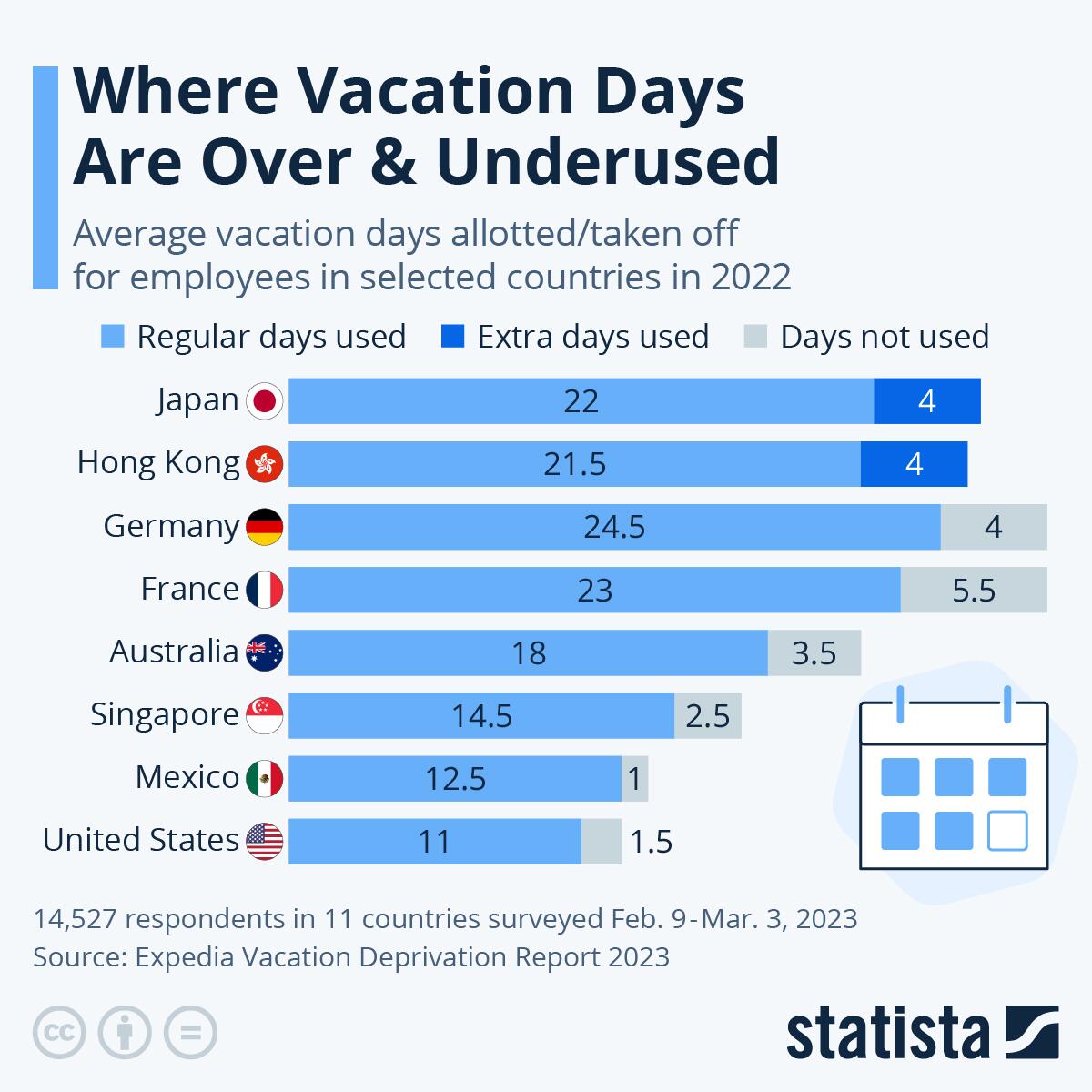
Where Vacation Days Are Over & Underused

0
Where Vacation Days Are Over & Underused

While nations in Asia have in the past seen reports about their workaholic ways and failure to take off days from work, a 2023 release by Expedia paints a different picture of how employees in Japan and Hong Kong handle their vacation time.

As Statista’s Katharina Bucholz reports, according to the survey carried out in early 2023, Japanese and Hongkongese have actually requested four extra days off work on average beyond the time allotted to them in 2022. This gave them a longer average real vacation time last year than workers in Germany and France. People in these countries had more days available to them, but failed to take them all.

Some countries such as the United States rank towards the bottom of the list when it comes to the average number of vacation days allotted (and at its very bottom when looking at statutory leave with 0 days guaranteed). Despite this, the average American worker still leaves vacation days on the table, albeit just few at an average of 1.5. A more workaholic nation in Asia is Singapore, with 17 days allotted on average and an average of 2.5 unused days. Germany and French people have more unused days on average at four and 5.5, respectively. In these two countries, average vacation days allotted per year are also more numerous, however, at 28.5 each. Guaranteed by law are 20 days in Germany and 25 in France. In the U.S., Germany and France, between 10 and 14 public holidays are added to the vacation day tally as well. In Japan, this number is even higher at 16 days.

Tyler Durden
Tue, 10/10/2023 – 02:45

6 Takeaways From AfD’s Massive Gains In Bavaria And Hesse Regional Elections

0
6 Takeaways From AfD’s Massive Gains In Bavaria And Hesse Regional Elections

Authored by John Cody via Remix News,

While the Christian Democrats (CDU) and the Christian Socialists (CSU) received the most votes in the regional elections of Hesse and Bavaria, the headline news story across Germany is the Alternative for Germany’s (AFD) overperformance in both states. The outcome of the election is reverberating throughout Germany, with implications for the federal level as well. On the issues of immigration, the economy, and green energy, the AfD is pulling ahead, while the ruling left-liberals will be left searching for answers after an election shellacking.

Here are six takeaways from the election results and what they could mean for the future political landscape of the country.

AfD may be stronger than the polls say

With both Bavaria and Hesse combined, the AfD party will now have 70 seats, a 50 percent increase compared to its previous 2018 elections. The party actually did better than the polls said it would, which had already painted a rosy picture for the anti-sanctions, anti-immigration party.

For example, AfD was polling at around 16 percent in Hesse, but actually ended up in second at 18.4 percent, while in Bavaria the AfD is on par with the Greens and Free Voters, where it earned 15.8 percent, making it the third-largest party.

The party has for years had a stable level of support at around 10 to 12 percent, but in the last year, it has soared in the polls up to 23 percent and continues to hover at 21 percent.

Many new potential AfD voters may be “shy” voters who are afraid to express their support to pollsters, meaning that pollsters may not be capturing the full picture. The party is, after all, facing a potential ban, openly mocked and attacked by the political and journalistic establishment, and supporters of the party along with politicians have been physically assaulted in the past.

Furthermore, with the AfD’s success in local elections, it may begin to “normalize” the party in the eyes of voters, which could contribute to more open support for the party — and even a jump in the polls — going into the future.

Germans are fed up with mass migration

In the run-up to the elections, Remix News reported a new groundbreaking poll showing a huge majority of Germans wanted fewer migrants and also saw migrants bringing fewer advantages than disadvantages.

If we look at the polling surrounding these specific elections, it only cements the reality that Germans are remarkably shifting against mass immigration.

For example, in Bavaria, immigration was rated as the second most important factor by voters, behind the economy, with 48 percent of all respondents telling Infratest dimap that they “welcomed” that the AfD wanted to limit the number of foreigners and refugees more strongly. In Hesse, 42 percent backed the AfD’s anti-immigration policies. In Hesse, the issue of immigration was decisive for 18 percent of voters in terms of their vote, meaning that this was their number one issue.

This polling data shows the massive disconnect between the left-liberal mainstream that promotes mass immigration in the media and culture and the actual sentiment of the German people.

The AfD’s Robert Lambrou, who was second on his party’s election list in Hesse, leaned heavily into the issue of migration during the campaign. Notably, he not only called for faster deportations but stated that skilled legal immigrants should only be accepted in exceptional circumstances and then only from “neighboring countries that are culturally close to Germany.”

AfD rises in the west

The AfD has been historically strong in the east of the country, but with a result of over 18 percent in Hesse, it marks the first major breakthrough in the west of the country. The results come as the AfD recently broke the 20 percent mark in wealthy Baden-Württemberg, the first time it has achieved such a result in a western state.

Notably, the German mainstream is now noting that the AfD’s rise in two Western states is not a fluke or a mere protest vote, with Taggeschau writing:

To interpret the strong results in both states as just a protest election would be too short-sighted. More and more people are voting for the AfD out of conviction. The current situation benefits the party: Asylum and refugee policy concerns many people, and support for a more restrictive migration policy is growing, as data from Infratest dimap shows. At the same time, fewer and fewer voters in both states have a problem with voting for a party that is partly right-wing extremist. And it is not just in migration policy that it is increasingly being given authority: more people are also placing their hope in the far-right party when it comes to the issues of internal security, the economy and social justice.

Such an acknowledgment from the state-run Tagesschau regarding the AfD is big news all in itself.

Massive blow to the traffic-light government

Besides the AfD, the other big outcome was how incredibly poorly Germany’s left-liberal government performed in the election. Now, the political fallout could be felt for months and even years.

For starters, the business liberals of the Free Democrats (FDP) were completely wiped out and failed to obtain the 5 percent needed to enter parliament in both states. It follows a long string of election losses for the party, which has been accused of abandoning many of its principles in its coalition alliance at the federal level. The party is now suffering the consequences, with the results likely sending party leadership scrambling to avert all-out disaster. The FDP, which has already criticized its coalition partners at the federal level, will undoubtedly be seeking out a more independent path in the future, which could lead to a serious governing crisis for Chancellor Olaf Scholz.

However, the SPD and Greens also fared poorly, particularly the SPD, which earned an abysmal 8 percent in Bavaria and only 15.1 percent in Hesse, both historic lows. The Greens earned 14 percent in both Bavaria and Hesse, a substantial drop in both instances from their previous election results.

There is in all likelihood trouble ahead for this coalition, and the far-left Interior Minister Nancy Faeser could still lose her job over her party’s election debacle in Hesse, although there are currently denials from top party brass that this is a possibility post-election.

The CDU could shift further right

Of course, the CDU is also taking note of the AfD’s rise. The CSU, the sister party of the CDU, saw 100,000 of its voters shift to the AfD in Bavaria. In short, the AfD could quickly cut into the CDU’s base, especially over the issue of immigration.

According to German state-run media outlet Tagesschau, it also sees the CDU potentially shifting its stance over the issue, writing: “These results may well lead to a shift in the policies of the mainstream conservative CDU towards a stricter stance on migration. The votes — and the preceding campaign largely focused on national rather than regional issues — may also force the government to revisit its policy of phasing out fossil fuels.”

Will anything change?

Despite the AfD’s surge and a mass rejection of the left, the two elections are notable for another key reason. In both Bavaria and Hesse, both governing coalitions survived. In Bavaria, the CSU can continue governing with the Free Voters, and in Hesse, the CDU could form a theoretical coalition with the Greens once again. In other words, the status quo was maintained.

The AfD may have seen a serious boost in both states, but for now, all parties have vowed to never work with the party. In the short term, the AfD is working to create the conditions that make it increasingly difficult for ruling parties to form status quo coalitions. In the long term, it sees the only viable path to power through a coalition with the CDU. The big question mark is if and when that will ever happen.

Many voters may agree with the AfD’s positions on a range of issues, but many are mentally conditioned to never consider voting for the party. The CDU and other parties are aware of this and will continue to hone their message to keep their voters from straying too far away, even if they plan to maintain the status quo once they achieve power.

Tyler Durden
Tue, 10/10/2023 – 02:00