80.1 F
Chicago
Friday, September 4, 2026
Home Blog Page 3284

Ford, GM Layoff Another 500 Workers As Strikes Ripple Across Heartland 

0
Ford, GM Layoff Another 500 Workers As Strikes Ripple Across Heartland 

After United Auto Workers expanded strikes against Ford Motor Co. and General Motors Co. on Friday, both automakers laid off an additional 500 workers at four Midwestern plants because of the worsening impacts of labor actions about to enter the third week. 

Reuters said Ford on Monday “was furloughing a total of 330 workers at its Chicago Stamping and Lima, Ohio Engine plants, while GM layoffs included 130 at its Parma, Ohio Metal Center and 34 at its Marion, Indiana Metal Center.” 

On Friday, UAW boss Shawn Fain expanded strikes against a General Motors plant in Lansing, Michigan, and a Ford Chicago assembly plant but spared Stellantis after last-minute talks that offered progress on a new four-year labor deal for UAW workers. 

“Our courageous members at these two plants are the next wave of reinforcements in our fight for record contracts,” the union boss said Friday. He added, “We are not calling on additional members at Stellantis to go on strike because moments before this broadcast, the automaker made significant progress on the contract.”

The Wall Street Journal said, “With the layoffs disclosed by GM and Ford on Monday, more than 6,000 factory workers are off the job because of spillover effects from the strike. That figure includes several suppliers who have cited furloughs directly tied to the walkouts.”

About 25,000 out of 146,000 UAW workers are striking at facilities operated by General Motors Ford, and Stellantis.

Last week, Ford’s chief supply chain officer, Liz Door, warned:

“We have roughly 125,000 supplier employees that support our Michigan assembly plant.

“And if prolonged, this really could have a significant impact as it expands into our other Ford factories. We see anywhere between 325,000 to 500,000 people that could be laid off.”

CEOs of Ford and General Motors blasted UAW boss Fain over the weekend:

GM CEO Mary Barra said: “It’s clear that there is no real intent to get to an agreement.”

While CEO Jim Farley said, “UAW is holding the deal hostage over battery plants.”

Late Monday, General Motors said it received a counteroffer from the union. Last week, Fain dropped pay hike demands from 40% to 30% for a new four-year labor contract. Still, automakers are around 20%.  

In other UAW news, Volvo Group-owned Mack Trucks agreed on a new labor contract with the union on Sunday night to avert a strike. 

JPMorgan told clients Monday that it had reduced General Motors’ third-quarter earnings by approximately $191 million and decreased Ford’s profit by around $145 million because of ongoing strikes. 


Tyler Durden
Tue, 10/03/2023 – 15:00

Ukraine Accused Of Using Cluster Bombs On Russian Village Near Border

0
Ukraine Accused Of Using Cluster Bombs On Russian Village Near Border

Russian officials have accused Ukraine forces of using cluster munitions against civilian targets. The governor of Russia’s Bryansk region on Tuesday said that a Russian village came under attack which lies near the border.

Gov. Alexander Bogomaz announced on Telegram that cluster bomblets were observed in a cross-border attack on the village of Klimovo, but no casualties have been reported.

File image: AFP

Reuters said it wasn’t able to independently verify the claim, for which there was no immediately available visual evidence. “The governor of Russia’s Bryansk region has alleged Ukraine used cluster munitions on a Russian village near the Ukrainian border, hitting several houses,” EuroNews reports.

Russian border regions like Bryansk and Belgorod in particular have come under frequent indiscriminate shelling throughout at least the last year of war.

It was only in this past summer that Washington escalated its support to Kiev through the supply of cluster munitions, a weapon type currently banned by more than 120 countries:

Washington controversially supplied Kyiv with cluster bombs in July –  which was blasted as a “terrible mistake” by politicians and rights groups. 

…Like a shotgun, they splatter explosive submunitions over an area as big as several football fields. These can then lie dormant like landmines, killing and maiming civilians years after a conflict has finished.  

The Biden administration late last month announced it would likely include more cluster bombs in the next weapons package for Ukraine, which will draw on previously approved funds. 

This isn’t the first time that Russian officials have alleged cross-border shelling from Ukraine which used cluster bombs, with initial accusations having come as early as July, at around the time the Ukrainians reportedly received their first US shipments.

White House national security spokesman John Kirby at that time said, “We have gotten some initial feedback from the Ukrainians, and they’re using them quite effectively.” But if these latest attacks on Russian civilian villages are accurate, Putin could use it to escalate with continued large-scale attacks on decision-making centers across Ukraine, as the Kremlin has threatened before. 

Tyler Durden
Tue, 10/03/2023 – 13:00

Global Use Of The Euro Has Collapsed In The Past Nine Months

0
Global Use Of The Euro Has Collapsed In The Past Nine Months

By Elwin de Groot, Head of Macro Strategy at Rabobank

Despite the September ECB hike and warnings by President Lagarde that inflation is still much too high, the market has increasingly turned its focus to the economy, succumbing to the idea that the European economy may already have entered a recession. Nowhere better is that view being reflected in the euro, which has given up all the gains it made against the dollar from December 2022 to July 2023. Since mid-July, the common currency has lost nearly 8% against the dollar. According to data from SWIFT – the global messaging service for cash transactions – the use of the euro has collapsed in the past nine months. It’s share in transactions dropped from 38% in January to 23.2% at the end of August, which is the lowest level recorded in, at least, twelve years.

Our G10 FX analyst Jane Foley believes that EUR weakness is likely to persist. For the dollar leg of the exchange rate our US analyst Philip Marey is of the view that the US could still see a technical recession early in 2024 as the effects of monetary tightening take their toll. This, however, need not trigger a USD sell off, as it appears likely that during the winter the market will have to contend with slow growth in China and cyclical as well as structural weakness in the Eurozone. With investors likely to shun risk assets this could actually favour the dollar.  

Meanwhile, as said, the Eurozone is the economy that is losing growth momentum at the most rapid pace, where the US economy has continued to ‘hang in there’. Although the final release of the Eurozone manufacturing PMI saw a slight upward revision in the French index and slightly better-than-expected outcomes for both Spain and Italy (although both remaining firmly in contraction territory), the German index was revised down deeper into recession territory (39.6 in September). Also the Irish PMI, a bellwether for the high-value-added part of industry, slipped back below the 50-mark.

Some snippets from the Eurozone HCOB PMI report highlight the recent weakness. Its headline reads: Factory job losses intensify amid sinking new orders and deteriorating business confidence.” According to the report, the “[…] volume of new orders placed with eurozone goods producers fell rapidly once again during September. In fact, the rate of decline remained among the steepest seen in the survey’s 26-year history. Considerable weakness was also seen on the export front. The response by manufacturers was to reduce production levels for the fourteenth time in 16 months. The decrease was sharp and slightly faster than in August.” Also employment is moderating, as “[…] further job cuts were made in September, with euro area factory employment falling at the quickest pace in almost three years.” The good news for households, then, is that price pressures are also waning quickly: “With the exception of the great recession in 2008/2009, output prices have never decreased at a pace faster than the current three-month average.”

Altogether, this backdrop suggests scope for further downside pressure for the EUR. Having breached our former EUR/USD1.06 target, Jane Foley revised our forecasts lower and now expects EUR/USD to move to 1.02 on a 3-month view and remain lower for longer into 2024. Last but not least, on the margin, rising concerns about the fiscal pledges of Italy’s right-wing government could also become a EUR negative factor, since this has the potential to create tensions with Brussels going forward.

Apart from these cyclical developments, concerns over structural weakness may be playing into bouts of currency weakness as well. We have discussed the woes of the European car sector in several previous editions of this Global Daily. With the EU having launched a probe into illegal state subsidies in the Chinese car sector, this has injected fresh uncertainty over the trade relation between the two economic blocs. At the end of the day, we believe that the most likely scenario is a negotiated settlement that would either result in some protective measures and/or entails an agreement on Chinese investments in Europe in either the car or the battery sector. But the EU may face a bumpy ride. Teeuwe Mevissen and Erik-Jan van Harn explain our thinking on this matter in more detail here.

On this note, today the European Commission and European Parliament debate on the trade relations with China. After several reports on critical raw materials, the European Commission is also launching a report today that looks at critical technologies: “The European Commission will assess the risks of four critical technologies”. Those technologies are said to be i) semiconductors, ii) artificial intelligence, iii) quantum technologies and iv) biotechnologies such as vaccines and genome sequencing. Reuters cites a Commission official saying that the Commission wants to assess the risks of these technologies “being weaponized by countries not aligned with its values”. The deadline for this assessment is set for the end of this year and the next step is to mitigate the risks next year, according to the Reuters article. These developments show that the EU is now following more or less the same path as the US, although it is still in the ‘assessment phase’ rather than the ‘action phase’.

Meanwhile, on the other side of the world, the RBA chose to leave the cash rate unchanged at 4.10%. This was the first meeting under new Governor Michele Bullock. This was despite the August inflation report showing an acceleration in price growth for the first time since April, and substantial gains in energy prices during the month of September.

The Governor’s statement notes that uncertainties surrounding the health of the Chinese economy, the speed of monetary policy transmission and the outlook for household consumption, all informed the decision to remain on hold. At the same time, continued brisk growth in services price inflation, tight labour markets and faster than expected GDP growth were noted as arguments for raising rates. The hawkish bias has been maintained (with a caveat). The statement says “Some further tightening of monetary policy may be required to ensure that inflation returns to target in a reasonable timeframe, but that will continue to depend upon the data and the evolving assessment of risks”. This fits with our RBA watcher Ben Picton’s view that the final 25bp hike in this cycle will likely be administered at the November meeting, following the Q3 quarterly inflation report due in late October.

Tyler Durden
Tue, 10/03/2023 – 12:40

“He Will Help You With What You Need”: New Messages To Hunter Deepen Concerns Over Chinese Influence

0
“He Will Help You With What You Need”: New Messages To Hunter Deepen Concerns Over Chinese Influence

Authored by Jonathan Turley,

After the initiation of the Biden impeachment inquiry, new messages are deepening concerns over the influence of Chinese figures on the Biden family. Messages from longtime Biden associate Fran Person show the Chinese stepping in to support Hunter’s lavish lifestyle as funds dried up during his divorce. Person wrote Hunter that Chinese businessman Bo Zhang “will help you with what you need.”

Fran Person was not just a close aide to Joe Biden for years, but someone that the First Lady Jill Biden described as a member of the family: “Fran has been like a son to Joe and me. For eight years, we traveled the country, shared holidays together … Fran may be leaving the office, but he will always be a part of our family.”

Fran left the staff of Joe Biden and went to work with Chinese figures . . . and Hunter.

In a July 2017 WhatsApp message, Person told Hunter that Zhang was aware that he was in financial distress during his divorce and would cover his costs. Hunter sounds desperate for the Chinese support as he gushes money to fund his lavish lifestyle: “100K at least gets me until next month.”

Person assures him that Zhang has his back: “He will help you with what you need.”

Fox News Digital reported on Person’s messages. They include this assurance:

“I talked to Bo previously about the 37K – he didn’t flinch. I will talk to him about 56K and possibly 100K. It really depends on his liquid assets in the US…I will ask. His only problem is getting large sums out of China (especially right now).”

Hunter appears in distress and presses Person if he knew whether anything was wired or if they were in a “holding pattern.”

Person responds “No holding pattern…he was on his way to the bank this morning. He will be in touch when it’s confirmed.”

“He will help you with what you need. He also mentioned that you should take a trip to China some time this month to just get away for a week or so…just decompress.”

Hunter later schedules the trip.

The concern is that Hunter was receiving money from figures closely associated with foreign government and foreign intelligence, including the CCP.  These operatives often look for people who are in desperate situations to exercise influence over them. Hunter Biden’s massive spending and addictions would have been a draw for intelligence services.  He offered an obvious entry into potential influence or access with regard to Joe Biden.

At one point, Hunter offers in July 2017 to hold Zhang at his father’s McLean home after Joe Biden left the vice presidency.

Zhang met repeatedly with Hunter Biden, Person, and Eric Schwerin several times.

Person’s message shows him showering Hunter with praise and promises of Chinese funds. In one message, Person told Hunter that he

“selfishly want[s] to work” with him “because I know what the hell your capable of, AND I want to learn from you. I’m putting myself out there right now, and I’m learning quickly. But I’d love to be there with you doing some of this stuff. I mention the 500K on 10M raise be I’m about to get started on that, and I could really use your help. We could knock it out together. I’d think that’d help take some bite out, and you wouldn’t feel like your ‘resorting’ to anything…I’ve got one loyalty brother. That’s to my family. Your family.” 

Person is obviously going to be busy during this impeachment inquiry. Despite President Biden’s repeated denials that anyone in his family received any money from China, The Washington Post and other media outlets have found those denials to be false.

Indeed, at least two transfers of funds to Hunter Biden in 2019 from a Chinese source listed the President’s home in Delaware where Hunter sometimes lived and conducted business.

The latest messages reveal how Hunter Biden’s personal and financial distress may have been viewed as an opportunity for foreign interests. Hunter suggests that he was existing month to month on such payments. The question is what he did in return for such foreign generosity in what is clearly an influencing peddling operation.

Tyler Durden
Tue, 10/03/2023 – 12:00

Government Shutdown Averted. But Is That A Good Thing?

0
Government Shutdown Averted. But Is That A Good Thing?

Authored by Lance Roberts via RealInvestmentAdvice.com,

Once again, due to the ongoing lack of fiscal responsibility in Washington, the markets and the economy faced a Government shutdown. After a day of theatrics, Congress passed a “stopgap” measure that will keep the Government operating for 45 days. But is that a good thing?

First of all, while much media hyperbole surrounds Government shutdowns, much like the debt ceiling, there is a long history of shutdowns going back to the 70s. As Katherine Buchholz of Statista recently penned:

“The 2018/19 Government shutdown was the longest in recent U.S. history at 34 days. A timeline shows that government shutdowns have been getting longer in the last three decades, with the second and the fourth-longest Government shutdowns taking place in 1995 and 2013, respectively. Throughout the 1980s, shutdowns were numerous but shorter, while in the 1970s, they also ran somewhat longer but only surpassed two weeks once, in 1978. Government shutdowns aren’t all that rare: Since 1976, there have been 20 shutdowns that lasted an average of 8 days.

While the latest measure provides funding, we will likely deal with this again in mid-November. What is notable, however, is that the Government has stopped functioning normally since 2008. Before the Obama administration, the Government operated on an annual fiscal budget. The House of Representatives would put together a budget for spending, the Senate would make its modifications, and then it would go back to the House for reconciliation. Once complete, it would move to the President for signature. Funding would then be allocated accordingly.

Compound Spending

However, since 2008, the Government has continued to operate without a budget. Rather than passing a budget each year, a “Continuing Resolution” is passed to fund spending. The problem with using “Continuing Resolutions” is that it uses the previous spending levels and increases that spending by 8%. Such is why, since 2008, the debt has exploded as spending is compounding annually.

Of course, given the massive surge in spending, revenues cannot keep up the pace, leading to a rapid increase in debt issuance and a trending deficit.

It is worth noting that before 2008, revenues were greater than the running growth trend of public debt. However, post-2008, such has not been the case. Subsequently, the growth in the deficit continues to accelerate.

However, does this mean a calamity is at hand with the Government now shut down?

A Temporary Delay Doesn’t Solve The Problem

While the media and Government officials will declare victory over avoiding a Government shutdown, is it a victory? Washington, D.C., has a long history of “kicking the can” to avoid doing its “job” of governing. That job sometimes includes making unpopular decisions that cause short-term pain for a healthier economy in the years ahead.

Rather than taking the easy path, it is essential to understand what occurs during a Government shutdown. Yes, roughly 900,000 “non-essential” workers will be furloughed. While their salaries will accrue during the furlough, the lack of income will impact economic growth. That impact would be relatively minor, and based on past shutdowns, Goldman Sachs estimated a reduction of annualized growth by around 0.2% for each week it lasted after accounting for modest private-sector effects.

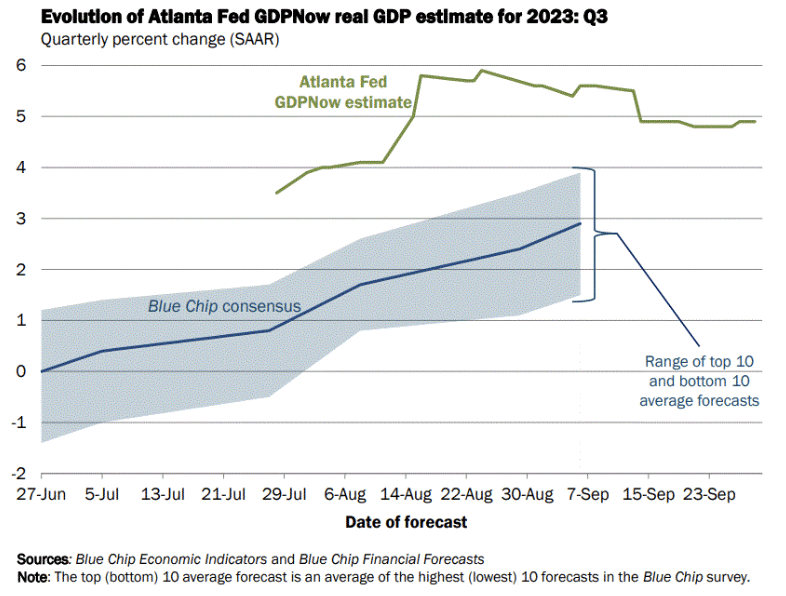
Given that the longest shutdown lasted 35 days, as shown above, you can estimate the impact on economic growth could be roughly as much as 1%. Yes, that is certainly concerning, but with economic growth running near 5% according to the latest Atlanta Fed GDPNow, such is not a recessionary concern.

Shutdowns Are About Discretionary Spending

What is critical to understand about Government shutdowns is that mandatory spending (social security, welfare, interest on the debt) continues as needed. Shutdowns are primarily about discretionary spending. Such is why it mainly involves Government employment and the shuttering of national parks and monuments. According to Goldman Sachs, the shutdown would have only impacted about 2% of Federal spending overall. Notice that the vast majority of Government spending is directly a function of the social welfare system and interest on the debt.

The above chart shows spending as a percent of GDP. However, using the 2023 data from the Center On Budget Policy, we can better understand why we have a problem with our welfare system.

As of the latest annual data, through the end of Q2-2023, the Government spent $6.3 Trillion, of which $5.3 Trillion went to mandatory expenses. In other words, it currently requires 113% of every $1 of revenue to pay for social welfare and interest on the debt. Everything else must come from debt issuance.

While a Government shutdown would undoubtedly create a minor negative impact on economic growth, maybe such would be an acceptable price to return the Government to some form of fiscal responsibility.

What A Shutdown Would Mean For The Markets?

But what impact would a shutdown have on the financial markets?

This past weekend’s newsletter discussed why the recent summer weakness laid the groundwork for a potential year-end rally. To wit:

As a contrarian investor, excesses get built when everyone is on the same side of the trade. With that said, everyone is so bearish the markets could respond in a manner no one expects. The chart below shows the relatively sharp decline from the more exuberant bullish sentiment we saw in June and July. Historically, when the combined readings of retail and professional sentiment reached current levels, such formed the basis for a reflexive rally.

A Government shutdown would undoubtedly impact the financial markets as investors remain skittish about committing capital into an uncertain environment. However, as noted by Zerohedge recently:

“What’s more, market reactions to government shutdowns have become increasingly muted given that despite the high odds of a shutdown, funding typically arrives at the 11th hour via a ‘continuing resolution’ to provide temporary funding at the start of the Oct. 1 fiscal year, which eventually translates to longer-term spending bills. A failure to do either leads to a shutdown – which looks likely at this point.”

As shown in the table below, since 1995, markets tend to wobble heading into and during the Government shutdown but tend to post positive returns overall.

While the mainstream media’s hyperbole about Government shutdowns is undoubtedly concerning, the reality is that they have little impact on both the economy and the financial markets.

The fiscal irresponsibility in Washington, D.C., which continues to erode economic growth, prosperity, and a stronger middle class, should be of more concern.

As we concluded in “Debts, Deficits, and Why $32 Trillion Matters,”

“{The debt] is one of the primary reasons why economic growth will continue to run at lower levels. Changes in structural employment, demographics, and deflationary pressures derived from changes in productivity will magnify these problems.

Like a forest fire cleanses and fertilizes the soil, making the forest healthier, maybe a Government shutdown that returns some fiscal responsibility to Washington might be a good thing.


Tyler Durden
Tue, 10/03/2023 – 11:20

Defund Police Backfires: Democrat Congressman Carjacked At Gunpoint In DC As Crime Chaos Spreads

0
Defund Police Backfires: Democrat Congressman Carjacked At Gunpoint In DC As Crime Chaos Spreads

Late Monday night, Rep. Henry Cuellar, Democrat of Texas, was carjacked in the Navy Yard neighborhood, about a mile from the United States Capitol Complex, according to CBS News.  

“As Congressman Cuellar was parking his car this evening, three armed assailants approached the Congressman and stole his vehicle,” Cuellar’s chief of staff, Jacob Hochberg, said in a statement.

Hochberg continued, “Luckily, Cuellar was not harmed and is working with local law enforcement.”

Metropolitan Police said the carjacking occurred around 2130 ET near New Jersey Avenue and K Street in a redeveloped area that includes residential housing and a Marriott hotel. 

Bloomberg noted, “Dozens of lawmakers, Republicans and Democrats alike, live in the apartment and condominium buildings within the block of Monday night’s attack.” 

An aide to Cuellar said police recovered the car, but no arrests have been made. Police say they’re looking for three male suspects wearing all black. 

The carjacking comes after a chaotic weekend across the nation’s capital as failed progressive policies continued to transform city streets into a third-world-like country.  

Weeks ago, DC Mayor Muriel Bowser, a former supporter of the ‘defund the police’ movement, requested increased policing due to a murder crisis. 

“What I can say is this: To me, numbers are just numbers. When we lose one person — whether it’s one or 200 — that’s too many,” Bowser said at a press conference in late September. 

Of course, Bowser, like many Democrat mayors, blames firearms as the issue, deflecting any possibility her disastrous social justice reforms only embolden criminals – while punishing law-abiding taxpayers across the imploding metro area. 

Directly north of DC lies another crime-ridden liberal metro: Baltimore City. 

… and then there’s this. 

It’s time for law-abiding taxpayers to demand radical leftists who run many major cities to reinstate law and order. 

Tyler Durden
Tue, 10/03/2023 – 11:00

Beer-Can Bearing Trump’s Mug-Shot Hits Major Milestone: CEO

0
Beer-Can Bearing Trump’s Mug-Shot Hits Major Milestone: CEO

Authored by Jack Phillips via The Epoch Times (emphasis ours),

A beer brand that was launched earlier this year as an alternative to Bud Light amid a months-long boycott has shattered its own company records by marketing a special edition can that featured former President Donald Trump’s mug shot, according to the company’s head.

Ultra Right Beer CEO Seth Weathers told Fox News last week that the special edition can was launched after President Trump’s mug shot was taken in August after he was indicted in Fulton County, Georgia, on racketeering and other charges stemming from his activity following the 2020 election.

Mr. Weathers told Fox Business that sales of the limited edition offering have amounted to more than five tractor-loads of cans, saying that it’s now the “most sought-after collector beer can in American history.”

We knew people would go wild over these collector cans, but we had no idea the response would be this crazy,” he said in a recent statement, adding that sales of the beer would top $2 million by 11:59 p.m. on Oct. 1 when it’s taken off the market.

Sales of the can “have poured in from the moment we launched,” Mr. Weathers said. “With over $1 million in beer and merchandise sales, we’ve raised over $50,000 for the legal defense of the Georgia Trump electors and the Georgia Republican Party. Conservative Dad’s Ultra Right Beer puts our money where our mouth is—we’re doing our part to fight back against the unjust persecution of American patriots.”

The company touts its product as “100 percent American beer,” according to its website, and states that 10 percent of the beer’s sales will be donated to the Georgia Republican Party legal defense fund and the David Shafer Legal Defense Fund.

As for President Trump, the 2024 presidential candidate’s campaign released mug-shot-inspired gear in August that included T-shirts, coffee mugs, and beer holders. Hours after the mug shot was taken at the Fulton County Courthouse, the former president posted the image on his X (formerly known as Twitter) account—the first and only time he’s done so since he was allowed back on the platform after his account was suspended in January 2021.

President Trump’s mug shot merchandise was still available on his website on Oct. 1.

Bud Light Update

In April, Bud Light created a backlash with its release of a promotional beer can featuring transgender activist Dylan Mulvaney in connection with the NCAA’s March Madness. As images of the beer can went viral on social media, conservative social media influencers and celebrities suggested a consumer boycott of the brand, causing sales to plummet for months.

Anheuser Busch InBev, the parent company of Bud Light, said in early August that its U.S. revenue fell by about 10 percent in the second quarter as sales of Bud Light slumped. Revenue fell $395 million in North America, too, it said.

Bud Light’s U.S. sales through retail stores have fallen by 25 percent or more since April, but the company said that they have stabilized.

Bud Light, made by Anheuser-Busch, sits on a store shelf in Miami on July 27, 2023. (Joe Raedle/Getty Images)

In an investors’ call this summer, CEO Michel Doukeris said that AB InBev’s U.S. team is working hard to win back consumers and that the stabilization comes with signs of improvement. Bud Light’s loss has spelled gains for Coors Light and Miller Lite, brands of main U.S. rival Molson Coors.

Last week, analysts with Bank of America upgraded Anheuser-Busch InBev’s stock to buy from neutral, although they stressed that in the United States, it’s “hard not to be negative” amid the boycott.

The top bank lifted AB InBev’s price target to $68 from $65, according to MarketWatch. Cost of goods sold (COGS) pressures have begun to ease on the brand, while analysts cited how the brand is doing business in Latin America.

“Over the last few years, [Anheuser-Busch InBev] has transformed its business in many of its key markets [particularly in Latin America], with a more effective portfolio strategy, stepped-up innovation, and digitization of its route-to-market with BEES (B2B), a clear competitive advantage,” said analysts led by Andrea Pistacchi.

However, they cautioned that it’s “hard not to be negative” about the brand’s U.S. volume outlook. They predicted that the permanent profit damage to Anheuser-Busch InBev because of the Bud Light backlash may exceed $1 billion, CNBC reported.

Reuters contributed to this report.

Tyler Durden
Tue, 10/03/2023 – 10:40

Japanese Yen JOLTed Higher – Is The MoF In The Market?

0
Japanese Yen JOLTed Higher – Is The MoF In The Market?

This morning’s hotter-than-expected JOLTS print initially sparked a hawkish response across markets, pressing the USD higher against its fiat peers.

The JPY slipped back above 150/USD on the move – the weakest since October last year, and is trading in an area where authorities stepped in with purchases to support the yen last year for the first time since 1998.

As a reminder, the first intervention by Japan last year came when the yen weakened to 145.90 in September. The country spent around $65 billion in total to support the yen in three occasions in September to October.

But then, out of nowhere, someone bought JPY with both hands and feet and smashed USDJPY 3 handles stronger…

Did we just see the Ministry of Finance intervene?

As Bloomberg reports, Masato Kanda, the top currency official at the Ministry of Finance, has said he’s keeping in close contact with his US counterparts, with both sides in agreement that excessive currency moves are unwelcome.

Finance Minister Shunichi Suzuki warned about the currency fluctuations for six days in a row through Tuesday. He said on Tuesday he won’t judge the possibility of FX intervention on currency levels but through volatility.

Is the old Gold-Yen trade back?

… something it did for much of the previous decade.

We suspect this ‘volatility’ is Suzuki’s signature now.

Tyler Durden
Tue, 10/03/2023 – 10:22

Market Pukes After Biden’s Dept Of Labor Shocks With 5-Sigma Beat In Job Openings Which Soar The Most Since July 2021

0
Market Pukes After Biden’s Dept Of Labor Shocks With 5-Sigma Beat In Job Openings Which Soar The Most Since July 2021

Just when the Fed thought that the White House had instructed Biden’s Department of Labor to go easy on the fabricated data, and after several months of declining job openings and easing payrolls in line with an economy that is gradually slowing if not outright falling into a recession, moments ago the BLS absolutely shocked and stunned markets, strategists and economists when the DOL decided to come up with the biggest data fabrication in years, and reported that in August job openings exploded from 8.827MM to a mindblowing 9.61 million. The increase, a staggering 690K (from the upward revised July print of 8.920MM), was the biggest monthly increase since July 2021 (!)…

… which not only came above the highest forecast but was a 5-sigma beat to the median expectation of 8.815MM...

… the biggest such “beat” since Sept 2022.

According to the BLS, job openings increased in professional and business services (+509,000), finance and insurance (+96,000), state and local government education (+76,000), nondurable goods manufacturing (+59,000), and federal government (+31,000). Again: it is the BLS’ position that there was a 35% increase in professional and business services job openings, an absolutely hilarious goalseeking of data.

The surge in the number of job openings meant that in August the number of job openings was 3.255 million more than the number of unemployed workers, back to the highest since May and reversing the last three months of normalization in the labor maret.

Curiously, despite the surge in job openings, the recent spike in unemployed workers (recall the surge in the unemployment rate), meant that the number of job openings for every unemployed worker was unchanged to 1.51.

And while the number of job openings was farcical and clearly politically mandated, one certainly could not see a similar euphoria in the other data points tracked by the JOLTS reported, starting with the number of quits, which barely increased in July, rising by just 19K to 3.638 million, effectively remaining at the lowest level since May 2021.

Furthermore, while the DOL goalseeked job openings sharply higher, it forgot to do the same to not only quits but also hires; in fact, hires rose a tiny 35K to 5.5857 million, also just barely above the lowest level since March 2021.

And while we have previously discussed the chronic fabrication of job openings data by the BLS, which goes against all private surveys, we are confident that when the Biden admin finally falls and some enterprising forensic accountant digs to find out just where all these bullshit numbers came from, what they will find is some political hack at the BLS/DOL claiming that it’s not their fault, but rather that it’s the response rate. And indeed, as the BLS itself indicates, the response rate to most of its various labor (and other) surveys has collapsed in recent years, nothing is as bad as the JOLTS report where the actual response rate has tumbled to a record low 31%

In other words, more than two thirds, or 70% of the final number of job openings, is estimated!

And at a time when it is critical for Biden to still maintain the illusion that at least the labor market remains strong when everything else in Biden’s economy is crashing and burning (or soaring and burning as may be the case of inflation) we’ll let readers decide if the admin’s Labor Department is plugging the estimate gap with numbers that are stronger or weaker.

As for the market, for now it is going with the increasingly laughable fiction that the US has completely decoupled from every other country in the world, and amid fears that a November hike may be in the books, yields and the dollar spiked…

… sending stocks sharply lower.

Tyler Durden
Tue, 10/03/2023 – 10:20

McCarthy Out Today? House To Vote On Gaetz Motion To Vacate After ‘No Deal’ Struck With Dems

0
McCarthy Out Today? House To Vote On Gaetz Motion To Vacate After ‘No Deal’ Struck With Dems

Days after narrowly averting a government shutdown by striking a secret side-deal with Democrats over Ukraine funding, Rep. Kevin McCarthy (R-CA) faces the biggest challenge to his Speakership by the same group of House conservatives who delayed his rise to power eight months ago.

On Monday night, Rep. Matt Gaetz (R-FL) filed a motion to formally remove McCarthy from his role as speaker – a vote for which McCarthy says he’ll get out of the way first thing today, while CNBC says the vote should begin at 2pm ET.

In short, only Democrats may be able to save McCarthy – who says he hasn’t made any deals with the Democrats who he says “haven’t asked for anything,” following a Monday night call with House Minority leader Hakeem Jeffries (D-NY) – who will ultimately decide McCarthy’s fate.

While the minority party in the House typically doesn’t support the majority’s choice for speaker, motions to vacate are rare – and this situation hasn’t been seen in more than a century.

According to the Guardian, Gaetz and his allies have the votes to remove McCarthy.

In a notice to lawmakers, Democratic whip Katherine Clark’s office said votes on the motion to vacate Kevin McCarthy from his position as speaker of the House could take place “at any time after the House convenes at 12:00 p.m. today.”

Before voting on the motion itself, McCarthy’s allies may move to table the proposal, which, if successful, would block the motion to vacate, and save McCarthy’s speakership. That would need a simply majority to pass, and, the way the numbers are looking now, can’t be achieved without Democratic help.

“Members should keep their schedules flexible and be prepared to vote at the appropriate time,” reads the notice.

Gaetz and his Freedom Caucus allies were livid on Sunday after it emerged that McCarthy had made a secret side-deal with Democrats for more Ukraine funding, in exchange for passage of a continuing resolution that will keep the government running through mid-November.

Developing…

Tyler Durden
Tue, 10/03/2023 – 09:51