97.3 F
Chicago
Wednesday, September 2, 2026
Home Blog Page 3322

Stocks & Bonds Slammed As Powell Pi$$es In Next Year’s Punchbowl

0
Stocks & Bonds Slammed As Powell Pi$$es In Next Year’s Punchbowl

If you’re not confused now, you weren’t paying attention.

  • Fed held rates unchanged (as expected) – neutral.

  • Fed increased its growth expectation, lowered its unemployment expectation, and increased its inflation outlook – dovish/soft-landing.

  • Fed erased 50bps of cuts expected for next year in its dot-plot – hawkish as hell.

That sent STIRs hawkishly higher…

Source: Bloomberg

Mohamed El-Erian offered the most succinct summary of the malaise many were left in after the statement, the SEP, and the press conference:

“I worry that the economic and policy signals coming out of this Federal Reserve press conference may come across to many as both confused and confusing.

Some will deem this an inevitable consequence of this phase of the inflation and policy cycle; others will view it as further evidence of challenged Fed communication.”

And the Dot-Plot crushed expectations for cuts next year…

Source: Bloomberg

Treasuries were mixed on the day – and very volatile – with the short-end dramatically underperforming. 2Y ended up 6bps while 30Y was down 3bps on the day. On the week, the long-end is lower but the short-end is significantly higher…

Source: Bloomberg

The pattern was similar for all bonds (except the 30Y) with early gains (erasing yesterday’s losses) quickly being eviscerated on the Fed’s SEP.

Source: Bloomberg

10Y yield broke out from the August highs late in the day to their highest since Oct 2007…

Source: Bloomberg

And 2Y yields soared to a new high since July 2006 (2y yields rose 14bps off the intraday lows this afternoon)…

Source: Bloomberg

All of which crushed the yield curve (2s30s)…

Source: Bloomberg

Equities did what equities do around the FOMC. The kneejerk move was lower (hawkish SEP), but the second Powell started speaking the algos ripped the market back up to unch… but this time, they could not hold it and stocks tanked to the lows of the day, extending losses after Powell stopped speaking. Nasdaq (longest duration stocks) suffered most…

Gamma-heavy 4500 was key resistance for the S&P 500…

0-DTE selling was dominant after The Fed but we note that the S&P fell down to exactly match its Put Wall level…

Source: SpotGamma

‘Most Shorted’ Stocks puked hard today with no bounce at all…

Source: Bloomberg

CART was carried out today, plunging all the way back to its IPO price…

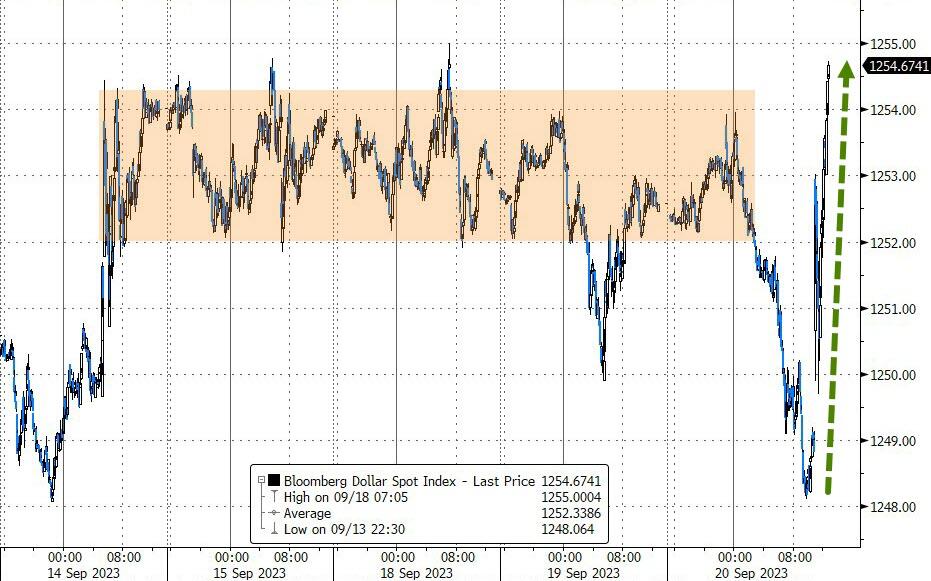
The dollar dumped overnight into The Fed statement then exploded higher…

Source: Bloomberg

Bitcoin ended lower, falling back below $27000 as stocks tumbled…

Source: Bloomberg

Gold (spot) rallied up to near $1950 intraday before fading as the dollar spiked after The Fed…

Source: Bloomberg

Oil prices managed gains on the inventory data but The Fed’s hawkishness dragged WTI back below $90…

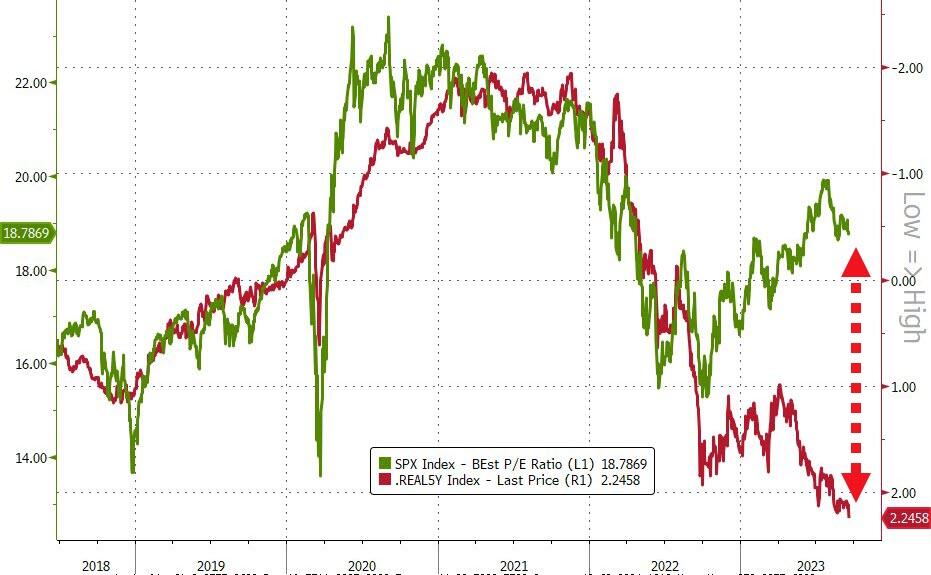
Finally, with Powell and his pals pissing in the punchbowl of rate-cuts for next year, one has to wonder just how long this chasm between real rates and equity valuations can remain…

Source: Bloomberg

…and real rates are getting higher.

Tyler Durden
Wed, 09/20/2023 – 16:01

Thousands Of Armenians Rush To Airport, Fearing Genocide, As Ceasefire Announced In Nagorno-Karabakh

0
Thousands Of Armenians Rush To Airport, Fearing Genocide, As Ceasefire Announced In Nagorno-Karabakh

After an intense full day of fighting between Azerbaijan forces and ethnic Armenian separatists in the contested Nagorno-Karabakh enclave, an agreement for full ceasefire has been reached. 

Nagorno-Karabakh officials said it lost at least 32 civilians and soldiers following a Tuesday of intense gunfire, artillery, and strikes on civilian neighborhoods, particularly focused on the breakaway region’s chief city of Stepanakert. At least 200 have been wounded.

Prime Minister Nikol Pashinyan said Armenia was not involved in reaching the ceasefire agreement, which is expected to be implemented with the coordination of Russian peacekeeping forces

He emphasized in a statement, “we have numerously said that Armenia doesn’t have an army in Nagorno-Karabakh since August 2021.” He further confirmed, “the intensity of the fighting has greatly decreased” in Nagorno-Karabakh.

One war correspondent from Armenpress news agency described, “People are still hesitating to leave their shelters. Only a few people have come out for some fresh air, so to say.”

Ethnic Armenian civilians fled during the daylong fighting to the Russian peacekeepers’ main base, with Russia’s defense ministry confirming that in total 2,261 civilians, of whom 1,049 are children, took refuge at the base.

Stunning images of a sea of people gathered at the region’s airport were widely circulated…

The Wall Street Journal is pointing out that such a brief attempt of the Armenian separatists to throw off the blockade and occupation of the surrounding Azeri forces marks a catastrophic setback and defeat, after already ceding territory at the conclusion of the 2020 war:

Armenian separatists in Nagorno-Karabakh agreed Wednesday to disarm and discuss reintegration with Azerbaijan following a swift but deadly assault by Azeri forces, a capitulation that signals the end of decades of ethnic-Armenian rule in the enclave and the rapid decline of Russian influence in the former Soviet Union territories.

The terms of the cease-fire lay groundwork that could bring to a close the autonomous rule by the population of Nagorno-Karabakh, which was won from Baku in a bloody yearslong war after the fall of the Soviet empire.

The report continues, “The speed at which the Armenian separatists agreed to abandon their armed struggle underscores Moscow’s waning power over events in the region as its forces are stretched in Ukraine.”

“The Kremlin has used the frozen conflict—one of dozens that dotted the post-Soviet landscape—as a lever to maintain sway over both Armenia and Azerbaijan,” the WSJ adds. “Over the years, Moscow has sent both weapons and peacekeepers to the region while using diplomacy to retain its position as ultimate arbiter over the region’s geopolitics.”

The terms of the ceasefire are a devastating loss for the separatist forces…

Azerbaijan’s defense ministry had on Tuesday confirmed it was in the midst of what it dubbed an “anti-terrorist” campaign in the enclave that has about 120,000 ethnic Armenians.

Separatist officials are urging the population not to rush to the airport, amid fears of that an Azeri retaliation campaign and ethnic cleansing could ensue:

Thousands of ethnic Armenians in Nagorno-Karabakh have massed at the airport where some Russian peacekeepers are based after separatist forces agreed to a ceasefire which would see them surrender to Azerbaijan.

Separatists running the self-styled “Republic of Artsakh” urged the population of 120,000 not to rush to the airport in the capital which they call Stepanakert.

“We once again urge the population of Stepanakert not to succumb to panic and not to go to the airport on their own initiative in order to evacuate,” the separatists said.

Ethnic Armenian neighborhood after shelling by Azerbaijan forces, via EPA.

Baku’s defense military had announced the following ultimatum:

“To stop anti-terrorist measures, illegal Armenian armed groups must raise the white flag, surrender all weapons, and the illegal regime must dissolve itself. Otherwise, anti-terrorist measures will be continued until the end.”

Azerbaijan has stood accused of seeking to conduct a slow genocide of ethnic Armenians in the Nagorno-Karabakh region by cutting off food, medicine, and humanitarian aid. 

Tuesday is being widely seen as a defeat for the Artsakh Republic…

One regional journalist, Paul Antonopoulos, has written that “After starving Armenians in Nagorno-Karabakh for 9 months, Azerbaijan launched another vicious attack to terrorize the indigenous population.”

Tyler Durden
Wed, 09/20/2023 – 15:45

Wall Street Reacts To The Fed’s “Confused” 2024 Hawkish Shock

0
Wall Street Reacts To The Fed’s “Confused” 2024 Hawkish Shock

In our FOMC preview, we said that the only thing that will matter today was the Fed’s 2024 median dot…

… and that’s precisely what happened: with a statement that was a carbon copy of July, the real shocker today was the much more hawkish outlook for 2024. Indeed, as Bloomberg notes, when comparing the 2024 dots with the previous projection, one can clearly see a hawkish shift. The most frequent, (aka mode) projection from June was 4.375% (6 dots). Now, it’s between 4.875% and 5.375%. It’s a shift of as much as 100 bps.

And while the market swings around wildly, repricing trillions worth of assets based on a forecast which will be dead wrong months from today, let alone a year, here is what some Wall Street analysts, strategists and traders had to say in kneejerk response to the Fed statement and Powell presser.

Mohammed El-Erian

“I worry that the economic and policy signals coming out of this Federal Reserve press conference may come across to many as both confused and confusing. Some will deem this an inevitable consequence of this phase of the inflation and policy cycle; others will view it as further evidence of challenged Fed communication.

Ira Jersey, chief rates strategist at Bloomberg Intel

A Fed that maintains short term rates well above 5% for most, if not all, of 2024 will keep the Treasury yield curve inverted for longer than many casual observers will be comfortable with. But in our view, even if the Fed doesn’t cut, the curve will continue to price for lower rates at some point in the future.”

Bloomberg Economics Team

“Even though the dot plot shows another hike this year, we see a number of potential adverse shocks to growth between now and end-year that could derail that plan. Economic uncertainty and disruptions from the UAW strikes and looming government shutdown may push the Fed to postpone a hike to 2024 — or even nix it completely. Still — we do think the question of another hike this year is an increasingly close call.”

Zachary Hill, head of portfolio strategy at Horizon Investments.

“The Fed’s projections are compatible with a more resilient economy under higher interest rates, which implies a higher neutral rate. On its face, that is not a great reason to give up on equities, so I think that explains why we have had a muted selloff so far. Plenty of time left in the day though.”

Jake Schurmeier, PM at Harbor Capital Advisors

“It seems that the Fed is quite optimistic about a soft-landing. And it’s clearly leading them to revise up their estimates of the neutral rate despite the stickiness of the long-run dot.”

Omair Sharif, president of Inflation Insights LLC

“It’s very hard to explain a 3.7% core PCE forecast for this year. That figure, along with lower unemployment and higher growth, explains why the Fed took out two hikes for next year, but it’s very, very hard to justify. It implies a much higher monthly core PCE than most are expecting (especially given the 0.1% August core PCE that most are forecasting). It’s also odd to think the unemployment rate will just stick at 3.8% this year. It seems like officials have more confidence that we’ll just see lower demand via job openings and no pickup in layoffs. It’s oddly optimistic on the labor market and equally oddly pessimistic on core inflation this year.”

Andrew Patterson, senior economist at Vanguard

“It means (combined with the increase in growth expectations and cut in unemployment rate for that year) that the Fed is increasingly confident that they can pull off a soft landing and that the economy can withstand higher rates for longer.”

Derek Tang, economist with LH Meyer/Monetary Policy Analytics

“Contours of dot plot were largely as expected though the 2024 dots moving up to 5.1%, not just 4.9%, raised my eyebrows. I found the new absence of any 2023 dots above 5.6%, which means even the most hawkish no longer see hiking twice more as necessary, as imparting a dovish tone in the near term. The number who don’t project any more hiking this year was seven, which is a comfortable margin for Powell.”

Anna Wong, chief economist at Bloomberg Economics

“Conditional on very optimistic SEP forecasts on unemployment and inflation, Bloomberg Economics’ rule would indeed match the dot-plot projection of only two 25-bp rate cuts next year, and 120 bps of cuts in 2025. Our view is that the risks tilt toward a weaker economic outlook than the SEP has penciled in — and we think the Fed ultimately will end up cutting more than the dot plot indicates.”

Bryce Doty of Sit Investment Associates

“The large real fed funds rate means the Fed does not need to raise rates any further. Odd how Powell points out STRONG growth of working age labor force as earnings growth subsides (more supply = less cost) and yet concludes the Fed is looking for WEAK employment before saying they are done raising rates.”

Audrey Childe-Freeman, chief G-10 FX strategist at Bloomberg Intelligence:

“There is not much in today’s Fed policy decision or policy statement likely to deter dollar bulls near-term when considering that the high for long interest rate message holds strongly, so that means that US dollar yield appeal for now. “In addition and arguably more surprisingly for 2024, the adjustment higher in the GDP growth profile for this year and next year puts dollar bulls in a strong position too, for now. Whether this can be sustained will obviously be a function of whether this soft landing scenario unfolds. All eyes on the press conference next but a first take at the statement and forecasts gives fresh ammunition to dollar bulls.”

David Powell, head of market strategy at TradeStation

“Today’s slightly hawkish Fed statement reflects the strength we’ve seen in the economy since their last meeting. Policymakers have zero incentive to get dovish now, especially with oil on the rise and the auto strike threatening to push up wages and potentially car prices… This announcement keeps them data dependent, which could be a positive if shelter costs continue to ease. Jerome Powell isn’t ready to back down yet, but markets might look past the rhetoric. Investors know he’s wary of declaring victory against inflation after his infamous transitory call two years ago.” 

Peter Tchir of Academy Securities

“They do not want to cut. They want to hold rates higher for longer. End of 2024 and end of 2025 both 50 bps higher on recent SEP than the June SEP. A significant move but one that seems in line with our “extremely high hurdle” to cut. Between them barely mustering the dots to get one more 25 bp hike this year, and a press conference that seemed like he had to contain himself from sounding dovish (he did not come across hawkish) we may have moved from “high hurdle to hike” to “extremely high hurdle to hike”. Yes, they are data dependent, and maybe it is wishful thinking on my part, but they seem to be looking to the data for reasons to do nothing! The Fed is always “data dependent” but they often seem to have had a bias. Until early this summer, they seemed to be looking for excuses to hike. I just don’t see that in his language or their actions (remember, he comes into this with an objective of not coming across as dovish, so anything less than brutally hawkish is probably an admission of neutrality). So far, treasury yields are getting more inverted across the curve as the front end sells off a bit (pricing in higher for longer) but the back end is rallying a bit (given it is an FOMC day and we are near the high yields of the year (depending on where you look on the curve) the movements are quite muted.

Finally, to summarize the market moves: Initially we saw rates higher and equities lower. But both reversed during the press conference, before re-reversing again with yields back to session highs and stocks at session lows.

“Those moves are loosely consistent with a better growth outlook,” said Stuart Kaiser of Citi. “Higher rates are a tactical risk for equities but medium-term the SEP changes are positive for stock markets, in our view. It’s important to note that the FOMC is implying fewer cuts rather than additional hikes.”

Source: Bloomberg, primary sources.

Tyler Durden
Wed, 09/20/2023 – 15:20

Dealers “Stuffed On Gamma” Ahead Of Fed As The ‘Sell The Prem, Live The Dream’ Dynamic Continues (For Now)

0
Dealers “Stuffed On Gamma” Ahead Of Fed As The ‘Sell The Prem, Live The Dream’ Dynamic Continues (For Now)

“Vol is aloof again,” notes Nomura’s Charlie McElligott as he reflects on the state of the market ahead of this afternoon’s FOMC statement and presser, confirming the trend we discussed earlier of realized vol (variance) coming in below implied vol day after day after day.

VIX is back below 14 ahead of ‘the event’…

Much of this ‘lack of fear itself’ appears to be driven by the market’s growing acceptance of The Fed’s “higher for longer” narrative (and the reduction in expectations that The Fed being ‘done’ hiking means they’ll be cutting soon).

As McElligott notes, the socialization of “high for longer” as data and consumer / labor remain resilient has pushed rates projections for ’24 / ’25 (and / or the longer-run median dot) higher as “Fed Cuts” are pushed further-out.

As a reminder, SFRZ3-4 has already gone from -162.5bps since mid July to -93bps as of this morning, and Z3-Z5 from -206.5 mid July to -158 today…

Source: Bloomberg

In other words, a lot of the re-pricing of ’24 / ’25 has already occurred, which means a lot of the uncertainty being removed from Vol / front-end.

All of which plays into what the Nomura strategist describes as the “sell the prem, live the dream” dynamic that has dominated intraday flows (and PnL) for months.

And all the index and single-name Vol selling simply means that Dealers remain “stuffed on Gamma” – hence the afternoon equities rally back off morning lows yesterday, as hedging flows saw Delta bought, which ultimately dragged SPX back near “unch” ~ 4500 by EOD like a tractor-beam.

And from this Options positioning perspective, McElligott sees no real opportunities for excitement via “Dealer accelerant flow” unless we vacuum down through 4400.

And this is where we stand into today’s statement.

What will happen next?

The Nomura MD sees two scenarios:

1. Sure, from a “Spot Equities” perspective, some sort of “hawkish” surprise (i.e. the risk that the 2024 dot moves up more than the current +25bps consensus – or, theoretically, “hawkish BoJ” surprise perhaps moreso) – are scenarios which would likely risk pushing Index lower from here and embolden Bears

…even though I see a “hawkish” outcome as low probability, as the Fed has the world (and the data) at their fingertips right now, and should instead simply maintain optionality without an overtly “anything” message.

2. HOWEVER, the largest “Vol Squeeze” risk today might counter-intuitively be from any “DOVISH Fed” surprise

…say a hypothetical scenario where the ’24 / ’25 rates projections or longer-run median dot do NOT move higher – because we continue to see higher realized Vol on “UP” days across US Index than “DOWN” days

ESPECIALLY in-terms of “the” market leadership driver Nasdaq / MegaCap Tech, where Nasdaq “down day” rVol spread “up day” rVol is outright NEGATIVE to levels we haven’t seen previously – i.e. positive Spot-Vol correlation persists.

So what is the catalyst for a vol acceleration that squeezes out some of this “Short Vol” flow? 

In the medium-term, McElligott says we would need an economic “Tail” (which appropriately looks utterly low-Delta over the next two-three months of visibility at the very least).

Either an inflation upside shock (which would get Fed terminal rates moving higher again, when the market thinks we are already there)…

or

A surprise back into “Hard-Landing” after everybody has capitulated into “Soft-Landing” over recent months, which maybe looks like labor finally rolling-over with a negative NFP shock, which then inevitably then means that the market suddenly goes “growth scare” and pulls-forward the US consumer then finally cracking, as data resiliency finally then mushes.

But, that’s not happening today.

Today, as SpotGamma notes, we’re looking for the SPX to shift to one of two large gamma zones after Powell’s presser this afternoon:

  • to the upside its SPX 4,500 Call Wall,

  • to the downside its the 4,400 – 4,417 Put Wall(s) area.

We flag the SPY 440 Put Wall in particular (4,417 SPX), as its holds a very large gamma notional, as shown below.

This level was also the low in yesterday’s session.

Tyler Durden
Wed, 09/20/2023 – 13:05

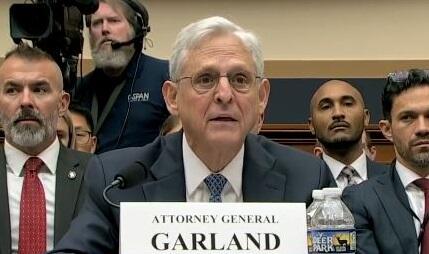
Watch Live: Garland Grilled Over Ray Epps, Hunter Biden Influence Peddling

0
Watch Live: Garland Grilled Over Ray Epps, Hunter Biden Influence Peddling

Update (1250ET): AG Merrick Garland had few answers during a barrage of hard-hitting questions from Republicans, ranging from January 6th to investigating his boss, Joe Biden and family.

At one point, Rep. Thomas Massie (R-KY) asked Garland why January 6th instigator Ray Epps was only charged with a misdemeanor, while the DOJ is “sending grandmas to prison.”

“You’re putting people away for 20 years for merely filming. Some weren’t even there but you got the guy on video saying go into the Capitol, he’s at the sight of first breach, and it’s an indictment on a misdemeanor,” he said.

To which Garland uncomfortably shifted in his seat and delivered a canned answer on Epps ‘not being employed by the FBI.’

Garland was also grilled by Rep. Matt Gaetz (R-FL), who asked Garland whether he could guarantee that people buying Hunter Biden’s ‘art’ weren’t doing so to gain political favors from the Bidens, as well as whether the Biden DOJ dissolved the Trump-era China initiative as a result of Hunter’s Chinese business deals.

According to Garland, he hasn’t interfered with the DOJ’s investigation of Hunter Biden, and never discussed the probe or received direction about it from anyone at the White House.

“Mr. Weiss has full authority to conduct his investigation however he wishes,” said Garland, referring to the US attorney in Delaware who was appointed special counsel.

“The determination of where to bring cases and what kind of cases to bring were left to Mr. Weiss,” claimed Garland.

Gaetz also asked Garland whether the DOJ ‘lost count’ of the number of federal assets present at the Capitol on January 6th, 2001.

More clips from the hearing: 

*  *  *

Biden Attorney General Merrick Garland is testifying before the House Judiciary Committee for the first time since a special counsel brought two criminal indictments against former President Donald Trump, and a sweetheart plea deal for Hunter Biden collapsed.

Chairman Jim Jordan opened the session.

Out of the gate, Garland says he won’t talk about discussions with David C. Weiss, the special counsel in the Hunter Biden case.

To review:

And now for the questions:

Garland also insisted that the DOJ doesn’t apply two standards of justice.

Watch live:

Come back for more updates…

Tyler Durden
Wed, 09/20/2023 – 12:51

Lesson Of The Day: Sanctions Don’t Work Because They Create New Markets

0
Lesson Of The Day: Sanctions Don’t Work Because They Create New Markets

Authored by Mike Shedlock via MishTalk.com,

A person who touted a buyer’s cartel sanction success, now complains the buyers cartel leaks like a sieve…

Tweet of the Day

Foreign Policy: “Since Russia’s invasion of Ukraine, Greece’s mighty shipping sector has continued to earn good money shipping Russian oil. But Greek shipowners have discovered an apparently even more lucrative source of revenue: selling the ships themselves to mysterious buyers linked to Russia. One publication has declared that a “Great Greek Tanker Sale” is taking place, and no price seems too high for a secondhand tanker. But the formerly Greek ships are entering a Hades-like shadow economy.”

Lesson of the Day: Sanctions Create New Markets

Eurointelligence comments on How Sanctions Created New Markets

Sanctions on Russia were meant to stop trade and coerce Vladimir Putin into a U-turn on Ukraine. Instead, Russia continues to bide its time in Ukraine, and Russian oil in particular continues to flow into world markets. The buyers may have changed and the way markets operate. What was transparent before all of a sudden turned opaque.

The west did also not completely cut themselves off from Russia despite all rhetoric. Western firms and banks are still operating in Russia, even if the numbers have dwindled. Russian gas is still flowing into Europe, albeit at much-reduced volumes, and could even increase thanks to a recent deal between Bulgaria and Turkey. 

Elisabeth Braw, writing for Foreign Policy, has a cracking story about how Greek shipowners made a fortune selling their oil cargo ships second hand. Since the war in Ukraine started, Greece sold 290 ships. They do not sell at a discount. On the contrary, the story gives examples of where the ship price has doubled or tripled compared to the original price the Greek owners paid. In markets like these where money is not a limiting factor, tankers are a desired object that cause a hike in prices. A whole new tanker market has come alive as a result of the war.

The buyers are much more mysterious than the sellers. Companies based in the United Arab Emirates bought most of the tankers, followed by buyers in China, Turkey and India. In 2022, a stunning 864 new maritime companies with an association or link to Russia emerged according to S&P Global Market Intelligence. Sometimes there is not even an email address linked to those companies. The role of the UAE is not surprising, as Dubai has emerged as the new Geneva for Russian oil trading companies. China and India both have stepped up their imports in Russian oil and need tankers for transport.

The role of the UAE is not surprising, as Dubai has emerged as the new Geneva for Russian oil trading companies. China and India both have stepped up their imports in Russian oil and need tankers for transport.

Lesson Number Two

Countries, political leaders, and market makers act in their best interest.

It is in the best interest of Greek shippers to sell ships so they do. It is in the best interest of India and China to buy Russian oil and Greek ships so they do.

It is in the best interest of Dubai middlemen to make a market in ships so they do.

What this boils down to is simple: It is the best interest of middlemen in Greece, Russia, India, China, and Dubai to tell Biden to go to hell, so they do.

Flawed Policy of Trump and Biden

Both Trump and Biden pretend they can set policy for the whole world. The rest of the world is sick of it.

The US’ best interest is not in the best interest of much of the world. Since the US does not give a damn about anyone else’s opinion, why should anyone else give a damn about the US opinion?

Sure, the US can bully small nations, not that it works (because it doesn’t). US foreign policy failed or worse yet backfired in Iran, Iraq, Libya, Cuba, Afghanistan, Venezuela, even Ukraine.

One should not make excuses for Putin, but one also needs to admit the US foreign policy played a huge role in fomenting the mess in Ukraine.

The US is now finding it cannot bully large nations at all. India, China, Russia, and Brazil have had enough.

Enter the BRICS

The world is sick of leaders like Trump and Biden who both believe they can set sanction policy for the globe. But SWIFT, the dollar routing means to enforce sanctions, is approaching a dead end.

The BRICS countries will not challenge the US dollar. Toss that idea in the trash. Instead, the biggest success of the BRICS will be sanction avoidance.

For discussion, please see What Would it Take for a BRIC-Based Currency to Succeed?

One measure of “success” would be use as a reserve currency in a significant percentage of global trade.

A second measure of “success” involves sanction avoidance. The second measure is far more likely to succeed for many reasons. 

We are starting to see a groundswell of sanction avoidance already. And once central bank digital currencies can get around the SWIFT system, the whole idea of the US dictating global foreign policy via sanctions heads straight to the gutter, frankly where it belongs.

If the US minded its own business in the first place, the alleged need for many of these sanctions would never have arisen.

Meanwhile, economists holler for still more sanctions. All that will do is create more innovative ways to avoid them.

Tyler Durden
Wed, 09/20/2023 – 12:45

Peter Schiff: The Inflation War Is Over; Inflation Won!

0
Peter Schiff: The Inflation War Is Over; Inflation Won!

Via SchiffGold.com,

After the August CPI data came out, Paul Krugman declared that the inflation war was over. The Biden administration and the Fed won the fight. In his podcast, Peter Schiff said he actually agrees with Krugman, at least in part. The inflation war is over. But who really won?

Last week’s CPI data showed price inflation heating up again, driven by climbing oil prices. Despite CPI rising to 3.7% in August after dipping to 3.2% a month earlier, Peter said most people still think everything is fine.

I think the more important aspect of the inflation data was how few people seem to comprehend what it means. Most of the talk I hear by the talking heads on the financial media is that everything is great. The inflation threat is pretty much behind us. Yeah, there are a few more bumps in the road, but we’re on the road to 2%. No problem. We’ll be there. The Fed is going to be cutting interest rates by next year, so these high rates aren’t really a problem. It’s just a temporary nuisance until we get back to low rates.”

Peter mentioned one pundit who proclaimed inflation has topped out and it’s coming down.

How can he say that when if you actually look at what’s happening, it’s the reverse? Inflation has bottomed out and now it’s rising.”

We had a long run of low inflation as the government measures it. (Not necessarily how people live it.) We enjoyed more than a decade with CPI averaging less than 2%. That all changed in 2021. Peter called it the “breakout year” for inflation. Then in 2022, it got even worse.

If you think of inflation like a stock, this was a massive breakout. You had a 10-year consolidation, kind of below this 2% resistance, and now it’s a massive breakout above 2%.”

Peter said it looks like 2023 will be a bit of a pullback.

If you were a trader, you would want to buy inflation. Inflation looks very bullish on a chart. It broke out and now you got a little bit of a pullback, and it’s an opportunity to buy the pullback following the breakout. All the evidence is inflation is heading a lot higher.”

Oil prices closed above $90 last week. They are up 8% in September already. Meanwhile, interest rates continue to climb. Americans have a lot of debt and they use a lot of energy. In other words, two important inputs in the US economy continue to get more expensive. At least some of those costs will be passed on to consumers and that will ultimately be reflected in the CPI.

It’s obvious to anybody who opens their eyes that inflation is not topped out and coming down. It’s bottomed out and going up. And the people who are blind to this, who are asleep, they are in for a rude awakening. That is a lot of investors.”

Peter said the thinks we’ll see much worse price inflation in 2024.

All of these rosy Goldilocks scenarios that are out there, they’re all going to fall apart in 2024.”

Nevertheless, after the August CPI data came out, Paul Krugman loudly declared the inflation war was over and the Fed won.

According to Paul Krugman, the economy is great, and we’ve won the war on inflation, and there’s no recession. I mean, how wrong can one guy be?”

Peter said he does think Krugman is right about one thing though.

I agree with Krugman that the inflation war is over. I just disagree on who won. I think inflation won!”

Of course, the Federal Reserve hasn’t officially surrendered, but Peter said when it does, gold is going to go ballistic.

You don’t want to wait for that to buy it. You want to head over to SchiffGold and buy your gold now, and your silver, before this next breakout. Because when it moves, I am convinced it’s going ot be fast.”

Tyler Durden
Wed, 09/20/2023 – 12:05

The ‘Kitchen Sink’ Is McCarthy’s Only Path To Avoid Shutdown, And It Probably Won’t Work

0
The ‘Kitchen Sink’ Is McCarthy’s Only Path To Avoid Shutdown, And It Probably Won’t Work

You wanted the job, Kevin…

With a shutdown looming in just over a week, House Speaker Kevin McCarthy (R-CA) has backed himself into a corner.

On Tuesday, House Republicans were forced to cancel a procedural vote for a 30-day stopgap funding measure (Continuing Resolution) to keep the government’s lights on beyond Sept. 30. Hours later, five GOP lawmakers crossed the aisle to vote with Democrats to bring down the rule for the Pentagon’s spending bill.

As Punchbowl News puts it: “Tuesday was a bad day for McCarthy and House Republicans.”

The problem for Kevin is that he needs votes from members of the Freedom Caucus, who are demanding that the CR be spliced up so that it doesn’t fund ‘the election interference of Jack Smith,’ according to Rep. Matt Gaetz (R-FL). Gaetz also wants McCarthy to sign a subpoena to better investigation Hunter Biden’s alleged “high crimes and misdemeanors,” – with the Florida rep going so far as to draft said subpoena for McCarthy to sign.

McCarthy can also throw a Hail Mary and pander to Democrats for the votes he needs to pass the CR, however doing so would likely seal his fate over a looming threat by Gaetz and others to remove him from his post.

Kitchen Sink?

The former Politico journalists at Punchbowl News – who have an uncanny read on inside baseball on the Hill, say that McCarthy’s only solution here is to cave to the Freedom Caucus (which might still screw him!) with a “kitchen sink” approach of acquiescing to all of their demands.

McCarthy needs to take all of the conservatives’ demands and lump them together into one 30-day funding bill. Ignore how far-fetched or illogical these proposals are and accept what they represent — a means to an end. -Punchbowl News

Freedom Caucus member Ralph Norman (R-SC) told the outlet that he’d vote for the CR if McCarthy will commit to a $1.47 trillion discretionary spending cap, and a schedule for the 11 remaining FY2024 appropriations bills during the 30 days to which the CR applies.

But the pain isn’t over for McCarthy – even if he bends the knee and Freedom Caucus members agree to pass it, the bill will then head to the Senate, where they’ll undoubtedly strip out key Republican demands, and send a revised bill back to McCarthy that will likely contain billions of dollars for Ukraine.

McCarthy will then need to sell the CR back to House Republicans, who will either need to accept the reality of a divided government to avert a shutdown, or not.

Oh, and the Freedom Caucus might still dick him…

BTW: Another weakness here is that there’s no guarantee that McCarthy will be able to pass a CR even if he loads it up with House GOP priorities. There are a number of House Republicans — Reps. Matt Gaetz (Fla.), Matt Rosendale (Mont.), Ken Buck (Colo.), Andy Biggs (Ariz.), Dan Bishop (N.C.) and Tim Burchett (Tenn.) — who may vote no no matter what McCarthy does.

The bipartisan approach: If this were “The West Wing,” McCarthy would walk into the Problem Solvers Caucus and hash out a deal to avert a shutdown (He’d also be talking to President Bartlet!) Yet this is real life, not a TV show. And yes, McCarthy could easily pass a CR with a big bipartisan majority.

But this approach would likely threaten McCarthy’s hold on the speaker’s office. Gaetz is already leaving copies of his motion to vacate in bathrooms around the Capitol. If McCarthy partners with Democrats, Gaetz may want to move the motion from the loo to the floor. -Punchbowl News

Thus, Punchbowl thinks a shutdown is likely

Tyler Durden
Wed, 09/20/2023 – 11:45

Trump To Skip Second GOP Debate, Will Instead Address Detroit Auto Workers

0
Trump To Skip Second GOP Debate, Will Instead Address Detroit Auto Workers

Former President Donald Trump will skip the second GOP debate and will instead address current and former members of the United Auto Workers (UAW) in Detroit, the NY Times reports.

The move will directly inject Trump into one of the largest strikes in the past three decades, as 146,000 workers rival the 1998 UAW/General Motors strike when 152,200 workers walked off the job for nearly two months (and the largest being a 10-day UPS strike in August 1997, when 180,000 workers walked off the job).

Trump’s decision will mark the second consecutive primary debate he won’t attend, while the remaining candidates vie for Trump’s VP spot on the eventual ticket (based on current polling).

In response to Trump skipping the debate, former Vice President Mike Pence, who’s polling ‘somewhere in that mess’ above, told CBS News it was a “missed opportunity” for both Trump and Republican voters.

“Look, this country is in a lot of trouble. Joe Biden has weakened America at home and abroad, and I think the former president – just like all the rest of us vying for the Republican nomination – owe it to the American people to express what our agenda will be for turning this country around,” Pence said.

Tyler Durden
Wed, 09/20/2023 – 09:30

September Siesta

0
September Siesta

By Philip Marey, Senior US Strategist at Rabobank

In the US House of Representatives, Republicans can’t seem to agree on a continuing resolution to keep the government funded beyond September 31. Failure to pass this stopgap measure would lead to a government shutdown on October 1. The continuing resolution is needed because the necessary appropriations bills for fiscal year 2024 (which starts on October 1) have not yet been approved in the House. Sunday’ s proposal by the Freedom Caucus and the Main Street Caucus of the House Republicans is unacceptable to the Democrats because of spending cuts attached to the continuing resolution, so passage depends on Republicans who have a narrow 221-212 majority. However, even some members of the Freedom Caucus oppose the bill, so it is still unclear whether this proposal will be adopted. Consequently, some Republicans are now raising the possibility of making a temporary deal with the House Democrats.  

Meanwhile, in the real world, US housing starts saw a steep decline in August (-11.3%), extending the downward trend since April. On the bright side, building permits grew by 6.9%, but they have been zigzagging this year. The interest-rate sensitive housing market has been a casualty of the Fed’s hiking cycle from the start. Given the Fed’s focus on fighting inflation, a sustained recovery of the housing market should not be expected anytime soon.

Day ahead

This morning, UK inflation data were weaker than expected with a 0.3% month-on-month increase in the price level in August (against 0.7% expected), leading to 6.7% year-on-year, not only below the expected 7.0%, but even lower than July’s 6.8%. So even headline inflation unexpectedly continues to fall. Meanwhile, core CPI inflation fell to 6.2% from 6.9%. The largest downward contributions to the monthly change in CPI annual rates came from food, where prices rose by less in August 2023 than a year ago, and accommodation services, where prices can be volatile and fell in August 2023.

Today, the FOMC will conclude its two-day meeting with a policy rate decision, fresh economic projections and a press conference by Powell. As explained in our FOMC Preview, we expect the FOMC to remain on hold in September because of the gradual decline in core inflation and the improving balance in the labor market.

The formal statement is likely to repeat that economic activity has been expanding at a moderate pace, but we may see some acknowledgement that the labor market is softening. For example, according to the Beige Book “job growth was subdued.”

Regarding monetary policy, the FOMC is likely to repeat that “In determining the extent of additional policy firming that may be appropriate to return inflation to 2 percent over time, the Committee will take into account the cumulative tightening of monetary policy, the lags with which monetary policy affects economic activity and inflation, and economic and financial developments” and that “The Committee would be prepared to adjust the stance of monetary policy as appropriate.”

At the press conference, Powell is likely to repeat his Jackson Hole performance, stressing that the FOMC remains data-dependent, but underlining the upside risks to the outlook and the Fed’s willingness to act if warranted by the incoming data. We also expect him to continue his battle against expectations of an early pivot.

The new economic projections, featuring the dot plot, are likely to imply another 25 bps hike before the end of the year, similar to the June dot plot. This would underline the Fed’s willingness to deliver another 25 bps hike before the end of the year if warranted by the incoming data. Meanwhile, the projections will be extended through 2026.

However, we still expect the economic data to deteriorate before the November meeting and avert additional rate hikes. In fact, we expect the US to slip into a recession in the final quarter of the year. Although a soft landing is possible, we find it less likely. The Fed has no reliable model to forecast inflation (remember they initially thought that the current episode of inflation was transitory and did not warrant a monetary policy response), and at Jackson Hole Powell admitted there is considerable uncertainty regarding the lags of the impact of monetary policy and the precise level of monetary policy restraint (for a given level of the federal funds rate). Therefore, we think it will be very difficult for the Fed to engineer a soft landing. If they succeed, it will probably be luck

Tyler Durden
Wed, 09/20/2023 – 09:10