92.7 F
Chicago
Wednesday, September 2, 2026
Home Blog Page 3325

Spinning The Press On Hunter Biden: Lee Fang

0
Spinning The Press On Hunter Biden: Lee Fang

Authored by Lee Fang via RealClear Wire,

Speaker Kevin McCarthy, announcing that the House of Representatives will pursue an impeachment inquiry, suggested that the probe will hinge in part on deceiving the American public about Hunter Biden’s foreign business ventures.

“President Biden did lie to the American people about his own knowledge of his family’s foreign business deals,” McCarthy said at a press conference. GOP lawmakers, he added, have “uncovered credible allegations into President Biden’s conduct.”

Such an investigation will likely force an examination of the public narrative regarding Hunter Biden’s consulting deals that go back at least a decade. During President Obama’s second term, then-Vice President Joe Biden was the administration’s point man on the nation’s policy toward Ukraine, a perch he used to urge the country to resist “the cancer of corruption” and enact sweeping ethics reforms.

At the time, some American journalists began to question whether the vice president’s stern message was undermined by his son Hunter Biden’s employment at the Ukrainian energy firm Burisma, which was owned by a notorious local oligarch.

Emails on Hunter’s laptop reveal that the inquiries sparked an internal debate within his team of consultants and public relations agents. Ultimately, they devised a series of responses about Hunter’s work with Burisma that were, at best, misleading and, at worst, outright falsehoods.

The Biden team has constructed a careful image of Hunter Biden’s business ventures, sometimes employing a sophisticated myth-making operation aided by allies in the media who rarely challenged or investigated their false claims. The laptop emails show that the team closely monitored critical reporting and pushed to shape coverage with reporters from the New York Times, Time magazine, the Wall Street Journal, and the Associated Press.

Their spin informed much of the ensuing coverage in the mainstream press, defusing the issue, even as President Trump and other Republicans insisted that Ukraine was a hotbed of Biden family corruption. Although he had no background in the energy field and little experience in corporate governance, Hunter Biden, who had a law degree, was appointed to the board of Burisma in May 2014.

It was revealed later that he was paid about $1 million per year – as was his business partner Devon Archer. In a press release announcing his appointment, Hunter Biden is quoted as saying, “I believe that my assistance in consulting the Company on matters of transparency, corporate governance and responsibility, international expansion and other priorities will contribute to the economy and benefit the people of Ukraine.”  

That same month, journalist Michael Scherer reached out with questions about the arrangement.

Several consultants employed by Burisma, including Ryan Toohey of FTI Consulting and Heather King, a partner at the law firm Boies, Schiller, & Flexner, where Hunter worked as counsel, strategized over how to respond to Scherer, a reporter then with Time magazine who has since joined the Washington Post. 

For the Scherer inquiry, laptop emails show, Hunter’s business associates settled on a strategy to deflect the most direct questions and obfuscate the true intent of Burisma’s attempts to sway U.S. government officials.

One of Hunter’s associates noted that they planned to respond to Scherer’s attempts to reach David Leiter, a former aide to then-Secretary of State John Kerry, hired to work for Burisma. The plan was to use an assistant to make Leiter “unavailable to comment, as opposed to some sort of statement that made it seem like we were unwilling or refusing to engage with the reporter.” Leiter, the emails show, was in fact available, but the public relations team wanted to keep him out of reach.

Scherer wanted to know why Burisma was on a hiring spree of well-connected American lobbyists, including Leiter and others. In response, Toohey planned to tell Scherer that the hired guns were simply working on issues related to energy independence, economic growth, as well as “transparency and good governance.”

In response to other questions posed by Scherer, Toohey prepared a statement claiming that Hunter Biden will “not be engaged with the U.S. government” on anything related to Burisma.

The response belied a detailed lobbying agenda spelled out in other emails.

Burisma had made clear that the company had hired Leiter, Hunter Biden, and other political operatives as part of a focused plan to obtain Burisma owner Mykola Zlochevsky a U.S. visa as well as to persuade American officials to intervene with Ukrainian government officials to drop an investigation of his business interests.

In a May 2014 email, Vadym Pozharskyi, a close adviser to Zlochevsky, explained to Hunter that he needed his “advice on how you could use your influence to convey a message/signal, etc. to stop what we consider to be politically motivated actions,” a reference to an ongoing investigation of Zlochevsky by Ukrainian prosecutors.

That month, Pozharskyi again wrote to Hunter, spelling out the “working plan for both FTI and David,” reiterating that he wanted the lobbyists to intervene against the “politically motivated proceedings initiated against us in Ukraine” and to overcome the “US entry ban” for the Burisma owner.

“The immediate plan is to reach out to the Energy and Ukraine desks, respectively, at State Dept,” wrote Heather King, the attorney working closely with Hunter Biden at the time. “That will include outreach to Carlos Pascual, he is the top US energy diplomat,” she added. 

Scherer printed the denials, but to his credit, reported on the odd circumstances surrounding Biden’s hiring, at a time when Joe Biden was the Obama administration’s point person for Ukraine, with a special focus on energy policy in the region. 

In many cases, Hunter Biden’s associates cast him as simply an auditor with a special focus on renewable energy sourced from geothermal vents. That was the strategy in response to an inquiry from Stephen Braun, a reporter for the Associated Press. “Mr. Biden will not lobby on behalf of Burisma. His role is to advise the company’s legal and compliance unit, including guidance on corporate governance standards.”  

Behind the scenes, Hunter Biden’s team knew otherwise. In emails conferring over how to deal with Braun’s questions, one lobbyist reiterated the plan to provide Braun with “minimum information.” 

Like many other articles from this time, the AP story focused on the conflict of interest issues, noting the denials around any lobbying with a degree of skepticism:   

A former Washington lobbyist, the vice president’s son is effectively exempt from most rules that would require him to describe publicly the legal work he does on behalf of Burisma.  

Hunter Biden will not lobby for the company, said Lawrence Pacheco, an official with FTI Consulting, a Washington government affairs company recently hired by Burisma.  

Pacheco did not say whether Biden might oversee or advise on any future Burisma lobbying strategy in the U.S. Pacheco said the company “does not take positions on political matters.”  

Braun could not be reached for comment. Scherer declined an opportunity to comment on the Hunter Biden emails. Biden, Toohey, and King did not respond to a request for comment. 

However, the emails clearly indicate that substantial resources were allocated to managing both Burisma and Hunter’s personal image. Pozharskyi pointed out that Burisma had retained American consultants to reach out to “the most reputable European and American journalists/newspapers, magazines, websites, blogs,” while assistance was required to handle Wikipedia, Facebook, LinkedIn, and other online platforms. Burisma, wrote Pozharskyi, sought a “detailed algorithm on how the Company should act in case of bad publicity.” The effort included scrubbing negative details from Hunter Biden’s Wikipedia, while bolstering the online credentials of Burisma, emails show.    

A highly focused effort to monitor and shape news media coverage helped maintain the public profile. Even with relatively low visibility, independent media were closely watched. Hunter and his team monitored Vice News as well as the gadfly website ZeroHedge. In response to critical reporting from Vice, one colleague noted approvingly that the article was not being “reposted or republished” in Ukrainian media.

In July 2014, Toohey circulated an investigative piece I wrote for Salon about Hunter Biden’s hiring at Burisma, which noted that the vice president’s son had been retained amid a string of nepotistic hires likely aimed at influencing natural gas and energy policy.  

In the article, I noted that Joe Biden had traveled to Ukraine to “announce a $50 million aid package that included technical support for increasing the country’s natural gas production – an investment that could bolster profits at Burisma Holdings, where his son is a director.” What was not known at the time, however, was that Hunter Biden was already working with a team of public affairs consultants to channel U.S. government technical assistance to his client. 

The laptop emails show that even this relatively brief mention of Hunter Biden and a potential conflict of interest with his father raised concerns. 

“All, please see below a piece that mentions Hunter’s appointment as part of a broader trend, mostly within the context of relatives of eleceds [sic] engaged to lobby for the energy industry,” wrote Toohey, attaching a copy of the text of my piece. But, he added, “This was a freelanced piece picked up in a number of web-based outlets including Salon, but nothing with significant reach.”  

Pozharskyi replied that he had seen the piece earlier and “wanted to have a discussion in this regard.”

In some cases, the team celebrated media coverage that elevated its desired narrative. Politico reported Hunter’s hiring at Burisma and simply printed quotes from the company’s official statements: 

“The company’s strategy is aimed at the strongest concentration of professional staff and the introduction of best corporate practices, and we’re delighted that Mr. Biden is joining us to help us achieve these goals,” Alan Apter, Burisma Holdings’ chairman of the board of directors, said in a statement, which was reported by The Moscow Times on Tuesday.  

Biden, joining the board, will be in charge of the legal unit, the company said. He will also provide support for Burisma Holdings “among international organizations.”  

Biden said the company will help strengthen Ukraine’s economy.  

Pozharskyi circulated a link to the Politico article to Hunter and his associates, noting the “positive coverage.” 

Hunter’s membership on the Burisma board received renewed attention in late 2015, as then-Vice President Biden was set to visit Ukraine where he planned to address the parliament on the need to adopt new reforms against a culture of corruption in the country. James Risen of the Times, among others, renewed inquiries directed toward Hunter and his associates about the rationale behind his appointment to the company, Burisma, and why the company appeared to be buying access to high levels of government.  

In one email found on Hunter’s laptop, Risen asked, “What lobbying activities is the company engaged in the US?” among other questions to Hunter Biden. In response, a Burisma spokesperson straightforwardly claimed that “no one is lobbying on their behalf.” 

The company’s lobbying efforts were not covered in the story ultimately published by the New York Times, which featured Risen’s piece on Dec. 8, 2015. The article included a statement from the Hunter Biden team, crafted by the strategy firm FTI Consulting, asserting that the company’s focus was on “corporate governance and transparency.”

Risen’s article did not address whether Hunter’s business career demonstrated such expertise or his lack of experience in the energy field. Although Risen identified Hunter as “a former Washington lobbyist,” he accepted the denial that no lobbying was involved.  

In reality, just a month prior to the email exchange with the Times, Burisma, following Hunter Biden’s advice, had hired Blue Star Strategies, a Democratic lobbying firm, to influence the Obama administration. A copy of the agreement, belatedly filed with the Justice Department, reveals that the firm, which aided in lobbying State Department officials on Ukrainian energy policy, received a monthly retainer of $30,000. 

Blue Star Strategies was even copied on the emails with the Hunter Biden team on its response plan to Risen. 

Risen also allowed a Burisma spokesman to decline to state Hunter’s compensation while claiming it was “not out of the ordinary” for such board positions. It was later disclosed that he was paid about $1 million per year, which is far higher than the typical compensation. As a point of comparison, median annual compensation of board members at Fortune 500 companies is around $110,000. 

Risen, now with The Intercept, did not respond to a request for comment.  

Political operatives of all ideological backgrounds frequently manipulate public perception – often employing specialized “crisis communication” firms to suppress negative coverage and shape desired narratives. What is remarkable about the Hunter Biden episode is how successful it was, and how uncritically most media organizations treated this unorthodox relationship between a president’s son and a controversial foreign corporation. 

In response to the Wall Street Journal, Toohey worked closely with Blue Star Strategies’ Sally Painter and Karen Tramontano to craft a message defusing questions around a conflicting message between Hunter and his father. They settled on a strategy of presenting the Ukrainian gig as perfectly “aligned” with an anti-corruption agenda, laptop emails show. The lobbyists suggested that they release a statement to the Journal claiming that Hunter’s work for the Ukrainian energy giant, to supposedly strengthen corporate governance, are “also goals the United States.” 

The Journal printed the statement, attributing it to a spokesperson.  

Such coverage – which suggested Hunter Biden had engaged in questionable but ultimately harmless behavior that did not involve, much less implicate, his father – set the narrative for most coverage in mainstream outlets. When President Trump told Ukraine’s president in 2018 that “there’s a lot of talk about Biden’s son” and asked him to look into Joe Biden’s demand that the prosecutor looking into Burisma be fired, Democrats moved to impeach him.  

The Biden spin continued even after the New York Post published the first articles based on material from Hunter’s laptop in October 2020. The Washington Post’s fact checker, Glenn Kessler, sought to discredit the New York Post’s reporting that Hunter Biden had arranged a dinner meeting between his Ukrainian associates at Burisma and his father when he served as vice president. At the time, the Biden presidential campaign claimed that it “reviewed Joe Biden’s official schedules from the time, and no meeting, as alleged by the New York Post, ever took place.” Kessler reiterated this denial as though it were an established fact.

It turned out to be false. The July testimony by former Hunter Biden associate Devon Archer confirmed that Hunter Biden had arranged a secret dinner with his Ukrainian business partner and his father, as the New York Post had originally reported. The ongoing saga over the Washington Post’s role in discrediting the Biden revelations was detailed last month by RealClearInvestigation’s Paul Sperry. 

Also last month, Washington Post columnist Philip Bump, who has dismissed any hint of scandal regarding Biden business dealings, appeared on Live at the Table, a podcast hosted by Noam Dworman, the owner of New York City’s Comedy Cellar. The show went viral as Dworman challenged Bump’s claims that there was “no evidence” of wrongdoing by Joe Biden.

In a heated exchange, Bump conceded that Hunter Biden’s text messages that claim, “unlike pop, I won’t make you give me half your salary,” was one form of “evidence.” Moments later, Bump ended the interview and walked off the set. 

The interaction provided a rare moment of visible accountability for the establishment press, which has largely followed the Biden spin for an entire decade on this issue.   

Yet the White House is still hoping it can still instruct journalists on how to cover the story. Shortly after McCarthy’s impeachment inquiry announcement, President Biden’s White House staff circulated a memo, instructing media outlets on how to cover the news. In bold type, the memo claimed that the entire Hunter Biden conflict of interest scandal had been “refuted” and “debunked” – language that was adopted in media reports about the inquiry in Vox, NBC News and CNN.   

Lee Fang is an independent journalist based in San Francisco. He writes an investigative newsletter on Substack via www.leefang.com.

Tyler Durden
Tue, 09/19/2023 – 17:25

WTI Holds Gains After API Reports Bigger-Than-Expected Crude Draw

0
WTI Holds Gains After API Reports Bigger-Than-Expected Crude Draw

Oil prices ended unchanged today as early Azerbaijan angst sent WTI above $92 and some chatter from the Biden admin that draining the SPR was once again the table seemed to drag WTI back down (but $90 was support).

“The Saudi appetite to withhold oil from market, supported by Russia maintaining a certain level of export constraint, points to higher prices in the short term, all else equal,” analysts at Citi, led by Edward Morse, global head, commodities, wrote in a note dated Monday.

Investors have been looking past worries about China’s economic growth and a sluggish economy in Europe to push the commodity higher amid ever-tightening supplies, as Russia and Saudi Arabia have each curbed production.

API

  • Crude -5.25mm (-1.00mm exp)

  • Cushing -2.56mm

  • Gasoline +732k (+500k exp)

  • Distillates -258k (-200k exp)

After last week’s big surprise product builds (and crude build), all eyes remain on this week’s inventory data for signs that demand is stalling. Instead, API reported a big (5.25mm barrel) crude inventory draw. Cushing stocks continued to drawdown heavily…

Source: Bloomberg

WTI was hovering at $90.80 ahead of the API print.

Shrinking supplies have ignited a flurry of predictions that $100 oil could return on a roster than includes industry heavyweights such as Chevron Chief Executive Officer Mike Wirth and traditional bears at Citigroup.

“Oil trading is a sophisticated game of Chutes & Ladders” and there are some hot spots that may take Brent, and possibly WTI, to $100 a barrel shortly, said Tom Kloza, global head of energy analysis at the Oil Price Information Service, a Dow Jones company.

But whether either benchmark can average $100 for a month is “an interesting question,” he said.

“When there are bullish extremes in sentiment, it is often a sign that the market is about to turn.”

The biggest threats to the oil rally continuing are “changes in fundamentals,” said Troy Vicent, senior market analyst at DTN.

“At current price levels, a diminished appetite for crude imports by China and rising Chinese product exports are the most likely culprits to help cool off this rally in the near term,” he told MarketWatch.

“If this materializes, and particularly if we start to see demand slow elsewhere, it could quickly change the Saudi’s calculus on how far they’re willing to push their voluntary supply cuts.”

Finally, as a reminder, history shows that surging energy costs usually play a role in tipping the U.S. into recession.

Meanwhile, Russia is killing it…

When will ‘The West’ start fighting back against the price-cap-deniers? (Like Trudeau did today… until absolutely no one else joined him in condemning India).

Tyler Durden
Tue, 09/19/2023 – 16:39

The Peculiar Power Of Denial

0
The Peculiar Power Of Denial

Authored by Charles Hugh Smith via OfTwoMinds blog,

We’d rather risk societal collapse than face the sacrifices and challenges of revolutionizing our unsustainably neofeudal economy and broken gears of governance.

Denial is scale-invariant and universal–we’ve all experienced in some way or another. By scale-invariant, we mean the individual, household, enterprise, city, state and empire all experience denial.

Denial has several signature characteristics:

1. The more profound and consequential the issue, the more stubborn our denial. When a minor cut reddens, we don’t go into denial that it’s infected, we simply treat it with greater care. But when the unmistakable signs of heart disease appear, we find ways to deny the reality because it’s too upsetting and frightening. We want very desperately to think it will go away on its own and we’ll be fine, and nothing in our life will change.

2. The strength of our denial flows from the tacit understanding that if we let even a tiny bit of doubt break through our dam of denial, the whole foundation will give way. The power of denial originates in the impermeability of the barrier blocking warning signs that all is not well. If the enterprise, relationship, policy, investment, etc. is no longer sustainable or viable, we must shut out all doubt and evidence because even a rivulet of doubt and evidence will quickly erode the dam of our denial and collapse our sense of security, control and predictability.

And so we hold fast to the idea that these chest pains are merely indigestion, and inflation is already receding. We fiddle with data (“ex-food, fuel, used cars, shelter, healthcare, childcare, hospitality and dining out, inflation is trending down!”) to conjure up an alternative reality in which everything is fine, under control, progress and growth are still positive and unstoppable, and so on.

When challenged, we become defensive and angry, as if our security and identity are under attack. Since we’ve tied our identity and security to fixed, rigid standards, should those standards erode and decay, we deny the erosion because we feel our own security, identity and sense of control are giving way and might collapse. To avert this disaster, we shore up our dam of denial, making sure no shred of doubt or evidence gets through to threaten us.

This strategy is terribly misguided, of course, because denying reality doesn’t make the threat go away, it magnifies the risk of collapse. Denial can be summarized as the stubborn inability to tell the truth because our fear of losing control as the foundations of our life crumble beneath us is so great that we’re compelled to cling to denial and fantasy: debt doesn’t matter, the government can print as much money as it needs, we’ll just renovate all those empty office towers into housing, and so on.

Reality is only a threat if we’ve forsaken flexibility, adaptability, problem-solving, and the willingness to make sacrifices and accept failure–what I call Self-Reliance. The appeal of denial is uniquely powerful because it offers us a means to cling to our security, identity and sense of control without having to actually do anything.

Just as we’d rather risk expiring from a heart attack than face the sacrifices and challenges of revolutionizing our diet and fitness, we’d rather risk societal collapse than face the sacrifices and challenges of revolutionizing our unsustainably neofeudal economy and broken gears of governance.

And so all those who’ve benefited from the Bubble Economy look down on the decaying city center from their comfortable, smartly-appreciating homes and cling to the absurd fantasy that the rot won’t reach them–indeed, the rot can’t possibly reach us, it will stay safely far away and we’ll be safe here in our enclave.

This is remarkably reminiscent of the wealthy Romans just before the collapse, complaining to each other in correspondence about the annoyances of decay seeping into their comfortable estates. They too reassured themselves that Rome was eternal, everything would right itself without any sacrifice on their part.

Their correspondence ended abruptly when the Imperial courier service ceased to function. The “Barbarians” (i.e. non-Italian residents of the Empire) who assumed power did not have the wherewithal to gather the taxes needed to support the immense Imperial infrastructure that made life comfortable for the landed wealthy, and so it went away.

So no worries, our neofeudal system, broken governance and all, is eternal and will fix itself without any sacrifices on our part. Maybe those chest pains are just indigestion. Let’s just ignore them, they’ll probably go away on their own.

Alternatively, we can relinquish fantasies and fear and accept that it’s adapt or expire and we’ll have to handle the adapting ourselves. This is the path of Self-Reliance, and if we’re willing to take it, the path is wide open.

*  *  *

My new book is now available at a 10% discount ($8.95 ebook, $18 print): Self-Reliance in the 21st Century. Read the first chapter for free (PDF)

Become a $1/month patron of my work via patreon.com.

Subscribe to my Substack for free

Tyler Durden
Tue, 09/19/2023 – 16:20

Bond Yields Blasted To 16 Year Highs; Stocks Sink Ahead Of Fed

0
Bond Yields Blasted To 16 Year Highs; Stocks Sink Ahead Of Fed

Ugly Canadian CPI, surging crude prices (early – on Azerbaijan angst)), mixed housing data, and a trigger happy group of traders anxiously awaiting tomorrow’s Fed-sponsored narrative all sparked some chaotic moves in markets today.

The headline-making market of the day is USTs today with a double-barf sending yields 5-7bps higher on the day…

Source: Bloomberg

Which pushed yields to their highest since 2007…

Source: Bloomberg

With bonds at their cheapest to stocks since Oct 2007…

Source: Bloomberg

At the very short-end of the curve, the market has really started to embrace the ‘higher for longer’ narrative as this year’s rate-change expectations have drifted (dovishly) lower (less expectations of more rate-hikes) while next year’s rate-change expectations have surged (hawkishly) higher, pricing out expectations of rate-cuts…

Source: Bloomberg

All of which pressured stocks lower – especially longer-duration assets. After Europe closed, the algos tried to lift the major indices back to unch but failed. All the major indices closed red (down 02. to 0.3% on the day)…

CART IPO’d at $30, opened at $42, rallied up to $42.95 before fading the rest of the day…

ARM fell back below its post-IPO opening price…

Regional banks keep falling – now back at SVB tumble lows…

The dollar chopped around but ended back in the very tight range of the last couple of days…

Source: Bloomberg

Bitcoin bounced back above $27,000…

Source: Bloomberg

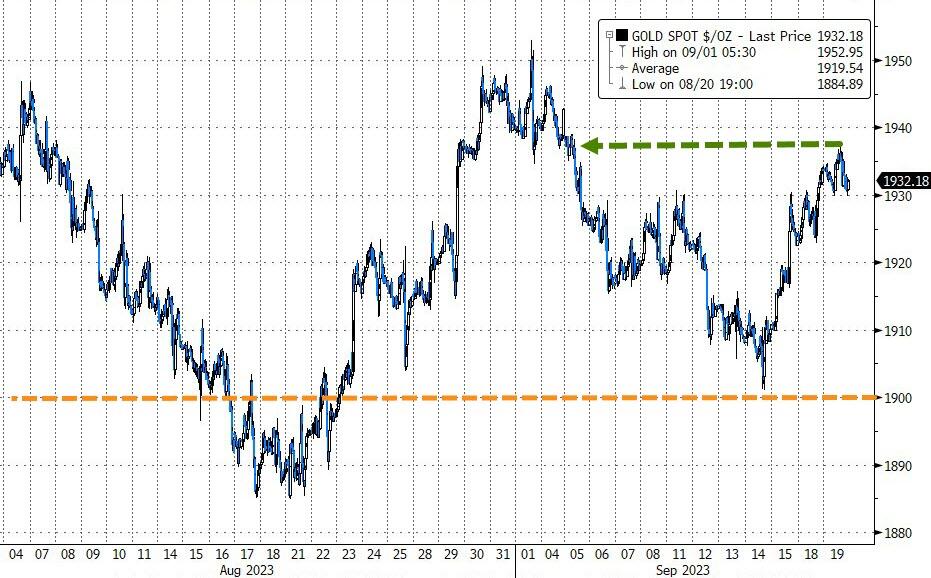
Gold (spot) neared $1940 intraday, but ended unchanged…

Source: Bloomberg

Oil prices pumped (to new cycle highs) and dumped (WTI finding support at $90) to end practically unchanged…

Finally, with real yields hitting fresh highs, one wonders when reality hits for equity valuations?

Source: Bloomberg

Consider what kind of shift (down) in real yields it would take to rationalize this valuation (economic depression?)

Tyler Durden
Tue, 09/19/2023 – 16:00

House Republicans Set Date for First Biden Impeachment Hearing

0
House Republicans Set Date for First Biden Impeachment Hearing

After House Speaker Kevin McCarthy finally announced an impeachment inquiry into the Biden family, members of the chamber have scheduled the first hearing in the case for Sept. 28, according to a spokesperson for the House Oversight Committee in a statement to the Epoch Times.

The hearing will focus on various constitutional and legal questions pertaining to President Biden’s alleged involvement in corruption and abuse of public office.

“The Committee also intends to subpoena Hunter and James Biden’s personal and business bank records as early as this week. The Oversight Committee will continue to follow the evidence and money trail to provide the transparency and accountability that Americans demand from their government.”

After caving to Freedom Caucus members ahead of an anticipated government shutdown battle, Speaker McCarthy said in prepared remarks: “House Republicans have uncovered serious and credible allegations into President Biden’s conduct. Taken together these allegations paint a picture of a culture of corruption.”

Helping to lead the probe is House Oversight Committee Chairman Rep. James Comer (R-KY).

“Here’s the reality: As Vice President, Joe Biden changed U.S. foreign policy to the benefit of a Ukrainian business paying Hunter Biden,” said Rep. Matt Gaetz (R-FL) in an op-ed this week.

The White House is of course preemptively defending Biden, with spokesman Ian Sams saying that Republicans have already been investigating the Bidens and have “turned up no evidence of wrongdoing.”

According to Biden himself, “the best I can tell, they want to impeach me because they want to shut down the government.”

Mr. Comer and other Republicans have found that the president spoke repeatedly to business partners of Hunter Biden, including at dinners at Washington’s Cafe Milano. They also confirmed that President Biden sent emails under pseudonyms while vice president, including accounts that corresponded with Mr. Biden.

Mr. Biden, other Biden family members, and associates received more than $21 million, primarily from foreigners, while President Biden was vice president. -Epoch Times

The House can bring impeachment charges against a president or another official. While it takes only a simple majority to impeach an official, the Senate must then consider the charges. 

Former President Donald Trump was notably impeached twice by House Democrats – once for asking Ukraine to investigate Biden family corruption, which they claimed was ‘election interference,’ and a second time for inciting the January 6th Capitol riot. The GOP-controlled Senate acquitted Trump both times.

“In my mind, we have more than enough to impeach him right now, I don’t think we have to go through the process of an impeachment inquiry,” Rep. Ronny Jackson (R-TX) told Newsmax.

“There are text messages, there are e-mails, there are witnesses, there are whistleblowers, there are meetings, there are phone calls, there are dinners. And you can’t say, hey, there’s a little bit of smoke, we’re not going to follow the fire. And the inquiry, my understanding is, as you said earlier, gives us expanded subpoena powers,” Rep. Nancy Mace told ABC‘s “This Week.”

Democrats, of course, are crying foul.

“There is no facts in the record to suggest that President Biden engaged in wrongdoing. There are no facts on the record to suggest that President Biden engaged in impeachable offenses. There are no facts on the record to suggest that President Biden broke the law in any way, shape or form,” Rep. Hakeem Jeffries (D-NY) told ABC.

Tyler Durden
Tue, 09/19/2023 – 15:45

Peter Schiff Puts The UAW Strike In Its Economic Context

0
Peter Schiff Puts The UAW Strike In Its Economic Context

Via SchiffGold.com,

The United Auto Workers went on strike against the Big Three US automakers in Detroit last week. Peter Schiff went on Real America with Dan Ball to talk about the strike and how it might impact the US economy.

Peter put the strike in the context of the current inflationary and high interest rate environment, and talked about how it might impact the broader US economy.

This is the first time the UAW has gone on strike against all three US automakers at the same time. About 12,700 workers are on strike. The UAW is demanding a 40% wage increase through 2027 with a 20% raise immediately. They also want a 32-hour workweek.

Dan Ball called it “a big ask.”

Peter said some of it might just be negotiating tactics – demand the moon and settle for less. But he said they are certainly looking to become less productive, especially with the shorter work week. But a lot of that big raise would do nothing but keep up with price inflation.

Remember, the CPI doesn’t even come close to capturing the inflation that people experience in their daily lives. I think these auto workers have lost a lot of purchasing power over the last few years, and they’re trying to catch up. But unfortunately, when you combine what they’re doing with what the Biden administration is doing, they’re not only going to get killed by Biden’s inflation tax, but Biden is helping to undermine the productivity of their employers to a point where a lot of these auto workers are going to be out of jobs. If they’re having a hard time now, it’s to be a lot worse when they’re unemployed.”

Peter said that more than a decade of zero percent interest rates skewed the labor market.

A lot of these companies were able to cave into the demands of workers because they had such cheap financing. So, their labor costs were going up, but their debt service costs were low. Well, now the interest rates are surging. Companies don’t have that leeway.”

And it’s not interest rates. Other production costs are skyrocketing. Peter specifically noted the rising price of oil and fuel. Oil is up 8% just in September.

Costs are going way up for these companies and for their customers. What’s ultimately going to happen is there’s going to be a big decline in auto sales because people can’t afford to buy. And to the extent that they do buy, they may buy more imports because those companies are more competitive. And so, American jobs get lost.”

Dan pointed out that if the strike goes on, it will ripple through the broader economy. Peter said the strike will end. Auto workers will get increased wages and benefits. And the Big Three automakers will add those increased costs to the price of their vehicles.

But what got this going is not the strikers. They are reacting to inflation. They are not causing it. They’re trying to catch up to it. The inflation is being caused by the government. It’s by the Federal Reserve printing money and by the Biden administration spending money. That’s where the inflation comes from. That’s why it’s a tax.”

The Biden administration has indicated that it might help the US automakers handle the increased costs. Dan pointed out the irony of the government that created inflation taking American tax money to bail out companies hurt by that inflation.

Peter said they’re not even taking our money. They’re just borrowing more money.

What they’re going to do to bail out these companies is create even more inflation. And so, they’re going to hit the American public with a bigger inflation tax to finance these bailouts. That’s who’s getting stuck with all these bills.”

Tyler Durden
Tue, 09/19/2023 – 15:25

Strong Tailwinds Could See Oil Become Even More Overbought

0
Strong Tailwinds Could See Oil Become Even More Overbought

Authored by Simon White, Bloomberg macro strategist,

Oil and oil stocks are overbought, but underlying supports could see them rise further before profit taking drives prices lower.

In June I laid out the case for why oil’s extended slump was likely over. Since then WTI is up over 30%, with prices near a one-year high.

Getting into a trade is comparatively the easy part, it’s knowing when to get out that’s the hard part. Unfortunately that’s the case with oil today, with it being overbought in the short term, but with still strong underlying supports which could mean it rises further.

Rising excess liquidity was one of the main factors pointing to higher oil in June.

Over the longer-term, supply and demand are the ultimate arbiter of commodity prices, but over the medium term (~3-6 months) excess liquidity – the difference between real money growth and economic growth in dollar terms – is a key driver.

Excess liquidity has yet to turn lower, as inflation remains low and tailwinds from previous dollar weakness persist, which should keep oil supported for now.

My indicator for oil, which leads oil prices by six months, had started to turn up in June, and has continued to rise, in another positive for oil in the medium term.

The US has been drawing down on its strategic reserves, while China has been scooping up barrels to add to its stockpiles, at the same time as OPEC+ and Saudi Arabia have cut production.

All of which dovetail with the excess liquidity picture to create a continued positive backdrop for crude.

One caveat is that China’s demand may wane unless stimulus soon begins to pick up. Real money growth, which leads China’s oil imports, has turned lower.

Nonetheless, on shorter-term time scales oil and oil stocks are overbought. Whether we look at RSIs, MACDs, Bollingers, etc, oil is stretched to the upside, and is vulnerable to correcting lower.

Moreover sentiment has moved from extremely negative back in June, to considerably more positive.

But markets have a habit of overshooting, and given the still-friendly supports it’s conceivable oil becomes more overbought – especially as the net long in speculative positioning is not yet at extremes.

Tyler Durden
Tue, 09/19/2023 – 12:45

‘High Crimes And Misdemeanors’: Gaetz Drafts Hunter Biden Subpoena, Challenges McCarthy To Sign And Date

0
‘High Crimes And Misdemeanors’: Gaetz Drafts Hunter Biden Subpoena, Challenges McCarthy To Sign And Date

Rep. Matt Gaetz (R-CA) has drafted a subpoena for Hunter Biden as part of the House’s investigation into “alleged bribery and other high crimes and misdemeanors,” which seeks emails, text messages, multimedia files, phone records, documents and contracts, and other records regarding Hunter’s business dealings.

Gaetz then challenged Speaker Kevin McCarthy to sign the subpoena, which he drafted on McCarthy’s letterhead.

It simply requires your date and signature,” said Gaetz on X.

House Freedom Caucus members have been visibly pissed at McCarthy’s inaction of the Biden family, and are obviously using it as leverage in negotiations for their vote in a Continuing Resolution that would (temporarily) avoid a government shutdown.

Of note, Don Jr. had already appeared three times in Congress at this point during the last Congress over the Trump Tower setup (whereby Democratic opposition research firm FusionGPS armed a Russian operative with supposedly incriminating information on Hillary Clinton – which Don Jr. refused to entertain).

Will McCarthy sign the subpoena?

Tyler Durden
Tue, 09/19/2023 – 12:25

Ray Epps Charged With Misdemeanor In Long-Delayed Wrist-Slap

0
Ray Epps Charged With Misdemeanor In Long-Delayed Wrist-Slap

While dozens of January 6th political prisoners languish behind bars, the man caught on camera repeatedly inciting them to enter the Capitol, Ray Epps, was just given a long-delayed slap on the wrist.

A review of Epps’ behavior surrounding J6;

In July, Epps’ attorney revealed that his client was going to be criminally charged, after Epps sued former Fox news host Tucker Carlson for defamation.

Epps hired attorney Michael Teter – formerly of Perkins Coie, the firm notorious for helping the Clinton campaign hatch the Steele dossier and collaborating with the FBI to push the Trump-Russia hoax. Teter immediately sent a letter to Carlson demanding that the former Fox News host retract “false and defamatory statements” that Epps was a J6 government plant.

Epps, 62, was identified as a key instigator of the riot who has long been suspected of being a fed (or a fed asset), told his nephew in a text message: “I was in the front with a few others. I also orchestrated it.

Julie Kelly compares a similarly charged defendant… whose sentencing keeps getting kicked down the road.

We wonder how this will affect Tucker’s defense?

Tyler Durden
Tue, 09/19/2023 – 12:17

Oil Prices Hit 10 Month Highs As Azerbaijan Military Action Threatens New War

0
Oil Prices Hit 10 Month Highs As Azerbaijan Military Action Threatens New War

By Tsvetana Paraskova of OilPrice.com

Oil prices rose for yet another day early on Tuesday, with Brent hitting $95 per barrel, as Azerbaijan said it had launched “anti-terrorist” operations in the Nagorno-Karabakh region with mostly Armenian population.

The Azerbaijan-Armenia tensions have been rising in recent months after Azerbaijan imposed a blockade on the ethnic Armenian region also known as Artsakh by Armenians but internationally recognized as part of Azerbaijan.

Last week, for the first time in three months, Nagorno-Karabakh received aid via Azerbaijan’s Aghdam route, while Azerbaijan continues to block the Lachin corridor connecting the region to Armenia.

Today, Azerbaijan’s defense ministry said that “local anti-terrorist activities have been launched” “to disarm and secure the withdrawal of formations of Armenia’s armed forces from our territories, neutralize their military infrastructure.” Azerbaijan said Armenia’s armed forces targeted a vehicle with a land mine, killing two civilians.

Armenia, for its part, accused Azerbaijan of spreading false information in claiming that there are Armenian military, equipment and personnel in Nagorno-Karabakh. As of 2 p.m. local time on Tuesday, “the situation on the borders of the Republic of Armenia is relatively stable,” Armenia’s ministry of defense said.

Azerbaijan is an oil and gas producer and exporter and is part of the OPEC+ alliance of producers as a non-OPEC participant in the group currently withholding oil supply to the market.

While tensions in the restive Azerbaijan-Armenia region rise, oil prices were also up on Tuesday morning ET, with Brent topping $95 per barrel, the highest in 10 months, and WTI Crude up by 1.3% at $92.50.

“A 15% rally in the space of around three weeks to trade at levels not seen since last November and not far from triple figures, it’s been an impressive move and there could be more to come,” Craig Erlam, senior market analyst at OANDA, wrote in a note on Monday.

Tyler Durden
Tue, 09/19/2023 – 12:05