92.7 F
Chicago
Wednesday, September 2, 2026
Home Blog Page 3326

Are House Conservatives Trying To Force McCarthy Out Via Shutdown?

0
Are House Conservatives Trying To Force McCarthy Out Via Shutdown?

A new theory has emerged on the hill… that conservative hardliners in the House are looking to provoke a government shutdown on Oct. 1 in order to force Kevin McCarthy out of the speakership.

Reps. Matt Gaetz (R-FL), Speaker Kevin McCarthy (R-CA)

As a quick refresher, McCarthy is now pushing for a 30-day Continuing Resolution (band-aid), which more than a dozen conservatives have argued against on the grounds that it continues to fund the Ukraine war and “woke” policies by the Biden administration. McCarthy appears to have just a four-vote margin in the House, with ‘some Republicans likely to miss votes due to health issues.’

Punchbowl News lays out the argument for the ‘oust McCarthy’ strategy.

Let’s review the evidence.

Conservative hardliners, of course, dragged out McCarthy’s election as speaker for 15 rounds back in January, only relenting after he made a number of serious concessions.

McCarthy then cut a deal on a topline FY2024 spending number with President Joe Biden back in May, which angered his detractors in the Republican Conference.

The speaker later abandoned that agreement in the face of a conservative floor blockade, caving to the right and cutting $100 billion-plus from the annual spending bills as they demanded. Yet House Republican leaders have still been unable to pass next year’s appropriations bills on the floor due to continuing GOP infighting.

Now his Republican critics are hammering McCarthy for not moving those same bills. The hardliners — and there’s a big split among conservatives here — refuse to allow House GOP leaders to pass a stopgap funding package to avoid shutdown. They argue that to do so would continue current Biden administration policy — even if for a month. This includes a continuing resolution negotiated by House Freedom Caucus members.

So it’s a Republican vs. Republican stalemate with McCarthy’s future on the line.

The House Freedom Caucus, meanwhile, is just fine playing chicken. On Sunday, Rep. Anna Paulina Luna (R-FL) said on local television that after a 90 minute call with the Caucus, the group thinks DC is headed for “at least” a “10-day government shutdown.”

Meanwhile, Rep. Matt Gaetz has threatened to introduce a “motion to vacate” McCarthy if the speaker pushes a continuing resolution.

Rep. Victoria Spartz (R-IN), who also opposes the Continuing Resolution, said on Monday “It is a shame that our weak Speaker cannot even commit to having a commission to discuss our looming fiscal catastrophe.”

McCarthy lashed out at Spartz in ‘very personal terms’ to CNN‘s Manu Raju, drawing harsh rebuke from Gaetz for “disgraceful” comments about her retirement at the end of this term.

“Anybody who criticize you has never worked harder than you. And I mean, if Victoria is concerned about fighting stronger, I wish she would’ve run again and not quit,” said McCarthy, adding “I mean, I’m not quitting, I’m gonna continue to work for the American public.”

On Monday, Gaetz knocked the stopgap measure – dubbing it “the Donalds CR” after Rep. Byron Donalds (R-FL) thought it would be a good idea to argue that it will continue funding the office of Jack Smith, the special counsel investigating GOP frontrunner, former President Donald Trump.

And if McCarthy ‘turns to Democrats’ for help in passing the CR, Punchbowl suggests that his GOP opponents inside hte house could move against him.

“The thing that would force the motion to vacate is if Kevin has to rely on Democrat votes to pass a CR,” said Rep. Ken Buck (R-CO), adding “I don’t think it has legs until Kevin relies on Democrats.”

That said, Buck admitted: “I don’t see how we can pass the bill [a CR] without Democrat votes.”

According to McCarthy ally Rep. Patrick McHenry (R-NC), “It was always going to be a huge challenge in a narrowly divided government for us to fund the government and have some compromise. This was always going to be a fight,” adding “So far, the speaker has played every single situation exceedingly well, and the base is exceedingly happy with him.”

Around and around we go…

Tyler Durden
Tue, 09/19/2023 – 11:45

Reeling Europe Crushed By Merkel’s Catastrophic Legacy

0
Reeling Europe Crushed By Merkel’s Catastrophic Legacy

By Bas van Geffen and Elwin de Groot, strategists at Rabobank

Sometimes, art is more than just the canvas or sculpture. Many will probably remember the Banksy painting that –as soon as it was sold at auction– self-destructed by means of a paper shredder that was hidden in the frame.

When she left office after 16 years, a local museum unveiled a statue of Merkel on horseback to commemorate her reign. The artist left it to the viewer whether the statue was created out of appreciation or whether it was intended to be ironic. It drew plenty of ridicule at the time.

Last week, the statue collapsed under its own weight. As with most things done during the Merkel-era, the statue was built as efficiently as possible, but not very durable: it was hollow and 3D-printed out of concrete that could neither withstand the external forces of nature, nor support its own weight. This probably wasn’t intentional, but if it were it would be a brilliant artistic rendition of Merkel’s leadership and the aftermath the country is dealing with.

Since her leadership, European has seen supply chains collapse, with the future of German industry now at risk as EU leaders scramble to source more reliable sources of energy and inputs. And thanks to the lack of a German, or European, strategic global view, external forces like China have eroded away the continent’s power on the global stage and the competitiveness of Germany’s industrial engine: the car sector.

Post-Merkel, Europe has woken up, and pushed by Germany the Commission is investigating whether government subsidies are helping cheap Chinese EVs being dumped on the European market – though one can wonder why a probe into the matter is even necessary. A Bloomberg Opinion columnist argues today that China made –and subsidized– EVs should actually be welcomed by the EU, as it also lowers the price European consumers have to pay for their cars, and may therefore lower the cost of the energy transition. Well, obviously. But as we have repeated ad nauseam in this daily, the price of EVs and the likes is comprised of so much more than simply the monetary value of the product. Germany learned that lesson the hard way when the Russian gas supply got cut off.

The inflationary effects of the energy crisis haven’t even fully faded yet, as new commodity price increases are bringing renewed inflation risks to the fore. Oil prices continued to edge higher yesterday, with the nearest Brent future piercing through the $95/bbl level. Arguably, the key driver of this development has been the decision by Saudi Arabia and Russia in June to extend their production cuts. Speaking at the 5-day World Petroleum Congress in Calgary yesterday, Saudi energy minister Prince Abdulaziz bin Salman defended that decision, arguing that it was necessary to curtail volatility.

But there is more to it. Perhaps the perceived tightness of the market (which can be gauged from the backwardation in the market: futures prices trading lower than spot and nearest future prices) is also a sign that demand in some parts of the world, such as the US, has remained more resilient than expected just a while ago. Yet there are also structural forces, as our own energy analyst Joe DeLaura points out in a Webinar for Rabobank clients today. He basically sees 2010 to 2019 as an anomaly: a time of artificially low volatility and interest rates, and an oversupply of cheap energy. He believes a dramatic shift will mark the coming decade. Underinvestment in energy supply and infrastructure forms the basis of this new period of market volatility as humanity grapples with the clash between old fossil fuels and renewable energy. Worldwide investment in new oil and gas fields, gathering systems, refineries and exploration has dropped by over one-third. The relative oversupply of the 2010s kept volatility artificially low but that era is over, according to Joe. Oil and gas is a capital intensive business on the upstream side, so rising interest rates discourage new drilling, exploration and building gathering systems or refineries that take decades to pay back.

Meanwhile, climate change leads to a rising frequency of extreme weather conditions and is impacting things like peak electricity demand (this year’s scorching summer in several parts of the world also boosted demand for air conditioning), impairs nuclear cooling capacity and leads to hydroelectric power disruptions and transport challenges caused by low water levels in key hubs such as the German Rhine river and the Panama Canal.

In other words, higher fossil fuel prices are likely to be with us for the foreseeable future. That may be another incentive to accelerate investment in alternative energy sourced but is also likely to keep (energy) inflation more elevated during this transition. Global central banks, pay attention!

These developments drove some of the weakness in market sentiment. Equity markets slipped (Euro STOXX -1.15%), whilst European rates rose with a slight bear flattening move. The (modest) increase in risk aversion was visible in a slight widening of sovereign spreads.

The 10y US Treasury yield stayed within a whisker of its recent (post-pandemic) record of 4.337%, as concerns over a possible US government shutdown over the coming months are mounting again. Yes, we hear you thinking, “hang on a minute, I thought Republicans and Democrats had reached an agreement earlier this year, so what is this fuss all about?”

Well, as our US strategist Philip Marey points out, when the US debt limit was raised early June, it was assumed that a government shutdown later this year was averted as well. After all, the debt limit deal included sequestration in the form of a 1% cut in spending if all appropriations bills for fiscal year 2024 (which starts on October 1, 2023) are not passed by the end of this calendar year. This would surely encourage both parties to compromise on the necessary spending bills before December 31. However, we still need a continuing resolution to keep the government funded from October 1 until the end of the year or at least until agreement is reached on the budget for FY2024. Given the constructive bipartisan deal in June, a continuing resolution was supposed to be a stopgap measure that both parties would agree on. However, the House Freedom Caucus now wants something in return for a continuing resolution and this could be difficult to swallow for the Democrats. On Sunday, the Freedom Caucus and the more moderate Main Street Caucus came up with their own short term proposal, which would extend government funding until October 31. Yet, this proposal would cut discretionary spending levels by about 8% for most government programs, except defence and veterans programs, and will almost certainly be rejected in the Democrat-controlled Senate and thus cause a stalemate that could ultimately lead to a government shutdown on October 1. So, a deal that wasn’t a water-tight deal after all!

Closing yesterday’s European session, Reuters startled money markets with an unexpected article on possible future ECB policy tweaks. Several policymakers suggested that the minimum reserve requirement could be increased from 1% to as much as 4% of banks’ deposits. This would raise the minimum reserves to some €660 billion from the current €165, an amount that we believe is significant enough to pressure money market rates.

When the ECB stopped paying interest on minimum reserves, we speculated that more changes could be in the cards as the ECB is looking to cut the costs of its monetary policy. At the current deposit facility rate of 4%, the €495 billion increase would save the central bank €19.8 billion in interest costs annually. However, this would shift the burden of excess liquidity to banks, who, in turn, may decide to pass on these costs in the form of higher lending rates or a lower passthrough of rate hikes to the rate banks pay on customer deposits.

Tyler Durden
Tue, 09/19/2023 – 10:15

Azerbaijan Launches Major ‘Ground Operation’ In Karabakh Against Armenians

0
Azerbaijan Launches Major ‘Ground Operation’ In Karabakh Against Armenians

Azerbaijan’s military has attacked areas of Nagorno-Karabakh under Armenian control in a major action which shatters the unsteady regional peace in a significant first since the 2020 war which lasted for six weeks.

Karabakh representatives have said a “large-scale military offensive” is targeting Armenian holdouts, and have accused Azeri forces of having “violated the ceasefire along the entire line of contact with missile-artillery strikes.”

Azerbaijani checkpoint at the entry of the Lachin corridor, the Nagorno-Karabakh region’s only land link with Armenia, via AFP

But Azerbaijan’s defense ministry has blamed Armenian forces for provocations, citing “systematic shelling” of Azeri army positions. Baku has dubbed this an operation against “local, anti-terrorist activities… to disarm and secure the withdrawal of formations of Armenia’s armed forces from our territories.”

“Air raid sirens and mortar fire were heard in Karabakh’s main city,” BBC writes, noting that a fragile ceasefire collapsed especially after “eleven Azerbaijani police and civilians have been reported killed in a mine blast and another incident.”

Moscow is monitoring the situation closely, given some 2-3,000 Russian peacekeepers have been in the region as part of the post-war settlement that emerged after 2020. But lately Armenian Prime Minister Nikol Pashinyan had complained that Russian forces were “spontaneously leaving the region”.

Armenia has said that so far the fighting has not spilled over into its own borders, saying that within the borders things are “relatively stable”. 

As for the rising casualty count on the Armenian side in Nagorno-Karabakh, the following has been cited:

The Nagorno-Karabakh separatist Human Rights Ombudsman said two people died, including one child, after Azerbaijan launched a military offensive in the region.

It also said at least 11 people have been injured.

The United Nations is likely to address the flare-up in new violence, given the general assembly is currently underway in New York. Armenian Prime Minister Nikol Pashinyan is urging an emergency meeting of the UN Security Council.

Armenia is also calling on its powerful ally in the Collective Security Treaty Organization (CSTO), Russia, to take action. But Moscow, despite long having a military base in Armenia, has for years been reluctant to get more deeply involved, and especially now is absorbed by the war in Ukraine.

Pashinyan has called for “clear and unambiguous steps to end Azerbaijani aggression.” 

Azerbaijan has stood accused of seeking to conduct a slow genocide of ethnic Armenians in the Nagorno-Karabakh region by cutting off food, medicine, and humanitarian aid. 

One regional journalist, Paul Antonopoulos, has written that “After starving Armenians in Nagorno-Karabakh for 9 months, Azerbaijan launched another vicious attack to terrorize the indigenous population.”

There has been sporadic flare-ups in cross-border shooting going back to 2020 and 2021. Before that, the conflict hearkened back to post-Soviet times.

Christian Armenia and Muslim Azerbaijan fought a war at that time in which at least 200 people were killed over Armenian ethnic breakaway Nagorno Karabakh, which declared independence in 1991, despite being internationally recognized as within Azerbaijan territory.

The first war for the territory finished in 1994, but the region has been militarized since, amid sporadic shelling. Turkey has tended to be Azerbaijan’s most powerful supporter, also given Azeris are ethnic Turks. Israel has also supplied Baku with advanced military equipment, especially drones.

Tyler Durden
Tue, 09/19/2023 – 09:55

Sick Thoughts Of Capitulating

0
Sick Thoughts Of Capitulating

Submitted by QTR’s Fringe Finance

Almost daily, where I reside in Philadelphia, I jog or walk past the United States Mint and the Federal Reserve Bank of Philadelphia. Both institutions are merely a couple of blocks apart in Old City, housed in heavily guarded structures made of marble and cement that appear impervious, even to a Category 5 hurricane.

From the exterior, to the fortified loading ramps for incoming and outgoing 18-wheelers, to the police who diligently patrol on foot and passively survey sidewalk activity — everything about these buildings exudes a sense of security.

However, as tourists walk through the front doors to peruse carefully assembled exhibits explaining our monetary system, the back rooms in these buildings are busy generating pure inflation. There, PhDs in suits hand down flawed monetary policies that are, by mathematical certainty, setting our country down the wrong course.

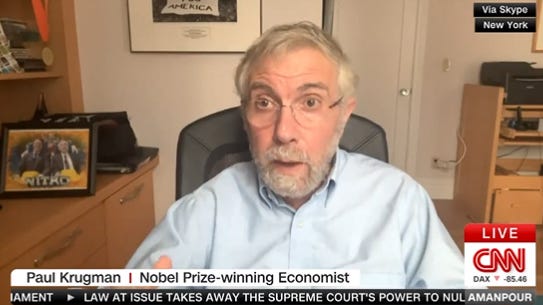
There are days, like one I experienced early this week, when I simply stand in awe of these buildings. Everything about them screams stability, and their inhabitants will passionately argue that stability is precisely their raison d’être. Yet, it’s hard to ignore the facts. Income inequality is widening, and inflation is spiraling out of control, disproportionately affecting the middle and lower classes. Meanwhile, limousine-liberal economists like Paul Krugman take to the airwaves, confidently proclaiming an economic victory utilizing these institutions…for reasons they can’t even clearly articulate.

“The economic data have been just surreally good. Even optimists are just stunned,” he recently said on CNN. “This is a goldilocks economy.”

He says inflation is coming down “quickly and painlessly”.

“We don’t really understand why this is happening. I can come up with multiple stories, but it’s important to point out that there’s a really profound and peculiar disconnect going on.”

You can say that again, Paul.

For a good portion of the population, this bullshit commentary cuts the mustard and this state of affairs is perfectly acceptable, as long as it doesn’t interrupt their planned weekend golf trip or doesn’t prevent their football team from kicking off on Sunday.

Many people continue to invest in their 401(k)s and have reaped benefits over the decades as the stock market ascends, seemingly defying gravity and common sense, all while leaving a trail of socio-economic casualties in its wake.

For me, the harsh reality of the situation is impossible to ignore. With more than two decades of investing experience, I’ve often considered my ability to anticipate market crashes or spikes in volatility as a gift. In the short term, my cautious nature usually puts me ahead of market fluctuations. Many of my followers started paying attention during the COVID-19 crisis, when I accurately predicted both the pandemic and the subsequent market crash. At that time, my pessimistic outlook was largely seen as an asset.

However, nearly two years into a rate-hiking cycle, the stock market is signaling that all is well, a notion that economically seems implausible. This has turned my once-valued caution into a liability.

For roughly the past 18 months, I’ve been betting on increased market volatility, a position that hasn’t paid off. As I reflect on this, I can’t help but question, on a broader, existential level, whether my market perspective is fundamentally flawed. It’s not the unsuccessful trades that concern me; rather, it’s the thought that my view of the market might be more trouble than it’s worth. What has this two-decade vigil for a system collapse yielded? A few profitable moments, certainly, but nothing that has defined my career or life. And here I am again, in a situation where I believe the economic indicators are dire, yet the market steadfastly disagrees.

At what point does the daily struggle become too much? I do maintain dividend-earning and long-only portfolios that stand to benefit from the current situation, but when does it stop being worth the mental toll of feeling like I’m constantly swimming against the current?


50% OFF ALL SUBSCRIPTIONS: Subscribe and get 50% off and no price hikes for as long as you wish to be a subscriber.


Setting the trade aside, it’s about outlook. On Wednesday, the Consumer Price Index (CPI) surpassed estimates—albeit slightly—but also still came in at a level nearly twice what the Fed is targeting. The stark reality is that inflation is still not under control, despite narratives about a “soft landing” or the notion that the Fed has everything in hand. Guided by the CPI, there’s scant evidence to suggest the Fed will shift course anytime soon.

Even if the Fed changed their policy tomorrow, the die is cast for the economy. Credit card debt is soaring, personal savings are dwindling, mortgage rates are at two-decade highs, and the excess liquidity from the pandemic era is drying up. The current trajectory is unsustainable. Maybe the Fed will once again engineer a market bailout, sending gold prices skyrocketing. Or perhaps they’ll let the market crash to combat inflation. The unpredictability of government reactions and market directions creates a volatile mix.

As certain as I am about this chaotic calculus incoming, I also know it won’t be long before the government finds another way to manipulate the system. They’ll scapegoat market crashes on non-sequiturs that the commonfolk will accept without question, blaming volatility on foreign leaders and bombing Syria as a result — or they’ll blame inflation on gold enthusiasts using cash instead of credit cards at gas pumps. They might even escalate their bond-buying programs or brazenly start purchasing stocks under the guise of a new way to help obese Americans burn fat—a maneuver I suspect they’ve been conducting covertly for years (the government buying stocks, not Americans losing weight).

Point is: when the government and the Federal Reserve set the rules, they have carte blanche to rig the game as they see fit.

This puts me in an intellectual quagmire. Why even decry a monetary policy that I find morally abhorrent and ethically dubious? Why bother challenging modern monetary theorists when so many just set their concerns on autopilot and enjoy a leisurely weekend? I question whether I’m expending too much mental energy on this, but I can’t stay silent when global monetary policy defies reason.

Despite uncertainties about market volatility, the most recent CPI numbers were met with celebration, and the NASDAQ continues to perform well. If I had just invested passively, I’d be comfortably counting my gains for the year. But that’s not me.

Over the last 18 months, I’ve often felt worn out—disheartened by my own skepticism and tired of seeing a flawed system perpetuate indefinitely. It’s particularly concerning that the real consequences of this system disproportionately impact the middle and lower classes—yet this is seldom discussed or understood.

As we move towards year-end, market volatility seems unusually subdued, almost inviting disaster when least expected. Have I lost my touch in offering a reality check? Am I the one who’s out of touch? These questions are louder in my head now than ever before.

I feel like Peter Gibbons from Office Space waiting to change lanes on his way to work. He thinks he’s finally found an open lane, switches, and before he knows it is waiting in an even longer line of cars watching the line he used to be in go flying by him.

The day I capitulate and declare that all is well—when it’s clearly not—will be the day before chaos reigns. It makes it a lose/lose scenario for me when contemplating switching to ‘the dark side’. If I give the ‘all clear’ the day before the market wrecks 15% and I knew why and how it was going to happen all along, I’ll never forgive myself.

But swimming upstream isn’t always easy, and gets tiring after a while.

“You never need patience more than when you’re about to lose it.”

– Sign hanging at my local Korean deli, where they are notoriously slow making sandwiches.

Now read:

QTR’s Disclaimer: I am an idiot and often get things wrong and lose money. I may own or transact in any names mentioned in this piece at any time without warning. This is not a recommendation to buy or sell any stocks or securities, just my opinions. I often lose money on positions I trade/invest in. I may add any name mentioned in this article and sell any name mentioned in this piece at any time, without further warning. None of this is a solicitation to buy or sell securities. These positions can change immediately as soon as I publish this, with or without notice. You are on your own. Do not make decisions based on my blog. I exist on the fringe. The publisher does not guarantee the accuracy or completeness of the information provided in this page. These are not the opinions of any of my employers, partners, or associates. I did my best to be honest about my disclosures but can’t guarantee I am right; I write these posts after a couple beers sometimes. Also, I just straight up get shit wrong a lot. I mention it twice because it’s that important.

Tyler Durden
Tue, 09/19/2023 – 09:35

Canadian CPI Triggers Panic-Puke In Bonds: 5Y Treasury Yield Highest Since 2007

0
Canadian CPI Triggers Panic-Puke In Bonds: 5Y Treasury Yield Highest Since 2007

Headline CPI for Canada printed a hotter than expected 4.0% YoY in August (a huge jump from the 3.34% YoY in July)…

Source: Bloomberg

Coming on the heels of the hotter than expected US inflation data, it appears this triggered some more fear in US markets that rates will be ‘higher for longer’ (as we noted was evident in rate-expectations changes yesterday)…

Source: Bloomberg

This sent TSY yields screaming higher (up around 5-6bps)…

Source: Bloomberg

With 5Y yields breaking above the 2022 highs – back to their highest since 2007…

Source: Bloomberg

Some context for the 10Y Yield move (testing yesterday’s highs)…

Source: Bloomberg

Bear in mind that Treasuries maturing in 10 or more years – which have the highest price sensitivity to changes in interest rates, or duration – have slumped 4% this year, following a record 29% plunge in 2022, according to data compiled by Bloomberg. That’s more than double losses across the broader Treasury market, the data show.

Source: Bloomberg

Feeling like now is the time to step in and buy? Bloomberg notes that the May 20250 TSYs are once again trading below 50c…

“Those bonds have below market coupons and investors need to get compensated for it,” said Nancy Davis, founder of Quadratic Capital Management.

The Treasury initially sold $22 billion of the 2050 securities at about 98 cents (it subsequently did two so-called reopenings, adding to the amount outstanding.)

They have very positive convexity, and that make them very interesting bonds, although liquidity is probably very low,” said Mustafa Chowdhury, chief rates strategist at Macro Hive Ltd.

Double your (notional) money in 27 years?

The higher yields have hammered the longest-duration equities…

And while cause and effect may be hard to discern, oil prices are exploding higher alongside bond yields with WTI above $92. Lots of chatter that oil is moving on headlines that Azerbaijan said it had launched “anti-terrorist” operations in the Nagorno-Karabakh region with mostly Armenian population. Azerbaijan is an oil and gas producer and exporter and is part of the OPEC+ alliance of producers as a non-OPEC participant in the group currently withholding oil supply to the market.

…which will drag gasoline prices higher… and CPI hotter… and so the vicious circle continues.

Tyler Durden
Tue, 09/19/2023 – 09:20

October Weakness Before The Year-End Run?

0
October Weakness Before The Year-End Run?

Authored by Lance Roberts via RealInvestmentAdvice.com,

While September has been a bit sloppy so far, will further weakness in October weigh on investor sentiment before the seasonally strong period begins? As shown by the S&P 500 index seasonality chart below, weakness in the last two weeks of September and the first two weeks of October is common. However, we must also understand that the big down move in the market during that period came from historical crashes such as the “Financial Crisis” in 2008. Excluding those periods, the market still tends to be weak but more flat in nature.

Just as a reminder, the historical analysis suggests summer months of the market tend to be the weakest of the year. The mathematical statistics prove this as $10,000 invested in the market from November to April vastly outperformed the same amount invested from May through October. Interestingly, the max drawdowns are significantly larger during the “Sell In May” periods. Previous important dates of major market declines occurred in October 1929, 1987, and 2008.

So far this year, the May through October period remains about average, with a return through last Friday of 6.74%. Even if there is some additional weakness, the overall period should still be a “win” for investors. However, as noted, the weakness came a bit late this year, with a 5%ish correction starting in August.

However, this is a bit deceiving. As we noted previously, much of the gain in the market this year has come from essentially ten stocks that have the largest concentration, in terms of market capitalization, in the index. The surge in those stocks has skewed the performance of the broad market index. The performance of the bottom 490 stocks remains markedly different.

Looking at the performance of the equal-weighted index from May to the present, we see the seasonal market weakness more clearly. While still positive, the return so far is about 200 basis points weaker.

So, as we begin to wrap up the seasonally weak period for stocks, what will potentially be the market drivers into year-end as the seasonally strong period begins?

Driving Ms. Daisy

Three primary drivers will likely drive markets from the middle of October through year-end.

The first is earnings season, which kicks off in two weeks. As is always the case, analysts have significantly lowered the “earnings bar” heading into reporting season. As noted in “Trojan Horses,” analysts are always wrong, and by a large degree.

“This is why we call it ‘Millennial Earnings Season.’ Wall Street continuously lowers estimates as the reporting period approaches so ‘everyone gets a trophy.’” 

The chart below shows the changes in Q3 earnings estimates from February 2022, when analysts provided their first estimates.

Of course, with the bar lowered, such will generate a high “beat rate” by companies, which will help fuel stock prices in the short term. Notably, those “high beat rates” get support from the more negative short-term sentiment and reduced equity allocations by professional managers during the summer. As stocks start to move higher, professional managers will begin to chase performance, pushing prices higher.

Given the large divergence between the market and equal-weighted indices this year, there is additional pressure on managers to “catch up” with performance moving into year-end reporting. Given the “career risk” to managers of significant underperformance, additional buying pressure could manifest.

Lastly, corporate share buyback windows will reopen in November and December as companies exit their earnings “blackout period.” Notably, as shown in the table below, the last two months of the year represent the best two-month period of the year for corporate executions. Such is because corporations have a clear picture of their current financial positions and can use stored cash to execute buybacks. As noted by Goldman Sachs:

“The VWAP machines will be lining up to buy $5bn worth of equities daily during November and December.”

Yes, that is $5 billion each trading day, which provides sufficient buying power to lift asset prices into year-end.

Don’t Forget About The Risks

A reasonable backdrop between the summer selloff, sentiment, positioning, and buybacks suggests a push higher by year-end. Add to that the performance chase by portfolio managers as they buy stocks for year-end reporting purposes. As Goldman’s flow guru Scott Rubner points out:

“Since 1900, the average Q4 return for SPX when the market returns for the first three quarters of the year were greater than 10%, fourth quarter returns were stronger than average coming in at 4.6%.”

While the backdrop certainly supports a rally into year-end, such is not guaranteed. However, the potential risk of elevated interest rates, slowing economic data, and tighter financial conditions should not be dismissed.

One of the things we continue to keep a very close watch on is the extremely suppressed level of market volatility. While the markets are indeed acting bullishly, extremely low levels of volatility are a warning. As shown below, previous periods of low volatility eventually led to periods of higher volatility.

While such low levels of volatility can certainly last longer than many expect, it is inevitable that, eventually, we will have a reversal. When that will happen, or what will cause it, is always unknown, but such a reversal is almost assured.

For now, an ongoing bullish bias continues to support the market near-term. Bull markets built on “momentum” are very hard to kill. Warning signs can last longer than logic would predict. The risk comes when investors begin to “discount” the warnings and assume they are wrong by suggesting “this time is different.”

There is little to lose by paying attention to “risk.”

If warning signs prove incorrect, removing hedges and reallocating into equity risk is simple.

However, if warning signs come to fruition, a more conservative stance in portfolios will protect capital in the short term. Reducing volatility allows for a logical approach to making further adjustments as the correction becomes more apparent. (The goal is not to be forced into a “panic selling” situation.)

It also allows you the opportunity to follow the “Golden Investment Rule:” 

 “Buy low and sell high.” 

Tyler Durden
Tue, 09/19/2023 – 08:50

Rocket Lab Shares Crater On Botched Space Mission 

0
Rocket Lab Shares Crater On Botched Space Mission 

Rocket Lab USA shares cratered in premarket trading in New York after its Electron rocket experienced an in-flight “anomaly” that resulted in the end of the mission. 

An Electron rocket carrying a synthetic aperture radar (SAR) spacecraft for the California company Capella Space lifted off from Rocket Lab’s New Zealand site Tuesday at 0255 ET. The company said lift-off from Launch Complex 1, first-stage burn, and stage separation were successful, but explained, “an issue was experienced at around T+ 2 minutes and 30 seconds into flight, resulting in the end of the mission.” 

“The launch director has called an anomaly, resulting in the end of the mission. We’ll share more information as it comes to hand,” Rocket Lab posted on X around 0300 ET. 

Space.com said Electron’s single Rutherford engine might have “suffered an ignition failure or a premature shutdown, though that’s just speculation.” 

The company said, “We are deeply sorry to our partners Capella Space for the loss of the mission.” 

Rocket Lab shares plunged as much as 19% in premarket trading. 

Tuesday’s mission was dubbed “We Will Never Desert You.” And it’s the ninth of the year and 41st overall. 

“We are working closely with the FAA and supporting agencies as the investigation into the root cause commences,” Rocket Lab noted. 

Maybe Capella Space will try SpaceX next time. 

Tyler Durden
Tue, 09/19/2023 – 06:55

COVID-19 Vaccines Revealed To Be ‘Neither Safe, Nor Effective’: Watchdog

0
COVID-19 Vaccines Revealed To Be ‘Neither Safe, Nor Effective’: Watchdog

Authored by Naveen Athrappully via The Epoch Times (emphasis ours),

COVID-19 vaccines were authorized in Canada during 2020 and 2021 without being subjected to the country’s safety tests as required under established drug regulations, revealed an accountability watchdog.

A medical assistant holds a tray of syringes filled with doses of Moderna COVID-19 vaccine at a vaccination site in Los Angeles on Feb. 16, 2021. (Apu Gomes/AFP via Getty Images)

An investigation into COVID vaccines found that the jabs were “neither safe nor effective,” said the nonprofit National Citizens Inquiry (NCI) in a Sept. 15 post on X. The organization published a report Thursday detailing the flawed mechanism through which the vaccines were granted “approval” in Canada.

“It is important to understand that the COVID-19 vaccines were never approved under the traditional approval process for drugs in Canada,” stated the report (pdf). Instead, Health Canada, the federal agency responsible for national health policy, approved the vaccines through an alternative authorization process—an interim order.

Under the alternative authorization process, the necessity to establish the safety and efficacy of COVID-19 vaccines through an objective manner appears to have been set aside.

Canada’s Food and Drug Regulations require that a drug can only be approved in the country after its safety and effectiveness are demonstrated to the Minister of Health. Then, the minister considers whether the benefits outweigh the risks, following which, approval is granted.

Instead of following regulations, the Minister of Health sanctioned an interim order on Sept. 16, 2021, which exempted all COVID-19 vaccines from normal review and approval. This provision usually allows the minister to override normal regulations in situations of “significant risk” to health, safety, or the environment.

In Canada, four COVID-19 vaccines were authorized by the health agency under an interim order—Pfizer-BioNTech, Moderna, Janssen, and AstraZeneca.

The report noted that under the order, vaccines were authorized under a “subjective test.” In this situation, authorization is granted by simply proving that the benefits of vaccination outweigh the risks.

This cannot be an appropriate standard for approving a drug that the Government intends to administer to the entire population. It is difficult to conceive of a less-scientific test for drug authorization than that found in the Interim Order.”

A child receives a dose of the Pfizer BioNTech COVID-19 vaccine at the Fairfax County Government Center in Annandale, Va., on Nov. 4, 2021. (Chip Somodevilla/Getty Images)

Moreover, the order made sure that the authorized vaccines could not be revoked even under evidence that it was unsafe and ineffective. Once an interim order is issued, the typical Food and Drug Regulations do not apply.

The order thus exempted manufacturers from having to effectively demonstrate “objective evidence of safety and effectiveness” of their COVID-19 vaccines.

“The result was that while chief medical officers across the country repeatedly assured Canadians that the COVID-19 vaccines were ‘safe and effective’—the general Canadian population had no understanding that their authorization process had not required objective proof of safety nor efficacy.”

‘Not Safe for Human Use’

The NCI report was supported by cardiologist Dr. Peter A. McCullough. “Excellent work @Inquiry_Canada with exhaustive testimony and evidence review. Conclusion: all COVID-19 vaccines unsafe for human use and must be removed from the Canadian market immediately to protect the public,” he wrote in a Sept. 16 post on X.

DALLAS, TX—Peter McCullough, cardiologist, speaks at the Conservative Political Action Conference in Dallas at the Hilton Anatole August 5, 2022. (Bobby Sanchez for The Epoch Times)

Dr. McCullough recently asked European lawmakers to take COVID-19 vaccines off the market due to concerns about illnesses like heart inflammation, blood clots, and neurological diseases.

COVID-19 vaccines and all of their progeny and future boosters are not safe for human use. I implore you, as a governing body, European Medicines Agency (EMA), to apply all pressure and due urgency to remove the COVID-19 vaccines from market,” Dr. McCullough said in Sept. 13 testimony to the European Parliament.

The NCI report comes as the U.S. Food and Drug Administration (FDA) approved new COVID vaccines on Sept. 11 for children as young as six months old.

“Vaccination remains critical to public health and continued protection against serious consequences of COVID-19, including hospitalization and death,” Dr. Peter Marks, a top FDA official, said in a statement.

However, many experts have questioned the push for new vaccines. Earlier this month, Florida’s Surgeon General, Dr. Joseph Ladapo, criticized the updated shots.

We all know there’s a new vaccine that’s coming around the corner, [a] new mRNA COVID-19 vaccine. And there’s essentially no evidence ‘for it,” he said during a press conference.

“There’s been no clinical trial done in human beings showing that it benefits people, there’s been no clinical trial showing that it is a safe product for people. And not only that, but then there are a lot of red flags.”

Mr. Ladapo said that mRNA COVID-19 vaccines have “caused cardiac injury in many people.”

Not Actually ‘Interim’

Canada’s interim order for COVID-19 vaccines “has become permanent,” according to the NCI report (pdf). An interim order typically only lasts for one year. In March 2022, the order was replaced with permanent regulations which codified the “subjective authorization” of the vaccine.

“Thus, under the permanent test, Health Canada no longer has to be swayed by urgency, but simply by the public health need related to COVID-19. In this way, it seems that so long as COVID-19 is a circulating virus, Health Canada must authorize any vaccine for which there is an argument to support the conclusion that its benefits outweigh its risks,” the report said.

“In effect, we fear that there will never be a need for COVID-19 vaccine manufacturers to prove [the] safety or efficacy of their products.”

NCI also alleged there was a “conflict of interests” while approving the COVID-19 vaccines, with the government being involved.

The Epoch Times has reached out to Health Canada for comment.

Political Interests, Letter to Trudeau

Canada usually does not allow drugs to be imported into the country unless approved by Health Canada. However, the interim order allowed the unapproved COVID-19 vaccines to be imported “as long as the Canadian Government was the purchaser,” said the report.

This pre-purchasing and distribution of COVID vaccines were done to make sure the jabs were available for dissemination as soon as they were authorized. “This created a tremendous conflict of interest.”

“Once the vaccines were purchased, imported and ready for distribution, the Government of Canada would have suffered significant political blowback if it was unable to authorize them. Thus, it needed to authorize the COVID-19 vaccines, and it needed to do it quickly.”

The administration “ordered the vaccines, imported them, created new regulations to authorize them, and then took significant measures to convince and coerce every Canadian to take multiple doses. The political stakes were high, and the federal government had every motivation to get the vaccines authorized, regardless of their actual efficacy or safety.”

On Sept. 14, the NCI sent a letter (pdf) to Canadian Prime Minister Justin Trudeau highlighting the issue of COVID-19 vaccine approval.

Canadians are relying on representations as to the safety and effectiveness of COVID-19 vaccines,” which Health Canada has never determined, the letter said. “Some might draw the conclusion that the misrepresentation to Canadians of proven safety is intentional, made while knowing it to be false and intending it to be relied upon.”

“As a matter of common sense, the objective falsity of the ‘proven safe’ claim brings into question the basis for informed consent to the administration of the injections, creating potentially enormous liabilities.”

In the current context, the organization pointed out that the population immunity has increased along with the latest variants being “milder.”

“In the face of your government’s reported intention to promote booster injections in coming months, the urgency now lies in telling the truth to Canadians and taking corrective action.”

The NCI asked the prime minister to withdraw COVID-19 vaccines “until the normal rigorous evaluation can be completed” and to reinstate the traditional objective test for safety.

Tyler Durden
Tue, 09/19/2023 – 06:30

Russia: The United States Is At War Against Us

0
Russia: The United States Is At War Against Us

Russian Foreign Minister Sergey Lavrov in fresh statements made to reporters has said the Untied States in waging war against Russia through the Ukraine proxy war.

Lavrov in the Russian-language comments described that Washington is not only transferring some $100 billion in military aid to Kiev, but is actually controlling its decision-making. He further said this is in order to try and inflict a “strategic defeat” on Russia.

The top Russian diplomat was speaking on the sidelines of the Eastern Economic Forum on Sunday morning. “No matter what it says, it [the US] controls this war, it supplies weapons, munition, intelligence information, data from satellites, it is pursuing a war against us,” he said, according to a translation.

“While what is going on is that Ukraine has been prepared, has long been prepared for inflicting strategic defeat to Russia using its hands and its bodies,” Lavrov emphasized.

He in prior comments Friday had said the US is also waging a global effort to isolate Moscow, and that this was the intent of the recent Saudi-hosted Ukraine peace summit.

“There is a real plot around the topic of the so-called (peace) negotiations, as well as attempts to turn everything upside down through pseudo diplomacy,” he said Friday. He explained: 

“The West has been saying for months that this ‘peace formula’ is the only basis for negotiations. It starts from innocent topics … and then comes to the purpose for which it was concocted – inflicting a strategic defeat on Russia, to restore the borders of Ukraine as they were in 1991, court-martial the Russian leadership, force Russia to pay reparations, and then ‘mercifully’ agree to sign a peace agreement.”

He then suggested it’s a pattern in dealing with other countries as well: “These are exactly the dirty methods that the West uses not only in relation to Ukraine but in many other areas of global politics,” Lavrov stated.

Meanwhile, the White House appears to be on the cusp of approving long-range missiles, the ATACMS, which has a range of 190 miles.

And yet, dangerously, it’s become quite clear in the last several months that Ukraine will continue seeking to strike cities and bases inside Russia. New long-range missiles from Washington will without doubt make this easier for Kiev to do, risking more severe escalation which could eventually see direct Russia-NATO clashes.

Tyler Durden
Tue, 09/19/2023 – 05:45

Is The LME Losing Its Grip On Global Nickel Pricing?

0
Is The LME Losing Its Grip On Global Nickel Pricing?

Authored by Metal Miner’s Nichole Bastin via OilPrice.com,

  • Nickel prices experience a significant decline, erasing gains from H2 2022, and the Stainless Monthly Metals Index drops by 3.1%.

  • The stainless steel market is oversupplied, leading to limited demand and historically short 304 mill lead times, though base prices remain unchanged.

  • In the aftermath of the March 2022 nickel squeeze, trading volumes on the LME remain low, prompting potential new futures contracts from competitors like the Shanghai Futures Exchange and Abaxx Commodities Exchange.

The nickel price index continued to trend downward, as it fell to its lowest level since July 2022 by mid-September. Following an over 7% decline during August, prices fell nearly 3% during the first two weeks of September. As prices drop toward historical support zones, they come close to wiping out nearly all gains from the last major uptrend in H2 2022. While the LME nickel contract remains plagued by low liquidity, the continued creation of lower highs and lower lows suggests bearish momentum within the market.

Overall, the Stainless Monthly Metals Index (MMI) returned downward from last month, with a 3.1% decline from August to September.

Stainless Inventories Reportedly “Supplied to Over-Supplied”

The stainless steel market remains decidedly bearish as the final quarter of 2023 nears. Suppliers described current inventory levels among both service centers and end users as “supplied to oversupplied.” While 304 and 430 grades account for the majority of the market, oversupply is apparently indicative through much of the stainless market. 

Numerous end users reportedly intend to sit out of the market for the remainder of the year, which will pressure service center pricing as they work to reduce inventories at the end of the year. Competitive import prices tempted some OEMs back into the market, as witnessed by a jump in cold rolled import licenses during August. However, imports throughout the year remain muted from 2022 amid the shift in market dynamics. View MetalMiner’s track record of forecasting where industrial metal prices are headed.

Stainless Mill Lead Times Remain Short, Base Prices Hold Firm

Amid limited demand, 304 mill lead times remain historically short. Lead times continue to average around 4.5 weeks. Under normal conditions, mill lead times typically extend from 6 to 8 weeks.

In spite of the bearish market, base prices have remained unchanged since January 2022. Domestic mills are expected to hold firm on base prices during the remainder of the year to mitigate the impact of lower demand. While greater market pressure could change this, the effective duopoly between NAS and Outokumpu and long lead times for imports will allow domestic producers greater control over market pricing.

Impress your executive team and lead like a procurement pro. Decode nickel market volatility’s impact on earnings with the Monthly Metals Outlook report. Start with a free sample, then subscribe.

Broken Nickel Market Still Ripe For Challengers

September marked the year-and-a-half anniversary of the March 2022 nickel squeeze, which caused liquidity within its 3M nickel contract to plunge. While trading volumes picked up slightly throughout the summer, they sit far beneath their averages from previous years. This leaves the LME nickel contract ripe for the picking.

In addition to Global Commodity Holdings, the Shanghai Futures Exchange (SHFE) is reportedly considering the creation of its own international nickel futures contract. According to Reuters, the exchange “has been studying the structure of the nickel market and supply and demand at the instigation of industry participants looking for alternatives.”

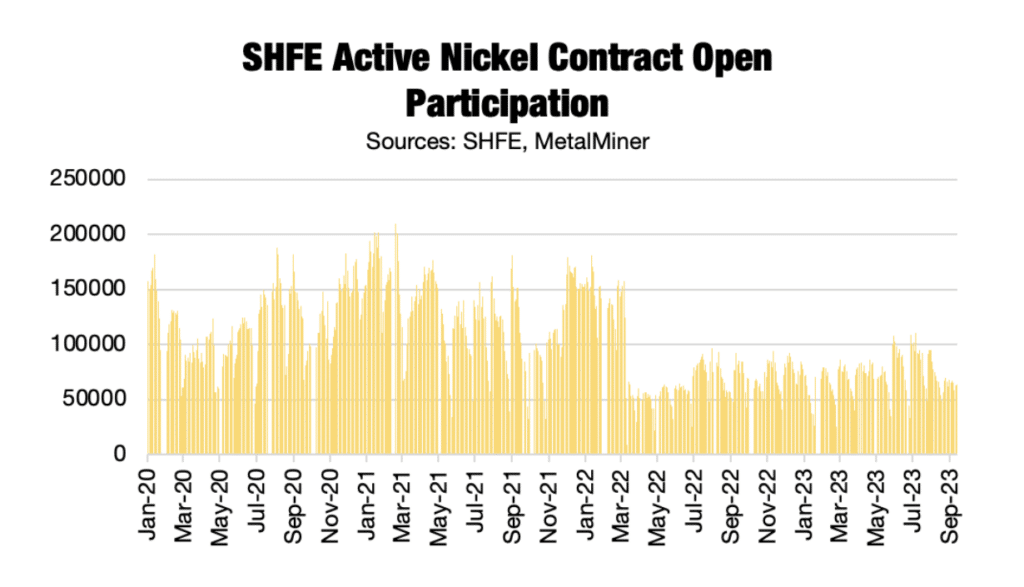
It remains unclear whether a viable alternative contract would bring traders back to the market. The impact of the March 2022 squeeze reverberated across exchanges, as open participation on the SHFE’s own active nickel contract dropped amid the nickel market exodus. How exactly these factors will impact 2024 nickel prices and market volatility are all covered in MetalMiner’s 2024 Annual Metals Outlook.

Other Nickel Price Factors at Work

Meanwhile, as Class 2 nickel supply becomes increasingly important amid the rise of EVs, Singapore’s Abaxx Commodities Exchange is currently working on a physically settled nickel sulfate futures contract it hopes to have available by the end of the year. Abaxx’s contract would not compete with the LME or SHFE, which reflect the Class 1 nickel price. Should it become liquid enough to use as a pricing benchmark, however, it would provide an important reference point within the increasingly bifurcated nickel market between Class 1 and 2 material.

As the LME fights to retain its dominant position as the global pricing benchmark, the beleaguered exchange’s continued struggles to regain market participants begs the question as to why stainless producers use LME nickel prices to begin with. Outokumpo boasts using an average of 90% recycled material content within its melt mixes. This would suggest scrap prices hold a far more important position in the actual cost of stainless steel.

Beyond that, there remains a considerable margin between scrap prices and LME prices, a notable benefit to mills. Low liquidity on the LME contract exacerbates this delta, as it has led to a lack of momentum within price action causing slow overall price movement. This, in turn,has led to slow declines within the stainless surcharge.

Tyler Durden
Tue, 09/19/2023 – 05:00