76.6 F
Chicago
Monday, August 31, 2026
Home Blog Page 3417

Chess Bans Trans

0
Chess Bans Trans

Authored by Steve Watson via Summit News,

The International Chess Federation (FIDE) has has become the latest governing body to completely ban trans-identifying biological men from competing in women’s competitions.

FIDE introduced new guidelines that state “In the event that the gender was changed from a male to a female the player has no right to participate in official FIDE events for women until further FIDE’s decision is made.”

“Such decision should be based on further analysis and shall be taken by the FIDE Council at the earliest possible time, but not longer than within 2 (two) years period,” the guidelines add.

The guidelines continue, “If a player holds any of the women titles, but the gender has been changed to a man, the women titles are to be abolished.”

“Those can be renewed if the person changes the gender back to a woman and can prove the ownership of the respective FIDE ID that holds the title,” the rules now state.

“The abolished women title may be transferred into a general title of the same or lower level (e.g., Women’s Grand Master may be transferred into FM, Women’s International Master into Candidate Master, etc.),” the guidelines further state.

FIDE noted that it made the changes after receiving recognition requests from players who identify as transgender, in addition to cases where men have been caught disguising themselves as women in order to win prize money:

The governing body also notes that “are no restrictions to play in the open section for a person who has changed the gender,” referring to a non gender specific category of competition.

Women are also not banned from competing in men’s chess events should they choose to, primarily because there are way fewer women chess players than men.

Unsurprisingly, trans activists have branded the move as “pure bigotry and persecution,” with others also arguing that because chess is not a physical sport, it signals that the governing body believes women are intellectually inferior.

Others pointed out that the matter is more nuanced:

Related:

*  *  *

Brand new merch now available! Get it at https://www.pjwshop.com/

In the age of mass Silicon Valley censorship It is crucial that we stay in touch. We need you to sign up for our free newsletter here. Support our sponsor – Turbo Force – a supercharged boost of clean energy without the comedown.

Also, we urgently need your financial support here.

Tyler Durden
Sat, 08/19/2023 – 10:30

Buying Second-Hand Is Gaining Popularity

0
Buying Second-Hand Is Gaining Popularity

Second-hand shopping is gaining traction in several countries around the world.

Statista’s Anna Fleck reports that data from the Statista Consumer Insights survey reveals that in the United States, now as many as 60 percent of respondents say they have made at least one second-hand purchase in the past year, up from 49 percent in 2019.

A similar trend can be seen in the other countries polled in the survey, with France seeing the biggest leap (+17 p.p.).

Infographic: Buying Second-Hand Is Gaining Popularity | Statista

You will find more infographics at Statista

According to Statista’s Second-hand apparel dossier, the value of the worldwide second-hand apparel market is forecast to hit $84 billion by 2030, which would mark a jump of $56 billion in just a decade.

Statista analysts say that at this rate, fast fashion may soon be outpaced by the second-hand fashion market.

Is this yet another sign of the growth of the ‘working poor’ in western nations as wage growth is outpaced by policy-induced inflation of everything else.

Tyler Durden
Sat, 08/19/2023 – 09:55

Study On ‘COVID-19 Misinformation’ Rife With Misinformation: Critics

0
Study On ‘COVID-19 Misinformation’ Rife With Misinformation: Critics

Authored by Zachary Stieber via The Epoch Times (emphasis ours),

A new study claiming some doctors offered “COVID-19 misinformation” is full of false and misleading information, critics say.

A nurse administers a COVID-19 vaccine booster to a person at a hospital in Hines, Ill., on April 1, 2022. (Scott Olson/Getty Images)

Dr. Sarah Goff and colleagues in their study claimed that the COVID-19 vaccines are completely safe, that only nine deaths have been confirmed as being caused by the vaccines, and that there are no negative consequences to wearing masks.

In some instances, the authors went against their own definition of misinformation. They defined misinformation as information that went against guidelines issued by the U.S. Centers for Disease Control and Prevention (CDC) or “unsubstantiated claims.”

The CDC in 2021 acknowledged severe allergic shock as a COVID-19 vaccine side effect. The agency also said that year that the Pfizer and Moderna vaccines likely caused heart inflammation and that the Johnson & Johnson vaccine caused blood clotting.

The study was published by the Journal of the American Medical Association (JAMA) Network Open and covered January 2021 to December 2022.

Dr. Goff, an associate professor of health promotion and policy at the University of Massachusetts Amherst, and other researchers from the university, also labeled as misinformation saying post-infection immunity, or natural immunity, was better than vaccine-bestowed immunity.

A statement from January 2022 from Dr. Marty Makary, a surgeon at Johns Hopkins University, saying “natural imm[unity] is more effective than vax [immunity]” was included as an example of purported misinformation.

According to the CDC, natural immunity provided better protection than the vaccines during the Delta era. Another CDC study, which came after the time period the study covered, found the same for the Omicron era.

“JAMA, CDC, & the government’s Truth™️ agencies spread a lot of misinformation during the pandemic,” Dr. Makary said in a social media post. “But when they use the term it’s to justify censoring different scientific opinions—even after they are later supported by solid research.”

Dr. Goff and JAMA did not respond to requests for comment.

The researchers said that their study found “widespread, inaccurate, and potentially harmful assertions made by physicians across the country,” adding that “Further research is needed to assess the extent of the potential harms associated with physician propagation of misinformation, the motivations for these behaviors, and potential legal and professional recourse to improve accountability for misinformation propagation.”

But Dr. Jay Bhattacharya, a professor of health policy at Stanford University, said the study itself promoted misinformation and will contribute to the falling trust in public health.

“The U.S. public health establishment failed to safeguard the health and well-being of the American public during the pandemic. A primary reason for this is that the establishment embraced many policies and ideas unsupported by scientific evidence, such as the efficacy of toddler masking or the inefficacy of immune protection after COVID recovery. They pushed vaccine mandates on the false premise that the COVID vaccine could stop COVID,” Dr. Bhattacharya, who was not involved in the research, told The Epoch Times via email.

“For JAMA to publish a piece on misinformation—citing true facts as if they were misinformation—without mentioning the much more consequential misinformation that public health and medical authorities pushed further, diminishes public trust in public health and medicine,” he added.

Other Claims

Dr. Goff and the other authors reviewed statements made on social media and during interviews and analyzed them to see if they were “unsupported by or contradicting” CDC guidance or “contradicting the existing state of scientific evidence for any topics not covered by the CDC.”

Themes of purported misinformation, the authors claimed, included statements that the COVID-19 vaccines were ineffective at preventing the spread of COVID-19 and that the vaccines were harmful.

The clinical trials for the vaccines did not test efficacy against transmission and vaccinated people almost immediately began becoming infected despite being vaccinated, records show. Studies have found that vaccinated people have similar viral loads to unvaccinated people.

Side effects, meanwhile, have been acknowledged by the CDC and other agencies starting in late 2020 with anaphylaxis, or severe allergic shock. Other known or suspected side effects include heart inflammation, Guillain-Barre syndrome, and blood clotting.

While dismissing vaccine risks, the authors also said that doctors distributed misinformation by contradicting the CDC’s position that COVID-19 vaccines have only been confirmed as causing or contributing to nine deaths. But death certificates and other evidence undercut the CDC’s position, and authorities in other countries have confirmed additional deaths.

The authors also said that alleging COVID-19 originated in a laboratory in China, where the first COVID-19 cases were detected, “contradicted scientific evidence at the time” and was thus misinformation. But their two citations were from 2023, after the study was completed. Experts remain divided on the COVID-19 origins, and many support the theory it came from the lab.

They also took issue with Dr. Bhattacharya’s December 2022 statement that “we found that government actors across a dozen federal agencies were in contact with Twitter, with social media telling the social media companies what to censor and in many cases who to censor regarding COVID information.”

Court documents from a case in which the doctor was involved support his statement. A federal judge overseeing the case later said the plaintiffs  “have produced evidence of a massive effort by Defendants, from the White House to federal agencies, to suppress speech based on its content.”

Tyler Durden
Sat, 08/19/2023 – 09:20

Mercedes, BMW Sever Russian Dealers From Diagnostic Software

0
Mercedes, BMW Sever Russian Dealers From Diagnostic Software

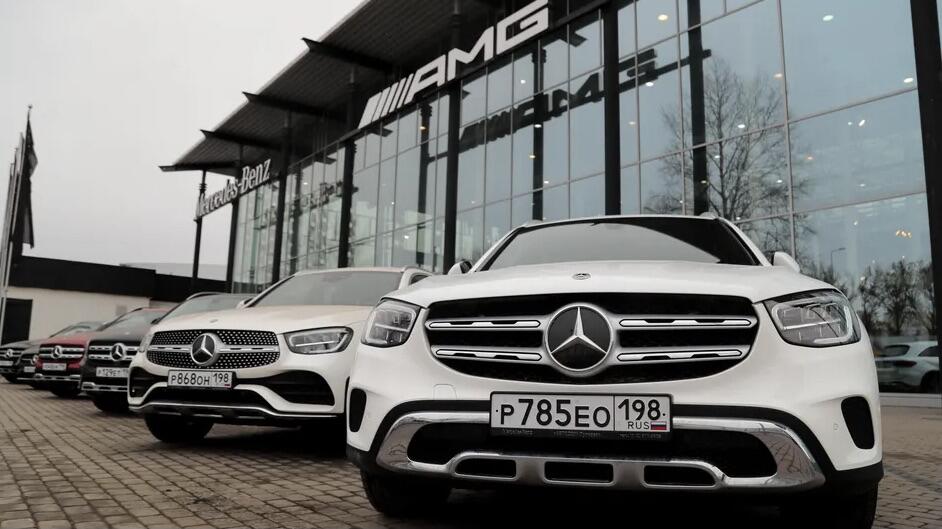
Under pressure of the western sanction regime, Mercedes-Benz has cut Russian dealers off from its software, severely impacting their ability to diagnose and service vehicles. BMW has implemented its own restrictions.  

“Dealers have been disconnected from the manufacturer’s online software systems,” distributor Mercedes-Benz Russia told Izvestia. “Due to the withdrawal of Mercedes-Benz AG from the Russian market, the joint-stock company Mercedes-Benz Russia does not have any additional opportunities to check and carry out other service measures set for Mercedes-Benz cars by the manufacturer.” 

A Mercedes-Benz dealership in St. Petersburg, Russia (DPA/Picture Alliance via Getty Images and Forbes

“In some cases, the lack of access to online systems will increase repair times,” the company said, as mechanics will have to rely on their “accumulated experience and knowledge.” In addition to thwarting maintenance and repairs, the software cut-off will also leave Russian drivers unable to update programming on their vehicles. 

On his program, Russian TV host Vladimir Solovyov lashed out at the Germany company. “Mercedes-Benz informed dealers that all cars would be withdrawn from the service,” he said, according to a translation circulating online. “What does it mean? They sold it and it’s now dangerous? Where’s the class action lawsuit against Mercedes asking it to buy back the cars it sold in Russia? Driving these cars is now potentially dangerous.” 

Escalating the rhetoric, he implored the Russian government to “protect the rights of Russian citizens” and “make this Nazi bastard bankrupt.”

It’s the latest fallout from Russia’s invasion of Ukraine. In April, Mercedes-Benz announced that it sold its stake in its Russian subsidiary — including manufacturing plants in the country — to Avtodom, a Russian car-dealer chain. The deal included a buyback option, creating a path for a potential postwar return by Mercedes-Benz. 

In a world where everyday essentials increasingly rely on proprietary technology, the development is a reminder that we’re all increasingly at risk at having our lives disrupted by corporations bowing to governments’ wishes — sometimes reluctantly, but often enthusiastically. 

“Given the way things are clearly developing, it won’t be long before your ability to access automative services is as subject to deplatforming as your ability to upload YouTube videos or make posts on social media,” writes Vox Day.  

“They state that only the wealthy Russian oligarchs can afford Mercedes, but that is simply not true,” writes Martin Armstrong“This opens a new door for tyranny and control as car manufacturers can now directly punish the people of any nation. Germany is allegedly not at war with Russia, but they have the ability to prevent Russians from properly maintaining their vehicles. This is just the beginning, as now car manufacturers will have the power to disconnect customers from services with no repercussions.” 

Tyler Durden
Sat, 08/19/2023 – 07:35

Germany Reverses Course On Pledge To Meet NATO Military Spending Target

0
Germany Reverses Course On Pledge To Meet NATO Military Spending Target

Authored by Connor Freeman via The Libertarian Institute,

Berlin has backed off its plan to legally commit itself to meeting NATO’s two percent yearly military spending target, a government source told Reuters on Wednesday. Finance Minister Christian Lindner’s draft of a new budget financing law was passed by parliament after a clause pledging to meet the target was deleted at the last minute.

Instead, in keeping with Berlin’s National Security Strategy, it will maintain its policy to aim for spending two percent of GDP on military spending on average over a five-year period. Germany’s Foreign Ministry, led by Annalena Baerbock, opposed the plan favored by the Defense Ministry to commit to 2 percent spending every year.

“From now on, we will invest more than 2 percent of the GDP into our defense year after year,” Chancellor Olaf Scholz declared in February 2022 when he announced the Zeitenwende, a sea change in German foreign policy.

This came after the Kremlin launched its war with Kiev, a de facto NATO member on Russia’s doorstep. In order to “weaken” Russia, the conflict quickly morphed into a proxy war against Moscow led by the Washington-led alliance.

As a result of the proxy war with Russia, Berlin has recently taken steps which severely damaged relations between Germany and the Kremlin. Namely, green-lighting the export of Poland’s Soviet-era warplanes which originally came from German military stocks.

Additionally, yielding to pressure from Washington and elsewhere inside NATO, Scholz approved the transfer of German-made main battle tanks to Kiev, and sent its own tanks as well, vastly escalating the tensions with Russia.

Earlier in the war, Scholz had explicitly ruled out just such steps over concerns that sending heavy weapons, including tanks and planes, to Ukraine would lead to a direct war between the North Atlantic alliance and Russia. In May, Berlin announced it was providing Kiev with a massive arms package worth nearly $3 billion, including 30 Leopard 1 tanks as well as Marder fighting vehicles. This was Germany’s largest transfer of weapons since the war began.

NATO members have been increasing their defense spending since Russia’s invasion, which has been a boon for weapons makers particularly in the US and the UK. According to Reuters, half of a $103 billion special fund Berlin has set up to modernize the German military will be spent purchasing arms made by the US military industrial complex.

Tyler Durden
Sat, 08/19/2023 – 07:00

These Are The World’s Ten Busiest Airports

0
These Are The World’s Ten Busiest Airports

Hartsfield-Jackson Atlanta International Airport, U.S., was the world’s busiest airport in 2022, with an annual footfall of some 93.7 million passengers.

The figure is 24 percent higher than in 2021, but 15 percent lower than in 2019, the year before the pandemic.

It is followed by Dallas-Fort Worth Airport, with 73.4 million travelers, and Denver Airport, with 69.3 million, according to data released by Airports Council International (ACI).

After 22 years leading the charge as the number one airport for passenger volume, Atlanta’s airport was pushed to second place in 2020 by Canton Baiyun International Airport, China.

However, the Chinese airport fell to eighth place a year later and the U.S. airport once again topped the list.

As Statista’s Anna Fleck shows in the following infographic, five of the top ten airports with the highest passenger traffic last year were in the United States.

Infographic: The World’s Ten Busiest Airports | Statista

You will find more infographics at Statista

ACI highlights that all ten, representing 10 percent of global traffic, have a significant share of domestic traffic – the segment that has led the global recovery.

The total number of passengers worldwide in 2022 was estimated to hit nearly 7 billion, representing an increase of nearly 54 percent over 2021.

Tyler Durden
Fri, 08/18/2023 – 23:20

“The End Is Nearing” – Seymour Hersh Slams The White House’s “Wishful Approach” To Ukraine War

0
“The End Is Nearing” – Seymour Hersh Slams The White House’s “Wishful Approach” To Ukraine War

Authored by Seymour Hersh via Substack

It’s been weeks since we looked into the adventures of the Biden administration’s foreign policy cluster, led by Tony Blinken, Jake Sullivan, and Victoria Nuland. How has the trio of war hawks spent the summer?

Sullivan, the national security adviser, recently brought an American delegation to the second international peace summit earlier this month at Jeddah in Saudi Arabia. The summit was led by Crown Prince Mohammed bin Salman, known as MBS, who in June announced a merger between his state-backed golf tour and the PGA. Four years earlier MBS was accused of ordering the assassination and dismemberment of the journalist Jamal Khashoggi at the Saudi consulate in Istanbul, for perceived disloyalty to the state.

Via Associated Press

As unlikely as it sounds, there was such a peace summit and its stars did include MBS, Sullivan, and President Volodymyr Zelensky of Ukraine. What was missing was a representative of Russia, which was not invited to the summit. It included just a handful of heads of state from the fewer than fifty nations that sent delegates. The conference lasted two days, and attracted what could only be described as little international attention. 

Reuters reported that Zelensky’s goal was to get international support for “the principles” that that he will consider as a basis for the settlement of the war, including “the withdrawal of all Russian troops and the return of all Ukrainian territory.” Russia’s formal response to the non-event came not from President Vladimir Putin but from Deputy Minister of Foreign Affairs Sergei Ryabkov. He called the summit “a reflection of the West’s attempt to continue futile, doomed efforts” to mobilize the Global South behind Zelensky. 

India and China both sent delegations to the session, perhaps drawn to Saudi Arabia for its immense oil reserves. One Indian academic observer dismissed the event as achieving little more than “good advertising for MBS’s convening power within the Global South; the kingdom’s positioning in the same; and perhaps more narrowly, aiding American efforts to build consensus by making sure China attends the meeting with . . . Jake Sullivan in the same room.” 

Meanwhile, far away on the battlefield in Ukraine, Russia continued to thwart Zelensky’s ongoing counteroffensive. I asked an American intelligence official why it was Sullivan who emerged from the Biden administration’s foreign policy circle to preside over the inconsequential conference in Saudi Arabia.

“Jeddah was Sullivan’s baby,” the official said. “He planned it to be Biden’s equivalent of [President Woodrow] Wilson’s Versailles. The grand alliance of the free world meeting in a victory celebration after the humiliating defeat of the hated foe to determine the shape of nations for the next generation. Fame and Glory. Promotion and re-election. The jewel in the crown was to be Zelensky’s achievement of Putin’s unconditional surrender after the lightning spring offensive. They were even planning a Nuremberg type trial at the world court, with Jake as our representative. Just one more fuck-up, but who is counting? Forty nations showed up, all but six looking for free food after the Odessa shutdown”—a reference to Putin’s curtailing of Ukrainian wheat shipments in response to Zelensky’s renewed attacks on the bridge linking Crimea to the Russian mainland. 

Via AFP

Enough about Sullivan. Let us now turn to Victoria Nuland, an architect of the 2014 overthrow of the pro-Russian government in Ukraine, one of the American moves that led us to where we are, though it was Putin who initiated the horrid current war. The ultra-hawkish Nuland was promoted early this summer by Biden, over the heated objections of many in the State Department, to be the acting deputy secretary of state. She has not been formally nominated as the deputy for fear that her nomination would lead to a hellish fight in the Senate. 

It was Nuland who was sent last week to see what could be salvaged after a coup led to the overthrow of a pro-Western government in Niger, one of a group of former French colonies in West Africa that have remained in the French sphere of influence. President Mohamed Bazoum, who was democratically elected, was tossed out of office by a junta led by the head of his presidential guard, General Abdourahmane Tchiani. The general suspended the constitution and jailed potential political opponents. Five other military officers were named to his cabinet. All of this generated enormous public support on the streets in Niamey, Niger’s capital—enough support to discourage outside Western intervention.

There were grim reports in the Western press that initially viewed the upheaval in East-West terms: some of the supporters of the coup were carrying Russian flags as they marched in the streets. The New York Times saw the coup as a blow to the main US ally in the region, Nigerian President Bola Ahmed Tinubu, who controls vast oil and gas reserves. Tinubu threatened the new government in Niger with military action unless they returned power to Bazoum. He set a deadline that passed without any outside intervention. The revolution in Niger was not seen by those living in the region in east-west terms but as a long needed rejection of long-standing French economic and political control. It is a scenario that may be repeated again and again throughout the French-dominated Sahel nations in sub-Saharan Africa.

So the White House’s wishful approach to the war, when it comes to realistic talk to the American people, will continue apace. But the end is nearing, even if the assessments supplied by Biden to the public are out of a comic strip.

Read the full post at Seymour Hersh’s Substack and subscribe to it here.

Tyler Durden
Fri, 08/18/2023 – 23:00

Athletes Vs Animals… Not Even Close

0
Athletes Vs Animals… Not Even Close

The world’s fastest and fittest have descended on the Hungarian capital of Budapest to compete in the 2023 World Athletics Championships, taking place August 19-27. 

Sporting events like these show just what humans are capable of.

But, out of interest, Statista’s Anna Fleck wondered how do the best of our kind compare to the mightiest of the animal kingdom?

Perhaps unsurprisingly, not that well.

For example, the fastest man in the world, Usain Bolt, ran at a top speed of 44.72 kilometers per hour in his world record 100-meter sprint in Berlin in 2009. Even such a pace pales next to that of a cheetah, the fastest animal in the world, which can reach speeds of around 114.5 kilometers per hour while hunting.

In this rather odd hypothetical race, Olympian Michael Phelps too would have to bow out. On his top form, Phelps reached a speed of 7.08 kilometers per hour in an Olympic swimming pool. But as the following chart shows, a sailfish can reach speeds of 110 kilometers per hour under water.

Meanwhile, a contest between human and animal jumpers is at least somewhat in the same ballpark. Where a snow leopard can cover distances of up to 15 meters in a single jump, world record holder Mike Powell set the best mark of 8.95 meters in the long jump in 1991.

Infographic: Athletes vs Animals | Statista

You will find more infographics at Statista

…yeah, but we can kick their ass at Chess or Minecraft or Pool or Beer-pong or Cornhole…

Tyler Durden
Fri, 08/18/2023 – 22:40

After Years In The Wilderness, Conservative Christian Education Is Being Born Again Post-Pandemic

0
After Years In The Wilderness, Conservative Christian Education Is Being Born Again Post-Pandemic

Authored by Vince Bielski via RealClear Wire,

Conservative Christian education is being born again.  

Arcadia Christian Academy, which opened in Arizona on Aug. 8, is one of dozens of Christian micro-schools popping up across the country, offering a hybrid in-class and at-home education to keep costs down and the odds of survival up in an increasingly competitive K-12 sector. What’s more, many long-established Christian schools are growing their enrollment after years of stagnation. 

The recent post-pandemic rebound in Christian education, prompted by parental anger over public school shutdowns and the expansion of school choice programs, comes after a prolonged period of plunging enrollment and shutdowns since the mid-2000s. Behind that decline were dismay over unaccredited schools and an emphasis on preaching the gospel over teaching rigorous courses, according to interviews with Christian school leaders, parents, and national associations, as well as religious education scholars and consultants. 

They tell the story now of a Christian school movement with about 700,000 students in 8,000 schools that’s striving to leave behind its reclusive evangelical roots and reinvent itself for today, with STEM programs, AP classes, and classical “great books” curriculums. 

The revamp, demanded by millennial parents and embraced by leaders of accreditation associations, is propelled by a combination of push-and-pull forces. 

The push started with COVID. Public schools lost an estimated 1.2 million students during the pandemic. Upset over the long-term closure of classrooms, some parents also objected to what they observed their kids being taught during remote learning at home: Schools with a progressive tilt were teaching that gender is a fluid concept and that America is an inherently racist nation. 

Evangelical schools have taken in a fair share of these public school refugees by appealing to the conservative views of parents. In their statements of faith, schools not only stress classic doctrine, such as the Bible as the word of God and the second coming of Jesus Christ. The statements also include the conservative Christian take on hot-button issues, such as it’s a sin to deny one’s biological sex.  

“Alarmed that schools are embracing gender neutral ideology?” Arizona’s Dream City Christian School asks parents rhetorically on its homepage. 

The pull factor – a major expansion of school choice programs – is now adding to the appeal of Christian schools. In addition to programs in 32 states that mostly provide taxpayer funding for the private education of low-income and special needs kids, eight states recently approved universal laws that make all students eligible for scholarships, regardless of family wealth. At Christian schools, these state-funded scholarships typically cover most if not all tuition, providing a powerful incentive for families that’s boosting enrollment. 

But after the growth spurt, scholars and school leaders are asking a big question: Does it have legs or will it soon burn out? 

New-wave Christian schooling faces plenty of headwinds. There’s competition for students from well-established Catholic schools, which have a superior academic track record, as well as rapidly expanding charter networks and homeschooling, says David Sikkink, a prominent scholar of religious education at Notre Dame. And there are the old-guard fundamentalist schools that resist accreditation and refuse to accept school-choice funding. 

“Are Christian schools going to retain those parents who came at the end of COVID and continue to grow?” says Vance Nichols, head of Alta Loma Christian School in southern California. “That’s the question of the moment.”

Flocking to Christian Schools 

In Florida and Arizona, the answer to that question seems to be yes, thanks to new universal choice laws. 

By removing income and other restrictions on receiving school choice funding, the universal laws have expanded the eligibility pool nationwide by about 4 million students, bringing the total to more than 13 million, according to the advocacy group EdChoice

But the sweeping laws have also sharply divided school choice advocates, with prominent players like Chester Finn of the Thomas B. Fordham Institute objecting to ultra-wealthy families getting taxpayer dollars to send their kids to private schools. 

Florida was already a wellspring of Christian education, with about 800 schools, when it approved a universal choice program in March. The new law is expected to dramatically boost the number of choice scholarships by as much as 40% to 350,000 students for the 2023-24 school year, says Doug Tuthill, president of Step Up For Students, which administers Florida’s five choice scholarship programs. 

“A lot of bigger Protestant schools with middle- and upper-middle class students are definitely going to benefit from this expansion in demand for scholarships,” Tuthill says. 

To meet demand in states like Arizona, where many Christian schools are full, educators are setting up micro-schools that enroll only about a hundred students. With students learning both in formal classrooms for a few days a week and at home for the rest, these hybrid schools keep operating costs down. To access a steady revenue stream, they are setting tuition below the choice scholarship maximum amount, allowing them to attract students with the enticing offer of a free ride. “Historically, the amount is able to cover all of our tuition costs,” which top out at $5,950, Arcadia Christian says on its website. 

The new wave of micro-schools is enabled by entrepreneurial consulting groups like Soaring Education Services, which provides a one-stop shop of educational models and coaching for the Christian startups. The group, which is part of the Christian nonprofit Open Sky Education in Wisconsin, is helping launch seven micro-schools in seven states by 2024, says Jack Preus, Soaring’s national director. 

Demand for Christian schools is high,” Preus says. “Most of the growth in new schools is in micro and hybrid space.” 

But traditional Christian schools are starting too. The Minneapolis-based Spreading Hope Network, which focuses on bringing a God-centered and rigorous liberal arts education to low-income urban youth, will have assisted 19 new schools and campuses get started through this year with the goal of opening 100 startups by 2032. Most of these schools are in states with choice programs, making it easier for students from poor families to afford the tuition, says Executive Director Dan Olson. 

That’s true at the new campus at Pusch Ridge Christian Academy, serving mostly Latino students on the south side of Tucson. Latino pastors convinced Pusch Ridge to open the new campus after the public school district in 2020 approved a sex education program starting in the 5th grade over the objections of conservative parents, says Jonathon Basurto, principal of the new campus. 

With all its low-income students certain to qualify for one or more of Arizona’s choice scholarship programs to cover the $13,000 tuition, the new Pusch Ridge campus has ambitious plans to grow from K-2 today to K-12 in 10 years. 

We are looking at a minimum of 500 students and up to 900,” Basurto says. “We have families driving 45 minutes to come to this Spanish-speaking school because it is Christian.”

Christian Schools in Crisis 

The growth in Christian education is a remarkable turnaround for a movement that suffered thousands of school closures in the 15 years before the pandemic. It was a period of “crisis” for the community, says Nichols, the school leader, who wrote his dissertation at the University of Southern California on the rash of failures. 

The mid-2000s were the high-water mark for Christian schools. In 2006, the Association of Christian Schools International (ACSI), the largest of many Protestant education associations, counted almost 4,000 schools as members, or about half the U.S. total. Membership plummeted to 2,094 by 2022 amid the shutdowns before increasing by 45 schools this year, says Nichols, who is also an ACSI commissioner overseeing accreditation. 

For Christian schools, which tend to enroll several hundred students, it was the biggest decline in their modern history. Nichols’ research shows that poor leadership, particularly by school boards, lackluster academics that didn’t meet the rising expectations of families for a rigorous education, and financial pressures from the Great Recession were major causes of the closures. 

Many of the schools that shuttered in the last decade were the old-timers that remained attached to the original separatist ideology of Christian education. This took root in the 1950s when Baptist and other Christian churches began setting up hundreds of schools in response to sweeping changes in public education from Supreme Court orders that ended racial segregation and banned prayer in classrooms, according to studies of the period. 

The main priority of these fundamentalist schools has been the cultivation of Christian morality and faith for the benefit of their communities. As for academics, they have practiced “good enough-ism,” or an education that’s good enough to get by in the real world, says Patrick Wolf, who studies private schools at the University of Arkansas.  

The churches were sold on the concept that all they had to do is to buy a curriculum in packets and parents could run the school without professionals,” says Howard Burke, executive director of the Florida Association of Christian Colleges and Schools, an accreditation agency. “They believed a godly mother could teach a child a Christian curriculum.” 

Since then, many Christian schools have made big academic leaps forward. The best of them send students to Harvard, M.I.T., Vanderbilt, and West Point. 

Alta Loma Christian, the school Nichols heads, is an example. In 2016, Nichols began introducing a serious STEM (science, technology, engineering, and mathematics) program, where students learn computer coding in early elementary grades. That’s partly why Alta Loma’s enrollment has grown from 240 to more than 300 students in a highly competitive private school market in San Bernardino County. 

When Paul and Nuria Koszut were looking for a Christian school for their oldest son, they rejected several that seemed like a continuation of Sunday school until they found Alta Loma. “We did want a Christian foundation at a school but also a very strong academic program,” says Paul Koszut. “Alta Loma has both parts.” 

Hundreds of Christian schools are also adopting a demanding classical liberal arts program, a rapidly growing trend in private education that focuses on fundamental truths and virtue through the reading of great works of literature and philosophy. In Illinois at the K-12 Classical Consortium Academy, a Christian hybrid school, seventh graders read Dante’s “Inferno,” one of a long list of classics in the middle and high school curriculum that includes “The Republic,” Plutarch’s “Lives,” Augustine’s “Confessions,” “Don Quixote,” and “The Communist Manifesto.” 

“The academic bar has been lowered so significantly that students think they can’t read these great works,” says Jennifer Burns, who founded the school and is helping launch seven more classical Christian academies nationwide for Turning Point Academy. “We offer rigor not to break their spirit but to show them they can handle it.”

Fundamentalist Education Lives On 

But a smaller number of Christian schools continue to abide by orthodoxy. They criticize bigger and academically driven schools for “being not very Christian and tempted by worldly standards of success,” says Sikkink of Notre Dame. 

The fundamentalist schools also don’t see the need for accreditation – a big priority for leaders in the movement – because it brings outside oversight and standards. As a result, these schools struggle to attract students and revenue and can’t afford to offer higher-level classes like calculus and physics. “Fundamentalist schools could use some financial help,” says Sikkink. 

No one knows how many Christian schools are accredited, but only 39% of more than 2,100 ACSI schools have this stamp of academic approval by the association, which is making efforts to expand that number. In Florida, where Christian schools have had more state support to develop and improve, almost 80% are accredited by independent associations.  

The unaccredited schools are more likely to use the overtly patriotic Christian textbooks from Bob Jones University Press and Abeka, which were mainstays in Christian education several decades ago. School leaders now criticize the textbooks for sugarcoating America’s transgressions, such as the treatment of America Indians and black slaves. While many schools have ditched these materials in favor of more politically balanced readings, the Bob Jones and Abeka brands continue to be used at about 40% of Christian schools, estimates Sikkink, who says the textbooks remain “an issue.” 

The infusion of faith-based politics into the classrooms of evangelical schools is also concerning to education leaders. They aim to steer clear of accusations that Christian schools are a conservative training ground for America’s culture wars. 

A Christian school in New England blurs the line between education and activism, according to research that kept the school anonymous as a condition of access to its classes. In a lesson on transgender issues, several articles given to students all concluded that the practice of gender reassignment is wrong and harmful to teens, a position in keeping with Christian dogma about the God-given sexual identities of men and women, according to the study of the school by Jeremy Alexander of Boston College. At the end of the lesson, the teacher stressed to students the importance of voting, particularly in local school board elections, where candidates who hold anti-Christian views on issues like gender identity can be defeated. 

Scholars differ on whether just a handful or a significant chunk of schools are encouraging students to be political activists guided by the conservative Christian playbook. But they agree that schools shouldn’t tell students how to think and should instead present a range of views, on everything from economics to evolution, to prepare them for the debates and compromises that are essential to a democracy. 

“I don’t think the overwhelming majority of Christian schools are trying to groom culture warriors, but some of them are,” says Alexander, who published a 2022 paper on this topic. “This isn’t how students should be taught to live in a pluralistic society.”

Schools Built on Choice  

Most schools benefiting from school choice are not Christian traditionalists. They shun the programs in fear that the government will try to control them despite a hands-off approach in most states. Instead, college-prep schools like Little Rock Christian Academy in Arkansas are opening their doors to state funding. 

The PK-12 academy has steadily grown since 1977 to about 1,600 students, luring them with at least 18 AP classes and an average ACT test score well above the national average. The strong academic program in a Christian academy also brought Justin Smith, who holds a doctorate in education, to the school six years ago. 

Smith, who heads Little Rock, says his board decided to participate in the state’s recently approved universal choice program after concluding it wouldn’t compromise the school’s Christian values with requirements other than accreditation, an award the school has already earned. As the program rolls out, increasing numbers of currently enrolled and new students will get $6,600 in funding for tuition and other expenses, reaching all students in the state by 2025. 

The funding makes it easier for hardworking families to afford the tuition and stay enrolled, providing Little Rock with more stability. “It strengthens our families, and in turn, our school,” says Smith. 

States like Arkansas that are just starting to expand choice programs can look to Florida to see what decades of taxpayer support for private schools can do. 

So far, the biggest impact is in poor communities, where black and Latino churches have used the state funding to build and expand more than 200 schools over two decades, says Tuthill of Step Up For Students. The payoff has been the improved academic performance of underprivileged students, almost all of whom are on choice scholarships, and job growth that the schools generate in these communities. 

Show me a better anti-poverty program anywhere,” says Tuthill. “The churches are essentially running small businesses and the schools are thriving.” 

Florida’s new universal program is now expanding scholarships to the middle and upper classes, benefiting schools like the high-performing Rocky Bayou Christian Academy in Niceville. It educates students from military, law enforcement, and wealthier families with a college prep curriculum inspired by the Dutch Reformed idea of schooling. “You worship God by learning,” says Superintendent Mike Mosley, who holds a Ph.D. in history. “We have 11 AP classes, including calculus BC and physics.” 

Rocky Bayou has expanded from 730 students in 2021 to 1,100, partly because choice scholarships have made the tuition of about $10,000 affordable. With universal choice, the number of students on a state-funded scholarship will rise to 80%, which will allow Mosley to reduce his own school’s financial aid and redeploy it to upgrade the facilities and boost low teacher salaries. A new high school building is in the works that will push enrollment up to about 1,400. 

Katie Williams, whose husband works in law enforcement, has four children at Rocky Bayou. During the pandemic, she pulled her two boys out of public school to teach them at home using a Christian curriculum that won her over. She now sends the boys and her two young daughters to Rocky Bayou to continue their Christian education. 

“We would never be able to send our four children to Rocky without the choice scholarships,” says Williams, who pays only $400 a month in total tuition. 

What will be the impact of more school choice funding on Christian education nationwide? Sikkink estimates that enrollment could grow by about 20% over time despite resistance from the fundamentalist wing and competition from other private schools. 

“Christian schools have been reinventing themselves and it needs to continue to prepare our kids for their future,” says Nichols. “If we do this, we can prevent another downturn in the number of Christian schools.” 

Tyler Durden
Fri, 08/18/2023 – 22:20

Which Country Consumes The Most Oil?

0
Which Country Consumes The Most Oil?

Even with the share of renewables in electricity production rising continuously over the past years, oil remains the world’s most important energy source when factoring in transport and heating.

As Statista’s Florian Zandt reports, according to an analysis by the International Energy Agency (IEA), 29 percent of the world’s energy supply in 2020 came from oil.

As Zandt shows in the below, based on the Energy Institute Statistical Review of World Energy 2023, two countries were particularly heavy oil consumers in 2022.

The United States consumed 19 million barrels of oil per day, followed by its fiercest economic and political competitor, the People’s Republic of China, with 14 million barrels per day this past year.

Infographic: Which Country Consumes the Most Oil? | Statista

You will find more infographics at Statista

The usage of other countries pales compared to the two superpowers: The rest of the top 8 consumers combined only amounted to two thirds of the amount used by the U.S. and China.

When looking at the change in oil consumption between 2012 and 2022, the picture changes significantly.

U.S. oil usage only increased by about nine percent, with China and India emerging as growth leaders with 42 and 41 percent consumption growth, respectively.

All in all, four out of the five BRICS countries are featured in the top 8 oil-consuming countries, and three out of four have shown a considerable increase in appetite for fossil fuel over the past decade.

Tyler Durden
Fri, 08/18/2023 – 22:00